
A complete issue · 17 pages · 1896
Judge — December 26, 1896
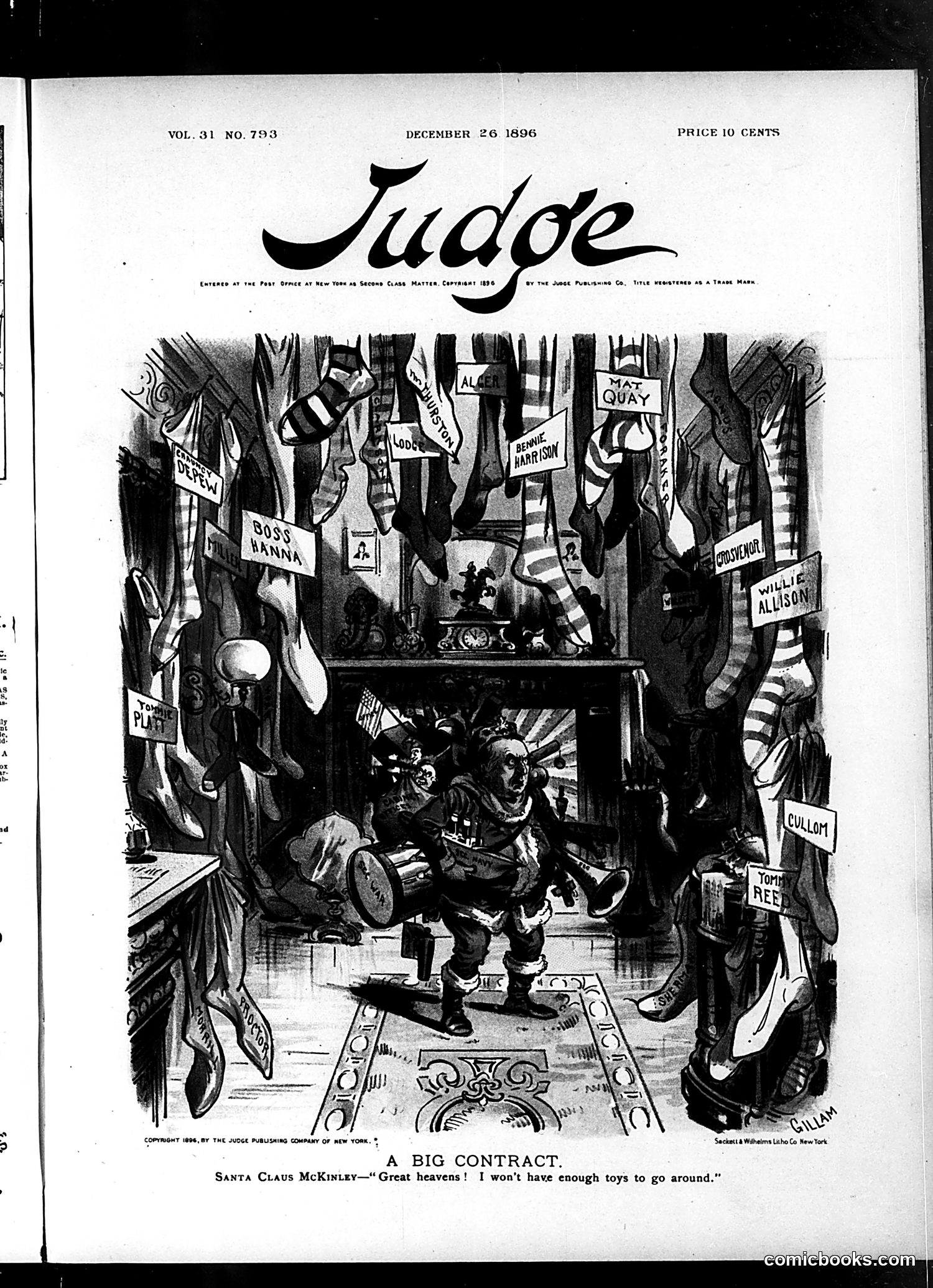
This political cartoon depicts Santa Claus (labeled "McKinley," referring to William McKinley, the newly elected U.S. president) overwhelmed in a room hung with banners bearing names of various politicians and figures—including Allison, Harrison, Quay, and others. Santa holds a toy while surrounded by oversized stockings and labels. The caption states: "Great heavens! I won't have enough toys to go around." The satire addresses McKinley's incoming administration and the pressure from Republican Party figures seeking patronage appointments and political favors. Each named banner represents a politician demanding "gifts" (government positions). The cartoon jokes that McKinley cannot possibly satisfy all these competing demands, critiquing the patronage system and party expectations facing the new president.
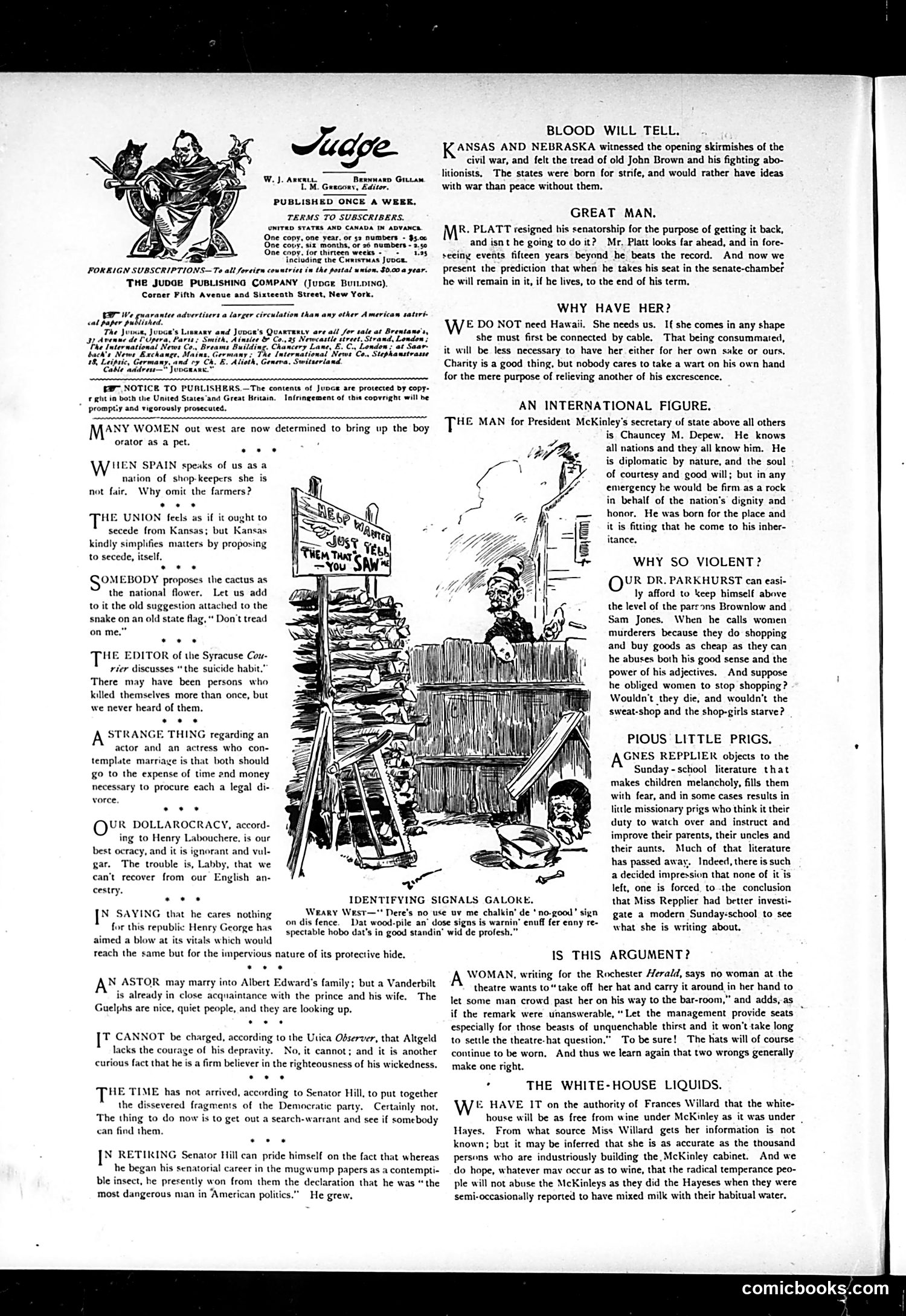
The central cartoon depicts a tall structure labeled "THE SHOP" with figures climbing a ladder. Based on the surrounding text about "IDENTIFYING SIGNALS GALORE," this appears to satirize labor disputes or unionization efforts. The figure at top likely represents management or authority, while workers below struggle with the ladder—a visual metaphor for workplace hierarchy and conflict. The text discusses various political and social issues including Senator Hill's involvement in "mugging" politics, women's suffrage, theater management, and McKinley administration temperance debates. "Blood Will Tell" references Kansas-Nebraska conflict origins. The overall page uses satire to critique contemporary political figures, labor conditions, and social controversies of the early 1900s, though specific identifications of some individuals remain unclear without additional historical context.
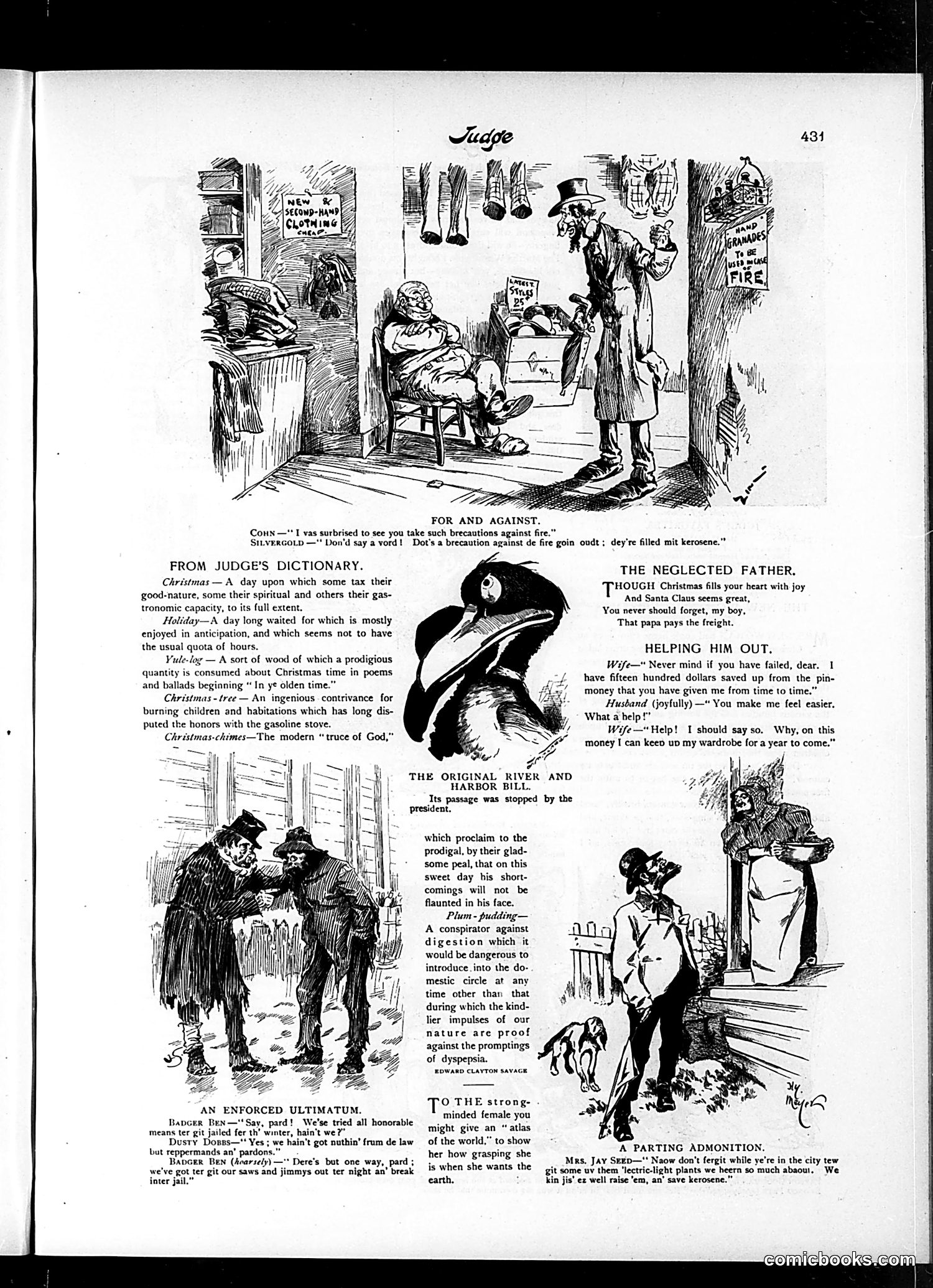
**Top Cartoon ("For and Against")**: Shows a tenement scene where a man argues about fire safety regulations. The joke contrasts two positions on building codes—one character defends fire safety restrictions while another resists them as excessive. This reflects early 20th-century debates over tenement house reform and fire safety standards following deadly fires that killed workers. **Dictionary Section**: Satirical definitions mocking holiday excess, Christmas consumerism, and wasteful spending patterns among the wealthy. **Lower Content**: Several brief humorous vignettes about marital relations, family dynamics, and domestic life—typical Judge magazine fare targeting middle-class readers with social humor about husbands, wives, and household economics. The page reflects Progressive Era concerns about labor safety and class tensions.
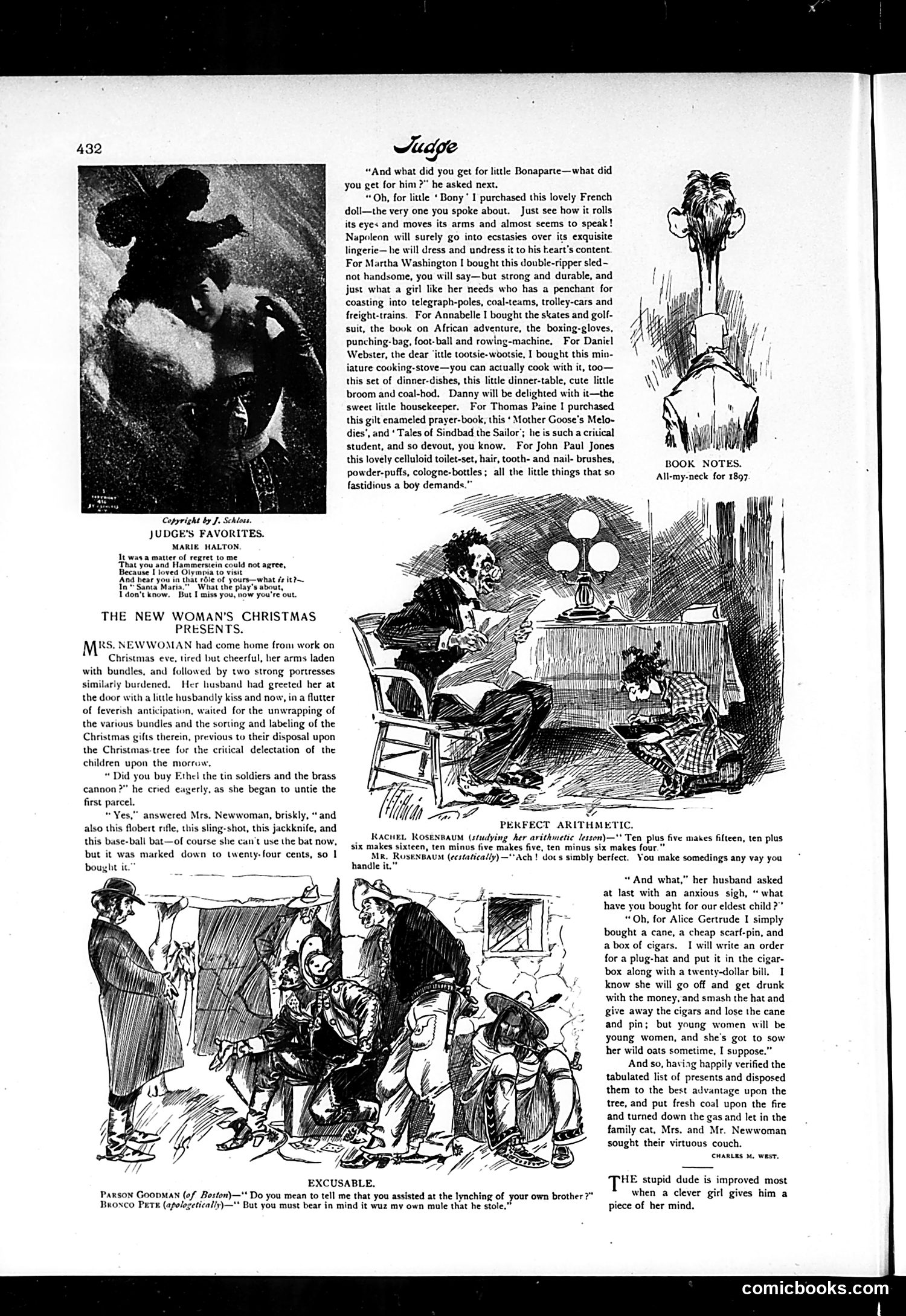
This page satirizes the "New Woman" of the 1890s—the emerging independent female who challenged Victorian gender roles. The main cartoon mocks a progressive mother who purchases traditionally masculine gifts for her children: tin soldiers, rifles, and boxing gloves for daughters named after male historical figures (Bonaparte, Martha Washington, Daniel Webster, John Paul Jones); and a French doll for her son. The joke targets the inversion of gender norms—the satire suggests that feminism has gone absurd, producing confused children with gender-inappropriate presents. The accompanying text reveals Judge's conservative stance: the purchases are presented as ridiculous overcompensation, implying that "New Women" are misguided radicals corrupting childhood. The other cartoons ("Perfect Arithmetic," "Excusable") are minor social comedy pieces about Jewish immigrants and racial violence, typical of Judge's broader satirical approach to contemporary American life.
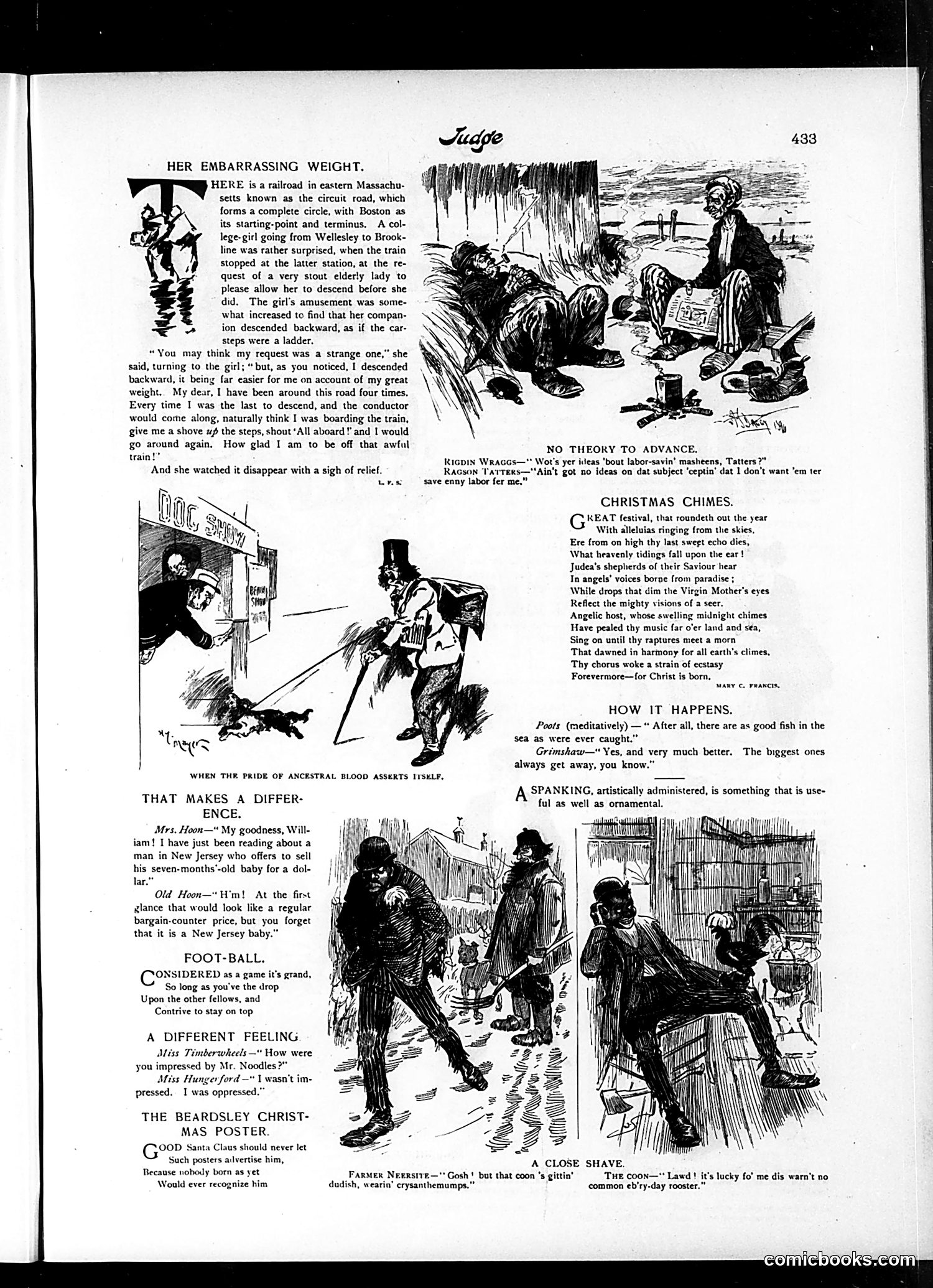
This page from Judge magazine contains several satirical pieces reflecting early 20th-century American humor and attitudes. **"Her Embarrassing Weight"** depicts a heavyset woman explaining to a young college girl why she must descend a train backward: she's been mistaken for a boarding passenger four times and pushed back aboard by conductors. The humor relies on body-shaming and the era's fixation on weight as comedy. **"That Makes a Difference"** satirizes class prejudice—a wealthy woman's dismissal of a "New Jersey baby" (suggesting working-class inferiority) contrasts with her interest in a similar sale based on social status. **Scattered short jokes** mock labor-saving machinery, ancestry-obsessed wealthy people, and courtship dynamics typical of period humor. **"Christmas Chimes"** is sentimental poetry, unrelated to satire. The page reflects Judge's blend of social commentary with period prejudices—class snobbery, racist terminology (visible in dialect humor), and body-based mockery were standard satirical devices then, though deeply offensive by modern standards.
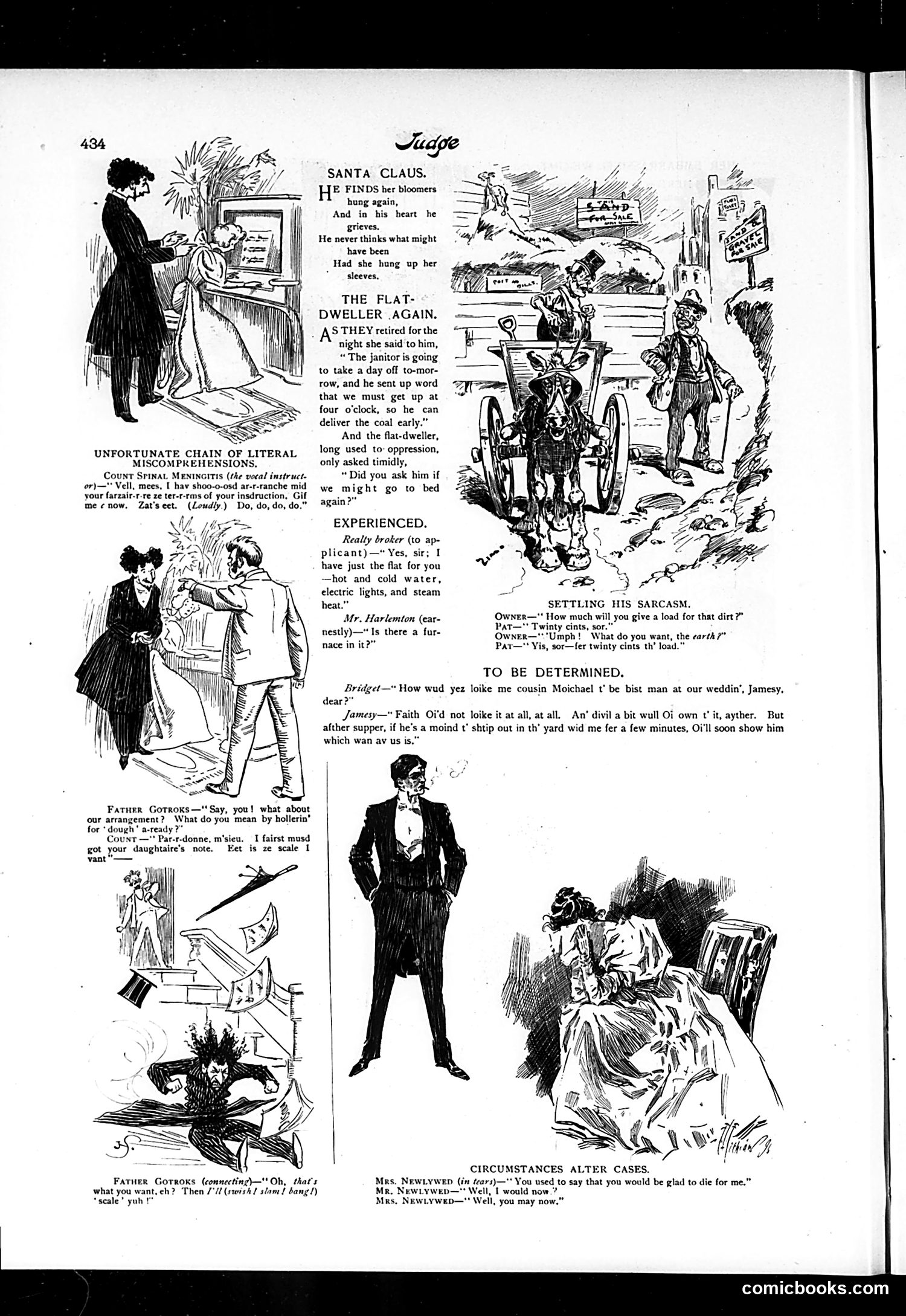
This page contains multiple satirical cartoons mocking immigrant stereotypes and domestic situations popular in early 20th-century American humor. **"Unfortunate Chain of Literal Miscomprehensions"** depicts a vocal instructor (speaking with exaggerated accent) telling students to practice "do, do, do"—which a working-class father mishears as a demand for "dough" (money), leading to physical violence. The satire targets both immigrant speech patterns and class tension. **"Santa Claus"** is a brief joke about a woman hanging bloomers (underwear) instead of stockings, implying impropriety. **"The Flat-Dweller Again"** satirizes apartment living's indignities—tenants must wake at 4 AM for coal delivery, with the downtrodden tenant asking pathetically if they can return to bed. Other cartoons mock Irish immigrants ("Bridget," "Jamesy," "Pat") through thick dialect humor, and include mild domestic comedy about newlyweds and realty brokers. The page reflects period attitudes: immigrant mockery was standard entertainment, and working-class hardship was treated as comedy rather than social concern.
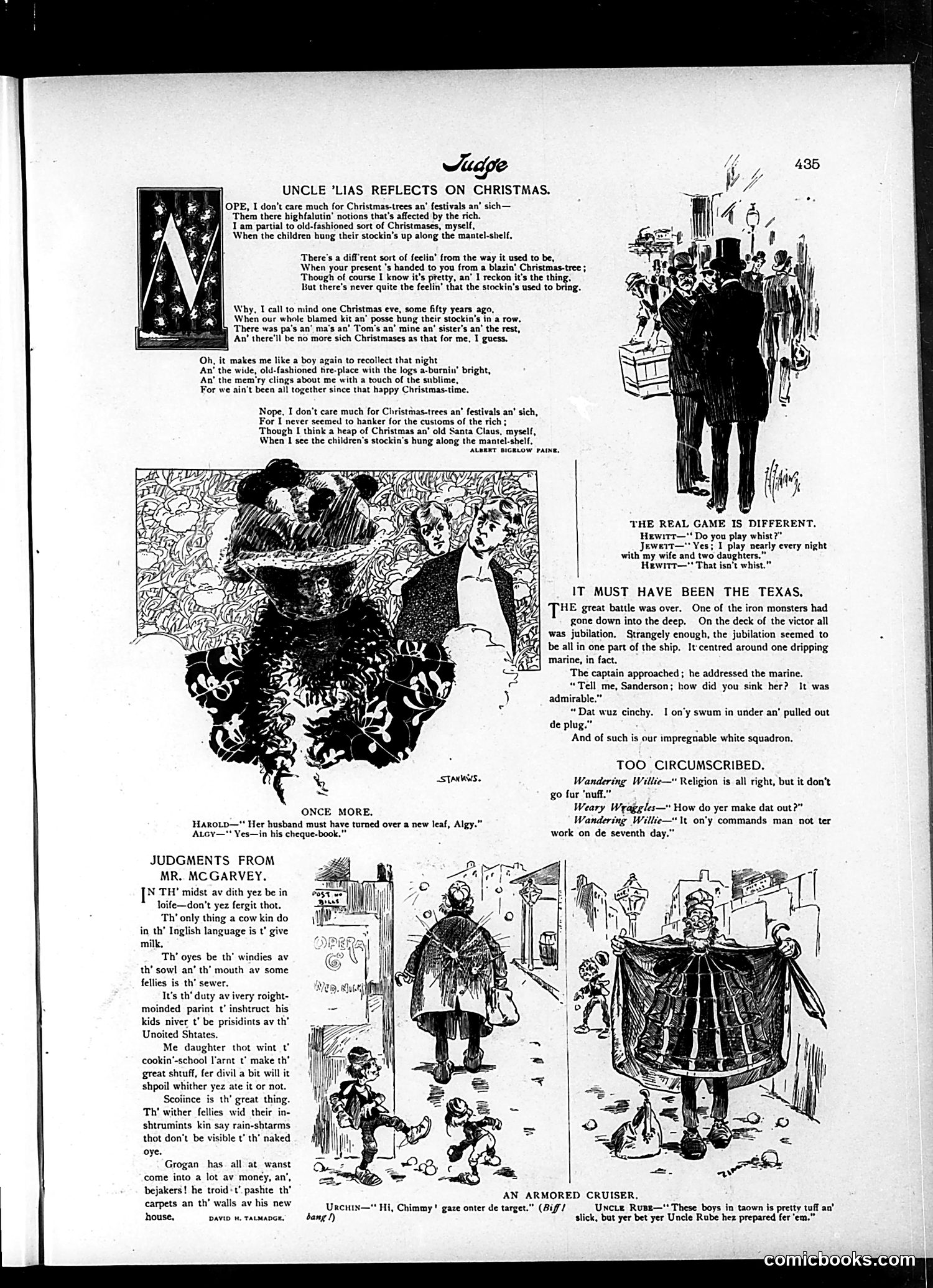
This page contains nostalgic and humorous content typical of early 20th-century American satire. **"Uncle 'Lias Reflects on Christmas"** is a dialect poem by Albert Bigelow Paine expressing working-class nostalgia for simpler Christmases—stockings hung on mantels rather than elaborate Christmas trees favored by the wealthy. The contrast satirizes class differences and modernization's displacement of traditional customs. **Other brief jokes** mock domestic life ("The Real Game is Different"), naval warfare (a submarine sinks a ship by "pulling out de plug"), and religious hypocrisy (religion only prohibits work on Sundays). **"Judgments from Mr. McGarvey"** features Irish-dialect observations on life, education, and domestic matters—typical of period humor using exaggerated ethnic stereotypes for comic effect. **"An Armored Cruiser"** shows Uncle Rube preparing toughs for street fighting, likely referencing contemporary urban gang culture or military preparedness anxieties. The page uses working-class and immigrant dialect humor throughout, reflecting early 1900s satirical conventions now considered offensive.
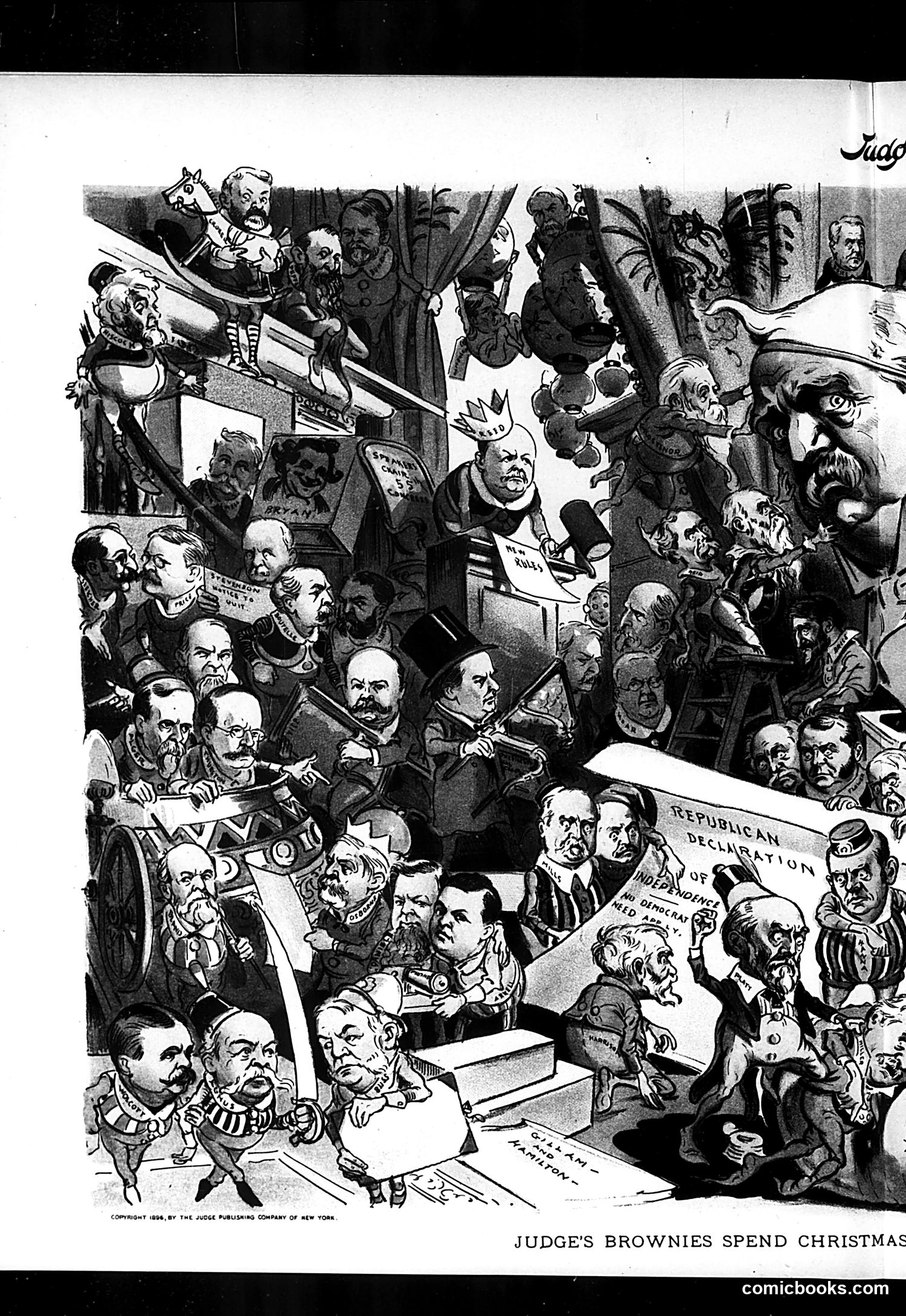
This satirical cartoon depicts a chaotic Christmas scene populated by numerous caricatured figures, many appearing to represent prominent political and social figures of the era. The composition is densely packed with characters in period dress, some wearing crowns or military regalia, gathered around documents labeled "Republican Declaration" and what appears to be official proclamations. The title "Judge's Brownies" refers to *Judge* magazine's recurring satirical characters used to mock contemporary politicians and public figures. The cartoon likely satirizes Republican Party politics and holiday politics during the Gilded Age or Progressive Era, though without clearer identification of specific figures, the exact targets remain unclear. The crowded, raucous scene suggests chaos and mockery of political pretension.
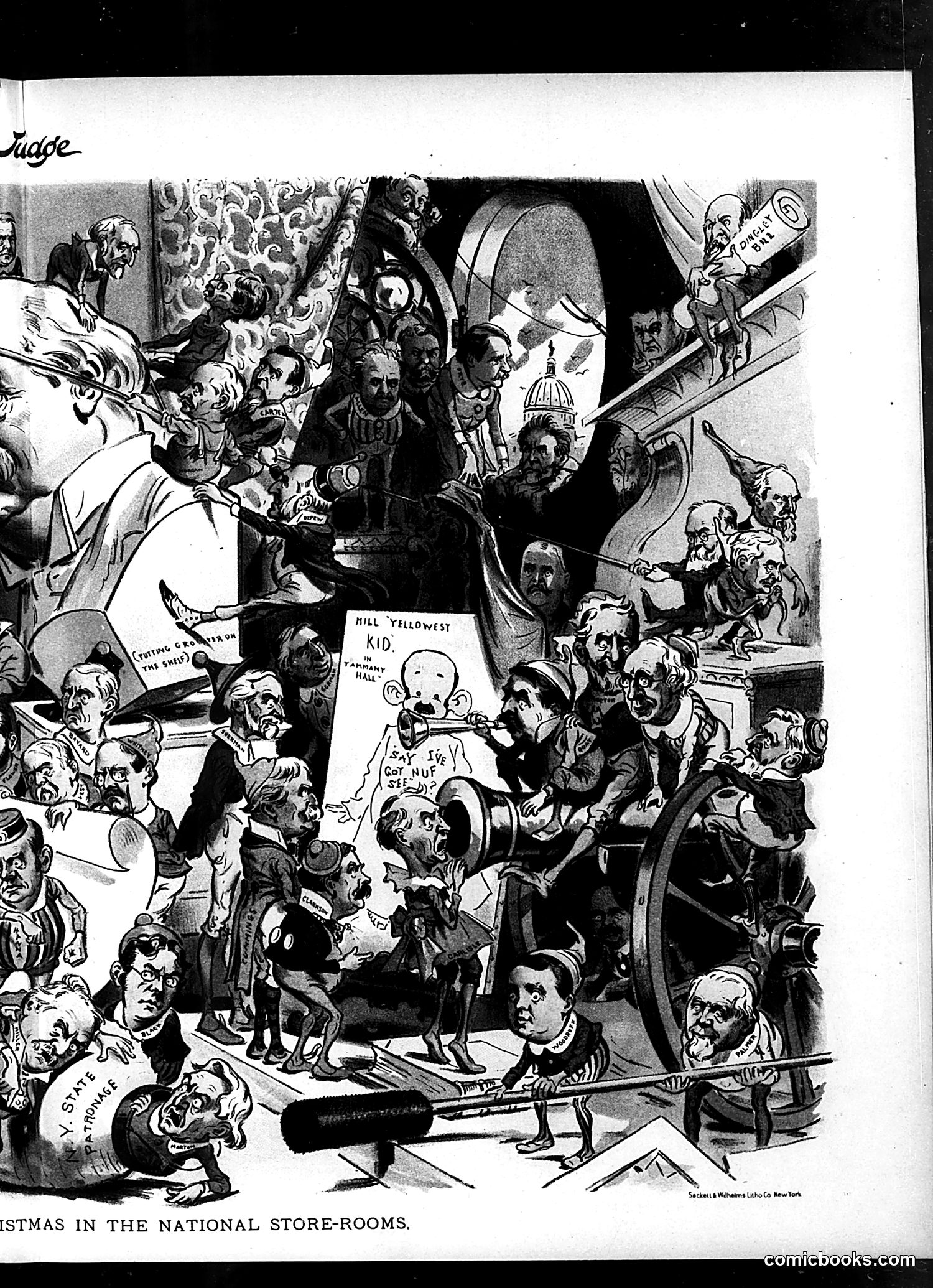
This political cartoon satirizes government waste and corruption during the Christmas season. The scene depicts a chaotic interior—likely a government building or "national store-room"—where politicians and bureaucrats are depicted as grotesque figures looting supplies and resources meant for public use. A sign reading "HILL 'YELLOWEST KID'" appears to reference a contemporary political figure or scandal. The crowded composition shows various caricatured officials grabbing goods, suggesting rampant graft and misappropriation of taxpayer resources during the holiday season—a contrast between the festive period and institutional corruption. The cartoon critiques how government officials enriched themselves at public expense, a common reform-era complaint in Gilded Age political satire.
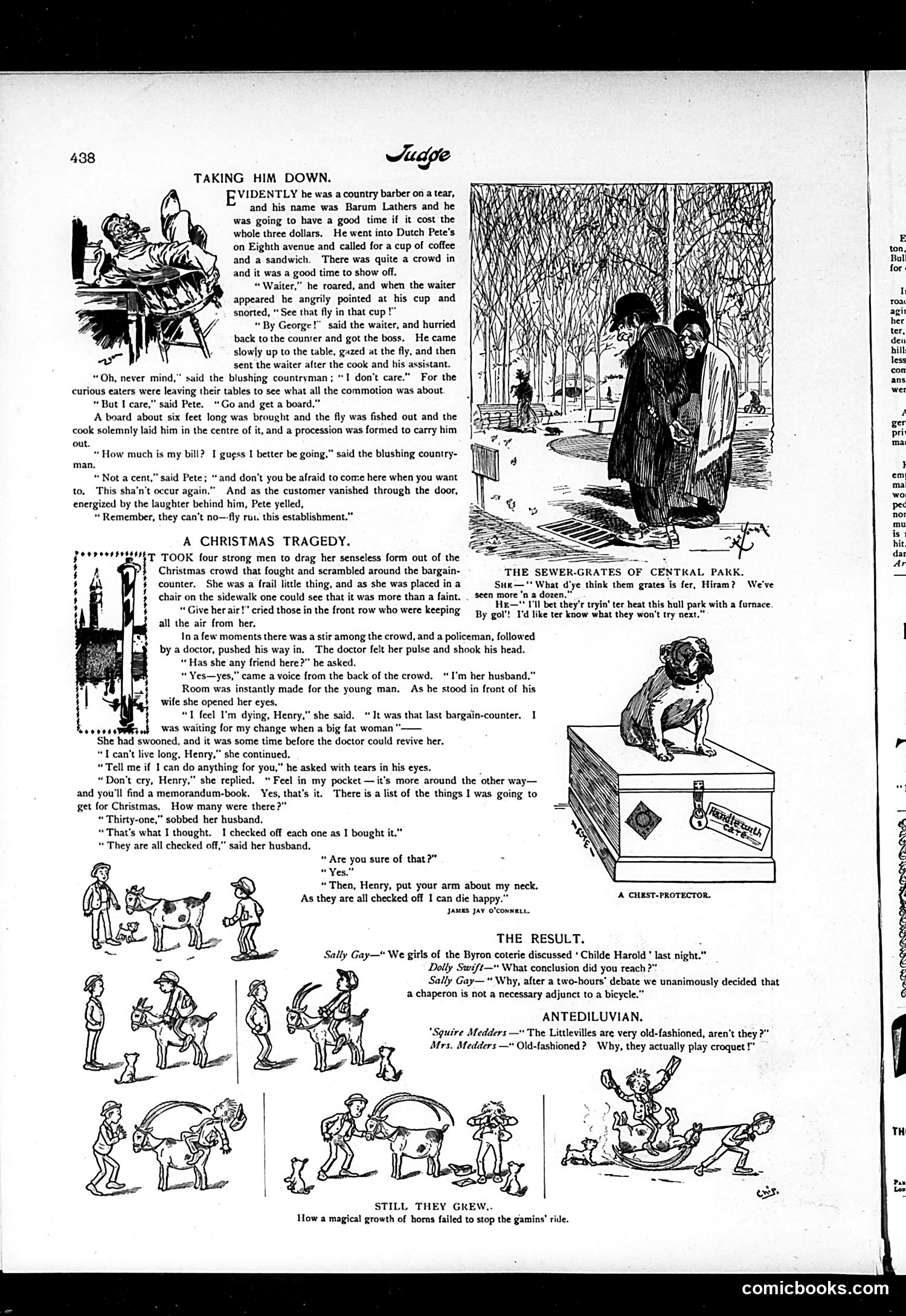
This page contains several satirical pieces mocking American social behaviors: **"Taking Him Down"** ridicules a country boor named Barum Lathers who creates a scene at a lunch counter over a fly in his coffee. The joke satirizes his attempt to impress urban strangers through aggressive rudeness. The proprietor (Pete) outwits him by treating the incident with exaggerated solemnity, shaming the braggart into leaving without paying—a humbling "takedown." **"A Christmas Tragedy"** parodies the retail madness of holiday shopping. A woman faints from the crush at a bargain counter, dies believing she's completed her Christmas list, and finds peace in death. The satire targets both the frenzy of consumerism and the era's sentimental deathbed scenes in popular fiction. The shorter pieces mock upper-class pretension ("Antedelivian"), children's games, and ironically, young women debating whether chaperones are necessary on bicycle rides—commenting on changing social mores regarding female independence. The cartoons use exaggerated situations and deadpan humor typical of Judge's satirical style.
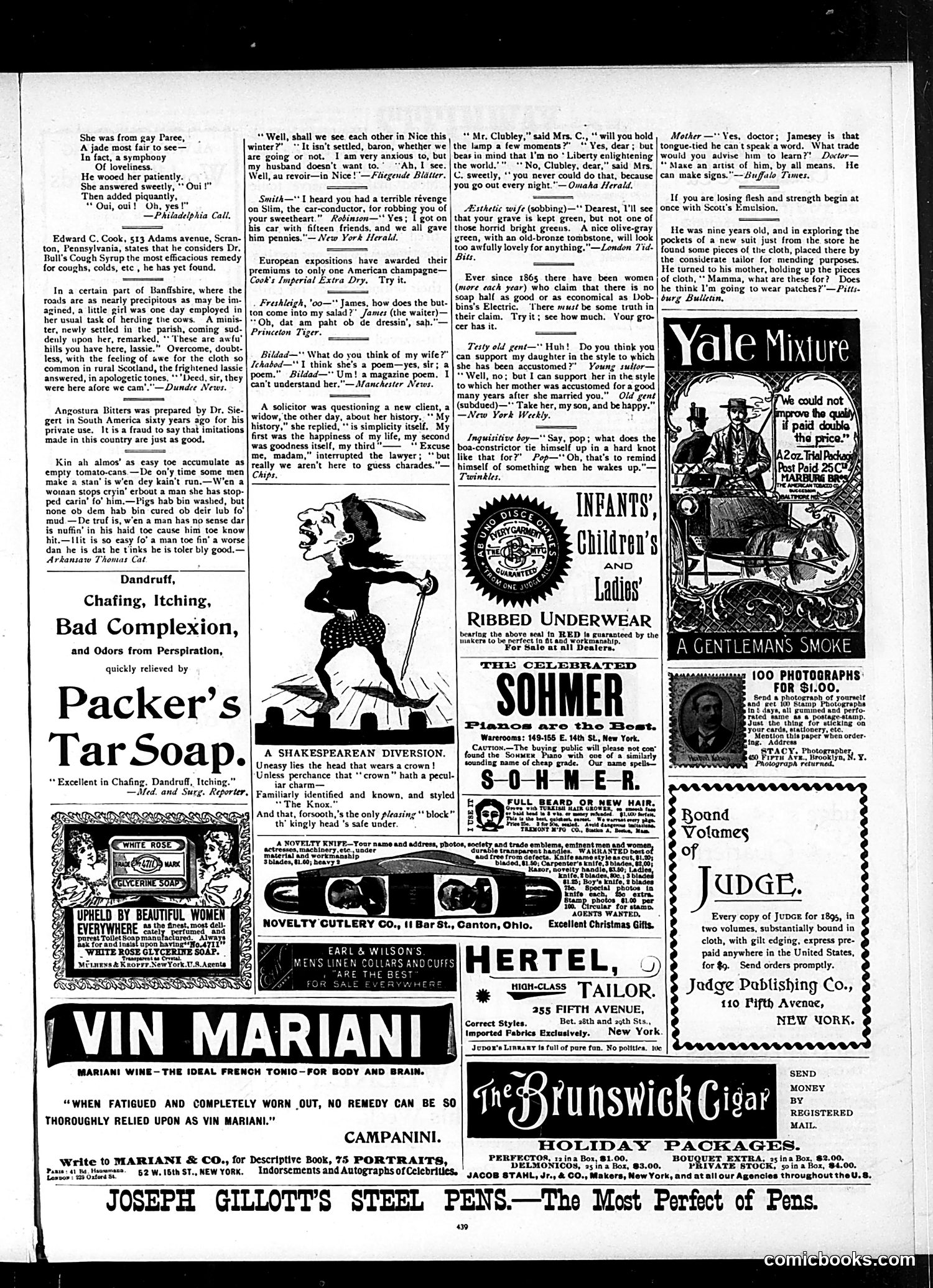
This page is primarily **advertising**, not political satire. It contains short humorous anecdotes and product advertisements typical of Judge magazine's format. The few comic bits include: **"Oui, Oui!"** — A light romantic joke about a Parisian woman who says yes to a suitor's proposal, playing on the French phrase and stereotypes of French romance. **The Baron and Wife** — A society joke about infidelity: a baron invites a woman to Nice, but her husband won't allow it, so the baron bids goodbye, implying their affair was understood by both parties. **The Widow's Marriages** — A solicitor interviewing a widow about her three husbands grows impatient when she keeps describing each romantically, thinking she's avoiding the question rather than genuinely cataloging her feelings. The rest is **product advertising** (Packer's Tar Soap, Vin Mariani wine, Sohmer pianos, etc.) interspersed with brief folksy aphorisms attributed to "Arkansas Thomas Cat." There is no significant political content on this page.
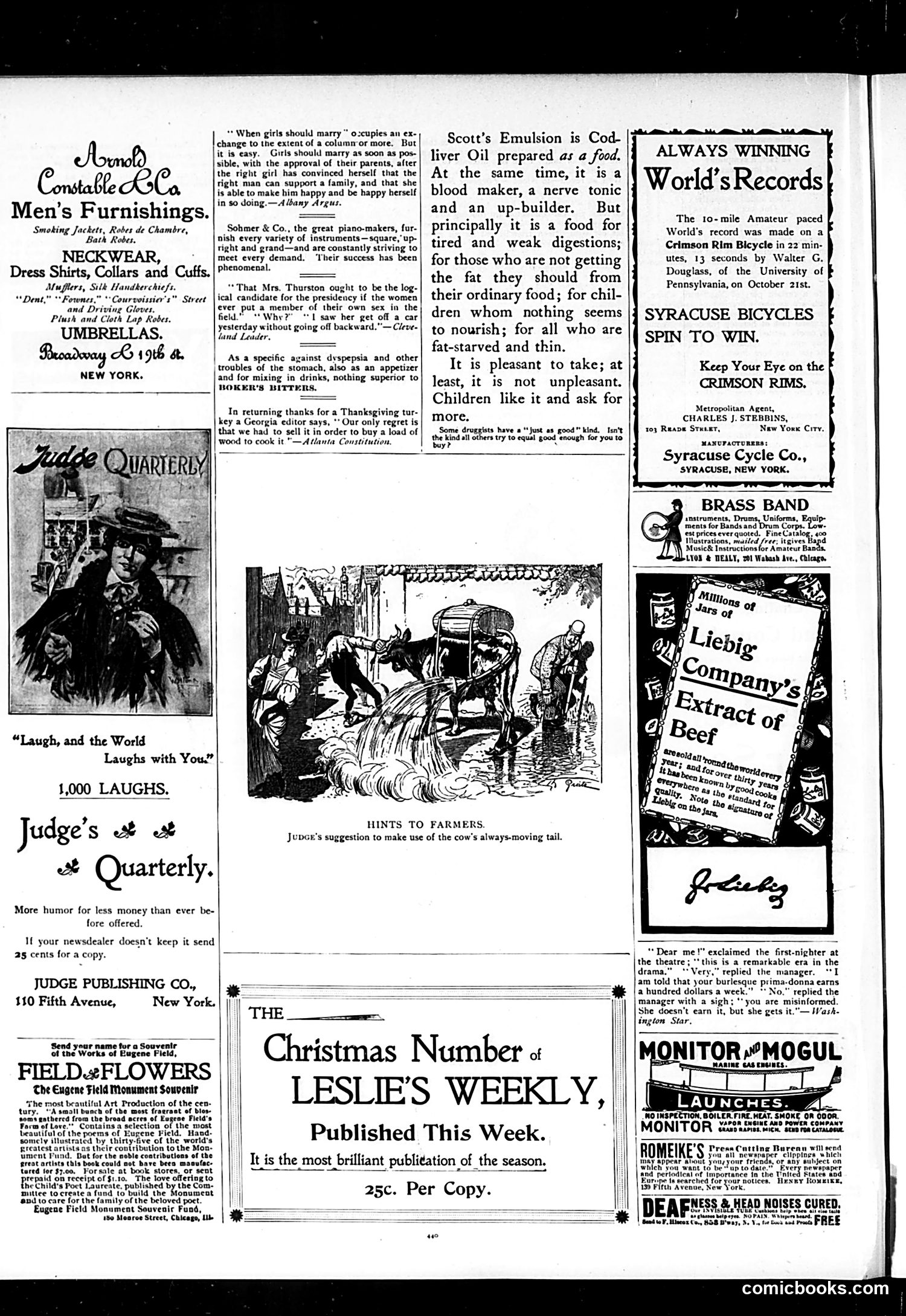
This is primarily an **advertising and promotional page** from Judge magazine's Christmas issue. The central content announces Leslie's Weekly's Christmas Number (25¢ per copy), described as "the most brilliant publication of the season." The page contains scattered **brief satirical jokes and advertisements** rather than sustained political cartoons: - A humorous illustration labeled "Hints to Farmers" shows rural figures with a cow, captioned with a joke about using the cow's "always-moving tail" — a simple visual gag about farm practicality. - Small editorial quips mock gender roles ("When girls should marry"), women's behavior ("car yesterday without going off backward"), and theatrical economics (a prima donna earning money she doesn't actually keep). The ads promote **consumer goods** (pianos, bicycles, Scott's Emulsion cod liver oil, umbrellas) typical of the era. The page reflects Judge's format: lightweight humor mixed with commercial promotion for a general, educated readership.
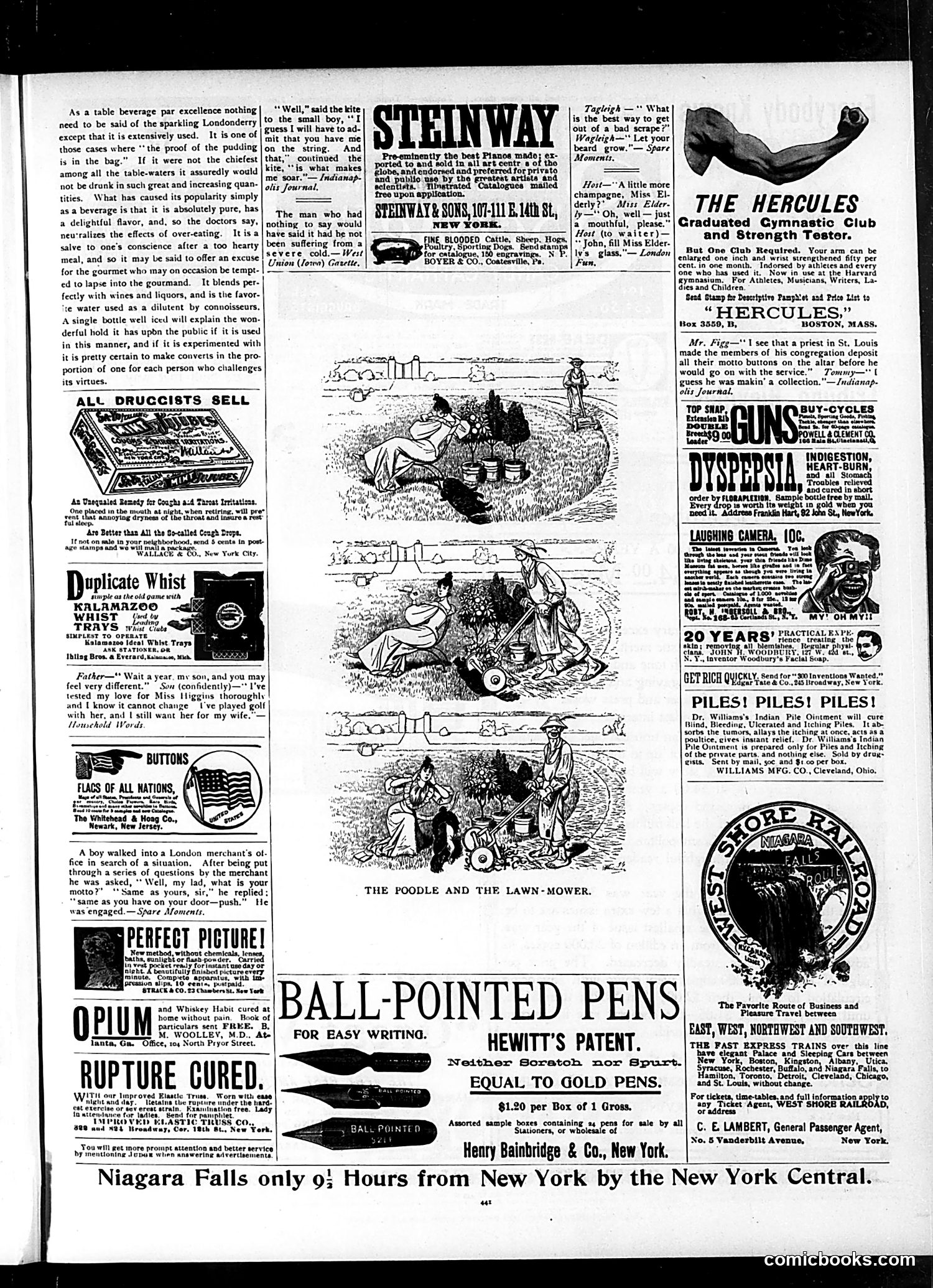
This page is primarily **advertising**, with three cartoon vignettes scattered among product promotions for beverages, writing instruments, and health devices. The central cartoon titled "The Poodle and the Lawn-Mower" appears to be a sequential humor strip showing a small poodle encountering a lawn-mower operator, likely depicting the dog's misadventure or comic reaction to the machinery—a relatable domestic scene for early 20th-century readers. Other small comic snippets on the page present brief joke scenarios: a father-son dialogue about love and golf, a waiter/host exchange, and a conversation about a priest collecting "motto buttons" from parishioners. These are simple, lighthearted humor pieces typical of Judge magazine's satirical style—gentle social commentary rather than sharp political critique. The page reflects Judge's approach: mixing advertising with accessible humor aimed at middle-class readers, featuring everyday domestic situations and mild social observations rather than serious satire.
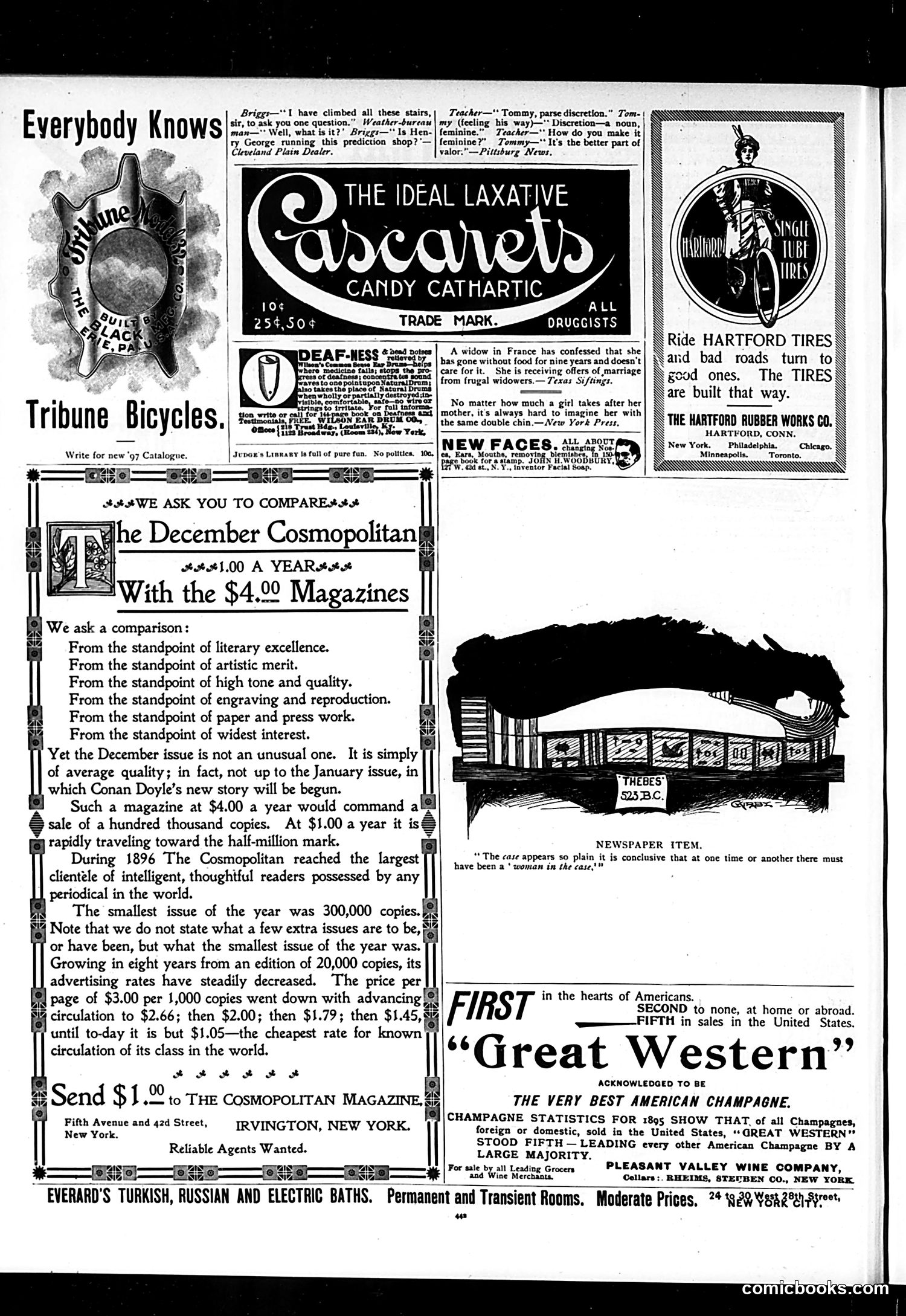
This page is primarily **advertising**, not satirical cartoons, though it contains brief joke items. The two small cartoon jokes are topical references: 1. **"Henry George" joke**: A man climbs stairs to ask a weather bureau official if Henry George runs the prediction shop—mocking Henry George's economic theories (single tax) as nonsensical as weather prediction. This was contemporary political satire (1890s). 2. **"Deafness" item**: A brief anecdote about a French widow living without food for nine years receiving marriage proposals—absurdist humor about resourceful poverty. The page mostly showcases **product advertisements**: Cascaret laxative candy, Tribune Bicycles, Hartford Tires, and prominently, **The Cosmopolitan Magazine** promoting its $1.00 annual subscription against $4.00 competitors. The Cosmopolitan ad boasts circulation growth and declining advertising rates as proof of quality and value. No major political figures or events are caricatured. The content reflects late-19th-century concerns: patent medicines, bicycles, magazines as mass media, and competitive publishing economics.
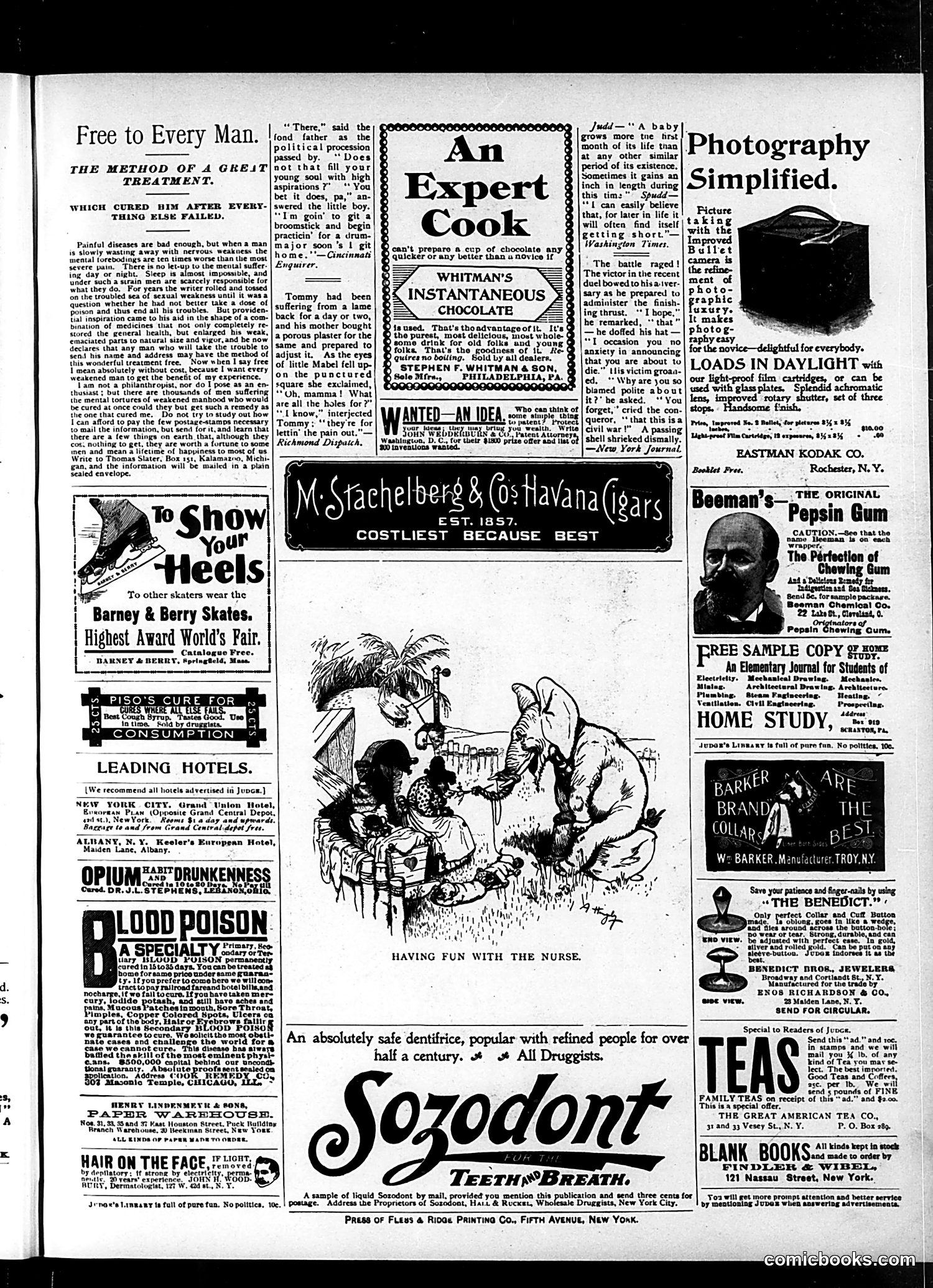
This page is primarily **advertising**, not political satire. The dominant feature is a large cartoon titled "Having Fun with the Nurse" depicting a domestic scene with a woman and child. The ads reflect late 19th/early 20th-century concerns: patent medicines for sexual dysfunction ("Free to Every Man"), blood poison treatment, opium and drunkenness "cures," and dental work. These were common in period publications despite dubious efficacy. The small dialogue at top-right appears to be a joke about baby growth rates—a parent responds to their child's observation about political processions with a non-sequitur about infant development. The page includes standard period advertisements (skates, hotels, Sozodont toothpaste) alongside today-shocking medical pitches that were normalized then. **No clear political cartoon or satire is evident on this particular page.**
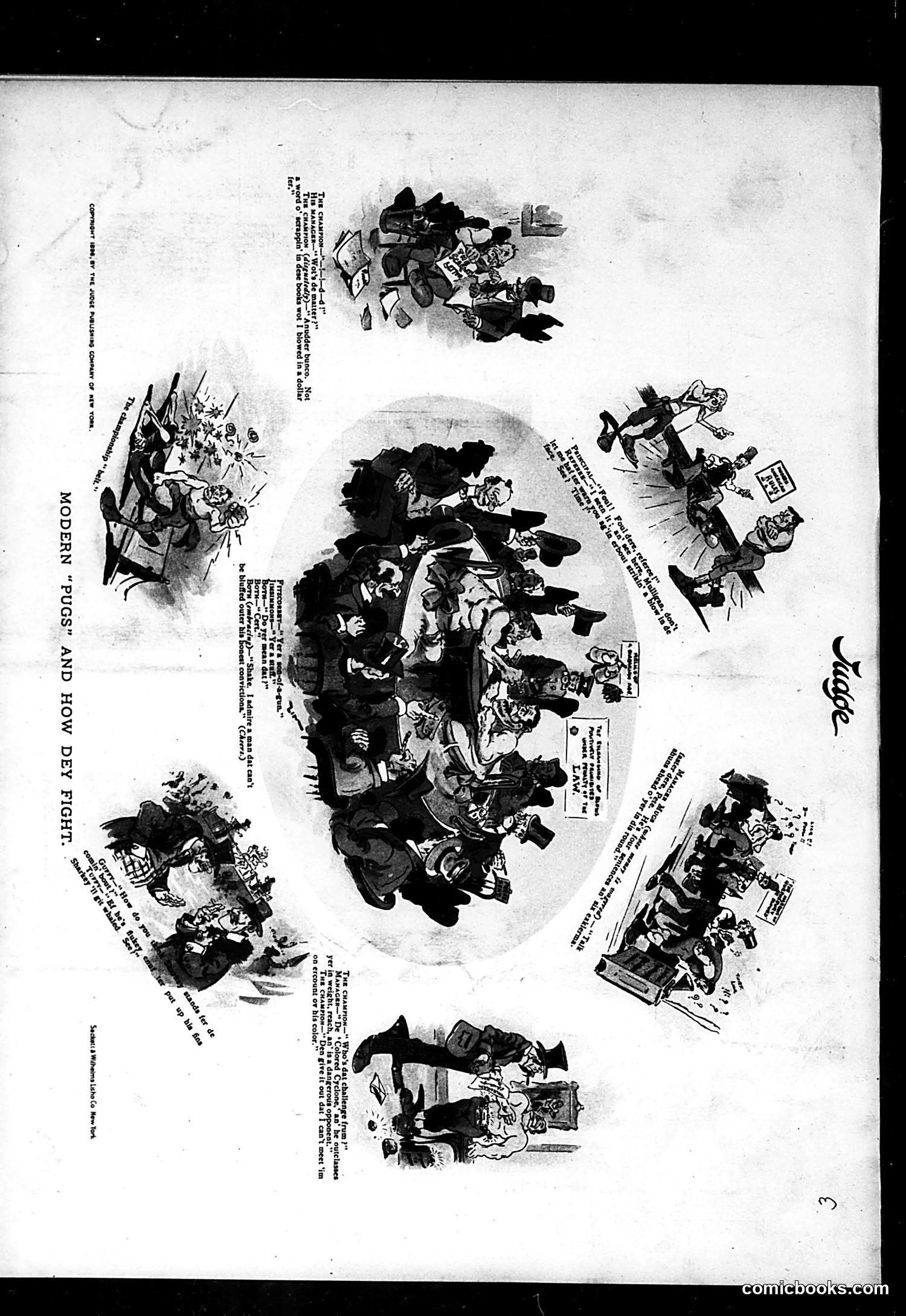
This Judge magazine page satirizes political reconciliation through caricature. The central large illustration shows various political figures arranged around a circular composition, surrounded by smaller vignettes depicting different confrontational scenarios. The dialogue at bottom suggests two antagonistic figures (possibly representing different political factions) exchanging insults ("You're a son-of-a-gun," "You're a stuff") before reconciling in an embrace, with one praising the other's "honest convictions" while crowds cheer. The satire appears to mock the ease and superficiality of political rivals making peace—suggesting that modern politicians quickly abandon bitter disputes when convenient, despite fundamental disagreements. The multiple fight scenes surrounding the central scene reinforce this commentary on the performative nature of political conflict and reconciliation in the era. The Sackett & Wilhelms credit indicates this is a lithographed political cartoon commentary.

I can see this is a page from Judge magazine, but the image is almost entirely black with only a white margin visible on the left side and the "comicbooks.com" watermark at the bottom. The OCR text provided contains only the website watermark. I cannot discern any cartoon illustrations, caricatures, text content, or satirical commentary from this image. The page appears to be either: - A blank or mostly blank page - Severely degraded or poorly scanned - Improperly exposed in the original photography Without visible content to analyze, I cannot identify figures, political references, or explain the intended satire. A clearer image would be needed for proper historical analysis.