
A complete issue · 16 pages · 1896
Judge — November 7, 1896
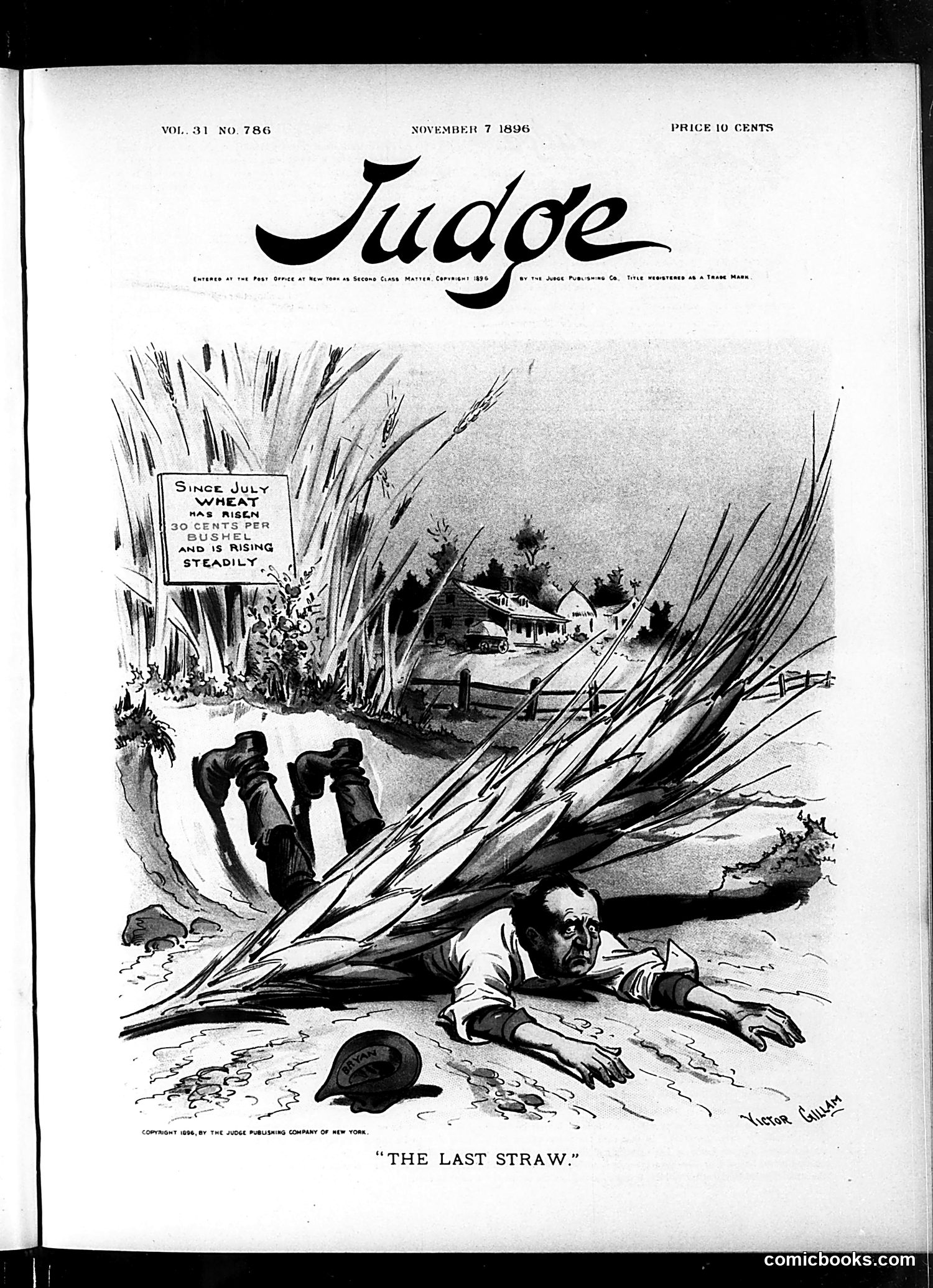
This political cartoon depicts a farmer crushed beneath falling wheat stalks, titled "The Last Straw." The inset sign states: "Since July wheat has risen 30 cents per bushel and is rising steadily." The cartoon satirizes the **1896 presidential election**, likely criticizing the outcome or predictions regarding agricultural policy. The farmer—representing American agriculture—is being overwhelmed despite wheat prices rising, suggesting the satire cuts against expectations that rising commodity prices would benefit farmers. The cartoon's title plays on the idiom "the last straw," implying the farmer's situation has become unbearable. The visual exaggeration of the wheat stalks conveys crushing burden rather than prosperity, suggesting skepticism about whether rising prices actually help farmers facing other economic pressures or debts.
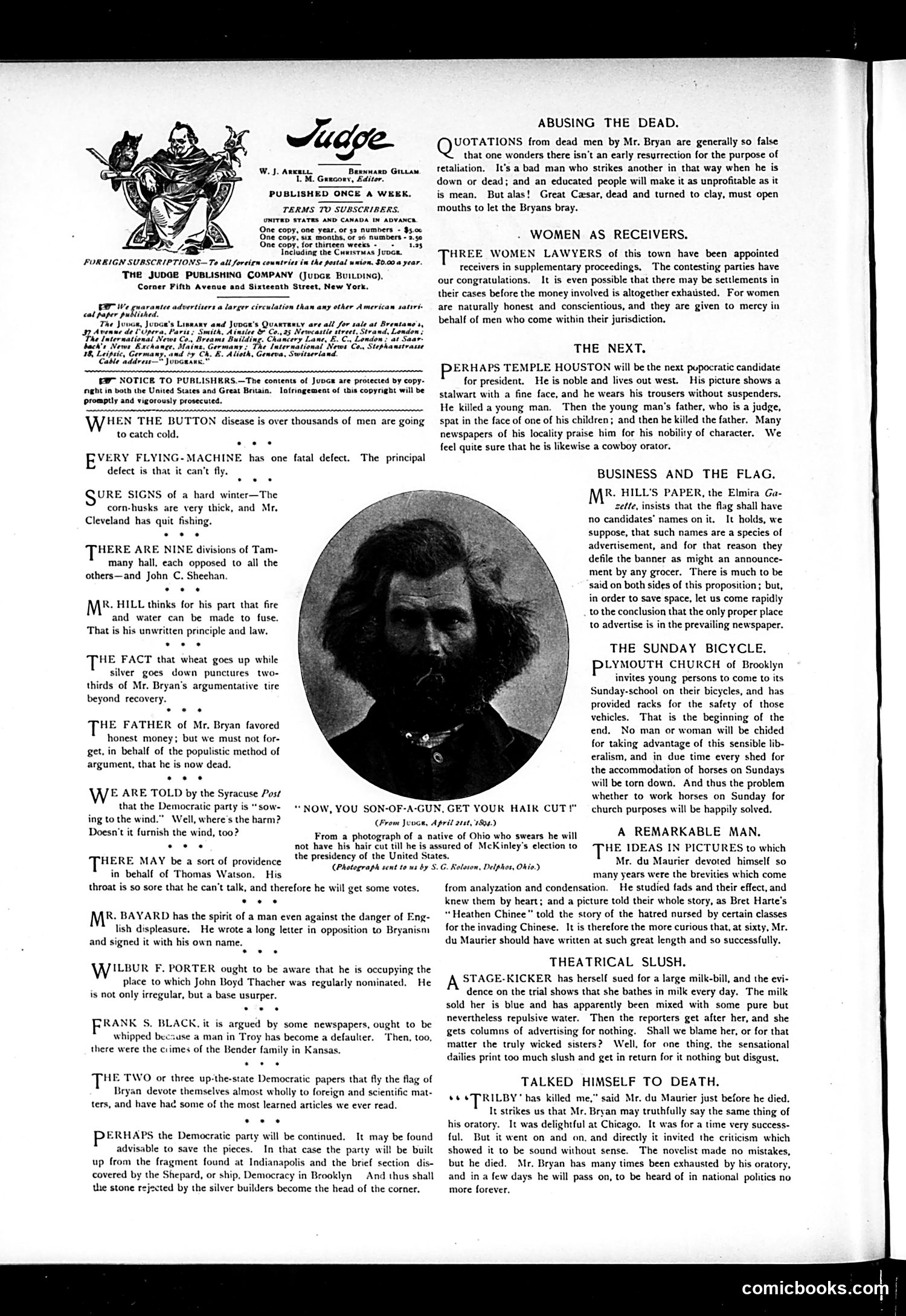
The central image is a circular portrait photograph of a man with distinctive facial features. The caption quotes him saying "NOW YOU SON-OF-A-GUN GET YOUR HAIR CUT," attributed to McKinley regarding Ohio politics. The page's articles mock various public figures and issues of the era. "Abusing the Dead" criticizes Bryan (likely William Jennings Bryan) for misquoting deceased historical figures for political purposes. Other brief items satirize contemporary politicians including Derham Temple Houston (described as a potential presidential candidate) and references to Democratic politics. The content reflects Judge's Republican-leaning satirical stance, targeting Democratic figures and policies through humor and caricature. However, without clearer identification of the photograph's subject and specific historical context, precise interpretation of some references remains uncertain.
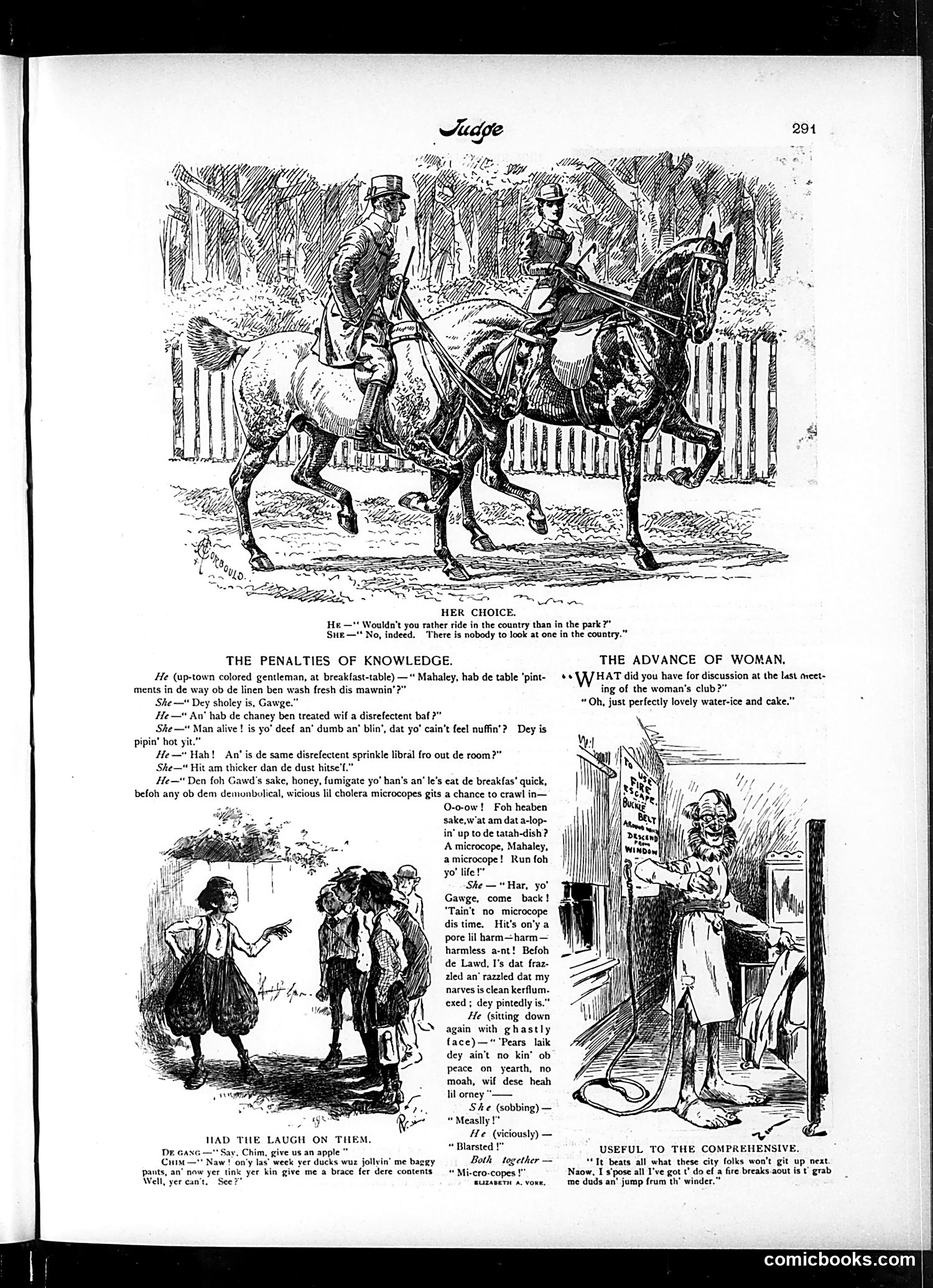
This page contains three separate satirical sketches mocking social pretensions and gender dynamics of the era: **"Her Choice"** (top): A woman on horseback rejects a gentleman's offer to ride in the park, claiming "there is nobody to look at one in the country"—satirizing women's vanity and need for public attention. **"The Penalties of Knowledge"** (left): A colored gentleman at breakfast complains about laundry practices, microscopes, and dust, while his wife responds with frustration—mocking educated Black men's pretentious complaints about domestic matters. **"The Advance of Woman"** (right): A woman's club discussion devolves into gossip about "water-ice and cake," and a maid warns her employer about jumping from a window—suggesting women's education and progress remain superficial. All three sketches employ period stereotypes to ridicule social climbers and women's liberation movements.
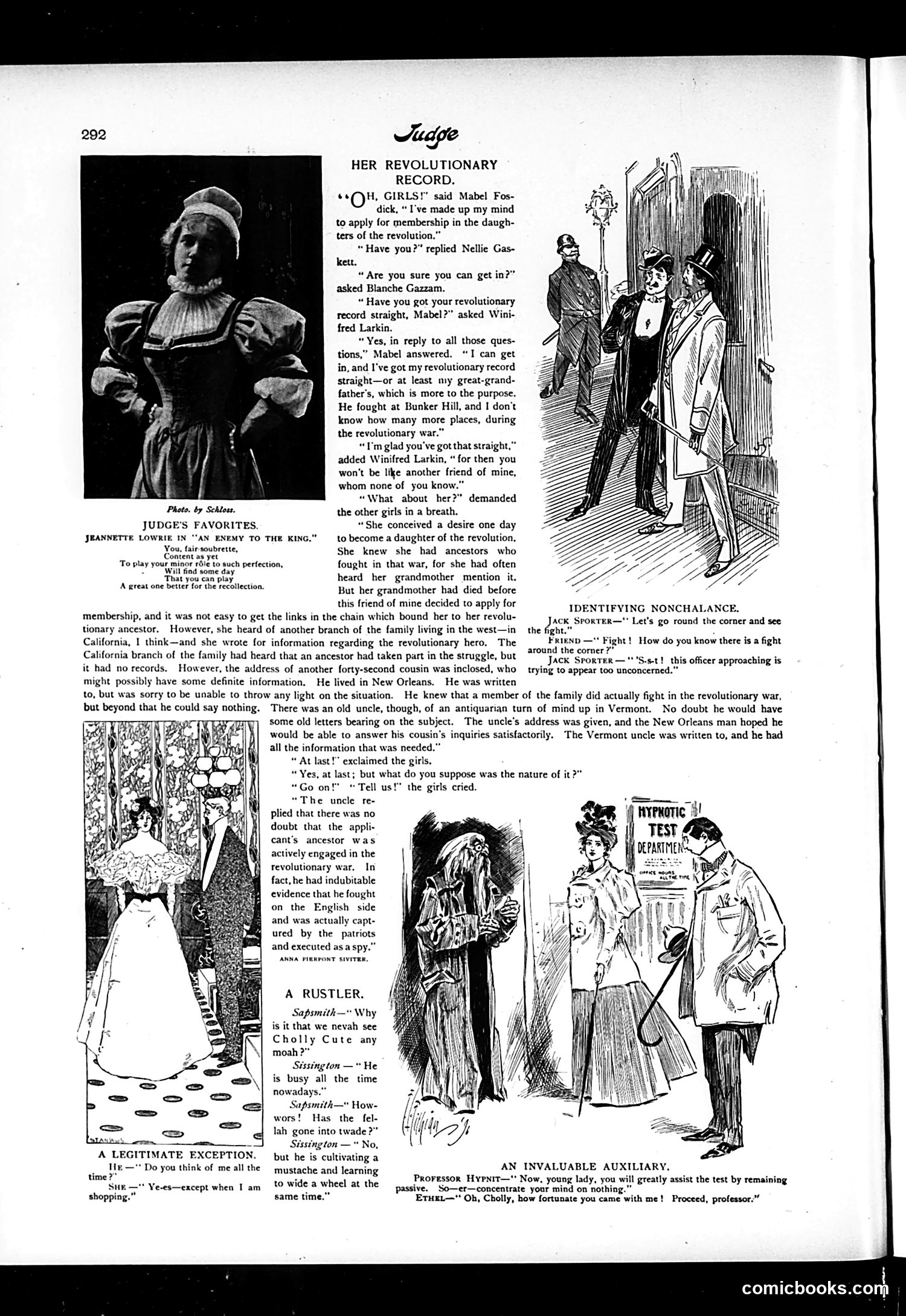
This page contains three satirical pieces: **"Her Revolutionary Record"** is the main feature—a joke about membership in the Daughters of the American Revolution (DAR), a real organization requiring documented colonial ancestry. A woman confidently claims eligibility based on her great-grandfather's Revolutionary War service. The punchline: when her distant Vermont uncle finally provides documentation, it proves the ancestor fought *for the British* and was executed as a spy by patriots. The satire mocks both the DAR's rigid genealogical requirements and the absurdity of claiming pride in ancestors whose actual records might be embarrassing. The smaller cartoons are brief gags: - **"A Rustler"**: A man avoids his socialite friend Cholly Cute because Cholly is now learning to drive—considered undignified. - **"Identifying Nonchalance"**: A plainclothes officer trying to appear inconspicuous is identified by his *over*-casual demeanor. The page opens with praise for actress Jeannette Lowrie in a theatrical production, and includes period advertising snippets. The humor targets American social pretension and genealogical snobbery.
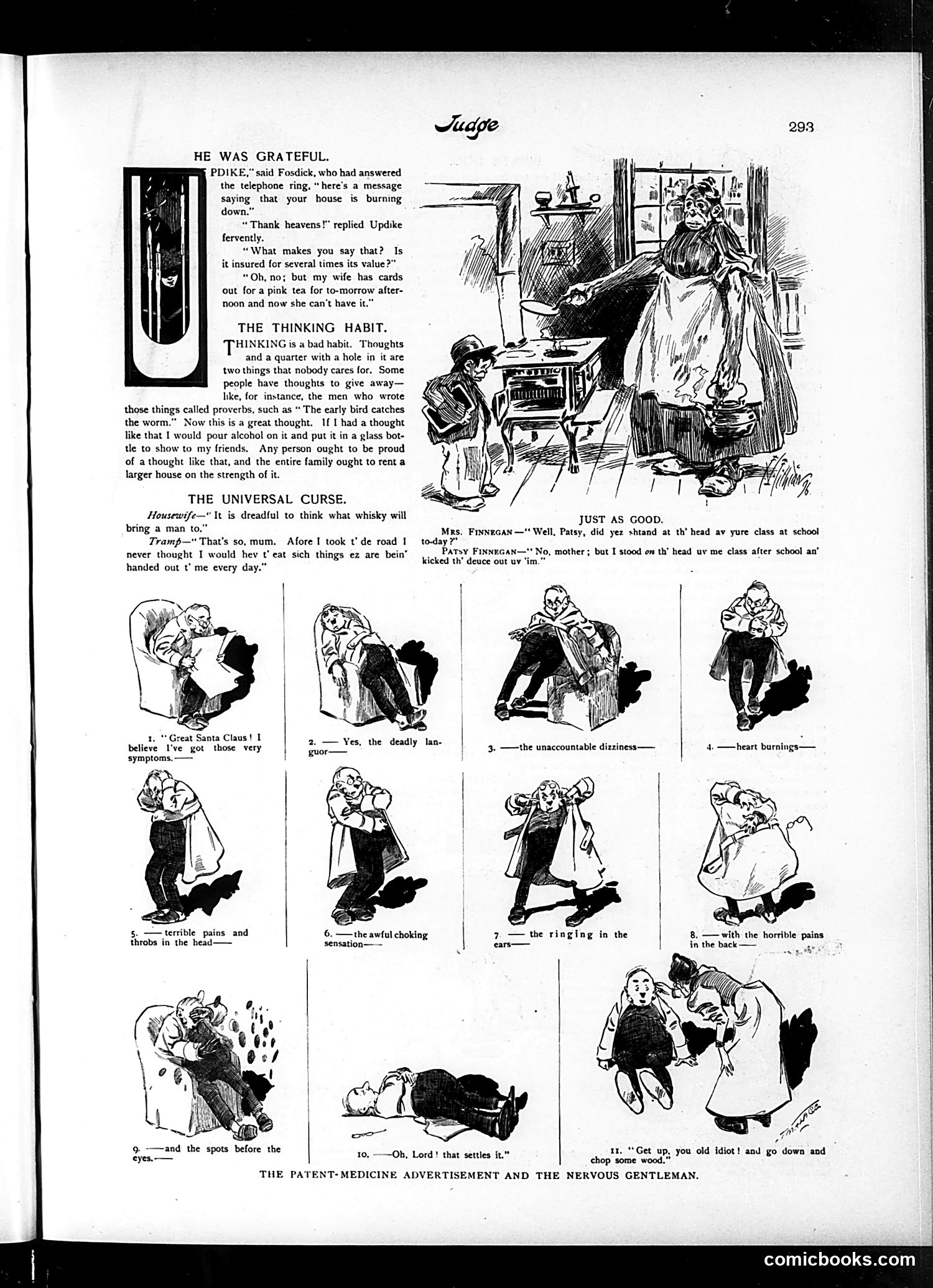
This page contains three separate satirical pieces mocking American social conventions and commercialism: **"He Was Grateful"**: Updike is relieved his burning house prevents his wife's "pink tea" (an upper-class social gathering). The joke satirizes society's obsession with trivial social obligations over actual disasters. **"The Thinking Habit"**: A philosophical piece arguing thinking is worthless, citing proverbs as examples of thoughts people foolishly treasure. It mocks both intellectualism and the common person's naive respect for platitudes. **"Just As Good"**: Mrs. Finnegan's son Patsy stood on classmates' heads rather than academically excelling—he achieved the same "top position" through violence instead. This satirizes Irish immigrant stereotypes as violent and anti-intellectual. **Main cartoon**: "The Patent-Medicine Advertisement and the Nervous Gentleman" depicts a man experiencing increasingly dramatic symptoms (lethargy, pain, ringing ears, spots) that perfectly match a patent medicine's advertised ailments. This satirizes fraudulent medicine advertisements that exploited hypochondriacs and the gullible by inventing diseases to sell fake cures.
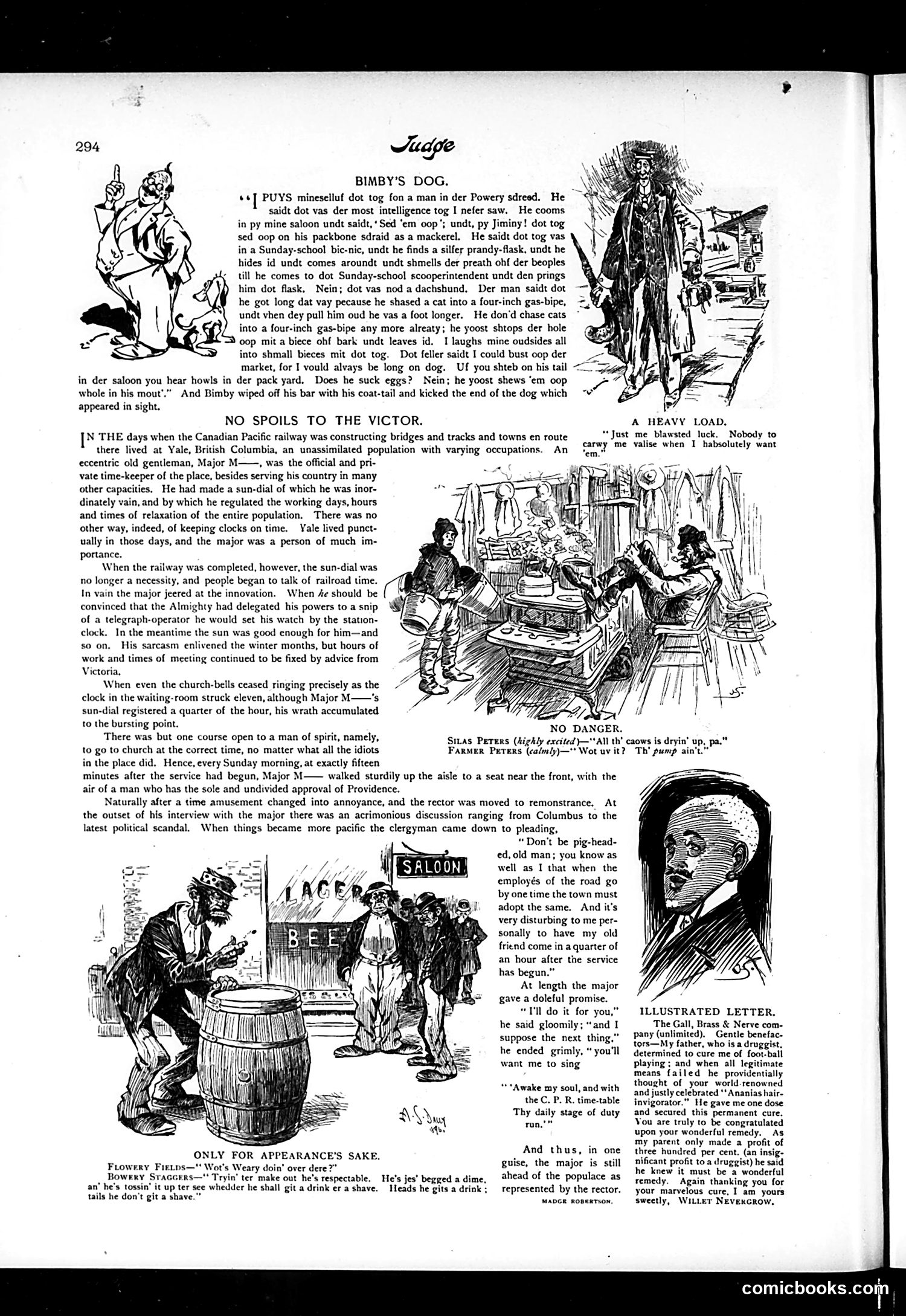
**"Bimby's Dog"** (top): A Yiddish-accented saloonkeeper describes an extraordinarily intelligent dog that finds lost items and returns them to their owners. The humor relies on ethnic dialect comedy popular in the era—the exaggerated German-Jewish accent ("dot tog," "Jiminy") was standard vaudeville-style humor. **"No Spoils to the Victor"** (center): This satirizes a Canadian Pacific Railway official, Major M—, obsessed with his sun-dial for timekeeping. When the railway introduces standard railroad time, the Major resists, viewing it as an affront to tradition and his authority. The rector must negotiate with him to accept modern timekeeping. The satire mocks stubborn resistance to progress and technological innovation. **"A Heavy Load"** and **"No Danger"** (right): Brief, unrelated comic vignettes about luggage troubles and a farmer unconcerned about his drying cows. The page exemplifies Judge's humor: ethnic caricature, satirical commentary on modern institutional changes, and light domestic comedy.
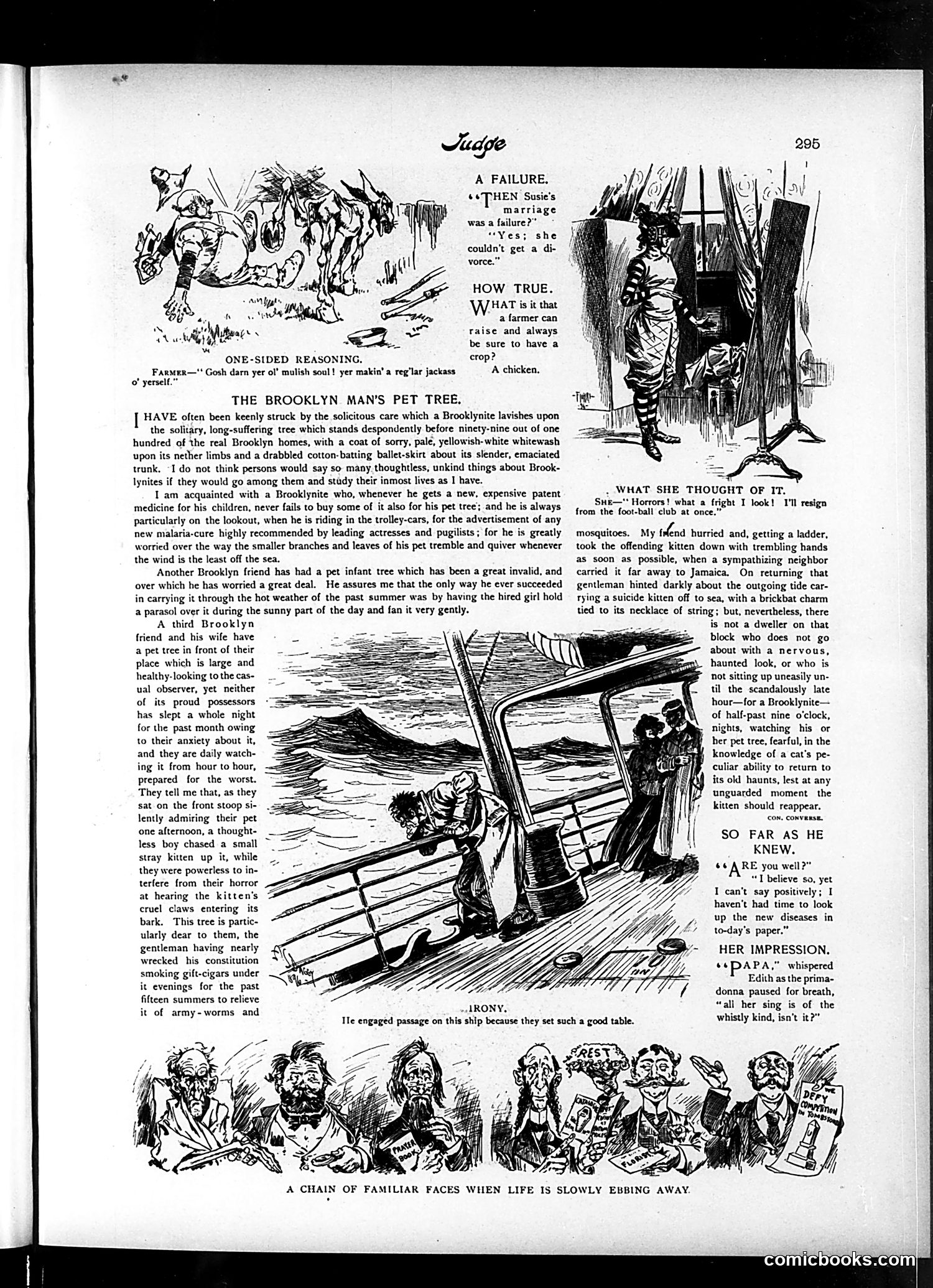
This page from Judge magazine contains several satirical pieces mocking middle-class American life, primarily targeting Brooklyn residents. **"The Brooklyn Man's Pet Tree"** is the main feature—a lengthy essay with illustrations satirizing Brooklynites' obsessive care for the single, sickly tree in front of their homes. The author describes residents treating their trees like invalids: buying patent medicines for them, having hired girls hold parasols, losing sleep over their welfare. One anecdote describes neighbors traumatized after a boy chases a kitten up their tree, with the gentleman darkly hinting the kitten should have drowned—yet everyone remains vigilant it won't return. The satire targets both the neurotic over-attachment of Brooklyn homeowners and the class pretensions implied by such fussy, excessive concern for a decorative tree. The shorter jokes on the page mock divorce law, farming logic, and hypochondria—typical Judge fare of lightweight social commentary aimed at recognizable urban and rural stereotypes of the era.
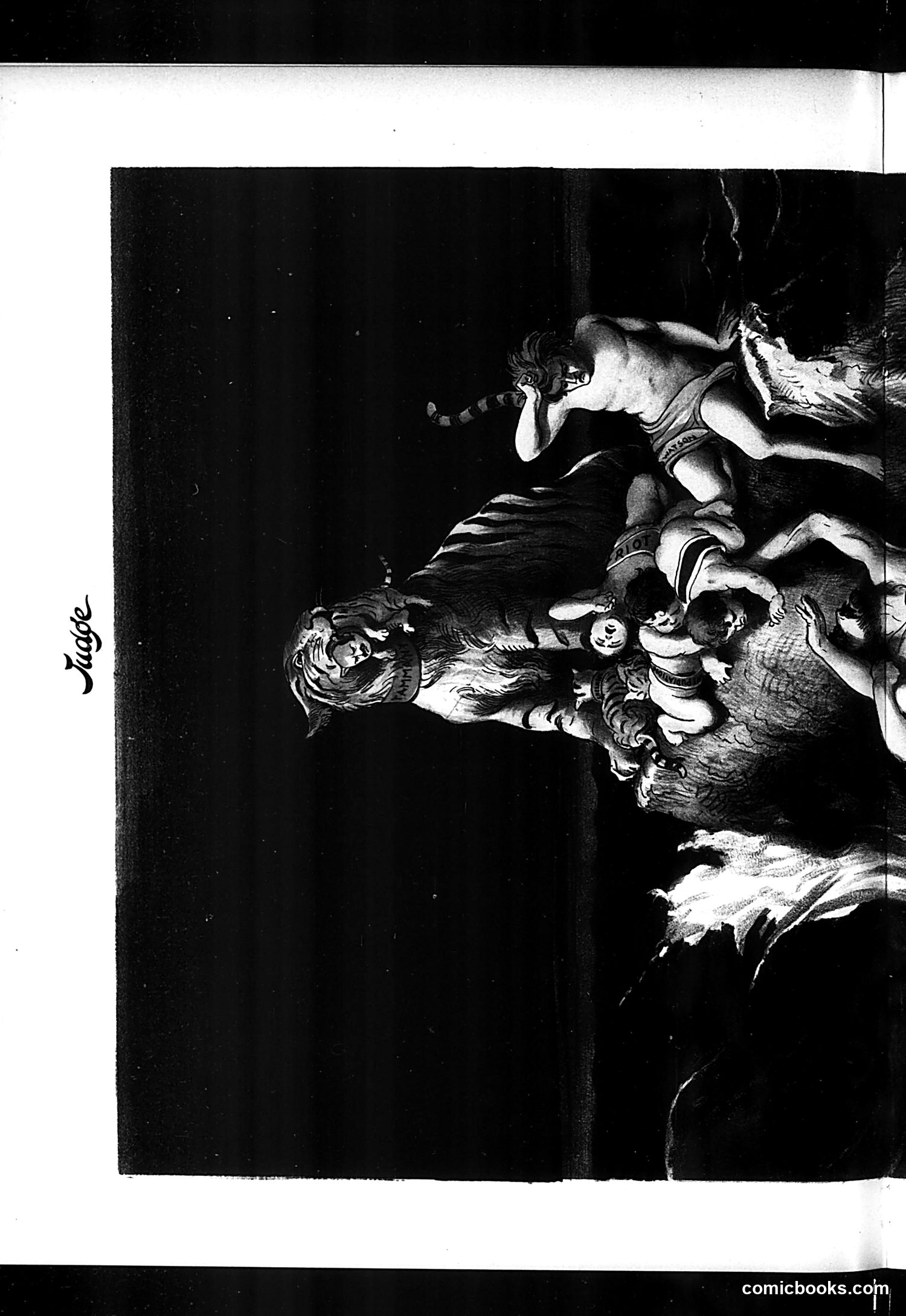
This appears to be a classical or mythological scene rendered as a black and white engraving, showing multiple figures in dramatic poses against a dark background. The signature "Judge" appears on the left margin. However, I cannot reliably identify the specific mythological narrative depicted or determine what political or social satire this represents. The classical style and composition suggest this may be illustrating a well-known myth or historical event, but without clearer context or legible text on the page itself, I cannot accurately explain what contemporary political or social commentary Judge magazine intended here. The OCR text only provides a website attribution, offering no additional context for interpretation.
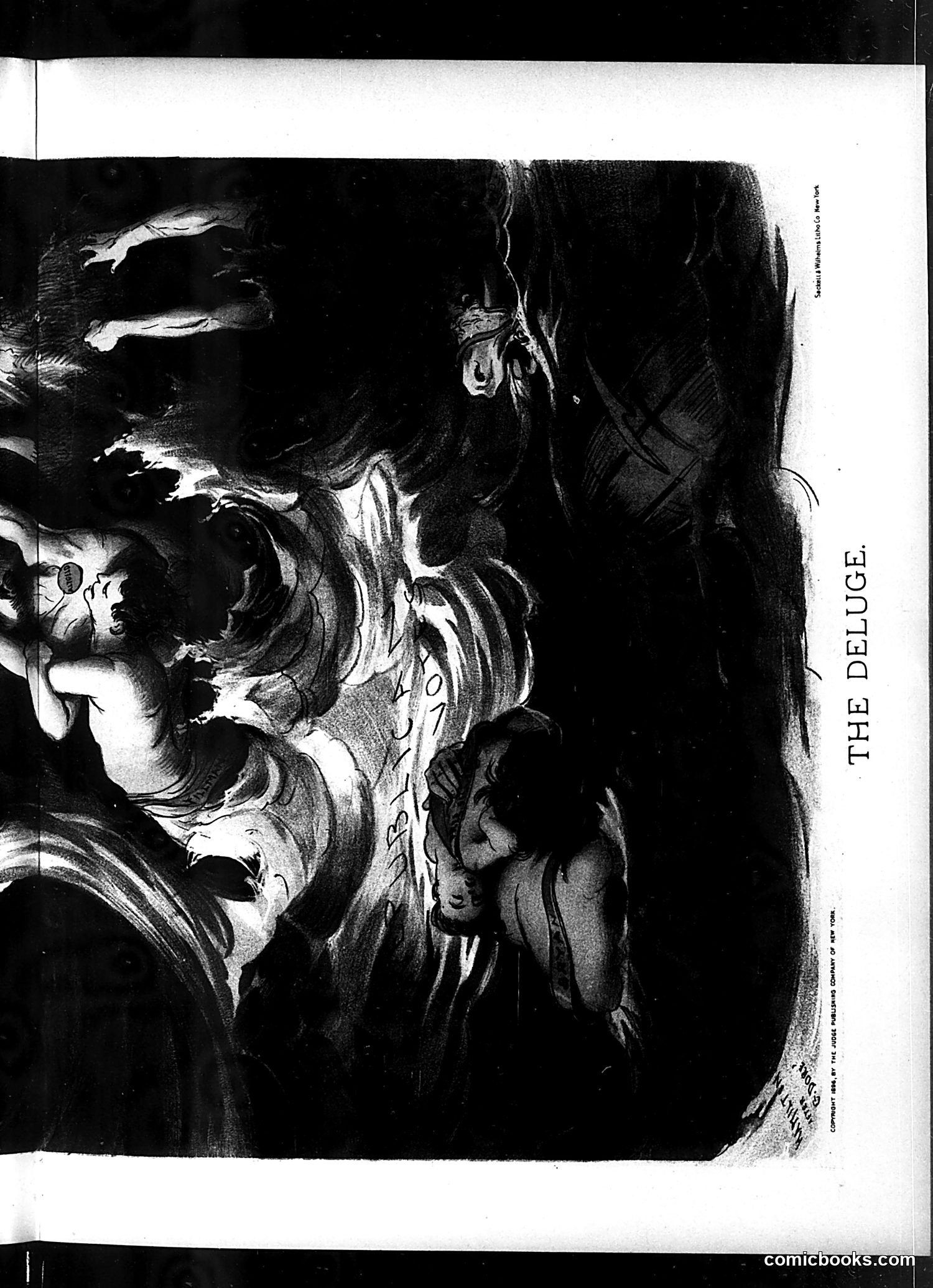
This appears to be a dramatic illustration titled "The Deluge" showing turbulent, swirling waters or chaos engulfing figures below. The artistic style—with its dark, flowing lines and expressionistic treatment—suggests a catastrophic or overwhelming event. Without clearer OCR text or visible date information, I cannot definitively identify the specific political event or figures referenced. However, the imagery of drowning or being overwhelmed by flood waters was common Judge magazine satire for depicting political crises, economic collapse, or social upheaval. The Secketts Wilhelm Litho credit indicates this is a professionally produced lithograph. To accurately explain the satire's target and meaning, I would need either a clearer title, publication date, or readable caption text from the page.
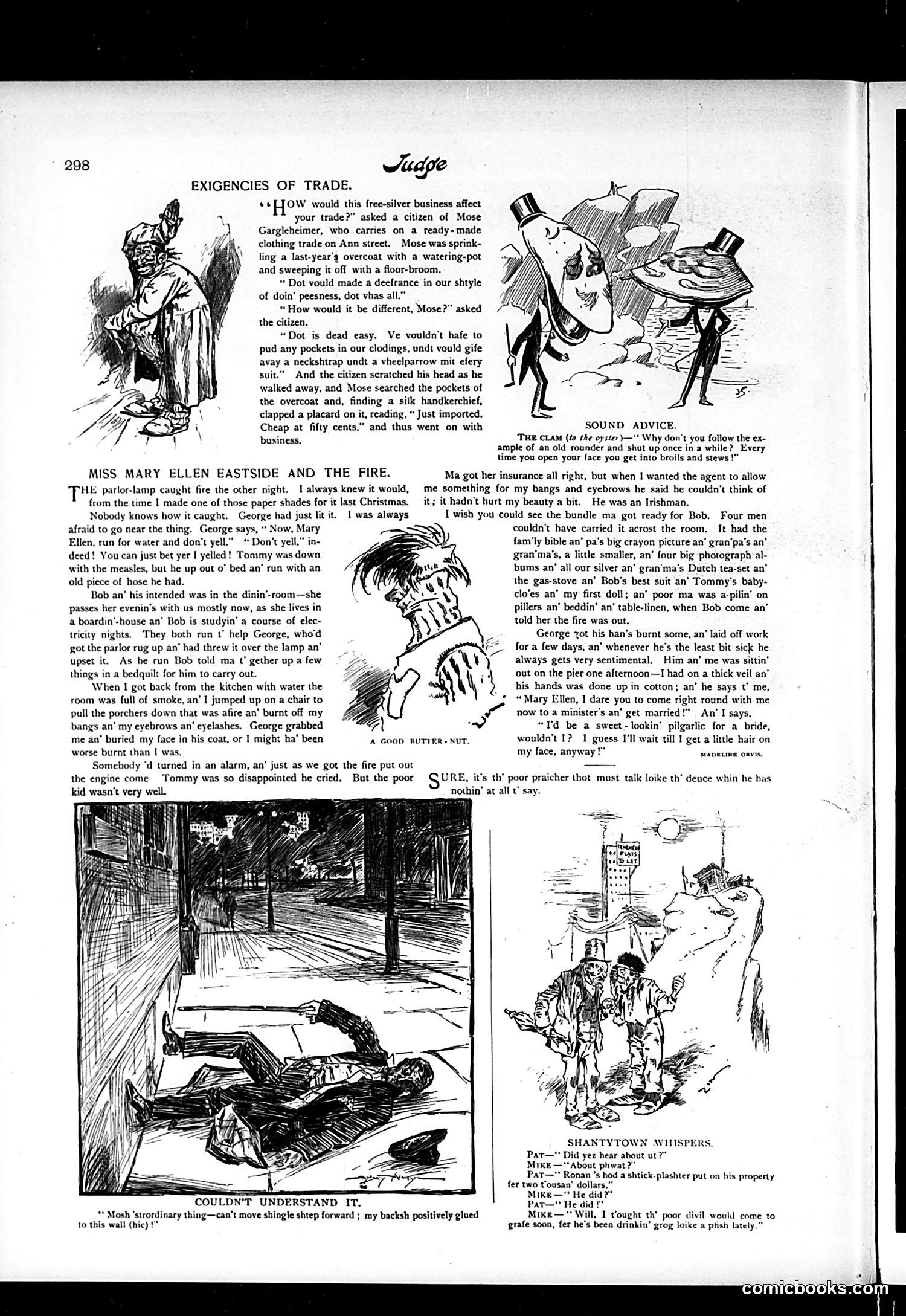
This Judge magazine page (page 298) contains satirical content about late 19th-century American life: **"Exigencies of Trade"**: A Jewish merchant character (Mose Gargleheimer, identified by Yiddish-accented dialect) jokes that free-silver currency reform would let him eliminate pockets from clothing and give away cheap accessories—essentially, selling inferior goods. The satire targets both currency debates and merchant dishonesty. **"Miss Mary Ellen Eastside and the Fire"**: A humorous domestic narrative about a working-class family's parlor fire. The story satirizes both the chaos of tenement life and sentimental romance, ending with a burnt, bandaged suitor proposing marriage. **Minor pieces** include "Sound Advice" (oyster/clam dialogue), "Shantytown Whispers" (poverty humor), and "Couldn't Understand It" (drunk immigrant unable to move). The ethnic caricatures and class-based humor reflect Judge's satirical approach to contemporary urban American life, targeting immigrants, the working poor, and consumer culture.
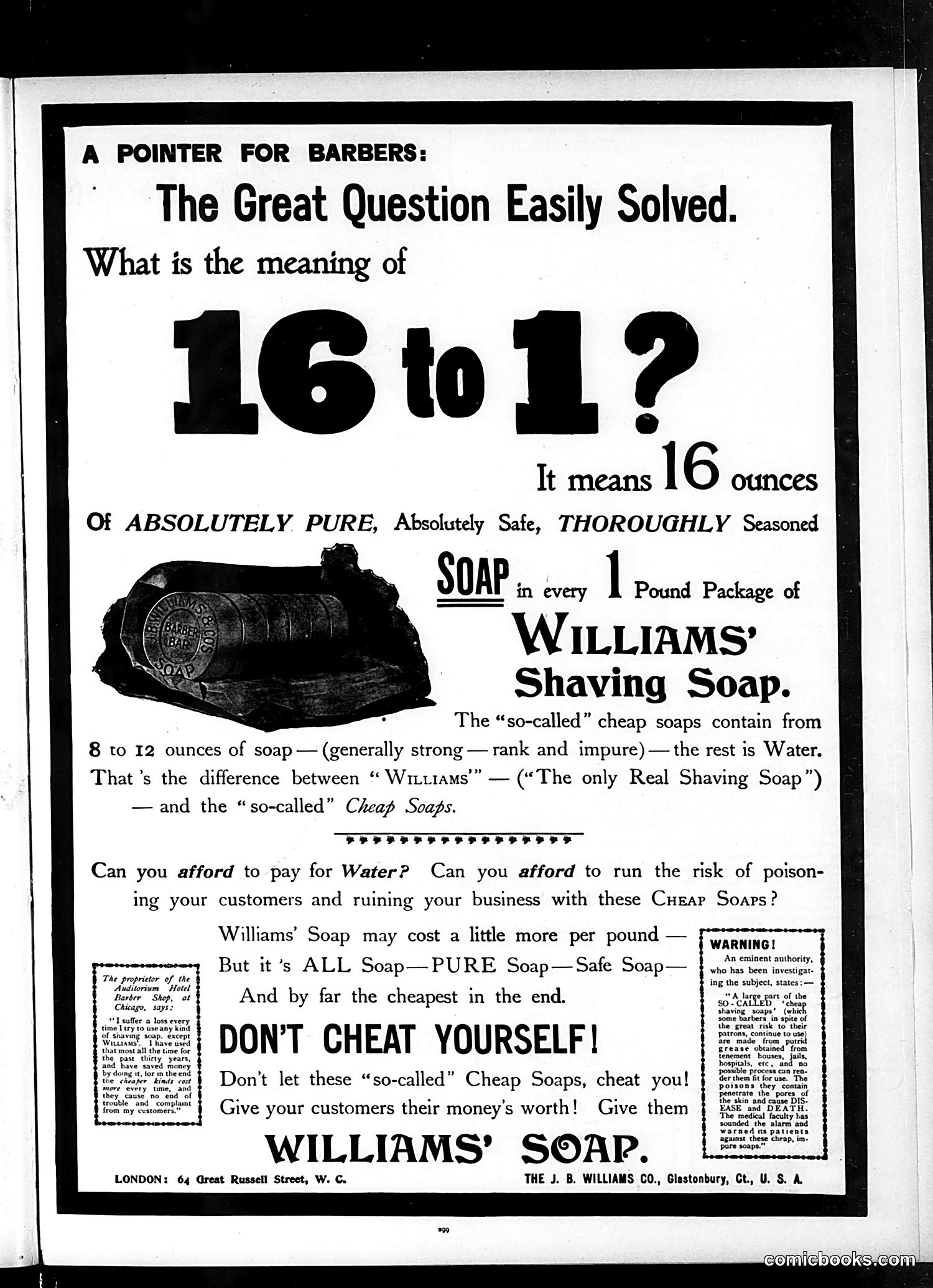
This is primarily a **product advertisement**, not political satire. Williams' Shaving Soap targets barbers with a comparative pricing argument. The "16 to 1" refers to the soap-to-water ratio: Williams' contains 16 ounces of actual soap per pound, while competitors contain only 8-12 ounces—the rest being water. The ad argues that cheaper soaps are actually expensive because customers pay for water, and risk health hazards from impure ingredients. The page includes testimonials (left and right margins) from satisfied users praising Williams' purity and safety. The "WARNING" box on the right cites an "eminent authority" cautioning against adulterated soaps containing harmful substances. The appeal is economic rather than satirical: barbers should choose quality soap that demonstrates value and protects customers' health, positioning Williams' as the superior long-term investment despite higher upfront costs.
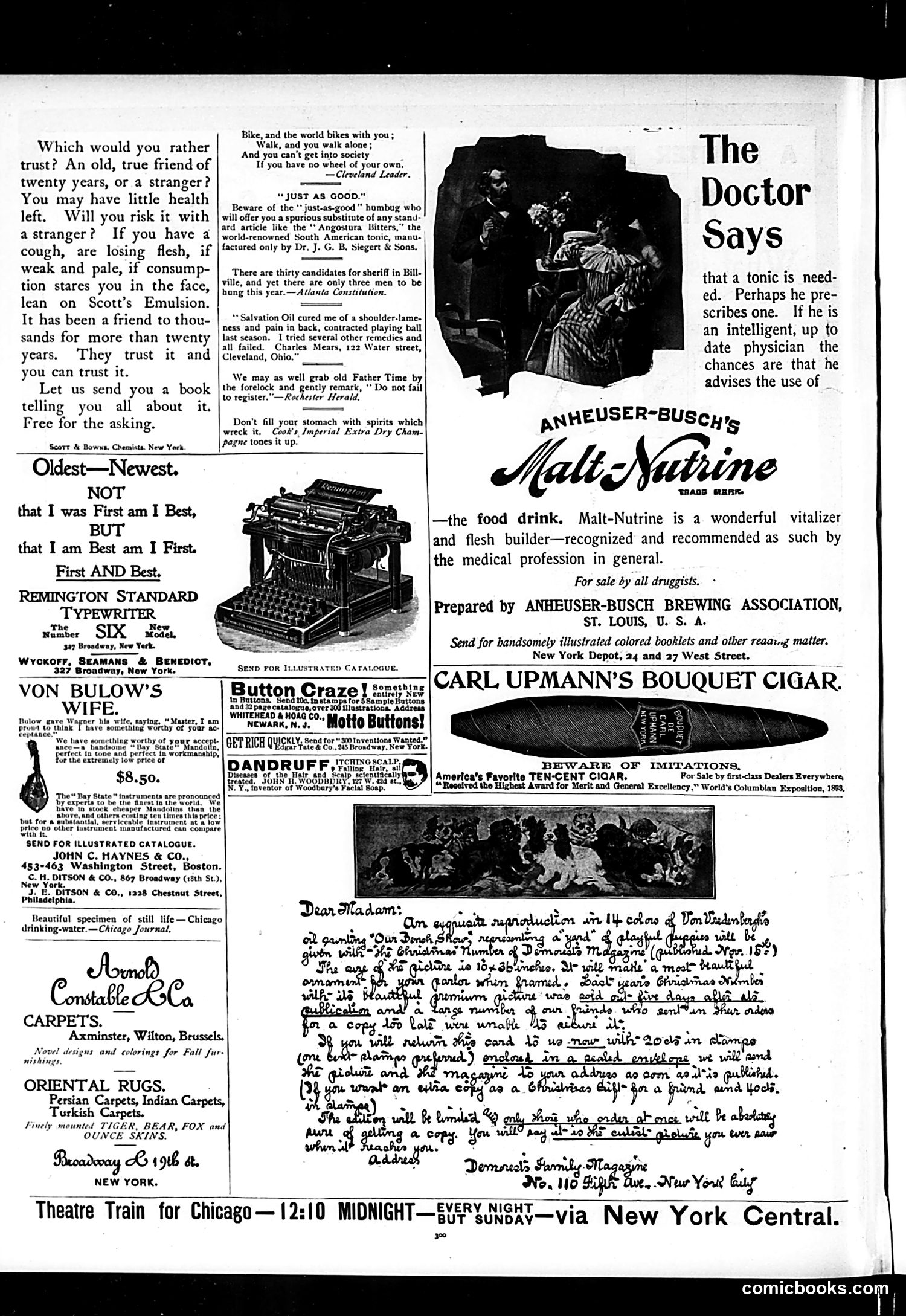
This is primarily an **advertising page** with minimal editorial cartoon content. The visible imagery consists of: 1. **Malt-Nutrine advertisement** (top right): Features a dark illustration of what appears to be a doctor or medical figure examining a patient. The ad endorses this beer-based tonic as a medicinal "food drink" recommended by physicians—reflecting the era when alcohol was marketed as therapeutic. This reflects pre-Prohibition-era patent medicine culture. 2. **Multiple product advertisements**: Scott's Emulsion (health tonic), Remington typewriters, Von Bülow piano reference, carpets, cigars, and dandruff treatments. These reveal consumer goods and marketing strategies of the period. 3. **Small quoted jokes/quips** scattered throughout (about bicycles, sheriffs, etc.) rather than cohesive political cartoons. The page demonstrates how Judge mixed satirical commentary with advertising revenue. The medical endorsements are notable—they reflect how early pharmaceutical marketing exploited medical authority before FDA regulations existed.
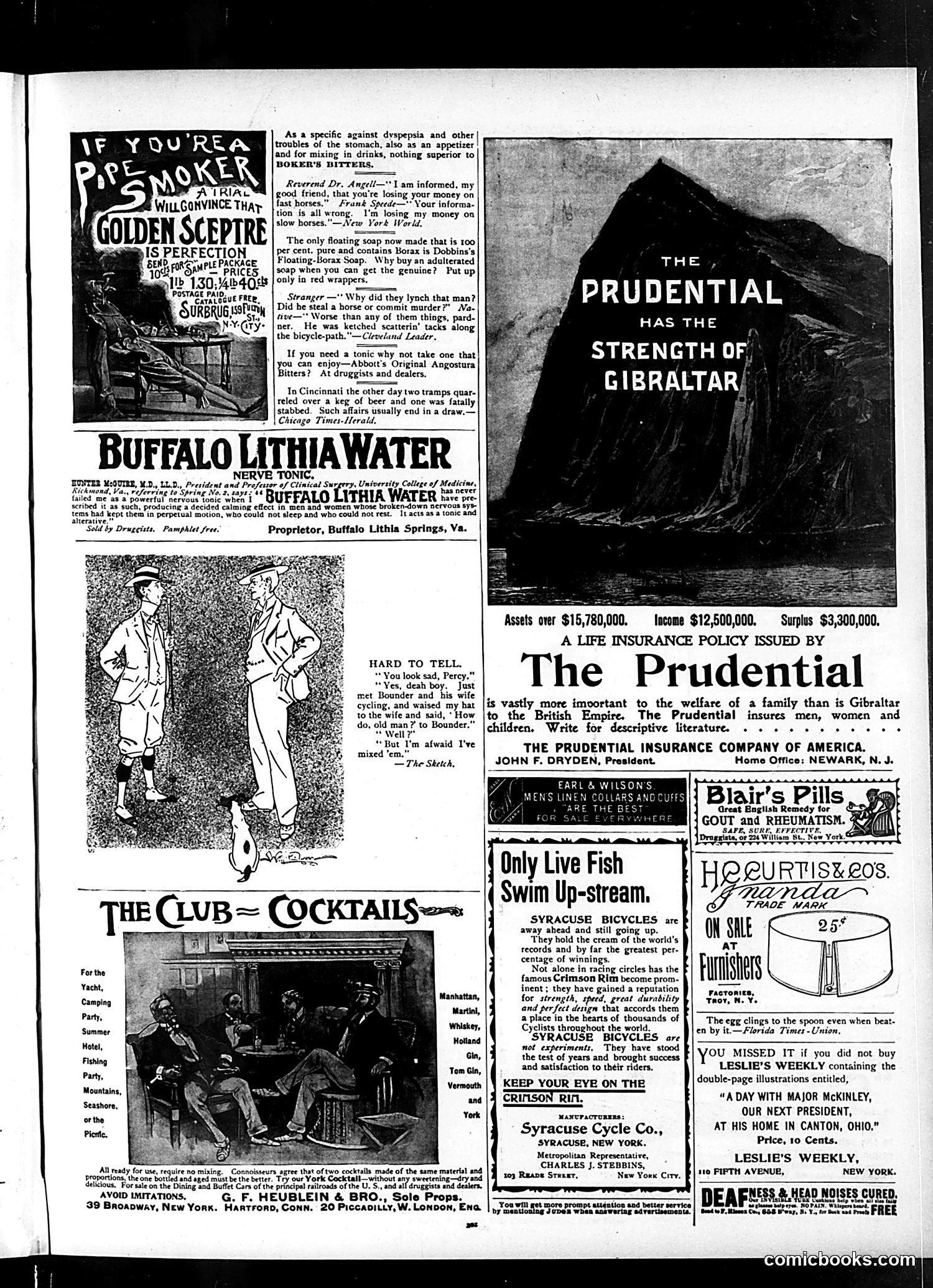
This page is primarily **advertising**, typical of early 1900s American magazines. The small satirical content includes: **The cartoon "Hard to Tell"** (center-left): A brief visual joke about social awkwardness—a man admits he accidentally greeted his friend's wife as "old man" while cycling, confusing the husband. The humor is gentle, playing on Victorian-era gender etiquette and the confusion of formal address. **The text jokes** scattered throughout mock various topics: clergy losing money on horses, lynching someone for scattering tacks on roads, and tramps stabbing each other over beer—the last quipped as "usually ending in a draw," dark humor typical of the era. **Otherwise, the page showcases period advertisements**: patent medicines (Buffalo Lithia Water, Boker's Bitters) claiming health benefits, bicycles, insurance, and cocktail ingredients. These ads reflect contemporary consumer culture and the magazine's commercial dependence. The satirical elements are minor; this issue primarily served as a revenue vehicle for advertisers.
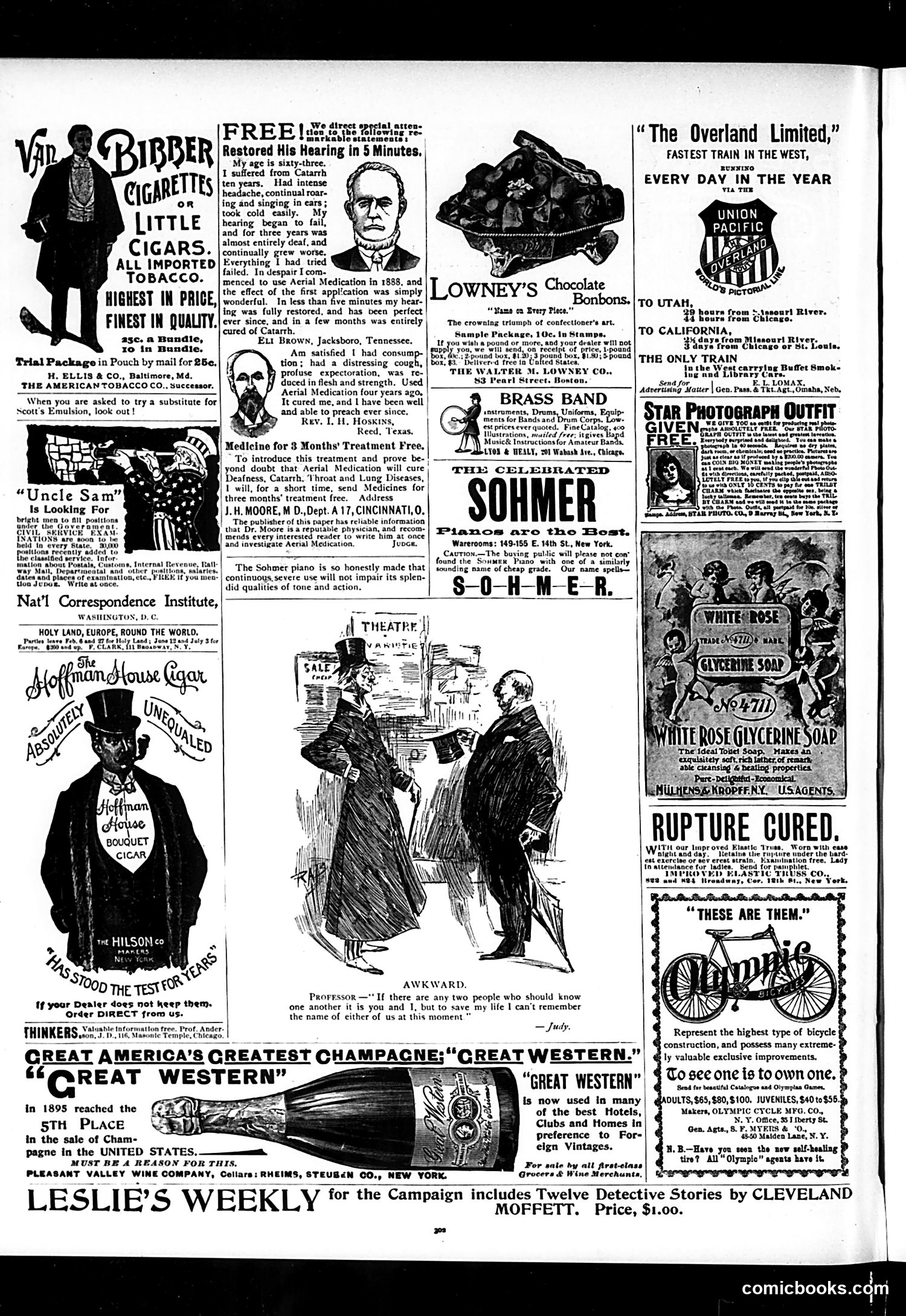
This page is predominantly **advertising**, not political cartoons. The mastheads and ads occupy roughly 75% of the space and concern: tobacco products, correspondence schools, champagne, pianos, chocolates, trains, brass band instruments, medical treatments (Aerial Medication for deafness/catarrh), bicycles, soap, and rupture trusses. The single cartoon visible—captioned "AWKWARD"—shows two men in a theater confrontation. The professor's dialogue is cut off mid-sentence, but appears to be setting up a social embarrassment joke typical of period humor. The joke itself isn't fully legible. The page functions as a typical late-19th/early-20th century magazine issue: miscellaneous consumer advertising wrapped around modest editorial/humorous content. The "Uncle Sam" recruitment ad and various testimonials for quack medicines reflect period advertising norms without satirical intent—these were genuine commercial pitches.
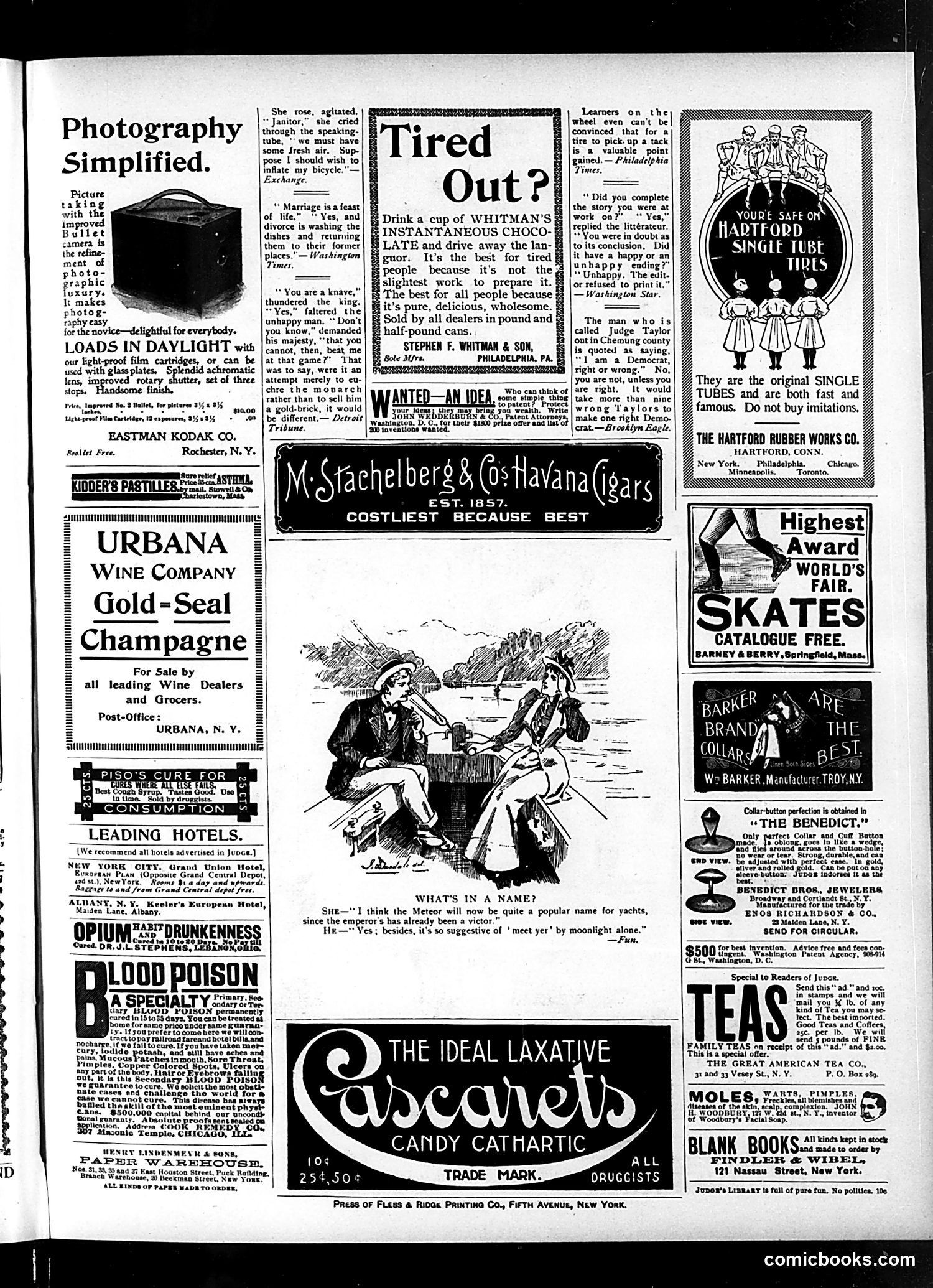
This is primarily an **advertising page** from Judge magazine with minimal editorial content. The few cartoons/jokes present are brief social observations typical of the era: **Main Content:** The page consists almost entirely of period advertisements for products like champagne, photography equipment, cigars, patent medicines (including dubious treatments for opium addiction and blood poison), and candy laxatives—reflecting early 1900s commercial practices. **The Cartoon:** The only substantial illustration shows two people by water discussing yacht names. The joke plays on "Meteor" being fashionable after the emperor's yacht success, with the male character suggesting it's also suggestive of romantic moonlit meetings ("meet yer"). It's mild romantic humor. **Social Context:** The brief text jokes scattered throughout mock marriage, social hierarchy, and journalism—standard Judge fare. The references to bicycles, yachts, and editors reflect turn-of-century middle-class concerns. **Note:** This page lacks significant political satire or caricature—it's commercially focused rather than editorially driven.
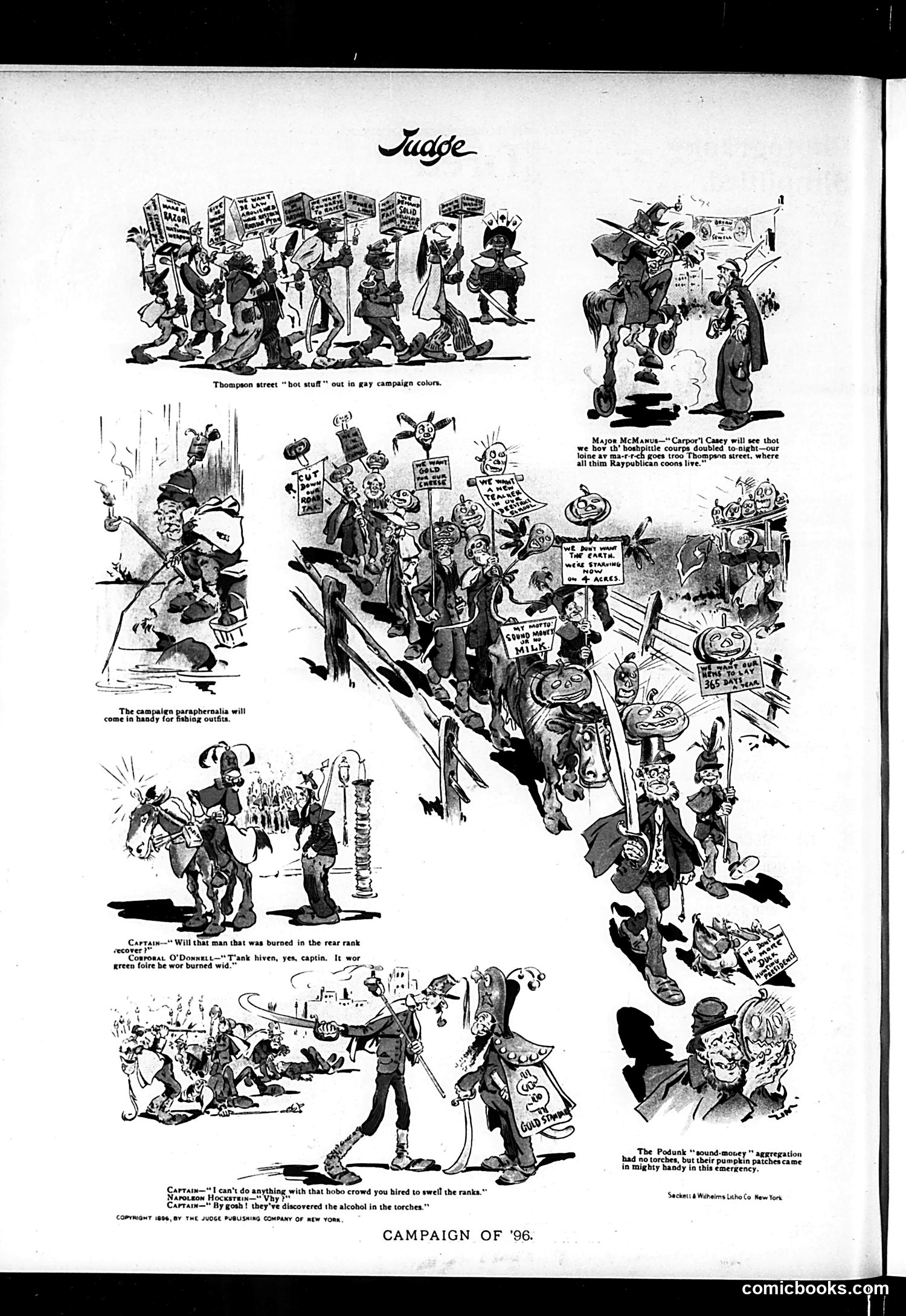
This page mocks the 1896 U.S. presidential campaign through multiple cartoons depicting a political parade or rally. The satire targets: **Campaign Theatrics**: The cartoons ridicule the elaborate spectacle of political campaigns—torches, parades, hired crowds—suggesting candidates rely on hollow pageantry rather than substance. **Voter Quality**: References to hiring "hobos" to "swell the ranks" and the "Podunk" delegation using pumpkins as torches mock the desperation to inflate crowd sizes and the poor quality of supporters. **Ethnic/Racial Mockery**: The OCR text contains period-appropriate offensive language reflecting 1896 attitudes (now unacceptable). **Ineptitude**: Jokes about burned participants, discovered alcohol in torches, and general chaos satirize campaign disorganization. The overall message: 1896 campaign spectacles were manufactured, populated by questionable participants, and fundamentally absurd—a critique of political theater that, while expressed through offensive 1890s conventions, critiques campaign artificiality broadly.