
A complete issue · 16 pages · 1896
Judge — October 31, 1896
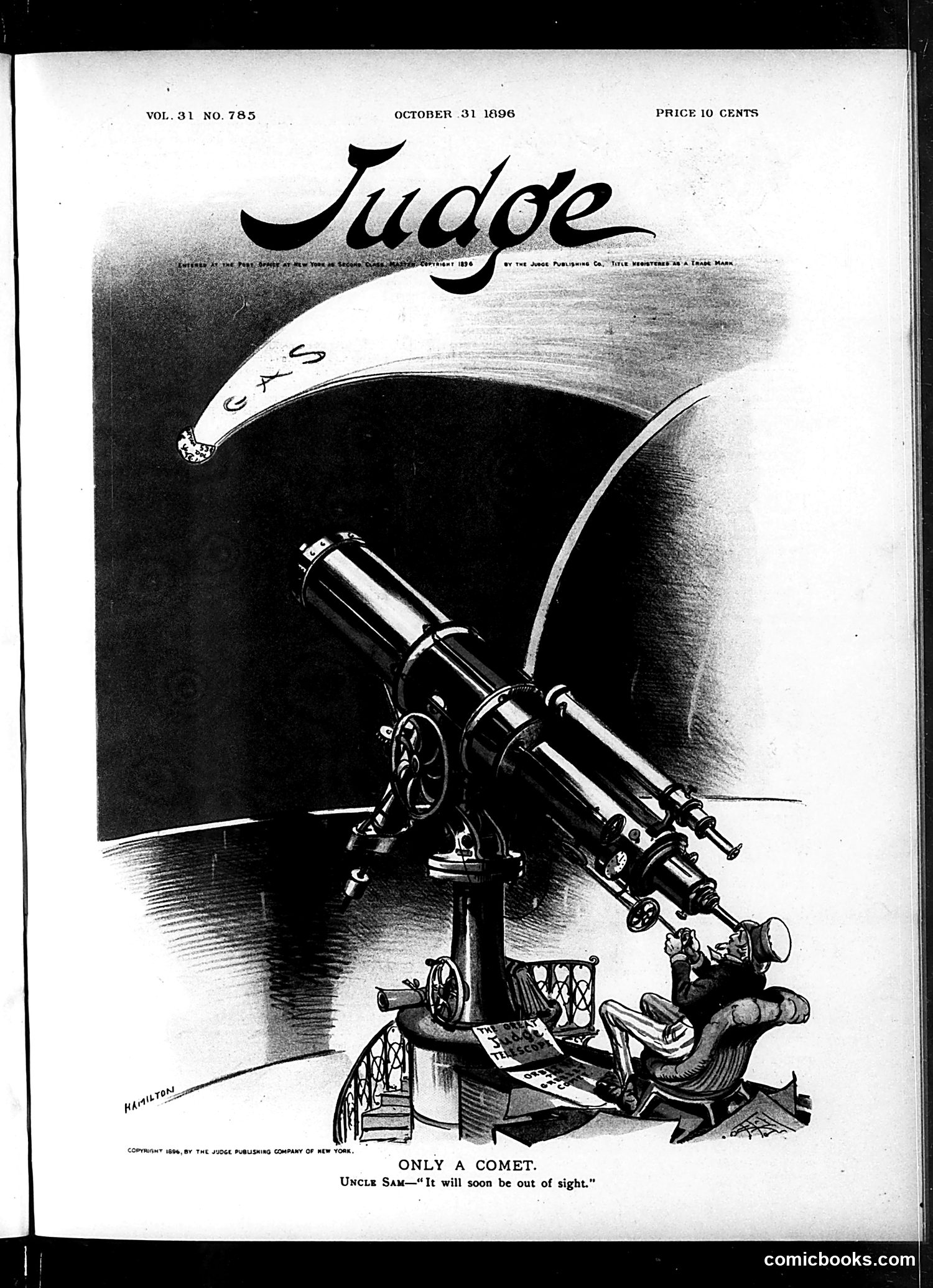
This political cartoon depicts Uncle Sam observing a comet through a telescope, with the caption "It will soon be out of sight." The comet likely represents a political figure or issue of concern in 1896—possibly William Jennings Bryan's presidential campaign or another controversial political movement that Republicans (Judge's typical audience) viewed as a temporary phenomenon. The satire suggests that whatever threatens or worries Uncle Sam will naturally pass away without lasting impact, similar to how comets disappear from view. By comparing the concern to a comet's passage, the cartoonist dismisses the threat as fleeting and inevitable to vanish. The artist is Hamilton, signed at bottom left.
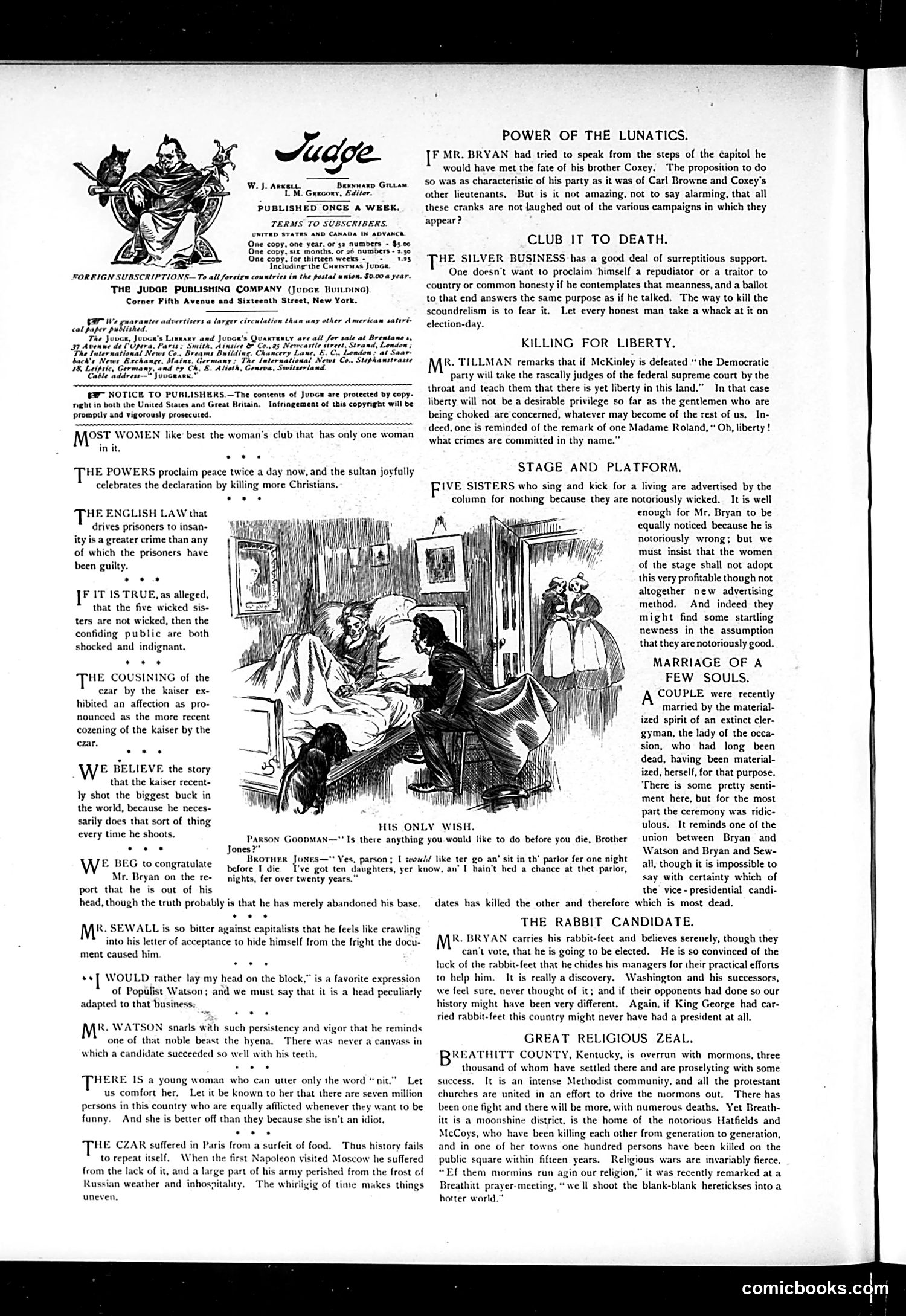
The main illustration depicts a deathbed scene titled "His Only Wish," showing two men—one clearly dying in bed, the other (identified in dialogue as "Brother Jones") standing beside him. The dying man requests his brother bring him "a couple of daughters" before he dies, adding he "hasn't had a chance at that parlor slip." The satire targets mid-19th century courtship customs, specifically the practice of young women sitting on men's laps in parlors—considered risqué behavior. The joke's dark humor comes from the dying man's final, worldly desire rather than spiritual redemption. The surrounding text columns contain unrelated editorial commentary on political topics (Bryan, the judiciary, religious movements), making this a typical Judge layout mixing satirical cartoons with opinion pieces.
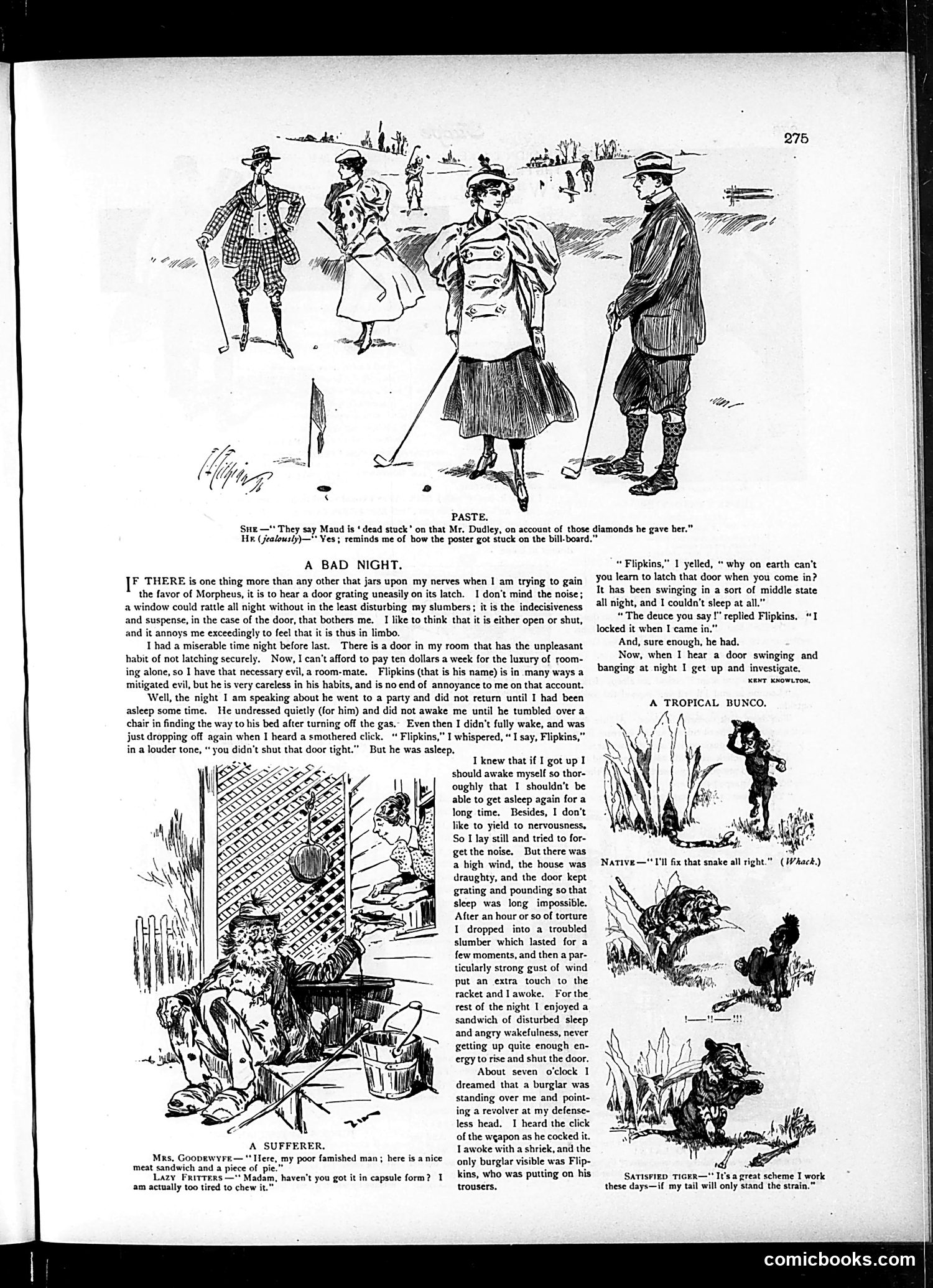
**"A Bad Night"** is a humorous domestic narrative about an annoyed homeowner whose sleep is repeatedly disrupted by a door that won't stay closed. The protagonist, frustrated by the persistent noise and the indecisiveness of whether to leave it open or shut, eventually discovers his cat Flipkins is responsible for the banging. **"A Tropical Bunco"** appears to be a separate satirical piece about hunting or wildlife, featuring illustrations of native peoples and animals (tiger, boar) in what seems to be a colonial-era setting, though the specific context remains unclear from the visible text. The "Paste" cartoon at the top depicts a golf scene with what appears to be a commentary on golfing etiquette or an anecdote about diamonds.
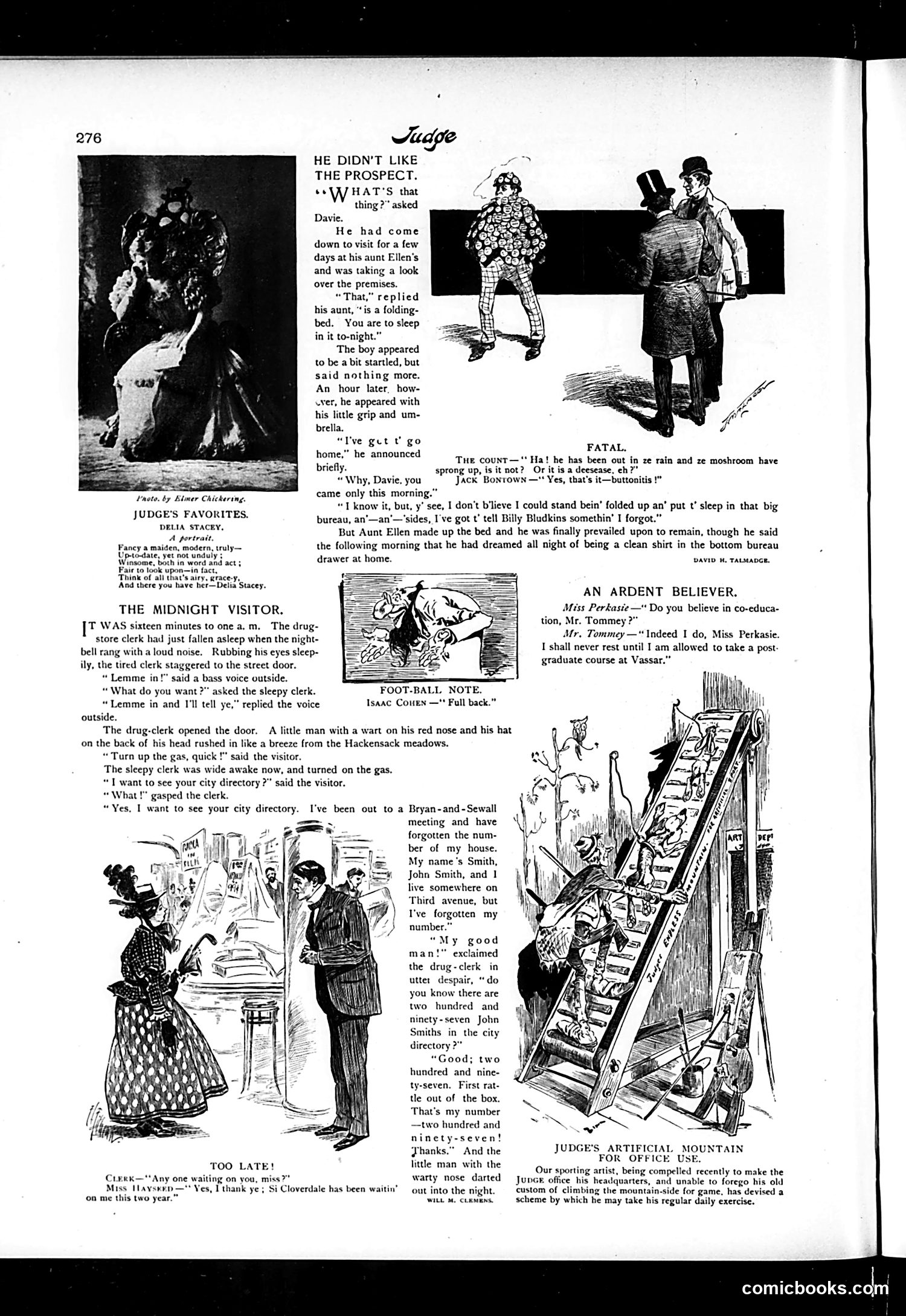
This page from *Judge* magazine contains several short humorous pieces typical of late 19th-century American satire: **"The Midnight Visitor"** mocks urban inefficiency: a desperate man interrupts a drugstore clerk at 1 a.m. seeking a city directory to find his own address among 297 John Smiths on Third Avenue—a jab at both bureaucratic incompetence and the absurdity of rapid urban growth. **"He Didn't Like the Prospect"** is a children's joke about a boy horrified by a folding bed, fearing he'll be "folded up" like laundry. **"Fatal"** features ethnic humor (a French count speaking broken English) observing mushroom-like growths on someone, diagnosing "buttonitis"—wordplay on buttons. **"An Ardent Believer"** contains mild social commentary: a man enthusiastically endorses co-education at women's colleges like Vassar, but only to attend as a student himself—satirizing male self-interest. The page also includes a portrait and a joke about an artist who built an artificial climbing structure in the office gym.
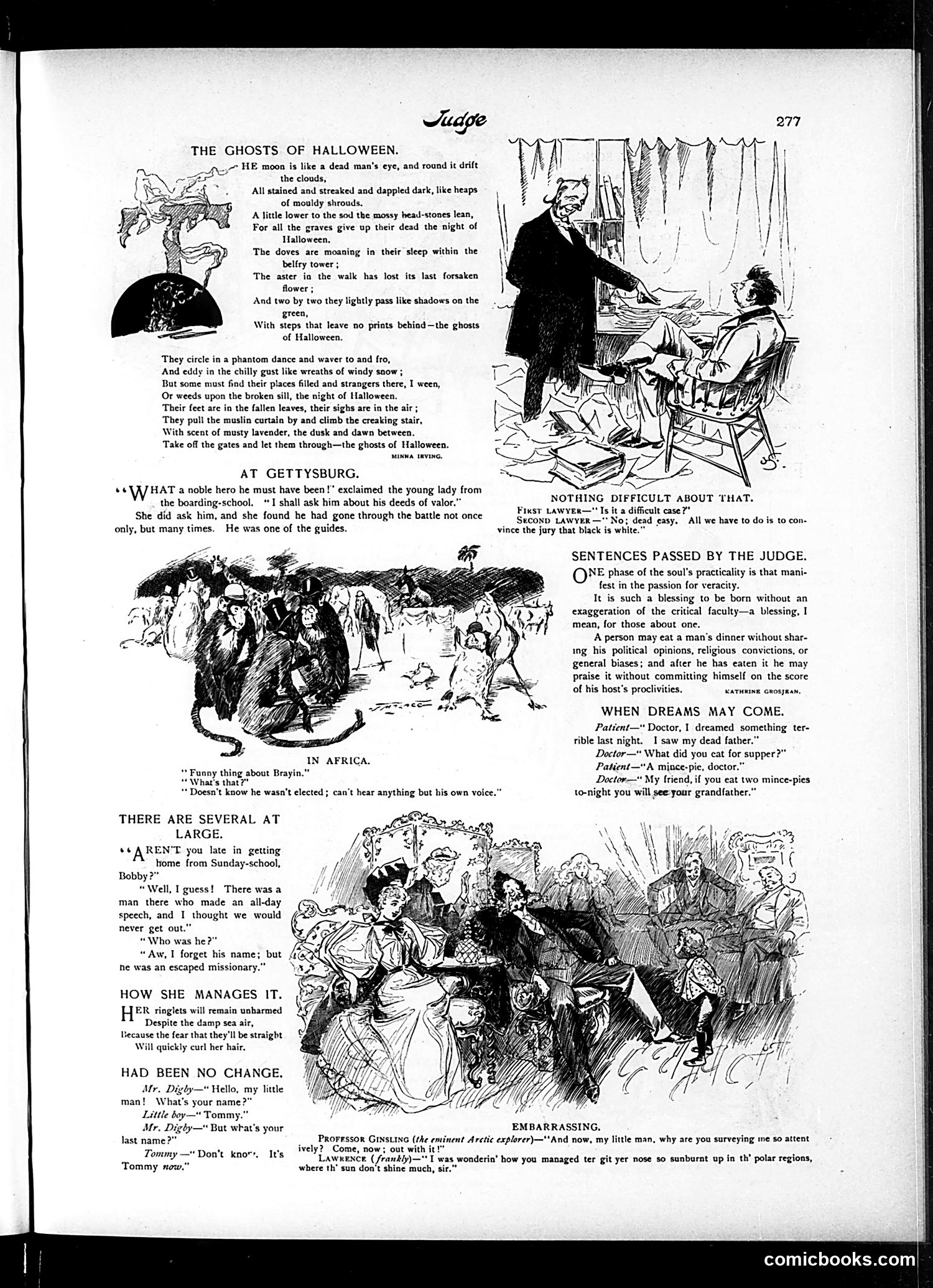
This page contains multiple satirical pieces typical of late 19th/early 20th-century American humor: **"The Ghosts of Halloween"** is a sentimental poem about spirits returning on All Hallows' Eve—straightforward horror-themed verse, not political satire. **"At Gettysburg"** mocks naive romanticism: a boarding-school girl asks a Civil War veteran about his "deeds of valor," only to learn he was merely a guide, having gone through the battle "many times" in that non-combatant role. The satire targets unrealistic heroic expectations. **"Nothing Difficult About That"** satirizes lawyers' willingness to argue anything—one boasts he can "convince the jury that black is white," mocking courtroom dishonesty. **"When Dreams May Come"** jokes that eating mince-pies causes nightmarish hallucinations. **"Embarrassing"** features an Arctic explorer (likely Fridtjof Nansen or similar) embarrassed when a child naively asks how his nose got sunburned in polar regions "where th' sun don't shine much"—exposing the explorer's exaggerations about Arctic conditions. The overall tone is light social mockery rather than serious political commentary.
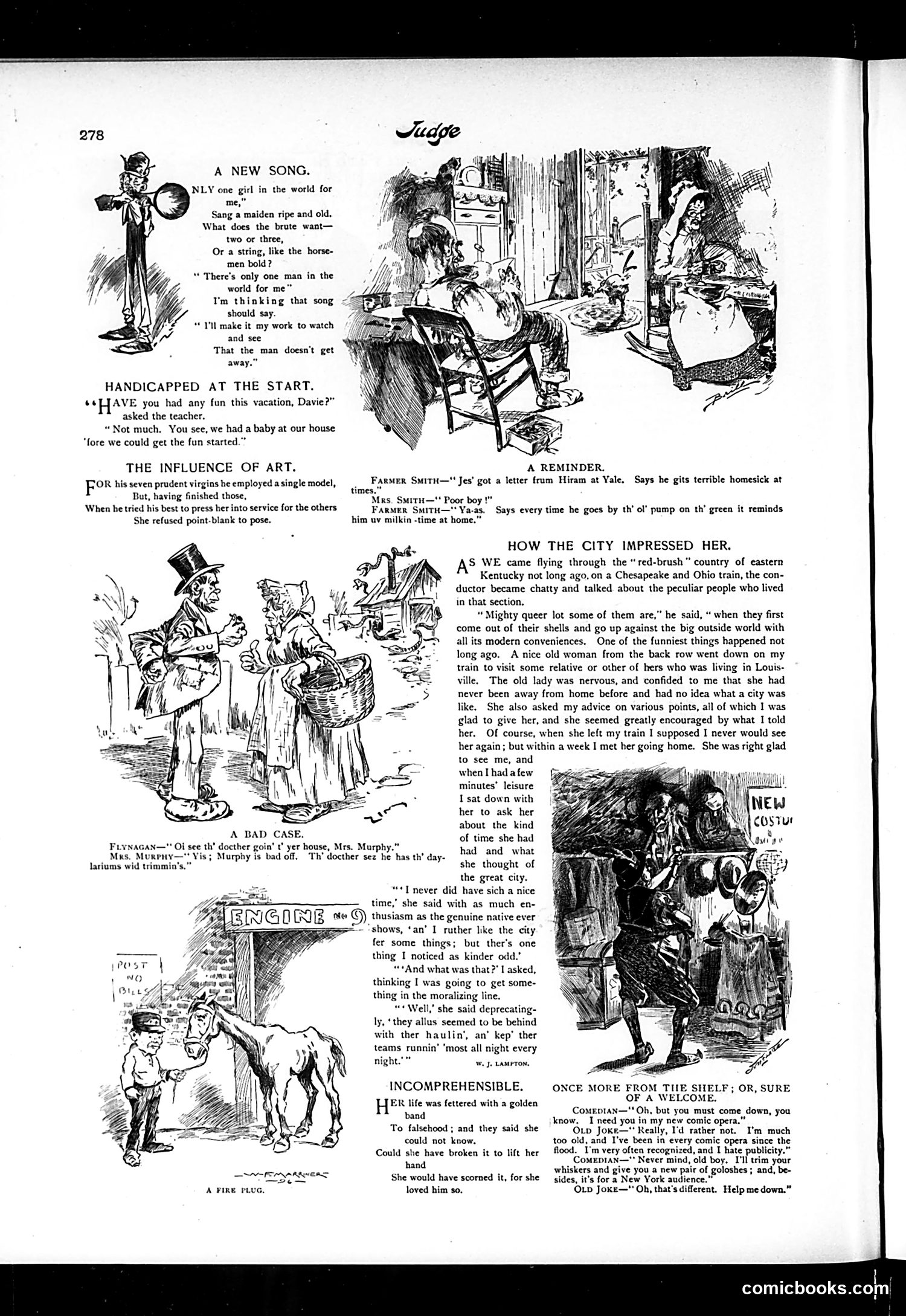
This page contains several short satirical pieces typical of early Judge magazine: **"A New Song"** mocks romantic conventions—a woman singing she has "only one man in the world" for her, then revealing her real agenda is simply to prevent him from leaving. **"Handicapped at the Start"** is a brief joke about a baby's arrival ruining family vacation plans. **"The Influence of Art"** shows a prudish model refusing to pose for an artist's biblical scenes (the "seven prudent virgins" reference). **"How the City Impressed Her"** satirizes rural Kentucky people's unfamiliarity with urban life through a conductor's anecdote about an old woman visitor impressed only by the fact that city people work their horses/teams constantly at night. **"A Bad Case"** and **"A Fire Plug"** are minor sight gags about illness and street life. **"Incomprehensible"** and **"Once More from the Shelf"** feature theater/opera jokes about aging actors and homesickness. The overall tone reflects turn-of-century American urban humor mocking rural simplicity and social pretension.
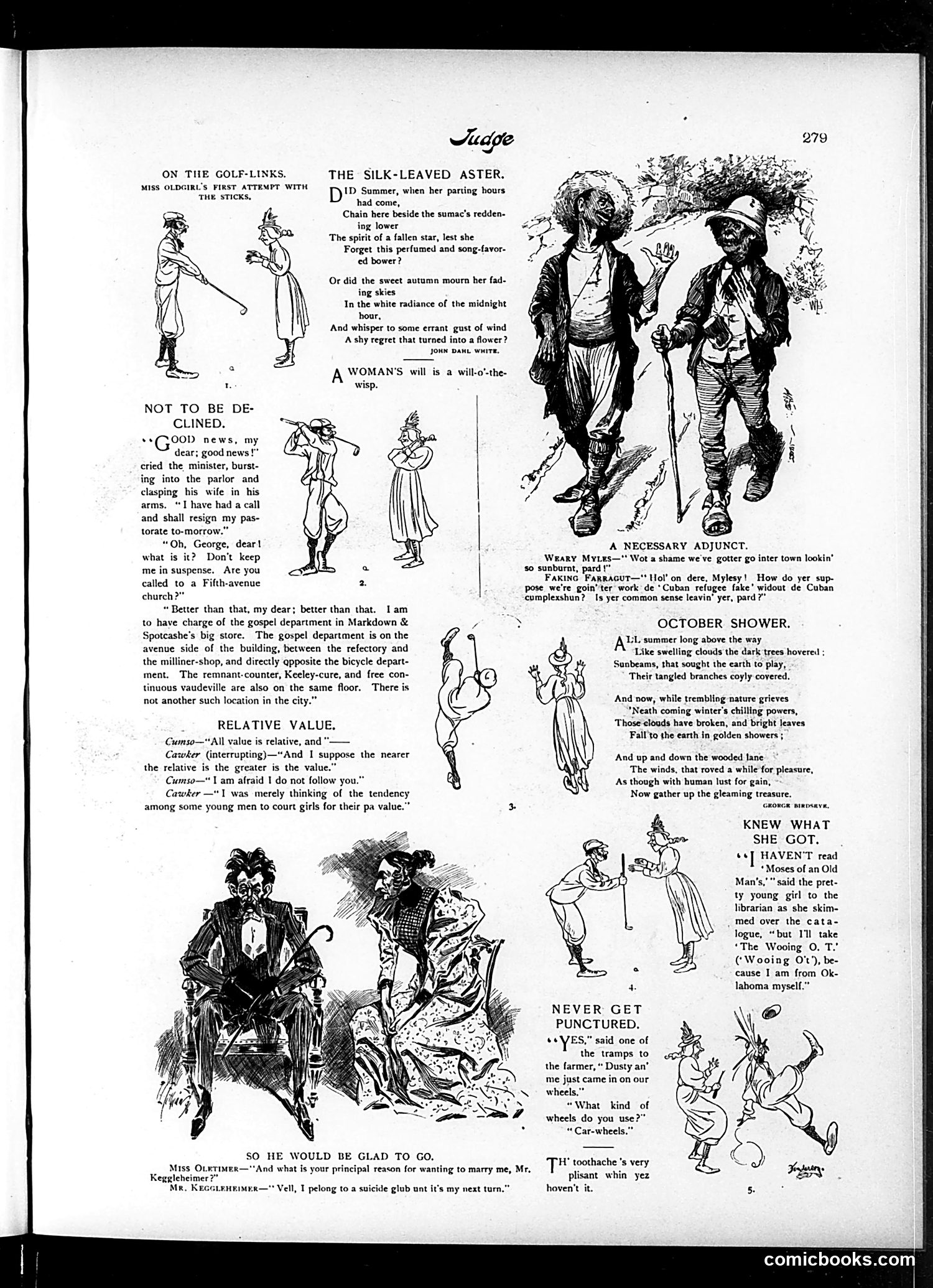
This page contains multiple brief satirical pieces typical of Judge magazine's format: **"On the Golf-Links"** mocks women's incompetence at golf through illustration. **"Not to be Declined"** satirizes clergy ambition: a minister excitedly announces his "call" to lead the "gospel department" at a department store—revealed as merely the religious goods section sandwiched between a lunch counter and bicycle department, mocking the commercialization of religion. **"A Necessary Adjunct"** references the "Cuban refugee fake"—likely satirizing sensationalized newspaper coverage or fraudulent charity schemes related to Cuban refugees (possibly post-Spanish-American War period). **"Never Get Punctured"** jokes about hobos using "car-wheels" (railroad wheels) instead of bicycle wheels. Other items include poetry about autumn flowers and romantic misunderstandings. The humor relies on wordplay, institutional critique, and class-based comedy typical of early 1900s American satirical magazines.
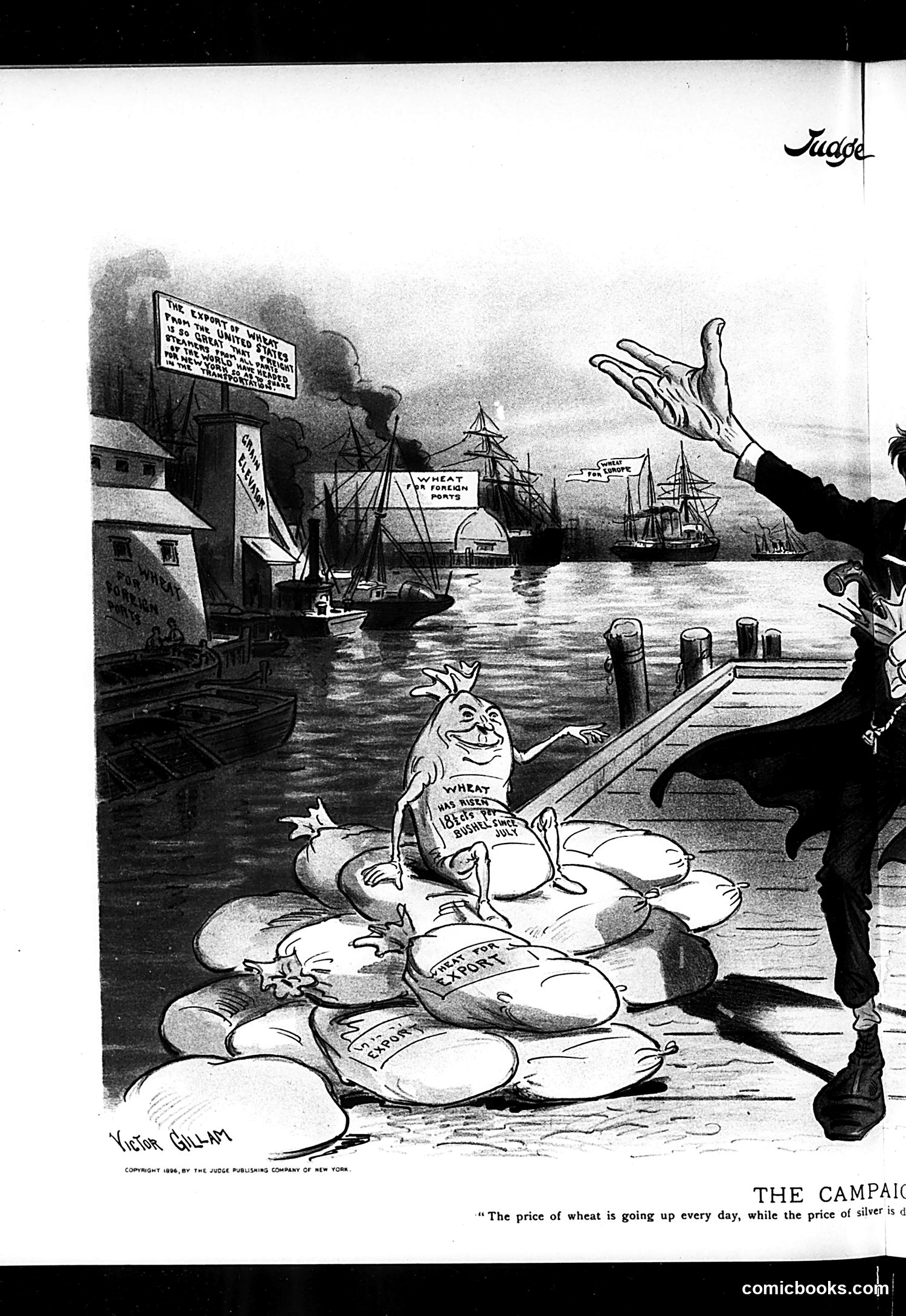
This Judge magazine cartoon satirizes a political campaign issue around commodity prices. A personified wheat sack sits contentedly on a dock surrounded by bags labeled "WHEAT" and "SILVER," while a politician (right) gestures frantically toward it. The caption indicates the cartoon criticizes the disparity between rising wheat prices and falling silver prices. This appears to reference the "Free Silver" political debate of the 1890s—a major campaign issue pitting agricultural interests (who favored cheap money/silver) against those benefiting from wheat price increases. The cartoon suggests hypocrisy: politicians promised to help farmers through silver coinage, yet wheat prices rose while silver remained undervalued. The smiling wheat personification implies some interests profited while farmers didn't receive expected relief.
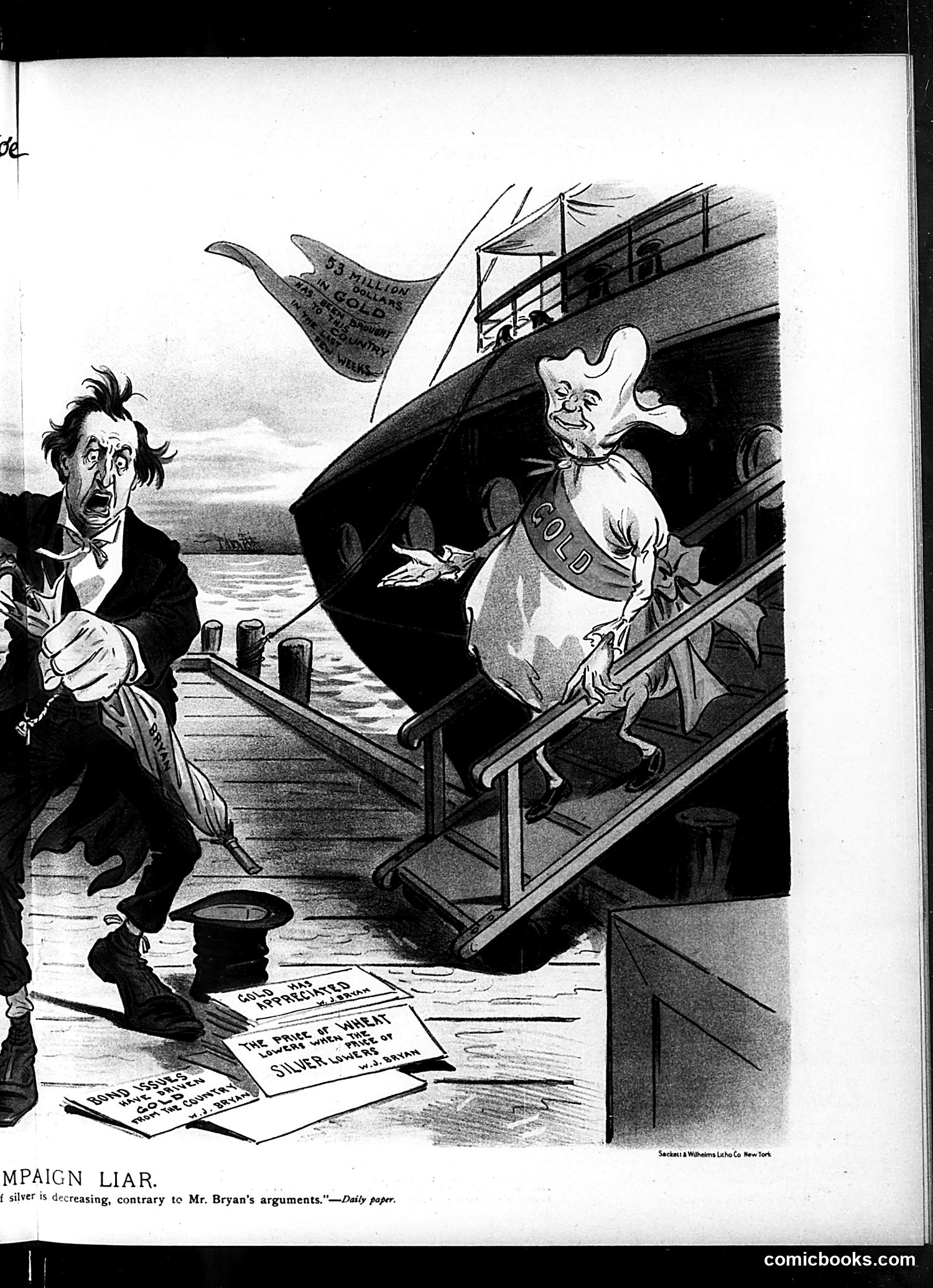
This political cartoon satirizes William Jennings Bryan's 1896 presidential campaign advocating for free silver coinage. The caricature shows a demagogue (representing Bryan or his campaign) arriving by ship with propaganda materials, while a concerned figure on the dock holds documents proving "silver is decreasing, contrary to Mr. Bryan's arguments." The cartoon's point: Bryan's campaign promises about silver are dishonest. The flag labeled "3 MILLION OUNCES" and scattered evidence at the dock suggest actual data contradicts the pro-silver rhetoric. Judge magazine, traditionally Republican, used the cartoon to mock Democratic campaign claims as lies based on false economic arguments.
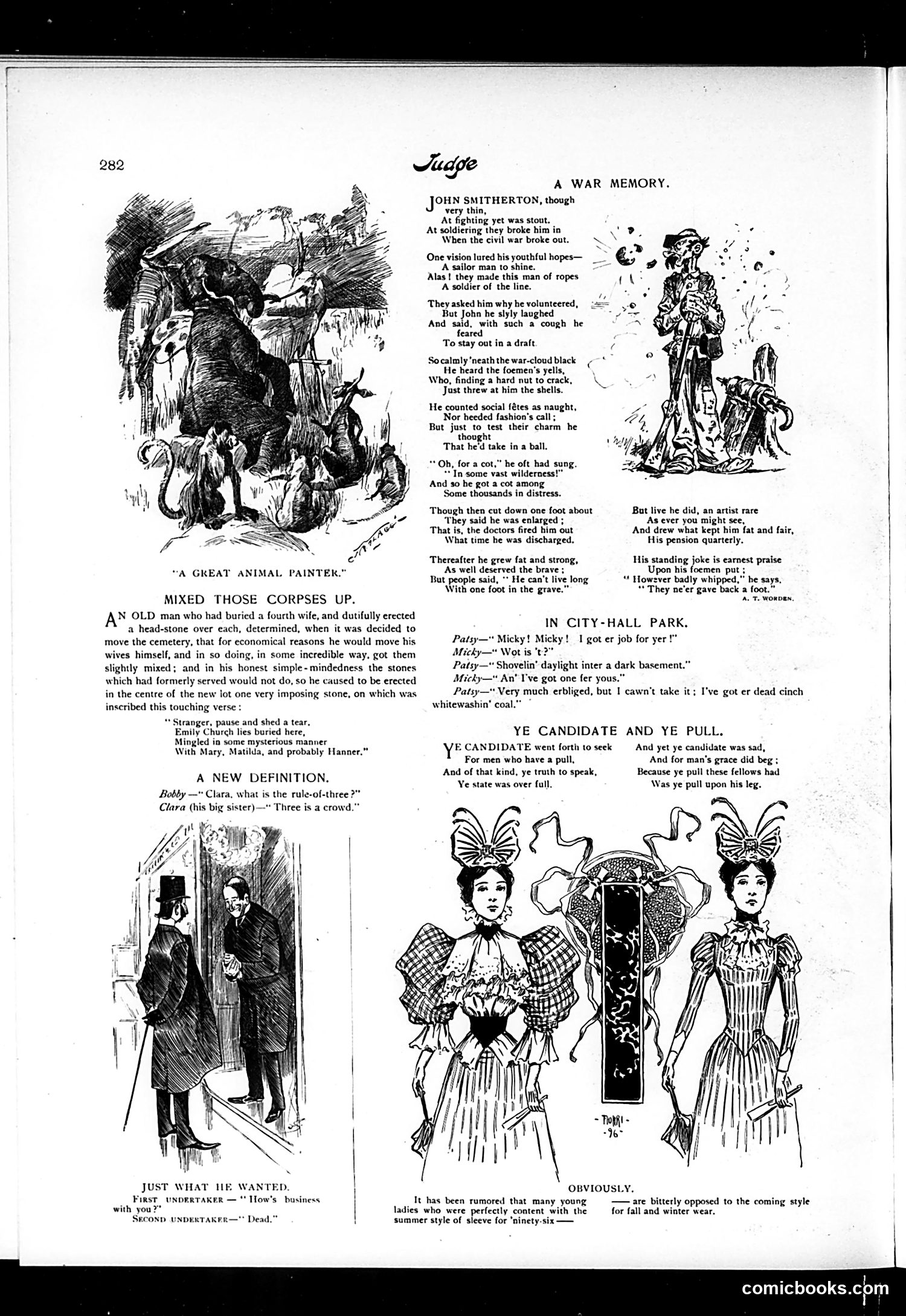
This page contains multiple satirical pieces typical of 1890s American humor: **"A War Memory"** is a poem mocking a Civil War veteran named John Smitherton who enlisted to avoid drafts, endured battle indifferently, attended social events to "test their charm," and was discharged after losing a foot. The satire criticizes both his casual attitude toward military service and the ironic outcome—he survives to become a comfortable pensioner. **"Mixed Those Corpses Up"** jokes darkly about an elderly widower who buried four wives and, when relocating the cemetery, confused their graves so badly he erected one monument listing all four names jumbled together. **Brief comic vignettes** include wordplay about the "rule of three" (three is a crowd), undertaker business ("Dead"), and city politics involving job-seekers with "pull" (connections/influence). **"Ye Candidate and Ye Pull"** satirizes political patronage—a candidate seeking votes discovers that powerful men's influence matters more than democratic principles. **Fashion commentary** mocks ladies abandoning 1896 sleeve styles for upcoming fashions. The overall tone reflects Judge's satirical stance on American politics, class dynamics, and social pretension.
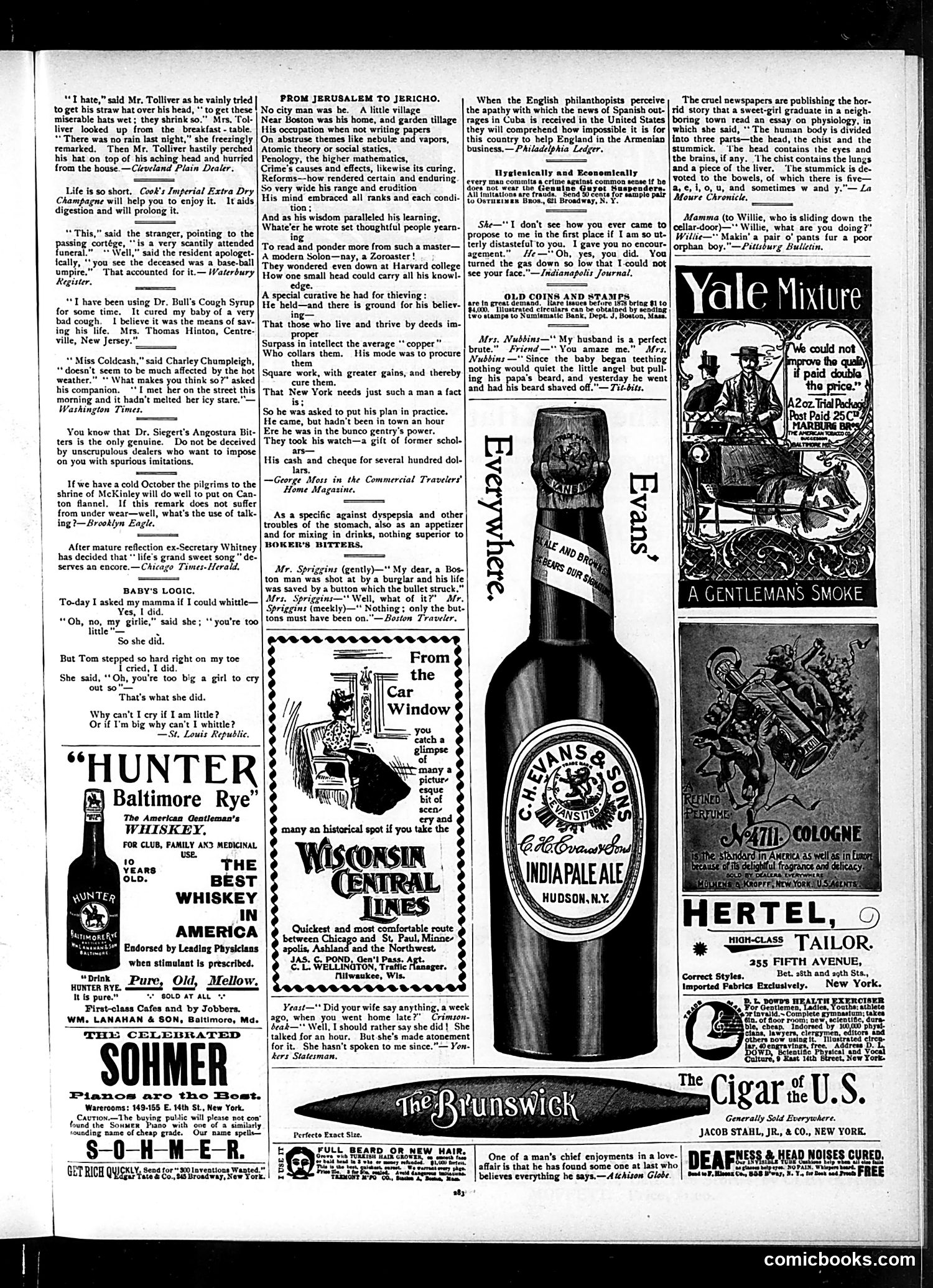
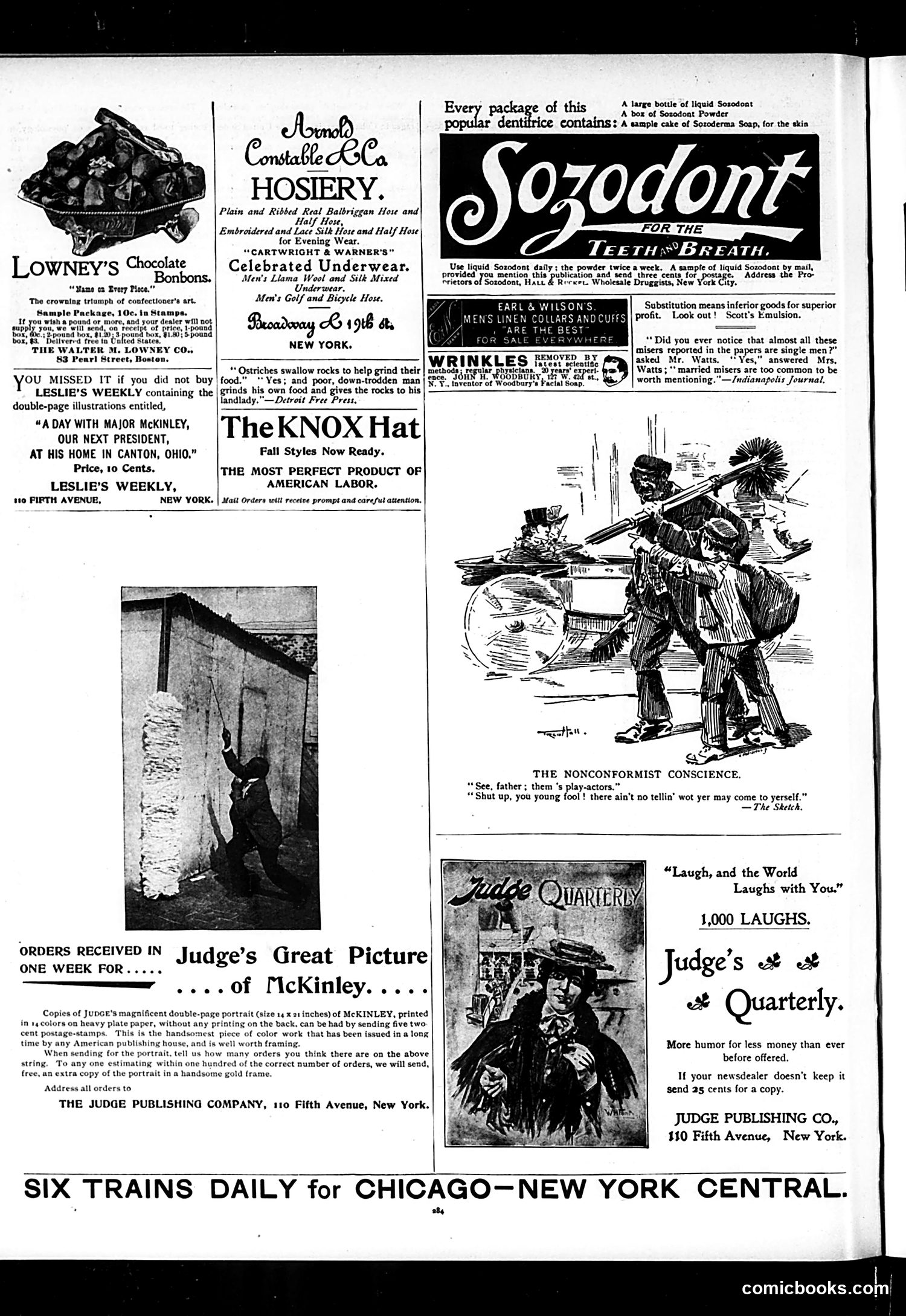
This page is primarily **advertising and promotional content** rather than political cartoon satire. However, it contains notable references: **McKinley References:** Multiple ads reference William McKinley, who appears to have been a recent or upcoming political figure of significance. Leslie's Weekly advertises a feature on "A Day with Major McKinley, Our Next President, at his Home in Canton, Ohio"—suggesting this page dates from the 1896 election cycle when McKinley was campaigning for president. Judge Publishing itself offers a large portrait of McKinley for purchase. **"The Nonconformist Conscience" cartoon** (bottom right) depicts working-class men confronting what appear to be theatrical performers, warning against moral compromise—a common Judge theme mocking both bohemian behavior and rigid moralism. The rest of the page consists of period product advertisements (hosiery, chocolate, hats, toothpaste, magazines) typical of early American satirical magazine publishing, which relied heavily on advertising revenue.
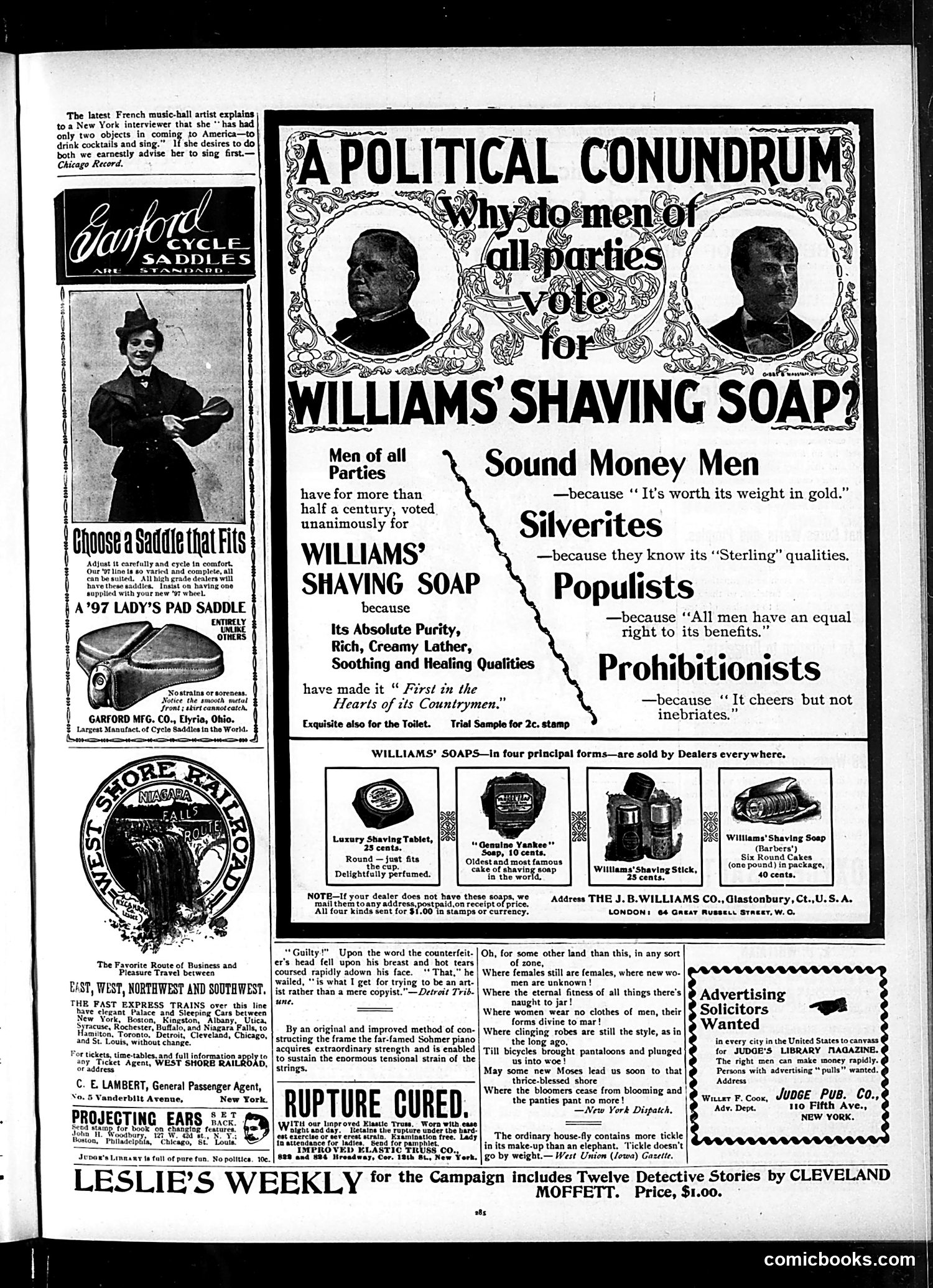
## Main Cartoon: "A Political Conundrum" This satirical advertisement for Williams' Shaving Soap mocks late-19th-century American political divisions by claiming that men from *all* political parties unanimously support the product. Each faction's endorsement includes wordplay mocking their ideology: - **Sound Money Men**: "worth its weight in gold" (referencing the gold standard debate) - **Silverites**: "Sterling qualities" (supporting silver currency) - **Populists**: "equal right to its benefits" (populist egalitarianism) - **Prohibitionists**: "cheers but not inebriates" (alcohol opposition) The joke: despite fierce political disagreement over currency policy, labor rights, and alcohol regulation, this product unites them—suggesting the schisms were absurd or that commerce transcends ideology. The ornate frames containing two unidentified male portraits reinforce the "universal appeal" claim while gently ridiculing partisan earnestness. ## Minor Content The page includes typical period advertisements (Garford cycle saddles, railroad services) and brief humor pieces about French performers and counterfeiters—standard Judge magazine filler.
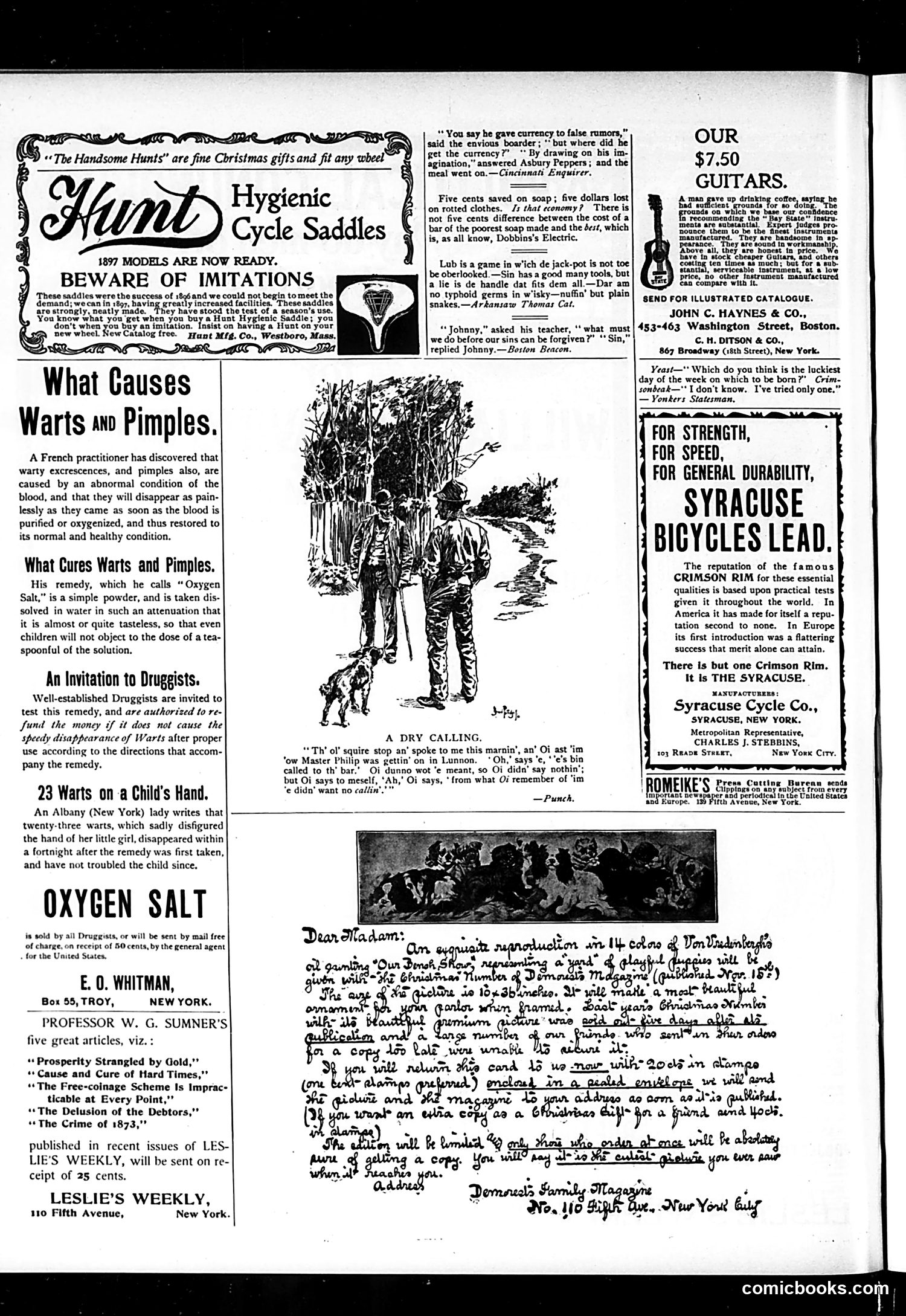
This page is primarily **advertising** with minimal editorial content. The advertisements include bicycle saddles, guitars, and patent medicines (notably "Oxygen Salt" for warts and pimples). The sole cartoon—titled "A Dry Calling"—depicts a street encounter between two figures with dogs. The dialogue references "Master Philip" and "Lunnon" (London), playing on cockney dialect for humor. The joke appears to be a pun about social standing or occupations ("dry calling"), though the specific satirical target is unclear from the image alone. The page also contains brief humorous anecdotes (attributed to newspapers like the *Cincinnati Enquirer* and *Boston Beacon*) on topics like false rumors, soap economy, and religious instruction—typical filler humor for late-19th-century magazines. The advertisements reflect 1890s consumer culture: bicycle saddles marketed as "hygienic," patent medicines promising medical cures, and musical instruments. Nothing here engages contemporary political issues.
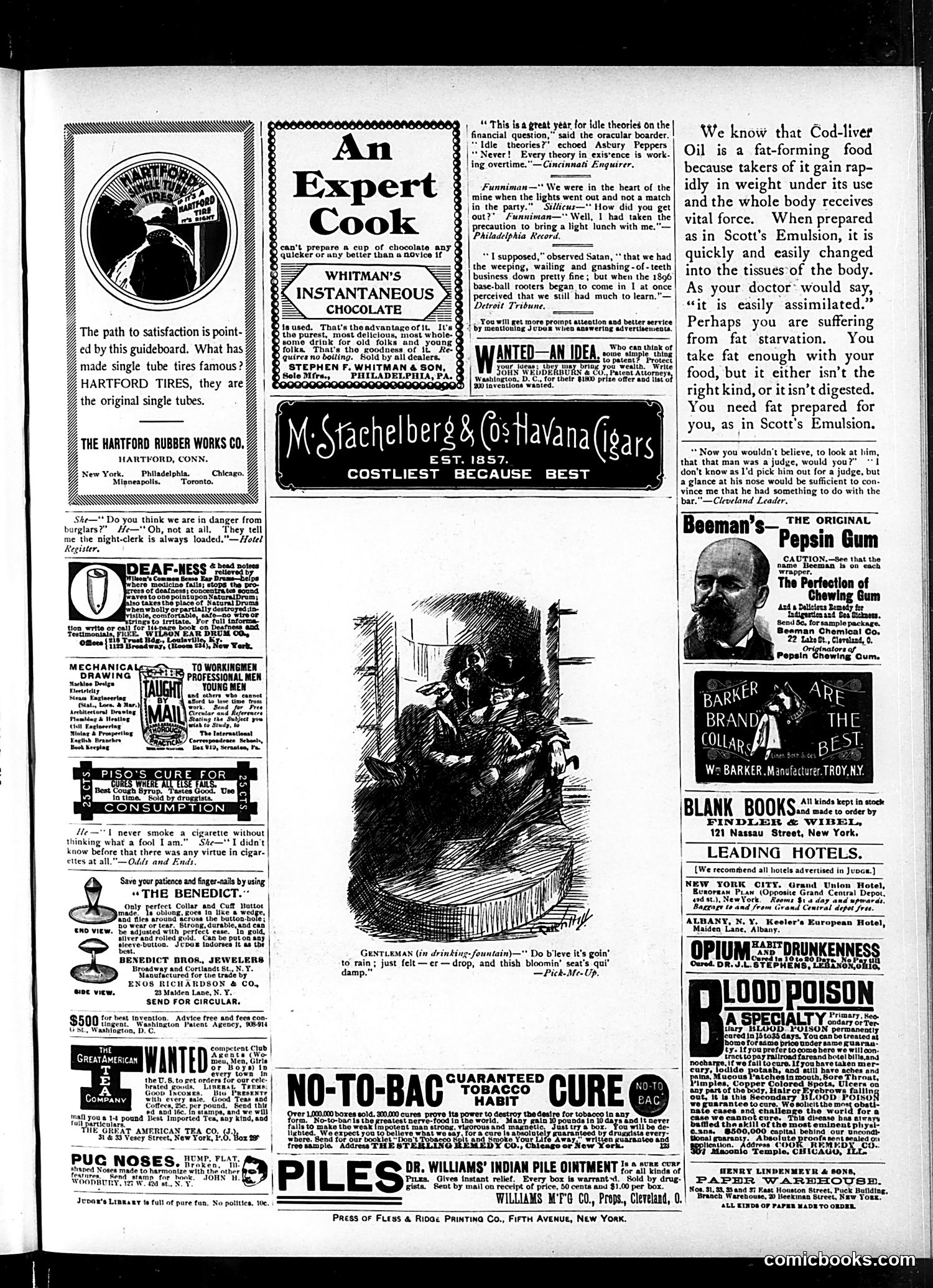
This page is primarily **advertising** with minimal editorial cartoon content. The dominant feature is a central sketch showing a gentleman at a drinking fountain, captioned with a joke about dropping something and the "bloomin' seat" being "quite damp"—a mild bathroom humor gag typical of the era. The page's main value lies in its **advertisements**, which reveal period concerns: remedies for piles, consumption cures, tobacco-habit treatments, and "blood poison" tonics. These ads reflect late-19th/early-20th-century anxieties about health and morality. Two brief **text jokes** appear discussing baseball fans in Hell and financial theories, representing Judge's typical light satirical fare mocking contemporary obsessions. The **Hartford Tires ad** claims originality, suggesting competitive tire manufacturing was a commercial battleground. Overall, this is a representative Judge page balancing modest humor with substantial advertising revenue—characteristic of American humor magazines' business model of the period.
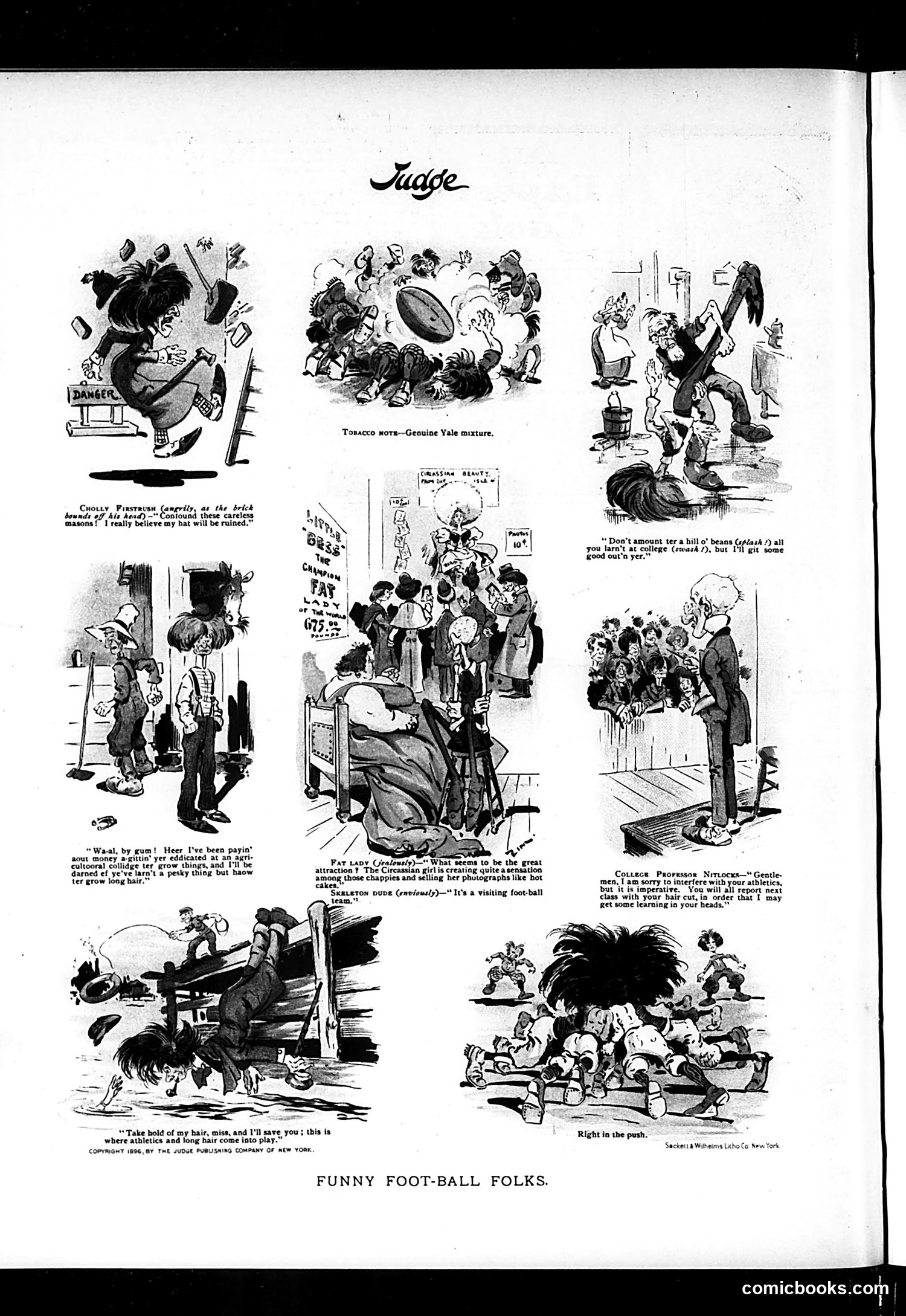
This page from *Judge* magazine presents humorous cartoons satirizing college football culture. The sketches mock various aspects of the sport and its participants circa the 1880s-1890s. The cartoons ridicule: - Dangerous playing conditions and injuries ("Danger") - Tobacco use and "genuine Yale mixture" - Excessive fan enthusiasm and chaos around games - The absurdity of college athletes' behavior - Class pretensions (references to "College Professor") The humor targets both players' recklessness and spectators' overwrought reactions. One sketch references Yale specifically, suggesting these are contemporary college football scandals. The overall tone mocks football as chaotic and barbaric—a common satirical theme during football's early, rougher era when the sport faced serious criticism for brutality and deaths.