
A complete issue · 16 pages · 1896
Judge — September 26, 1896
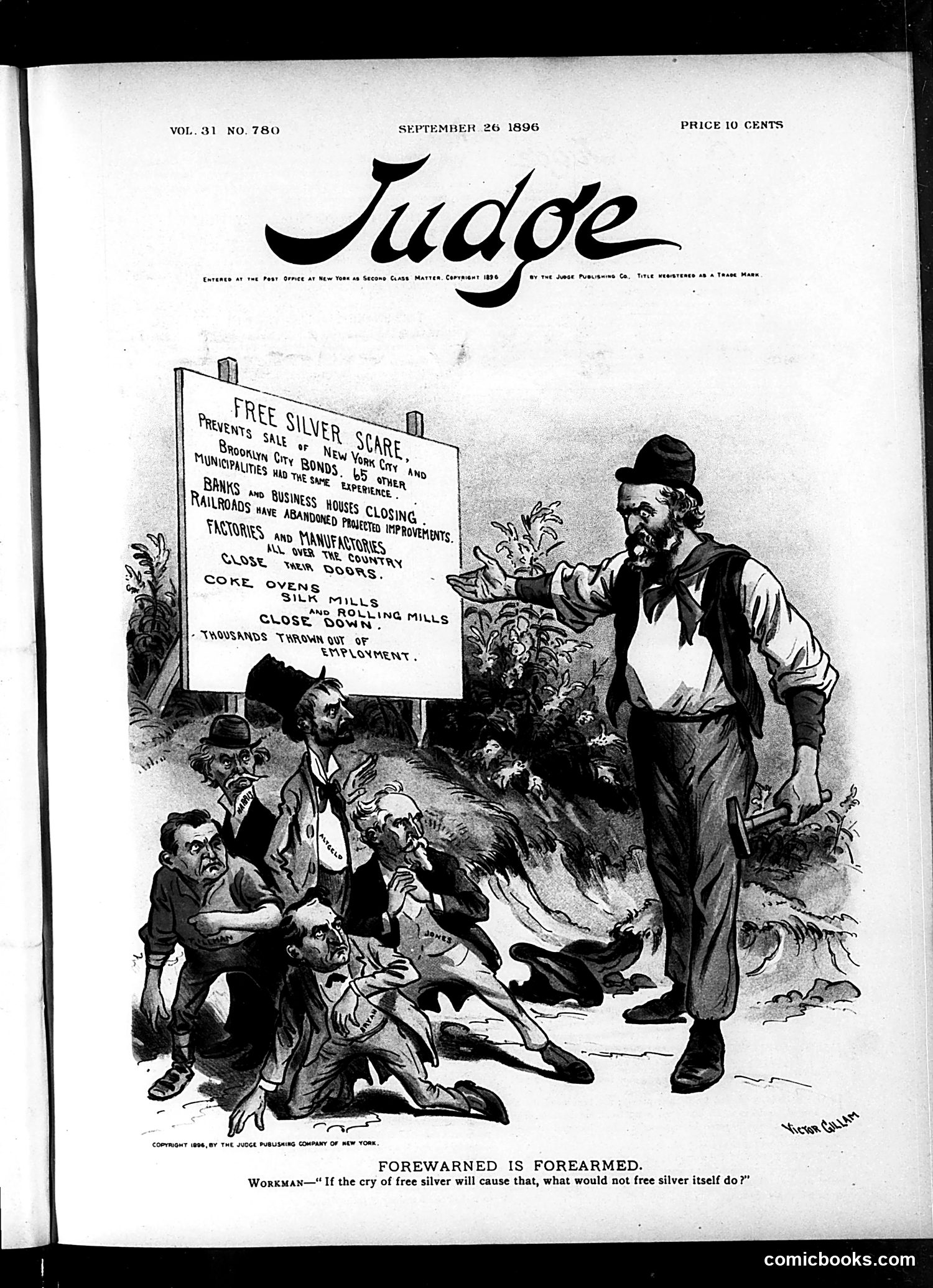
**Date & Context:** September 26, 1896 — during the heated U.S. presidential campaign over monetary policy. **The Satire:** A tall figure (likely representing a politician or advocate) displays a warning sign to distressed workers listing catastrophic consequences of "free silver" — bank closures, factory shutdowns, unemployment, and economic collapse affecting New York City and municipalities. **The Point:** The cartoon mocks fear-mongering about free silver (unlimited silver coinage), a major 1896 campaign issue. The "forewarned is forearmed" caption sarcastically suggests this warning poster is meant as advance preparation. The suffering workers depicted suggest the cartoon questions whether such warnings are justified or merely scare tactics by opponents of free silver currency. **Artist:** Victor Gillam (signed lower right).
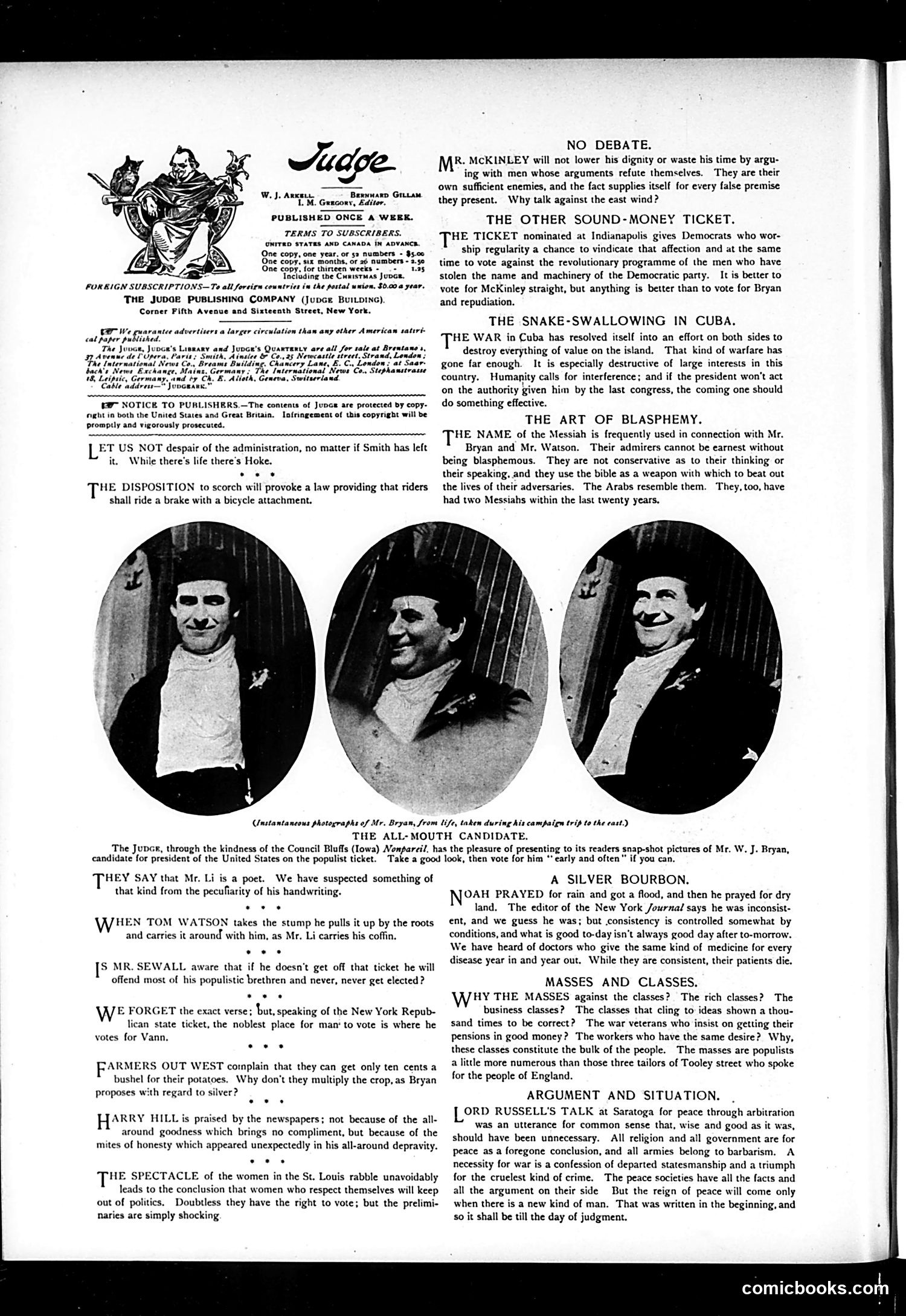
This page from *Judge* magazine contains several political opinion pieces rather than cartoons. The main targets appear to be: **W.J. Bryan** - Multiple articles mock Bryan's presidential campaign, calling him "the all-mouth candidate" and sarcastically praising his speaking abilities while questioning his policy substance. **McKinley** - Defended against critics, with text suggesting McKinley shouldn't "lower his dignity" arguing with opponents. **The 1900 Election** - References to voting choices and Bryan versus McKinley frame the political debate of that era. The pieces use satirical ridicule as their primary tool—mocking Bryan's oratorical reputation while defending the incumbent McKinley administration. The tone is sharply partisan, typical of *Judge's* Republican-leaning editorial stance during this period.
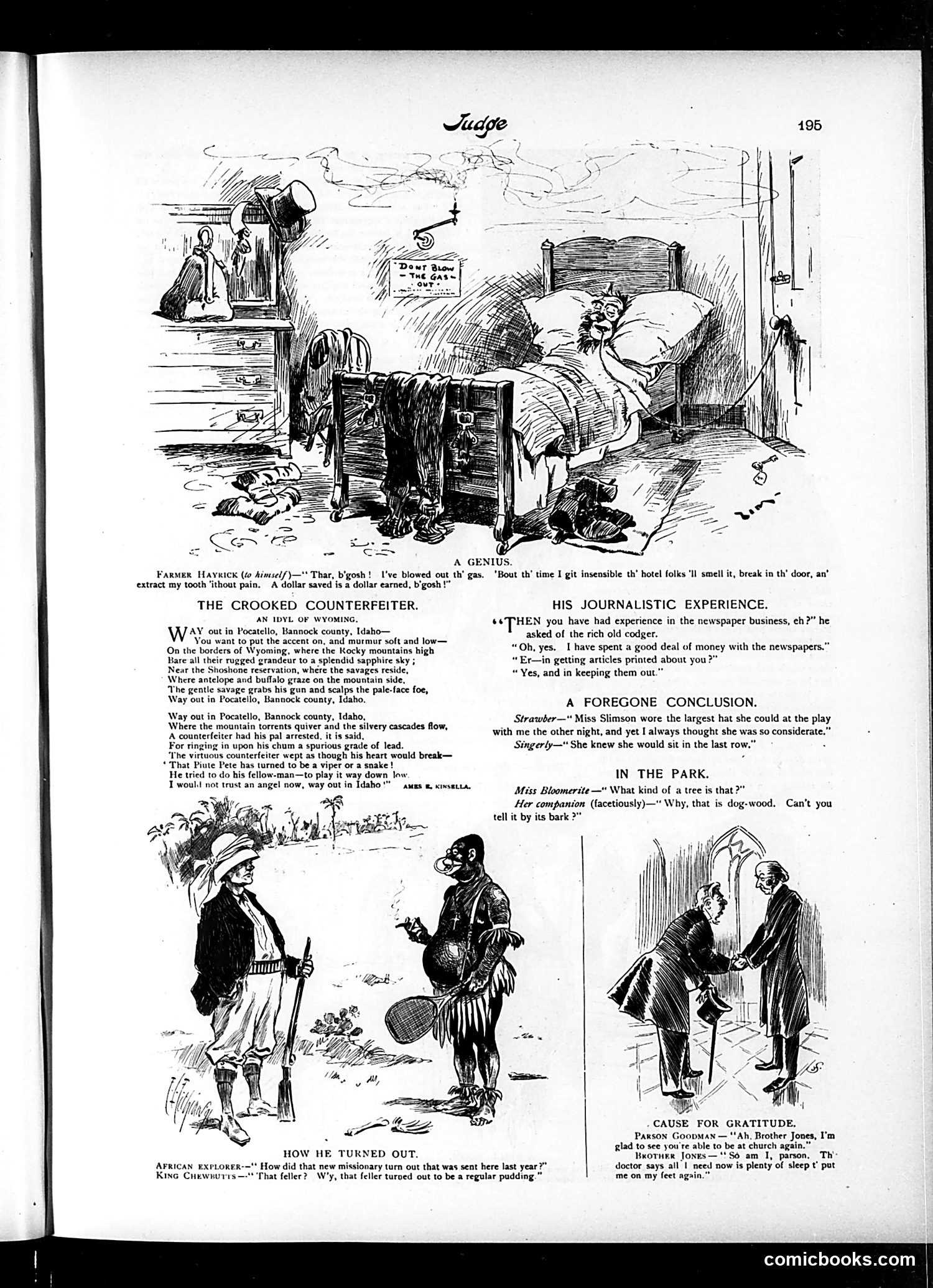
This page contains multiple unrelated humorous sketches typical of Judge's format. The top illustration, "A Genius," depicts a bearded man in bed claiming he's "blooded out in ye gin" but only gets "insensible th' hotel folks" to notice—satirizing self-important braggarts. "The Crooked Counterfeiter" tells of an Idaho counterfeiter arrested for forging lead into gold coins, with the ironic punchline that he'd "not trust an angel now" in Idaho—mocking frontier lawlessness. Lower sketches include "His Journalistic Experience" (about newspaper waste), "A Foregone Conclusion" (theater gossip), "In the Park" (a botanical joke about dog-wood), and "How He Turned Out" (missionary humor). These are gentle, society-focused gags rather than hard political satire.
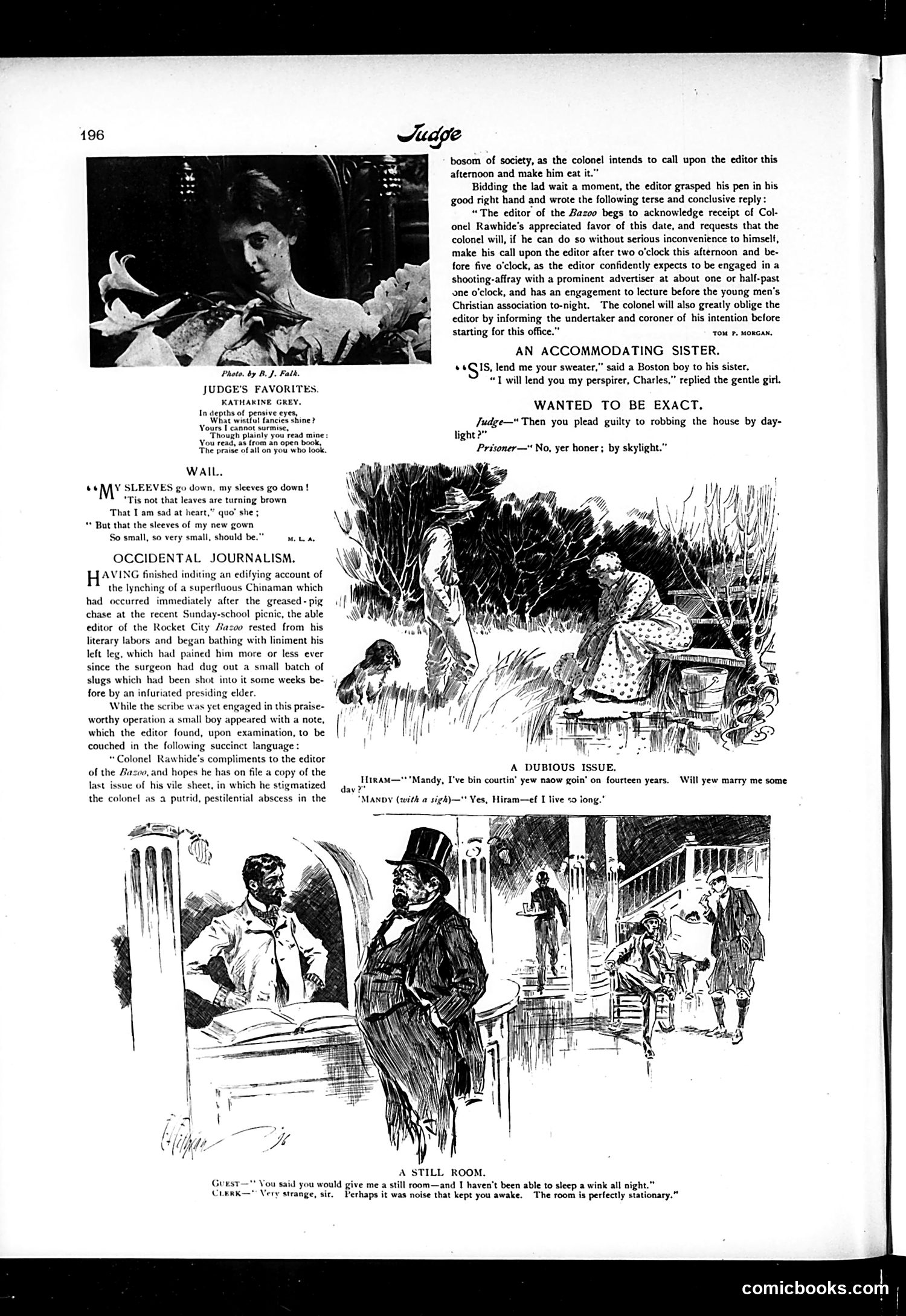
This page contains several unrelated jokes typical of Judge's satirical format: **"Occidental Journalism"**: A frontier editor of the *Bazoo* receives a threatening note from "Colonel Rawhide" demanding a retraction. The editor coolly responds that he's busy with a "shooting-affray" and a lecture, sarcastically asking the colonel to inform the undertaker first. The satire mocks both frontier violence and the brash newspaper culture of the American West. **Other jokes** include wordplay ("perspirer" vs. "perspire," "skylight" burglary), puns about sleeve length, and a final gag about a "still room" (quiet room) being "perfectly stationary" despite the guest's sleeplessness. The cartoons feature ink sketches of domestic and social scenes. Overall, the page reflects late-19th/early-20th-century American humor—crude, pun-heavy, and focused on class interactions and frontier stereotypes.
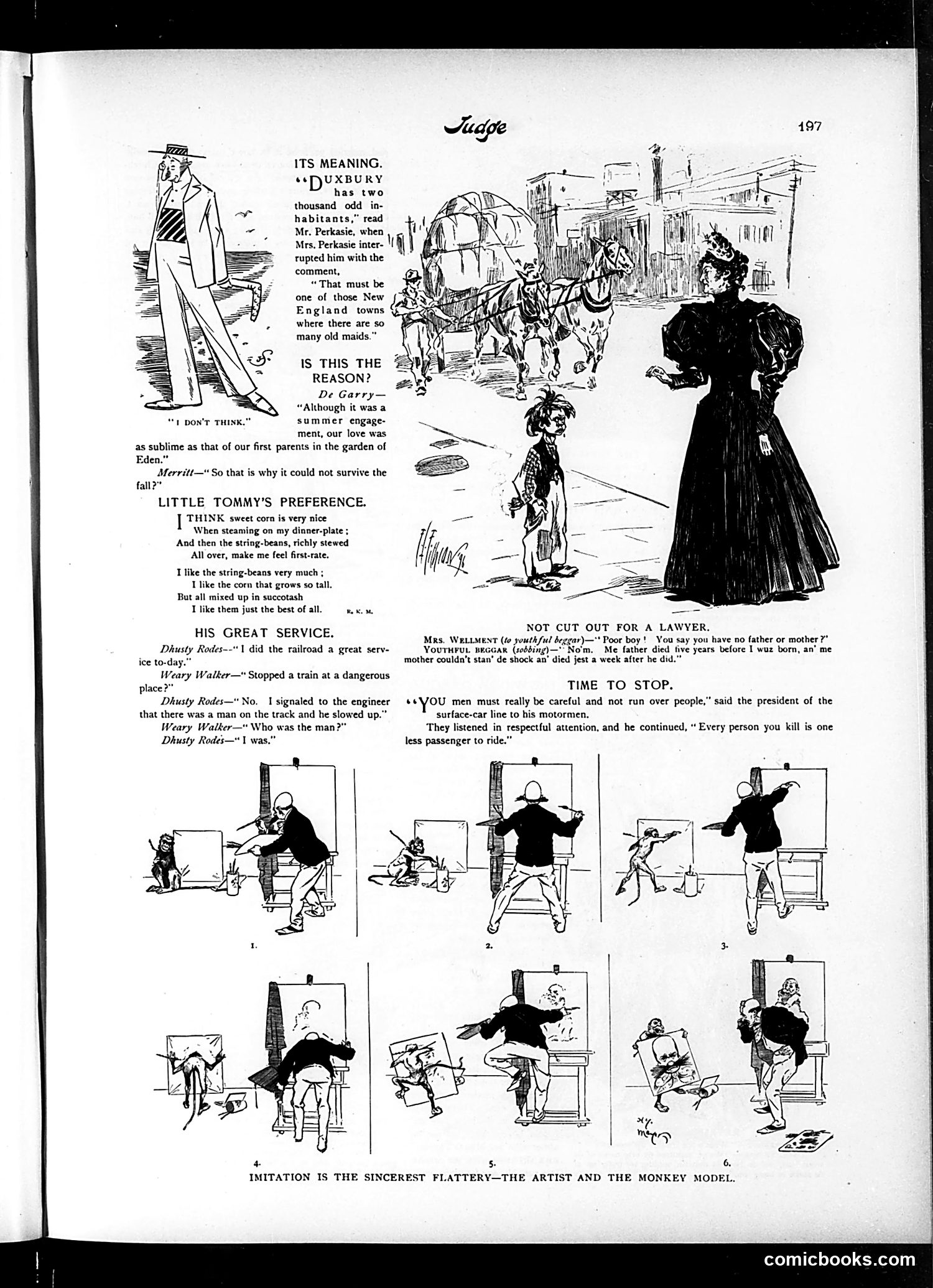
This page contains multiple brief satirical jokes typical of early 20th-century humor magazine format: **Main content includes:** - **"Its Meaning/Duxbury"**: A joke about a New England town with many unmarried women, playing on period stereotypes about provincial life. - **"Is This the Reason?"**: A pun on the Eden/Fall narrative—lovers' summer romance fails like Adam and Eve's paradise. - **"Little Tommy's Preference"**: A child's poem about preferring mixed vegetables (succotash) to individual ones—innocent domestic humor. - **"His Great Service"**: Dark humor about a vagrant stopping a train to save himself from being hit, framing self-preservation as altruism. - **"Not Cut Out for a Lawyer"**: An absurdist joke—a beggar's claim his father died before he was born is logically impossible, suggesting he'd make a poor lawyer. - **"Time to Stop"**: Grim satire on streetcar safety: a transit company president cynically notes fewer deaths mean fewer paying passengers. The page showcases Judge's mix of domestic comedy, wordplay, and darker social commentary about class and industrial-age concerns.
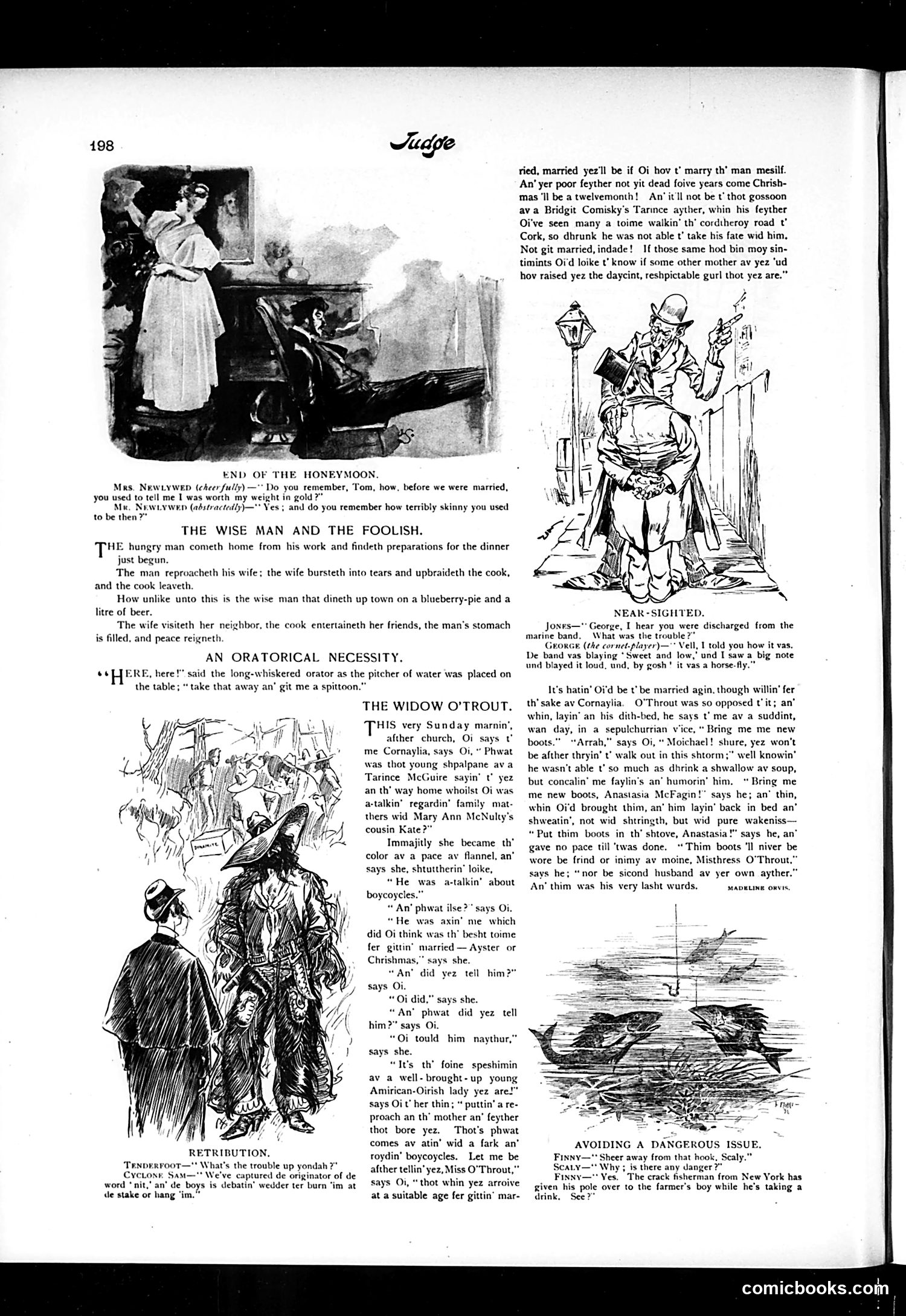
This page contains several satirical sketches on marriage and social behavior: **"End of the Honeymoon"** mocks the disillusionment of marriage—the wife recalls being called "worth her weight in gold" before marriage; the husband retorts she was "terribly skinny" then. The joke inverts romantic flattery into practical complaint. **"The Wise Man and the Foolish"** contrasts two approaches to domestic discord. One husband complains about late dinner, causing chaos; the "wise man" simply dines downtown on cheap food, allowing household peace. It's sardonic advice prioritizing marital harmony through avoidance. **"An Oratorical Necessity"** briefly satirizes verbose public speakers who demand spittoons—mocking their pretension and oral excess. **"The Widow O'Trout"** uses heavy Irish dialect to depict a widow interrogating her daughter about a suitor's intentions regarding marriage timing. It appears to mock Irish-American speech patterns and family protective anxieties, representing a period when such caricatures were considered acceptable humor. The sketches reflect Victorian-era anxieties about marriage disappointment and domestic management.
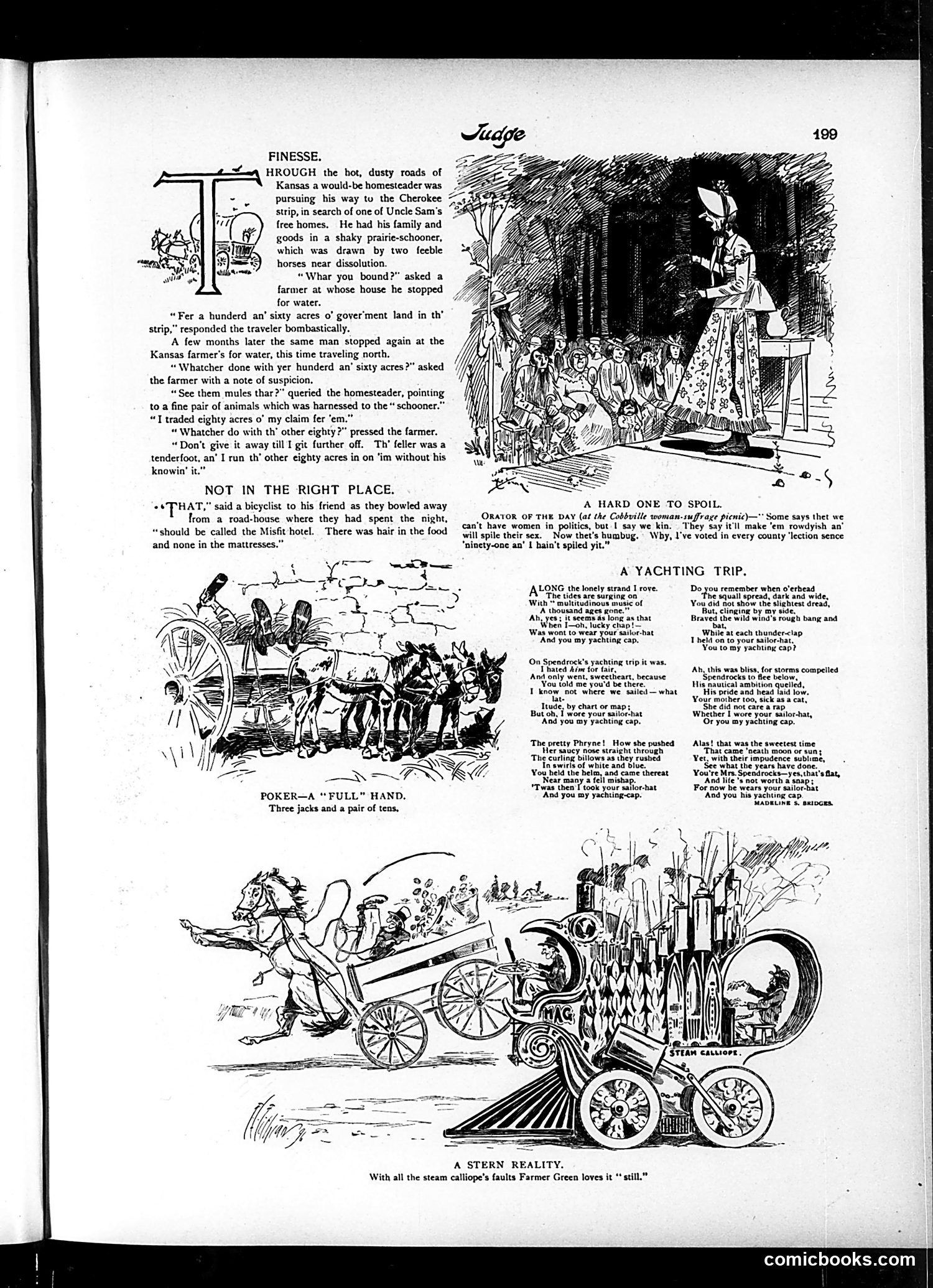
This page contains three distinct satirical pieces from an American humor magazine: **"Finesse"** mocks homesteaders moving westward during the Oklahoma Land Run era. A con artist trades 80 acres of his government claim for mules, then fraudulently trades his remaining 80 acres to a naive "tenderfoot" without the man's knowledge—illustrating frontier dishonesty dressed up as shrewd dealing. **"Not in the Right Place"** is a brief joke about a roadside hotel's poor hygiene and service standards. **"A Yachting Trip"** is a sentimental poem about lost romance—a couple who wore each other's sailor hat and yachting cap during a seaside courtship. Years later, married to wealth (Mr. Spendrocks), the narrator laments that romantic spontaneity has vanished, replaced by social propriety. **"A Stern Reality"** (bottom) shows a farmer contentedly operating a steam calliope despite its mechanical failures—gentle mockery of rural attachment to modern technology. The page reflects turn-of-century American preoccupations: westward expansion fraud, class anxiety, and nostalgia for lost innocence amid industrial progress.
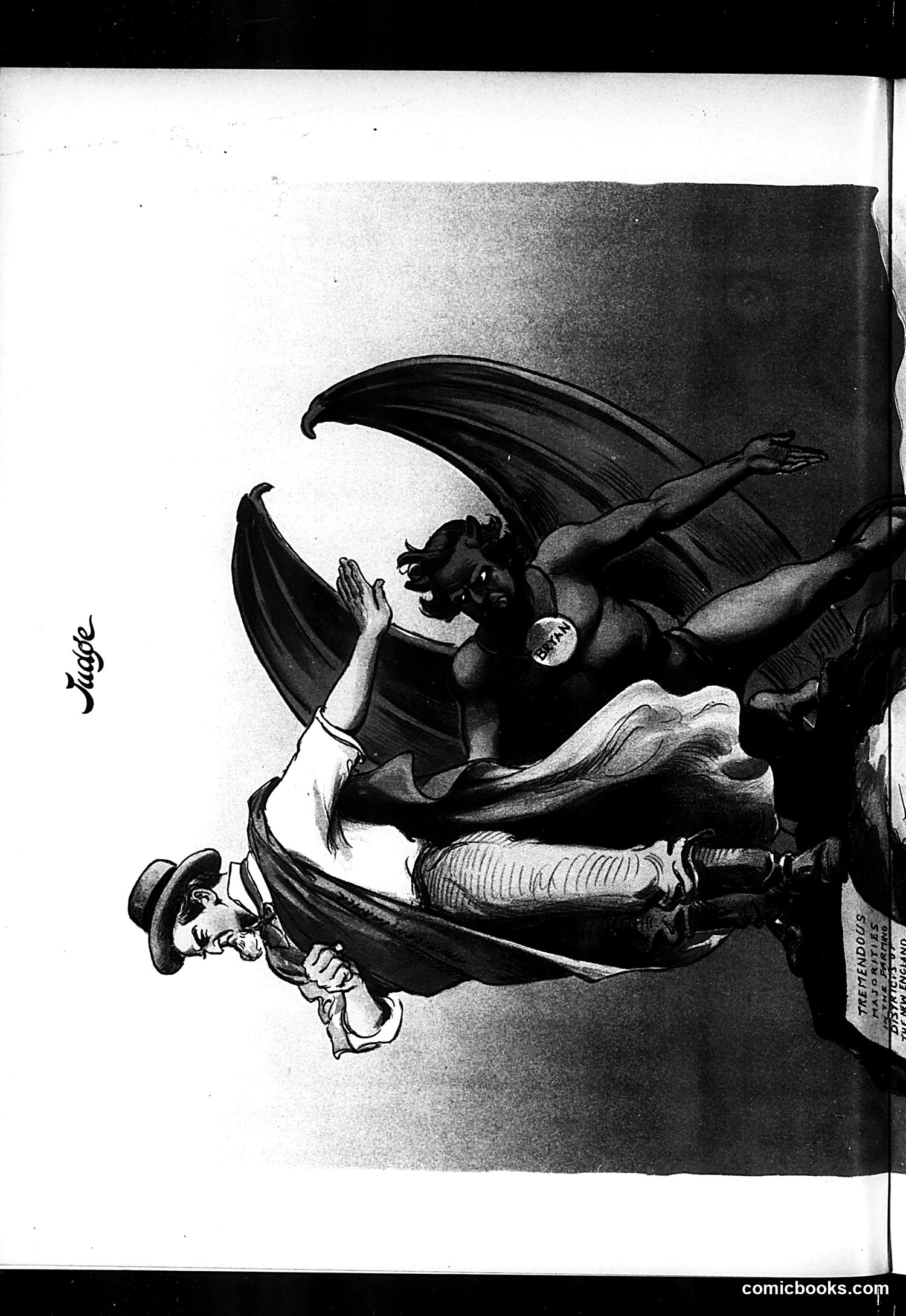
This black and white cartoon depicts a winged demon or devil figure menacing a small man in a top hat. The demon has large bat wings and an aggressive posture, while the human figure appears defensive or frightened below. The signature "Judge" appears on the left side. Given Judge magazine's satirical nature, this likely represents a political commentary, with the demon symbolizing some threatening force—possibly a political opponent, economic threat, or social ill—confronting an establishment figure (suggested by the top hat, indicating wealth or authority). However, without a visible caption, date, or clearer contextual text, I cannot definitively identify the specific political figures or historical event being satirized. More information would be needed for accurate interpretation.
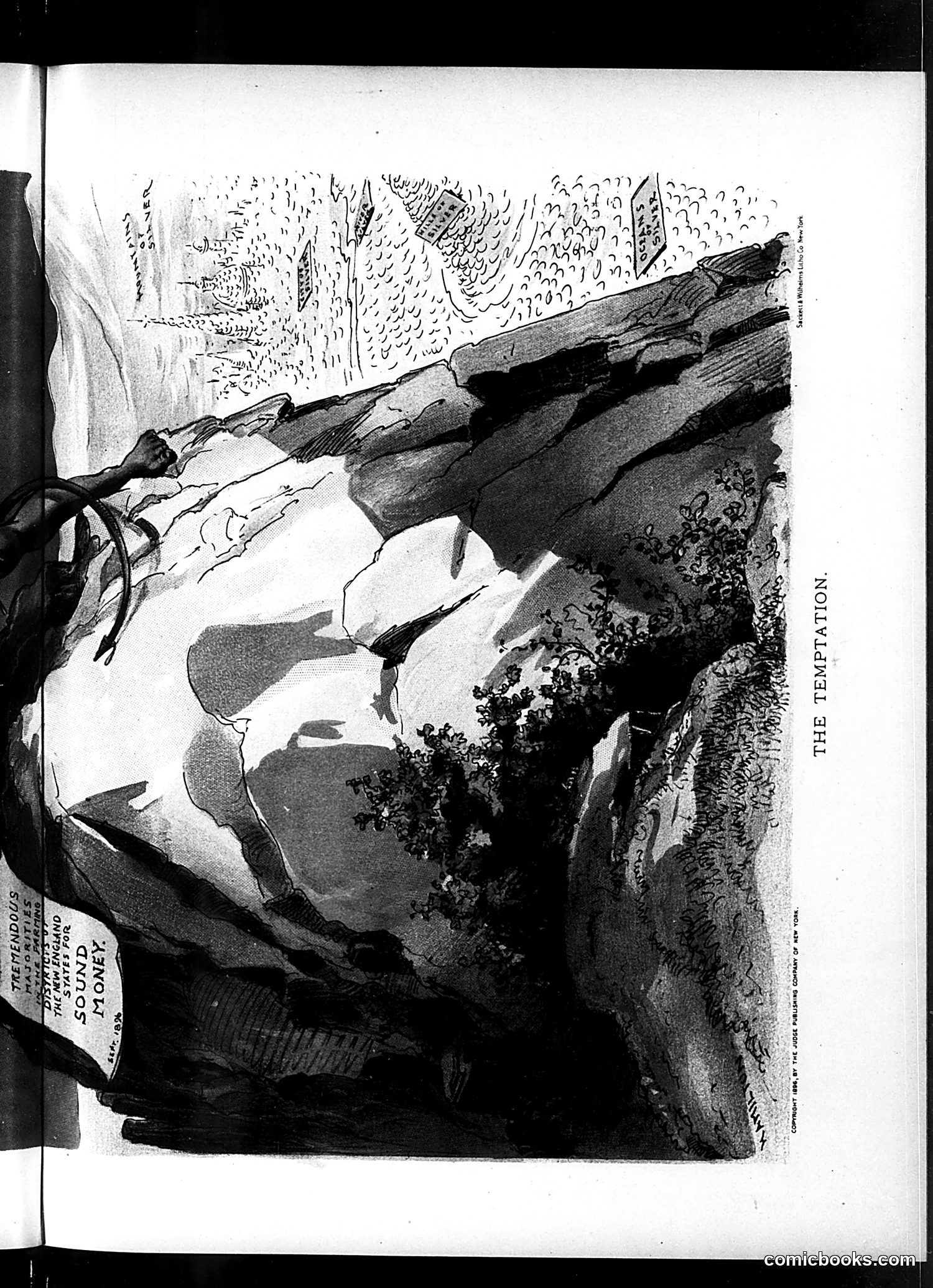
This page appears to be primarily a title/credits page from Judge magazine (copyright 1886). The OCR'd text is largely corrupted and unreadable, making it difficult to identify specific content. The image shows what appears to be a landscape illustration rotated 90 degrees, depicting rocky terrain with vegetation and possibly a figure. The caption reads "THE TEMPTATION," though the full context and satirical meaning are unclear from this reproduction. Without legible text or clearer context, I cannot reliably identify which political figures or social issues this cartoon addresses. The 1886 date places it in the Gilded Age, but determining the specific satire requires text I cannot accurately read.
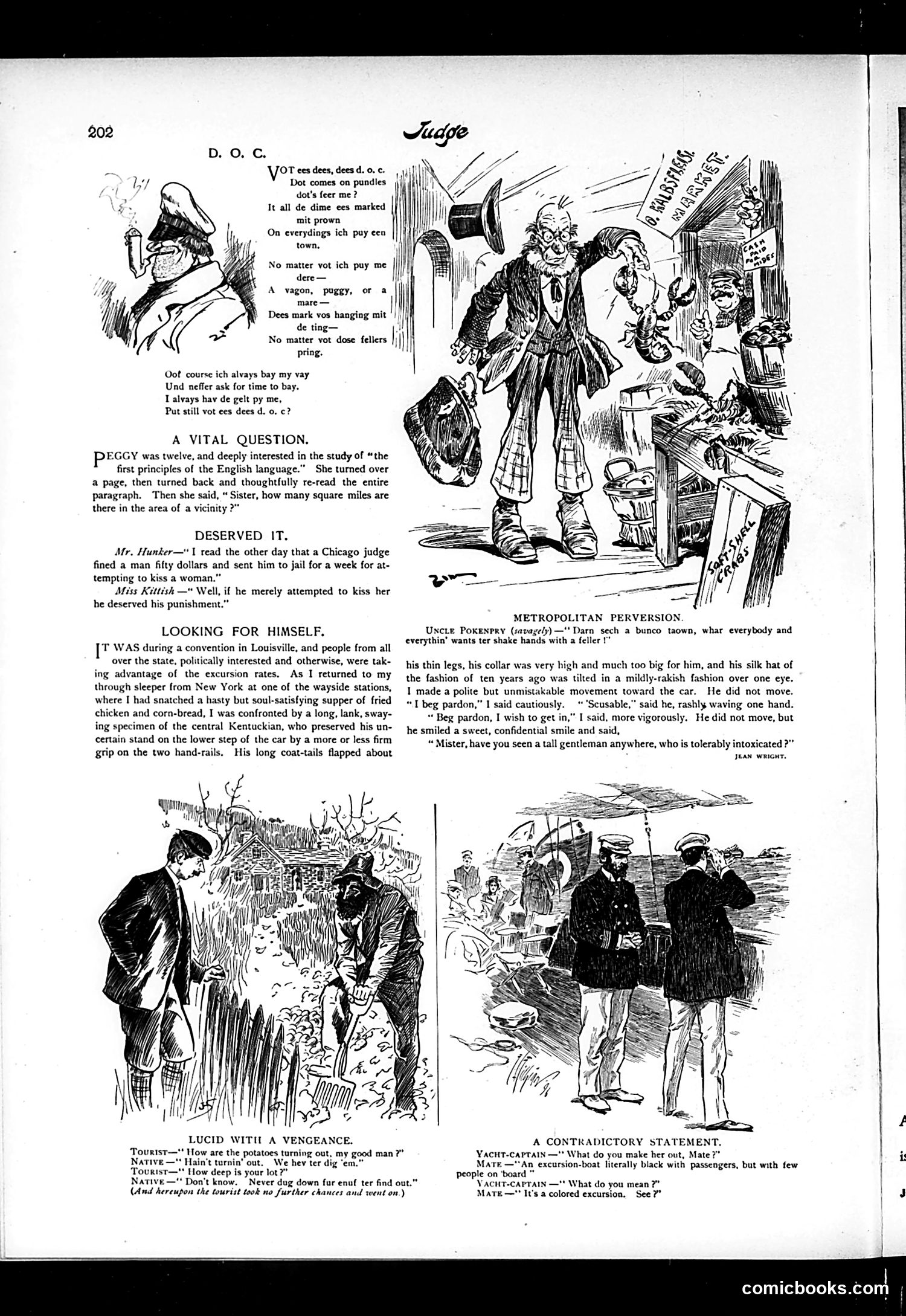
This page contains several satirical pieces targeting ethnic stereotypes and social absurdities common to early 20th-century American humor. **"D.O.C." poem**: Features a thick German-Jewish immigrant accent complaining about mysterious "D.O.C." marks appearing on everything he purchases in town. The satire mocks both the immigrant's confusion and xenophobic anxieties about marked goods. **"A Vital Question"**: A child's logic joke—the girl misinterprets "vicinity" as a measurable area, poking fun at linguistic confusion. **"Deserved It"**: Dark humor about a man jailed for attempted kissing; the woman's harsh response suggests victim-blaming. **"Looking for Himself"**: A drunk Kentucky farmer stumbles off a train, speaking in exaggerated rural dialect. The tourist's polite attempts to board fail against the man's oblivious rambling. **"Lucid with a Vengeance"**: A tourist's question about potatoes produces literal, nonsensical answers from a rural native, satirizing rural "stupidity." **Bottom cartoons**: The "colored excursion" joke relies on racial segregation-era assumptions about Black passengers and boat capacity. The page uses heavy dialect and stereotypes as its primary comedic device.
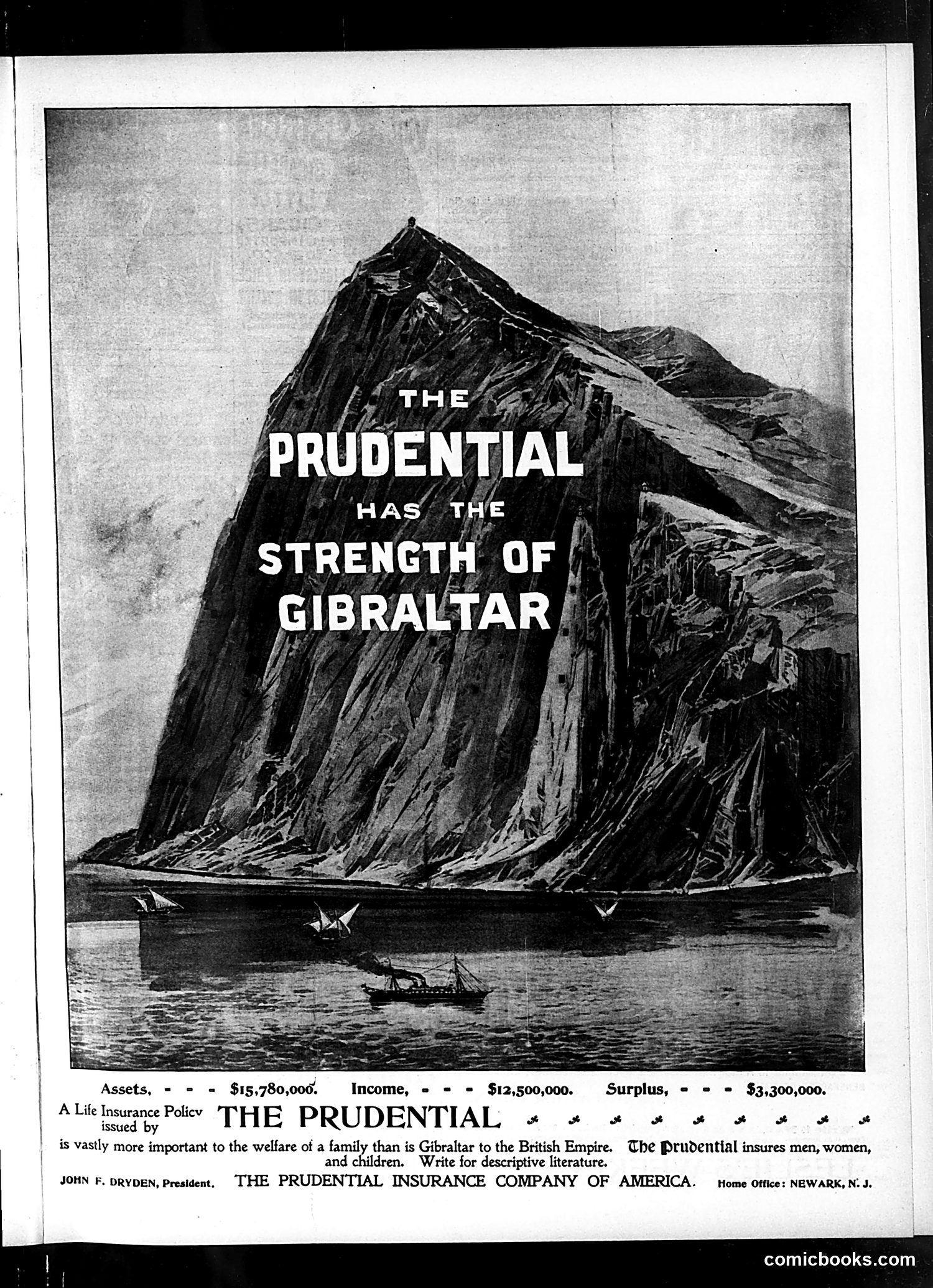
This is primarily a **full-page advertisement** for The Prudential Insurance Company, not political satire. The image shows the Rock of Gibraltar, a strategic British military stronghold. The ad's central claim compares Prudential's importance to families with Gibraltar's importance to the British Empire—suggesting life insurance is equally essential and fortified. The financial figures ($15.78M assets, $12.5M income, $3.3M surplus) establish the company's stability and trustworthiness. The rhetoric appeals to American audiences by implicitly positioning Prudential as a "rock-solid" protector of domestic welfare, mirroring Britain's military security. This is straightforward commercial messaging rather than satire, using patriotic/imperial imagery to sell insurance to "men, women, and children." President John F. Dryden is identified as the company's leader.
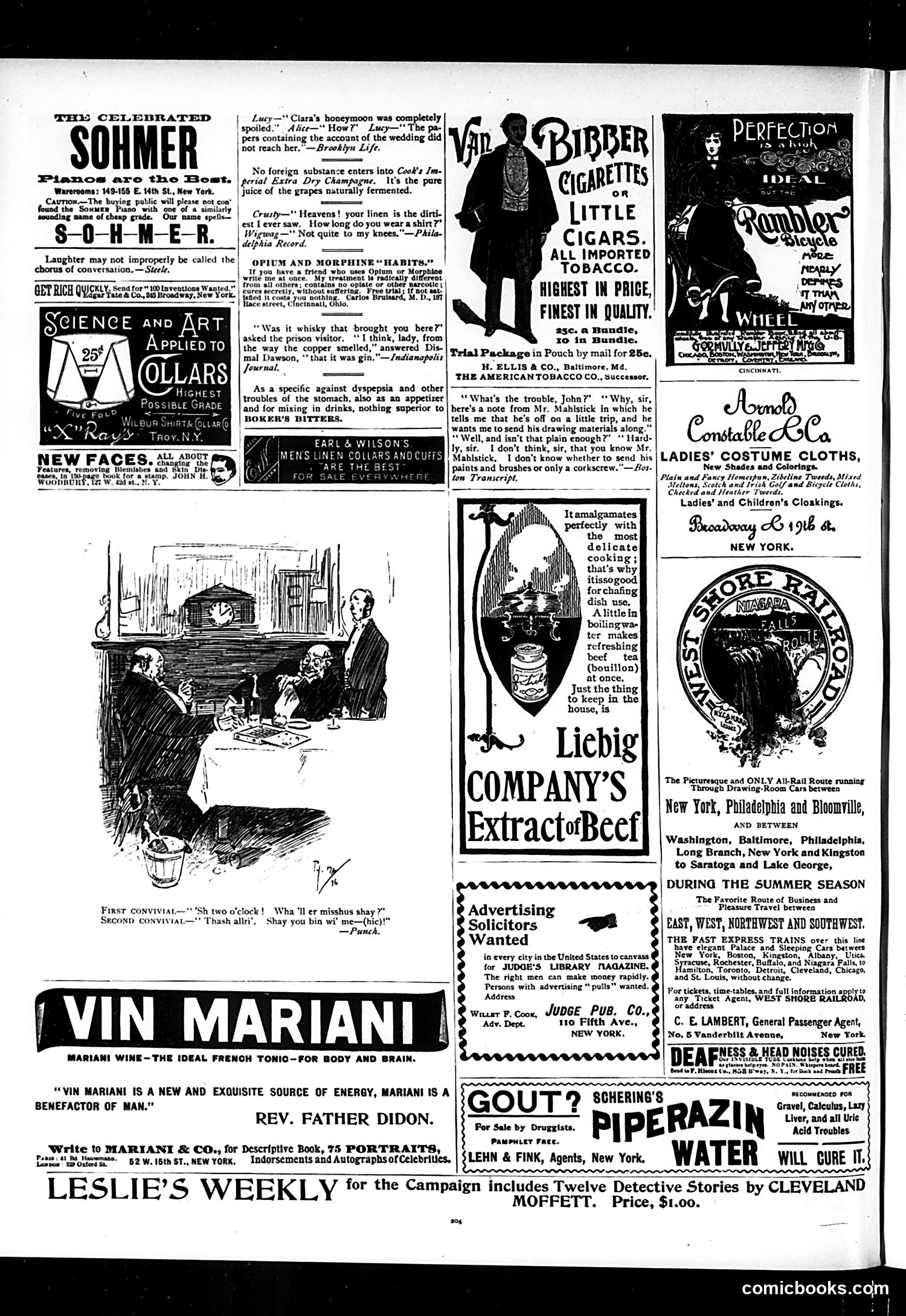
This page is primarily **advertising** with minimal editorial content. The few cartoons present are brief, genteel jokes typical of early 20th-century humor magazines. The visible cartoon shows two drunk men in conversation, with one asking "What'll er misshus say?" (What will your wife say?) and the other replying he's been with "me—(hic)!" — the "hic" being a written hiccup sound. This is straightforward domestic humor about inebriation, requiring no political context. The textual "jokes" scattered throughout are equally mild: one about a honeymoon spoiled by missing newspaper coverage, another about dirty laundry, a prison visitor's quip about whisky. These represent Judge's house style of genteel, safe humor aimed at middle-class readers. The page is dominated by advertisements for pianos, champagne, collars, cigars, patent medicines (including the now-notorious Vin Mariani wine with cocaine), and railroad services—reflecting the commercial nature of early periodicals.
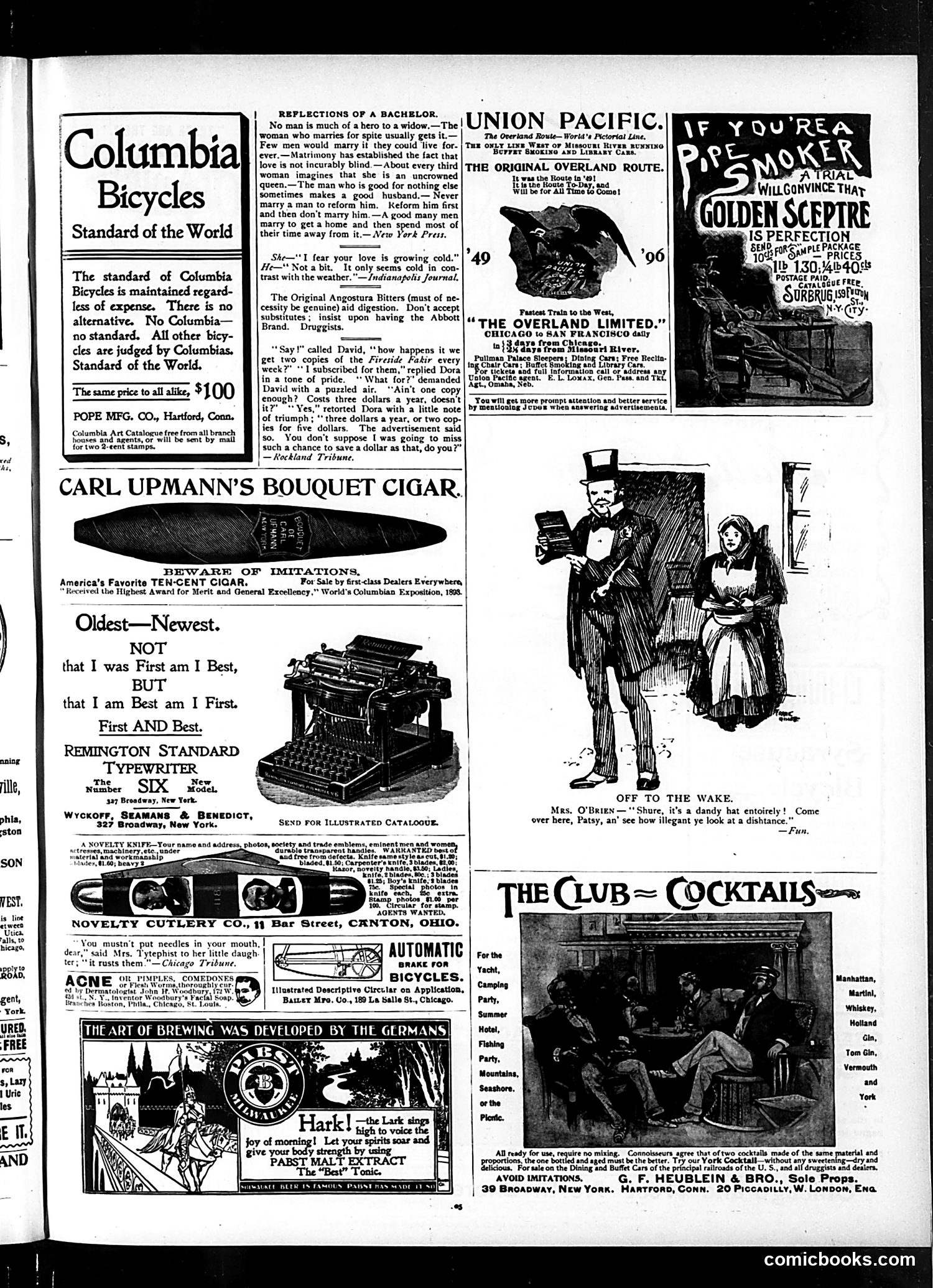
This page is primarily **advertising**, typical of Judge magazine's revenue model. The satirical content is minimal: **"Reflections of a Bachelor"** (top left) presents cynical one-liners about marriage and women—common era humor mocking matrimony as burdensome. The underlying attitude reflects turn-of-century misogyny: women are depicted as scheming, materially motivated, or foolish. **The cartoon "Off to the Wake"** (right side) shows a man in formal dress with a woman, with dialogue about a "dandy hat entirely." The Irish brogue ("Shure") suggests ethnic humor targeting Irish-Americans, stereotyping them as working-class and unfamiliar with refined social conventions. The "wake" (funeral gathering) context implies unsophistication. The **bulk of the page** comprises advertisements for bicycles, cigars, typewriters, cutlery, beer, and railroads—standard period marketing using brand-name repetition and claims of superiority. These ads reveal consumer culture priorities of the 1890s-1900s. Overall, this represents Judge's formula: light satirical commentary on gender and class, wrapped around commercial messaging.
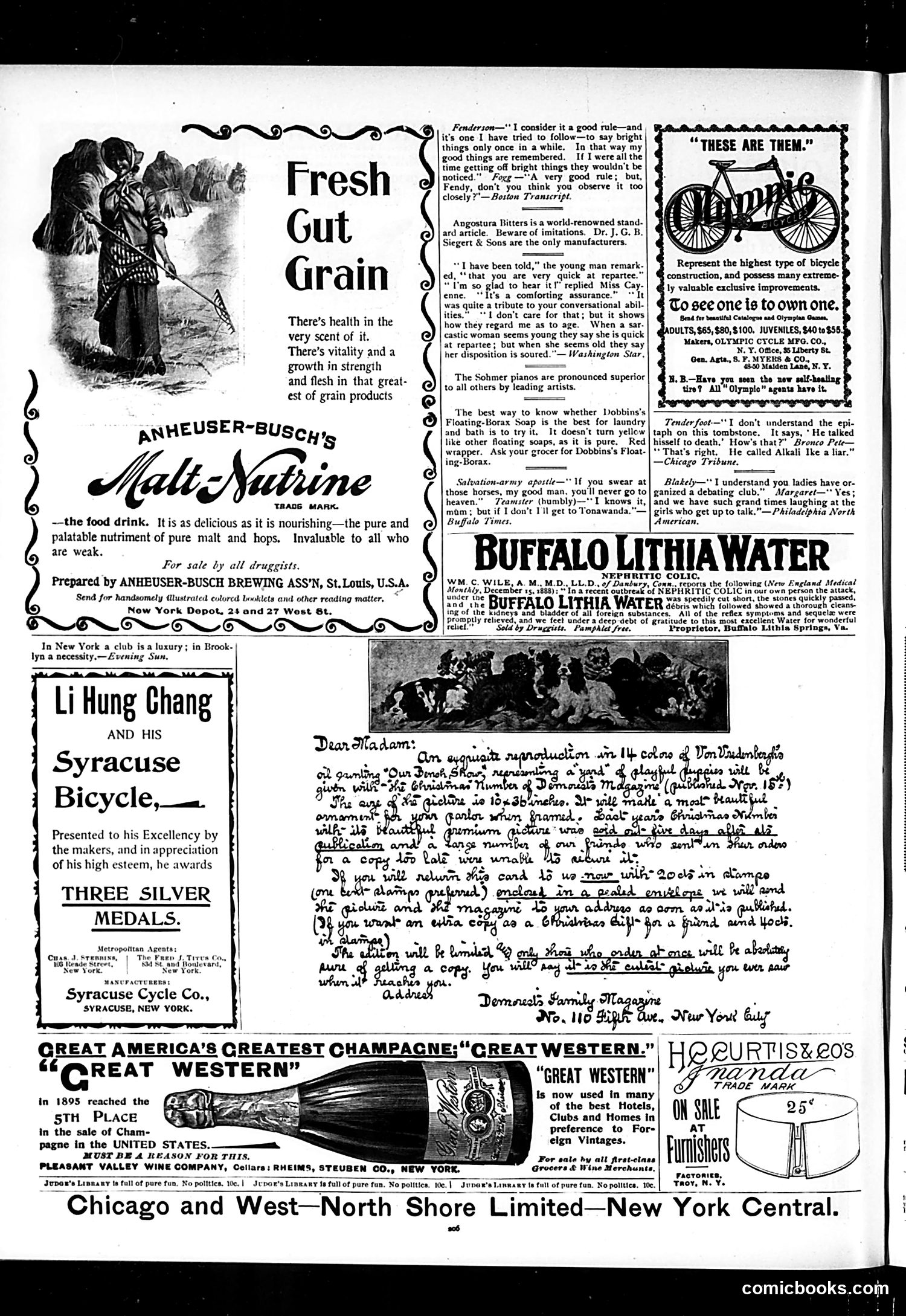
This page is primarily **advertising**, with brief comic vignettes interspersed. The main content includes: **Advertisements:** Anheuser-Busch's Malt Nutrine (grain beverage), Olympic bicycles, Buffalo Lithia Water (medicinal spring water), Syracuse bicycles, and "Great Western" champagne dominate the layout. **Comic Snippets:** Short jokes about conversation, repartee, and social behavior—typical Judge humor of the era. One joke references a Salvation Army officer and profanity; another involves a Western character named "Alkali Ike"; a third concerns a women's debate club. **Notable Item:** A handwritten letter to "Dear Madam" from *Domestic Family Magazine* (No. 116 Eight Ave., New York), discussing Christmas Number subscriptions—suggesting reader correspondence was featured. **Historical Context:** The page reflects Gilded Age concerns: patent medicines, emerging bicycle culture, and genteel social commentary. The Li Hung Chang bicycle reference (top left) likely alludes to the Chinese diplomat's 1896 American tour. The page is representative of late-19th-century magazine layout: dense, advertisement-heavy, with humor serving as filler between commercial pitches.
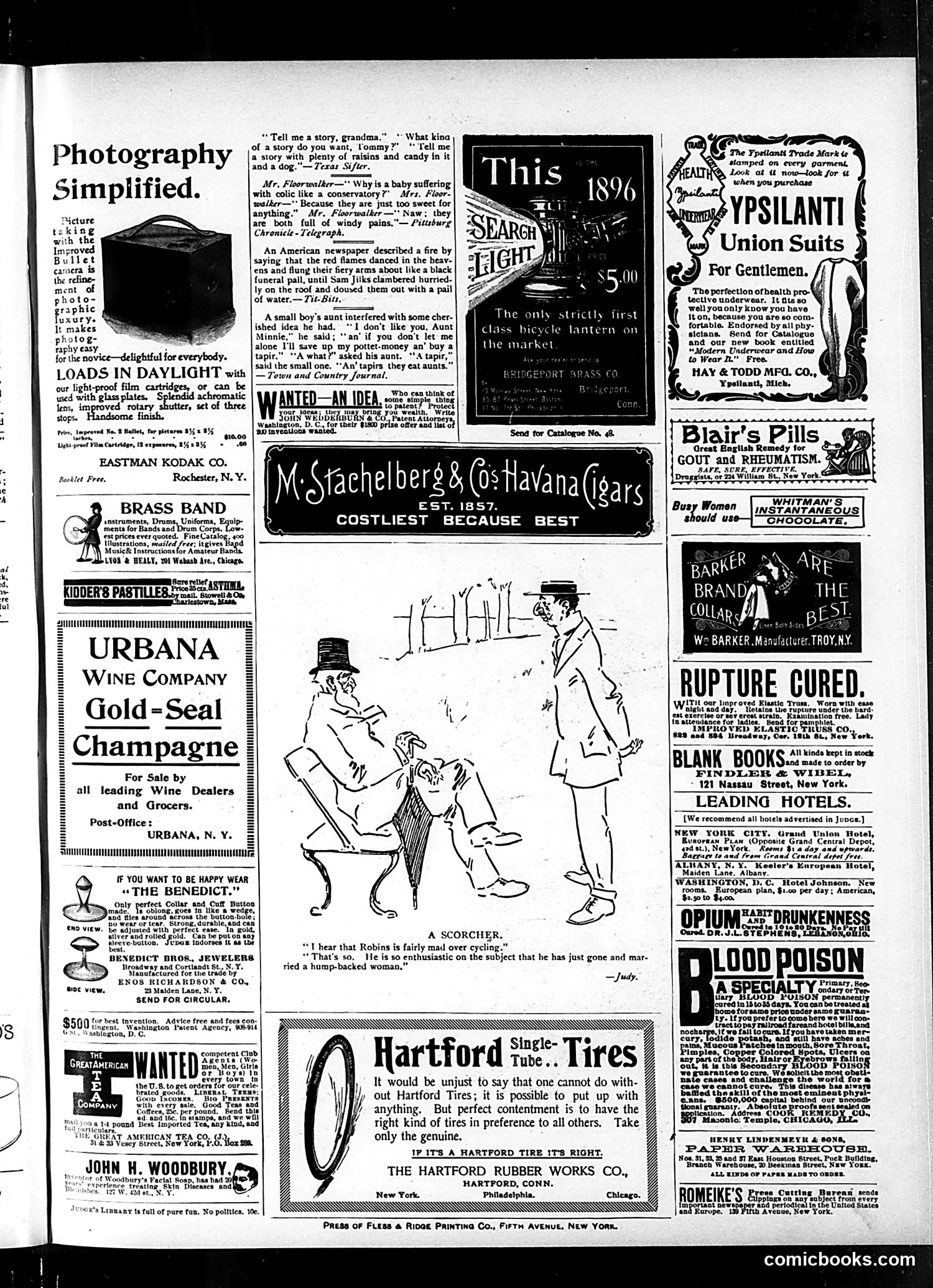
This cartoon illustrates a pun on the word "scorcher"—slang for someone who rides bicycles recklessly or with intense enthusiasm. The joke plays on the double meaning: a man named Robins is "fairly mad over cycling" (obsessed with bicycling), and the humor derives from the revelation that he's become *so* enthusiastic that he married a "hump-backed woman." The dark humor suggests the punchline: by marrying someone with a physical deformity, Robins has found a human "scorcher" or companion perfectly suited to his obsessive cycling lifestyle—presumably because riding a bicycle while hunched over resembles her posture. This reflects late-Victorian attitudes toward disability and marriage, using physical difference as the basis for crude comedy. The cartoon itself depicts two well-dressed men observing a hunched figure on a bicycle, visualizing the pun literally.
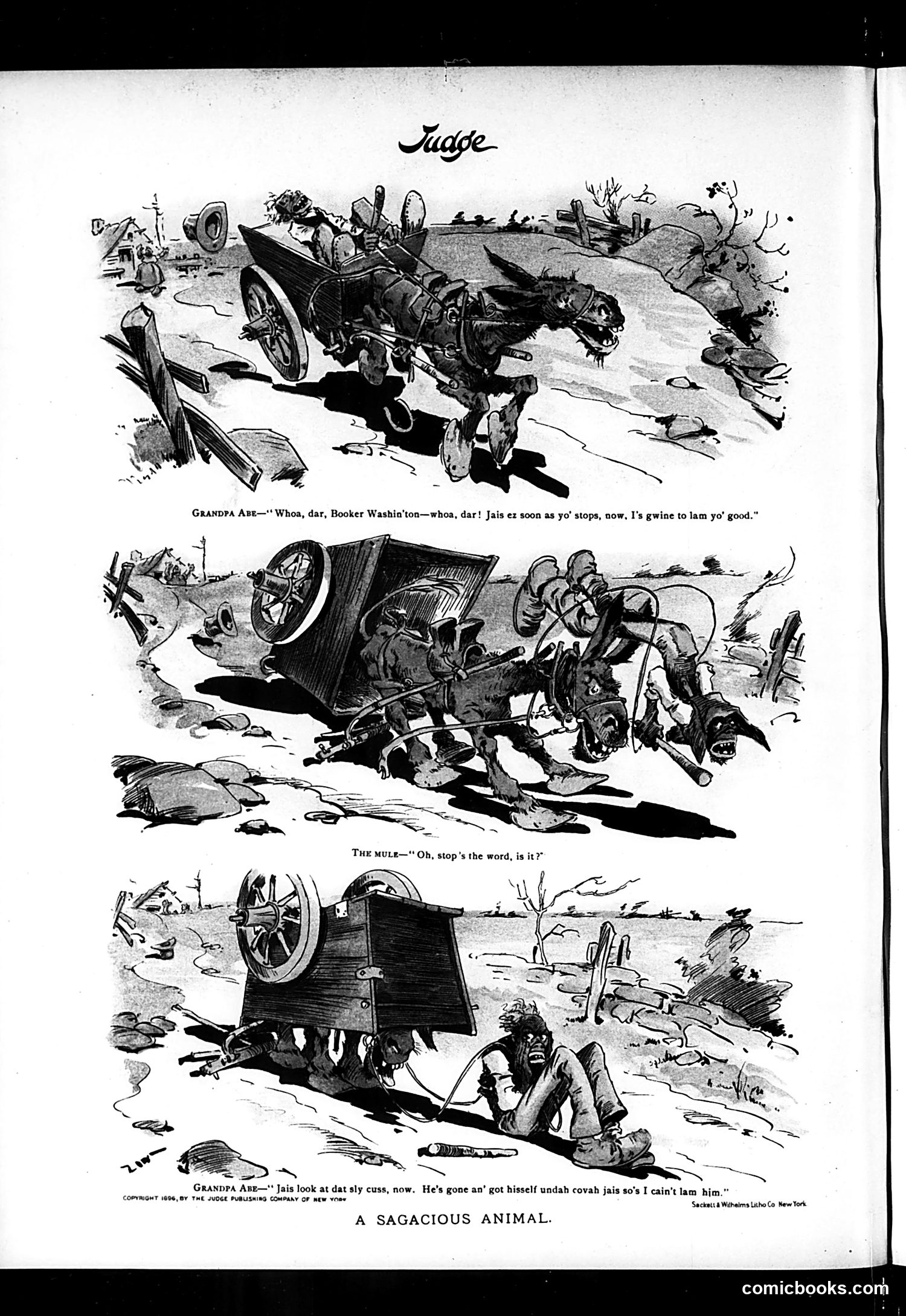
This is a three-panel comic strip titled "Judge" depicting an elderly man (labeled "Grandpa Abe") attempting to catch a mule. The mule repeatedly outwits him by hiding under a cart, prompting Grandpa's increasingly frustrated commentary in dialect. The humor relies on the mule's apparent intelligence—it "understands" when to hide to avoid being hit ("lammed"). The title "A Sagacious Animal" plays on this reversal, suggesting the animal is smarter than the man pursuing it. The dialect and rural setting suggest this targets early 20th-century American rural culture. Without additional context, the specific political satire remains unclear, though it may comment on stubbornness, foolishness, or the futility of human endeavors against nature.