
A complete issue · 16 pages · 1896
Judge — August 1, 1896
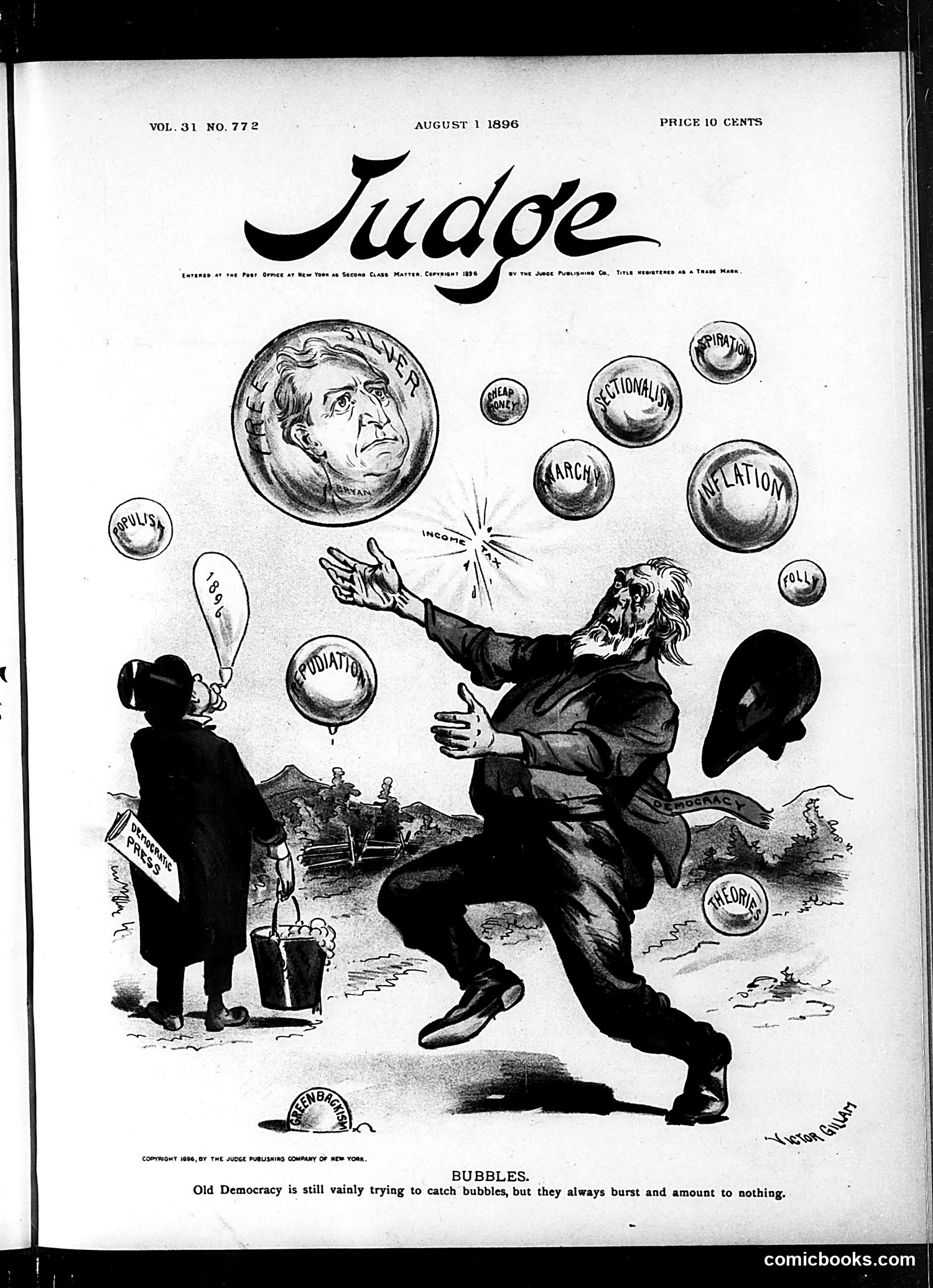
This Judge magazine cover from August 1, 1896 satirizes the Democratic Party's political struggles. The central caricatured figure—likely representing the Democratic establishment—frantically tries to catch floating bubbles labeled with various political movements and issues: Populism, Sectionalism, Inflation, Marchism (likely Marxism), Expansion, and others. A child on the left represents "Democratic Press." The caption states: "Old Democracy is still vainly trying to catch bubbles, but they always burst and amount to nothing." The satire suggests Democrats are chasing unstable, insubstantial political movements that collapse under scrutiny. This appears to reference the 1896 election era when the Democratic Party was fracturing over free silver and populism, struggling to maintain coherence amid competing ideological pressures.
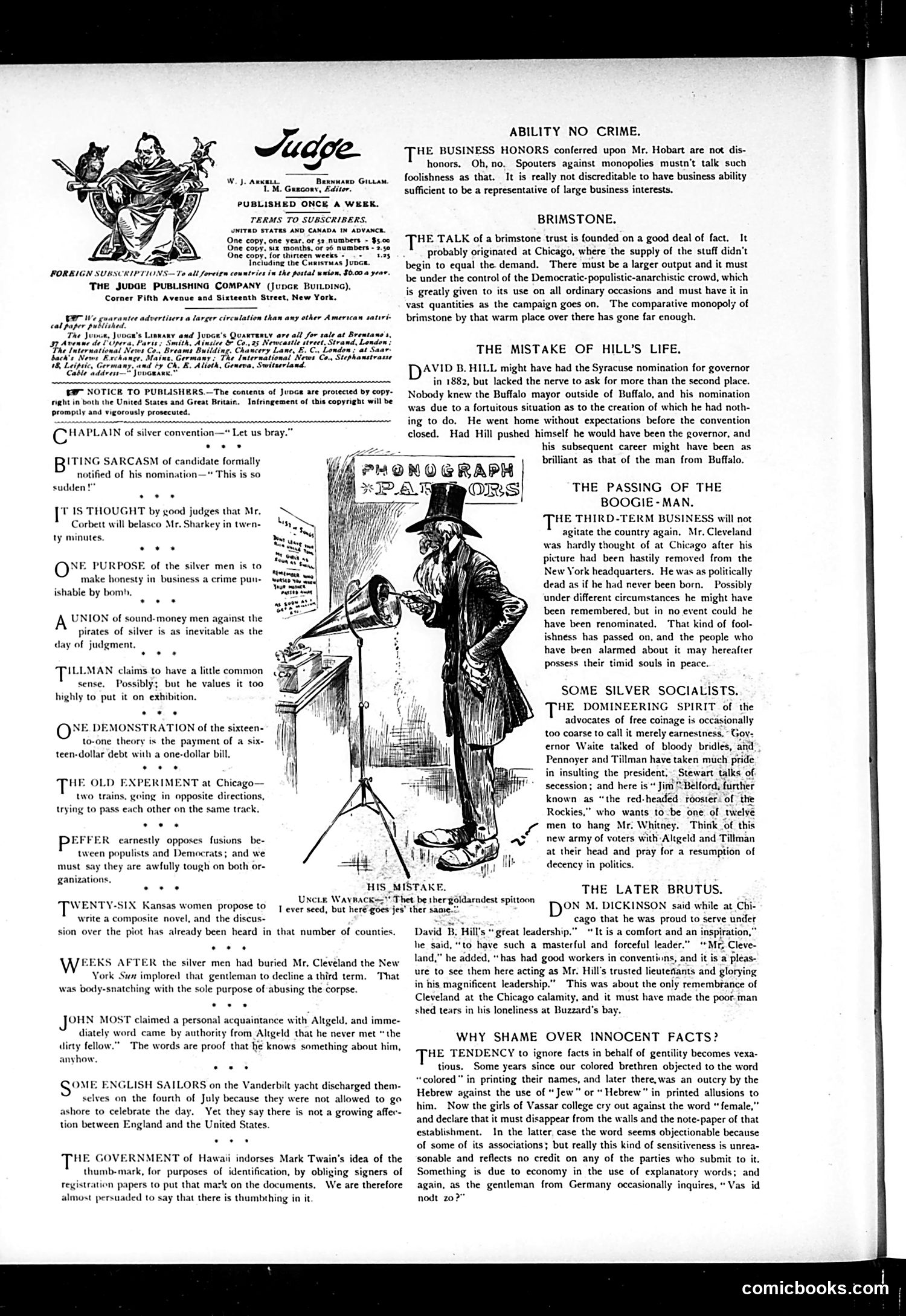
This page contains several short political commentaries rather than a single cartoon. The central illustration shows a monograph operator—a device for reproducing signatures—suggesting commentary on document authentication or fraud. Key topics addressed: **"Ability No Crime"**: Criticizes awarding business honors to Mr. Hobart based solely on business acumen, questioning whether this represents actual merit. **"The Mistake of Hill's Life"**: References David B. Hill missing a Syracuse gubernatorial nomination in 1882, suggesting he lost opportunity through miscalculation. **"The Passing of the Boogie-Man"**: Notes Cleveland's limited political future after losing the presidency, with New York headquarters now abandoned. **"Silver Socialists"**: Mocks free-coinage advocates as overly earnest, naming Jim Belford and others. The page satirizes 1890s American politics, business culture, and political figures' fading relevance.
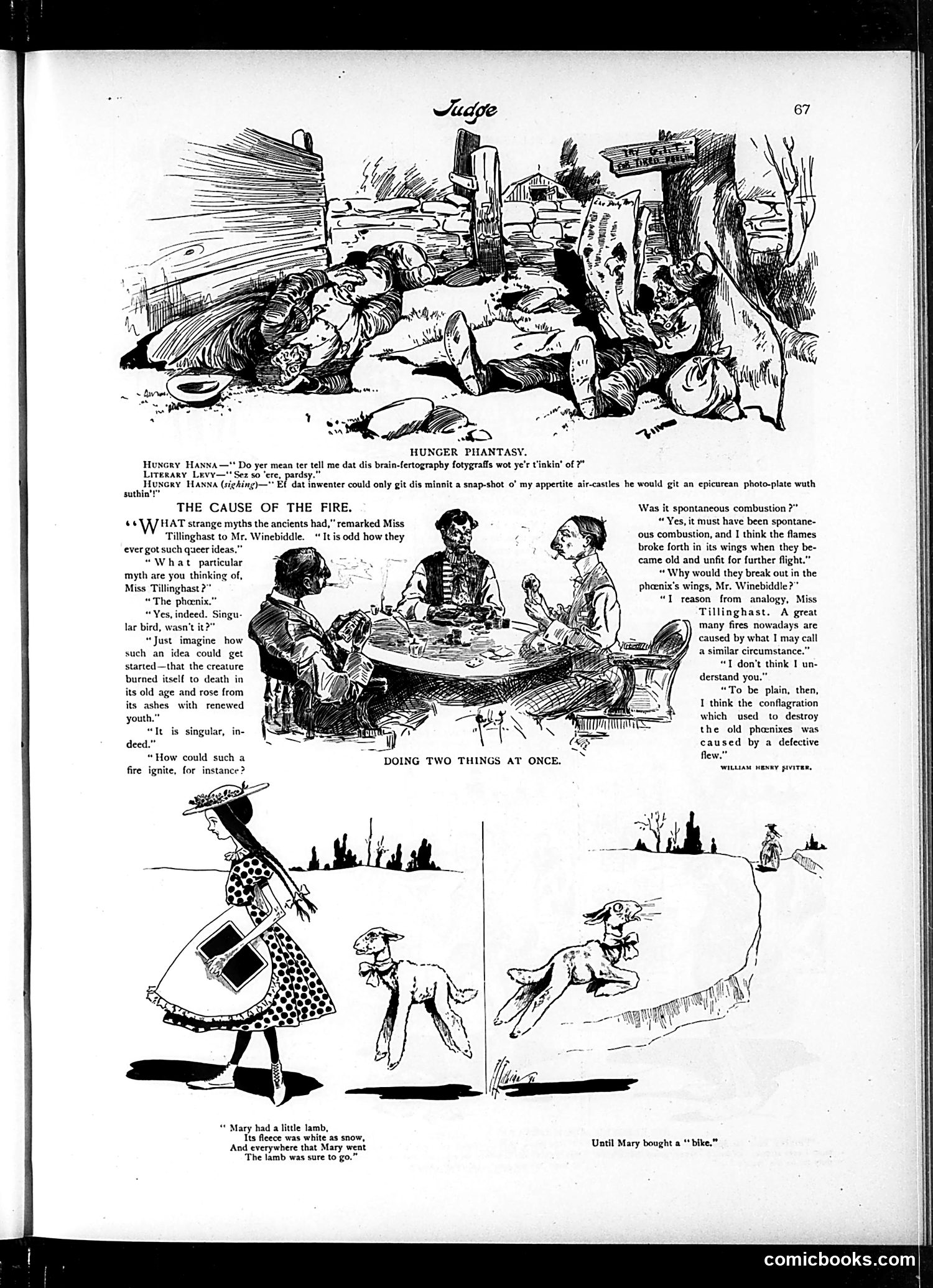
This page contains three separate satirical pieces: 1. **"Hunger Phantasy"** (top): A crude cartoon mocking someone's imagined delusions about food photography and appetite. 2. **"The Cause of the Fire"** (center): A dialogue between characters debating whether a fire destroying "old phoenixes" resulted from spontaneous combustion or a "defective flue." This appears to be social commentary, likely about an actual fire incident, though the specific event is unclear. The debate format suggests satire of how people assign blame to disasters. 3. **"Mary Had a Little Lamb"** (bottom): A humorous visual interpretation of the nursery rhyme, showing a woman chasing a lamb, then acquiring a "bike"—likely satirizing changes in transportation or modern life replacing traditional pastimes. The overall page emphasizes visual humor and wordplay typical of Judge magazine's satirical approach.
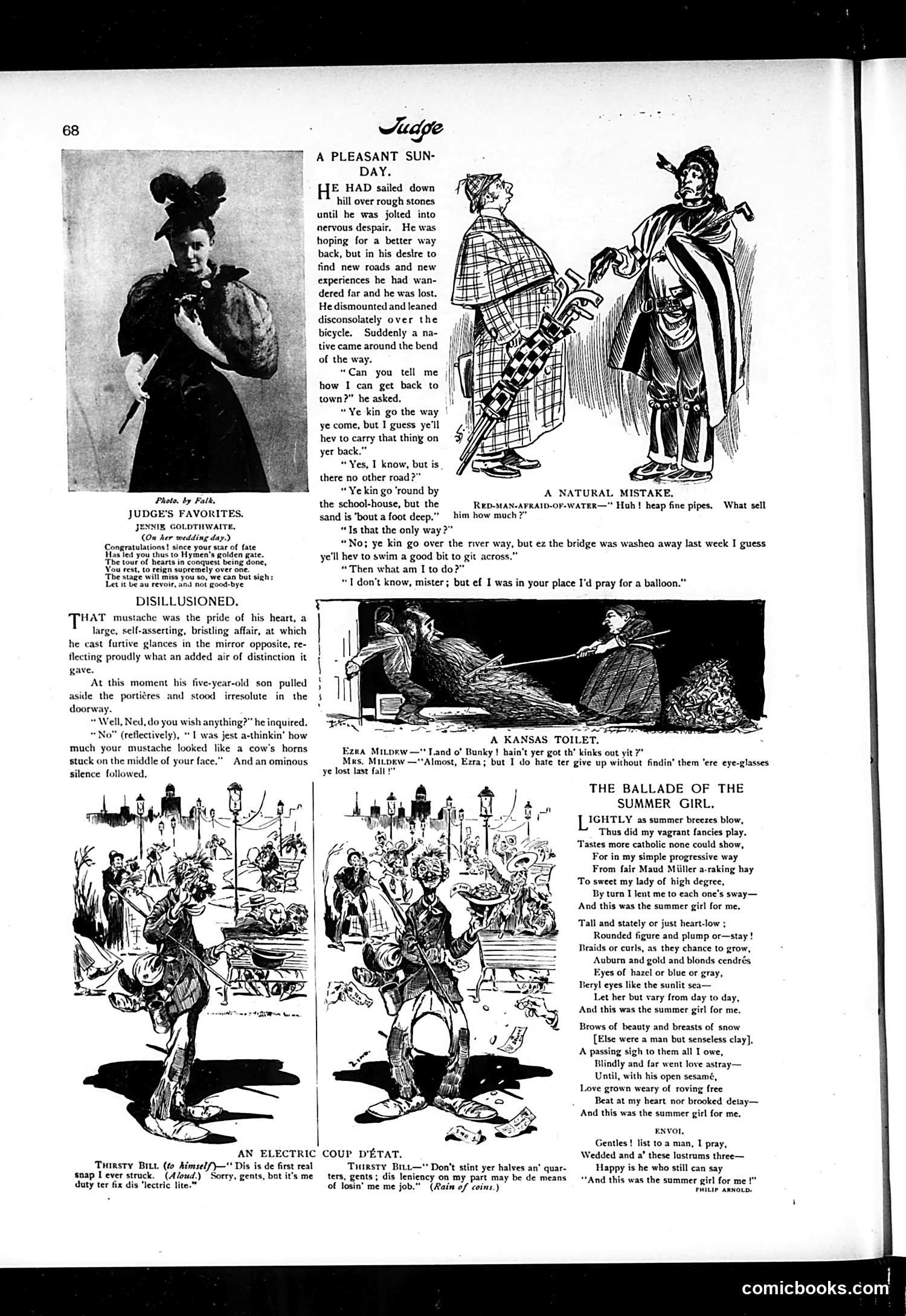
This page from *Judge* contains several satirical pieces typical of turn-of-the-century American humor: **"Disillusioned"** mocks masculine vanity: a man's pride in his new mustache is deflated when his five-year-old son compares it to cow horns—a child's innocent observation undercutting adult pretension. **"A Pleasant Sunday"** satirizes rural American dialect and impractical advice. A lost cyclist asking for directions receives increasingly absurd options (foot-deep sand, washed-out bridges, swimming), culminating in the unhelpful suggestion to "pray for a balloon." **"A Natural Mistake"** plays on stereotypes of Native Americans, depicting confused communication about trade. **"A Kansas Toilet"** uses rural dialect humor about lost eyeglasses, typical of period humor mocking rural Americans. **"The Ballad of the Summer Girl"** is a lighthearted poem about male fickleness toward different women, ending with a marriage moral—common romantic humor of the era. The cartoons employ exaggerated illustrations and vernacular dialect to create humor through class and regional stereotyping common to Gilded Age satire.
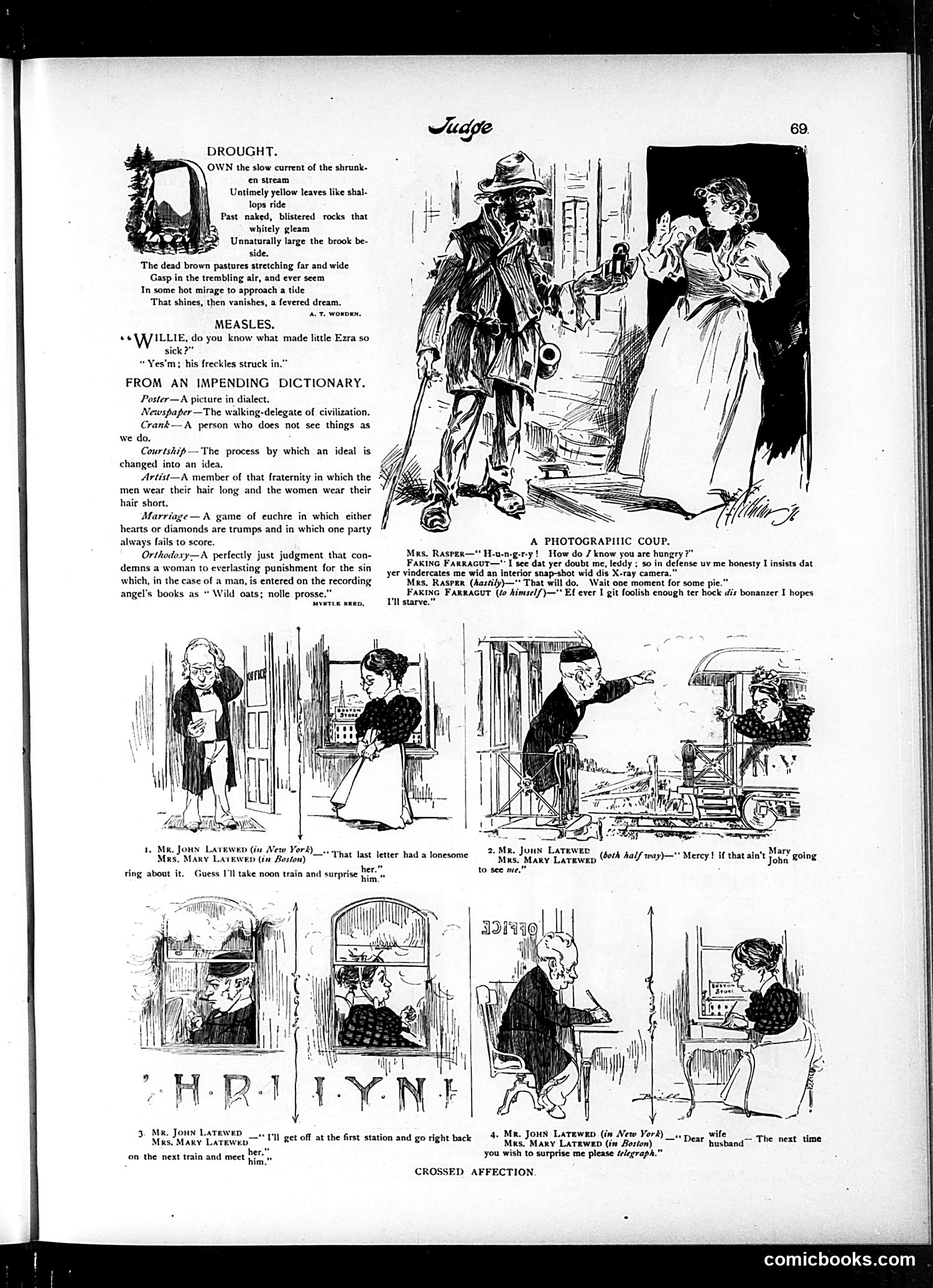
This page contains several distinct satirical pieces typical of Judge's style: **"Drought"** and **"Measles"** are poems and wordplay—light verse poking fun at natural phenomena and children's ailments with sentimental/humorous takes. **"From an Impending Dictionary"** offers satirical definitions mocking contemporary society: newspapers as "walking delegates," marriage as a rigged card game, and notably, **"Orthodoxy"** critiques religious hypocrisy by condemning women for sin while men's transgressions are dismissed as "wild oats." **"Crossed Affection"** is a four-panel comic strip about married couple John and Mary Latewen—one living in New York, one in Boston. The joke: they keep trying to surprise each other, but their plans repeatedly backfire. Panel 4's punchline shows the wife preemptively requesting a telegraph warning, frustrated by his surprise attempts. **"A Photographic Coup"** features "Faking Farragut" (an obvious hobo character) using fake X-ray photography to convince a landlady ("Mrs. Rasper") he's hungry, securing pie. The satire targets both con-artist culture and emerging photography technology's questionable reliability.
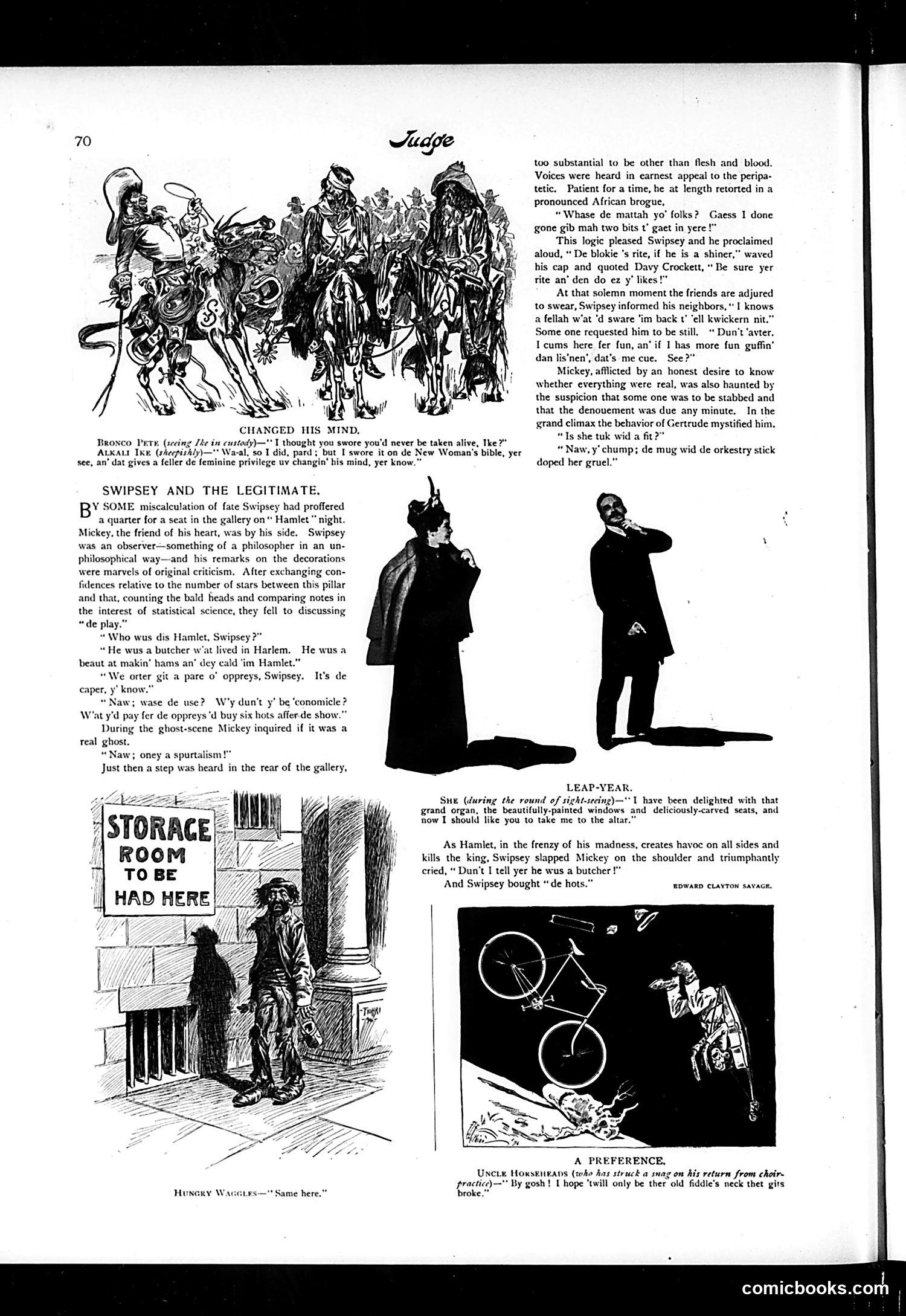
This page contains working-class satire centered on "Swipsey and the Legitimate," mocking immigrants' (likely Irish or similar ethnic groups, indicated by dialect) experience attending Shakespeare's *Hamlet*. Swipsey and Mickey are portrayed as unsophisticated theater-goers who fundamentally misunderstand the play, thinking Hamlet was "a butcher...in Harlem." Their running commentary—complaining about prices, debating whether the ghost is real—satirizes both their ignorance of high culture and their pragmatic working-class values (they'd rather buy six beers than theater seats). The joke culminates when Gertrude's death scene confuses Mickey, and Swipsey triumphantly declares the murderous protagonist "a butcher"—his original misreading accidentally proven "correct" by the violence. The other cartoons use similar ethnic dialect humor for comedic effect. This reflects *Judge*'s era of class-based and ethnic satire targeting immigrants and lower classes.
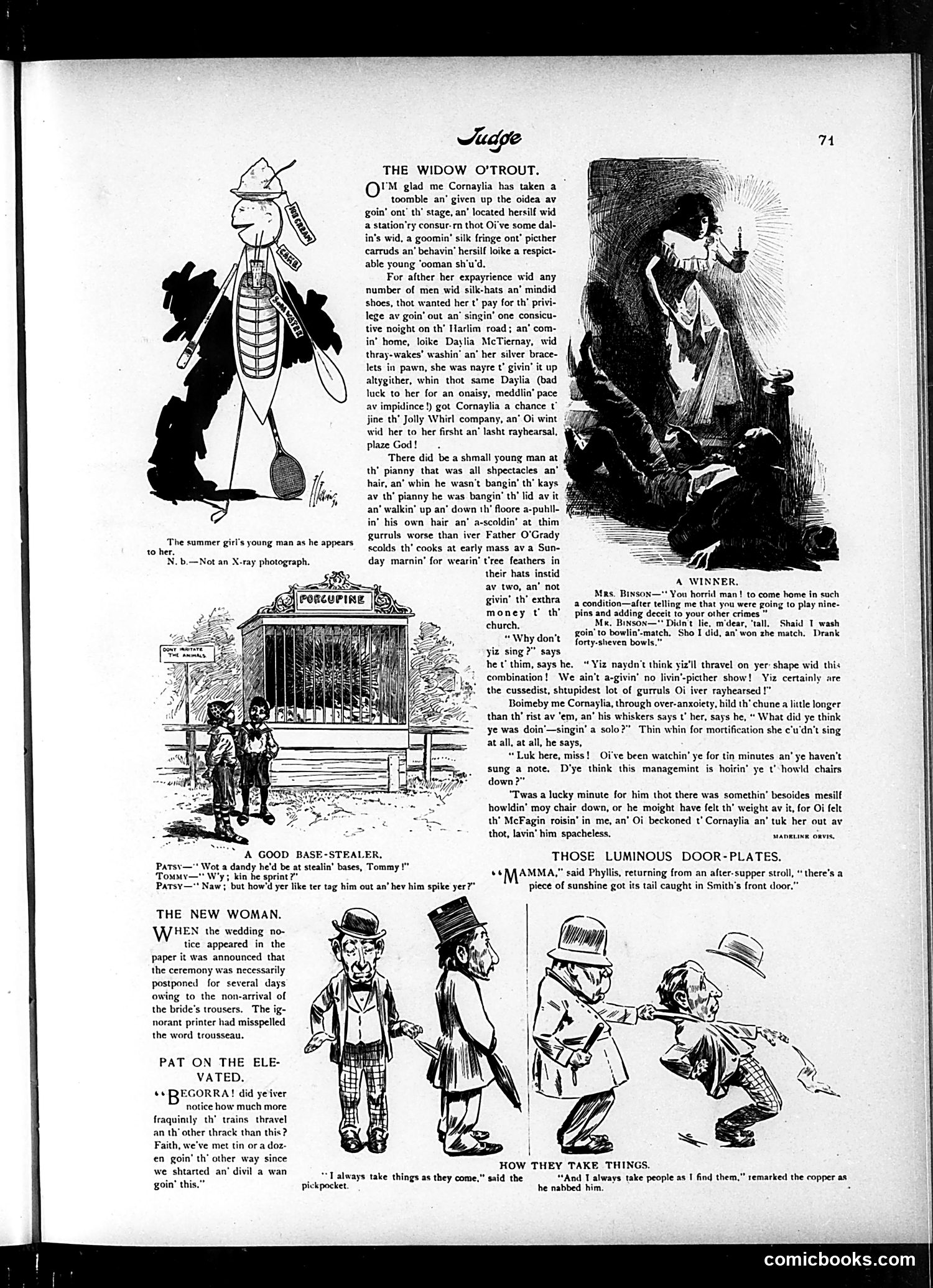
This page contains multiple satirical sketches mocking contemporary social trends: **"The Widow O'Trout"** features an Irish-accented monologue (heavy dialect used for comic effect) about a woman abandoning theatrical ambitions after mistreatment by an abusive piano accompanist during rehearsals. The satire targets both exploitative theater practices and the depicted woman's resilience. **"The New Woman"** jokes about a printer's error—"trousers" for "trousseau"—mocking both the emerging "New Woman" movement (women demanding independence and modern clothing) and typographical mishaps. **"A Good Base-Stealer"** uses baseball terminology as double entendre, joking about a criminal's spiking ability. **"How They Take Things"** shows pickpockets at work—straightforward criminal humor. **"Those Luminous Door-Plates"** appears incomplete but likely comments on nouveau riche ostentation. The Irish dialect throughout reflects period prejudice. Overall, Judge satirizes social change, theatrical exploitation, criminality, and ethnic stereotypes typical of early 1900s American humor.
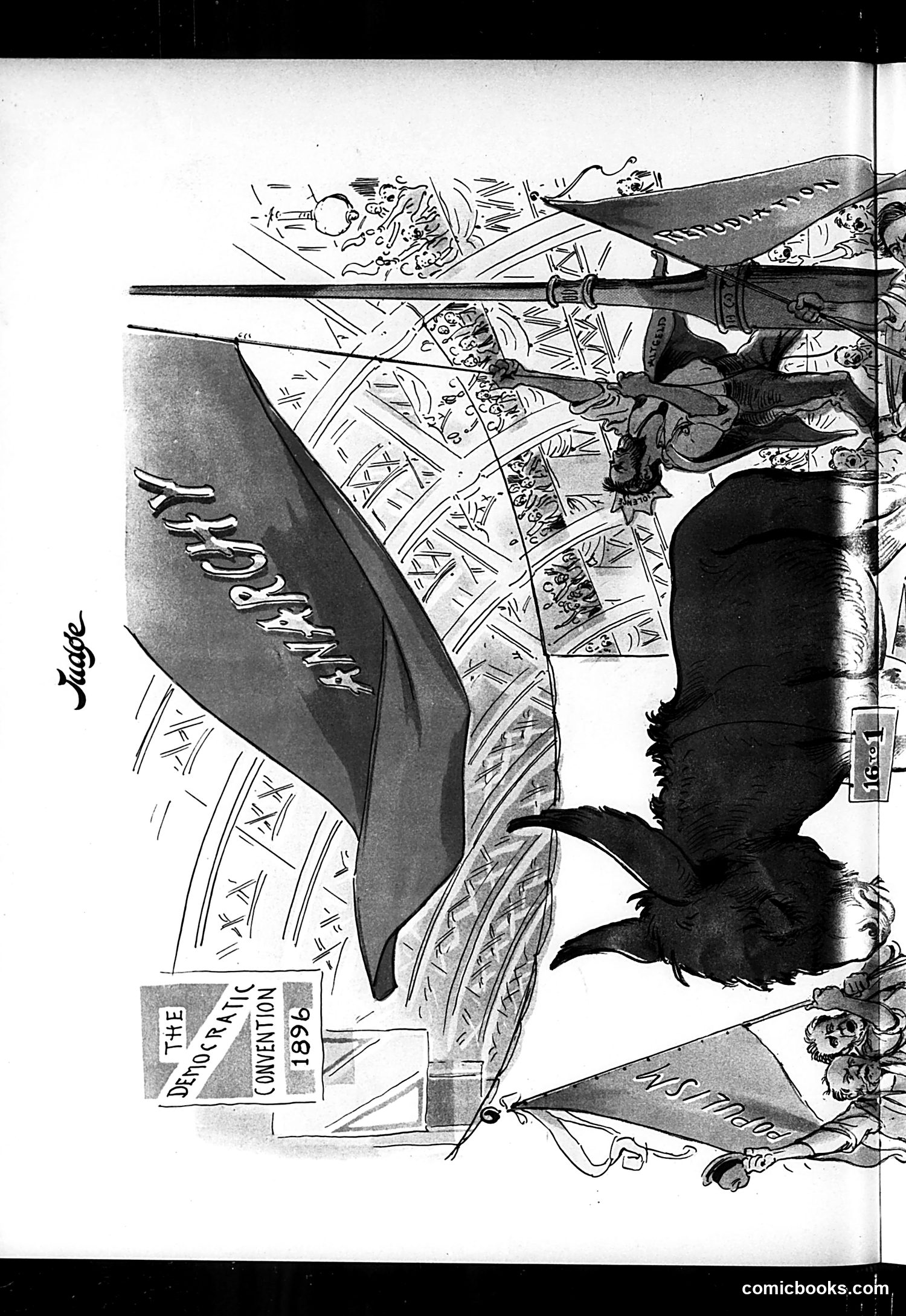
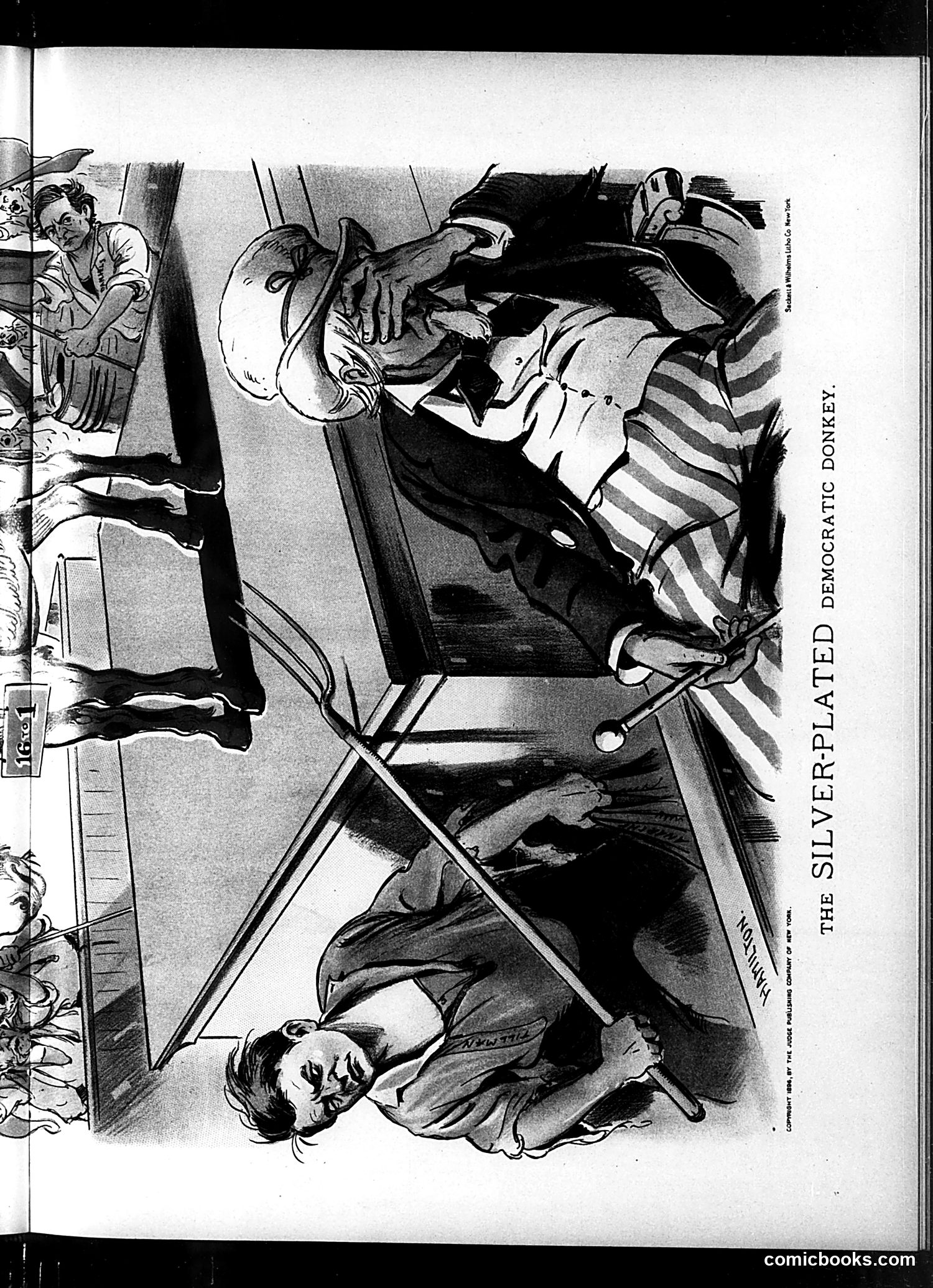
This page appears to be a political cartoon from Judge magazine, though the OCR text is largely illegible. The image shows a figure in formal attire (top hat and coat) gesturing toward what appears to be a convention or assembly hall scene with draped banners and crowds of people. The visible text references "THE DEMOCRATIC CONVENTION" (visible in a label), suggesting this cartoons satirizes Democratic Party proceedings, likely from the late 19th or early 20th century based on the artistic style. The specific political figures and satirical points are difficult to determine with certainty due to image quality and OCR limitations. The cartoon likely mocked either convention delegates, party leadership, or political positions of that era, which was Judge magazine's typical purpose.
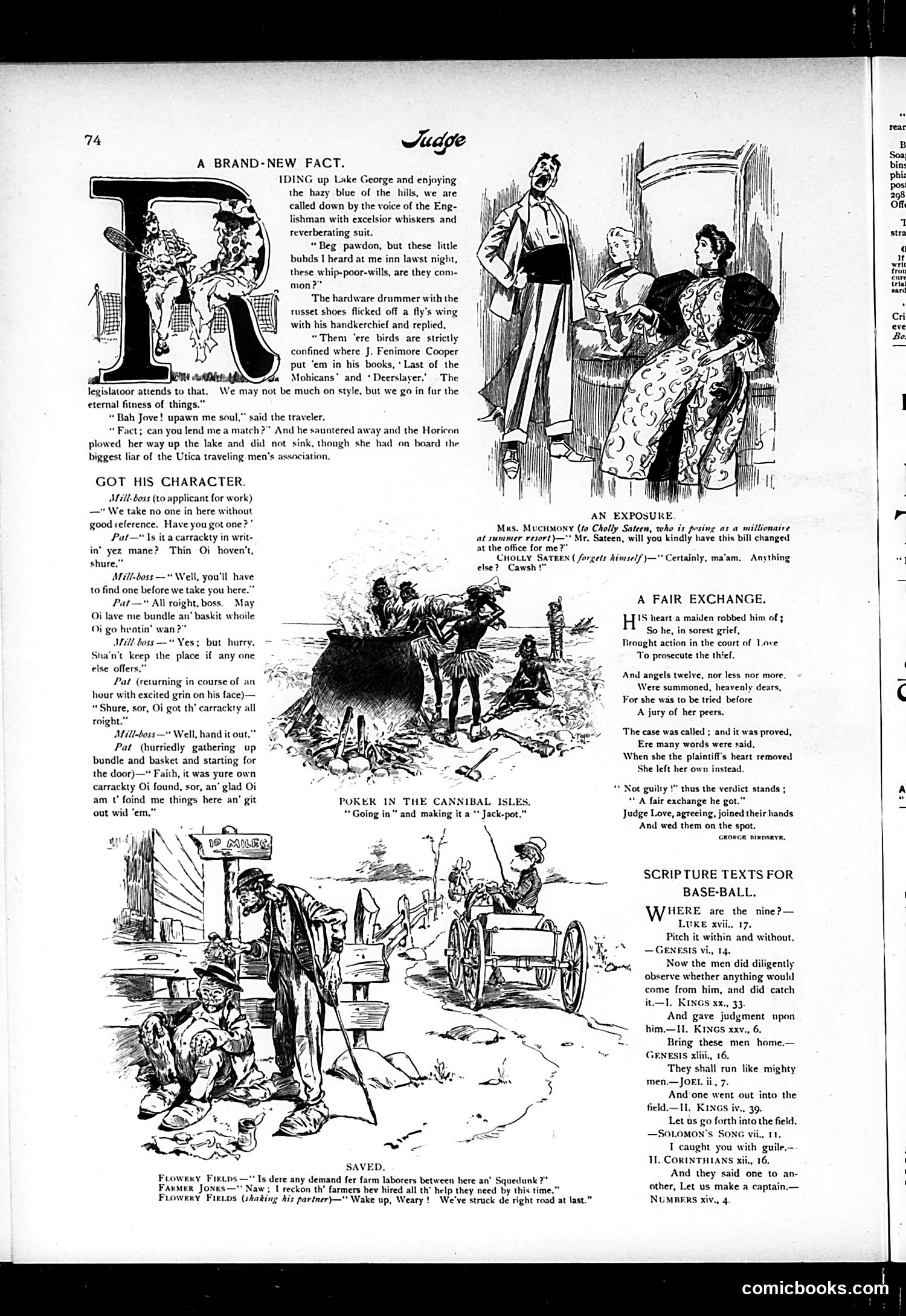
This page contains several humorous anecdotes satirizing American social types and pretensions circa the 1880s-1890s: **"A Brand-New Fact"** mocks the tall-tale tradition and pompous English tourists. A traveling salesman claims birds are confined to Fenimore Cooper novels by law—absurd boasting presented as fact. **"Got His Character"** ridicules Irish immigrant labor. An Irish worker ("Pat") seeking a job reference returns with his employer's own character reference, suggesting the boss is the actual problem employee. **"An Exposure"** exposes social climbers: a fake millionaire ("Cholly Sateen") pretending wealth is revealed when he forgets himself and asks a woman to cash a bill—betraying his actual modest status. **"A Fair Exchange"** is sentimental verse about romantic love. **"Scripture Texts for Base-Ball"** is humorous—matching baseball terminology with Bible verses for comedic effect. The page satirizes working-class immigration, tourist pretension, and social fraud typical of Gilded Age American humor.
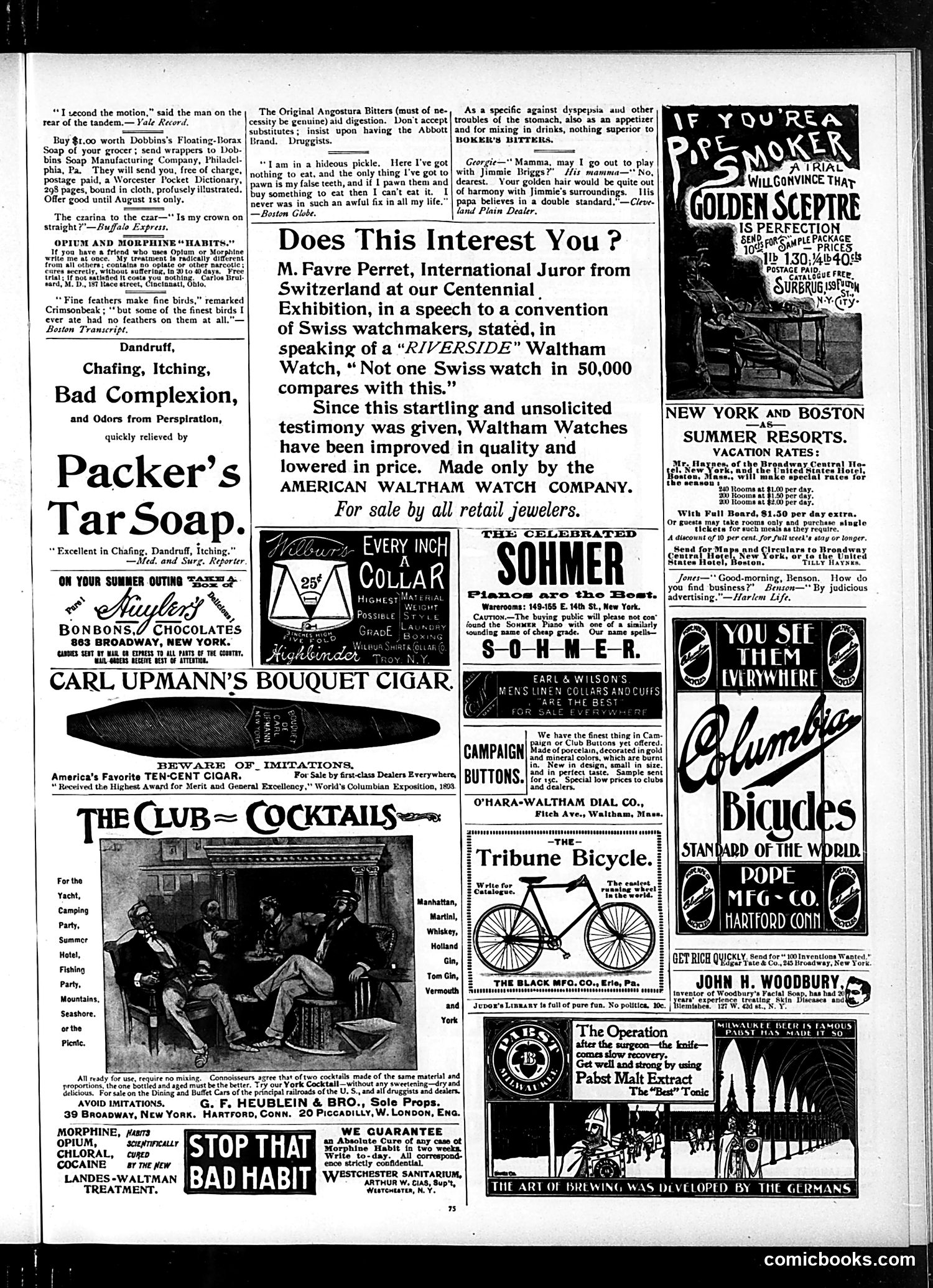
This page is primarily **advertising** with minimal editorial cartoon content. The visible advertisements promote consumer products typical of the 1890s: patent medicines (Angostura Bitters, Boker's Bitters), cigars, chocolate, soap, bicycles, pianos, and resort vacations. The notable editorial content includes brief humorous snippets rather than political cartoons: - A tandem bicycle joke from Yale Record - A joke about pawning false teeth due to poverty - A mother forbidding her daughter from playing with a boy from a lower social class because his family's "surroundings" conflict with her "golden hair"—a satirical jab at class snobbery and pretension The largest feature is an advertisement for **American Waltham Watches**, quoting a Swiss juror at the Centennial Exhibition claiming Swiss watches cannot compare to this American product. This appears designed to appeal to American pride and consumer nationalism during an era of growing industrial competition. The page reflects late-19th-century consumer culture and class anxieties rather than political satire.
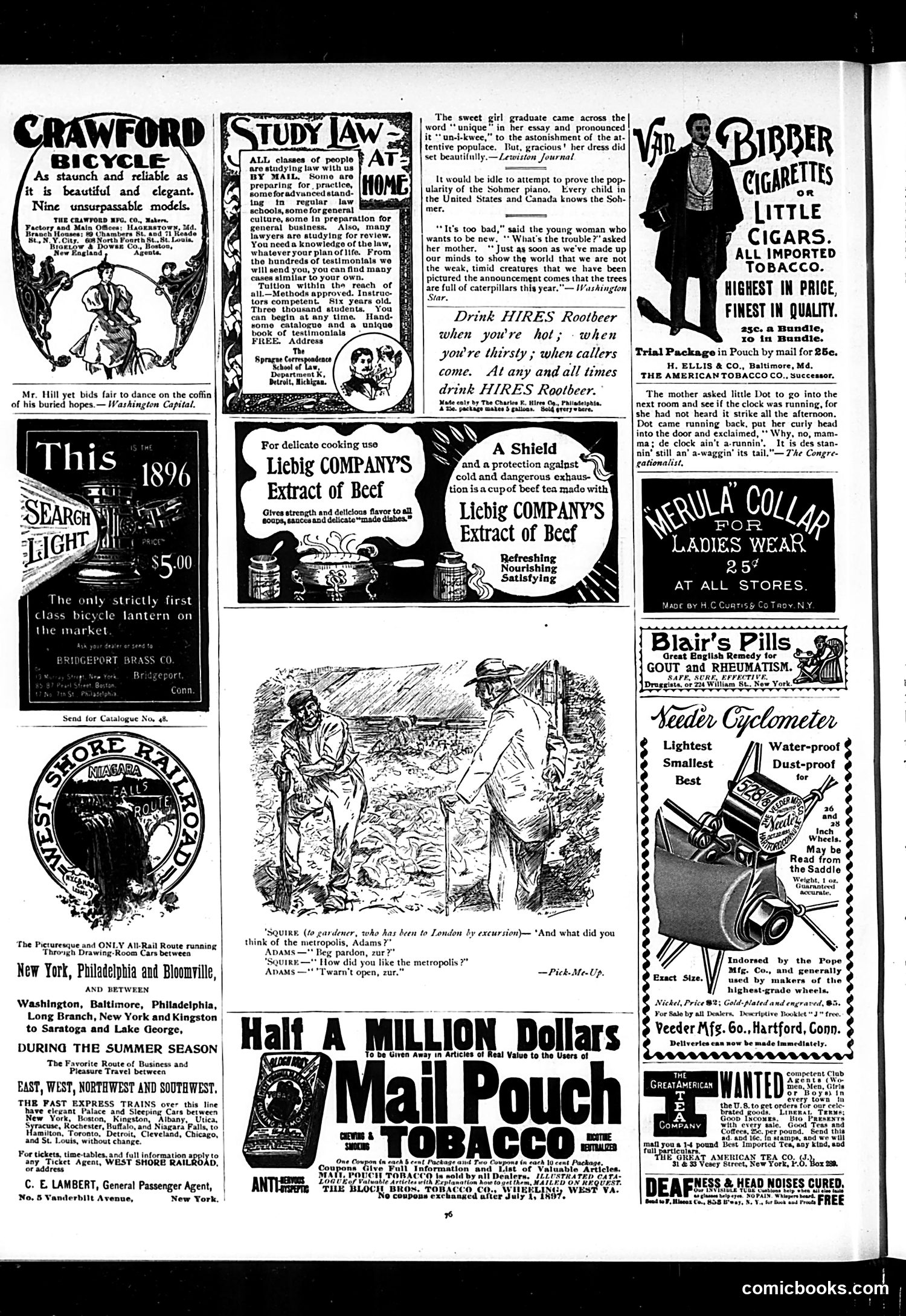
This page is primarily **advertising**, typical of 1896 Judge magazine. The dominant content includes ads for bicycles, beef extract, rootbeer, cigars, and rail travel. The only substantive cartoon appears mid-page: a rural dialogue between a Squire and his gardener Adams, recently returned from a London excursion. The squire asks what Adams thought of "the metropolis," but Adams mishears it as asking if it was "open." The joke hinges on **class satire**—the working-class gardener's misunderstanding of the educated man's vocabulary and his implied rural unfamiliarity with urban sophistication. This reflects late-Victorian humor mocking social hierarchies and rural ignorance. The page's small text items are light social jokes about a "sweet girl graduate" mispronouncing "unique" and a child's confusion about a clock "running." The bulk of the page reflects Judge's business model: advertising revenue subsidizing satirical content.
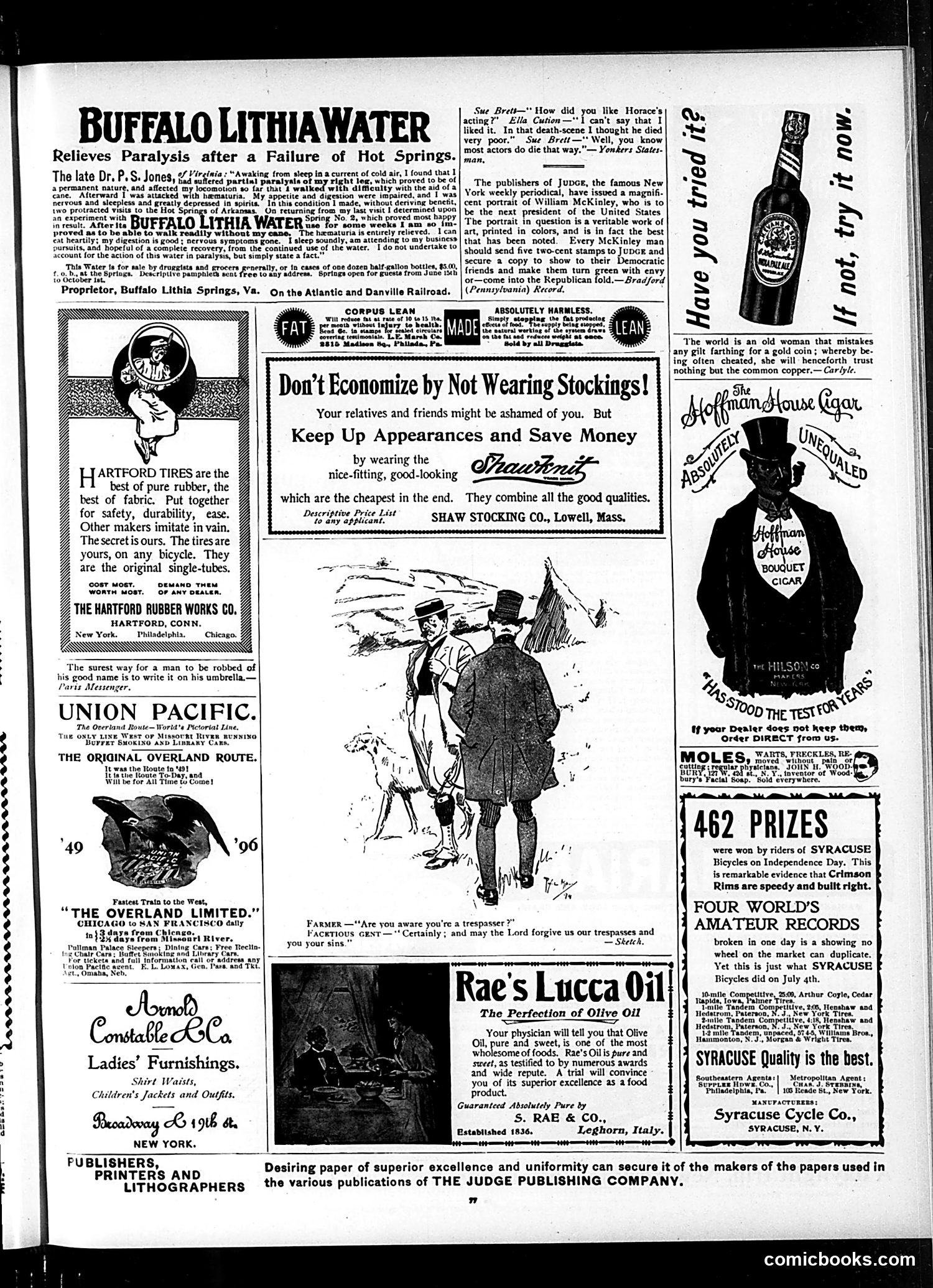
This page is primarily **advertising** from Judge magazine, with a few small satirical items embedded. The main cartoon (center) shows two well-dressed men encountering a woman on a country road. The "facetious gent" (right) claims to be a trespasser, then deflects with religious language—a mild joke about apologizing for sins rather than actual wrongdoing. Most content is **product advertisements**: Buffalo Lithia Water (claimed to cure paralysis), Hartford bicycle tires, stockings, cigars, and railroad services. The only political reference mentions **William McKinley's upcoming presidency**, encouraging Republicans to request a portrait to show Democratic friends. The small "actor's death scene" joke at top-right is simply wordplay about poor acting. The page reflects **Gilded Age advertising practices**—testimonials, health claims, and social pressure ("relatives might be ashamed"). Nothing here requires specialized historical knowledge beyond recognizing McKinley as a late-1890s presidential figure.
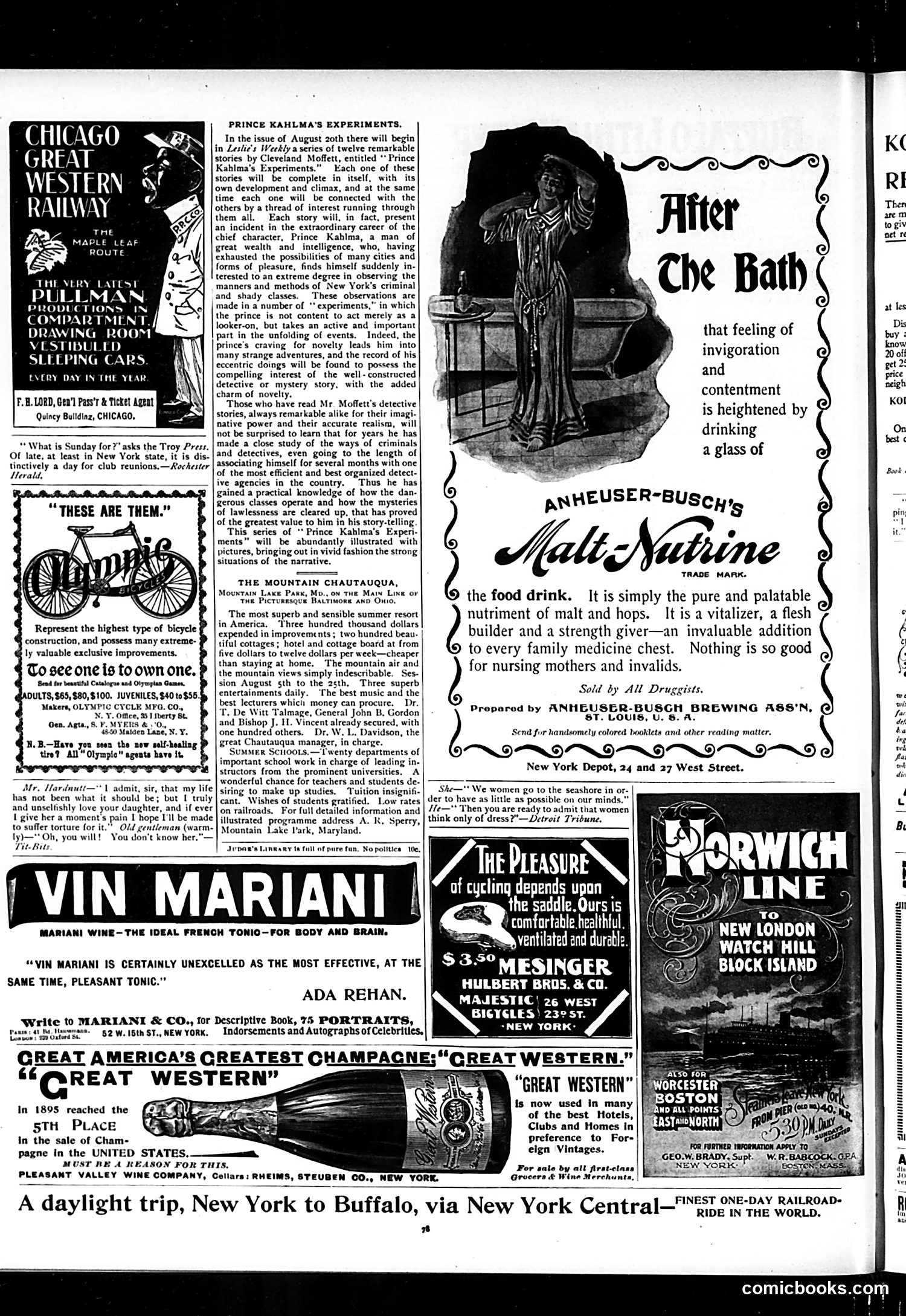
This page is primarily a **vehicle for advertisements** rather than editorial content, as was common in Judge magazine. The few visible editorial/cartoon elements include: 1. **Top-left cartoon**: An untitled joke about "Sunday" in New York—the caption explains that Sundays have become synonymous with "club reunions," a satirical jab at the leisure activities of the wealthy and idle classes. 2. **Small comic vignette**: A brief dialogue between "Mr. Hardnutt" and an "Old gentleman" about romantic devotion—likely satirizing melodramatic courtship language of the era, though the full context is cut off. The page is otherwise dominated by **advertisements** for rail travel (Chicago Great Western Railway), bicycles (Olympic Cycle), beverages (Anheuser-Busch's Malt-Nutrine, Vin Mariani, Great Western champagne), and other luxury goods and travel services—all targeting Judge's affluent readership. There's also a notice about an upcoming serialized story by Cleveland Moffett on "Prince Kahlma's Experiments."
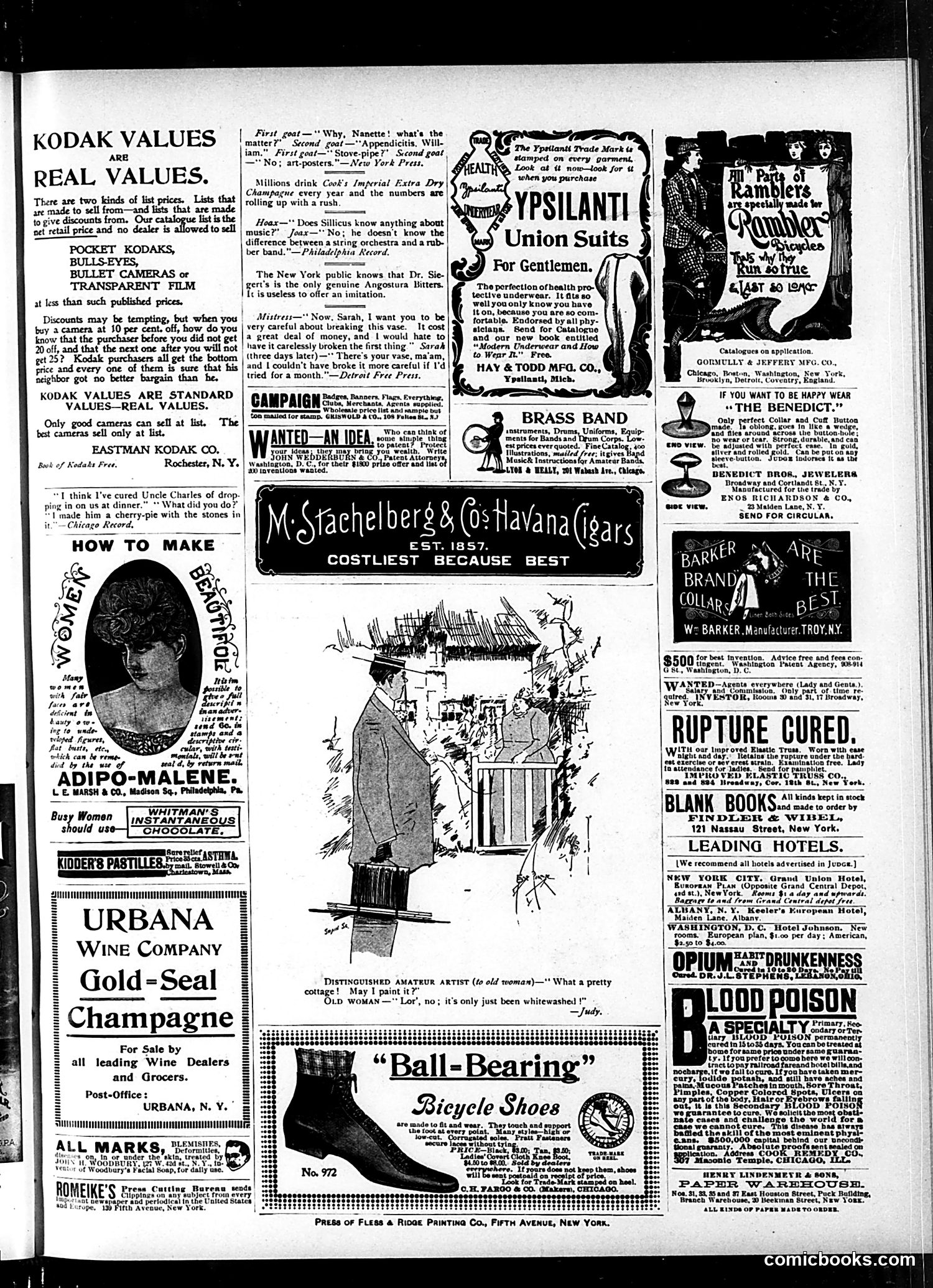
This is primarily an **advertising page** from *Judge* magazine, not a satirical cartoon page. The main content consists of period product advertisements for champagne, cameras, cigars, underwear, bicycles, and patent medicines. The **cartoon content is minimal**: one sketch shows an amateur artist asking permission to paint an old woman's cottage, to which she replies it's "only just been whitewashed"—a simple joke about mistaking the woman's face for the building. The page does include a few brief **humorous quips** (jokes about a man who doesn't understand music, a maid breaking a vase despite careful warnings), but these aren't political commentary. The **advertising reflects the era**: noticeable are medicines like "Adipo-Malene" (weight-loss product), opium-based treatments, and "Rupture Cured" remedies—reflecting late 19th/early 20th-century patent medicine practices largely unregulated and often dubious by modern standards.
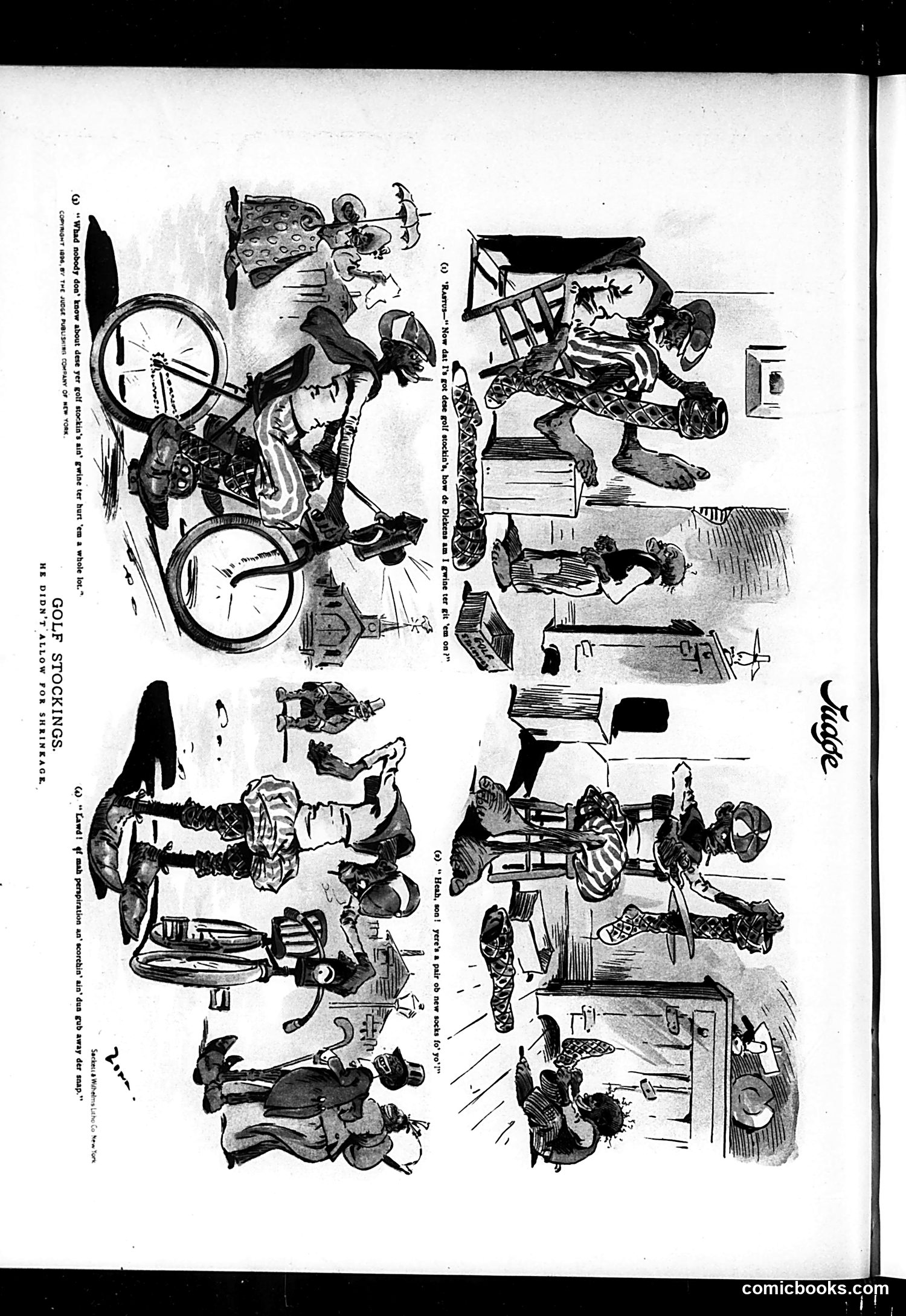
This Judge cartoon satirizes the emerging early-20th-century golf craze among American leisure classes. The comic depicts men in golfing attire, with focus on their stockings, which apparently shrink excessively when washed—rendering them unwearable despite manufacturer claims about durability. The dialogue in exaggerated dialect mocks both the working-class laundry workers handling these garments and the wealthy golfers who purchase them. The humor targets the pretension of golf fashion and the gap between advertising promises and reality. "Me didn't allow for shrinkage" suggests manufacturers ignored obvious product flaws. The satire critiques both the frivolous spending of the golf-playing wealthy and the ineffectiveness of early commercial garment manufacturing—a common Judge theme mocking nouveau riche leisure culture and consumer goods failures.