
A complete issue · 16 pages · 1896
Judge — June 13, 1896
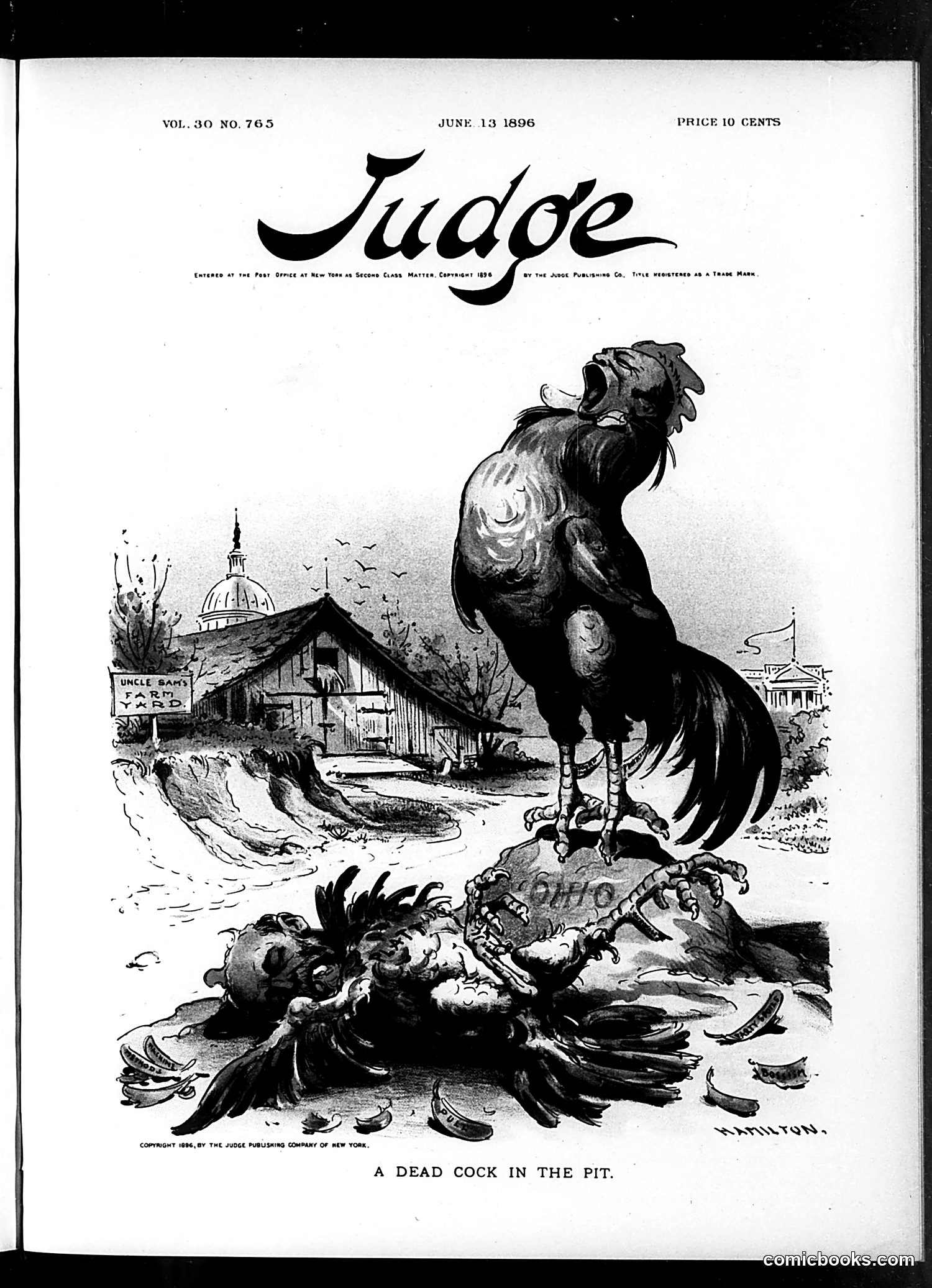
This political cartoon from *Judge* magazine (June 13, 1896) uses cockfighting imagery as satire. A rooster stands triumphantly over a dead competitor in a pit, with "Uncle Sam's Poultry Yard" visible in the background—establishing this as American political commentary. The cartoon likely references the 1896 presidential election or a significant political defeat. The "dead cock" represents a defeated political figure or faction, while the victorious rooster suggests a political winner. The architectural elements (Capitol dome, government buildings) confirm this concerns U.S. politics. Without additional context about June 1896 events, the specific identity of the defeated figure remains unclear, but the satire equates political struggle with brutal cockfighting—a commentary on the viciousness of political competition.
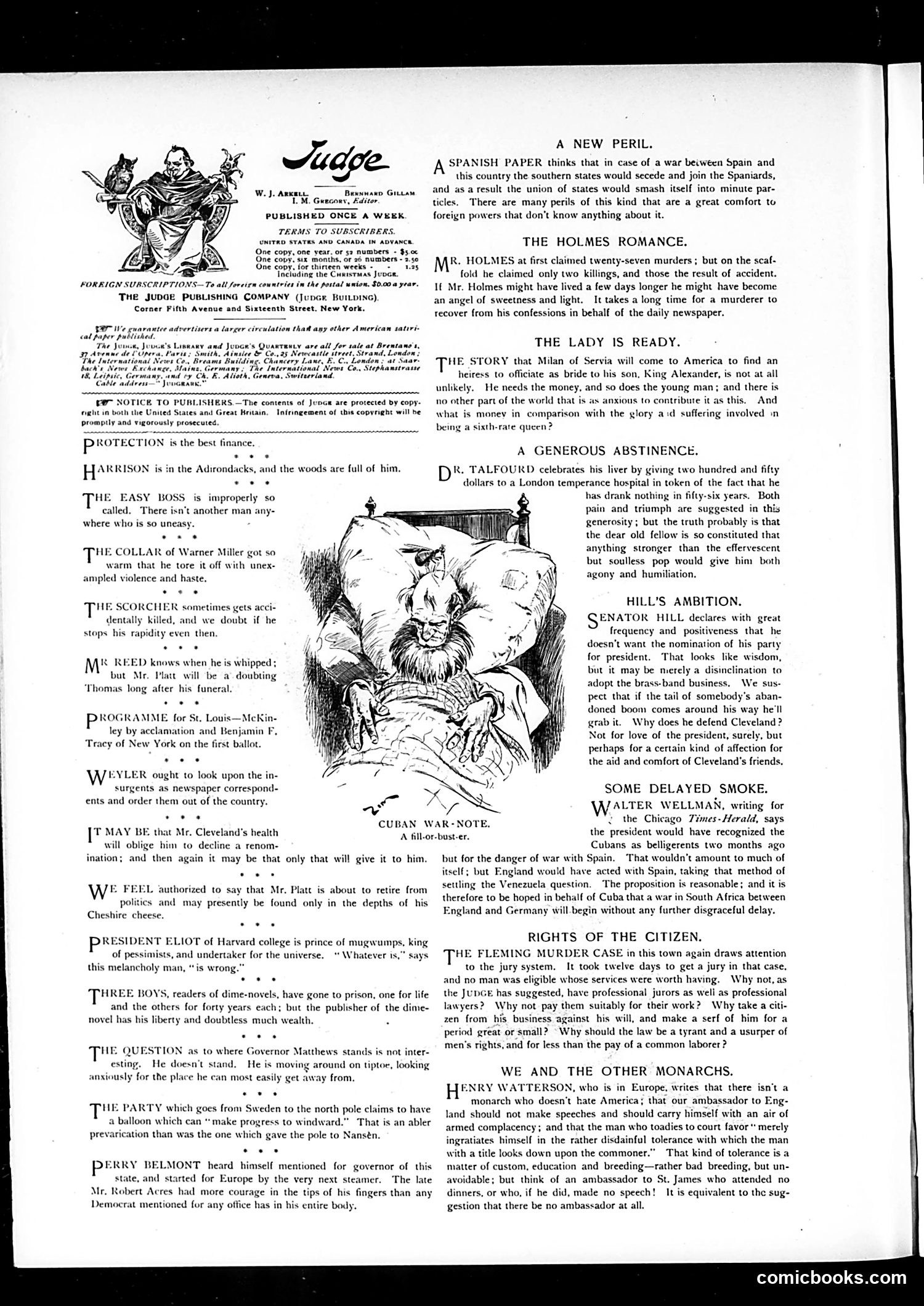
The central cartoon depicts a bearded man in bed, appearing ill or incapacitated. Based on the accompanying article titled "CUBAN WAR—NOTE," this likely represents the Cuban situation itself personified—suffering from the threat of war with Spain. The text discusses whether England would intervene in a potential Cuba-Spain conflict, suggesting war was a real concern at this time (appears to be 1890s era). The satirical point seems to be that Cuba's "health" depends on international politics rather than its own agency. The surrounding "Judge" editorial commentary addresses American politics and social issues, including references to Cleveland's presidency and various political appointments, typical of the magazine's satirical coverage of contemporary politics and governance.
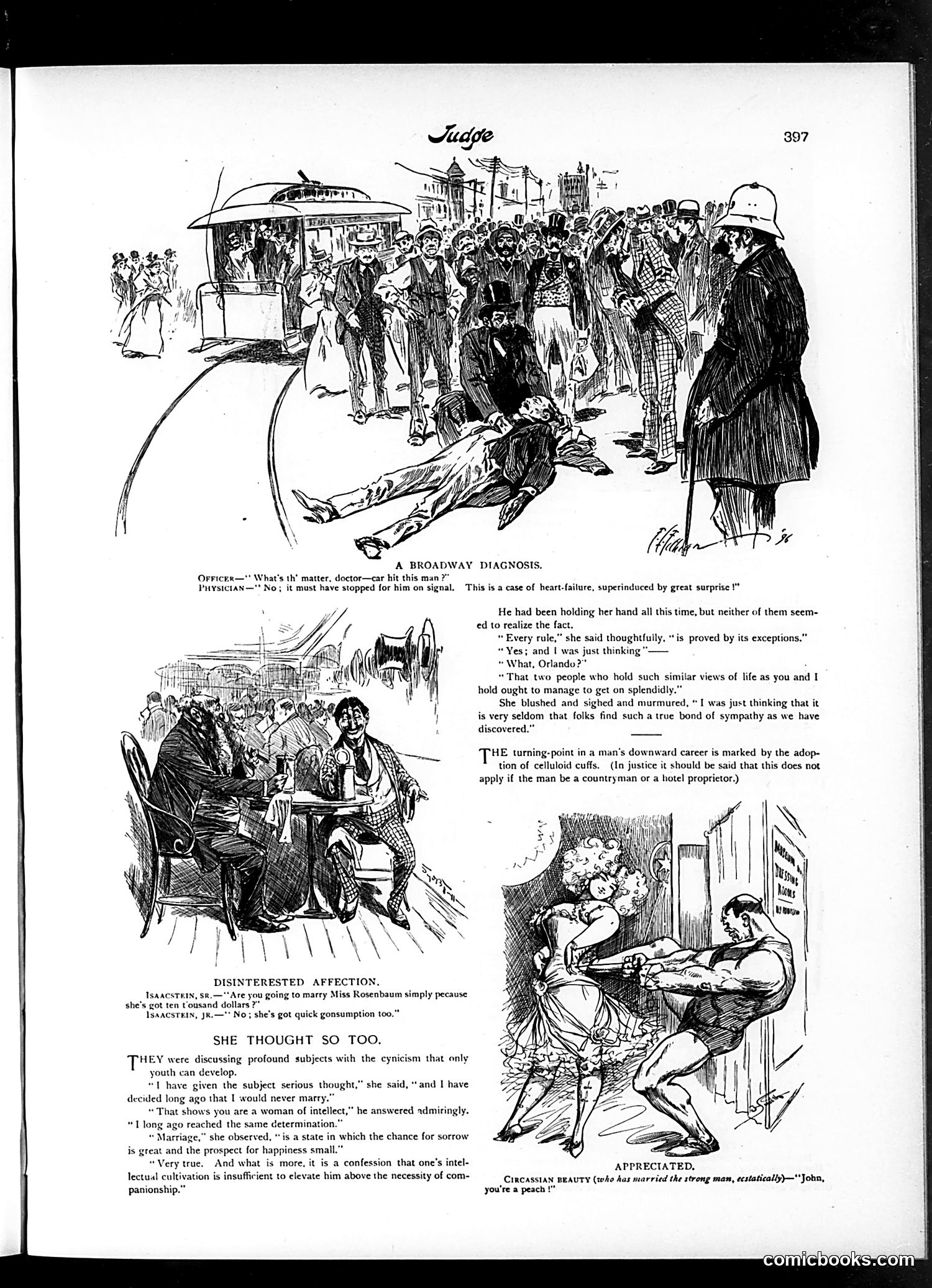
This page contains three separate satirical sketches rather than a unified cartoon: **"A Broadway Diagnosis"** depicts a street scene where a doctor diagnoses a collapsed man's condition to gathered onlookers—the joke being the absurdity of public medical pronouncements. **"Disinterested Affection"** shows Isakstein discussing marriage prospects, satirizing indifference disguised as romantic consideration. **"She Thought So Too"** portrays an intellectual couple debating whether marriage elevates people through "intellectual cultivation." The satire mocks pretentious philosophizing about love and education among the upper classes. **"Appreciated"** (bottom right) shows a woman with a "strong man," captioned to suggest Caucasian beauty prefers physical strength over intellectual refinement—likely satirizing changing social attitudes about gender and class. The overall theme appears to be mocking urban sophistication and middle-class affectations regarding romance and society.
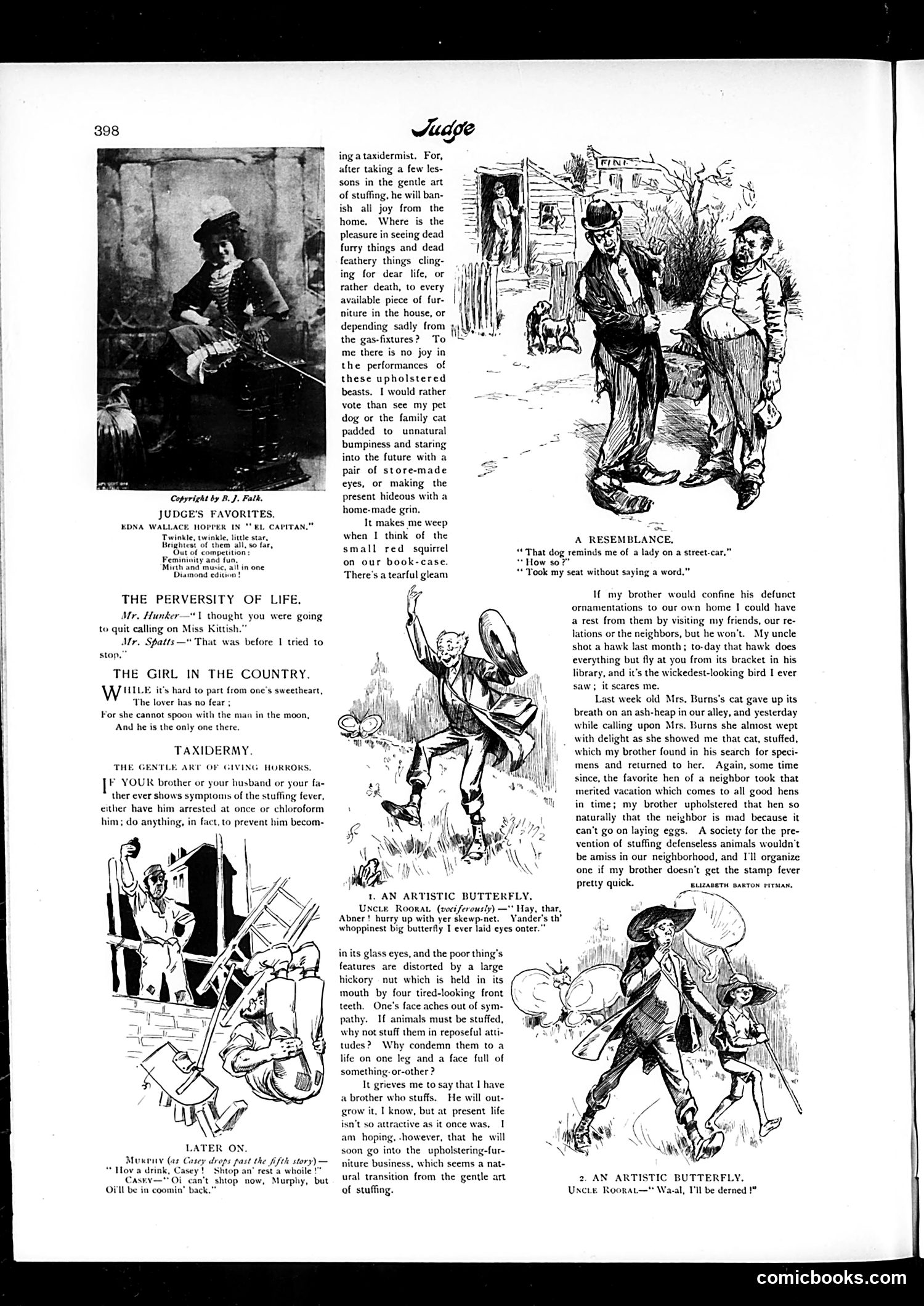
This page satirizes the Victorian craze for **taxidermy** — the practice of stuffing and mounting dead animals as home decoration. The main article mocks the hobby through the voice of someone whose brother has become obsessed with taxidermy, cluttering their home with awkwardly-posed stuffed creatures: a hawk that "stares into the future with a pair of store-made eyes," a neighbor's deceased cat, and a prized hen that can no longer lay eggs. The satire's point: taxidermy produces grotesque, unnatural displays that disturb rather than beautify the home. The cartoons illustrate absurdities: a rural man (Uncle Rootat) excitedly pursuing a butterfly with a net, and various figures wrestling with taxidermic specimens in undignified positions. The piece targets upper-middle-class Victorians' obsession with displaying "refined" natural history collections as status symbols, exposing how the practice actually produces ridiculous, creepy results that undermine claimed aesthetic taste.
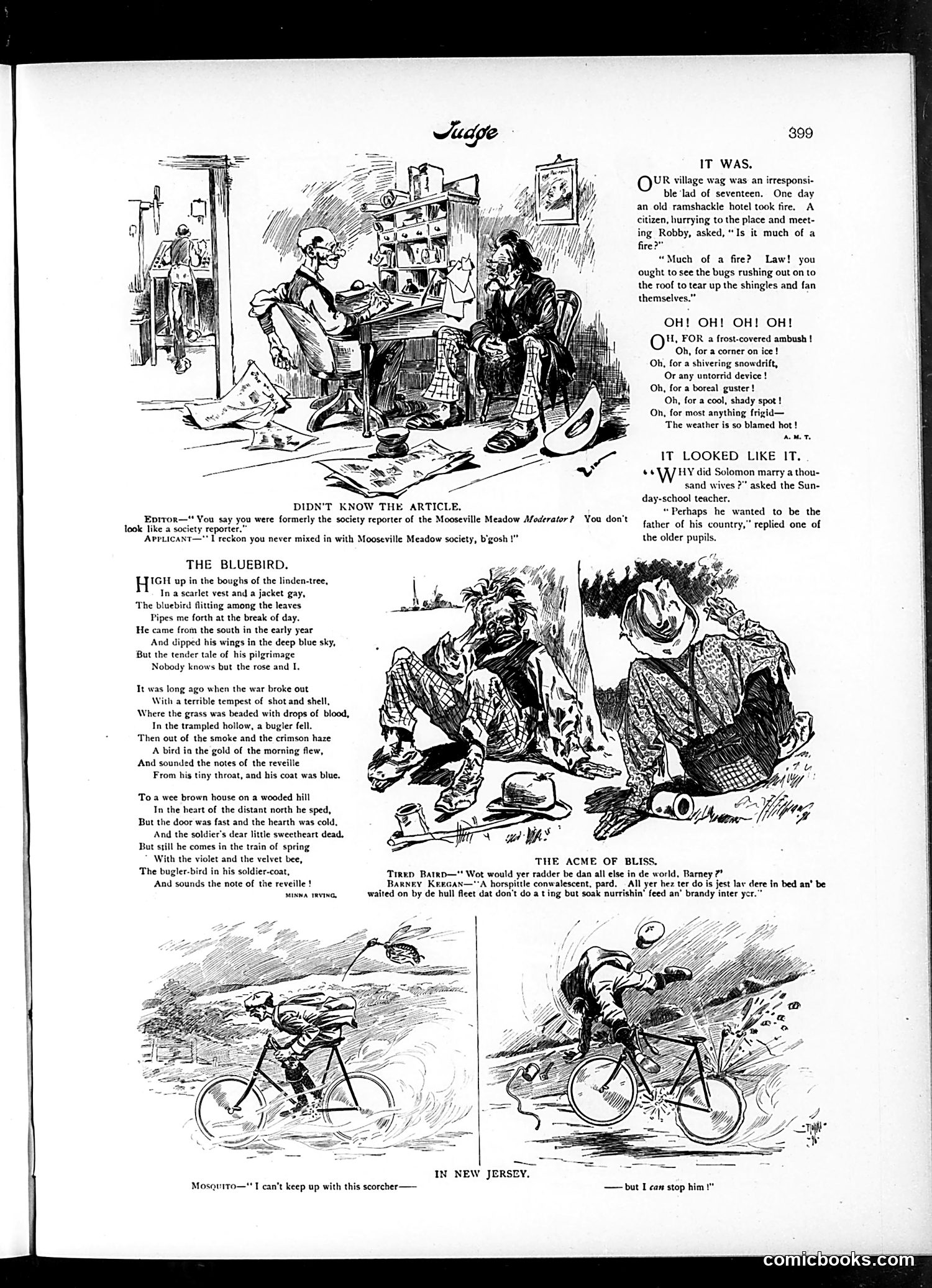
This page contains several satirical pieces typical of Judge's humor circa 1899: **Top cartoon**: A society editor boasts about her credentials, but admits she's never actually mingled in high society—poking fun at pretentious journalism and class pretense. **"The Bluebird" poem**: A sentimental Civil War narrative about a bluebird (symbolizing hope/the Union) that sang a bugle call after a soldier died, then visited his sweetheart's home only to find her dead. This mixes jingoistic patriotism with melodrama typical of the era. **"It Looked Like It"**: A schoolteacher asks why Solomon married a thousand wives; a student suggests he wanted to be "father of his country"—a pun confusing Solomon with George Washington, mocking children's historical ignorance. **"The Acme of Bliss"**: Two working-class characters discuss paradise as lying in a hospital bed being fed and cared for—satire on working-class exhaustion and desire for rest. **Bottom cartoons**: Heat-wave humor about cyclists struggling in scorching New Jersey weather, with a mosquito commenting it can chase one cyclist but not stop him.
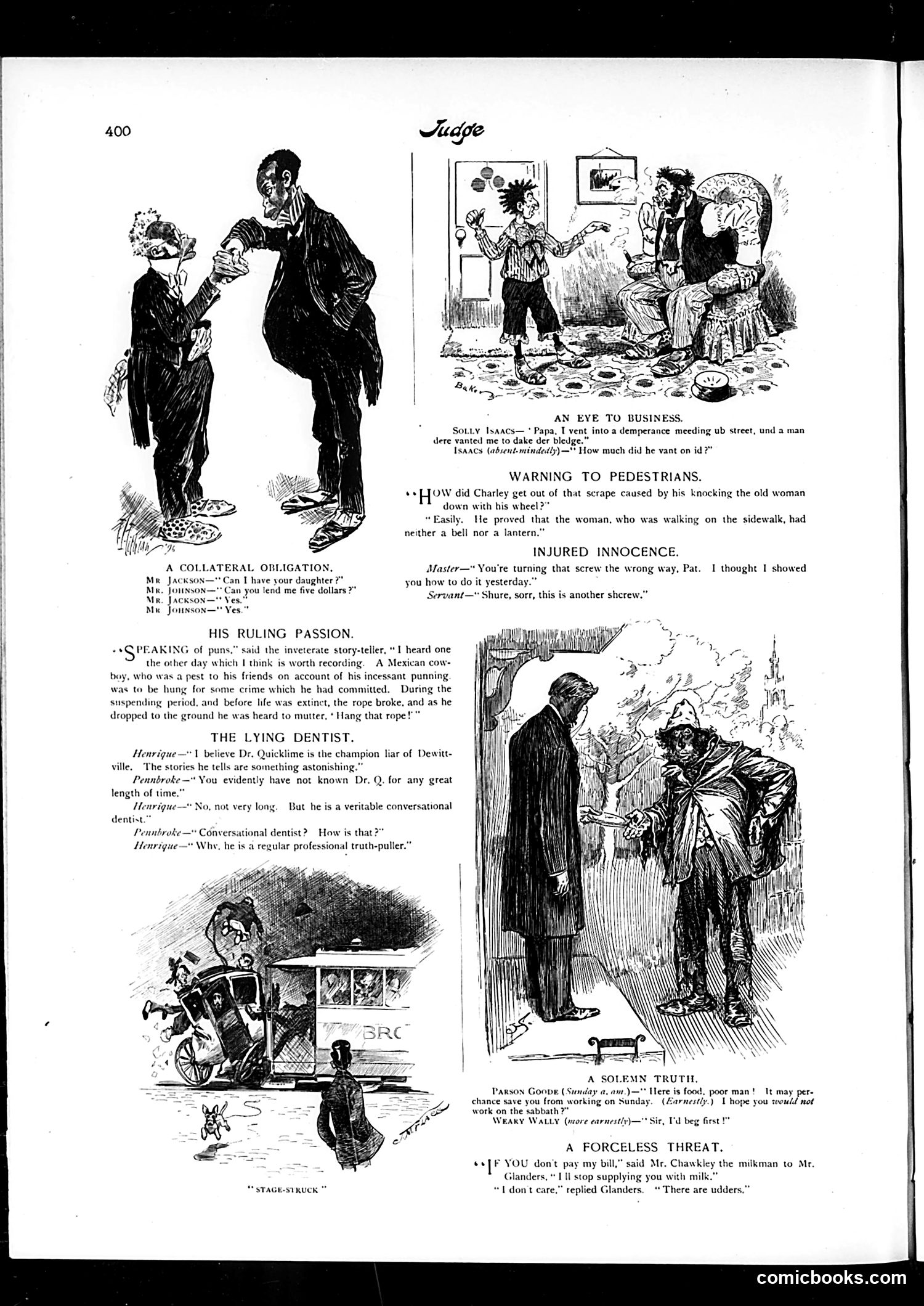
This page contains multiple short humorous sketches typical of late-19th-century American satirical magazines: **"An Eye to Business"** mocks Jewish stereotypes through a Yiddish-accented character (Solly Isaacs), suggesting his father cynically sees a temperance pledge as a financial transaction rather than moral commitment. **"Warning to Pedestrians"** satirizes early automobile culture—specifically the lack of traffic safety standards. The joke is that a cyclist avoided legal responsibility by proving the pedestrian he hit had no bell or lantern, turning victim-blaming into a legal defense. **"The Lying Dentist"** is a pun: dentists are "truth-pullers" (extracting teeth), so a liar becomes a "conversational dentist." **"A Solemn Truth"** uses irony—a clergyman offers charity to prevent Sunday labor, but the poor man pragmatically values immediate food over religious observance. **"A Forceless Threat"** delivers a milk-related pun: the milkman's threat means nothing because "there are udders" (others). The page reflects period concerns: immigration, emerging traffic dangers, working-class poverty, and class attitudes.
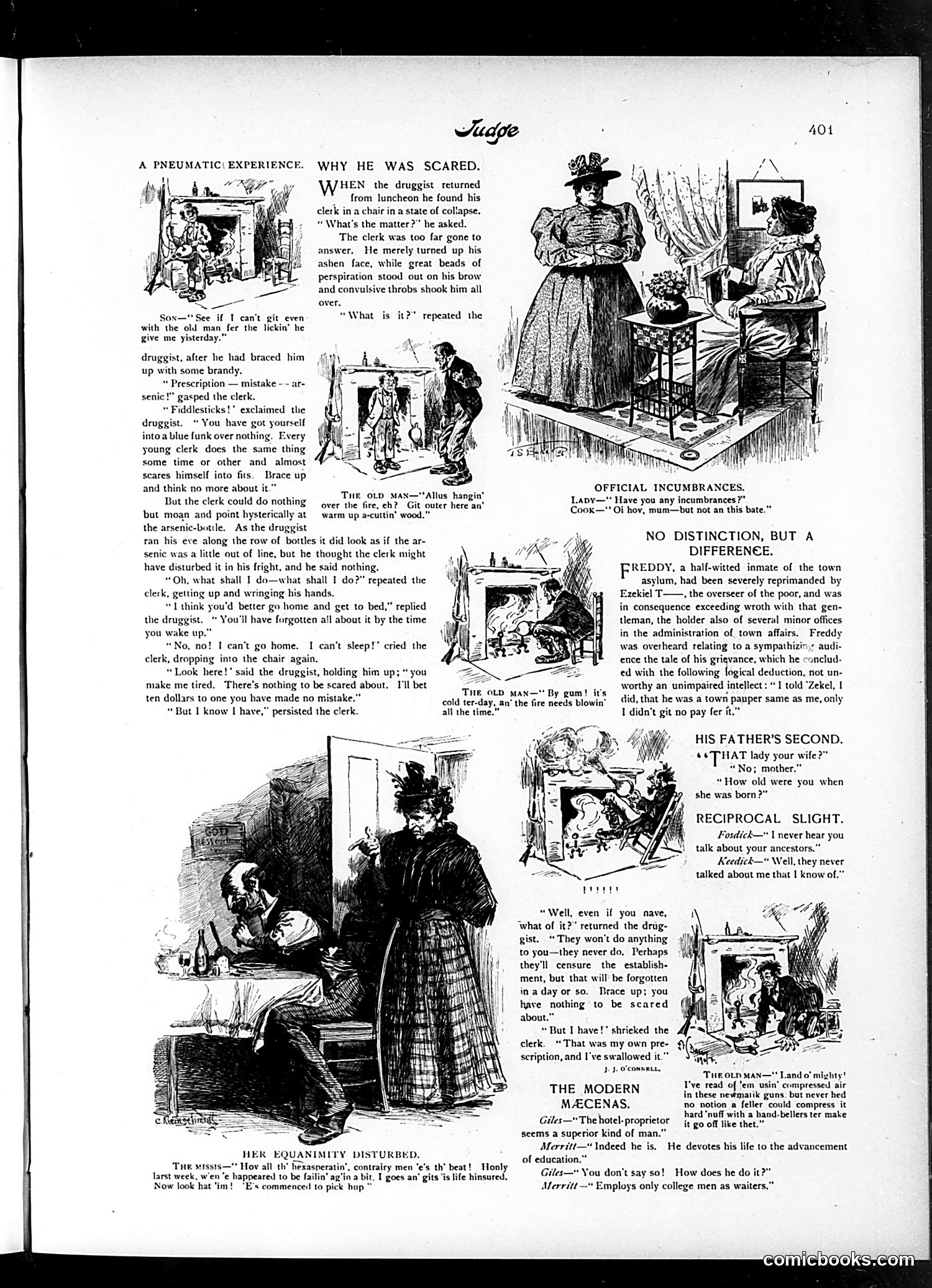
This page contains several unrelated short humorous pieces typical of Judge magazine's format: **"A Pneumatic Experience"** depicts a druggist reassuring a panicked clerk about a prescription mistake. The joke's payoff: the clerk accidentally swallowed his own incorrect prescription containing arsenic, making his terror justified despite the druggist's dismissal. **"Official Incumbrances"** and related brief comedic exchanges use wordplay and social observations—a landlady asking about a tenant's "incumbrances" (obligations/dependents), and jokes about class distinctions and ancestry. **"The Modern Mæcenas"** appears to reference patronage, though details are unclear from the OCR. The illustrations are satirical sketches typical of the era, depicting middle and working-class characters in everyday situations. The humor relies on Victorian-era sensibilities: panic over poison, class consciousness, and domestic situations. No specific political figures or events appear identifiable from this page—it's primarily social satire aimed at general audiences.
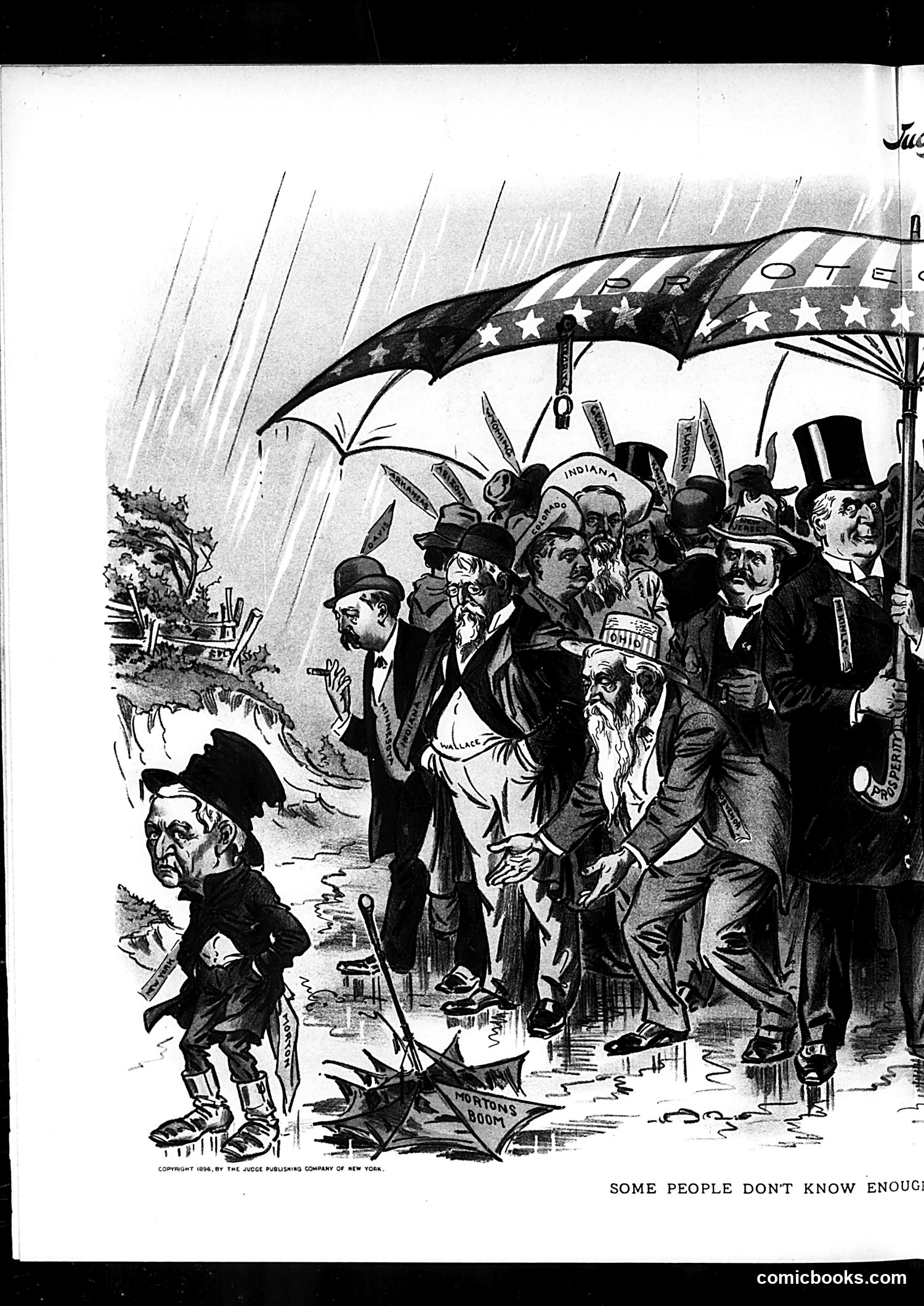
This Judge magazine cartoon satirizes immigration and political patronage in late 19th-century America. A diverse group of recently arrived immigrants—identifiable by their ethnic caricatures and labels like "Indian" and "Chinese"—huddle under an American flag umbrella during a rainstorm. A small figure labeled "Morton's Boom" (likely referring to politician Levi P. Morton) stands apart, excluded from shelter. The cartoon's incomplete caption—"SOME PEOPLE DON'T KNOW ENOUG[H]"—suggests the satire targets either the immigrants' ignorance of American ways or politicians' insufficient understanding of immigration policy. The contrast between protected insiders and the outsider figure critiques either xenophobic exclusion or political mismanagement of immigration during this period of significant American immigration.
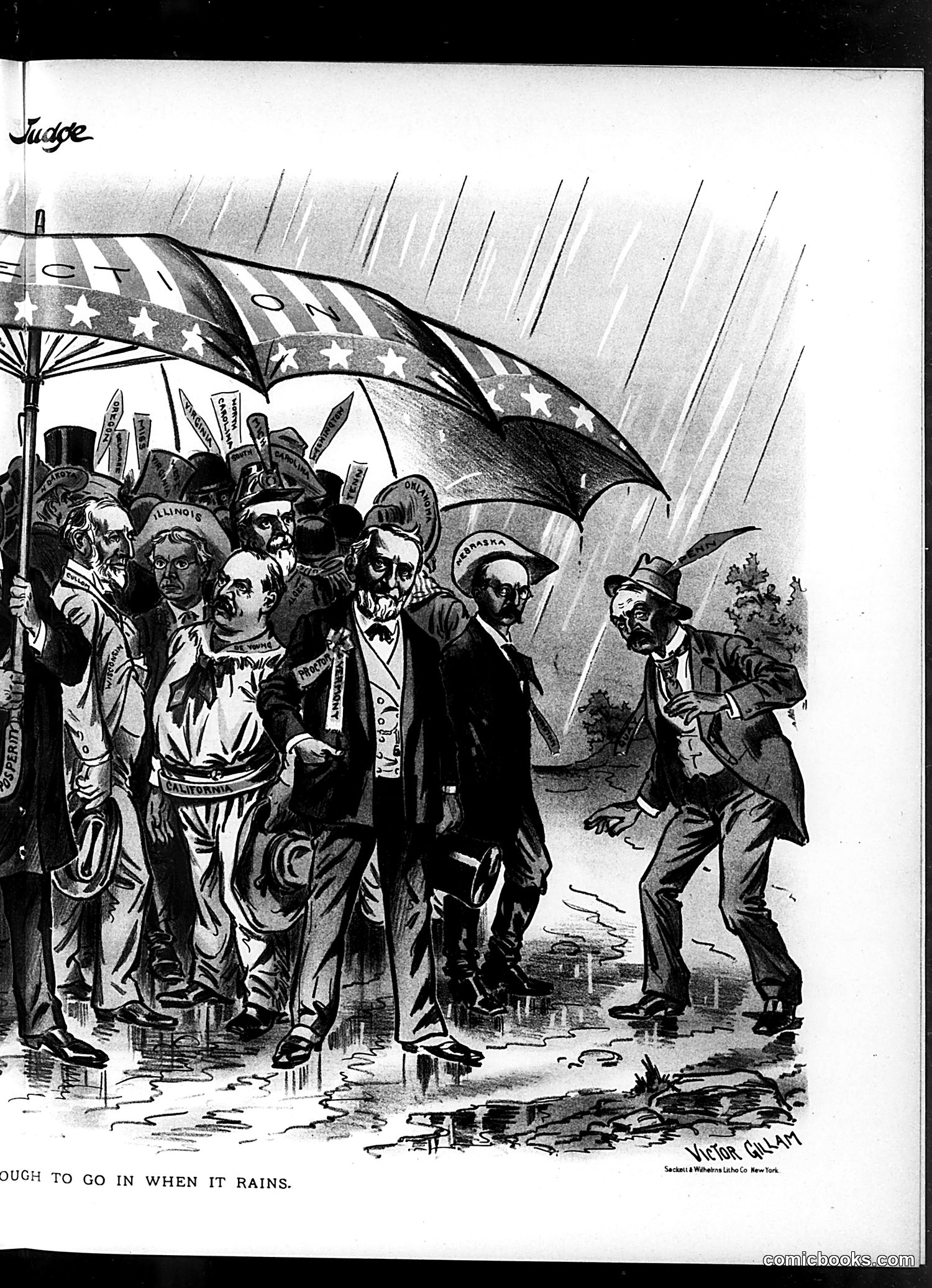
This Judge magazine cartoon satirizes immigrant political participation in America. The image shows a diverse group of men huddled under an American flag during heavy rain, with state identifications visible (Illinois, California, Nebraska visible on clothing). A figure on the right appears to be a political operative or "boss" directing them. The caption "—OUGH TO GO IN WHEN IT RAINS" (likely "TOUGH ENOUGH TO GO IN WHEN IT RAINS") suggests these immigrants are being marshaled to vote regardless of conditions. The cartoon mocks machine politics and immigrant voting blocs—commenting on how political bosses controlled immigrant voters through ethnic organization, sending them to polls en masse. This reflects late 19th/early 20th century anxieties about immigrant political power and urban machine politics.
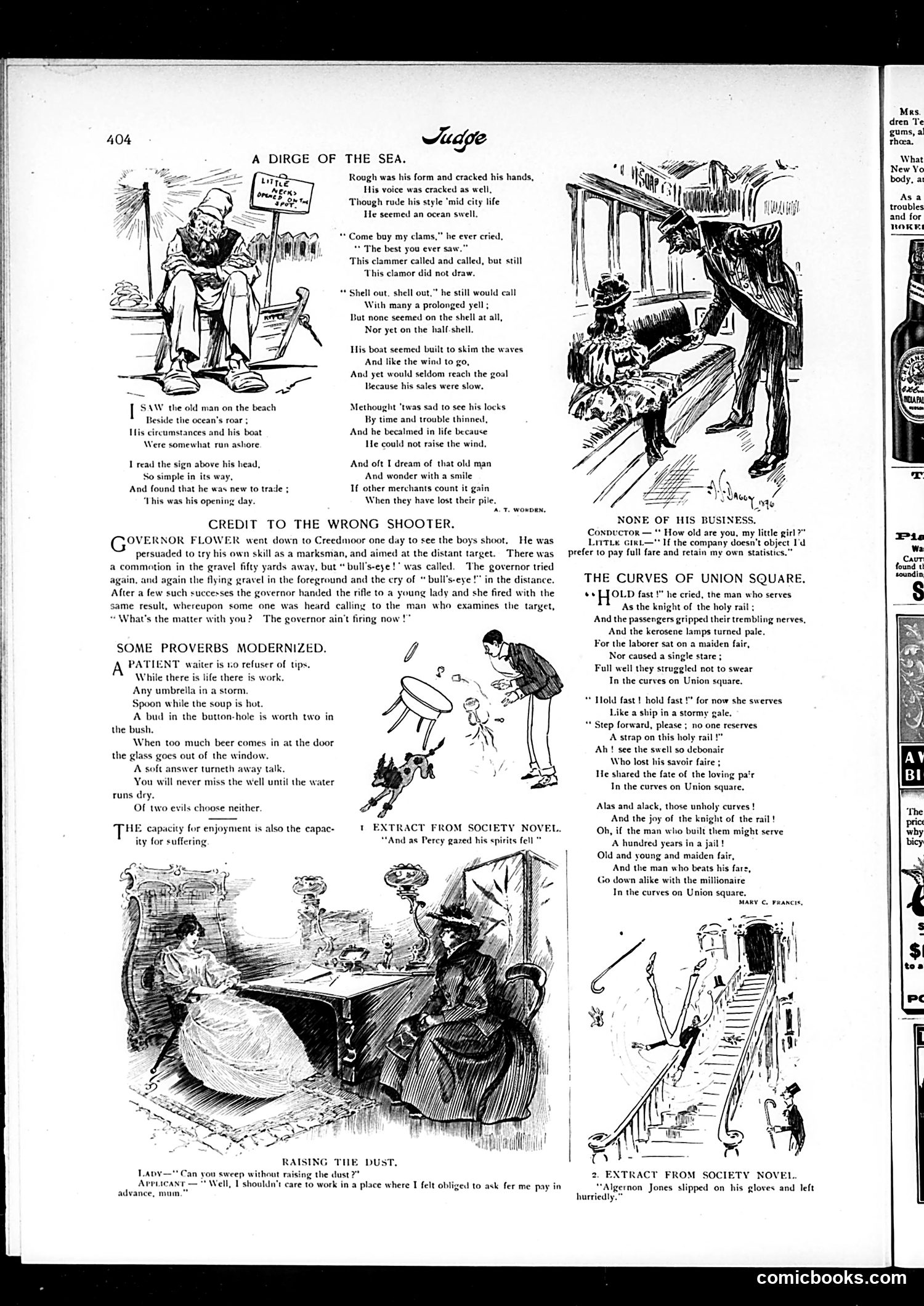
This *Judge* page contains several unrelated satirical pieces mocking contemporary American society. **"A Dirge of the Sea"** depicts an unsuccessful clam vendor on a beach—a down-on-his-luck tradesman whose boat and appearance are weathered, whose sales are nonexistent despite his persistent cries ("Come buy my clams"), and who opened his business during an inauspicious time. The satire targets struggling small merchants and the futility of their efforts. **"Credit to the Wrong Shooter"** mocks Governor Flower (likely Roswell P. Flower of New York, 1880s), who shoots poorly at a rifle range but receives false credit when a young woman's superior shot is attributed to him—a joke about undeserved reputation and sycophantic observers. **"The Curves of Union Square"** satirizes New York streetcar passengers gripping overhead rails during a jostling ride, with elaborate mock-heroic poetry treating the mundane experience as dramatic. The remaining items ("Some Proverbs Modernized," brief vignettes) offer light social humor about everyday hypocrisy and absurdity.
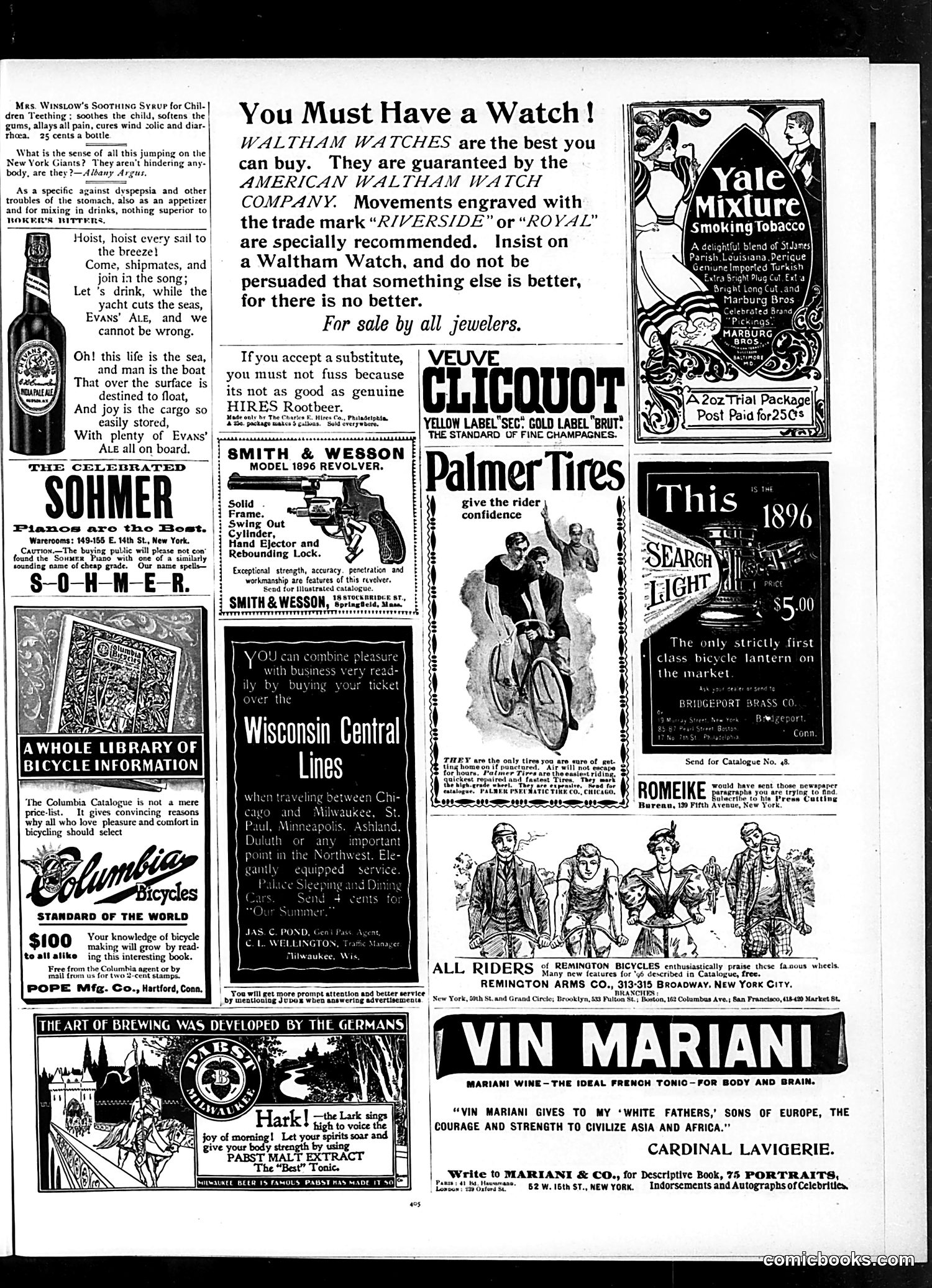
This is primarily an **advertising page** from an 1896 issue of Judge, with minimal editorial content. The few non-advertisement items are brief and unremarkable: - A short quip questioning criticism of the New York Giants baseball team - A poem promoting Evans' Ale, using nautical imagery as a thin pretext for product placement The page is dominated by **period advertisements** for consumer goods: watches (Waltham), firearms (Smith & Wesson revolvers), bicycles (Columbia, Remington), tires (Palmer), champagne (Clicquot), patent medicines (Mrs. Winslow's Soothing Syrup), and notably **Vin Mariani wine**, which features a quote from Cardinal Lavigerie endorsing it as providing "courage and strength to civilize Asia and Africa"—reflecting the era's imperialist attitudes. There are **no political cartoons** on this page. It functions as a commercial vehicle rather than satirical commentary, typical of Judge's mixed editorial-advertising format in this period.
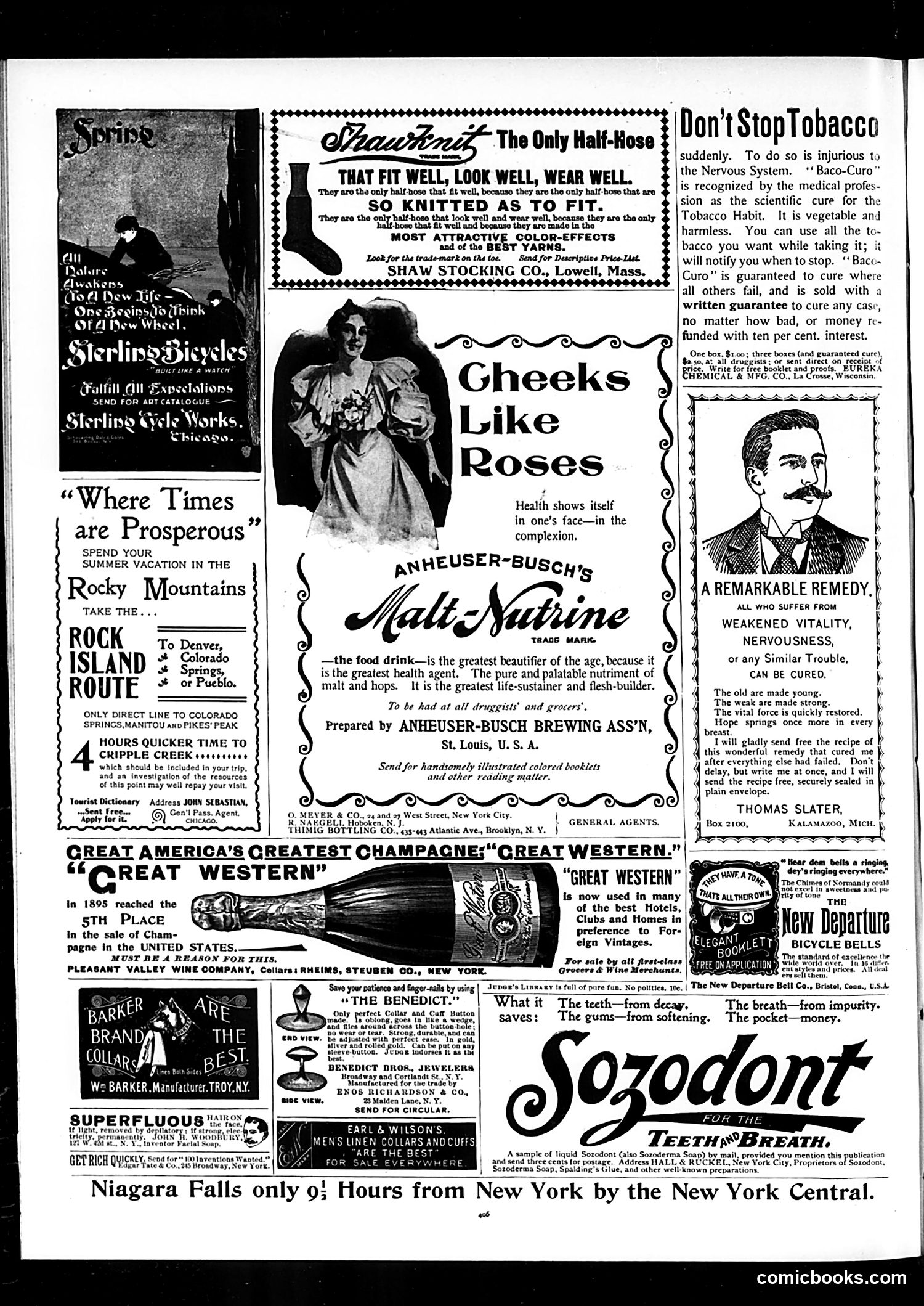
This page is primarily **advertising**, typical of Judge magazine's business model. The content includes: **Main Advertisements:** - Sterling Bicycles, Shaw Stockings, and Anheuser-Busch's Malt Nutrine (a health drink) dominate - Travel promotions (Rocky Mountains, Niagara Falls) - Patent medicines including "Baco-Curo" (tobacco cessation) and an unnamed "remarkable remedy" for vitality issues - Champagne, jewelry, and dental products **Historical Context for Modern Readers:** The ads reflect late-19th/early-20th century concerns: bicycle craze, "patent medicine" era (before FDA regulation), and health tonics of dubious efficacy. Anheuser-Busch marketing malt as medicinal rather than purely alcoholic is notable. The "Baco-Curo" ad's guarantee structure was common then. **Not Satirical:** This page contains **no political cartoons or satire**—it's a straightforward advertising section. Judge's humor appeared elsewhere in the magazine; this represents its commercial revenue model.
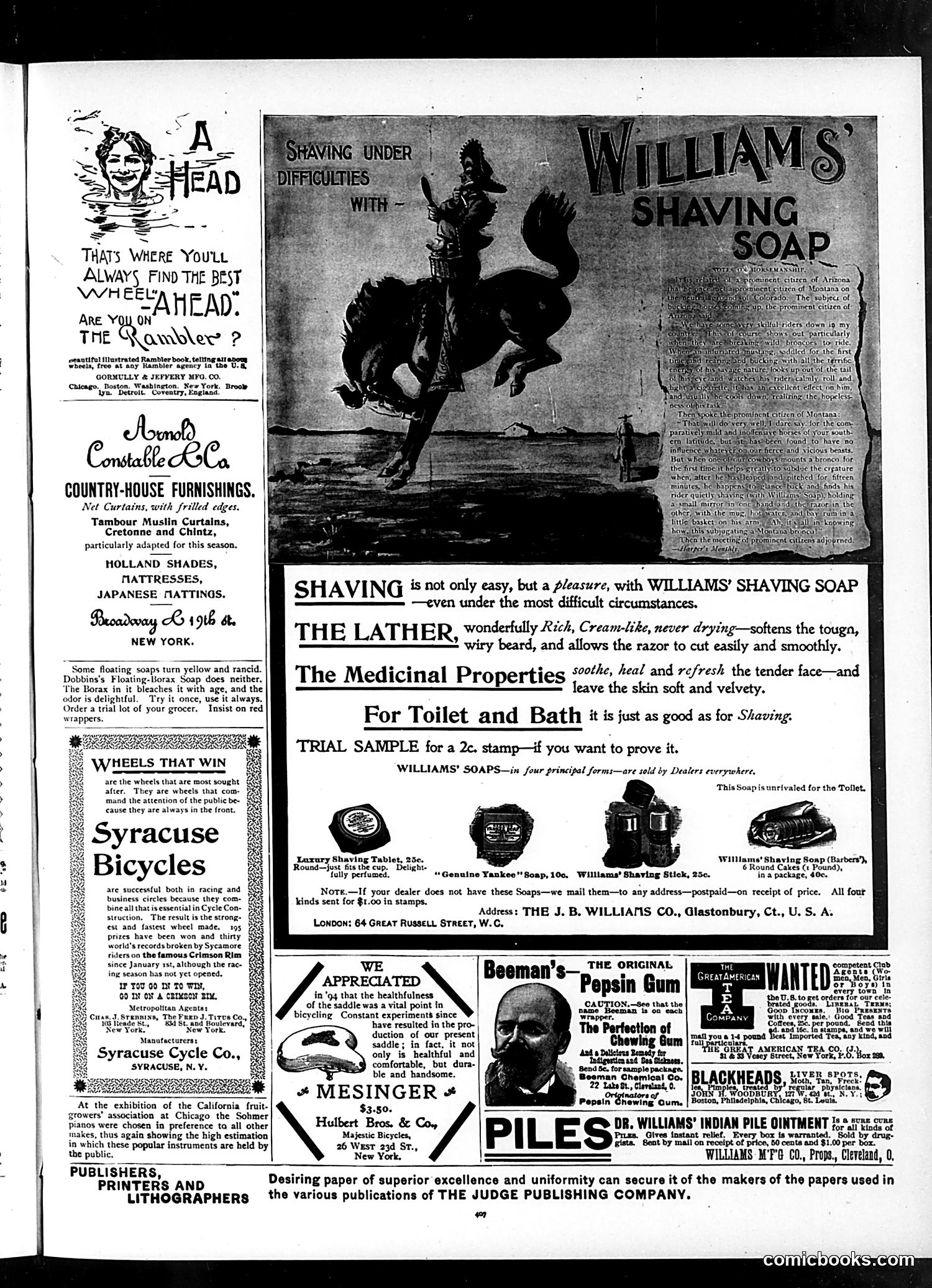
This page is primarily **advertising**, not political satire. It's from Judge, the American satirical magazine, but this particular page showcases commercial advertisements rather than editorial cartoons. The content includes ads for: - **Rambler bicycles** ("A Head" - pun on "ahead") - **Williams' Shaving Soap** (largest ad, featuring a bucking horse) - **Syracuse Bicycles** - Various patent medicines and consumer goods (Beeman's Pepsin Gum, Dr. Williams' Indian Pile Ointment, etc.) - Home furnishings and household products The only visual humor is minimal wordplay in the Rambler bicycle ad's headline. The page demonstrates how turn-of-the-century magazines like Judge monetized their readership through full-page product advertisements, many promoting now-obsolete or dubious remedies typical of the era (pile ointments, "medicinal" gum, etc.). This is a commercial page rather than satirical content.
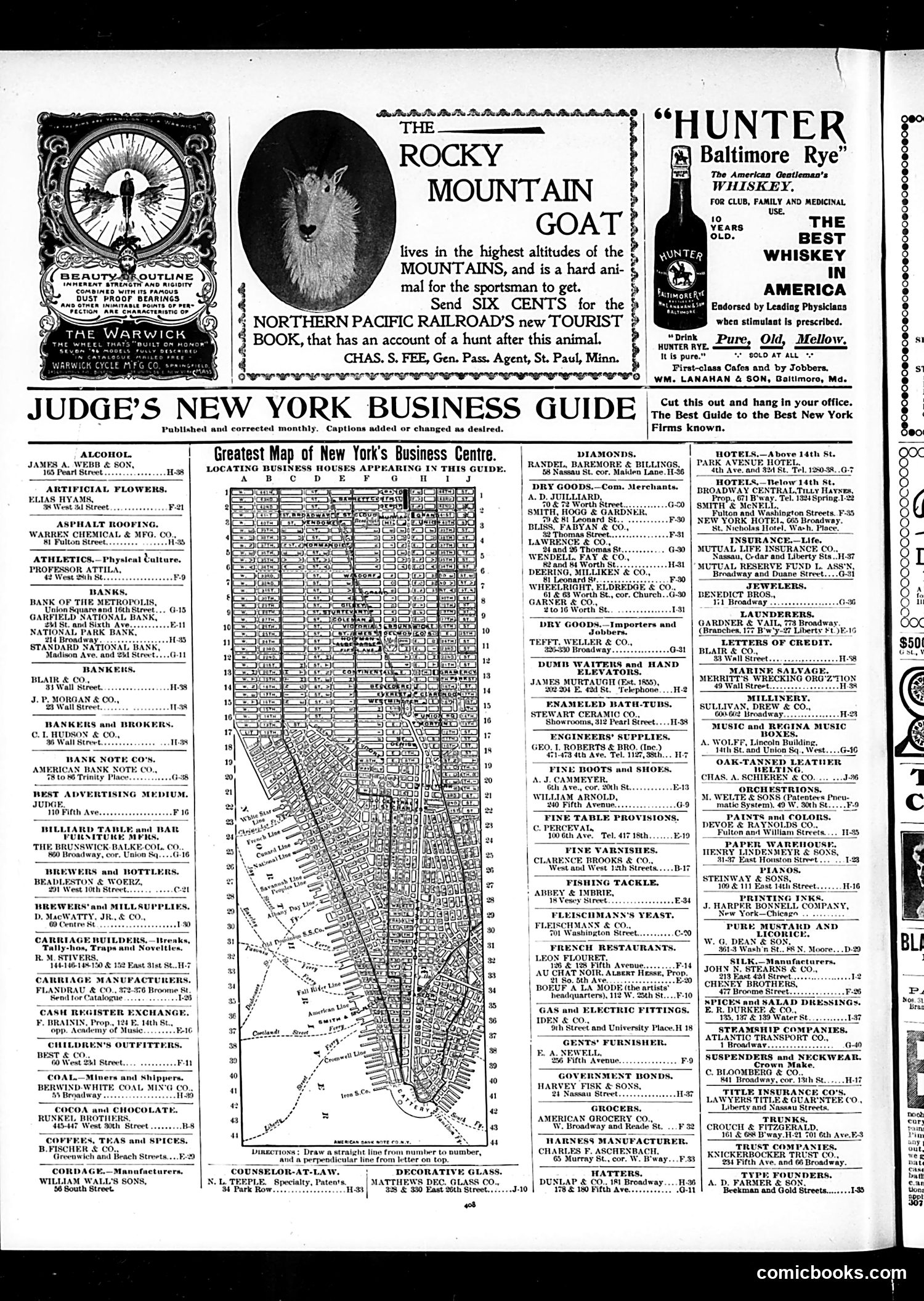
This page is primarily a business directory and advertisement section from *Judge* magazine, not a political cartoon. The main content features "Judge's New York Business Guide"—a classified business directory organized alphabetically (banks, artificial flowers, breweries, etc.) with a detailed map of Manhattan's business center. This reflects the magazine's dual function as satire publication and practical business resource for readers. The notable non-directory content includes two advertisements: 1. **Rocky Mountain Goat** (top center): An advertisement for the Northern Pacific Railroad's tourist book, promoting adventure hunting trips. 2. **Hunter Baltimore Rye Whiskey** (right side): A liquor advertisement claiming it's "The Best Whiskey in America," endorsed by physicians and marketed for "club, family and medicinal use"—reflecting the era when whiskey was marketed with health claims. There is no political satire visible on this page; it's essentially a practical business listing mixed with period advertising.
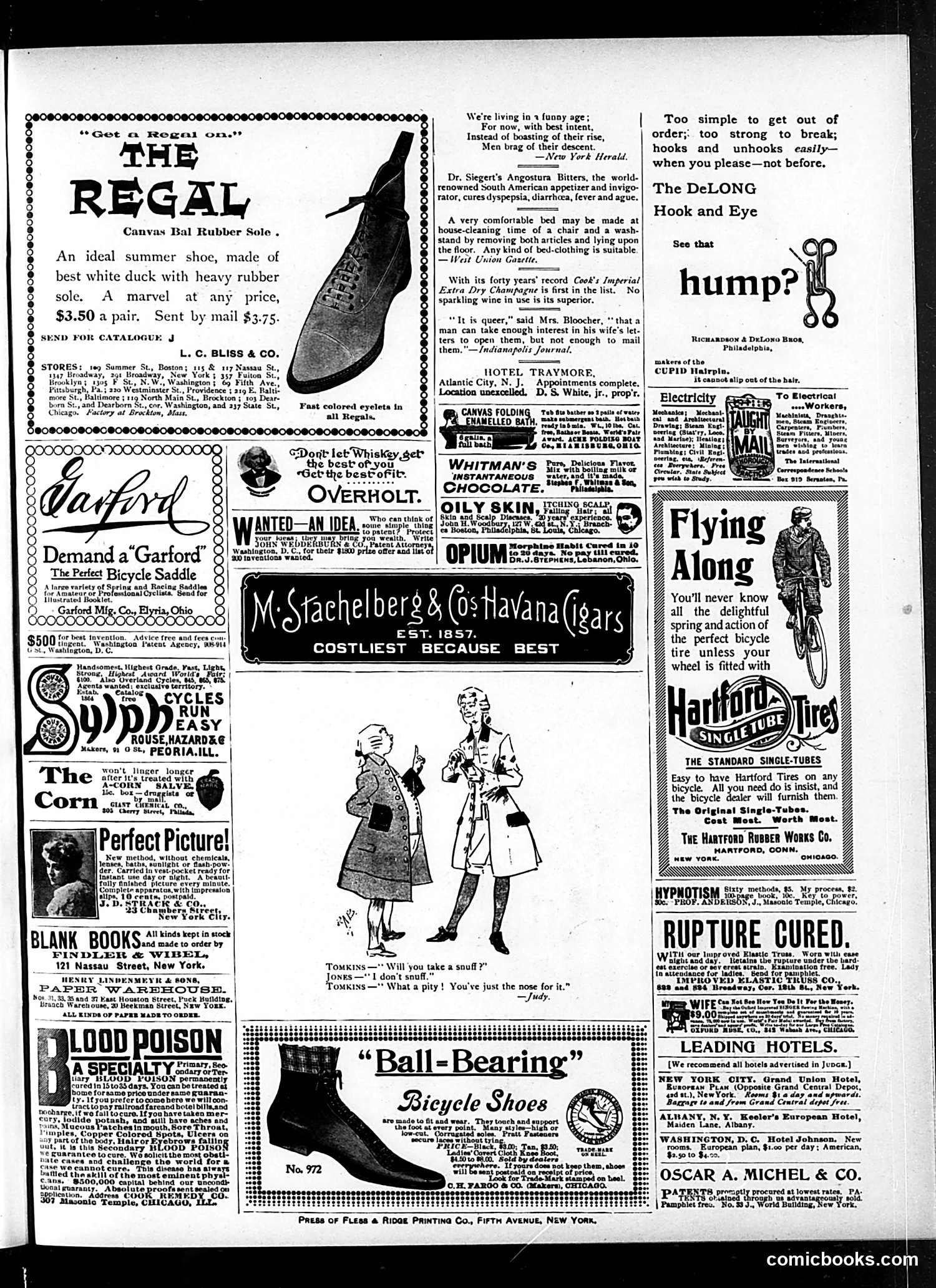
This page is **primarily advertising** with one small cartoon. The single comic illustration (center-lower portion) shows two women in conversation, with the caption depicting a social joke about snuff-taking. One woman asks if the other takes snuff; when refused, she quips that the other woman has "just the nose for it"—a mild insult suggesting a large nose, typical of period humor. The page otherwise contains product advertisements typical of early 1900s Judge magazine: shoes (Regal canvas, ball-bearing bicycle shoes), saddles, cigars, medicinal products (including blood poison treatments and opium cures), and hotel listings. Notable is the prevalence of medical "cure-all" advertisements—blood poison, rupture, oily skin remedies—reflecting an era before FDA regulation of patent medicines. The ads reveal contemporary consumer concerns and marketing tactics rather than satirical content. The single quote at top-left mocking people braising their descent rather than ancestry represents the magazine's actual satirical function.
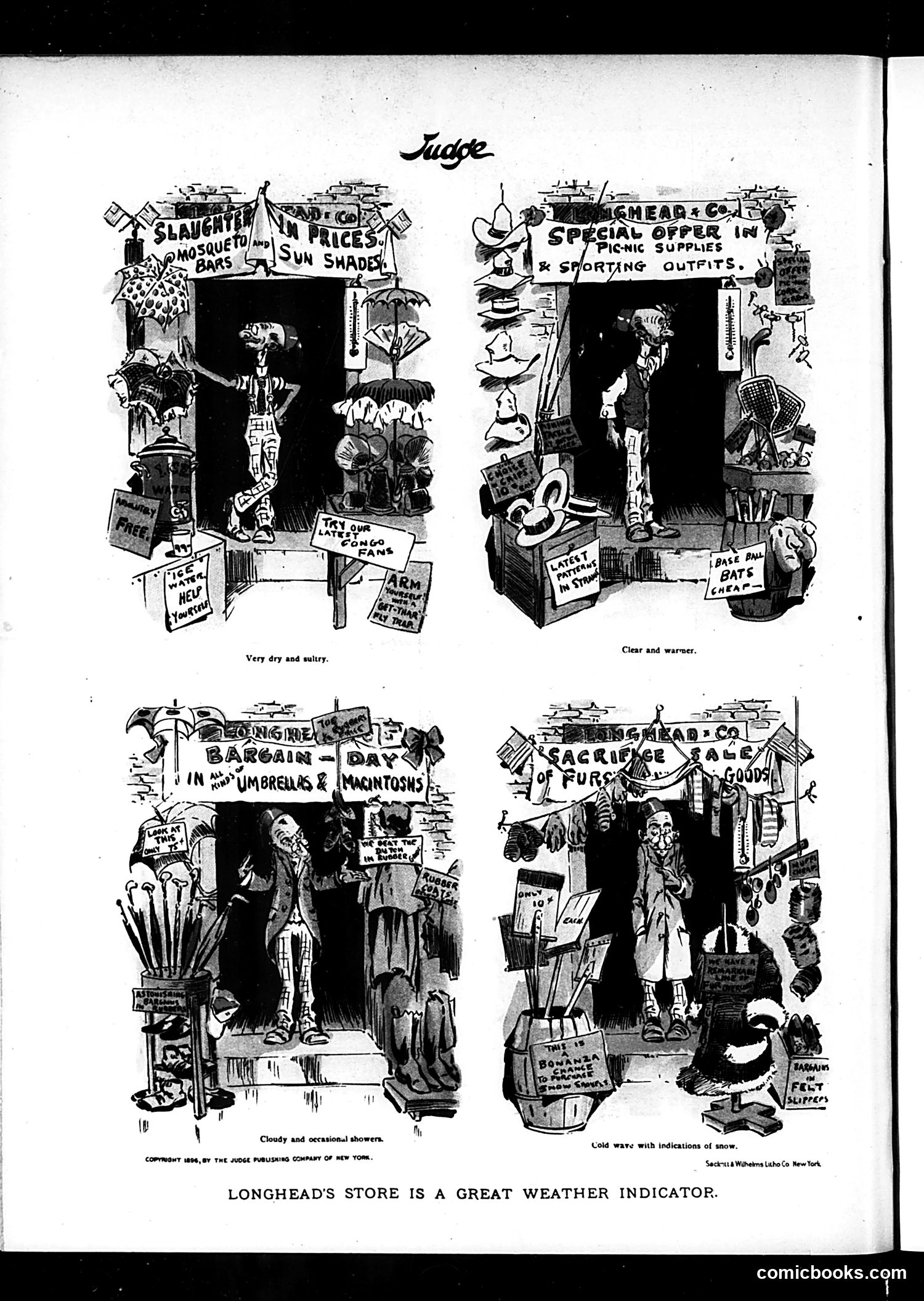
This is a humorous visual joke about a general store's inventory and customer traffic reflecting weather patterns. Four panels show "Longhead's Store" under different seasonal conditions: **Top left** ("Very dry and sultry"): Features slaughter prices on umbrellas and sun shades—goods nobody needs in hot weather. **Top right** ("Clear and warmer"): Displays sporting outfits and recreational equipment. **Bottom left** ("Cloudy and occasional showers"): Emphasizes umbrellas and mackintoshes (raincoats). **Bottom right** ("Cold wave with indications of snow"): Shows fur coats and winter goods. The satire mocks both the store's predictable seasonal inventory shifts and, possibly, the shop owner's obvious attempts to move merchandise. The joke's premise—that you could predict the weather by looking at what's being advertised outside a store—plays on the transparent nature of retail marketing responding to actual climate conditions.