
Judge, 1896-06-13 · page 3 of 16
Judge — June 13, 1896 — page 3: what you’re looking at
What you’re looking at
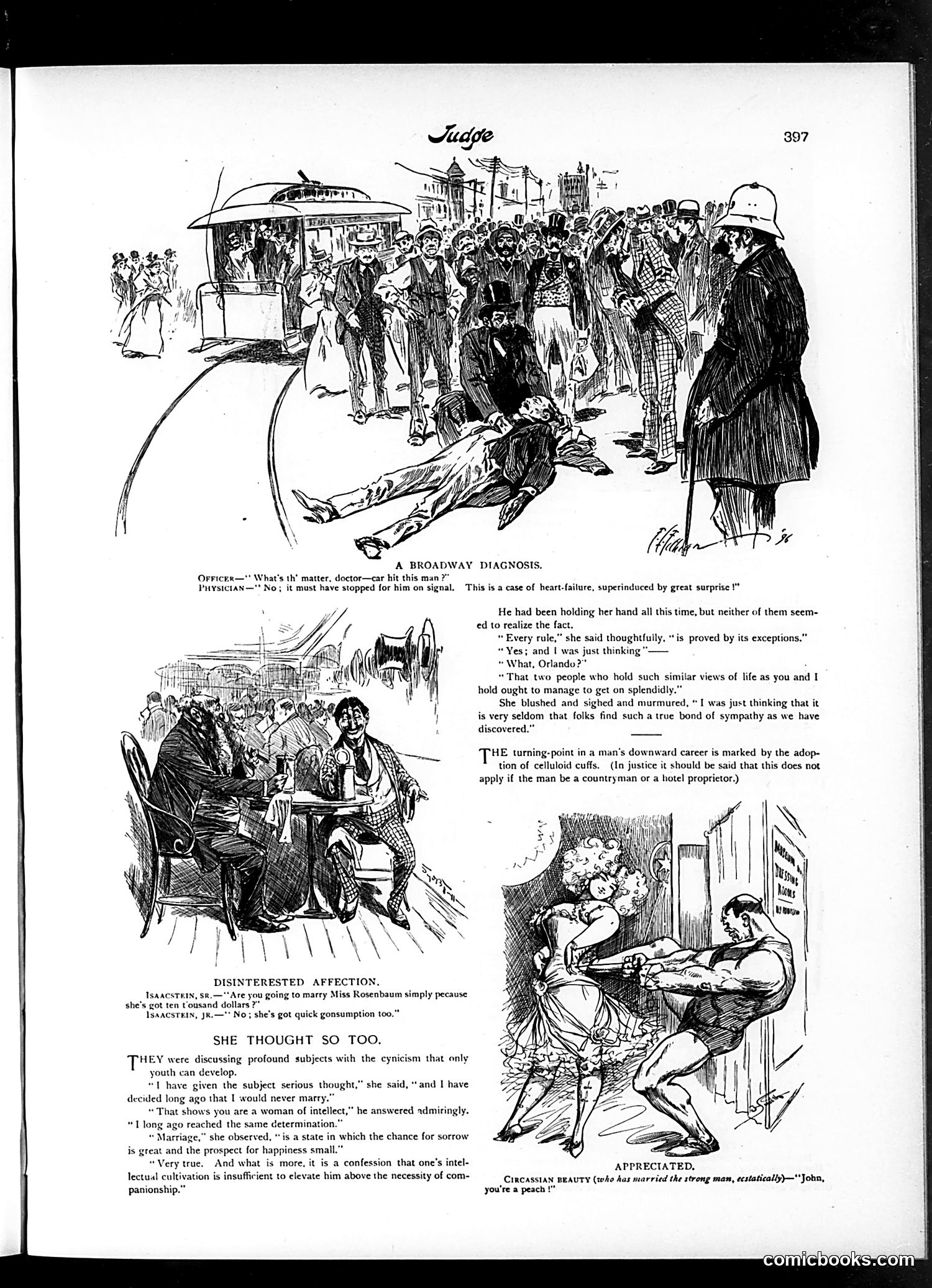
This page contains three separate satirical sketches rather than a unified cartoon: **"A Broadway Diagnosis"** depicts a street scene where a doctor diagnoses a collapsed man's condition to gathered onlookers—the joke being the absurdity of public medical pronouncements. **"Disinterested Affection"** shows Isakstein discussing marriage prospects, satirizing indifference disguised as romantic consideration. **"She Thought So Too"** portrays an intellectual couple debating whether marriage elevates people through "intellectual cultivation." The satire mocks pretentious philosophizing about love and education among the upper classes. **"Appreciated"** (bottom right) shows a woman with a "strong man," captioned to suggest Caucasian beauty prefers physical strength over intellectual refinement—likely satirizing changing social attitudes about gender and class. The overall theme appears to be mocking urban sophistication and middle-class affectations regarding romance and society.
📄 Transcribed text from this page (OCR, searchable)
Machine-transcribed from the original scan — historical spelling and the odd misread are preserved.
A BROADWAY DIAGNOSIS. Orricer—** What's th’ matter, doctor—car hit this man ?” Puysiciay—"* No ; it must have stopped for him on signal. This is a case of heart-failure, superinduced by great surprise !" He had been holding her hand all this time, but neither of them seem- ed to realize the fact. Every rule,” she said thoughtfully, “is proved by its exceptions.” “Yes; and I was just thinking "— hat, Orlando?” “That two people who hold such similar views of life as you and I hold ought to manage to get on splendidly She blushed and sighed and murmured, "I was just thinking that it is very seldom that folks find such a true bond of sympathy as we have discovered.” HE turning-point in a man’s downward career is marked by the adop- tion of celluloid cuffs. (In justice it should be said that this does not apply if the man be a countryman or a hotel proprietor.) DISINTERESTED AFFECTION, ISAACSTRIN, SR.—"‘Are you going to marry Miss Rosenbaum simply pecause she’s got ten Cousand dollars ?* ISAACSTELN, JR.—"* No ; she’s got quick gonsumption too.” SHE THOUGHT SO TOO. HEY were discussing profound subjects with the cynicism that only youth can develop. “TL have given the subject serious thought,” she said, “and I have decided long ago that I would never marry.” “That shows you are a woman of intellect,” he answered admiringly. “Tong ago reached the same determination.” iage,” she observed, “is a state in which the chance for sorrow is g d the prospect for happiness small.” “Very true. And what is more, it is a confession that one’s intel- lectual cultivation is insufficient to elevate him above the necessity of com- panionship. APPRECIATED, CIRCASSIAN BEAUTY (sho Aas married the strong man, ecstatically)—“Jobn, you're a peach !""