
A complete issue · 16 pages · 1896
Judge — May 30, 1896
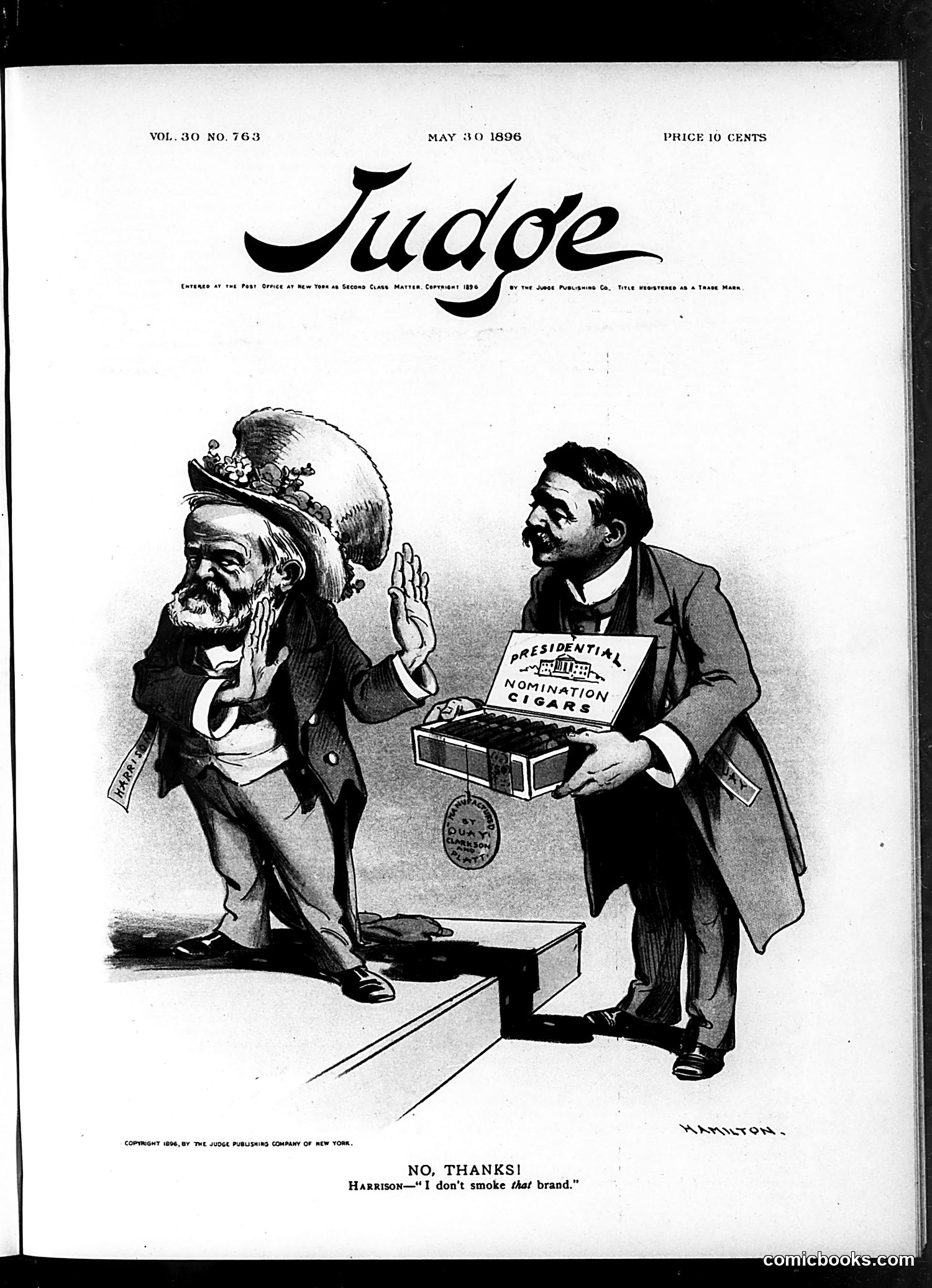
This Judge magazine cover from May 30, 1896 depicts a political figure labeled "Harrison" rejecting a box of "Presidential Nomination Cigars." The cartoon satirizes Harrison's reluctance to accept the Republican presidential nomination for that election year. The figure on the left (presumably representing party leadership or a political operative) offers the cigars as a symbolic gift of nomination, while Harrison waves them away, stating "I don't smoke that brand." This is a pun: he refuses both the literal cigars and the nomination itself. The joke relies on understanding that Harrison declined to seek another term in 1896, making his rejection of the "nomination" the central political commentary of the satire.
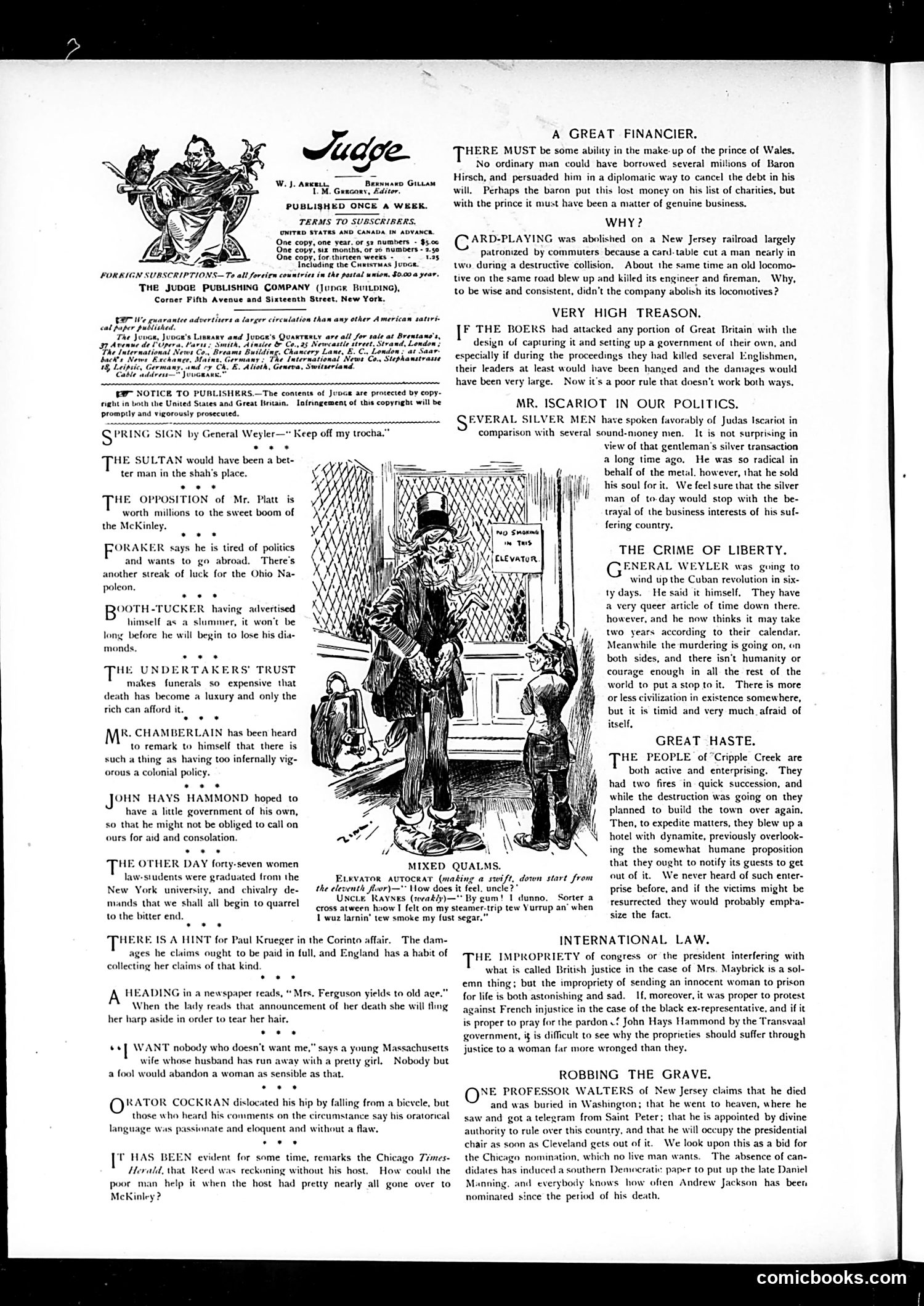
The page contains several brief satirical items rather than a single large cartoon. The main illustration shows an elevator accident—a man has fallen down an elevator shaft while another man looks on in shock. The text items mock various political and social figures of the era, including references to "the Sultan," "Mr. Platt" (likely a politician), and General Weyler (Spanish military commander in Cuba). One section titled "A Great Financier" suggests the Prince of Wales borrowed millions from a baron—satire about royal debt. "The Crime of Liberty" criticizes General Weyler's handling of the Cuban rebellion as timid. The final section, "Robbing the Grave," appears to reference Democratic politics and Andrew Jackson's influence. Without specific dates visible, the exact historical moment remains unclear, though references suggest the 1890s.
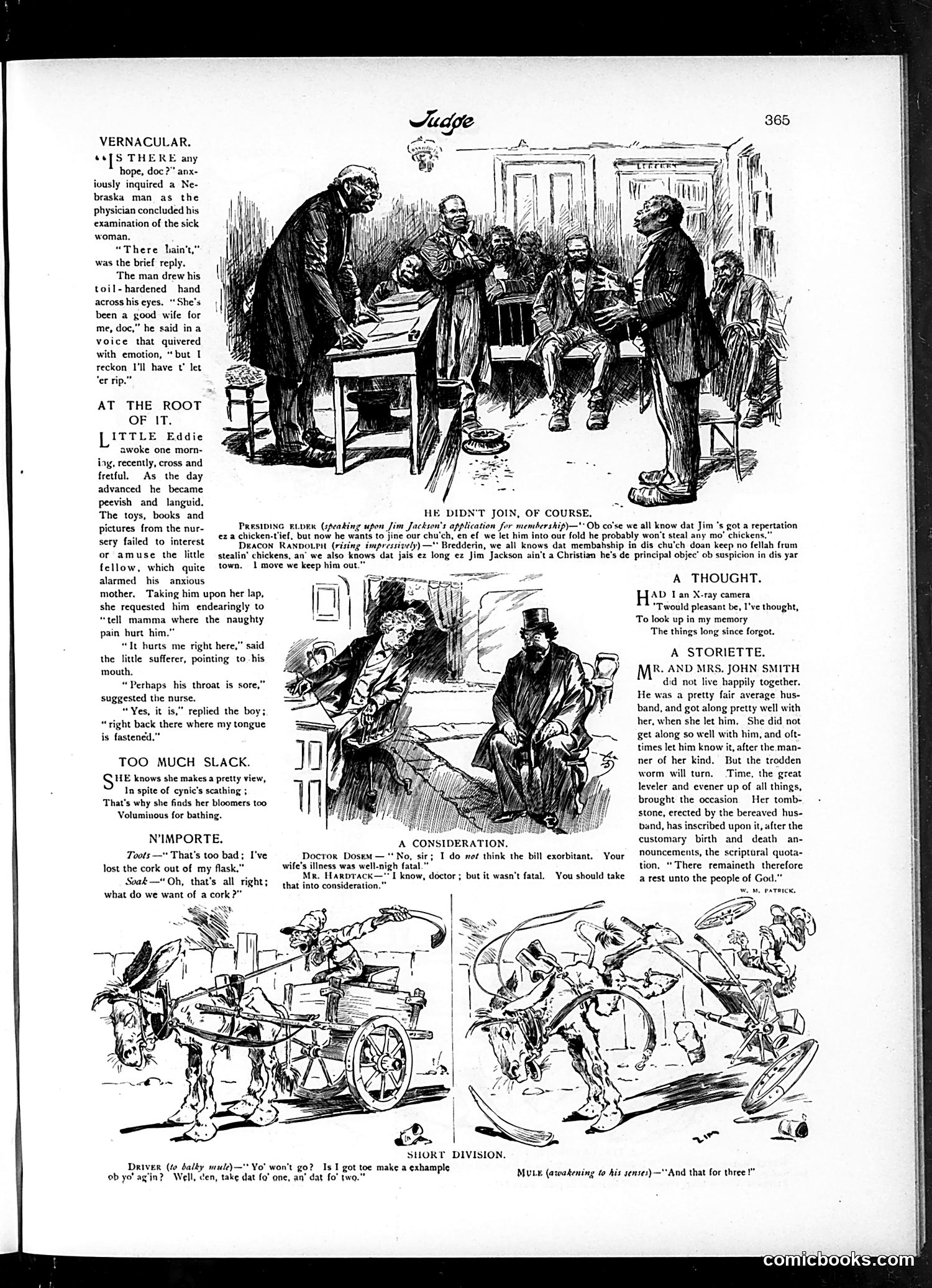
This page contains several short humorous sketches and illustrations rather than a single political cartoon. **"At the Root of It"** depicts a doctor examining a sick woman while family members gather around, discussing her ailments. The humor appears domestic rather than political. **"A Thought"** and **"A Storiette"** are brief literary pieces about personal relationships and romantic difficulties—social commentary on marriage rather than politics. The lower cartoons—**"A Consideration,"** **"Short Division,"** and **"Mule"**—show comic scenarios involving doctors, drivers with carts/wagons, and animals. These appear to be visual gags about everyday mishaps and class interactions, relying on slapstick humor rather than specific political references. Overall, this page represents Judge's lighter, domestic humor content rather than its satirical political coverage.
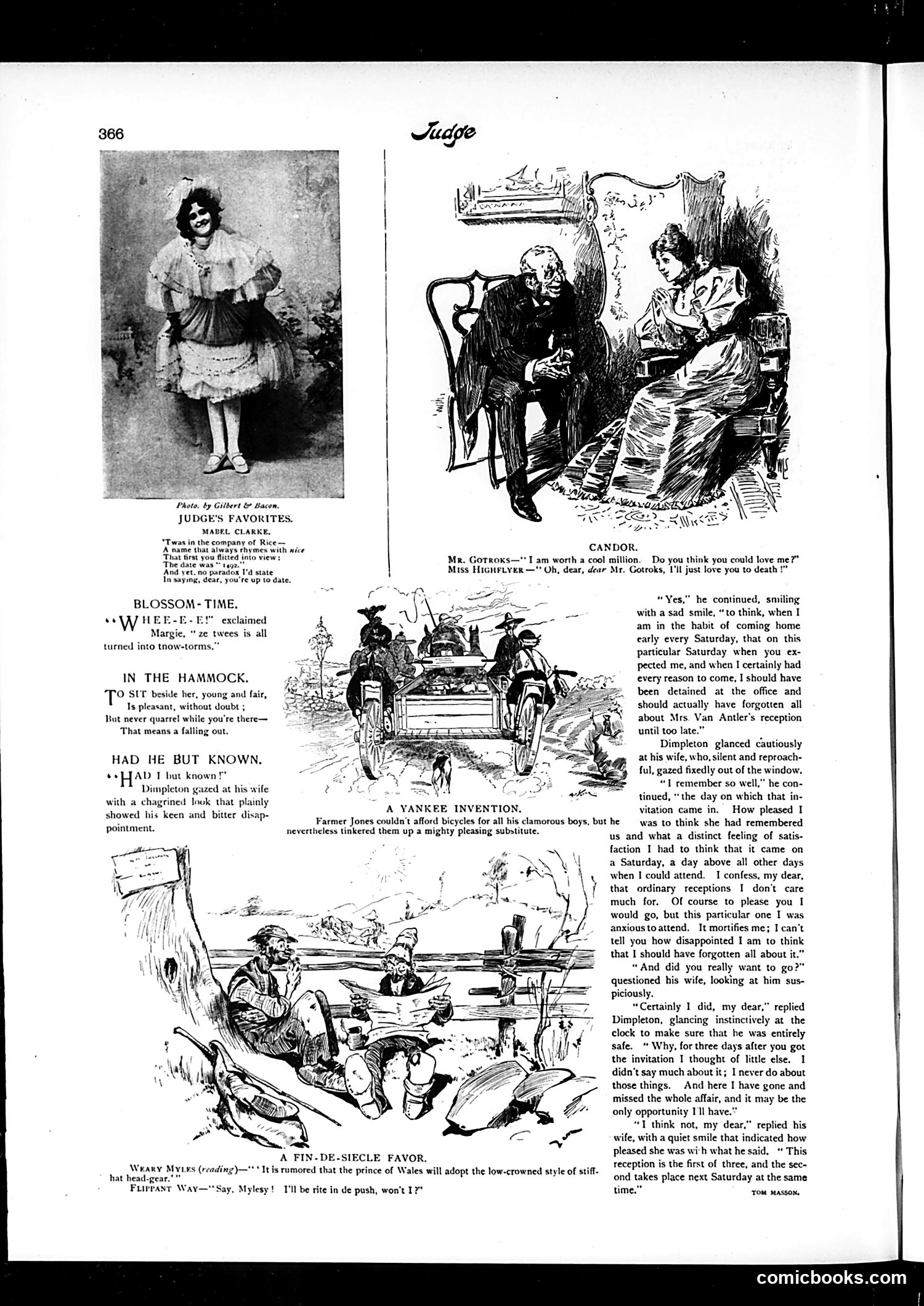
This page contains several brief humorous pieces typical of Judge magazine's satirical style: **"Judge's Favorites"** features a photograph of a young woman in period dress—likely a theatrical or social figure of the era, though the OCR text is too corrupted to identify her clearly. The remaining items are short comic pieces about domestic life and social manners: - **"Candor"** satirizes mercenary courtship: a wealthy man (Mr. Gotrocks) asks if a woman (Miss Highlyer) could love him for his million dollars; she eagerly agrees, revealing transparent greed beneath polite society's pretense of romantic sentiment. - **"Had He But Known"** depicts a husband's elaborate excuses for missing his wife's social event—only to discover she's planned identical future receptions, implying his excuses were transparent. - **"A Fin-de-Siècle Favor"** makes a brief joke about the Prince of Wales adopting a new hat style. The cartoons mock late-Victorian social conventions, marital tension, and materialistic attitudes among the wealthy.
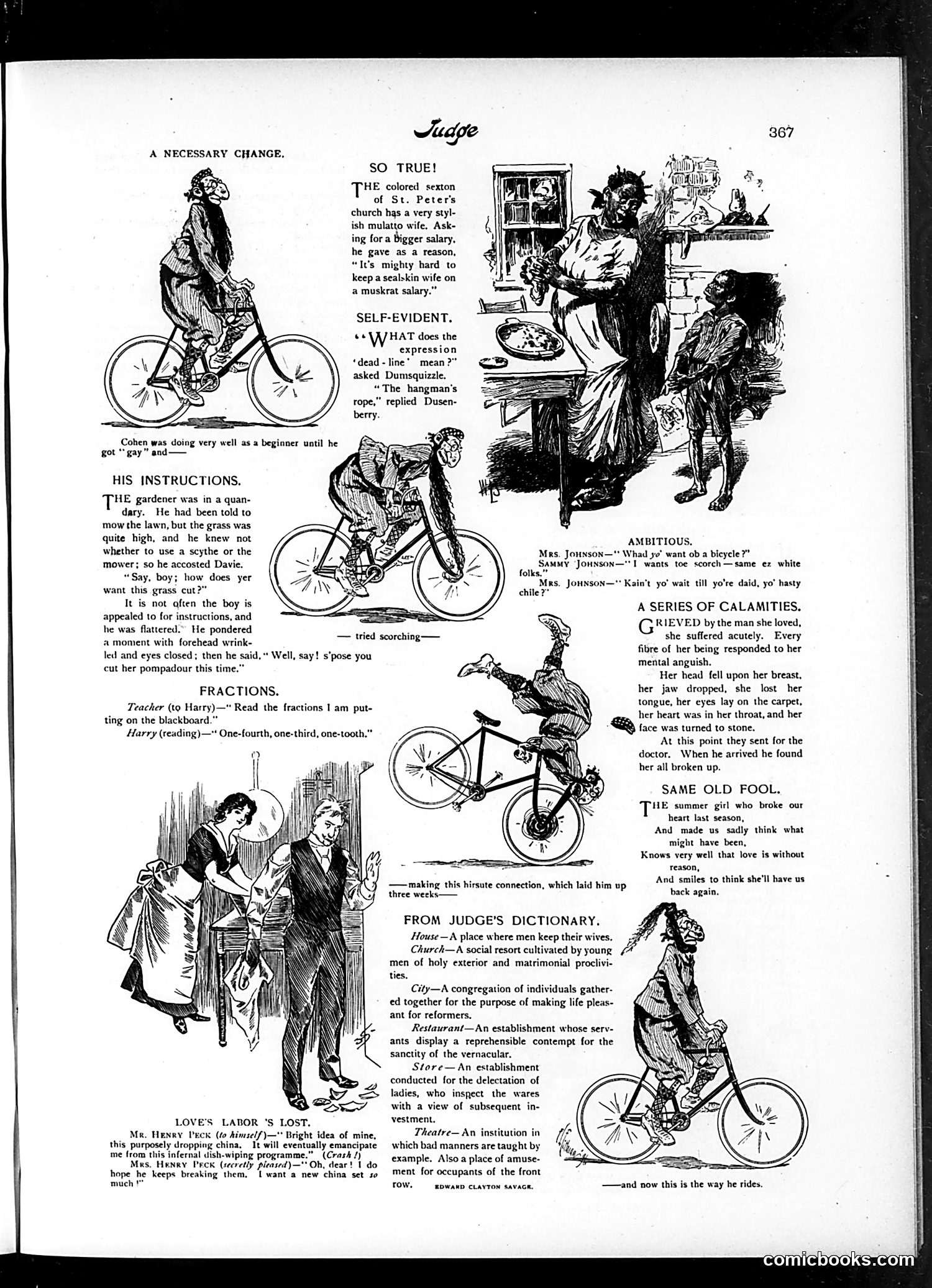
This 1890s page contains multiple short humorous pieces reflecting period attitudes: **"So True!"** mocks a Black church sexton requesting higher wages to support his stylish wife—the joke relies on racist stereotypes about Black people and consumption. **Bicycle humor** dominates several cartoons. "A Necessary Change," "His Instructions," and the final untitled piece depict novice cyclists comically falling or losing control—bicycles were then a novel, fashionable technology, and their adoption by women and working-class people generated social anxiety and ridicule. **"Love's Labor's Lost"** satirizes a husband deliberately breaking dishes hoping to escape dishwashing, while his wife secretly welcomes the breakage—poking fun at domestic gender dynamics. **"Judge's Dictionary"** offers cynical definitions mocking restaurants, theaters, churches, and stores with contempt for service workers and modern consumer culture. The overall tone reflects turn-of-century American attitudes: dismissive of racial minorities, amused by new technologies disrupting social norms, and skeptical of modern institutions.
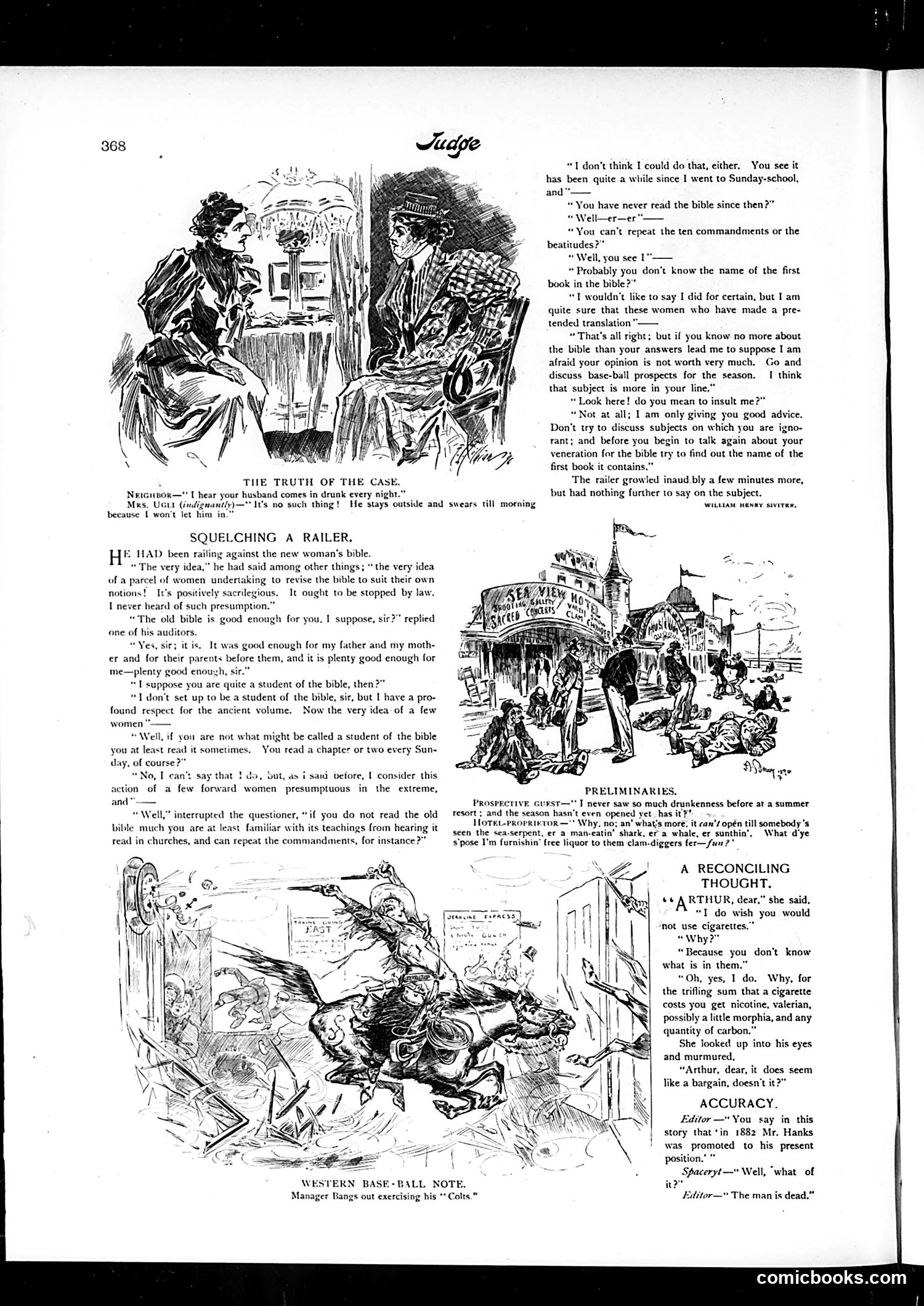
This page contains multiple satirical pieces typical of late-19th century American humor: **"The Truth of the Case"** and **"Squelching a Railer"**: These target a man who vehemently opposes women creating a revised Bible translation, claiming it's sacrilegious. The joke's irony: when questioned, he admits he doesn't read the Bible, can't recite the Ten Commandments, and doesn't know its first book. The "railer" (aggressive critic) is exposed as a hypocrite defending something he's never studied—common satire against knee-jerk traditionalism. **"Preliminaries"**: A joke about summer resort drinking culture and the need for sensational attractions (sea serpents, sharks) to draw crowds and justify providing alcohol. **"A Reconciling Thought"**: Dry humor about cigarette ingredients (nicotine, valerian, morphia, carbon). The wife, learning cigarettes contain these substances, paradoxically accepts them as "a bargain"—satirizing either her ignorance or resigned acceptance of danger. **"Accuracy"**: Editorial humor about a fictional error—a man promoted in 1882 is described in present tense despite being dead.
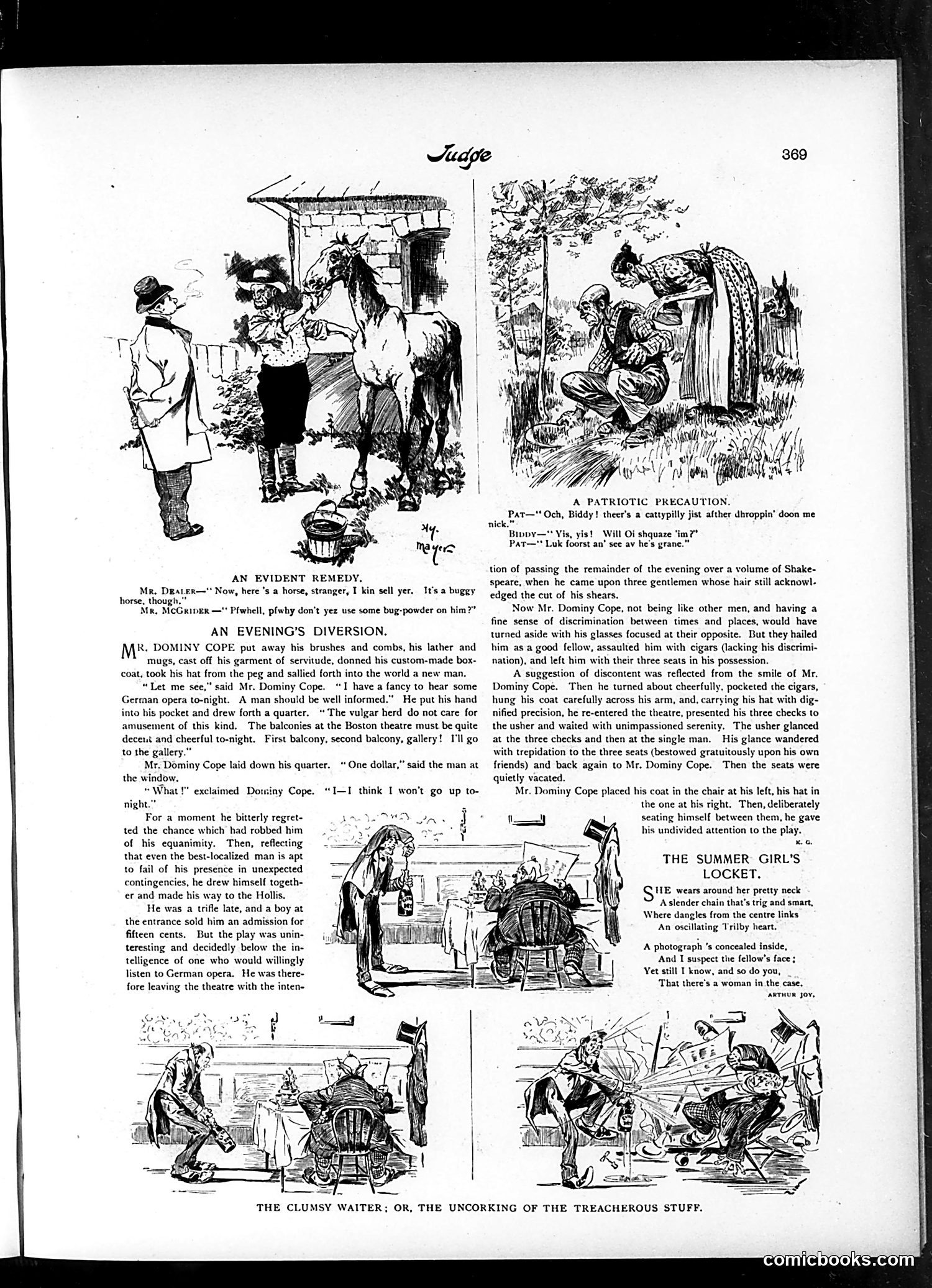
This page contains three unrelated humorous sketches typical of Judge's satirical style: 1. **"An Evident Remedy"**: A crude joke about a horse trader trying to sell a buggy-horse to a customer ("Mr. McGriper"), who suggests using bug powder—a pun playing on "buggy" as both a vehicle type and insect-infested. 2. **"An Evening's Diversion"**: Social satire mocking Mr. Dominy Cope, a barber-turned-gentleman who attempts attending German opera but discovers the cheapest gallery ticket costs a dollar (not a quarter). The narrative tracks his humiliation and strategic revenge—he later manipulates theater seating using three smaller tickets to force other patrons to yield better seats to him alone. 3. **"A Patriotic Precaution"** and **"The Summer Girl's Locket"**: Brief comic verses with accompanying illustrations about Irish immigrants and romantic sentiment. The central satire targets class pretension and social climbing among working-class men aspiring to "high culture."
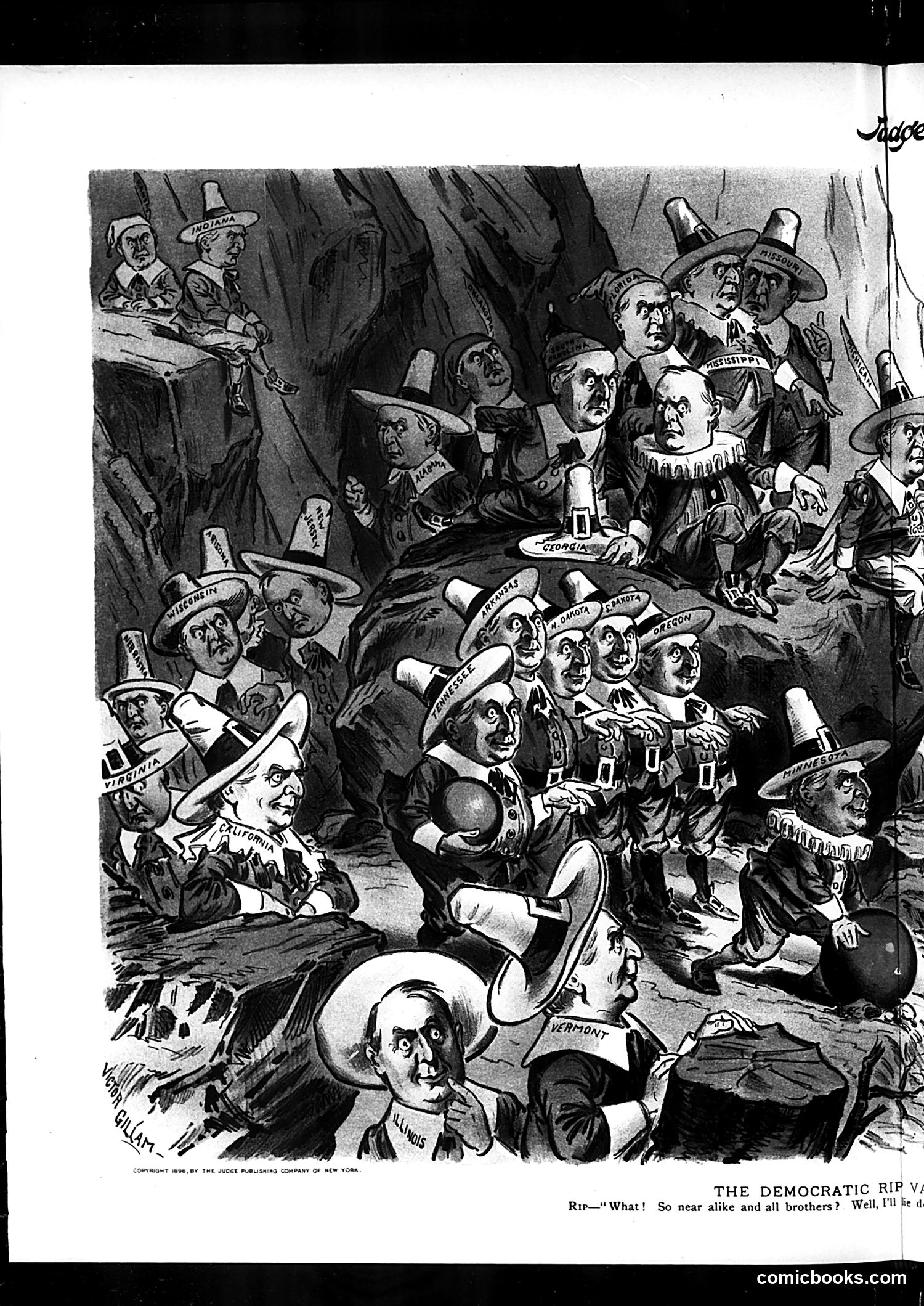
This political cartoon satirizes the Democratic Party's internal unity (or lack thereof). The title references Washington Irving's "Rip Van Winkle," suggesting the Democrats have awakened to find themselves fragmented. The image depicts numerous figures wearing sombrero-like hats labeled with what appear to be U.S. state names (Georgia, Texas, Illinois, Vermont, etc.), suggesting regional Democratic factions. The crowded, chaotic scene with diverse representatives highlights the party's struggle to maintain cohesion across different states and interests. The caption's incomplete quote—"What! So near alike and all brothers? Well, I'll lie a..."—implies ironic commentary: despite claiming unity ("brothers"), the Democrats are deeply divided. The cartoon critiques how the party presents itself as unified while actually comprising competing regional and factional interests that cannot genuinely align.
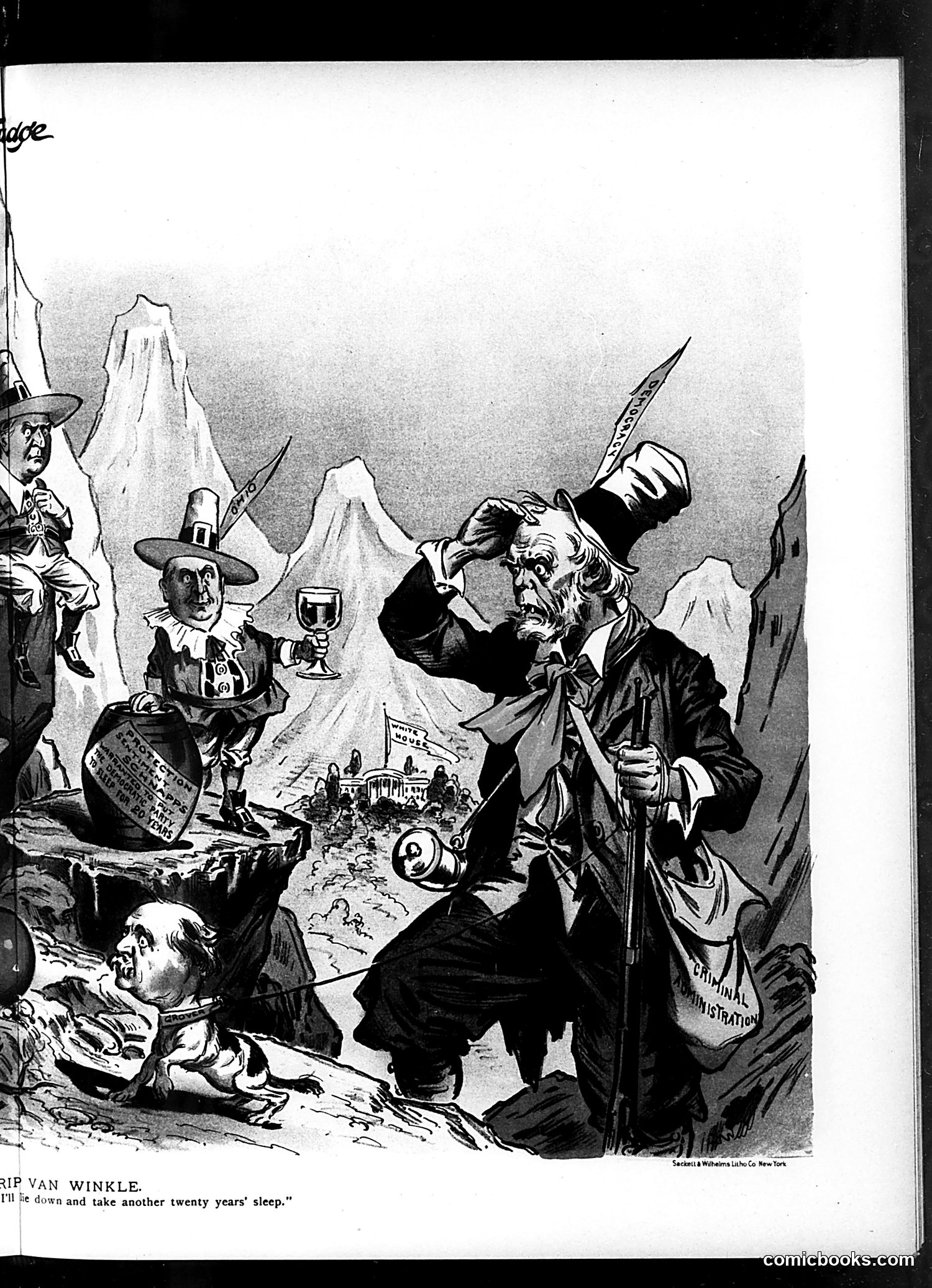
This political cartoon references Washington Irving's famous tale of a man who sleeps for twenty years and awakens to a transformed world. The elderly bearded figure (Rip Van Winkle) appears exhausted or disillusioned, suggesting he wants to escape current conditions by sleeping another two decades. The surrounding scene—with robed figures in what appear to be KKK garb, torches, weapons, and devastation—indicates the cartoon critiques American social/political conditions, likely from the Reconstruction era or Gilded Age. The KKK imagery and chaos suggest deep national discord. The satire's point: conditions are so dire that even escaping for twenty years seems preferable to facing present reality. The cartoon expresses despair about America's direction and social upheaval.
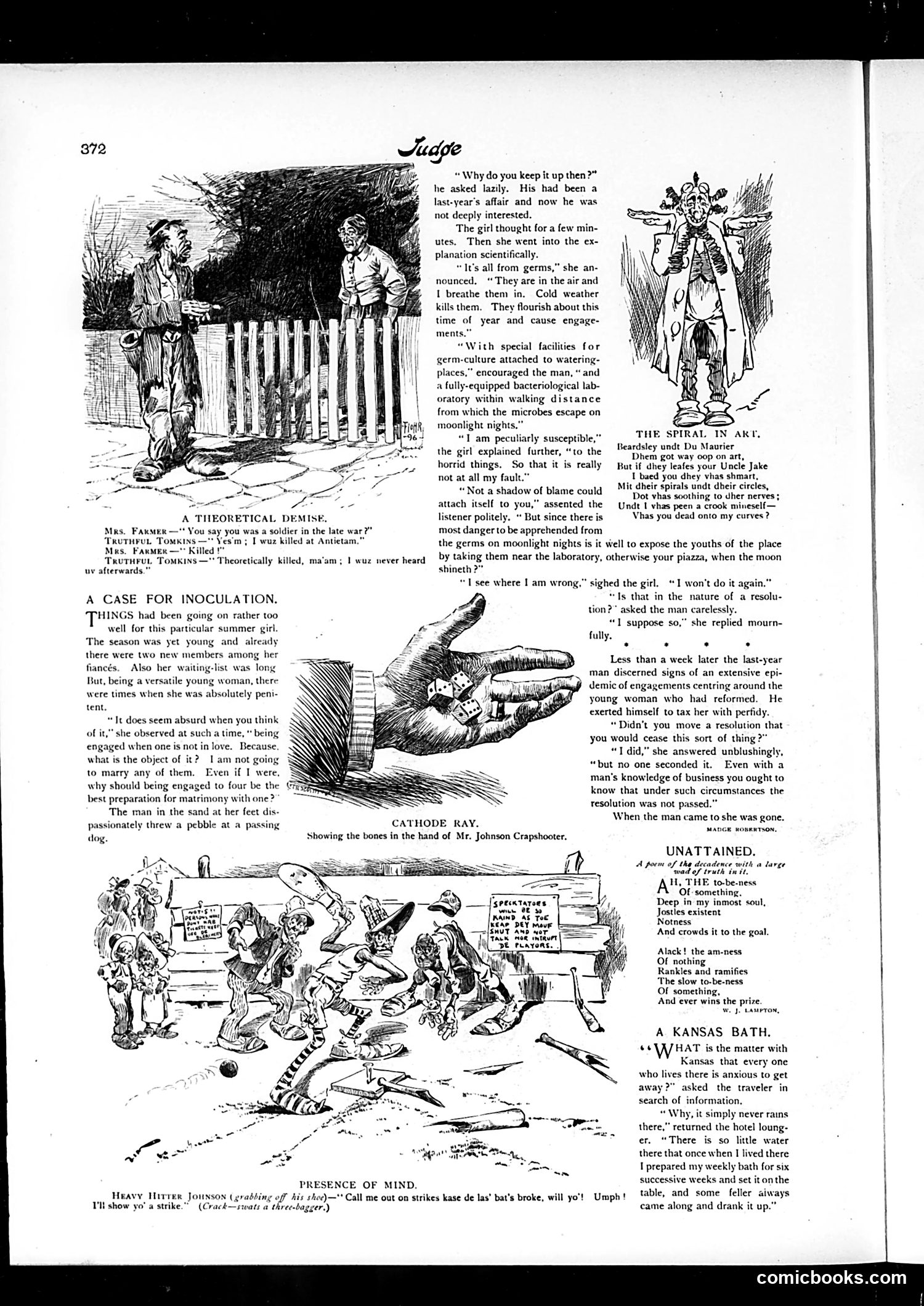
This page contains several satirical pieces mocking social pretensions and human behavior: **"A Case for Inoculation"**: A young woman engaged to multiple men simultaneously justifies her behavior using pseudo-scientific "germ theory"—claiming engagement epidemics spread like disease from watering-place germs. The satire mocks both her serial engagements and the era's casual invocation of science to excuse poor conduct. Her claim that a failed "resolution" wasn't binding because it wasn't "seconded" further ridicules her logic. **"Presence of Mind"**: A crude joke about a baseball player using a shoe as a bat, depicting working-class speech patterns. **"A Kansas Bath"**: Mild social commentary questioning why Kansas residents are eager to leave their state, implying poor conditions there. **"The Spiral in Art"**: Satirizes avant-garde artistic movements (likely referencing Aubrey Beardsley and du Maurier's stylized designs), with an immigrant character defending his criminal "curves" as artistic sophistication. The page uses humor to critique social climbing, female autonomy anxieties, and artistic pretension common to Gilded Age/early 20th-century America.
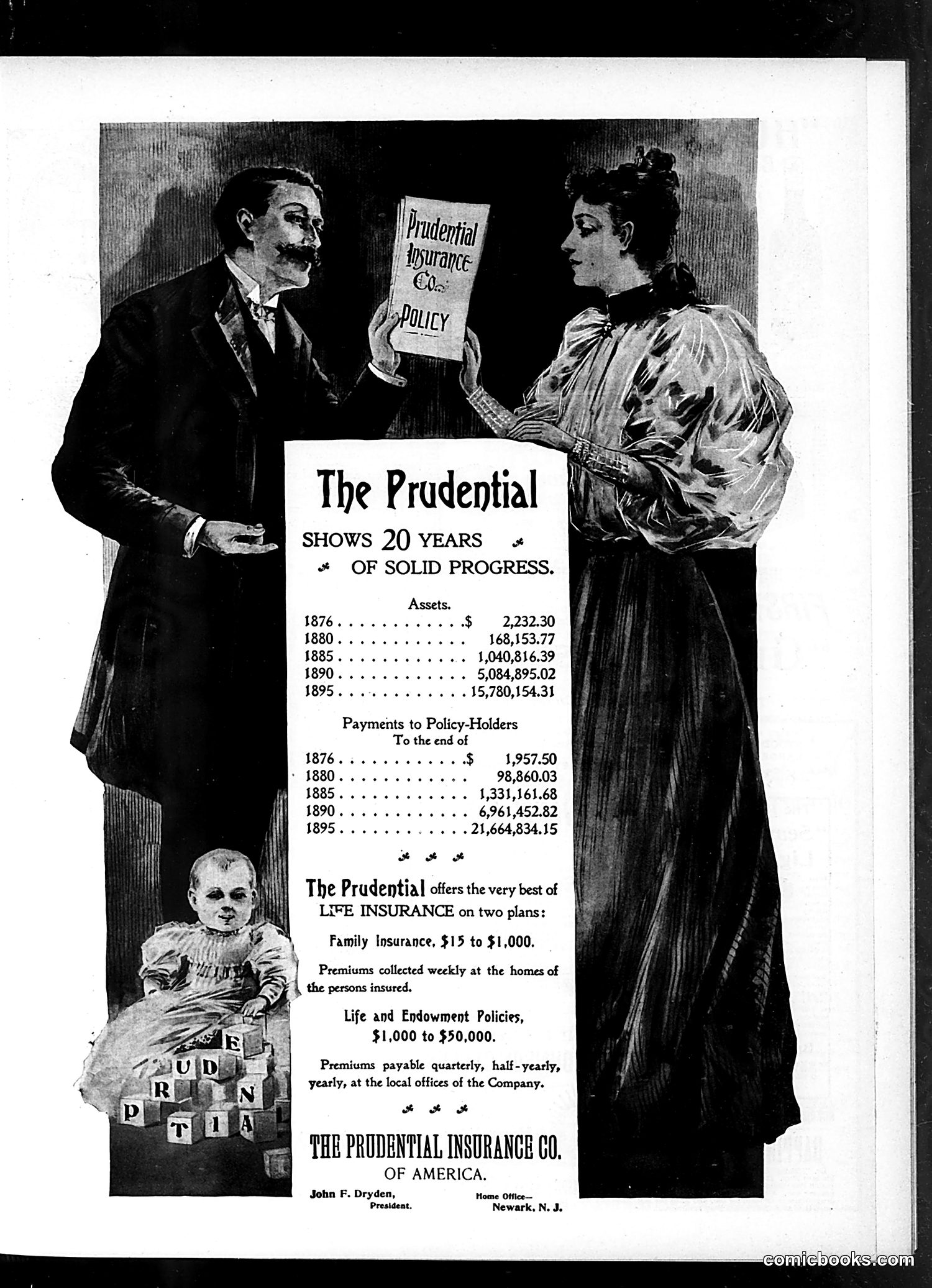
This is a straightforward **advertisement** for The Prudential Insurance Company, not satire. It appeared in *Judge*, a humor magazine that sold advertising space to commercial enterprises. The image shows a well-dressed couple examining a Prudential policy document, with a baby below surrounded by building blocks spelling "PRUDENTIAL"—symbolizing financial security and family protection. The ad emphasizes the company's 20-year track record by displaying asset and payment figures from 1876-1895, demonstrating growth and reliability to potential customers. Two insurance plans are offered: affordable "Family Insurance" with weekly home-collected premiums ($15-$1,000), and higher-value "Life and Endowment Policies" ($1,000-$50,000). The company president John F. Dryden and Newark headquarters are identified for credibility. This represents late-Victorian-era insurance marketing targeting middle and upper-class families seeking financial protection.
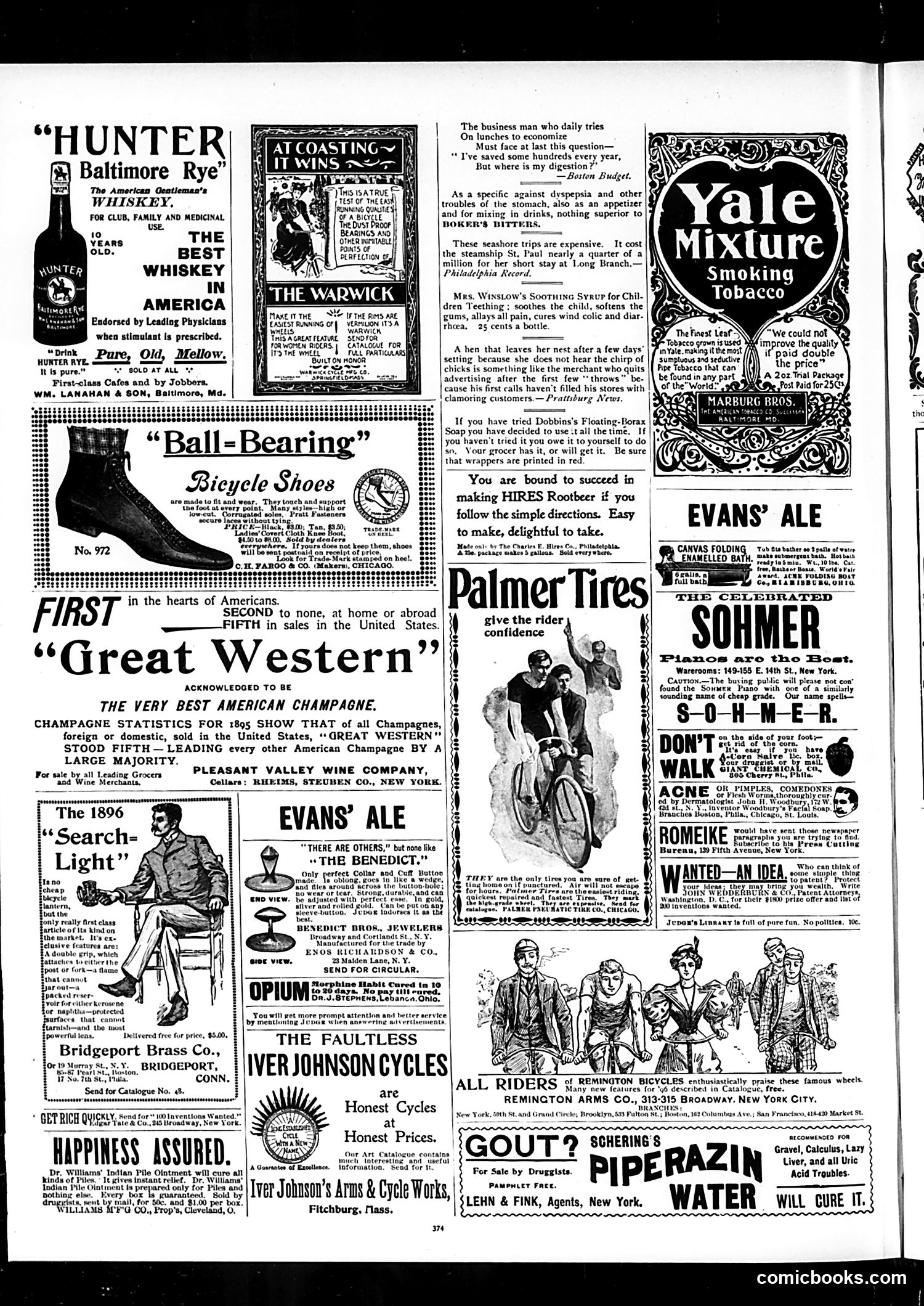
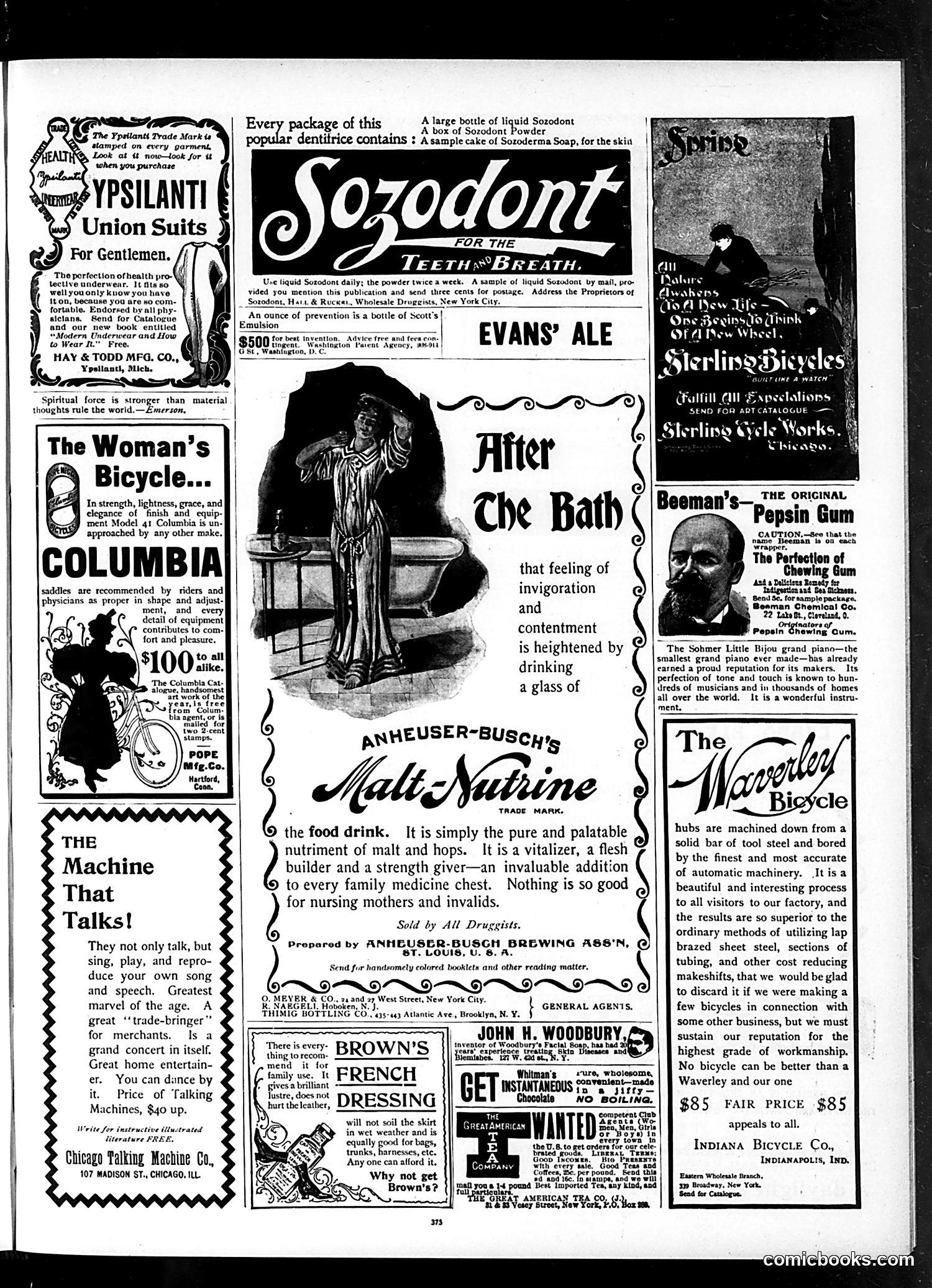
This is primarily an **advertising page** from Judge magazine, featuring product promotions typical of the 1890s rather than editorial cartoons or political satire. The advertisements reveal period concerns: **digestive aids** (Boker's Bitters, Hires Rootbeer) marketed to businessmen worried about dyspepsia from rushed lunches; **patent medicines** (Mrs. Winslow's Soothing Syrup for teething, Dr. Williams' Pile Ointment); **bicycle-related products** (Ball-Bearing Shoes, Palmer Tires, Iver Johnson Cycles)—reflecting the 1890s bicycle craze; and **luxury goods** (Hunter Whiskey, Evans' Ale, Great Western Champagne, Sohmer pianos). The small editorial snippets between ads mock consumer habits: a businessman saves money by cutting lunches but destroys his digestion; a hen abandoning her nest parallels a merchant abandoning advertising. The page captures **Gilded Age consumer culture**—products promising health, status, and modern convenience to an increasingly urban, commercial American audience.
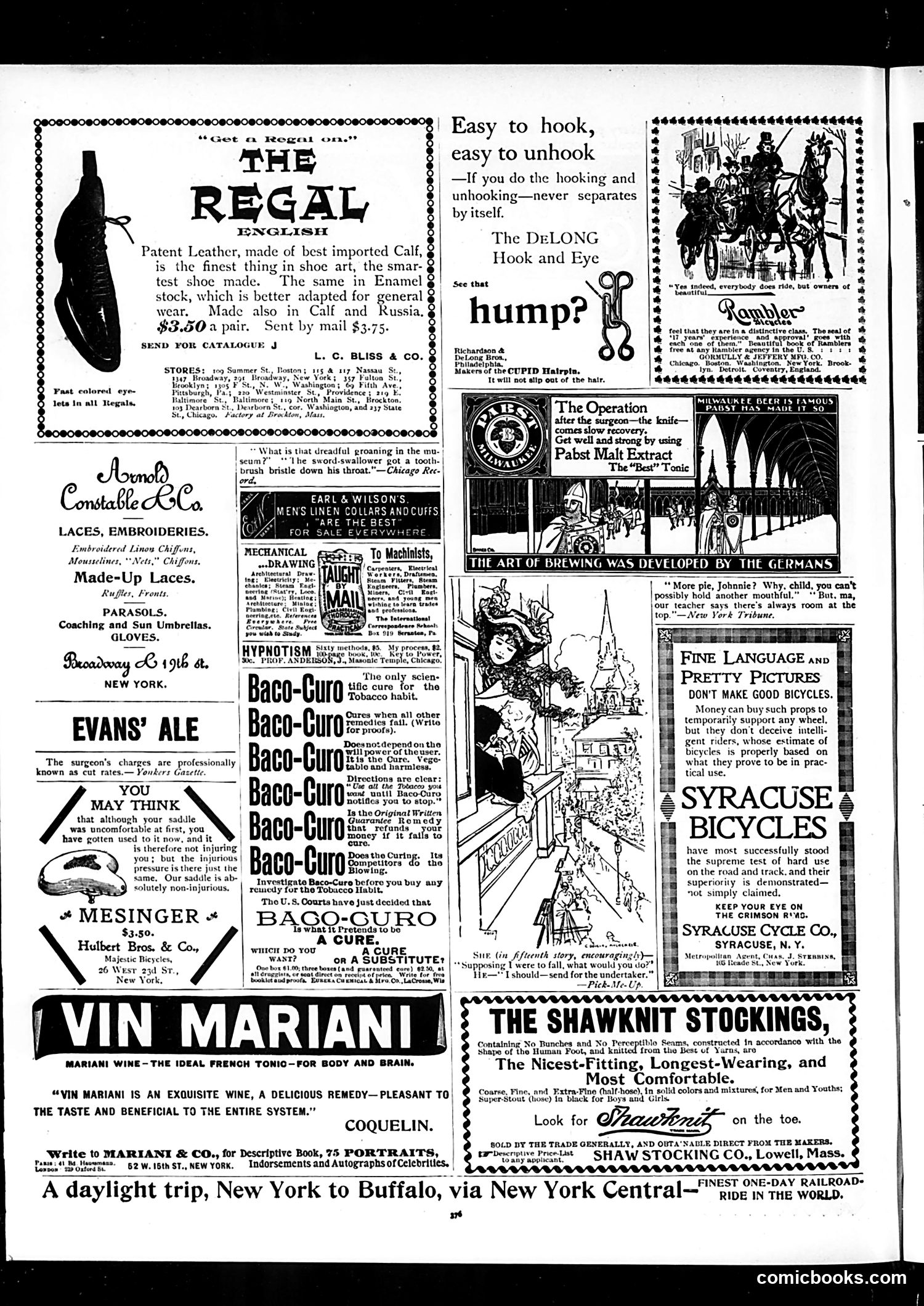
This is primarily an **advertising page** from Judge magazine, with one small cartoon visible. The single cartoon ("Sue in fifteenth story") depicts a couple on a high-rise building ledge. The woman encourages the man to jump, saying if he falls, she'll "send for the undertaker"—dark humor about marital discord and her desire for his death. This reflects early 20th-century satirical attitudes toward marriage and mortality. The bulk of the page comprises advertisements for period products: Regal shoes, DeLong hook-and-eye fasteners, Evans' Ale, Mesinger bicycle saddles, Baco-Curo (a tobacco-cessation product), Vin Mariani (a wine tonic), Syracuse bicycles, and Shawknit stockings. These ads reveal consumer goods and health products marketed to middle-class readers circa 1900s. The ads employ typical period marketing tactics: testimonials, appeals to comfort/health, and competitive claims—reflecting the competitive consumer marketplace emerging in that era.
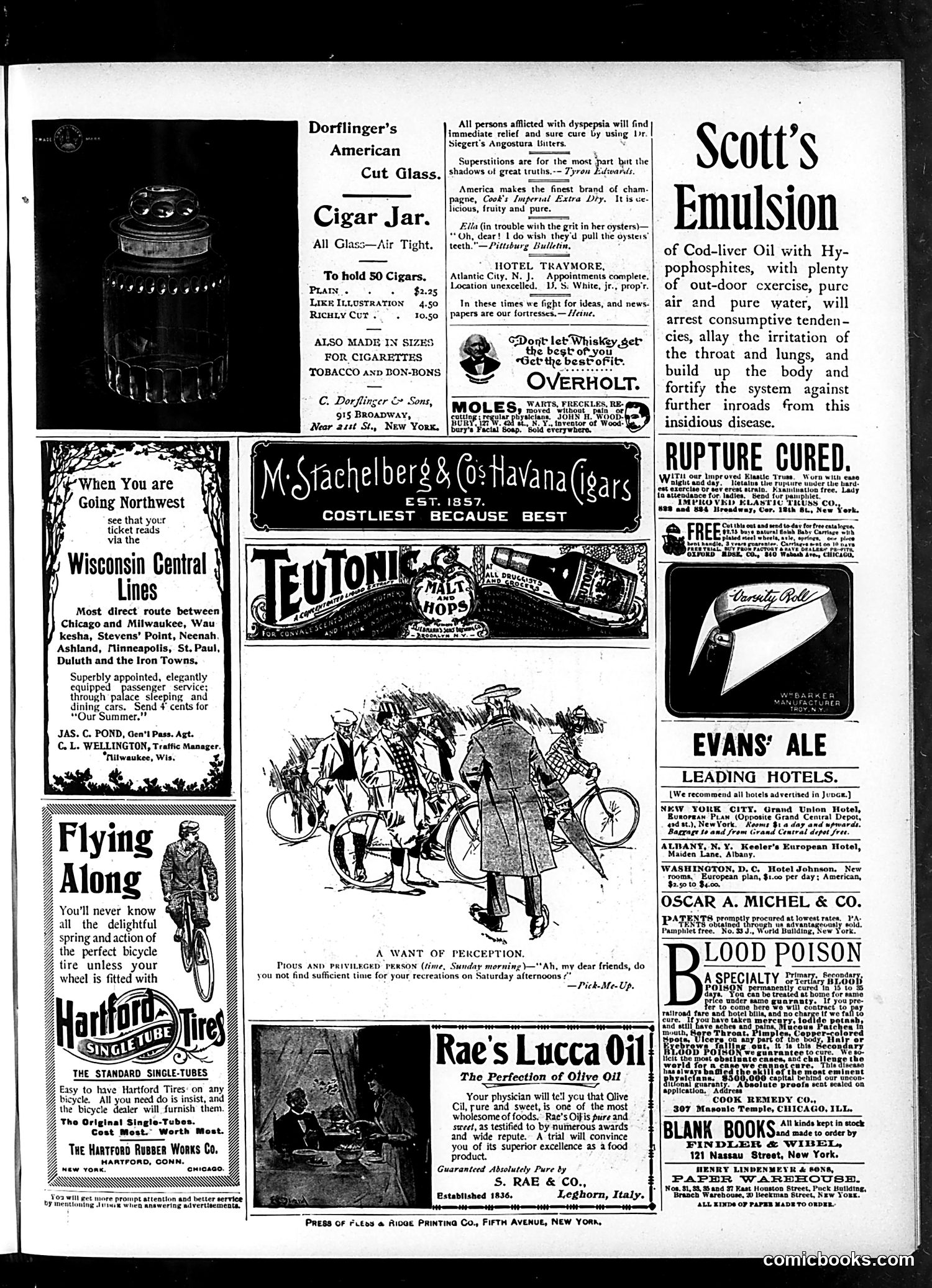
This is primarily an **advertising page** from Judge magazine, featuring various product and service advertisements typical of the early 1900s. The one substantive cartoon is titled **"A Want of Perception,"** depicting a sanctimonious "Pious and Privileged Person" addressing working-class parishioners on Sunday morning. The joke mocks the speaker's obliviousness: he asks why people don't have time for "recreations on Saturday afternoons," apparently unaware that working people labor six days a week and have no leisure time. The cartoon satirizes **class blindness**—the wealthy man's inability to perceive the economic reality of ordinary workers' lives. The surrounding advertisements promote cigars, bicycles, patent medicines (cure-alls for dyspepsia, rupture, blood poison), olive oil, and hotels—typical commercial fare for the era. Several make dubious medical claims characteristic of early-20th-century advertising before FDA regulation.
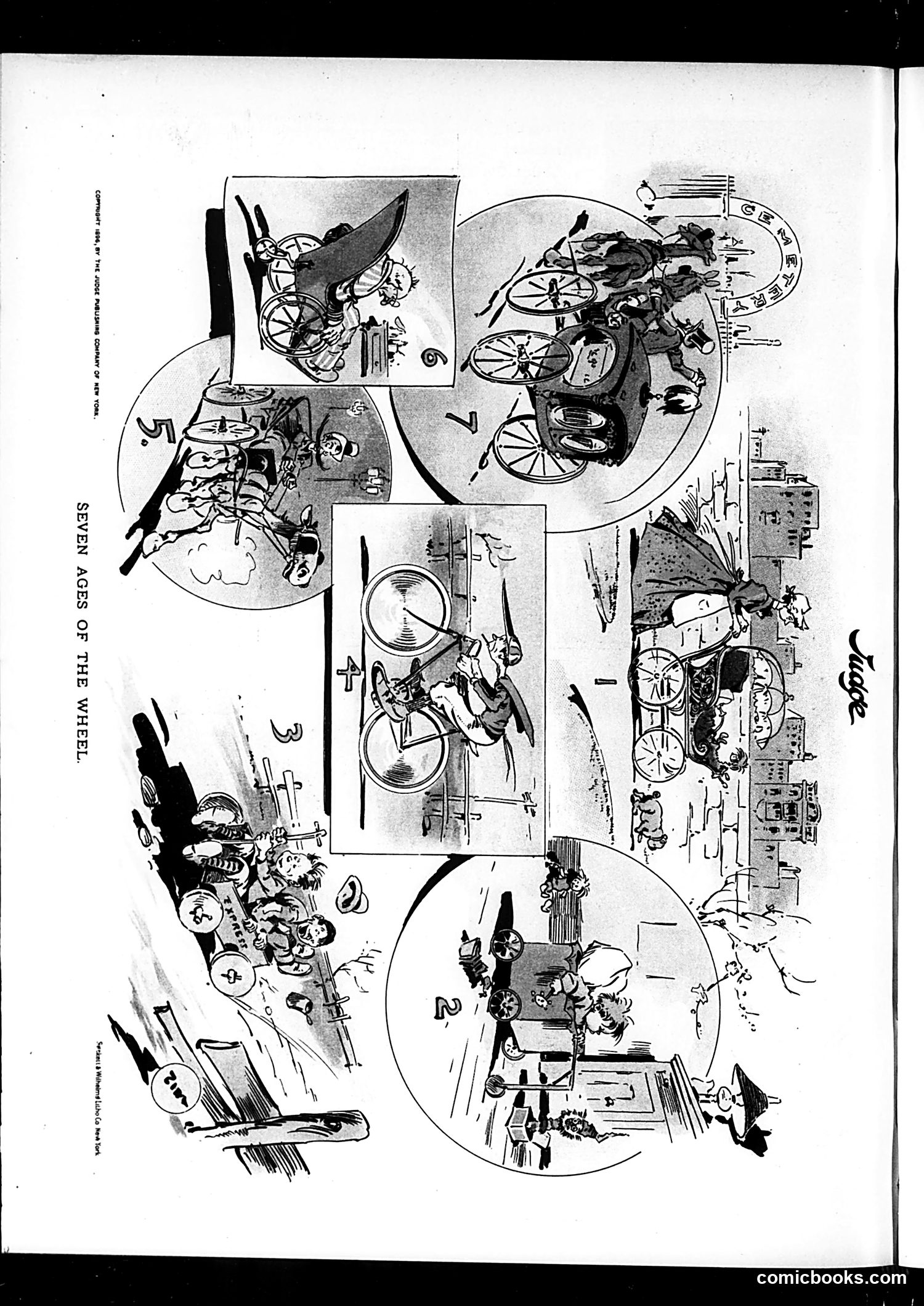
This page presents a satirical sequence showing the lifecycle of a bicycle wheel through seven stages. The cartoons appear to depict the wheel's journey from manufacture through various uses and eventual decline or destruction. Each numbered panel shows the wheel in different contexts—appears to include scenes of assembly, use by cyclists, wear and tear, and deterioration. The humor likely targets either the bicycle industry's rapid commercialization during the cycling boom of the 1890s-1900s, or perhaps mocks the disposable nature of mass-produced goods. The title "Seven Ages" references Shakespeare's "Seven Ages of Man," applying that literary framework to an inanimate object for satirical effect—a common Judge magazine technique of elevating mundane subjects to mock contemporary consumer culture and industrial production.