
A complete issue · 16 pages · 1896
Judge — May 16, 1896
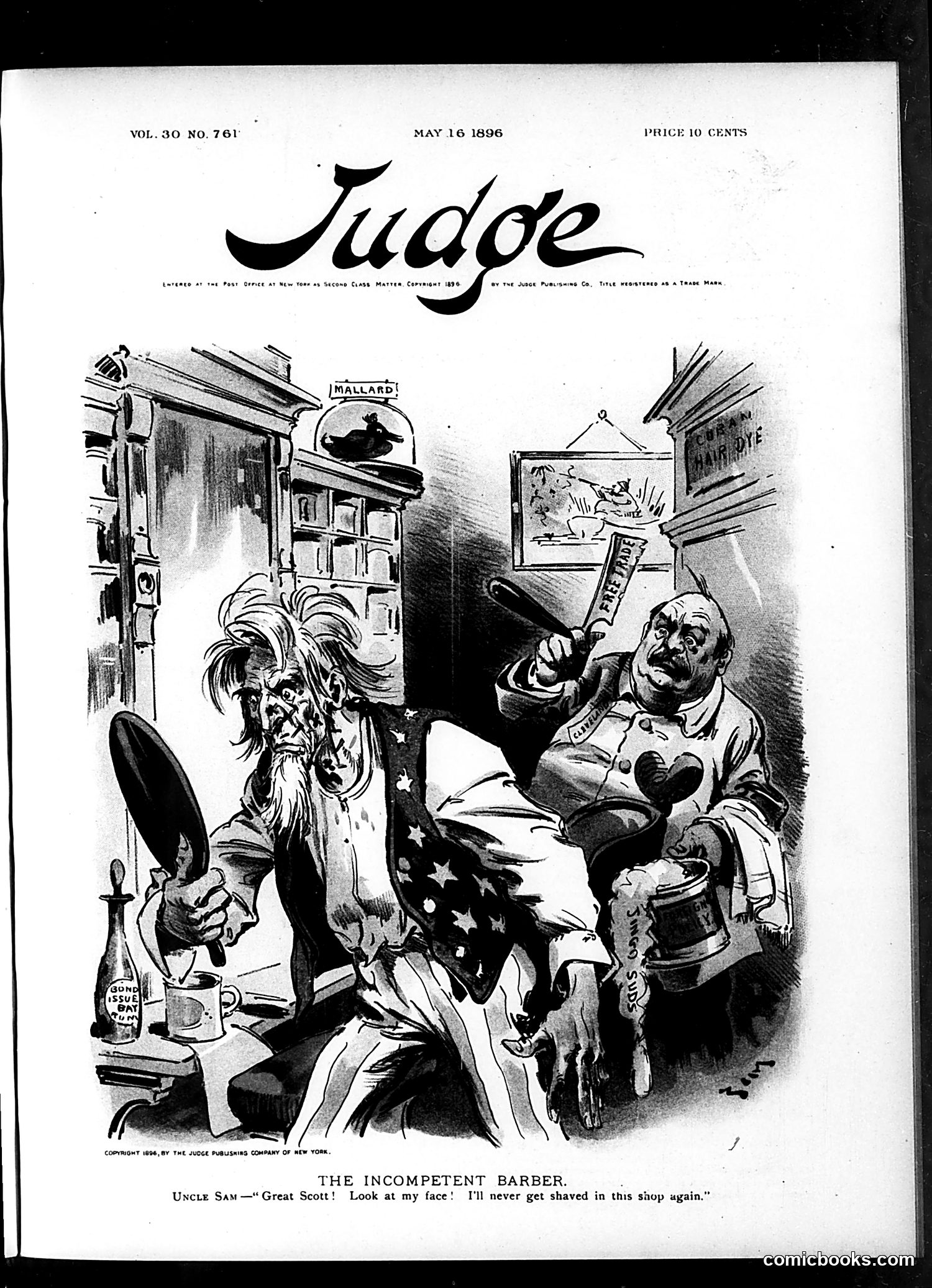
This political cartoon satirizes incompetent leadership through a barber-shop scenario. Uncle Sam (the bearded figure with stars-and-stripes clothing, representing America) is being badly shaved by an inept barber, who appears scarred and unprofessional. Uncle Sam exclaims he'll never return for service again. The barber likely represents either a political figure or political party deemed incompetent in handling national affairs during the 1896 election period. The "Mallard" sign visible on the shop and various background details suggest specific contemporary political targets, though without additional context those precise references are unclear. The cartoon's message: current leadership is dangerously incompetent and should be replaced—a common Judge theme criticizing incumbent politicians.
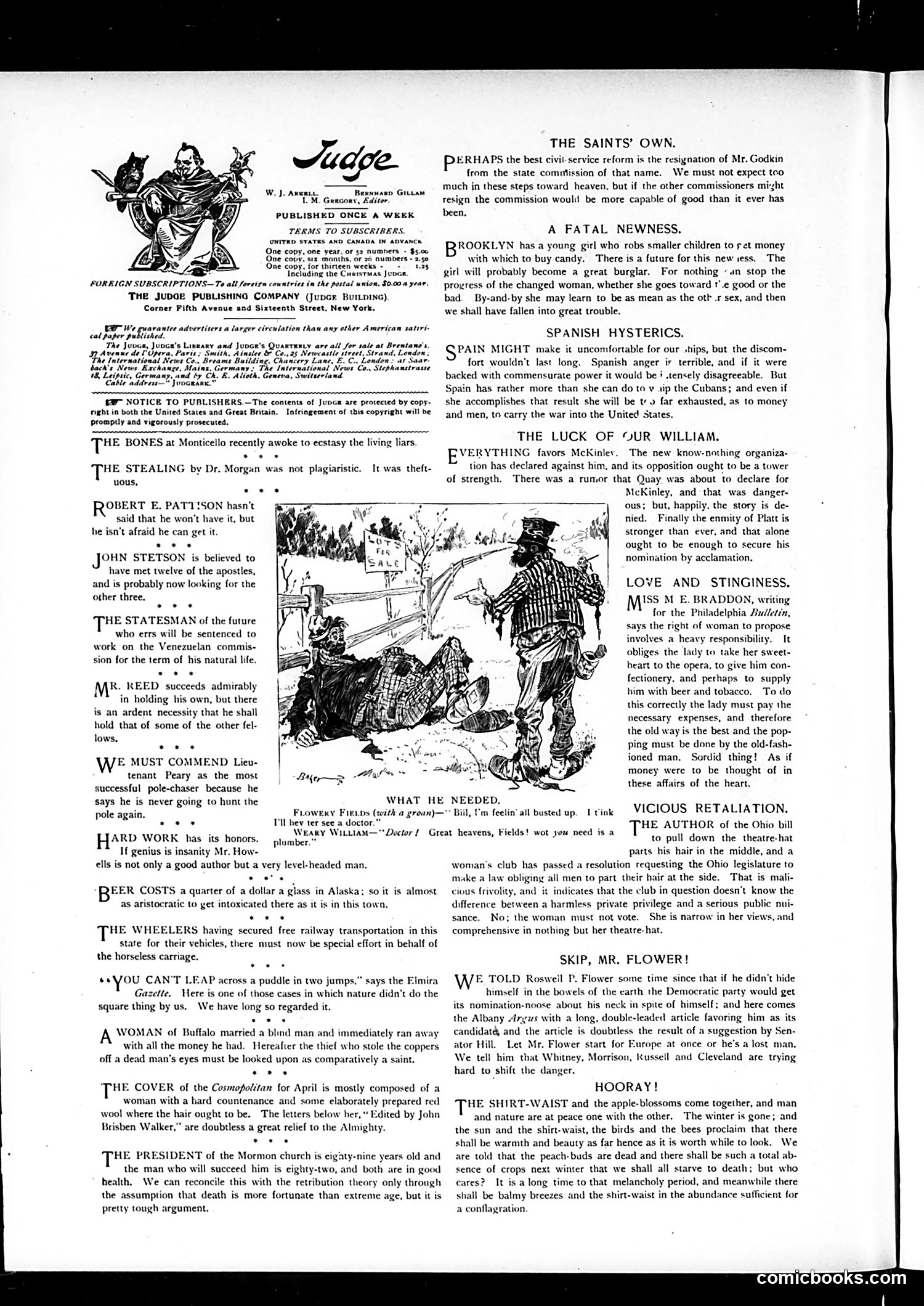
This page contains editorial commentary and brief satirical items rather than a single political cartoon. The visible sketch depicts what appears to be a beggar or poor person interacting with another figure—labeled "WHAT HE NEEDED"—illustrating a piece about charity or social conditions. The written items mock various targets: politicians' hair-parting preferences, the Ohio legislature, a woman's club resolution, and railway transportation policies. One item references "Skip, Mr. Flower," likely a political figure of the era, warning him to flee Europe. The overall tone is typical Judge satire: mocking social pretensions, legislative absurdities, and contemporary public figures through brief quips and illustrations. Without dates or clearer identification of specific figures, precise historical context remains uncertain.
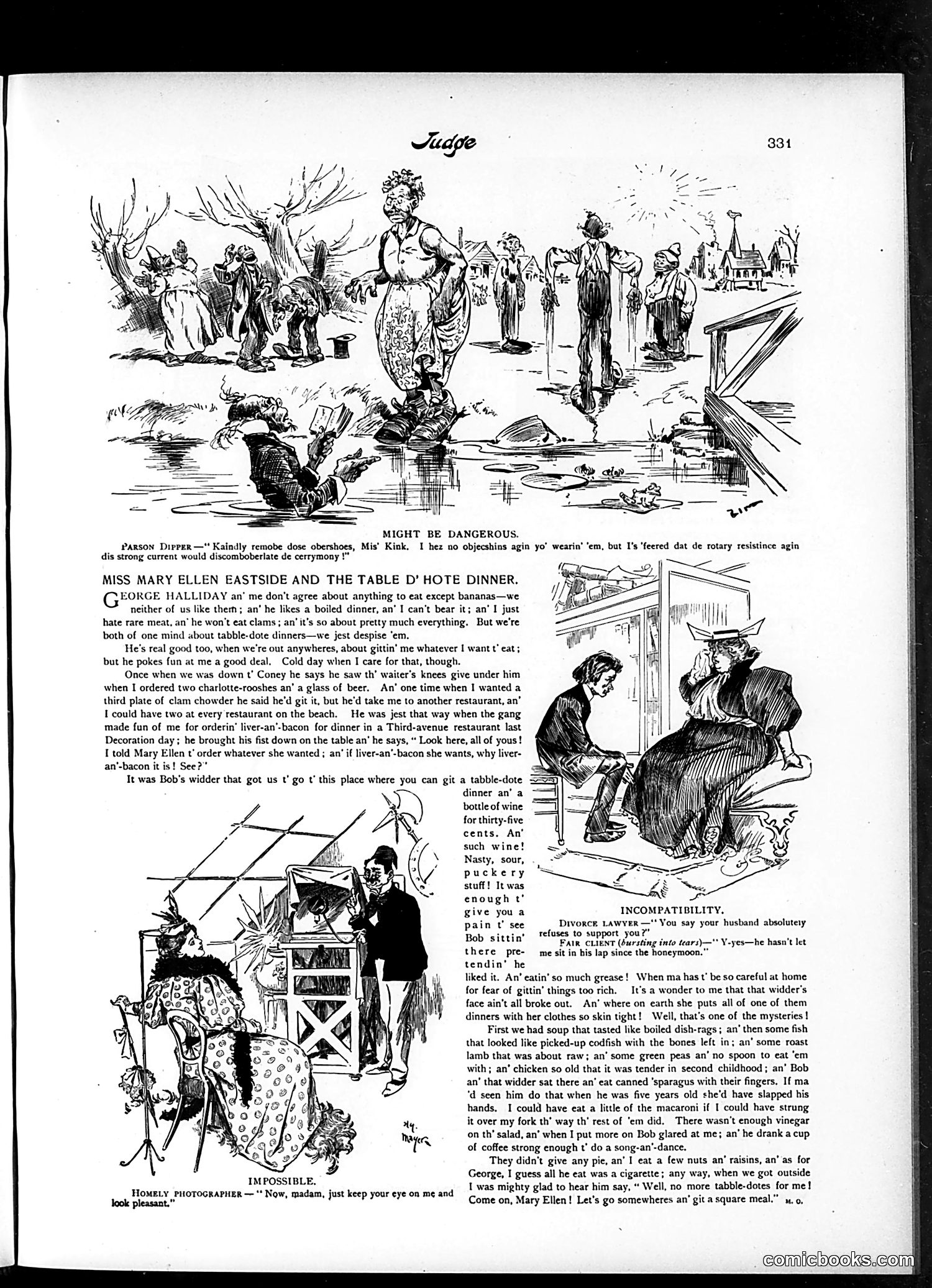
This page contains satirical short stories rather than political cartoons. The main piece, "Miss Mary Ellen Eastside and the Table d'Hôte Dinner," mocks working-class dining experiences and pretensions. Characters like "George Halliday" complain about restaurant food quality while frequenting cheap establishments offering "table-d'hote" (fixed-price) dinners for thirty-five cents. The humor targets social anxiety about dining etiquette among the less wealthy, describing unappetizing dishes (old chicken, raw lamb, pickled codfish) served at budget restaurants. The accompanying illustrations show poorly-dressed diners in shabby establishments. The piece satirizes both the food itself and working-class attempts at dining "respectably," suggesting the futility of seeking dignity in cheap commercial dining during this era (appears to be early 1900s).
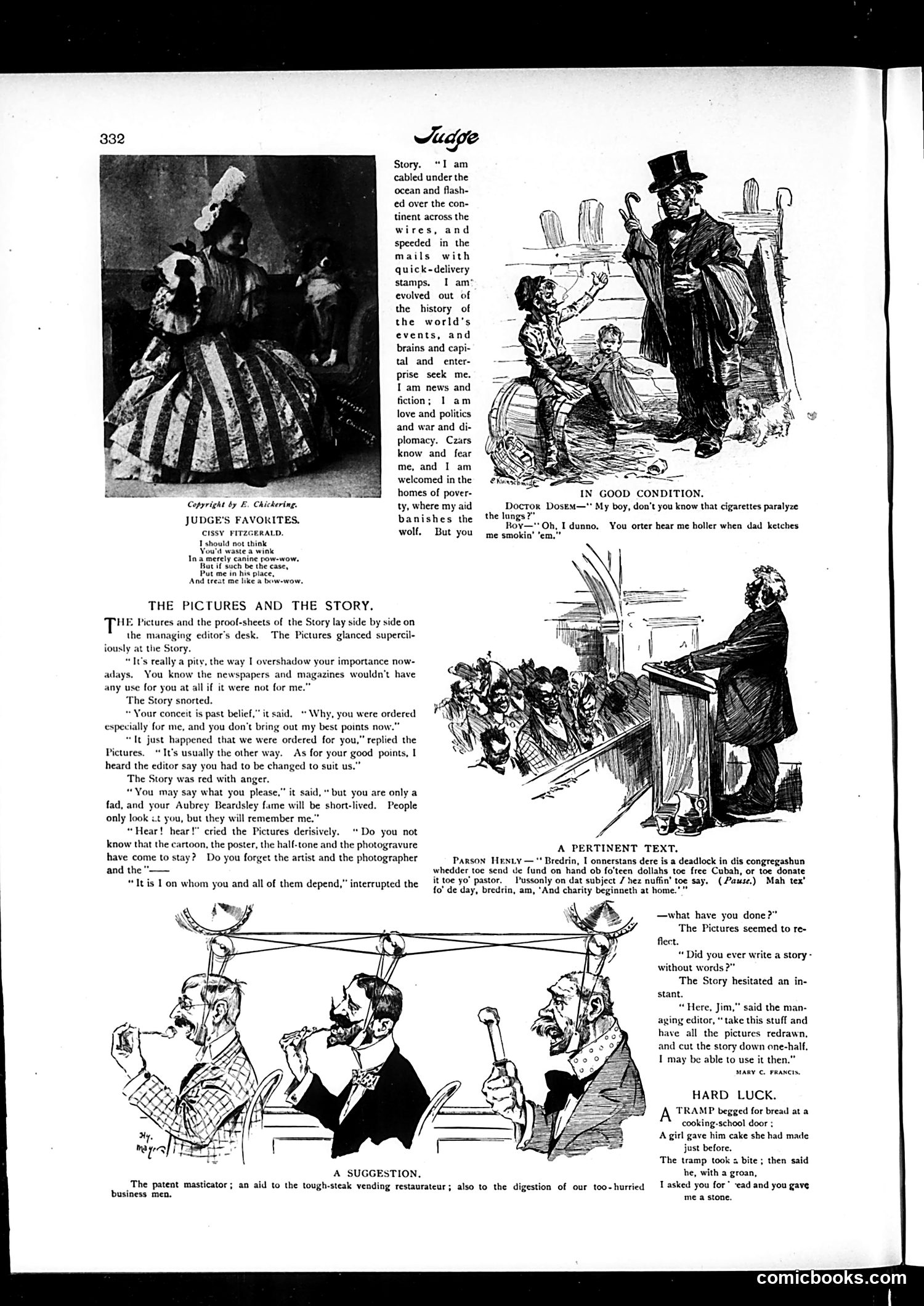
This page satirizes the growing tension between **visual media and literary narrative** in early 20th-century publishing. The central dialogue between "The Pictures" and "The Story" personifies a real industry shift: illustrated magazines were increasingly prioritizing striking images over substantial text. **The main cartoon** depicts competing figures at an editor's desk debating whose importance matters more. Pictures boasts that visuals now dominate—readers look at images, not words. Story defends its literary merit, but Pictures dismisses this as outdated, claiming cartoons, posters, and photographic reproductions are the future. **The irony**: The editor resolves the conflict by **redrawing all pictures and cutting the story in half**—validating Pictures' point while proving both are ultimately subordinate to commercial demands. The surrounding short pieces ("Hard Luck," "Pertinent Text") are satirical vignettes with moralizing punchlines typical of Judge's humor. They're unrelated to the main editorial commentary about media competition.
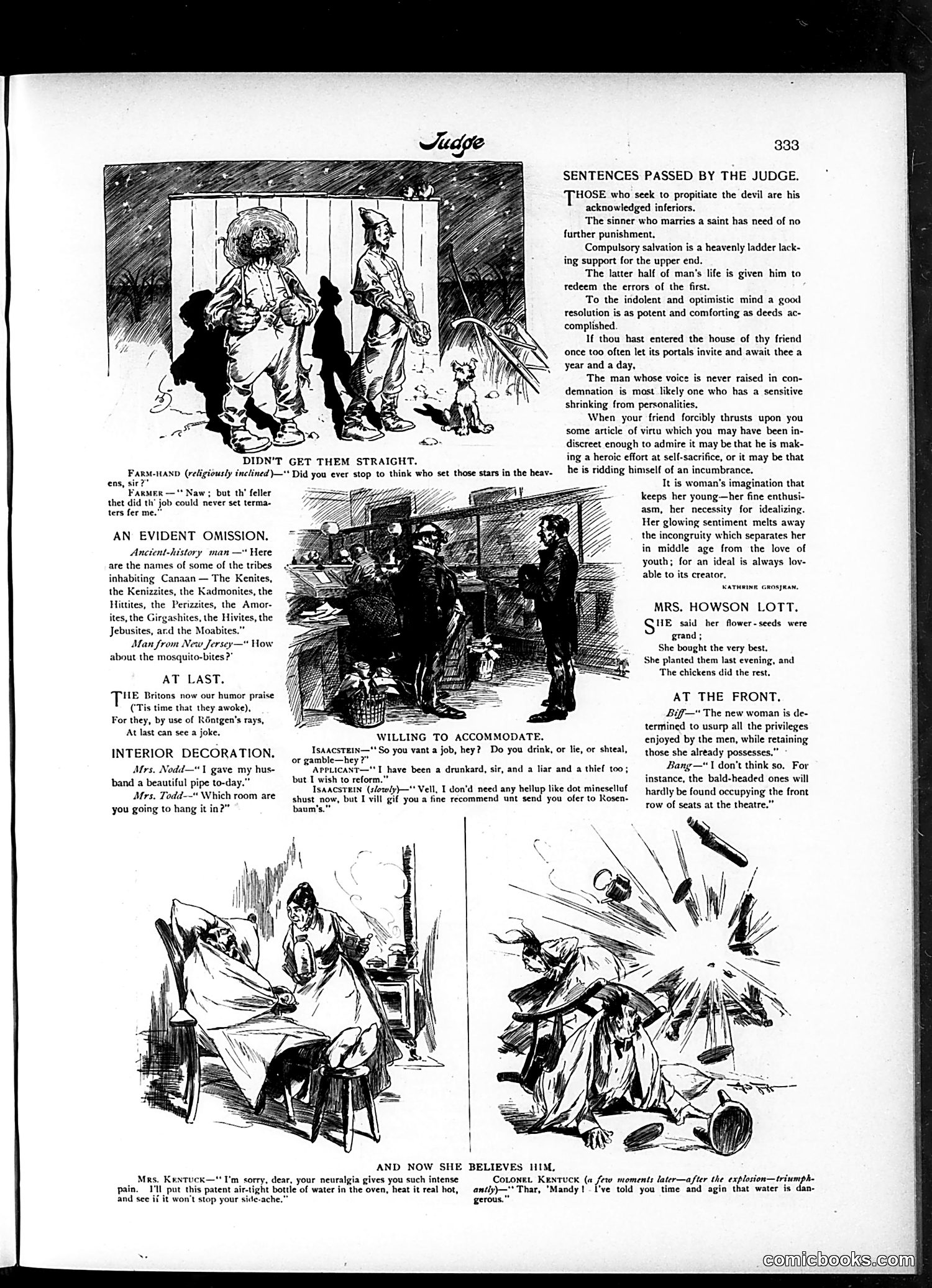
This page from Judge contains multiple short humorous sketches satirizing American social types and gender dynamics circa early 1900s. **Main cartoons:** 1. **"Didn't Get Them Straight"**: A farm hand questions his boss about divine creation; the farmer cares only about practical matters (tomatoes), mocking religious pretension among rural workers. 2. **"Willing to Accommodate"**: Two Jewish characters (stereotypically named Isaacstein) discussing employment. The employer offers to recommend the applicant to a competitor—satirizing both Jewish stereotypes and employment ethics. 3. **"At the Front"**: Mocks the "New Woman" movement. A man argues women can't truly gain equality because bald men won't surrender front-row theater seats to them—trivializing women's equality aspirations through absurdist logic. **Right column**: Philosophical aphorisms ("Sentences Passed by the Judge") and brief anecdotes about domestic life. The page reflects Judge's formula: crude ethnic/gender stereotypes mixed with genteel moral observations, typical of turn-of-century American satirical humor.
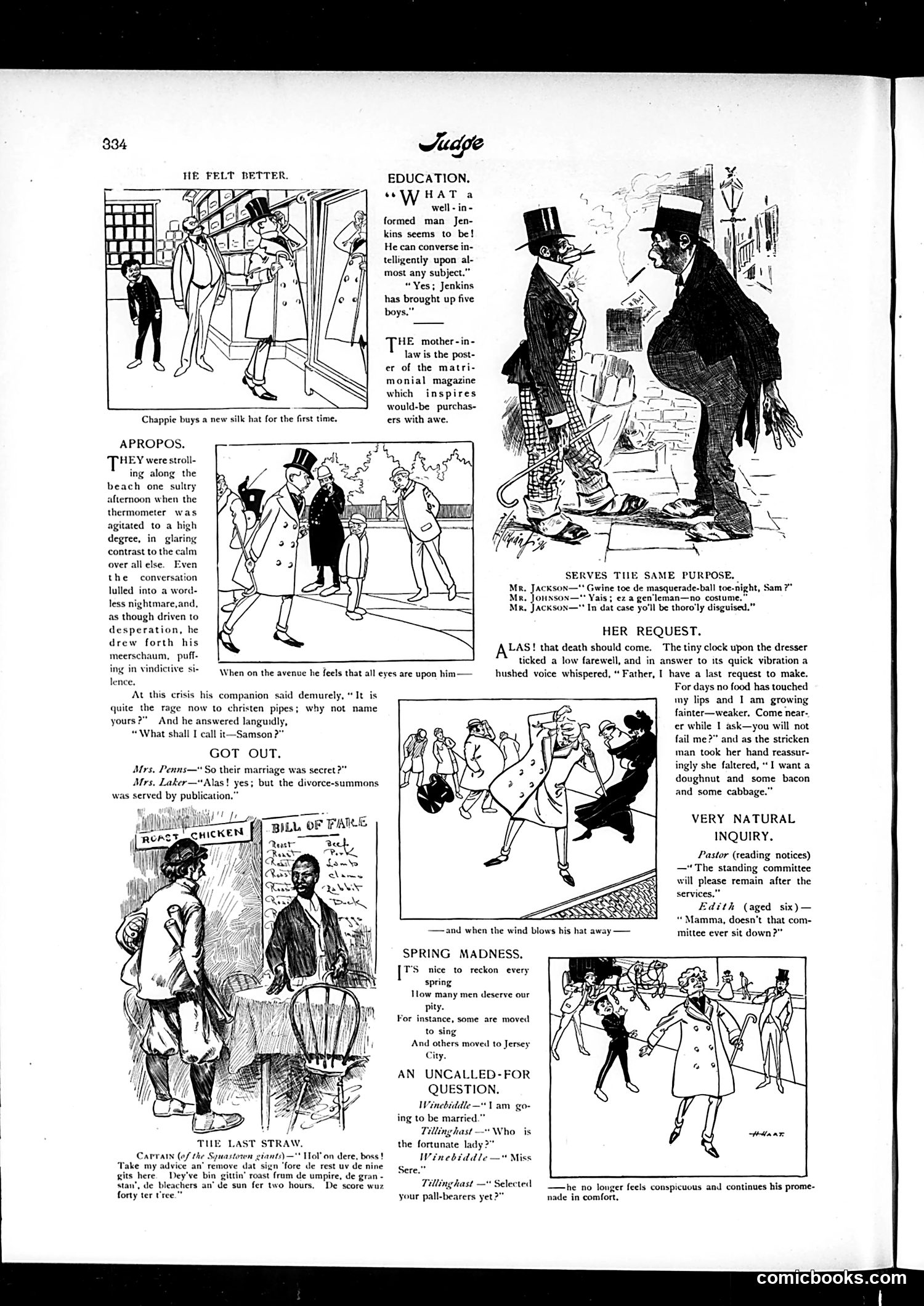
This page contains multiple brief satirical sketches typical of early 20th-century humor magazines: **"He Felt Better"**: A young man's first silk hat purchase boosts his confidence so much he walks differently. **"Education"**: Jokes about Jenkins' intelligence stemming from raising five boys, and mothers-in-law's influence on matrimonial magazine readers. **"Apropos"**: A beach scene where a man smokes a pipe; his companion suggests naming it "Samson," he responds "Samson?"—likely a wordplay joke about the pipe's strength or durability. **"Got Out"**: A woman reveals her "secret marriage" was actually served divorce papers publicly. **Other sketches** include cricket commentary, spring romantic impulses, an awkward engagement question about selecting pallbearers, a deathbed request for doughnuts/bacon/cabbage (humorous anticlimax), and a child's innocent question about whether a "standing committee" ever sits. The humor relies on incongruity, social observation, and period-specific references.
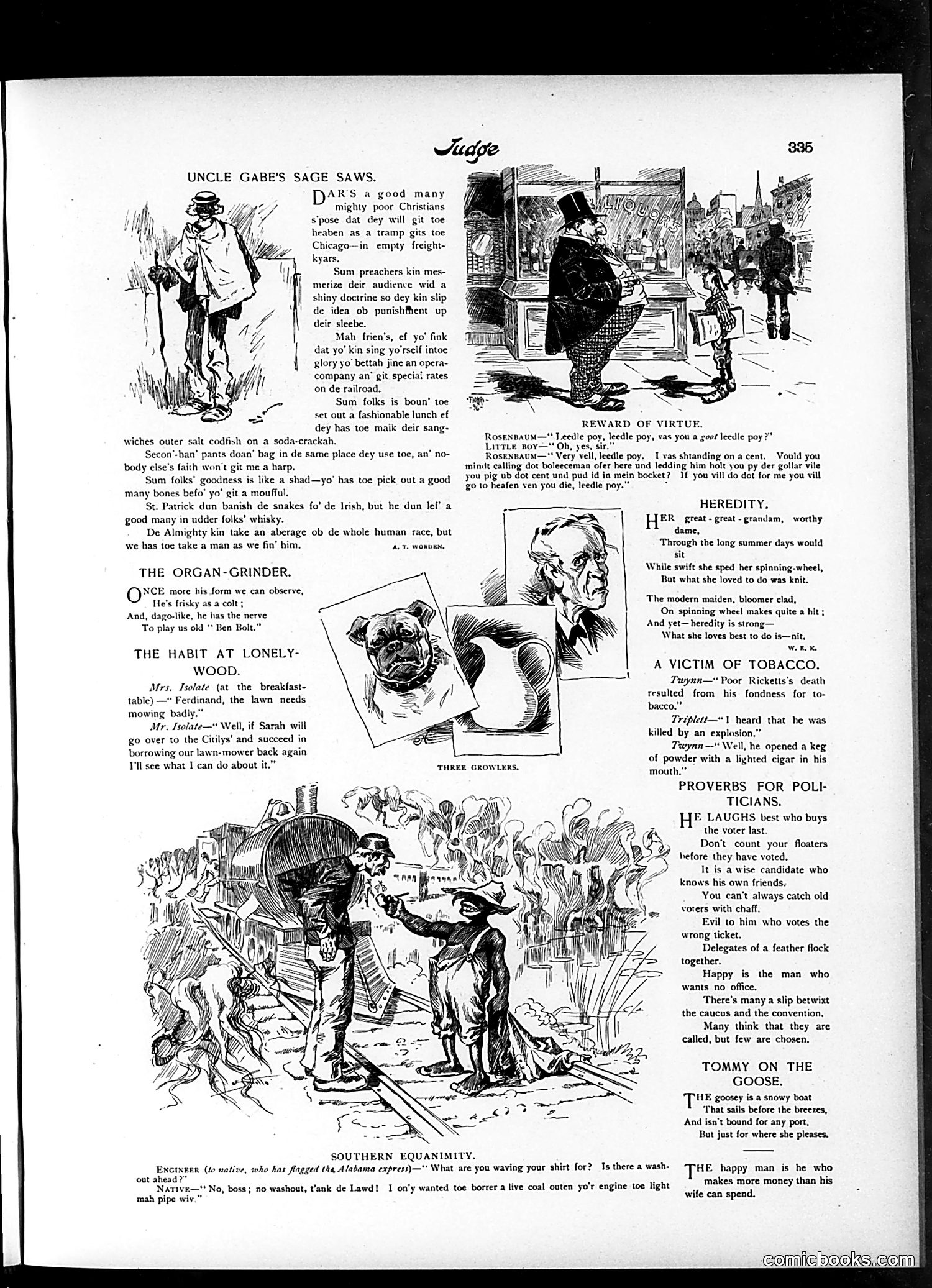
This page collects various humorous pieces typical of Judge's style: **"Uncle Gabe's Sage Saws"** features dialect humor from an African American character offering folksy, cynical observations about religion and morality—reflecting the era's common (though now-offensive) use of racial stereotypes for comic effect. **"The Organ-Grinder"** and other brief sketches mock immigrant stereotypes, particularly Italian immigrants ("dago-like") and their street professions. **"Southern Equanimity"** and **"Heredity"** offer genteel domestic humor about borrowing tools and inherited traits. **"Proverbs for Politicians"** satirizes election corruption—buying voters, stuffing ballot boxes ("floaters"), and backroom dealing at political conventions. This reflects widespread Gilded Age voter fraud and machine politics. **"A Victim of Tobacco"** presents dark humor about smoking dangers, while lighter pieces mock suburban gossip and gender roles. Overall, the page demonstrates Judge's mix of social satire, immigrant mockery, and political commentary—some clever, much relying on period prejudices now recognized as crude.
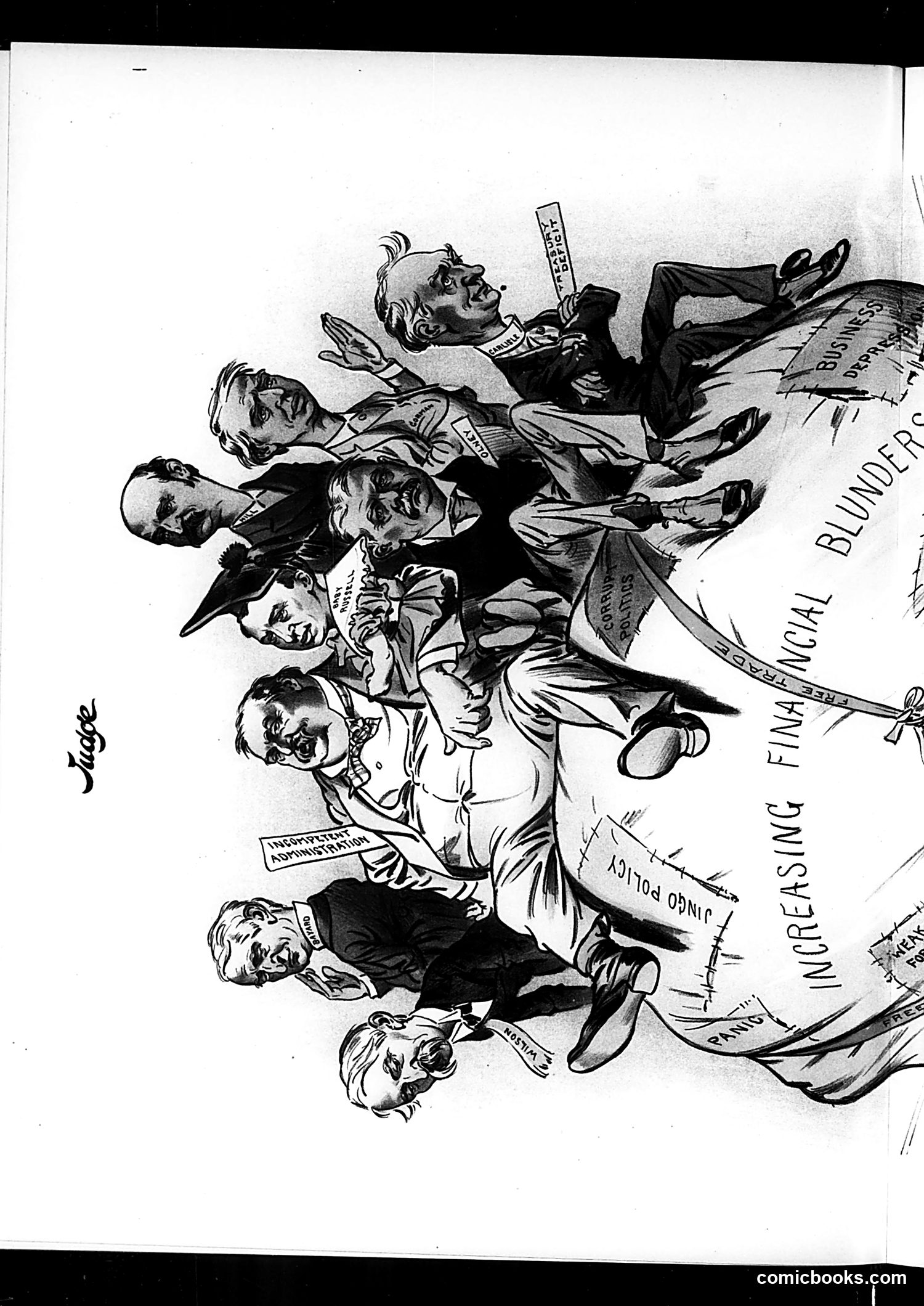
This is a satirical cartoon depicting several figures struggling over or being crushed by what appears to be a large legislative document labeled "FINAL BLINDFOLD" and "IMPOSING FINAL BLUNDER." The caricatured men, drawn in exaggerated style typical of Judge magazine's political satire, appear to represent politicians or government officials engaged in conflict over this legislation. The cartoon criticizes what it portrays as a chaotic, poorly-conceived final legislative act—suggesting the lawmakers involved are blundering or operating blindly. However, without visible date markers or clearer labeling of specific individuals, I cannot definitively identify which legislation or historical moment this references. The style suggests early-to-mid 20th century American politics, but the specific context remains unclear from the image alone.
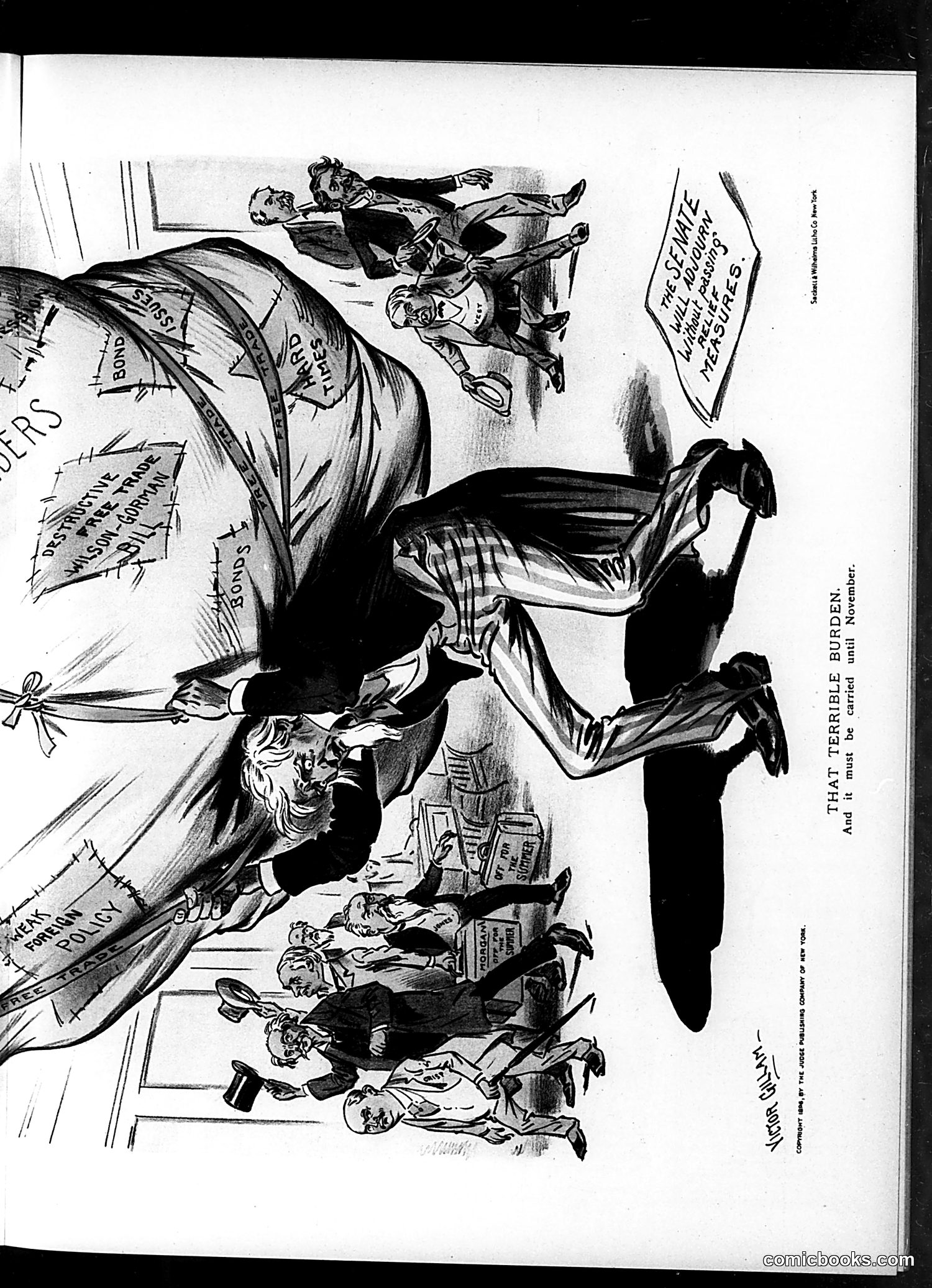
This appears to be a satirical cartoon titled "The Terrible Burden" depicting political or economic hardship. The image shows a large figure (possibly representing a political leader or institution) carrying an enormous, burdensome load labeled with various obligations or debts. Below, smaller figures—likely representing ordinary citizens or taxpayers—struggle beneath the weight of supporting this burden. The cartoon critiques how ordinary people bear the financial or political consequences of larger systemic problems or mismanagement. The labels on the burden (though partially illegible in the OCR) likely reference specific debts, obligations, or failed policies from the period. The satire suggests that responsibility flows downward: those at the top create problems that ordinary citizens must literally carry. This was a common Judge magazine theme—exposing how working people suffered consequences of elite decisions.
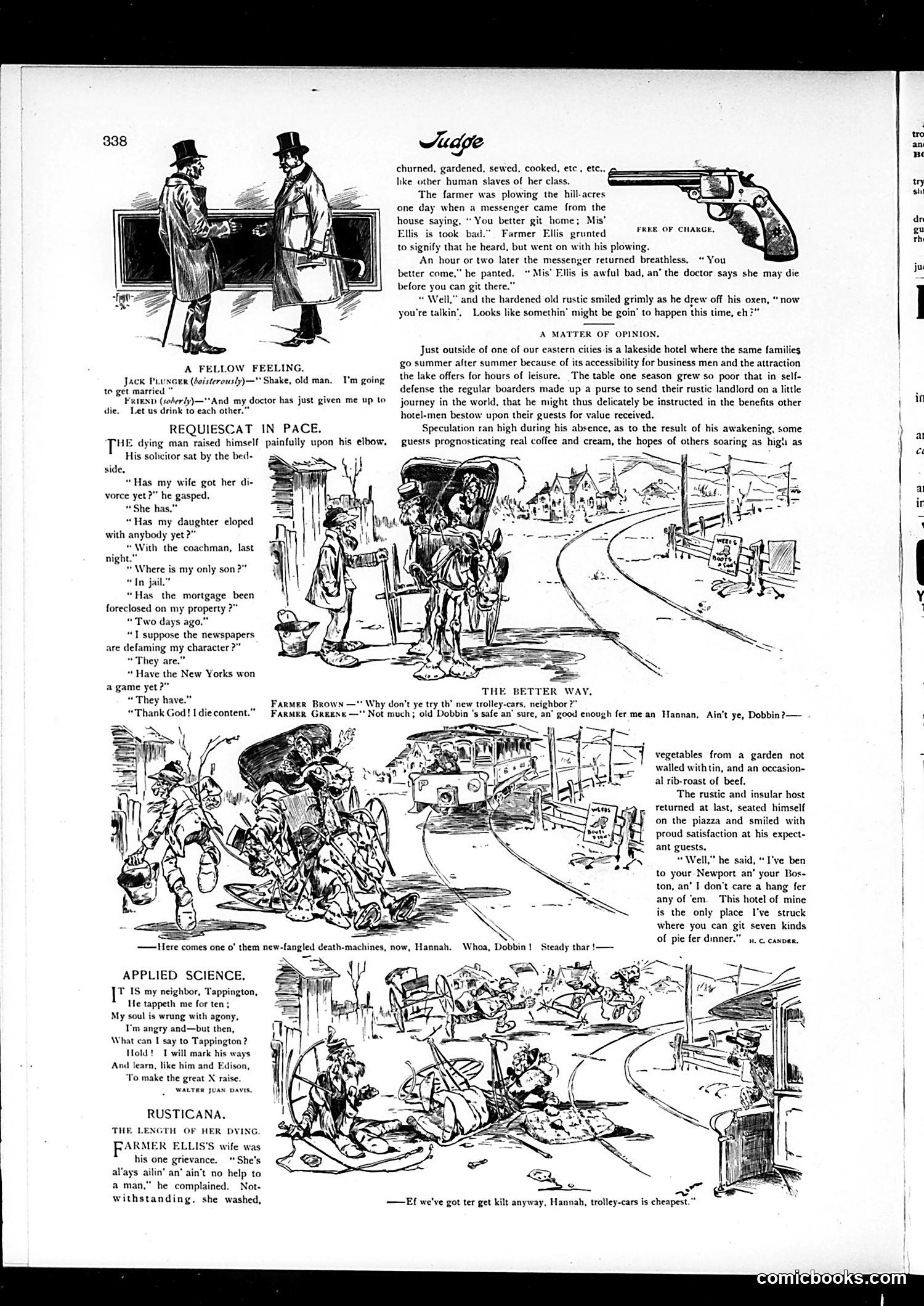
This page contains several satirical cartoons and humorous stories mocking rural/rustic American life and social pretensions of the era. **"A Fellow Feeling"** jokes about two men—one getting married, one dying—finding common cause in misery. **"Rusticana"** satirizes a hardened farmer whose wife's illness barely interrupts his work; he only shows concern when told she might actually die, treating her suffering as mere inconvenience. **"The Better Way"** contrasts farmers rejecting new trolley-cars in favor of horses, mocking rural resistance to modern technology and progressive improvements. **"A Matter of Opinion"** describes wealthy hotel guests pooling money to send their rustic landlord on an educational trip, hoping he'll improve service. He returns unmoved by Newport and Boston, proud only that his establishment serves "seven kinds of pie for dinner"—satirizing rural narrow-mindedness and inability to appreciate refinement. Overall, Judge presents rural figures as stubborn, unambitious, and immune to civilization, reinforcing urban-educated readers' sense of superiority.
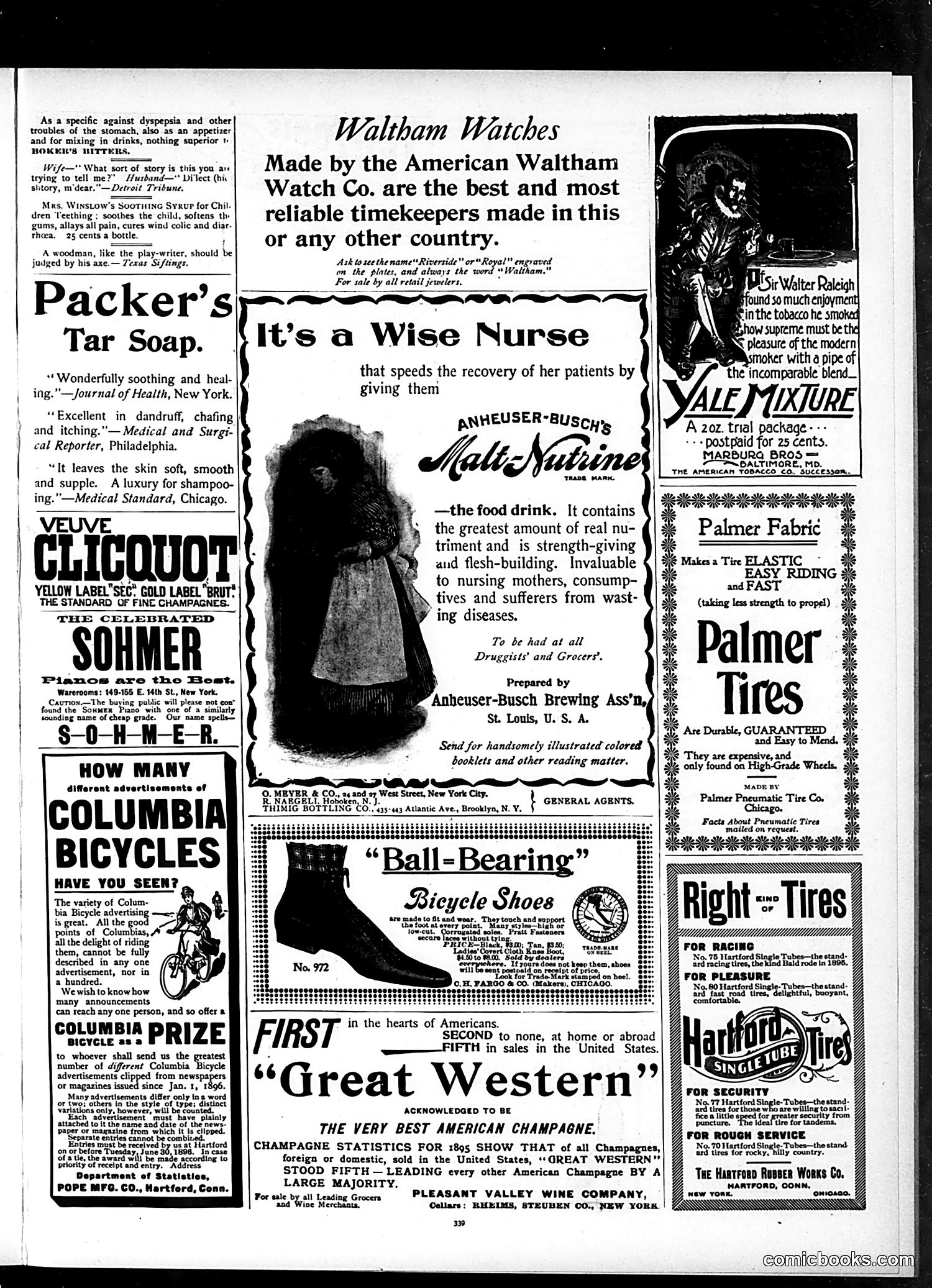
This page is primarily **advertising, not political satire**. It's from Judge magazine circa 1896, featuring testimonial advertisements typical of the era. The content includes: - **Patent medicines and health products** (Mrs. Winslow's Soothing Syrup, Tar Soap, Anheuser-Busch Malt-Nutrine beer marketed as medicinal), reflecting 1890s culture when tonics and alcohol were sold as cure-alls - **Consumer goods** (Waltham watches, Columbia bicycles, pianos, champagne, tires) with endorsements and competitive claims - **A prize contest** from Columbia Bicycles offering a free bicycle for collecting the most advertisements—a marketing strategy building brand awareness The page demonstrates how advertising infiltrated magazines and how unregulated product claims (especially health products) were standard practice. The "wise nurse" pushing beer as nutrition appears absurd today but reflects genuine 1890s advertising practices. There is no visible political cartoon or satire—this is an ordinary advertising page.
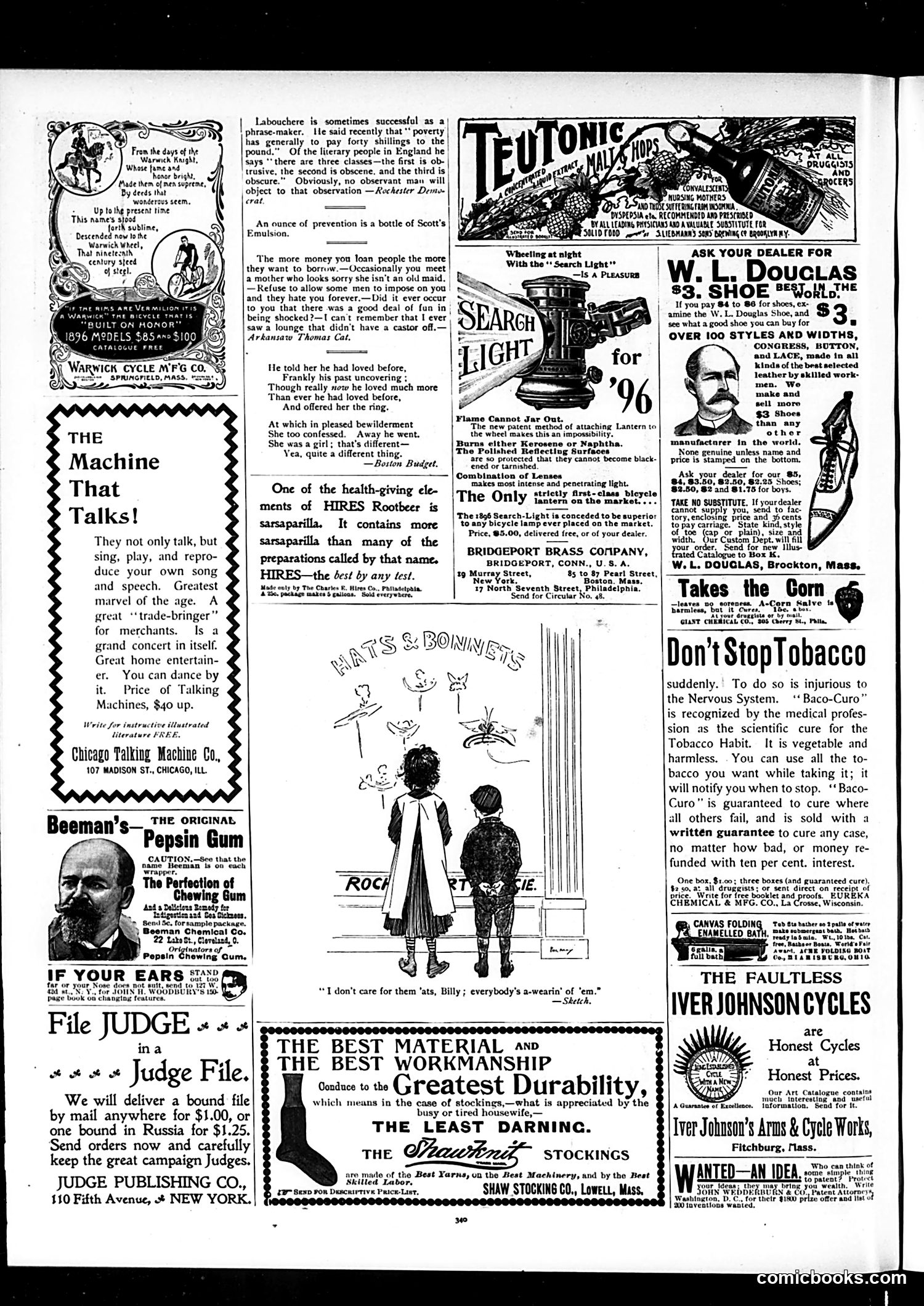
This page is primarily **advertising**, typical of 1890s American magazines. The main content is commercial pitches for various products: **Notable Advertisements:** - Warwick bicycles (invoking chivalric heritage) - Talking machines ($40 price point—expensive for the era) - Search Light bicycle lanterns - Hires Rootbeer (emphasizing sarsaparilla content) - Baco-Curo tobacco cessation cure - W.L. Douglas shoes - Ever Johnson bicycles - File Judge publishing (a subscription offer) **The One Cartoon:** The central illustration shows a mother and child viewing a storefront window displaying hats. The child says he doesn't care for them because "everybody's a-wearin' of 'em"—mild satire on fashion conformity and childhood independence. **Social Context:** The page reflects 1890s consumer culture, with bicycles appearing prominently (reflecting the cycling craze). The "Baco-Curo" ad's medical language ("guaranteed to cure") reflects the era's unregulated patent medicine marketplace. Overall, this is mundane commercial content rather than sharp political satire.
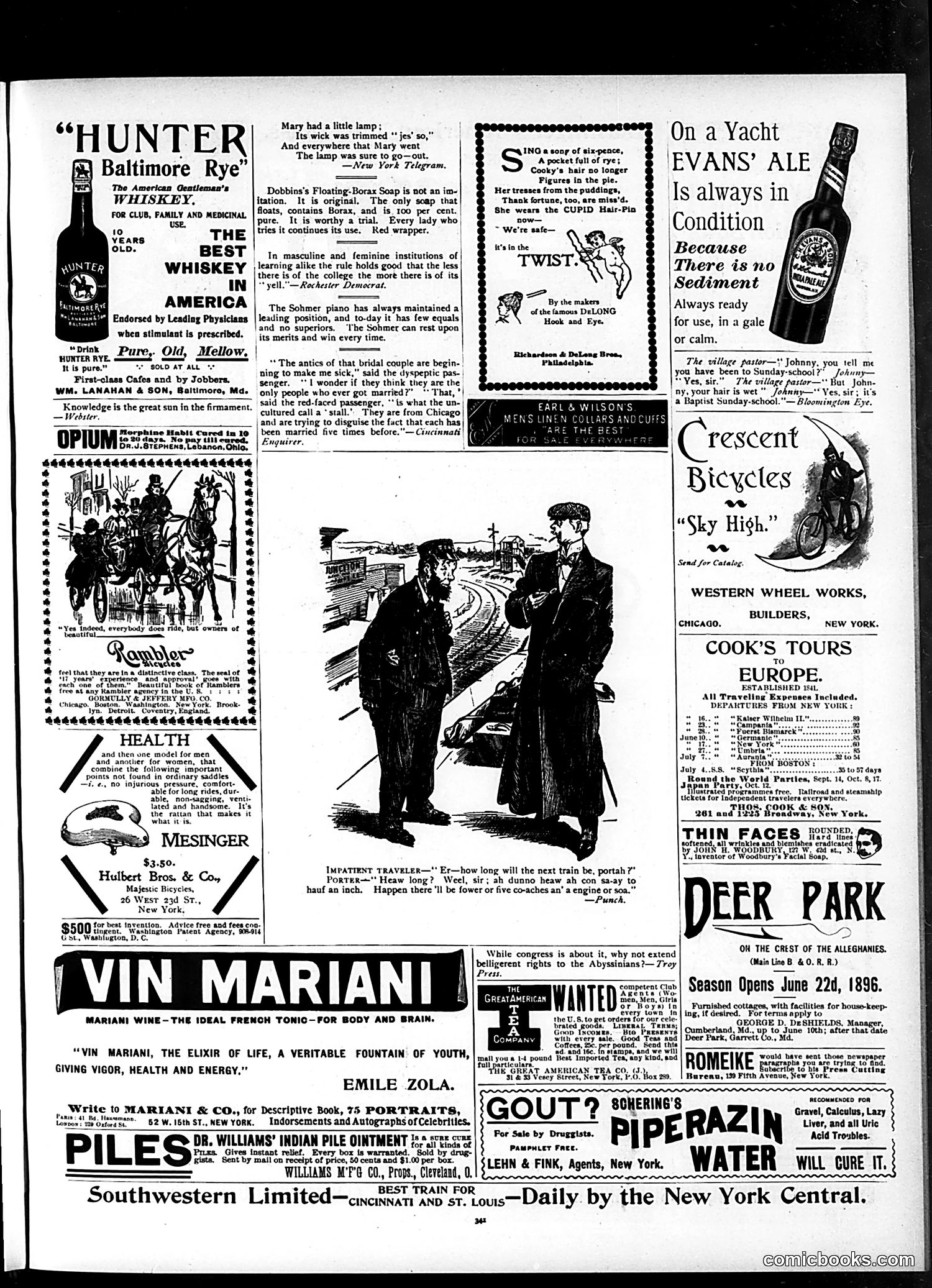
This page is primarily **advertising**, typical of Judge magazine from the 1890s. There is one small cartoon present: **The "Impatient Traveler" cartoon** (center-left) shows a poorly-dressed porter at a train station unable to answer when the next train departs—a class-based humor common to the era, mocking working-class workers as lazy or incompetent. The remainder is product advertisements: whiskey, soap, pianos, bicycles, tours, saddles, medical remedies for hair loss and piles—products marketed primarily to wealthy readers. Several ads claim "scientific" benefits (Mesinger saddles, Pilerine water). One ad references a joke about "cultured" people from Chicago, reflecting period stereotypes mocking wealthy Midwesterners as tasteless nouveaux riches. The advertisements reveal late-Victorian consumer culture and the magazine's affluent target audience.
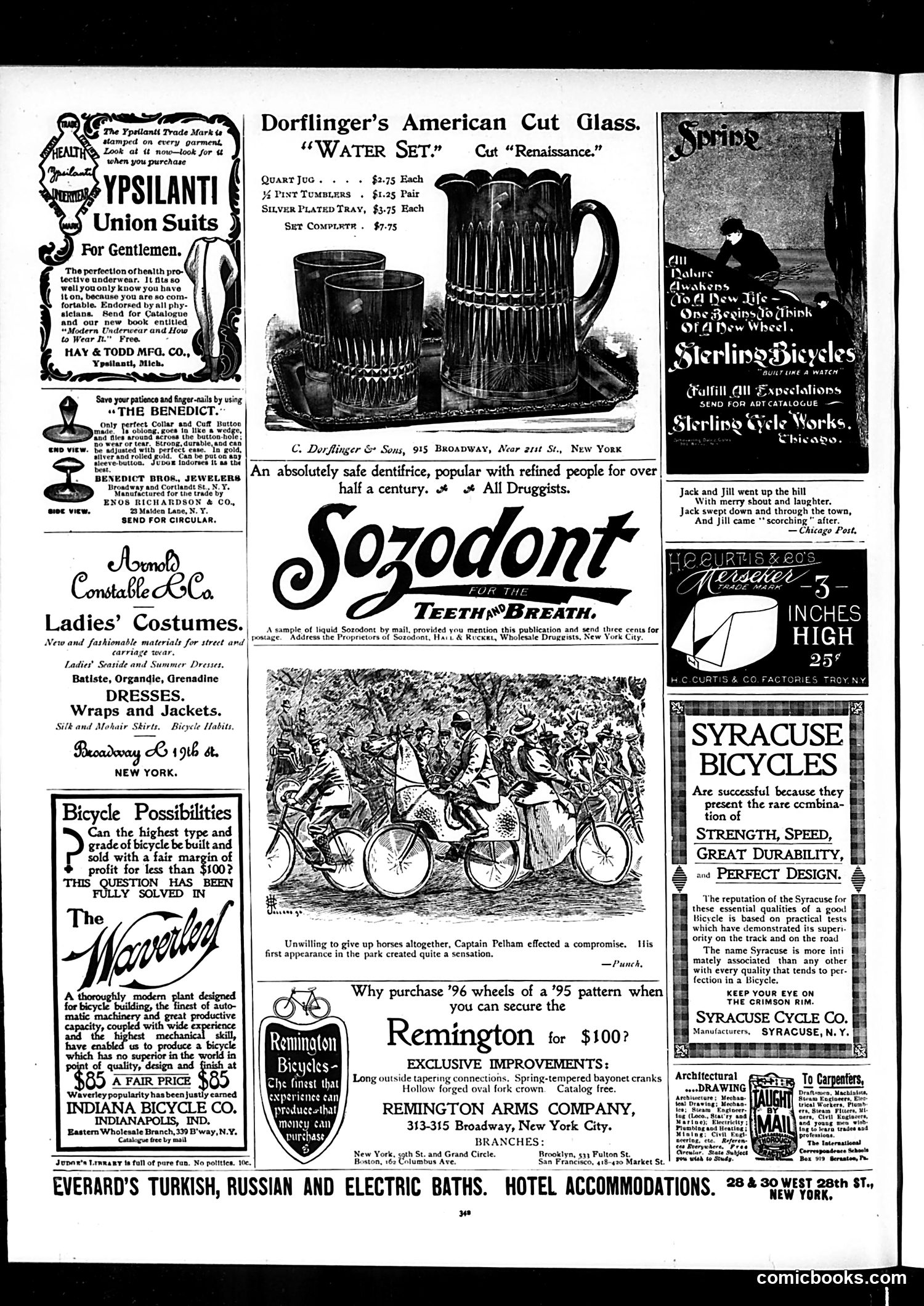
This is primarily an **advertising page** from Judge magazine, with one cartoon visible. The single cartoon ("Unwilling to give up horses altogether, Captain Pelham effected a compromise") shows a gentleman in a carriage being pulled by a bicycle instead of horses—a visual joke about the bicycle craze of the 1890s. The humor lies in the absurd compromise: rather than fully abandon horses for the newfangled bicycle technology, this character attempts an impractical hybrid. The accompanying verse about "Jack and Jill" humorously references "scorching" (contemporary slang for fast cycling), suggesting the bicycle's growing popularity and social disruption. The page reflects the 1890s bicycle boom, with multiple bike manufacturers advertising (Remington, Syracuse, Waverley, Indiana). Other ads showcase period luxury goods—cut glass, dental products, ladies' clothing, and jewelry—typical of Judge's affluent readership. The page documents how bicycles had become a major consumer product and cultural phenomenon by this era.
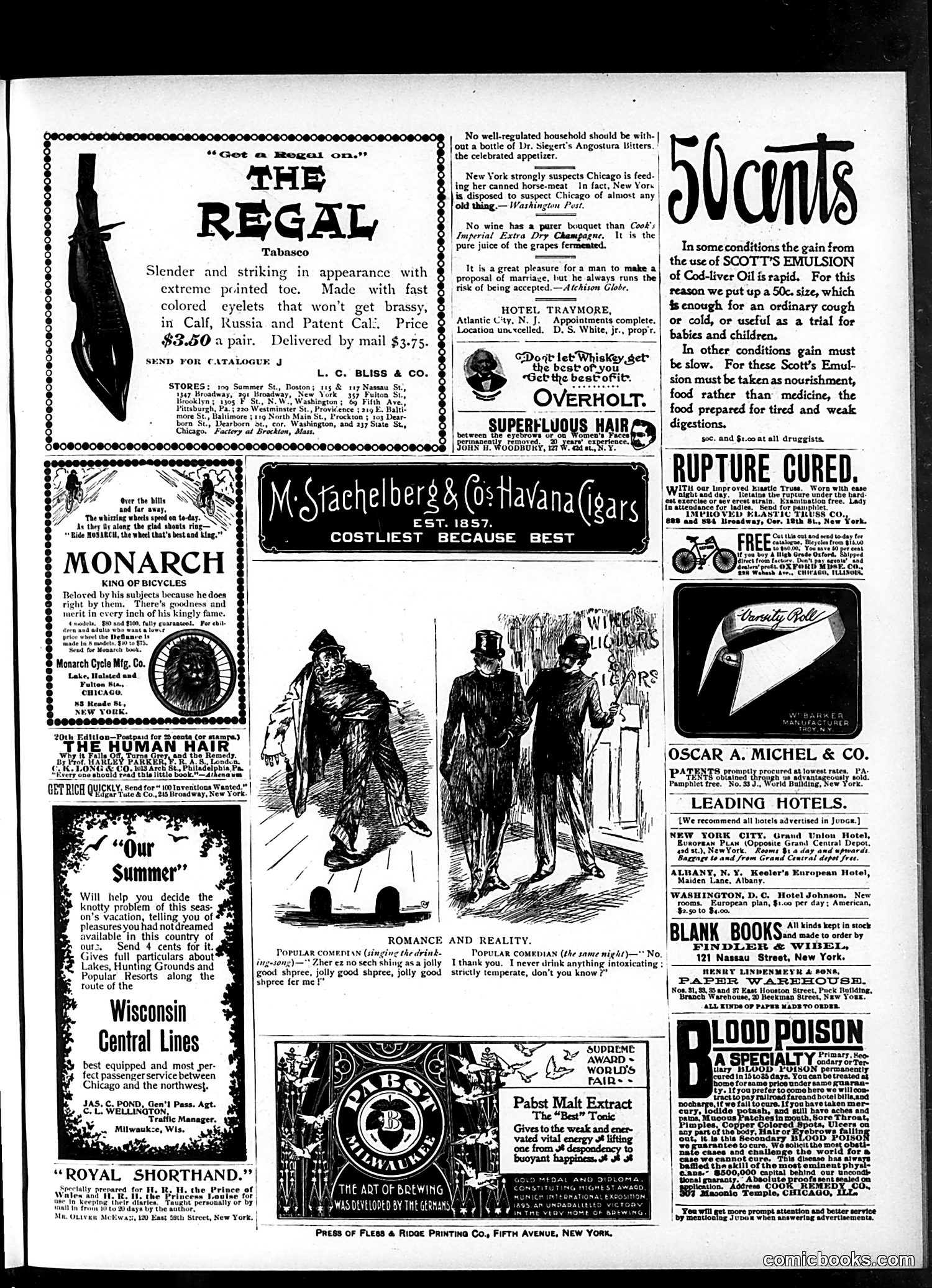
This page is primarily **advertisements and classifieds** rather than political satire. It's a typical turn-of-the-century Judge magazine ad section featuring consumer products and services. The one notable illustrated content is "Romance and Reality," a small cartoon contrasting a theatrical popular comedian's public persona with his claimed private temperance. The joke targets performative morality—the character preaches abstinence offstage while his stage persona celebrates drunkenness, exposing hypocrisy common among entertainers of the era. Otherwise, the page showcases period products: shoes, bicycles, cigars, patent medicines (Angostura bitters, Scott's Emulsion), champagne, rupture trusses, and hotels. These ads reflect contemporary consumer culture and medical attitudes (tonics for "weak digestion," medical devices now considered dubious). The Wisconsin Central Lines ad promoting tourism is typical leisure advertising of the era.
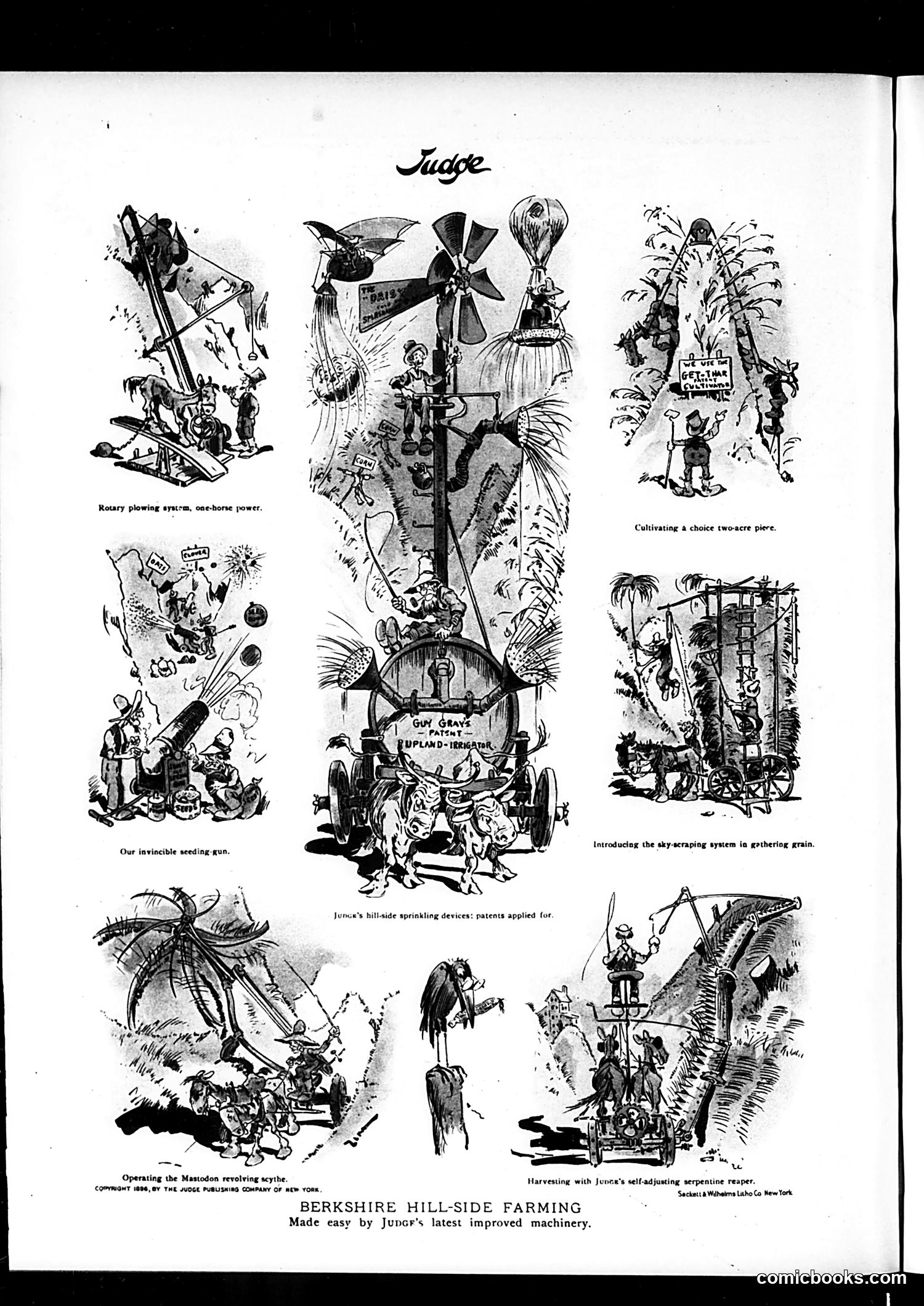
This 1896 page satirizes agricultural machinery and farming innovation through absurdist humor. The illustrations depict wildly impractical inventions with grandiose names—"rotary plowing system," "invincible seeding gun," "Mastodon revolving scythe," and "self-adjusting serpentine reaper"—each more baroque and mechanically illogical than the last. The satire mocks the era's obsession with industrial "progress" and labor-saving devices. The title sarcastically promises that Judge magazine's "latest improved machinery" makes farming "easy," yet each drawing shows chaotic, overcomplicated contraptions that appear far more dangerous and impractical than traditional methods. Tiny figures struggle with these elaborate devices, suggesting that technological complexity actually creates more problems. This reflects Gilded Age anxiety about industrialization replacing skilled labor and common sense with unnecessary mechanical complexity.