
A complete issue · 16 pages · 1896
Judge — April 18, 1896
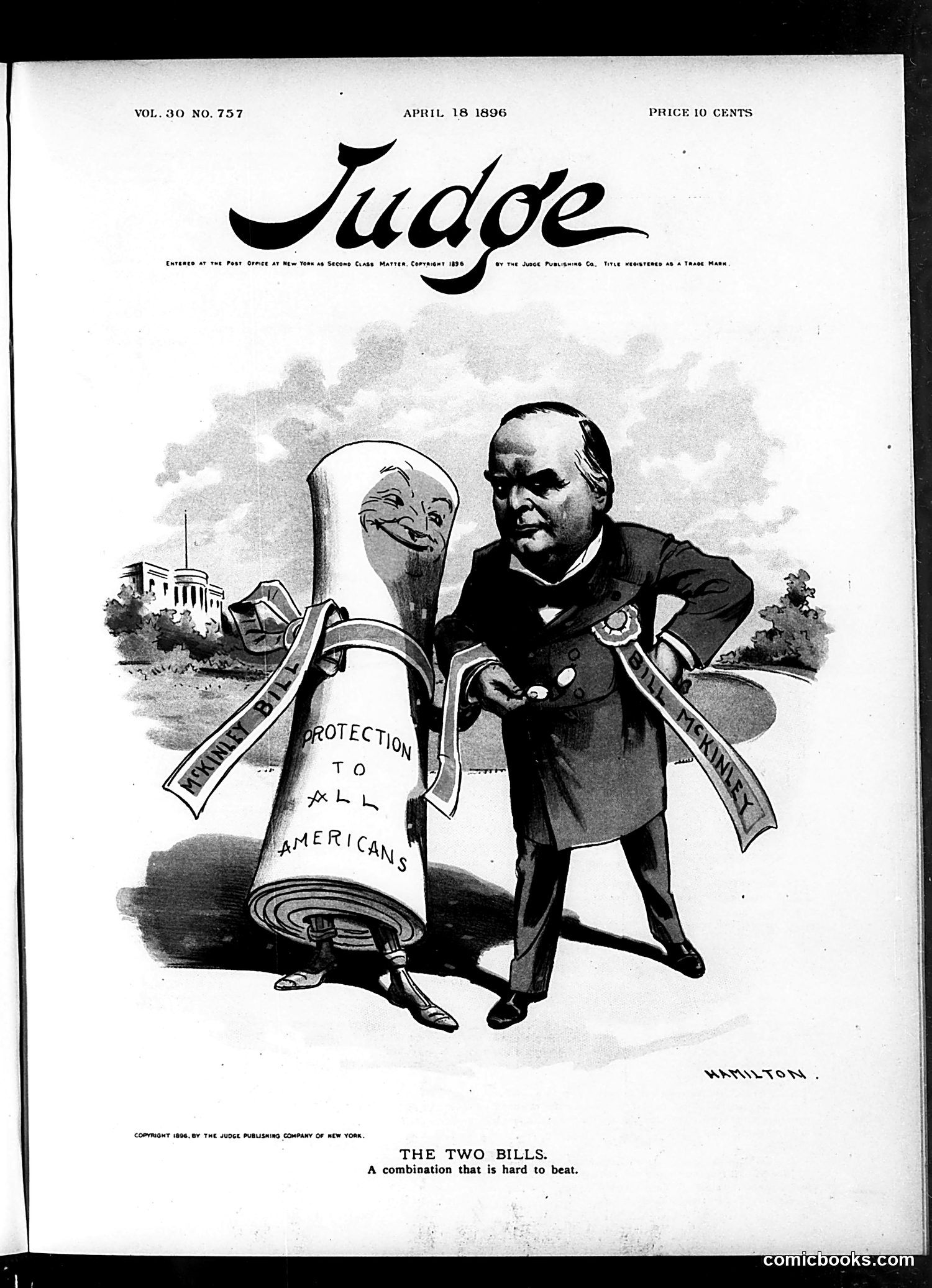
This *Judge* cartoon from April 18, 1896 depicts two political figures—a caricatured man in formal dress and a grotesque mask-like head labeled "PROTECTION TO ALL AMERICANS"—joined together. The ribbons extending from the mask read "REPUBLICAN" and "McKINLEY," suggesting this concerns the 1896 presidential campaign. The satire likely critiques the Republican Party's protectionist tariff policy (represented by the mask) and its political combination with a specific candidate or faction. The caption "A combination that is hard to beat" appears ironic—suggesting this pairing was formidable yet problematic. The grotesque depiction of "protection" implies satirical skepticism toward the policy's claimed benefits to ordinary Americans.
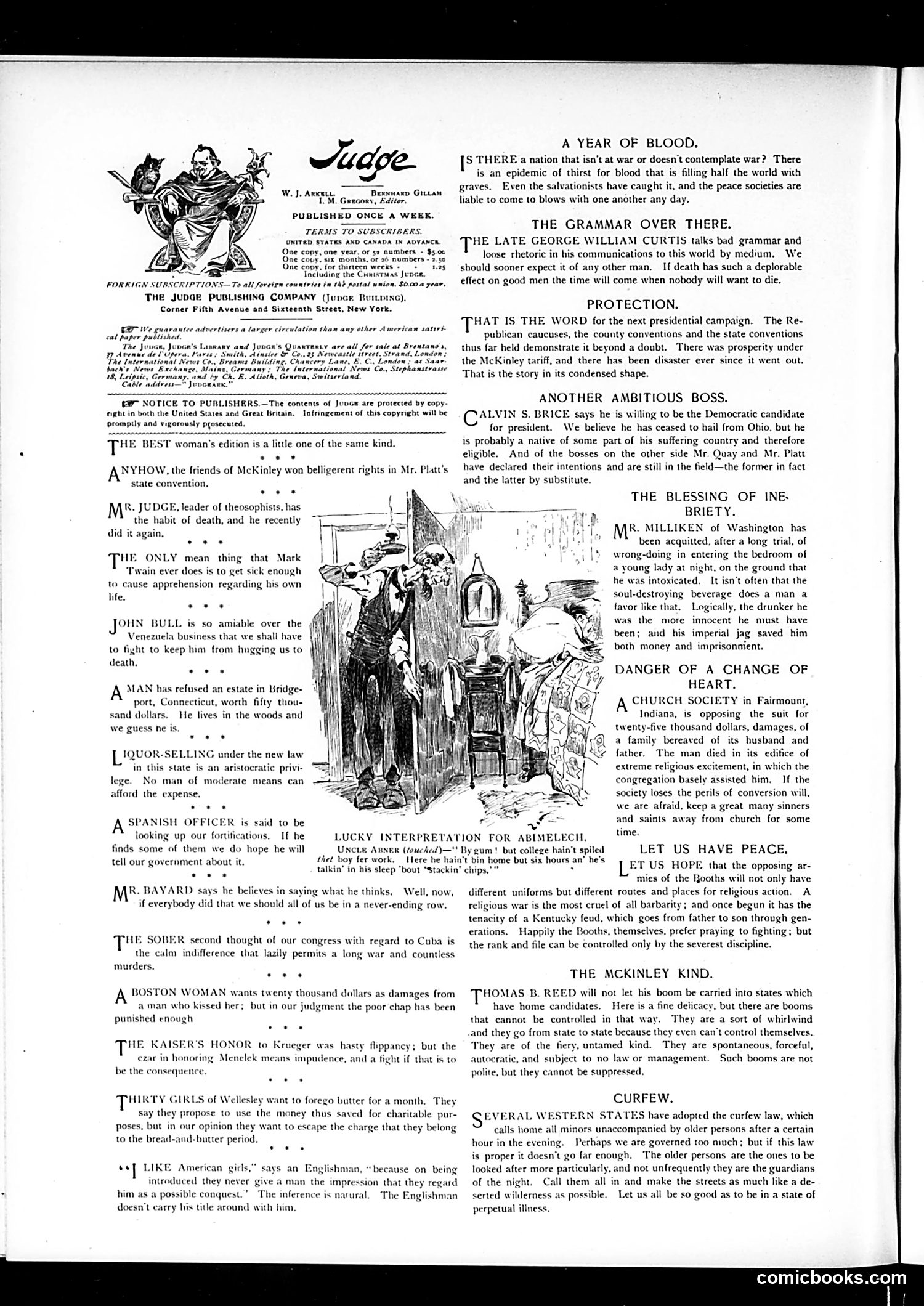
This page combines satirical commentary with illustrated jokes typical of Judge magazine's format. The central cartoon depicts an interior scene with exaggerated characters, likely satirizing social behavior or a specific incident (unclear from image alone which event or figures are targeted). The text sections employ Judge's signature format: brief satirical "items" mocking contemporary figures and issues. References include McKinley, Cuba (suggesting Spanish-American War context), religious controversy in Indiana, and social commentary on gender relations and legal matters. The "Lucky Interpretation for Auntie" illustration uses visual humor about misunderstanding language. Overall, the page reflects Judge's role as political and social satirist, targeting politicians, social reformers, and cultural institutions through quick jabs and illustrated commentary rather than sustained arguments.
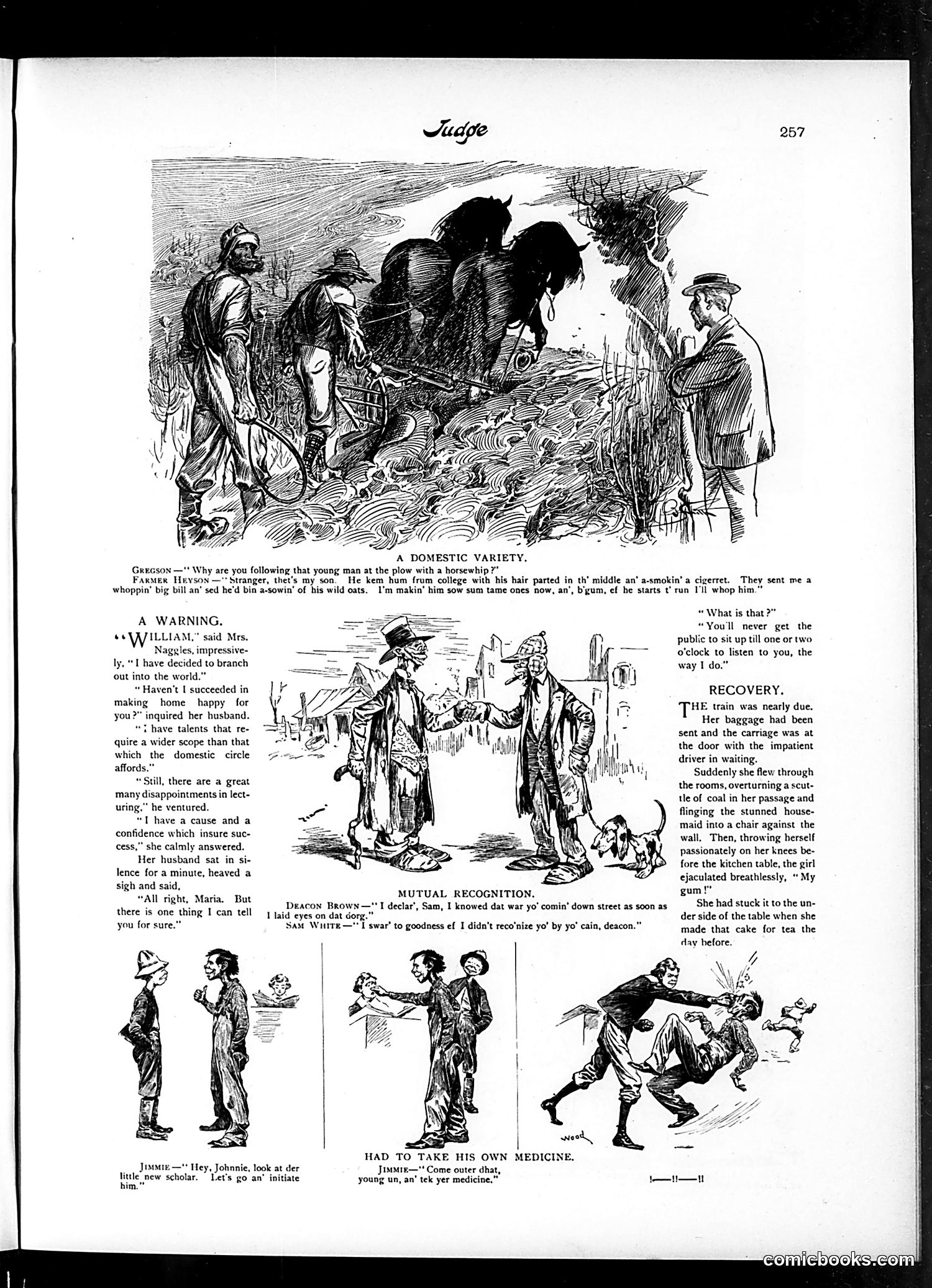
This page contains four separate comic sketches satirizing rural and working-class life, likely from the early 20th century. **"Domestic Safety"** mocks a farmer's wife lecturing about household management. **"A Warning"** depicts a woman (Mrs. William) warning against marrying for love, suggesting husbands disappoint wives' expectations. **"Mutual Recognition"** shows two men (Deacon Brown and Sam Writt) who initially fail to recognize each other despite claiming old acquaintance. **"Had to Take His Own Medicine"** appears to show a young boy receiving physical punishment ("medicine") as discipline. The overall theme satirizes domestic life, marriage disappointments, and rural/working-class manners. The humor relies on stock character types and contemporary social expectations about family dynamics.
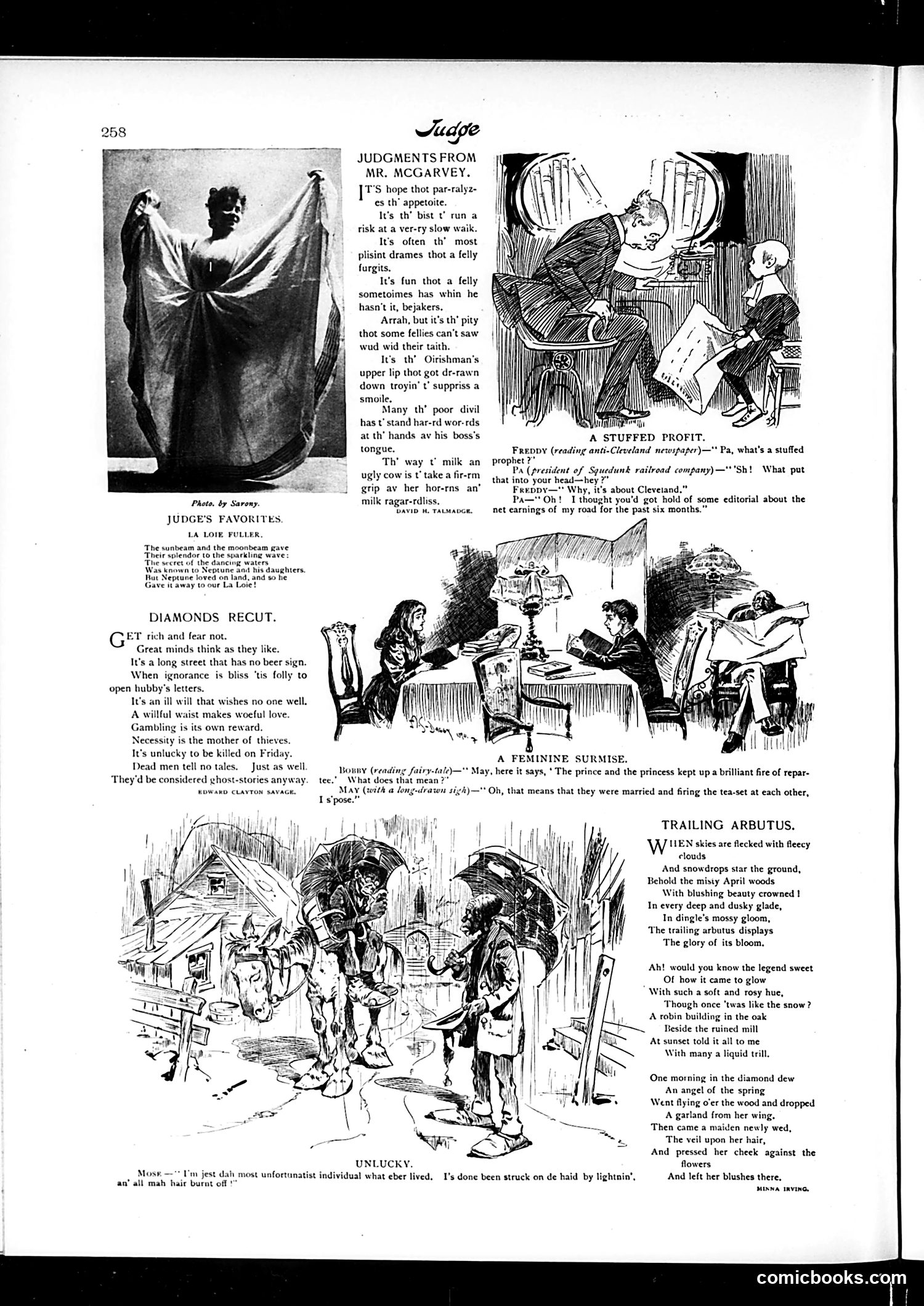
This page contains **editorial cartoons and humorous commentary** typical of Judge's satirical style. **"A Stuffed Profit"** mocks railroad corruption. A railroad company president (labeled president of "Squedunk railroad") dismisses his daughter's innocent question about "stuffed prophets" from a Cleveland newspaper—thinking she's referencing editorial criticism of his railroad's inflated earnings reports. The joke: he's guilty and defensive about financial manipulation. **"A Feminine Surprise"** satirizes newlyweds. Two women discuss a fairy tale mentioning lovers keeping up "brilliant repartee" (witty conversation). One quips it means they were married and "firing the tea-set at each other"—mocking the notion that marriage transforms romantic banter into domestic conflict. The page also includes **sentimental poetry** ("Trailing Arbutus"), **ethnic humor** featuring an Irish character (McGarvey) with stereotypical dialect, and **other light jokes**—typical of Judge's mix of political satire and general humor for Victorian-era readers. The Cleveland reference dates this to the 1880s-1890s (during President Grover Cleveland's tenure).
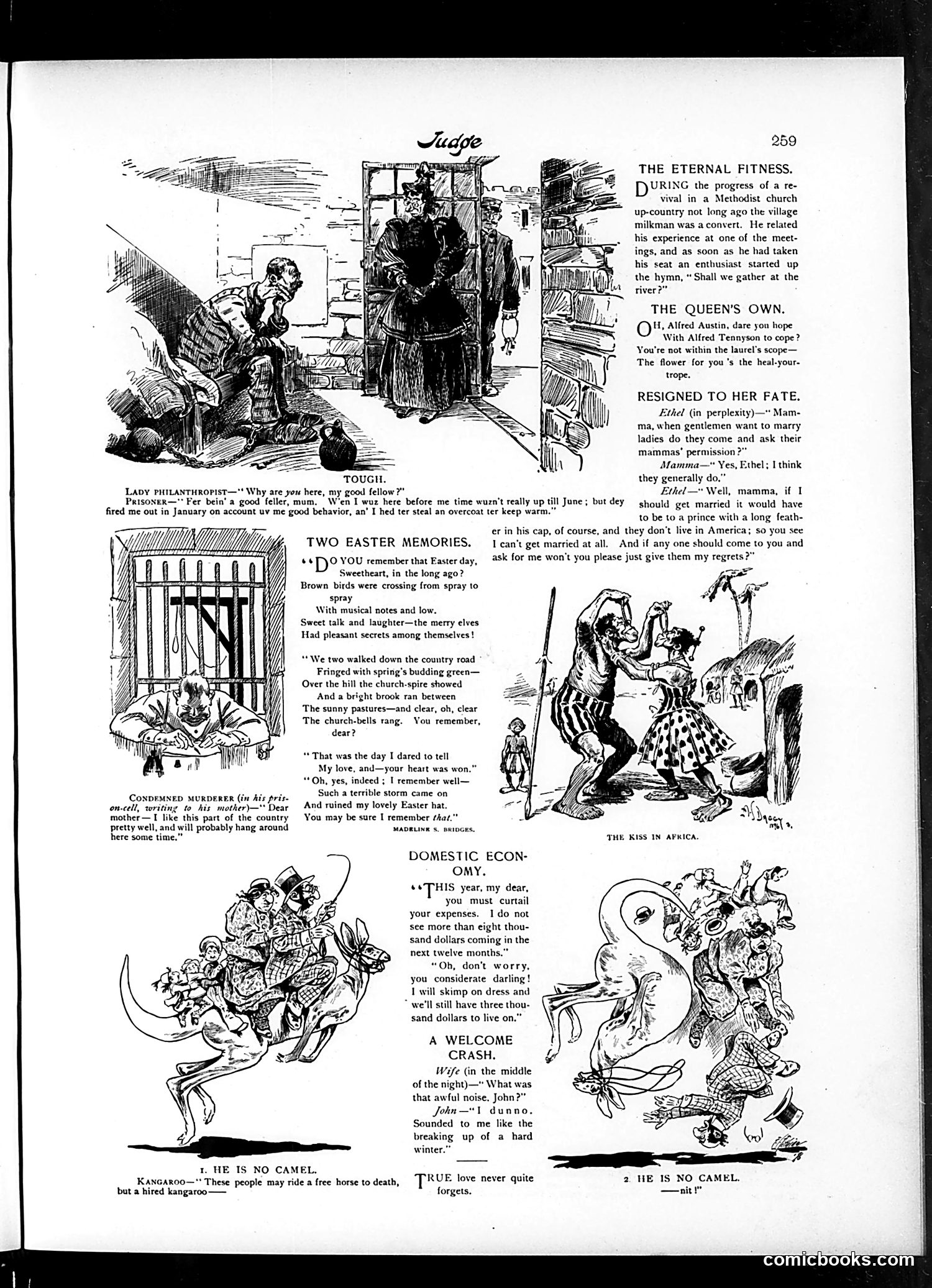
This page contains multiple satirical sketches typical of late-19th/early-20th century American humor: **"The Eternal Fitness"** mocks Methodist revival meetings—a convert milkman testifies, then the congregation ironically launches into "Shall We Gather at the River?" (implying the milkman will soon be drowning, given his profession). **"The Queen's Own"** appears to satirize Alfred Austin (likely the Poet Laureate) as inferior to his predecessor Tennyson, using horticultural wordplay ("heal-your-trope"). **"Resigned to Her Fate"** depicts a young woman's resignation that she cannot marry—princes live abroad and American gentlemen don't meet her standards, so she asks her mother to reject any suitors. **"Two Easter Memories"** contrasts a sentimental romantic memory with a woman's complaint that spring weather ruined her Easter hat—trivializing genuine emotion. **"Domestic Economy"** shows a wife casually dismissing her husband's budget concerns, assuring him they can still spend lavishly despite limited income. The kangaroo cartoons appear to offer animal observations unrelated to current events.
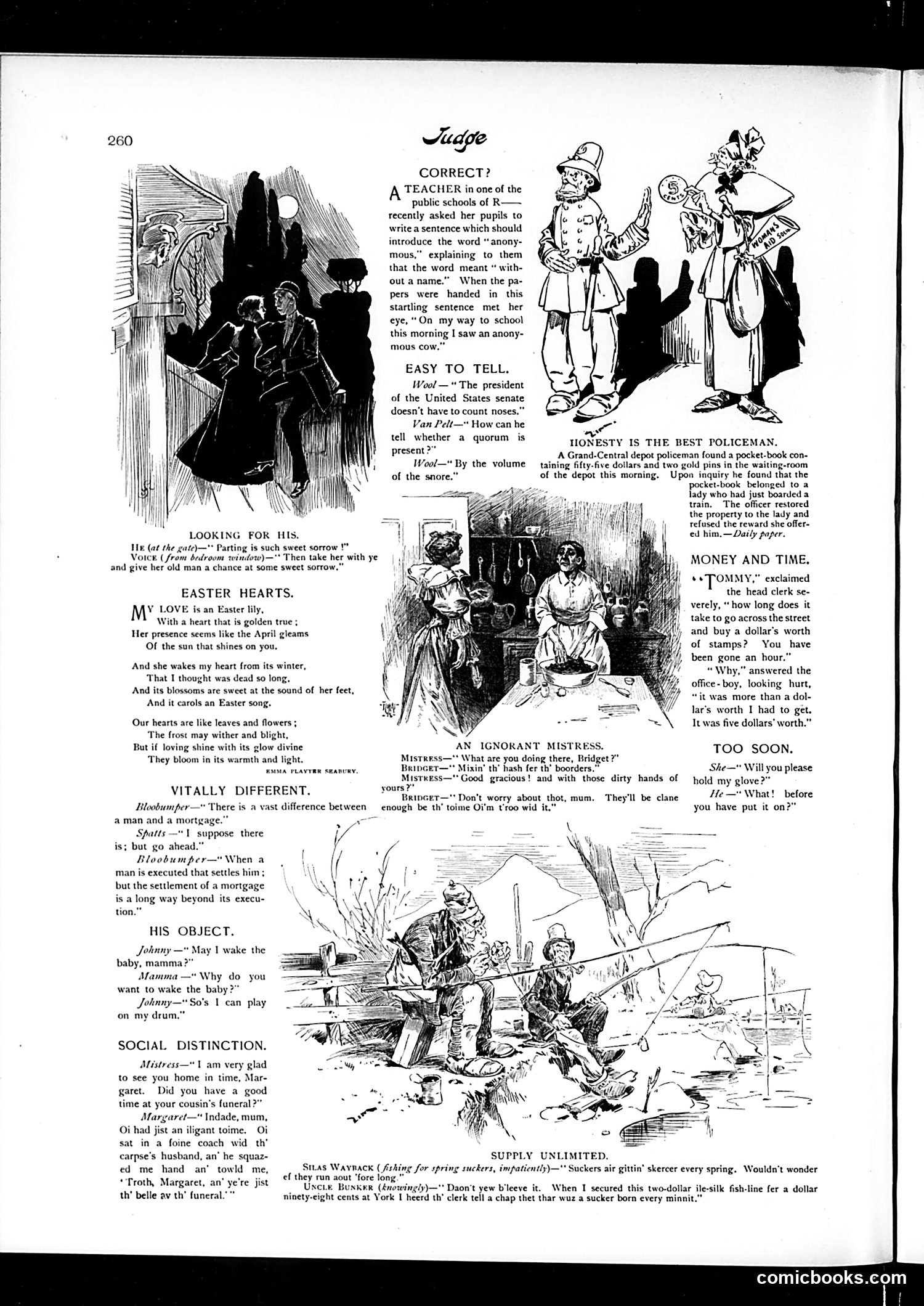
This page from *Judge* (a late 19th/early 20th-century American humor magazine) contains multiple short satirical pieces mocking various social groups and situations: **"Correct?"** ridicules a schoolchild's innocent misuse of "anonymous" as an example of naive literalism. **"Easy to Tell"** and **"Money and Time"** joke about bureaucratic incompetence and youthful stupidity—an office boy spending five dollars instead of one on stamps. **"Honesty is the Best Policeman"** ironically praises a Grand Central policeman for returning a lost wallet, suggesting such honesty was noteworthy enough to be newsworthy—implying corruption was common. **"An Ignorant Mistress"** and **"Social Distinction"** mock Irish immigrant domestic servants through heavy dialect, portraying them as simple-minded but good-natured—typical ethnic stereotyping of the era. **"Supply Unlimited"** contains a fishing anecdote about "suckers" (fish and gullible people), playing on the double meaning. The page reflects period attitudes toward class, ethnicity, and workplace hierarchies through gentle mockery rather than biting political satire.
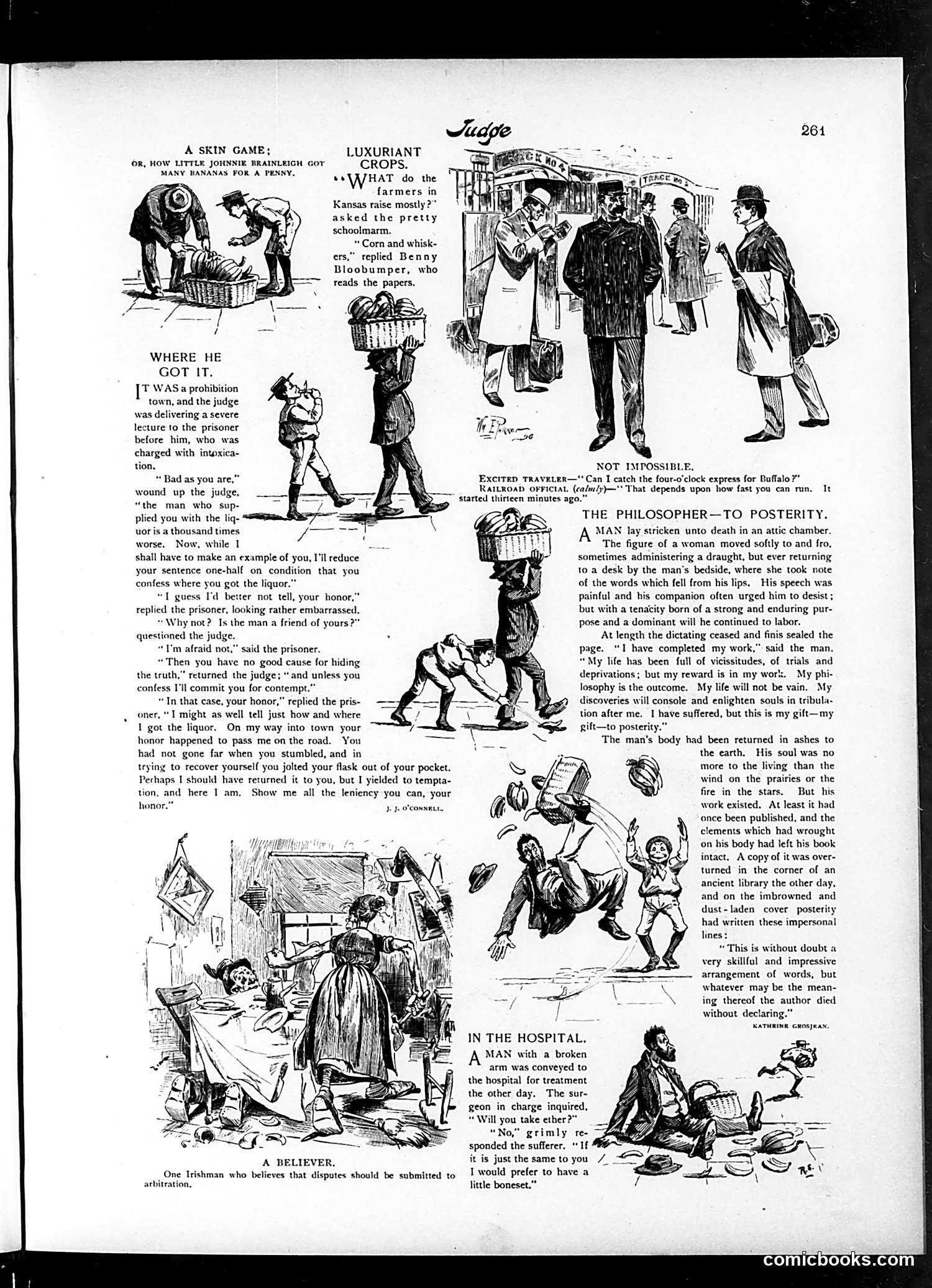
This page contains multiple satirical vignettes typical of Judge's humor: **"A Skin Game"**: A judge lectures a prisoner on intoxication, then reduces his sentence if he'll confess his liquor source. The prisoner reveals the judge himself lost his flask on the road—a reversal exposing the judge's hypocrisy and moral authority. **"Luxuriant Crops"**: A schoolteacher asks what Kansas farmers grow; a student answers "corn and whiskers," mocking Kansas politicians' prominence in contemporary politics (likely referencing the state's visible political figures of the era). **"The Philosopher—To Posterity"**: A dying man writes philosophical work while a woman attends him, believing his legacy will enlighten future generations. Posterity's verdict: impressive prose, but meaningless—satirizing pretentious intellectualism and the vanity of seeking immortal fame through obscure philosophy. **"In the Hospital"**: A patient refuses ether for surgery, preferring "a little boneset"—apparently Irish folk medicine—mocking both medical skepticism and ethnic stereotypes. Each cartoon mocks human folly: hypocrisy, pretension, and misplaced confidence.
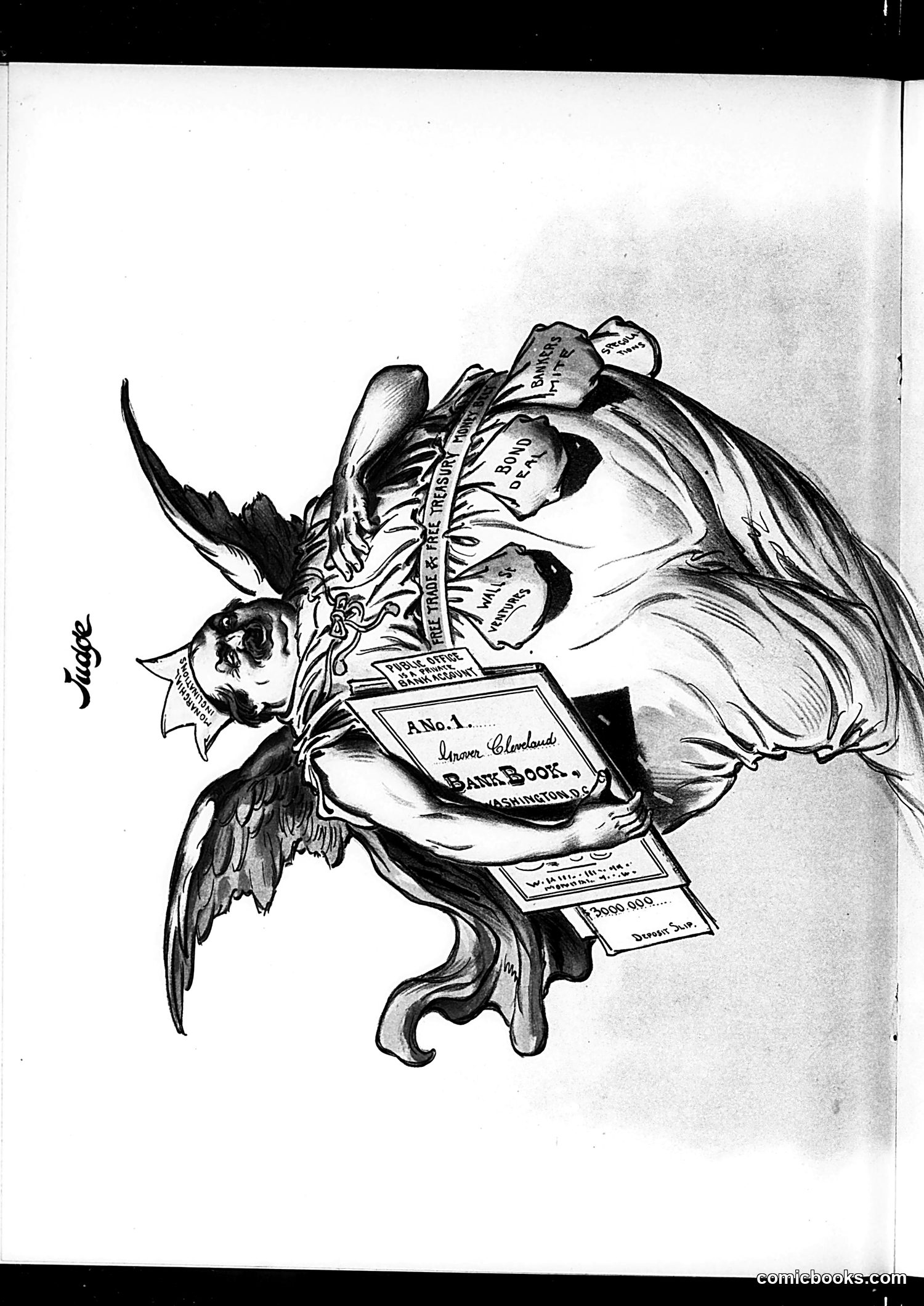
This is a satirical illustration depicting what appears to be a goose or bird laden with various labeled documents and papers. The visible text references "Bank Book," "Washington, D.C.," and what seem to be financial or governmental documents, though the OCR quality makes complete identification difficult. The cartoon likely satirizes corruption or financial malfeasance in government—a common Judge magazine theme. The bird carrying multiple official documents and bank-related materials suggests someone in government improperly transporting or profiting from official business. The grotesque, exaggerated bird form was typical of *Judge*'s style for depicting corrupt figures as distasteful creatures. Without clearer text or additional context, the specific political figure or scandal referenced remains unclear.
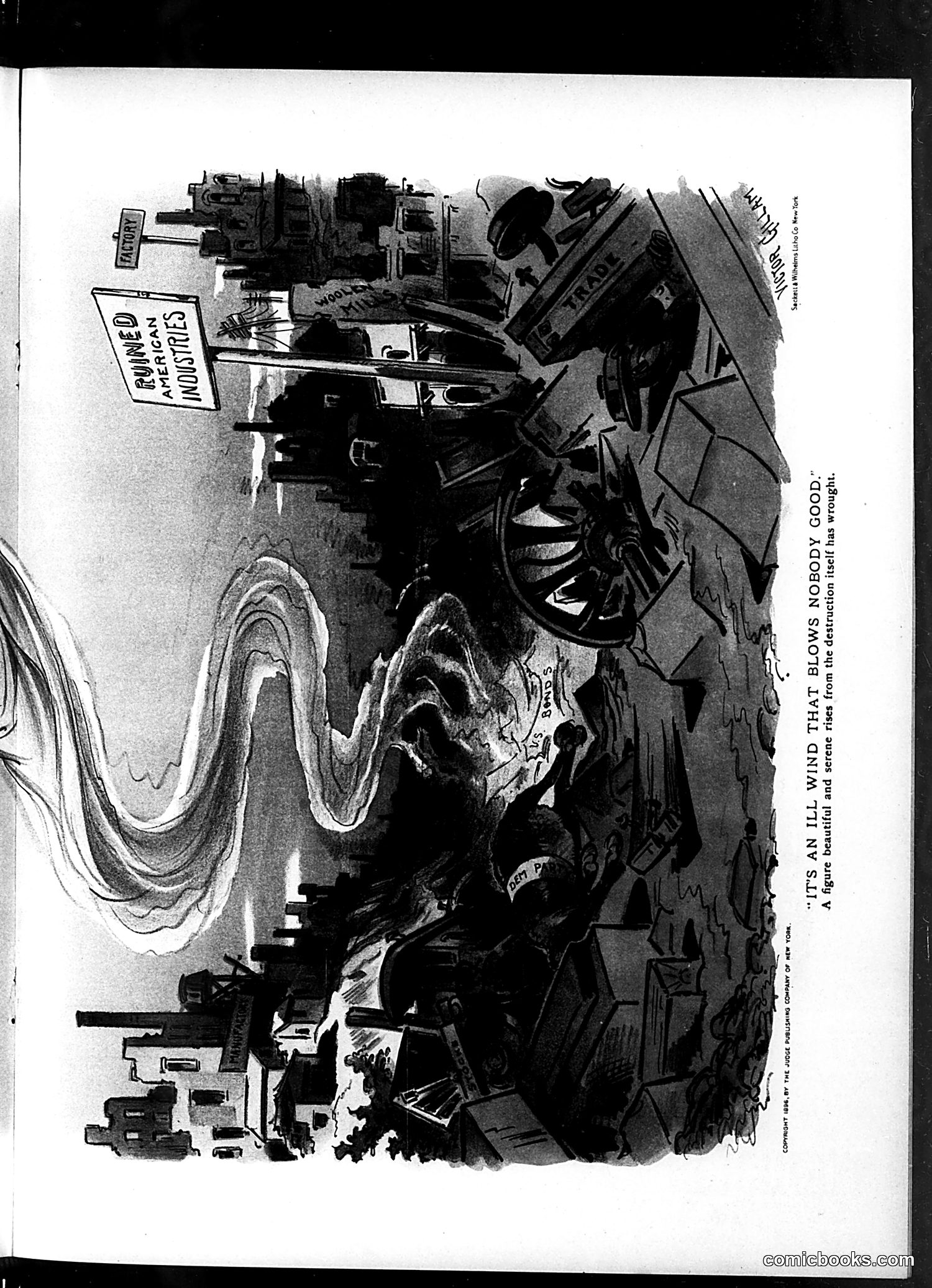
I can see this is a political cartoon that appears to be rotated or upside-down in the image, making precise interpretation difficult. The visible text fragment suggests a caption about "it's an ill wind that blows nobody good" — a common idiom meaning even bad situations benefit someone. The cartoon depicts what appears to be an industrial or commercial scene with machinery and a storefront sign reading "MOVED" and what looks like "AUCTION INDUSTRIALS." There's also a sign visible that says "BUILDING A SELECTION INDUSTRIES." However, due to the image's orientation, quality, and OCR text corruption, I cannot reliably identify: - The specific political figures or caricatures - The exact historical event being satirized - The precise point of the satire To provide accurate historical interpretation, I would need a properly oriented, clearer image or confirmed publication date and title information.
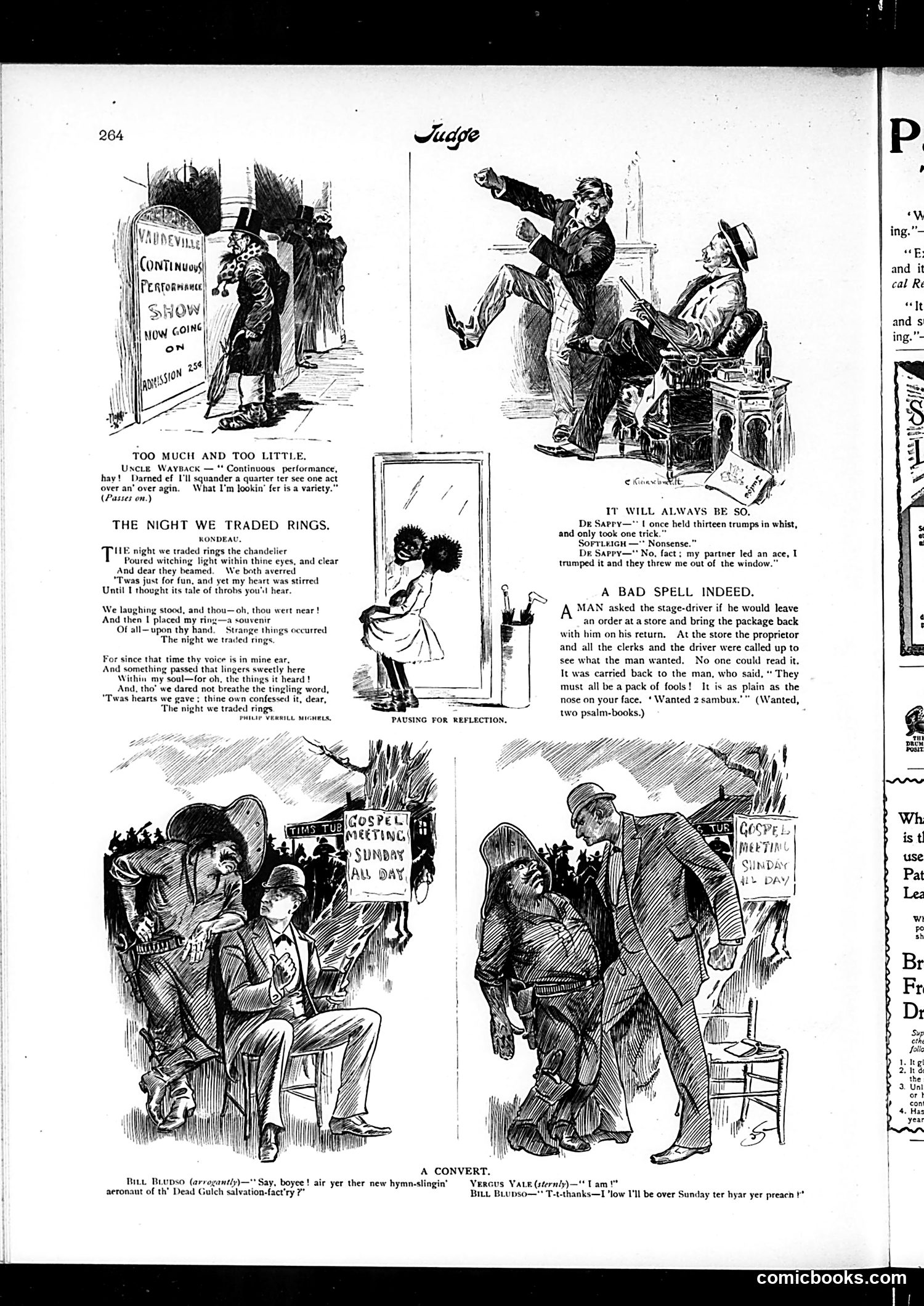
This page contains several unrelated satirical vignettes typical of Judge magazine's format: **"Too Much and Too Little"** mocks Uncle Waynack's complaint that continuous vaudeville performances bore him—he wants variety, not repetition. **"The Night We Traded Rings"** is a sentimental poem about exchanging rings, contrasting with the magazine's typically irreverent tone. **The cartoon sketches** depict social humor: a man at a gospel meeting, conversations about card games and unfortunate outcomes, and a "bad spell" joke where a storekeeper cannot read a customer's handwriting requesting "2 sambux" (psalm-books), humorously suggesting illiteracy. **"A Convert"** shows a rough character (Bill Blubso) promising to attend church, likely satirizing sudden religious conversions among working-class types. The overall page reflects late-19th/early-20th-century American humor emphasizing wordplay, class humor, and genteel satire of everyday situations rather than explicit political commentary.
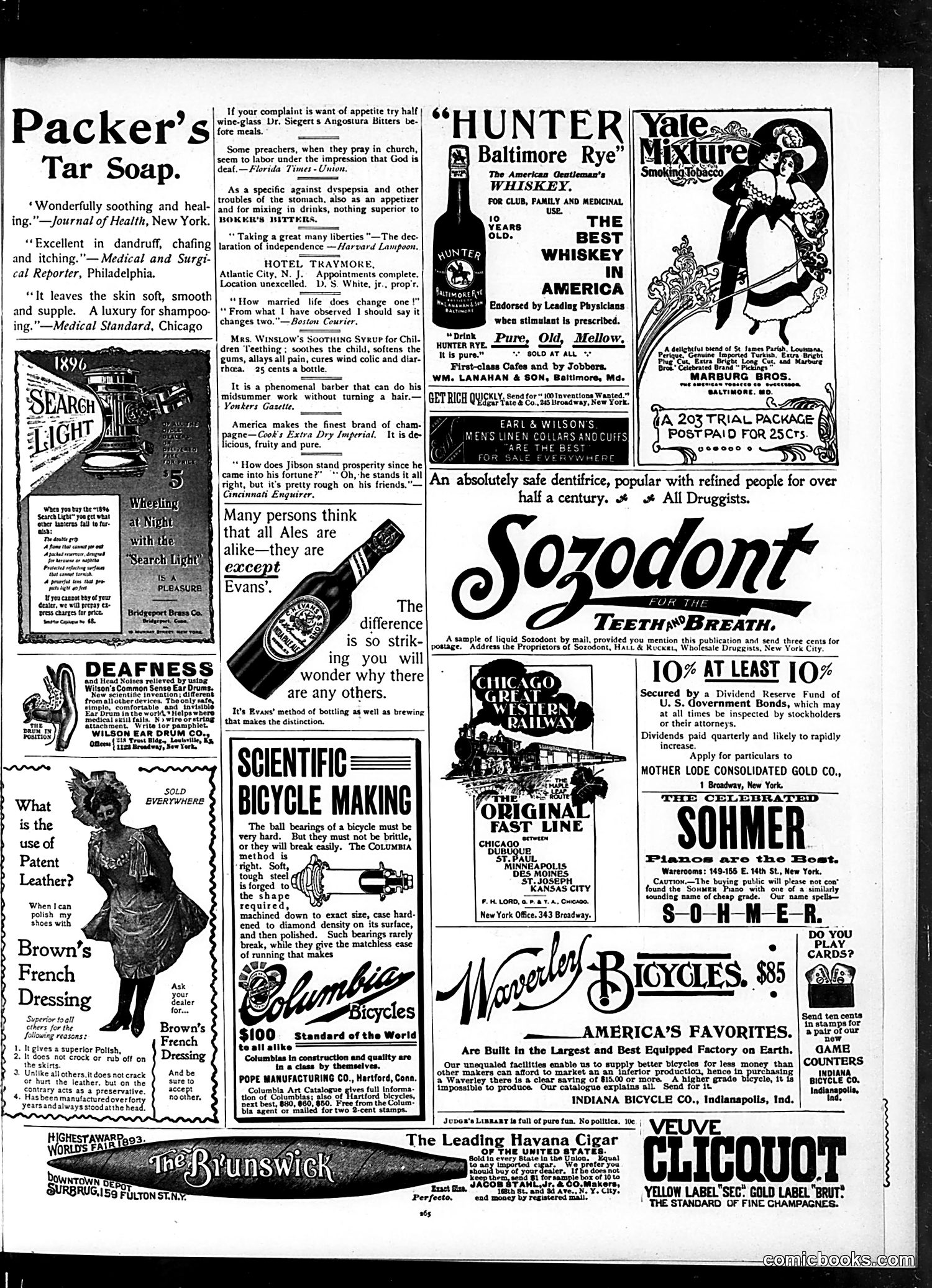
This page is primarily **advertising**, not political satire. It contains dozens of commercial advertisements for patent medicines, consumer goods, and services typical of the late 19th century. Notable ads include: - **Packer's Tar Soap** and **Mrs. Winslow's Soothing Syrup** (patent medicines) - **Evans' Ale** and **Hunter Baltimore Rye** whiskey - **Sozodont** toothpaste - **Columbia** and **Waverley** bicycles - **Brown's French Dressing** shoe polish The page includes some **brief humorous quips** (typical of Judge magazine's satirical style)—such as jokes about marriage, prosperity, and preachers—but these are short filler items, not developed cartoons. There are **no identifiable political figures or sustained satire** on this particular page. It represents Judge functioning as an advertising vehicle alongside its humor content, common for magazines of this era.
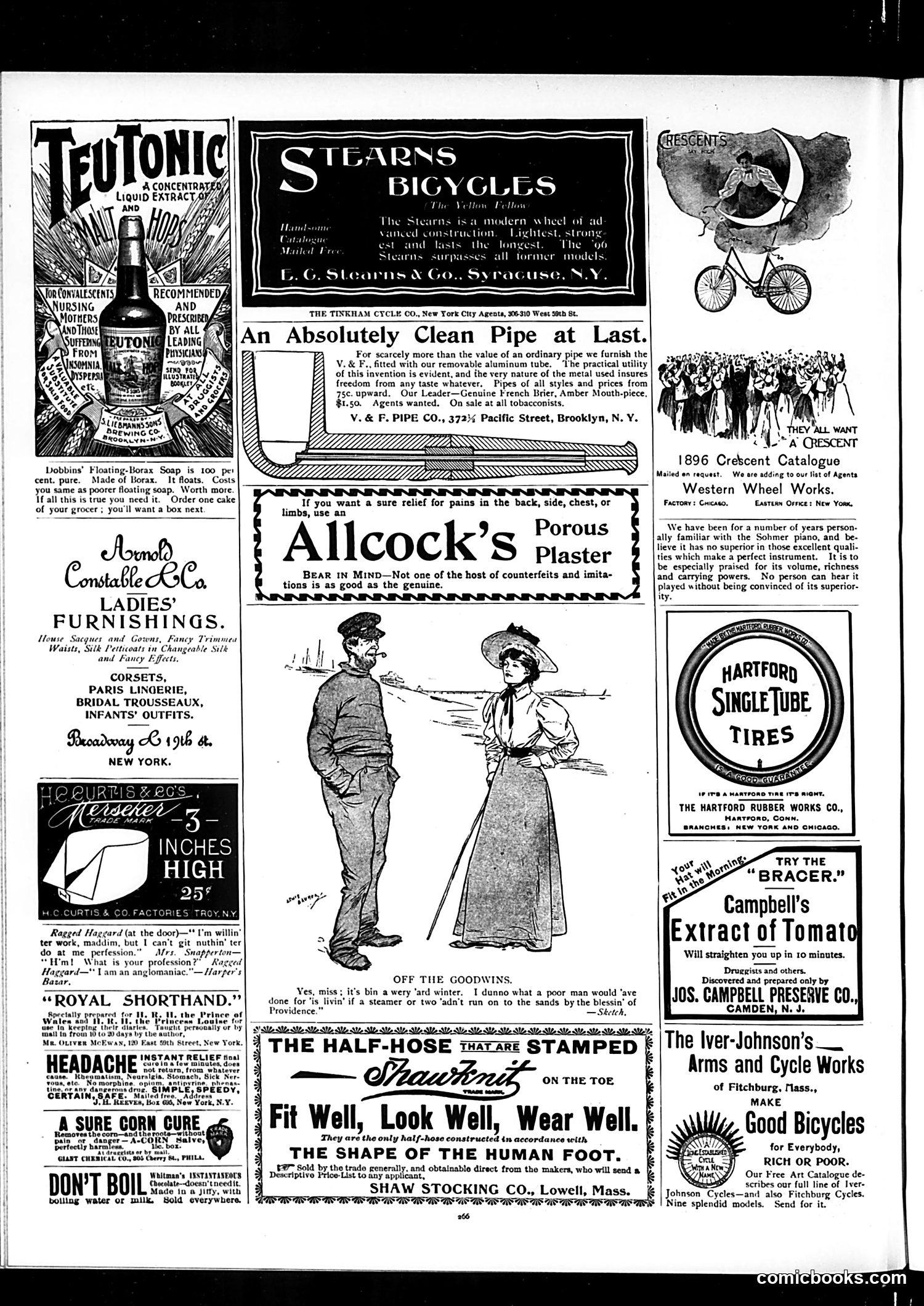
This page is primarily **advertisements**, not political satire or comics. It contains one minor joke cartoon but is dominated by product pitches typical of 1890s publications. The sole cartoon shows a ragged man (labeled "Haggard") at a door telling a woman he seeks work but "can't git nuthin' ter me perfession." She asks what his profession is; he replies he's an "anglomaniac." The joke is wordplay—his made-up profession literally means someone obsessed with angles or geometry, playing on his ragged appearance suggesting he's desperate and delusional. The rest of the page advertises bicycles (Stearns, Crescent, Iver-Johnson), pipes, plasters, soaps, corsets, tires, and other consumer goods. The only social commentary appears in a brief text anecdote mocking a steamer wreck as a "blessing of Providence" for poor salvagers—dark humor about coastal ship disasters providing income to locals.
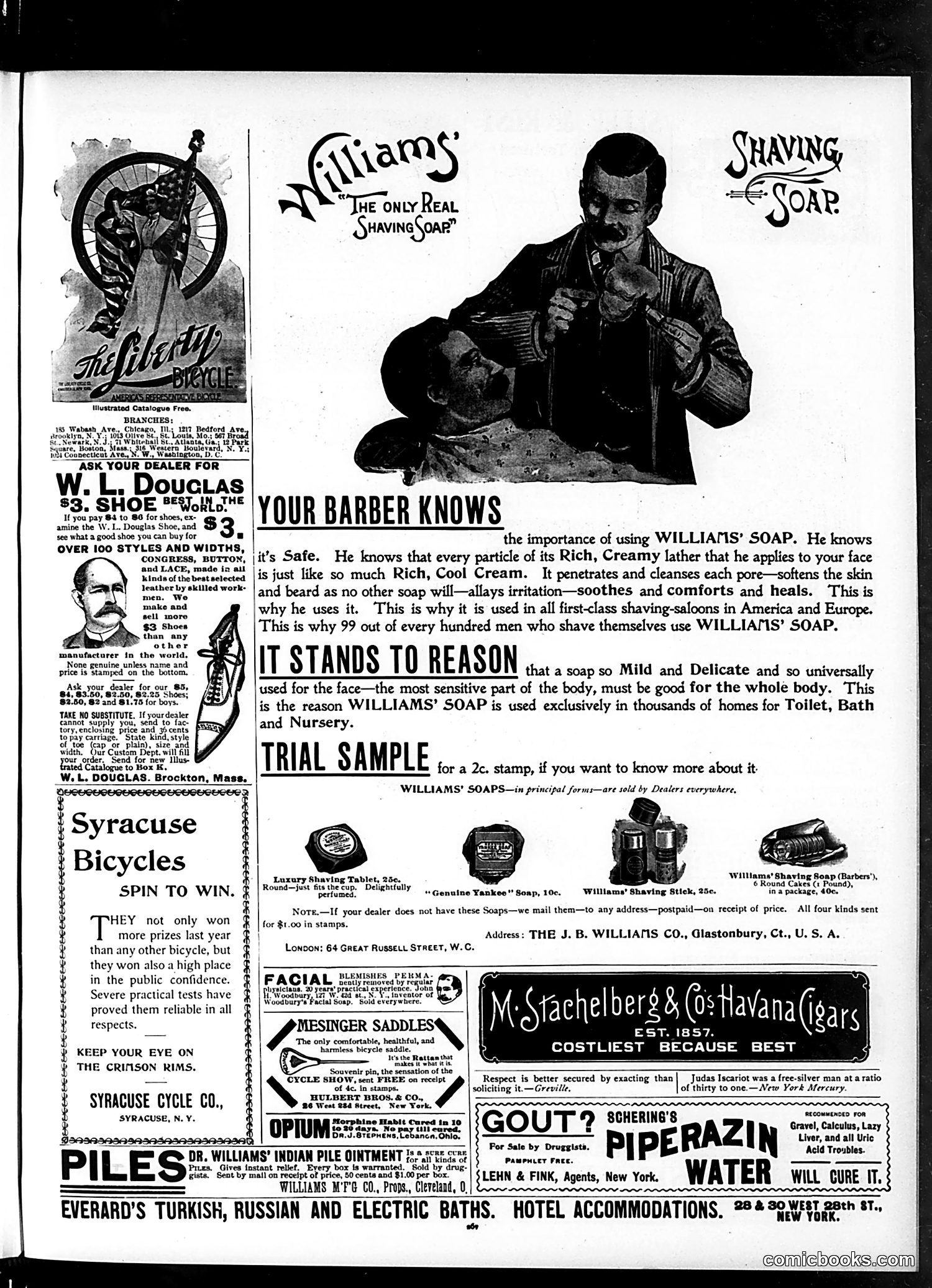
This page is primarily **advertising**, not political satire or editorial cartoons. It's a collection of product advertisements from what appears to be a late 19th-century issue of *Judge* magazine. The main content features **Williams' Shaving Soap**, with a barbershop scene showing a barber and customer. The advertisement emphasizes the soap's safety and quality for sensitive facial skin, claiming "99 out of every hundred men" use it. Surrounding this are ads for other products: W.L. Douglas shoes ($3 price point), Syracuse bicycles, bicycle saddles, various patent medicines (including opium and morphine treatments, legal then), and cigars. The only potentially satirical element is a small quote at bottom: "Judas Iscariot was a free-silver man at a ratio of thirty to one"—a reference to the heated 1890s currency debate, though it's unclear if this is genuine satire or just a stray joke. Overall, this is a commercial page reflecting period consumer culture and unregulated medical advertising.
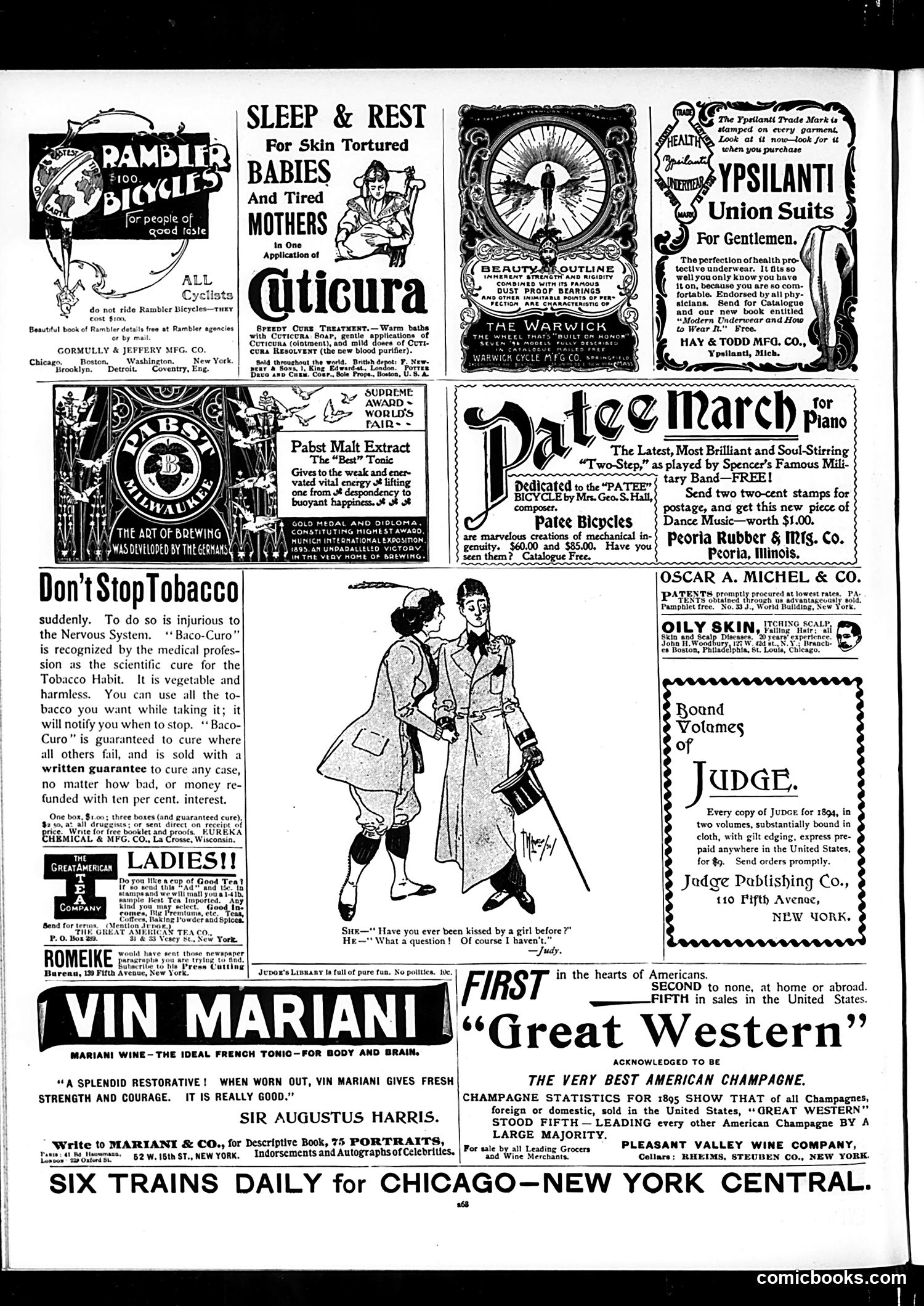
This is primarily an **advertising page** from Judge magazine (circa 1890s), with minimal satirical content. The only clear **cartoon** is a small dialogue joke at bottom-center: two men discussing whether a woman has kissed the male character. The humor relies on the assumption that women aggressively pursue men romantically—a dated stereotype. The page is dominated by **product advertisements** typical of the era: patent medicines (Cuticura for babies, Pabst Malt Extract as a "tonic"), tobacco-cessation products (Baco-Curo), bicycles, and wine tonics like Vin Mariani. These ads often made extravagant health claims by modern standards—Vin Mariani, for instance, advertises itself as a restorative endorsed by a celebrity (Sir Augustus Harris). The ads reflect the period's acceptance of dubious medical products and the magazine's reliance on commercial revenue rather than editorial content. No specific political figures or events are referenced; the page documents late-Victorian consumer culture and advertising practices.
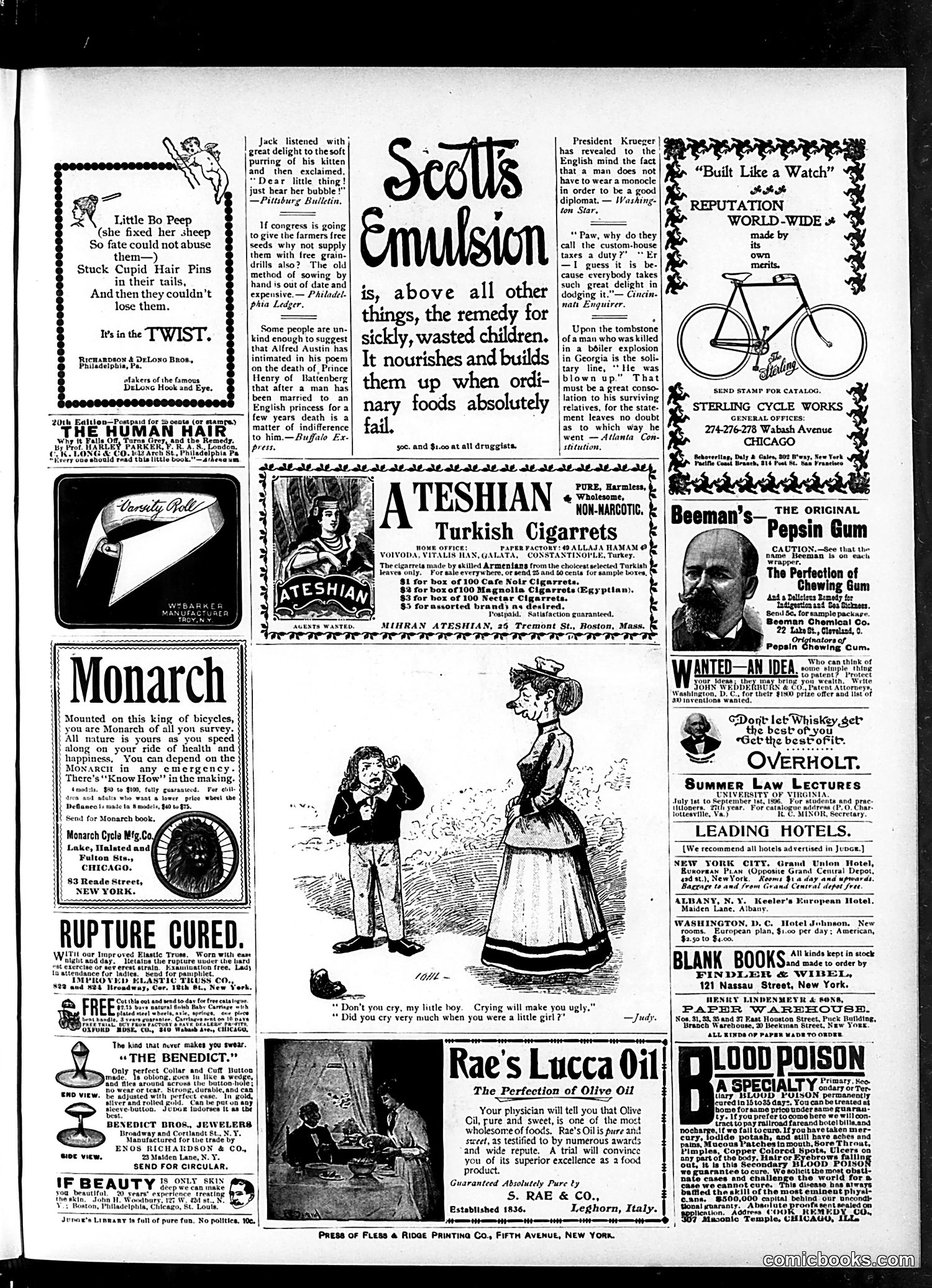
This page is primarily **advertising and commercial content** rather than political satire. The dominant feature is a cartoon labeled "Don't you cry, my little boy. Crying will make you ugly." — Jade, showing two figures in period dress, but lacking clear political context. The advertisements promote patent medicines and consumer goods typical of the era: Scott's Emulsion (nutritional supplement for children), Ateshan Turkish Cigarettes, Beeman's Pepsin Gum, and Rae's Lucca Oil. There's minimal political commentary visible. The single cartoon appears to be a generic domestic or social humor piece rather than satire targeting specific political figures or events. Without additional context about the magazine's date, identifying satirical intent is difficult.
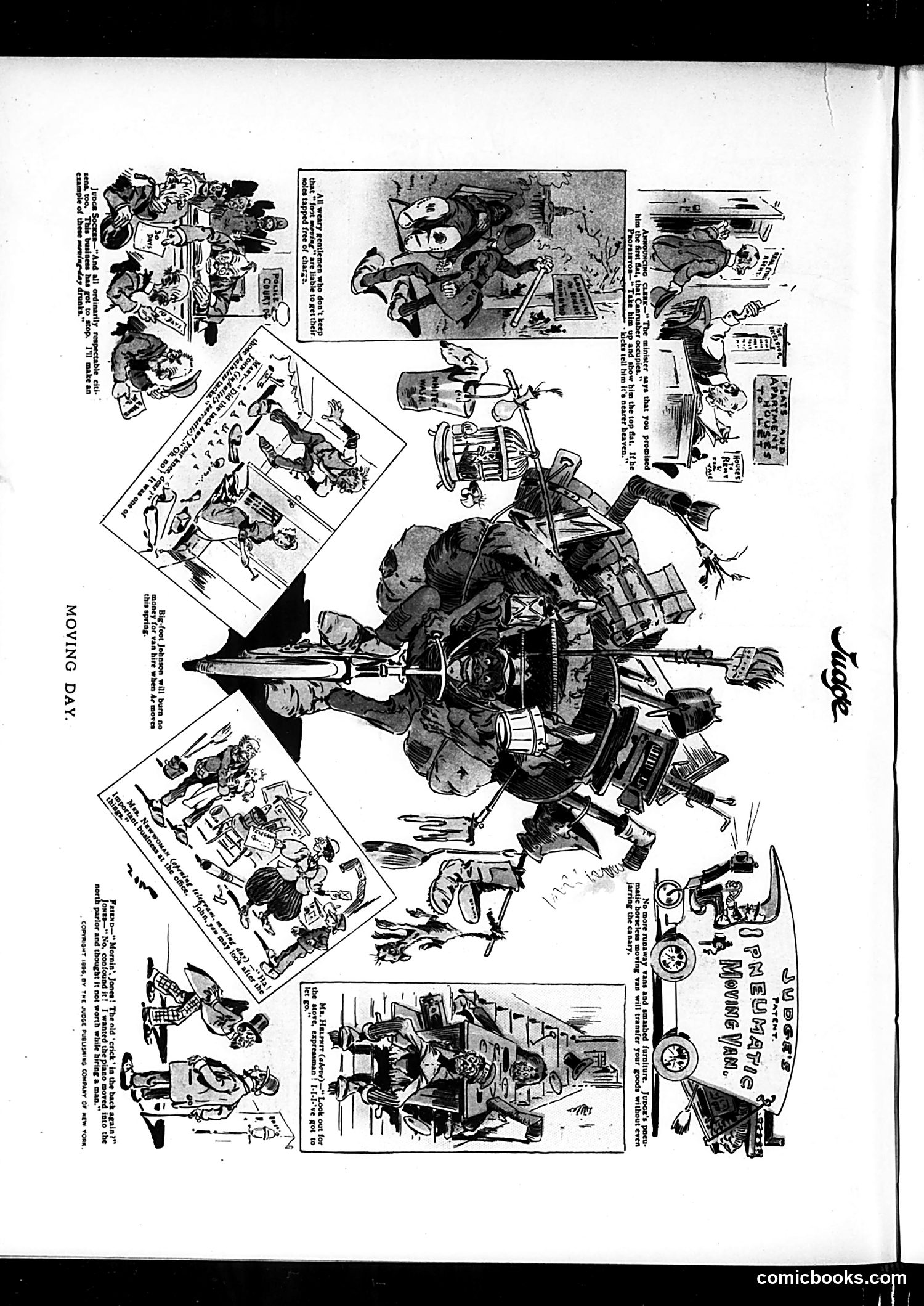
This page appears to be titled "Moving Day" and contains multiple comic panels arranged around a central illustration of a man surrounded by chaotic moving materials and furniture. The satire likely mocks the difficulties and absurdities of moving house—a relatable domestic frustration. The central figure is overwhelmed by belongings, tools, and debris, suggesting the pandemonium of relocation. The OCR'd text references "Big-foot Johnson" and mentions activities like hiring vans and having soles (shoes) repaired, reinforcing the moving theme. The scattered comic panels appear to show various moving-related mishaps or humorous scenarios. Without clearer text or specific historical context visible, the exact satirical targets remain unclear, but the general joke concerns the messy, chaotic nature of moving day and the incompetence or misfortune that accompanies it.