
Judge, 1896-04-18 · page 7 of 16
Judge — April 18, 1896 — page 7: what you’re looking at
What you’re looking at
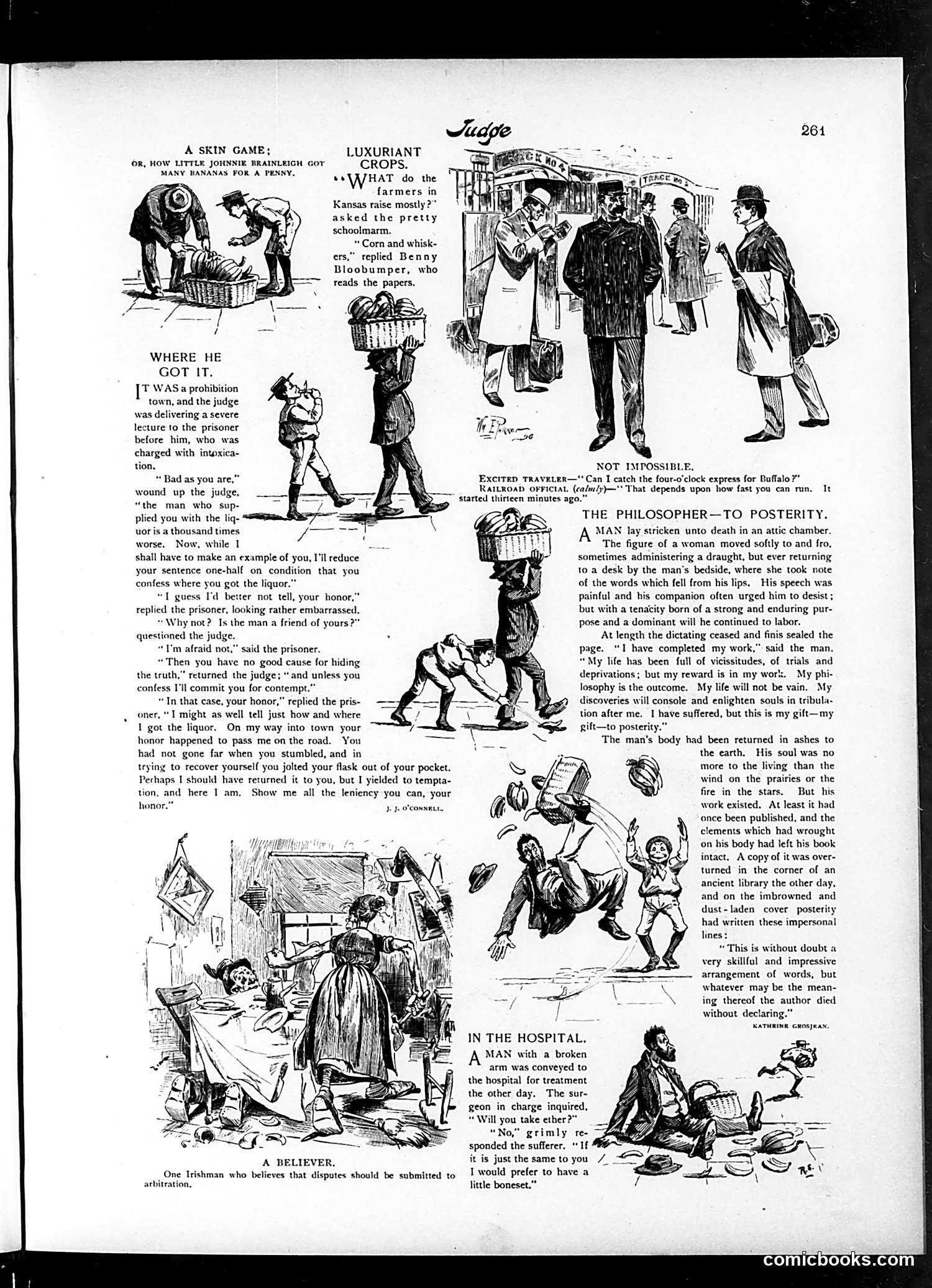
This page contains multiple satirical vignettes typical of Judge's humor: **"A Skin Game"**: A judge lectures a prisoner on intoxication, then reduces his sentence if he'll confess his liquor source. The prisoner reveals the judge himself lost his flask on the road—a reversal exposing the judge's hypocrisy and moral authority. **"Luxuriant Crops"**: A schoolteacher asks what Kansas farmers grow; a student answers "corn and whiskers," mocking Kansas politicians' prominence in contemporary politics (likely referencing the state's visible political figures of the era). **"The Philosopher—To Posterity"**: A dying man writes philosophical work while a woman attends him, believing his legacy will enlighten future generations. Posterity's verdict: impressive prose, but meaningless—satirizing pretentious intellectualism and the vanity of seeking immortal fame through obscure philosophy. **"In the Hospital"**: A patient refuses ether for surgery, preferring "a little boneset"—apparently Irish folk medicine—mocking both medical skepticism and ethnic stereotypes. Each cartoon mocks human folly: hypocrisy, pretension, and misplaced confidence.
📄 Transcribed text from this page (OCR, searchable)
Machine-transcribed from the original scan — historical spelling and the odd misread are preserved.
OR, HOW LITTLE JOHNNIE BRAINLEIGH GoT MANY BANANAS FOR A PENNY, A SKIN GAME; LUXURIANT CROPS. oe HAT do the WwW farmers in Kansas raise mostly ?” asked the pretty schoolmarm. “ Corn and whisk- ers,” replied Benny Bloobumper, who reads the papers. WHERE HE GOT IT. T WAS a prohibition town, and the judge was delivering a severe lecture to the prisoner before him, who was charged with intoxica- tion, NOT IMPOSSIBLE. “ Bad as you are,” EXciTRD TRAVELER—'Can I catch the four-o'clock express for Buffalo?” wound up the judge, . \ Raitroad orFictat (calm/y)—" That depends upon how fast you can run, It 3 started thirteen minutes ago.’ “the man who sup- ) plied you with the liq: “#38 . THE PHILOSOPHER—TO POSTERITY. uor is a thousand times y A MAN lay stricken unto death in an attic chamber. worse. Now, while I The figure of a woman moved softly to and fro, shall have to make an example of you, I'll reduce sometimes administering a draught, but ever returning your sentence one-half on condition that you to a desk by the man’s bedside, where she took note confess where you got the liquor.” of the words which fell from his lips. His speech was “T guess I'd better not tell, your honor,” painful and his companion often urged him to desist ; replied the prisoner, looking rather embarrassed. “Why not? Is the man a friend of yours ?” questioned the judge. “I'm afraid not,” said the prisoner. “Then you have no good cause for hiding the truth,” returned the judge; “and unless you confess I'll commit you for contempt.” “In that case, your honor,” replied the pris- oner, “I might as well tell just how and where I got the liquor. On my way into town your honor happened to pass me on the road. You had not gone far when you stumbled, and in trying to recover yourself you jolted your flask out of your pocket. but with a tenacity born of a strong and enduring pur- pose and a dominant will he continued to labor. At length the dictating ceased and finis sealed the page. “I have completed my work,” said the man. “My life has been full of vicissit of trials and deprivations; but my reward is in my work. My phi- losophy is the outcome. My life will not be vain. My discoveries will console and enlighten souls in tribula- tion after me. I have suffered, but this is my gift—my gift—to posterity.” The man’s body had been returned in ashes to the earth, His soul was no more to the living than the Perhaps I should have returned it to you, but I yielded to tempta- tion, and here 1 am, Show me all the leniency you can, your honor.” wind on the prairies or the fire in the stars. But his roe : work existed. At least it had . once been published, and the clements which had wrought ‘on his body had left his book intact. A copy of it was over- turned in the corner of an ancient library the other day, and on the imbrowned and dust-laden cover posterity had written these impersonal lines : “ This is without doubt a very skillful and impressive arrangement of words, but whatever may be the mean- ing thereof the author died | without declaring.” KATIORINE COS)RAN. IN THE HOSPITAL. A MAN with a broken arm was conveyed to the hospital for treatment the other day. The sur- geon in charge inquired, “Will you take ether?” “No,” grimly re- sponded the sufferer. “If WHELIEVERS it is just the same to you One Irishman who believes that disputes should be submitted to | Would prefer to have a arbitration, little boneset.” comicbooks.com