
A complete issue · 16 pages · 1896
Judge — April 4, 1896
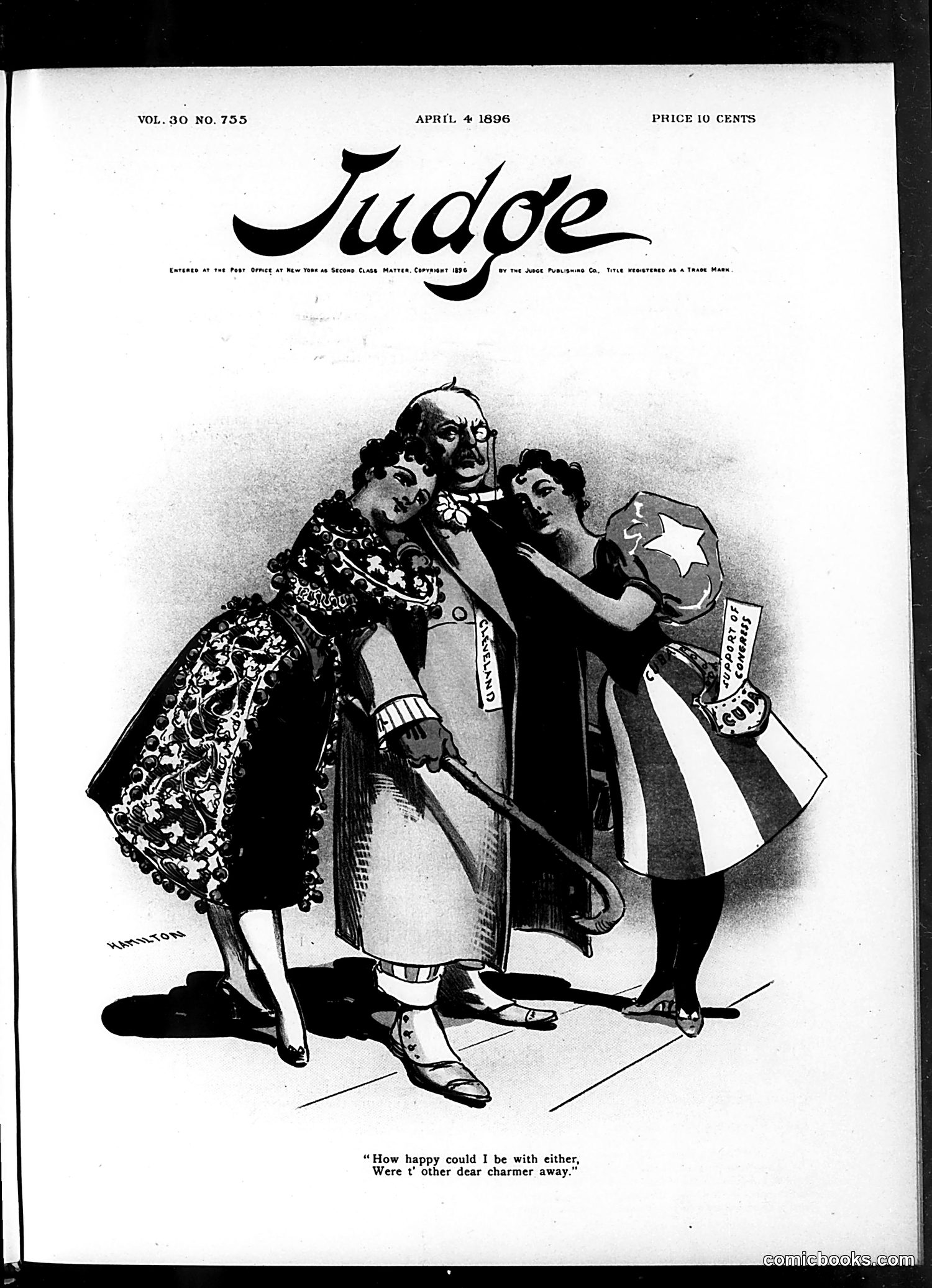
This political cartoon depicts a man in formal attire being pulled in opposite directions by two women. The caption reads: "How happy could I be with either, / Were t' other dear charmer away." The cartoon appears to satirize a man caught between two competing interests or loyalties—likely political factions or ideological positions relevant to 1896. The women represent different causes or parties vying for his allegiance. One woman wears an ornate cloak suggesting wealth or aristocracy; the other displays patriotic imagery (stars visible). Without additional context labels identifying the specific figures or political situation of 1896, the precise targets remain unclear, though this appears to reference contemporary political divisions of that election year.
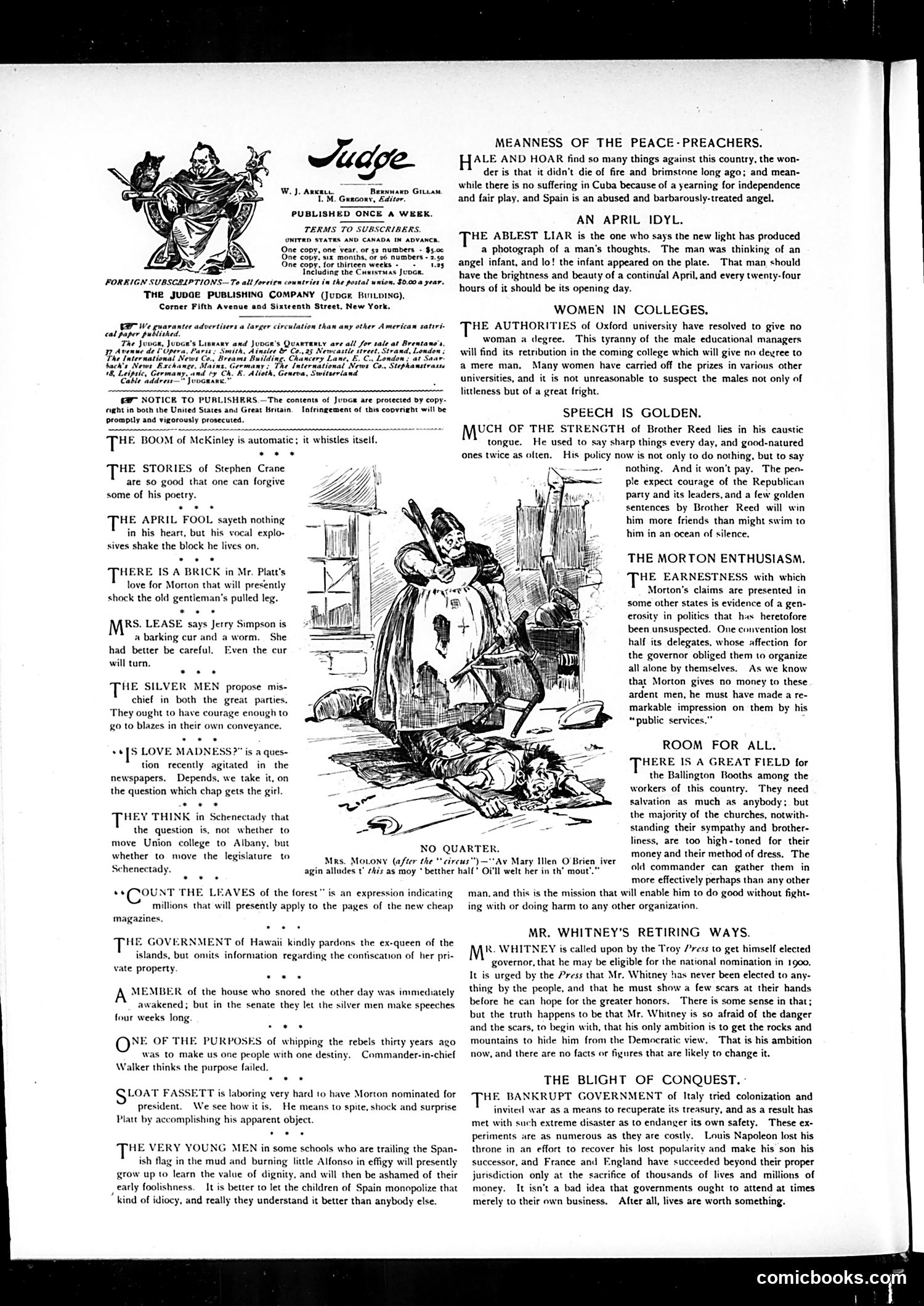
The central cartoon depicts a confrontation between a priest and what appears to be a policeman or authority figure, with a body lying on the ground. The caption reads "NO QUARTER," with a secondary caption identifying "Mrs. Molony (after the 'street')" and referencing Mary Ellen O'Brien. This likely satirizes **violent sectarian conflict in Ireland or among Irish-American communities**, possibly referencing a specific incident of religious or political violence. The "no quarter" phrase suggests merciless conflict. The surrounding text columns contain short satirical commentary on various political and social issues of the era, including women in colleges, Brother Reed's political rhetoric, and government matters. Without more specific historical context about which incident is referenced, the exact event remains unclear, but the cartoon clearly critiques sectarian violence and its tragic human cost.
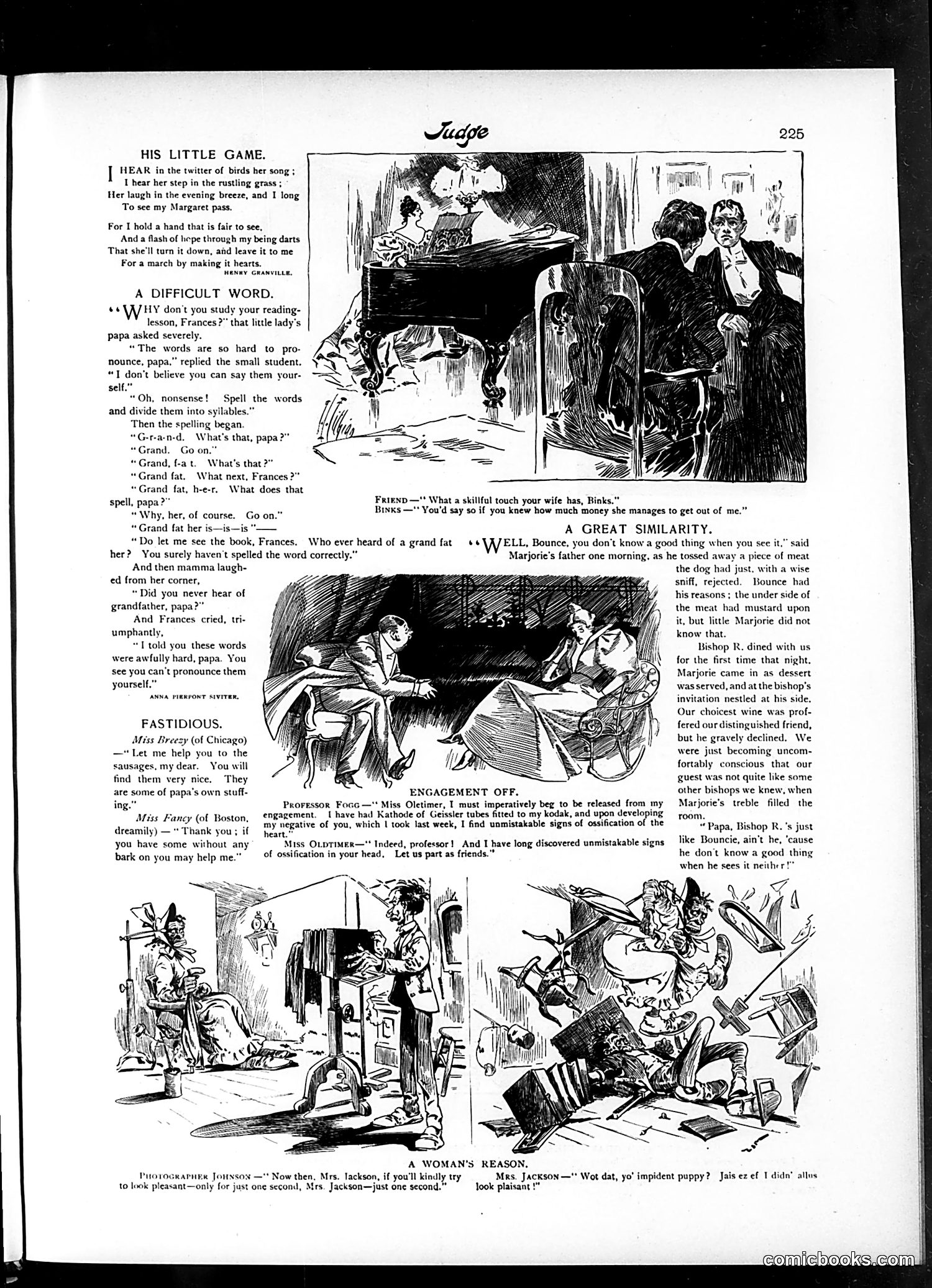
This page contains several humor pieces and cartoons typical of Judge's satirical content: **"His Little Game"** and **"A Difficult Word"** are short humorous prose pieces about domestic life and education, without obvious political content. **"Fastidious"** features two brief anecdotes mocking pretentious women from Chicago and Boston who demand expensive foods. The illustrated cartoons appear to satirize everyday social situations: an "Engagement Off" scenario between a professor and student; a "Great Guard" about a dog; and a "Woman's Reason" showing domestic disputes. These pieces mock middle-class social pretensions, romantic complications, and domestic friction—common Judge subjects. Without clearer context or identifiable public figures, the specific satirical targets remain general social commentary rather than references to particular political events or people.
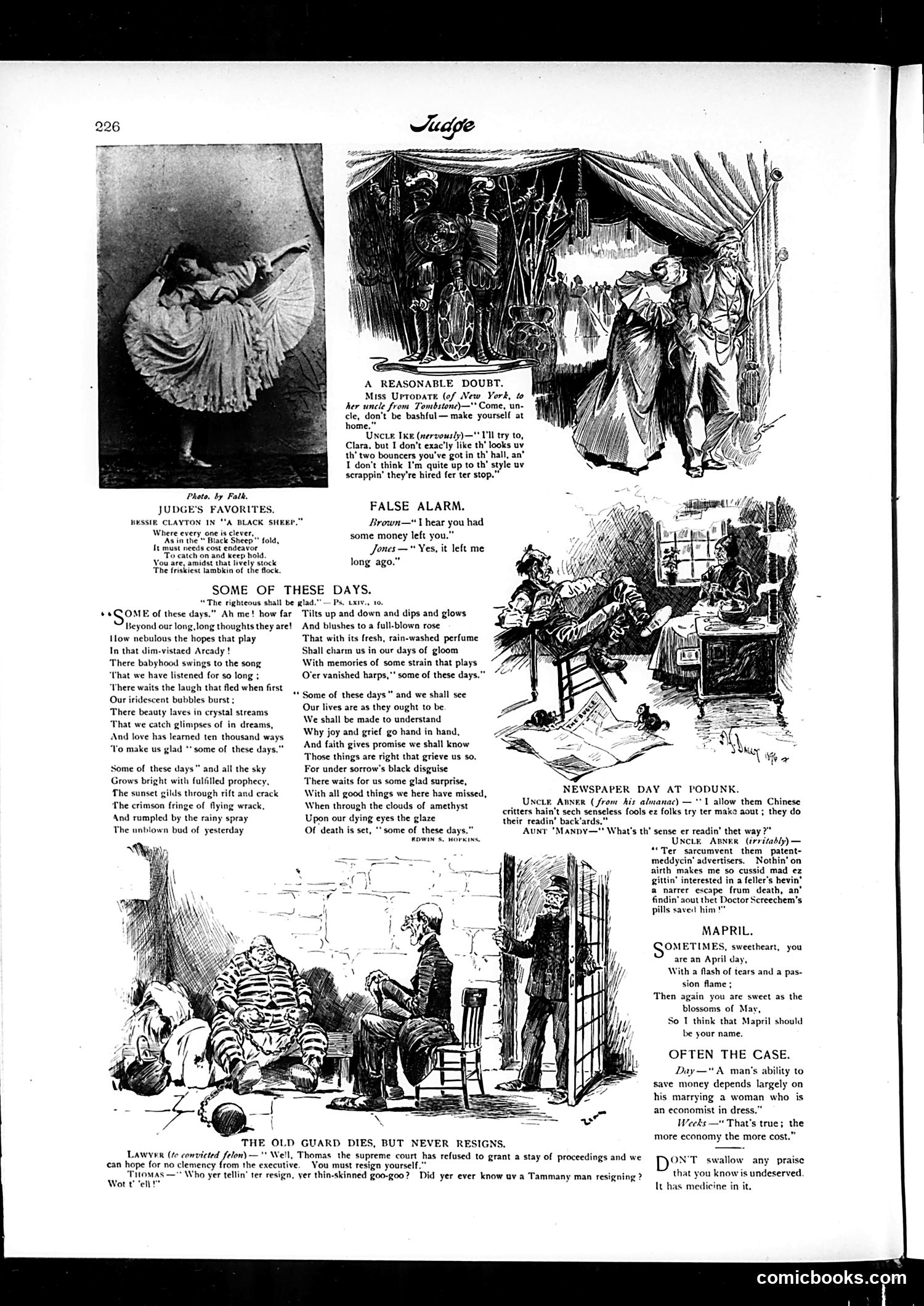
This page contains several satirical cartoons and humorous sketches typical of Judge's late 19th-century style. **"A Reasonable Doubt"** mocks upper-class New York society—a socialite invites her uncle from Tombstone (the rough frontier town) to visit, but he's intimidated by the hired bouncers at her hall, suggesting her social circle is as violent and dangerous as the Old West. **"The Old Guard Dies, But Never Resigns"** satirizes Tammany Hall (New York's notoriously corrupt Democratic political machine). A condemned criminal refuses to resign from anything—the joke being that Tammany men were so entrenched in power they'd never voluntarily leave office, even facing execution. **"Newspaper Day at Podunk"** portrays rural Americans as unsophisticated, mocking both frontier folk and patent-medicine advertising schemes that exploit readers' gullibility. The remaining items are lighter fare: poetry, social observations about romance and economics. The page reflects Judge's typical blend of political commentary, class satire, and sentimental verse aimed at educated urban readers.
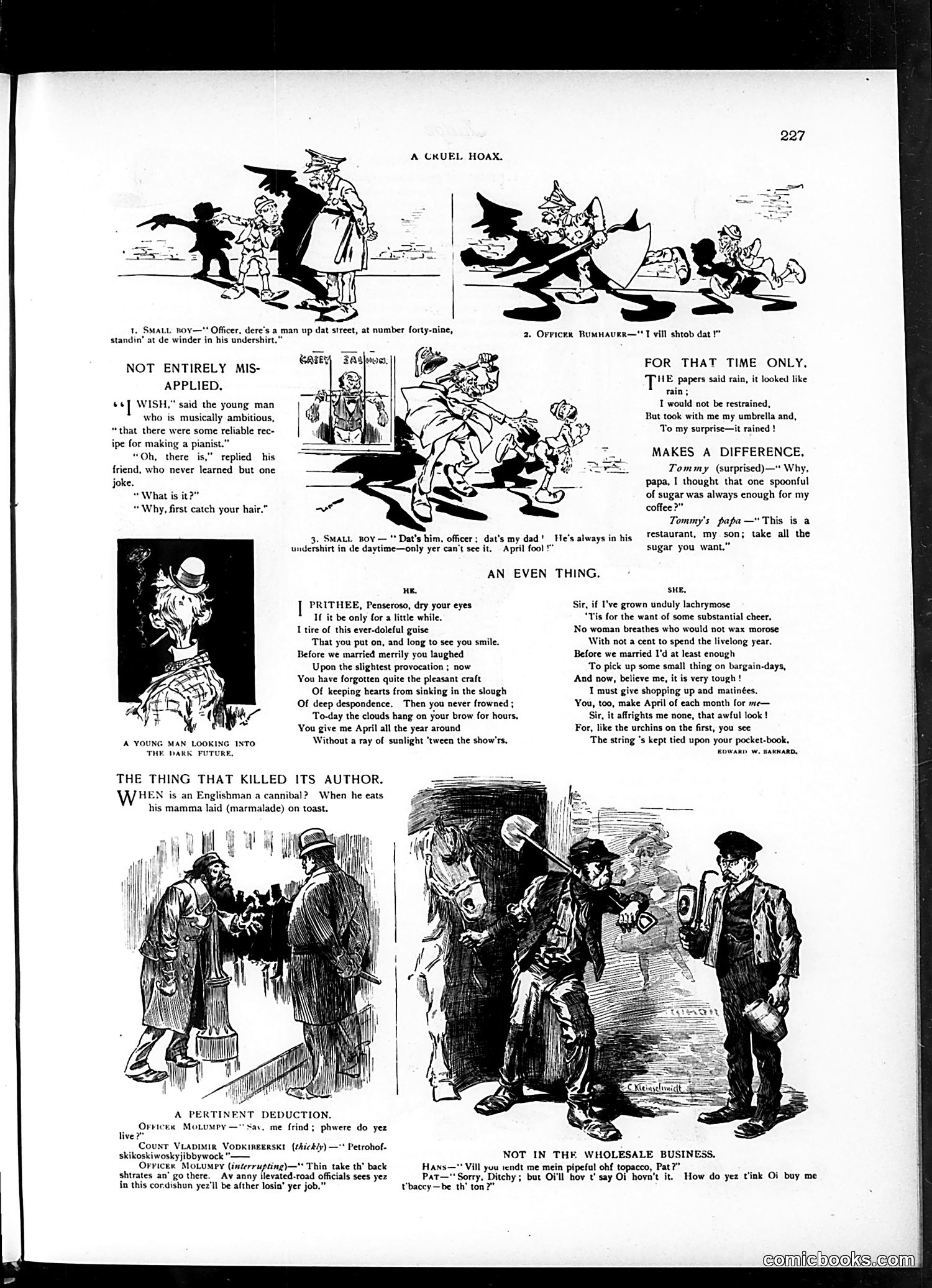
This page contains several short humorous pieces typical of late-19th/early-20th century American satire: **"A Cruel Hoax"** features three illustrated jokes about an April Fool's prank involving a man in his undershirt and a police officer—exploiting ethnic dialect humor common to the era. **"Makes a Difference"** satirizes restaurant economics: a father tells his son to take unlimited sugar at a restaurant (where it's free) versus at home (where he must pay). **"An Even Thing"** presents a domestic complaint poem where a wife blames her unhappiness on financial deprivation since marriage, claiming her husband now "makes April of each month"—withholding small pleasures she previously enjoyed. **"The Thing That Killed Its Author"** is a pun: "marmalade" sounds like "mamma laid." **"Not in the Wholesale Business"** shows immigrant characters (indicated by phonetic dialect spelling) discussing tobacco prices. The humor relies heavily on ethnic caricature, domestic strife, wordplay, and economic anxieties typical of the period.
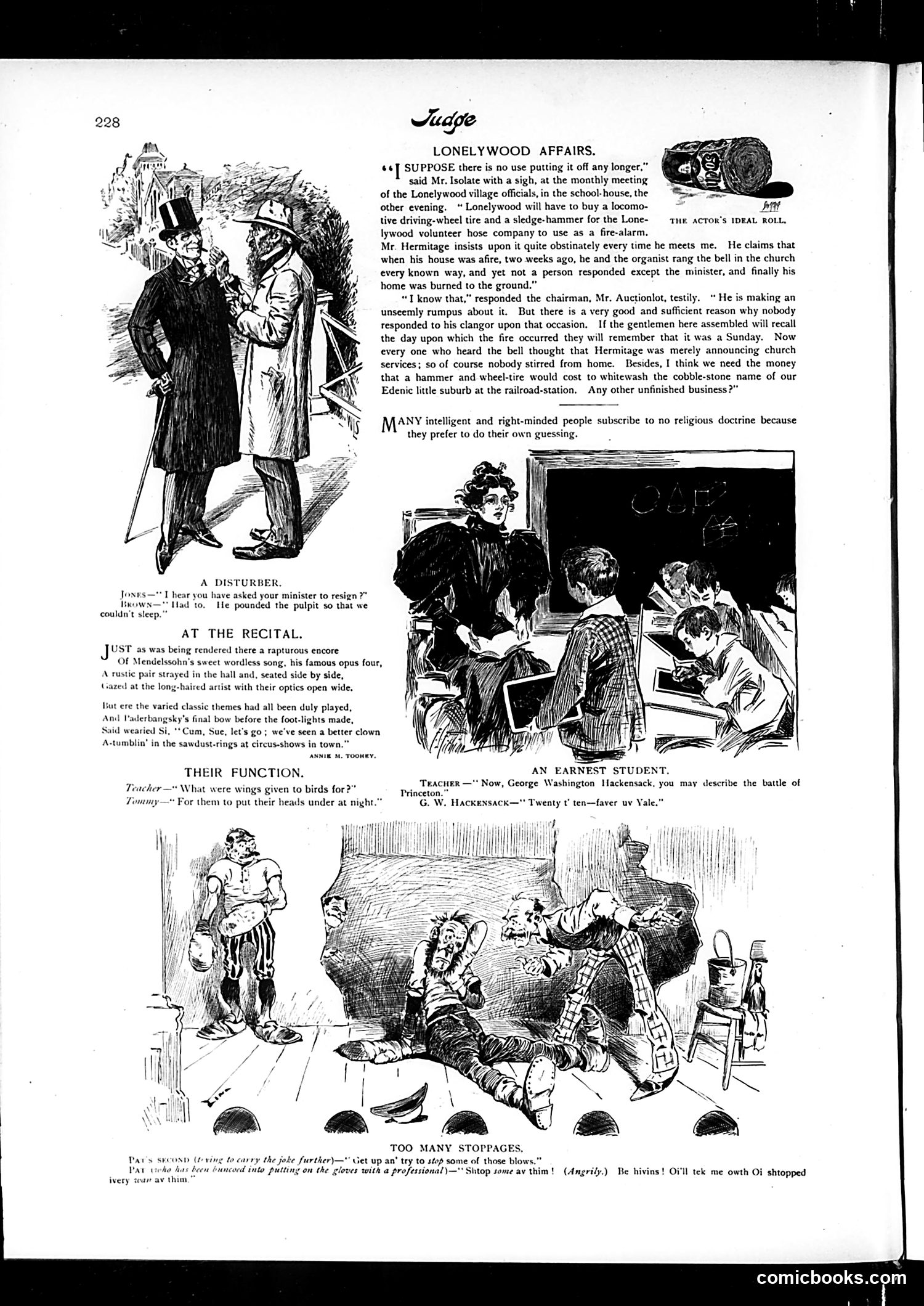
This page from *Judge* magazine contains several unrelated humorous sketches mocking American life: **"Lonelywood Affairs"** satirizes small-town bureaucratic absurdity. Village officials debate buying expensive fire equipment while dismissing a resident's legitimate complaint that his house burned down. Their excuse—the church bell rang on Sunday, so people thought it was a service announcement—exposes rural government incompetence and misplaced priorities (whitewashing a town sign over fire safety). **"At the Recital"** mocks rural unsophistication: rustic visitors to a classical music performance compare it unfavorably to circus acts, preferring lowbrow entertainment to high culture. **"Their Function"** is a simple joke: a teacher asks why birds have wings; a child answers "to put their heads under at night"—childish literalism. **"An Earnest Student"** shows a student confusing historical dates and universities—educational incompetence played for laughs. **"Too Many Stoppages"** depicts Irish boxers (stereotyped dialect included) complaining the match keeps stopping. The page overall reflects *Judge*'s satirical focus on American social hierarchies, rural versus urban sophistication, and ethnic stereotyping common to the era.
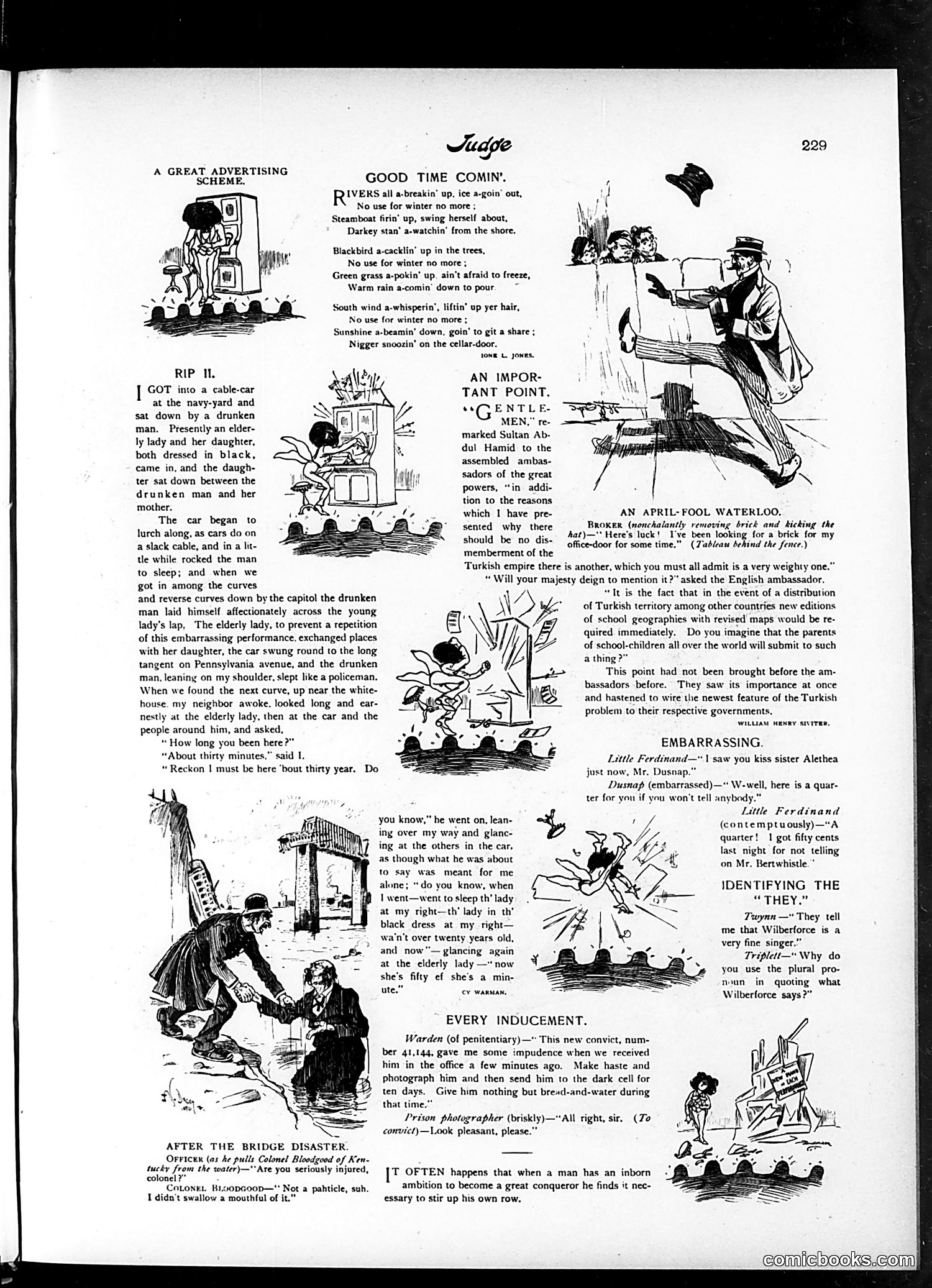
This page contains multiple unrelated satirical pieces typical of Judge magazine's format: **"Good Time Comin'"** is a dialect poem celebrating spring, using period-appropriate racial stereotypes in its language. **"Rip II"** tells an anecdote about a drunk man on a cable car whose head lands on a young woman's lap, then later he mistakes an elderly woman for the same young woman, implying decades have passed—a commentary on alcohol's disorienting effects and the absurdity of drunkenness. **"An Important Point"** satirizes Ottoman politics, likely referencing the Turkish Empire's territorial integrity debates during the declining Ottoman period. The Sultan argues against dismemberment because it would require new school geography textbooks—mocking bureaucratic resistance to change. **"An April-Fool Waterloo"** shows a broker playfully kicking a hat after finding a brick for his office door—an April Fools' Day joke. The page reflects Judge's eclectic mix of political commentary, social satire, and lighthearted humor typical of early 20th-century American satirical journalism.
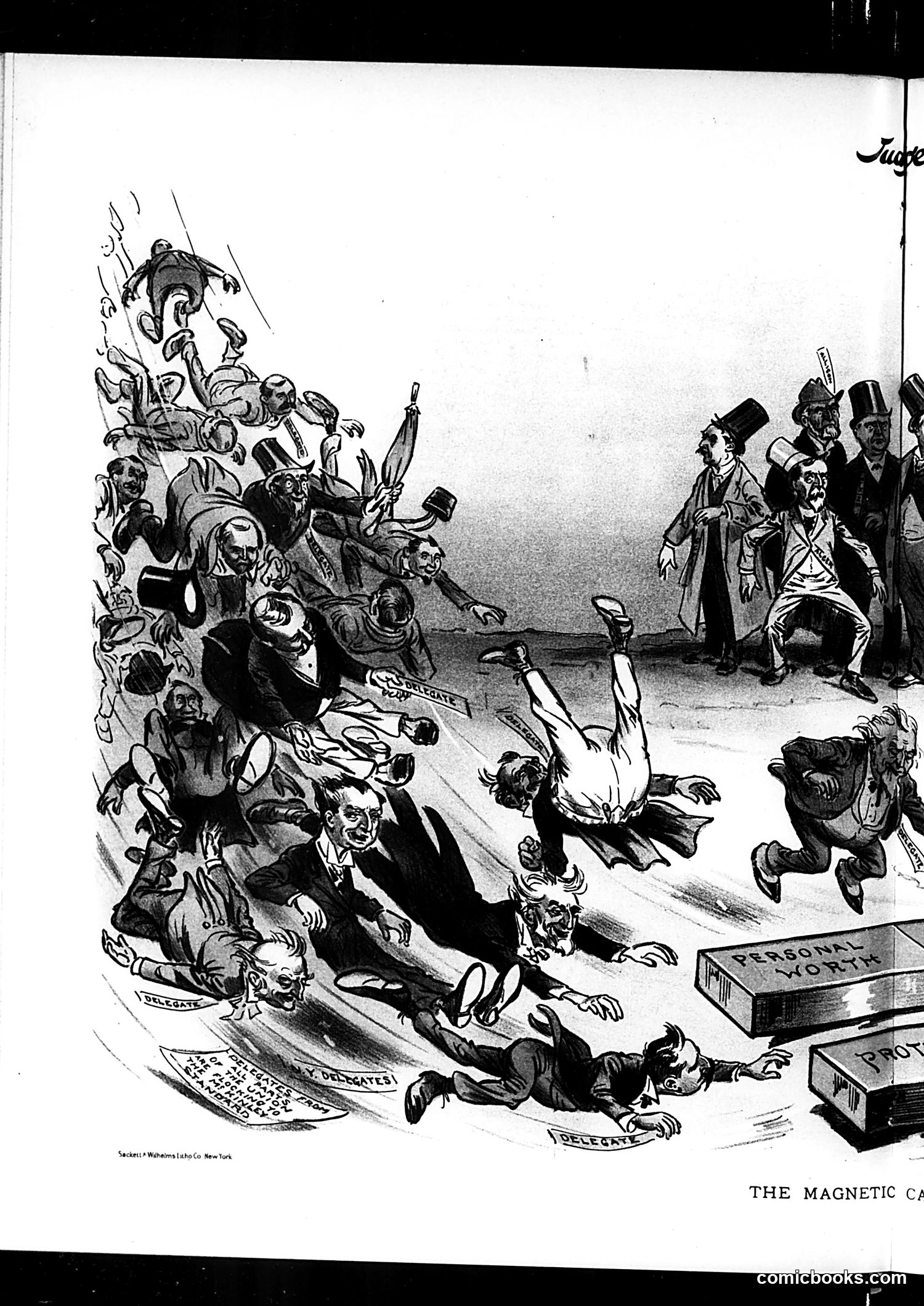
This political cartoon depicts a chaotic scene where a tall stack of figures on the left—depicted as various caricatured individuals—appears to be collapsing or magnetized toward a group of well-dressed men on the right (wearing top hats). The cartoon satirizes how certain political or corporate forces exert powerful "magnetic" attraction over crowds or delegates. Papers marked "DELEGATES" are visible on the ground, suggesting this concerns political convention proceedings or electoral politics. The exaggerated, tumbling figures represent people being irresistibly drawn toward the influence of powerful figures on the right, critiquing how money, power, or political machinery could manipulate or control masses of people against their better judgment. The specific historical context remains unclear without a visible date or more legible text.
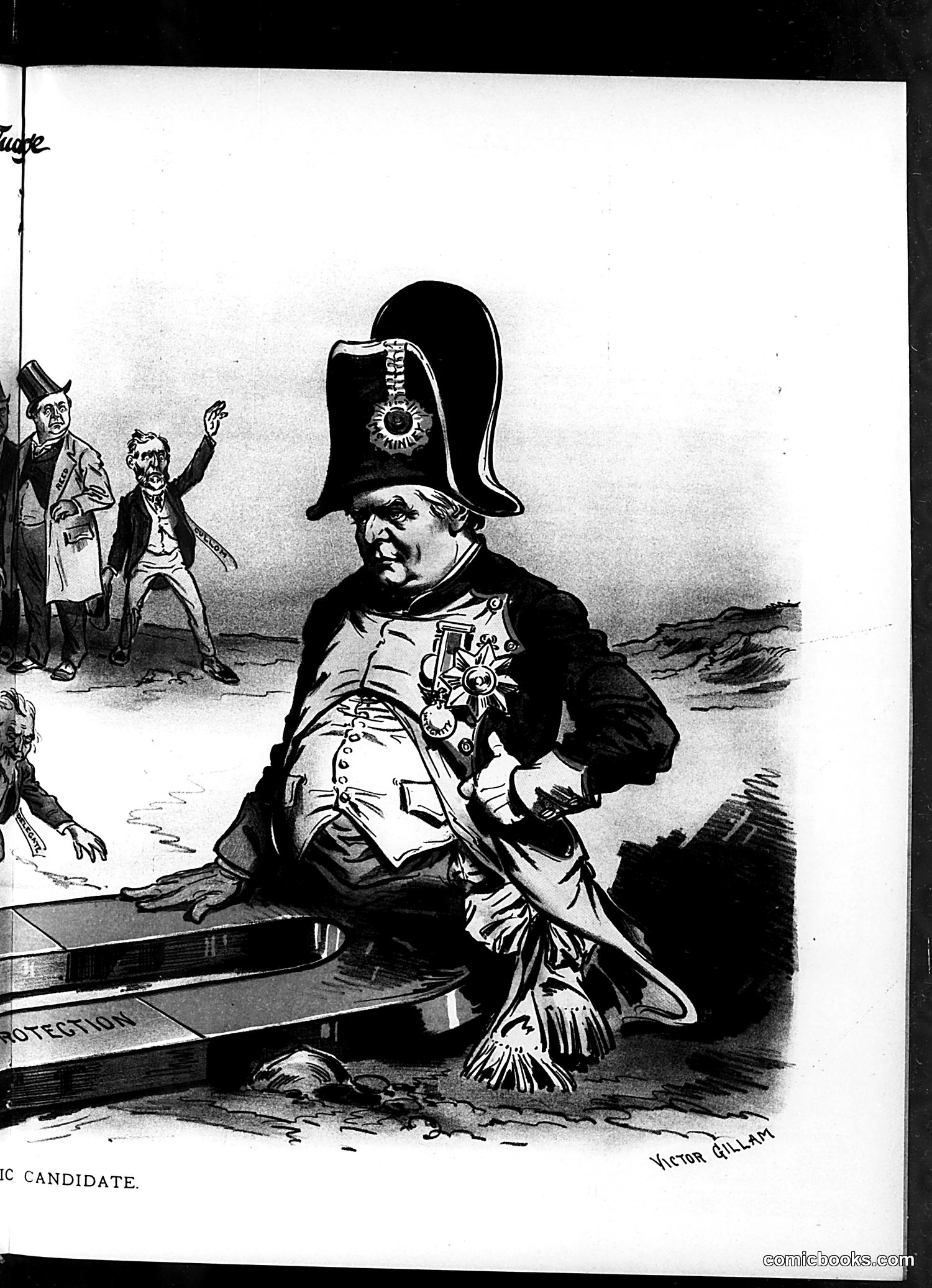
This cartoon by Victor Gillam depicts a military officer in an enormous bicorne hat and formal dress uniform, caricatured with exaggerated facial features suggesting mockery. The figure sits prominently while smaller men gesture and argue in the background, appearing to campaign or debate around him. The partial visible text "IC CANDIDATE" (likely "COMIC CANDIDATE" or similar) and the military regalia suggest this satirizes a military figure being presented as a political candidate. The cartoon critiques the elevation of a military personality into electoral politics, implying he's an absurd or unsuitable choice. The inflated uniform and grotesque features underscore the satirical point that this candidate is ridiculous or pretentious, while his supporters scramble around him.
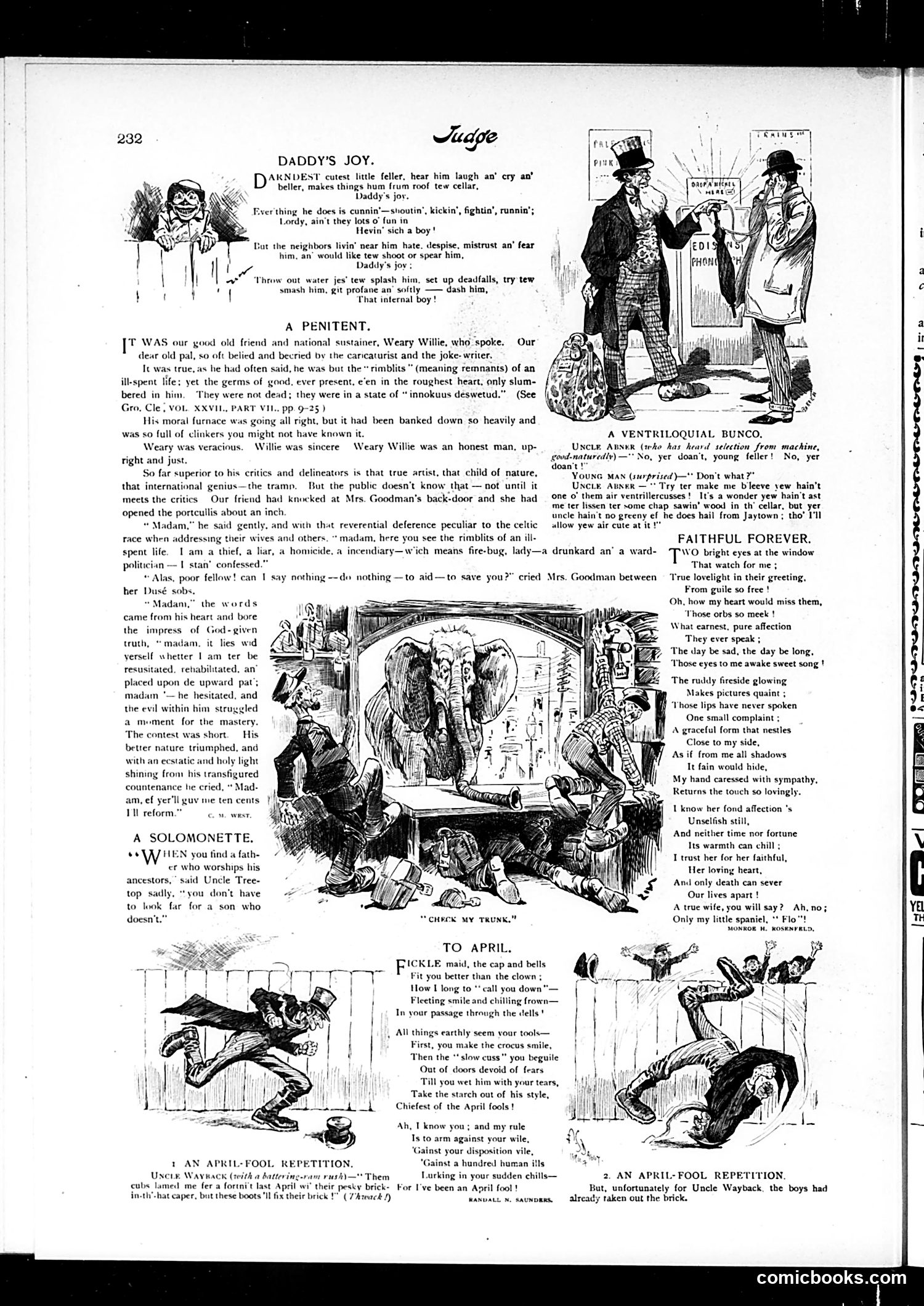
This page contains three distinct pieces of satirical humor typical of late 19th-century American magazine comedy: **"Daddy's Joy"** mocks the contrasting perspectives on rowdy children—delightful to parents but insufferable nuisances to neighbors. The humor plays on the selfishness of parental pride. **"A Penitent"** presents Weary Willie, a recurring tramp character in Judge, confessing his criminal past to a sympathetic Mrs. Goodman. The satire lies in his elaborate dialect and self-deprecating description (calling himself "rimblits"—remnants), culminating in the predictable con: he reforms himself for ten cents. It mocks both the sentimental melodrama of redemption stories and the eternal opportunism of vagrants. **"A Ventriloquial Bunco"** shows Uncle Abner rejecting a young man's ventriloquism act, suspicious it's a con to make him listen to pranks. "Bunco" refers to fraud schemes. The remaining poems are sentimental verses about faithfulness and domestic affection, contrasting with the satirical pieces above.
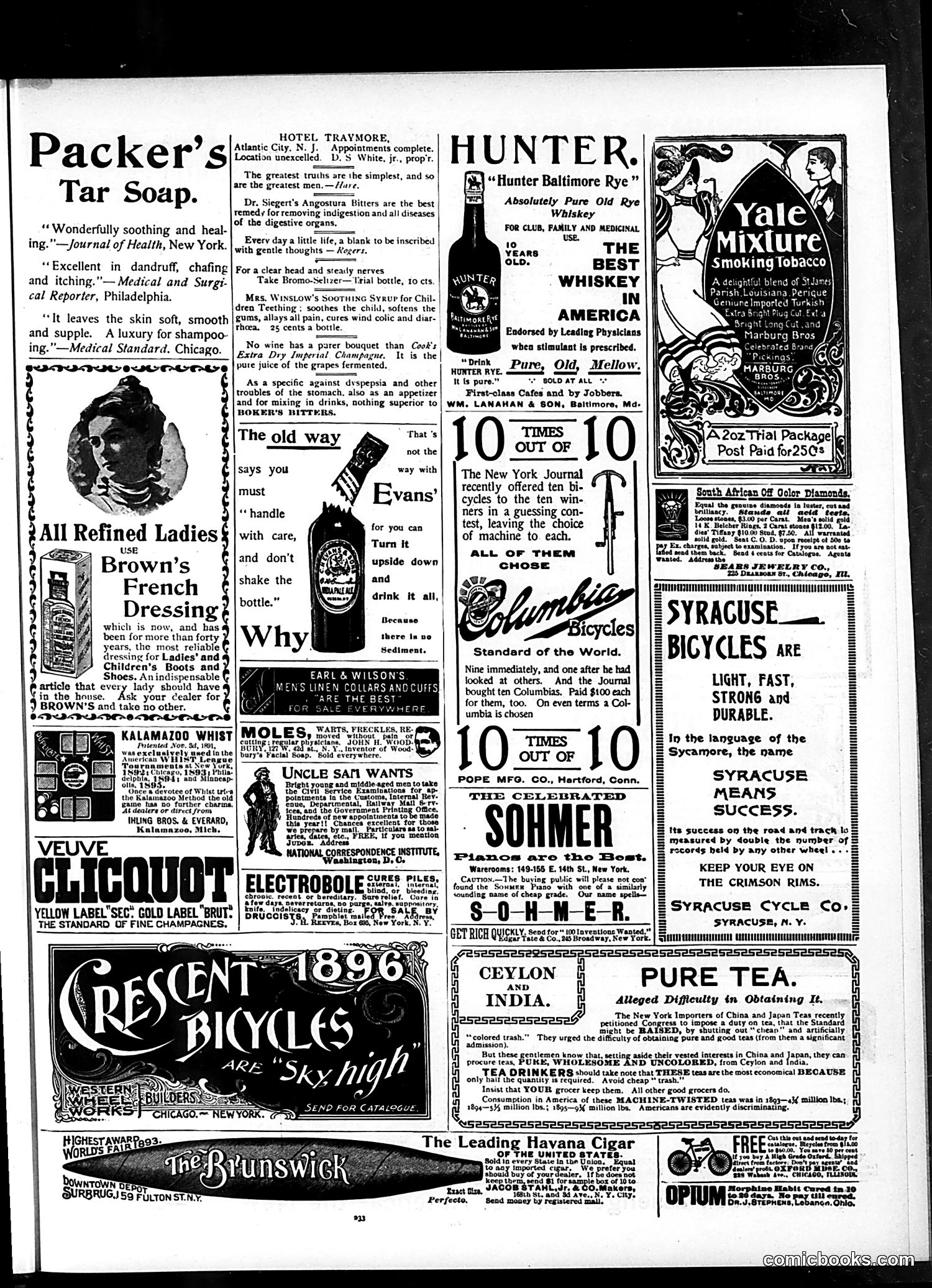
This is primarily an **advertising page** from Judge magazine, circa 1896, rather than editorial content with cartoons or satire. The page contains approximately 20 paid advertisements for consumer products and services typical of the era. Notable ads include: - **Packer's Tar Soap** and **Brown's French Dressing** (toiletries) - **Hunter Rye Whiskey** and **Cook's Champagne** (alcohol, marketed with health claims) - **Multiple bicycle manufacturers** (Columbia, Syracuse, Crescent) competing heavily - **Electrobole** medical device claiming to cure piles - Various patent medicines (Bromo-Seltzer, Mrs. Winslow's Soothing Syrup) The most interesting satirical element is the **bicycle ad showing the New York Journal's stunt**: they offered bicycles as contest prizes but let winners choose the machine—all ten selected Columbia bicycles, leading the Journal to purchase them. This advertises Columbia's dominance while mocking the Journal's generous spending. The ads reflect 1890s consumer culture, unregulated medical claims, and aggressive bicycle-industry competition during the cycling boom.
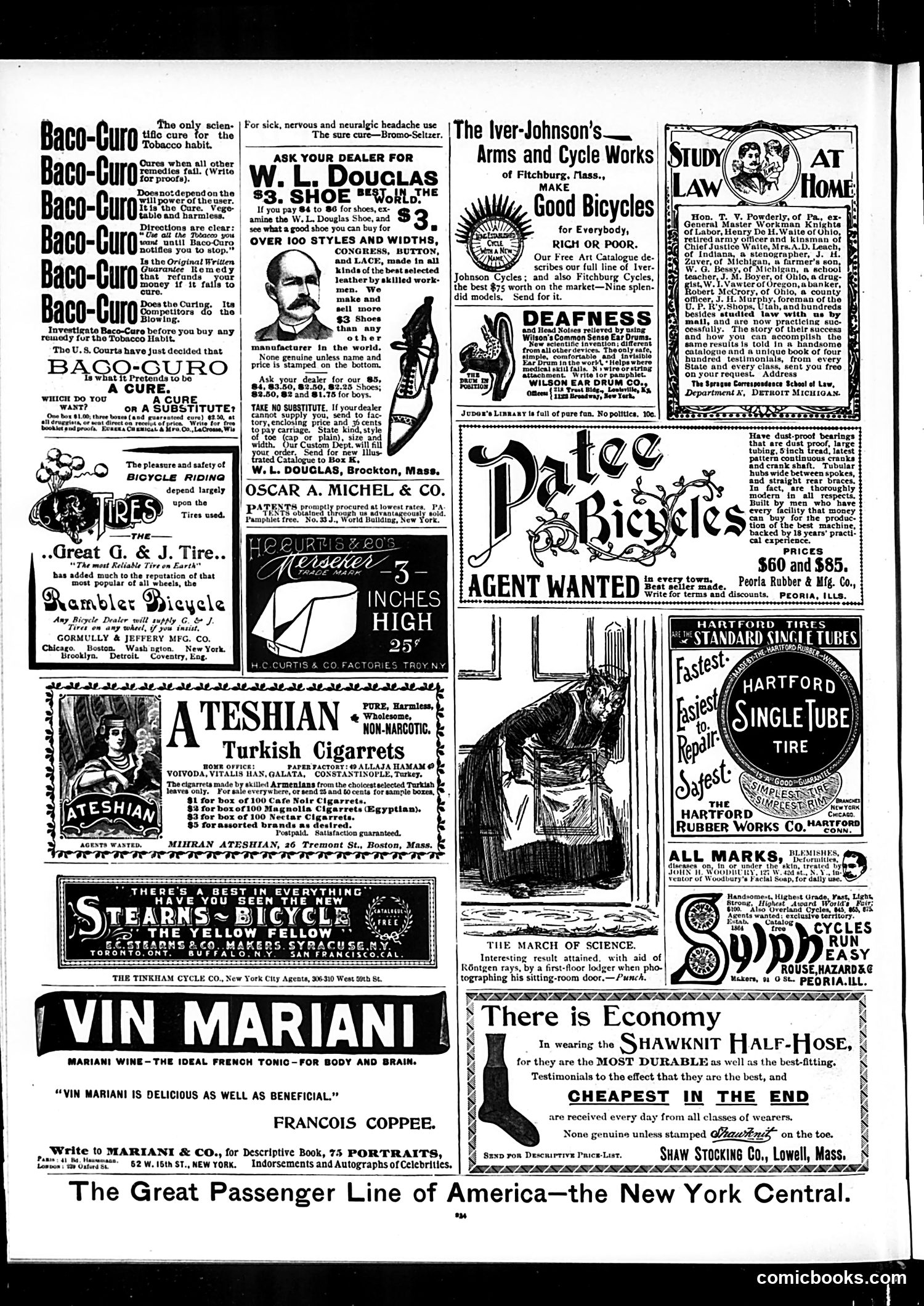
This page is **primarily advertising**, not political satire. It features numerous product advertisements typical of late 19th-century publications: Baco-Curo (tobacco-cessation remedy), W.L. Douglas shoes, bicycles (Iver-Johnson, Rambler, Pace), tires, Turkish cigarettes, and tonics. The one **illustrated cartoon** ("The March of Science") shows a figure operating an early telephone or similar device—likely mocking the era's fascination with new technology. The caption suggests humor about technological novelty, though specifics are unclear without fuller context. The page reflects the **commercial culture of the Gilded Age**, when Judge subsidized content through extensive advertising. Products advertised—smoking cessation cures alongside cigarettes, medicinal tonics, and bicycles—reveal period consumer concerns and the lack of modern regulatory standards. There is **no identifiable political satire or social commentary** on this particular page.
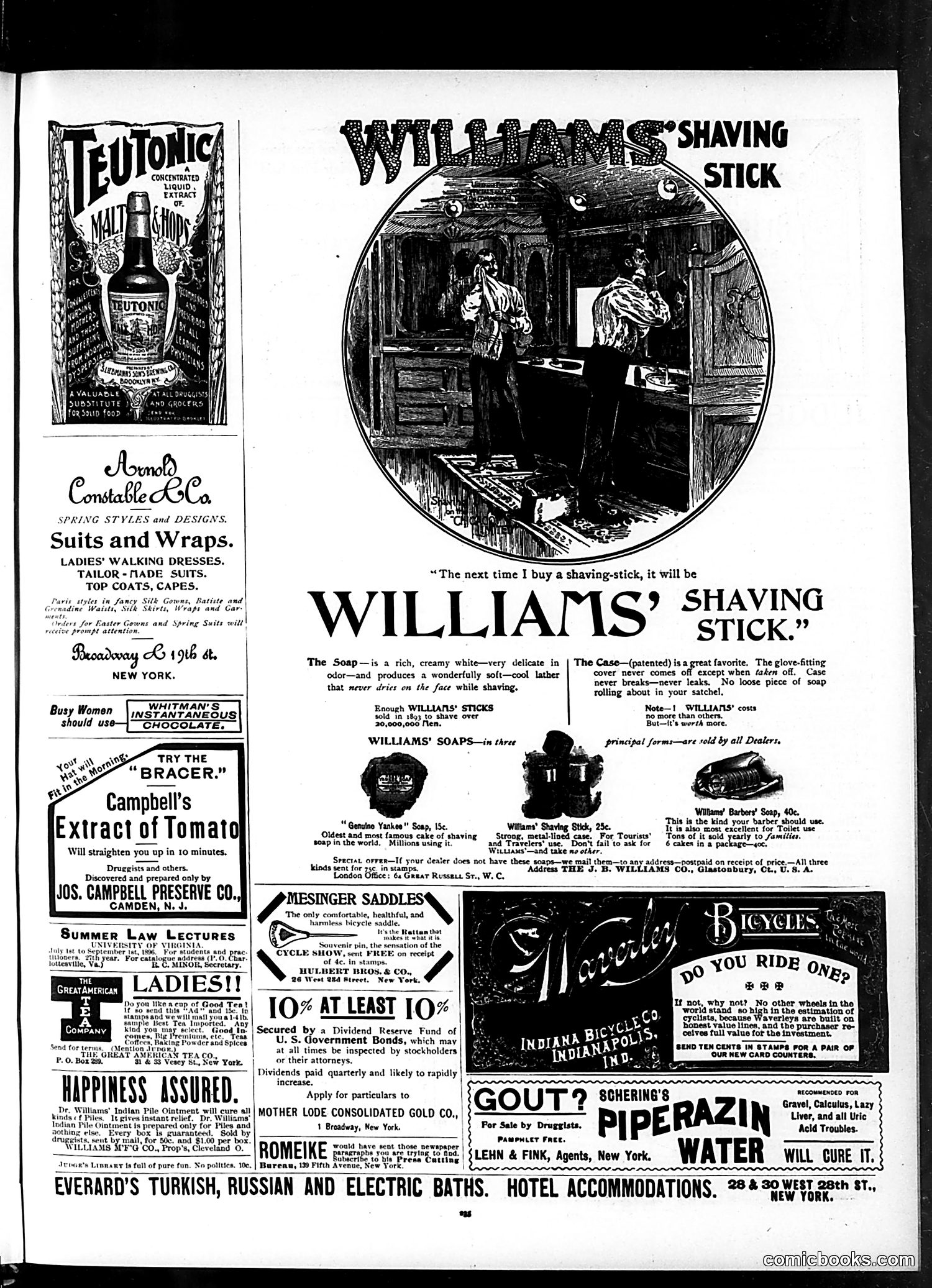
This page is primarily **advertising**, not editorial content or satire. The dominant feature is a large circular illustration advertising **Williams' Shaving Stick**, showing a man at a mirror with the caption "The next time I buy a shaving-stick, it will be WILLIAMS' SHAVING STICK." The advertisement emphasizes the product's superiority: the soap is creamy and produces lasting lather, while the patented case prevents breakage and soap loss—practical concerns for travelers. It claims the product has "sold in 1853 to shave over 20,000,000 Men," lending it historical authority. The surrounding advertisements address late-19th/early-20th-century consumer concerns: Campbell's Extract of Tomato (quick nutrition for "Busy Women"), bicycle saddles, investment bonds, and patent medicines like Piperazin Water (claiming to cure gout and "Acid Troubles"). There is **no political satire visible** on this page—it's a straightforward commercial publication showcasing period consumer products and services.
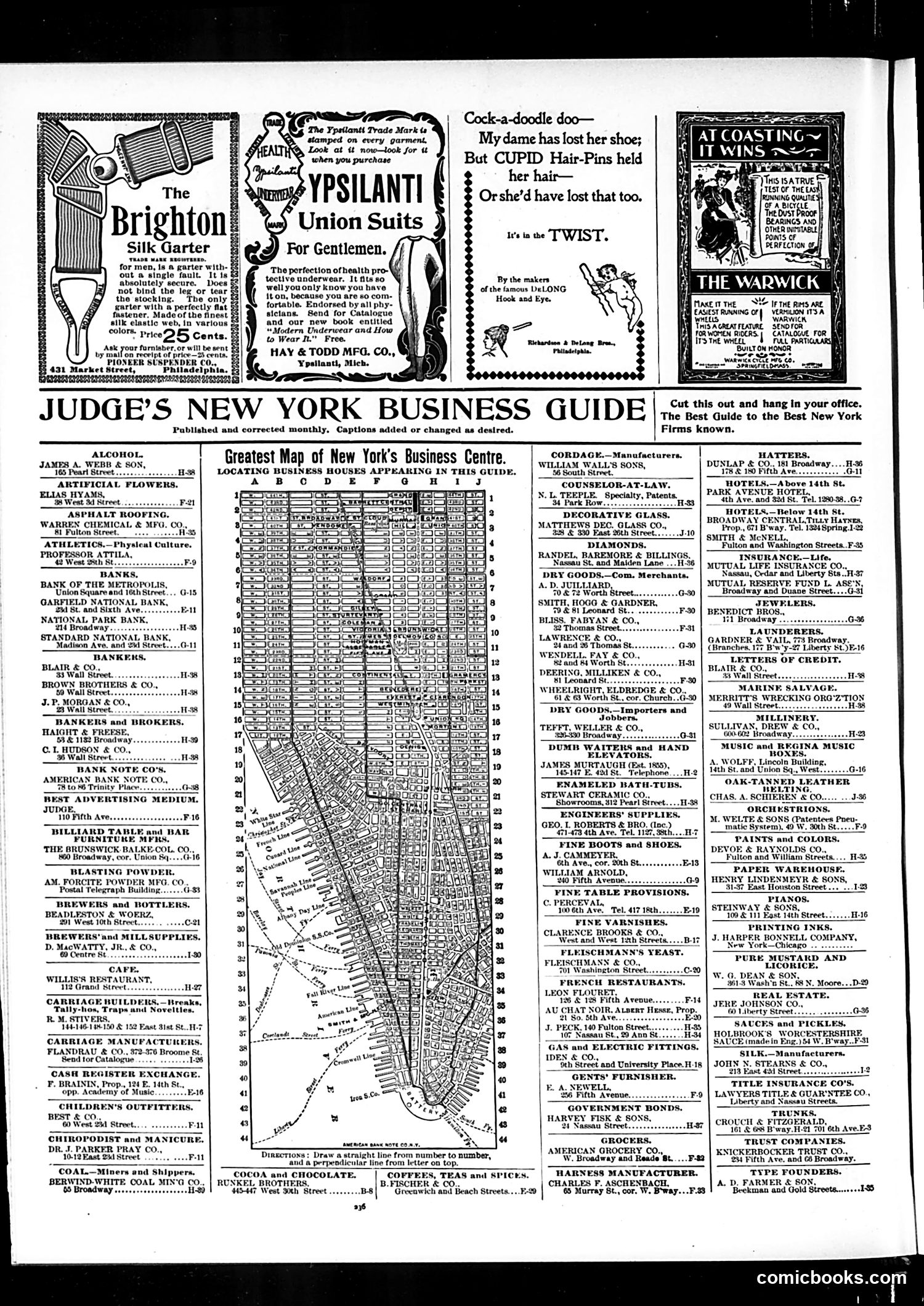
This page is primarily a **business directory and advertising** for Judge magazine's "New York Business Guide," rather than political satire. The small cartoon at top center shows a crude **nursery-rhyme parody** advertising Cupid Hair-Pins. The rhyme "Cock-a-doodle doo / My dame has lost her shoe" plays on the children's verse while claiming the product keeps women's hair secure—a lighthearted commercial joke rather than political commentary. The other advertisements promote typical late-19th/early-20th-century products: silk garters, Union Suits underwear, hair pins, and bicycle models ("The Warwick"). The bulk of the page features a detailed **map of Manhattan's business district** with an alphabetical listing of merchants, manufacturers, and services—a practical guide to New York commerce rather than satirical content. This appears to be a revenue-generating page mixing modest humor with commercial listings typical of Judge's business-guide editions.
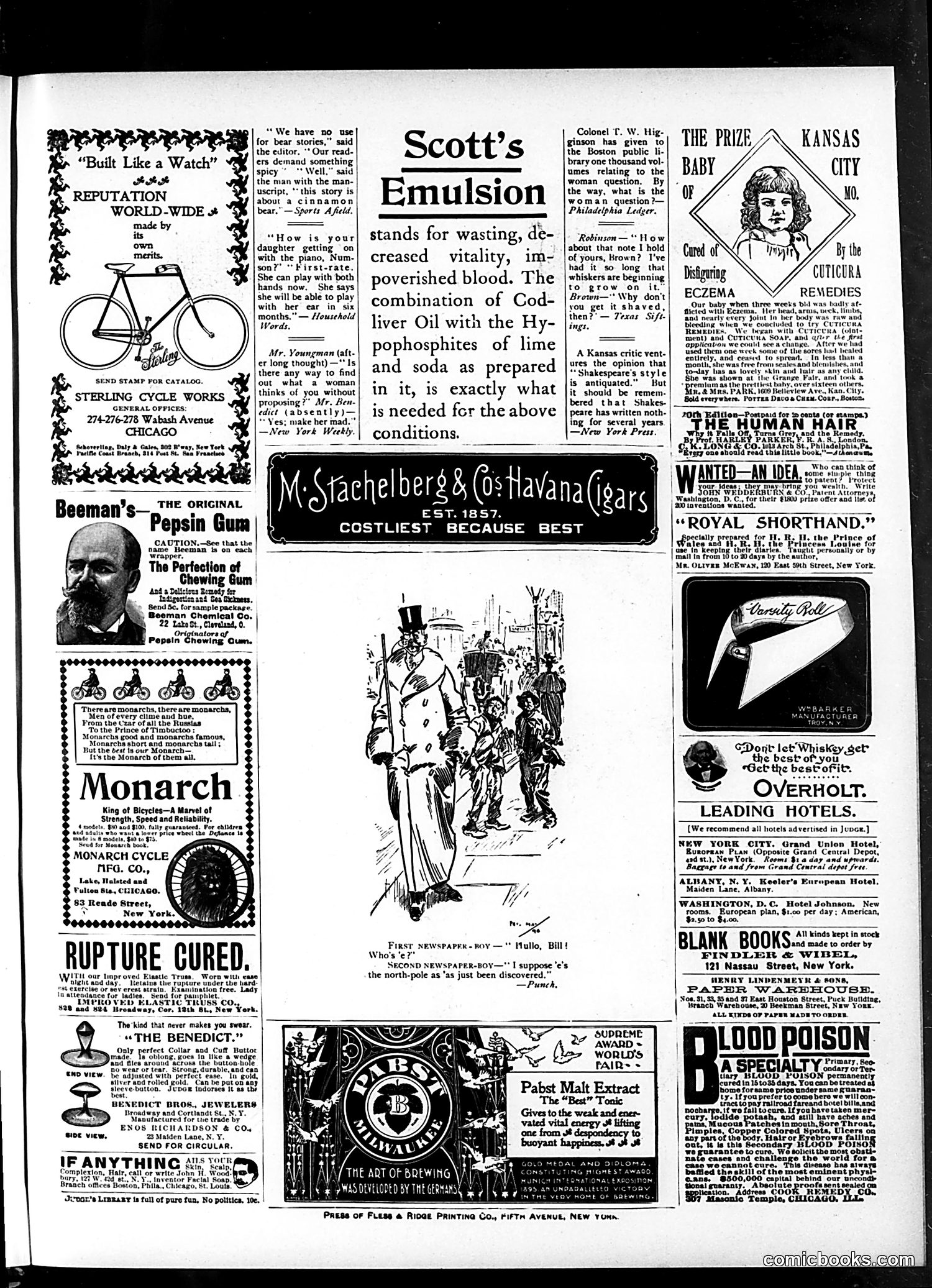
This page is primarily **advertisements and filler content** rather than political satire. The main elements include: **Central Cartoon:** A sketch labeled "First Newspaper Boy" depicts two newspaper vendors discussing the North Pole discovery—likely referencing contemporary Arctic exploration expeditions, a popular news topic of the era. **Advertisements dominate:** Scott's Emulsion (cod liver oil tonic), cycles (Sterling, Monarch), cigars (M. Stachelberg & Co.), hotels, and patent medicines occupy most space. **Notable text content:** - Brief humorous exchanges ("Bear stories," piano lessons) in the margins - References to Colonel T.W. Higginson donating books on the "woman question"—suggesting contemporary debates about women's rights/suffrage - A "Royal Shorthand" advertisement **Context for modern readers:** This reflects Judge's late-19th/early-20th-century format: satirical magazine as vehicle for advertising revenue. The "woman question" reference indicates women's rights discussions were newsworthy enough to mention, though treated lightly. The page shows how period media blended journalism, humor, and commerce.
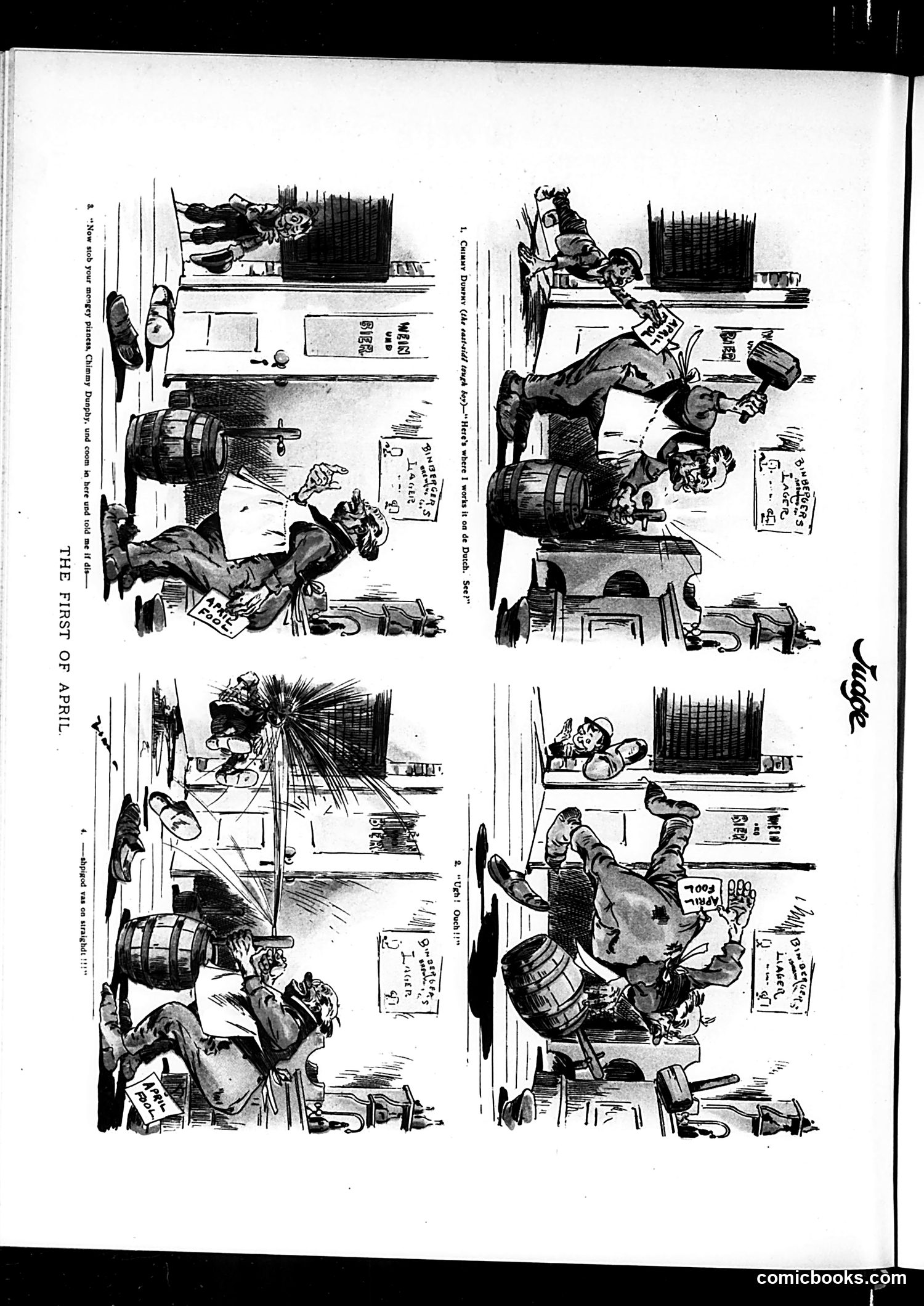
This appears to be an April Fools' Day themed comic strip from *Judge* magazine, showing a series of escalating pranks or mishaps in what looks like a tenement or working-class setting. The OCR'd dialogue references "Chimmy Dunphy," suggesting an Irish-American character—common in period satire. The four panels depict slapstick chaos: figures are knocked down, barrels and objects are overturned, and there's general mayhem. The humor relies on visual gags typical of early 20th-century comic strips—physical comedy and exaggerated reactions. The "April Fools'" title indicates this is satirizing how pranks spiral out of control, likely poking fun at working-class immigrant communities and their supposed propensity for rough horseplay. Without clearer OCR text or visible bylines, specific political targets remain unclear.