
A complete issue · 16 pages · 1896
Judge — March 14, 1896
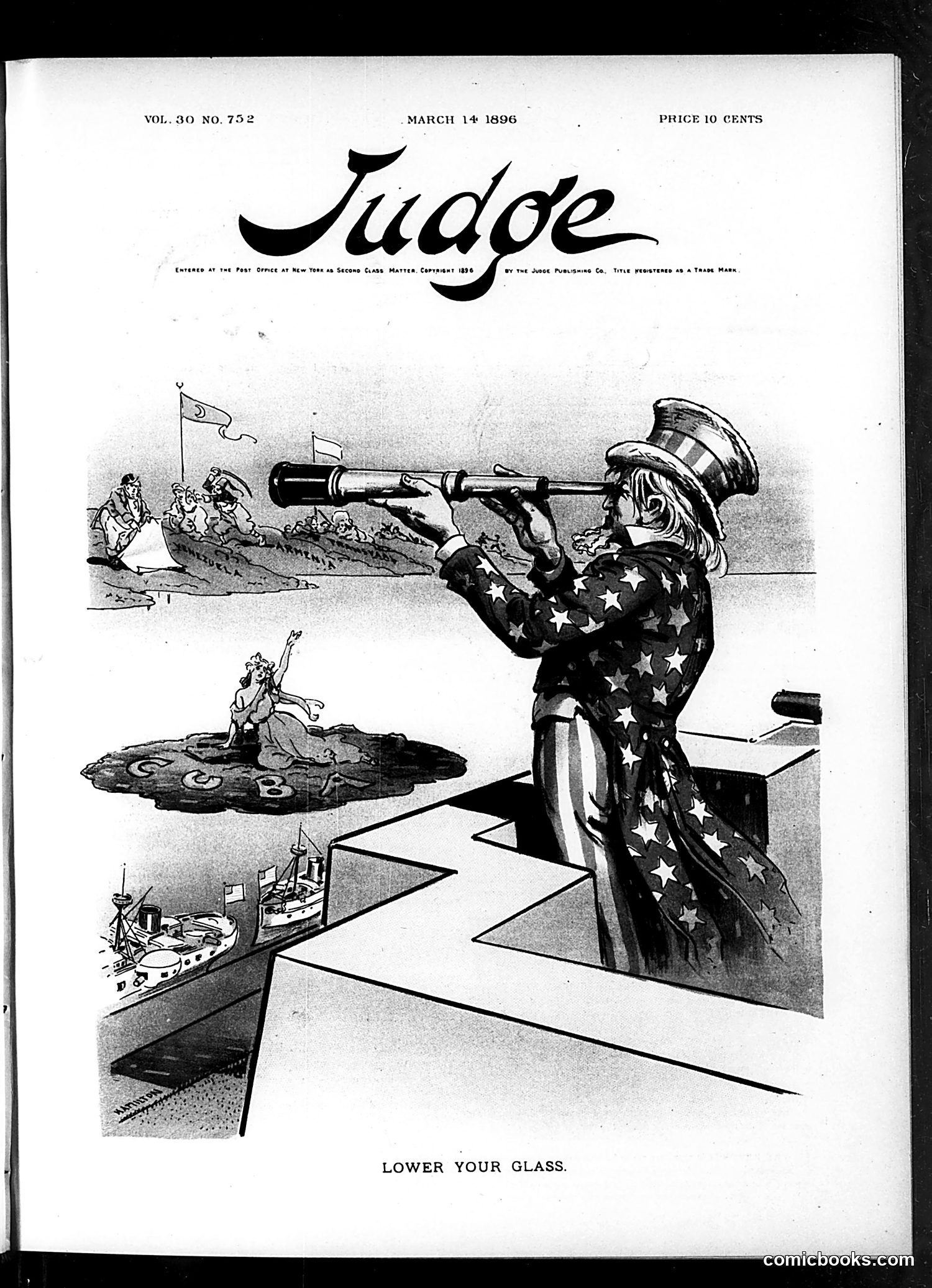
This political cartoon from Judge (March 14, 1896) depicts Uncle Sam as a naval observer using a telescope to survey three distinct scenes: foreign conflict zones, domestic economic trouble (marked with dollar signs), and a naval vessel. The title "Lower Your Glass" suggests Americans should look away from or ignore these problems—a satire on isolationism or political willful blindness. The cartoon criticizes the tendency to overlook serious issues: foreign wars, economic instability, and naval/military matters requiring attention. The work reflects 1890s debates about America's international responsibilities and domestic economic concerns, likely relating to post-Spanish American War tensions and economic anxieties of that era. The satire mocks those advocating disengagement from pressing national issues.
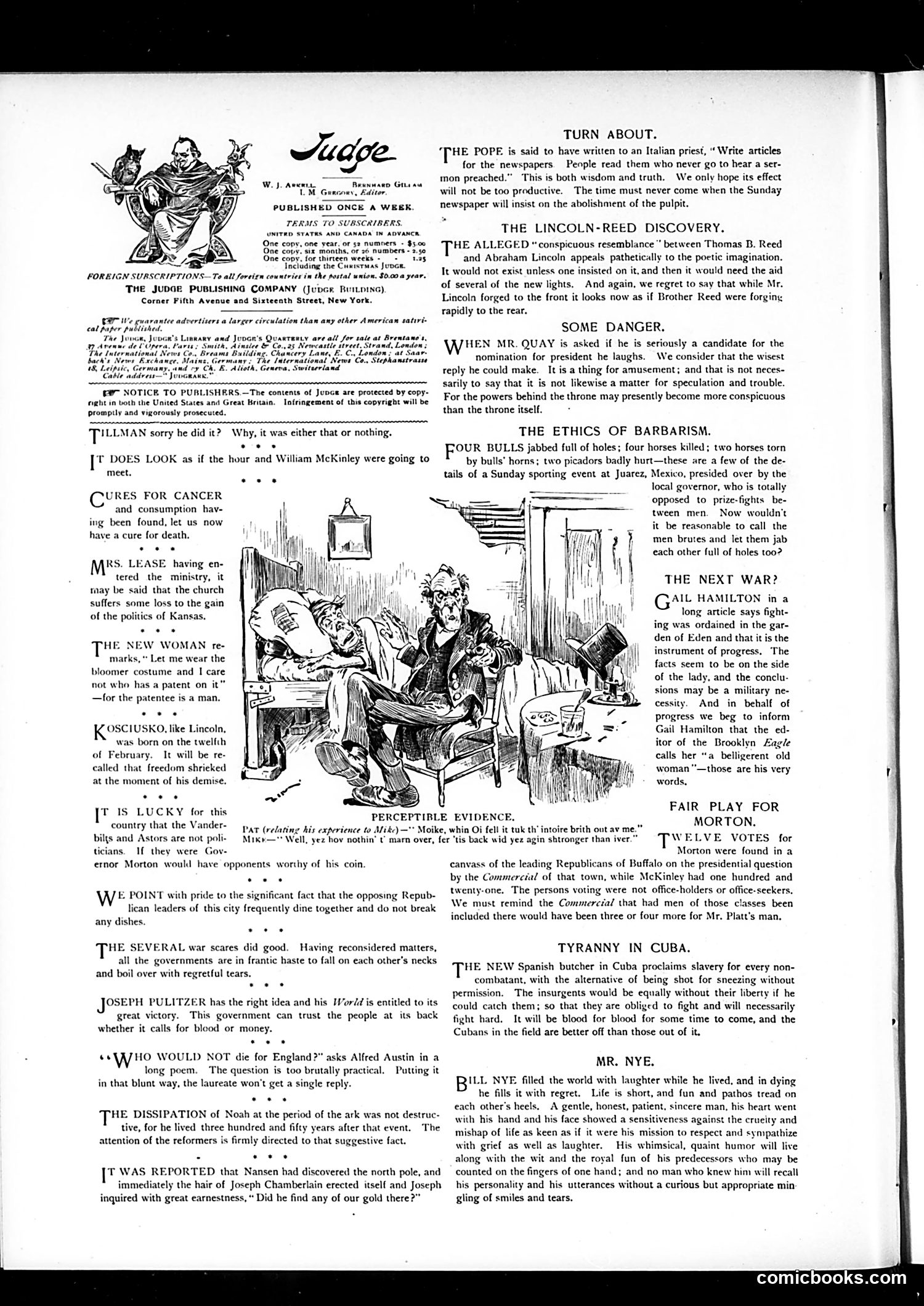
This page contains several short editorial columns rather than a prominent political cartoon. The central illustration depicts a scene of apparent poverty or hardship—possibly related to the article "Perceptible Evidence" about someone's experience with destitution. The editorials mock various political and social figures: references to William McKinley, Abraham Lincoln, and a priest writing articles for newspapers. One section criticizes barroom violence at a sporting event in Juarez, Mexico, controlled by a governor opposed to prize-fighting. Other brief items satirize electoral politics, Republican leadership, and international affairs (Cuba's new Spanish governor and slavery). The tone is generally conservative, mocking progressive reforms and praising Republican stability. Without identifying specific publication dates or clearer context, precise dating of references remains uncertain.
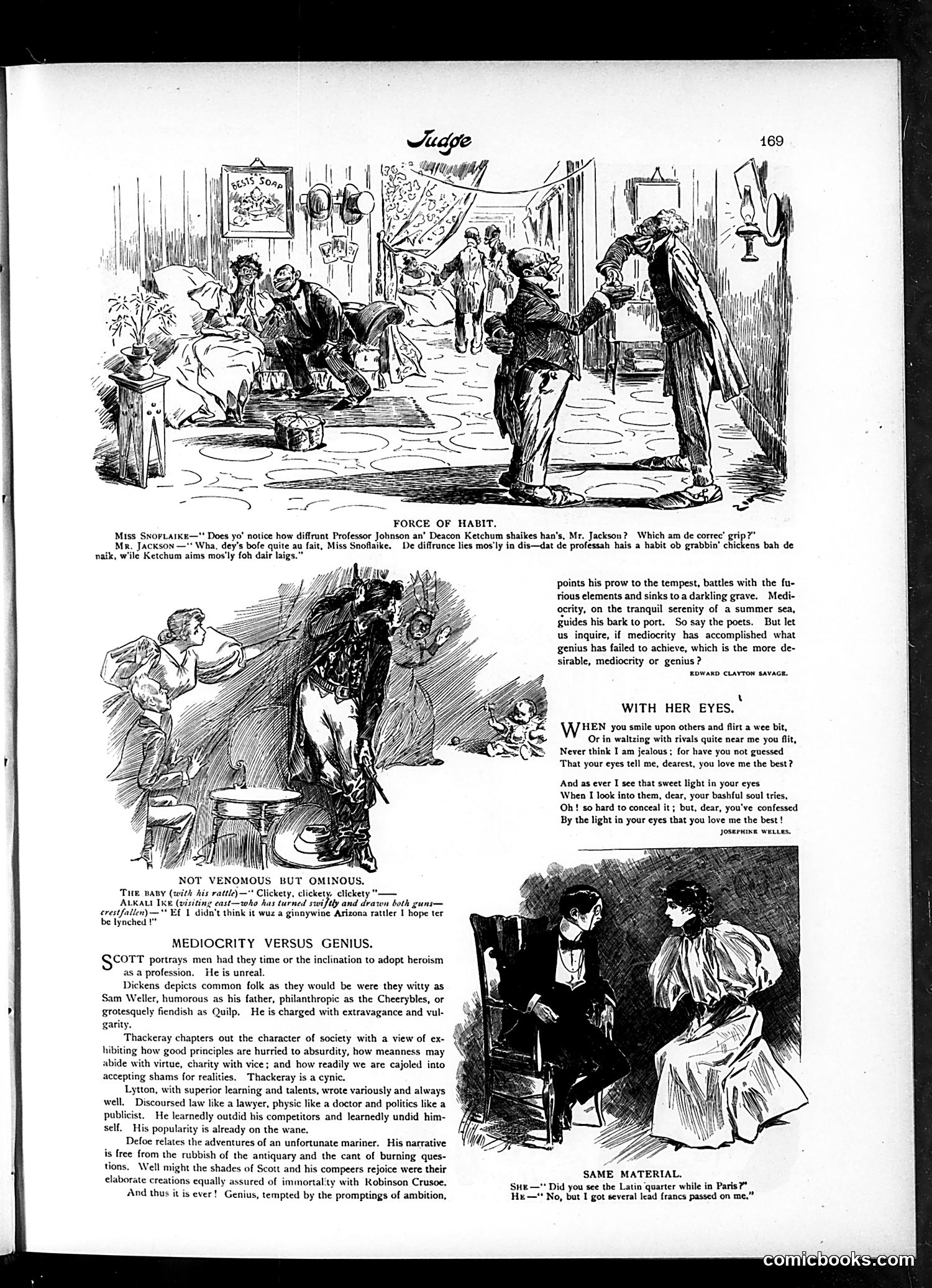
**Top Cartoon "Force of Habit":** A classroom scene where Professor Johnson and Deacon Ketchum debate Miss Snoflake's "grip" on distinguishing between similar concepts. The satire mocks academic pretension—the professor and deacon arguing pedantically over fine distinctions while missing obvious practical differences. **"Mediocrity Versus Genius":** The text compares Scott, Dickens, and Thackeray as writers, arguing that genius often trumps mediocrity in literature. It criticizes Thackeray as cynical and vulgar, though popular. **"With Her Eyes" and "Same Material":** These appear to be separate poem/story excerpts or advertisements unrelated to the primary satirical content. The page overall targets academic pomposity and debates about literary merit—typical Judge satire of intellectual pretension.
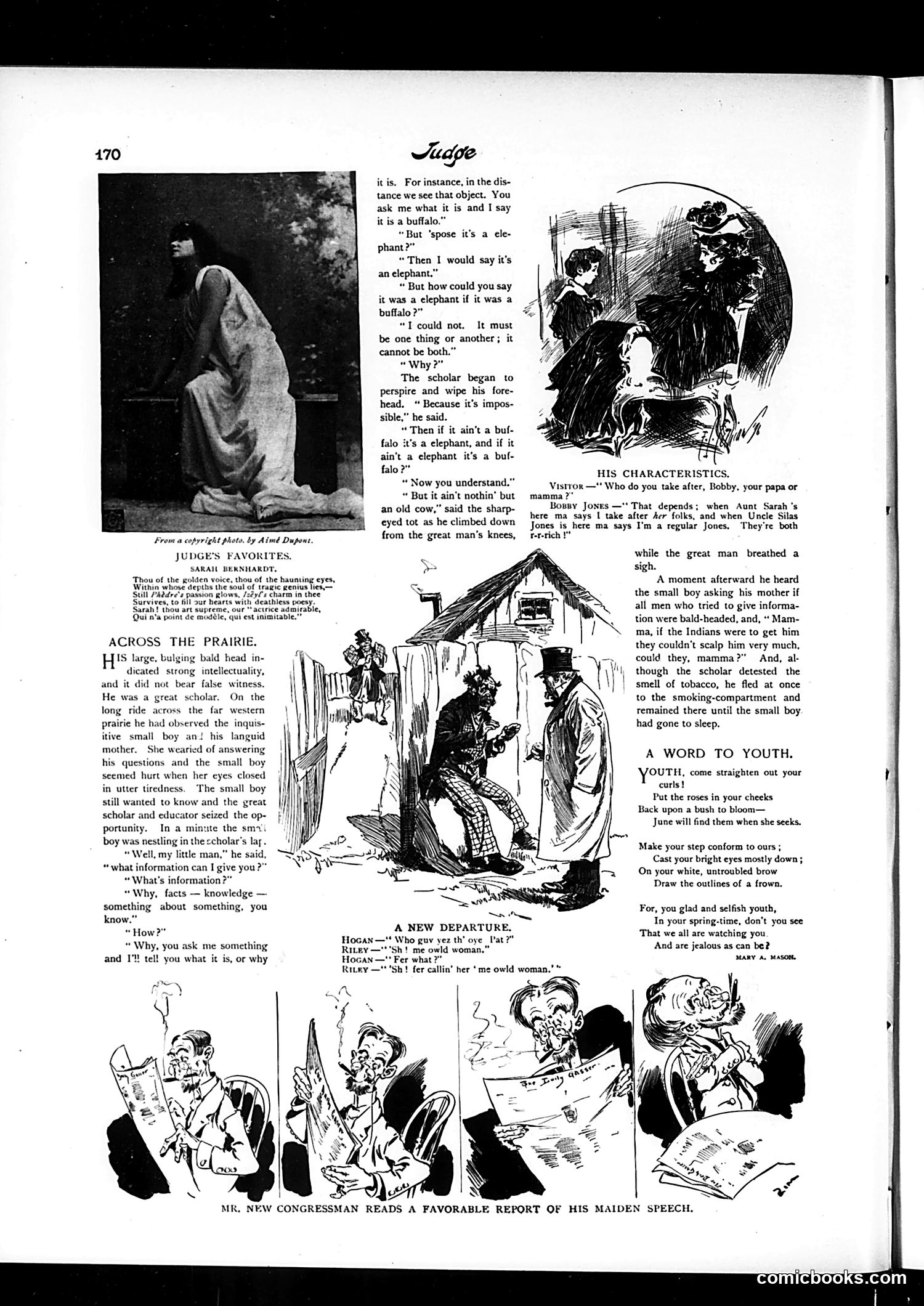
This page contains several satirical pieces typical of Judge's social commentary: **"Across the Prairie"** mocks pompous intellectualism. A scholar attempts to educate an inquisitive boy about logic and facts, but the child's simple observation—that the distant object is "just an old cow"—deflates the scholar's elaborate reasoning. The satire targets pretentious educators who overcomplicate simple truths. **"A New Departure"** appears to be Irish-dialect humor about a man striking his wife, labeled as calling her "me owld woman"—typical of the era's ethnic stereotyping in comics. **"His Characteristics"** jokes about a politician's vanity—he reads favorable reports of his inaugural speech with exaggerated self-satisfaction. **"A Word to Youth"** is a sarcastic poem criticizing young people's carefree attitude, written from the perspective of jealous older generations watching them. The page also features a portrait labeled "Judge's Favorites" honoring actress Sarah Bernhardt, representing the magazine's cultural coverage alongside political satire.
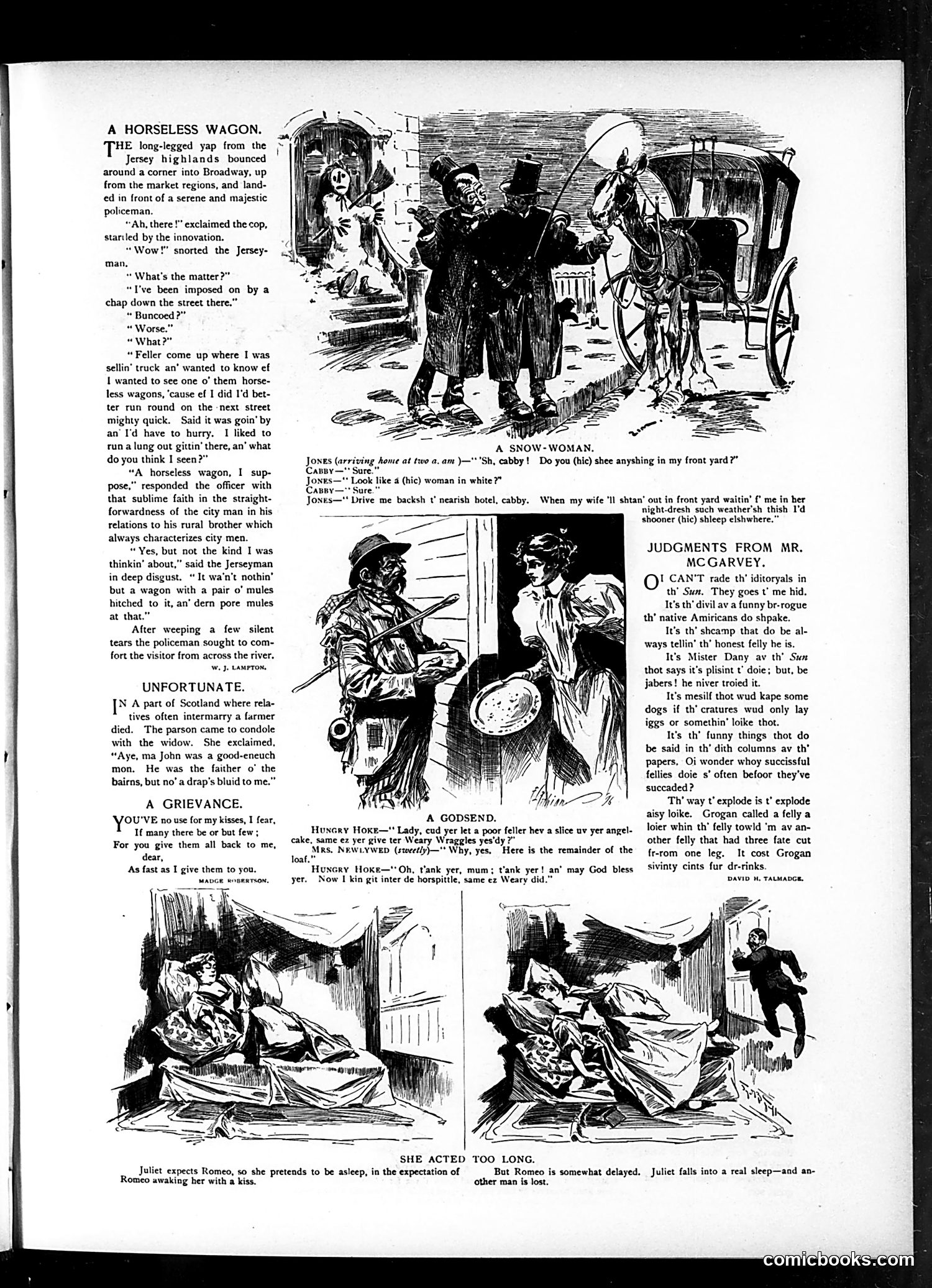
This page from *Judge* (a 19th-century American satirical magazine) contains several unrelated humorous sketches: **"A Horseless Wagon"** mocks the early automobile craze. A Jersey farmer is tricked into rushing to see a "horseless wagon," only to discover it's actually a mule-drawn cart—a joke about gullibility and the gap between rural and urban sophistication. **"A Snow-Woman"** depicts a drunk man mistaking a snow sculpture for a real woman in his yard. **Other sketches** include Irish dialect humor (McGarvey's observations, Henery Hoke's beggar dialogue) typical of the era's ethnic stereotyping, a Scottish widow's blunt indifference to her late husband, and a "Juliet and Romeo" domestic comedy where Juliet falls into genuine sleep while pretending to sleep, causing Romeo's planned romantic wake-up to fail. The humor relies on misunderstandings, wordplay, and period-specific references to automobiles, social class differences, and ethnic caricatures common to 1890s American comedy.
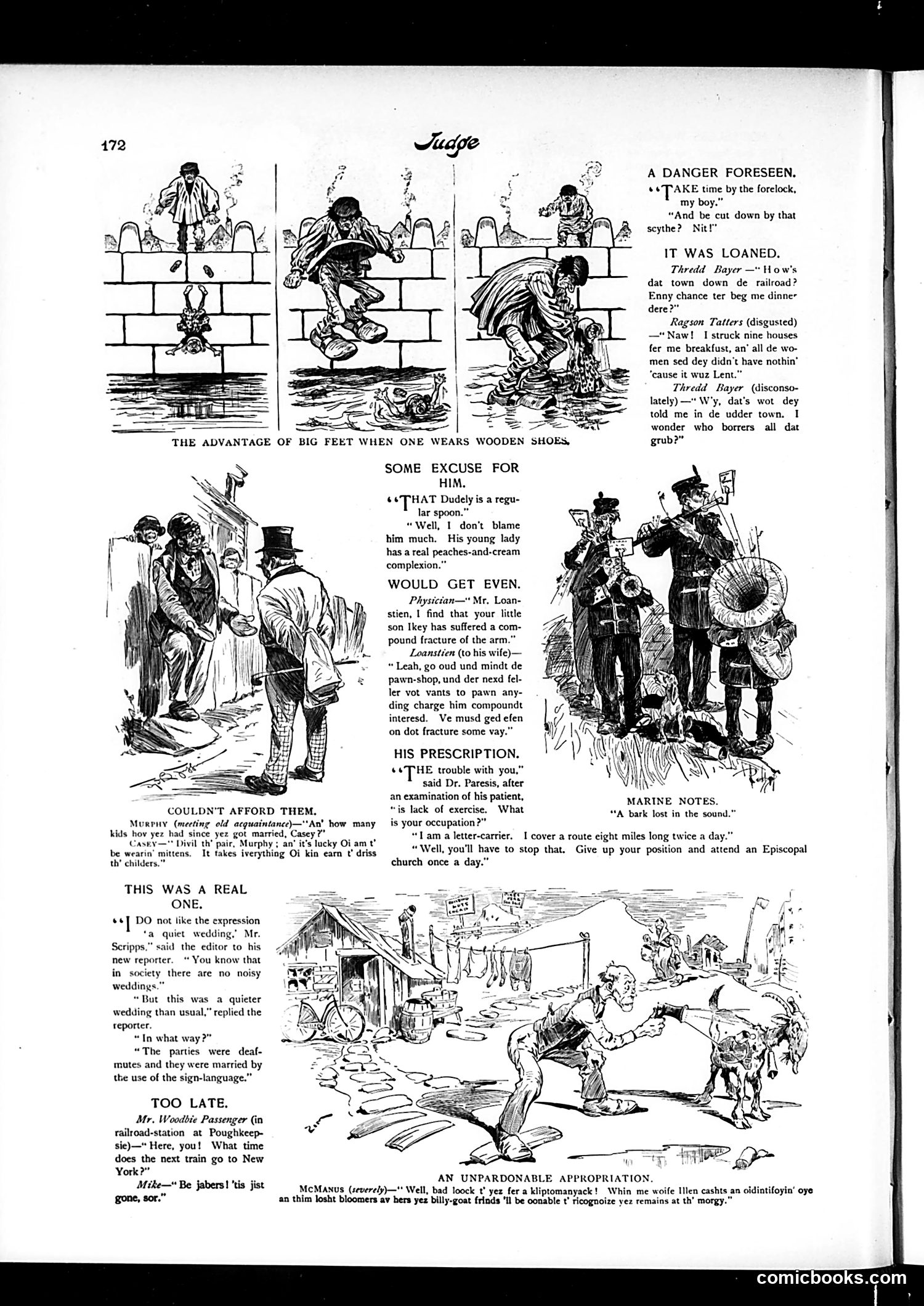
This page contains multiple unrelated jokes typical of Judge's format. Key satirical content: **"A Danger Foreseen"**: A boy refuses to "take time by the forelock" (seize opportunity) because he fears Death's scythe—satirizing youthful reluctance toward ambition. **"Would Get Even"**: A Jewish character (Loanstien, identified by Yiddish dialect) responds to his son's broken arm by charging compound interest to pawn customers—stereotyping Jewish people as obsessed with usury and revenge. **"His Prescription"**: A doctor prescribes a letter-carrier give up his job and attend Episcopal church daily for exercise—mocking both medical advice and Protestant religiosity. **"Marine Notes"**: A pun on "bark" (ship vs. dog sound). Other sketches mock drunks, poverty, deafness, and ethnic stereotypes. The humor relies heavily on period ethnic caricatures (Irish, Jewish, German dialects) that modern readers would find offensive.
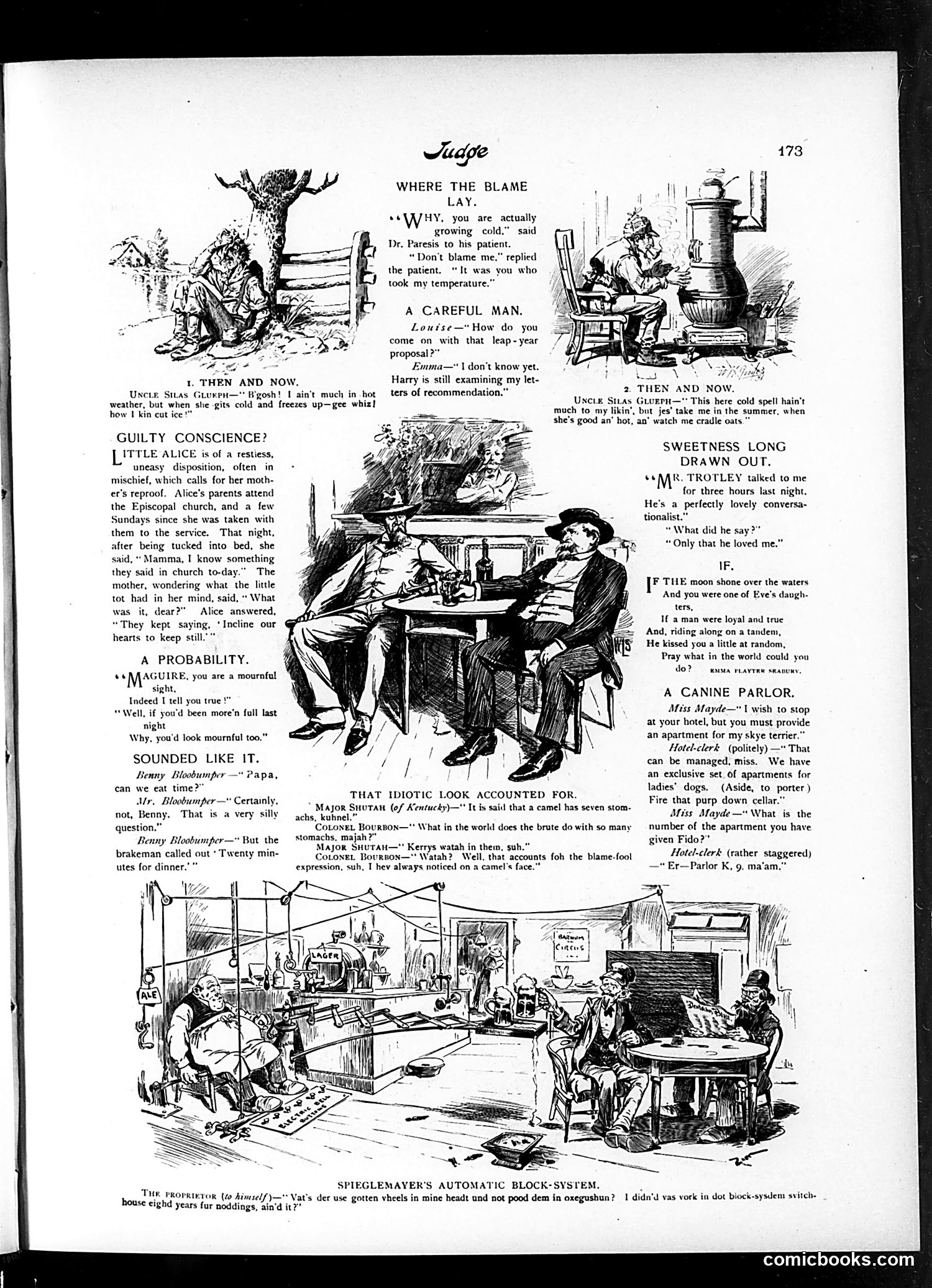
This page contains eight brief humorous sketches typical of Judge's satirical humor circa the 1890s-1900s: **"WHERE THE BLAME LAY"** mocks doctors' diagnostic methods—a patient blames the physician for his chilliness, claiming the doctor took his temperature and caused it. **"THEN AND NOW"** presents rustic characters (Uncle Silas) making contradictory statements about weather preferences, satirizing inconsistent human behavior. **"GUILTY CONSCIENCE?"** jokes about a child mishearing church liturgy ("Incline our hearts to keep still" as a command for silence). **"A CANINE PARLOR"** satirizes wealthy hotel patrons' absurd demands—a woman insisting on luxury apartments for her small dog. **"THAT IDIOTIC LOOK ACCOUNTED FOR"** features Southern gentlemen debating why camels look foolish, attributing it to water stored in multiple stomachs. **"SPIEGLEMAYER'S AUTOMATIC BLOCK-SYSTEM"** mocks a German immigrant inventor's incompetent logic—questioning why he has mechanical wheels in his head rather than implementing them practically. The humor relies on wordplay, class commentary, ethnic stereotypes, and absurdist logic typical of the era's satirical magazines.
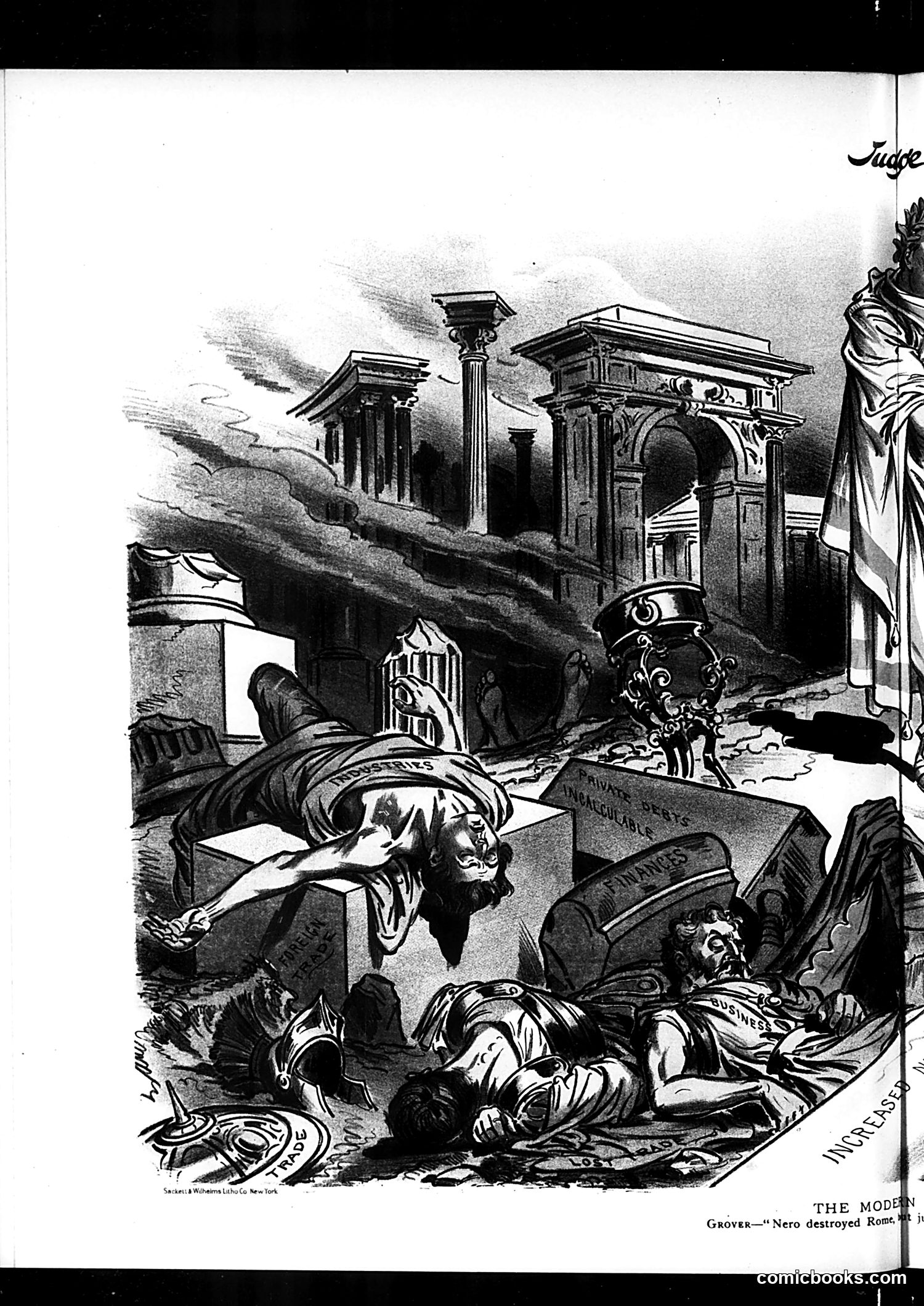
This political cartoon from *Judge* magazine uses classical allusion to criticize President Grover Cleveland. The caption compares him to the Roman Emperor Nero, who notoriously let Rome burn while playing music—a metaphor for destructive neglect during crisis. The illustration shows ruins of classical buildings with fallen figures amid debris, suggesting societal collapse. The military or official figures observing the destruction appear indifferent or complicit. The satire likely references Cleveland's handling of a major crisis during his presidency—possibly economic depression, labor unrest, or another national emergency the cartoonist believed he mismanaged or ignored. By invoking history's most notorious tyrant, *Judge* argues Cleveland's leadership was catastrophically inadequate, allowing American institutions to crumble like Rome itself.
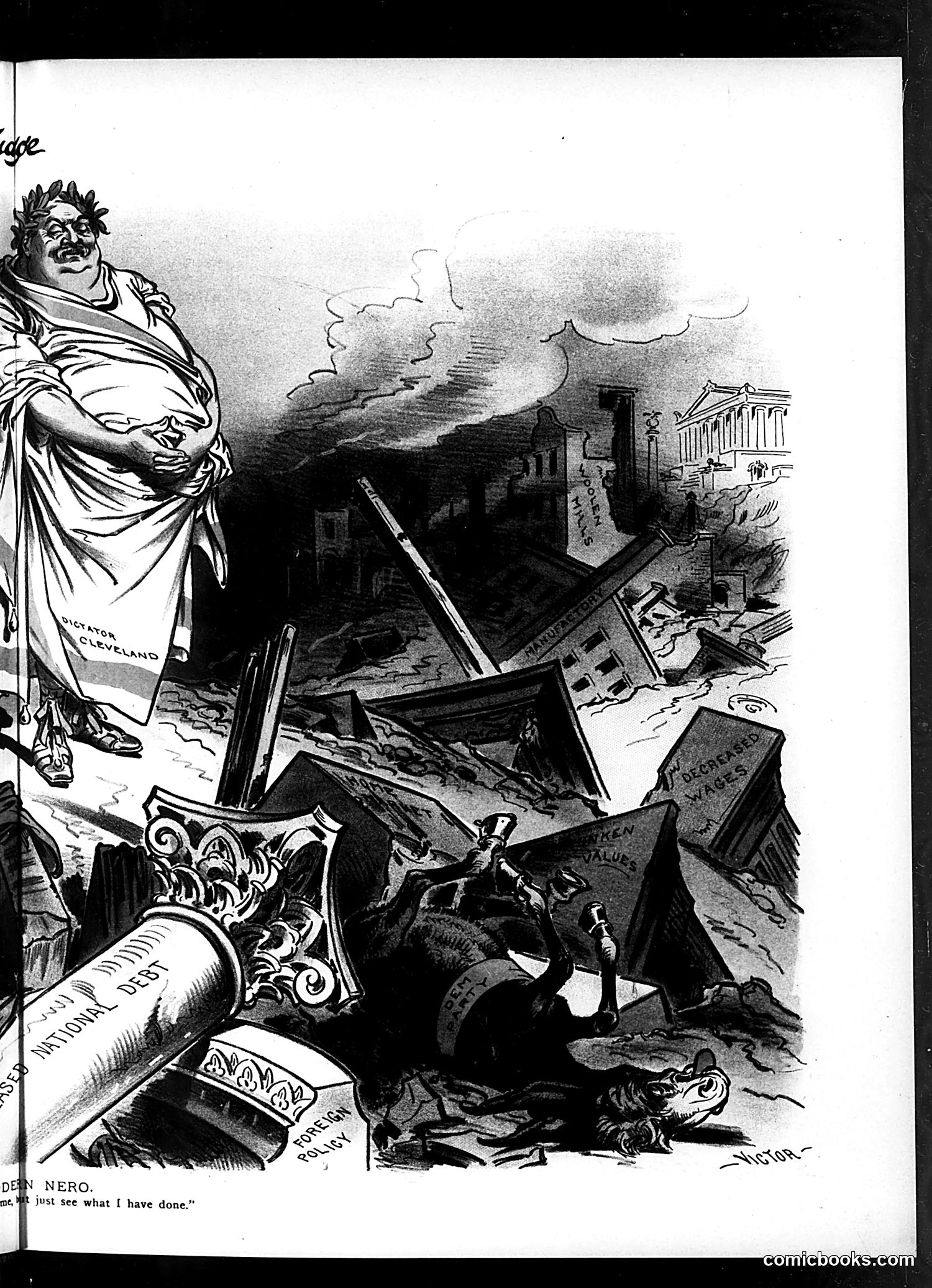
This Judge magazine cartoon depicts **"Modern Nero"** (labeled on the figure at left), comparing a contemporary political figure to the Roman emperor who allegedly fiddled while Rome burned. The left panel shows a portly man in classical dress overlooking destruction below. The right panel illustrates devastation: burning buildings, collapsed structures, and rubble, with visible labels including "National Debt" and "Foreign Policy." The satire suggests the figure's incompetence or indifference caused widespread damage—economic collapse, failed policies, or urban decay. The Nero comparison implies the leader ignored or caused catastrophe while remaining oblivious or unconcerned. Without the publication date visible, the specific historical context remains unclear, though this reflects common early-20th-century criticism of particular administrations. The classical allusion was a standard device for attacking political leadership as negligent or destructive.
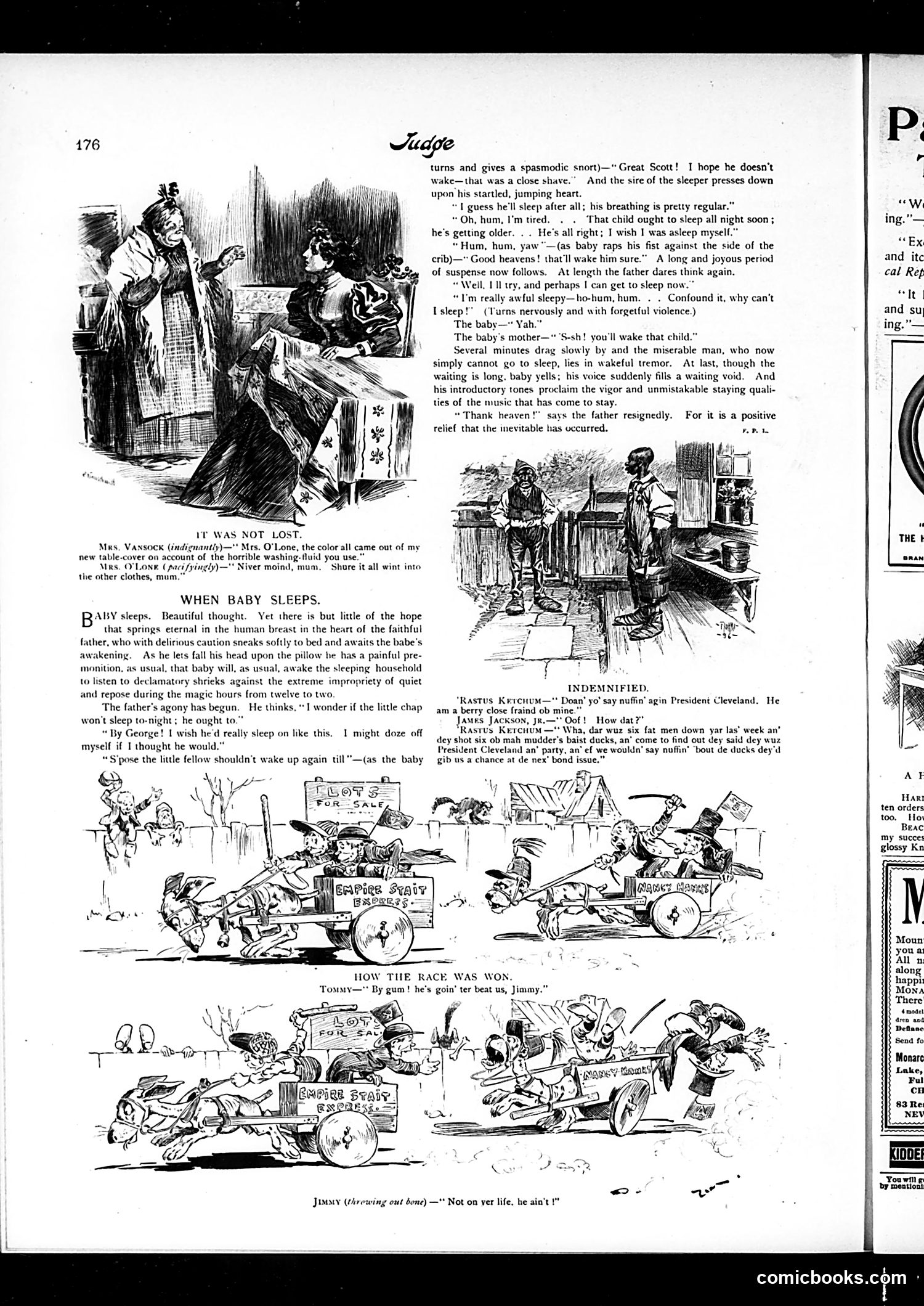
This page contains three distinct satirical pieces: **"It Was Not Lost"**: A brief domestic joke about a laundress (Mrs. O'Lone, depicted with Irish dialect) who ruined a customer's tablecloth. The humor relies on the maid's oblivious logic—the dye didn't disappear; it simply transferred to the other clothes. **"When Baby Sleeps"**: A lengthy satirical commentary on fatherhood, depicting the anxiety of a new father unable to sleep while worrying the baby will wake. The piece mocks paternal nervousness and sleeplessness, ending with resigned relief when the baby finally cries—at least the anticipated disaster has occurred. **"Indemnified"**: A dialect-heavy joke featuring Black characters (Rastus Kerchum and James Jackson) discussing President Cleveland. The humor, crude by modern standards, centers on compensation for stolen ducks allegedly shot by Cleveland's party—they'll overlook the loss in exchange for favorable bond-issue opportunities. This satirizes political favoritism and patronage. The bottom illustrations appear to show chaotic baby-related scenes, likely visual gags accompanying the sleeping-baby article.
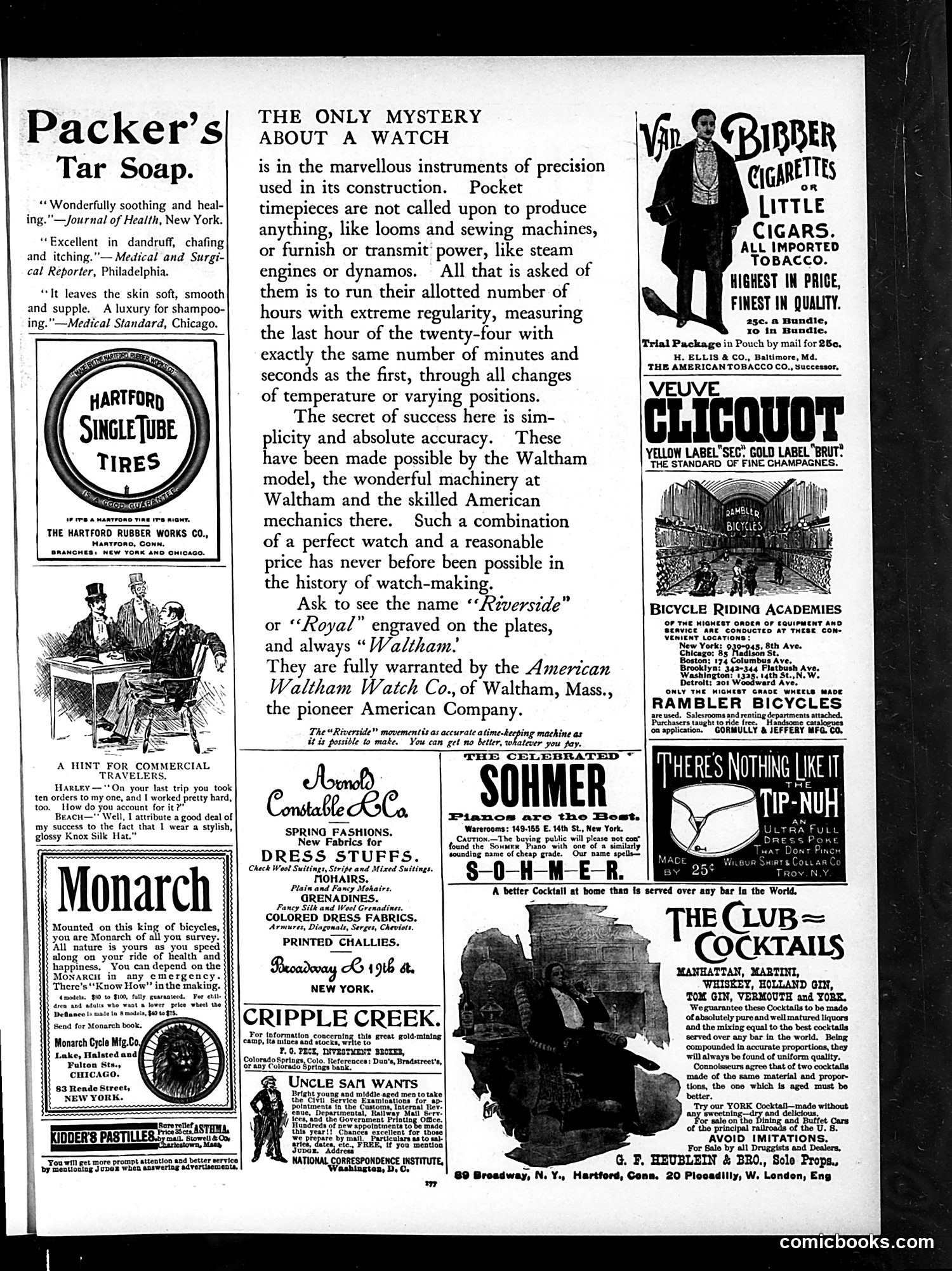
This page is primarily **advertising**, not political satire. It showcases products and services typical of the 1890s-early 1900s era. Notable advertisements include: - **Packer's Tar Soap** and **Hartford Single Tube Tires** (left column)—health/personal care products with medical endorsements - **Monarch Bicycles**—positioned as a luxury item for leisure - **Waltham Watches**—emphasizing American precision manufacturing and reliability - **Knox Silk Hats**—a humorous anecdote suggesting fashion/appearance aids sales success - **Van Bibber Cigars**, **Sohmer Pianos**, **Clicquot Champagne**—luxury imported goods - **Cripple Creek** mining information—reflecting the 1890s gold rush era The page reflects **turn-of-century consumer culture**: emphasis on precision engineering (watches, bicycles), aspirational consumption (cigars, champagne, silk hats), and the growing American industrial economy competing with European imports. There is no apparent political cartoon or satirical content visible.
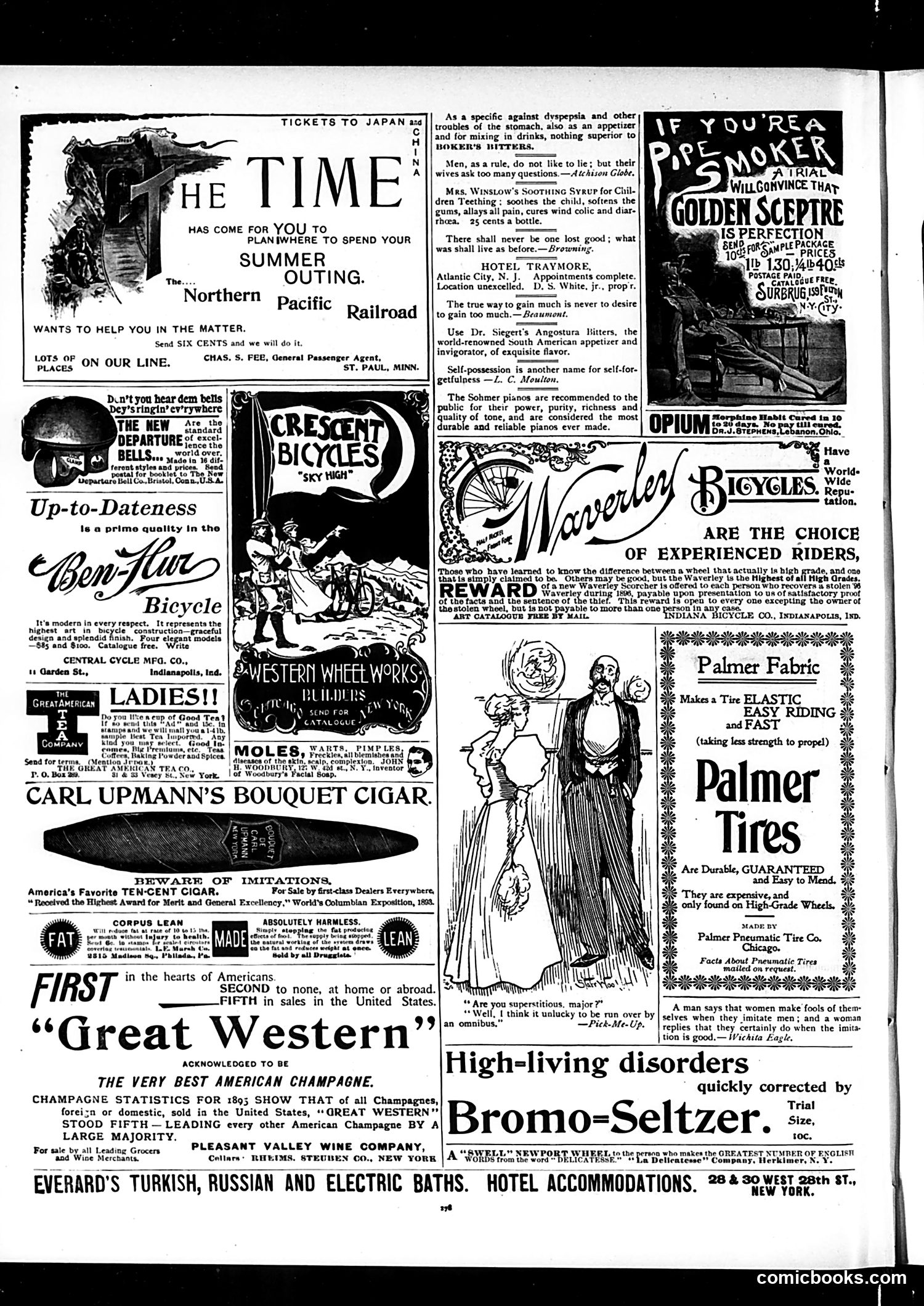
This is primarily an **advertising page** from Judge magazine, not a political cartoon. The page consists almost entirely of commercial advertisements for late 19th-century products: bicycles, cigars, champagne, patent medicines, pianos, and tires. The only identifiable satirical content is a **brief joke** at the bottom center, presented as a dialogue: - "Are you superstitious, major?" - "Well, I think it unlucky to be run over by omnibus." This is a simple play on words: the major claims superstition while expressing a perfectly rational fear of being hit by a bus (omnibus), not actual superstition. The page otherwise reflects period advertising conventions, including pseudo-medical claims (Bromo-Seltzer for "high-living disorders," Winslow's Soothing Syrup) and the prominent display of luxury goods targeting affluent readers. No significant political or social satire is evident on this particular page.
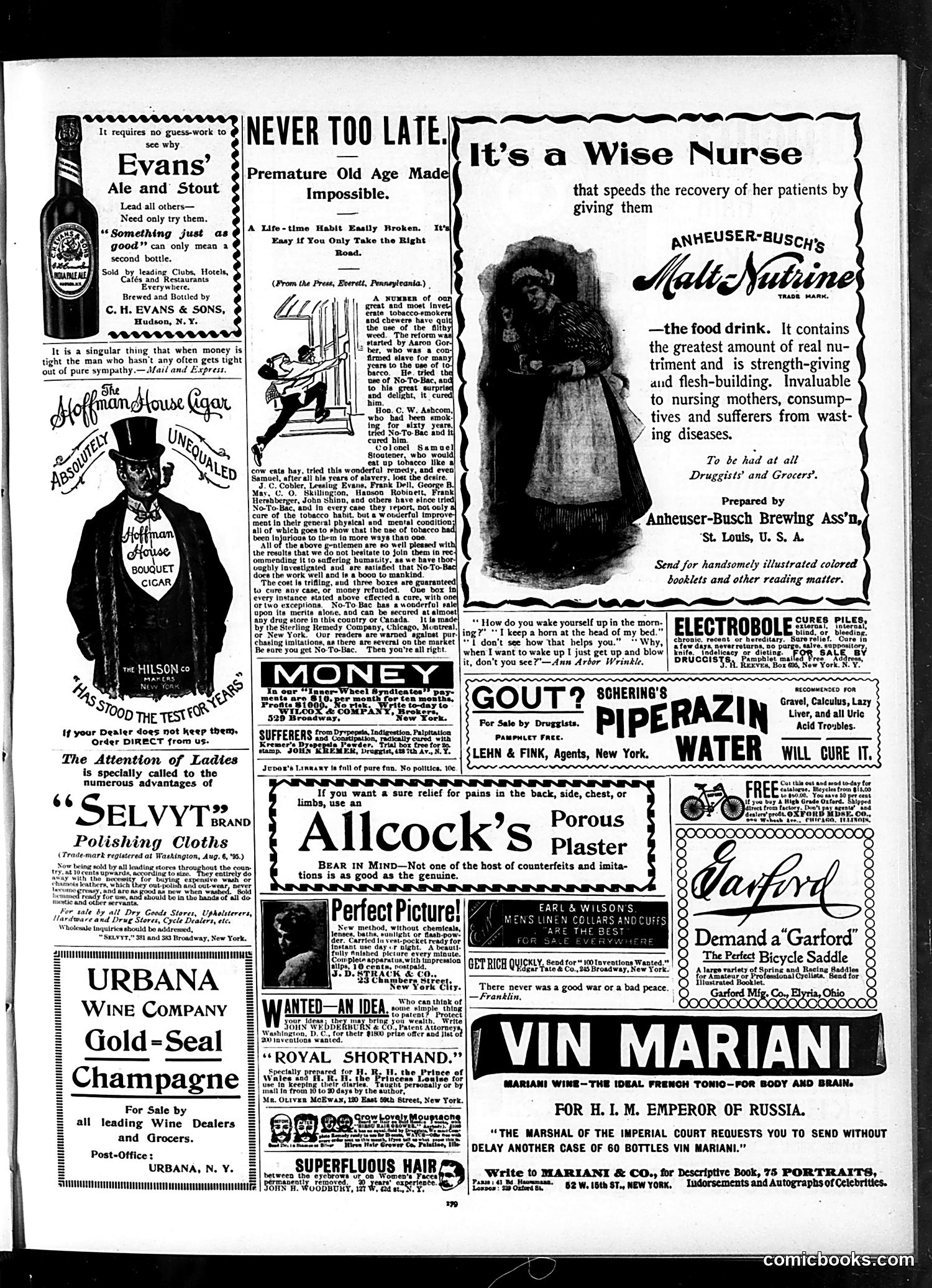
This is primarily an **advertising page** from an early 20th-century satirical magazine, with minimal political cartoons. The page consists largely of product advertisements typical of the era. Notable content includes: - **Evans' Ale and Stout** advertisement featuring a gentleman in top hat - **Anheuser-Busch Malt-Nutrine** promoting a beverage to nursing mothers and those with wasting diseases - **No-To-Bac**, a tobacco-cessation product claiming to cure tobacco addiction - **Allcock's Porous Plaster** and other patent medicines - **Vin Mariani**, a French tonic wine advertised for "body and brain" The only apparent satirical content is a small joke about waking up in the morning using a horn. The advertisements reflect **turn-of-the-century marketing**, when dubious health claims were unregulated and products like patent medicines, alcohol-based tonics, and tobacco cures were advertised alongside legitimate goods. The page demonstrates how such publications funded themselves through advertising revenue.
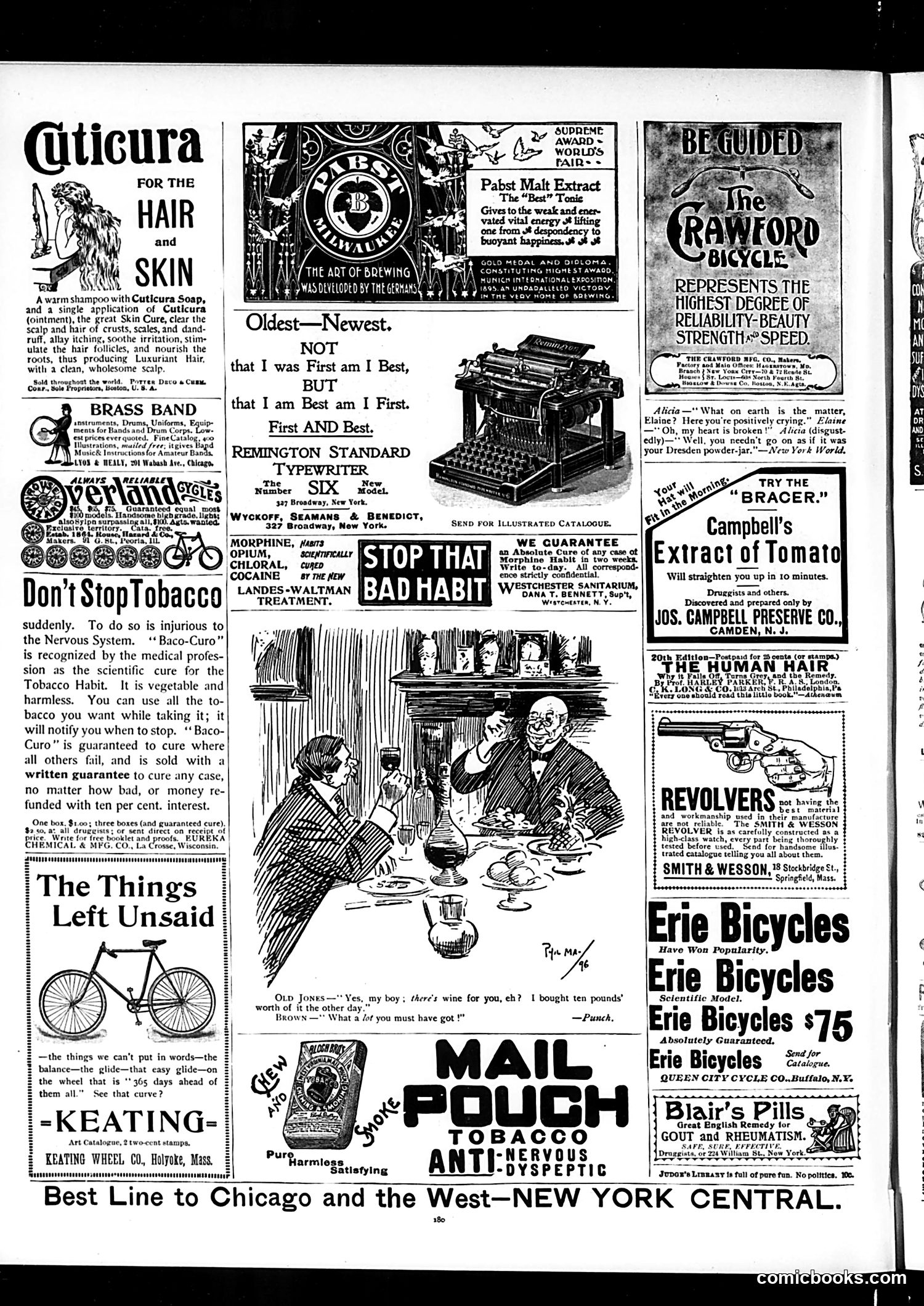
This page is **primarily advertising**, typical of late-19th-century magazines. The advertisements promote patent medicines and products marketed with exaggerated health claims now recognized as fraudulent. ## Key Elements: **Patent Medicine Ads**: Products like "Baco-Curo" (tobacco addiction cure), morphine/opium treatments, and "Mail Pouch Tobacco" exemplify the era's unregulated pharmaceutical market. These promised miraculous cures without scientific basis. **The Central Cartoon**: Shows a domestic scene (captioned from *Punch*) where a husband mentions buying wine; his wife demands he must have gotten a bargain. It's a gentle marital joke about household economics—unrelated to the ads surrounding it. **Product Advertisements**: Bicycles, revolvers, typewriters, and extract of tomato represent typical consumer goods of the period, positioned alongside dubious medicinal claims. **Social Context**: This reflects the Gilded Age's lack of FDA regulation, when magazines freely advertised dangerous substances as cure-alls. The mix of legitimate products with fraudulent medicines shows how normalized such claims were.
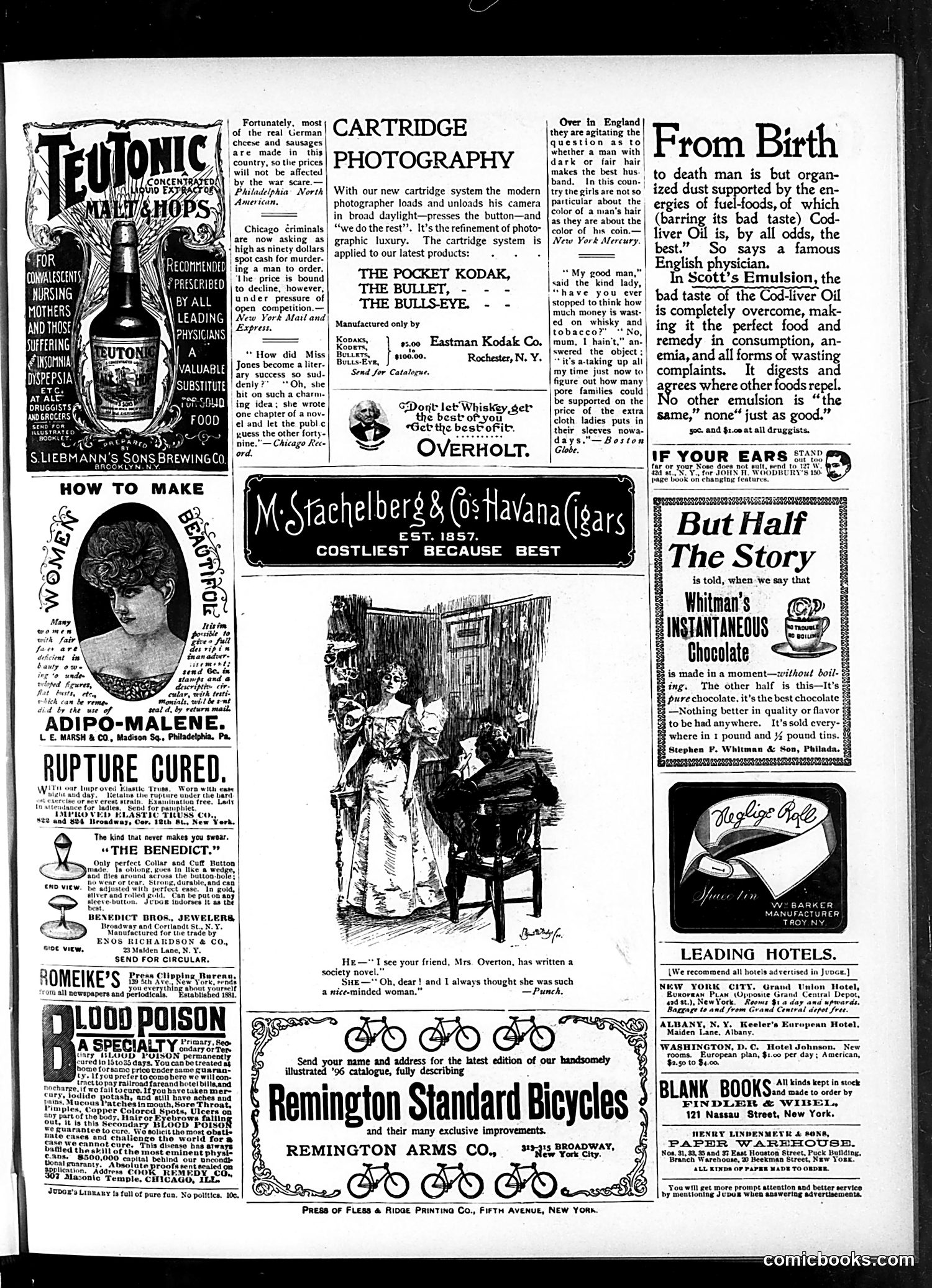
This is primarily an **advertising page** with miscellaneous product endorsements typical of early 1900s publications. The content includes scattered brief humorous items and commentary rather than coherent political satire. **Notable elements:** The brief **text snippets** are light social commentary: Chicago criminals pricing murder contracts, a girl becoming a literary success by writing one novel chapter, and a gender-war debate about whether dark or fair-haired husbands are preferable (the American punchline: men's wealth matters more than appearance). **Advertisements dominate**, promoting patent medicines (rupture cures, blood poison treatments), bicycles (Remington), cameras (Kodak's cartridge system), cigars, chocolate, and various dubious health products—typical of Judge's era when such publications made revenue from questionable medical claims. The **M. Stachelberg & Co. cigar ad** features an illustration of well-dressed figures in a social setting, standard advertising imagery of the period. This page reflects Judge's business model: mixing light humor with lucrative advertising for products we'd now recognize as ineffective or fraudulent.
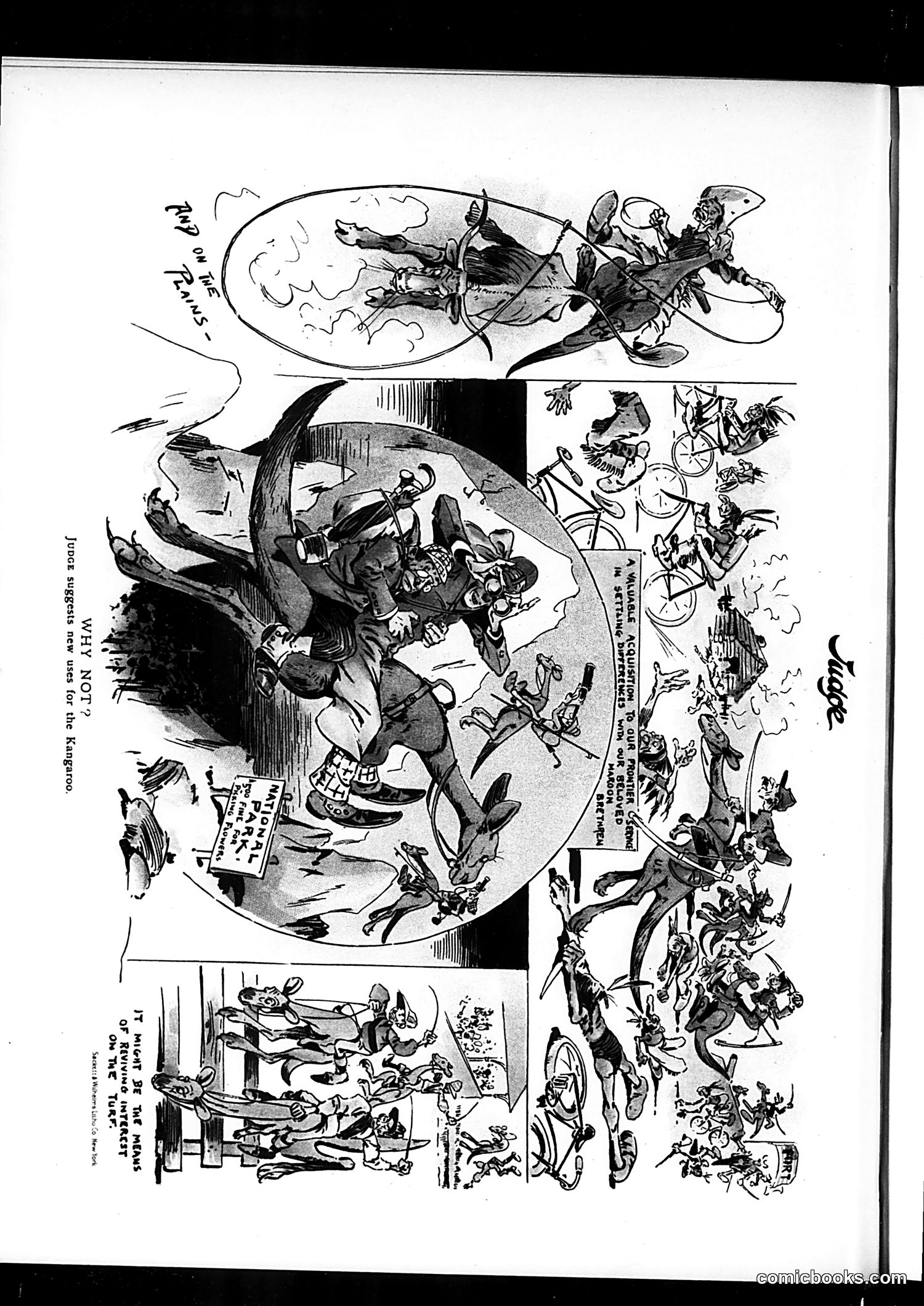
This Judge cartoon satirizes American imperialism and the acquisition of new territories. The main image depicts a kangaroo (representing Australia or the frontier colonies) being incorporated into American interests. The smaller panels show various proposed "uses" for the kangaroo—suggesting ridiculous applications like transportation or sport. The satire mocks the contemporary impulse to expand American influence globally. References to "settling differences with our beloved Maroon" and "reviving interest on the turf" indicate proposals to exploit colonial acquisitions for practical or entertainment purposes. The kangaroo caricature reflects period attitudes toward colonial peoples and resources as commodities for American benefit. This reflects late 19th-century debates about American expansionism and imperialism, positioning such ventures as simultaneously absurd and inevitable.