
Judge, 1896-03-14 · page 3 of 16
Judge — March 14, 1896 — page 3: what you’re looking at
What you’re looking at
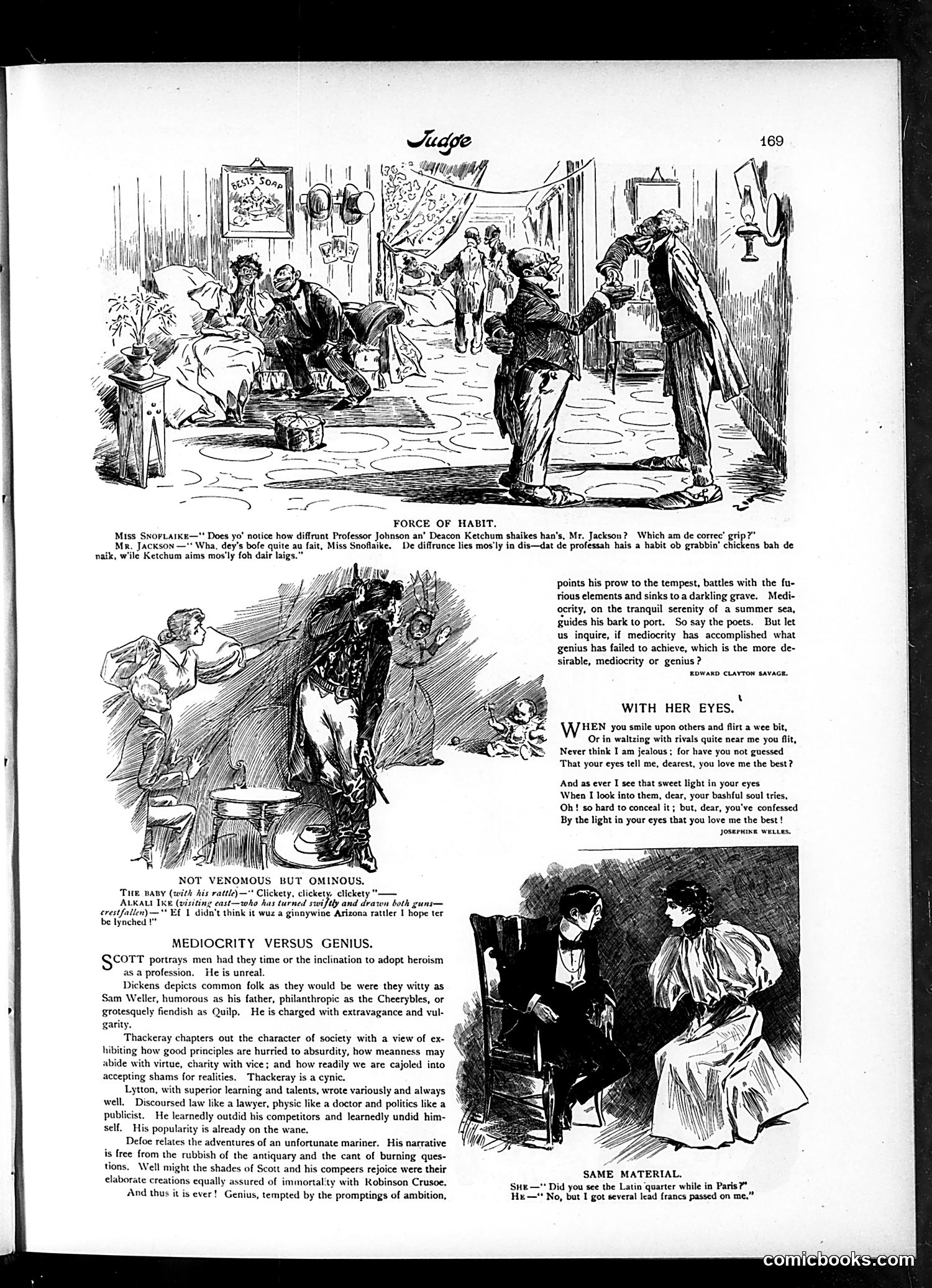
**Top Cartoon "Force of Habit":** A classroom scene where Professor Johnson and Deacon Ketchum debate Miss Snoflake's "grip" on distinguishing between similar concepts. The satire mocks academic pretension—the professor and deacon arguing pedantically over fine distinctions while missing obvious practical differences. **"Mediocrity Versus Genius":** The text compares Scott, Dickens, and Thackeray as writers, arguing that genius often trumps mediocrity in literature. It criticizes Thackeray as cynical and vulgar, though popular. **"With Her Eyes" and "Same Material":** These appear to be separate poem/story excerpts or advertisements unrelated to the primary satirical content. The page overall targets academic pomposity and debates about literary merit—typical Judge satire of intellectual pretension.
📄 Transcribed text from this page (OCR, searchable)
Machine-transcribed from the original scan — historical spelling and the odd misread are preserved.
FORCE OF HABIT, Miss SNOFLAIKE—"' Does yo notice how diffrunt Professor Johnson an’ Deacon Ketchum shaikes han's, Mr. Jackson? Which am de correc’ Mr. JACKson Wha, dey’s bofe quite au fait, Miss Snoflaike. De diffrunce lies mos'ly in dis—dat de professah hais a habit ob grabbin’ chickens bah de naik, wiile Ketchum aims mos'ly foh dair laigs.”” points his prow to the tempest, battles with the fu- rious elements and sinks toa darkling grave. Medi- ocrity, on the tranquil serenity of a summer sea, guides his bark to port. So say the poets. But let us inquire, if mediocrity has accomplished what genius has failed to achieve, which is the more de- sirable, mediocrity or genius? RDWAKD CLAYTON SAVAGE. \ WITH HER EYES. WHEN you smile upon others and flirt a wee bit, Or in waltzing with rivals quite near me you flit, Never think I am jealous ; for have you not guessed ‘That your eyes tell me, dearest, you love me the best? And as ever I see that sweet light in your eyes When I look into them, dear, your bashful soul tries, Oh ! so hard to conceal it; but, dear, you've confessed By the light in your eyes that you love me the best ! Vy; ie She —"— NOT VENOMOUS BUT OMINOUS. Tue BABY (with Ais rattle)—"* Clickety, clickety, clickety "—— ALKALI Ike (visiting east—who has turned swiftly and drawn both guns— erestfallen)—"* Ef 1 didn't think it wuz a ginnywine Arizona rattler I hope ter be lynched MEDIOCRITY VERSUS GENIUS. SCOTT portrays men had they time or the inclination to adopt heroism asa profession. He is unreal. Dickens depicts common folk as they would be were they witty as Sam Weller, humorous as his father, philanthropic as the Cheerybles, or grotesquely fiendish as Quilp, He is charged with extravagance and vul- garity. Thackeray chapters out the character of society with a view of ex- hibiting how good principles are hurried to absurdity, how meanness. may abide with virtue, charity with vice; and how readily we are cajoled into accepting shams for realities. Thackeray is a cynic. Lytton, with superior learning and talents, wrote variously and always, well. Discoursed law like a lawyer, physic like a doctor and politics like a Publicist. He learnedly outdid his competitors and learnedly undid him- self, His popularity is already on the wane. Defoe relates the adventures of an unfortunate mariner. His narrative is free from the rubbish of the antiquary and the cant of burning ques- tions, Well might the shades of Scott and his compeers rejoice were their SAME MATERIAL. elaborate creations equally assured of immortality with Robinson Crusoe. And thus it is ever! Genius, tempted by the promptings of ambition, SH —"" Did you see the Latin quarter while in Paris?” He —" No, but I got several lead francs passed on me,”