
Judge, 1896-03-14 · page 4 of 16
Judge — March 14, 1896 — page 4: what you’re looking at
What you’re looking at
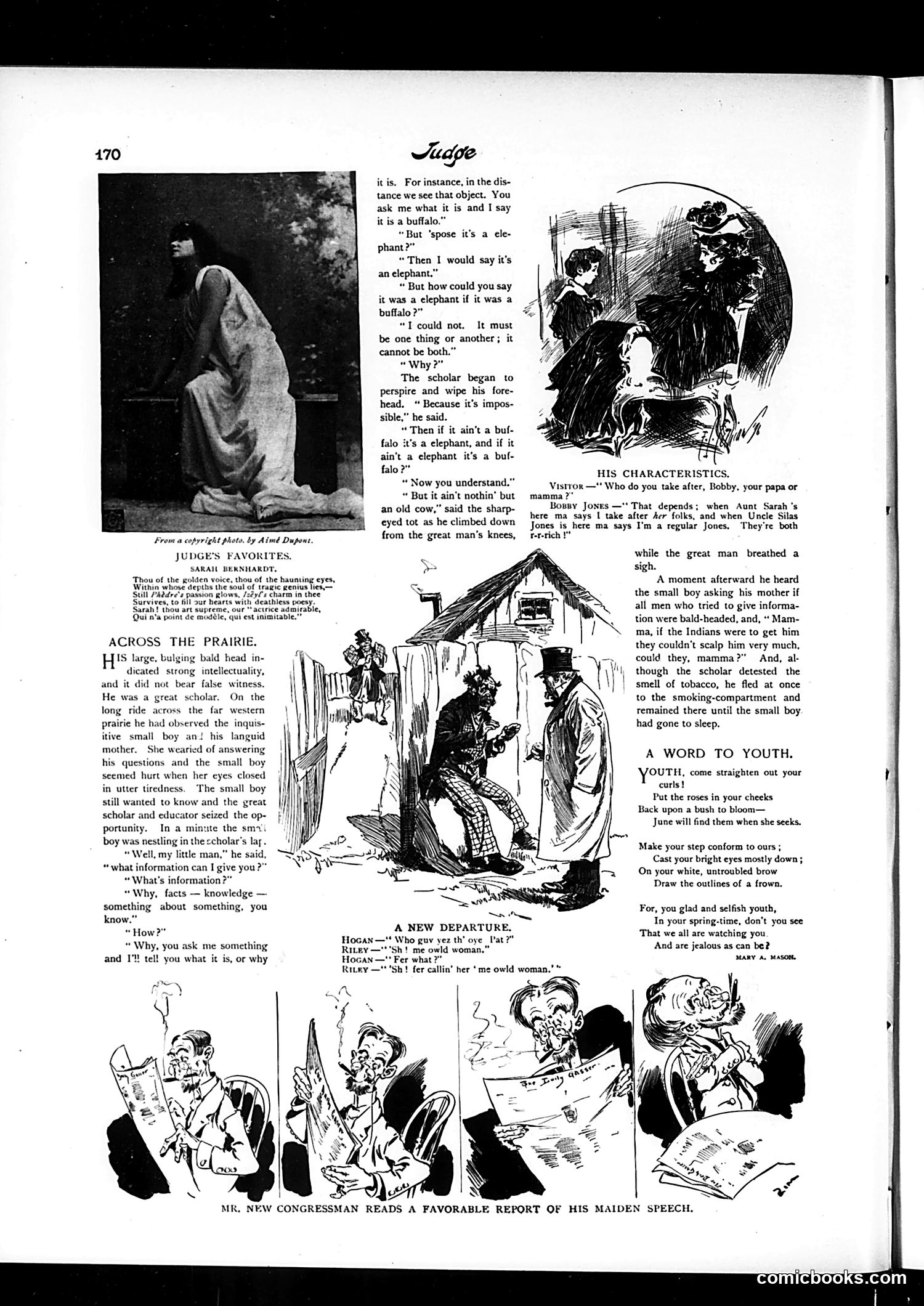
This page contains several satirical pieces typical of Judge's social commentary: **"Across the Prairie"** mocks pompous intellectualism. A scholar attempts to educate an inquisitive boy about logic and facts, but the child's simple observation—that the distant object is "just an old cow"—deflates the scholar's elaborate reasoning. The satire targets pretentious educators who overcomplicate simple truths. **"A New Departure"** appears to be Irish-dialect humor about a man striking his wife, labeled as calling her "me owld woman"—typical of the era's ethnic stereotyping in comics. **"His Characteristics"** jokes about a politician's vanity—he reads favorable reports of his inaugural speech with exaggerated self-satisfaction. **"A Word to Youth"** is a sarcastic poem criticizing young people's carefree attitude, written from the perspective of jealous older generations watching them. The page also features a portrait labeled "Judge's Favorites" honoring actress Sarah Bernhardt, representing the magazine's cultural coverage alongside political satire.
📄 Transcribed text from this page (OCR, searchable)
Machine-transcribed from the original scan — historical spelling and the odd misread are preserved.
170 Sasi ral From a copyright photo. by Aimé Dupont. JUDGE'S FAVORITES. SARAIL BERNHARDT, of the golden voice, thou of the haunting eyes, hin whose depths the soul of tragic genius lies, — Still PAddre's passion glows, /:2y/'s charm in thee il our hearts with deathless poesy. Supreme, our “actrice admirable, ACROSS THE PRAIRIE, HS large, bulging bald head in- dicated strong intellectuality and it did not bear false witn He was a great scholar. On the long ride across the far western prairie he had observed the inqui itive small boy an! his languid mother. She wearied of answering his questions and the small boy seemed hurt when her eyes closed in utter tiredness. The small boy still wanted to know and the great scholar and educator seized the op- portunity. In a minute the smvi boy was nestling in the echolar’s lay. Well, my little man,” he said, “what information can I give you?” “ What's information?” “Why, facts — knowledge — something about something, you know.” How?" “Why, you ask me something and I! tel! you what it is, or why uae it is. For instance, in the dis- tance we see that object. You ask me what it is and I say it is a buffalo.” “But ‘spose it's a ele phant?” “Then I would say it's an elephant.” “ But how could you say it was a elephant if it was a buffalo?” “To could not. It must be one thing or another; it cannot be both.” “Why ?” The scholar began to perspire and wipe his fore- head. “ Because it’s impos- sible,” he said. Then if it ain't a buf- falo it’s a elephant, and if it ain't a elephant it’s a buf- falo ?” “ Now you understand.” “ But it ain't nothin’ but an old cow,” said the sharp- eyed tot as he climbed down from the great man’s knees, ~~ A NEW DEPARTURE. Who guv yez th’ oye Pat?" h! me owld woman.” “Fer what?” er-rich !" fh! fer callin’ her *me owld woman,’ ” MR, NEW CONGRESSMAN READS A FAVORABLE REPORT OF HIS MAIDEN SPEECH. HIS CHARACTERISTICS, Vistrox —"* Who do you take after, Bobby, your papa or mamma ?" Bossy Jones —** That depends; when Aunt Sarah 's here ma says | take after Aer folks, and when Uncle Silas Jones is here ma says I'm a regular Jones. They're both while the great man breathed a sigh. A moment afterward he heard the small boy asking his mother if all men who tried to give informa- tion were bald-headed, and, “* Mam- ma, if the Indians were to get him they couldn't scalp him very much, could they, mamma?" And, al- though the scholar detested the smell of tobacco, he fled at once to the smoking-compartment and remained there until the small boy had gone to sleep. A WORD TO YOUTH. YOUTH, come straighten out your curls! Put the roses in your cheeks Back upon a bush to bloom— June will find them when she seeks. Make your step conform to ours ; Cast your bright eyes mostly down ; On your white, untroubled brow Draw the outlines of a frown, For, you glad and selfish youth, In your spring-time, don’t you see ‘That we all are watching you And are jealous as can be? MARY A. DASOR.