
A complete issue · 18 pages · 1896
Judge — March 7, 1896
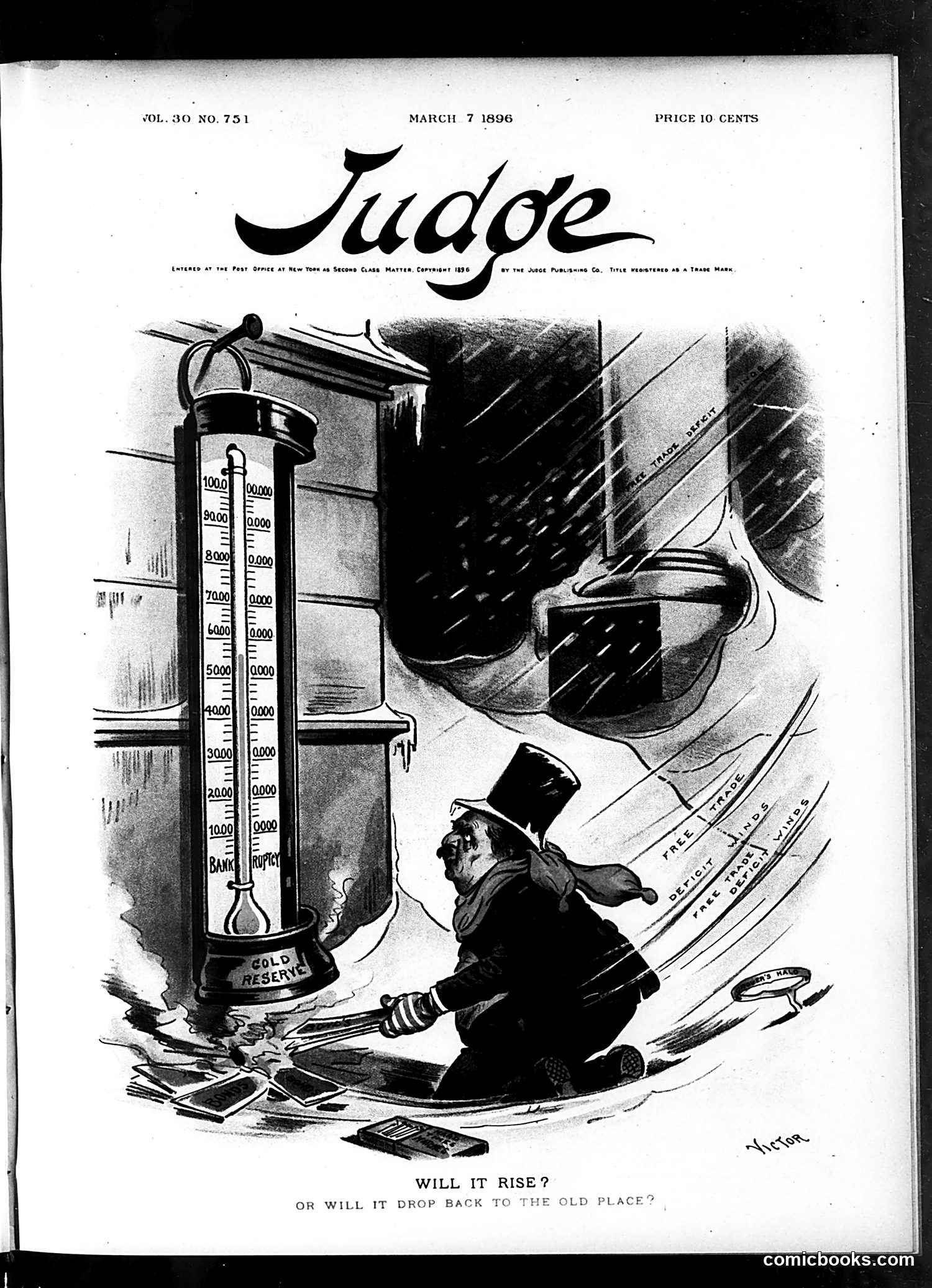
**Cartoon: "Will It Rise? Or Will It Drop Back to the Old Place?"** This political cartoon depicts a barometer labeled "COLD RESERVE" being manipulated by a figure in a top hat (likely representing a banker or financial elite). The rising/falling mercury represents stock market or economic conditions, while scattered financial documents and certificates lie at the figure's feet. The satire critiques financial manipulation and market speculation during the 1890s. The question posed—whether markets will genuinely rise or artificially collapse—suggests skepticism about whether economic recovery is real or merely engineered by wealthy insiders. The "cold reserve" barometer implies the entire system depends on artificial controls rather than natural economic forces.
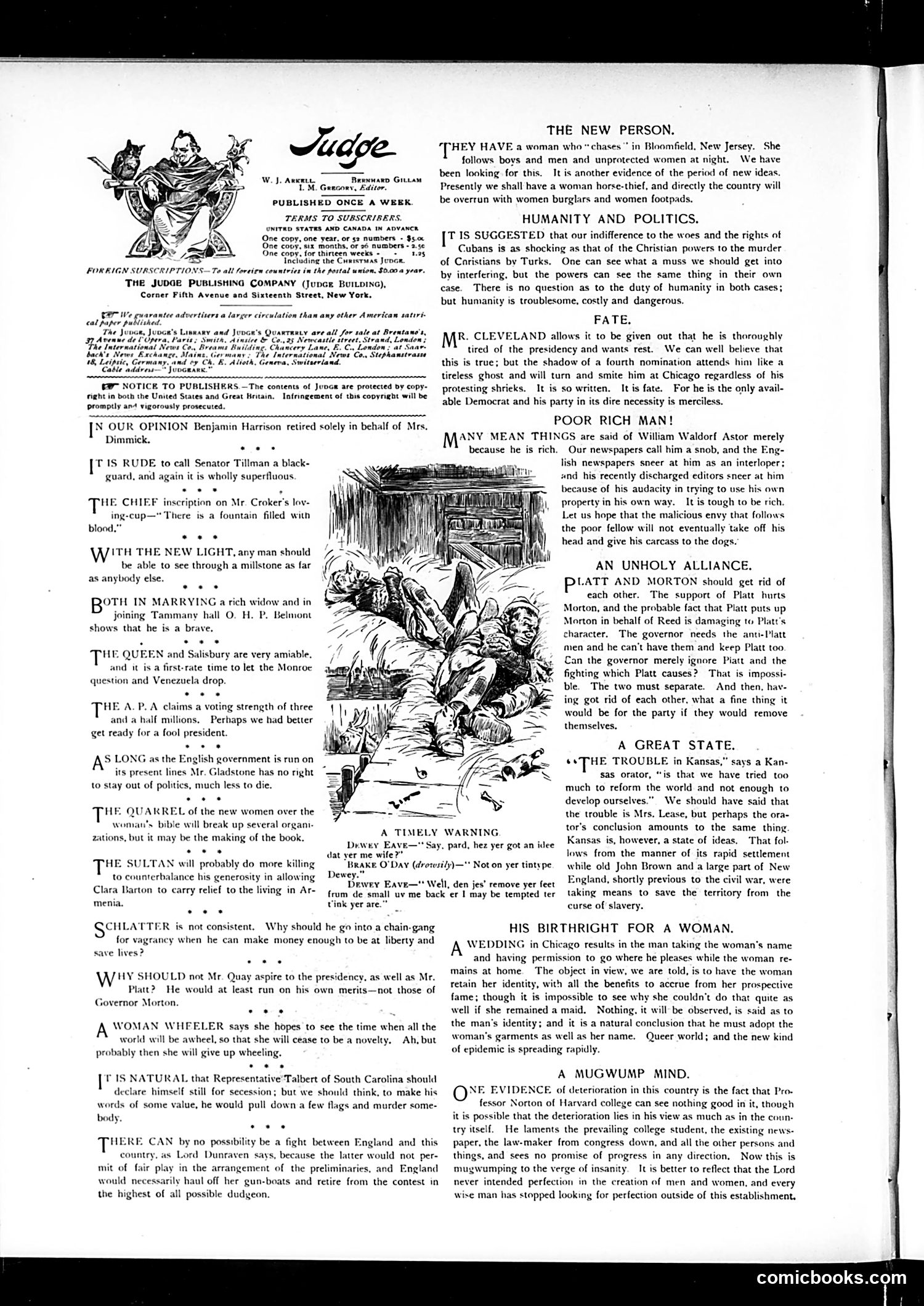
The central cartoon titled "A TIMELY WARNING" depicts a domestic scene with figures in period dress. The OCR text references "Davey Eave" and "Harvey Eave" in dialogue about removing feet from near a fire, suggesting a cautionary domestic humor piece rather than political satire. The accompanying editorial sections address contemporary issues: women's changing roles ("chasing" in Bloomfield, NJ), Cleveland's presidency fatigue, William Waldorf Astor's wealth criticism, and various political matters (Platt, Morton, the A.P.A.). Without clearer image resolution of specific caricatures or identifiable figures, the exact satirical targets remain somewhat unclear. The page appears to blend domestic humor with light political commentary typical of Judge's style, though the specific references and visual punchlines are difficult to definitively decode from this reproduction.
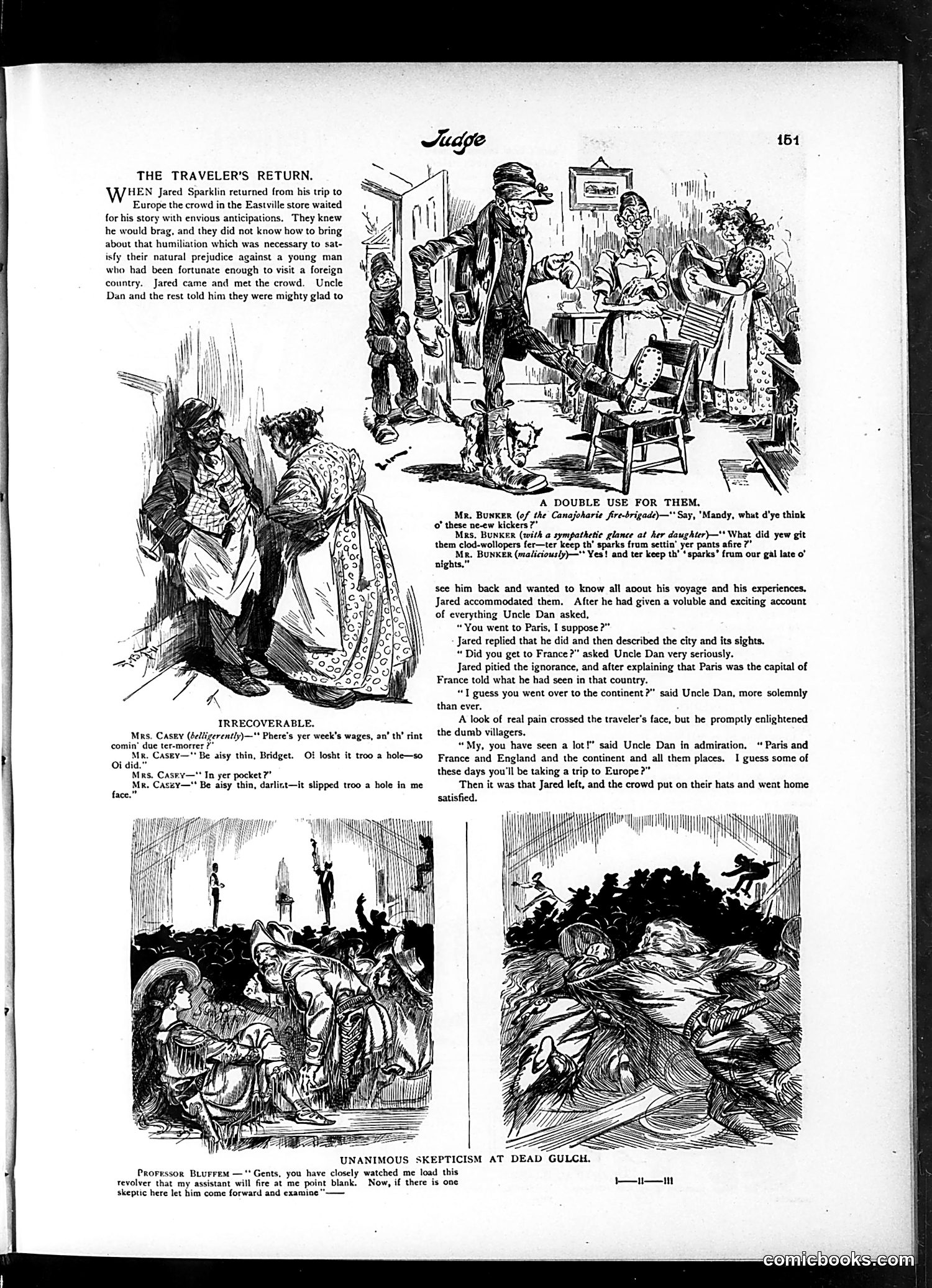
This page contains a story titled "The Traveler's Return" about a young man named Jared who traveled to Europe and returned to his small hometown (an Eastville store). The narrative satirizes provincial American attitudes toward foreign travel and cultural sophistication. The main joke targets small-town prejudice: the townspeople initially resented Jared's "fortunate enough to visit a foreign country" but welcomed him back, eager for stories. Uncle Dan and the crowd want to hear about Paris and France, but Jared's account apparently disappoints them—they expected grand tales but got mundane details instead. The satire mocks both the travelers' pretension and small-town anti-intellectualism. The bottom illustrations labeled "Unanimous Skepticism at Dead Gulch" and a dialogue between Mrs. Casey and others reinforce this theme of skepticism toward Jared's worldly experience.
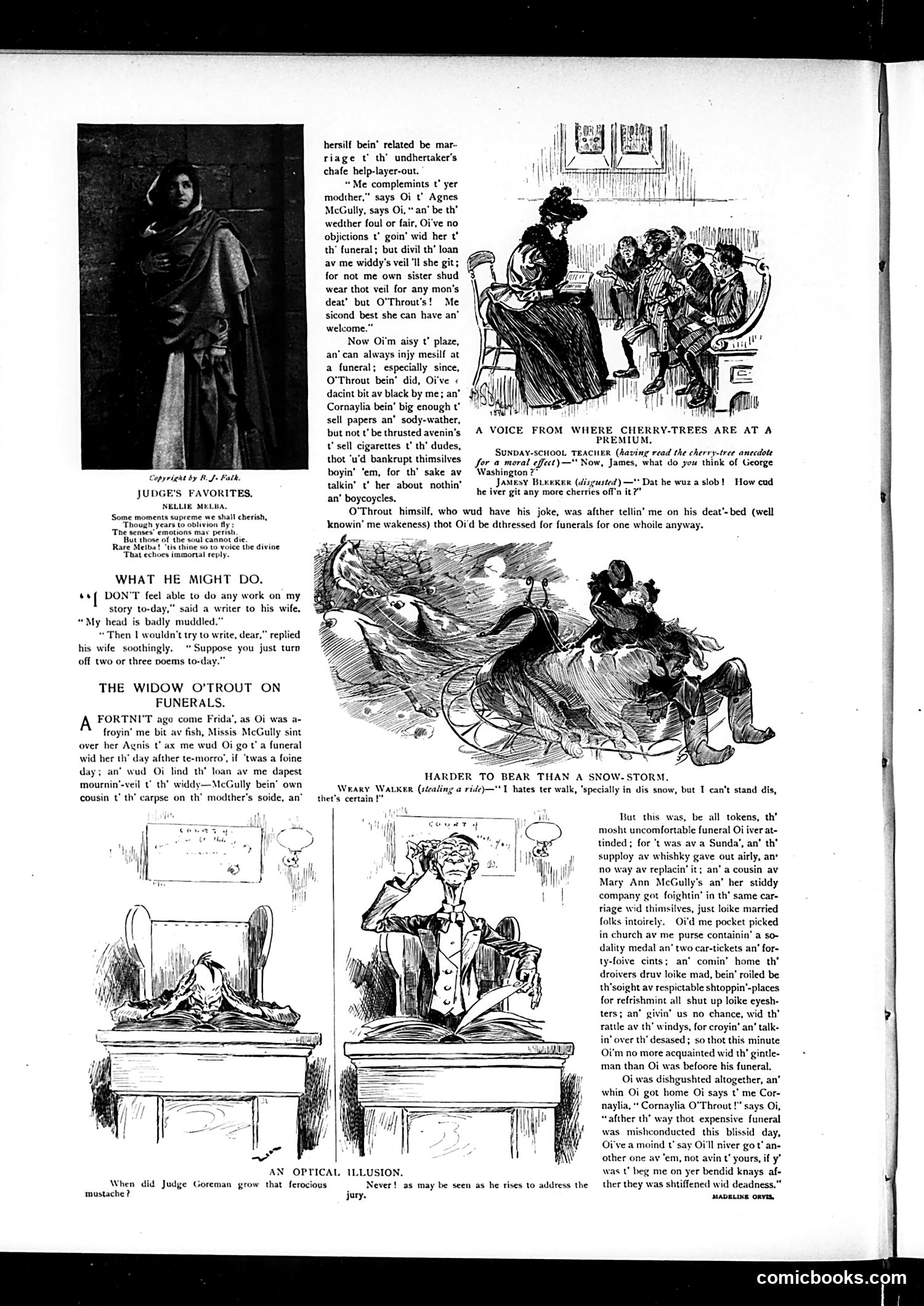
This page contains three distinct satirical pieces: 1. **"Nellie Melba" portrait**: A tribute to the famous Australian opera singer, with poetry praising her voice's immortal quality. 2. **"What He Might Do"**: A brief domestic joke where a writer claims his head is "muddled" to avoid work, and his wife sarcastically suggests he simply write "two or three poems" instead—mocking writers who claim inspiration strikes randomly. 3. **"The Widow O'Trout on Funerals"**: The main content, written in exaggerated Irish-immigrant dialect. An Irish widow recounts her uncomfortable experience at a funeral—where whisky ran out, a fight erupted, she was pickpocketed, and the carriage drove recklessly. The satire targets working-class Irish funeral customs and the chaotic social disorder that ensues. The piece relies heavily on ethnic stereotype humor typical of late 19th/early 20th-century American magazines. Supporting cartoons illustrate funereal solemnity and a sarcastic take on George Washington's cherry-tree legend.
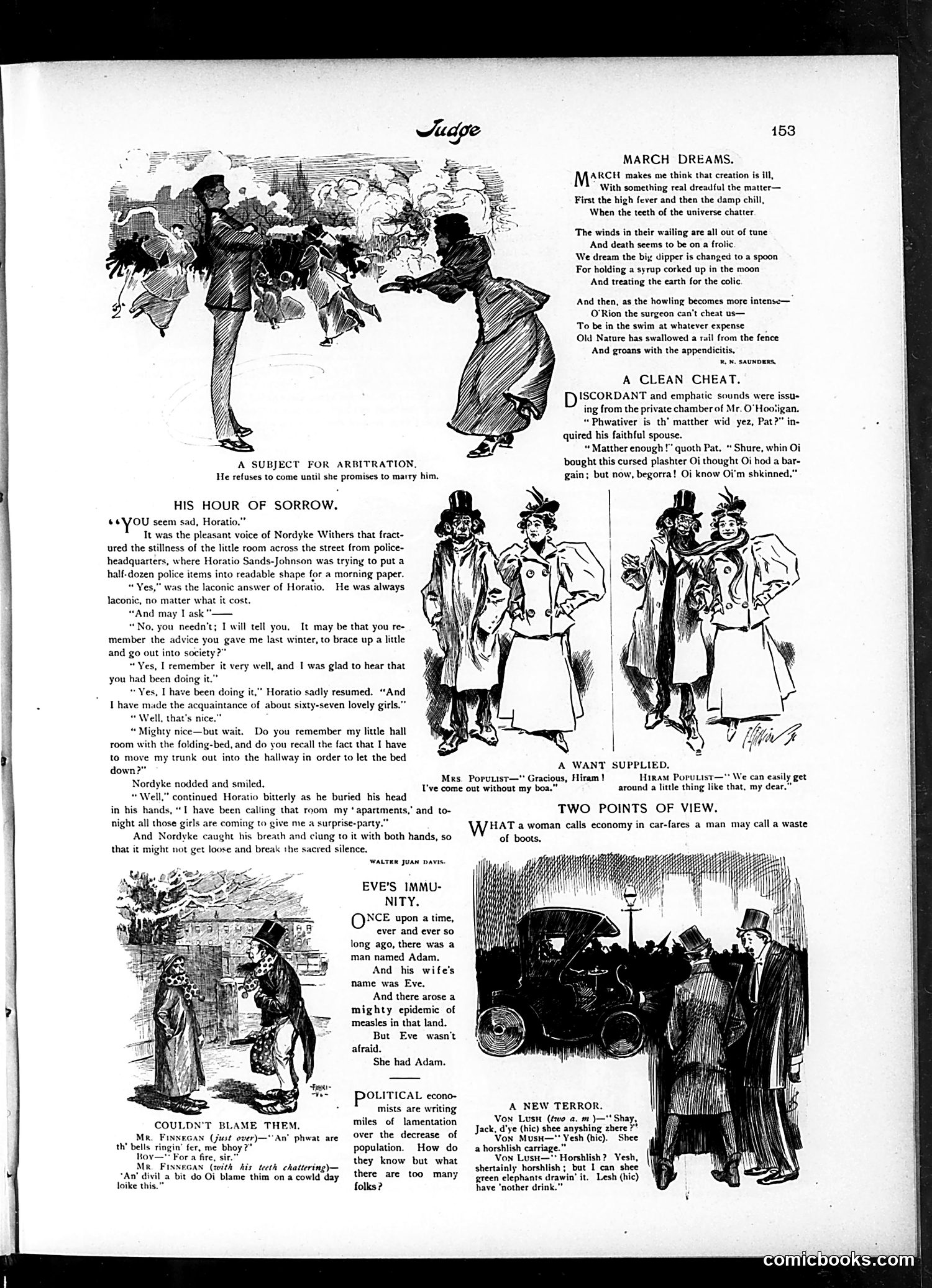
This page contains several unrelated satirical pieces typical of Judge's format: **"March Dreams"** is a poetic piece personifying March as a sickly season, with nature suffering ailments (appendicitis, etc.)—standard seasonal humor. **"His Hour of Sorrow"** mocks a newspaper reporter who took social advice and now faces embarrassment: he invited 67 young women to visit his tiny apartment simultaneously, thinking it would impress them. **"A Clean Cheat"** features Irish-dialect characters (O'Hootigan and Pat) discussing a bad plaster purchase—ethnic humor common to the era. **"Eve's Immunity"** makes a biblical pun: Eve wasn't afraid of a measles epidemic because "she had Adam"—a play on the common phrase. **"Two Points of View"** contrasts how men and women interpret the same action differently. **"A New Terror"** depicts two intoxicated men seeing hallucinations (green elephants), satirizing drunkenness. The page contains no apparent major political content—mostly light domestic and social humor typical of Judge's satirical magazine format.
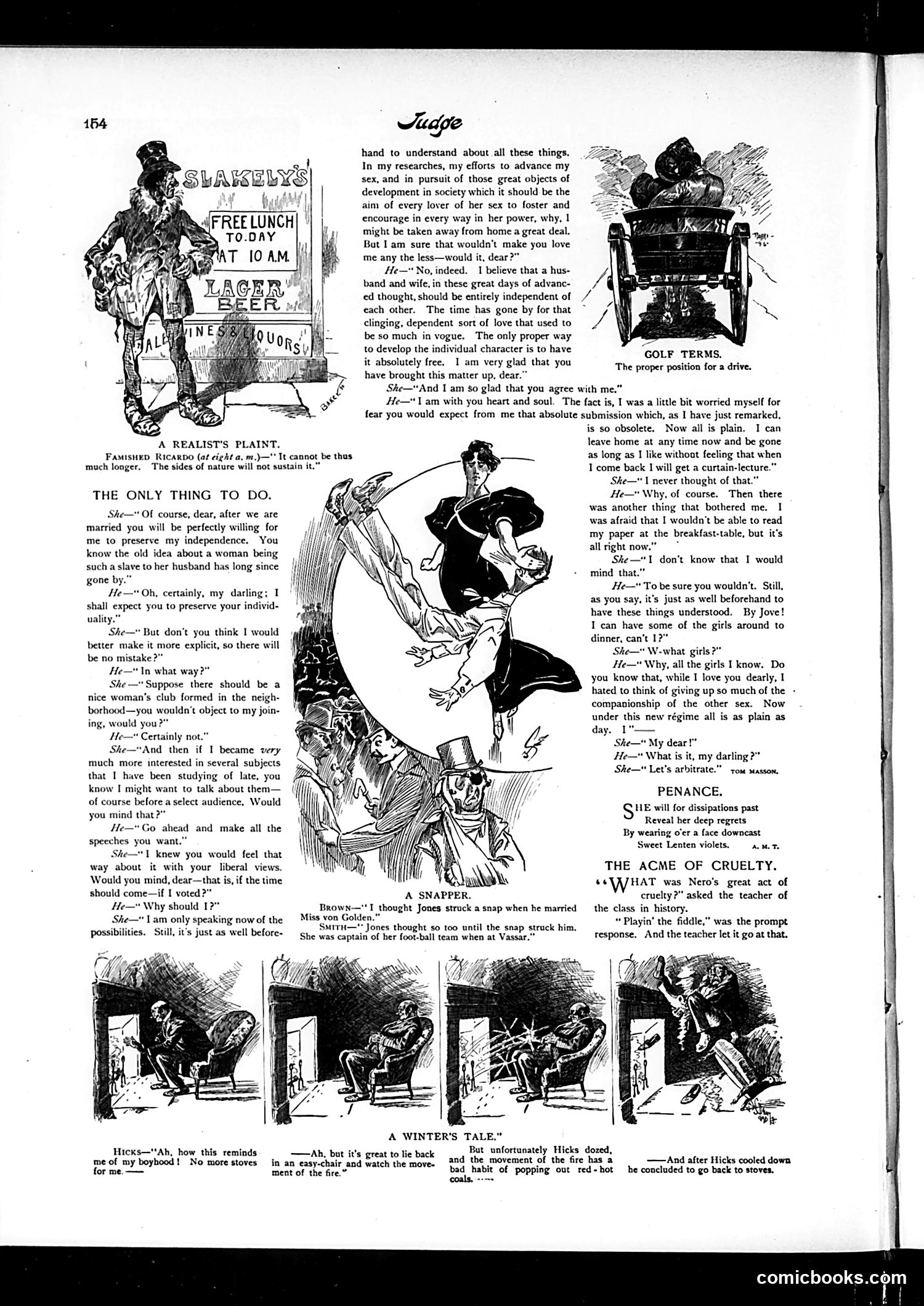
This page satirizes the emerging "New Woman" movement of the early 20th century, which advocated for female independence and equality in marriage. **Main Cartoon: "The Only Thing to Do"** A newly engaged couple discusses marriage terms with radical modern views. The husband enthusiastically endorses his fiancée's independence—she can join clubs, give speeches, vote, and maintain her own life. However, the satire becomes clear in his final concessions: he casually reveals he wants to read the newspaper at breakfast undisturbed and host dinners with "all the girls I know." The joke targets both partners' hypocrisy: they espouse equality while actually pursuing separate interests that benefit primarily him. The woman's final line—"Let's arbitrate"—suggests the arrangement's absurdity requires mediation. **Supporting Elements:** - Advertisements and shorter jokes fill the page - The "Winter's Tale" comic strip depicts a man enjoying a fire, satirizing domestic comfort The satire mocks progressive rhetoric about marital independence as a cover for selfishness rather than genuine equality.
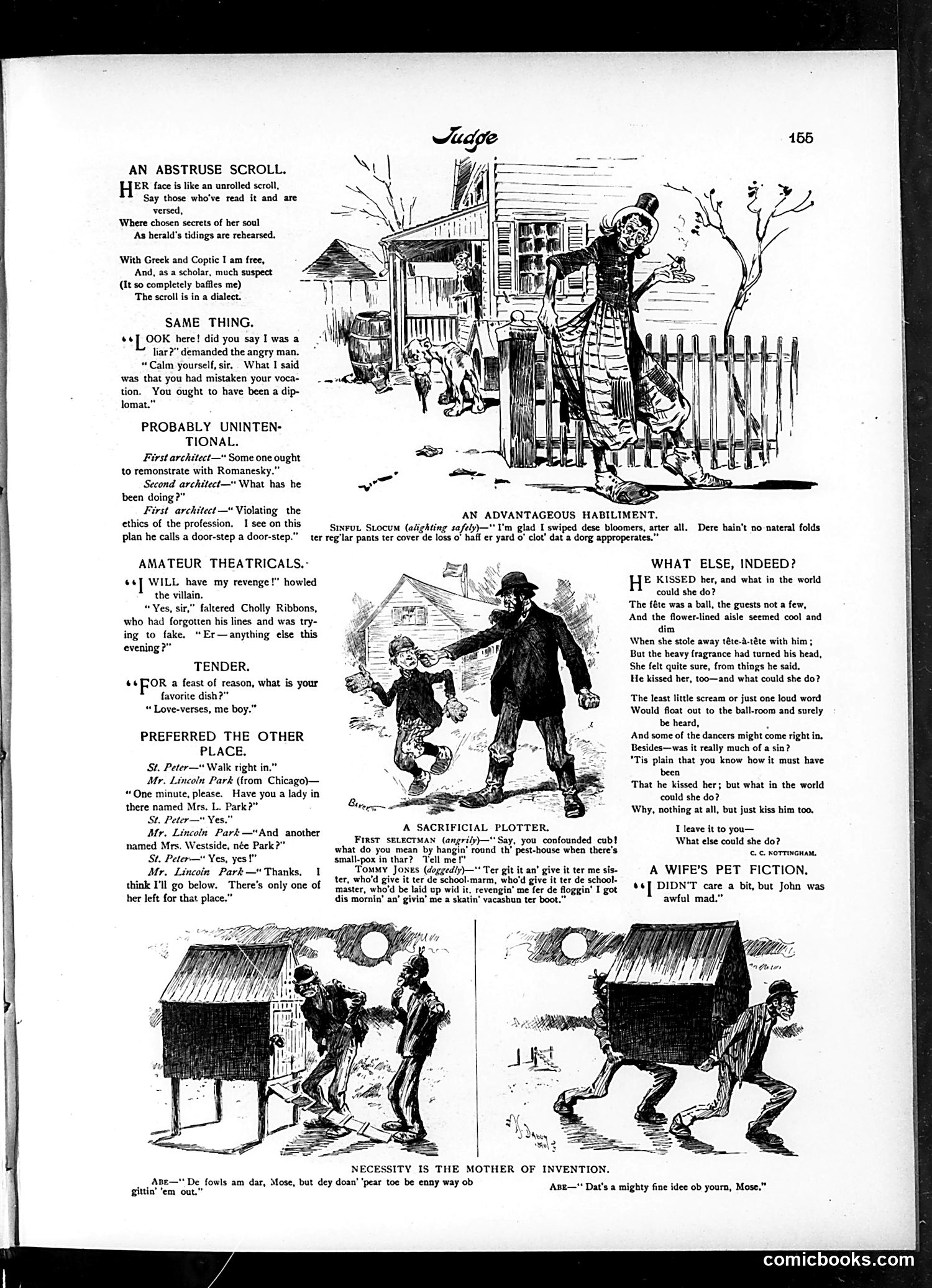
This page collects various brief satirical pieces typical of Judge magazine's humor. Key items include: **"Same Thing"**: A man accused of lying is told he should be a diplomat—implying diplomats are professional liars, a common early 20th-century jab at politicians. **"Amateur Theatricals"**: Mock-heroic theater scene where an actor forgets his lines and improvises poorly, satirizing amateur dramatic performances. **"Preferred the Other Place"**: A Chicago man (Mr. Lincoln Park) discovers multiple women with similar names in heaven and chooses hell instead—a joke about marital misery. **"What Else, Indeed?"**: A romantic poem with mild social commentary about a woman kissed at a ball who cannot protest without scandal—reflecting period concerns about propriety and women's constrained social positions. **Dialect humor sketches** ("An Advantageous Habiliment," "Necessity Is the Mother of Invention"): Feature African American vernacular characters in comedic situations, representing common (though offensive by modern standards) period humor conventions. The overall tone reflects turn-of-the-century American satirical magazine content.
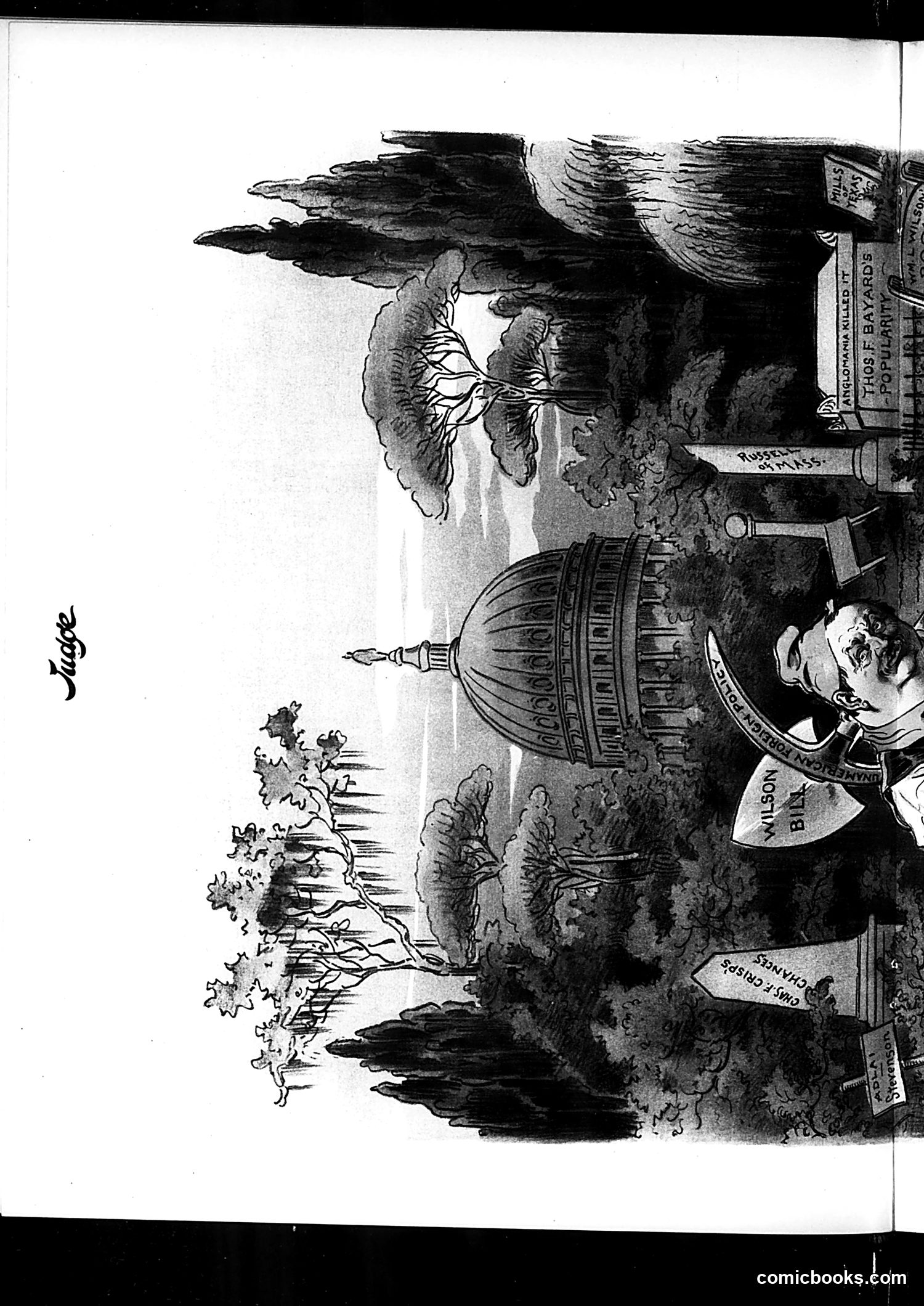
This page appears to be rotated 90 degrees, making interpretation challenging. The visible illustration shows a caricatured figure (likely a political or social figure) positioned near an ornate dome structure, with what appears to be a map or geographical representation on the left side showing various regions or territories. The style is consistent with Judge magazine's satirical approach to American politics and society. However, without being able to read the accompanying text clearly due to image quality and rotation, I cannot confidently identify the specific political figures, events, or social commentary being satirized. The dome structure suggests federal or governmental themes typical of Judge's content. To provide accurate historical context, clearer text and proper image orientation would be necessary.
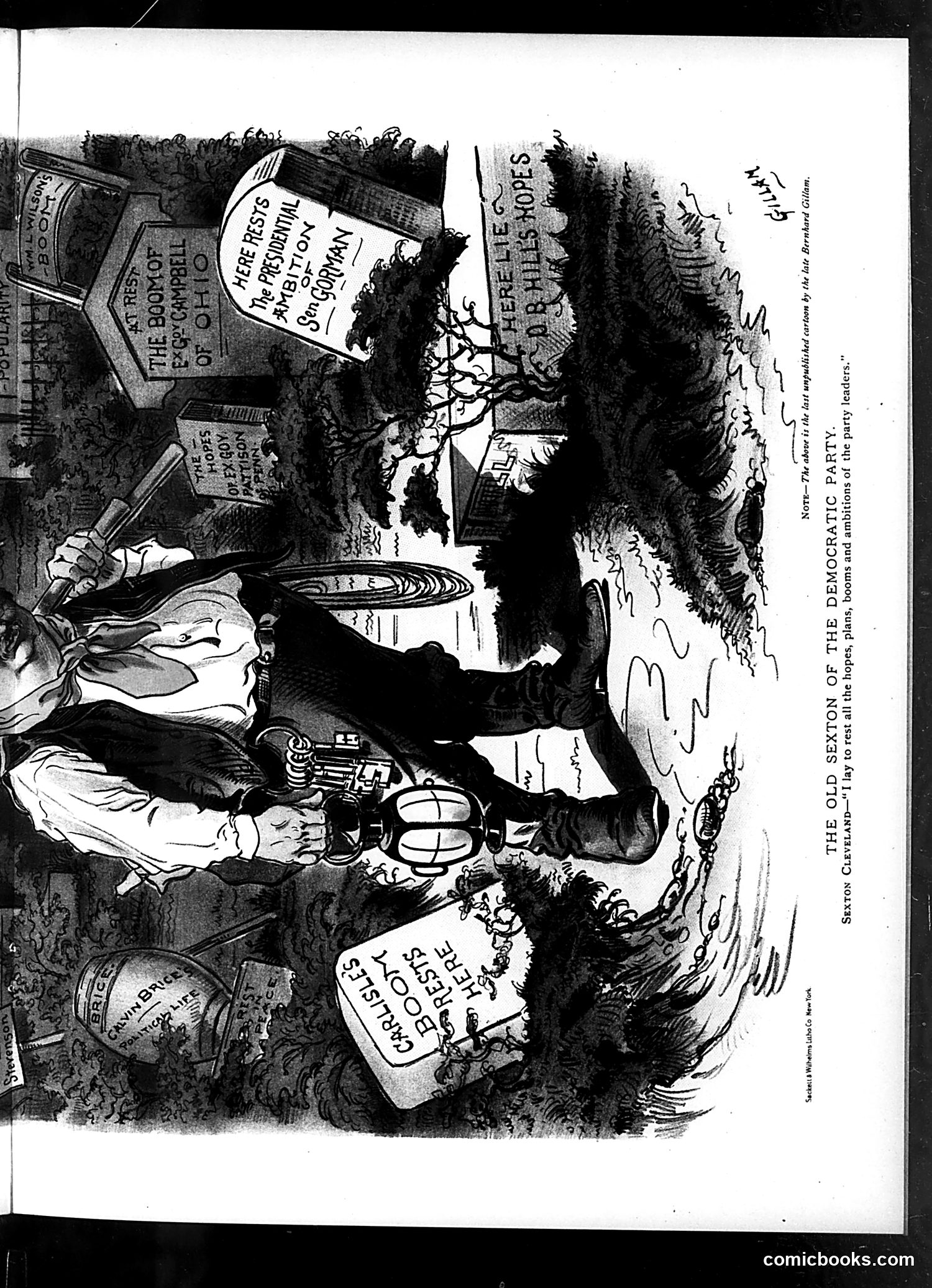
This appears to be a satirical cartoon from *Judge* magazine criticizing the Democratic Party's internal divisions. The image shows a skeletal or death-like figure labeled as the "old sexion [sexton]" of the Democratic Party—using "sexton" (a church gravedigger) as a metaphor for someone presiding over the party's demise. The cartoon depicts various bottles and containers with labels referencing Democratic political positions or factions, suggesting the party is fragmenting or "dying" from internal contradictions. The dark, grotesque imagery emphasizes the satire's harsh critique. Without clearer visibility of specific bottle labels and dates, the exact political moment is unclear, but this appears to mock Democratic Party disunity during a particular era, likely the late 19th or early 20th century when such factional disputes were common.
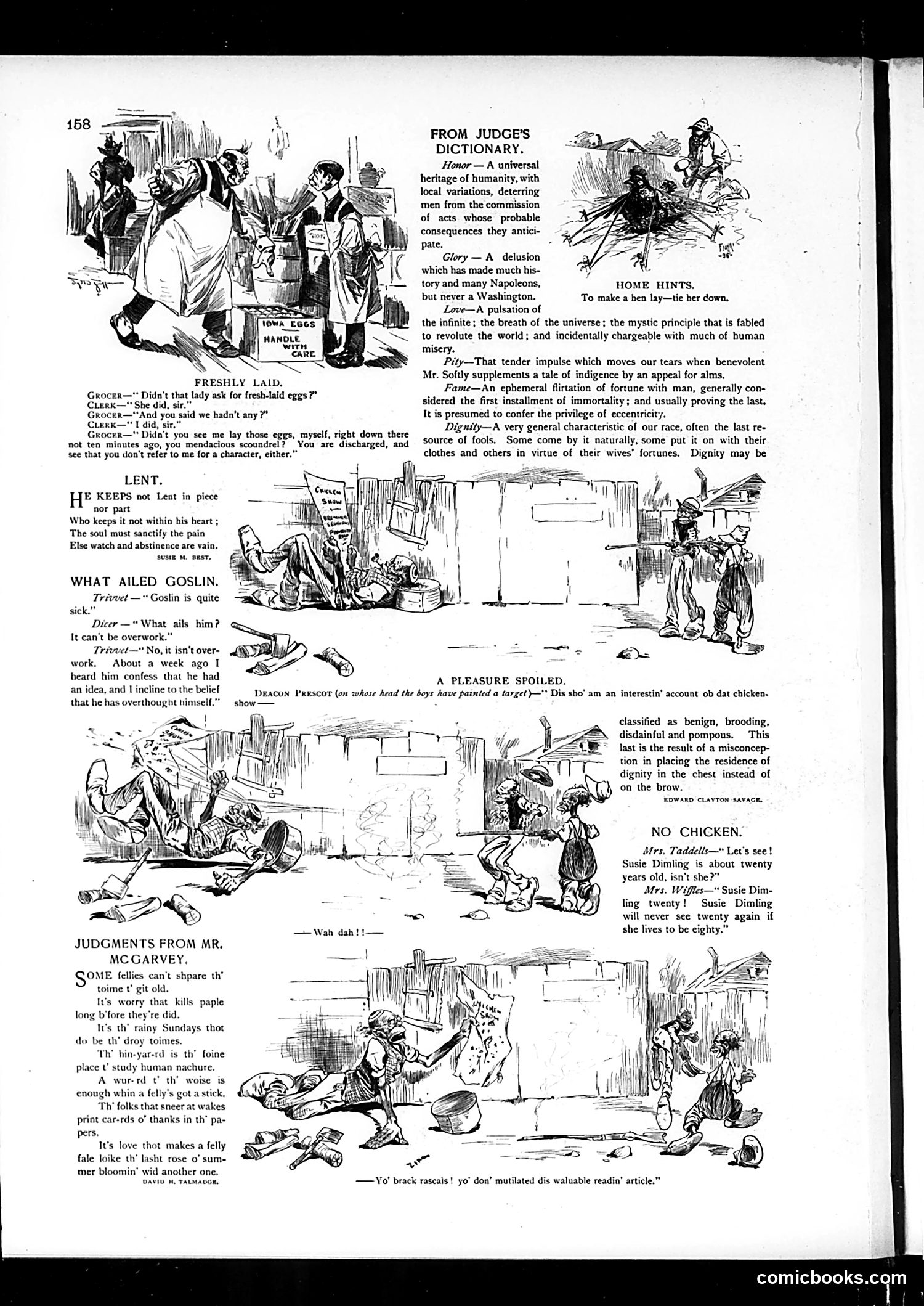
This page from the satirical magazine *Judge* contains multiple humor pieces mocking American society and institutions: **"From Judge's Dictionary"** offers cynical definitions of abstract concepts—Honor, Glory, Love, Fame, Dignity—deflating their romantic ideals. The tone suggests widespread hypocrisy: Glory produces "Napoleons, but never a Washington"; Dignity is often acquired through "wives' fortunes." **"Freshly Laid"** depicts a grocer caught in a lie about eggs, fired for dishonesty—commentary on commercial fraud and customer relations. **"What Ailed Goslin"** jokes that a man's illness stems from having "an idea"—suggesting intellectual effort is dangerous or uncommon. **"Judgments from Mr. McGarvey"** offers folk wisdom in dialect about worry, death, and human nature, likely satirizing rural stereotypes. **"A Pleasure Spoiled"** and **"No Chicken"** feature dialect humor about African Americans and aging women respectively—typical period comedy relying on stereotypes and appearance-based mockery. The page overall reflects late-19th/early-20th-century satirical humor targeting commercial dishonesty, pretension, and various social groups through exaggeration and crude stereotyping.

This is a **Pabst Malt Extract advertisement**, not political satire. The page uses humor to market a patent medicine as a tonic. The ornate circular design frames the "Baby" Milwaukee Pabst branding (the B logo with a hop leaf). Below, a mock-serious dialogue lists symptoms of supposed ailment—"Enervated, Run Down, Flaccid, Debilitated"—typical of early-1900s medical advertising language designed to create anxiety about vague health complaints. The joke is the dismissive response: "We did. What's the good of telling symptoms?" The advertiser sarcastically suggests that listing ailments is pointless—the reader already knows they need "spring medicine," and Pabst Malt Extract is the cure-all tonic. This reflects era advertising tactics exploiting hypochondria and promoting dubious tonics as panaceas. The "Best" Tonic claim and pricing ($0.25 per bottle, $2.50 per dozen) were typical of patent medicine marketing before FDA regulation.
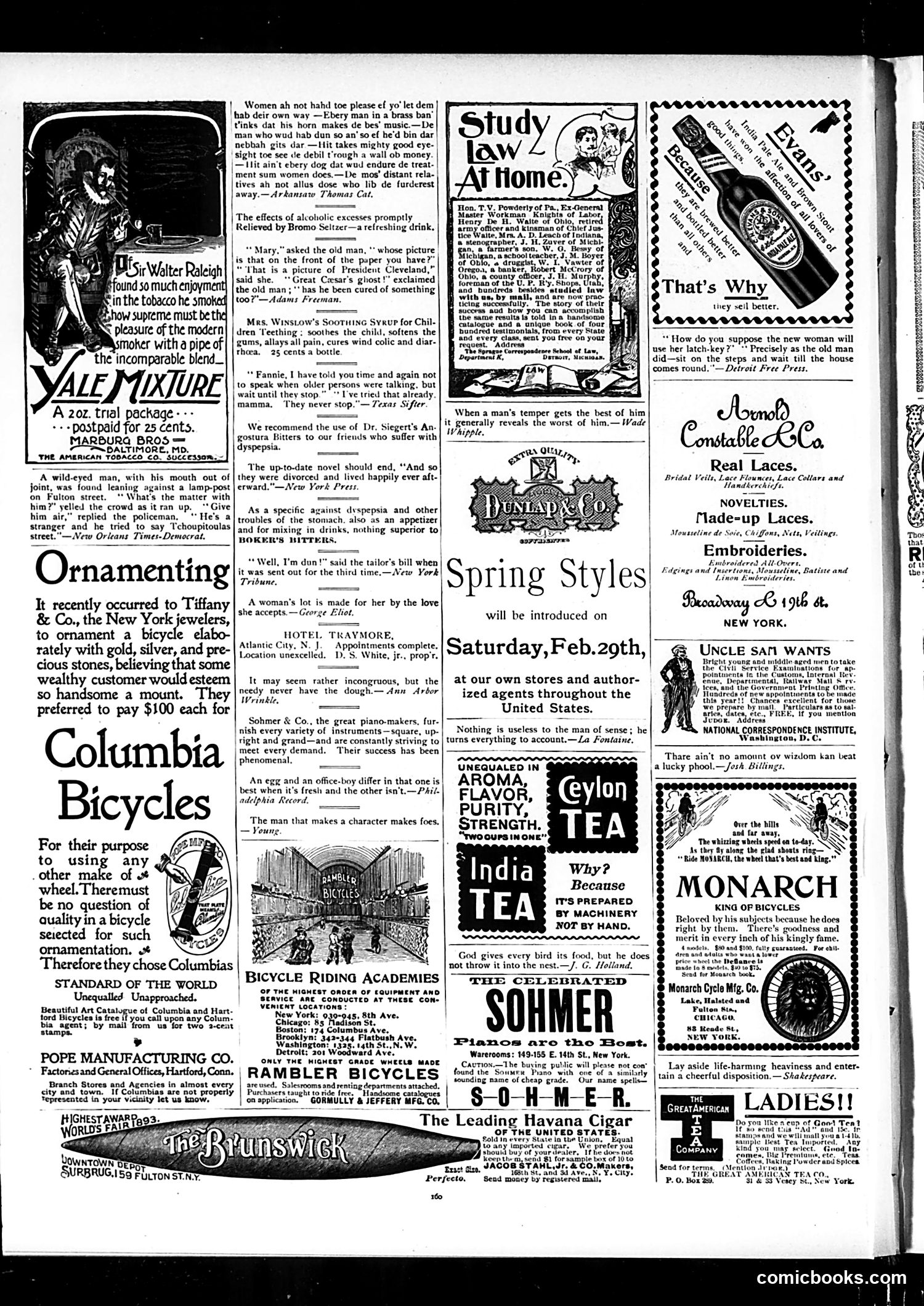
This page from *Judge* magazine (circa 1896, based on bicycle and product advertising) is primarily **advertising with snippets of humor**—not a major political cartoon. The largest cartoon visible concerns **ornate bicycle decoration**. The joke: Tiffany & Co., the luxury jeweler, spent $100 apiece adorning Columbia bicycles with gold and precious stones. The satire mocks both wealthy vanity and the absurdity of over-ornamenting a functional object. The underlying point: quality bicycles need no such embellishment—Columbia's reputation speaks for itself. The page also includes ethnic dialect humor typical of the era (racist by modern standards), product testimonials, and smaller jokes (like the reference to "Tchoupitoulas street"—a notoriously difficult-to-pronounce New Orleans street name used to mock immigrants or outsiders). The bulk is commercial advertising for bicycles, pianos, cigars, and patent medicines—standard *Judge* content. There's no significant political satire present on this page.
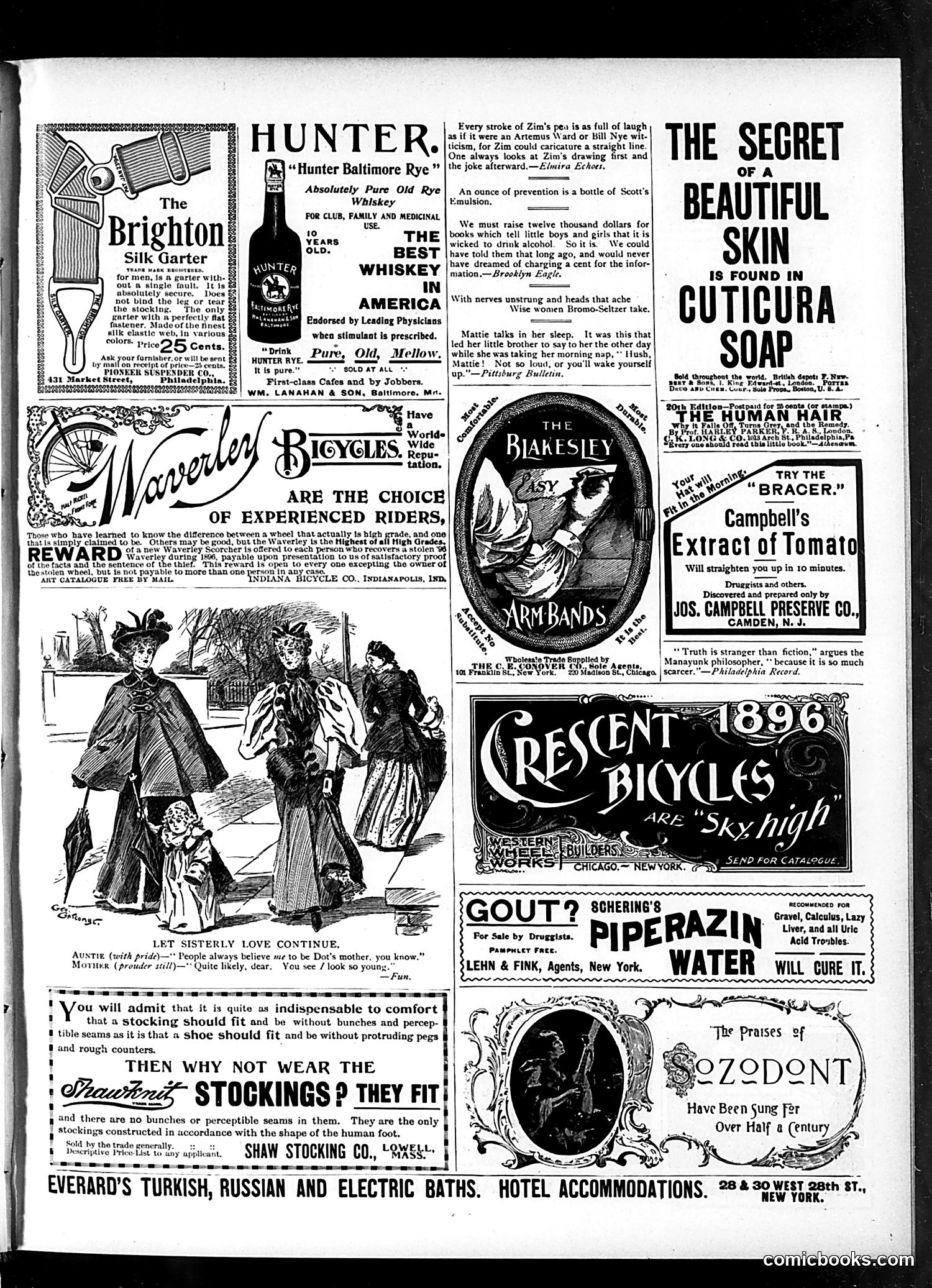
This is primarily an **advertising page** from Judge magazine, typical of late 19th-century publications. The layout contains multiple product advertisements rather than satirical cartoons. Notable elements include: **The main cartoon** ("Let Sisterly Love Continue") depicts three fashionably dressed women with a child, illustrating a humorous exchange where "Auntie" is mistaken for a child's mother due to her youthful appearance—reflecting period anxieties about aging and vanity. **Advertisements showcase era-specific concerns**: garters, bicycles (the Waverley), medicinal whiskey "endorsed by leading physicians" (reflecting pre-Prohibition attitudes toward alcohol as medicine), and patent remedies like Bromo-Seltzer and "Piperazin Water" for gout—products typical of an age before FDA regulations, when such tonics made unverified health claims. **A reference to "Zim"** (likely cartoonist Eugene Zimmerman) praises his caricature skills, suggesting he was a notable Judge contributor. The page reflects consumer culture and advertising standards of the 1890s more than political satire.
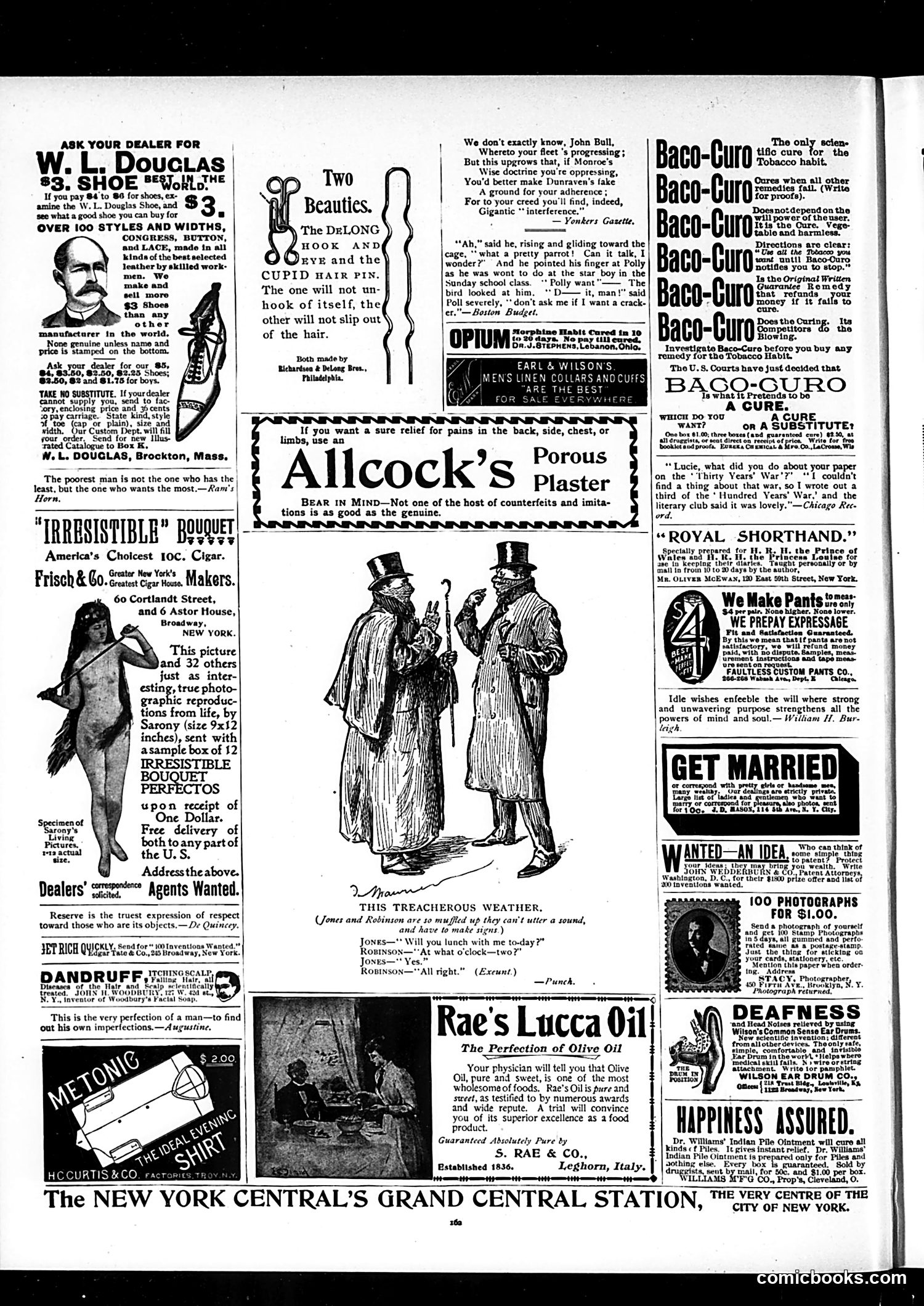
This is primarily an **advertising page** from Judge magazine, with one notable satirical cartoon. The main cartoon, titled "THIS TREACHEROUS WEATHER," depicts two heavily bundled figures (Jones and Robinson) so wrapped against cold that they cannot speak—they can only make hand gestures to communicate. The caption notes they "have to make signs." This is a visual pun: the men are literally "making signs" (gestures) because winter weather has rendered them unable to talk. It's gentle social satire about extreme cold weather rendering people nearly immobile and speechless. The page is otherwise dominated by period advertisements for patent medicines (Allcock's Porous Plaster, Baco-Curo tobacco cure), shoe manufacturers (W.L. Douglas), cigars, and other commercial products typical of early 20th-century magazine advertising. One small text item appears to reference "John Bull" and the Monroe Doctrine (American foreign policy), suggesting some political content, but lacks accompanying illustration.
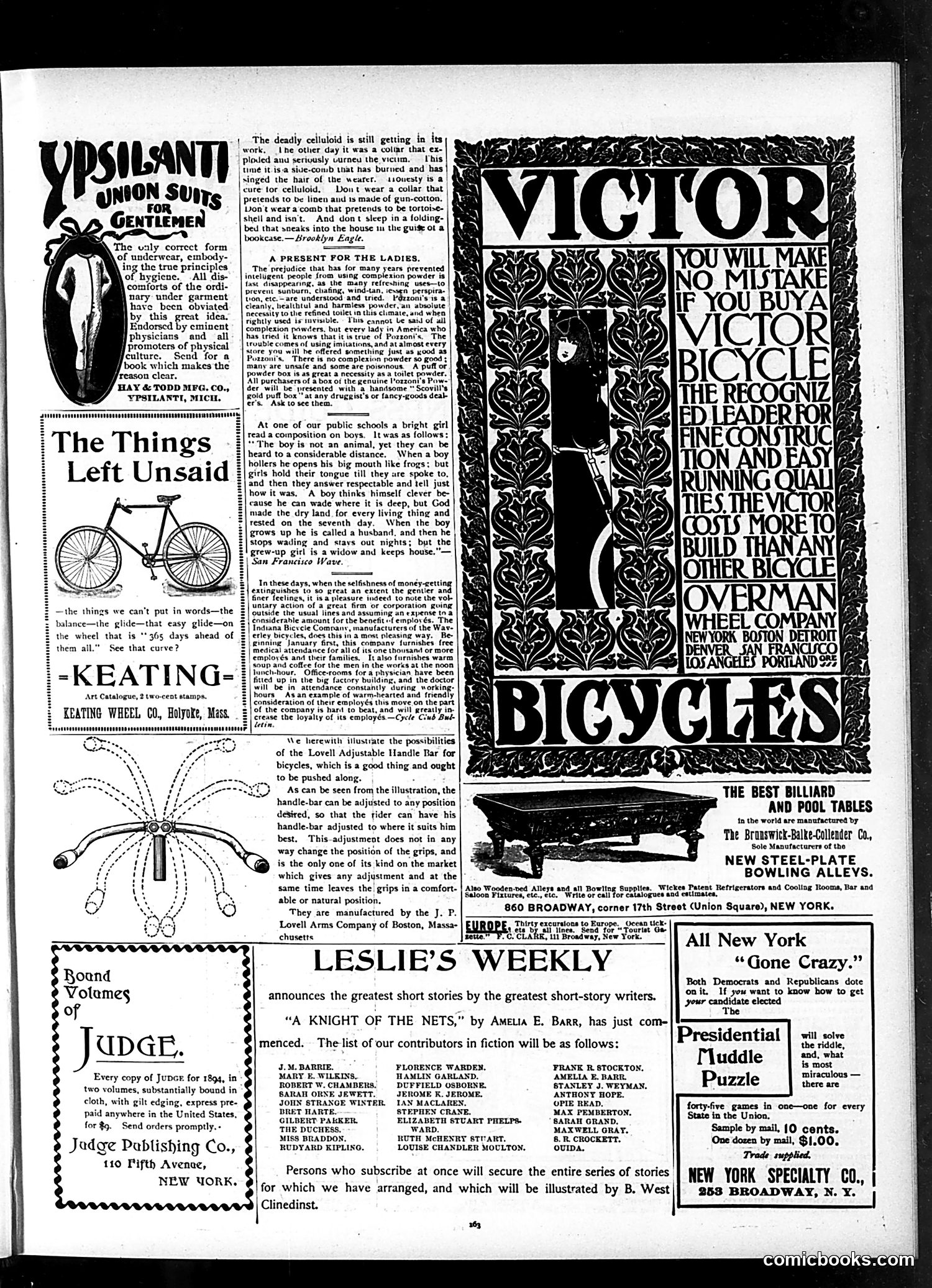
This page primarily consists of **advertisements and short humor pieces** rather than political cartoons. The content reflects early 1900s American concerns: **Key Content:** 1. **"Celluloid Dangers"** — A satirical warning about combustible celluloid products (collars, combs, folding beds) that spontaneously ignite, disguised as legitimate goods. This references a genuine public safety concern of the era. 2. **"Complexion Powder"** — An advertisement for Pozzoni's powder, addressing widespread Victorian prejudice against women using cosmetics, framed as promoting hygiene and refinement. 3. **A Schoolgirl's Essay on Boys** — Humorous commentary on gender differences, depicting boys as loud and foolish, girls as sensible and domestic—reflecting period gender stereotypes. 4. **Industrial Paternalism** — Text praising the Watsonville Bicycle Company for providing medical care and meals to workers, presenting this as enlightened business practice rather than labor necessity. The page reflects turn-of-the-century consumer culture, gender attitudes, and early corporate welfare rhetoric.
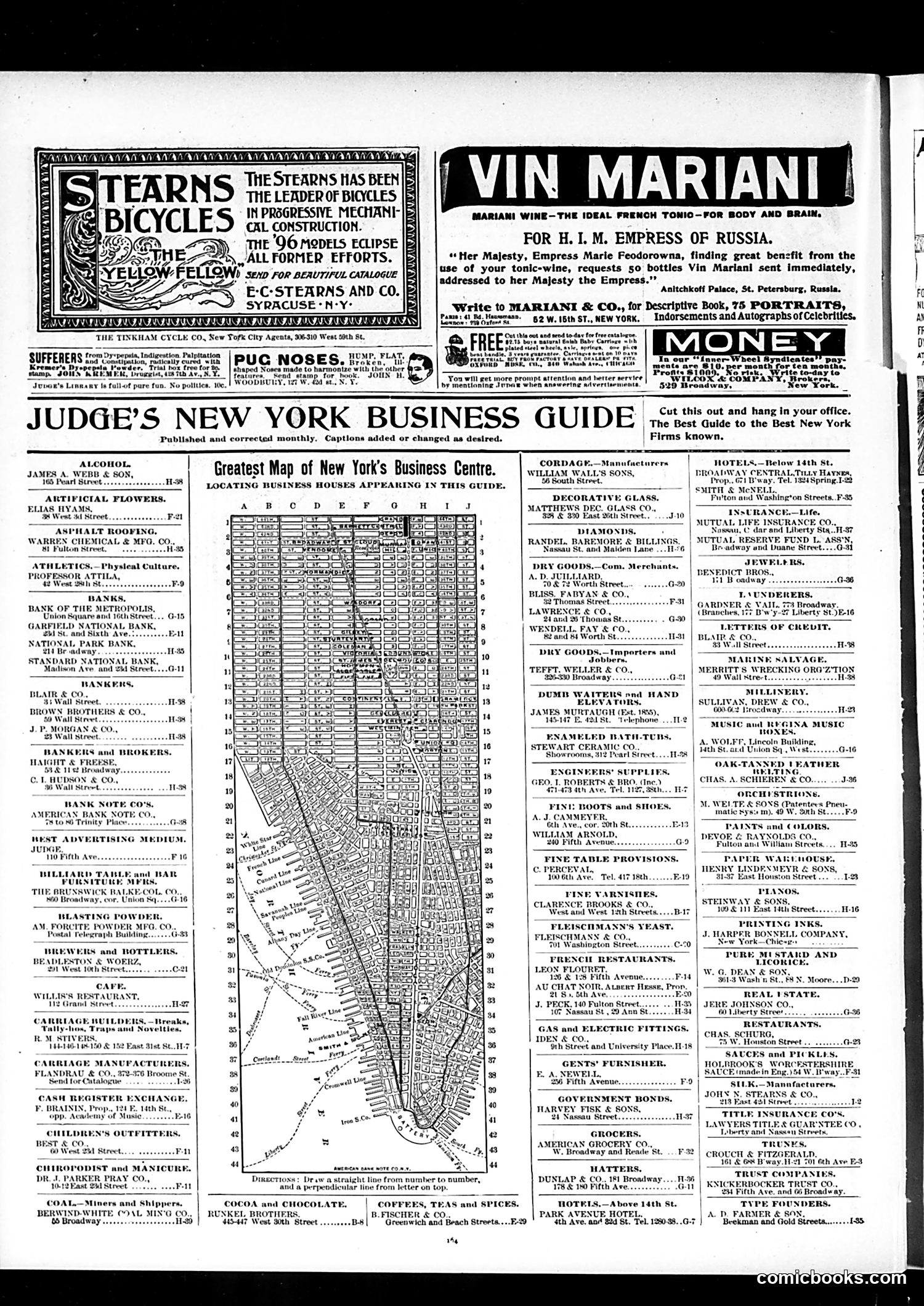
This page is primarily a **business directory and advertising**, not a political cartoon. The notable content includes: **Main Advertisement**: Vin Mariani wine, prominently featuring an endorsement attributed to the Empress of Russia (Marie Feodorowna). This appears designed to boost the product's prestige through royal association—a common marketing tactic of the era. The wine claimed medicinal benefits "for body and brain." **Other Ads**: Include Stearns Bicycles, constipation remedies, and various NYC business services—typical late 19th-century patent medicine and commercial advertising. **The "Business Guide"**: A detailed map and directory of New York City businesses, meant as a practical reference for navigating the commercial district. **No significant political satire** is visible on this page. It reflects the era's acceptance of celebrity endorsements and medicinal claims later restricted by FDA regulations.
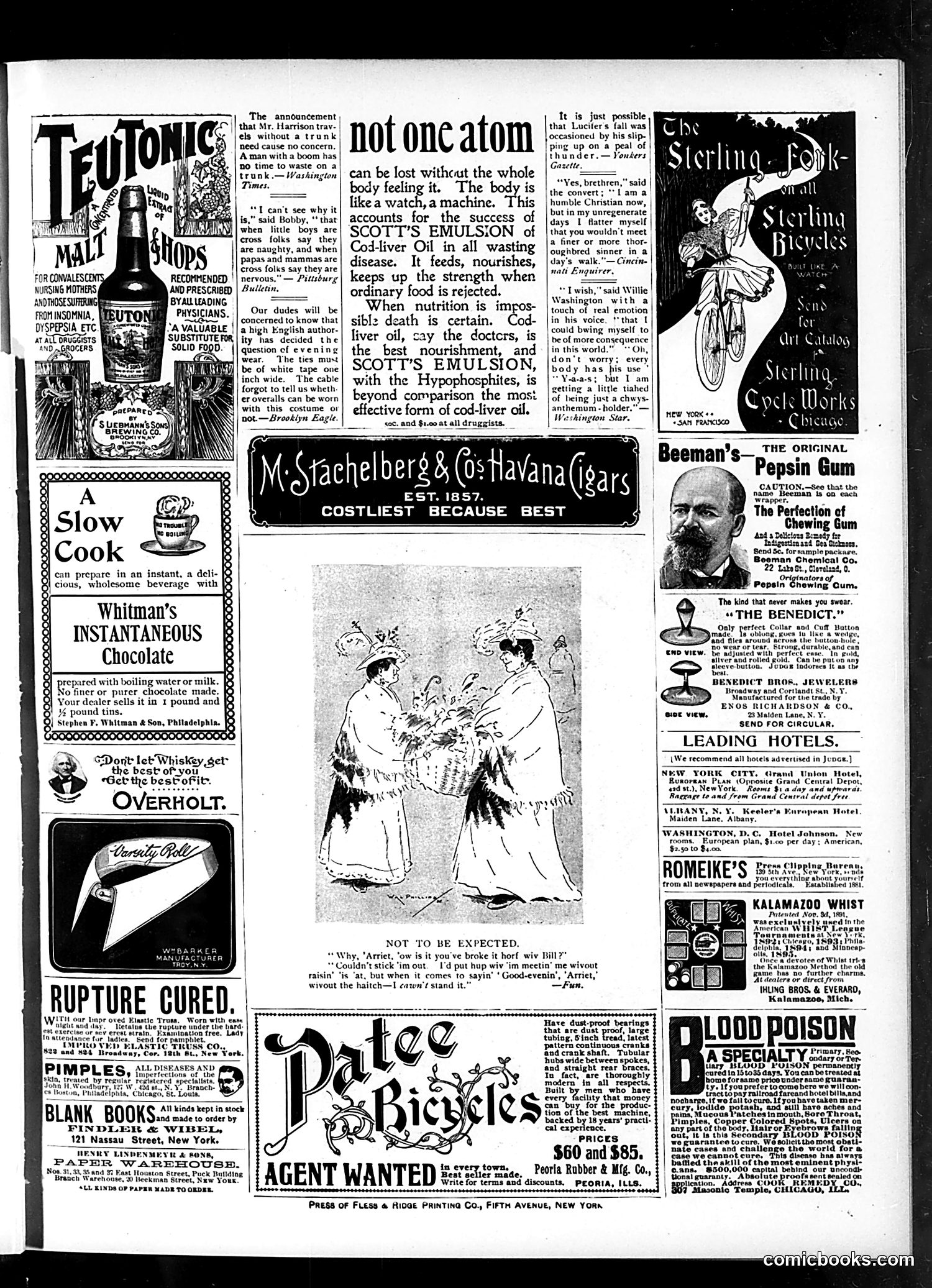
This page is primarily a **commercial advertising section** from Judge magazine, with minimal satirical content. The only cartoon is a small sketch titled "NOT TO BE EXPECTED," depicting two working-class figures discussing a broken object. The dialogue—where one character cannot say "h" sounds (dropping his h's)—plays on **class-based dialect humor** common to the era. The joke appears to mock working-class speech patterns, with the character's linguistic limitation presented as comedic. The remainder of the page consists of period advertisements for consumer goods: patent medicines (Scott's Emulsion, Whitman's Chocolate), whiskey, bicycles, chewing gum, cigars, and hotels. These ads reflect late-19th/early-20th century commercial culture and marketing strategies. The page contains no identifiable political figures or significant satirical commentary—it functions primarily as a revenue-generating advertisement section rather than editorial content.
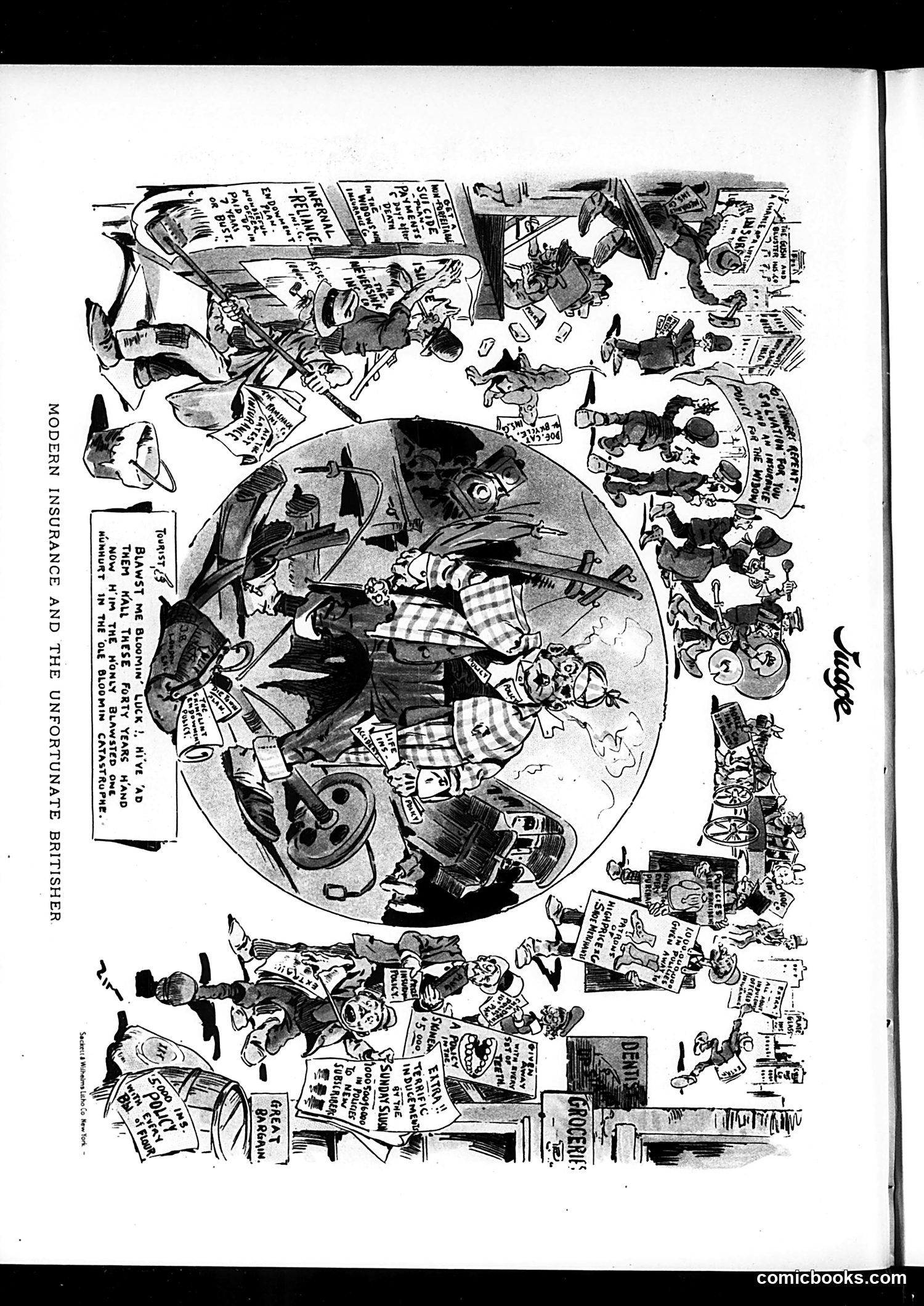
This Judge magazine cartoon satirizes the absurdity of insurance claims through a British character—identifiable by his accent ("Bloomin'," "H'lm," "Wole")—who has survived a catastrophic accident unscathed while everything around him is destroyed. The central circular illustration shows a chaotic scene of wreckage: vehicles, buildings, and debris scattered everywhere. The Britisher stands amid the carnage, ironically complaining that he's the "only blawsted one unhurt in the 'ole bloomin' catastrophe" after forty years. The satire targets the insurance industry: the joke appears to be that modern insurance policies are so riddled with exclusions and conditions that even in total disaster, the policyholder cannot collect—because he survived. The surrounding vignettes (though illegible in detail) likely show other insurance-related complications. This reflects Gilded Age skepticism toward insurance companies and their reputation for denying legitimate claims through legal technicalities.