
A complete issue · 16 pages · 1896
Judge — January 18, 1896
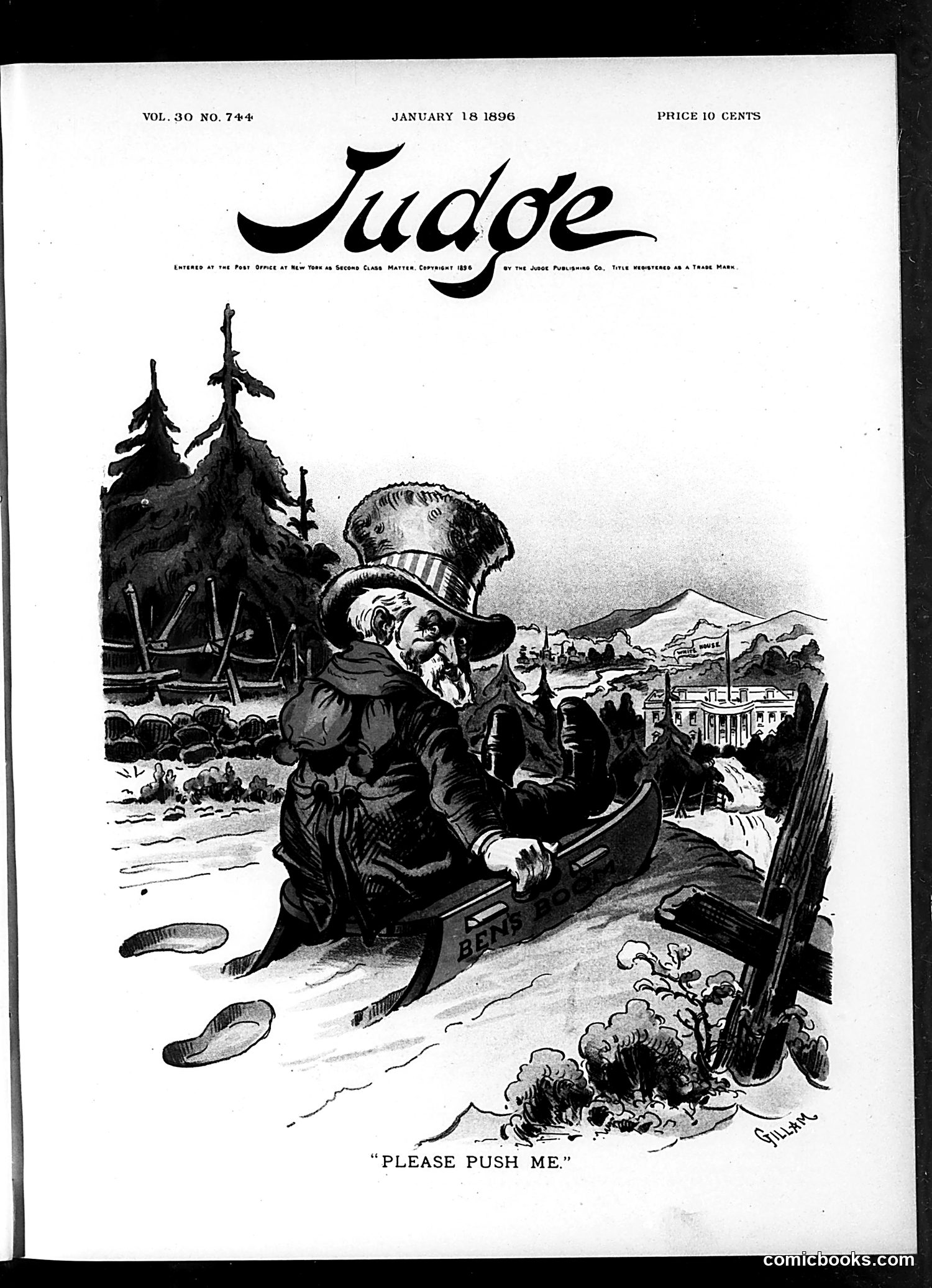
This political cartoon depicts a caricatured figure (likely representing a political or national leader, based on the exaggerated facial features and formal dress) sitting in a sleigh labeled "BUNK," asking to be pushed. The winter/snowy setting and Russian Orthodox church in the background suggest this references Russia or Russian affairs. The satire appears to mock either Russian political instability or a leader's dependence on external pressure to act. The phrase "Please push me" suggests the figure lacks independent agency or initiative, requiring outside force to move forward—a critique of either weak leadership or reluctance to pursue certain policies. The elaborate costume and caricature style were typical of Judge's political commentary from this era.
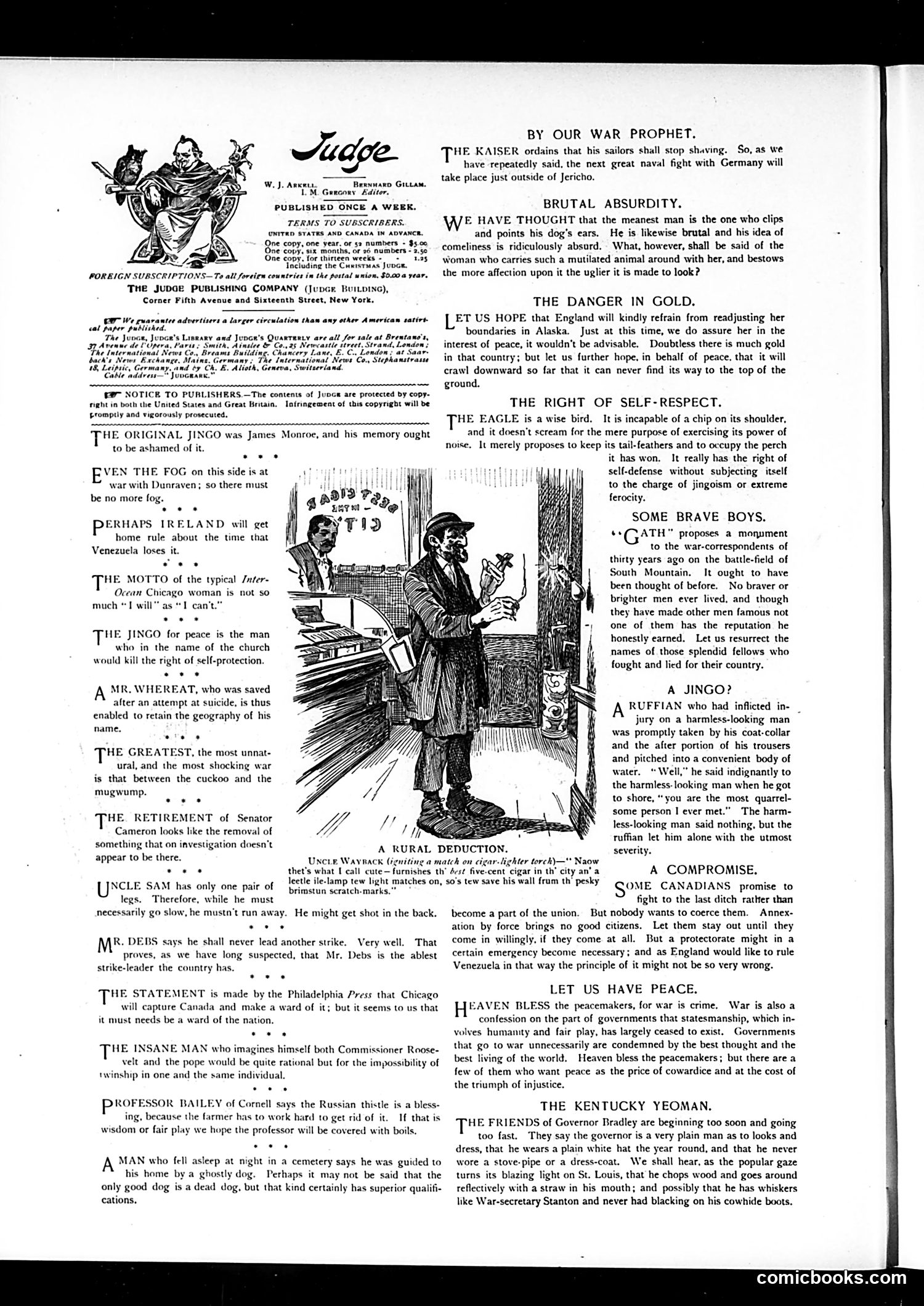
The page contains editorial commentary and short satirical pieces rather than a single cartoon. The main illustrated piece shows two men in what appears to be a train car, labeled "A RURAL DEDUCTION," depicting a dialogue about cigars and matches—a joke about rural economics and practical barter. The text sections ("By Our War Prophet," "Brutal Absurdity," "The Danger in Gold") offer commentary on World War I-era concerns: German naval warfare, animal welfare, and England's territorial ambitions. Additional pieces discuss Irish home rule, Senator Cameron's political longevity, and various contemporary figures. Without specific dates or clearer caricature identifications in the image, precise political targets remain uncertain, though the content clearly addresses major 1910s-era American political and social debates.
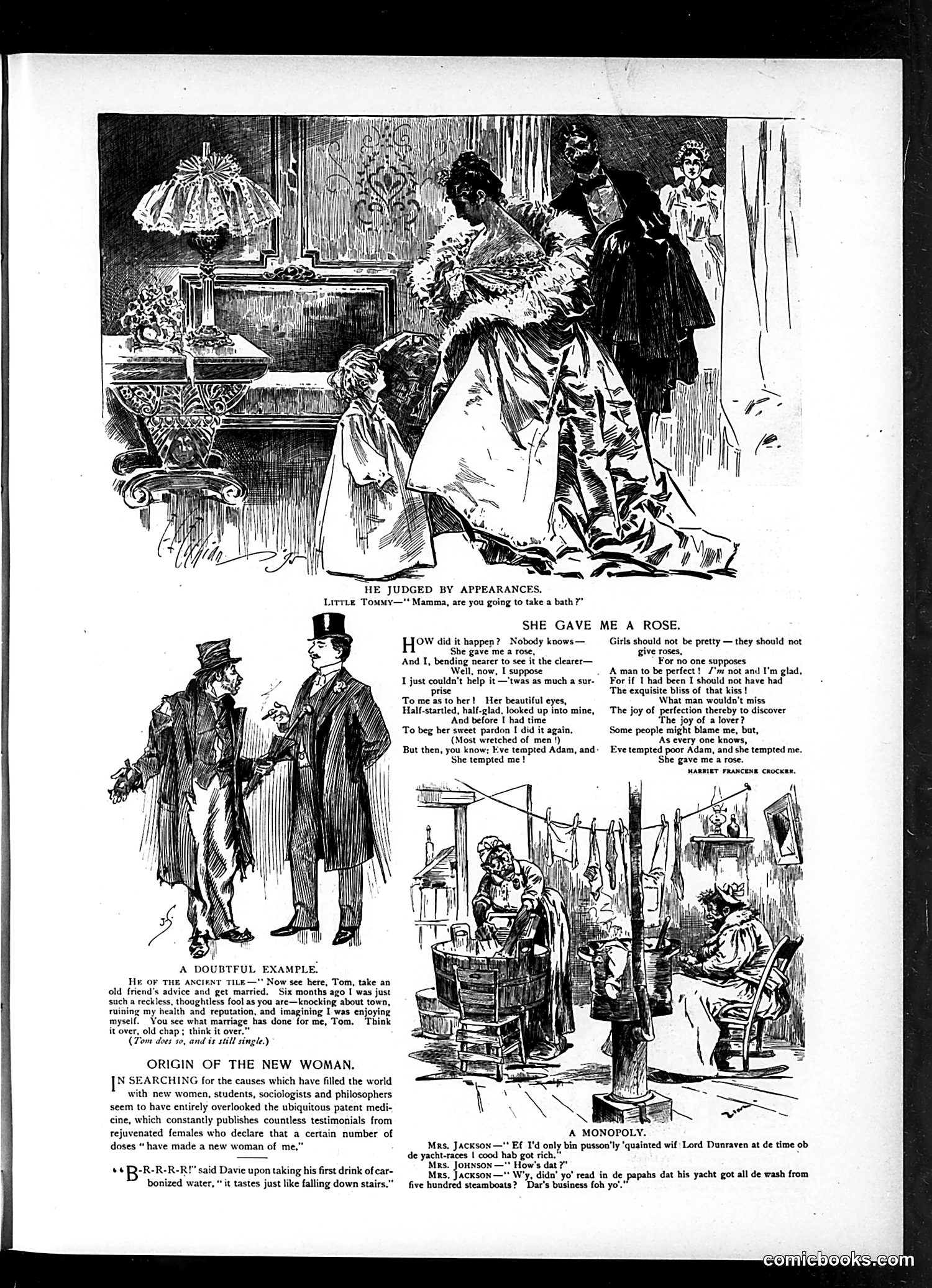
This page contains several satirical sketches mocking social pretensions and gender roles of the era: **"He Judged by Appearances"** depicts a mother asking her child about bathing—a commentary on how people present false fronts. **"She Gave Me a Rose"** is a sentimental poem about a woman's gift, likely satirizing overly romantic Victorian poetry. **"A Doubtful Example"** mocks an old friend's marriage advice, suggesting marriage ruined the friend's health rather than improving it. **"A Monopoly"** appears to ridicule wealthy women's leisure activities and pretension. **"Origin of the New Woman"** discusses emerging debates about women's expanding roles as students, professionals, and activists—treating this social change as simultaneously newsworthy and mockable, typical of Judge's satirical stance toward progressive movements of the period.
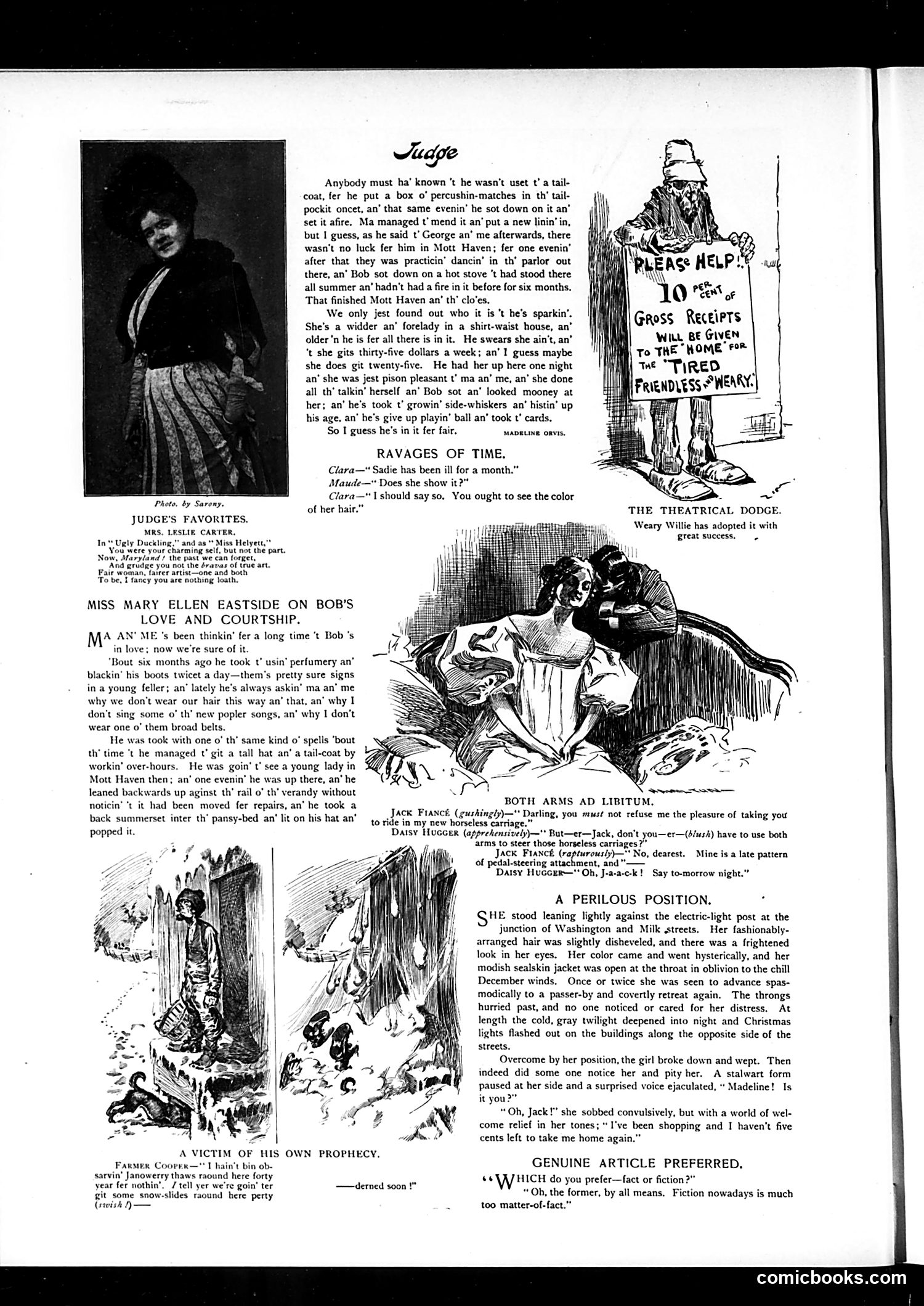
This page from *Judge* contains several satirical pieces targeting early-1900s American social life: **"Miss Mary Ellen Eastside on Bob's Love and Courtship"** mocks working-class courtship rituals through dialect humor. Bob's clumsy attempts at self-improvement—using perfume, blackening boots, wearing a tailcoat—comically backfire (he sits on matches, then a hot stove). The joke satirizes lower-class pretension and social climbing. **"A Victim of His Own Prophecy"** shows a farmer whose weather prediction proves self-fulfilling—his announcement of coming snow-slides somehow causes them, mocking rural superstition or jinxing. **"Both Arms Ad Libitum"** jokes about the emerging horseless carriage (automobile). A suitor claims his new vehicle requires only one hand to steer, implying he can embrace his date while driving—contemporary satire of automotive novelty and courtship customs. **"A Perilous Position"** depicts a distressed woman at a street corner in December, suggesting either poverty or romantic scandal—typical *Judge* melodrama. The cartoons mock class anxieties, new technology, and courtship conventions of the era.
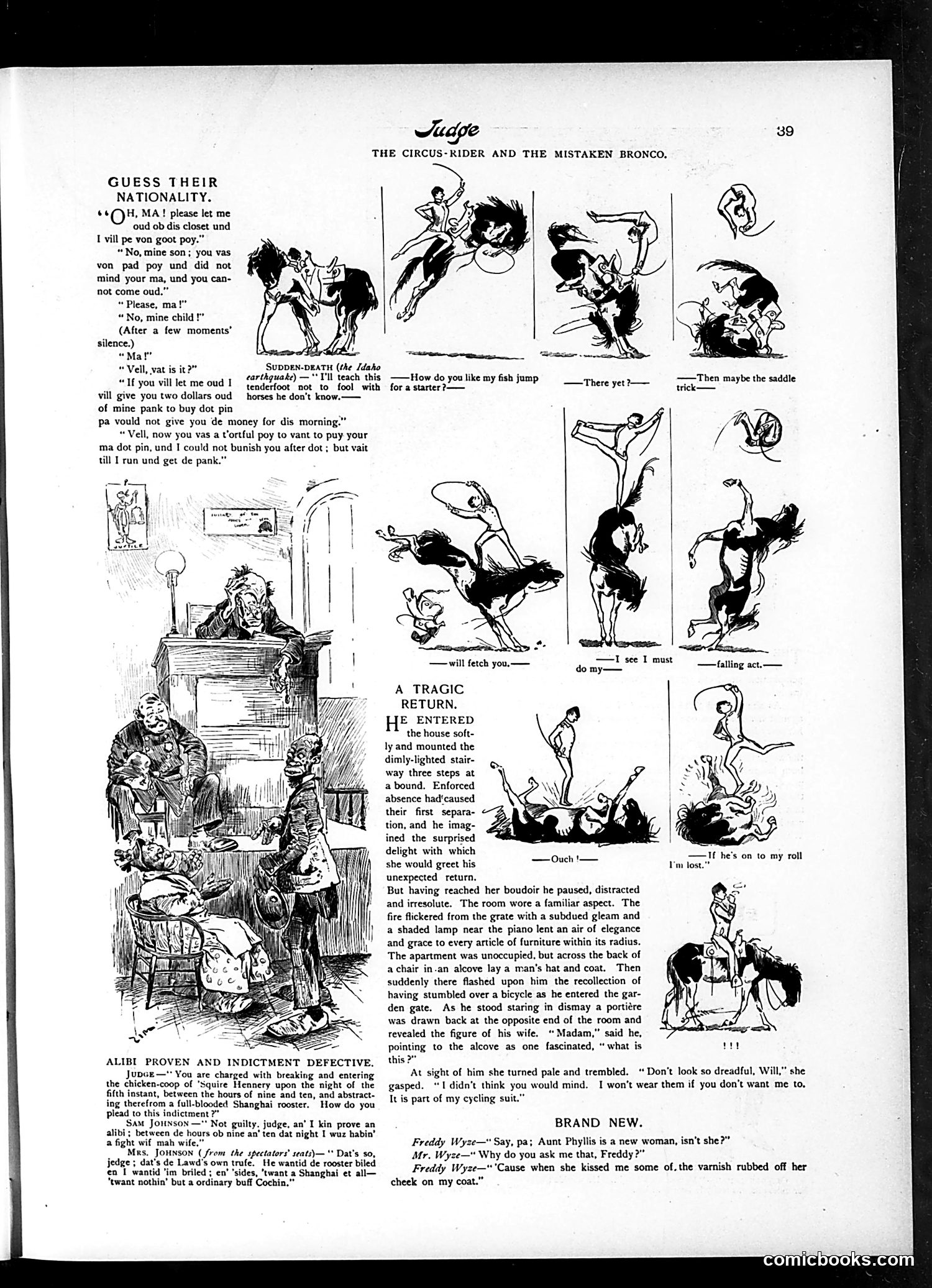
This page contains multiple unrelated satirical cartoons and jokes typical of Judge's format: **"Guess Their Nationality"** mocks German-American immigrants through heavy accent dialect ("oud," "vill," "poy"). A mother punishes her child in a closet; he bribes his way out with money—the joke being stereotypical assumptions about German thriftiness. **"Alibi Proven"** presents a Black defendant charged with stealing a rooster. His wife corroborates his alibi—he was fighting with her instead. The humor trades on racist stereotypes of domestic violence and dialect. **"The Circus-Rider and the Mistaken Bronco"** shows humorous acrobatic mishaps, captioned with circus performer commentary. **"A Tragic Return"** is a domestic drama sketch: a husband discovers a man's hat and coat in his wife's room, but she explains they belong to her "cycling suit"—a joke about the then-controversial women's bicycle and its practical clothing. **"Brand New"** jokes about a "new woman" (modern, independent female) whose cosmetics rub off when kissing a child. The page reflects early 20th-century attitudes toward immigrants, race, women's independence, and changing social norms.
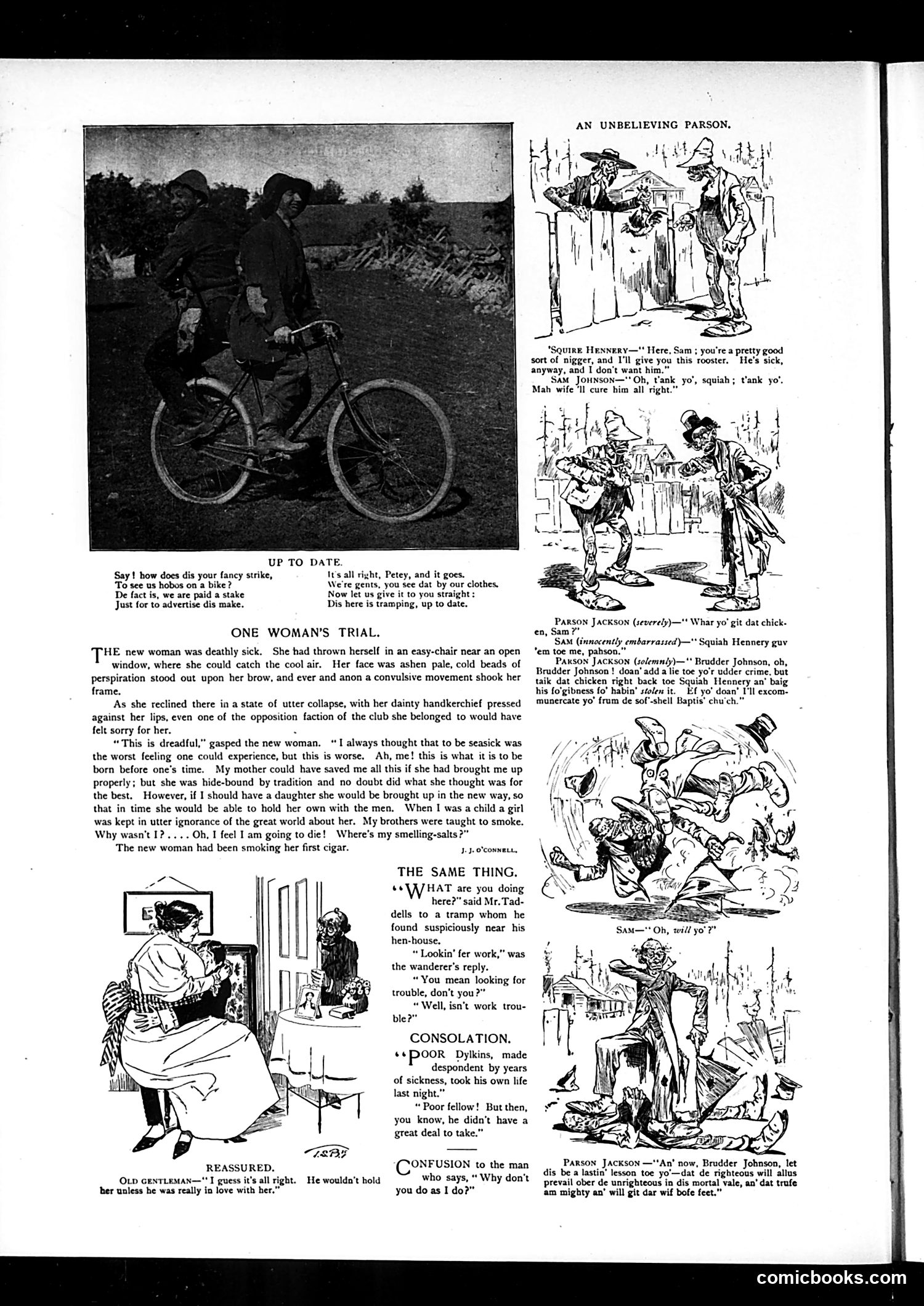
This page contains multiple satirical sketches mocking social trends and racial stereotypes typical of late 19th/early 20th-century American humor. **"Up to Date"** ridicules hobos who claim to be gentlemen advertisers riding bicycles—mocking both vagrants and emerging advertising culture. **"One Woman's Trial"** satirizes the "New Woman" movement. A woman suffers from smoking her first cigar and blames her upbringing, ironically complaining she wasn't taught to smoke like her brothers. The joke targets feminist demands for equality through exaggeration. **"An Unbelieving Parson"** uses racist dialect and caricature (common to the era) to depict a Black man named Sam and a parson in conflict over a stolen chicken. The parson sermonizes about righteousness while the sketch relies on degrading stereotypes. The remaining vignettes ("The Same Thing," "Consolation," "Reassured") offer brief, dark-humor jokes about work, death, and romance. The page reflects period attitudes: mockery of social reform, racist caricature presented as entertainment, and cynical humor about poverty and mortality.
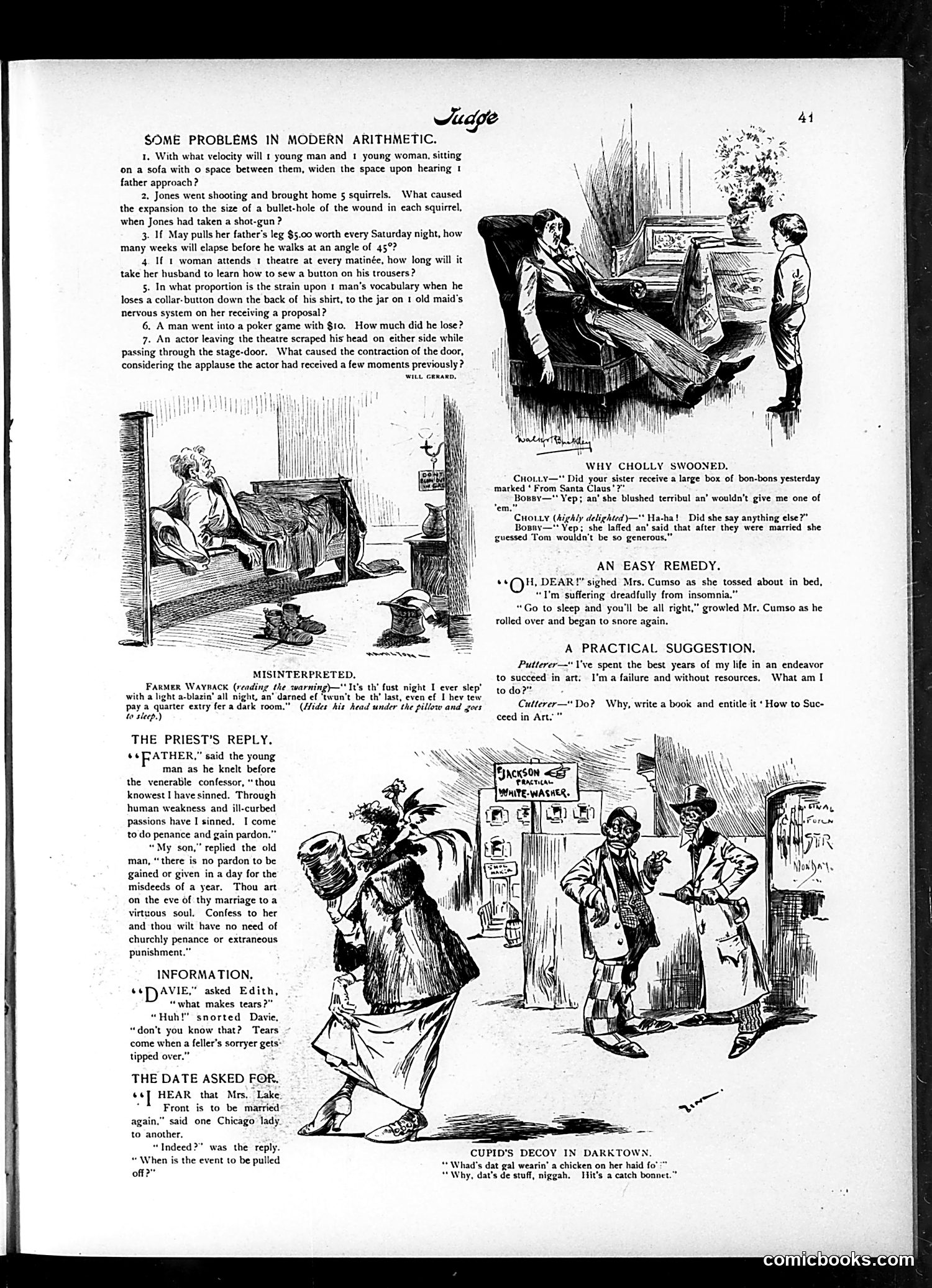
This page from Judge magazine contains multiple short humorous pieces satirizing early 20th-century American social conventions and gender relations. **"Some Problems in Modern Arithmetic"** mocks domestic life through fake math problems: young couples on sofas, wives nagging husbands ("May pulls her father's leg"), theater-attending wives forcing husbands to learn domestic skills, and men losing money at poker—all poking fun at perceived gender dynamics and marital frustrations. **"Why Cholly Swooned"** jokes about a young man fainting upon learning his rival will marry his love interest, satirizing sentimental Victorian masculinity. Other sketches lampoon: a farmer misinterpreting a hotel warning, a failed artist's impractical advice, a priest's cynical marriage counsel, and casual domestic exchanges. The illustrations use exaggerated expressions and body language typical of period comic art. The overall tone reflects middle-class anxieties about courtship, marriage, gender roles, and financial stability—treating these seriously-felt concerns as fodder for gentle ridicule.
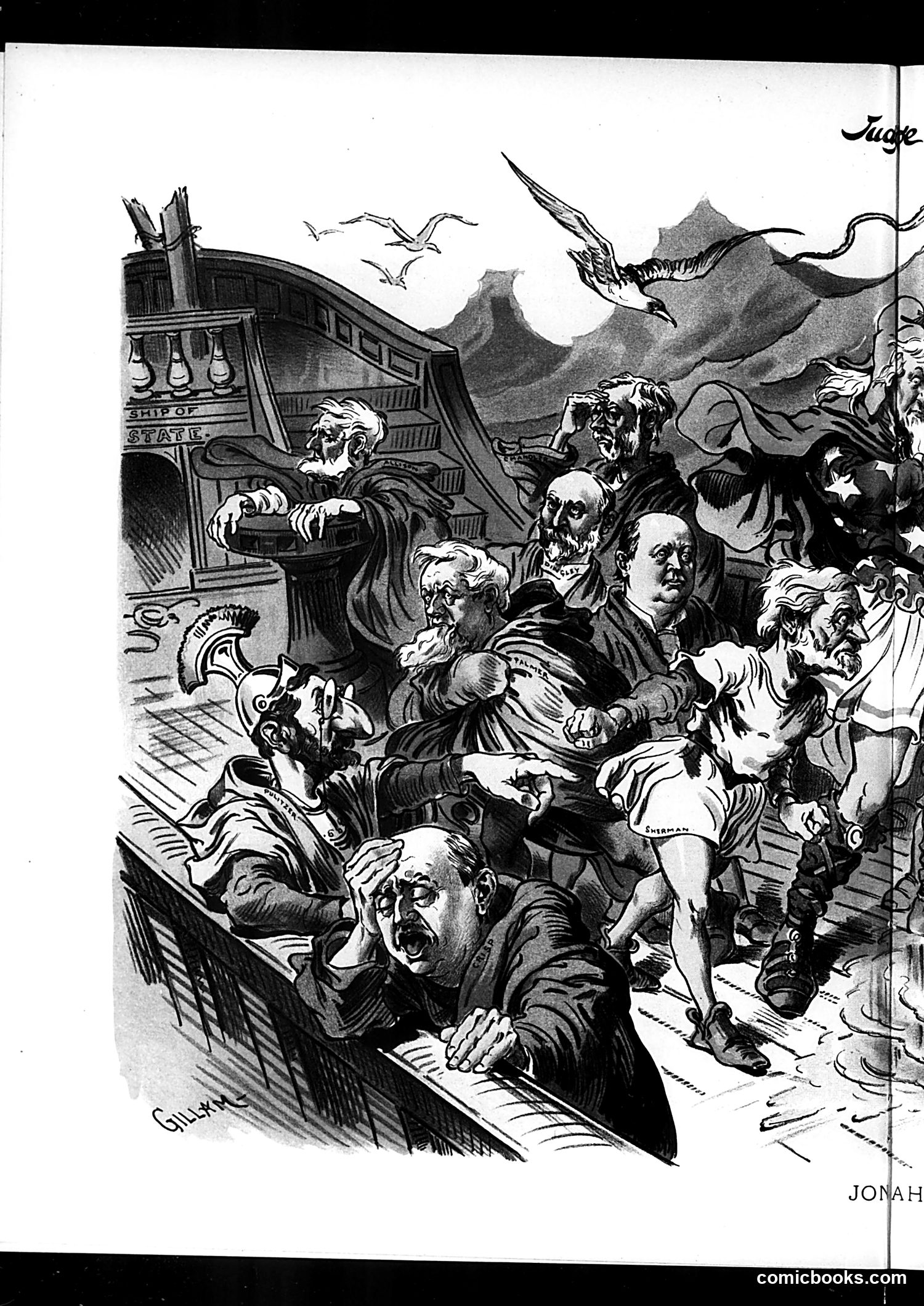
The OCR text is too corrupted to read. However, the image itself is a satirical illustration signed by Gillam, showing a chaotic scene aboard what appears to be a ship labeled "STATE." Multiple figures—bearded men in period dress, cherubs/putti, and mythological creatures—crowd the vessel in apparent disorder or crisis. A dragon-like creature flies above, and birds scatter in the sky. The "State" vessel appears to be in distress or turmoil. Without legible text identifying the specific political figures or historical moment, I cannot confidently explain which particular crisis, political scandal, or governmental upheaval this cartoon satirizes. The maritime metaphor and crowded chaos suggest commentary on governmental mismanagement, but the specific context—and thus the cartoon's precise satirical target—remains unclear from the visible information alone.
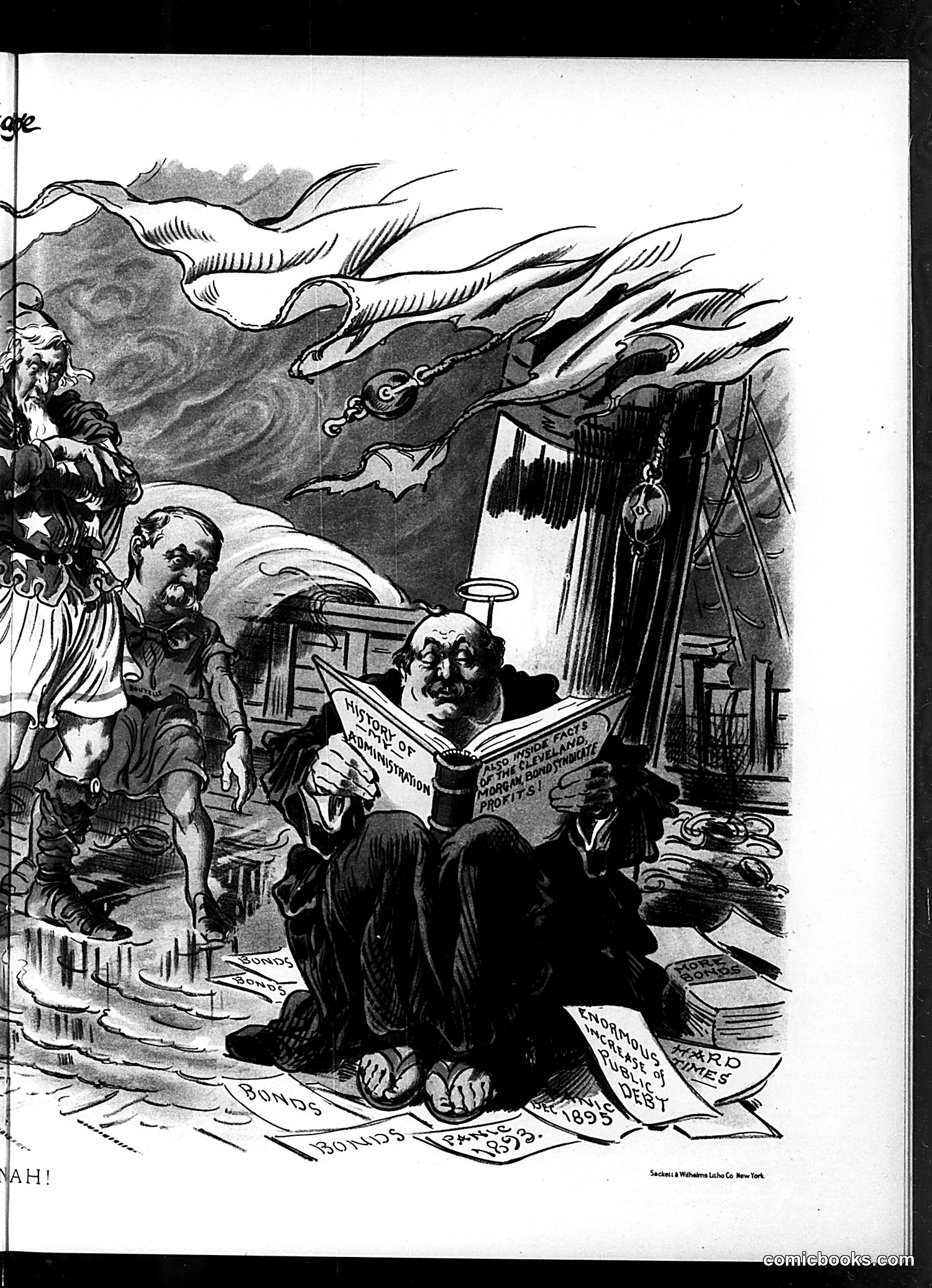
This **Judge** magazine cartoon depicts a figure (appears to be a political or financial leader) reading a book titled "History of Consolidation" while surrounded by documents labeled "Bonds," "Enormous Public Debt," and papers dated from the 1890s. The figure is depicted as ape-like, a common racist caricature device in period satirical art. The cartoon satirizes **corporate consolidation and financial manipulation** during America's Gilded Age, likely referencing trust-building or monopolistic business practices. The surrounding bonds and debt documents suggest criticism of how consolidation enriched elites while burdening the public with financial obligations. The stormy background and fallen Uncle Sam figure (left) emphasize the cartoon's message that these practices threaten American prosperity and democratic institutions.
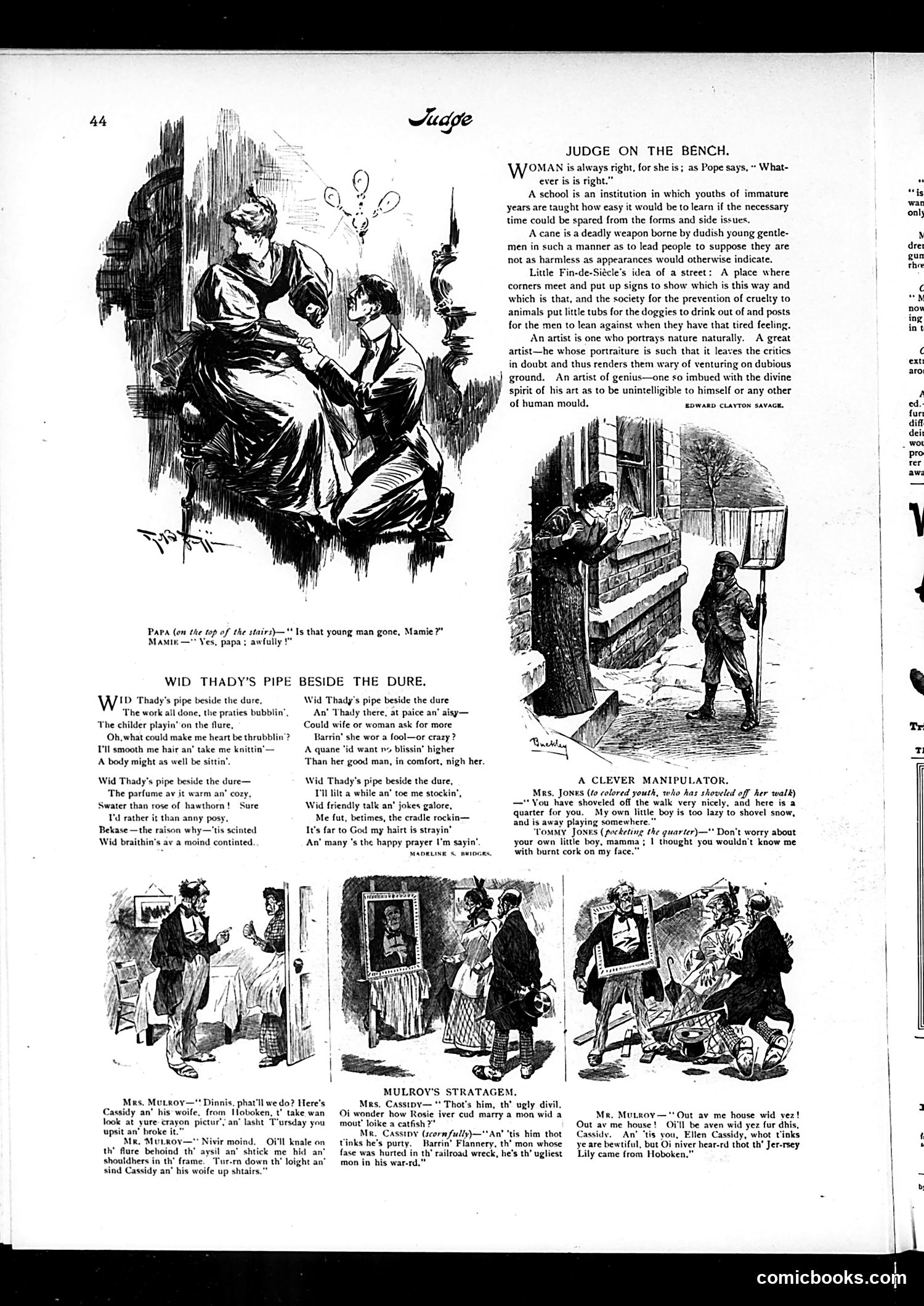
This page from *Judge* contains several satirical pieces mocking different social types and situations circa the late 19th/early 20th century: **"Judge on the Bench"** opens with cynical definitions of contemporary institutions—schools, canes (fashionable accessories), artists—reflecting fin-de-siècle pretension and absurdity. **"Wid Thady's Pipe Beside the Dure"** is an Irish dialect poem celebrating domestic contentment, likely satirizing sentimental romanticism about working-class Irish life that was popular in American magazines. **"A Clever Manipulator"** depicts a white woman patronizingly giving a Black boy a quarter for shoveling snow, while he plans to use burnt cork (blackface makeup) to hide his identity—a darkly satirical commentary on both racial condescension and blackface minstrelsy. **"Mulroy's Stratagem" and "Mulroy's Stratagems"** feature Irish immigrant characters (Mulroy, Cassidy) in comic domestic situations, playing on ethnic stereotypes common in period humor. The illustrations use exaggerated caricature typical of *Judge's* satirical style, targeting both upper-class pretension and immigrant Irish stereotypes.
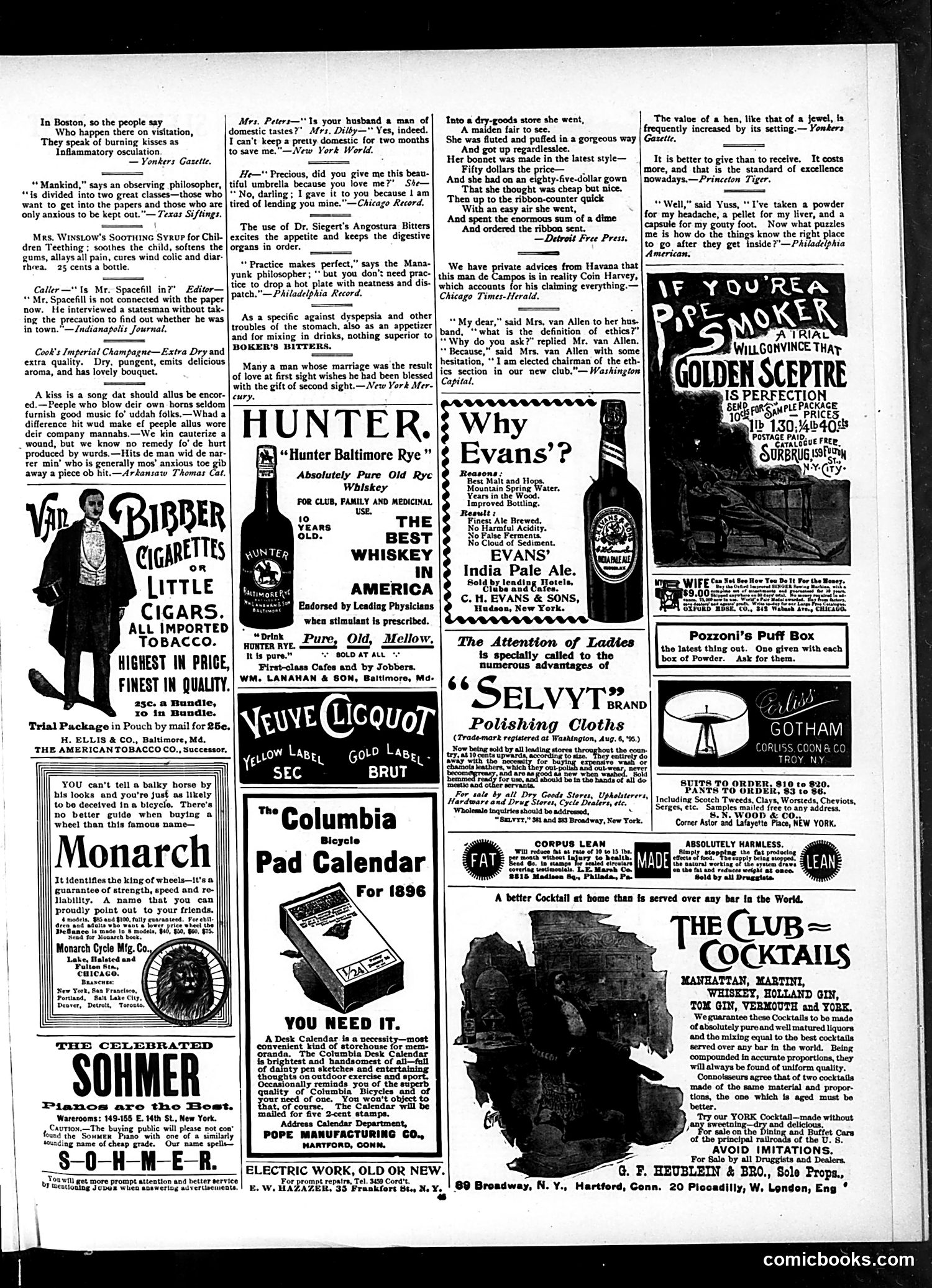
This page is primarily **advertising** with minimal editorial content. The visible material consists of: **Editorial/Humorous Content:** - Brief jokes and witticisms about Boston courtship customs, newspaper editors, and marriage - Observations about human nature (e.g., people divided into those seeking/avoiding press coverage) - Dialect humor typical of the 1890s ("A kiss is a song dat should allus be encor-ed") **Advertisements:** The page is dominated by ads for consumer products popular in the 1890s: - Tobacco products (Van Bibber cigarettes, cigars) - Bicycles (Monarch, Columbia) - Whiskey and liquor (Hunter Baltimore Rye, Veuve Clicquot) - Patent medicines (Mrs. Winslow's Soothing Syrup, Boker's Bitters) - Pianos (Sohmer) - Miscellaneous goods (calendars, powder) **No significant political satire is present.** This appears to be a typical late-19th-century magazine page mixing light humor with commercial messages targeting middle and upper-class readers.
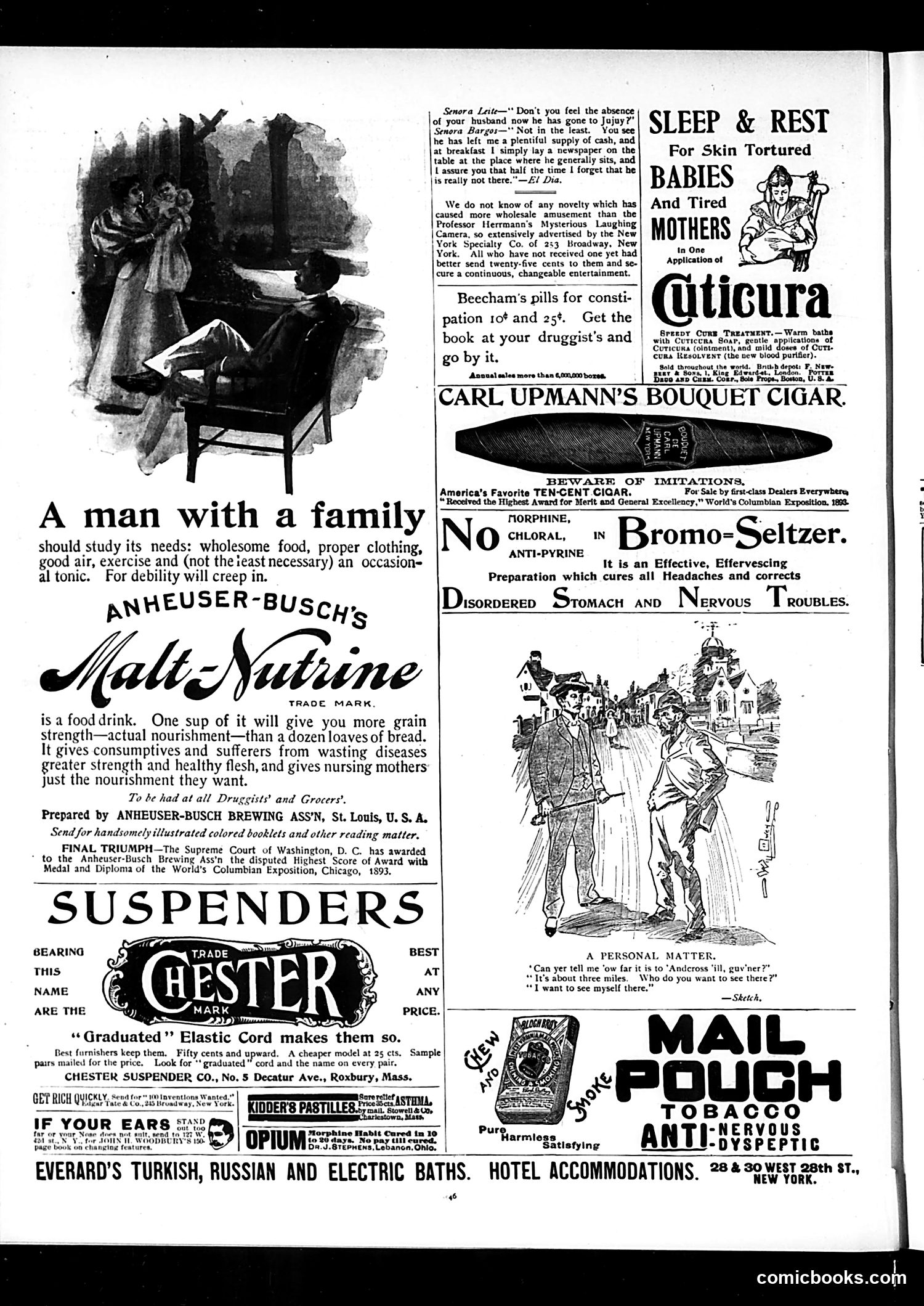
This page is primarily **advertising**, typical of late 19th-century magazines. The dominant image—a sketch of a woman sitting alone at a dining table with a newspaper placed at her husband's empty seat—illustrates a humorous anecdote in the "El Dia" column. The joke mocks marital indifference: a wife admits she barely notices her absent husband because his financial provision and a newspaper substitute for his presence. The page contains various patent medicine and consumer product ads characteristic of the era, including Anheuser-Busch's "Malt Nutrine" (marketed as nutritional drink), Chester Suspenders, Beecham's pills, and Cuticura skin treatments. These ads reflect contemporary medical attitudes—promoting tonics and remedies for "debility" and "wasting diseases." The cartoon itself offers gentle satire on marriage and domesticity rather than political commentary, reflecting Judge magazine's focus on social humor alongside advertising revenue.
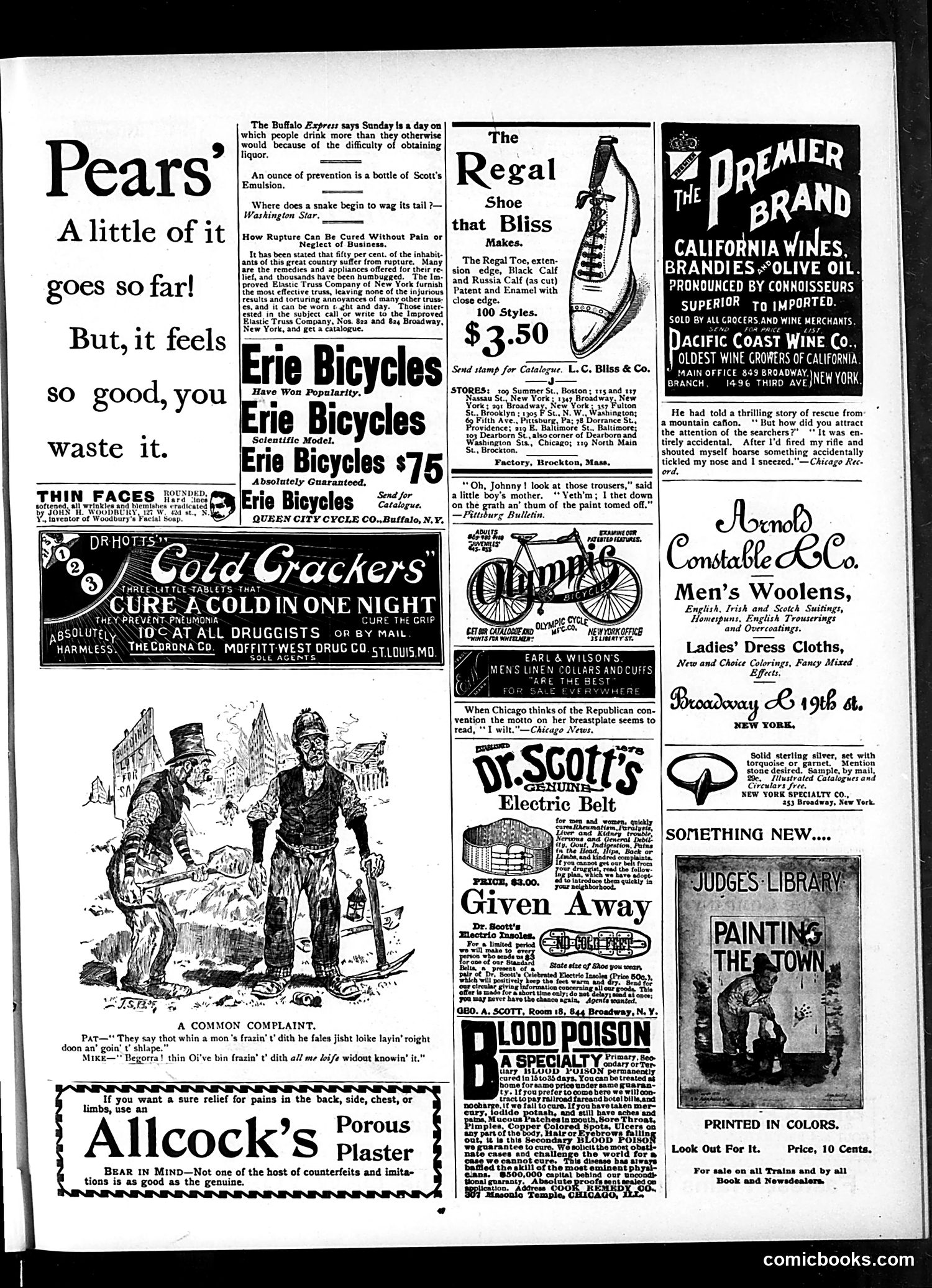
This is primarily an **advertising page** from Judge magazine with minimal editorial content. The few cartoons present are brief satirical sketches: **"A Common Complaint"** depicts two Irish immigrants (stereotyped through dialect) discussing freezing to death—a dark joke about poverty and indifference to suffering. **The unnamed cartoon** at top left shows two figures in period dress around a table, likely satirizing some social observation, though its specific reference is unclear from the visible text. The page is dominated by **product advertisements** typical of early 20th-century magazines: patent medicines (Dr. Scott's Electric Belt, Dr. Hotts' Cold Crackers), medical devices (Allcock's Porous Plaster for pain), bicycles, shoes, wines, and clothing. Many ads made dubious health claims now considered fraudulent—electric belts supposedly cured rupture; cold remedies claimed to prevent pneumonia. A brief political reference appears: a quip about the Republican convention and Chicago, suggesting political commentary on convention rhetoric. The page reflects period advertising standards and Irish immigrant stereotypes common in American humor of this era.
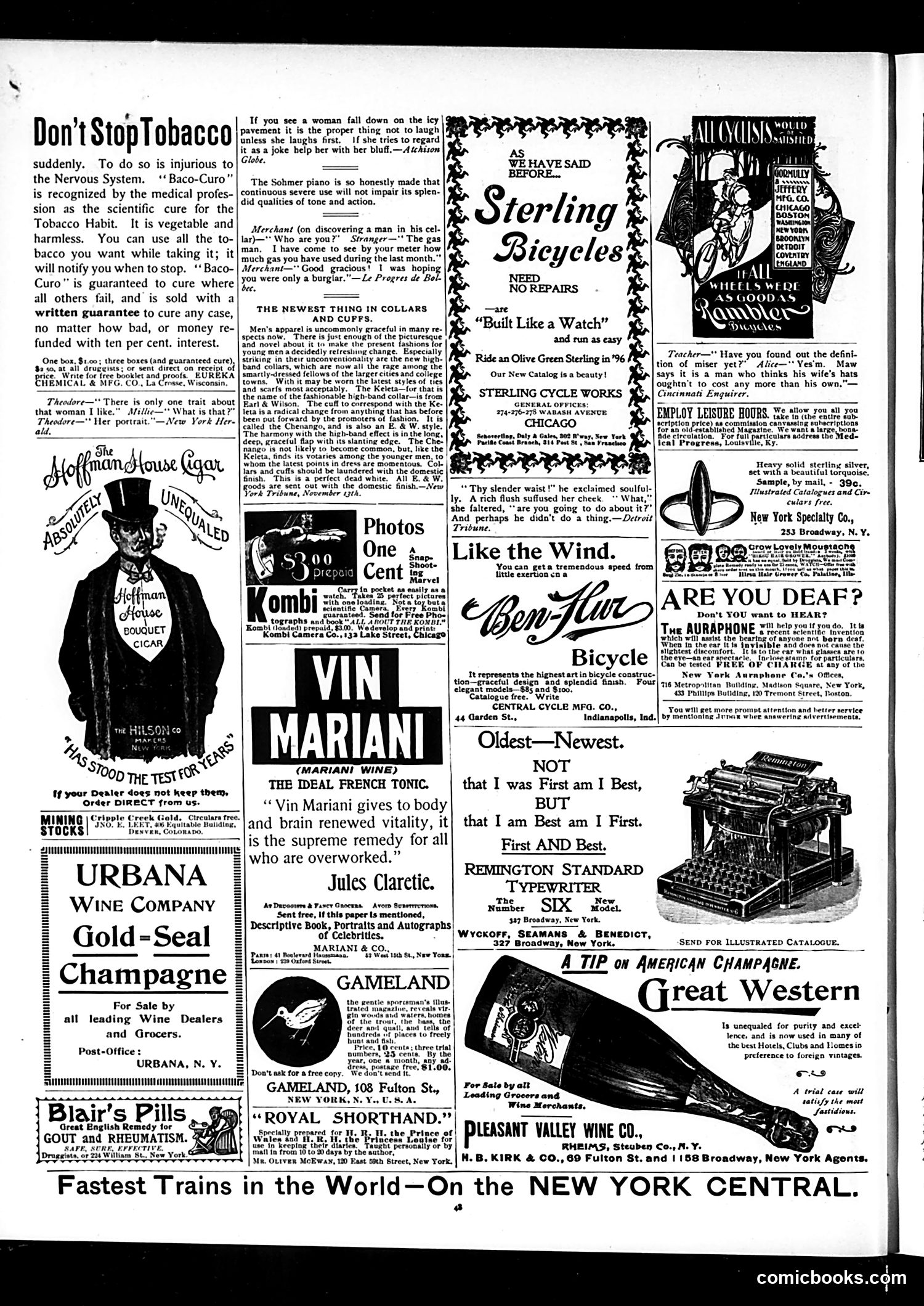
This page is **primarily advertisements** with minimal actual satirical content. The notable cartoon elements are brief: 1. **"Don't Stop Tobacco"** advertisement features a medical pitch for "Baco-Curo," claiming tobacco addiction can be cured scientifically while still using tobacco—a humorous contradiction typical of dubious patent medicine ads. 2. **Small joke snippets** scattered throughout (the Theodora "portrait" gag, the merchant/gas man exchange) are generic humor rather than political satire. 3. **Hillman House Cigar** ad uses a caricatured face of unclear identity—possibly a political figure of the era, but identification is uncertain from this image alone. The page exemplifies **early 1900s Judge magazine's actual function**: a vehicle for elaborate advertising revenue alongside light humor. The promise of "scientific" cures and dubious products reflects the era's unregulated patent medicine industry and consumer skepticism about miraculous claims—themes satirists would later target more sharply.
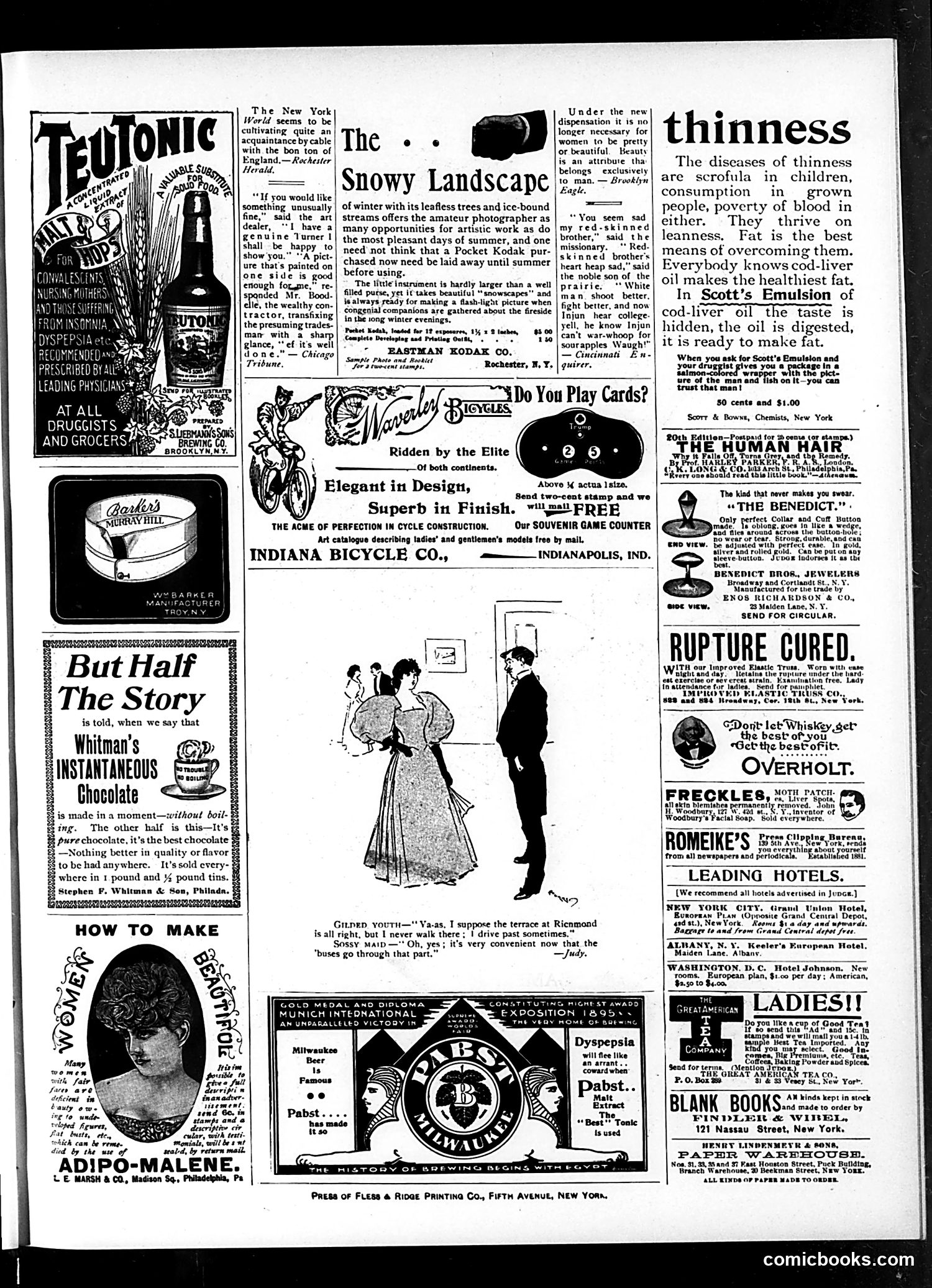
This is primarily an **advertising page** from Judge magazine, with minimal editorial content. The few satirical items are brief: **"The New York World" joke**: A short quip about the *New York World* newspaper cultivating relationships with British high society via telegraph—likely mocking the paper's aspirations to cover European aristocracy. **"Beauty" anecdotes**: Several short, disconnected humor bits about beauty standards and practicality (a wealthy contractor preferring functional art; a missionary's conversation with a Native American about "college yells"). These appear to reflect period stereotypes and casual racial attitudes common to the era. **"The Snowy Landscape"**: A gentle piece promoting Kodak cameras for winter photography. The page is dominated by **product advertisements**—Whitman's chocolate, Eastman Kodak, Indiana bicycles, Scott's Emulsion (cod-liver oil), playing cards, jewelry, hotels, and patent medicines. This reflects Judge's business model as a revenue-driven publication supporting content through advertising. No identifiable political figures or cartoons appear on this page.
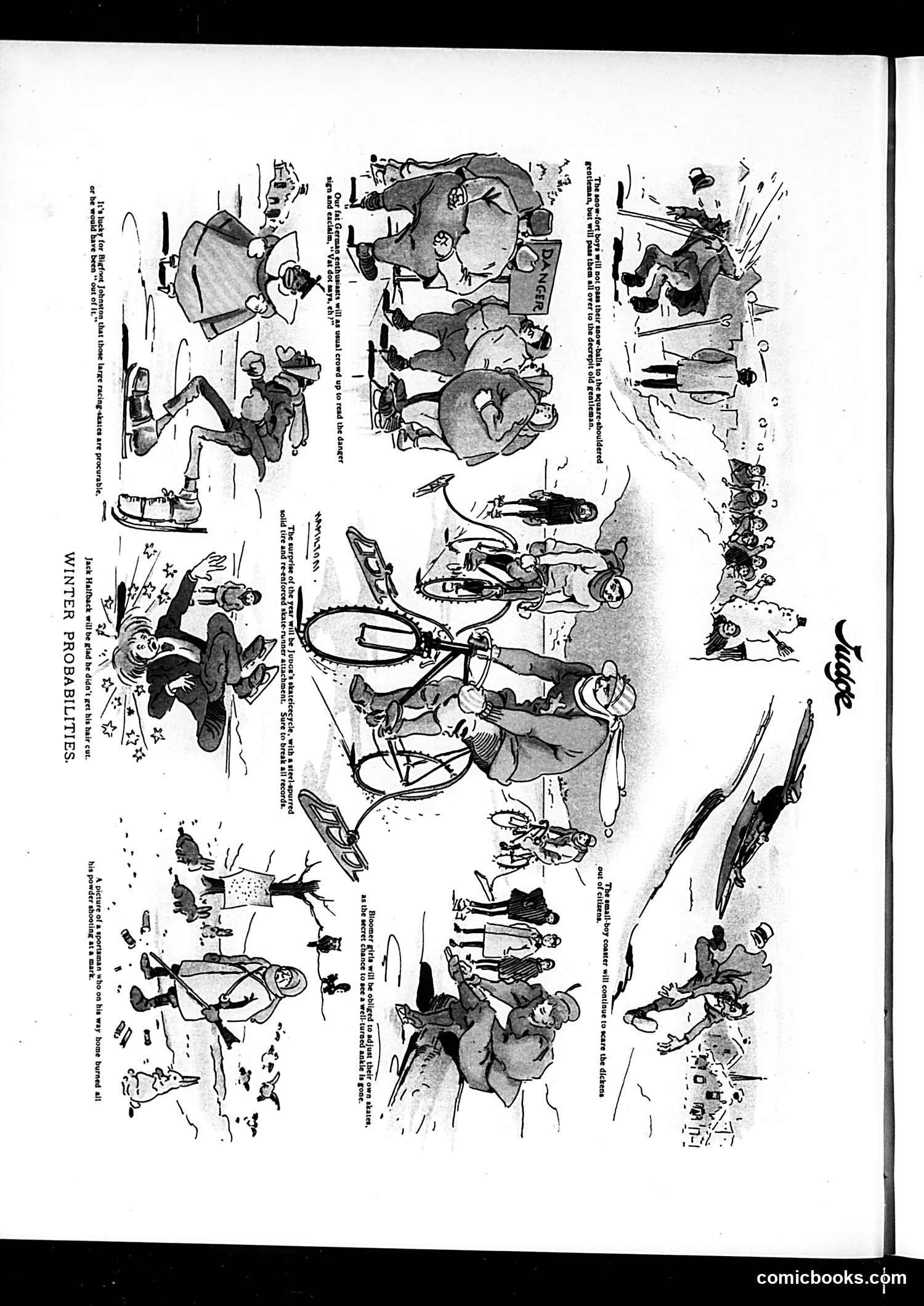
This page presents satirical predictions about winter activities and stereotypes. The cartoons mock various groups: **German immigrants** are caricatured as eager crowds gathering around warning signs, unable to read English ("Vat dot says, eh?")—mocking both their accent and literacy. **"Bigfoot Johnston"** and other named figures appear in vignettes about winter sports mishaps: a coaster accident, someone wasting ammunition target-shooting instead of hunting productively, and references to haircuts and racing skates. The overall tone is gentle mockery of winter behaviors and ethnic stereotypes common to Gilded Age American humor. The scattered, rotated comic panels suggest multiple brief jokes rather than a unified narrative—typical Judge magazine format mixing social observation with slapstick prediction. The humor relies on readers recognizing local figures or shared cultural references now obscure.