
Judge, 1896-01-18 · page 4 of 16
Judge — January 18, 1896 — page 4: what you’re looking at
What you’re looking at
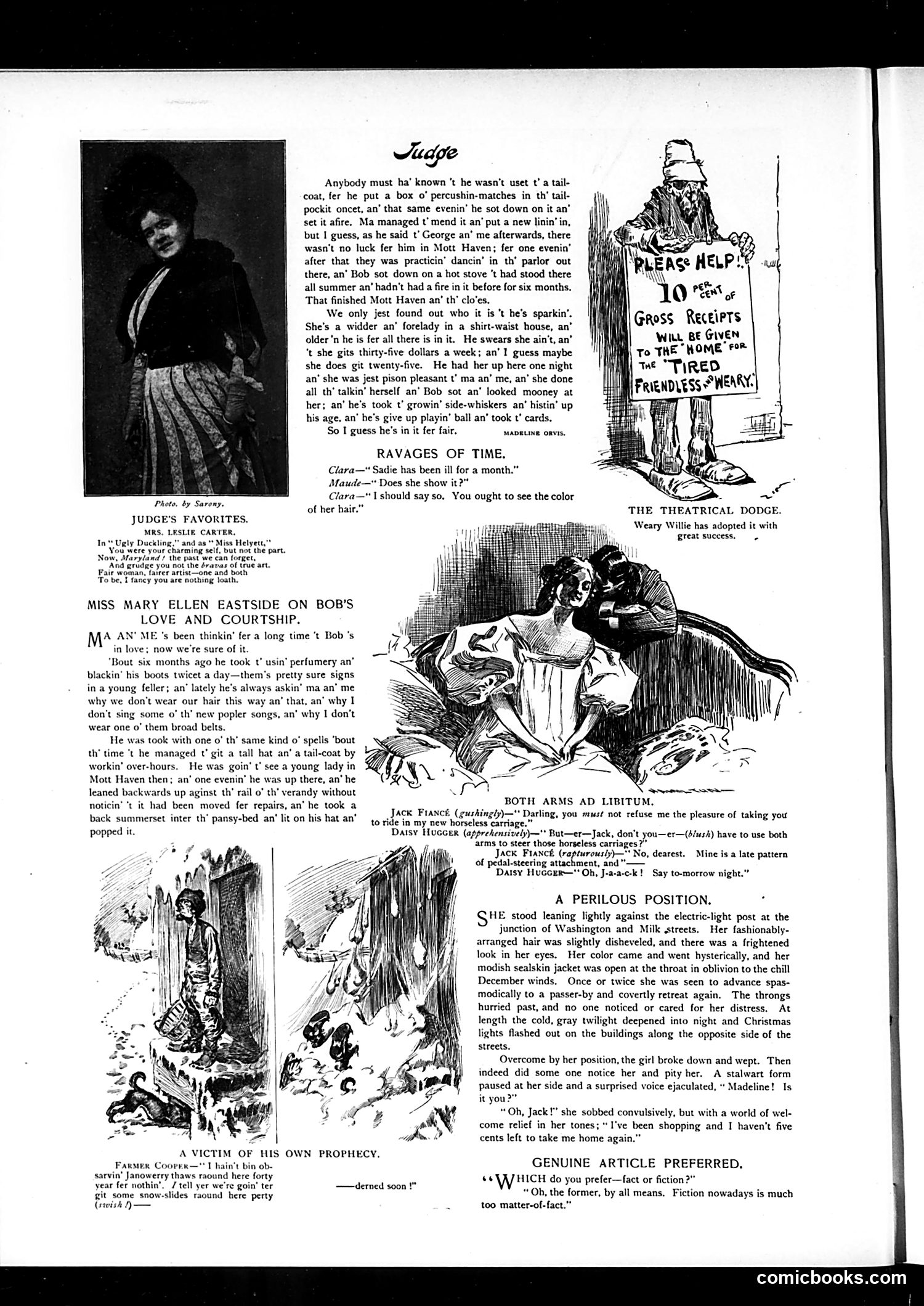
This page from *Judge* contains several satirical pieces targeting early-1900s American social life: **"Miss Mary Ellen Eastside on Bob's Love and Courtship"** mocks working-class courtship rituals through dialect humor. Bob's clumsy attempts at self-improvement—using perfume, blackening boots, wearing a tailcoat—comically backfire (he sits on matches, then a hot stove). The joke satirizes lower-class pretension and social climbing. **"A Victim of His Own Prophecy"** shows a farmer whose weather prediction proves self-fulfilling—his announcement of coming snow-slides somehow causes them, mocking rural superstition or jinxing. **"Both Arms Ad Libitum"** jokes about the emerging horseless carriage (automobile). A suitor claims his new vehicle requires only one hand to steer, implying he can embrace his date while driving—contemporary satire of automotive novelty and courtship customs. **"A Perilous Position"** depicts a distressed woman at a street corner in December, suggesting either poverty or romantic scandal—typical *Judge* melodrama. The cartoons mock class anxieties, new technology, and courtship conventions of the era.
📄 Transcribed text from this page (OCR, searchable)
Machine-transcribed from the original scan — historical spelling and the odd misread are preserved.
FAVORITES. 1k CARTER. * and as Miss Helyett,”* Now, Maryland / the past we can forget, And grudge you not the dravas of true art. Fair woman, fairer artist—one and both To be, I fancy you are nothing loath. MISS MARY ELLEN EASTSIDE ON BOB'S LOVE AND COURTSHIP. M24 AN ME'’s been thinkin’ fer a long time ‘t Bob 's in love; now we're sure of it. “Bout six months ago he took ¢' usin’ perfumery an’ blackin’ his boots twicet a day—them's pretty sure signs in a young feller; an’ lately he’s always askin’ ma an’ me why we don’t wear our hair this way an’ that, an’ why I don’t sing some o’ th’ new popler songs, an’ why I don’t wear one 0” them broad belts. He was took with one o' th’ same kind 0° spells ‘bout th’ time ‘t he managed ¢’ git a tall hat an’ a tail-coat by workin’ over-hours. He was goin’ t' see a young lady in Mott Haven then; an’ one evenin’ he was up there, an’ he leaned backwards up aginst th’ rail o” th’ verandy without noticin’ ‘t it had been moved fer repairs, an’ he took a back summerset inter th’ pansy-bed an’ lit on his hat an’ popped it. A VICTIM OF HIS OWN PROPHECY. Farmer Coovrk—" I hain't bin ob- sarvin’ Janowerry thaws raound here forty year fer nothin’. / tell yer we're goin’ ter git some snow-slides raound here perty (steish )— she does git twenty-five. Suape Anybody must ha’ known ’t he wasn’t uset t’ a tail- coat, fer he put a box o' percushin-matches in th’ tail- pockit oncet, an’ that same evenin’ he sot down on it an’ set it afire. Ma managed t’ mend it an’ put a new linin’in, but I guess, as he said t’ George an’ me afterwards, there wasn’t no luck fer him in Mott Haven; fer one evenin’ after that they was practicin’ dancin’ in th’ parlor out there, an’ Bob sot down on a hot stove ‘t had stood there all summer an’ hadn't had a fire in it before for six months. That finished Mott Haven an’ th’ clo’es. We only jest found out who it ist he’s sparki She's a widder an’ forelady in a shirt-waist house, an’ older 'n he is fer all there is in it. ‘t she gits thirty-five dollars a week; an’ I guess maybe He had her up here one night an’ she was jest pison pleasant t’ ma an’ me, an’ she done all th’ talkin’ herself an’ Bob sot an’ looked mooney at her; an’ he’s took t’ growin’ side-whiskers an’ histin’ up his age, an’ he’s give up playin’ ball an’ took t’ cards. So I guess he's in it fer fair. RAVAGES OF TIME. Sadie has been ill for a month.” * Does she show it?” Clara—“ I should say so. You ought to see the color of her hair.” —derned soon !* 10 Peet of Gross Receirts Wie BE GIVEN To THE HOME FOR He swears she ain't, an’ MADELINE ORVIS. s ~ THE THEATRICAL DODGE. Weary Willie has adopted it with great success, BOTH ARMS AD LIBITUM. (Jack FIANcé (gushingly)—"' Darling, you must not refuse me the pleasure of taking you to ride in my new horseless carriage.” Daisy Huccer (apprehensively)—"* But—er—Jack, don't you—er—(b/ush) have to use both arms to steer those horseless carriages ?” Jack Francé (rapturously)—" No, dearest. of pédal-steering attachment, and "— Daisy HuGcer—"' Oh, J-a-a-c-k! Mine is a late pattern Say to-morrow night.” A PERILOUS POSITION. . GHE stood leaning lightly against the electric-light post at the junction of Washington and Milk streets. Her fashionably arranged hair was slightly disheveled, and there was a frightened look in her eyes. Her color came and went hysterically, and her modish sealskin jacket was open at the throat in oblivion to the chill December winds. Once or twice she was seen to advance spas- modically to a passer-by and covertly retreat again. The throngs hurried past, and no one noticed or cared for her distress. At length the cold, gray twilight deepened into night and Christmas lights flashed out on the buildings along the opposite side of the streets, Overcome by her position, the girl broke down and wept. Then indeed did some one notice her and pity her. A stalwart form paused at her side and a surprised voice ejaculated, “ Madeline! Is it you?” “Oh, Jack!" she sobbed convulsively, but with a world of wel- come relief in her tones; “I've been shopping and I haven't five cents left to take me home again.” GENUINE ARTICLE PREFERRED. seWVHICH do you prefer—fact or fiction?” “Oh, the former, by all means. Fiction nowadays is much too matter-of-fact.” comicbooks.com