
A complete issue · 17 pages · 1895
Judge — December 28, 1895
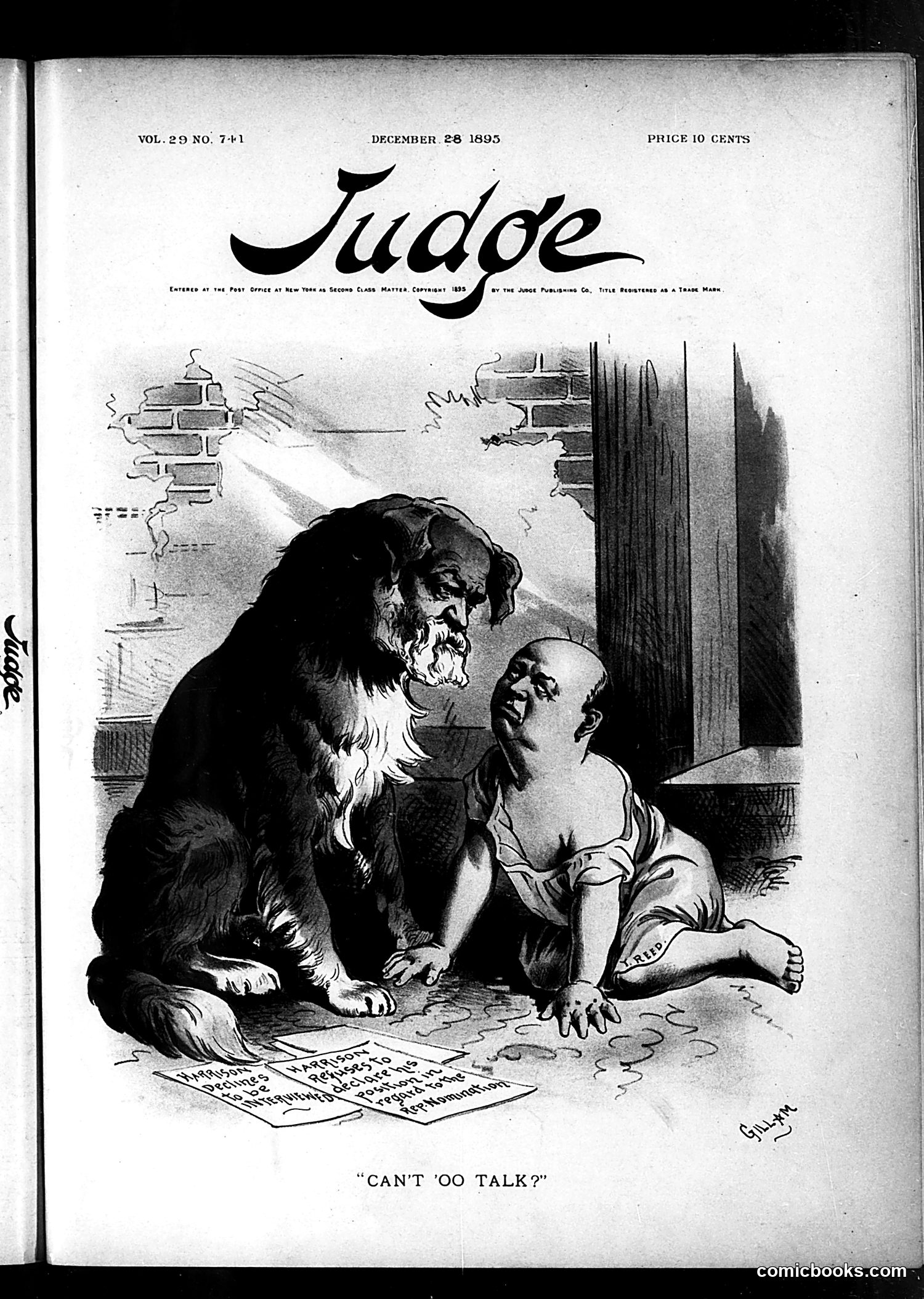
This December 1895 cartoon depicts a large, bearded man in tattered clothes speaking to a smaller bald man holding papers. The title's phrase suggests a dispute about who has the right to speak or express themselves. The papers on the ground appear to contain text, possibly representing documents, petitions, or published statements. The contrast between the figures—one robust and imposing, one diminished—suggests a power dynamic or social hierarchy being commented upon. Without additional context identifying these specific figures or the event referenced, the cartoon likely satirizes debates about free speech, labor rights, or class conflict that were prominent in 1890s America. The artistic style and positioning suggest commentary on whose voices are heard or silenced in public discourse.
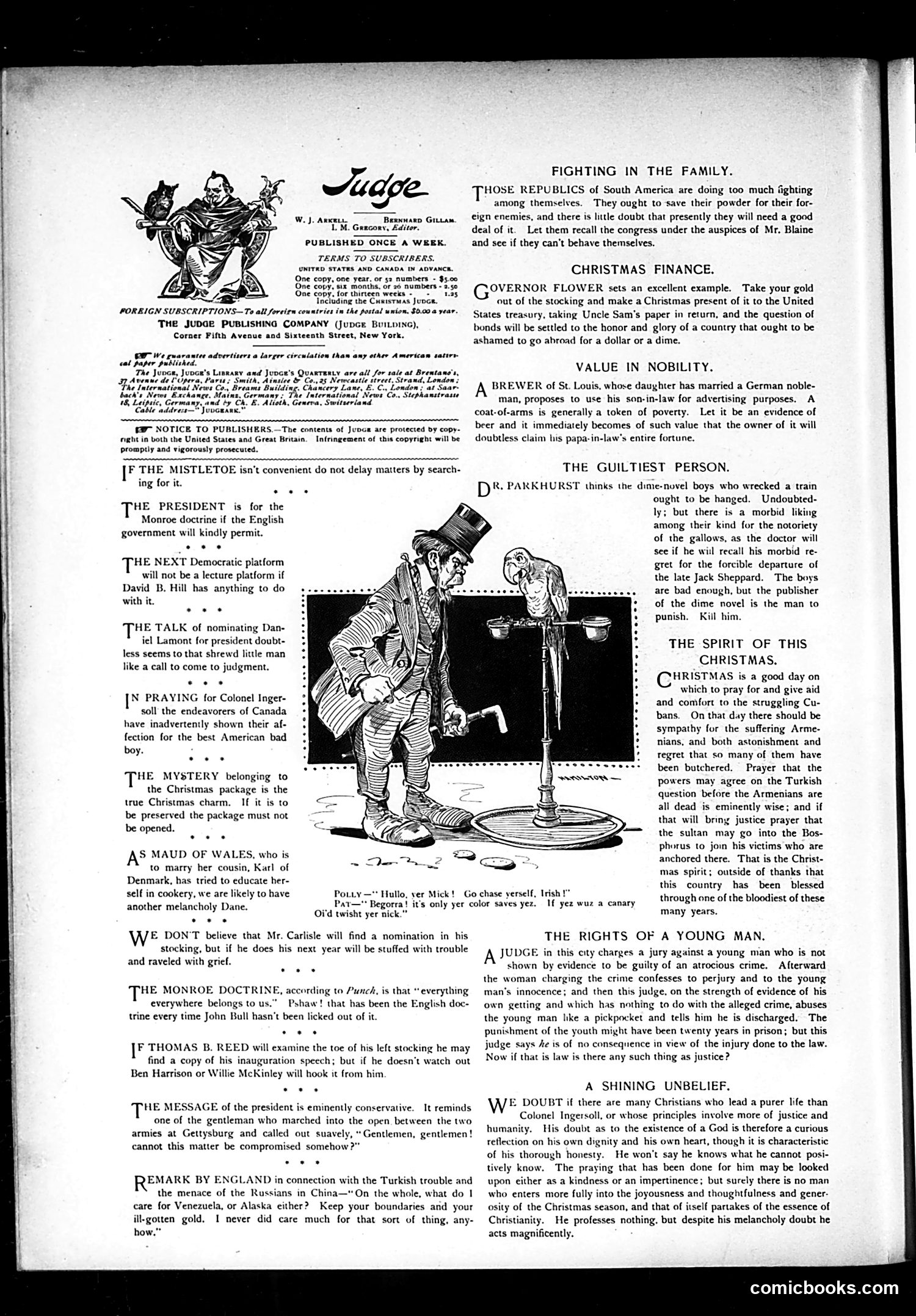
This page contains editorial commentary rather than a political cartoon. The main illustration shows a wealthy man in a top hat confronting a woman holding a baby—likely satirizing conflicts between social classes or marital disputes. The text sections address various issues: "Fighting in the Family" criticizes South American republics for internal conflict; "Christmas Finance" mocks politicians' hypocrisy about national debt during holidays; "The Guiltiest Person" attacks sensationalist crime fiction; and "The Spirit of This Christmas" advocates prayer for Armenian suffering (referencing early 20th-century Armenian massacres). "The Rights of a Young Man" critiques judicial bias against youth defendants, while "A Shining Unbelief" praises Colonel Ingersoll's atheism as morally honest. The commentary reflects Judge's reform-minded satirical approach to contemporary politics and social issues.
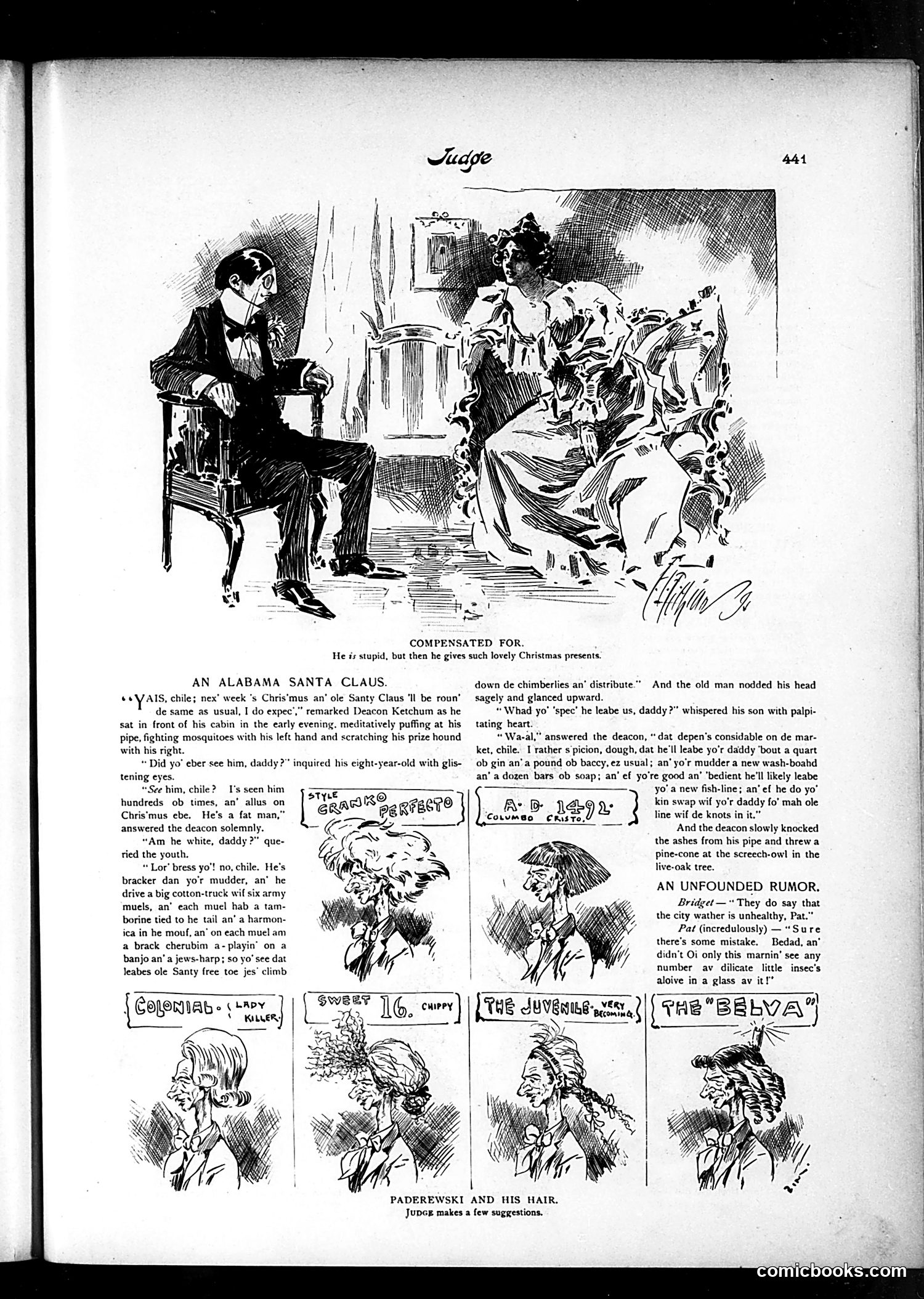
**"An Alabama Santa Claus"** presents a social satire about Southern racial attitudes. The story depicts a deacon character who struggles to accept his mixed-race son's existence, offering him only minimal Christmas gifts while providing lavish presents to his white children. The narrative mocks the deacon's hypocrisy—he claims the boy is "white" while denying him family acknowledgment and resources. **"Paderewski and His Hair"** is a four-panel caricature series mocking pianist Ignacy Jan Paderewski's distinctive appearance, likely his voluminous hair. The panels appear to humorously suggest various identities or alternative names for him, satirizing his famous theatrical presentation. Both pieces exemplify Judge's use of exaggeration and social commentary typical of early 20th-century American satire.
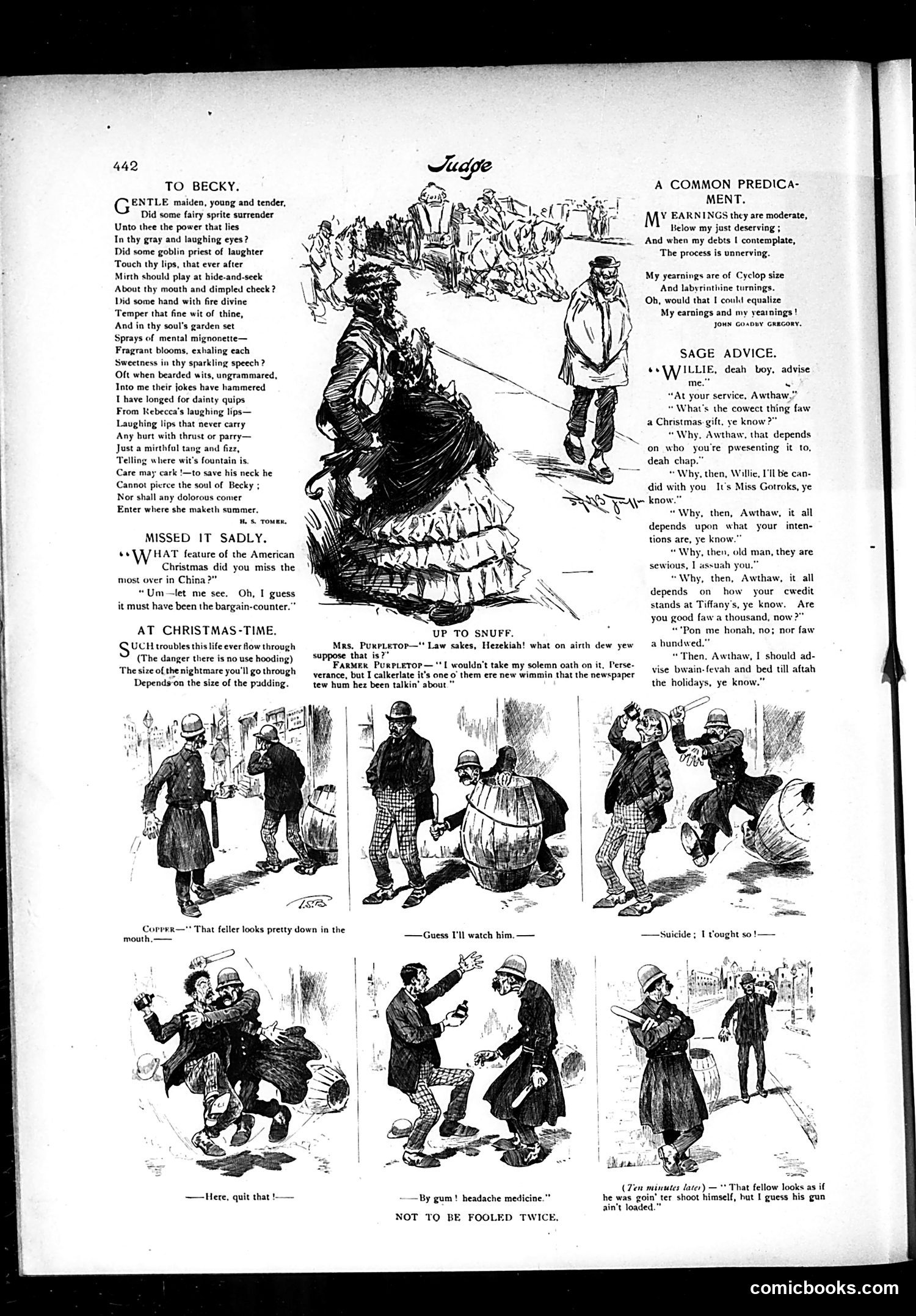
This page contains several satirical pieces typical of late 19th-century American humor: **"To Becky"** is a sentimental poem praising a woman's wit and charm—likely a tribute to someone associated with the magazine. **"Missed It Sadly"** jokes about an American returning from China, lamenting the loss of the "bargain-counter" at Christmas—satirizing American consumerism and the commercialization of the holiday. **"At Christmas-Time"** depicts comic holiday scenes of rowdy behavior and drunkenness. **"Sage Advice"** features two upper-class characters with affected speech discussing Christmas gifts. The joke: Willie advises that a suitable gift depends entirely on the suitor's credit at Tiffany's jewelry store—satirizing how wealth, not genuine affection, determines romantic gestures among the wealthy. **"Up to Snuff"** and **"Not to Be Fooled Twice"** show street-level comedy involving working-class characters in various predicaments. The page emphasizes Judge's dual focus: mocking both genteel pretension and working-class foolishness.
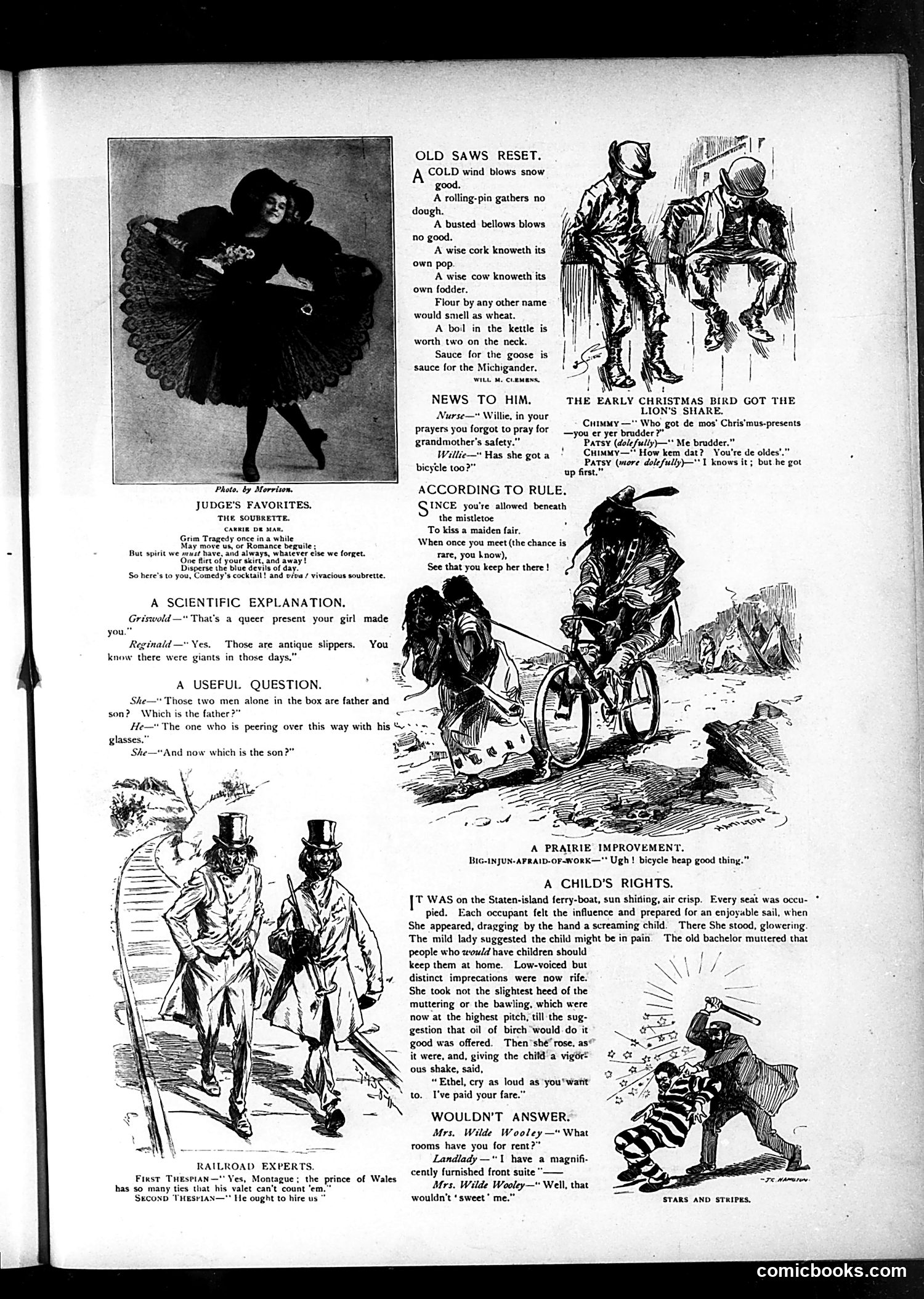
This page from Judge (likely early 1900s) contains several short satirical pieces mocking contemporary social conventions: **"Old Saws Reset"** playfully twists familiar proverbs—"A rolling-pin gathers no dough" instead of moss, "A wise cork knoweth its own pop"—poking fun at domestic life and gender roles. **"A Child's Rights"** satirizes entitled parenting: A mother drags a screaming child onto a Staten Island ferry, ignoring other passengers' distress. When criticized, she justifies the disruption by declaring she's paid the child's fare, implying purchased passage grants rights to public annoyance. **"Wouldn't Answer"** jokes about a prospective renter (Mrs. Wilde Wooley—likely a pun on "wilde"/wild behavior) rejecting a landlord's "magnificent" furnished rooms because the word "sweet" didn't appeal to her vanity. The cartoons feature period illustrations typical of Judge's style. The humor targets pretentious women, bratty children, and social pretense—common Judge themes ridiculing contemporary manners and entitled behavior.
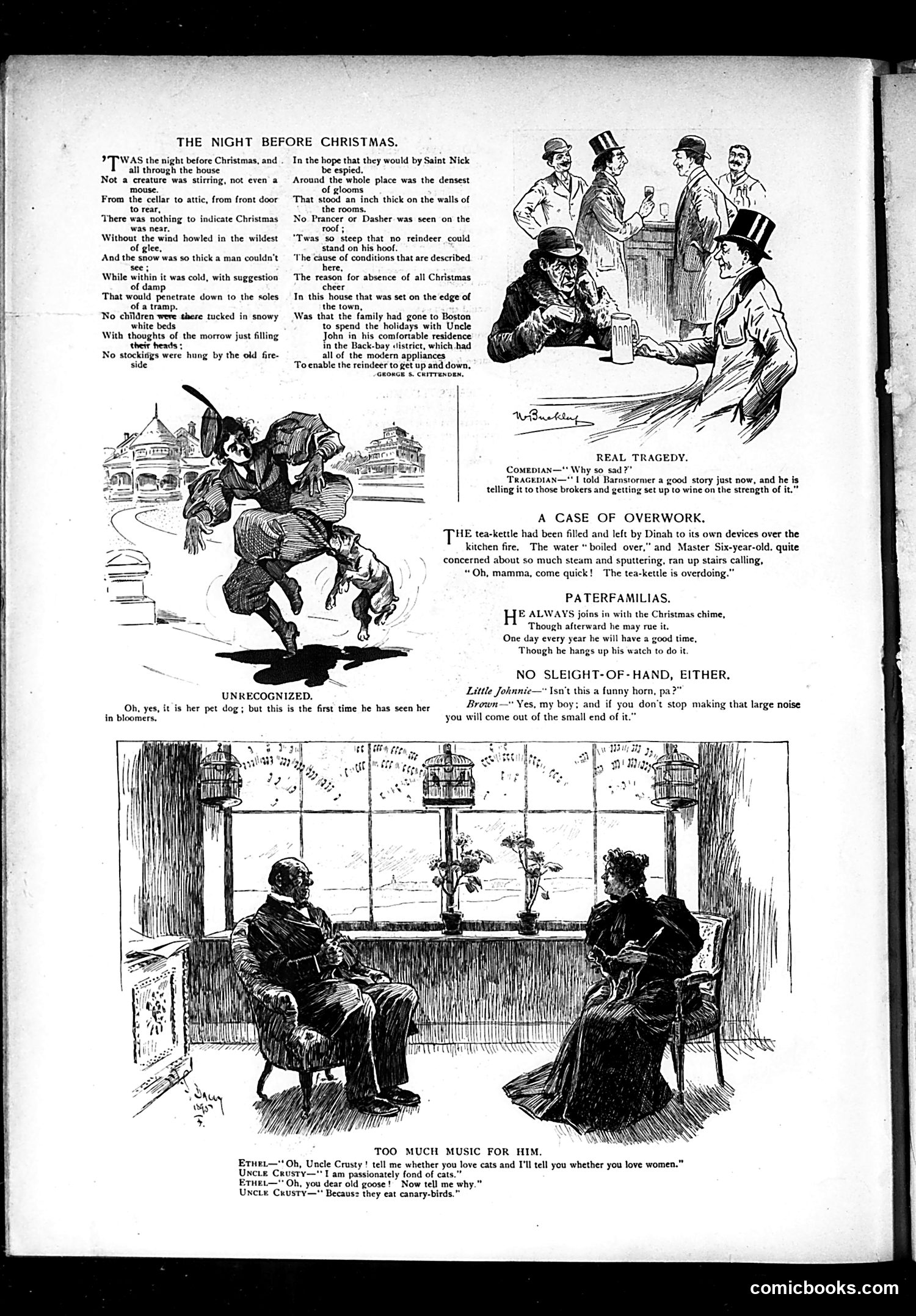
This page from the satirical magazine *Judge* contains several short humorous pieces mocking Victorian-era social conventions and domestic life: **"The Night Before Christmas"** parodies Clement Clarke Moore's famous poem, satirizing wealthy families who abandon home for holidays with relatives in Boston's fashionable Back Bay district—suggesting that Christmas spirit requires modern conveniences and social status rather than family togetherness. **"Real Tragedy"** jokes about theatrical types: an actor shares a good story with brokers, who will take credit for it over drinks. **"A Case of Overwork"** humorously depicts a child misusing vocabulary, calling a boiling kettle "overdoing"—gentle satire of children's malapropisms. **"Unrecognized"** shows a woman in new "bloomers" (split skirts—then controversial) being mistaken for her dog by her own pet. **"Too Much Music for Him"** presents an old man misanthrope: he loves cats because they eat canaries—implying he dislikes both women and songbirds. The page reflects turn-of-century middle-class anxieties about changing fashion, domesticity, and social pretension.
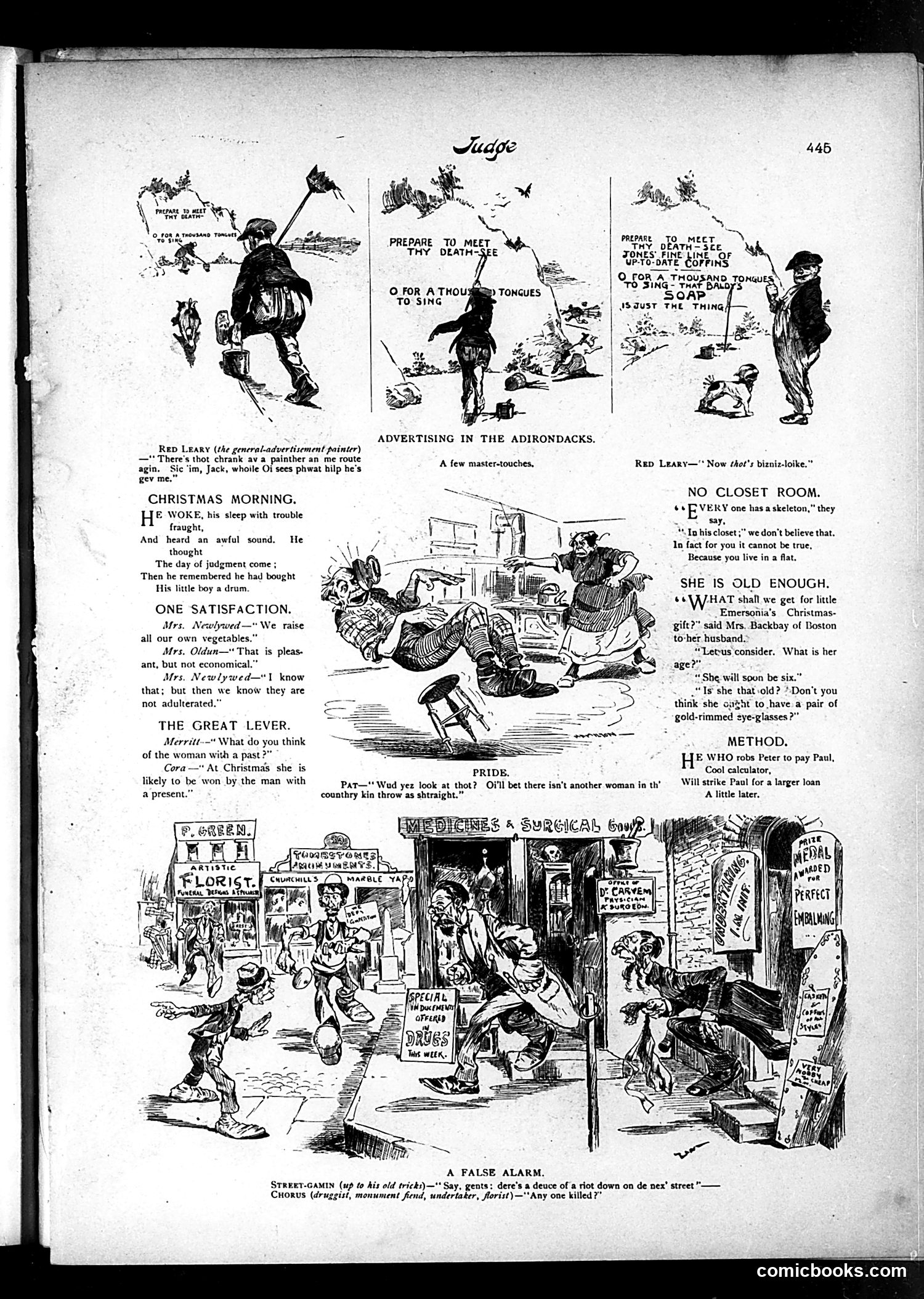
This page collects multiple satirical pieces typical of Judge's humor circa early 1900s: **"Christmas Morning"** mocks the popular gift of toy drums—the joke being a parent's regret after hearing the noise. **"The Great Lever"** satirizes materialism: a woman with a "past" (scandalous reputation) becomes marriageable if a man has money/gifts to offer. **"One Satisfaction"** ridicules new homeowners who grow vegetables to avoid food adulteration, though the practice is economically wasteful. **"No Closet Room"** jokes that apartment dwellers lack space for hidden "skeletons" (secrets)—everyone supposedly has one. **"She Is Old Enough"** mocks wealthy Boston society's absurd materialism: suggesting gold-rimmed glasses as a Christmas gift for a five-year-old. **"A False Alarm"** shows urban street characters reacting to commotion, reflecting working-class life. The ads and illustrations satirize immigrant dialects, advertising excess in remote areas, and commercial quackery—typical Judge targets of social pretension and hypocrisy.
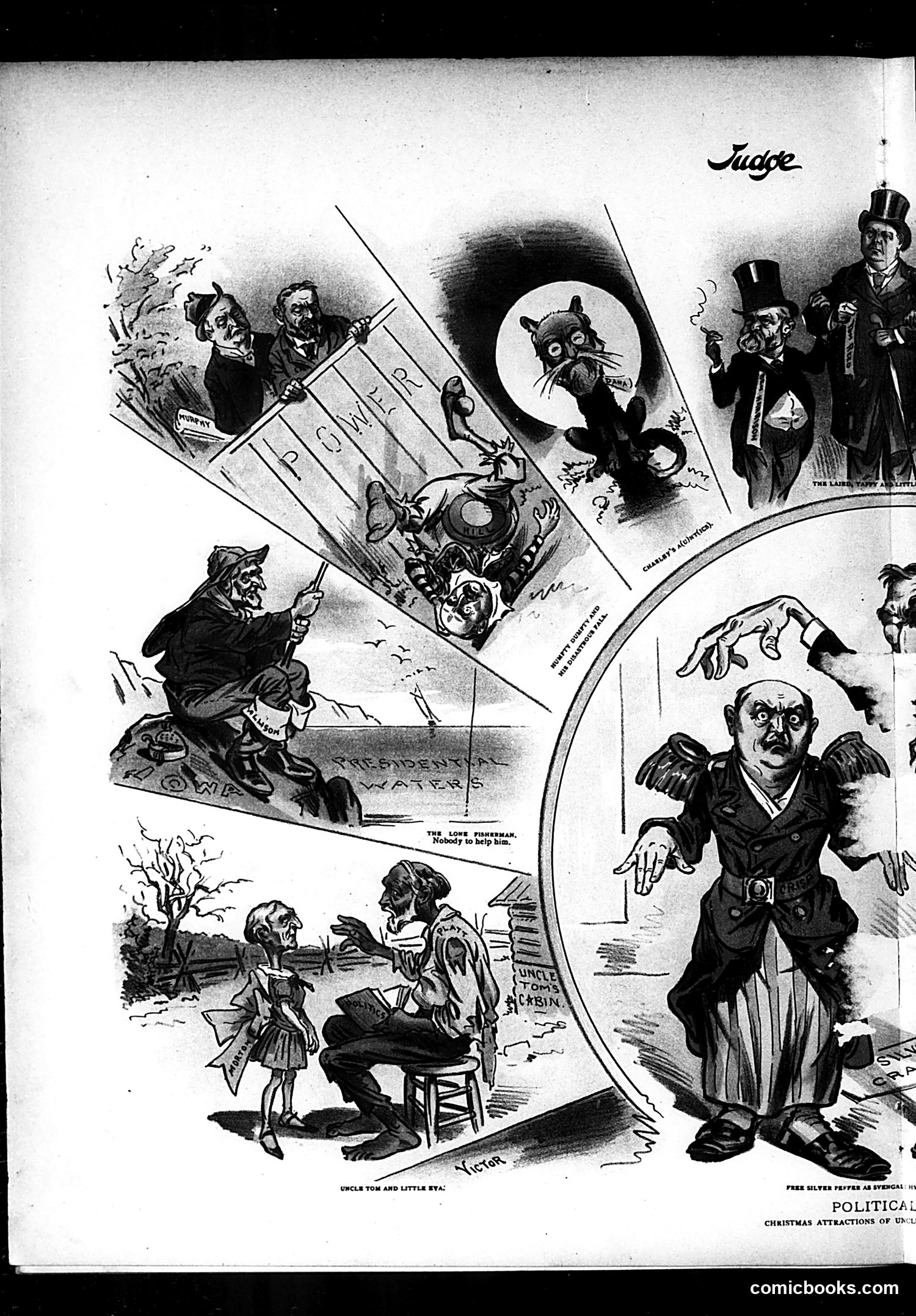
This Judge magazine page presents political cartoons satirizing Christmas-season themes circa 1890s. The top panels appear to reference "Uncle Tom's Cabin," depicting characters in distress—likely critiquing political figures or policies through literary allusions. The caption "The Lowe Fisherman / Nobody to help him" suggests commentary on an abandoned or unsupported political actor. The bottom panel, "Free Silver Prayer as Svengal," references the Free Silver political movement (advocating unlimited silver coinage) and the character Svengal from "Trilby"—a manipulator who controls others. This suggests satirizing Free Silver advocates as puppet-masters controlling American politics. The overall page title, "Political Christmas Attractions," frames these as holiday-season political commentary, mocking contemporary political figures and movements through exaggerated caricature and literary references that Judge's educated readership would recognize.
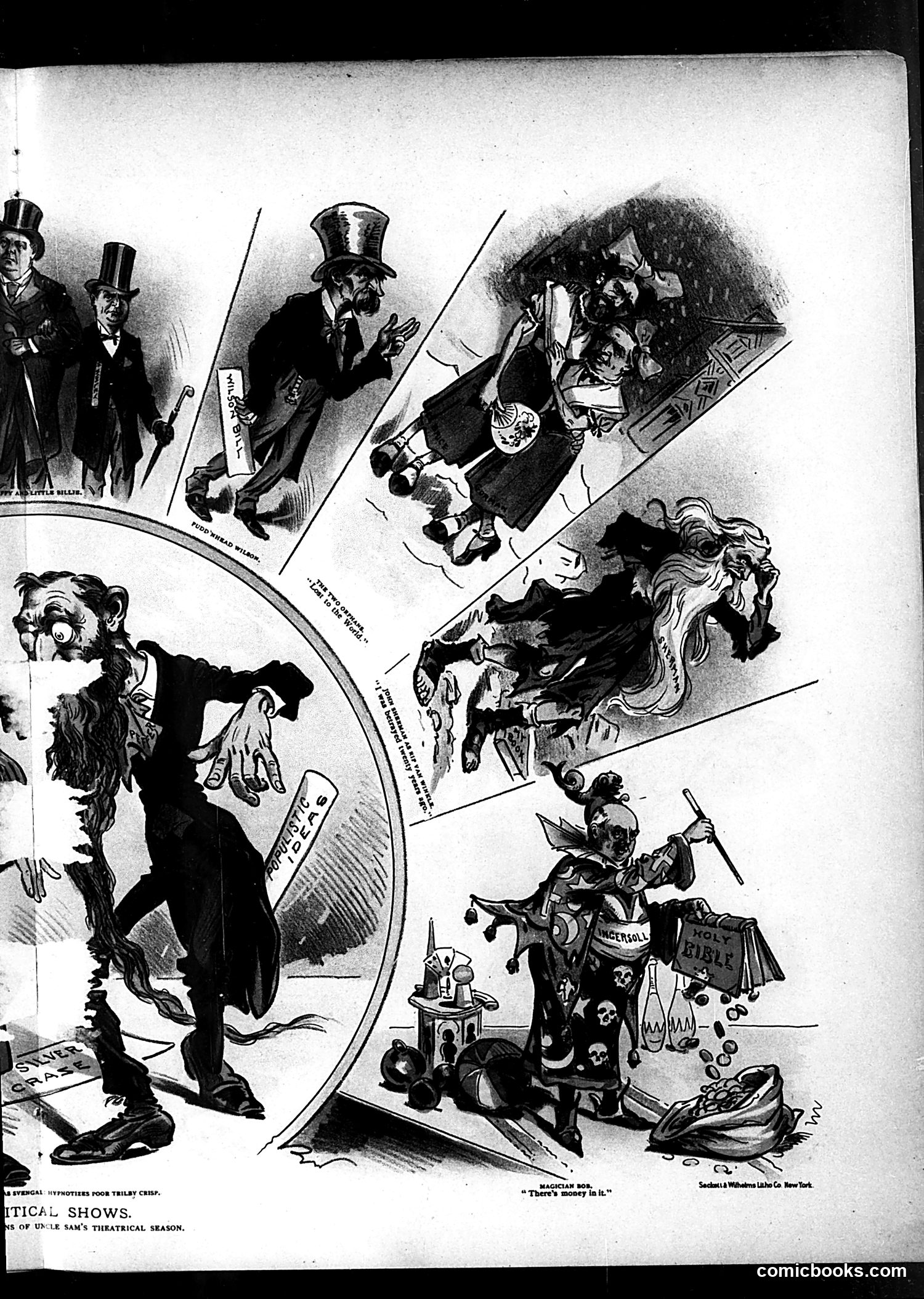
This page satirizes American theatrical productions as political allegories. The main cartoon references "Svengali," the manipulative character from the popular novel/play "Trilby" (1894). Here, "Svengali" represents a controlling political or financial force "hypnotizing" the American public ("poor Trilby Crisp"). The surrounding vignettes appear to depict various theatrical "shows" representing different aspects of Uncle Sam's political "season"—likely critiquing how politicians and special interests manipulate public opinion through theatrical spectacle and propaganda. The caricatured figures (top hats, exaggerated features) suggest politicians or wealthy elites. The demon-like figure at bottom appears to represent corruption or malevolent influence. The satire's core message: American politics functions as theatrical manipulation, with shadowy powers controlling public perception like a hypnotist controls a subject.
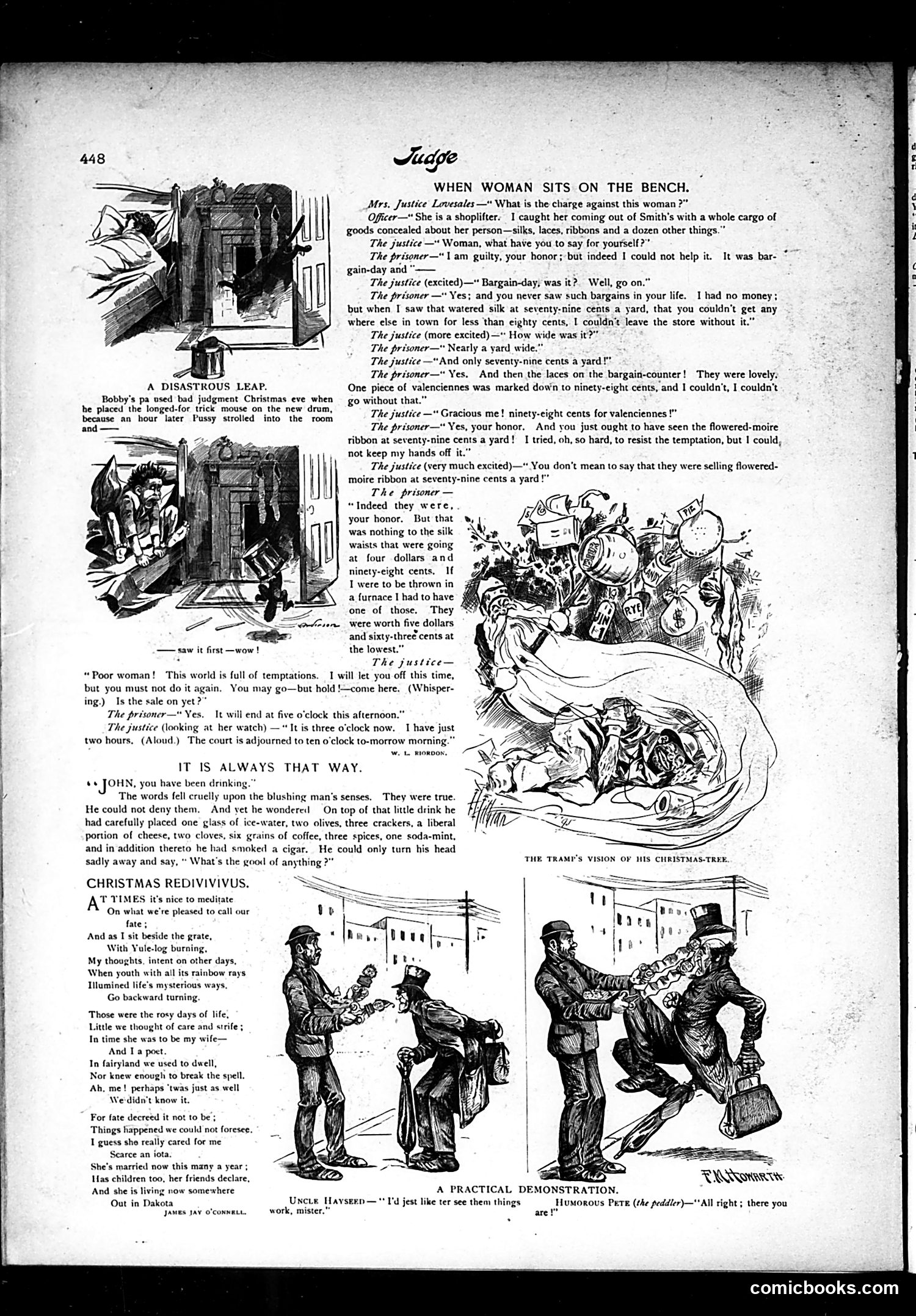
This satirical piece mocks both female shoplifters and female judges. "Mrs. Justice Lovesales" presides over a shoplifting case, initially appearing stern. However, when the defendant explains stealing silk and laces due to irresistible bargains, the judge becomes increasingly excited and sympathetic—eventually asking about ongoing sales. The joke's point: women are depicted as inherently susceptible to shopping temptation, so unfit to judge other women fairly. A female judge cannot maintain impartiality when bargains are involved. The satire targets both women's supposed weakness for deals and the notion of women in judicial authority, suggesting they'd be compromised by their own "nature." The accompanying illustrations show the judge abandoning her bench, ultimately adjourning court to attend the sale herself—confirming the stereotype that women prioritize shopping over professional duty.
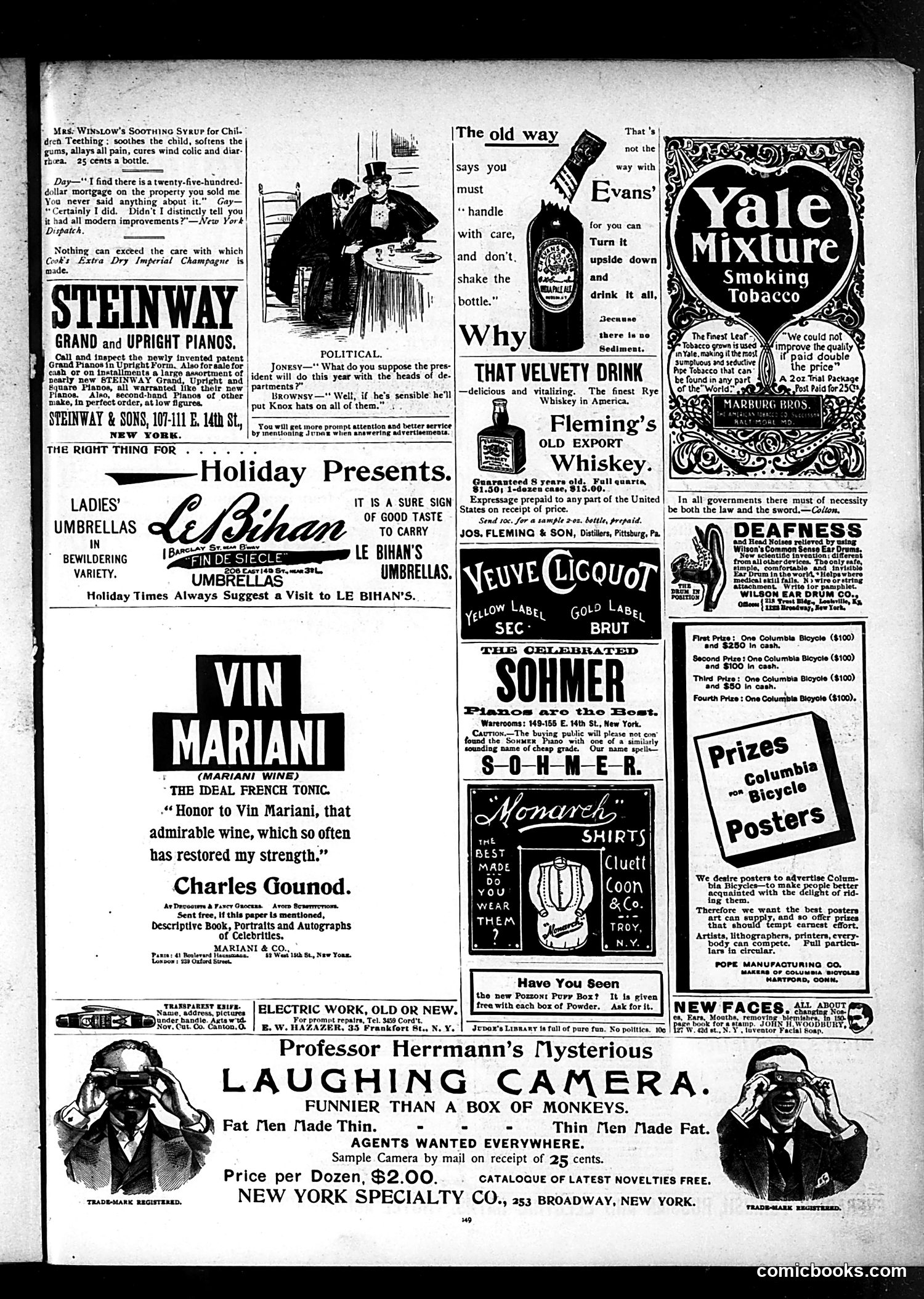
The page is primarily **advertising**, typical of Judge magazine's revenue model. However, there is one small political cartoon labeled "POLITICAL" showing two men in conversation. The joke references President McKinley's cabinet appointments. One figure (Jonesy) asks what the president will do with his department heads. The other (Brownsy) replies that if McKinley is sensible, he'll "put Knox hats on all of them"—a pun on Secretary of State John Hay's predecessor and the literal Knox hat brand. This is **gentle political satire** about cabinet management rather than serious critique. The humor relies on a visual/verbal pun about hats that modern readers would miss without recognizing Knox as both a political figure and a hat manufacturer of the era. The rest of the page consists of patent medicine ads (Mrs. Winslow's Syrup), musical instruments (Steinway pianos), alcohol products (various whiskeys), and novelty items (the "Laughing Camera"), reflecting turn-of-century consumer culture.
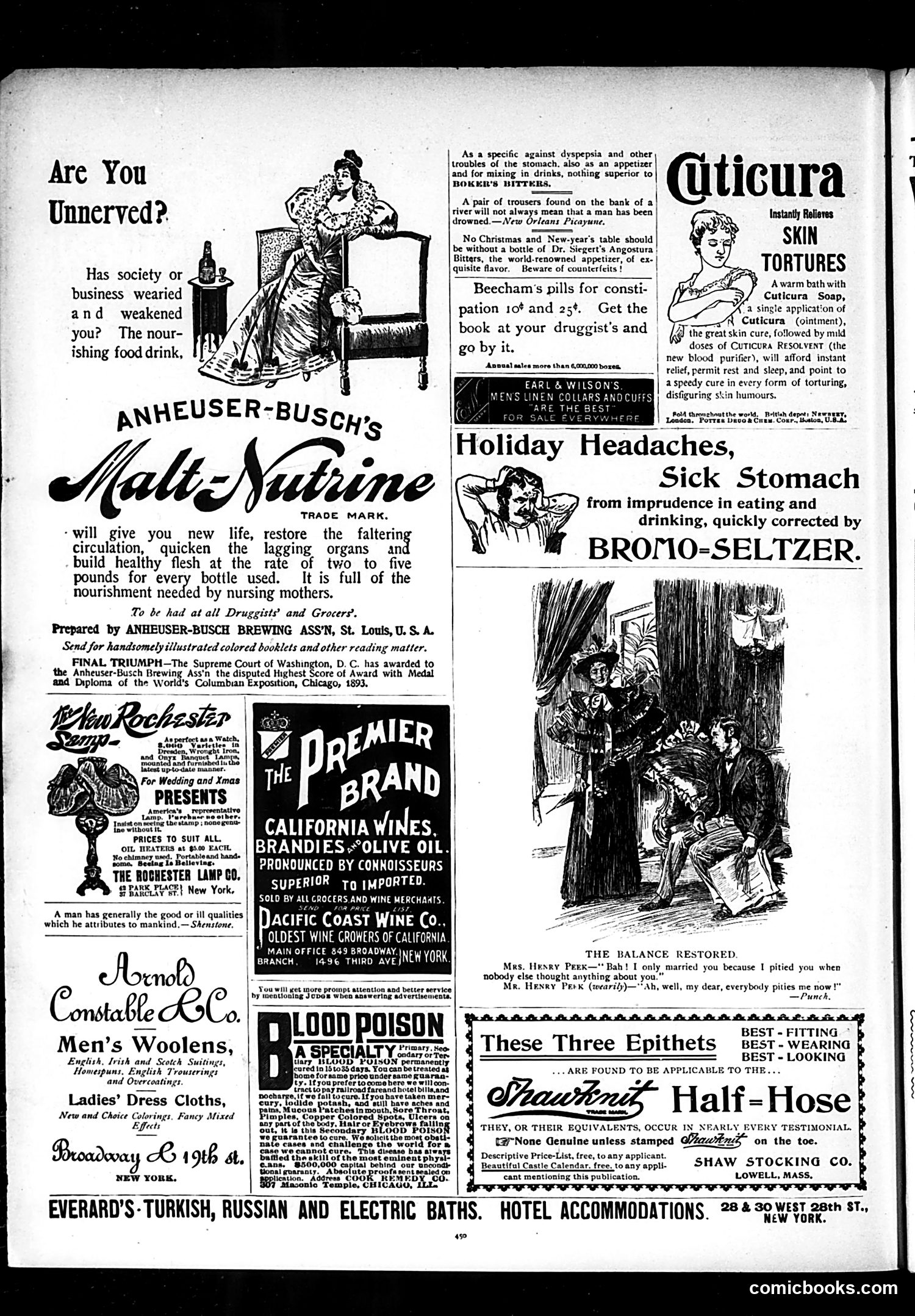
This is primarily an **advertising page** from a late 19th-century magazine (based on the 1893 World's Columbian Exposition reference and typography). Rather than political satire, it features medical and consumer product ads typical of the period. **Notable content:** - **Anheuser-Busch's "Malt-Nutrine"**: A tonic claiming to restore vigor and build flesh—representing the era's bogus patent medicines marketed to weakened urbanites and nursing mothers. - **Cuticura**: Advertised as a cure for "skin tortures," exemplifying dubious dermatological remedies of the time. - **Blood Poison cure** and **Bromo-Seltzer**: Treatments for venereal disease and indigestion, respectively, reflecting common period health anxieties. - **The Balance Restored cartoon**: A domestic scene where a husband sarcastically notes his wife married him out of pity—a modest attempt at marital humor typical of Judge's satirical tone. The page reflects genuine public health concerns of the 1890s, unregulated advertising, and the prevalence of patent medicines presented as scientific solutions.
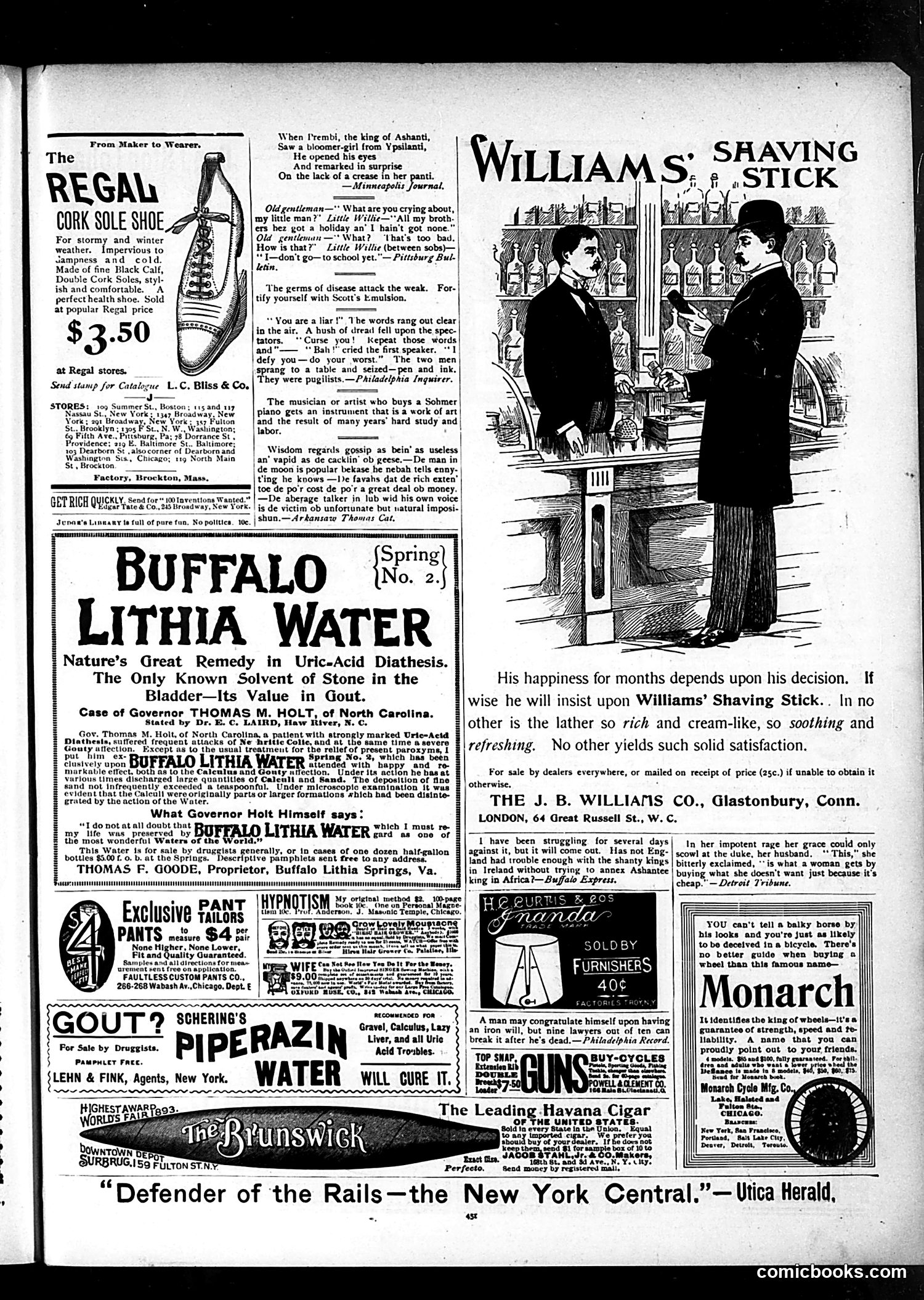
This is primarily a **product advertisement** for Williams' Shaving Stick, occupying the right half of the page. The illustration shows a well-dressed man in a barbershop examining his reflection, presumably deciding on shaving products. The advertisement's pitch emphasizes that a man's "happiness for months depends upon his decision"—a humorous exaggeration typical of early 20th-century advertising copy. The key selling points are that Williams' products offer superior lather that is "rich and cream-like, so soothing and refreshing," with claims of "solid satisfaction" unmatched by competitors. The ad targets middle-class male consumers concerned with grooming and comfort. The tone is lighthearted yet persuasive, suggesting that choosing the right shaving product was presented as a significant personal decision—reflecting period attitudes about masculine self-care and consumer choice. The manufacturer is J.B. Williams Co., located in Glastonbury, Connecticut, with a London office, indicating an established, reputable brand seeking national distribution.
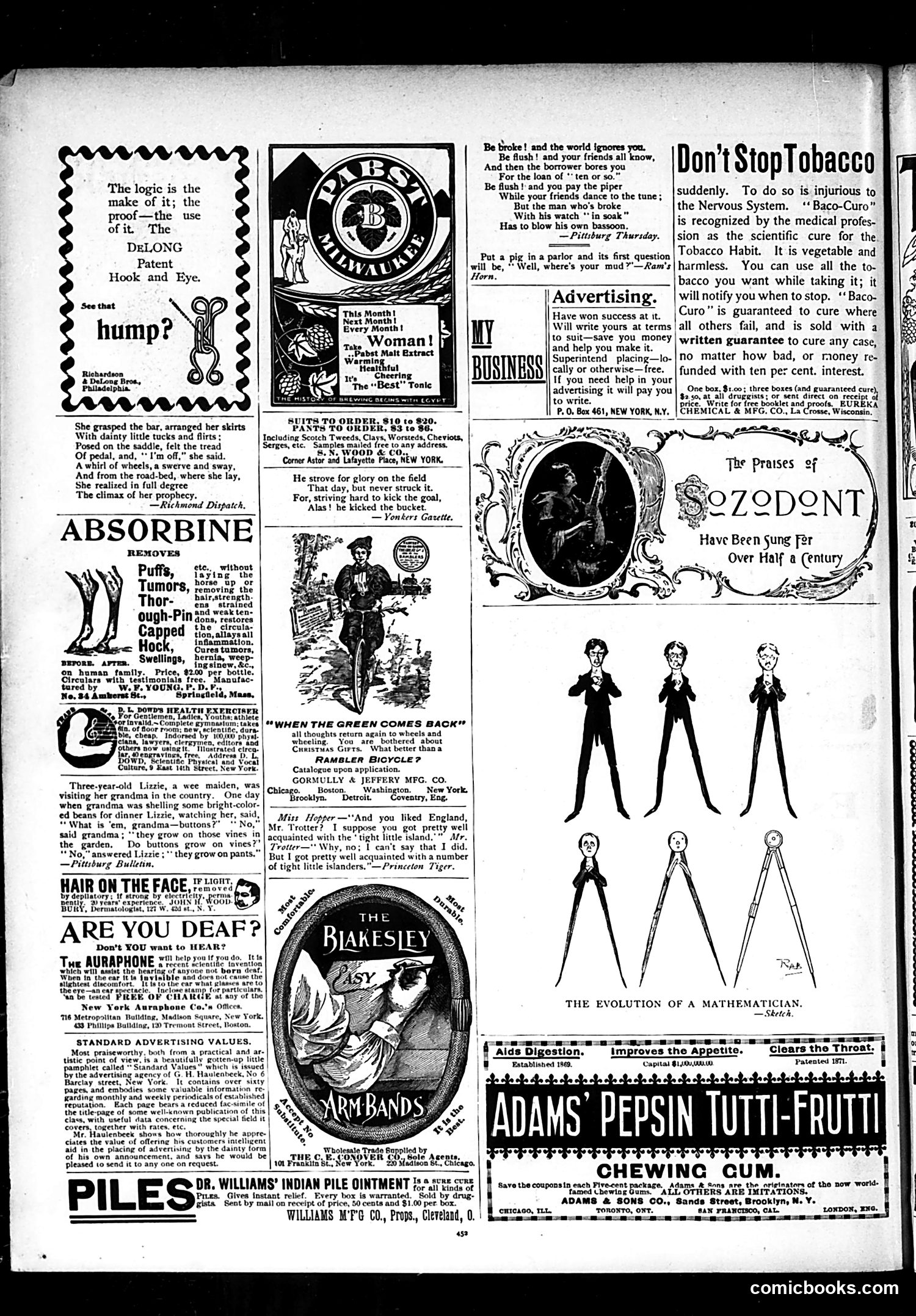
This is primarily an **advertising page** with minimal satirical content. The advertisements peddle patent medicines and dubious products typical of early 20th-century magazines. **Notable content:** - **"Baco-Curo"**: A tobacco cessation product claiming to be a "scientific cure" recognized by the medical profession. Modern readers should note: these unregulated claims would be illegal today; nicotine addiction wasn't well understood scientifically then. - **"Absorbine"**: Advertises removal of "puffs, tumors, thorough-capped hock, swellings"—appears aimed at both humans and horses, typical of period patent medicines with vague, unsubstantiated claims. - **"Dr. Williams' Indian Pile Ointment"**: Self-explanatory. The page includes light humor ("The Evolution of a Mathematician" sketch showing stick figures) and brief comedic anecdotes, but lacks political satire. It primarily reflects the era's unregulated medical marketplace and credulous advertising standards.
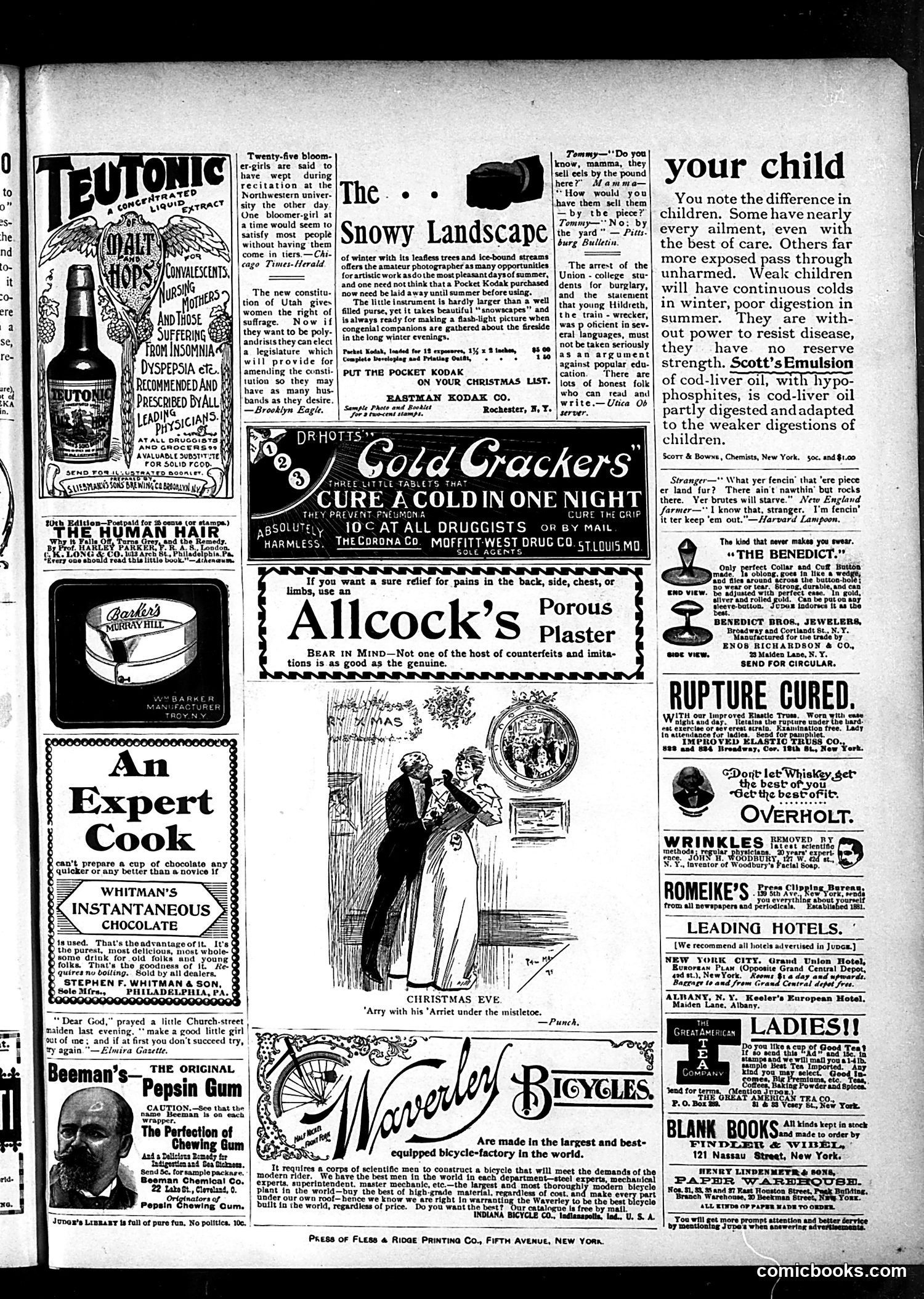
This page is primarily **advertisements and filler content** rather than political satire. The key editorial elements are brief humor items: **Main satire pieces:** - A jab at women's suffrage in Utah, joking that if women gain voting rights, they might "elect a legislature" to legalize polygamy—mocking both women's political capabilities and Mormon polygamy concerns. - A piece satirizing overeducated criminals: Union College students arrested for burglary, and a train-wrecker fluent in languages, arguing that education doesn't prevent crime. - A Tommy/Mamma dialogue making a mild joke about selling eels by pound versus piece. **Context for modern readers:** These reflect 1890s anxieties about women's suffrage (still decades from passage) and anxiety about immigrant education and criminality. The humor is gentle social commentary typical of Judge magazine's satirical approach. **The rest is advertising:** Kodak cameras, chocolates, patent medicines, bicycles, and plasters—typical period commercial content filling magazine pages.
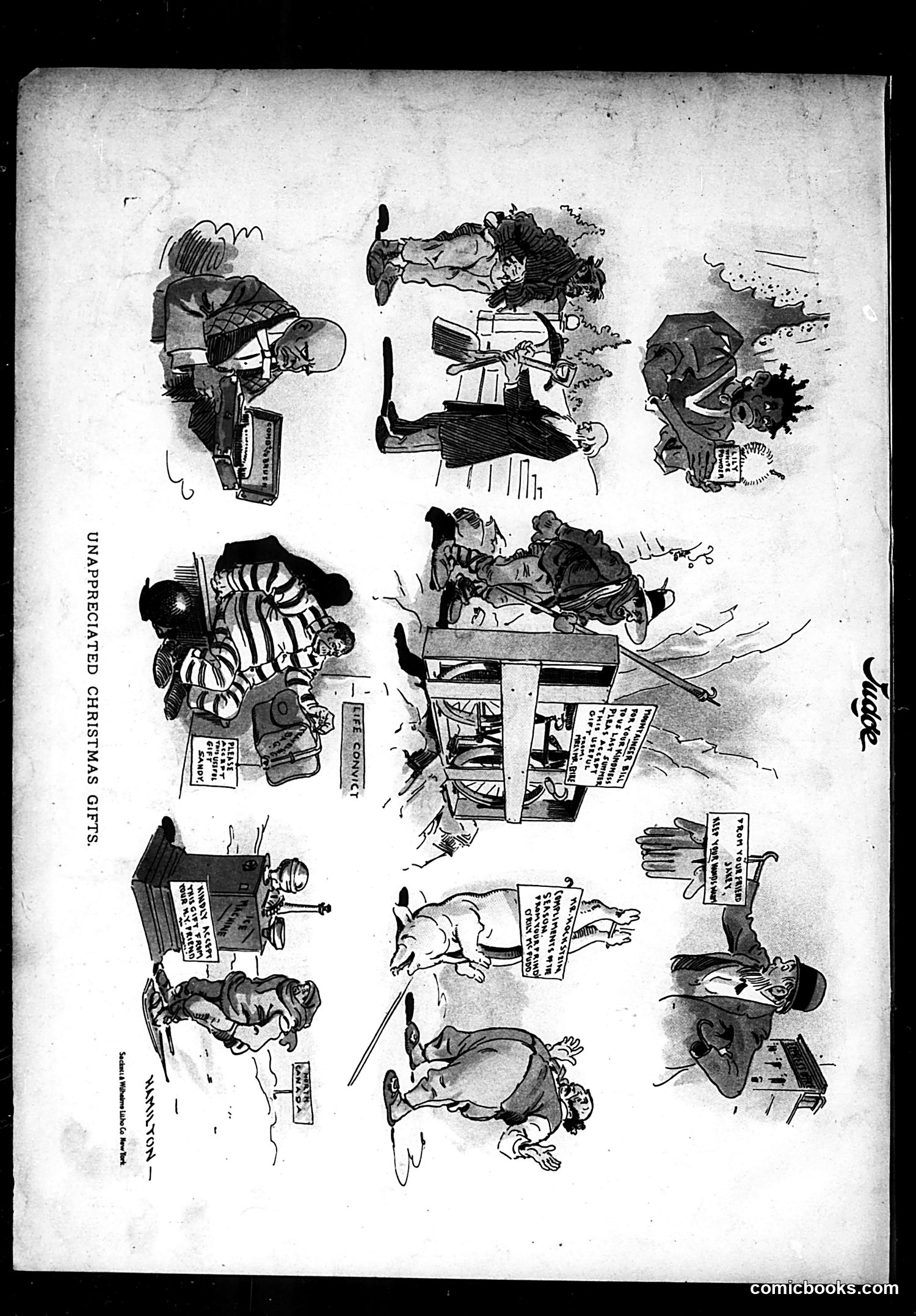
This satirical cartoon from *Judge* magazine depicts various people receiving unwanted or impractical Christmas presents. Each vignette shows a recipient with their gift and an explanatory label—though the specific text on most labels is too blurry to read clearly in this reproduction. The humor relies on the relatable premise of receiving gifts that don't suit the recipient: incongruous items, impractical goods, or presents that mock the person's circumstances or character. The cartoon uses caricature and exaggeration typical of late 19th/early 20th-century satirical illustration. The page title "Unappreciated Christmas Gifts" suggests social commentary on consumer culture and gift-giving conventions of the era, poking fun at both the generosity and thoughtlessness of holiday present-giving.
I can see this is a mostly black page from Judge magazine with minimal visible content. The only clearly legible text is "comicbooks.com" at the bottom right, which appears to be a watermark from the digital source rather than original magazine content. The page itself is extremely dark—either a blank page, back cover, or severely degraded during scanning. There are faint marks along the left edge that might be binding or damage, but no cartoon, illustration, or readable text is discernible enough to analyze. Without visible content to examine, I cannot identify figures, political references, or the intended satire. This appears to be either a blank advertising page or a scanning quality issue rather than substantive editorial or cartoon content.