
Judge, 1895-12-28 · page 10 of 17
Judge — December 28, 1895 — page 10: what you’re looking at
What you’re looking at
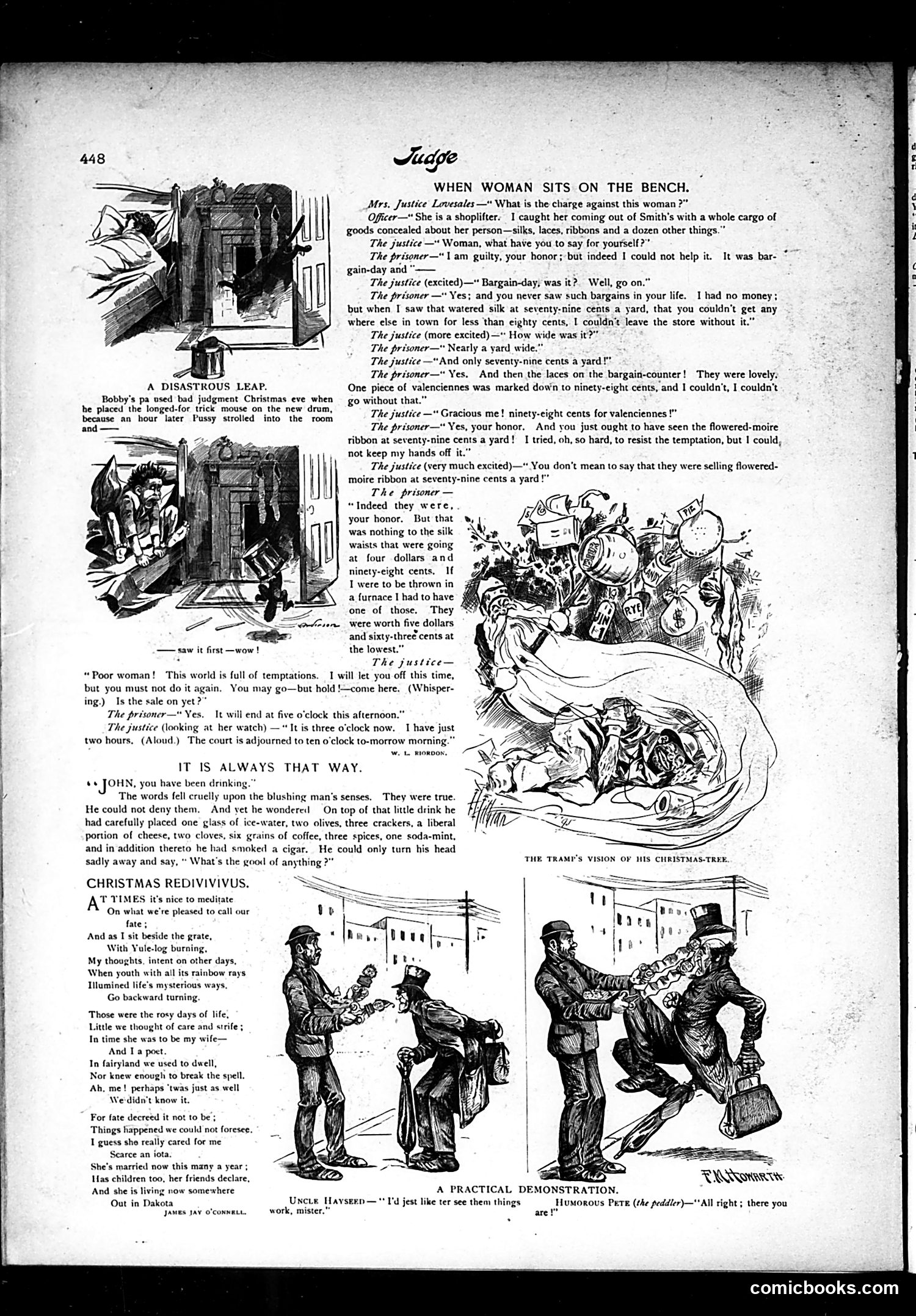
This satirical piece mocks both female shoplifters and female judges. "Mrs. Justice Lovesales" presides over a shoplifting case, initially appearing stern. However, when the defendant explains stealing silk and laces due to irresistible bargains, the judge becomes increasingly excited and sympathetic—eventually asking about ongoing sales. The joke's point: women are depicted as inherently susceptible to shopping temptation, so unfit to judge other women fairly. A female judge cannot maintain impartiality when bargains are involved. The satire targets both women's supposed weakness for deals and the notion of women in judicial authority, suggesting they'd be compromised by their own "nature." The accompanying illustrations show the judge abandoning her bench, ultimately adjourning court to attend the sale herself—confirming the stereotype that women prioritize shopping over professional duty.
📄 Transcribed text from this page (OCR, searchable)
Machine-transcribed from the original scan — historical spelling and the odd misread are preserved.
Suage WHEN WOMAN SITS ON THE BENCH. Mrs, Justice Lovesales —* What is the charge against this woman ?” Officer — She is a shoplifter. 1 caught her coming out of Smith's with a whole cargo of goods concealed about her person—silks, laces, ribbons and a dozen other things.” The justice —* Woman, what have you to say for yourself?” The prisoner gain-day and “—— The justice (excited) —" Bargain-day, was it?. Well, go on.” The prisoner —" Yes; and you never saw such bargains in your life. I had no money; but when I saw that watered silk at seventy-nine cents a yard, that you couldn't get any where else in town for less than eighty cents, I couldn’t leave the store without it.” The justice (more excited) —" How wide was it?” The prisoner— Neatly a yard wide.” The justice —"And only seventy-nine cents a yard!” The prisoner— Yes. And then the laces on the bargain-counter! They were lovely. One piece of valenciennes was marked down to ninety-eight cents, and I couldn't, I couldn't A DISASTROUS LEAP. Bobby's pa used bad judgment Christmas eve when Bobby's pa osed bad judg A go without that.” Nees beer kien tony oleae oe coe The justice — Gracious me! ninety-eight cents for valenciennes !” erpend) The prisoner—* Yes, your honor. And you just ought to have seen the flowered-moire - ribbon at seventy-nine cents a yard! I tried, oh, so hard, to resist the temptation, but I could, not keep my hands off it.” The justice (very much excited)—" You don’t mean to say that they were selling flowered- moire ribbon at seventy-nine cents a yard!” The prisoner — “Indeed they were, your honor. But that was nothing to the silk waists that were going at four dollars and ninety-eight cents, If I were to be thrown in a furnace I had to have one of those, They were worth five dollars and sixty-thre¢ cents at —saw it first —wow ! the lowest.” " The justice— “Poor woman! This world is full of temptations. I will let you off this time, but you must not do it again. You may go—but hold !—come here. (Whisper- ing.) Is the sale on yet?” The prisoner—* Ves. \t will end at five o'clock this afternoon.” The justice (looking at her watch) —“ It is three o'clock now. I have just two hours, (Aloud.) The court is adjourned to ten o'clock to-morrow morning.” IT IS ALWAYS THAT WAY. t+ JOHN, you have been drinking.” The words fell cruelly upon the blushing man’s senses. They were true. He could not deny them, And yet he wondered On top of that little drink he had carefully placed one glass of ice-water, two olives, three crackers, a liberal portion of cheese, two cloves, six grains of coffee, three spices, one soda-mint, and in addition thereto he had smoked a cigar. He could only turn his head sadly away and say, What's the good of anything ?” CHRISTMAS REDIVIVIVUS. a ‘T TIMES it's nice to meditate iis On what we're pleased to call our fate ; And as I sit beside the grate, With Yole-log burning, My thoughts, intent on other days, When youth with all its rainbow rays Illumined life's mysterious ways, Go backward turning. Those were the rosy days of life, Little we thought of care and strife ; In time she was to be my wife— And Ta poet. In fairyland we used to dwell, Nor knew enough to break the spell. Ah, me! perhaps ‘twas just as well We'didn't know it. For fate decreed it not to be’; Things happened we could not foresee. I guess she really cared for me Scarce an iota. She's married now this many a year; Has children too, her friends declare, Roane And she is living now somewhere ATION. Out in Dakota Uncur Hayseen— "I'd jest like ter see them things Humorous Pere (the peddler)—"*All right; there you JAMES JAY O'CONNRLL. work, mister.” are!” “Iam guilty, your honor; but indeed 1 could not help it. It was bar- * Ros