
A complete issue · 16 pages · 1895
Judge — November 16, 1895
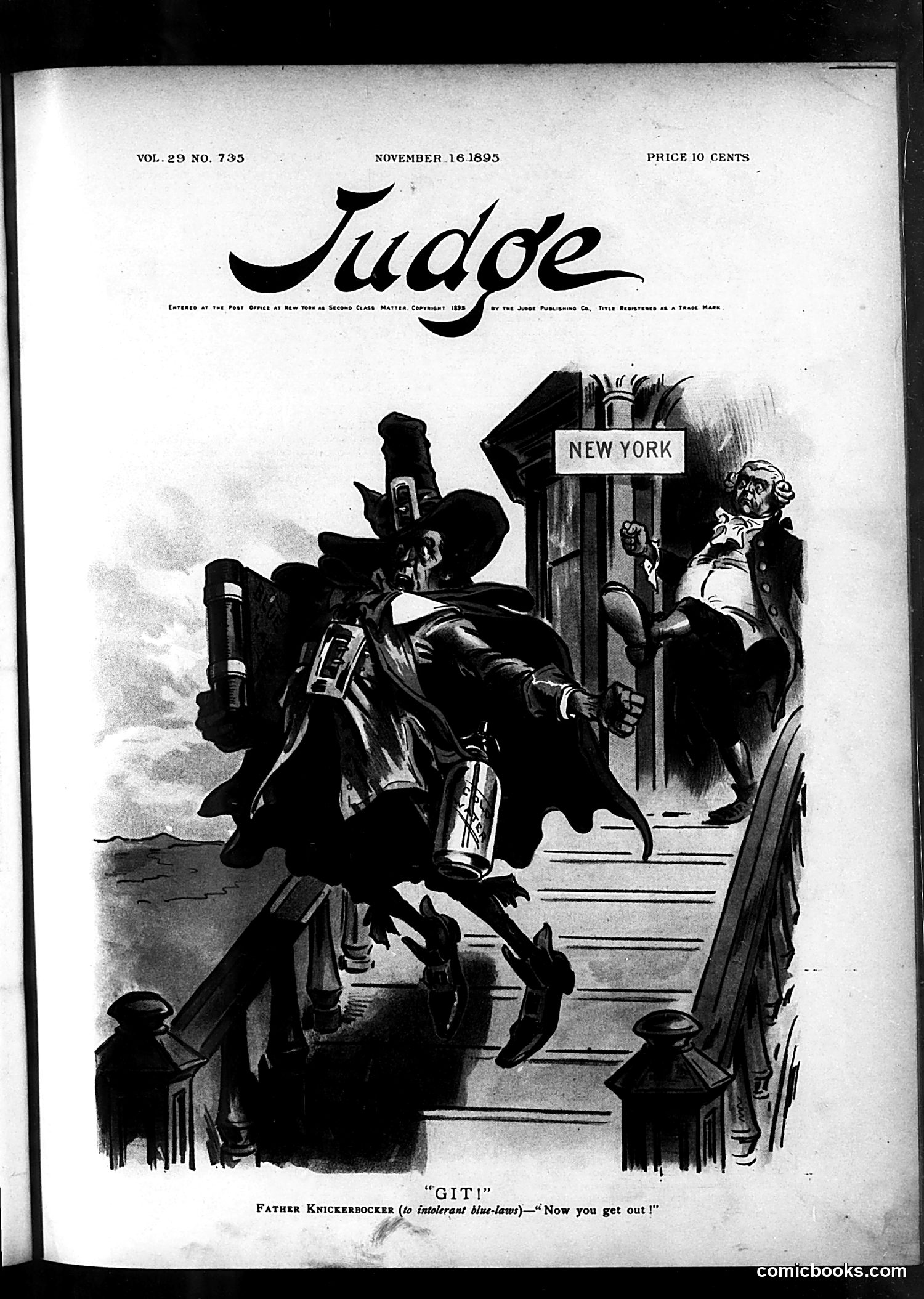
This cartoon, titled "GIT!" depicts Father Knickerbocker (an allegorical figure representing New York City) forcibly ejecting an intoxicated character from a doorway marked "NEW YORK." The satire appears to address unwanted visitors or undesirable elements being expelled from New York. The drunk's exaggerated pose and the violent ejection suggest social commentary on either: - Crime or vagrancy problems in the city - Corrupt or undesirable politicians/officials being removed - Immigration or class tensions of the 1890s Father Knickerbocker was a traditional personification of New York's authority and values. The cartoon's aggressive tone suggests disapproval of whatever the intoxicated figure represents, framed as necessary "housecleaning" for the city's welfare.
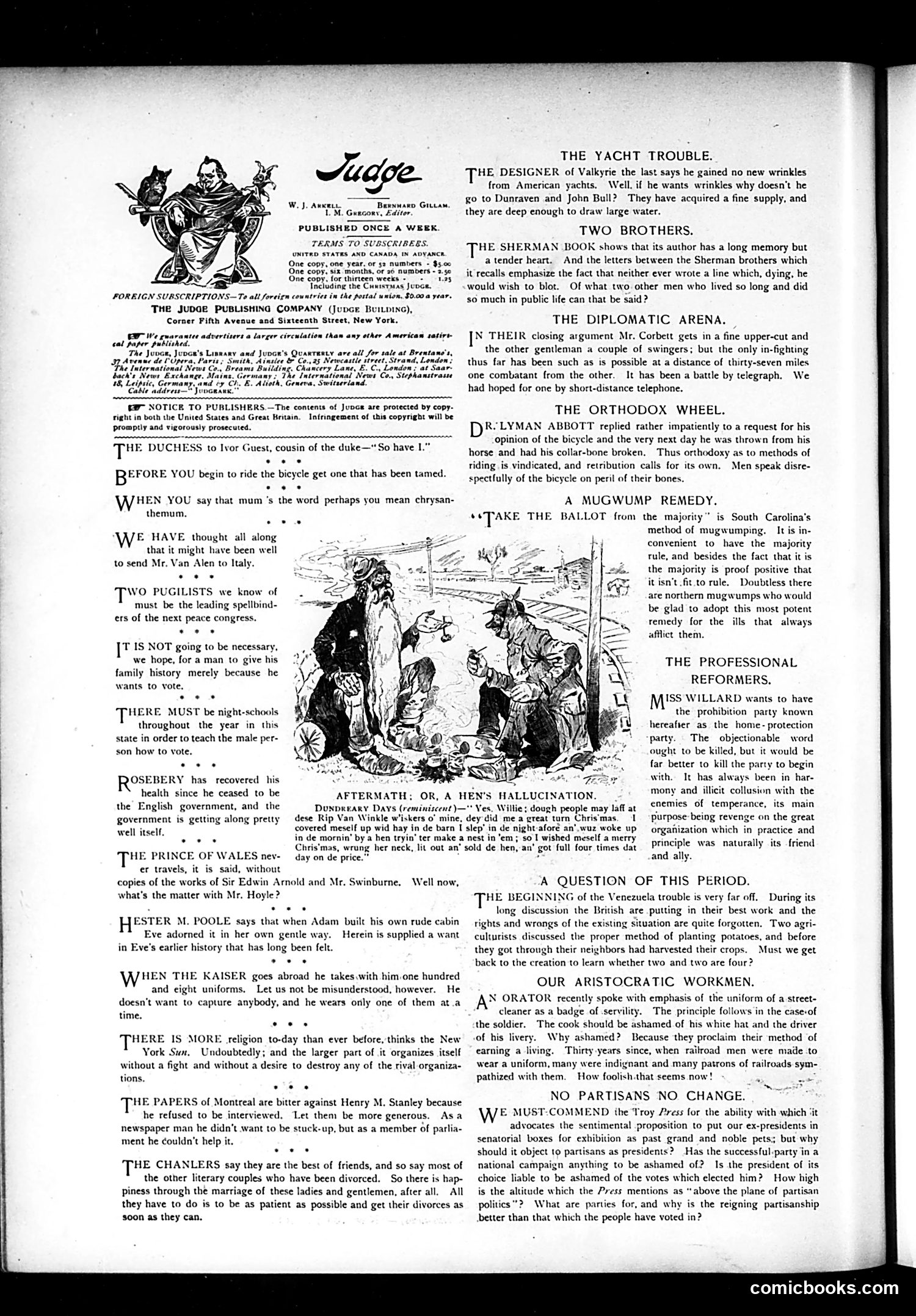
The central cartoon, "Aftermath; or, A Hen's Hallucination," depicts a hen experiencing a disturbing dream after Christmas dinner. The image shows the hen surrounded by anthropomorphic figures (appearing to be diners or ghosts) in a nightmarish scene, likely satirizing post-holiday excess and indigestion. The surrounding text columns cover various political and social topics typical of Judge's editorial voice: debates about bicycles, diplomatic disputes, electoral reform, and military uniform standards. One piece critiques the "prohibition party" and another discusses Venezuelan political troubles. The overall tone reflects turn-of-century American concerns: labor reform, political partisanship, and technological changes (bicycles). The layout mixes light humor with serious social commentary characteristic of Judge's satirical approach.
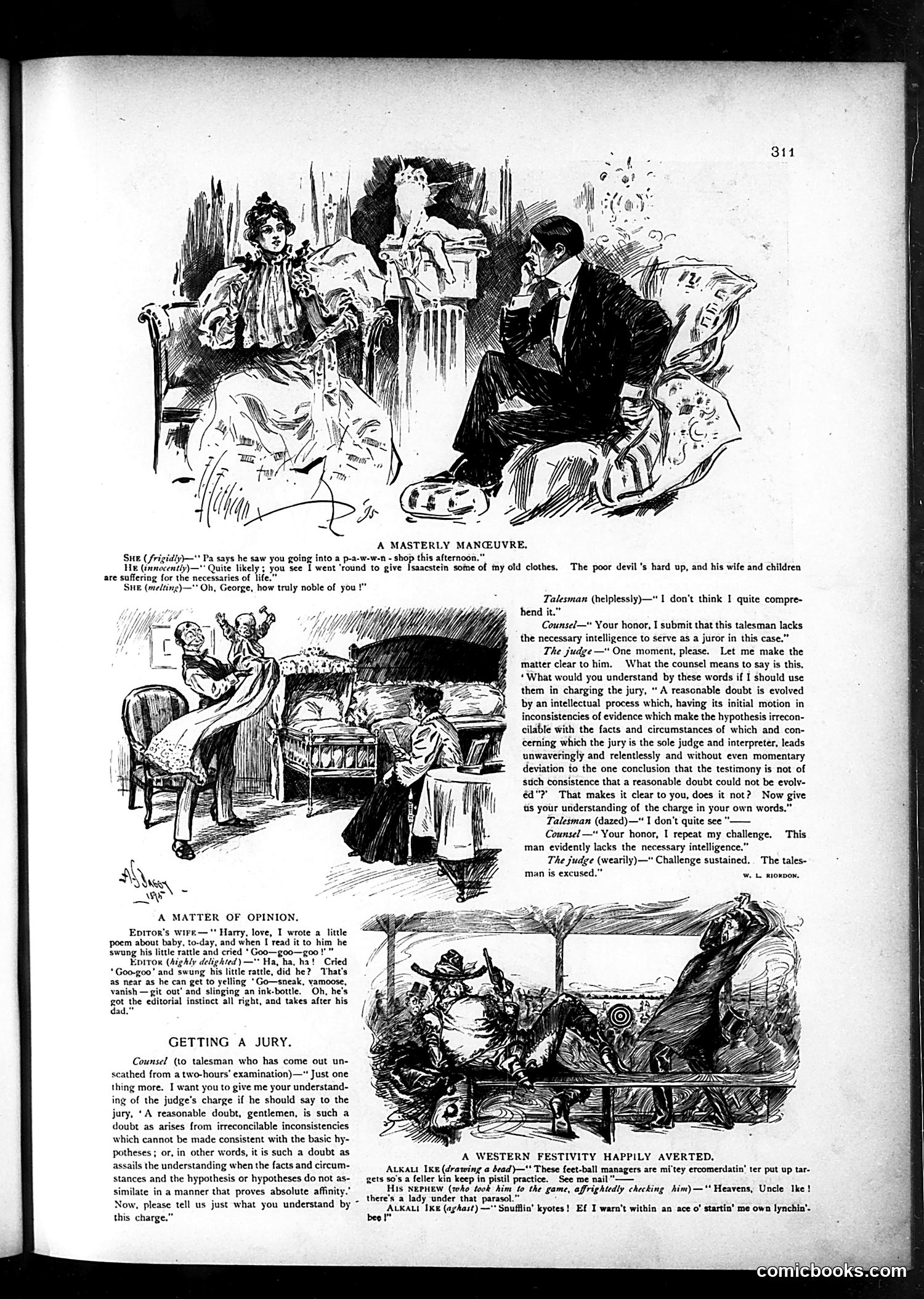
This page contains three separate satirical sketches without clear political figures or specific historical references visible in the image itself. **"A Masterly Maneuver"** depicts a social interaction where a man apparently uses clever pretense to distribute old clothes to the poor, framing it as charitable generosity rather than honest assistance. **"A Matter of Opinion"** shows a domestic scene where an editor's wife reads poetry; the husband's dismissive reaction humorously illustrates marital disagreement over artistic merit. **"Getting a Jury"** and **"A Western Festivity Happily Averted"** appear to be humorous vignettes about legal proceedings and frontier behavior respectively, using exaggeration for comedic effect. These sketches represent Judge's typical approach: satirizing everyday American social interactions and character types rather than specific political events or identifiable public figures.
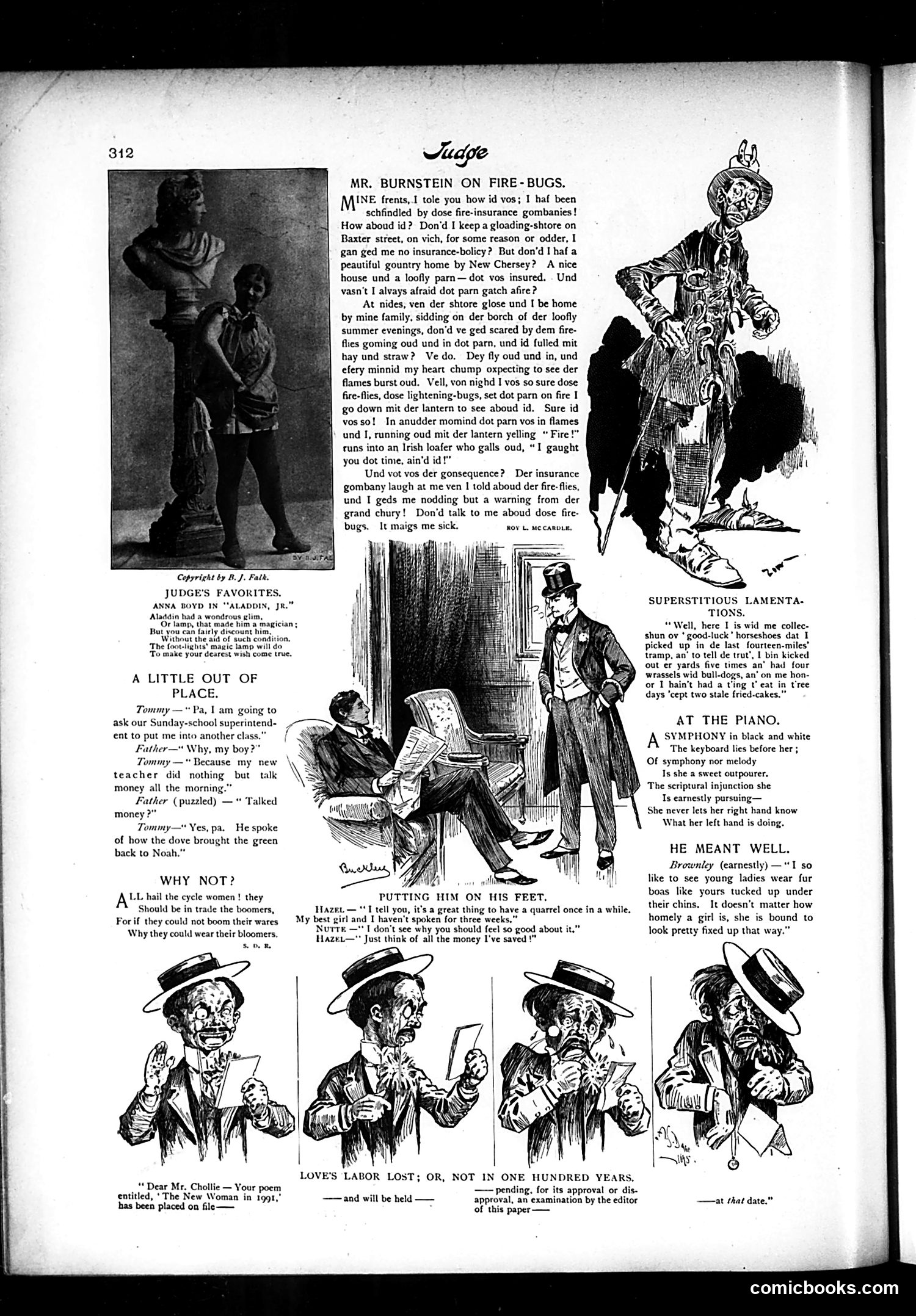
This page contains several satirical pieces targeting immigrant stereotypes and social issues of the era: **"Mr. Burnstein on Fire-Bugs"** is the main feature—a monologue in exaggerated Yiddish-inflected English by a Jewish character complaining about insurance fraud. Burnstein claims fire-flies near his insured barn terrified him, he mistook them for actual fire, and called the fire department. The insurance company and grand jury dismissed his claim, leaving him with nothing. The satire mocks both his paranoia and the insurance industry's dismissal of legitimate concerns. **Other pieces** include light humor about gender roles ("Why Not?" celebrates women cyclists as salespeople), domestic life ("A Little Out of Place" jokes about a teacher obsessed with money), and social commentary on the "New Woman" figure. The **illustration** in the upper right appears to be a decorative figure unrelated to the text below it. The overall tone reflects *Judge*'s typical approach: using ethnic caricature and dialect comedy for entertainment while occasionally critiquing business practices.
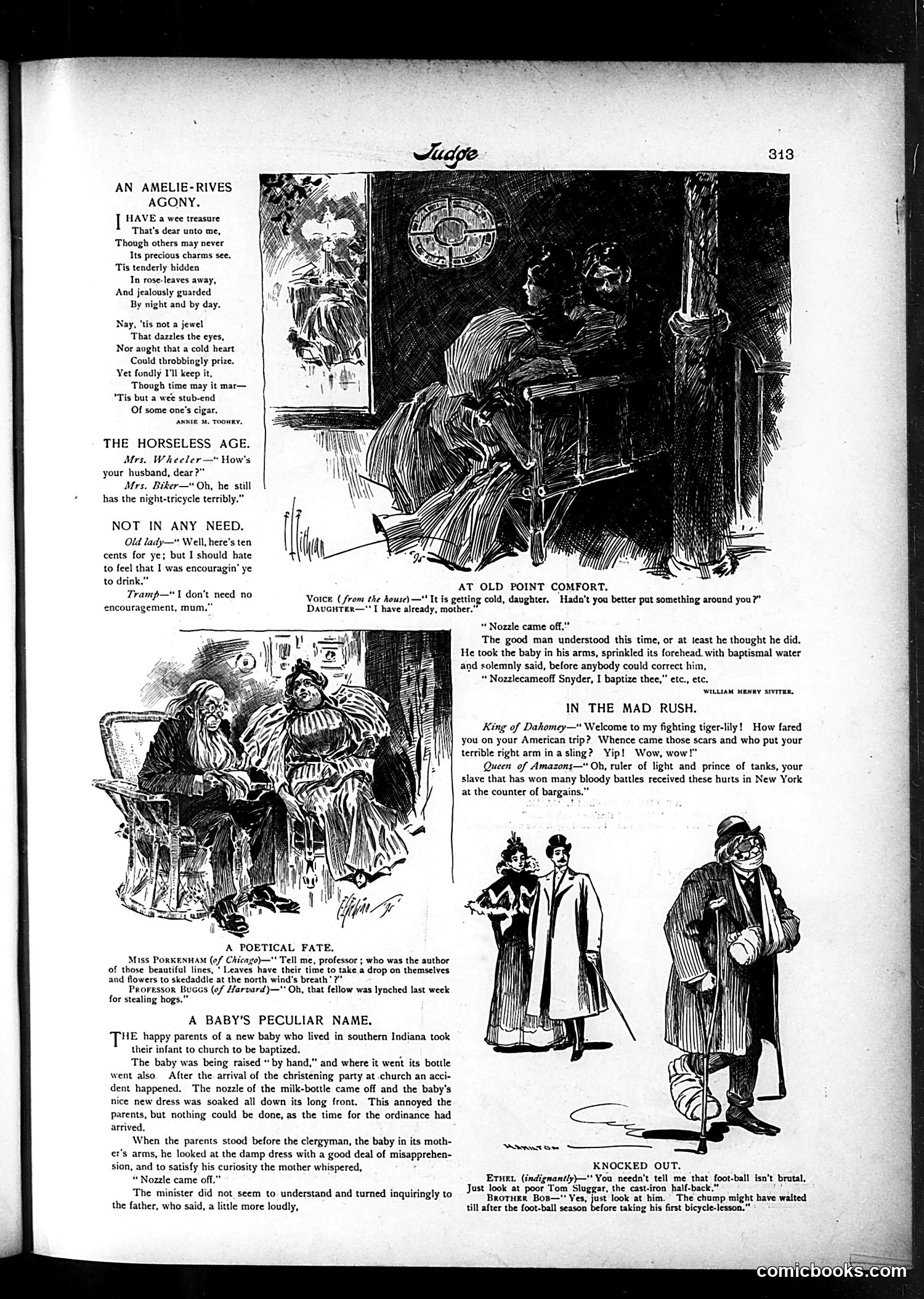
This page contains several satirical pieces typical of Judge's humor circa early 1900s: **"A Baby's Peculiar Name"** is the main story: a clergyman mishears "nozzle came off" (explaining a baby's soiled christening dress) as the child's name, baptizing the infant "Nozzlecameoff Snyder." The satire mocks both parental carelessness and clerical inattention. **"In the Mad Rush"** features caricatured African rulers (King of Dahomey and Queen of Amazons) discussing American violence, with the "Queen" claiming battle scars came from "the counter of bargains"—satirizing American commercialism and competitive shopping as brutally violent. **"Knocked Out"** jokes about football injuries versus bicycle accidents, implying football is so brutal that a player should have delayed learning to ride a bicycle. The page also includes minor humorous bits about cigars, horseless carriages, and beggary. The tone reflects Judge's era sensibility: casual ethnic caricature alongside domestic American humor.
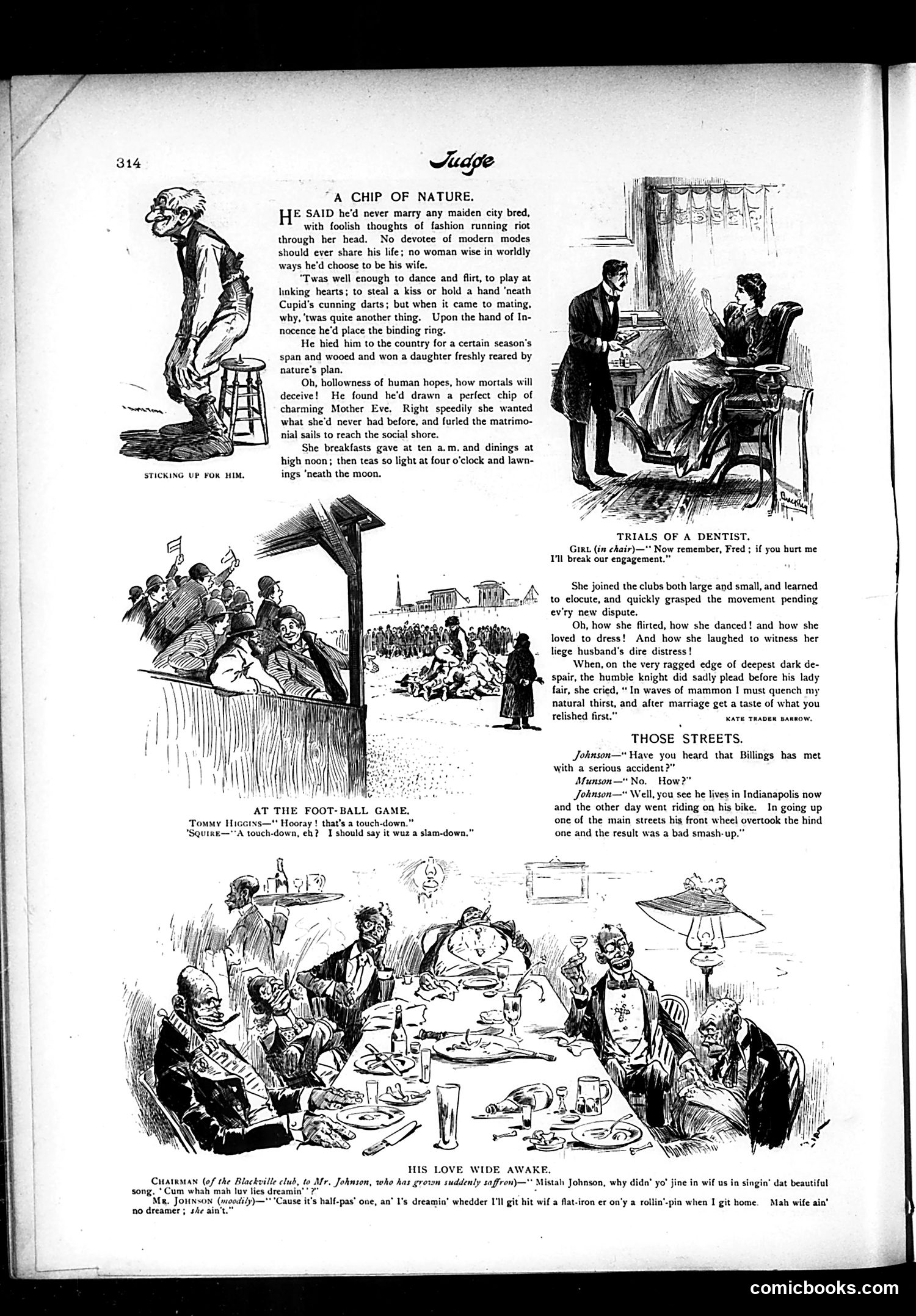
This *Judge* page contains four unrelated satirical pieces: **"A Chip of Nature"**: Mocks a man who marries a "country girl" untouched by city fashion, believing she'll remain unspoiled. The joke: she immediately becomes obsessed with social climbing—joining clubs, hosting expensive meals, dressing fashionably—thus proving that "natural" innocence is illusory and women inevitably pursue materialism and status once married. **"Trials of a Dentist"**: A woman threatens to break her engagement if her dentist-boyfriend hurts her during treatment—satirizing women's emotional manipulation. **"Those Streets"**: A brief joke about a bicycle accident in Indianapolis, with no deeper satire apparent. **"His Love Wide Awake"**: A racist caricature (using dialect stereotypes) where a Black man admits he won't sing because he's anxiously imagining his wife's violent reaction when he returns home late—treating domestic violence as comedic material. The page reflects Gilded Age attitudes: skepticism of women's independence, marital discord portrayed as humorous, and casual racism.
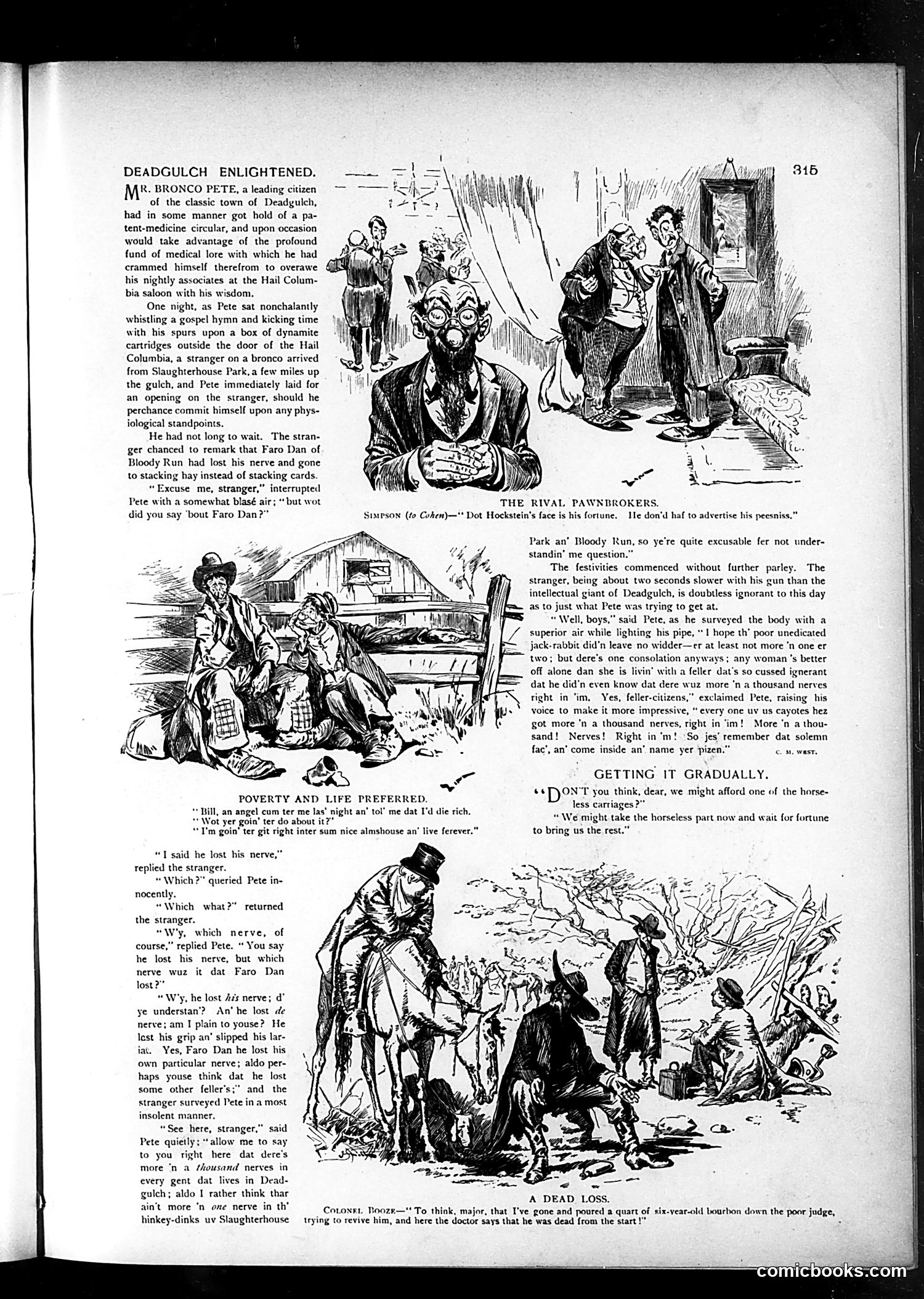
This page contains three satirical pieces mocking rural Western and urban stereotypes. **"Deadgulch Enlightened"** ridicules an ignorant frontier character, "Bronco Pete," who misuses medical jargon from a patent-medicine circular to sound educated. The joke: Pete kills a stranger over a misunderstanding about "nerves," then lectures corpse-side about anatomy he barely comprehends—claiming everyone has "a thousand nerves" in their body. The satire targets both patent-medicine quackery and frontier pretension masquerading as learning. **"The Rival Pawnbrokers"** is a brief ethnic stereotype joke about two Jewish pawnbrokers (Simpson and Cohen), implying one's homely appearance is his only asset. **"Getting It Gradually"** and **"Poverty and Life Preferred"** are shorter comic strips: one jokes about a poor couple buying a horseless carriage before affording horses; another mocks a man planning to die wealthy by entering an almshouse. The underlying satire targets patent-medicine fraud, frontier ignorance, ethnic stereotypes, and social climbing pretension—common Judge themes of the era.
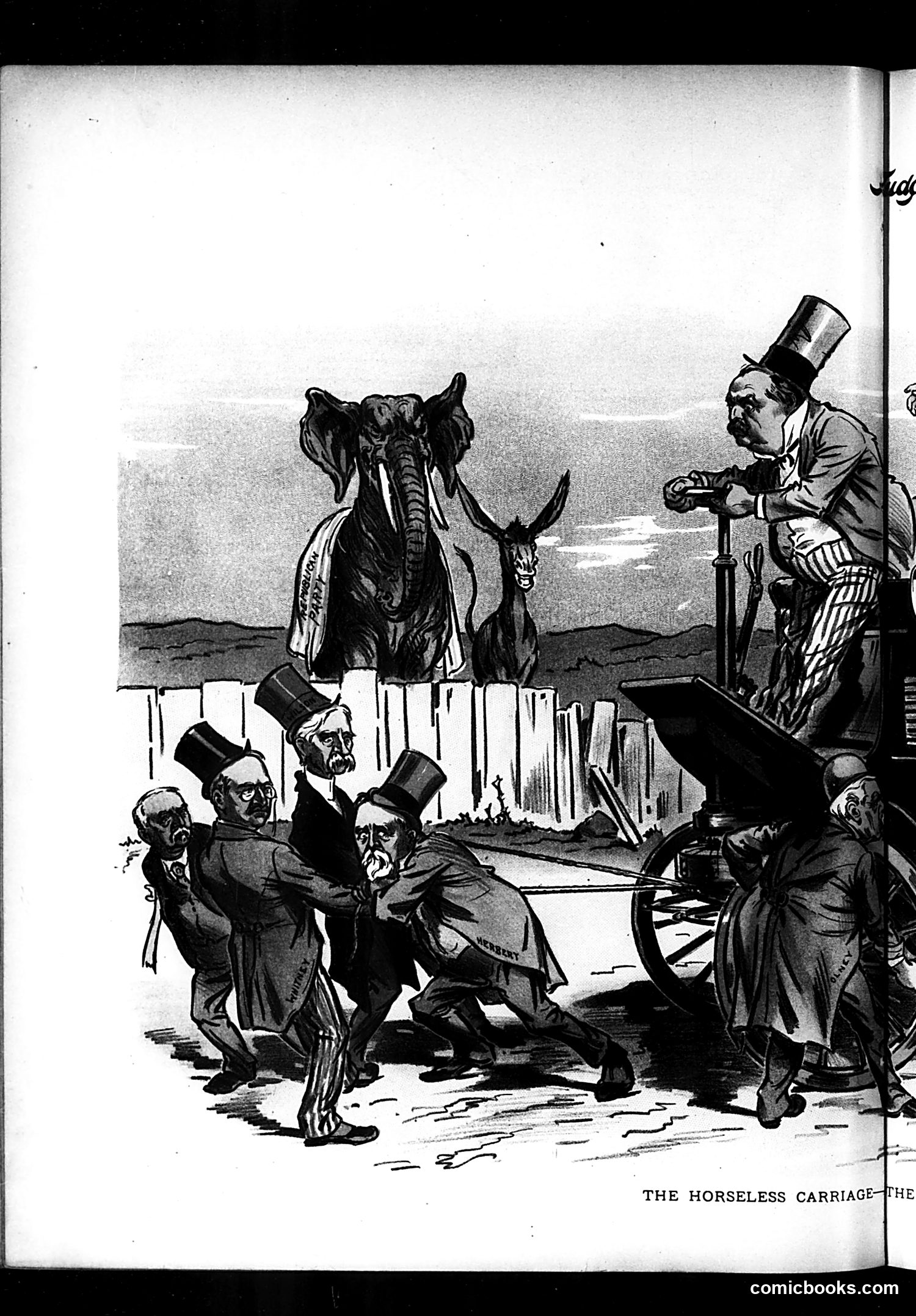
This political cartoon satirizes early automobile adoption, likely from the 1890s-1900s when motorized vehicles were novelties. The image depicts a fantastical "horseless carriage"—actually a cart pulled by an elephant and goat instead of horses, driven by a man in a top hat. The joke mocks the absurdity and impracticality of the automobile concept itself. Rather than showing a functioning motorized vehicle, the cartoonist ridicules the idea by depicting an equally ridiculous animal-powered alternative, suggesting that replacing horses with mechanical engines was comparably far-fetched. The formally-dressed figures observing this spectacle appear bewildered, reinforcing the cartoon's message that the "horseless carriage" was viewed as an impractical, laughable innovation by skeptical contemporaries.
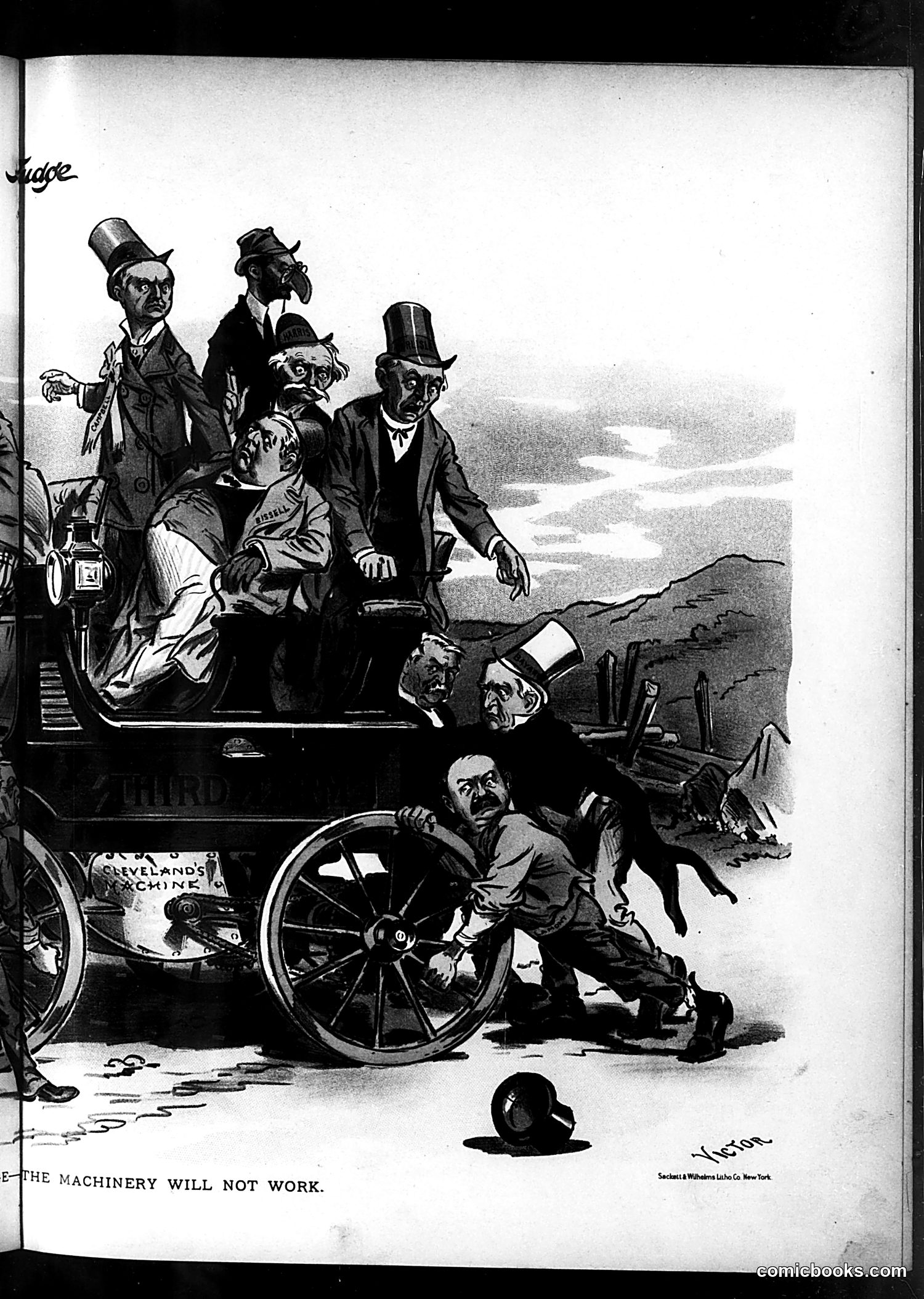
This political cartoon depicts wealthy industrialists or politicians (identifiable by top hats and formal dress) riding in an automobile labeled "CLEVELAND'S MACHINE," while a working-class man struggles to repair or maintain the vehicle. The broken wheel and stalled machinery suggest government dysfunction or failed policies during Cleveland's administration (likely Grover Cleveland's presidency). The satire critiques how the political "machine"—the apparatus of power and patronage—has broken down or failed to serve its intended purpose. The contrast between the comfortable passengers above and the laboring mechanic below highlights class divisions and the disconnect between elite political leadership and working people. The barren landscape suggests economic hardship or social strain.
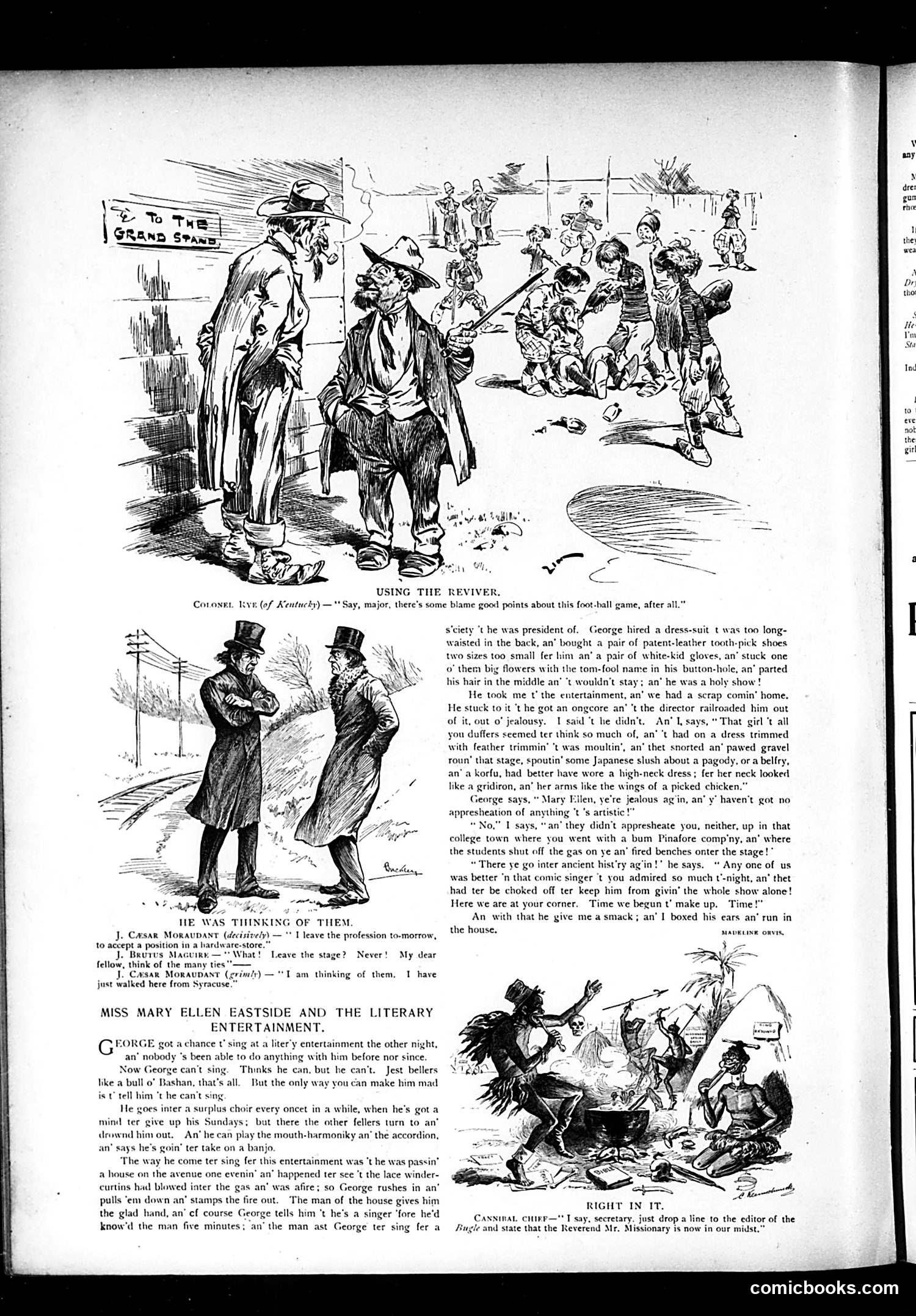
This page contains three distinct satirical pieces: **"Using the Reviver"** (top): A football joke where a coach asks a major about the game's merits. The humor appears to play on "reviver" (likely smelling salts or restorative) in a sports context. **"He Was Thinking of Them"** (middle): A theatrical joke about an actor (J. Caesar Moraudant) who quits the stage, claiming to have "ties" keeping him there—but clarifies he means literal ties (clothing), having just walked from Syracuse in inappropriate dress. This is word-play satire on theatrical pretension. **"Miss Mary Ellen Eastside and the Literary Entertainment"** (largest): A working-class domestic sketch where George, a tone-deaf man, gets invited to sing at a society event after rescuing a woman's curtains from fire. His wife Mary Ellen mocks his terrible singing, his rented ill-fitting formal wear, and his jealous criticism of other performers. The satire targets both working-class social climbing and male vanity about artistic ability. The final small item is a cannibal joke (period-typical racist humor) about notifying a newspaper editor.
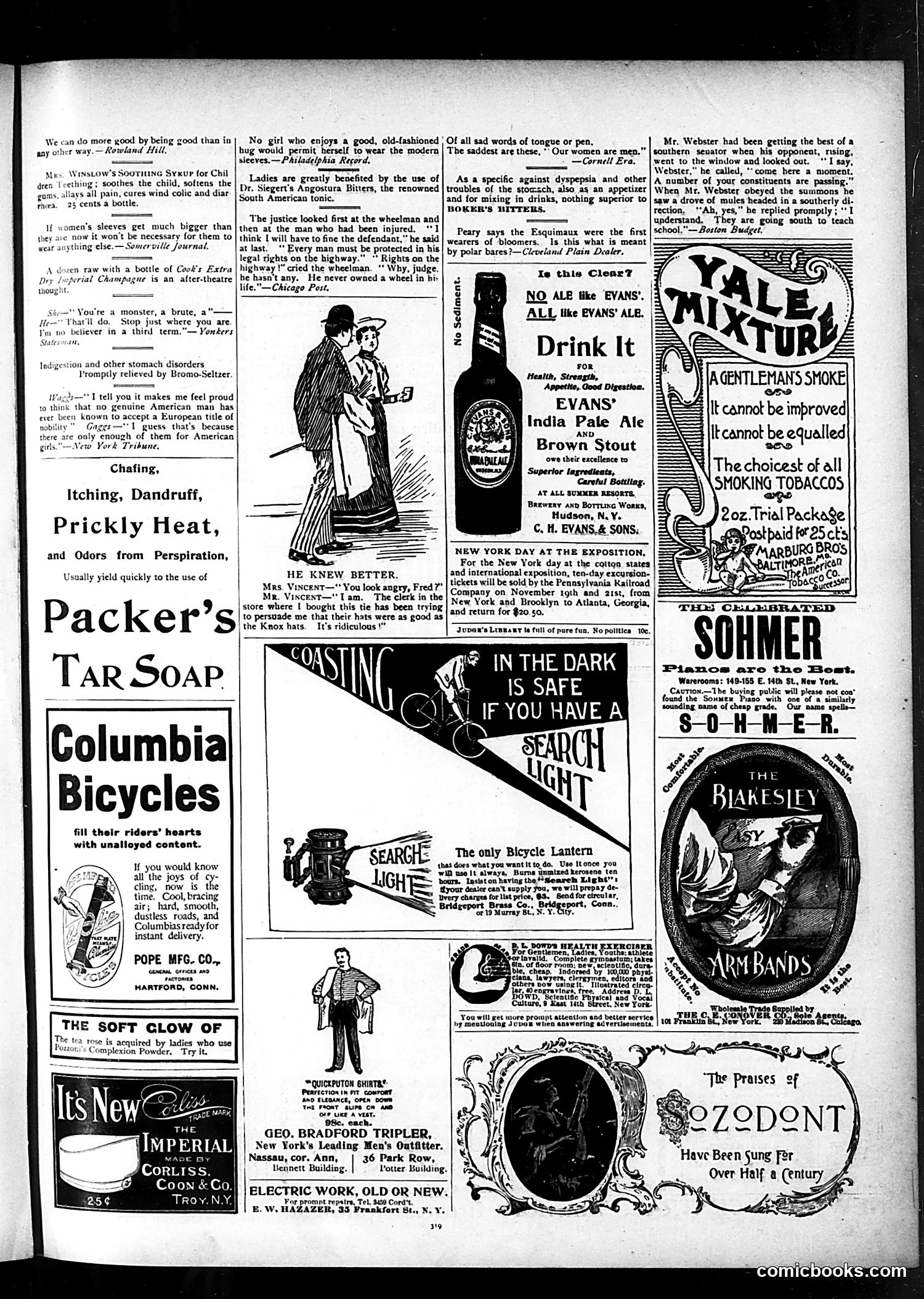
This is primarily an **advertising page** with scattered short jokes and one notable cartoon. The main satire is the cartoon titled "HE KNEW BETTER," showing a man angry at a store clerk for suggesting Knox hat competitors were comparable—the joke being that Knox hats were so obviously superior that even attempting the comparison is ridiculous. The page contains period advertisements for bicycles, soap, ale, complexion powder, and other goods, interspersed with one-liner jokes typical of Judge's humor. One joke references **"bloomers"** (women's athletic wear gaining popularity) and Arctic explorer Peary's Inuit encounters, making a pun about "polar bears." Another jokes about a cyclist having "no rights" on the highway—reflecting early-1900s tensions between automobiles/bicycles and pedestrians regarding road usage. The overall content reflects turn-of-century American consumer culture and evolving social attitudes about technology and women's fashion.
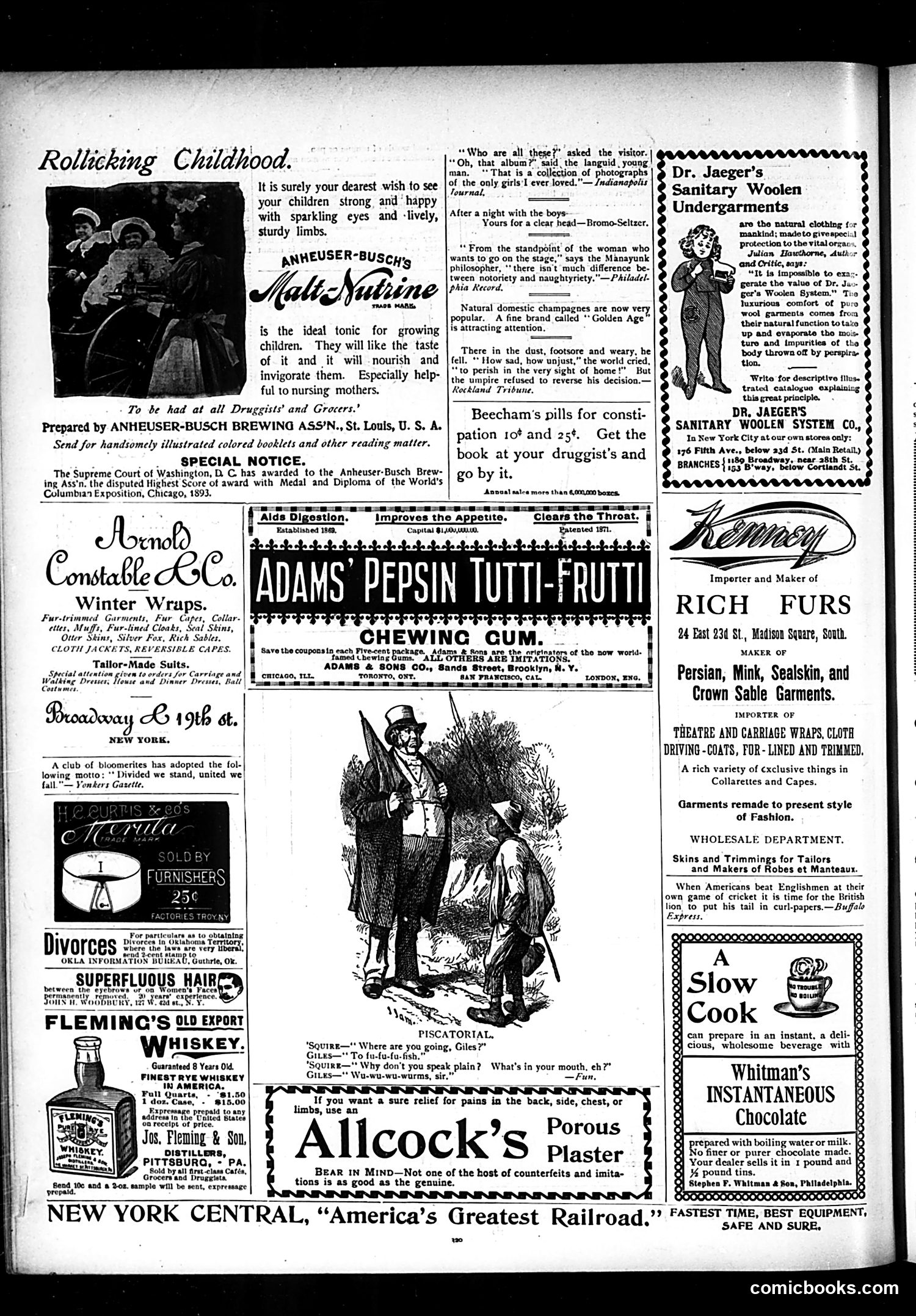
This page is primarily **advertisements** with a few short satirical jokes interspersed. The main satirical content includes brief humor pieces: one about a young man's photo album of romantic conquests, another mocking women seeking theatrical careers conflating "notoriety" with "naughtyriety," and a baseball joke where an umpire refuses to reverse a decision even as a man dies. The **Anheuser-Busch advertisement** is notable for claiming their malt beverage is an "ideal tonic for growing children" and nursing mothers—a claim that would be shocking to modern readers but reflects late-19th-century attitudes toward alcohol as medicinal. Other advertisements promote patent medicines (Beecham's pills, Bromo-Seltzer, Allcock's Porous Plaster), fur garments, whiskey, and Dr. Jaeger's wool undergarments. The page reflects a period when advertising made health claims now considered dangerous or fraudulent, and satirical magazines mixed humor with commercial content.
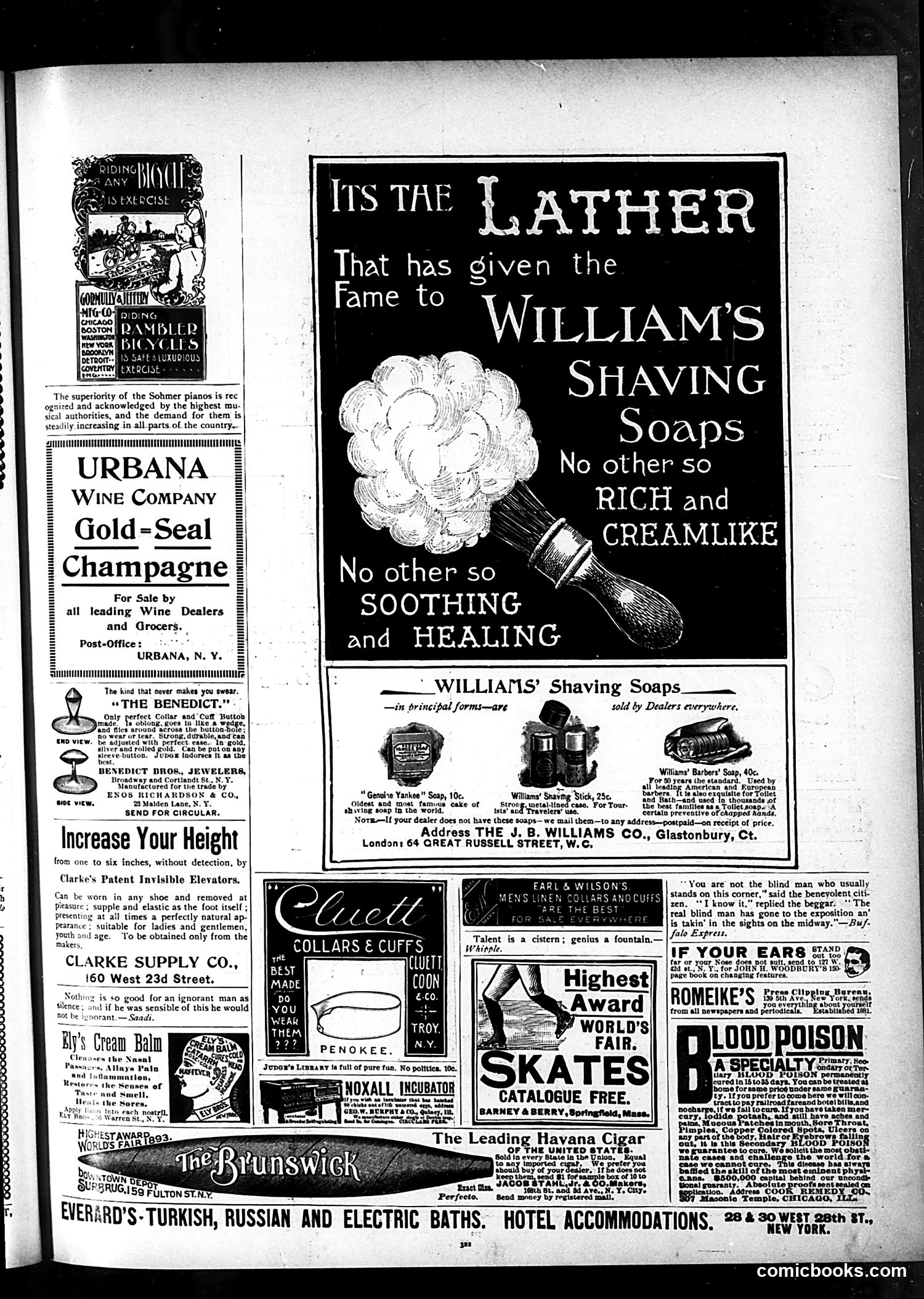
This is primarily an **advertising page**, not a satirical cartoon page. It contains various product advertisements typical of early 20th-century magazines. The main content includes ads for: - **Sohmer pianos** and **Bamboo bicycles** (top left) - **Williams' Shaving Soaps** (large center advertisement) — emphasizing the lather quality - **Clarke's height-increasing shoe inserts** — a dubious "invisible elevator" product - Various other goods: collars, skates, cigars, bath houses There is **one brief joke** (bottom center): A blind beggar tells a citizen he's not the usual blind man — the real one is at an exposition enjoying the sights, which is ironic since blind people cannot see. The humor relies on the beggar's witty wordplay. The rest of the page reflects period advertising concerns: personal grooming, appearance enhancement, and luxury goods. No significant political or social satire is evident. The page demonstrates Judge's business model: satirical editorial content subsidized by commercial advertisements.
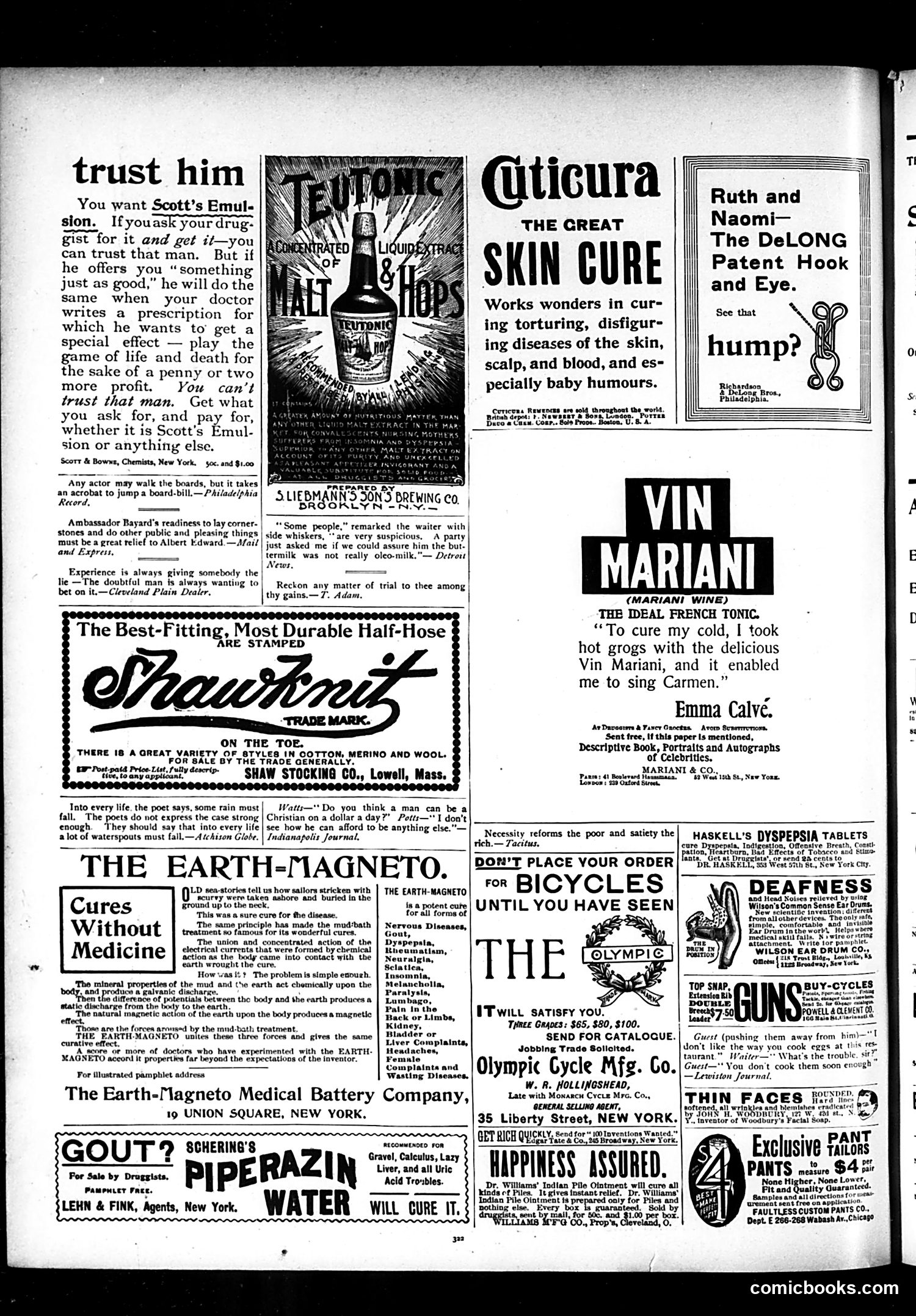
This page is primarily **advertising**, typical of early 20th-century magazines. The content includes: **Notable advertisements:** - **Scott's Emulsion** (top): A patent medicine pitch emphasizing trust in pharmacists - **Cuticura Skin Cure**: Promises to treat skin diseases and "baby humours" - **Vin Mariani**: A "French tonic" featuring a testimonial from opera singer Emma Calvé - **Shaw Stockings**: Half-hose marketed as durable - **Earth-Magneto**: A medical device claiming to cure nervous diseases through "magnetic discharge" - **Olympic Bicycles**: Advertised as satisfying **Minor content includes** scattered brief jokes and quotations about trust, experience, and social observation—typical of Judge's satirical humor pieces. **For modern readers:** These ads reveal patent medicine's prevalence before FDA regulation. Claims are wildly exaggerated by today's standards. The celebrity endorsement (Emma Calvé) was a common marketing technique. Most products lacked scientific basis.
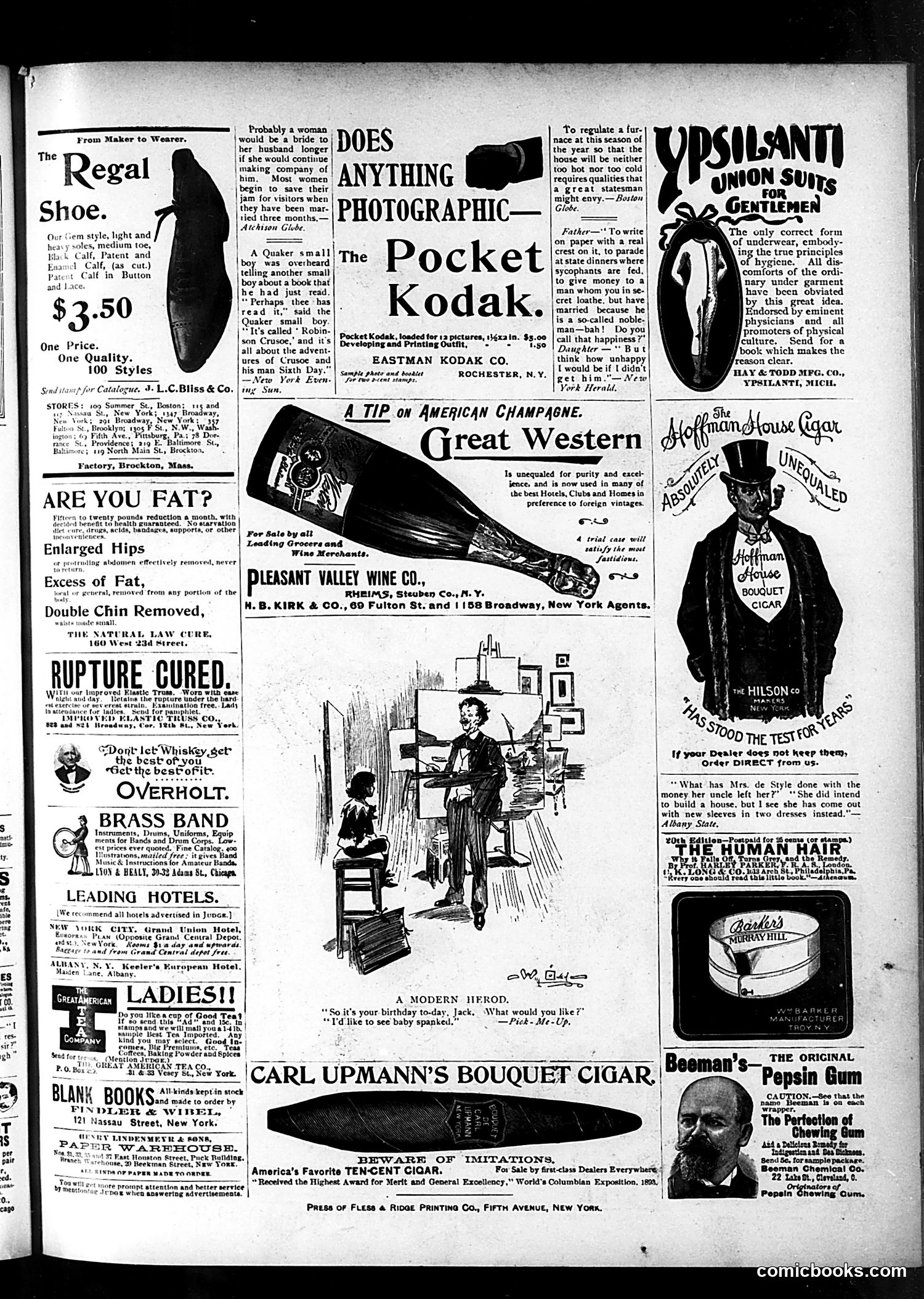
This is primarily an **advertising page** from Judge magazine, containing numerous commercial advertisements interspersed with brief satirical commentary typical of the publication. The main **cartoon** titled "A Modern Herod" depicts a conversation between an adult and child on the child's birthday. When asked what he'd like as a gift, the boy requests to "see baby spanked"—a dark joke referencing King Herod's biblical massacre of innocents. The humor lies in the child's cruel preference, satirizing either childish cruelty or perhaps parental discipline methods of the era. Scattered throughout are **short satirical observations**: one mocking wives who stop socializing with husbands after marriage; another about the difficulty of regulating home furnaces seasonally. The advertisements themselves reveal period consumer culture: Kodak cameras, cigars, corsets, hair products, wine, and remedies for obesity and ruptures—typical offerings in late 19th-century American publications. The page contains **no identifiable political figures or major satirical targets**—it's primarily commercial with light social commentary typical of Judge's format.
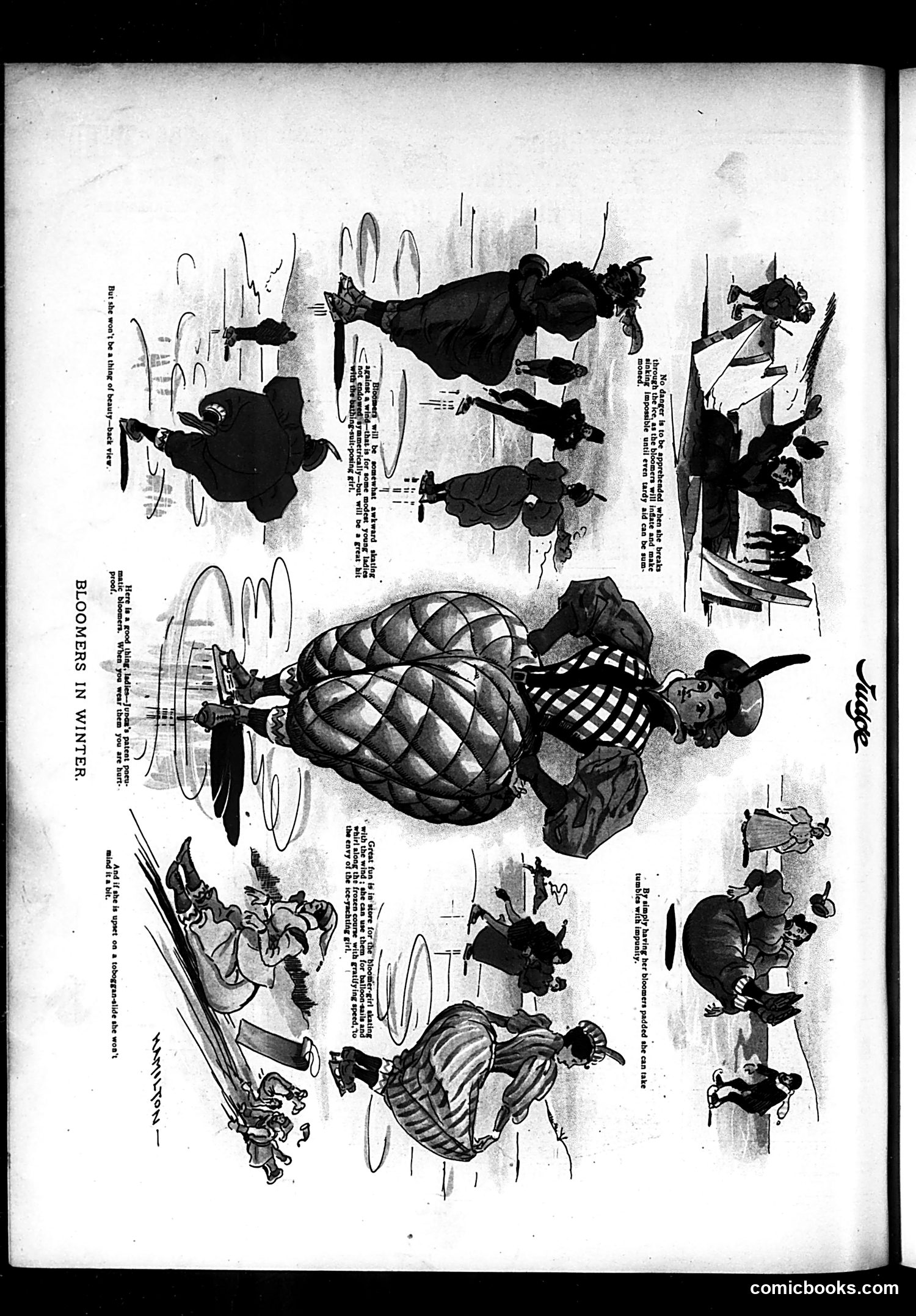
This cartoon satirizes the "bloomer" craze of the 1890s—women's baggy pants worn under skirts, promoted as practical athletic wear. The central figure demonstrates padded bloomers designed for winter sports like tobogganing, allowing women to take falls safely. The satire cuts two ways: it mocks both the safety innovation AND the garment's unflattering appearance. The "back view" caption emphasizes how ridiculous women look in bloomers despite their practicality. The joke targets the tension between women's growing athletic participation and Victorian beauty standards—suggesting women must choose between dignity and safety. This reflects period anxiety about changing gender roles and women's public visibility through sports and less-restrictive clothing.