
A complete issue · 16 pages · 1895
Judge — November 9, 1895
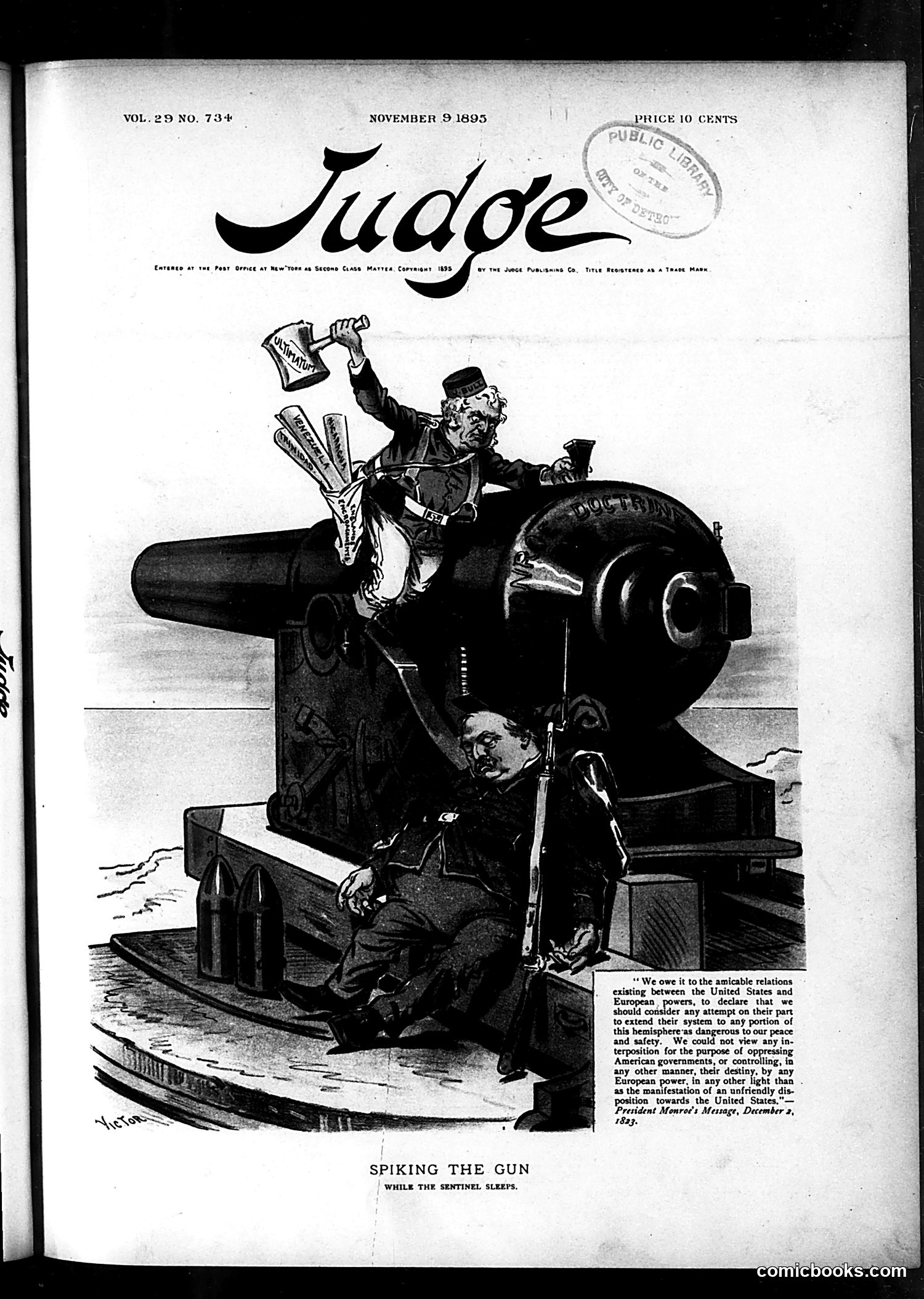
This November 1895 cartoon satirizes American foreign policy restraint. A figure atop a large cannon—likely representing a European power or imperialist force—waves papers while appearing to disable the weapon, suggesting they're neutralizing American military capability or influence. The sleeping sentinel below represents the United States as inattentive to international threats. The caption and accompanying quote (attributed to President Monroe's message from December 2, 1823) reference the Monroe Doctrine, which warned European powers against colonizing the Americas. The cartoon suggests America risks losing credibility or strength by not enforcing this doctrine, allowing European powers to act with impunity while American vigilance lapses. It's commentary on perceived American passivity during the imperial expansion era.
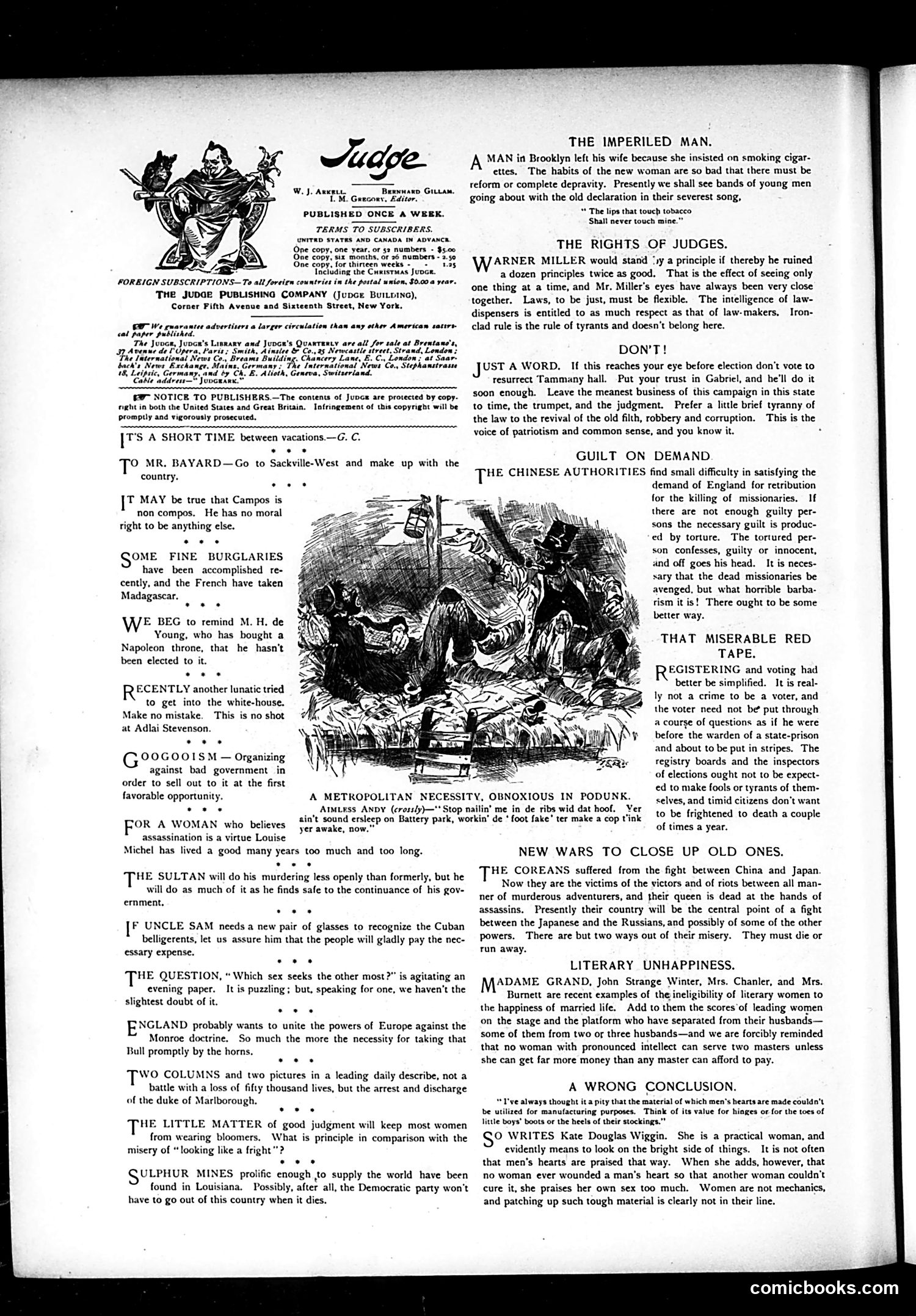
The main cartoon, captioned "A Metropolitan Necessity, Obnoxious in Podunk," depicts urban chaos—appears to show street fighting or disorder with multiple figures in violent confrontation. The satirical point seems to be that practices tolerated or necessary in cities (represented by "Metropolitan") are viewed as shocking or inappropriate in rural areas ("Podunk"—period slang for small towns). The page's editorial content addresses various political topics including voting rights, judicial independence, and American foreign policy regarding China and Korea. There's particular emphasis on election integrity and warnings against voter manipulation. The overall tone suggests this is political satire aimed at urban-rural cultural divides and governmental accountability issues of the era, likely early 1900s.
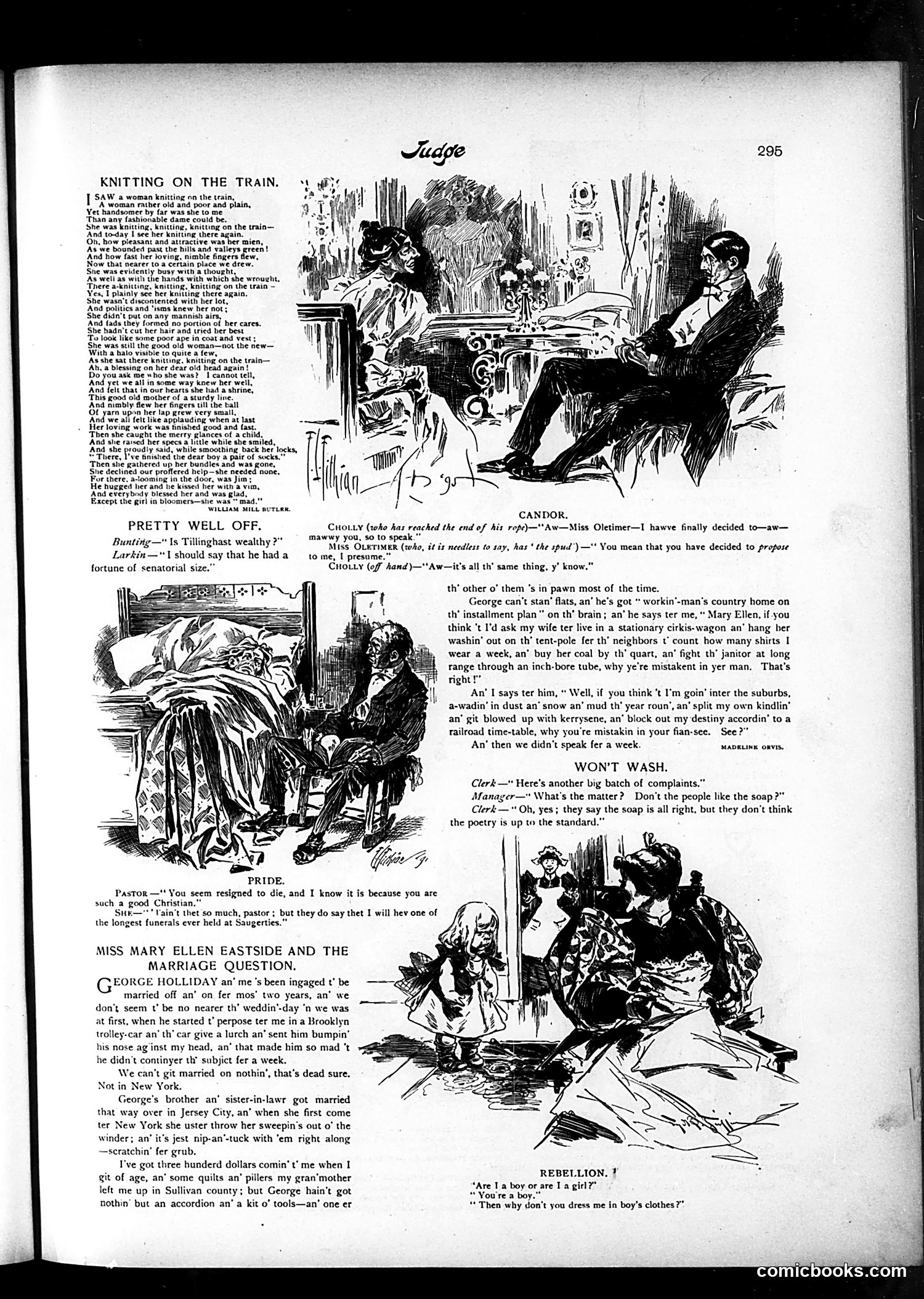
This page contains several satirical sketches and humorous dialogues typical of Judge magazine's social commentary. **"Knitting on the Train"** depicts a woman's knitting needles annoying fellow passengers—satirizing both women's public behavior and the nuisance of inconsiderate travelers. **"Candor"** shows a marriage proposal scene mocking the gap between romantic ideals and practical reality, with the woman's blunt discussion of household finances and marital expectations. **"Won't Wash"** critiques institutional standards, suggesting that claimed quality (soap) doesn't meet actual performance. **"Pride"** and **"Rebellion"** address gender roles and family dynamics, with the latter questioning why a child won't wear gender-appropriate clothing. The sketches collectively satirize ordinary social pretensions, class anxieties, and evolving domestic relationships in early 20th-century America.
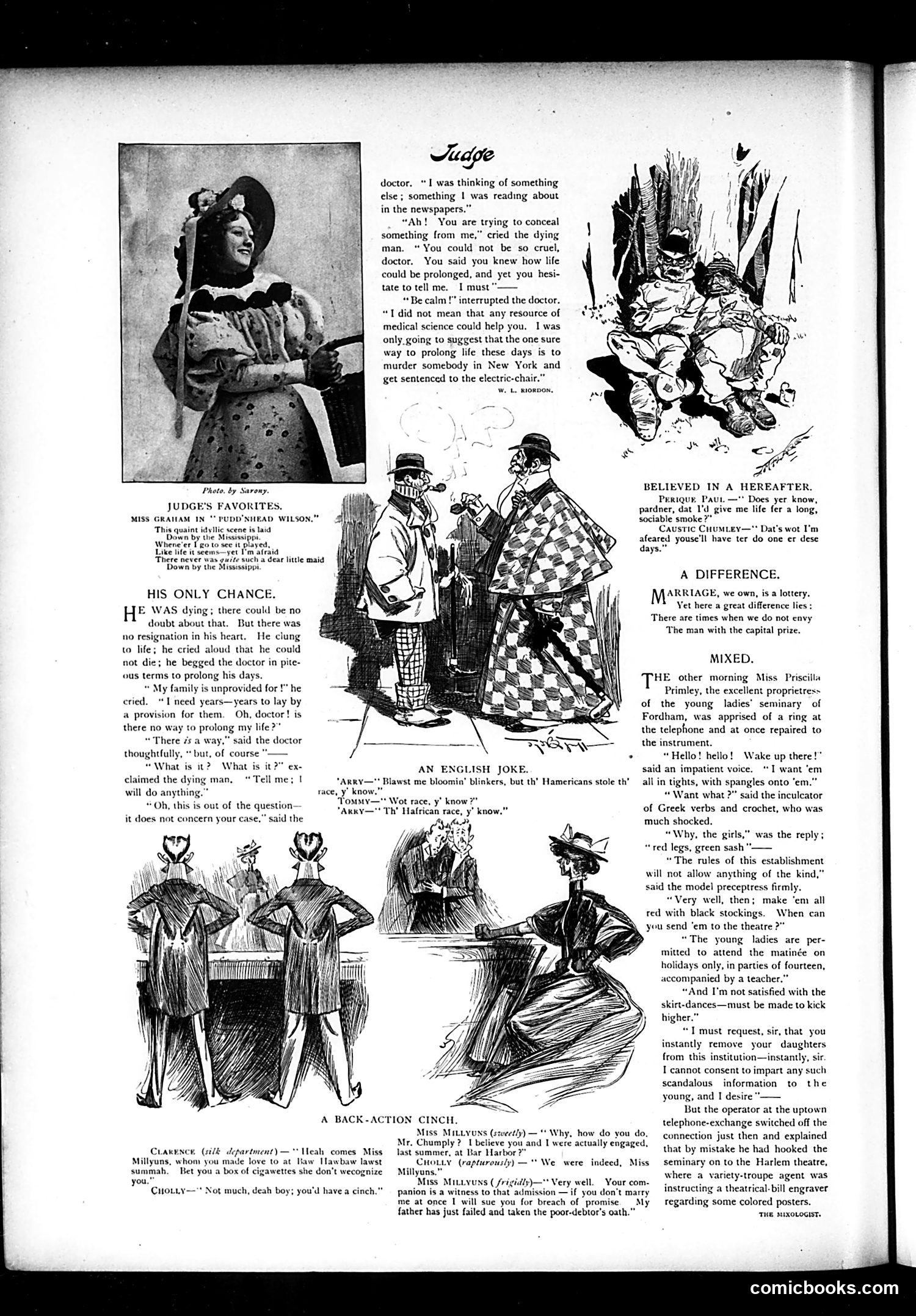
This page from *Judge* contains several satirical pieces mocking American life and social pretension circa the 1890s-1900s. **"His Only Chance"** satirizes capital punishment as the only way to "prolong life"—a dark joke about the electric chair becoming more common, suggesting execution is paradoxically the surest path to longevity (and thus remembrance). **"A Back-Action Cinch"** mocks a fortune hunter who seduces a wealthy woman ("Miss Millyuns") then denies the engagement when her father goes bankrupt. The humor lies in his miscalculation: she immediately threatens breach-of-promise litigation, a legal remedy women could pursue. **"An English Joke"** presents a stereotype of English speech patterns ("bloomin' blinkers") in a quip about Americans stealing something unspecified—likely topical satire about trade or cultural borrowing. **"Mixed"** ridicules an overly strict girls' seminary headmistress who forbids theatrical attendance and polices students' clothing, shown as absurdly prudish. The magazine's tone throughout is cynical about wealth, death, courtship, and propriety.
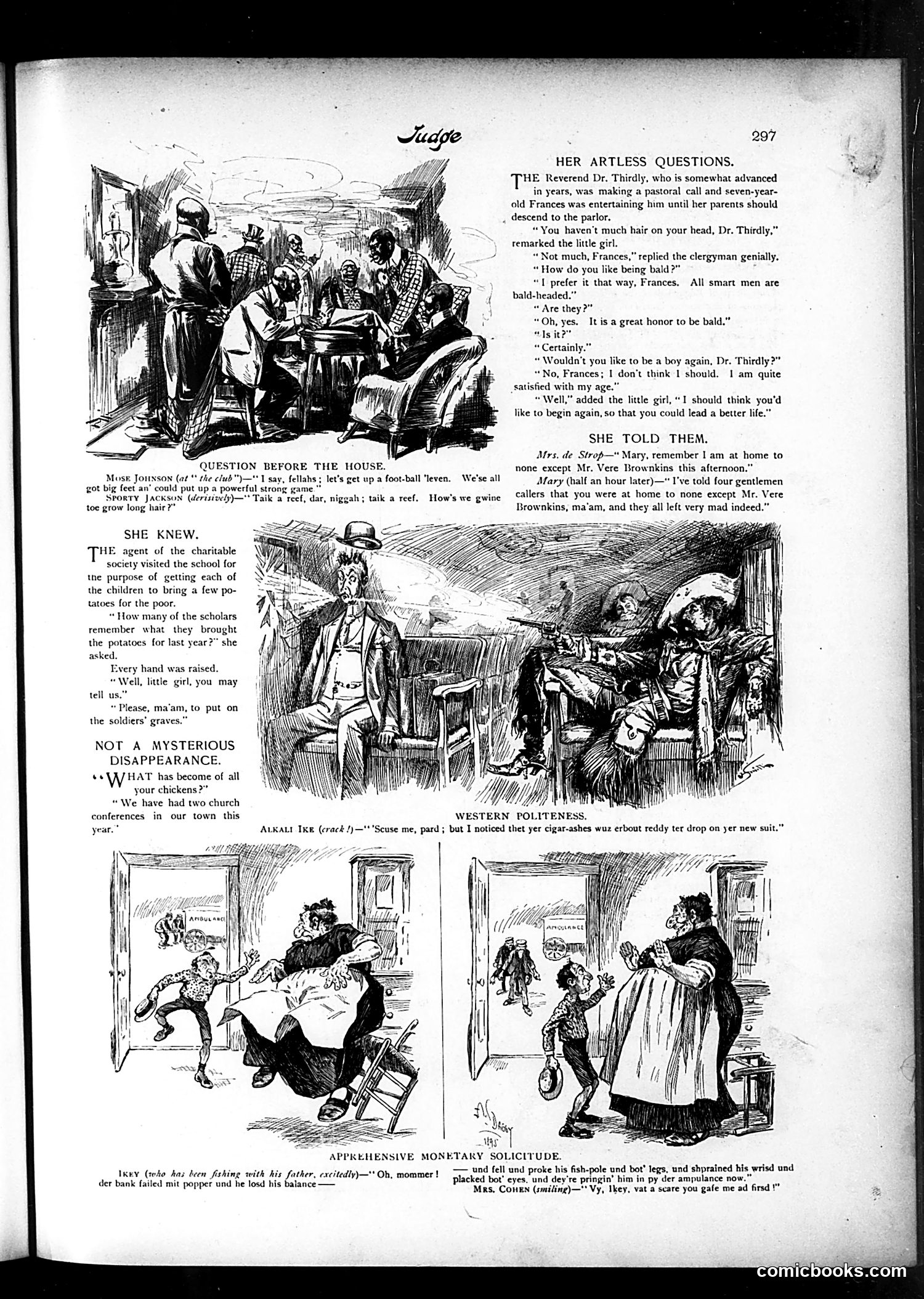
This page contains several brief satirical sketches typical of Judge's humor: **"Her Artless Questions"** depicts a child innocently insulting Reverend Dr. Thirdly by questioning his baldness and age, suggesting he start life over to "lead a better life"—humor from unfiltered childhood honesty. **"She Told Them"** satirizes a maid who misunderstands her mistress's instructions to tell callers she's "at home to none except Mr. Vere Brownkins," literally announcing this to four gentlemen callers, driving them away angry. **"Western Politeness"** shows frontier dialect humor: a rough cowboy ("Alkali Ike") politely warning another about cigar ash on his new suit—unexpected gentility from a stereotypically crude Westerner. **"Apprehensive Monetary Solicitude"** depicts a Jewish mother (Yiddish accent indicated by "Vy," "vat") relieved her son survived a fishing accident—the joke being her relief focuses on the medical costs rather than the injury itself. All rely on period stereotypes and gentle domestic/social mishaps rather than political content.
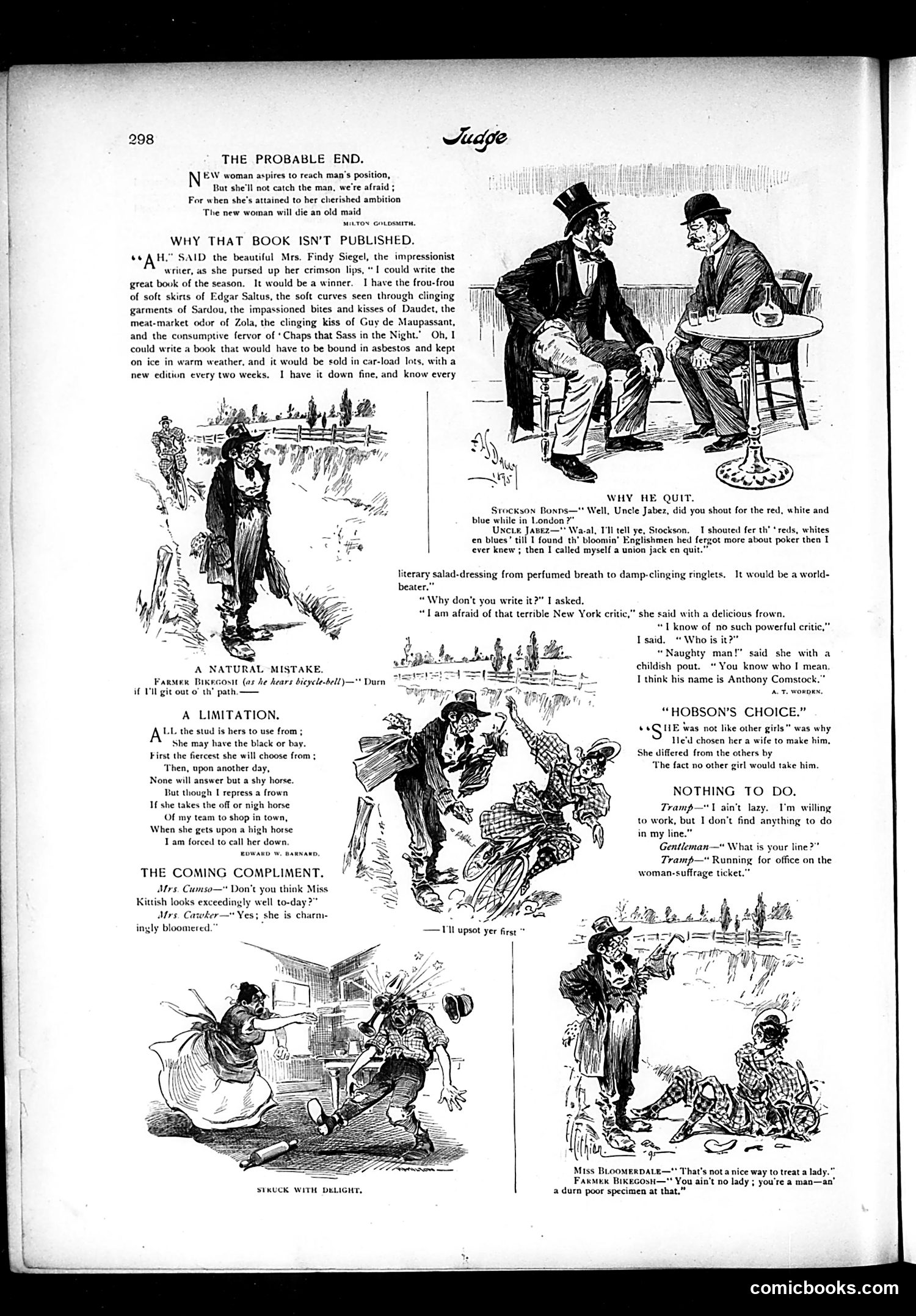
This satirical page from Judge attacks the "New Woman" movement of the late 19th century through multiple cartoons: **"The Probable End"** mocks women's ambitions for equality, predicting that career-focused women will become unmarriageable "old maids." **"Why That Book Isn't Published"** satirizes both female writers and **Anthony Comstock**, the real anti-obscenity crusader who censored American publications. Mrs. Siegel brags she could write a scandalous bestseller but fears Comstock's censorship—the joke being that even her exaggerated literary pretensions would face suppression. **"Why He Quit"** uses dialect humor about an American visiting London, confusing British patriotic songs with poker terminology—typical period xenophobia. **"Nothing to Do"** mocks women's suffrage advocates by depicting a vagrant claiming "running for office on the woman-suffrage ticket" as his profession—implying suffragists are lazy frauds. Throughout, the cartoons mock women's independence, suffrage activism, and changing social roles through crude caricature and dismissive humor typical of anti-feminist satire of the era.
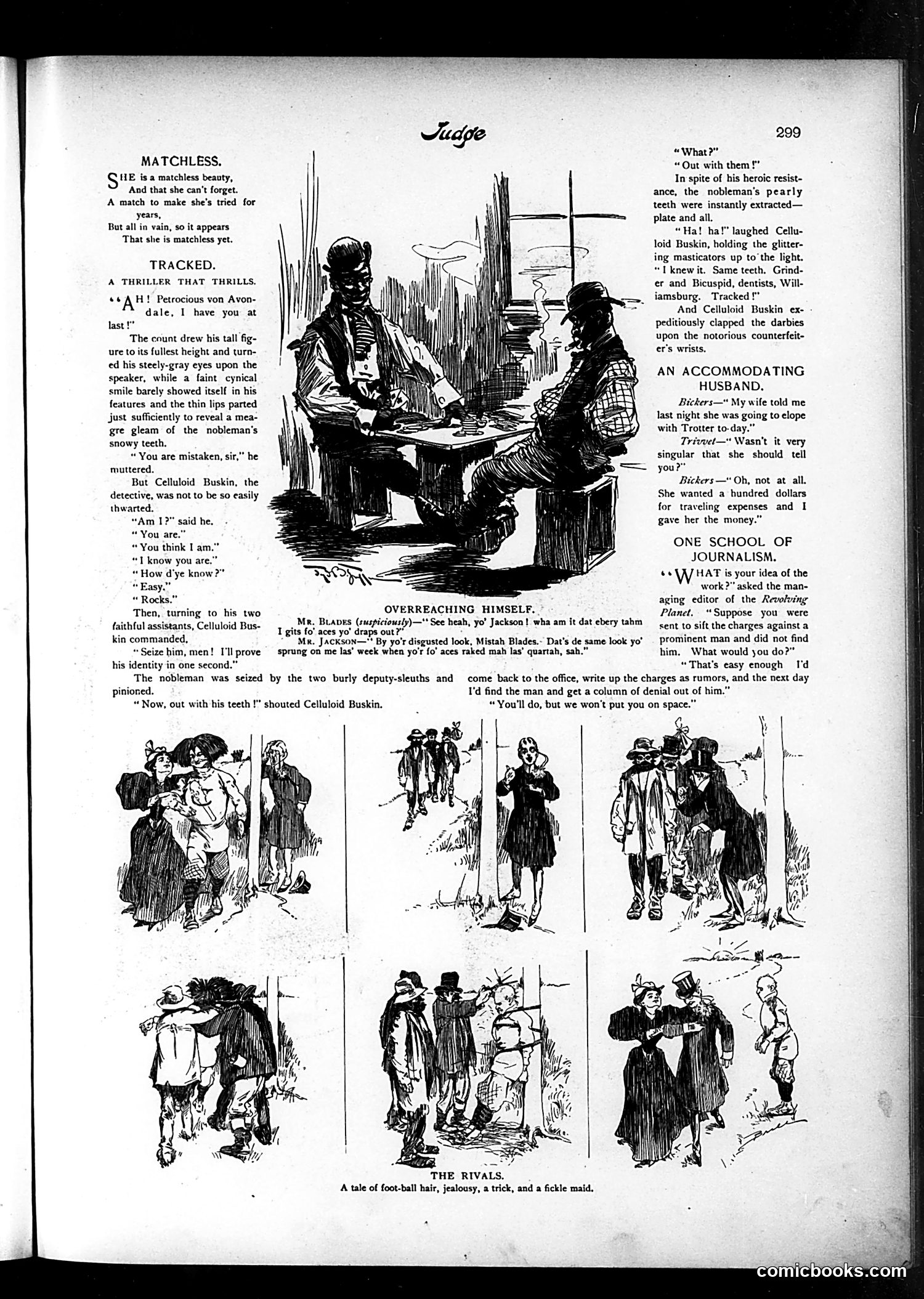
This page contains three satirical pieces mocking popular entertainment and social conventions of the era: **"Tracked"** parodies melodramatic detective fiction. "Celluloid Buskin" (a theatrical reference) is a bumbling detective who identifies a criminal nobleman by extracting his teeth—an absurdly overcomplicated solution. The satire mocks overwrought mystery stories and their improbable plot resolutions. **"Overreaching Himself"** depicts a card game between two Black men where Mr. Blades suspects Mr. Jackson of cheating, noting he always "drops out" when Blades gets aces. Jackson deflects by pointing out Blades's own suspicious losses. The joke relies on period stereotypes about Black gamblers. **"One School of Journalism"** critiques unethical reporting: a managing editor hires a journalist who admits he'd fabricate rumors as fact if unable to find actual evidence—then cynically refuses to pay him space rates, suggesting even disreputable editors have limits. The page uses exaggerated caricature and absurdist scenarios to satirize theatrical clichés, gaming, and yellow journalism.
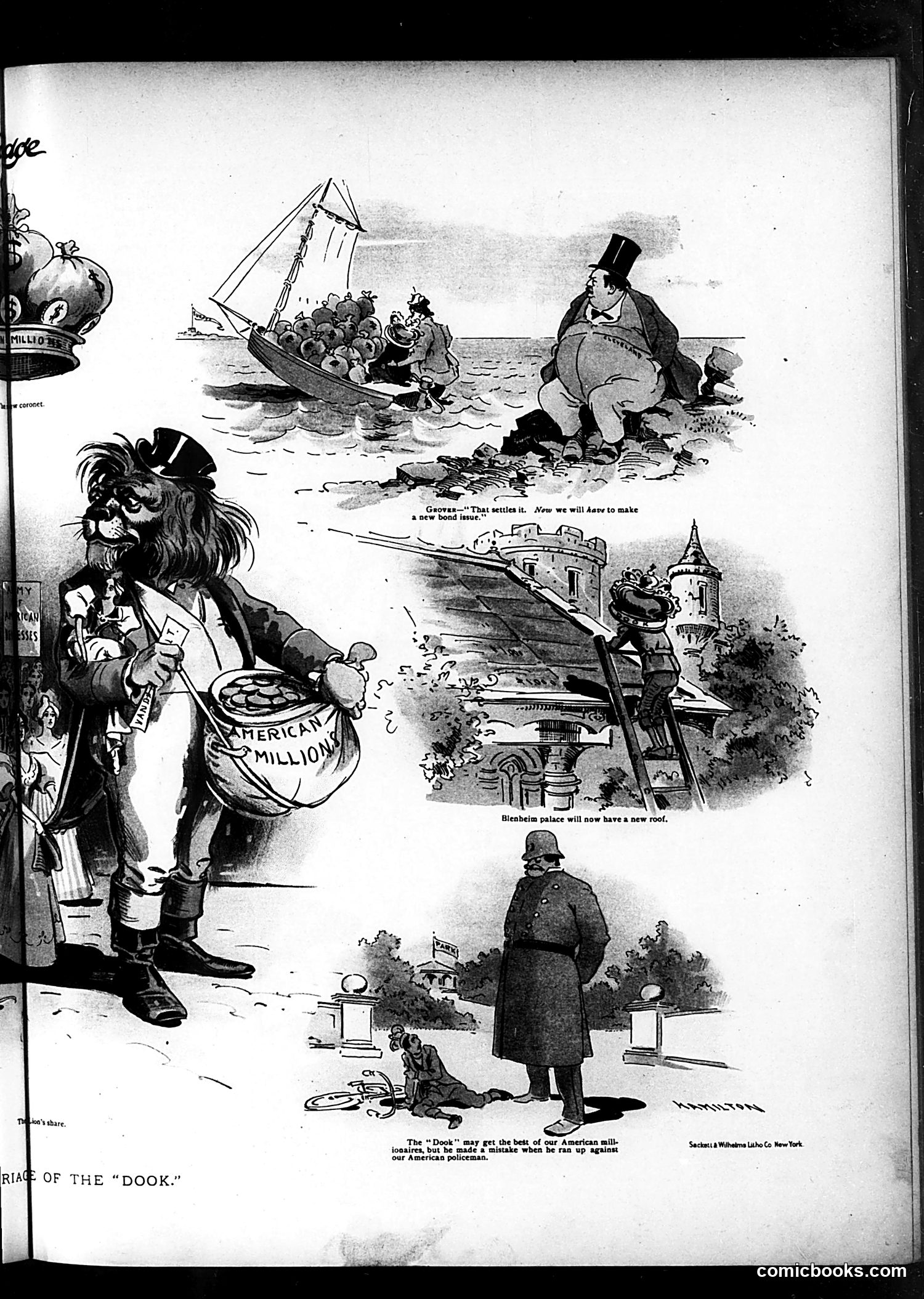
This page satirizes a foreign aristocrat (likely German, given "Dook" for "Duke") who encounters American law enforcement. The top panels show him causing havoc—shipwrecks and property damage—requiring expensive bond issues to repair. The bottom panel depicts him arrested by an American policeman. The satire's point: While wealthy European nobles ("millionaires") may manipulate American financial systems through loans and bonds, they ultimately answer to American justice and law enforcement. The cartoon suggests American democratic institutions—specifically police authority—triumph over foreign aristocratic privilege and wealth. This reflects early 20th-century American confidence in democratic values versus European class hierarchy.
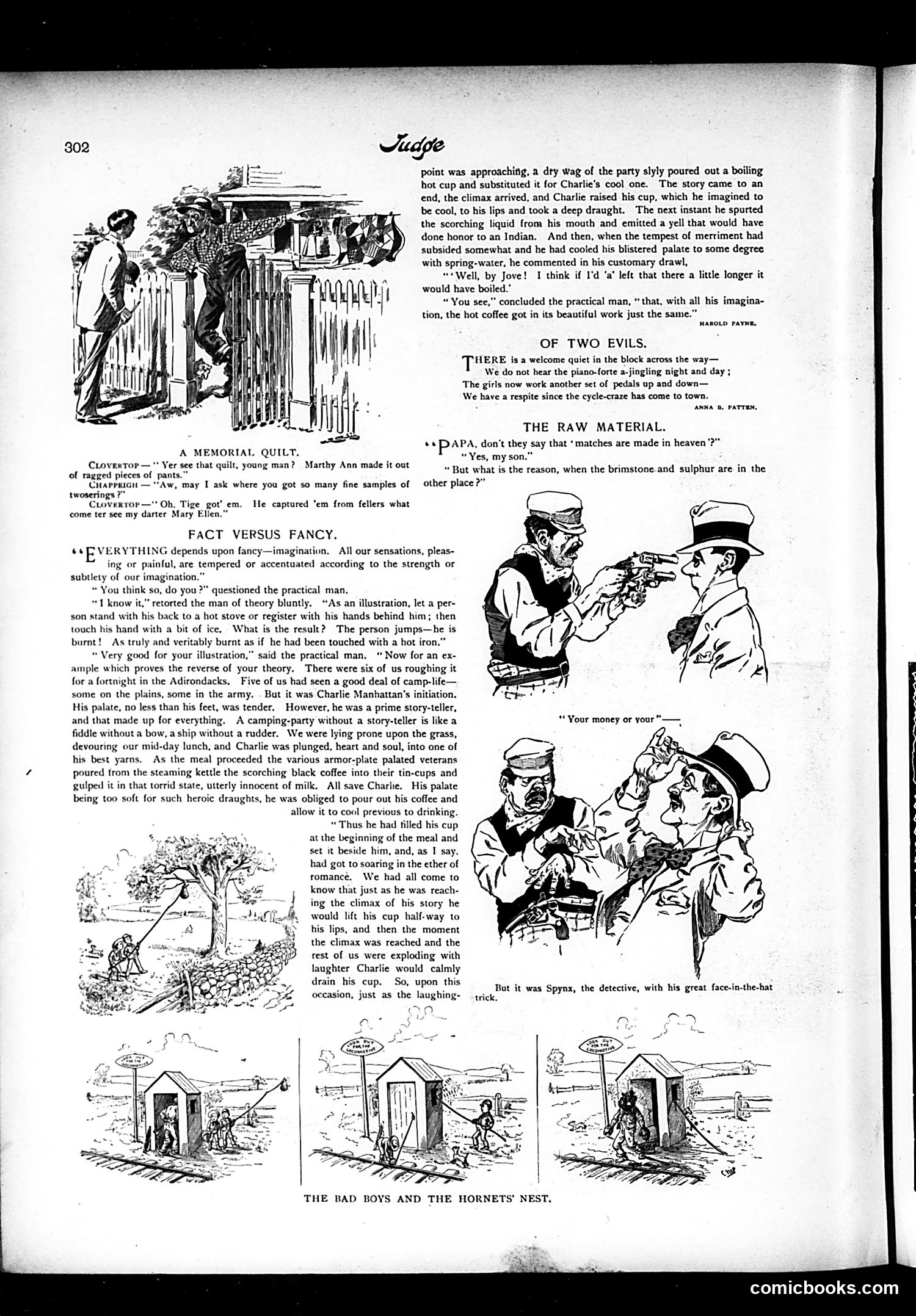
This page contains several humorous short stories and comic sections satirizing human nature and social habits of the era. **"Fact Versus Fancy"** presents the main narrative: a debate between an imaginative theorist and a practical man about whether imagination controls perception. The practical man counters with an anecdote about "Charlie Manhattan," a tender-palated newcomer on a camping trip. While Charlie tells an engrossing story, the other campers—experienced outdoorsmen—substitute his cooling coffee with boiling hot liquid as a prank. When Charlie dramatically reaches his story's climax and drinks, he's scalded but doesn't immediately notice, proving the practical man's point: *reality* (the hot coffee) affects us regardless of imagination. The smaller items—"A Memorial Quilt," "Of Two Evils" (mocking the bicycle craze), and "The Raw Material" (a joke about matches and brimstone)—are brief comic anecdotes typical of Judge's format. **The satire targets**: pretentious philosophical theorizing versus common-sense practicality, suggesting that no amount of imagination shields us from physical reality.
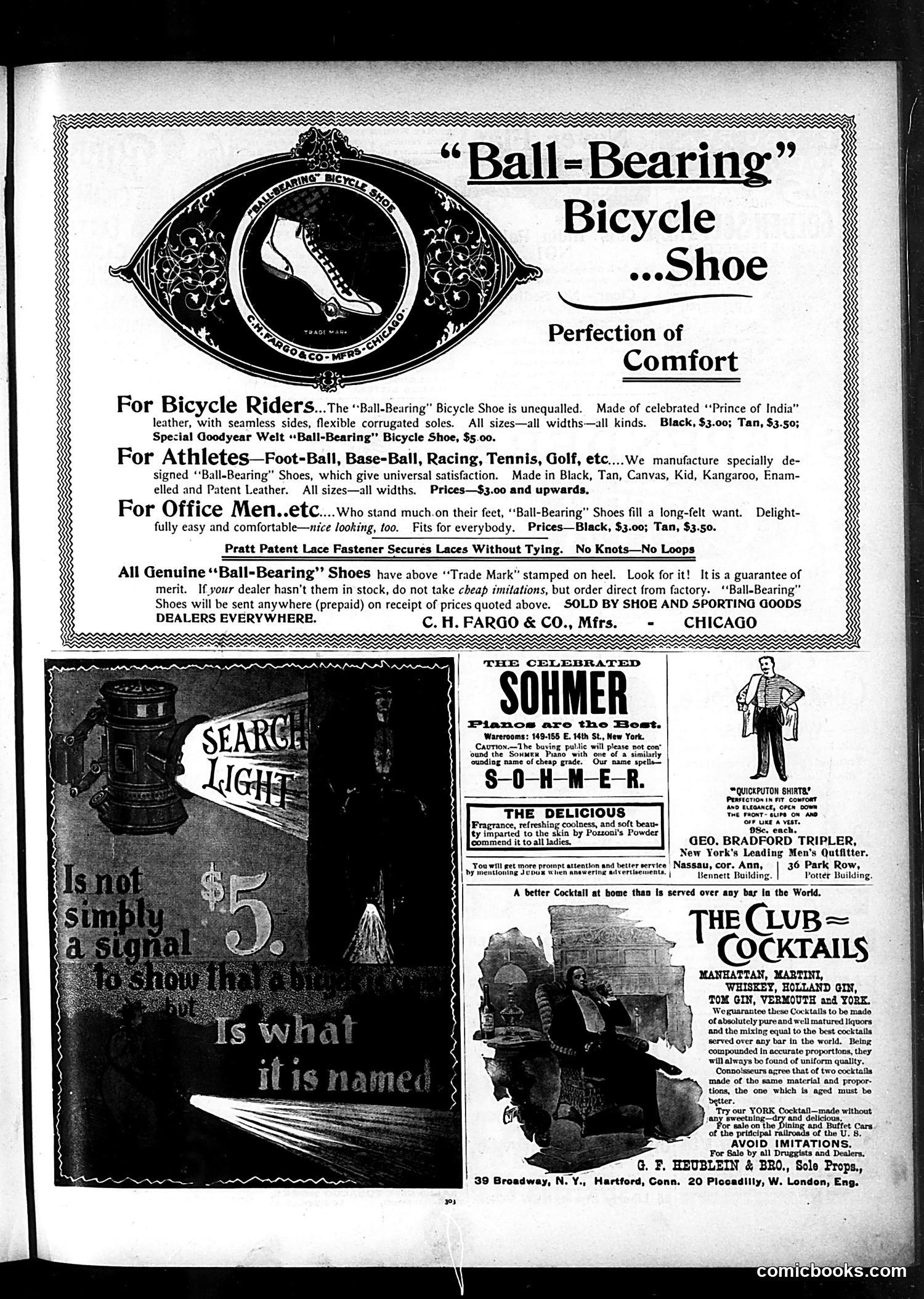
This page is primarily **advertising**, not satirical content. It contains several product advertisements from around the early 1900s: 1. **Ball-Bearing Bicycle Shoes** (top): A shoe brand marketed for cyclists, athletes, and office workers, emphasizing comfort through innovative "ball-bearing" sole technology. Prices range from $3-$5. 2. **Sohner Pianos** (middle right): A piano manufacturer warning consumers not to confuse their product with cheap imitations of similar-sounding names. 3. **Miscellaneous ads**: Including Quickputon Shirts, Pozzoni's Powder (cosmetic), George Bradford Tripler's men's clothing store, and Heublein's Club Cocktails (made with whiskey, gin, vermouth). 4. **Sarch Light** (left): An older oil lamp advertisement emphasizing its affordability. There is **no political satire or cartoon** on this page—it's a straightforward advertising spread typical of Judge magazine's revenue model, mixing editorial content with paid advertisements.
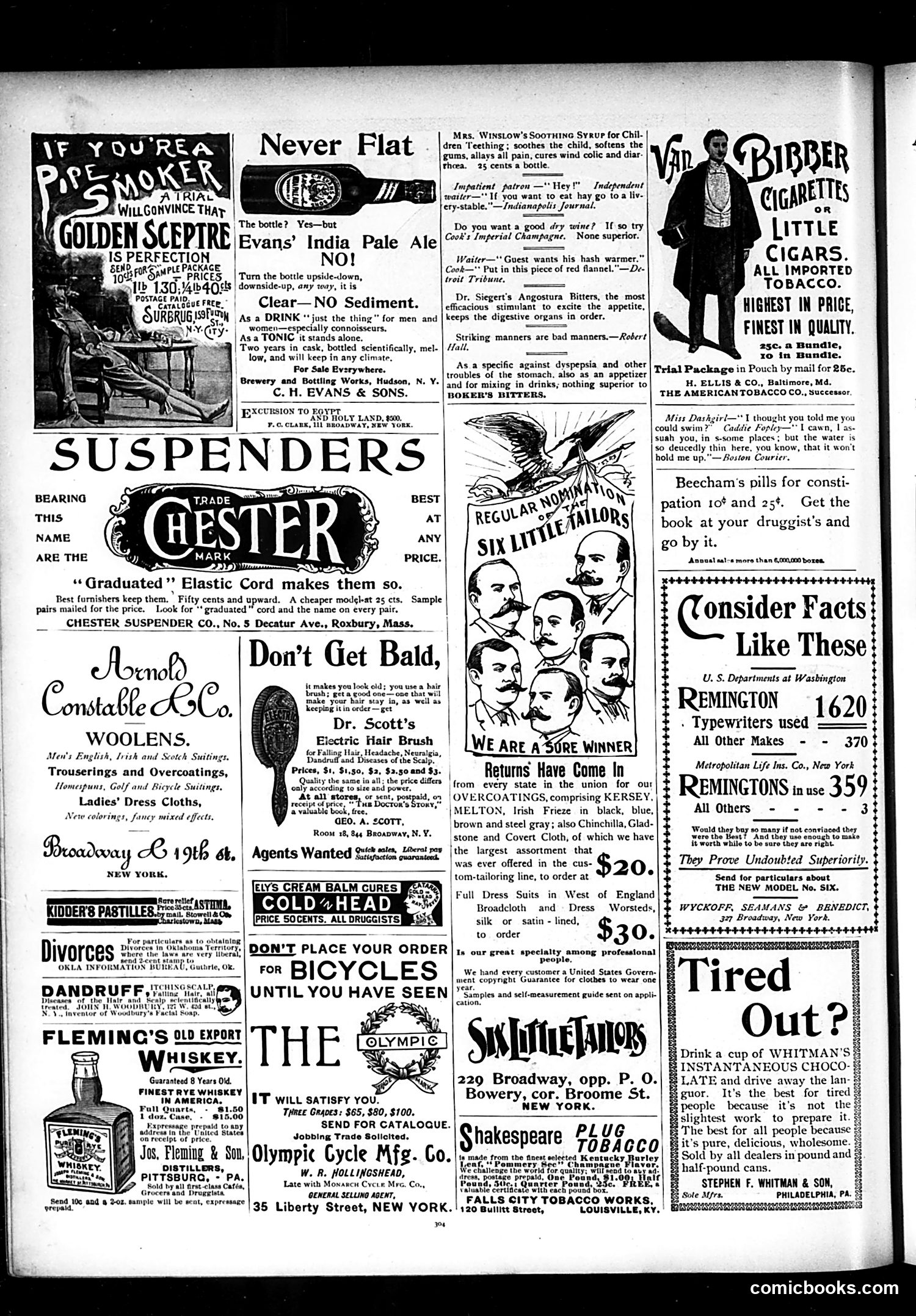
This page is primarily **advertising**, typical of Judge magazine's revenue model. It contains dozens of product advertisements with minimal editorial content. The few jokes visible are brief, generic service-industry humor: a waiter dismissing an impatient customer ("If you want to eat hay go to a livery-stable"), another preparing hash with flannel, etc. These small quips aren't political or satirical—they're mild workplace comedy. The ads target early-1900s middle-class consumers: patent medicines (Angostura Bitters, Dr. Scott's electric hair brush), liquor (Evans' ale, Fleming's whiskey), bicycles, suspenders, and clothing. Products like Mrs. Winslow's Soothing Syrup (containing laudanum) and Dr. Siegert's Bitters reflect what was then sold as legitimate medicine. There are **no political cartoons** on this page—no identifiable caricatures of public figures or social satire. The page demonstrates how satirical magazines like Judge were heavily advertising-dependent, with editorial content occupying minimal space.
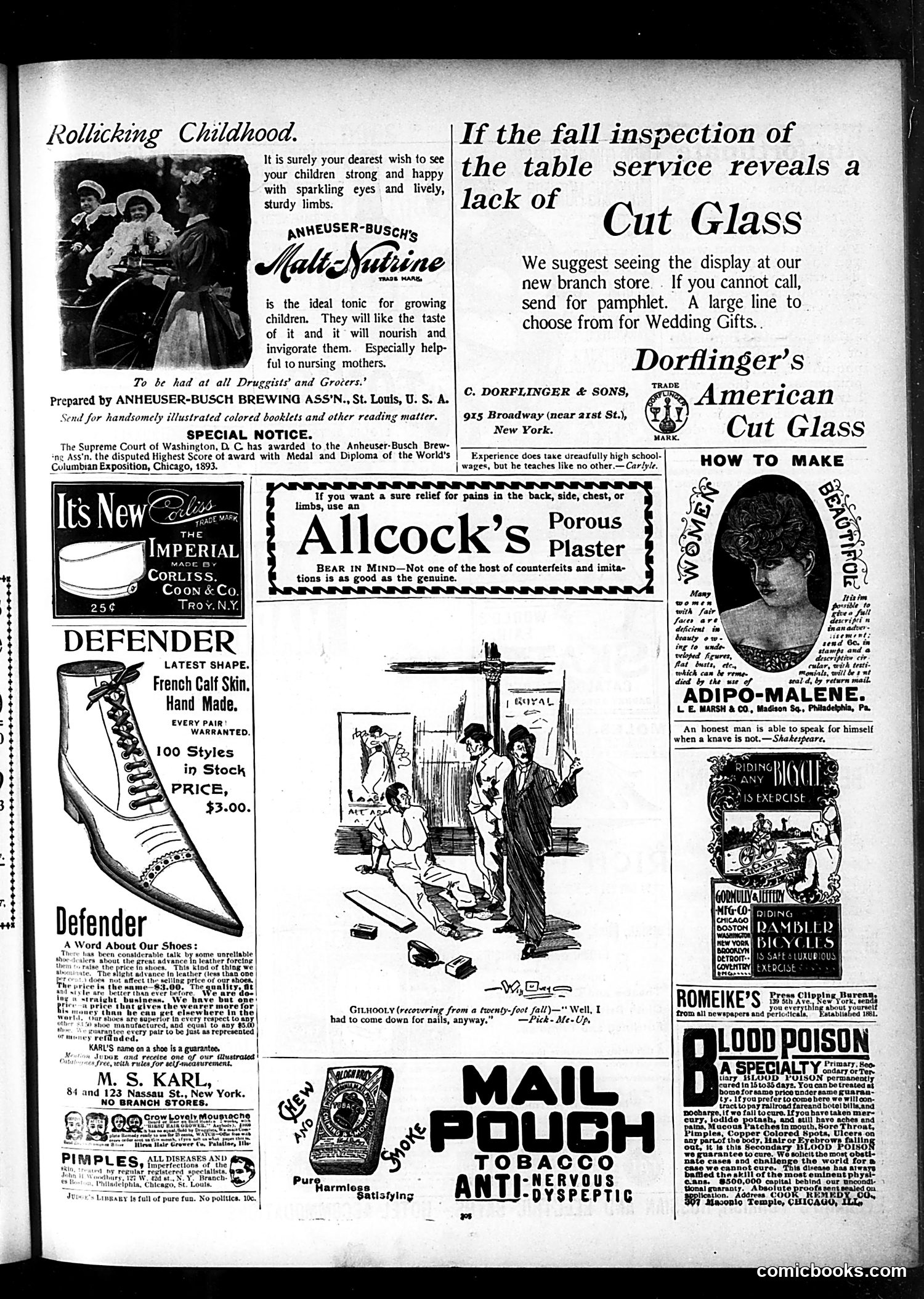
This page from Judge magazine is primarily **advertising**, not political satire. The dominant content includes: **Key Advertisements:** - **Anheuser-Busch's Malt Nutrine** - a "tonic for growing children" (a malt beverage marketed as nutritional) - **Dorflinger's American Cut Glass** - wedding gifts - **Defender shoes** - French calf skin, hand-made, $3.00 - **Allcock's Porous Plaster** - a medical remedy for back/chest pain - **Mail Pouch Tobacco** - marketed as "anti-nervous dyspeptic" - **Blood Poison remedy** and other patent medicines **The Single Cartoon** (center) shows a schoolteacher recovering from a "twenty-foot fall" with the caption "Well, I had to come down for nails, anyway"—a pun about classroom discipline ("come down" on misbehavior). The page reflects early 1900s consumer culture and the prevalence of dubious patent medicine advertising. No clear political satire or caricature of identified public figures appears.
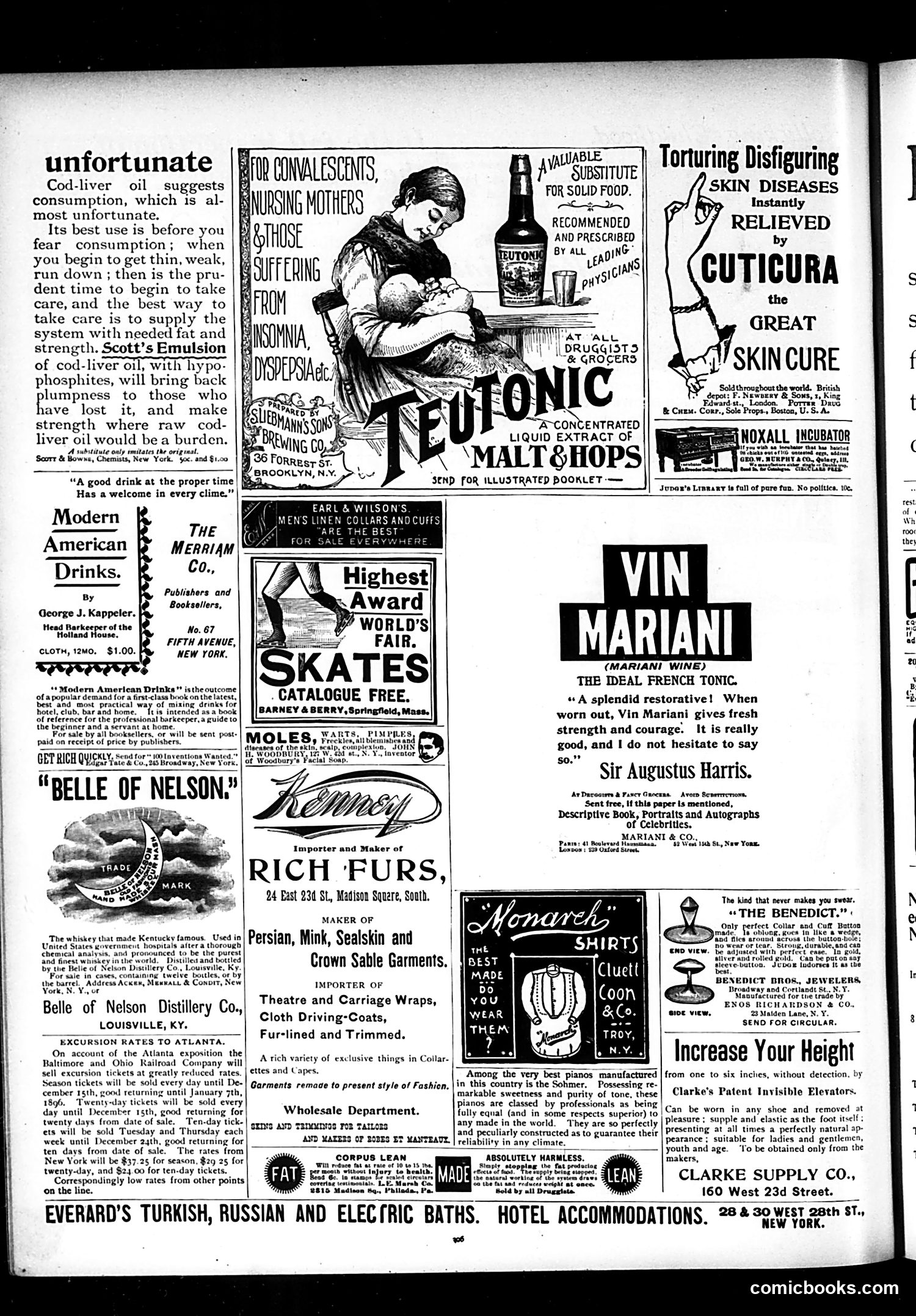
This page is primarily **advertising from the 1890s**, with minimal editorial content. The ads reveal period attitudes about health and medicine that seem shocking today. **Key advertisements visible:** - **Teutonic Malt & Hops**: Marketed to nursing mothers and convalescents, promising relief from insomnia and digestive problems—typical of patent medicines making vague health claims - **Cutcura Skin Cure**: Advertises instant relief for skin diseases - **Scott's Emulsion (cod-liver oil)**: Promoted as prevention for tuberculosis/consumption, a major killer of the era - **Vin Mariani**: A "French tonic" claiming to restore strength—likely alcoholic - **Clarke's Patent Invisible Elevators**: Devices claiming to increase height by inches **The satirical context**: While Judge was a humor magazine, this page shows how aggressively patent medicines and dubious health products were marketed without FDA regulation. Modern readers should note these products made unproven medical claims that would be illegal today.
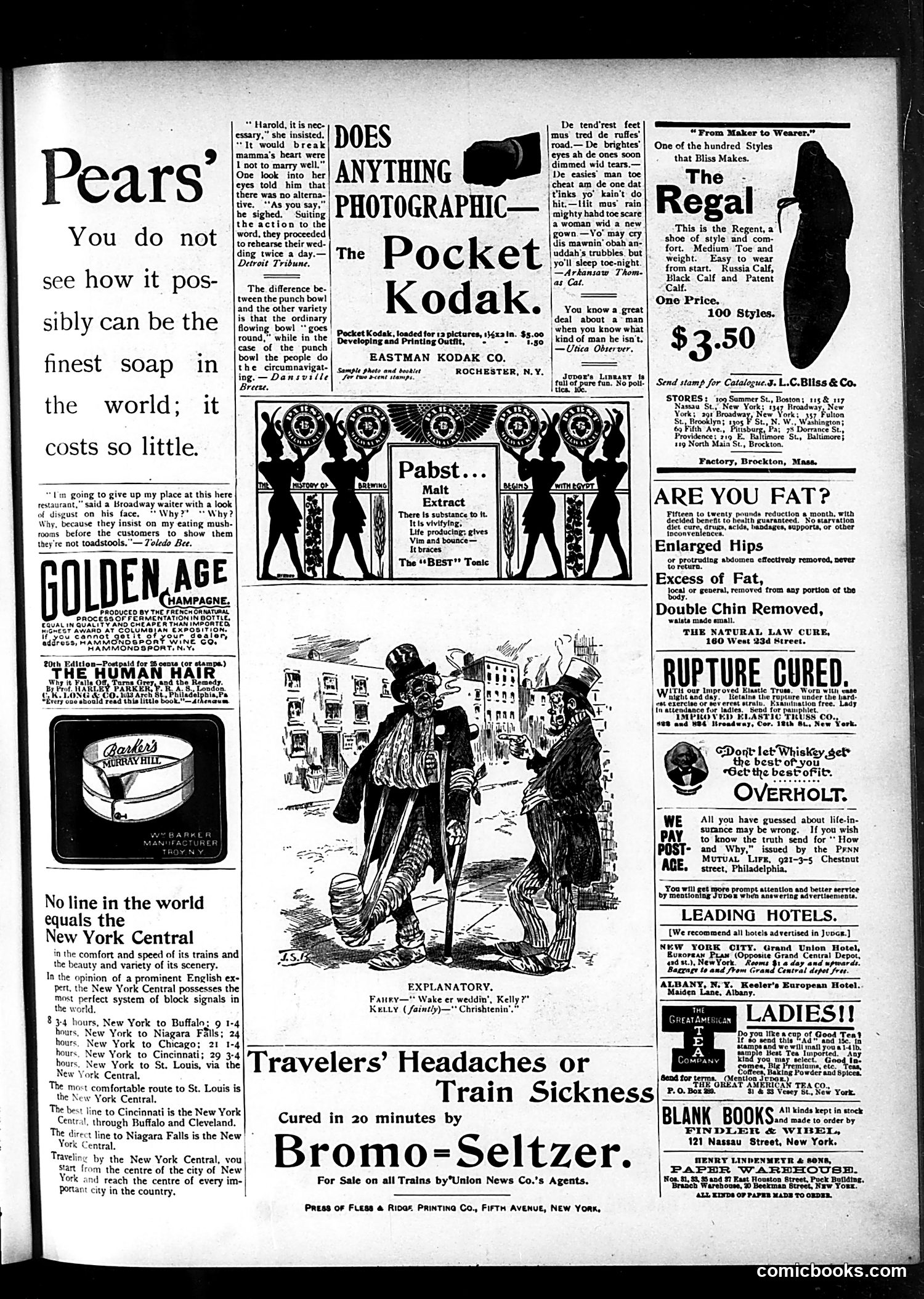
This page is primarily **advertising** interspersed with brief humorous snippets rather than political cartoons. The one illustrated cartoon shows two figures in Victorian dress on a street—labeled "Explanatory" with dialogue: "Wake er weddin', Kelly?" / "Chrishtenin'"—a joke playing on Irish dialect and the similar formality/chaos of weddings versus christenings. Most content consists of product ads (Pears soap, Kodak cameras, Regal shoes, Bromo-Seltzer) alongside small humor items: a Detroit Tribune piece about rehearsing weddings, brief quips about punch bowls and waiters eating mushrooms, and various patent remedies (weight loss, rupture cures, hair products). The ads target affluent readers with consumer goods and travel services (New York Central railroad). There's no discernible political satire on this page—it's standard period magazine filler designed primarily for revenue rather than editorial commentary.
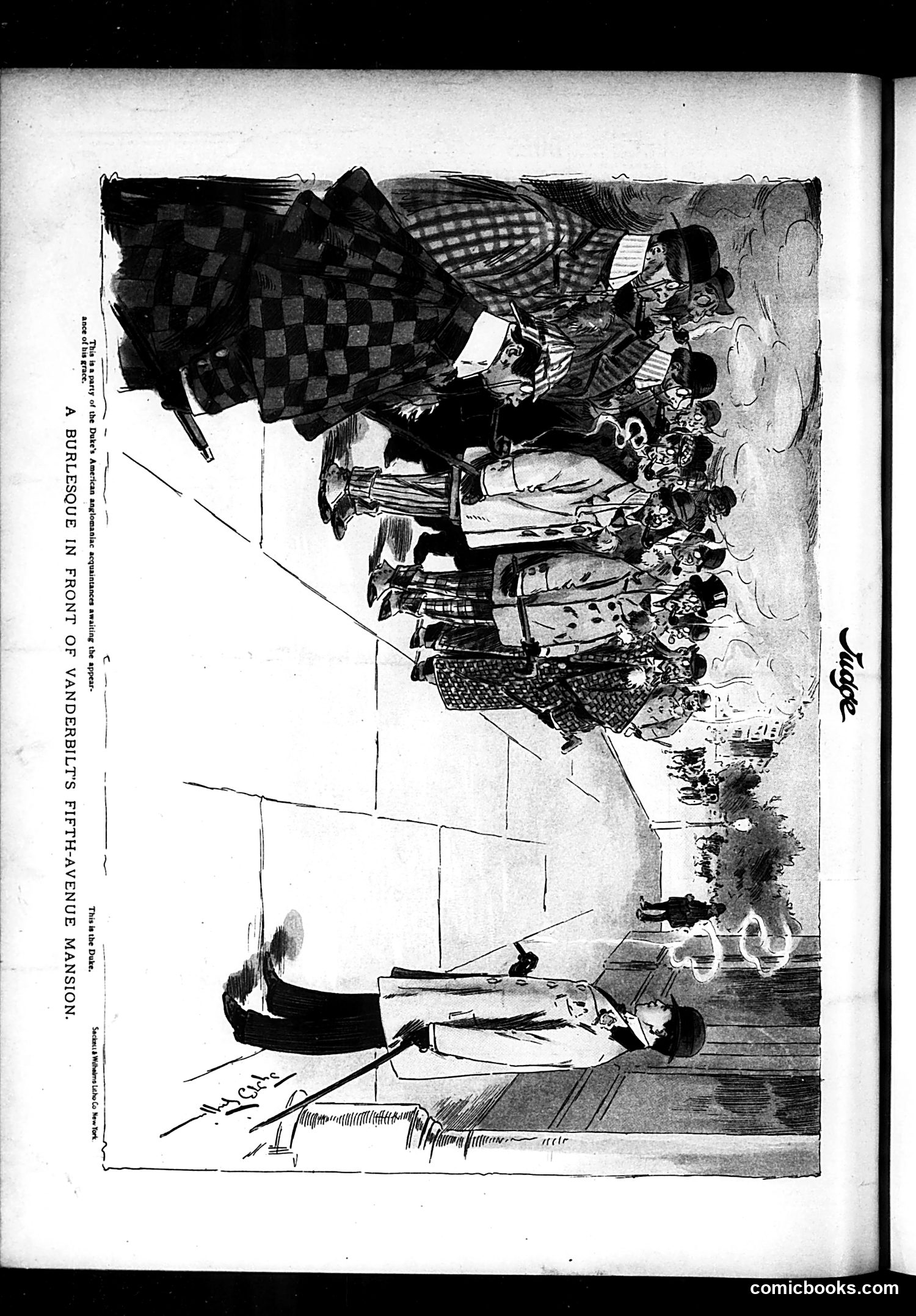
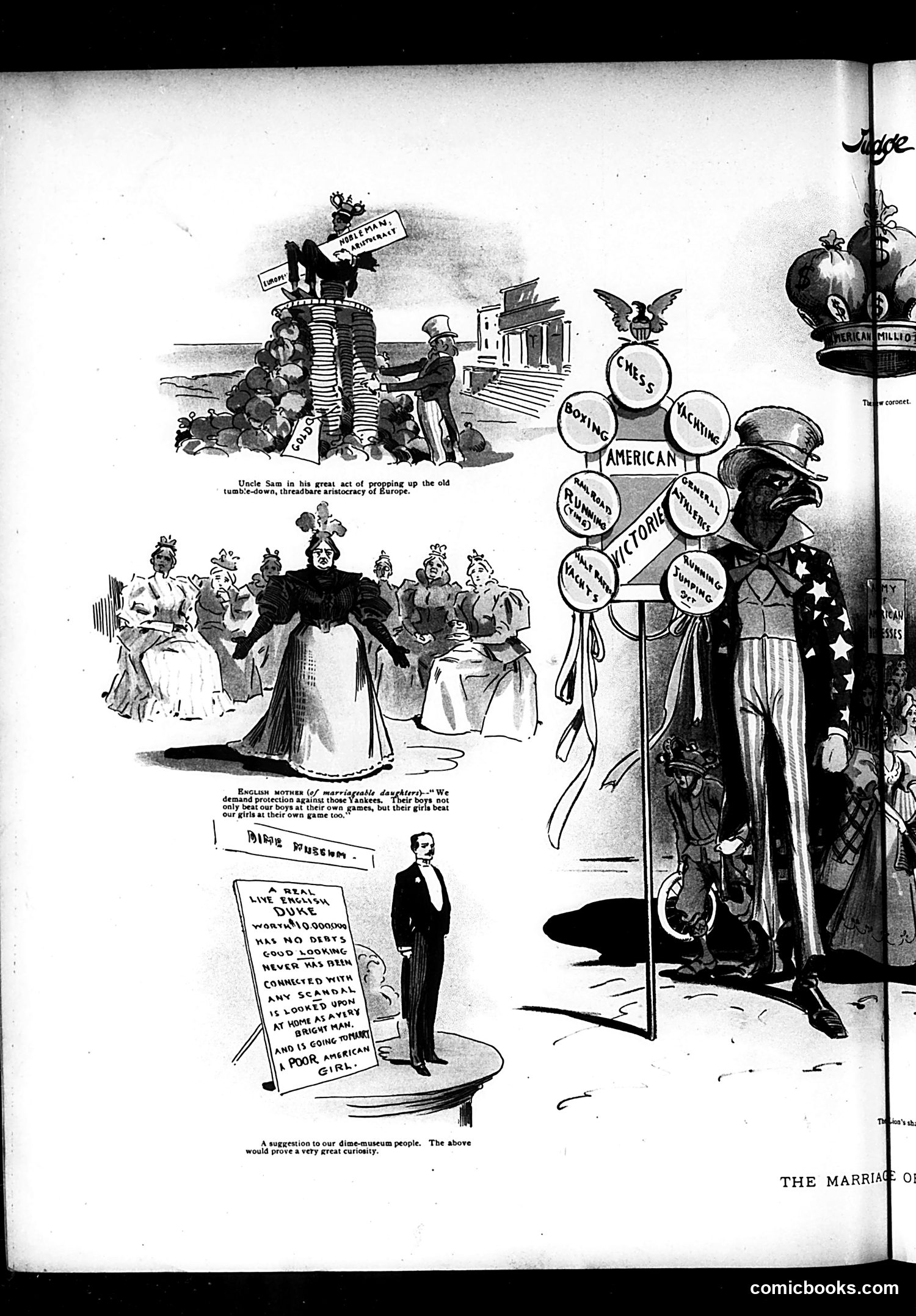
This two-panel satirical cartoon mocks wealthy American "anglomanics"—people obsessively imitating British aristocratic culture. The top panel shows a group of fashionably dressed socialites waiting outside a mansion, while the bottom panel features "the Duke," presumably a visiting British nobleman. The satire targets the Vanderbilt family's Fifth Avenue mansion and the American upper class's snobbish admiration for European nobility. The title "Burlesque" makes clear the cartoonist views this behavior as ridiculous pretension. The accompanying caption emphasizes these are the Duke's "American anglomaniac acquaintances," suggesting they're adopting affected British mannerisms and dress to impress visiting aristocracy. This reflects late-19th-century anxieties about American wealth-obsessed elites abandoning authentic American culture for European affectation—a common Judge magazine theme critiquing the Gilded Age's nouveaux riches.