
Judge, 1895-11-09 · page 3 of 16
Judge — November 9, 1895 — page 3: what you’re looking at
What you’re looking at
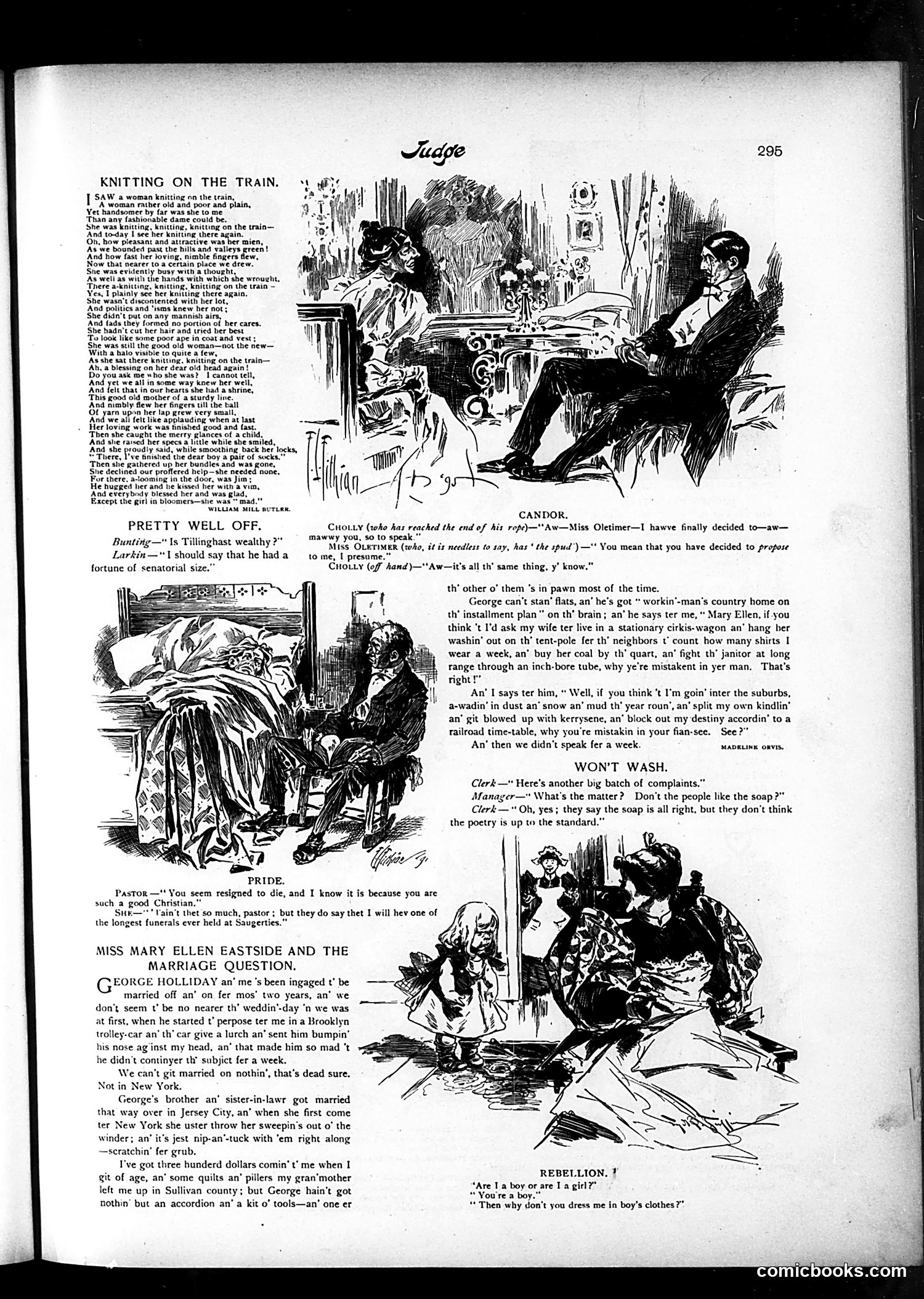
This page contains several satirical sketches and humorous dialogues typical of Judge magazine's social commentary. **"Knitting on the Train"** depicts a woman's knitting needles annoying fellow passengers—satirizing both women's public behavior and the nuisance of inconsiderate travelers. **"Candor"** shows a marriage proposal scene mocking the gap between romantic ideals and practical reality, with the woman's blunt discussion of household finances and marital expectations. **"Won't Wash"** critiques institutional standards, suggesting that claimed quality (soap) doesn't meet actual performance. **"Pride"** and **"Rebellion"** address gender roles and family dynamics, with the latter questioning why a child won't wear gender-appropriate clothing. The sketches collectively satirize ordinary social pretensions, class anxieties, and evolving domestic relationships in early 20th-century America.
📄 Transcribed text from this page (OCR, searchable)
Machine-transcribed from the original scan — historical spelling and the odd misread are preserved.
KNITTING ON THE TRAIN. SAW a woman knitting on the train, ‘A woman rather old and poor and plain, Yet handsomer by far was she to me ‘Than any f ‘And to-day L see her knit ain. On, how pleasant and attractive was her mien, ‘As we bounded past the hills and valleys green | ‘And how fast her loving, nimble fngers few, Now that nearer to a ceriain place we drew. She was evidently busy with a thought, ‘As well as with the hands with which she wrought, There a-knitting, knitting, knitting on the Wain — Yes. 1 piainly see hee knitiing there again. She wasn't discontented with her lot, ‘And politics and "isms knew her not: She didn't pat on any manish airs, ‘And fads they formed no portion of her cares. She hadn't cut her hair and tried ber best To look like some poor ape in coat and vest: She was still the good old woman—not the cew— Witt a halo visible to quite a few, As she sat there knitting. knitting’ on the train— ‘Absa blessing on her dear old head again! Do'yousse me who abe was? Teannot tell yet we all in some way knew her well, And Ieit that in our hearts She hada shine, ‘This good old mother of a sturdy line. And nimbly flew her fingers till the all Ot'yar upon er lap grew very sal, nd we all felt like applauding when at last Her loving work was tinished ood and fast. Then she caught the merry glances of a child, And she raised her specs a litle while she smiled, ‘And she proudly said, while smoothing back her locks, There, {ve finished the dear boy a pair of socks,” Then she gathered up her bundles and was gone, She declined our proffered help—she needed none, For there. a-looming in the door, was Jim ; He hugged hier and be kissed her with a te ‘And everybody blessed her and was glad, Except the git] in bloomers—she was mad. WILLIASO SILL BUTLER. CANDOR, CHOLLY (who has reached the end of his rope)—""Aw—Miss Oletimer—I hawve finally decided to—aw— PRETTY WELL OFF. Ada patti . Pat mawwy you, so to speak."” Buntidg—“ \s Tillinghast wealthy ? Miss OLETIMER (who, it is needless to say, has‘ the spud')—"* You mean that you have decided to propose Larkin —"1 should say that he hada to me, I presume.” fortune of senatorial size.” Cuouny (off hand )—"*Aw—it's all th’ same thing, y’ know." th’ other o' them ‘s in pawn most of the time. George can’t stan’ flats, an’ he’s got “ workin’-man’s country home on th’ installment plan” on th’ brain; an’ he says ter me, “ Mary Ellen, if-you think ‘t I'd ask my wife ter live in a stationary cirkis-wagon an’ hang her washin’ out on th’ tent-pole fer th’ neighbors t’ count how many shirts I wear a week, an’ buy her coal by th’ quart, an’ fight th’ janitor at long range through an inch-bore tube, why ye're mistakent in yer man. That's right!” An’ I says ter him, “ Well, if you think ‘t I'm goin’ inter the suburbs, a-wadin’ in dust an’ snow an’ mud th’ year roun’, an’ split my own kindlin’ an’ git blowed up with kerrysene, an’ block out my destiny accordin’ to a railroad time-table, why you're mistakin in your fian-see. See?” An’ then we didn’t speak fer a week. MADELINK ORVIS, WON'T WASH. Clerk —" Here's another big batch of complaints.” Manager—* What's the matter? Don’t the people like the soap ?” Clerk —* Oh, yes; they say the soap is all right, but they don’t think the poetry is up to the standar You seem resigned to die, and I know it is because you are such a good Christian” ain't thet 'so much, pastor ; but they do say thet I will hev one of the ioneet funerals ever held at Saugerties.” MISS MARY ELLEN EASTSIDE AND THE MARRIAGE QUESTION. EORGE HOLLIDAY an’ me's been ingaged t’ be married off an’ on fer mos’ two years, an’ we don’t seem t' be no nearer th’ weddi jay ‘n we was at first, when he started t’ perpose ter me in a Brooklyn trolley-car an’ th’ car give a lurch an’ sent him bumpin’ his nose aginst my head, an’ that made him so mad ’t he didn't continyer th’ subjict fer a week. We can’t git married on nothin’, that’s dead sure. Not in New York. George's brother an’ sister-in-lawr got married that way over in Jersey City, an’ when she first come ter New York she uster throw her sweepin’s out o' the winder; an’ it’s jest nip-an’-tuck with ‘em right along —scratchin’ fer grub. I've got three hunderd dollars comin’ t' me when I ’ git of age, an’ some quilts an’ pillers my gran‘mother : ISAT IAN Osh left me up in Sullivan county; but George hain't got Arete boy.or are Le eid 1 Ye out i. “You're a boy. nothin’ but an accordion an’ a kit o’ tools—an’ one er “* Then why don’t you dress me in boy's clothes?”