
A complete issue · 16 pages · 1895
Judge — September 28, 1895
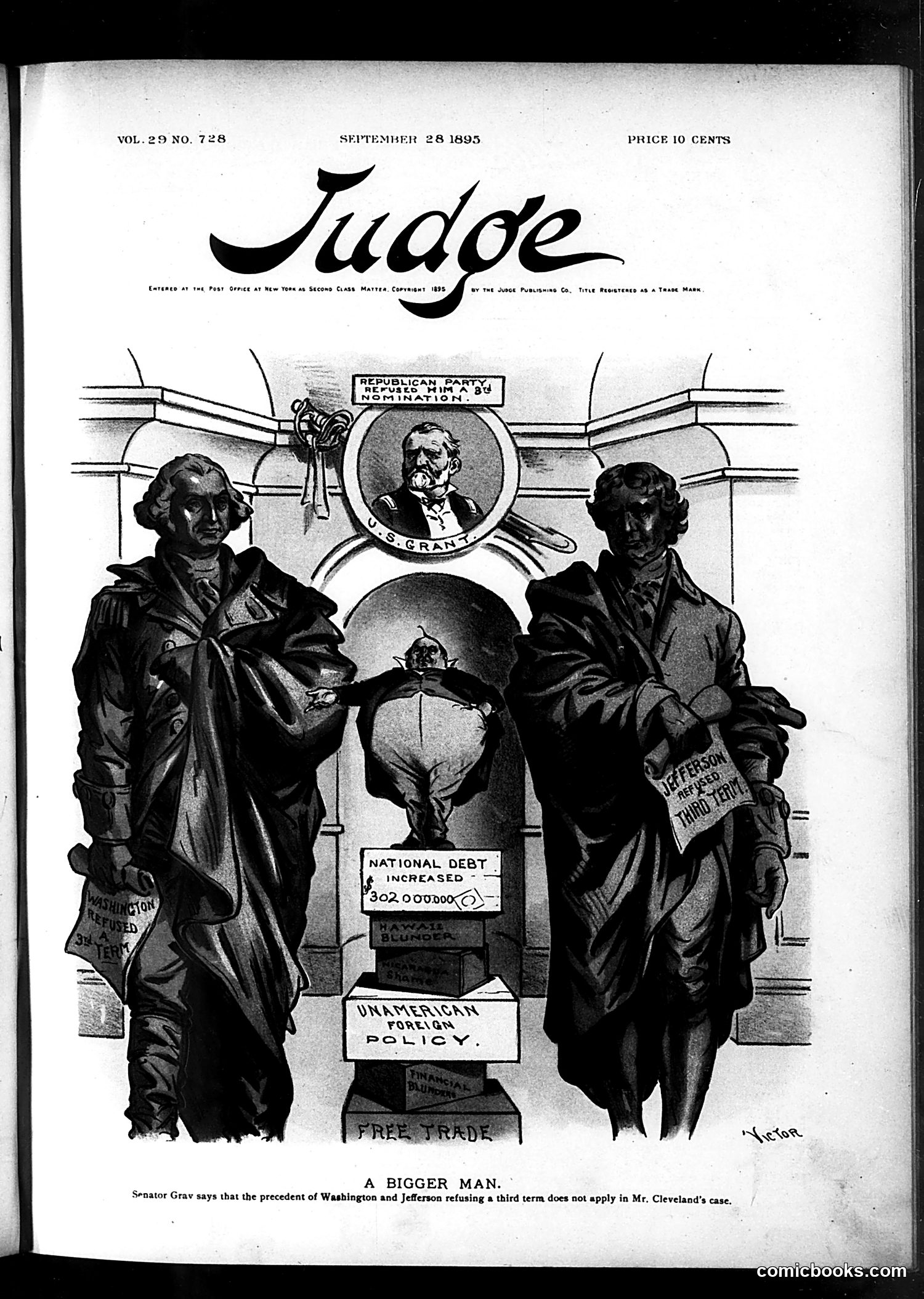
This political cartoon satirizes President Grover Cleveland's foreign policy during his second term. Two historical figures—Washington and Jefferson—flank a large globe labeled with policy positions: "Free Trade," "Financial Embarrass," "Unamerican Foreign Policy," and "National Debt Increased $302,000,000." Above the globe is a portrait of U.S. Grant within a banner reading "Republican Party Nomination." The caption claims Senator Gray argued that the precedent of Washington and Jefferson refusing third terms doesn't apply to Cleveland's case—sarcastically suggesting Cleveland considers himself "a bigger man" than these founding figures. The cartoon criticizes Cleveland's economic policies, foreign relations, and implicitly questions his presidential ambitions or authority.
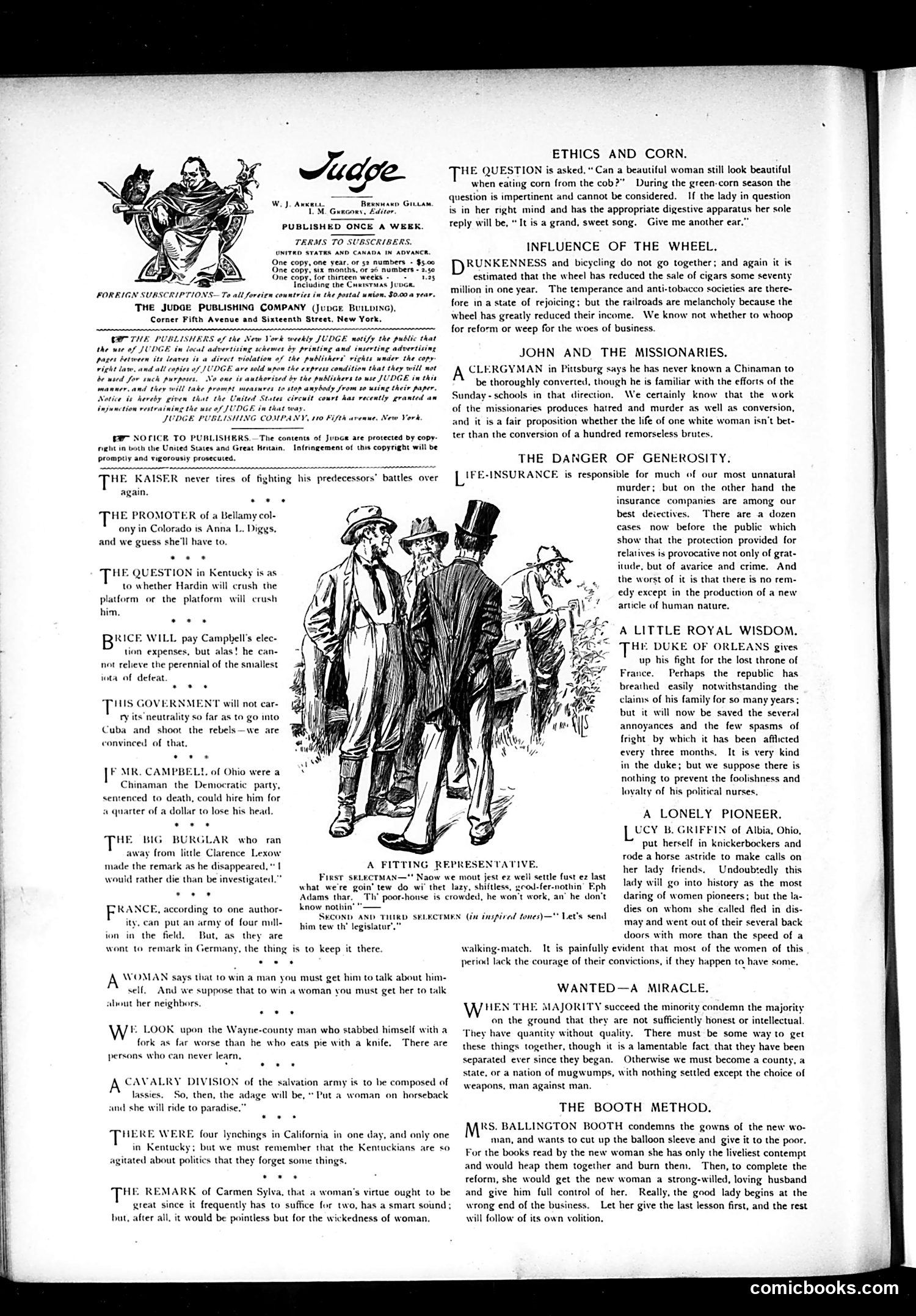
The central cartoon depicts three men in period dress labeled "FITTING REPRESENTATIVE." The dialogue suggests they're discussing political representation and elections, with references to "First Selectman" choosing candidates. The satirical commentary throughout critiques: - **Political corruption**: References to Campbell's election expenses and concerns about defeat - **Military issues**: Comments on the Kaiser and fighting predecessors' battles - **Gender politics**: Sections titled "ETHICS AND CORN" and "THE BOOTH METHOD" discussing women's roles and suffrage - **Social issues**: Articles on life insurance fraud, generosity dangers, and women pioneers The page reflects Progressive Era concerns about representation, women's participation in public life, and political accountability. Without clearer date markers visible, the specific election or event referenced remains unclear, but the satirical tone targets establishment political practices and social hypocrisy.
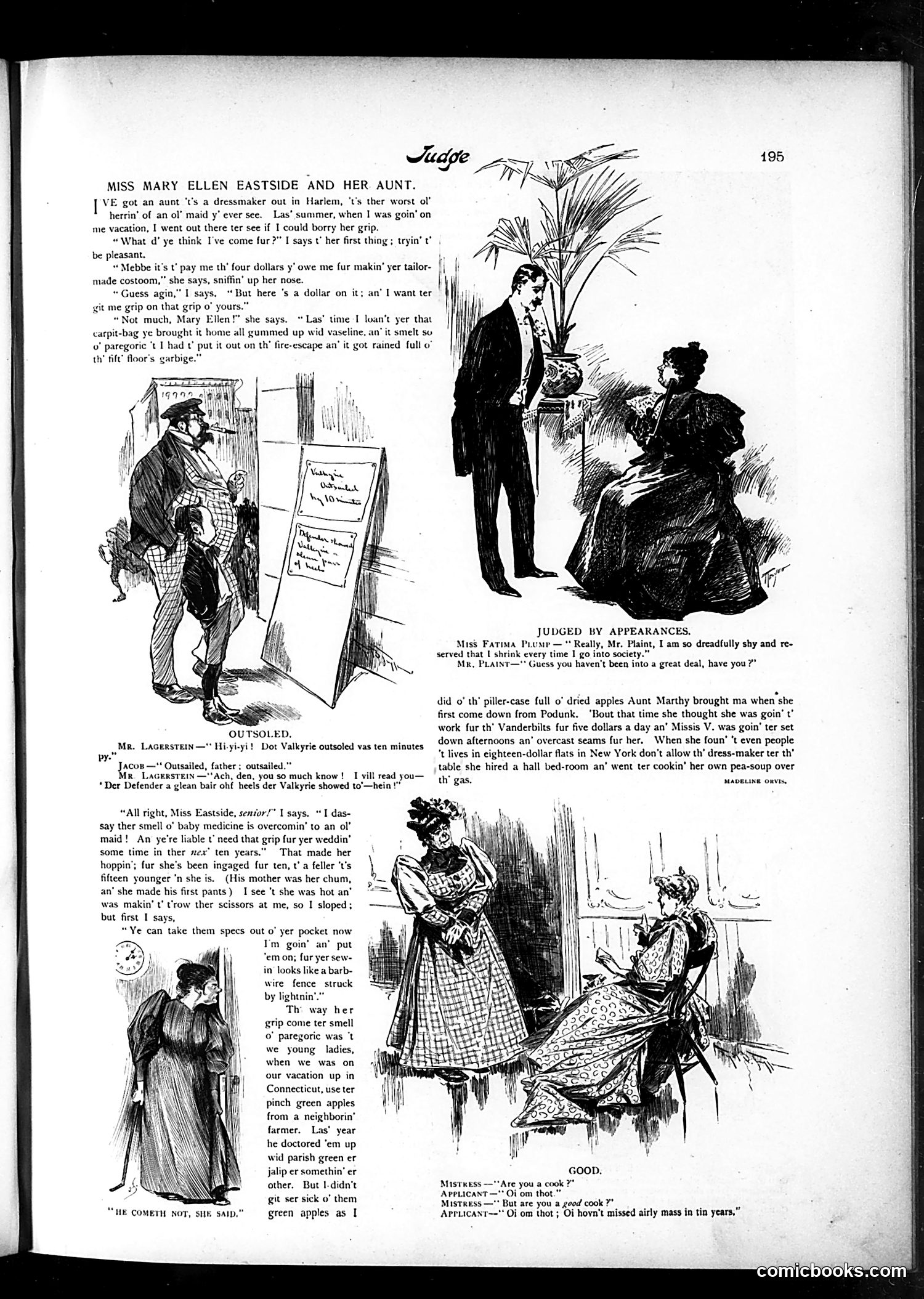
This page satirizes class pretension and social climbing. The cartoon depicts Mary Ellen Eastside, apparently from a working-class background ("Eastside"), attempting to pass as respectable in high society. Her aunt relates humiliating stories—hiring her out for odd jobs, her appearance in worn vaseline-covered clothing smeared with dried apples—that reveal her humble origins. The satire mocks both Mary Ellen's desperate social aspirations and the superficiality of "society" that judges people solely on appearance and manufactured respectability rather than character. The accompanying vignettes (labeled "Judged by Appearances," "Outsold," and "Good") reinforce this theme: surfaces deceive, and social status is often a fragile performance rather than genuine merit.
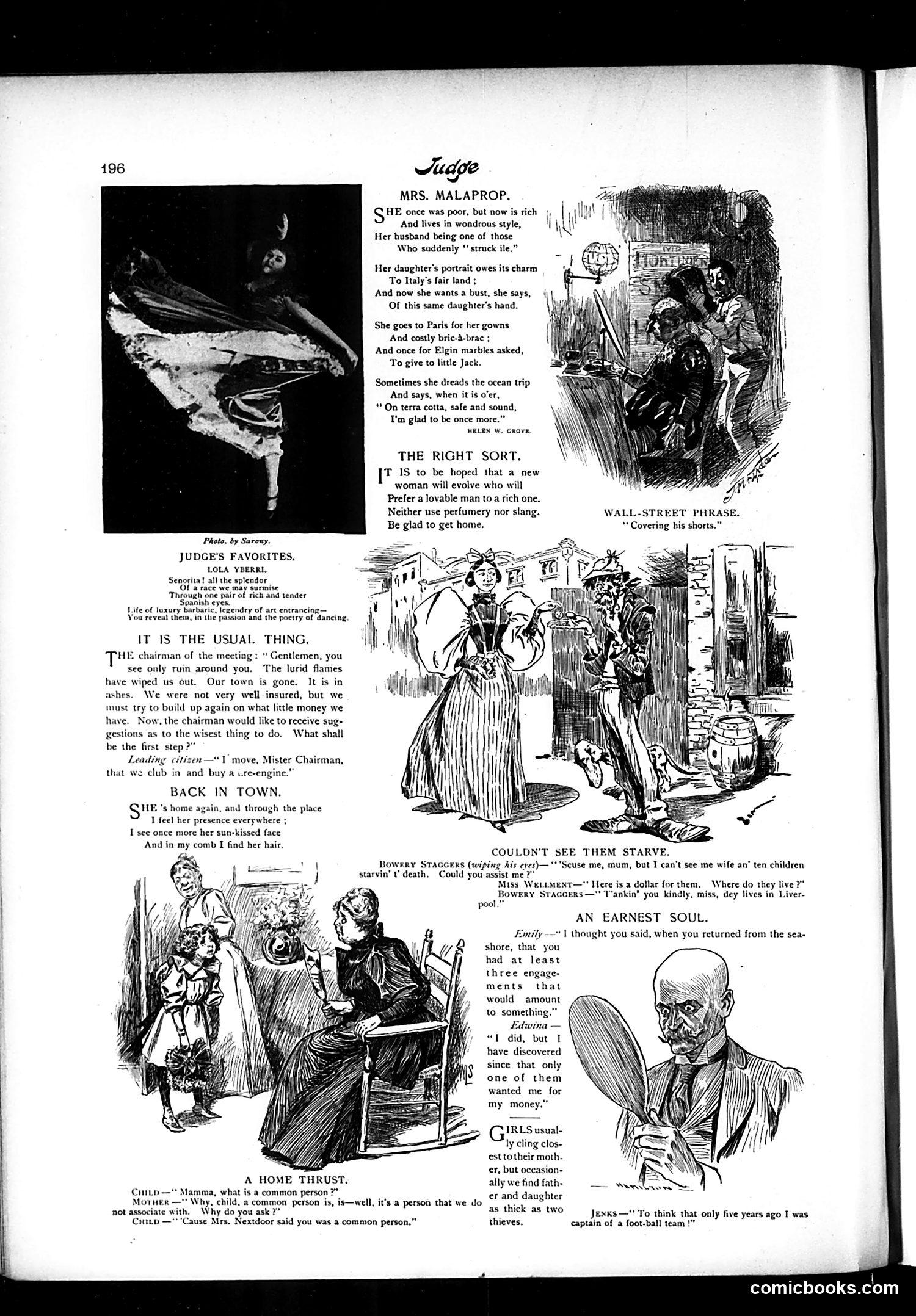
This page from *Judge* magazine contains several satirical pieces mocking social pretension and economic realities of the era. "Mrs. Malaprop" ridicules newly wealthy women who ape European sophistication through malapropisms—she says "terra cotta" instead of "terra firma" and requests "Elgin marbles" as children's gifts, exposing her ignorance while spending lavishly on Paris gowns and Italian portraits. "The Right Sort" offers editorial commentary hoping women will eventually prefer character to wealth—a gentle jab at materialistic marriage practices. "It Is the Usual Thing" satirizes post-disaster community meetings where, facing ruin, citizens' first instinct is buying a fire engine rather than practical rebuilding—mocking misplaced priorities. "Wall-Street Phrase" puns on financial terminology ("covering his shorts"). Lower pieces use brief comedic dialogues: a impoverished Bowery man unable to feed ten children; a woman discovering her fiancé loved only her money; a child learning what "common person" means. The page reflects *Judge*'s focus on class commentary and social satire typical of late 19th/early 20th-century American humor.
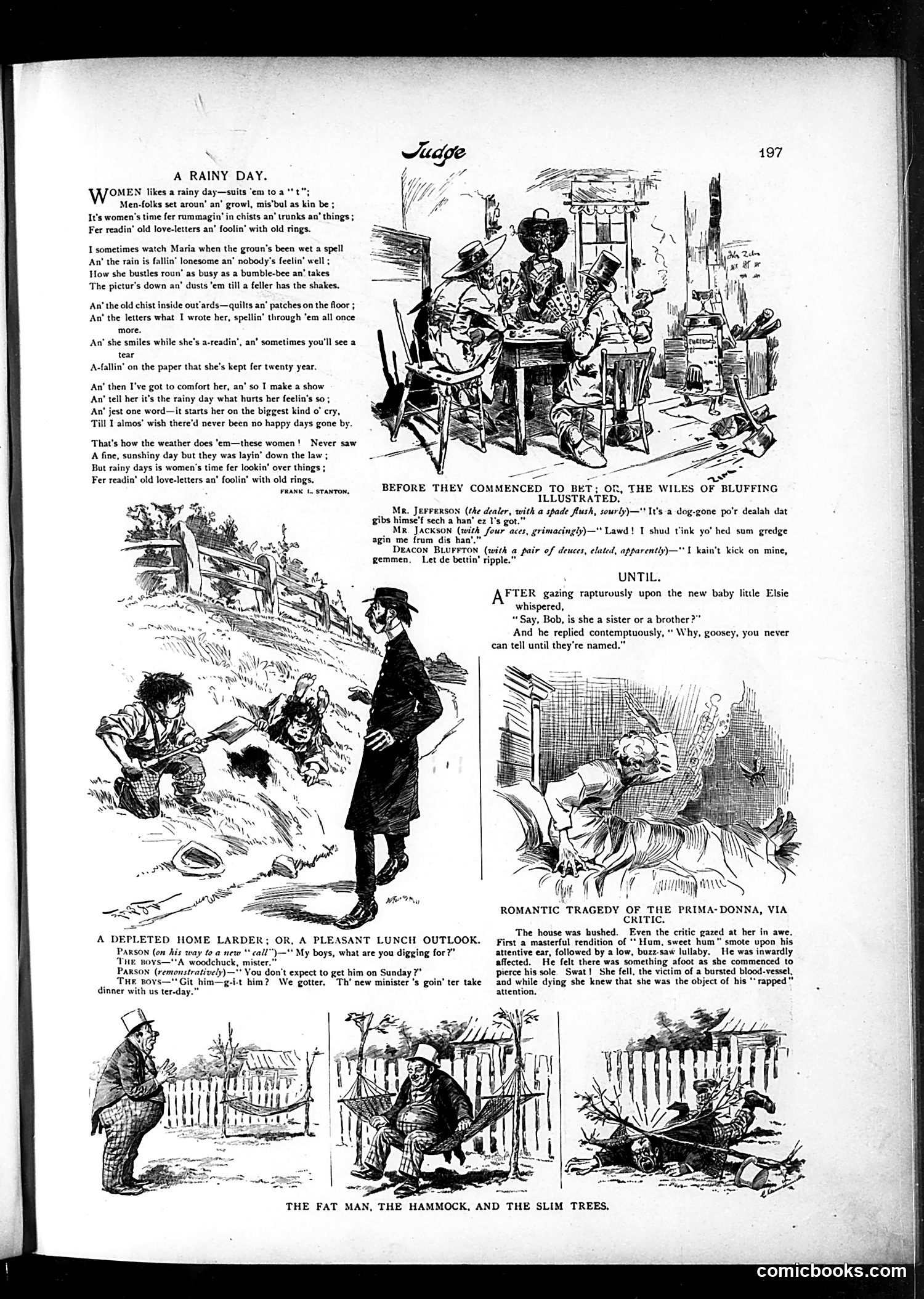
This page contains several unrelated satirical pieces typical of Judge's format: **"A Rainy Day"** is a sentimental poem by Frank L. Stanton depicting how rainy days prompt wives to revisit old love letters and mementos, stirring emotional memories of happier times with their husbands. The satire gently mocks domestic sentimentality. **"A Depleted Home Larder"** jokes about a poor parson whose boys attempt to catch a woodchuck for Sunday dinner since the household is broke—satirizing clergy poverty. **"Before They Commenced to Bet"** depicts three Black men playing poker, using dialect humor typical of the era's problematic racial comedy. The joke involves bluffing and poor card hands. **"Romantic Tragedy of the Prima-Donna"** is absurdist humor: a prima donna collapses mid-performance, and a theater critic only becomes emotionally engaged when she's dying and literally steps on him. **"The Fat Man, the Hammock, and the Slim Trees"** (caption only visible) likely depicts physical comedy about body size and hammocks. The page mixes domestic sentiment, class humor, racial caricature, and slapstick—representative of 1890s Judge magazine's varied comedic approaches.
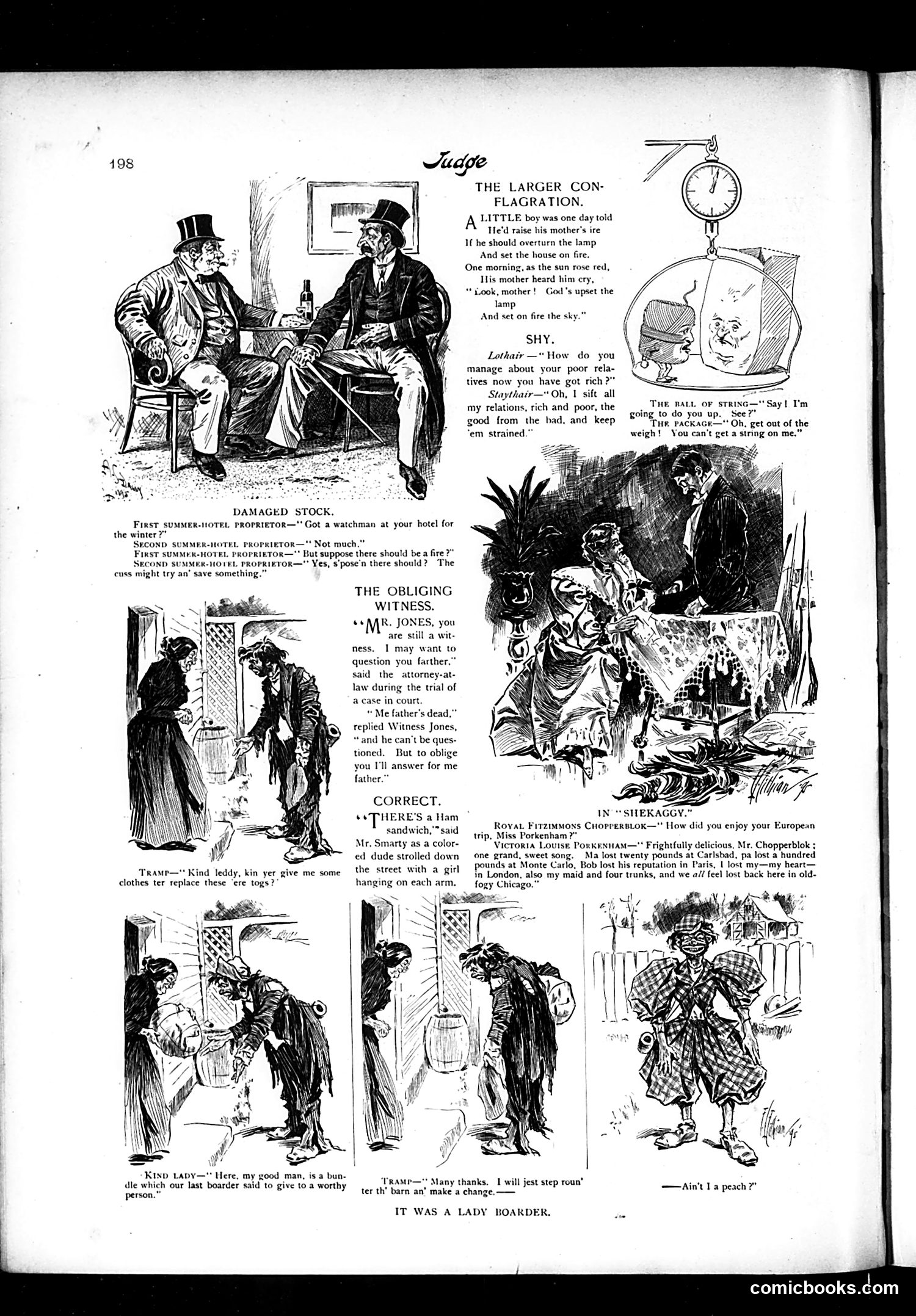
This page contains several unrelated satirical cartoons typical of the era: **"Damaged Stock"** jokes about hotel proprietors' indifference to fire safety—one admits his watchman might actually *save* property during a fire, which he treats as an unfortunate outcome. **"The Obliging Witness"** mocks courtroom absurdity: a witness offers to answer questions on behalf of his dead father to "oblige" the attorney. **"Correct"** plays on racial stereotypes, showing a Black man with two women being called a "sandwich"—a crude visual pun. **"The Larger Conflagration"** is a children's poem where a boy mistakes a red sunrise for his mother's lamp setting the sky on fire. **"In Shekaggy"** satirizes wealthy tourists, with "Miss Porkenham" describing European losses (money, reputation, heart, luggage) while feeling out of place back in Chicago. The page reflects period humor mixing class commentary, ethnic caricature, and wordplay typical of early-20th-century American satirical magazines.
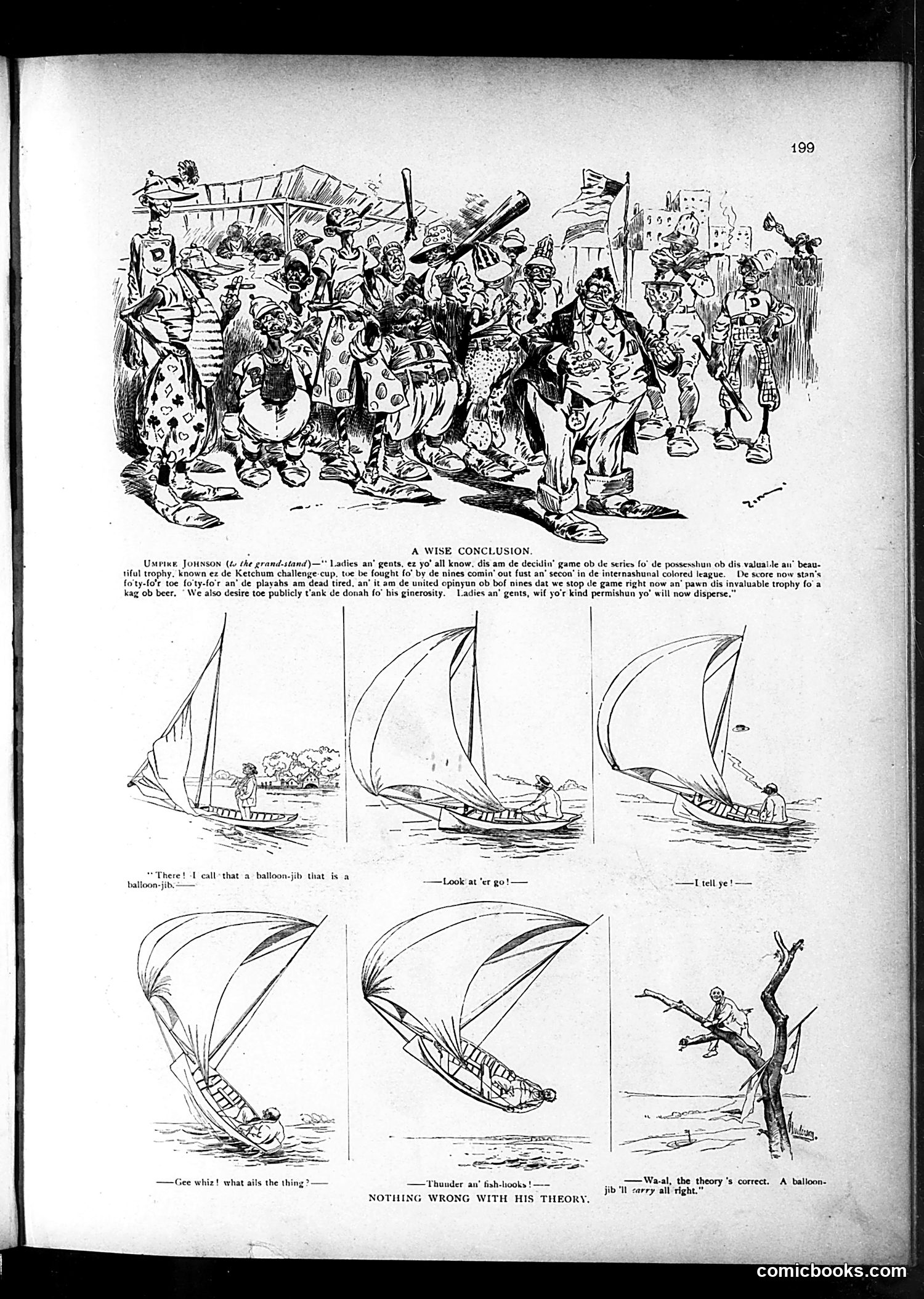
This page satirizes both racial stereotypes and sports culture of the era. The top cartoon mocks a baseball championship game between "colored league" teams through heavy dialect caricature. Umpire "Unteree Johnson" speaks in exaggerated African American vernacular while announcing that both exhausted teams have agreed to pawn their valuable trophy for beer rather than finish the game—presenting Black athletes as lazy and prone to alcohol. The bottom comic strip shows a sailboat's "balloon-jib" sail repeatedly failing. Each panel depicts the sail collapsing while the sailor insists his theory is correct, concluding "nothing wrong with his theory." This appears to mock stubborn adherence to failed ideas despite obvious evidence. Together, the page uses racist caricature for one joke and visual comedy for the other, typical of Judge magazine's entertainment approach.
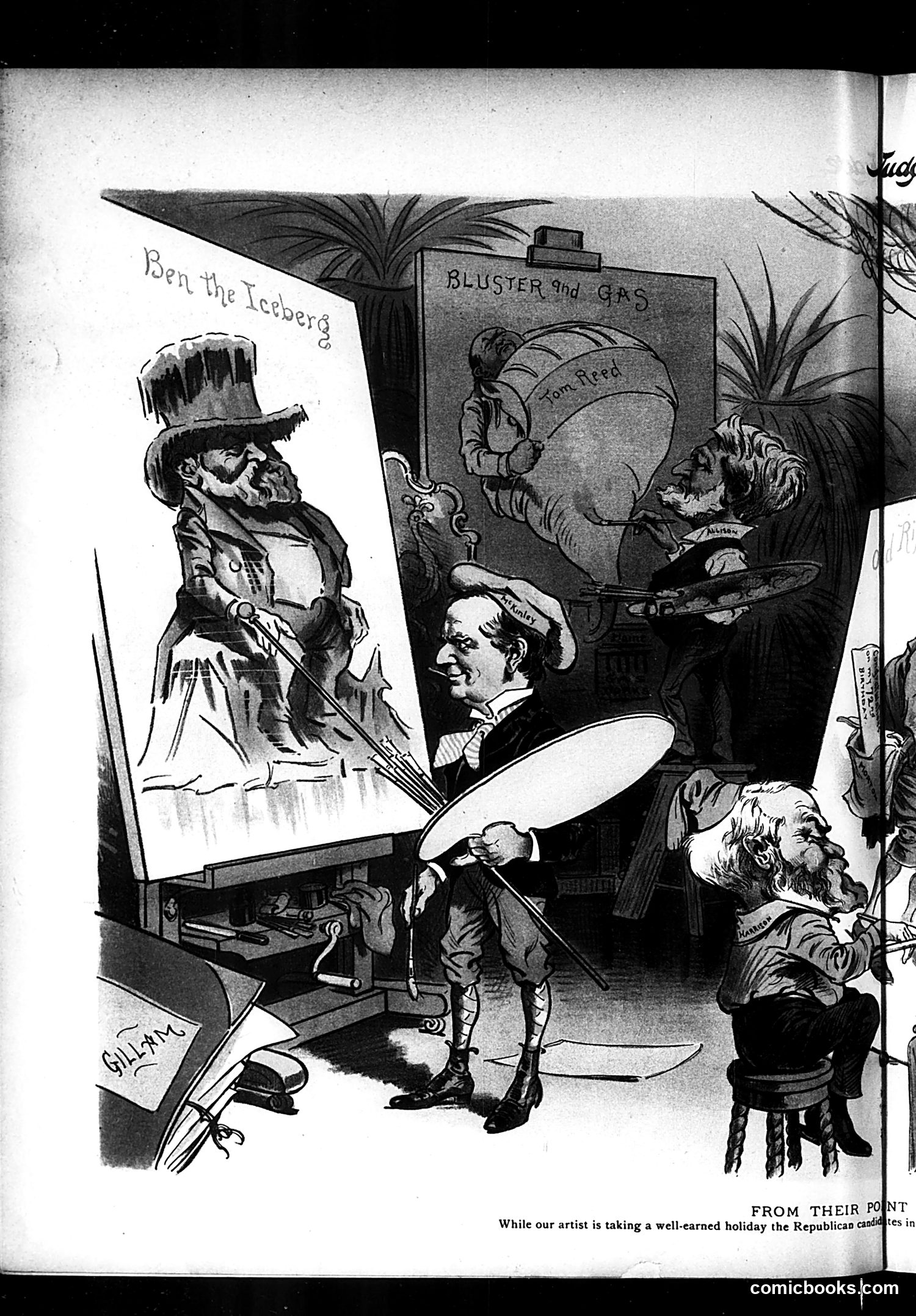
This Judge magazine cartoon satirizes Republican political candidates during what appears to be a presidential campaign period. The central figure is a man in formal dress examining artwork labeled "Ben the Iceberg" and "Bluster and Gas" (attributed to "Tom Reed"). The satire suggests Republican candidates are being presented and promoted like commercial products or artworks—with exaggerated, manufactured personas rather than substance. The "Bluster and Gas" label particularly mocks empty political rhetoric. The onlookers represent the public or media observing this political theater. The caption indicates the cartoonist is on holiday while Republicans campaign, implying the satire continues their established criticism of Republican political marketing and superficiality. The sketch-style execution typical of Judge's political commentary emphasizes the mockery of artificiality in political promotion.
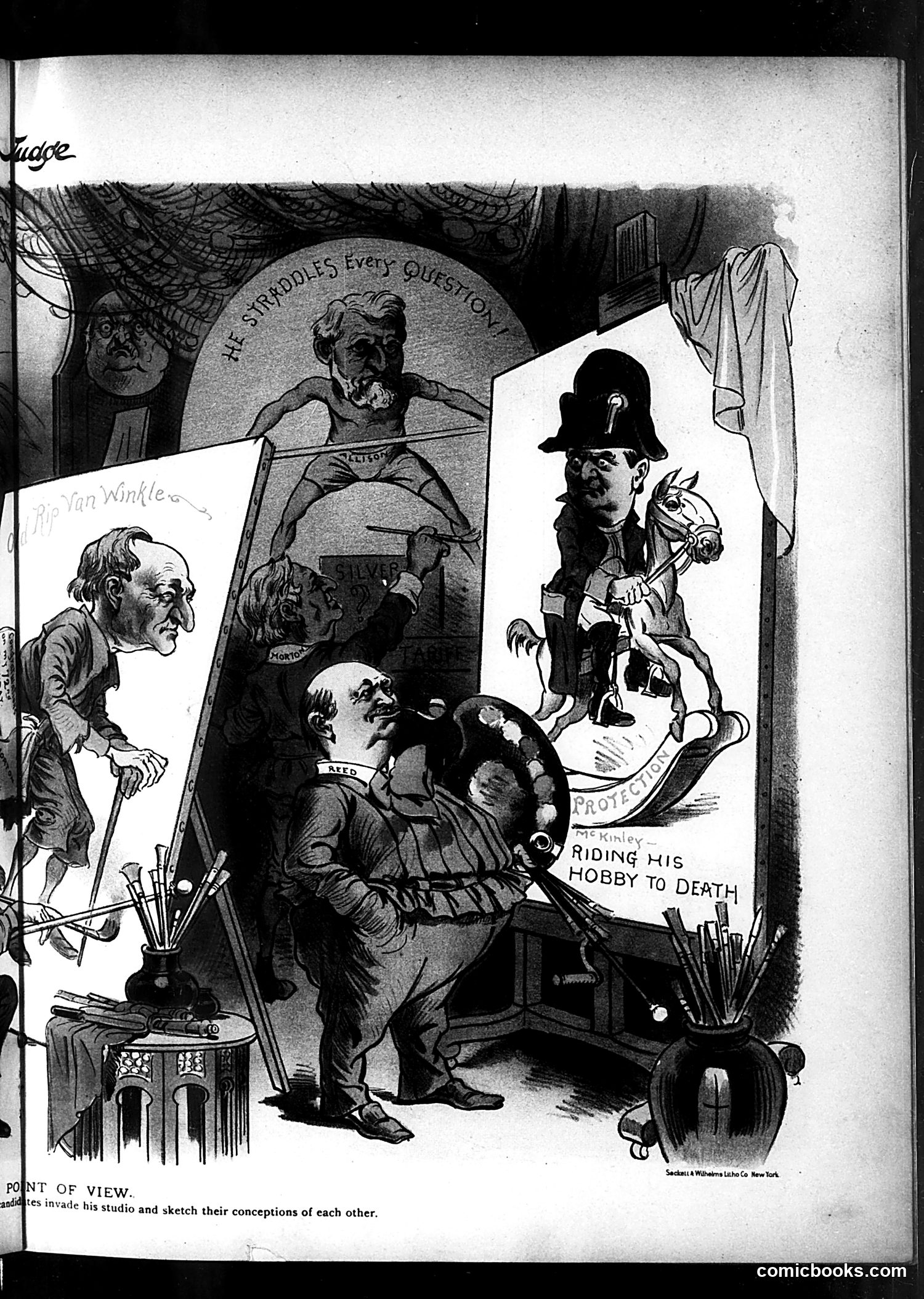
This page shows an artist's studio being invaded by political candidates who sketch caricatures of each other. The central figure appears to be an artist or illustrator confronted by exaggerated caricatured portraits of what are likely political rivals or candidates from the period. The satire critiques how political opponents create unflattering, distorted depictions of each other—literally "sketching their conceptions." The various sketches shown represent biased, hostile interpretations rather than accurate portrayals. One portrait references "Rip Van Winkle" (visible text), suggesting someone is out of touch or sleeping through events. The joke mocks the mud-slinging nature of political campaigns, where candidates deliberately circulate the worst possible caricatures of their opponents to damage their reputations. The intrusion into the artist's studio represents how pervasive and invasive this practice had become in political discourse.
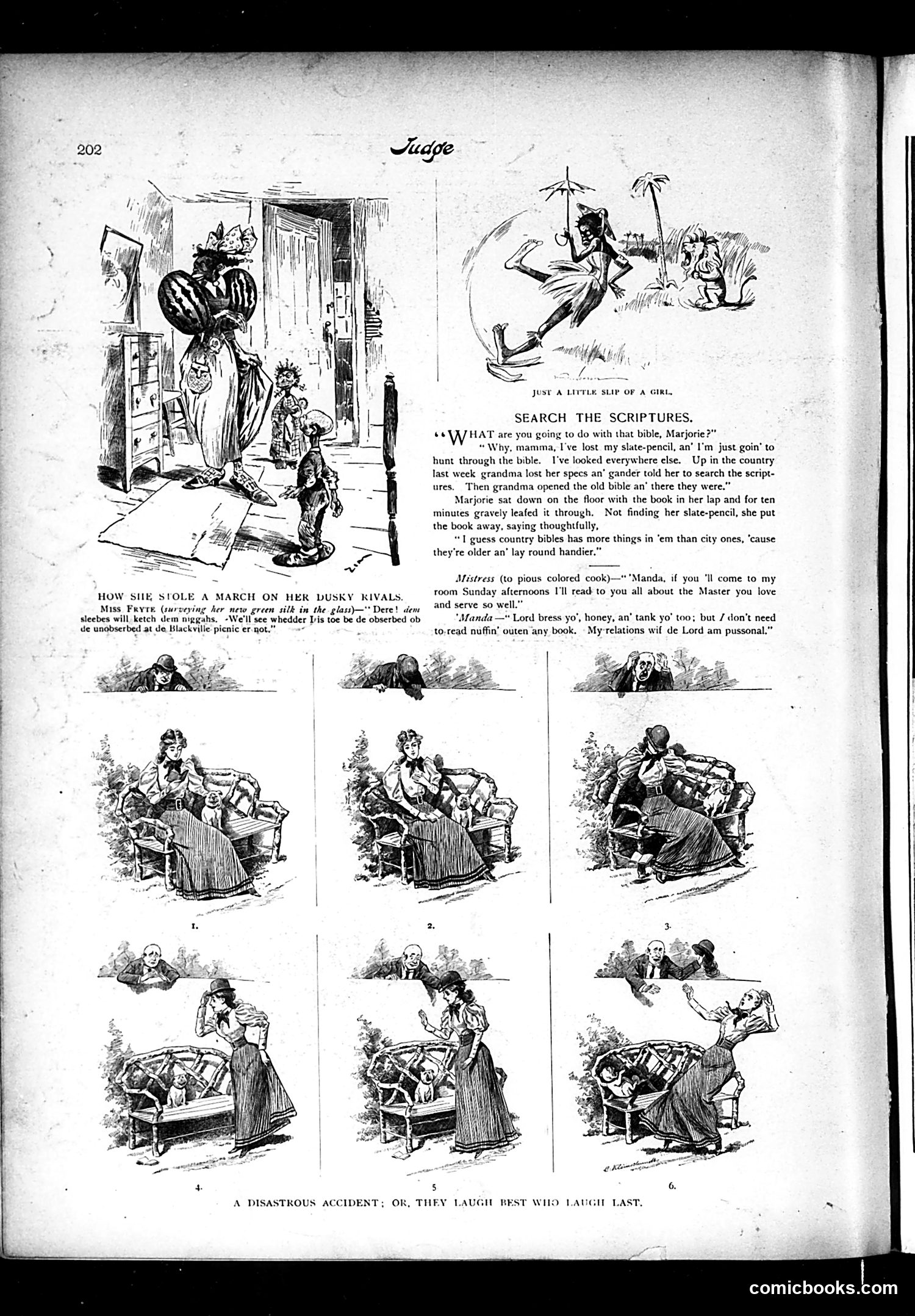
This page contains three separate satirical pieces reflecting late 19th-century attitudes: **"Search the Scriptures"**: A girl loses her slate-pencil and searches the family Bible, following her grandmother's precedent of finding lost items there. The joke mocks rural naïveté—the child's logic that old country Bibles contain more "things" because they're older and handier reflects stereotyped assumptions about country folk's lack of sophistication. **"How She Stole a March on Her Dusky Rivals"**: A wealthy woman shows off her new green silk dress, expecting it will impress Black attendees at a "Blackville picnic" (a common Judge stereotype). The racist language and premise mock both affected white society ladies and suggest condescension toward Black communities. **"A Disastrous Accident"**: The sequential comic strip shows an accident involving a baby carriage—the punchline appears to involve unexpected consequences. The page exemplifies Judge's reliance on racial stereotypes and class-based humor typical of the period, alongside genteel domestic comedy.
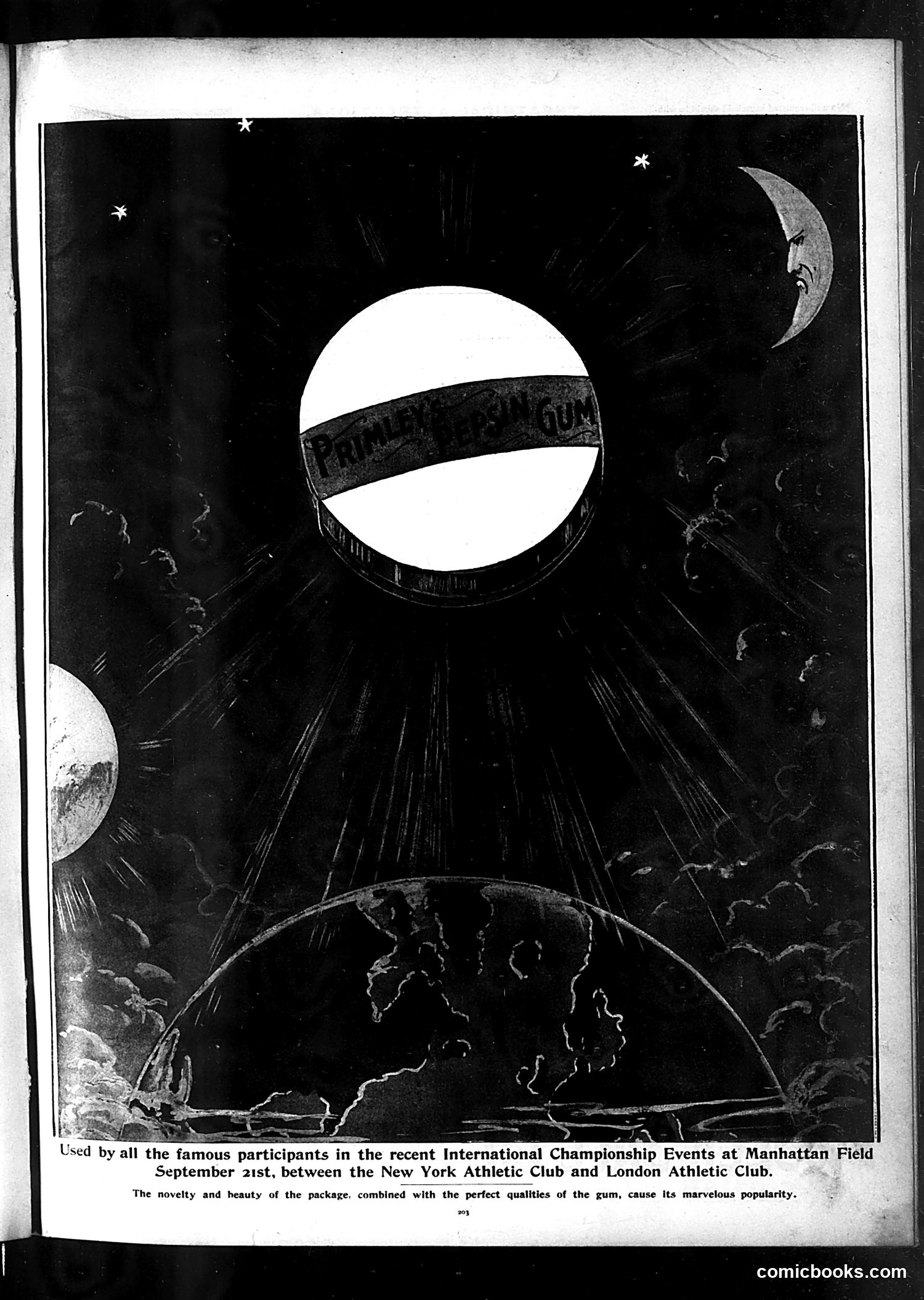
This is a **chewing gum advertisement**, not a political cartoon. The image depicts a celestial scene with the sun, moon, stars, and Earth, with a band of gum wrapping across the sun's face. The text references an "International Championship Events at Manhattan Field" on September 21st between the New York Athletic Club and London Athletic Club—likely an early 20th-century track and field competition. The ad claims the gum was "used by all the famous participants" in these events, arguing that the gum's "novelty and beauty of the package, combined with the perfect qualities of the gum" caused its "marvelous popularity." This is standard product-endorsement advertising rather than satirical commentary.
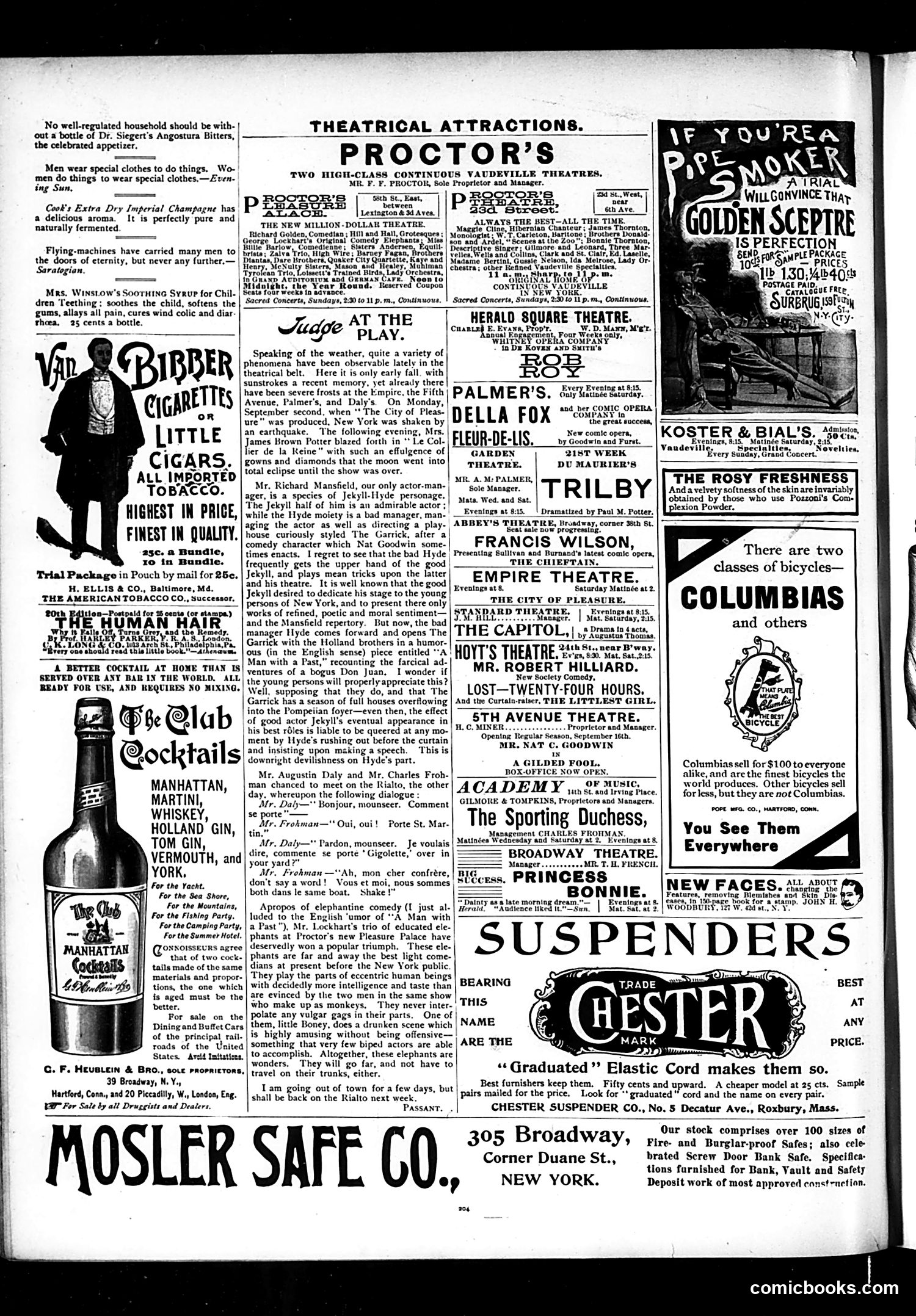
This page is primarily **theatrical advertising and gossip**, not political satire. The "Judge" magazine content consists of: **Theater Reviews/Gossip**: A column mocking actor Richard Mansfield as a Jekyll-and-Hyde personality—his "good Jekyll half" is an admirable actor, but his "bad Hyde half" is a poor theater manager who "plays mean tricks" on himself and his theater. This is personality-based entertainment criticism, not political commentary. **Advertisements**: The page is dominated by ads for vaudeville theaters (Proctor's, Herald Square Theatre), cigars, cocktail sets, hair products, and safes—typical period advertising. **No Clear Political Cartoons**: While the page header says "THEATRICAL ATTRACTIONS," there are no identifiable political cartoons or caricatures of public figures visible that would require historical context to understand. The page reflects early 1900s entertainment industry culture and consumer advertising rather than political satire.
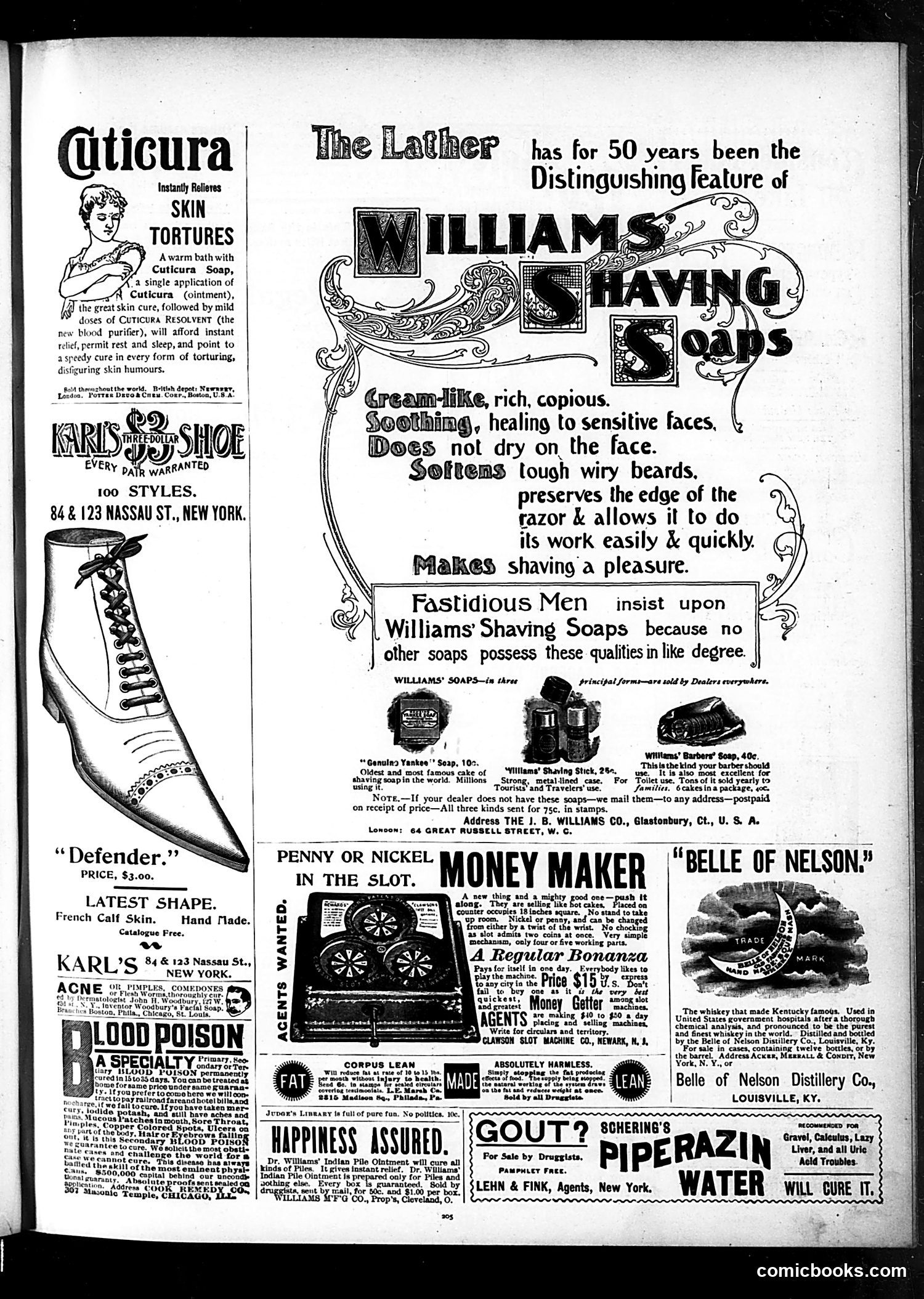
This is primarily an **advertising page**, not a satirical cartoon page. Judge magazine filled pages with patent medicine and consumer product ads typical of early 20th-century publications. The ads reflect period attitudes and medical pseudoscience: - **Cuticura products** promise to cure skin conditions via blood purifiers and ointments - **Williams' Shaving Soaps** emphasize lather quality for "fastidious men" - **"Blood Poison" treatment** advertises cures for syphilis and venereal disease—common mail-order remedies of dubious efficacy - **Slot machine "Money Maker"** and **Belle of Nelson whiskey** represent gambling and alcohol products - **"Piperazin Water"** claims to cure gout and kidney ailments These ads reveal what consumers believed would work and what companies could legally advertise without FDA regulation. The "happiness assured" and miraculous cure claims would be illegal today. The page shows how magazines subsidized content through such advertising, however questionable the products' actual effectiveness.
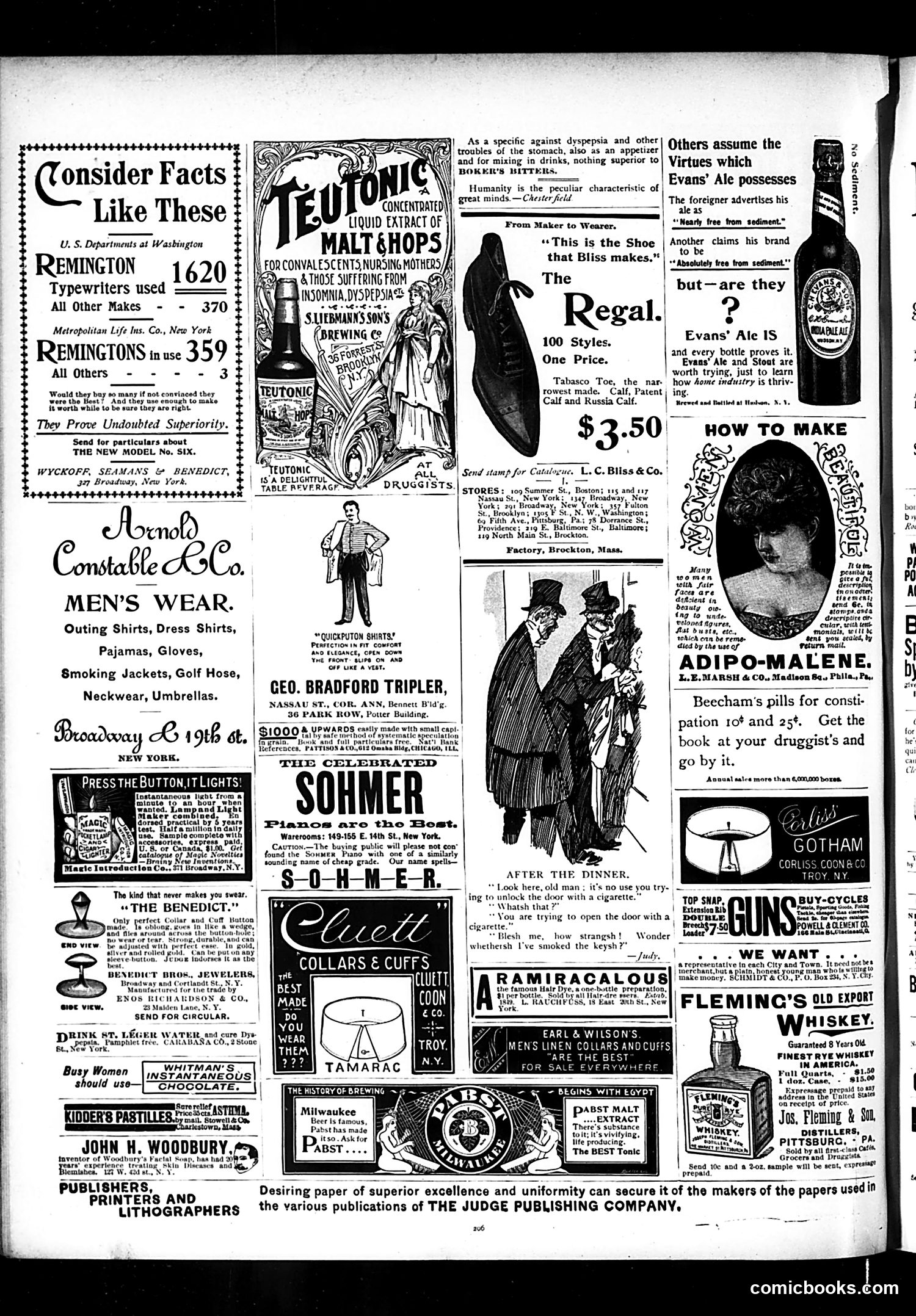
This page is primarily **advertising**, not political satire. It showcases late 19th/early 20th-century commercial products with minimal cartoon humor. The one notable cartoon appears under "AFTER THE DINNER"—a brief sketch depicting a drunk gentleman attempting to unlock a door with a **cigarette instead of a key**. The joke relies on the visual comedy of intoxication: the man has become so inebriated he's confused the objects. His slurred dialogue ("Blesh me, how strangsh!") reinforces the drunkenness. This gentle satire on overindulgence was typical Judge humor of the period. The surrounding advertisements promote typewriters, clothing, beer, pianos, shoes, and patent medicines—typical of the era. Notably, several ads make dubious health claims (Teutonic Malt Extract, Adipo-Malene for female beauty, Beecham's pills), reflecting the era's largely unregulated patent medicine industry. **No identifiable political figures or events appear on this page.**
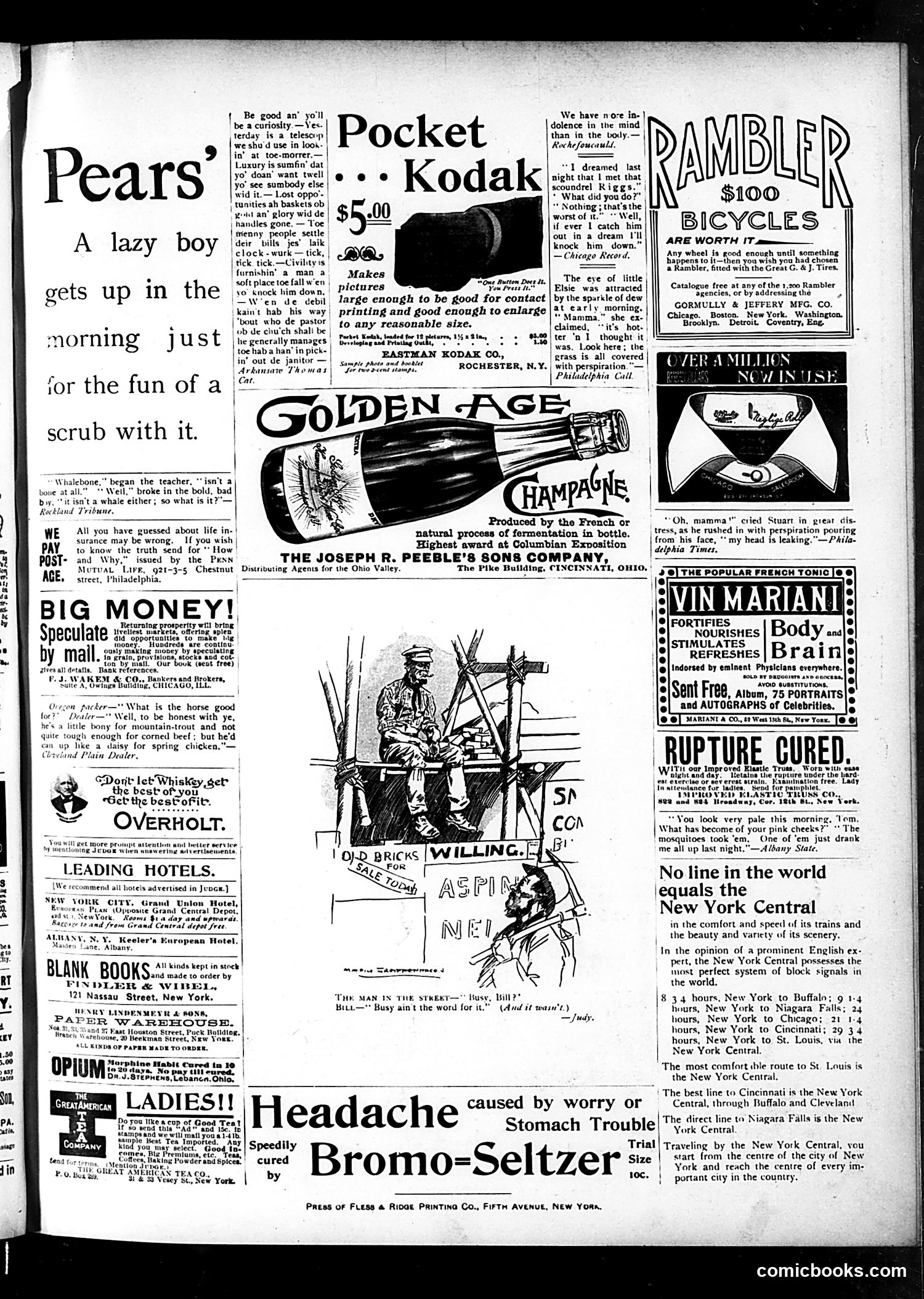
This page is primarily **advertising with minimal satirical content**. The cartoons present are brief, mild jokes rather than political satire: **The "Lazy Boy" and Pears soap sketch**: A simple domestic humor piece about a boy who enjoys bathing only for the fun of using Pears soap—straightforward product advertising dressed as comedy. **The rural dialect jokes** (scattered throughout): Brief, stereotypical humor featuring African American and rural Southern speakers. These reflect period attitudes but aren't sophisticated satire—they're conversational one-liners. **The remaining images** are largely **commercial advertisements**: Pocket Kodak cameras, Rambler bicycles, Golden Age champagne, Bromo-Seltzer, and various hotels and services. The page represents Judge's business model: mixing light humor with paid advertising. The satire, where present, is gentle and apolitical—focused on domestic situations rather than social criticism. This appears to be a general-audience issue rather than one tackling specific contemporary political events.
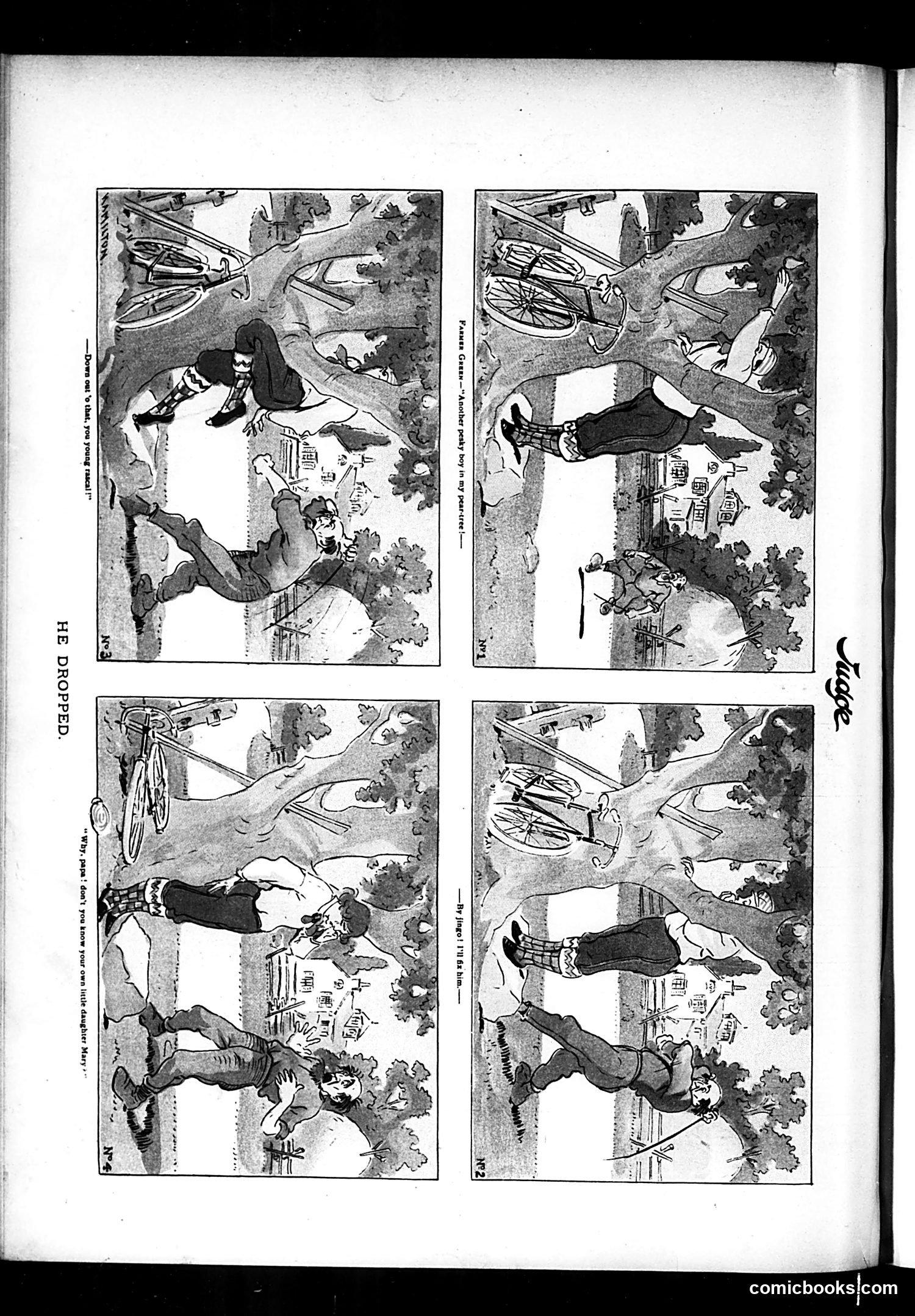
This appears to be a four-panel comic strip titled "HE DROPPED," showing a narrative sequence involving bicycles and characters in what looks like a park or outdoor setting. The visible dialogue includes a female character asking "Why, papa! don't you know your own little daughter Mary?" suggesting a recognition or surprise scene. The comic depicts people with bicycles in various positions—some riding, some fallen or positioned awkwardly on the ground. The art style and bicycles suggest this is from the late 19th or early 20th century, when cycling was a novel and popular activity. The joke appears to relate to the physical comedy of cycling—likely showing mishaps or unexpected situations involving bicycles and the characters' interactions. However, without clearer text or image resolution, the specific satirical or social commentary point remains unclear.