
A complete issue · 16 pages · 1895
Judge — September 14, 1895
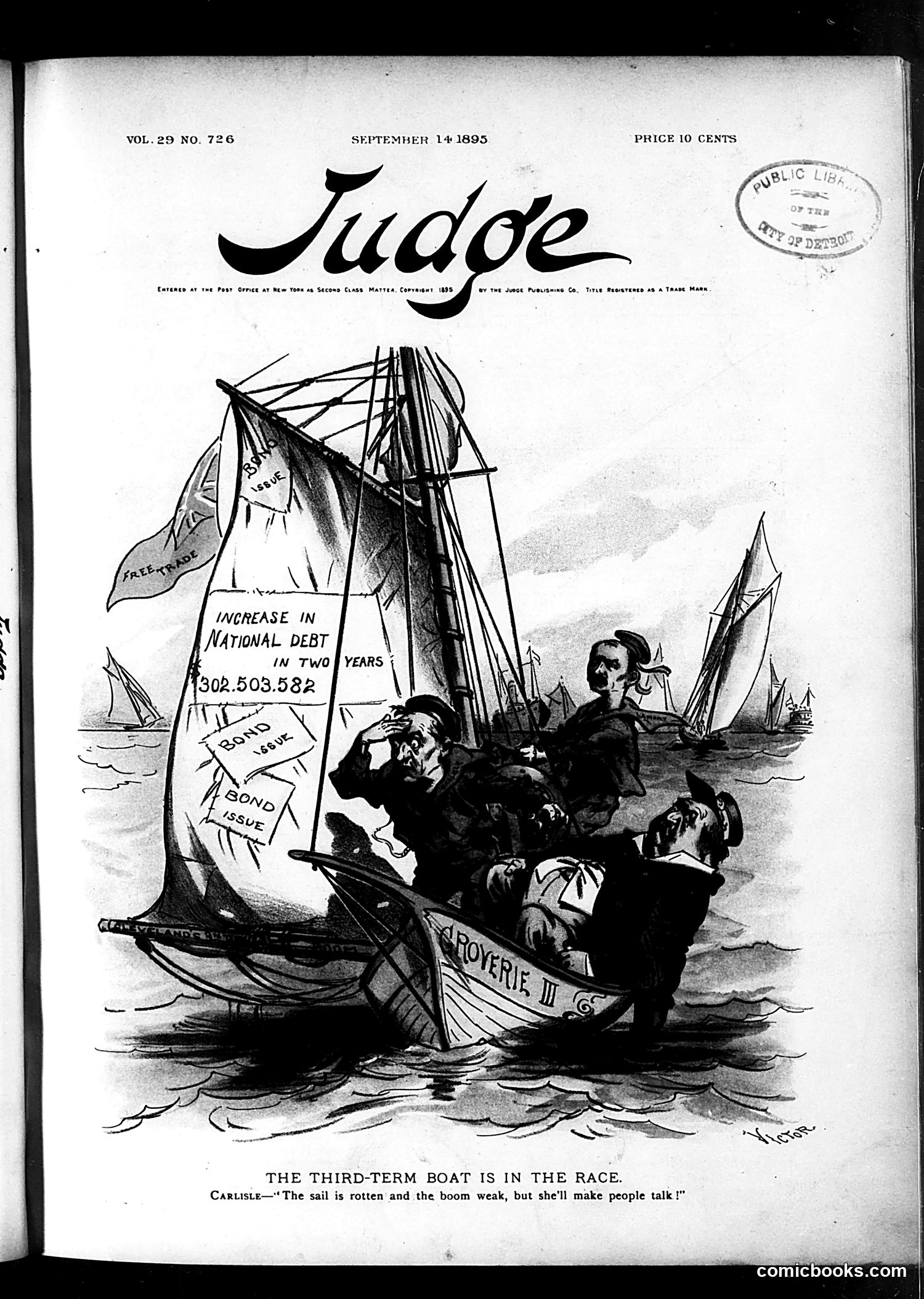
This political cartoon satirizes the third term of Cleveland's presidency and rising national debt. The large sailing ship represents the government, its sail emblazoned with "INCREASE IN NATIONAL DEBT IN TWO YEARS: 302,503,582" and labeled with "BOND" and "BOND ISSUE." The vessel, named "ROYERIE III" (appearing to reference royalty or aristocratic excess), is sinking or struggling despite its tattered sail. Sailors in the boat below appear distressed, watching the ship's deterioration. The caption—"The sail is rotten and the boom weak, but she'll make people talk!"—attributes this to Carlisle (likely Treasury Secretary John G. Carlisle), suggesting the administration's policies were damaging the economy while generating only talk rather than solutions.
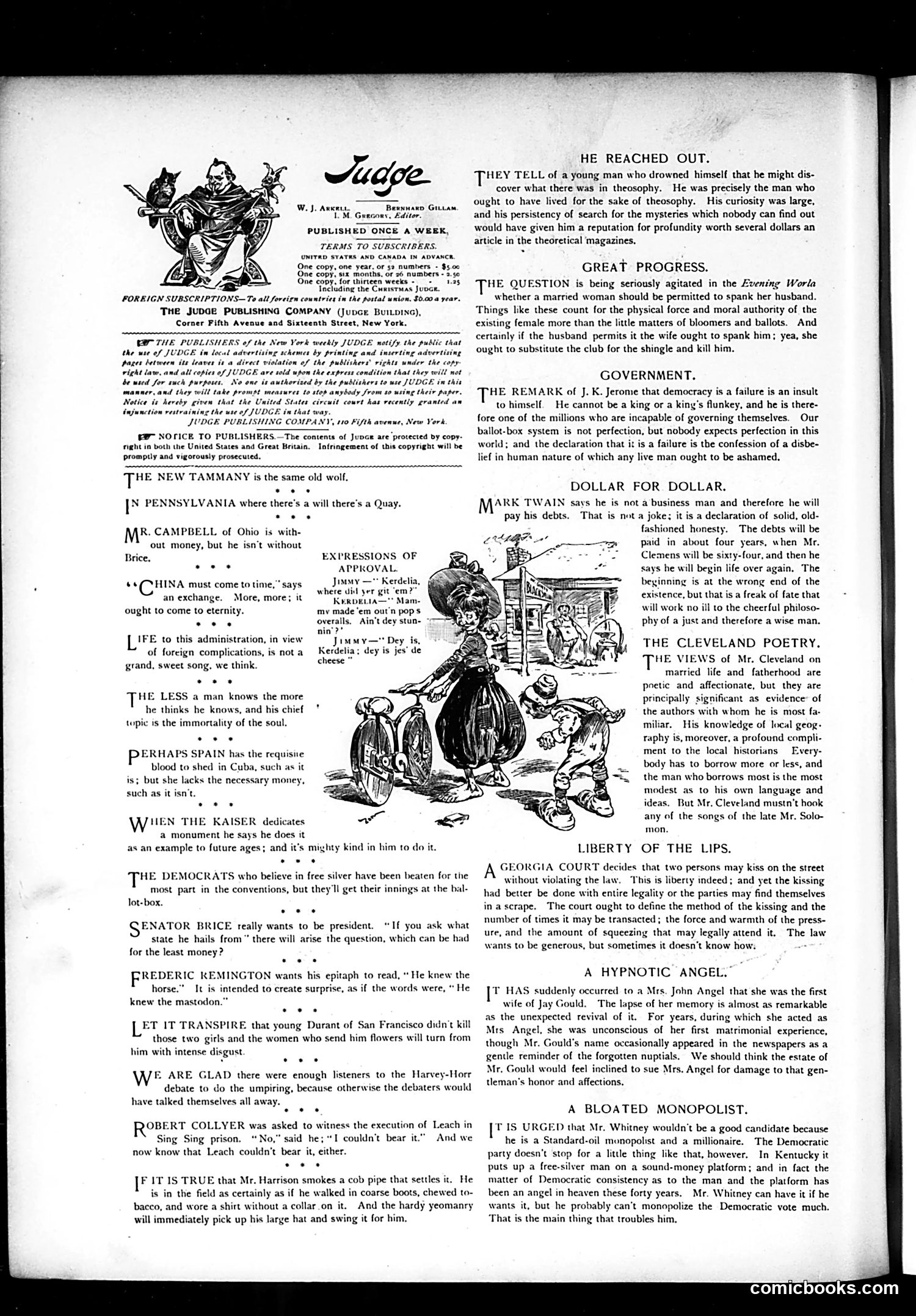
This page contains brief satirical commentary and one political cartoon rather than a unified narrative. The main cartoon depicts a woman distributing money to children, illustrating the text section "DOLLAR FOR DOLLAR," which discusses Mark Twain's claim about paying debts. The accompanying commentary satirizes financial irresponsibility. Other sections offer quick political jabs: criticism of democracy and King George, commentary on female suffrage (through the "Evening World" debate about wives spanking husbands), and mockery of various politicians including Senator Brice and Theodore Roosevelt. The cartoon's visual joke appears to contrast the woman's generosity with broader commentary on American financial attitudes, though without clearer context or dates visible, the specific political figures referenced remain uncertain beyond their general satirical intent.
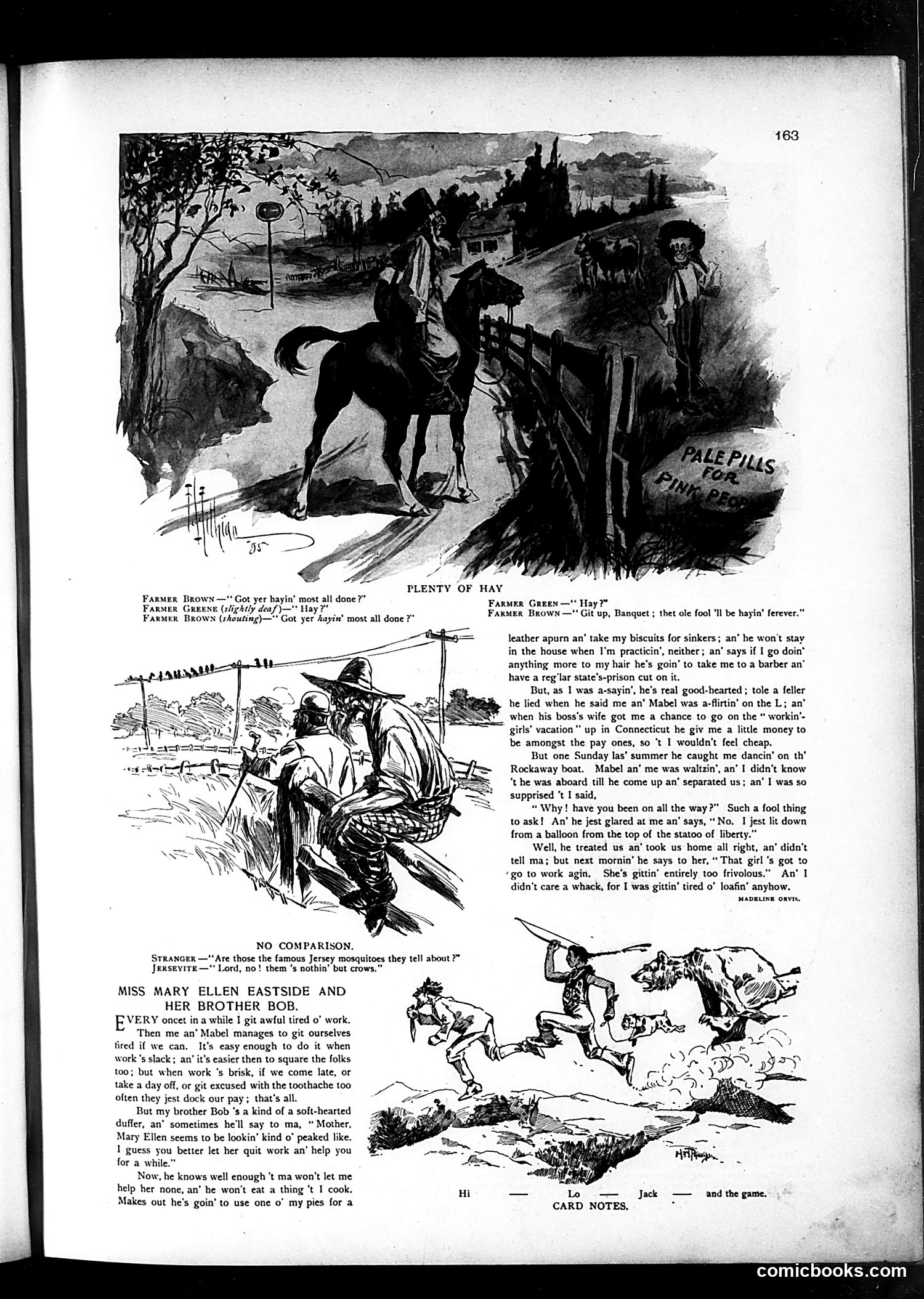
This page contains three distinct humor pieces: 1. **"Pale Pills for Pink"** (top): A rural scene showing a farmer with a horse and gate, apparently advertising patent medicine—a common product satirized in Judge for making dubious health claims. 2. **"No Comparison"** (middle): A brief exchange mocking Jersey mosquitoes, a standard regional joke format of the era. 3. **"Miss Mary Ellen Eastside and Her Brother Bob"** (bottom): A domestic humor piece about working-class life, where Mary Ellen's brother Bob complains about her not cooking or letting him rest, depicting period gender roles and class tensions humorously. The page primarily showcases **everyday humor rather than political satire**—focused on rural life, patent medicine absurdity, and working-class domestic frustrations typical of Judge's miscellaneous content.
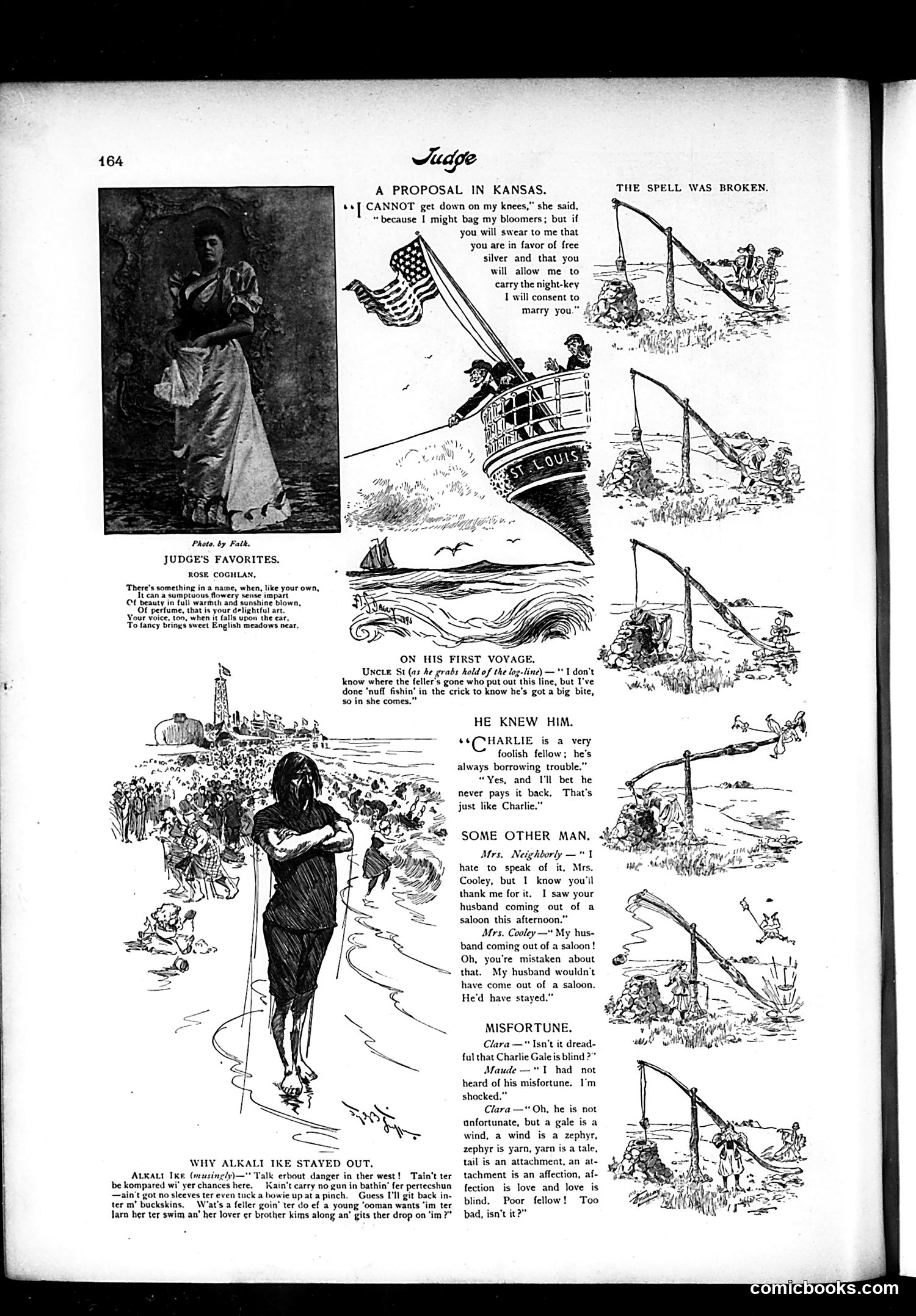
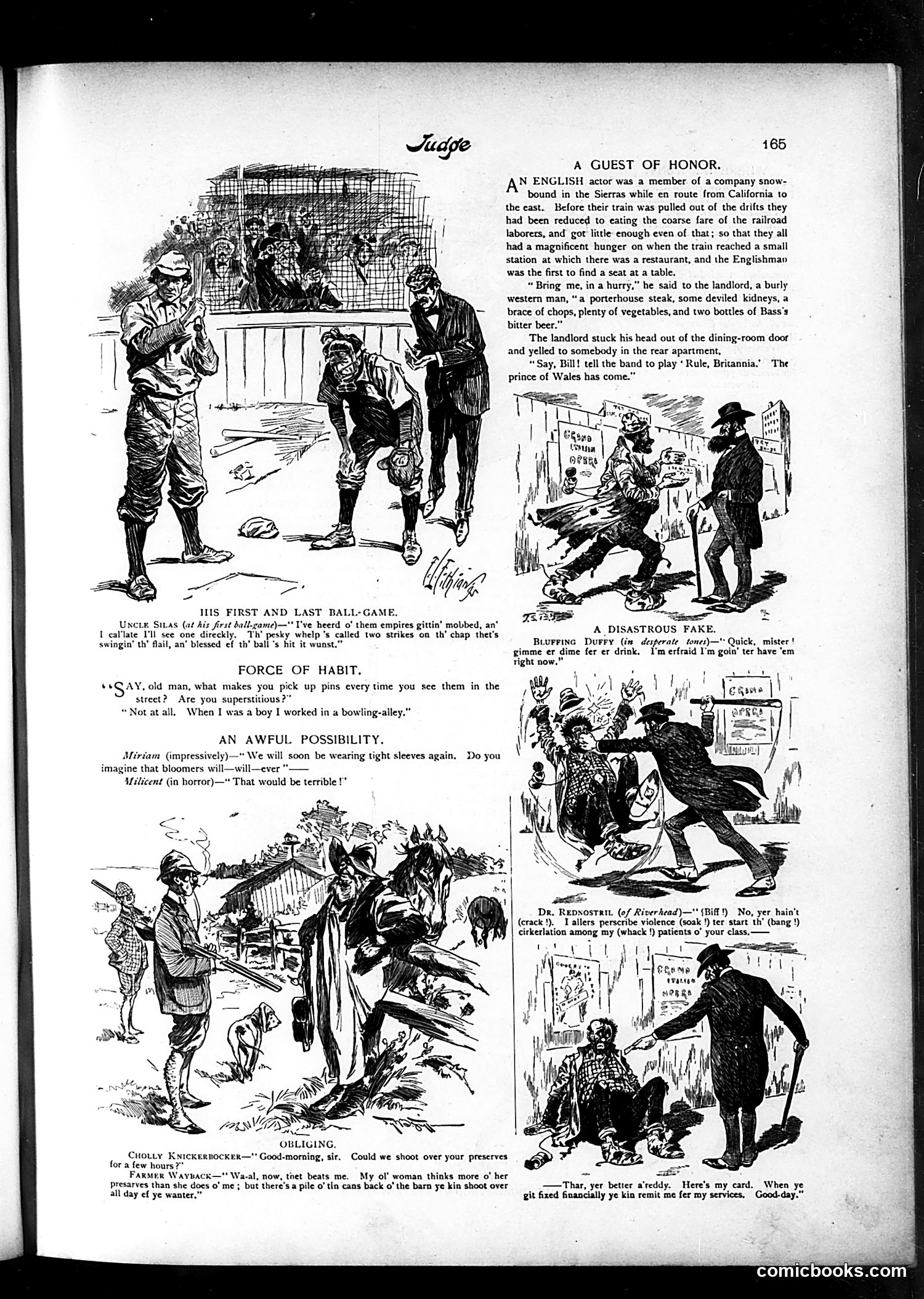
This page contains six separate comic sketches satirizing American social types and customs circa early 1900s: **"His First and Last Ball-Game"**: An rural Uncle Silas attends baseball, confused by the sport's rules—he mistakes the umpire's calls for actual game action, reflecting urban-rural cultural gaps. **"Force of Habit"**: An elderly man compulsively picks up pins due to childhood bowling-alley work, satirizing how labor conditions create ingrained behaviors. **"An Awful Possibility"**: Women worry that fashion will revert to tight sleeves and bloomers will disappear—mocking contemporary anxiety about evolving women's fashion and the bloomer controversy. **"Obliging"**: A farmer's casual indifference to shooting over his wife's preserves (canned goods) satirizes rural attitudes toward property and domestic matters. **"A Guest of Honor"**: An English actor receives mock-royal treatment from a rough western railroad-station restaurant owner, who plays "Rule, Britannia" upon recognizing refined British tastes—gentle satire of English pretension meeting American frontier hospitality. **"A Disastrous Fake"**: A drunk man seeks alcohol as medicine from a quack doctor, satirizing fraudulent medical practitioners and alcoholism.
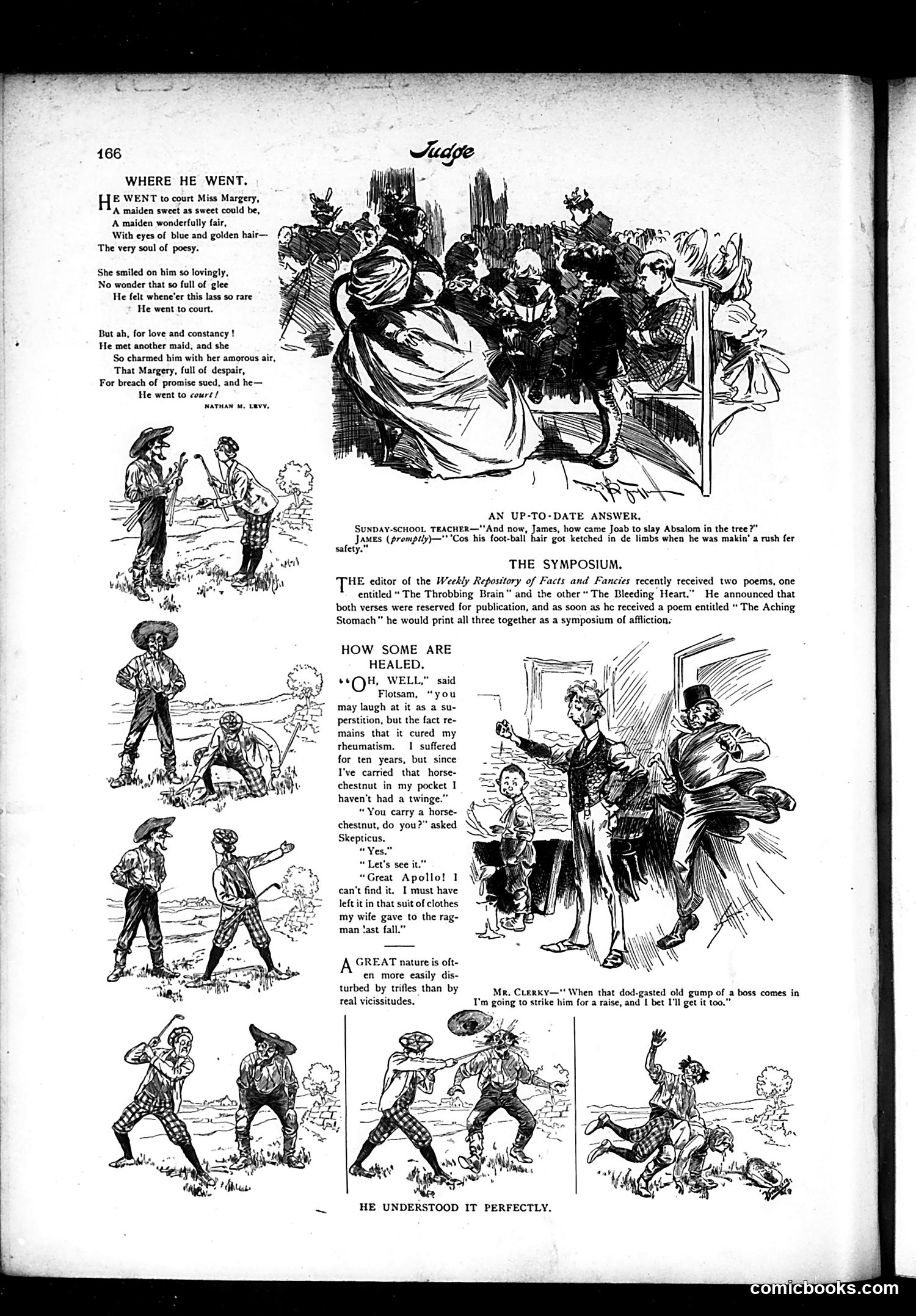
This page contains several disconnected satirical pieces typical of Judge magazine's format: **"Where He Went"** is a poem about a man who courts the fair Margery, then abandons her for another woman. She sues him for breach of promise—a common legal action in the era when broken marriage engagements were actionable offenses. The satire mocks inconstant suitors. **"An Up-to-Date Answer"** jokes about a Sunday school boy applying modern slang ("football hair") to a Biblical story, satirizing how youth modernize everything. **"The Symposium"** ridicules sentimental Victorian poetry by suggesting editors receive dreary verses about emotional ailments and proposes printing them together as an "affliction symposium." **"How Some Are Healed"** mocks superstition and folk medicine—a man credits a horse chestnut for curing rheumatism, then can't find it, undercutting his own belief. The final comic strip shows a worker understanding his boss's dismissal of a raise demand perfectly—he gets fired instead, illustrated through sequential panels.
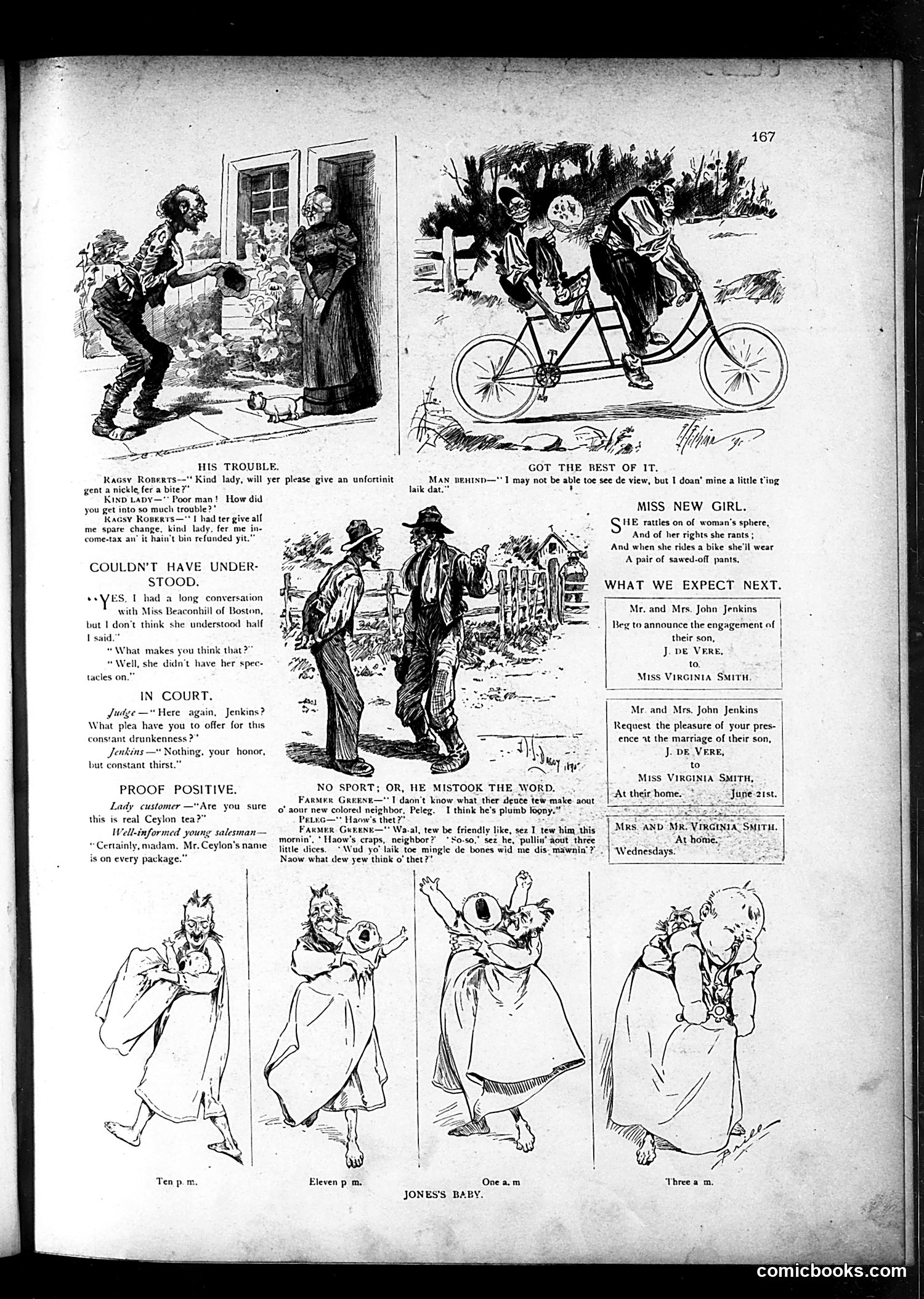
This page contains multiple satirical cartoons and humorous vignettes typical of late 19th-century American humor: **"His Trouble"** mocks Irish immigrants (suggested by dialect) with a beggar unable to afford even basic necessities because of income taxes—satirizing tax burdens on the poor. **"Got the Best of It"** jokes about a tandem bicycle rider who claims not minding the obstructed view, a jab at the "New Woman" cycling craze. **"Miss New Girl"** directly satirizes the emerging "New Woman" figure—mocking women's rights advocacy and the shocking fashion of women wearing shortened pants while cycling. **Other vignettes** include stereotypical humor about Bostonians lacking understanding, judicial drunkenness, and dubious product authenticity. **"Jones's Baby"** (bottom) depicts sleep-deprived parenting through four chronological sketches showing increasingly frantic nighttime caregiving. The page reflects turn-of-century anxieties about immigration, women's changing roles, urban life, and class tensions—presented through contemporary Judge magazine's characteristic mix of social commentary and gentle mockery.
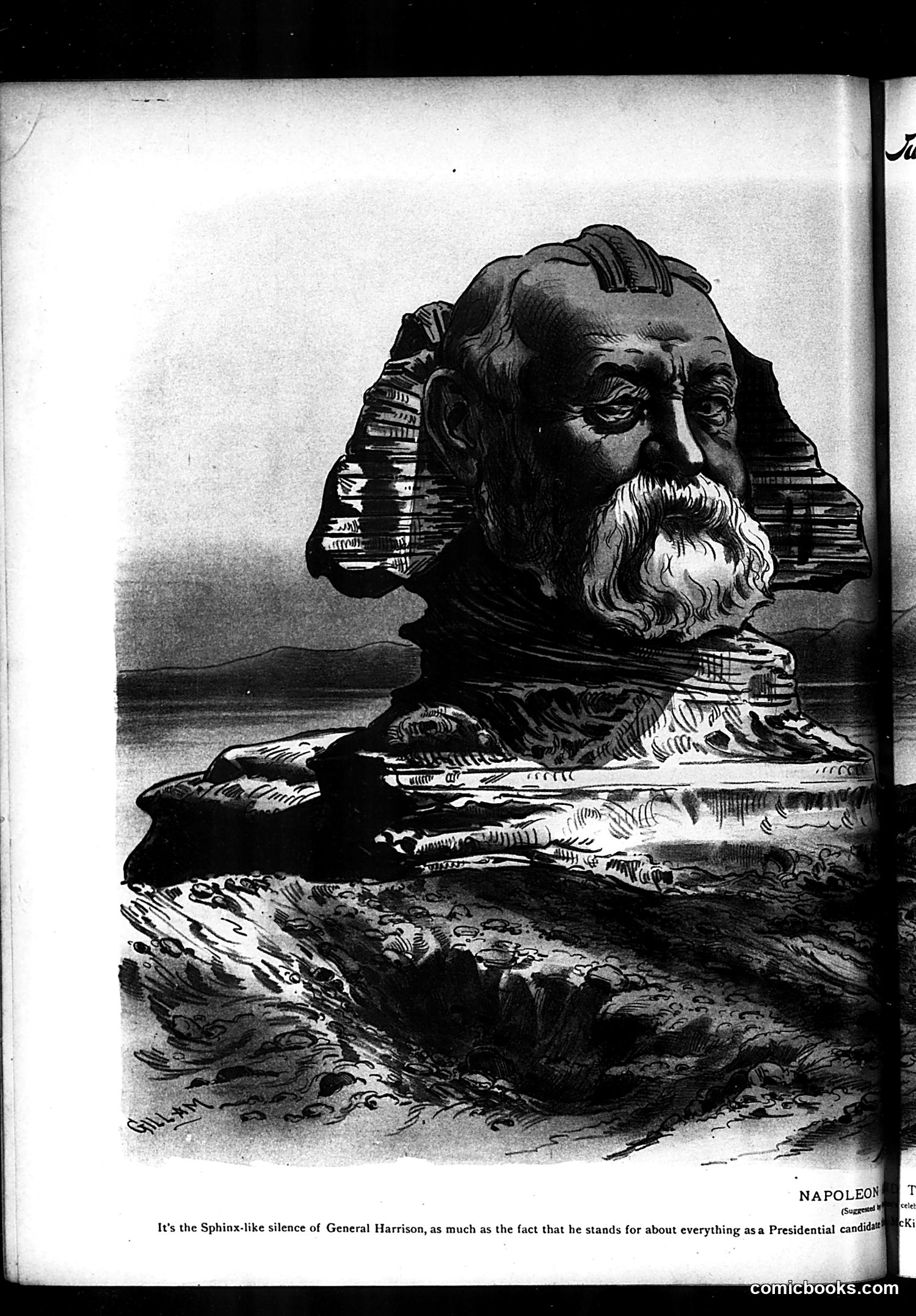
This Judge magazine cartoon satirizes General Harrison as a presidential candidate. The image depicts his head as an enormous sphinx-like sculpture, with his distinctive beard prominent. The caption critiques Harrison's "Sphinx-like silence"—suggesting he remains mysteriously quiet or evasive about his positions—while paradoxically claiming he "stands for about everything as a Presidential candidate." The satire works on two levels: first, mocking his apparent lack of clear policy statements despite being a serious candidate; second, suggesting his vagueness allows voters to project any positions they want onto him. The sphinx comparison implies both monumental importance and inscrutability. This appears to reference William Henry Harrison's 1840 presidential campaign, when he was criticized for giving few substantive speeches or policy declarations.
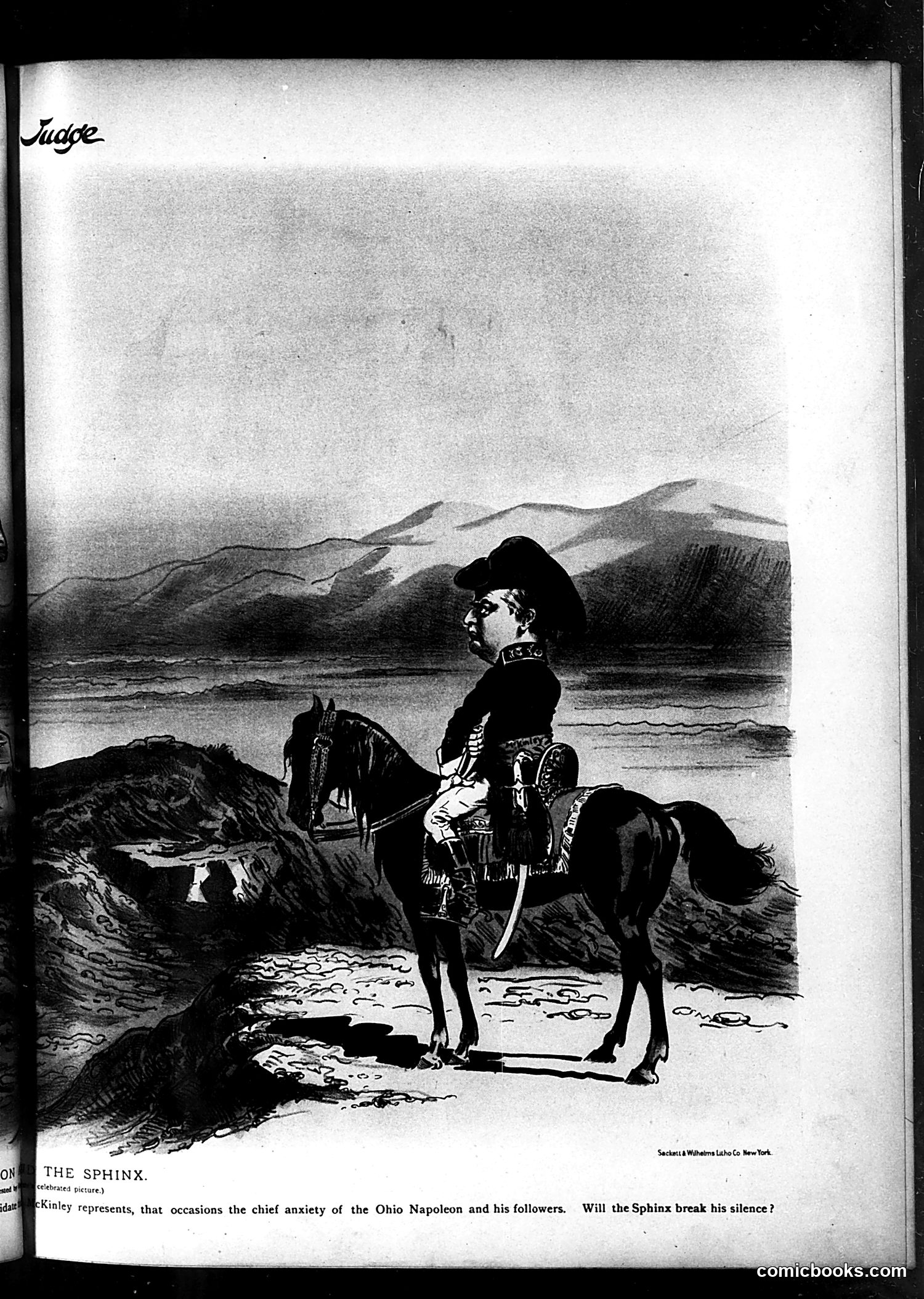
This cartoon depicts a mounted military figure in elaborate uniform gazing toward mountains and water, titled "The Sphinx." The caption references "the Ohio Napoleon and his followers," likely alluding to an Ohio political leader (possibly William McKinley, given "Kinley" in the text). The Sphinx metaphor suggests someone mysteriously silent on important matters. The caption asks whether this silent figure will "break his silence"—implying political pressure for the Ohio leader to publicly state their position on whatever issue "Kinley represents." The mysterious, watchful pose suggests deliberate withholding of opinion while awaiting judgment or creating suspense. Without the specific date, the exact political issue remains unclear, but this targets a prominent Ohio politician's strategic silence on a pressing contemporary question.
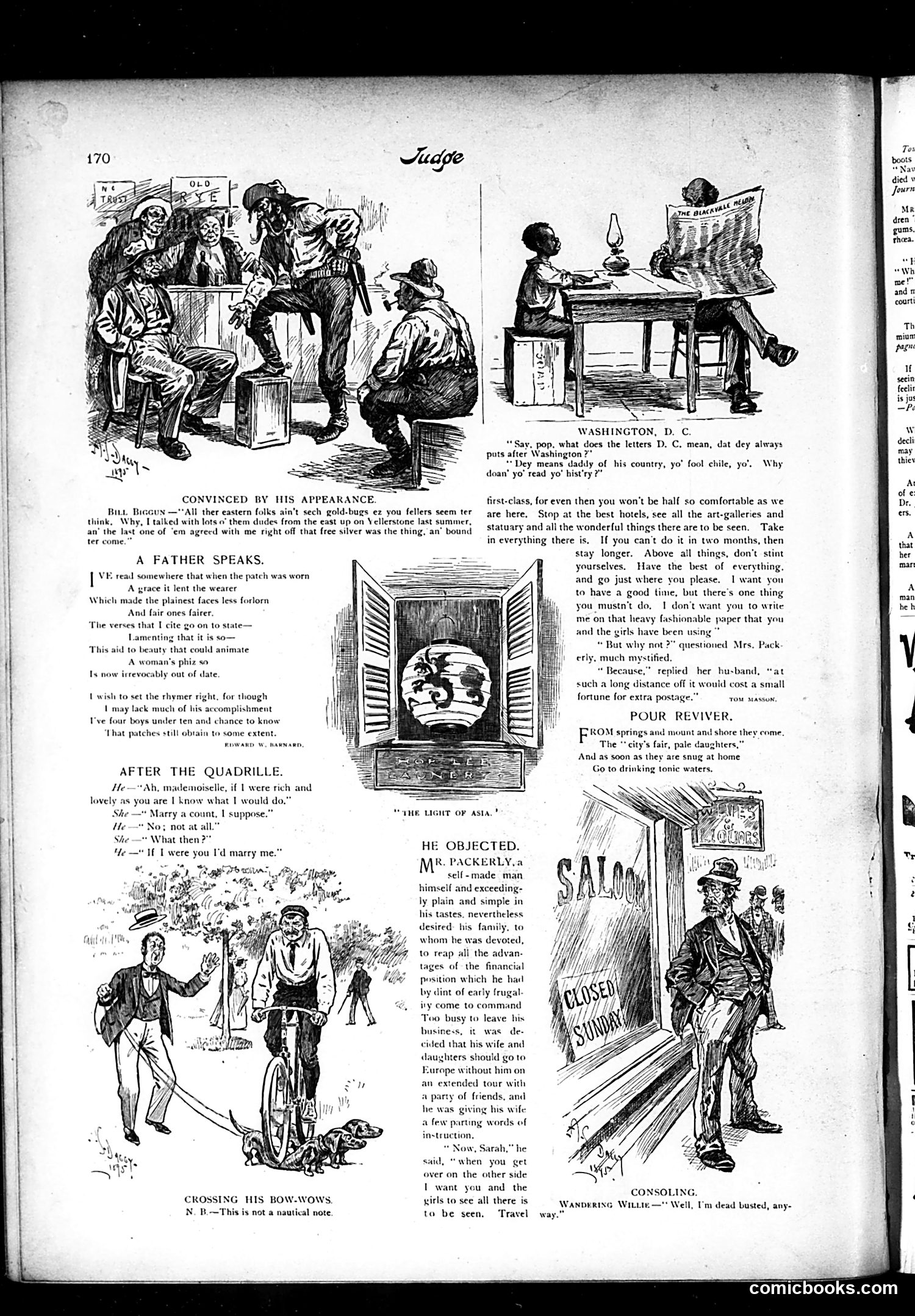
This page contains several satirical sketches typical of late 19th-century American humor: **"Convinced by His Appearance"** mocks Western frontier types, showing a rural character ("Bill Bodges") arguing that Eastern visitors he met at Yellowstone supported free silver—likely satirizing populist monetary debates of the era. **"A Father Speaks"** jokes about beauty patches (facial marks once fashionable), with a father claiming his boys still get them—implying children get bruises from roughhousing. **"After the Quadrille"** presents a flirtatious exchange where a man proposes marriage if rich, the woman agrees if he were her instead—standard boy-meets-girl humor. **"He Objected"** satirizes a self-made businessman who permits his wife lavish European travel but objects to expensive postage for heavy stationery—portraying miserly penny-pinching despite wealth. The Washington D.C. dialogue appears to mock African American dialect humor (common but offensive in the period), with a child asking about "D.C." Overall, the page reflects period attitudes, class anxieties, and romantic comedy conventions rather than focused political satire.
This page consists primarily of **short humorous quips and advertisements** rather than political cartoons. The satirical content targets various social issues: **Key satirical pieces:** 1. **Tourism/Fashion**: Mocks tourists dying with yellow shoes on—likely ridiculing nouveau-riche travelers' garish fashions. 2. **Women in Bloomers**: Jokes that men find women in bloomers as uncomfortable to see as women would find men in tights—satire on the controversial 1890s women's fashion reform movement. 3. **Bicycle Theft vs. Horse Theft**: Darkly notes that only when horses become worthless do we lynch bicycle thieves—commentary on shifting property values and vigilante justice priorities. 4. **Monopolies**: Compares monopolies to babies—men oppose them in principle until owning one personally—cynical commentary on business hypocrisy. 5. **Spanish-Cuban War**: References Spain killing Cubans with grim humor about reincarnation—topical reference to the Spanish-American War era conflict. The page is largely **advertising-driven**, with minimal visual cartoons, reflecting Judge's mixed editorial-commercial format.
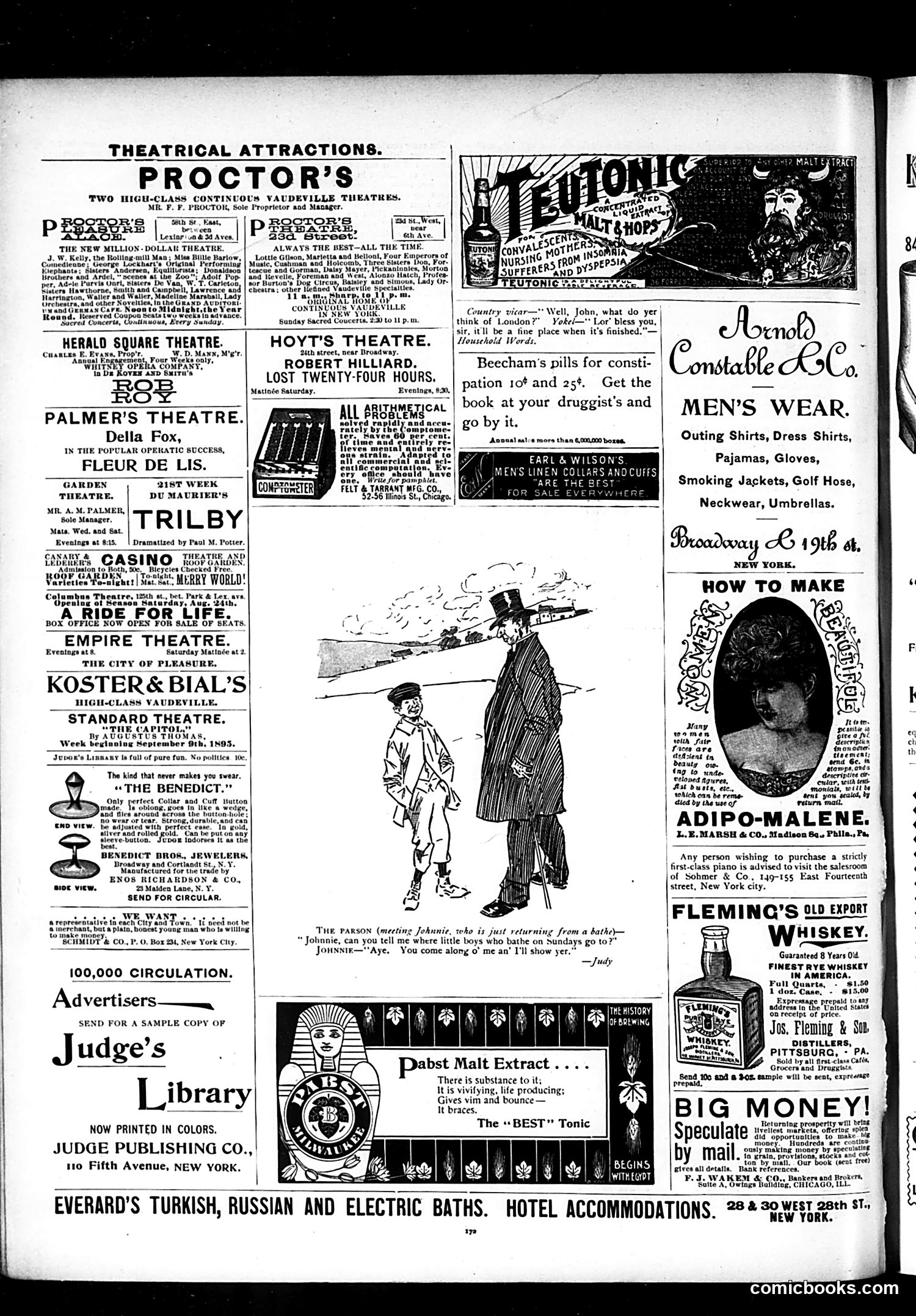
This page is primarily **theatrical advertisements and classified ads** for 1890s New York, with minimal satirical content. The main cartoon depicts **a Parson meeting a boy named Johnnie returning from bathing on Sunday**—likely referencing the period's strict religious views opposing leisure activities on the Sabbath. The joke's punchline ("You come along o' me an'I'll show yer") suggests the Parson will take the boy somewhere for violating religious observance, though the specifics are left to readers' interpretations of contemporary morality debates. The page consists largely of ads for **Proctor's and Hoyt's theaters, vaudeville houses, patent medicines (Beecham's pills, Pabst Malt Extract, Adipo-Malene for weight gain), men's clothing, whiskey, and pianos**—reflecting typical Judge revenue sources and turn-of-century consumer culture. The "Household Words" section with Beecham's pills appears to be a sponsored humor item rather than genuine satire.
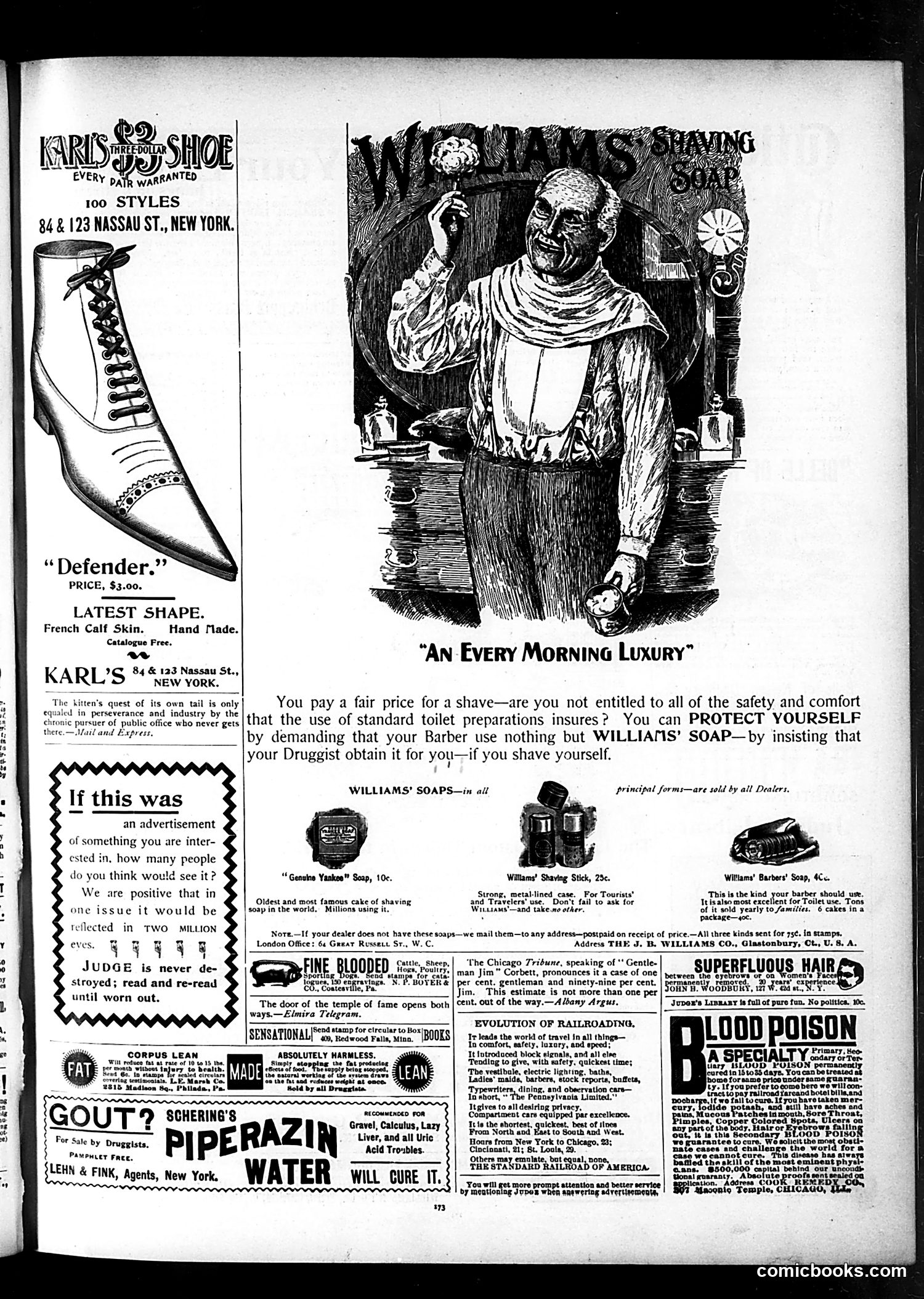
This page is primarily **advertising**, featuring multiple product promotions typical of late 19th/early 20th-century magazines. The main illustrated content is the Williams' Shaving Soap advertisement centered on the page. **The Central Image**: A barber or man shaving, labeled "An Every Morning Luxury." The accompanying text urges readers to insist their barbers use Williams' Soap specifically, framing it as a consumer protection issue—you're paying for a shave, so demand quality products. **Social Context**: The advertisement reflects the era's growing consumer culture and brand loyalty marketing. It appeals to middle-class men's grooming standards and suggests that product choice empowers consumers. **Other Notable Content**: - The page includes advertisements for shoes, remedies (Piperazine Water for gout), railroad services, and blood poison treatments - A small boxed item argues Judge magazine's durability and wide readership—a meta-advertisement for the magazine itself **No obvious political satire** appears on this page; it's a commercial collection typical of Judge's revenue model during this period.
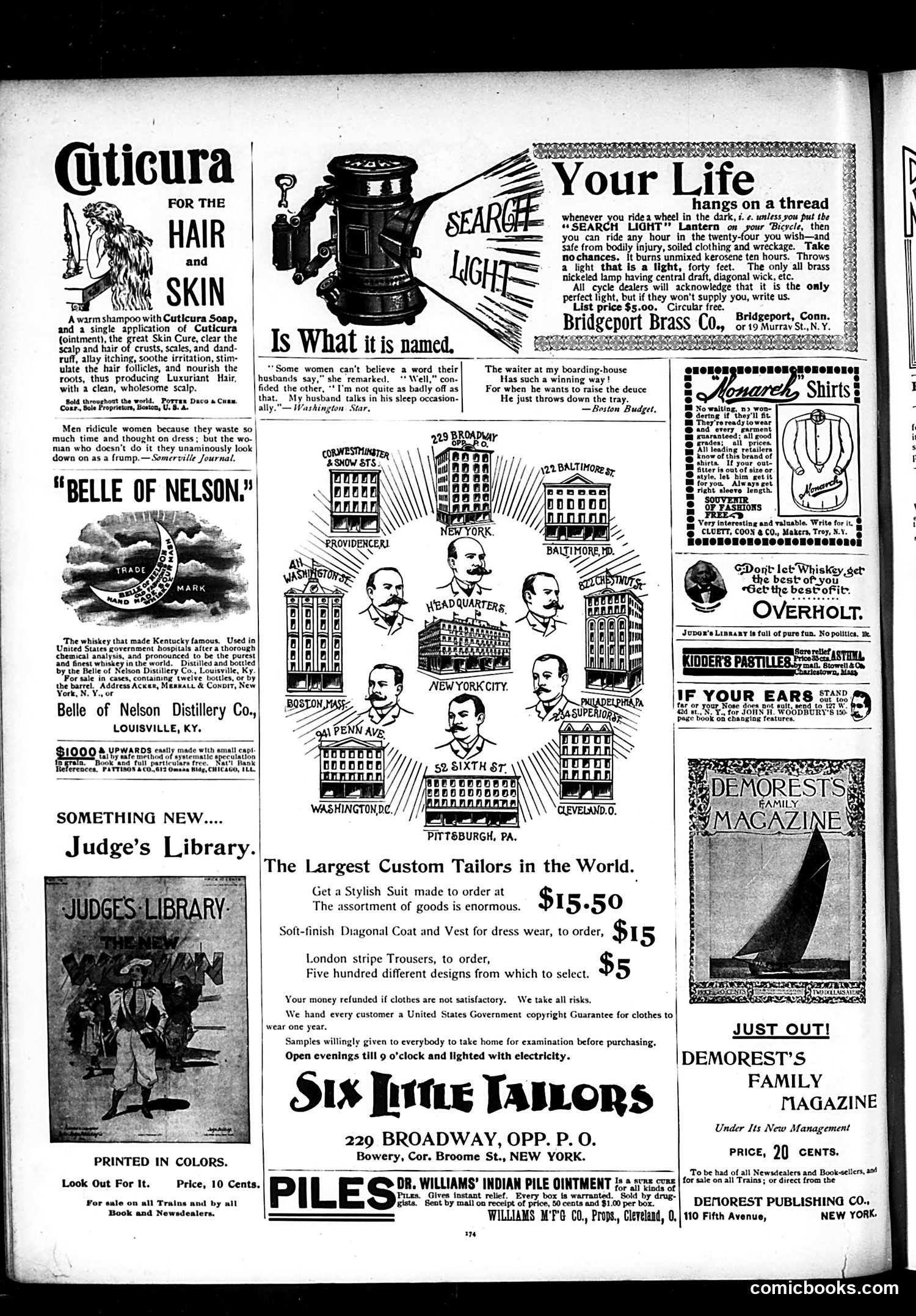
This is primarily an **advertising page** from Judge magazine, not a satirical cartoon page. The content consists of period product advertisements (circa early 1900s) with minimal political content. The page features ads for: - **Cuticura** soap and skin products - **Search Light** bicycle lanterns - **Belle of Nelson** whiskey (notably promoted as used in U.S. government hospitals) - **Six Little Tailors** custom tailoring service with multiple branch locations - **Judge's Library** book series - Various patent medicines (pile ointment, pastilles) The only quasi-satirical element is a small illustration showing **six men's faces representing different tailoring shop locations** (New York, Boston, Philadelphia, Pittsburgh, Washington DC, Cleveland) — a visual gag emphasizing the company's widespread presence. The page's humor derives from period advertisements' earnest claims rather than political satire. The whiskey ad's government hospital endorsement is notable as reflecting early 20th-century attitudes toward alcohol as medicine.
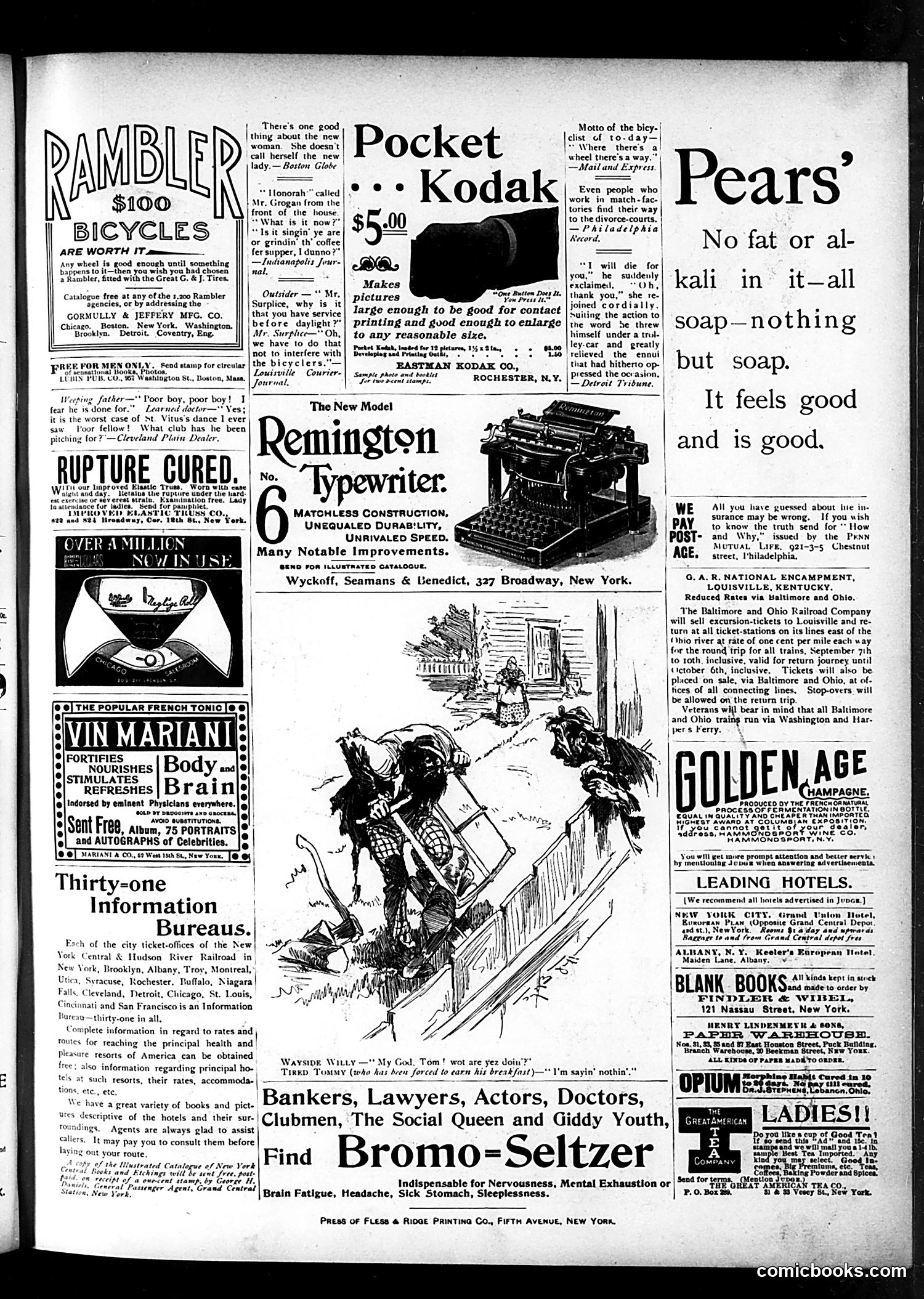
This appears to be a primarily **advertising-heavy page** from Judge magazine, a late 19th-century American satirical publication. The dominant content consists of product advertisements (Rambler bicycles, Kodak cameras, Remington typewriters, Pears soap, various patent medicines and services) rather than satirical cartoons. The few small comic elements visible include: - A brief anecdote about a bicycle rider and church organist - A doctor's misunderstanding about a "St. Vitus's dance" patient (confusing a medical condition with baseball) - A line drawing showing someone with a bicycle on stairs These small jokes reflect typical **turn-of-the-century humor**: puns, misunderstandings, and references to contemporary technologies (bicycles, typewriters) and fads. The bicycle particularly appears as a social phenomenon worthy of comic treatment. The page demonstrates that Judge relied heavily on **paid advertising** rather than editorial content, with commercials for new consumer goods dominating the layout.
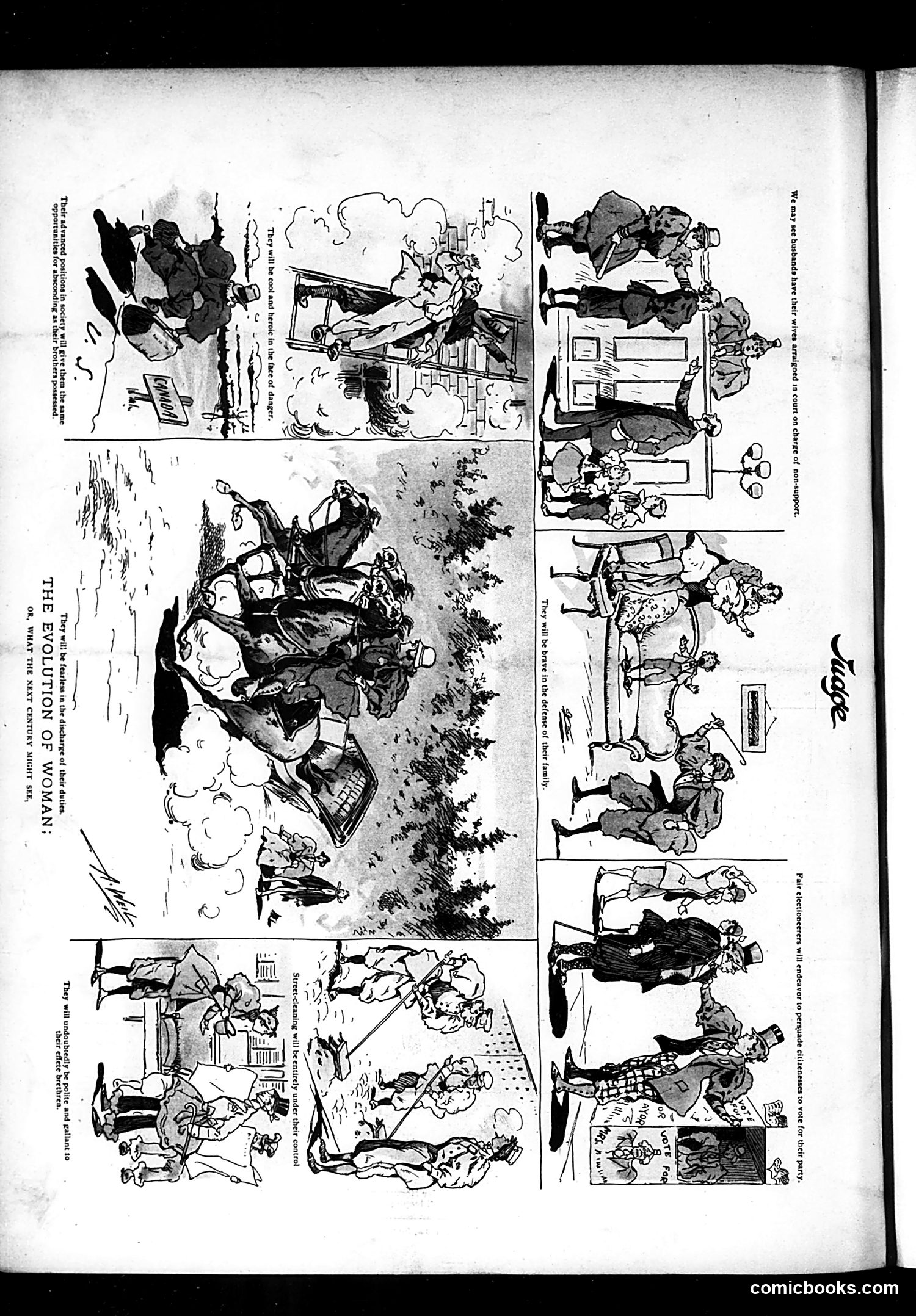
The OCR text is too corrupted to read reliably, making precise identification difficult. However, the image appears to show a multi-panel satirical cartoon labeled "**The Evolution of Woman**" (visible in the left panel). The cartoon depicts women in various domestic and social situations across different scenes—cooking, cleaning, managing households, and interacting with men. This appears to be **social satire about women's roles and rights**, likely from the late 19th or early 20th century when women's suffrage and changing gender roles were contentious political issues. Judge magazine frequently mocked both progressive reformers and traditional conservatives. This cartoon likely satirizes either: - Women's liberation movements and changing social expectations, or - The persistence of rigid domestic roles despite modernization Without legible text, the cartoon's specific target and satirical point remain **unclear**, though the title suggests commentary on how women's social position had (or hadn't) evolved over time.