
A complete issue · 16 pages · 1895
Judge — June 22, 1895
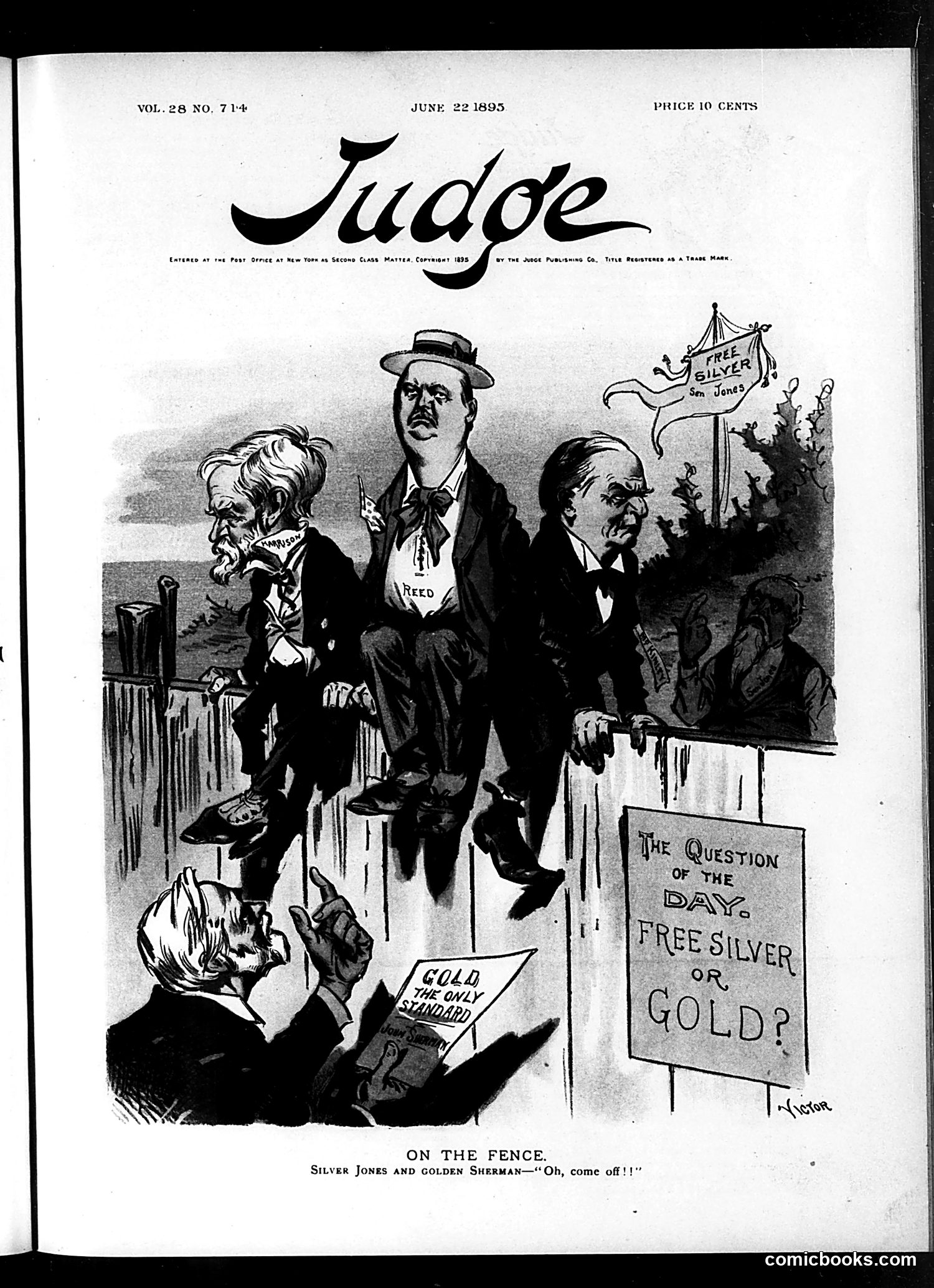
This political cartoon satirizes indecision over the **free silver versus gold standard debate**, the dominant economic issue of 1890s America. Three prominent figures stand literally "on the fence," apparently unwilling to commit to either position. The sign reads: "The Question of the Day: Free Silver, or Gold?" One figure wears a "Reed" label, likely Speaker of the House Thomas B. Reed. A caricatured figure labeled "Silver Jones" appears below, perhaps referencing silver-advocating politicians. The "Golden Sherman" reference suggests Secretary of the Treasury John Sherman, a gold standard advocate. The cartoon mocks political leaders for straddling this contentious economic divide rather than taking firm positions, while common citizens below watch their indecision with frustration.
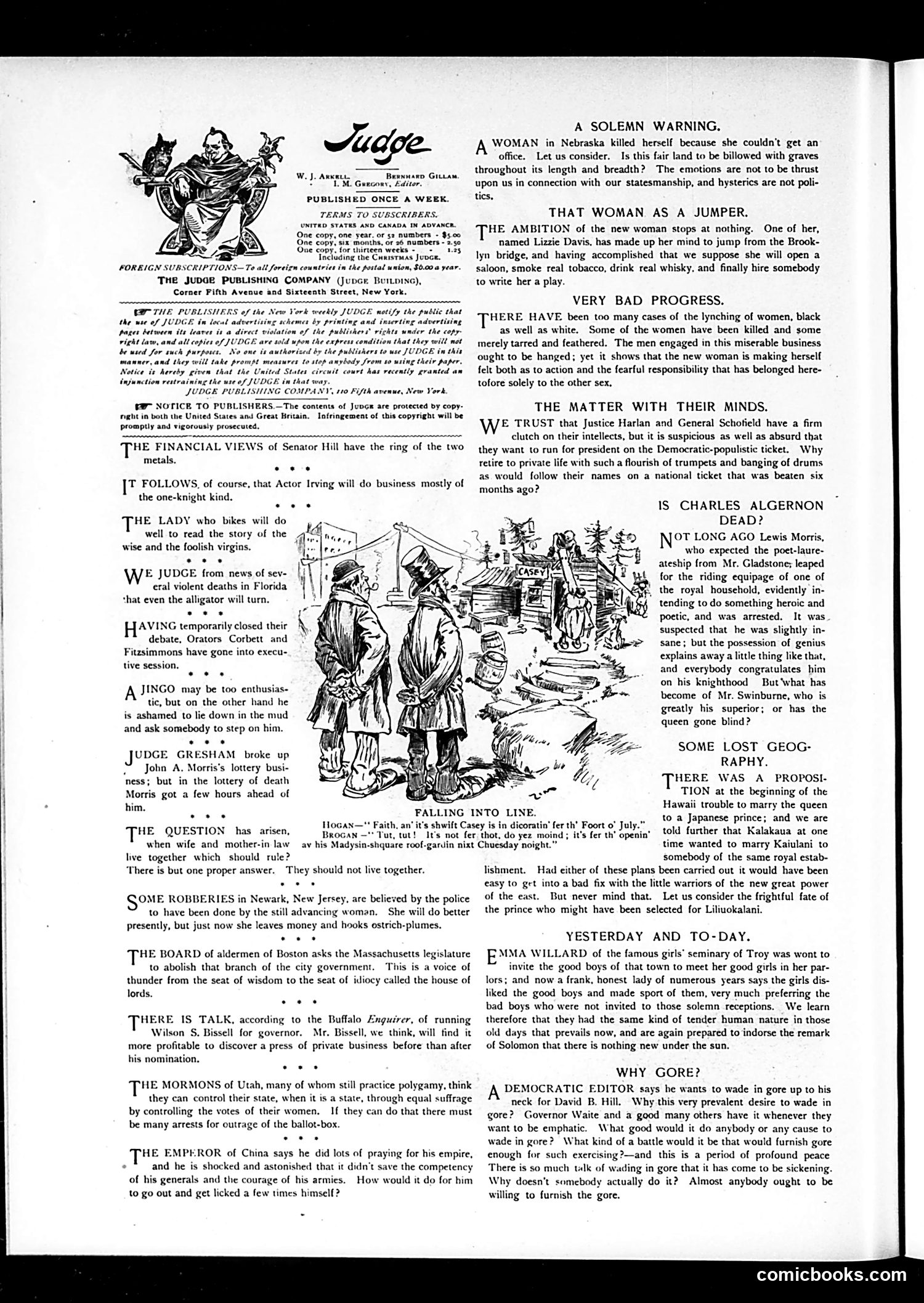
This page contains satirical commentary on various contemporary issues rather than a single focused cartoon. The main illustrated piece depicts two men in formal dress observing what appears to be a chaotic domestic scene—likely satirizing marital discord or household management. The text sections address multiple topics: women's ambitions (mentioning "Lizzie Davis" attempting to jump the Brooklyn Bridge), lynching of Black and white women, Florida violence, and political figures like Justice Harlan and General Schofield. There's also commentary on Senator Hill, Charles Algernon, polygamy among Mormons, and debates over American interventionism in Hawaii and China. The satire reflects Judge's typical late-19th-century editorial stance criticizing both social problems and political figures, though specific context for several references remains unclear without additional historical research.
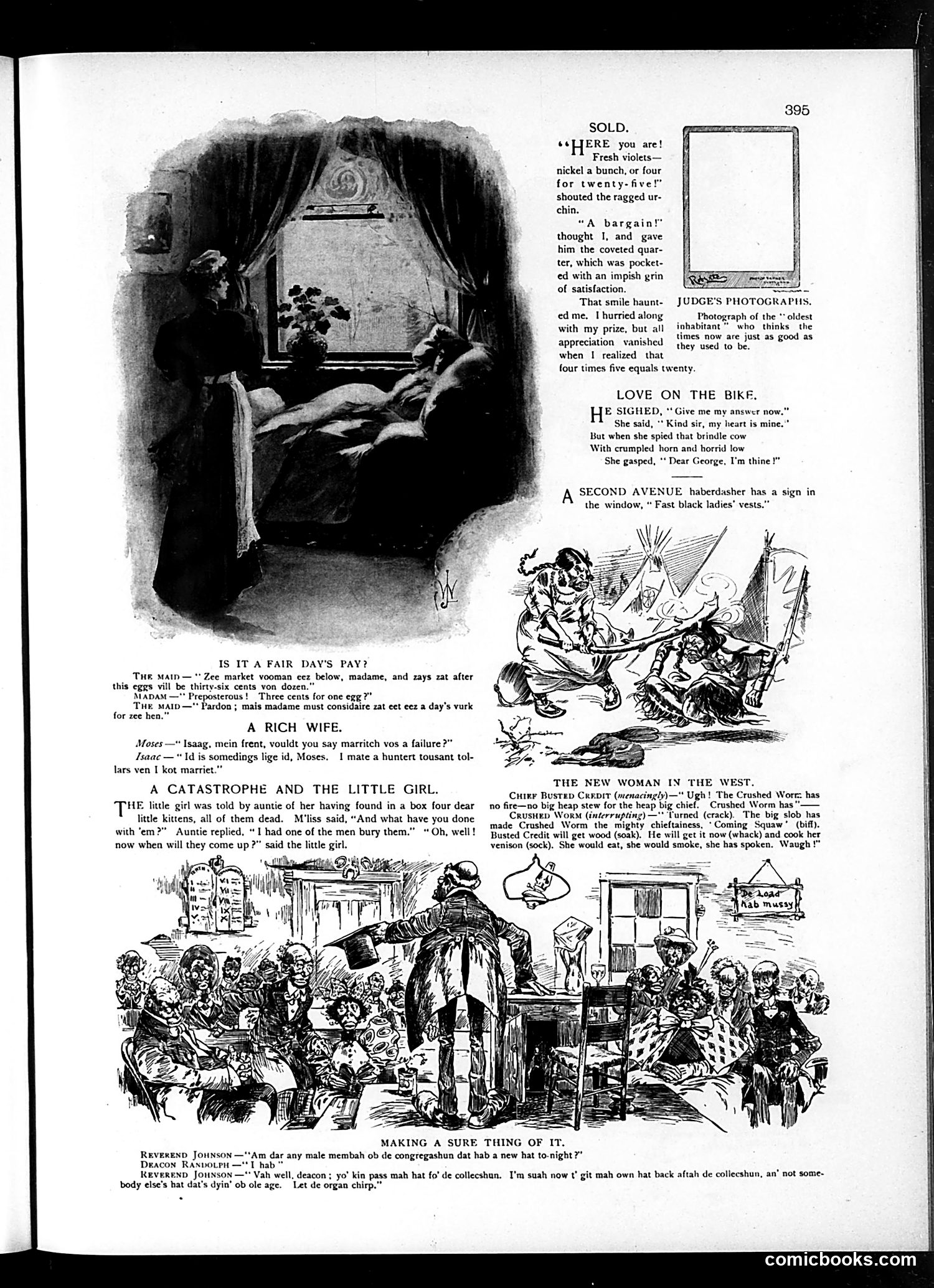
This page contains several Victorian-era humor pieces with accompanying illustrations: **"Sold"** depicts a street flower vendor making a sale—satirizing urban commerce and haggling over trivial amounts. **"Love on the Bike"** presents a romantic encounter involving a bicycle, poking fun at the then-novel bicycle craze and courtship. **"A Rich Wife"** features dialogue mocking marriage dynamics and gender relations through a conversation between Moses and Juana. **"A Catastrophe and the Little Girl"** shows a domestic disaster with dark humor about dead kittens and an aunt's burial. **"Making a Sure Thing of It"** (bottom) appears to mock religious or civic procedures, with reverend and deacon characters debating congregational membership requirements through comic dialect. The satire targets social pretension, marriage, emerging technologies, and institutional pomposity typical of 1890s Judge magazine humor.
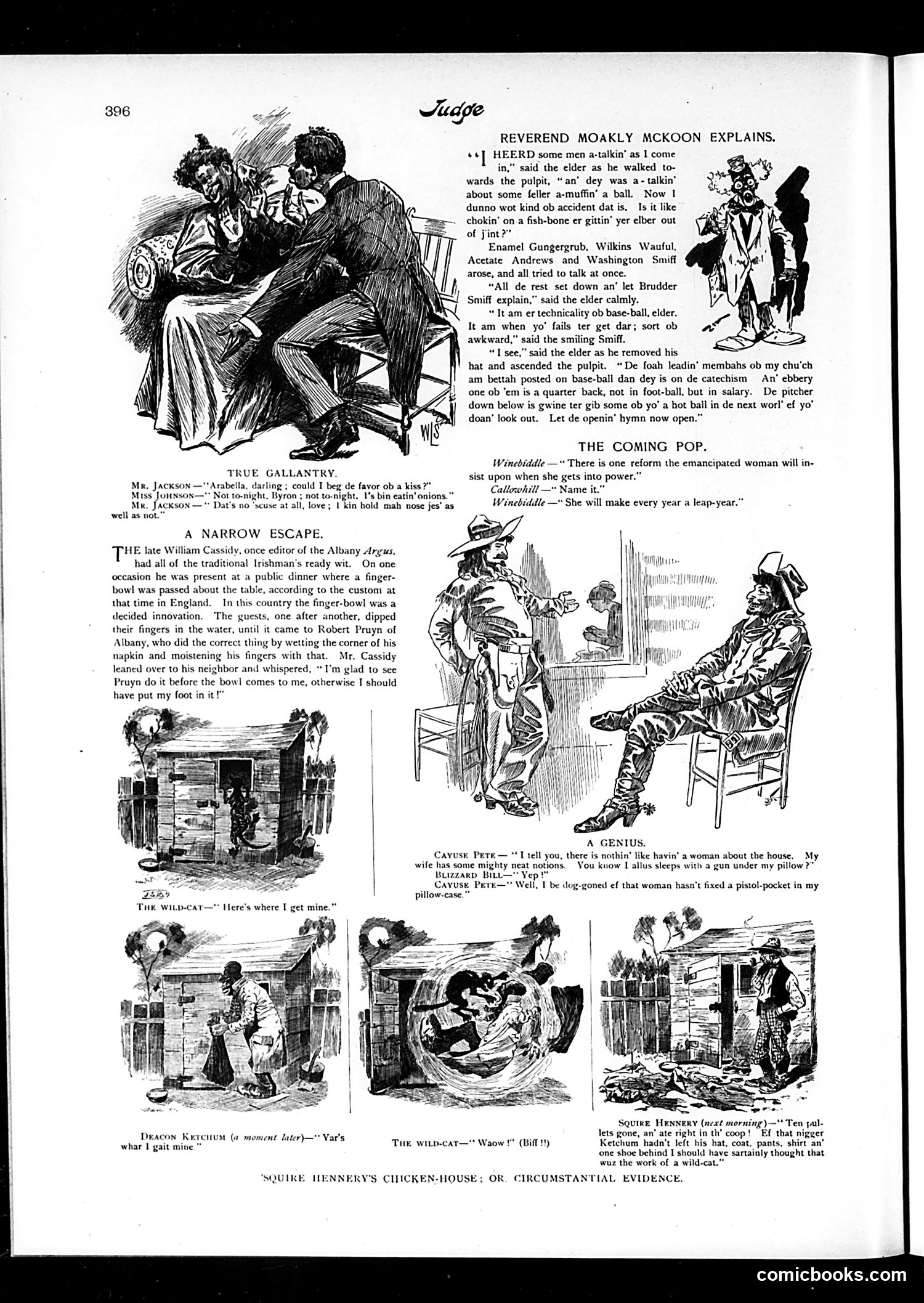
This page contains several humor pieces satirizing American social and cultural issues of the era: **"Reverend Moakly McKoon Explains"** mocks rural Black dialect and religious hypocrisy. A reverend, unfamiliar with baseball, lectures his congregation about "muffing" a ball while noting that church members understand sports better than Christian doctrine. The joke targets both ignorance and selective priorities. **"True Gallantry"** and **"The Coming Pop"** are brief romantic comedies about courtship conventions—one praising a gentleman's proper etiquette, the other joking about women's future reform demands (making every year a leap year for proposals). **"A Narrow Escape"** recounts an anecdote about Irish wit and proper finger-bowl etiquette, contrasting unsophisticated behavior with social refinement. **"A Genius"** and **"Squire Hennery's Chicken-House"** present rural/frontier humor involving guns, women's domestic ingenuity, and a wild-cat blamed for missing livestock and clothing. The page exemplifies Judge's era-typical reliance on ethnic stereotypes, class-based humor, and rural/urban cultural contrasts for comedic effect.
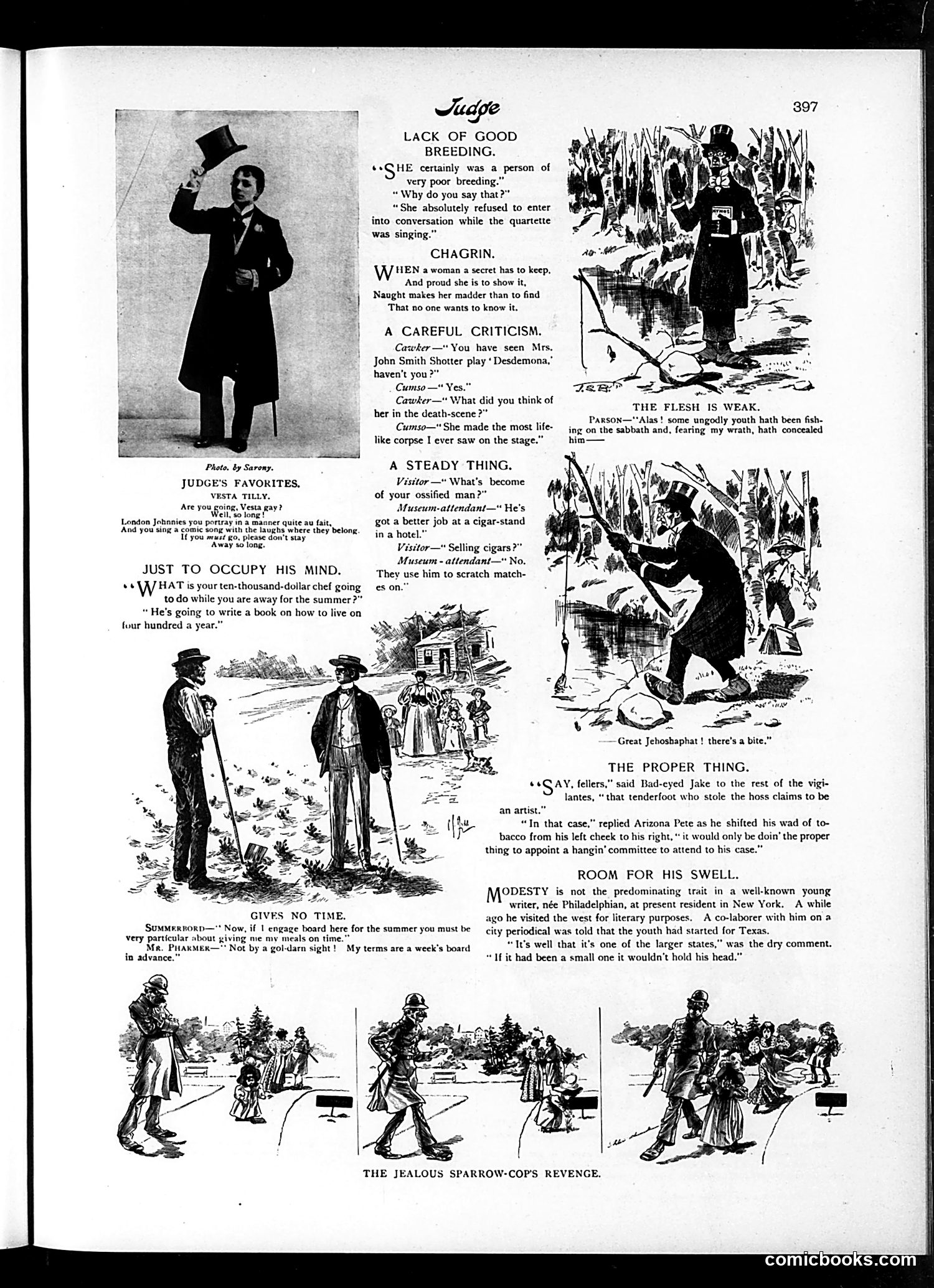
This page contains multiple brief satirical vignettes typical of Judge's humor circa early 1900s: **"Lack of Good Breeding"** mocks women who won't chat during musical performances—treating silence as social rudeness rather than courtesy. **"Chagrin"** jokes about women's vanity: they're prouder of keeping secrets than sharing them, annoyed when no one asks. **"A Careful Criticism"** satirizes theater-goers praising bad acting as "lifelike" when the actress merely lies motionless like a corpse. **"The Flesh is Weak"** shows a parson punishing a youth for sabbath fishing—typical 19th-century religious moralizing humor. **"Steady Thing"** jokes that an "ossified man" museum exhibit was fired and now scratches matchboxes at a cigar stand—a mundane job for a curiosity. **"The Jealous Sparrow-Cop's Revenge"** (illustrated sequence) appears to show a police officer punishing someone, though the specific reference is unclear. Other items mock wealthy people's pretensions and an arrogant Philadelphia writer visiting Texas. The humor is genteel, period-specific, and relies on social class commentary.
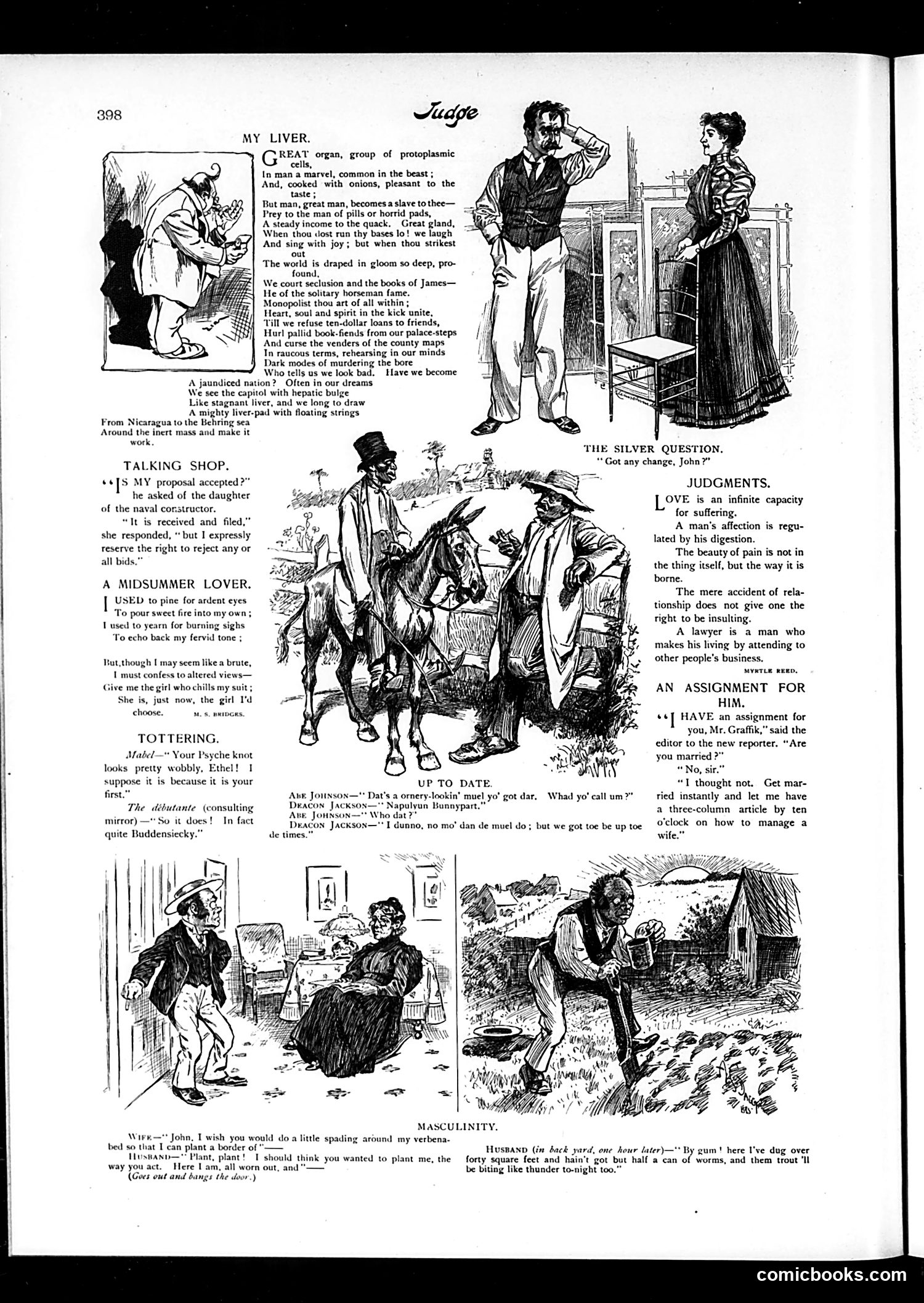
This page collects satirical poems and cartoons on various social themes circa late 1800s. **"My Liver"** mocks hypochondria and Americans' obsession with digestive ailments—the liver becomes a metaphor for national mood swings, suggesting the U.S. has become "a jaundiced nation" of health-obsessed worriers consulting quack remedies. **"Talking Shop"** and other brief pieces satirize courtship, fashion, and domestic life: a naval constructor's daughter rejecting marriage proposals; a debutante's failing hairstyle; marital discord over garden work. **"The Silver Question"** (untitled cartoon) appears to reference monetary policy debates of the era, though details are unclear from the image alone. **"Judgments"** offers cynical aphorisms about love, pain, and lawyers—typical fin-de-siècle satire. **"An Assignment for Him"** jokes about journalism: a editor assigns a newly-married reporter to write about household management, implying newlyweds are natural experts in domestic life. The overall tone reflects period anxieties about health, marriage, and modern life.
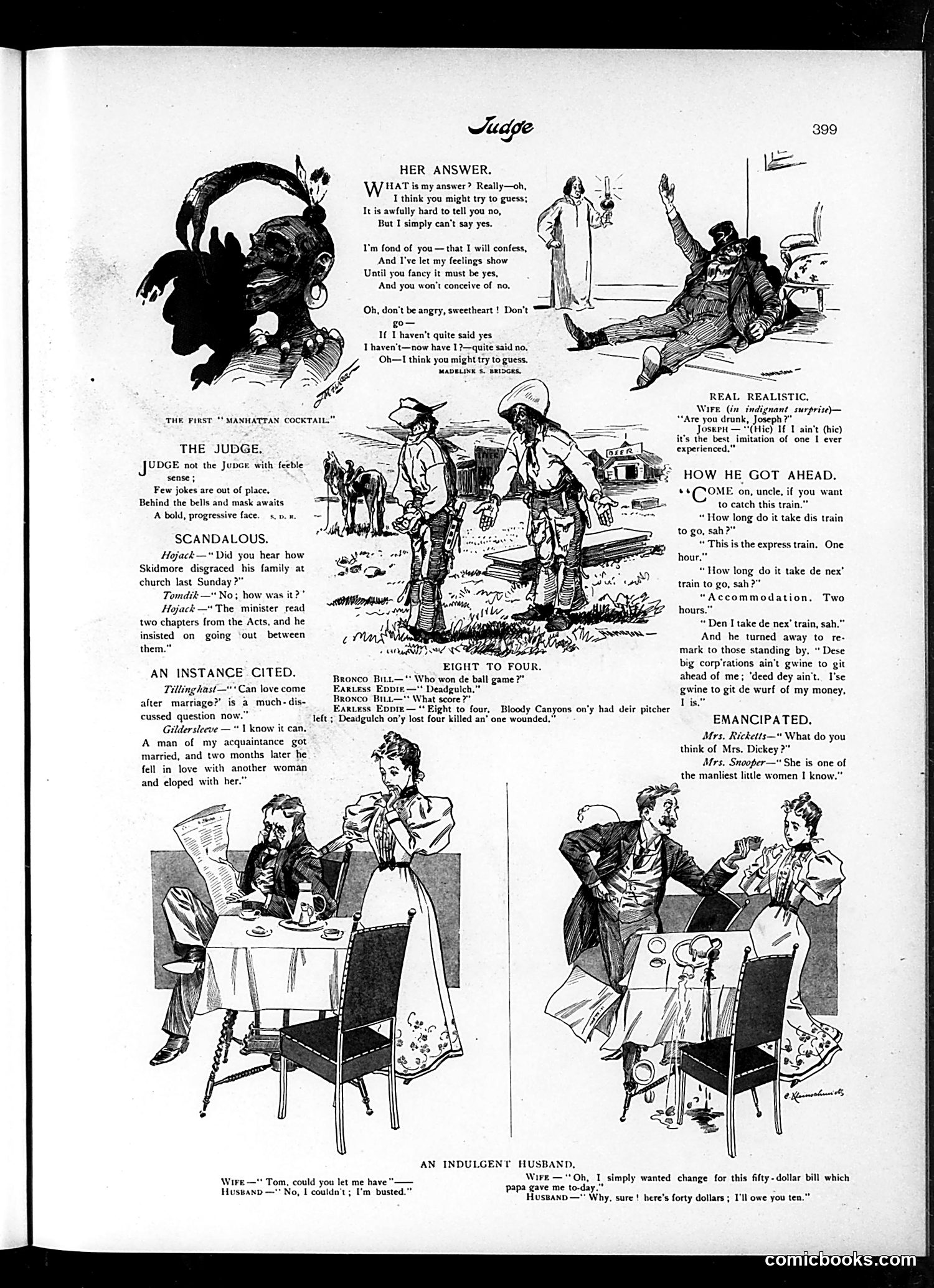
This page contains several short humorous sketches typical of 1890s-era American satire: **"Her Answer"** mocks romantic indecision—a young woman cannot commit to yes or no, stringing along her suitor with ambiguous affection. **"Scandalous"** jokes about overzealous religiosity: a man insists on leaving church between scripture readings, treating Acts as separate performances rather than continuous scripture. **"An Instance Cited"** presents the paradox of love arriving *after* marriage, contradicting romantic ideology. The remaining sketches satirize various American types: **"Real Realistic"** features a drunk man claiming convincing sobriety; **"Eight to Four"** depicts Wild West violence in baseball (unclear reference); **"How He Got Ahead"** stereotypes an African American character as shrewdly gaming the railroad system; **"Emancipated"** mocks "mannish" women; and **"An Indulgent Husband"** shows financial marital discord. The page primarily targets romance, propriety, class pretension, and emerging social changes through lightweight domestic comedy rather than pointed political commentary.
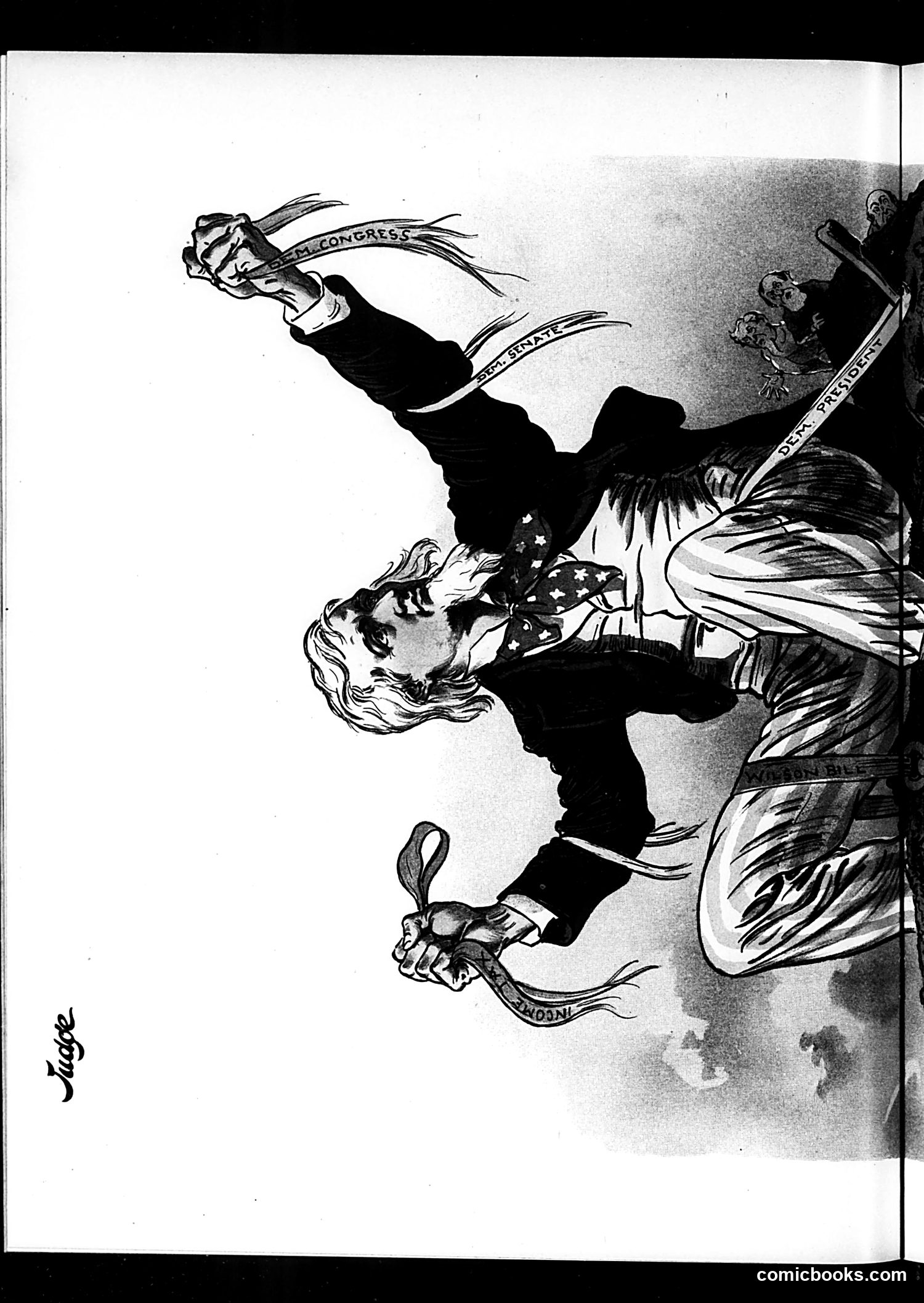
This appears to be a Judge magazine satirical cartoon, though the OCR text provides minimal context. The image shows a figure in classical dress (appearing to represent Liberty or Columbia, identifiable by the star-emblazoned garment) being pulled in opposite directions by two competing forces on the right side. One ribbon is labeled "CONGRESS" while another reads "PRESIDENT" (partially visible). A small figure at bottom left holds what appears to be a restraining rope labeled "SALOON." The cartoon satirizes political conflict between Congress and the President over a particular issue—possibly Prohibition or liquor regulation, given the "SALOON" reference. The classical female figure represents the nation itself, caught between competing governmental powers and special interests, unable to move freely. This visualizes the era's tensions over executive versus legislative authority.
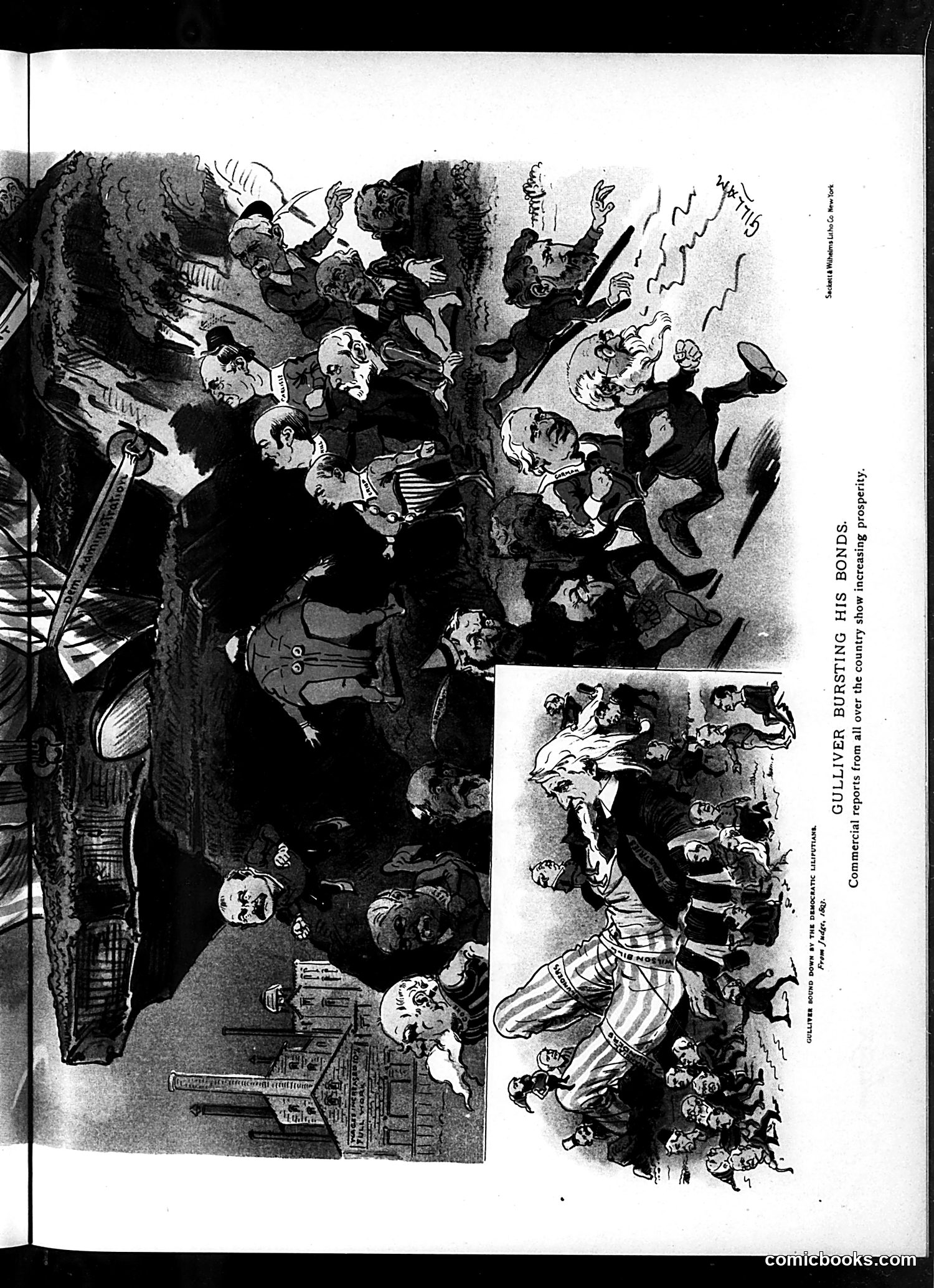
This page shows a large-scale satirical cartoon titled "Gulliver Bursting His Bonds," referencing Jonathan Swift's *Gulliver's Travels*. The main illustration depicts a giant figure (representing a powerful entity—likely American industrial or political power) breaking free from restraints held by numerous smaller figures (depicted as European diplomats, politicians, or foreign interests). The satire appears to critique entanglement in international affairs or commercial restrictions. The Lilliputian-like figures struggling unsuccessfully to contain the giant represent foreign powers attempting to constrain American interests or expansion. The smaller supplementary cartoon below reinforces this theme with similar imagery of struggle and resistance. **Note:** The OCR text is severely corrupted and unreadable, preventing precise identification of specific figures, dates, or context. The visual metaphor is clear, but the exact historical moment this commentary targets remains unclear without legible accompanying text.
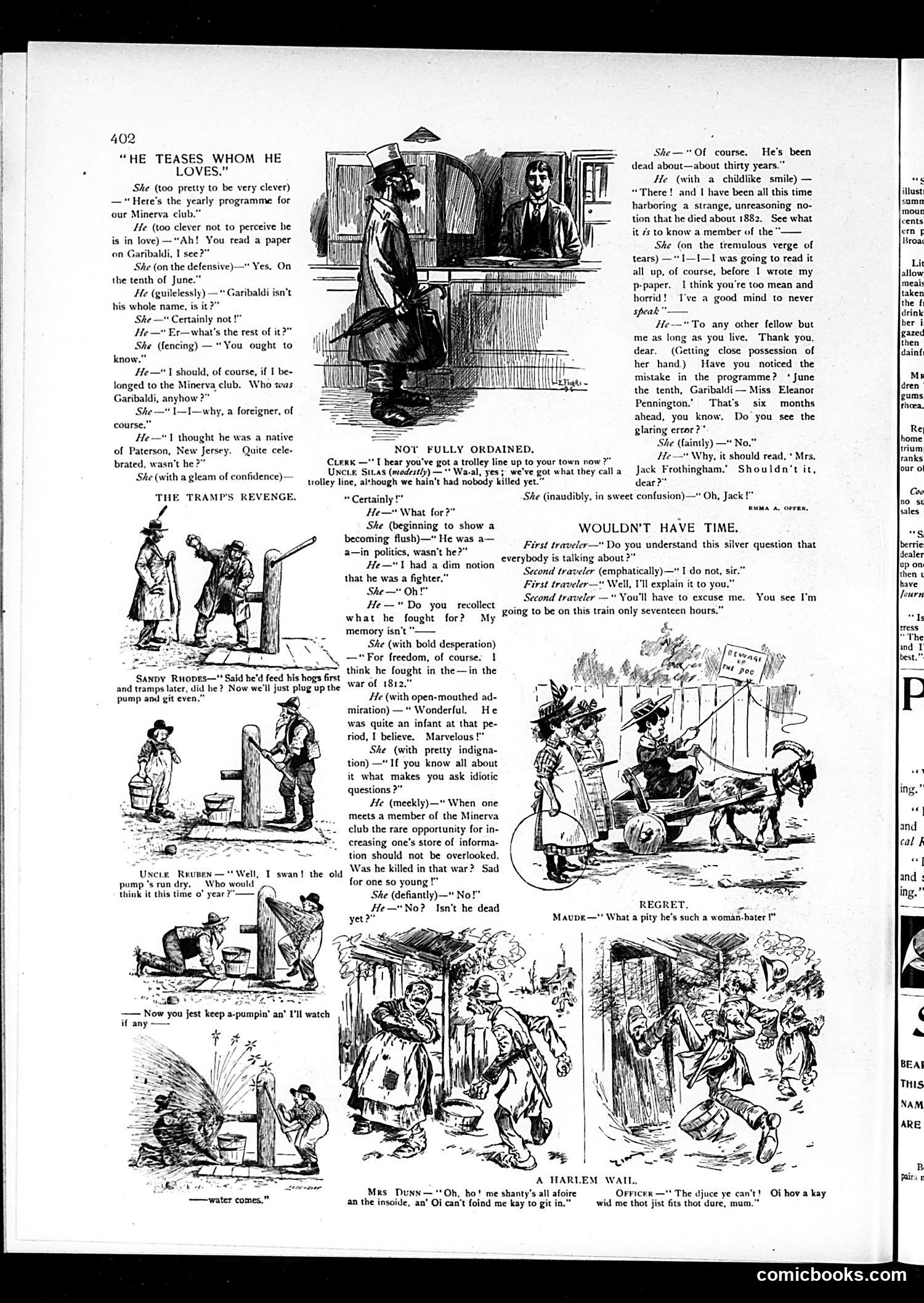
This page contains several satirical cartoons and comic dialogues typical of late-19th-century American humor: **Main feature**: "He Teases Whom He Loves" depicts a courtship scene where an intelligent young man deliberately asks a pretty but uninformed woman absurd questions about Garibaldi (the Italian nationalist leader). She claims to have read a paper on him but reveals profound ignorance—placing him in the War of 1812 and thinking he died around 1882. The satire targets both the pretensions of women's "improvement clubs" and the performance of intellectual interest in courtship. **Supporting cartoons** mock working-class characters: "The Tramp's Revenge" shows a vagrant sabotaging a farmer's pump, while "Sandy Rhodes" depicts rural vengeance. **Brief jokes** include travelers discussing the "silver question" (monetary policy debate of the era) and Harlem residents with language suggesting ethnic stereotyping. The overall tone reflects period attitudes about gender, class, and education—mocking both intellectual pretension and those excluded from education.
This page is primarily **advertisements and brief humorous anecdotes** rather than political cartoons. The content includes: **Short jokes** on domestic and social topics: a child refusing milk (comparing herself to a cat), a Spanish general's "victory" (shooting a cowardly officer), confused voters, and marital observations. These are gentle social satire typical of the era—poking fun at everyday situations rather than serious politics. **Large advertisements** dominate the lower half, including Packer's Tar Soap, Chester Suspenders, and alcohol brands (Belle of Nelson whiskey, "The Club" cocktails). The ads use testimonials and product claims common to late 19th/early 20th-century marketing. **Notable context**: The Spanish general joke may reference actual Spanish military actions in Cuba (relevant to the Spanish-American War era), but the anecdotes are mostly apolitical humor about manners, marriage, and children. This appears to be a typical Judge page mixing advertising revenue with light comedic content rather than serving as a vehicle for serious political satire.
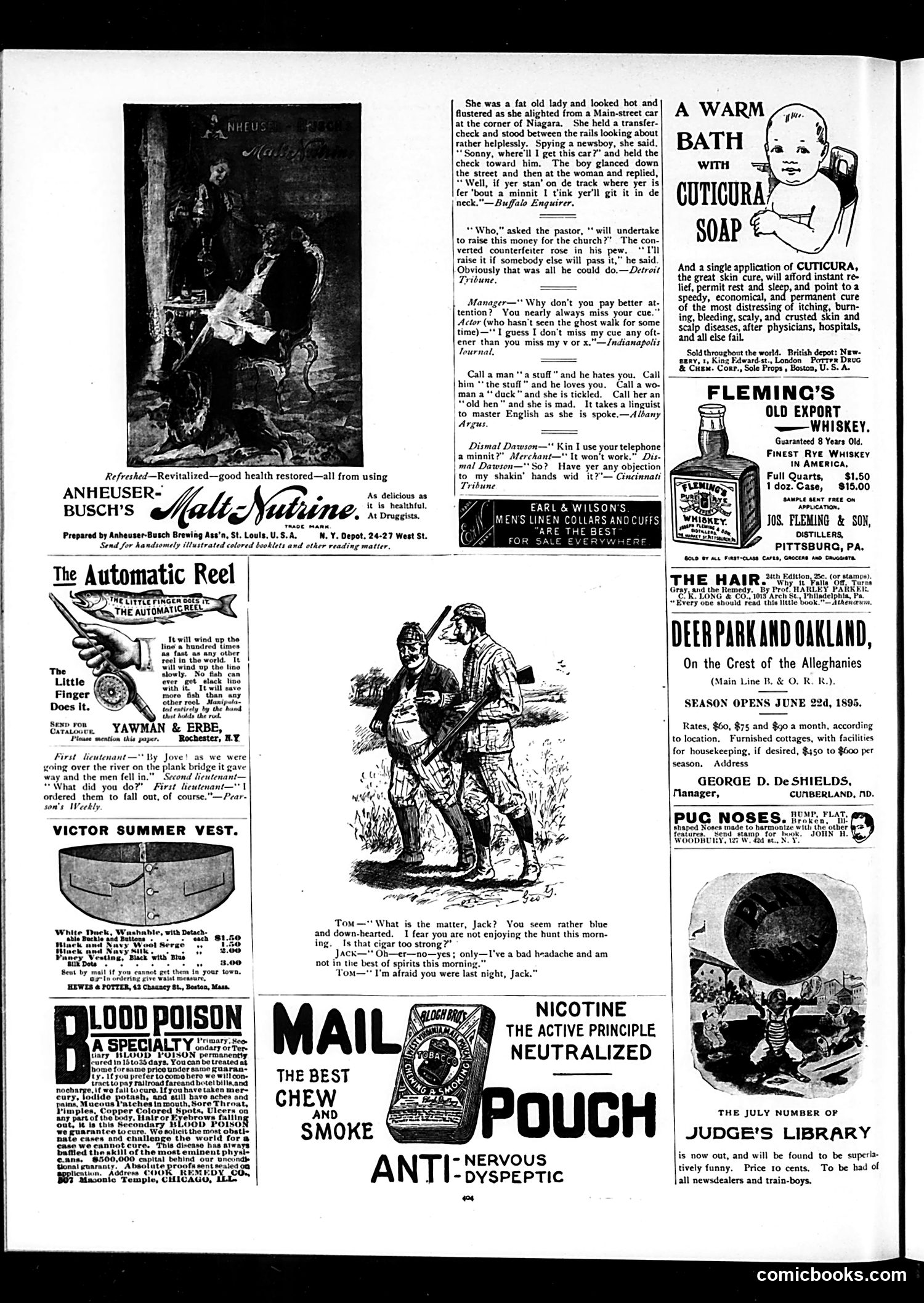
This appears to be primarily an **advertising and humor miscellany page** rather than political satire. The content consists of brief jokes, anecdotes, and numerous product advertisements. The few narrative pieces include period humor about social interactions—a fat woman asking a newsboy for directions (he jokes she'll be hit by the streetcar), a pastor's encounter with a reformed counterfeiter, observations about language and nicknames, and theatrical/military anecdotes. These jokes rely on dated stereotypes and social conventions of the 1890s. The visual cartoon shows two hunters in conversation; the OCR'd text suggests disappointment about the hunt's poor sport and hangovers from the previous night. The page is dominated by **advertisements** for Anheuser-Busch beer, Cuticura soap, Fleming's whiskey, the "Automatic Reel," blood poison cure, and resort destinations, reflecting the magazine's primary revenue model. No specific political figures or events are referenced on this page.
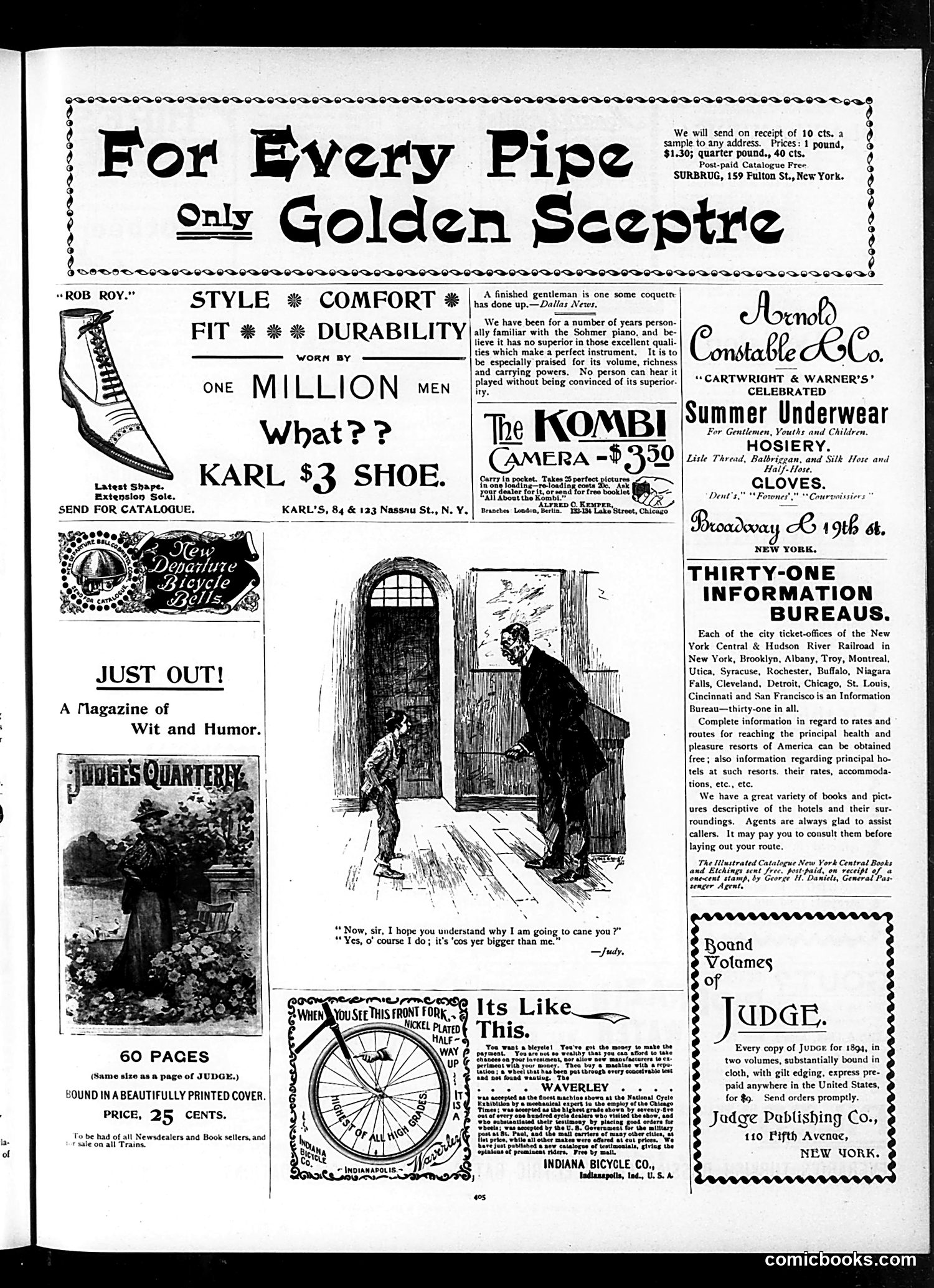
This page is primarily **advertising with one cartoon**. The dominant cartoon depicts a domestic scene where an adult appears poised to strike a child with a cane. The child explains his anticipated punishment: "it's 'cos yer bigger than me"—a joke about physical superiority rather than moral wrongdoing. The humor relies on the child's innocent, literal logic: he misunderstands that corporal punishment is meant to be corrective discipline, instead attributing it solely to the adult's greater strength. This satirizes both the era's accepted practice of caning children and the child's inability to grasp social authority structures. The page otherwise contains period advertisements for shoes, cameras, bicycles, railroads, and publications—typical of Judge's revenue model. The only other satirical content is a brief quote: "A finished gentleman is one some coquette has done up," mocking superficial courtship rituals.
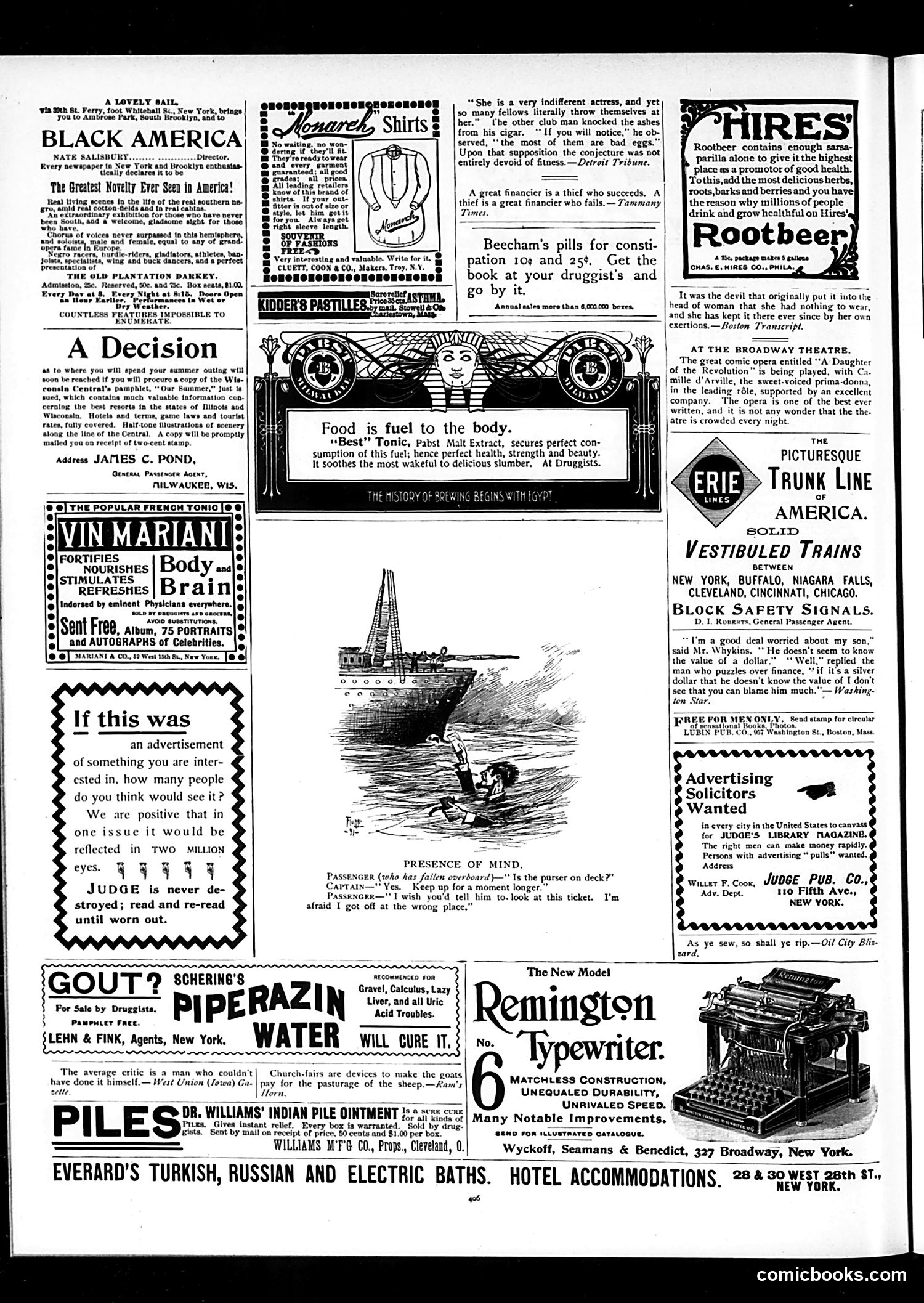
This page is primarily **advertisements interspersed with brief satirical commentary**, typical of Judge magazine's format. The notable content includes: **"Black America" Exhibition**: An advertisement for a traveling show featuring "real living scenes" of enslaved Black life—cotton fields, cabins, performers. This reflects the deeply racist "ethnographic exhibition" entertainment popular in the 1890s-1900s, presenting Black people as curiosities for white audiences. **Brief Satirical Quips**: Small jokes scattered throughout mock various subjects: critics who can't create ("a man who couldn't have done it himself"), financiers ("a great financier is a thief who succeeds"), and clergy ("Church-fairs are devices to make the goats pay for the pasturage of the sheep"). **Bulk Content**: Patent medicines (Piperazin Water, Dr. Williams' Pile Ointment), the Remington Typewriter, Hires Rootbeer, and Erie Railroad advertisements dominate the page—standard commercial space that subsidized the magazine. The page reveals period attitudes: casual racism in entertainment marketing alongside consumer culture and satirical commentary on American society.
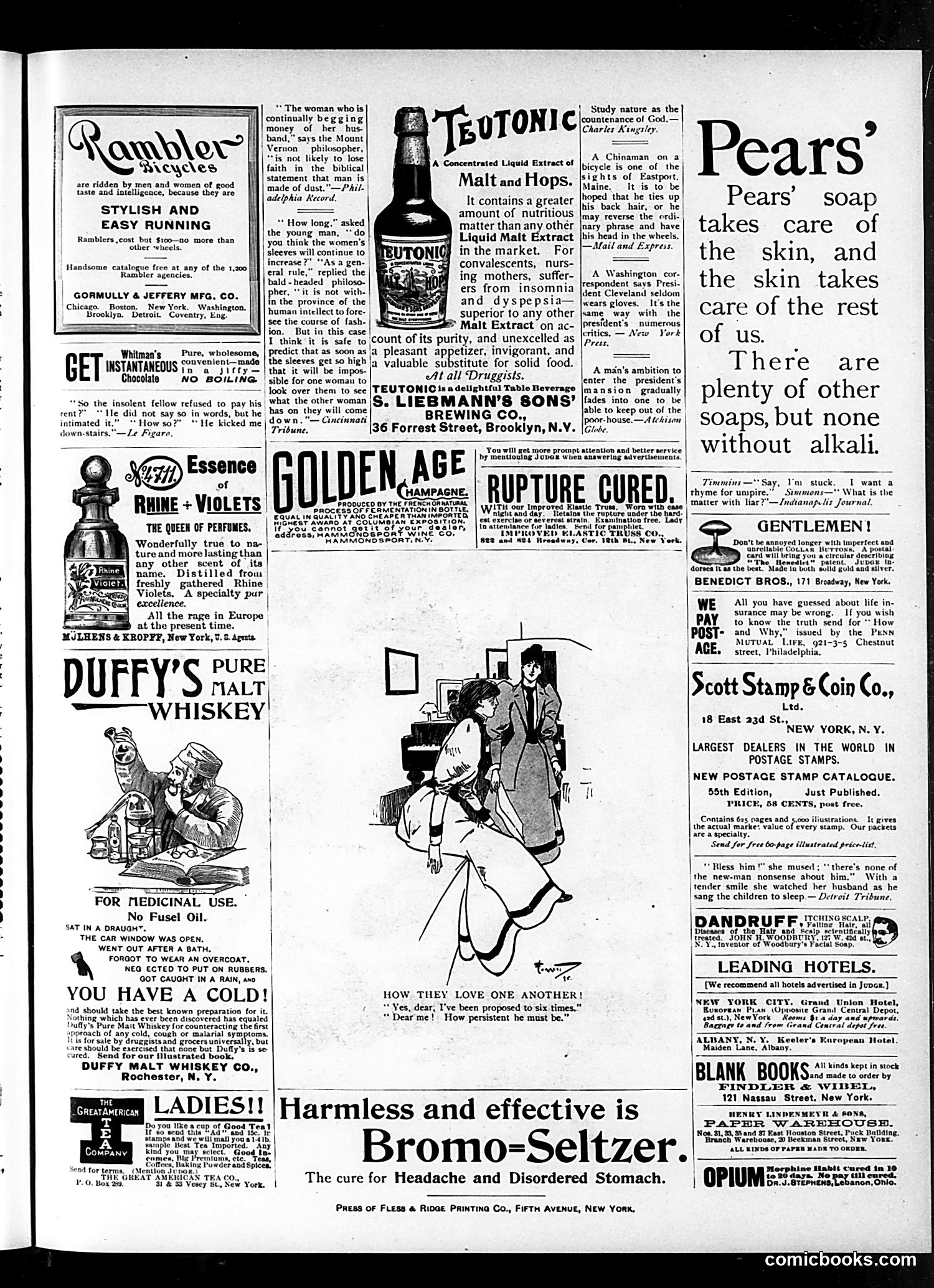
This is primarily an **advertising page** from Judge magazine, with one small cartoon. The cartoon titled **"How They Love One Another"** shows a couple in conversation. The caption reads: "Yes, dear, I've been proposed to six times." / "Dear me! How persistent he must be." This is a gentle joke about courtship—the humor lies in the woman's suitor misinterpreting her repeated rejections as persistent devotion rather than disinterest. It reflects early 20th-century dating conventions where a man might propose multiple times despite rejection, and the wife's dry observation about his persistence. The page is otherwise filled with period advertisements for patent medicines (Duffy's Malt Whiskey, Bromo-Seltzer), luxury goods (Rambler bicycles, perfume), and services, reflecting common Judge advertising. These ads often made exaggerated health claims typical of the era before FDA regulations.
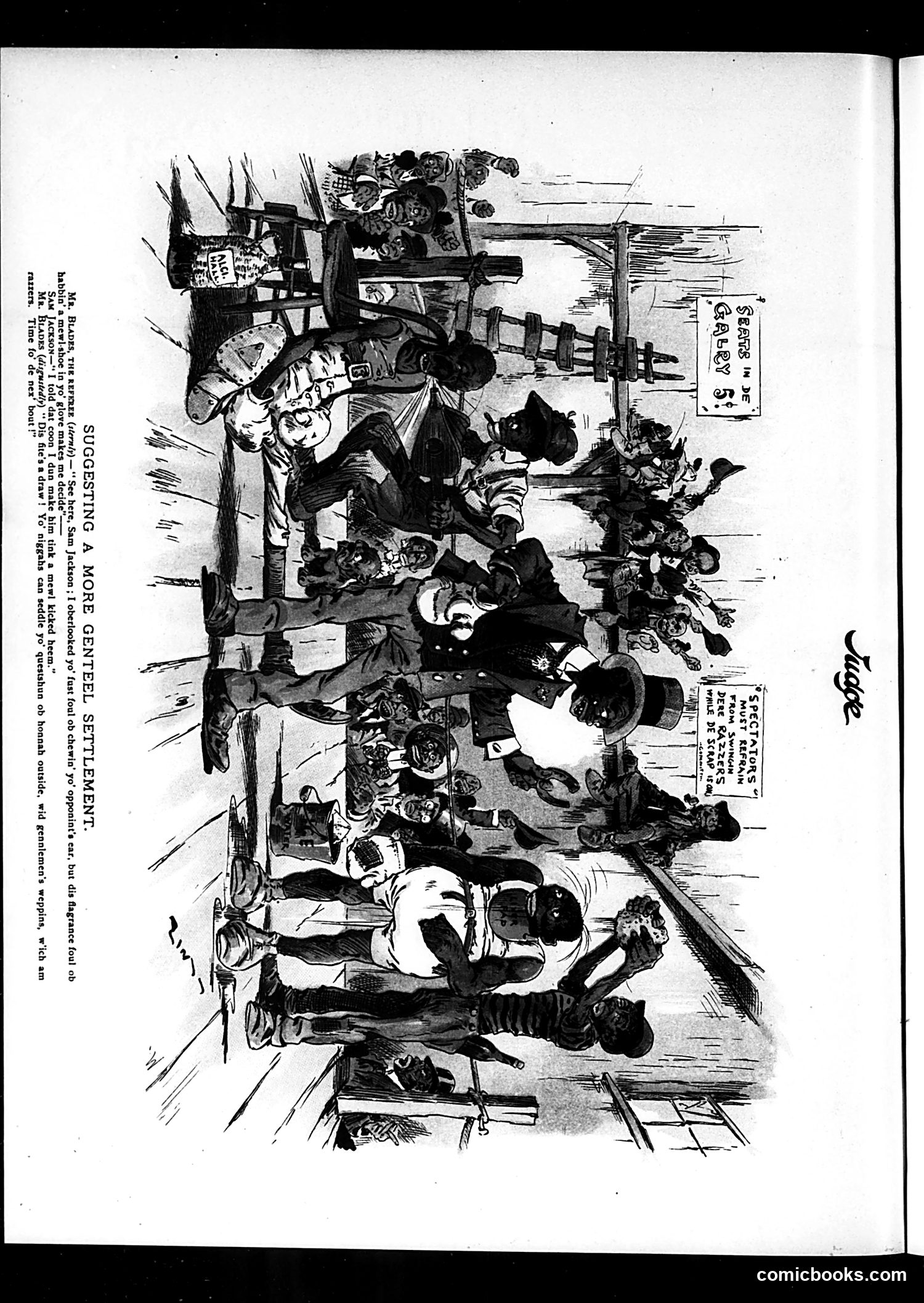
This Judge cartoon depicts a boxing match referee ("Ma. Blades") stopping a fight between two Black fighters over rule violations. One boxer allegedly hid a mule-shoe in his glove; the other had bitten his opponent's ear. The satire uses extremely offensive racial stereotypes and dialect to mock Black prizefighters and their perceived lack of gentility. The "joke" contrasts their brutal fighting style with the referee's suggestion they settle their "question of honor" like "gentlemen" using razors—implying that even the "civilized" alternative the referee proposes remains violent and disreputable. The cartoon reflects late 19th/early 20th-century racist attitudes prevalent in satirical publications, portraying Black athletes as inherently crude and prone to cheating or excessive violence. The title's irony—that razor-fighting represents "genteel settlement"—underscores the dehumanizing caricature. This represents the casual, systemic racism embedded in period humor magazines.