
A complete issue · 16 pages · 1895
Judge — June 1, 1895
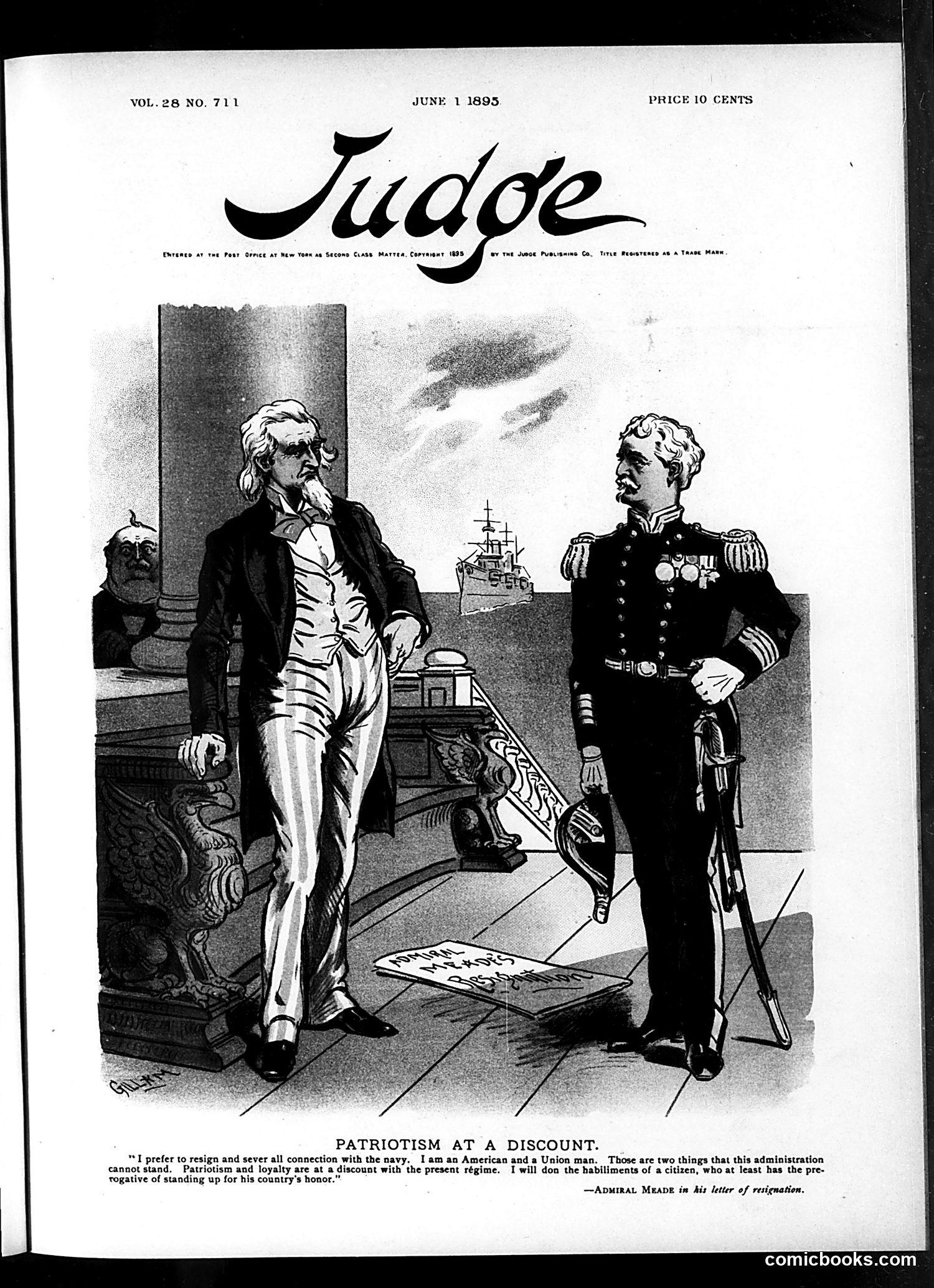
This June 1895 *Judge* cartoon satirizes Admiral George Dewey's resignation threat over the Cleveland administration. The titled "Patriotism at a Discount" shows three figures: a military officer (likely Dewey) in dress uniform confronting a civilian statesman, while a lion statue and distant warship suggest naval power. The quoted text attributes to "Admiral Meade" (likely referencing Dewey or similar naval figure) expressing willingness to resign over disagreements with the current administration's policies. The satire suggests the admiral is treating patriotic service as negotiable—hence "at a discount"—conditional upon political concessions rather than unconditional duty. The cartoon criticizes using military authority as leverage in civilian political disputes, mocking the notion of patriotism as transactional.
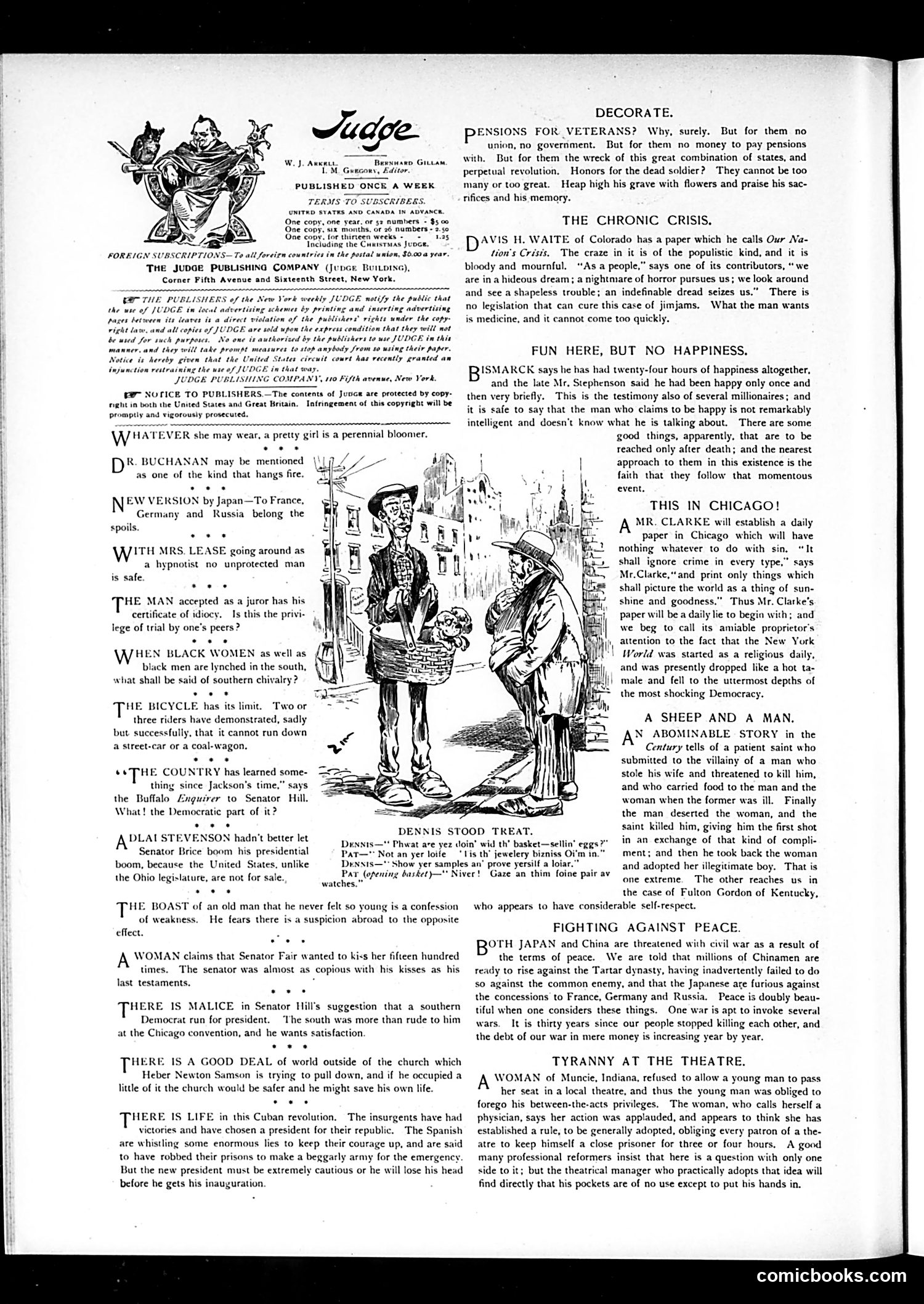
This cartoon depicts two working-class men in what appears to be a urban setting. The caption "DENNIS STOOD TREAT" suggests one character (Dennis) is treating the other to food or drink. The dialogue includes references to "basket" and "eggs," with one figure appearing to be a street vendor or food seller. The cartoon likely satirizes working-class social customs and economic realities of the era—how laborers spent leisure time and money on small treats or meals. The naturalistic drawing style and urban setting are typical of Judge's social commentary on American class dynamics. Without additional context about which "Dennis" is referenced, I cannot identify the specific person being caricatured or any particular historical event alluded to.
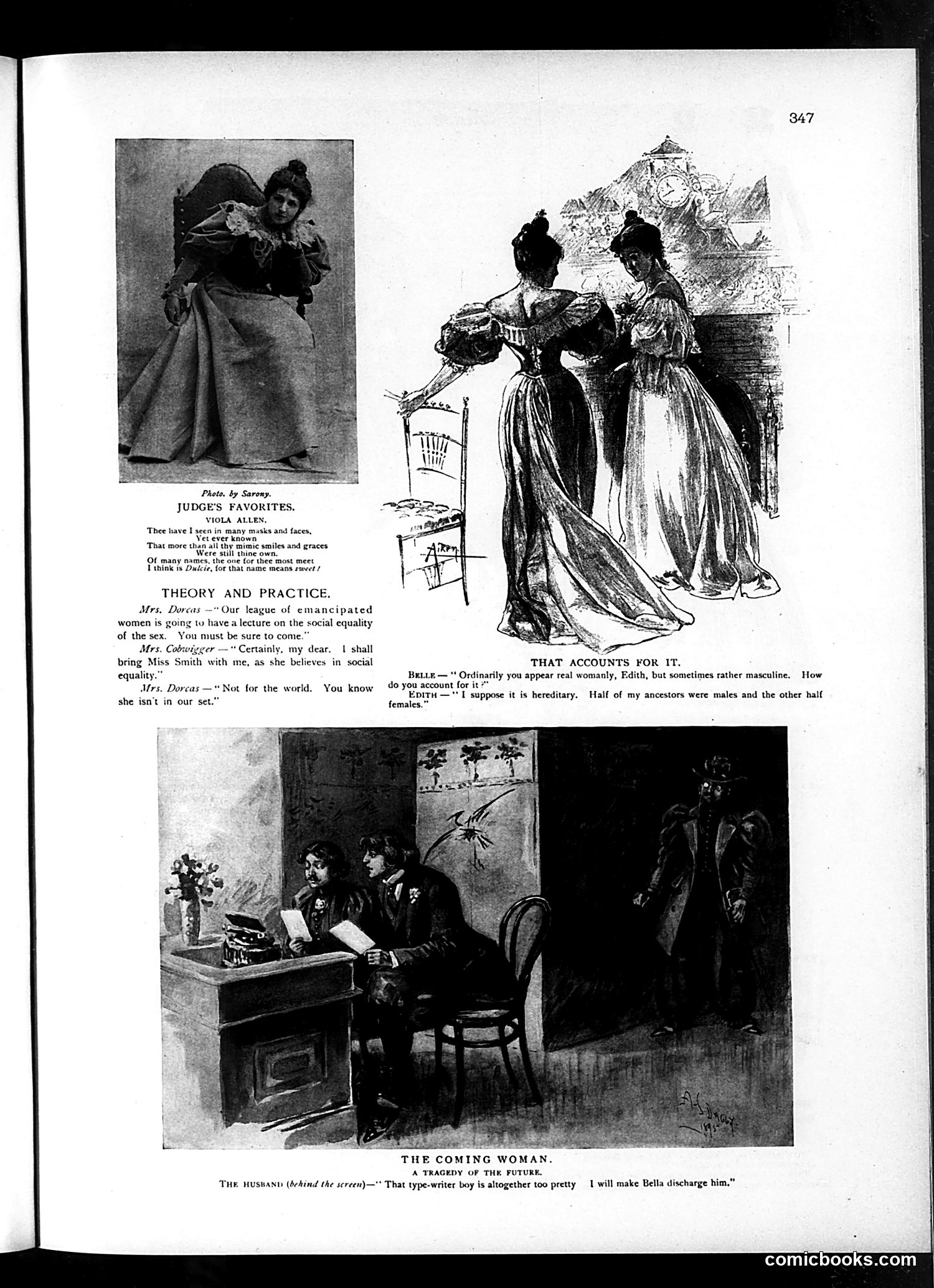
This page satirizes late-19th-century women's suffrage and gender equality debates. **"Judge's Favorites" (top left):** Photos a woman labeled "Viola Allen," likely the actress, presented as exemplifying traditional feminine beauty and grace. **"Theory and Practice" (center):** Mocks the contradiction between suffragists' rhetoric and reality. Mrs. Dorset lectures about women's "social equality," while Mrs. Cadwallader admits she'll only support it if her husband approves—exposing women's actual dependence despite equality talk. **"That Accounts for It" (top right):** A woman's masculine demeanor is humorously "explained" by her mixed ancestral heritage (half male, half female ancestors). **"The Coming Woman" (bottom):** Depicts a dystopian future where female dominance has reversed traditional gender roles, with a woman firing her "pretty" male secretary. The cartoons mock both suffragists and anti-suffragists, treating gender equality as absurd.
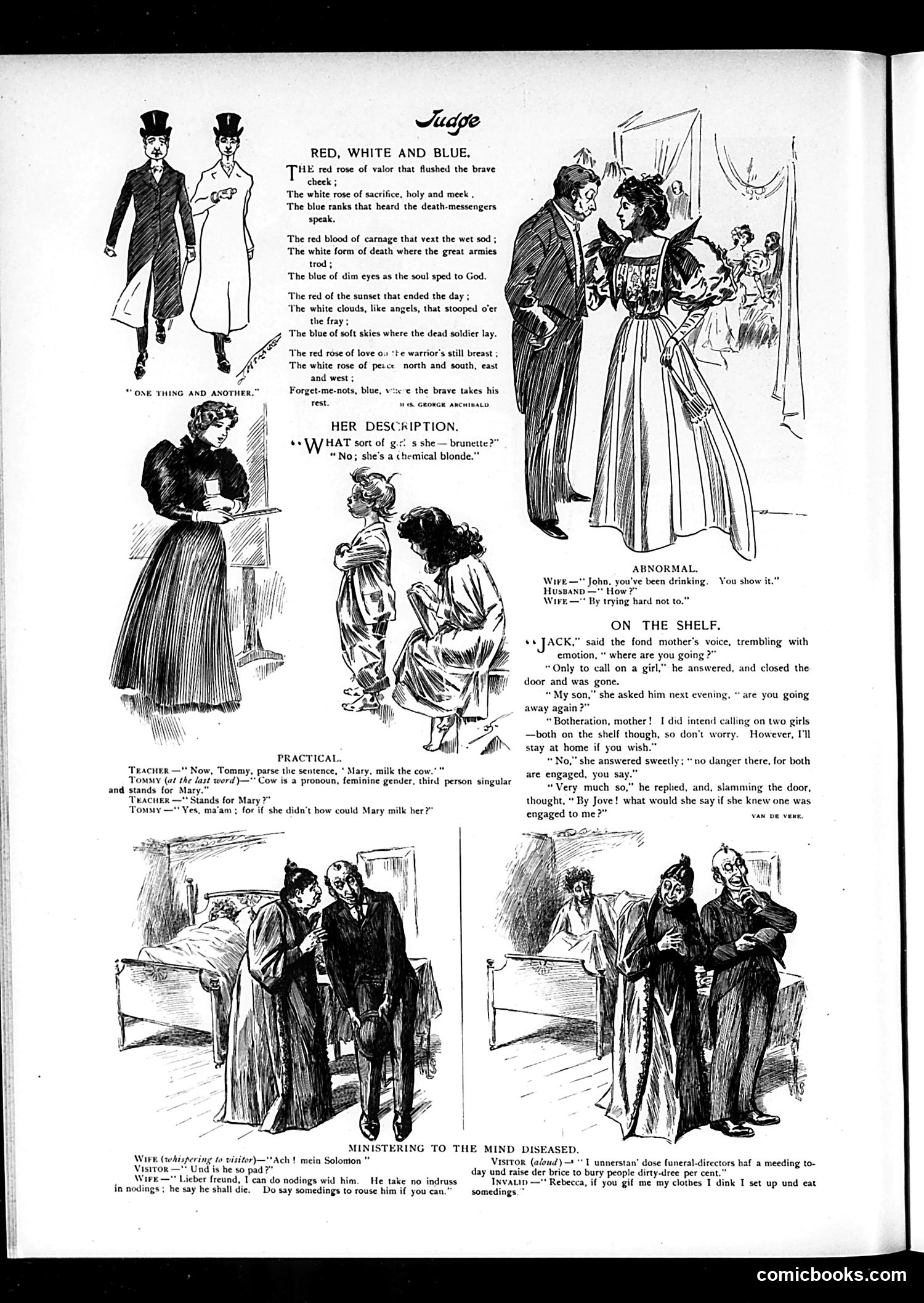
This page contains several unrelated comic sketches and humorous pieces typical of early 20th-century satirical magazines. **"Red, White and Blue"** is a patriotic poem about American sacrifice, likely referencing WWI, using the flag colors as metaphors for valor, death, and peace. **"Her Description"** makes a joke about artificial blonde hair dye—calling a woman a "chemical blonde" rather than a natural brunette. **"Practical"** satirizes schoolteacher logic: a student parses "Mary" as the pronoun in a sentence about milking cows, suggesting the teacher is interchangeable with farm animals. **"Abnormal"** depicts a doctor-patient exchange where a husband's drinking is so obvious he can't hide it by trying. **"On the Shelf"** features a mother worrying about her son visiting unmarried girls; he reassures her they're "engaged"—then reveals, ambiguously, one is engaged *to him*, leaving the mother's concern unresolved. The humor relies on the double meaning of "shelf" (storage/spinster status). These are disconnected, lighthearted domestic humor pieces.
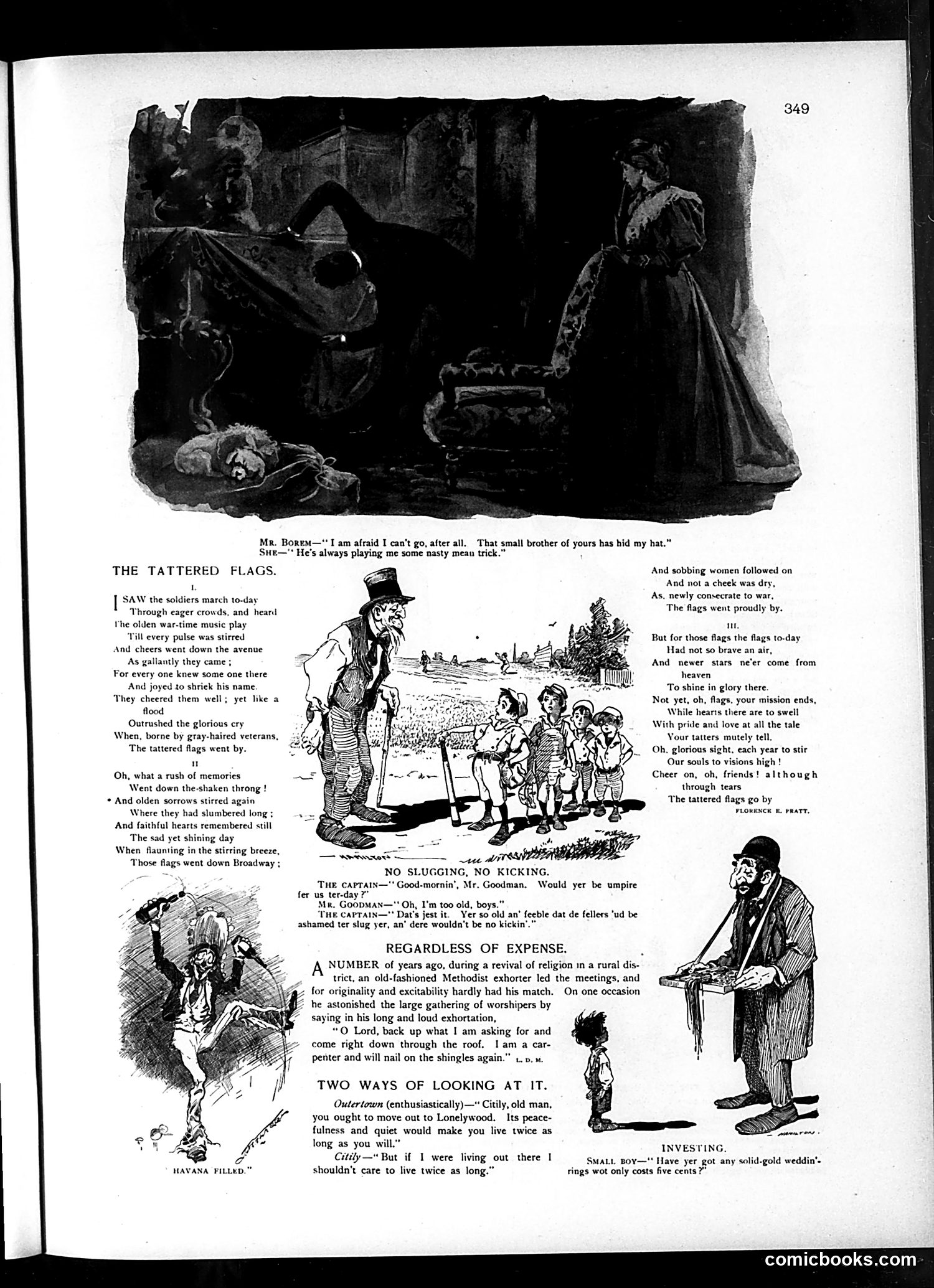
This page contains several unrelated humorous pieces typical of Judge's satirical format: **"The Tattered Flags"** is a patriotic poem accompanying an illustration of Civil War-era veterans carrying worn battle flags in a parade. The piece nostalgically celebrates American military sacrifice and courage, evoking emotional responses from onlookers. This likely commemorates a specific veterans' parade, though the exact event is unclear. **"No Slugging, No Kicking"** depicts a baseball scene where an aging man agrees to umpire because he's too feeble for players to risk hitting him—dark humor about elderly fragility. **"Regardless of Expense"** is a humorous anecdote about a rural Methodist preacher's literal-minded prayer asking God to break through the church roof, promising to repair it himself. **"Two Ways of Looking at It"** contrasts urban and rural perspectives on longevity. **"Investing"** features a child attempting to purchase gold wedding rings cheaply. These are typical Judge humor sketches—short jokes and light satire on American life rather than focused political commentary.
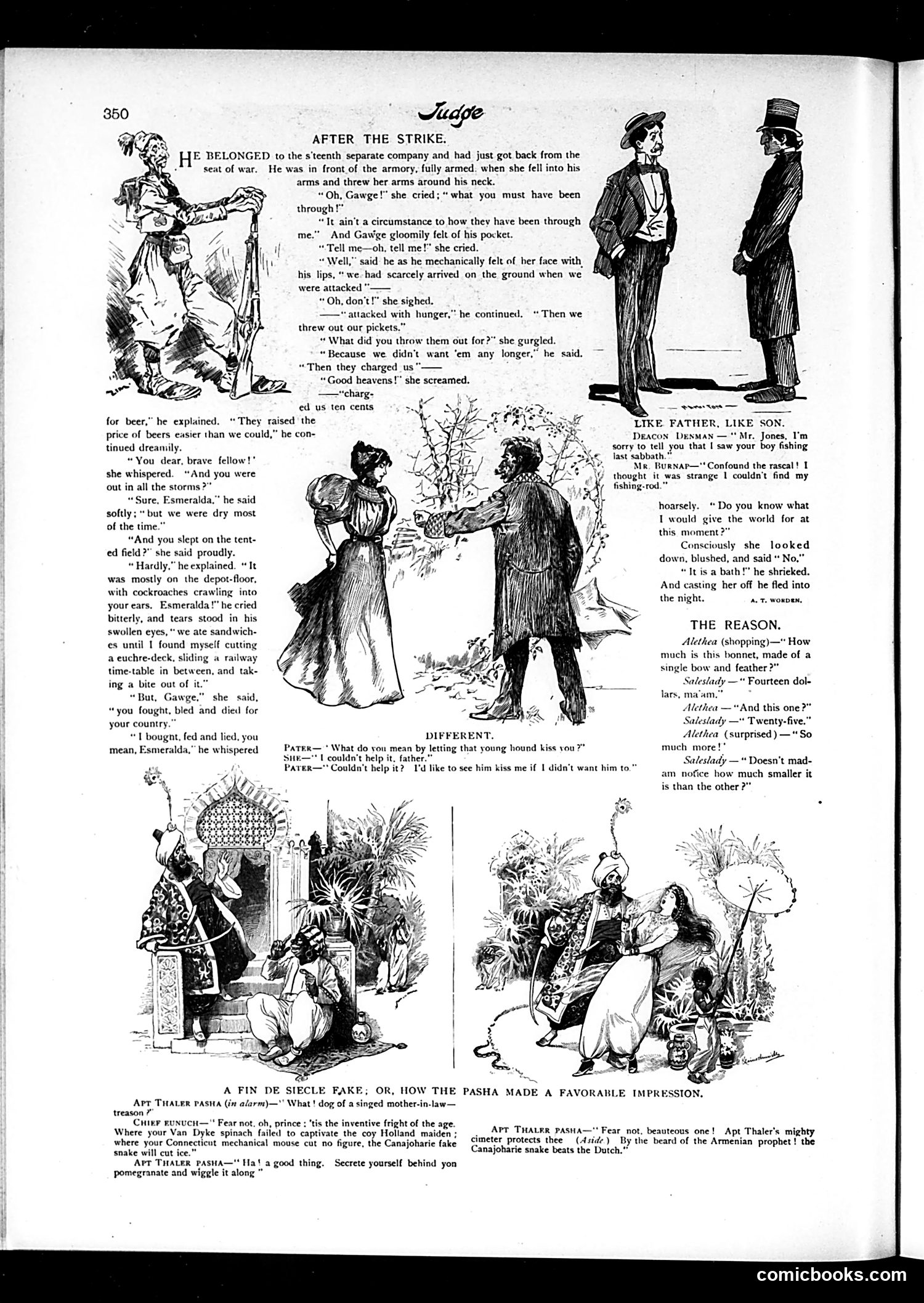
This page contains multiple satirical stories mocking domestic life and romance, typical of Judge's late 19th-century humor. **"After the Strike"** depicts a soldier returning from war (likely the Spanish-American War era) who disappoints his sweetheart by complaining about hardships rather than displaying heroism—he's hungry, tired, covered in cockroaches, and ultimately just wants a bath. The satire mocks both sentimental patriotic romance and soldiers' unglamorous reality. **"Like Father, Like Son"** jokes about hypocrisy: a disapproving father catches his son fishing on Sunday, while the father himself appears to be engaged in improper conduct. **"The Reason"** is a brief joke about pricing: identical bonnets cost different amounts based on size, mocking both fashion absurdity and consumer gullibility. **"A Fin de Siècle Fake"** parodies exotic orientalist tales, featuring an Ottoman pasha attempting elaborate deceptions to impress someone, only to be outdone by American trickery—reflecting contemporary attitudes toward cultural stereotypes and American cleverness. The cartoons reflect Judge's focus on domestic comedy, social pretense, and American superiority.
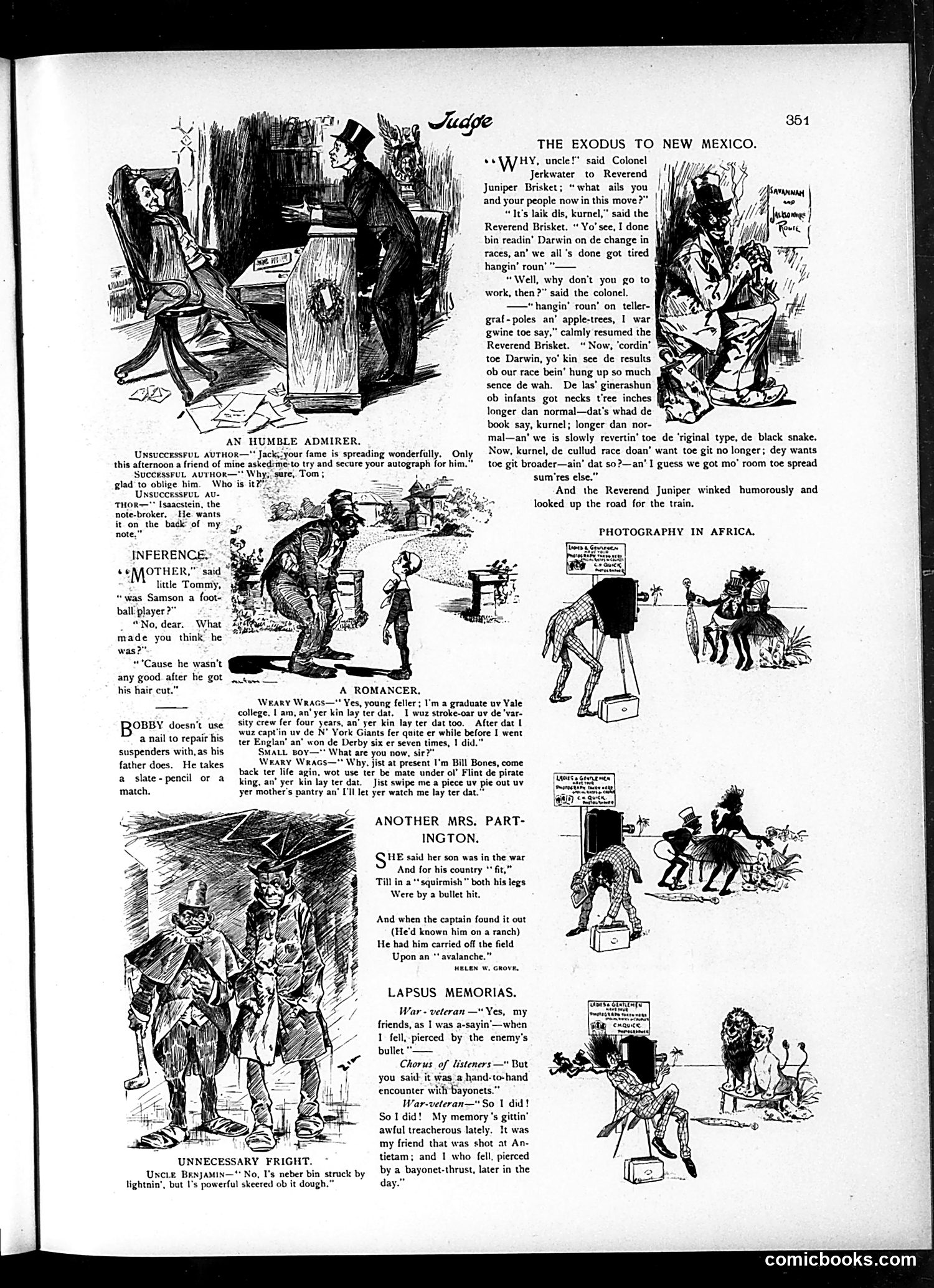
This page satirizes racial attitudes of the post-Civil War era. The main cartoon depicts a reverend claiming Black Americans should migrate to New Mexico because, per Darwin, prolonged hanging from telegraph poles and trees since the war has elongated their necks—reversing them toward their "original type, the black snake." The joke relies on grotesque racist pseudoscience, mocking both pseudo-scientific racism and the premise of Black emigration movements. The surrounding comics employ period dialect humor and character sketches typical of Judge's satirical approach. Other cartoons joke about unsuccessful authors, tall tales (a Yale graduate claiming implausible athletic achievements), and soldiers' exaggerated war memories. The artwork uses caricature and blackface conventions common to 1880s-1890s American humor, now deeply offensive. The satire targets multiple audiences—both mocking Black stereotypes and lampooning those who proposed emigration solutions to post-war racial problems.
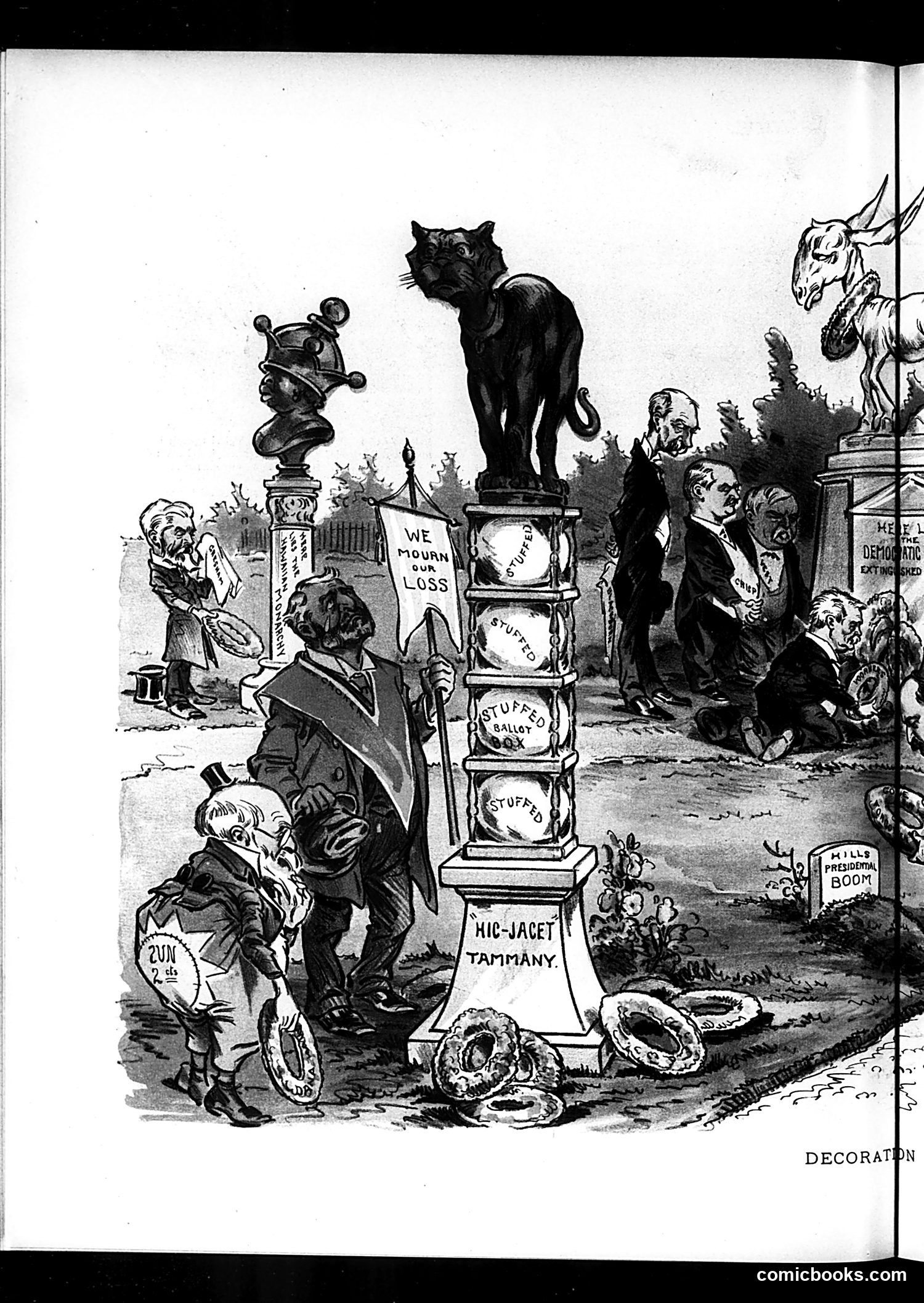
This is a satirical political cartoon from *Judge* magazine depicting a monument to "Hic-Jacet Tammany" (Latin: "here lies Tammany"). The large black cat perched atop represents Tammany Hall, New York's notorious Democratic political machine. The pedestal is stacked with boxes labeled "STUFFED BALLOT" and marked "WE MOURN OUR LOSS," mocking the organization's fraudulent electoral practices. Figures in formal dress surround the monument, appearing to mourn or pay respects—likely representing Tammany politicians or associates. The overall message is that Tammany Hall deserved to "die" due to its corruption, particularly ballot-stuffing and electoral fraud. The cartoon celebrates the machine's apparent downfall or loss of power, presenting corruption as worthy of burial rather than mourning.
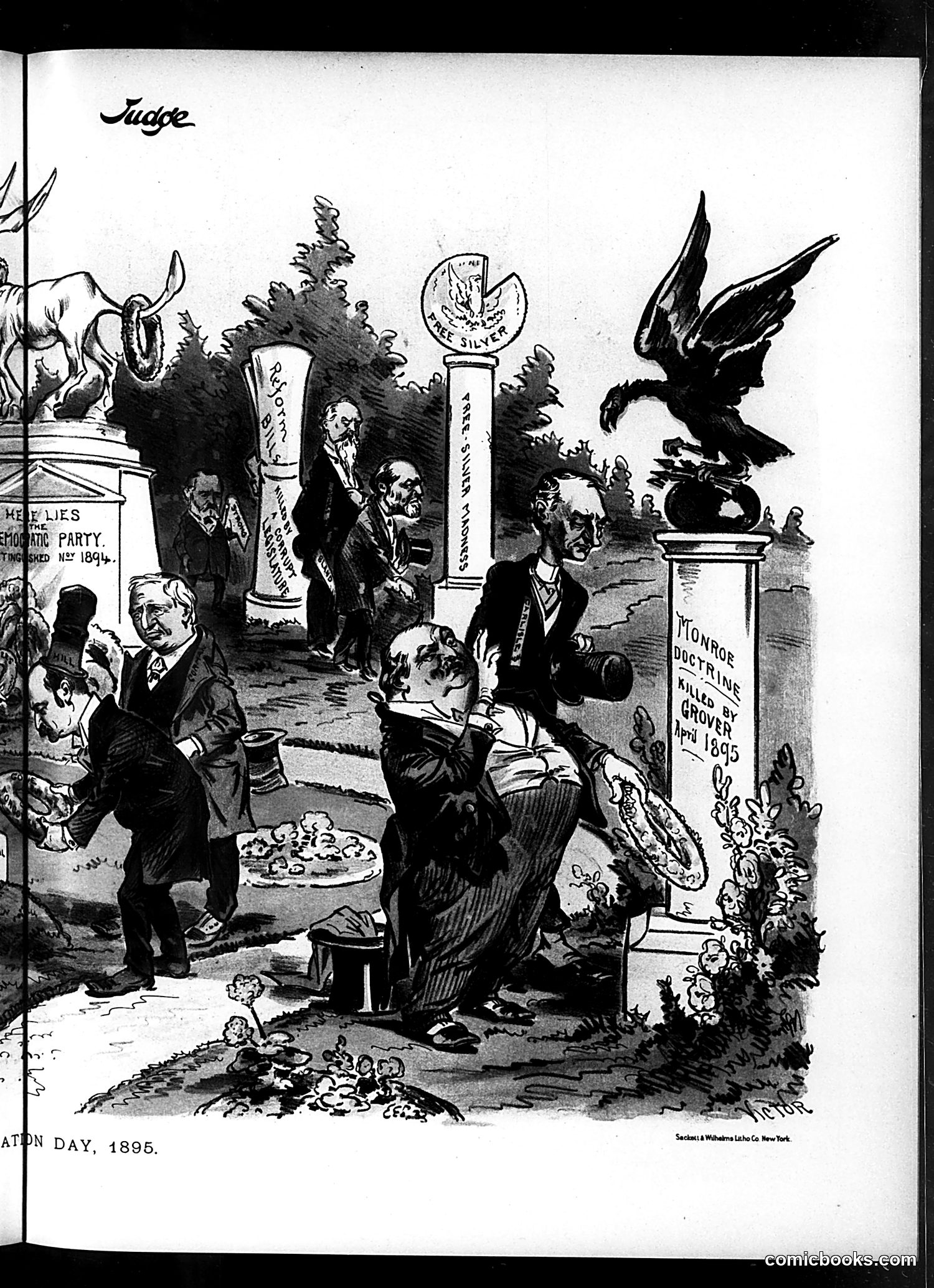
This Judge magazine cartoon from 1895 depicts what appears to be a cemetery or monument scene, likely referencing Decoration Day (now Memorial Day). The setting shows multiple gravestones and monuments, including visible inscriptions like "Monroe Doctrine" and references to "Silver." The cartoon appears to satirize American political factions visiting monuments to deceased political movements or ideologies. The various well-dressed figures suggest politicians or party leaders paying respects to—or perhaps mockingly acknowledging—defunct political causes. The eagle perched above suggests American authority or judgment over these matters. The satire likely critiques political parties' nostalgia for outdated positions, or perhaps disputes over which historical movements deserve remembrance. Without clearer identification of specific figures, the exact political targets remain uncertain, though the "Silver" reference suggests debate over currency policy from that era.
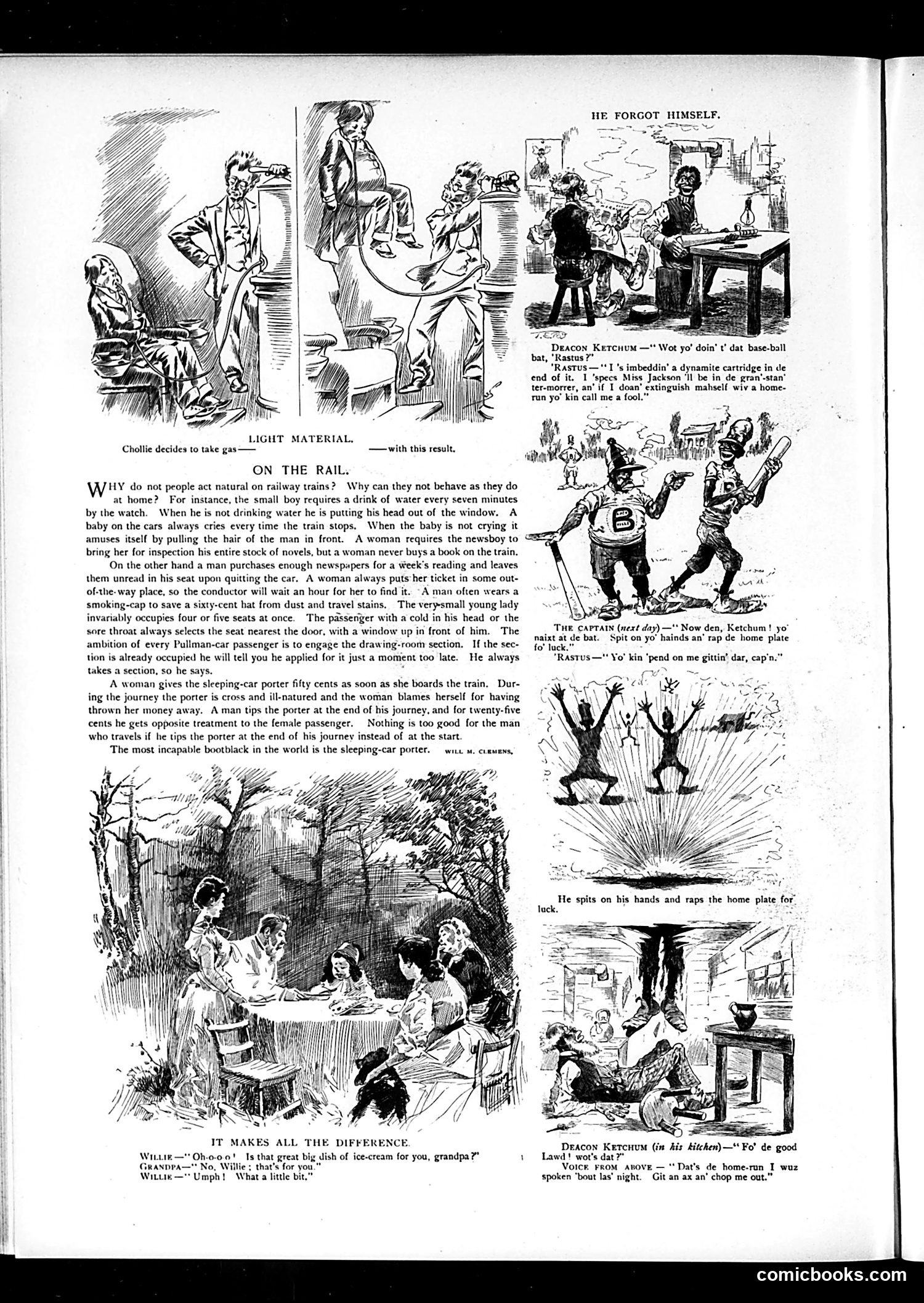
This page contains three distinct humorous pieces: **"On the Rail"** is an essay-cartoon hybrid satirizing peculiar passenger behavior on trains. Written by Will M. Clemens, it catalogs how people abandon normal etiquette aboard railways—children drink constantly, babies cry and pull hair, women can't find their tickets, men waste newspapers, and sleeping-car porters mysteriously become incompetent. The accompanying illustrations show exaggerated passenger misbehavior. The satire critiques how transportation temporarily suspends social norms. **"It Makes All the Difference"** is a brief joke about a grandfather and grandson's ice cream portions—playing on generational stinginess. **"He Forgot Himself"** uses racial caricature and dialect to depict a Black baseball player ('Rastus) who places dynamite in his bat intending to hit a home run so powerful it kills Miss Jackson in the stands. When he actually hits one, the explosion occurs mid-swing. The "joke" relies on grotesque stereotyping typical of Judge's era.
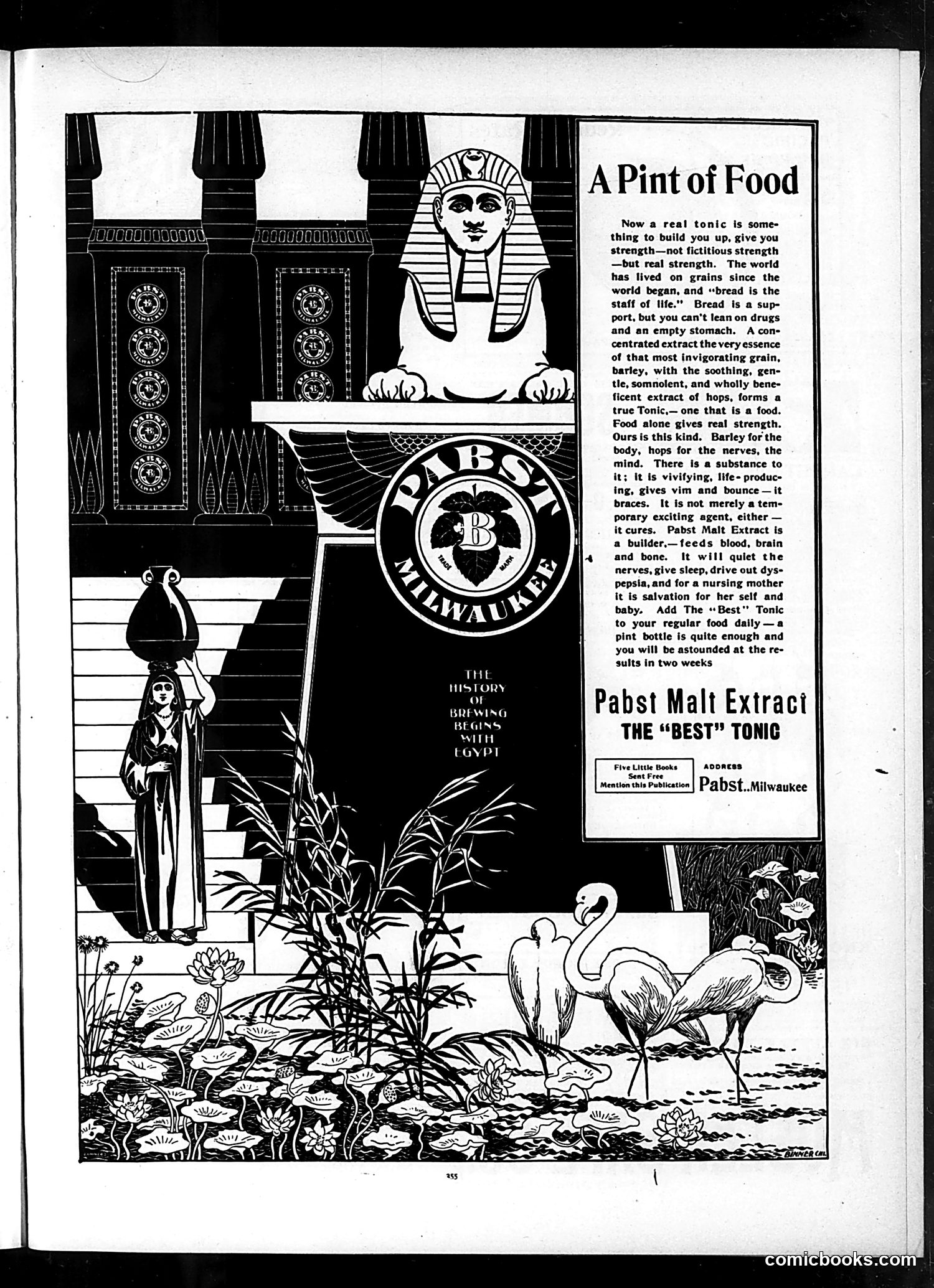
This is primarily a **product advertisement** for Pabst Malt Extract, not political satire. The page uses Egyptian imagery—a pharaoh, pyramids, and exotic birds—as decorative Orientalism to suggest ancient wisdom and timelessness, positioning the product as fundamentally sound. The ad claims Pabst Malt Extract is nutritious "food" rather than mere medicine, made from barley and hops. It promises real strength for the body and nerves, and claims benefits for nursing mothers and those with digestive problems. The text explicitly rejects "drugs and empty stomach" remedies, positioning this extract as wholesome sustenance. The Egyptian setting appears chosen for visual appeal and to evoke durability—like the pyramids have endured, so will this product's benefits. There's no clear political message; this is straightforward early-20th-century advertising using pseudo-scientific health claims and exotic aesthetic appeal.
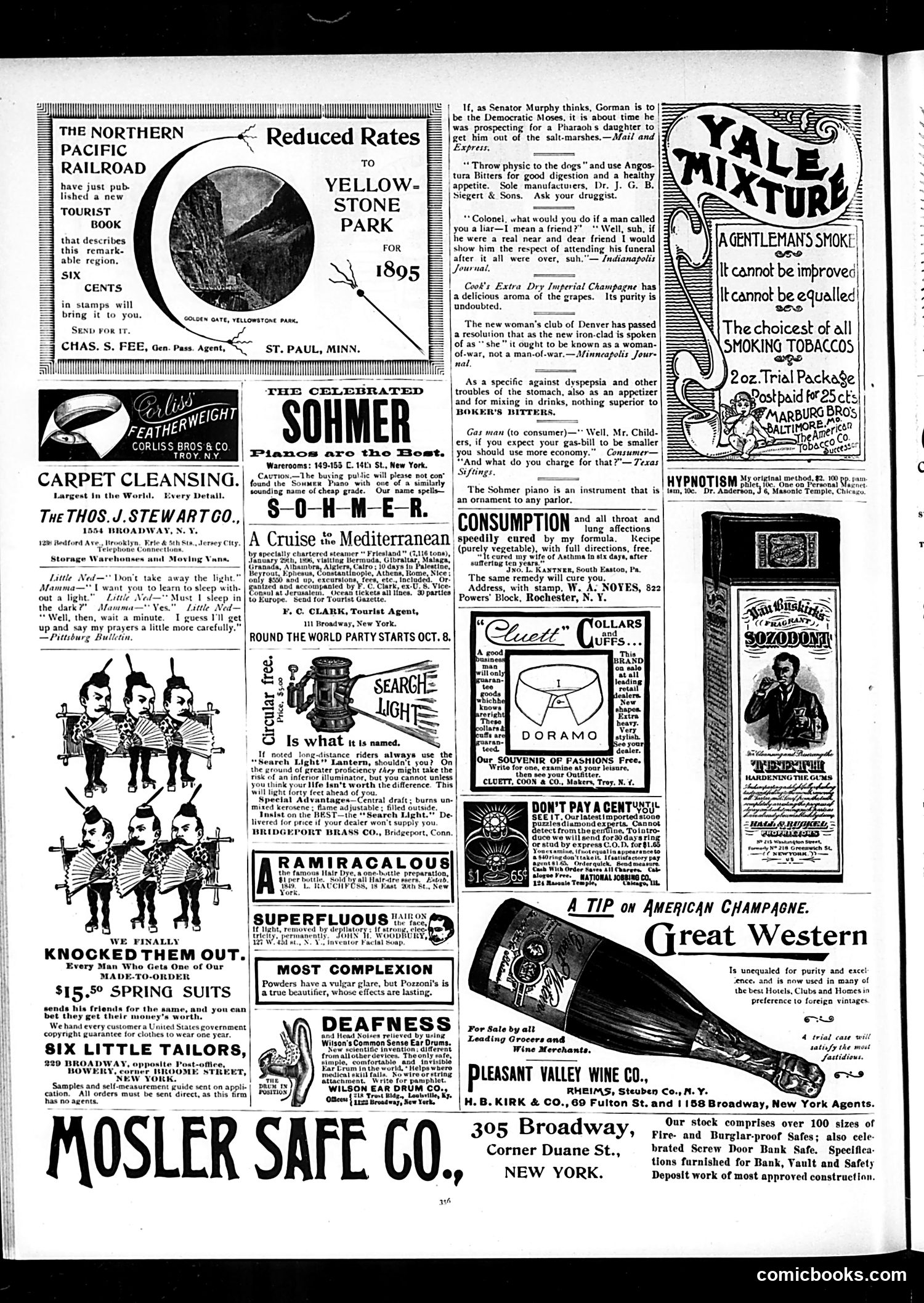
This is primarily an **advertising page** from Judge magazine (circa 1895), with several satirical items embedded among commercials for carpets, pianos, tailors, and patent medicines. The main cartoon humor appears in brief joke snippets: - A **political jab** at Senator Murphy and Democrat Arthur Gorman, likening Gorman to Moses searching for a "Pharaoh's daughter" to rescue him from "salt-marshes"—meaning political obscurity or defeat. This references 1890s Democratic Party leadership conflicts. - A **woman's club joke** from Denver about the new battleship USS *Ironclad* being called "she," so it should be termed "woman-of-war" instead of "man-of-war"—satirizing the era's emerging "New Woman" movement and women's groups. - A domestic joke about a child learning to sleep without light. The page otherwise showcases typical 1890s quack remedies (Angostura Bitters for digestion, deafness cures, consumption treatments) and consumer goods, representing how Judge mixed satirical content with period commercial advertising.
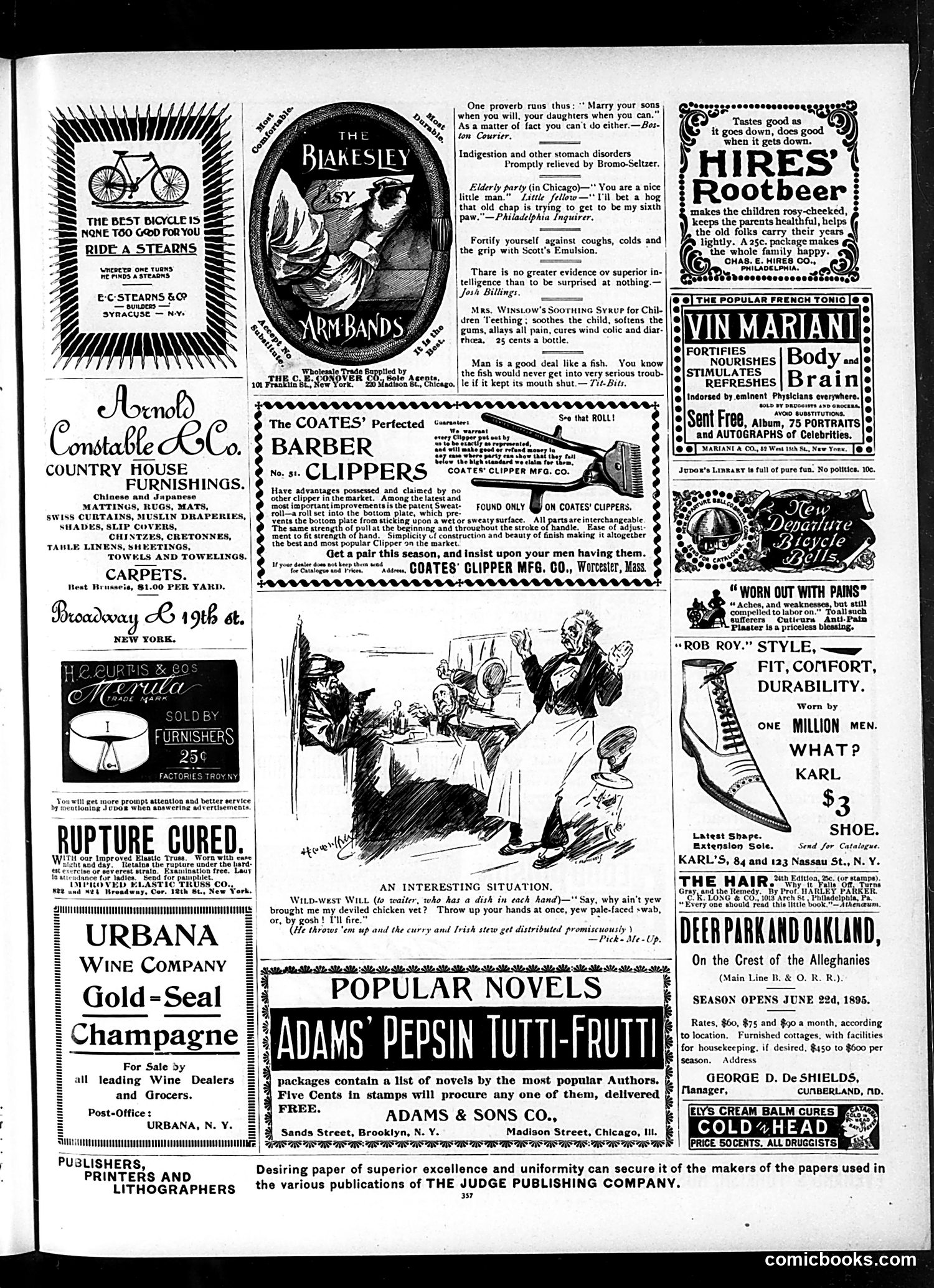
This page is primarily **advertisements and filler content** rather than political satire. The main cartoon—titled "An Interesting Situation"—depicts a Wild West scenario: a rough cowboy threatens a waiter carrying dishes, demanding his deviled chicken and ordering him to "throw up your hands." The joke relies on the waiter literally obeying ("throws 'em up"), causing the food to spill everywhere. The humor is straightforward slapstick—a play on the ambiguous command "throw up your hands"—rather than political commentary. The rest of the page consists of period product advertisements: bicycles, furniture, wine, hair products, shoes, and medical remedies (rupture cures, digestive aids). Small aphorisms and jokes appear between ads, offering generic wisdom about marriage, fish-keeping, and silence. **No significant political or social satire is present.** This appears to be a standard advertising-heavy magazine page from the early 1900s.
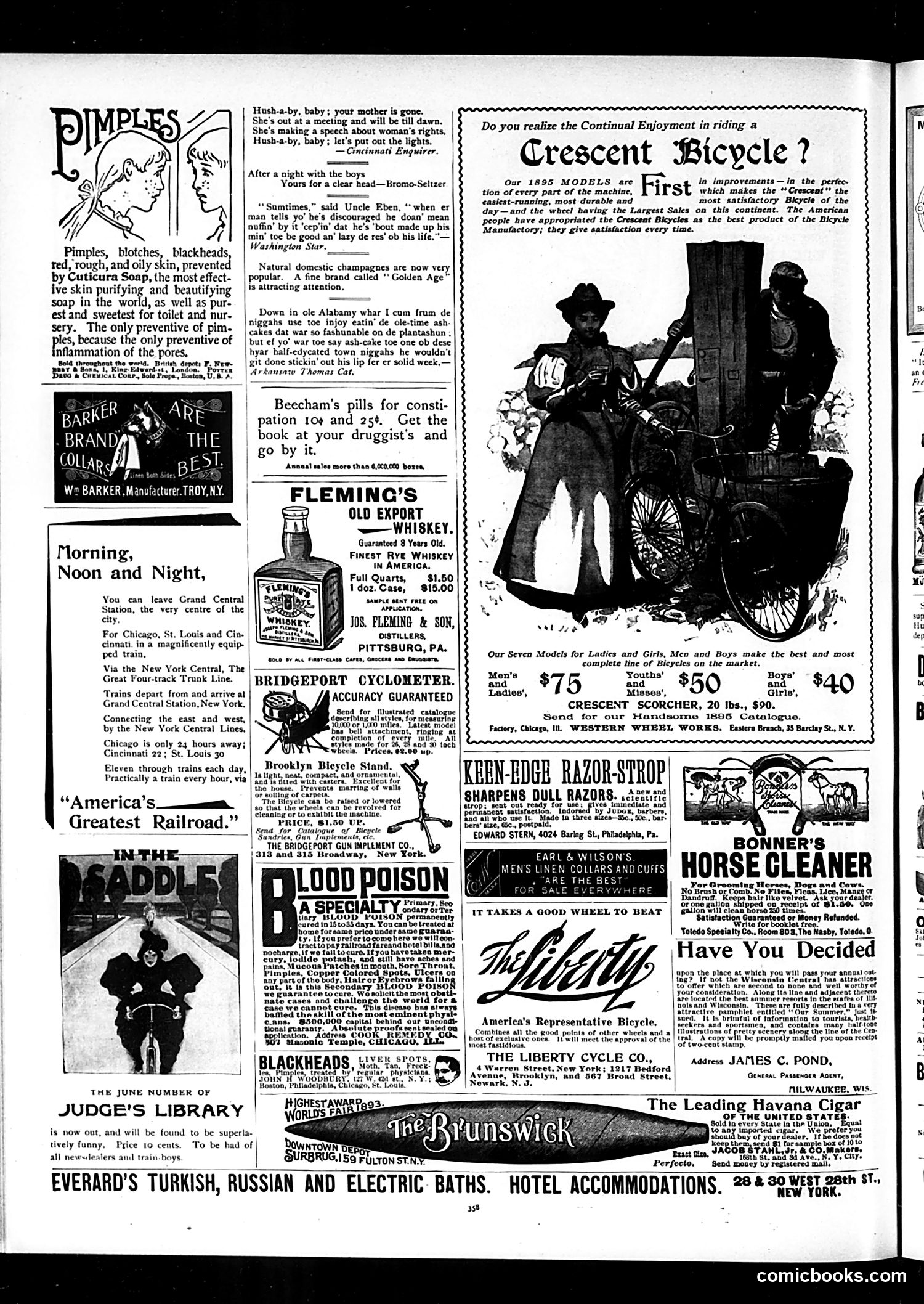
This page is primarily **advertising**, typical of Judge magazine's revenue model. The content mixes period product ads (bicycles, whiskey, patent medicines) with brief humorous dialect pieces. The illustrated cartoons appear minimal on this page. The notable satirical content consists of short, racist dialect humor pieces attributed to "Uncle Eben" and "Arkansaw Thomas Cat"—stock characters from 1890s American humor. These pieces mock African American speech patterns while offering crude social commentary (one jokes about a wife attending women's rights meetings neglecting her baby). The dominant content showcases the **Crescent Bicycle** prominently featured with an illustration of cyclists, reflecting the bicycle boom of the 1890s. Other advertisements tout patent medicines (Beecham's pills, blood poison cures), railroad services, and whiskey. The satire here is gentle and product-focused rather than politically sharp—typical of Judge's approach to generating both entertainment and advertising revenue during this period.
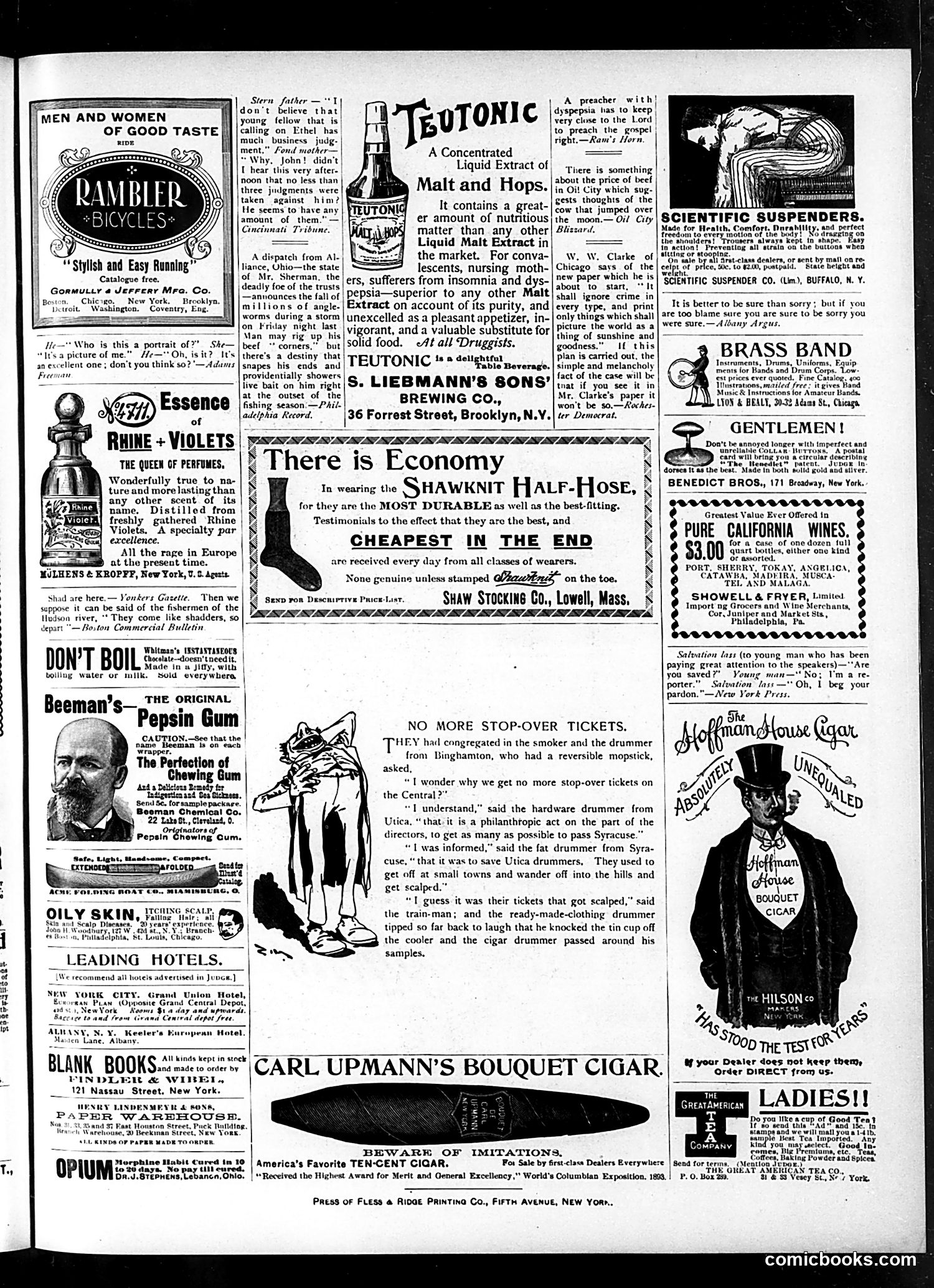
This page is primarily **advertising**, with small satirical elements typical of Judge magazine's format. The main cartoon depicts a dialogue between a stern father and young couple, satirizing Victorian courtship anxieties—the father worries the young man has "dyspepsia" (indigestion), which the mother dismisses as irrelevant to calling on the girl "Ethel." The page is dominated by product advertisements for patent medicines and consumer goods common to the 1890s-1900s era: Teutonic Malt Extract (marketed as medicinal for nursing mothers and the infirm), Beeman's Pepsin Gum, Scientific Suspenders, and Shawknit Half-Hose. These reflect period obsessions with digestive health and "scientific" solutions to everyday problems. One brief item mocks a Ohio newspaper editor's pledge to ignore crime reporting—satirizing the pretentiousness of certain editorial stances. The page illustrates how Judge blended satirical commentary with revenue-generating advertisements targeting middle-class consumers concerned with health, respectability, and modern conveniences.
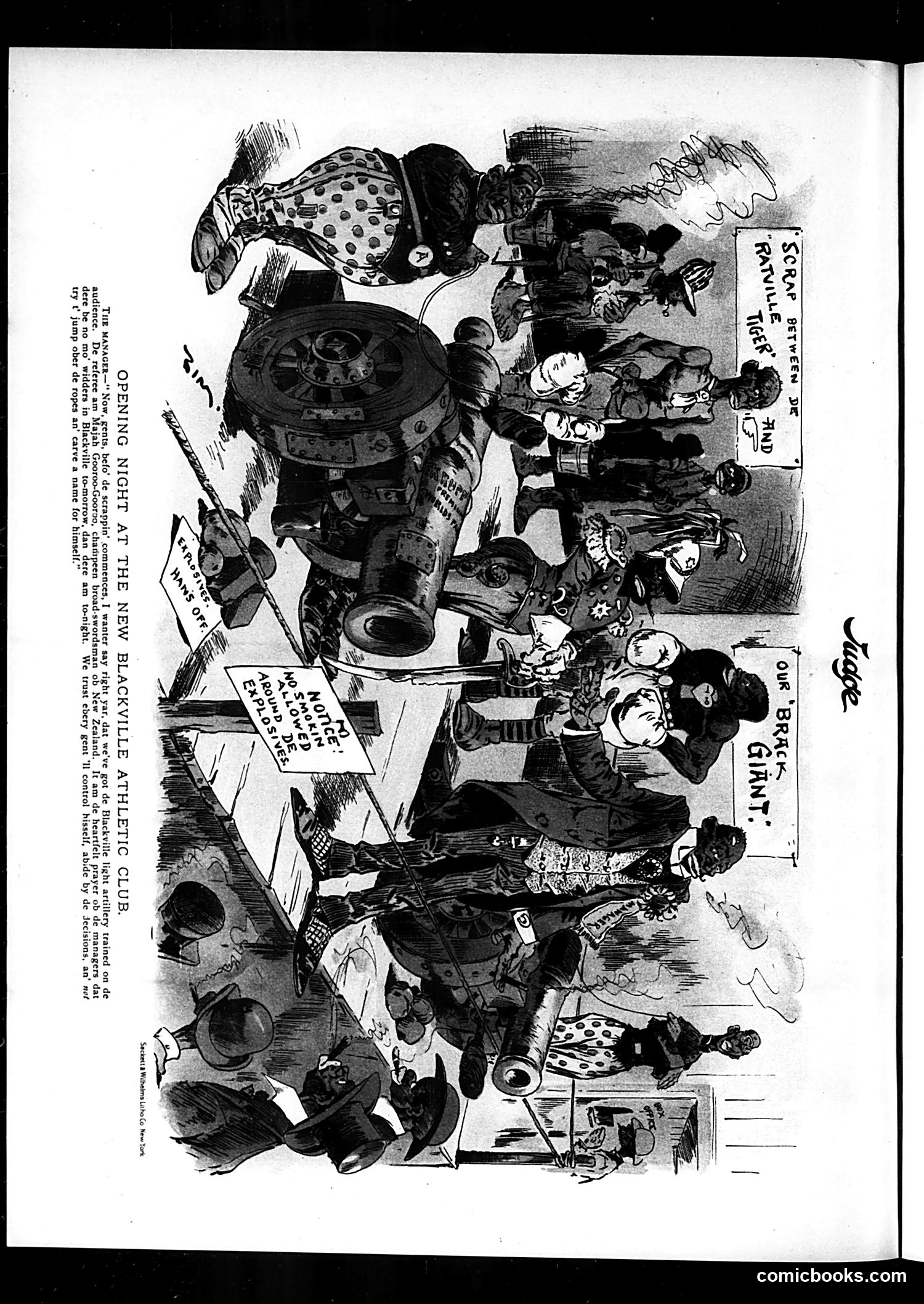
This is a satirical cartoon mocking a boxing match in a fictional African American community called "Blackville." The page depicts a fight announcement with exaggerated dialect and stereotypical caricatures typical of late-19th/early-20th-century minstrel-style humor. The manager announces the bout between fighters labeled "our Brack Giant" and "Brack Grant," with a New Zealand referee. The satire targets both the spectacle of prize fighting and uses offensive racial caricatures and dialect common to Judge magazine's era. The manager's warning about widows—suggesting previous fights were fatal—is the satirical "joke," implying violence and chaos in the depicted community. This reflects period attitudes using dehumanizing stereotypes for comedic effect. The cartoon represents problematic historical attitudes toward African Americans that modern readers should recognize as racist satire.