
A complete issue · 16 pages · 1895
Judge — May 4, 1895
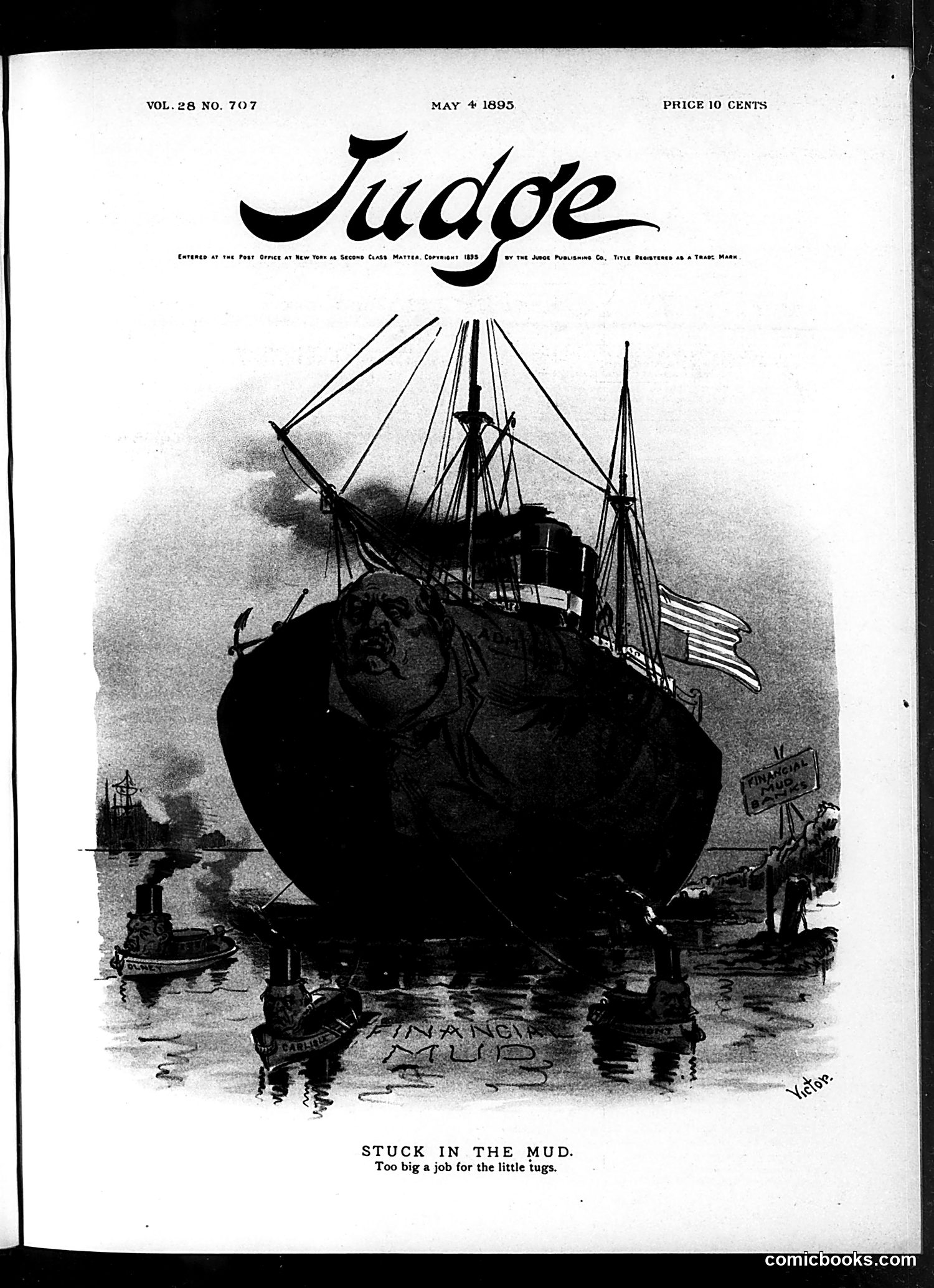
This political cartoon depicts a large ship heavily laden with cargo, stuck in shallow mud. The caption reads "Too big a job for the little tugs," suggesting the vessel represents a major political or economic issue too substantial for available resources to handle. The ship displays an American flag, and the composition—with small tugboats attempting to move an enormous stuck vessel—uses maritime imagery as metaphor. This likely comments on a specific 1895 crisis or policy challenge the Cleveland administration or Congress faced: a situation deemed too large or complex for existing institutions or political will to resolve. The exact reference is unclear without additional context, though 1895 involved economic depression and labor tensions. The satire mocks inadequate governmental response to an overwhelming problem.
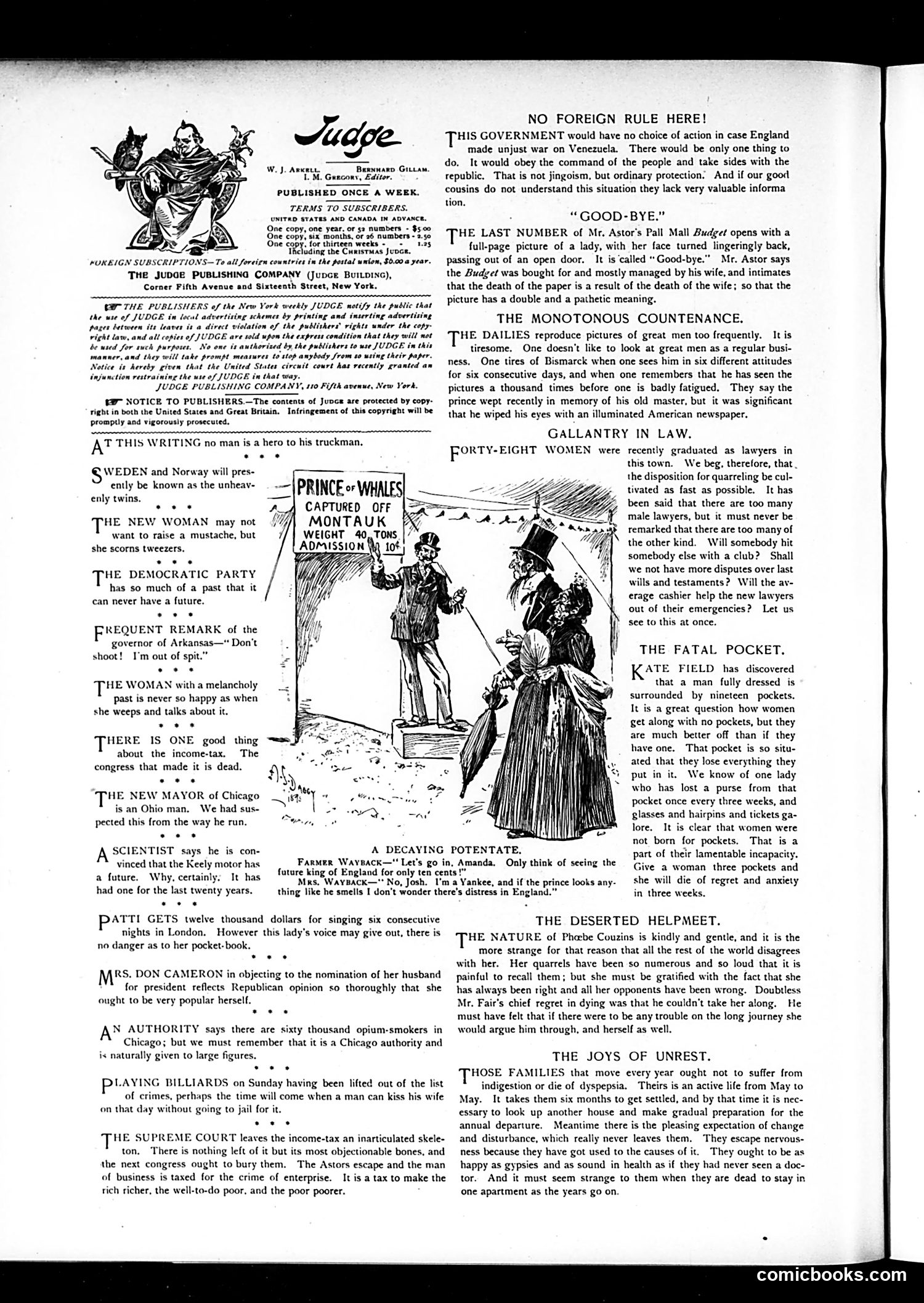
The main cartoon, "A Decaying Potentate," depicts a wealthy farmer character speaking to a woman named Amanda about seeing "the future king of England for only ten cents." The accompanying dialogue suggests this is satirical commentary on British royalty's perceived decline or diminished prestige. The accompanying text sections are satirical commentary on American social and political issues, including remarks about women lawyers, pocket usage, and frequent moving. The tone is typical of Judge magazine's turn-of-the-century humor—sometimes acerbic social observation mixed with lighthearted jabs at contemporary customs and institutions. Without clearer identification of the specific royal figure referenced or the precise historical moment, the exact political target remains somewhat unclear, though the cartoon appears to mock British aristocratic authority.
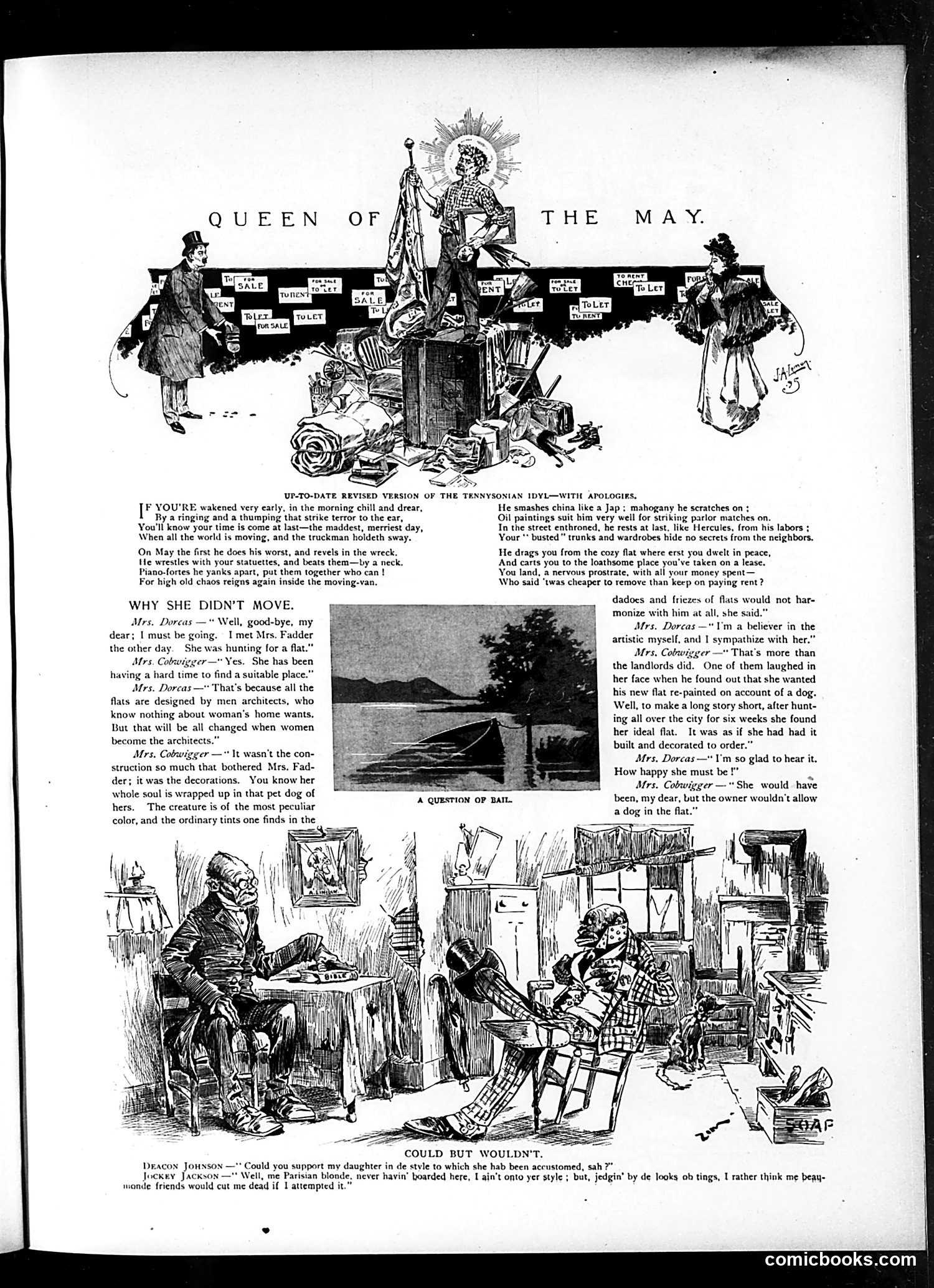
This Judge magazine page satirizes women's housing challenges in early 20th-century America. The title illustration depicts a woman enthroned as "Queen of the May," surrounded by landlords displaying "VACANT" signs—mocking how difficult women found securing suitable apartments. The dialogue section "WHY SHE DIDN'T MOVE" features Mrs. Dorset and Mrs. Cohaggier discussing flat-hunting. The satire centers on architectural and social prejudices: male architects design flats without considering women's needs, and landlords discriminate against female tenants, particularly regarding pets and respectability. The bottom cartoon humorously shows landlords rejecting tenants over minor concerns (a dog in the flat), highlighting the absurdity of housing discrimination against women.
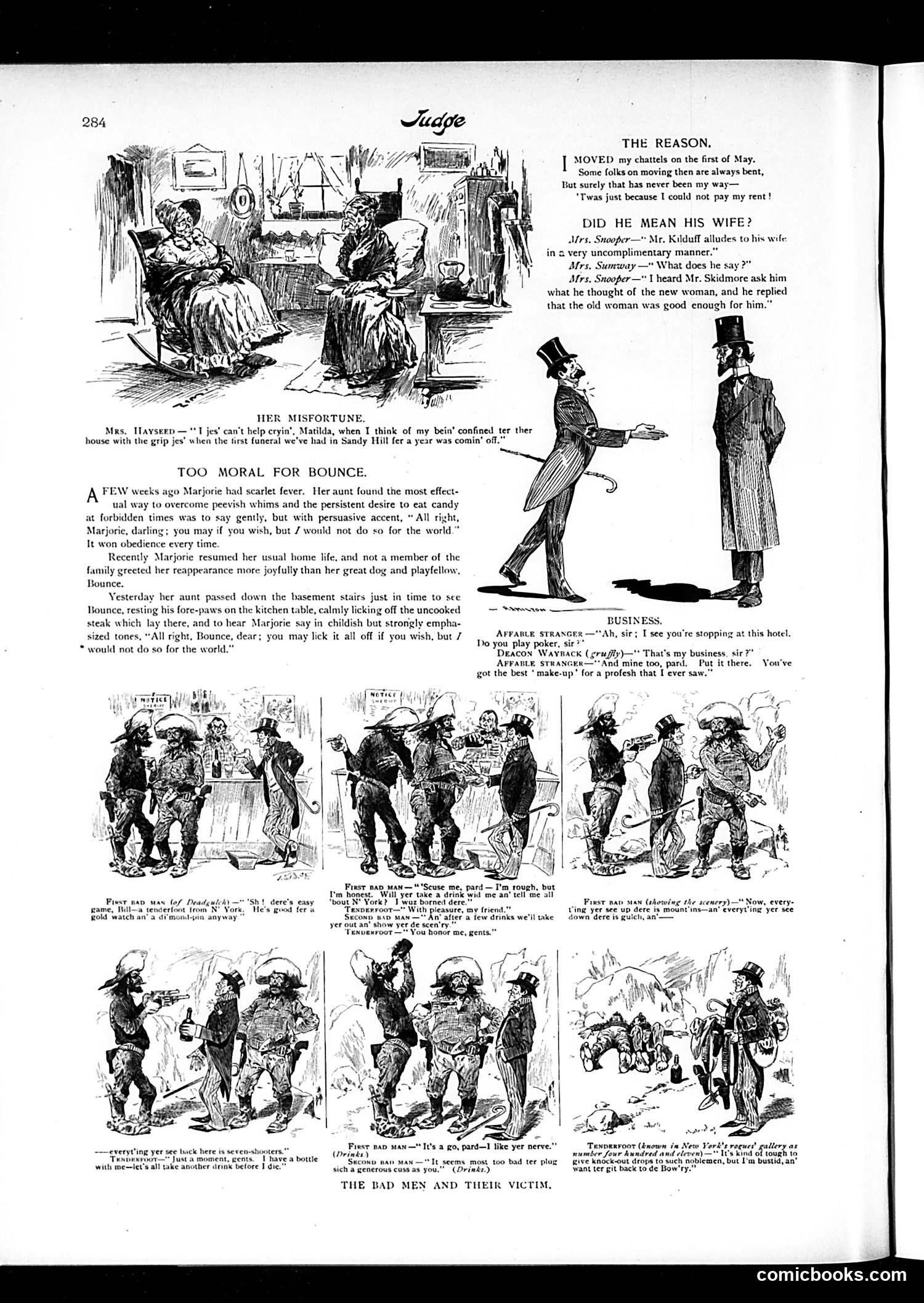
This page contains multiple short humorous pieces satirizing American social life circa early 1900s: **"The Reason"** mocks working-class financial struggles—a tenant admits moving on May 1st only because he couldn't pay rent, not by choice. **"Did He Mean His Wife?"** plays on marital discord: a husband's compliment about a "new woman" is revealed as backhanded praise for his current wife's adequacy. **"Too Moral for Bounce"** satirizes excessive moral instruction: a child mimics her aunt's persuasive phrasing ("I would not do so") while letting the dog eat raw steak, showing the method's absurd results. **"Business"** and the bottom strips mock the "tenderfoot" (naive Easterner) arriving in the Wild West. Con artists pose as friendly locals, plying him with drinks before robbing him—a stock satirical scenario about rural criminality and urban gullibility. The overall theme: human folly across class and geography, from landlords to drunken schemers.
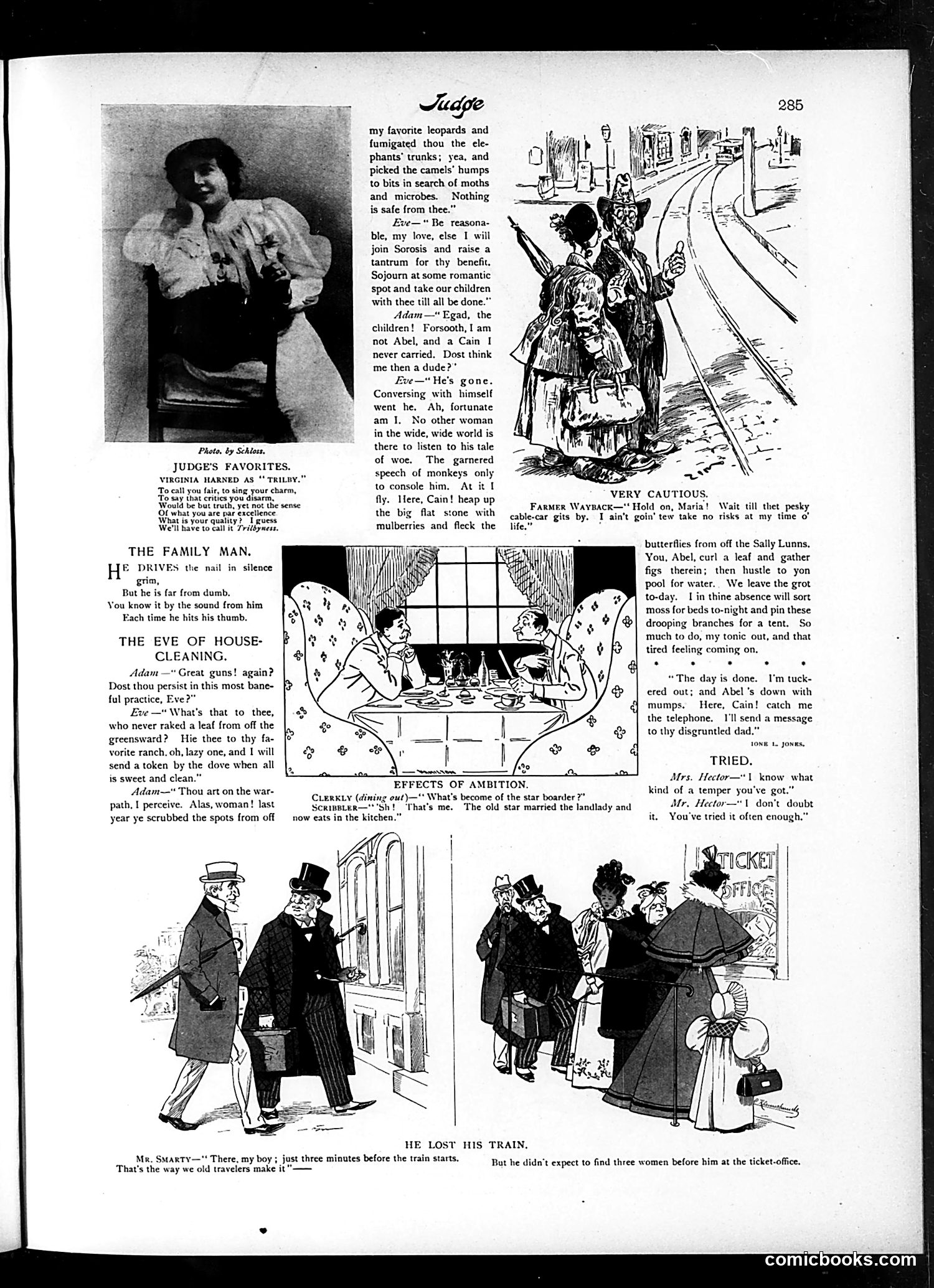
This page from Judge magazine contains several satirical cartoons and humorous sketches typical of late-19th/early-20th century American humor: **"Judge's Favorites"** features Virginia Harned, an actress, praised for her embodiment of the character "Trilby"—a popular theatrical role of the era. **"The Family Man" and "The Eve of House-Cleaning"** use Adam and Eve as archetypes to satirize marital dynamics, with the wife threatening to join "Sorosis" (a women's club) if her husband doesn't comply with her demands. The joke targets both domestic conflict and emerging women's organizations. **"Effects of Ambition"** jokes that a clerk's social ambition (marrying the landlady) resulted in his demotion from dining room to kitchen. **"He Lost His Train"** mocks men's presumed superiority: Mr. Smarty boasts of his traveling efficiency, unaware three women already occupy the ticket office—suggesting women outmaneuver men despite their pretensions. The overall theme reflects period anxieties about changing gender roles and domestic power dynamics.
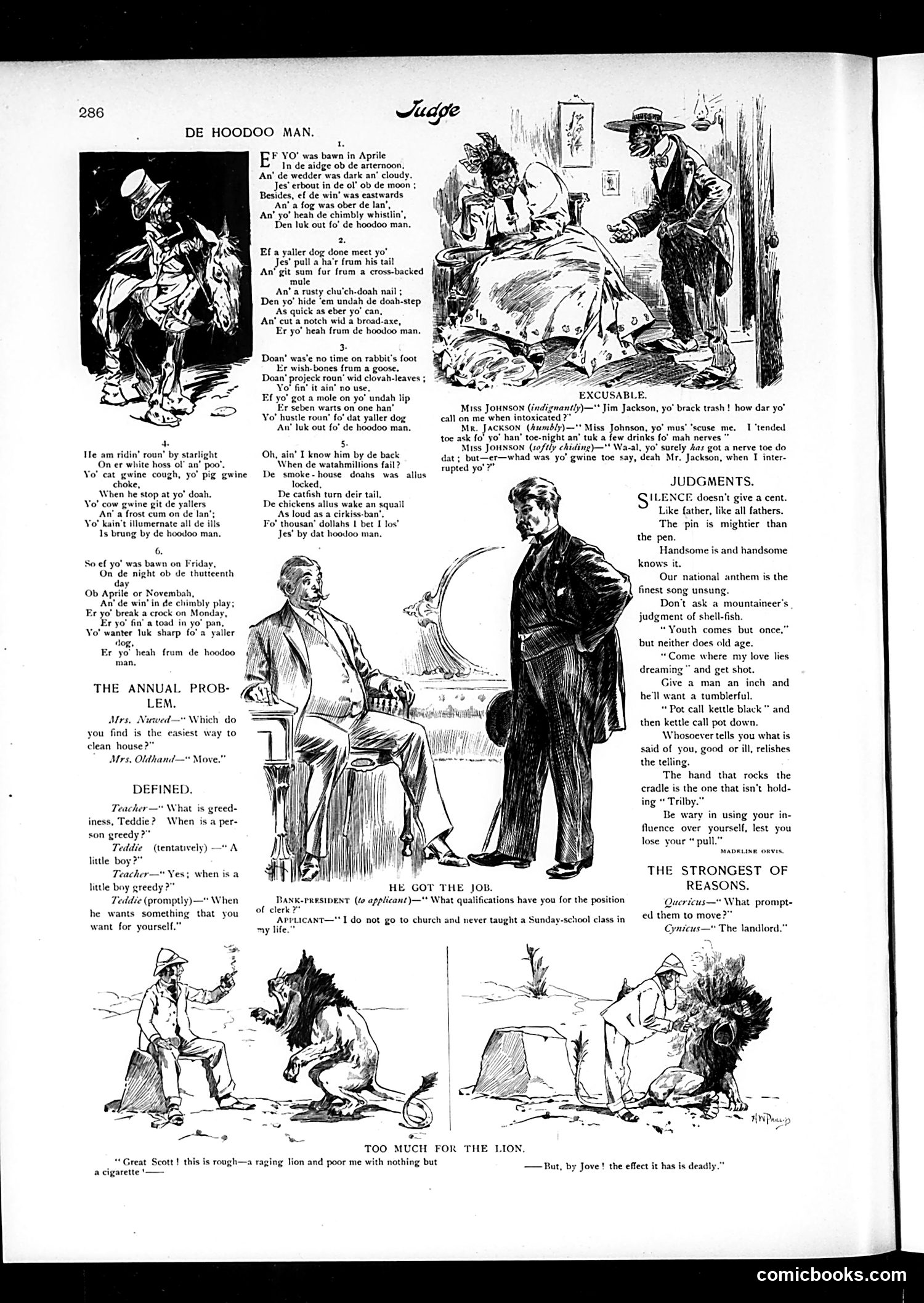
This page from *Judge* magazine features dialect-heavy humorous poetry and cartoons mocking African American folk beliefs and speech patterns, typical of late-19th-century American racist humor. **"De Hoodoo Man"** is a lengthy comic poem in exaggerated African American vernacular about superstitions—avoiding bad omens like being born in April during fog, performing protective rituals with mule hair and church nails, and fearing a mysterious "hoodoo man" who brings misfortune. The humor derives from stereotyping Black superstitious beliefs as ridiculous. The accompanying cartoons show racial caricatures and separate domestic/workplace humor: "Excusable" depicts a drunk Black man apologizing to a woman; "He Got the Job" shows a man hired for church attendance; "Too Much for the Lion" depicts a man with a rifle facing a lion. The "Judgments" section and smaller jokes provide general social commentary unrelated to race. The page represents *Judge*'s casual deployment of racial stereotypes as entertainment for its white audience.
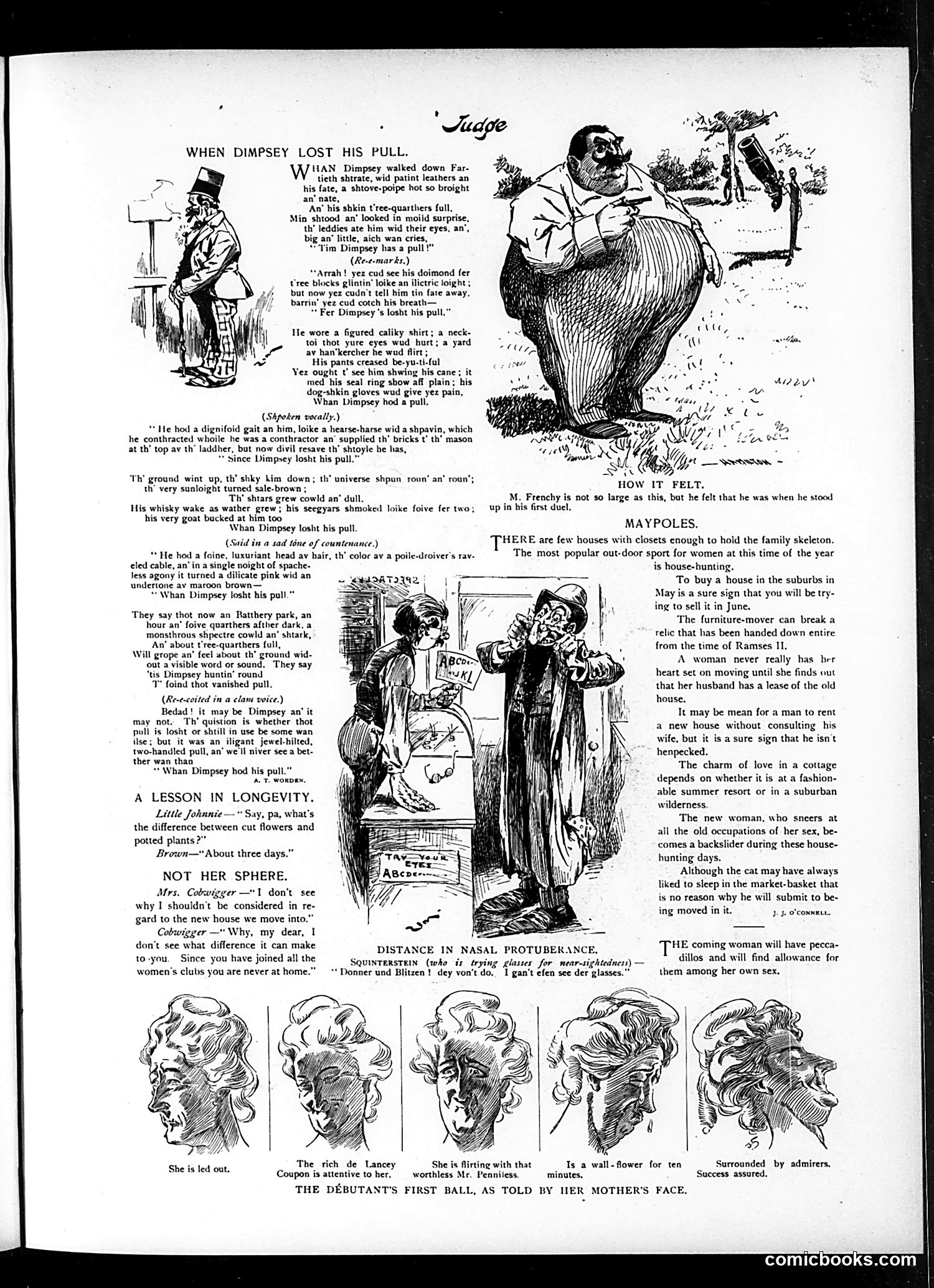
This page satirizes Irish-American working-class aspirations and the fragility of social status. The main narrative poem mocks "Dimpsey" (an Irish character, indicated by phonetic dialect spelling), who once had visible wealth and influence—a "pull" or connection that granted him social standing and material success. The humor centers on his dramatic fall from grace. When employed as a contractor supplying bricks, he dressed fashionably and commanded respect. Now jobless, he's reduced to a phantom haunting Battery Park, searching for his lost status. The satire suggests that Irish-American prosperity was often precarious, dependent on patronage rather than sustainable wealth. The accompanying illustrations and shorter pieces ("Maypoles," "Not Her Sphere") offer broader social commentary on house-hunting, women's roles, and domesticity, typical of Judge magazine's mix of ethnic humor and genteel social observation. The dialect spelling throughout—"shtrate," "t'ree-quarthers," "shkin"—reinforces period stereotypes about Irish immigrants.
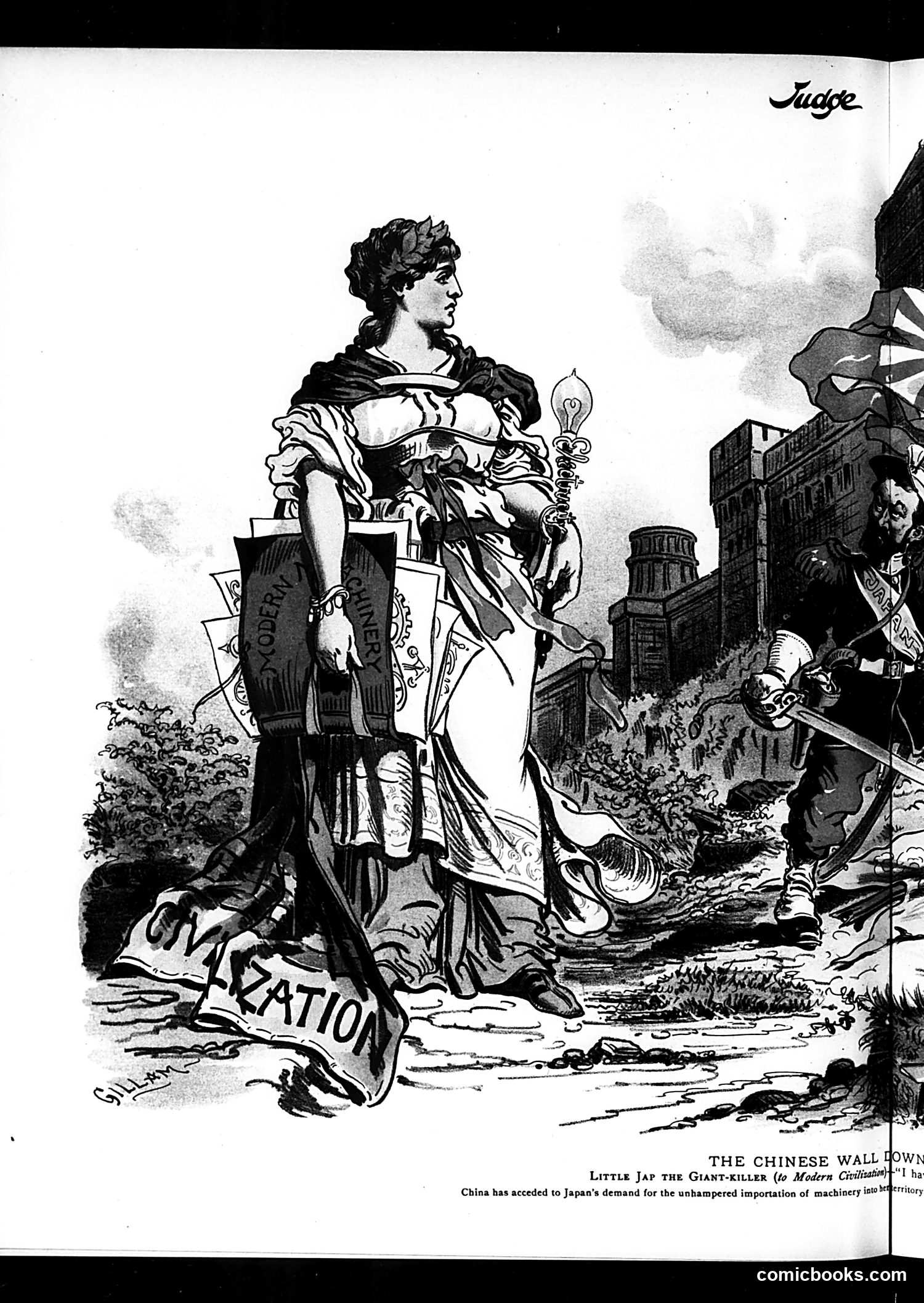
This Judge magazine cartoon satirizes early 20th-century Japanese imperial expansion. The central allegorical figure represents "Modern Civilization" (dressed classically, holding a scepter), appearing weakened or compromised. The caption identifies "Little Jap the Giant-Killer"—depicting Japan as a small but aggressive power defeating larger obstacles. The cartoon critiques China's forced concession allowing Japan unrestricted machinery imports into Chinese territory, presented as an example of Japanese imperial pressure on a weakened China. The "Chinese Wall" reference invokes the historical barrier, now symbolically "down," suggesting China's traditional isolationist defenses have been breached. The satire mocks both Japan's aggressive tactics and the erosion of Chinese sovereignty, framing this as a troubling moment in "Modern Civilization's" development—where military might overrides established international order.
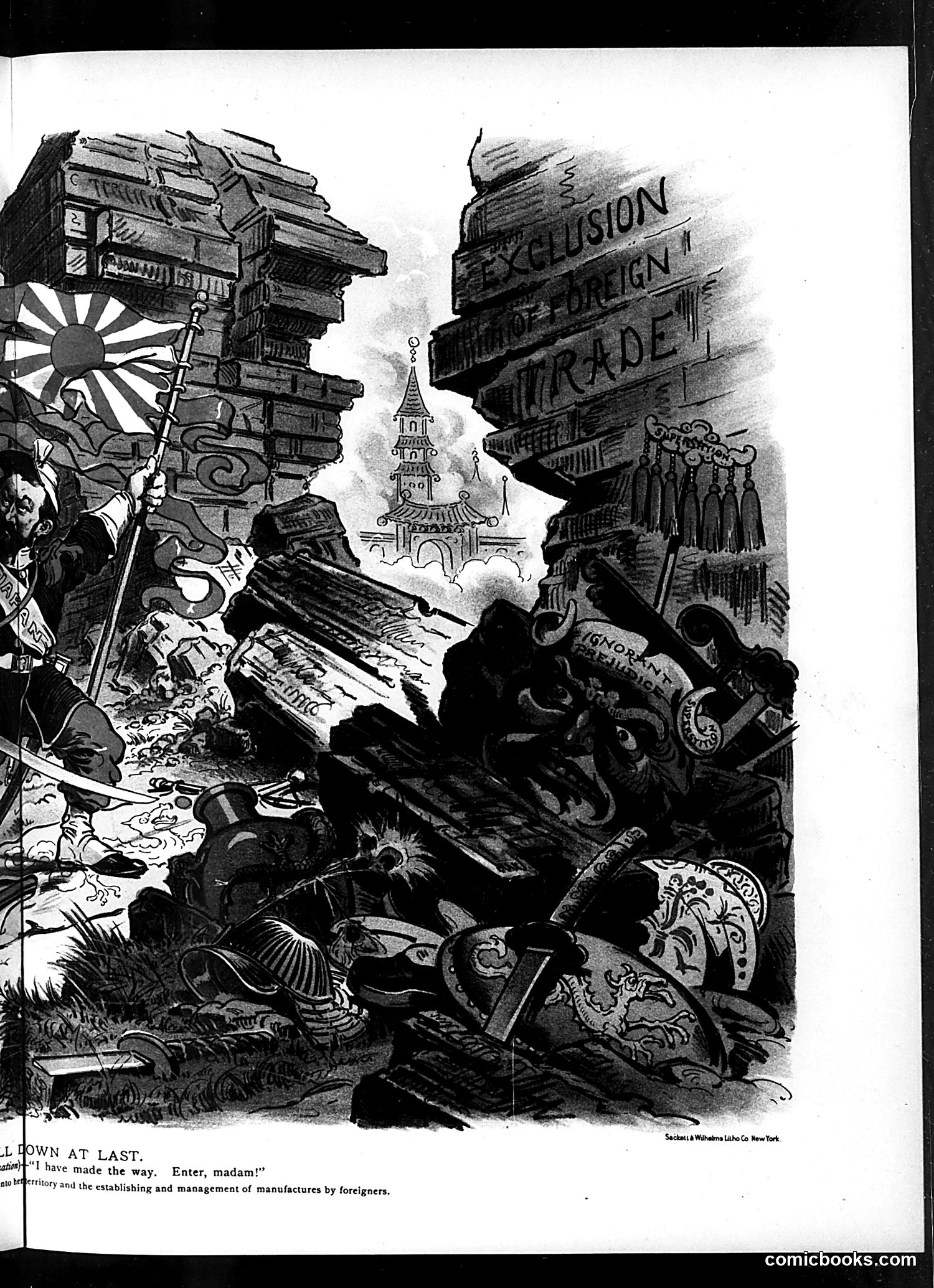
This cartoon depicts the collapse of Japan's imperial ambitions, likely from the post-World War I era. The towering stack on the right—labeled "EXCLUSION," "FOREIGN TRADE," and similar phrases—represents Japan's expansionist policies crumbling down. The central Asian pagoda symbolizes Japan itself. On the left, a figure labeled with Japanese imperial symbols lies defeated. The text references "I have made the way. Enter, madam!" and mentions "territory and the establishing and management of manufactures by foreigners"—suggesting Japan's forced opening to Western economic influence and foreign control. The cartoon satirizes Japan's geopolitical defeat, presenting it as a humbling comedown from imperial pretensions. The feminine "madam" likely refers to Western powers asserting dominance over Japanese sovereignty and economic autonomy.
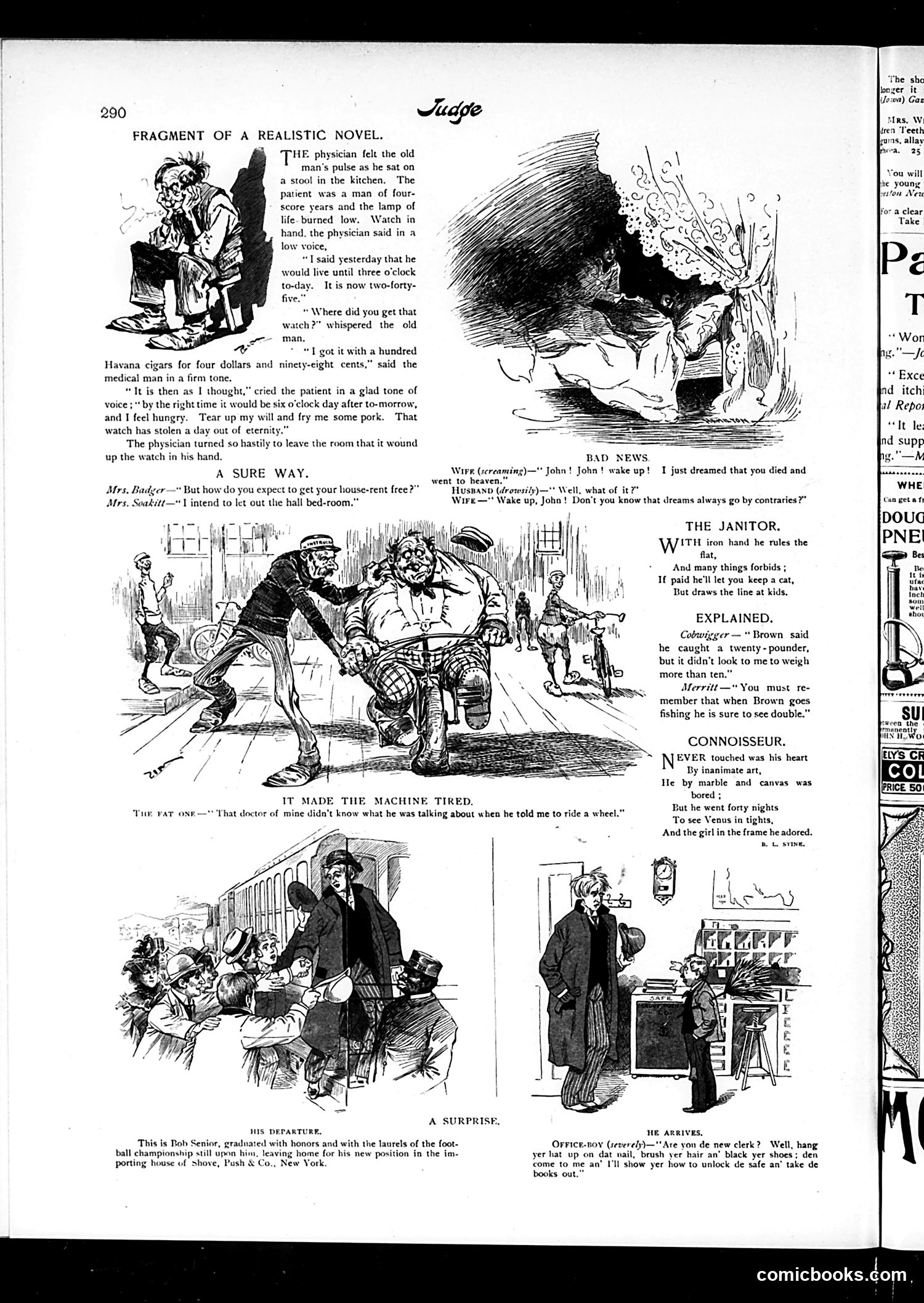
This page contains multiple brief satirical sketches typical of late 19th-century American humor magazines: **"Fragment of a Realistic Novel"** mocks medical pretension: a doctor predicts a patient's death to the hour, then admits he obtained his fancy watch through dubious means (trading Havana cigars worth $4.98). The joke satirizes both inflated medical confidence and consumer fraud. **"A Sure Way"** is a domestic joke about a wife renting out the hallway bedroom to avoid paying rent—absurd logic presented deadpan. **"It Made the Machine Tired"** ridicules a man whose doctor recommended bicycle-riding for health; he misunderstood the advice. **"Bad News"** and **"A Surprise"** are brief marital humor pieces playing on misunderstandings. **"The Janitor"** satirizes building superintendents' arbitrary petty rules and corruption (bribing them for permission). The remaining sketches offer mild social commentary on workplace dynamics, art snobbery, and office hierarchies. The humor relies on wordplay, class observations, and domestic situations recognizable to contemporary readers.
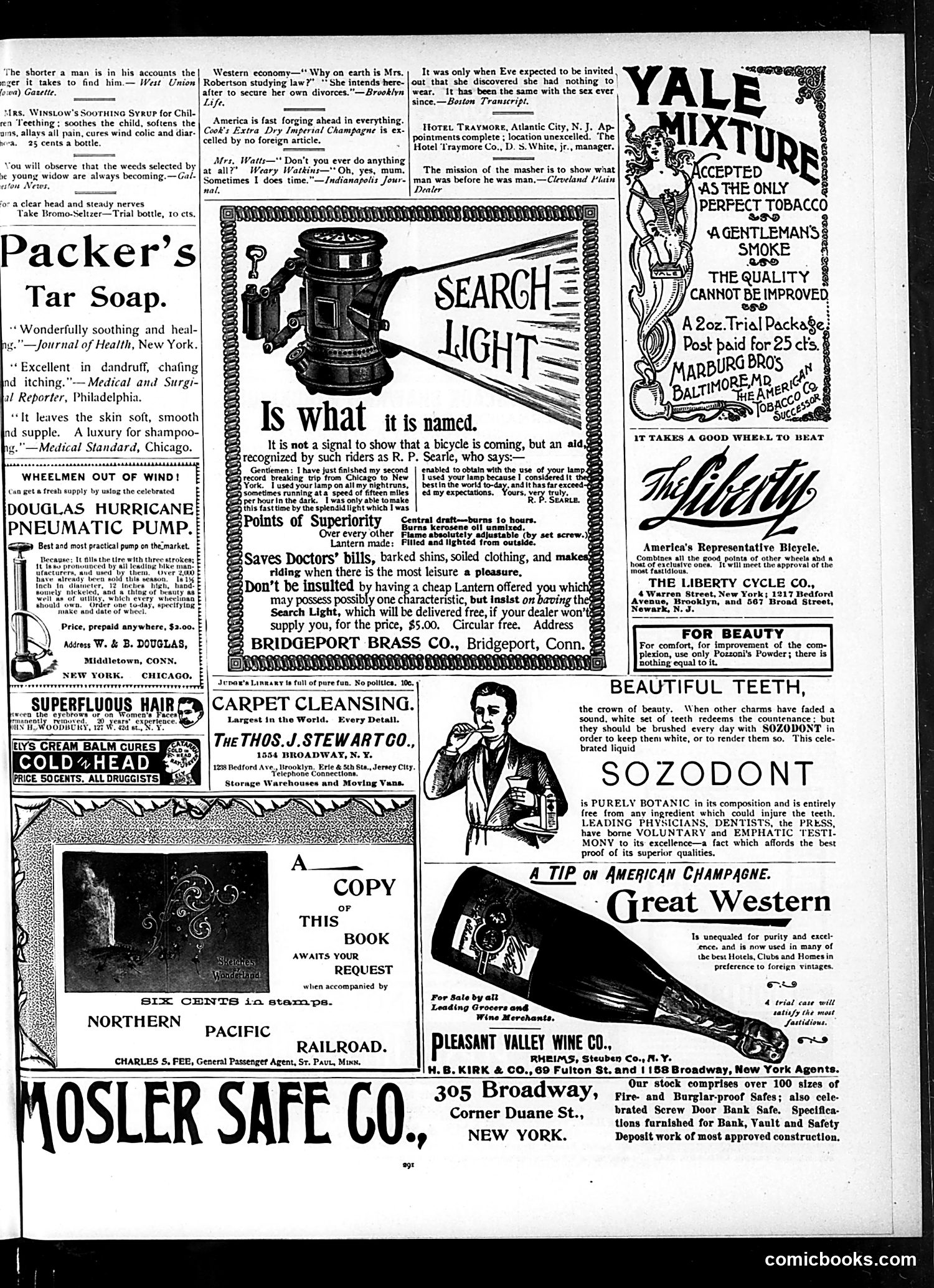
This page is primarily advertisements with brief humorous quotations interspersed—typical of Judge magazine's format. The satirical content includes: **Social commentary jokes**: On divorce ("Why on earth is Mrs. Robertson studying law?" because she wants to "secure her own divorces"), women's fashion anxiety, and male behavior (the "masher" is described as showing "what man was before he was man"). **The main cartoon/illustration** features a Search Light lantern for bicycles, with testimonial quotes from cyclists praising its superiority. This reflects the 1890s bicycle craze among the wealthy and middle class. The page otherwise consists of period product advertisements (Packer's Tar Soap, Bromo-Seltzer, Douglas Hurricane Pump, Liberty Cycle, Sozodont toothpaste), typical of late-Victorian consumer culture. No major political figures or events are referenced—it's entertainment and marketing aimed at Judge's affluent readership.
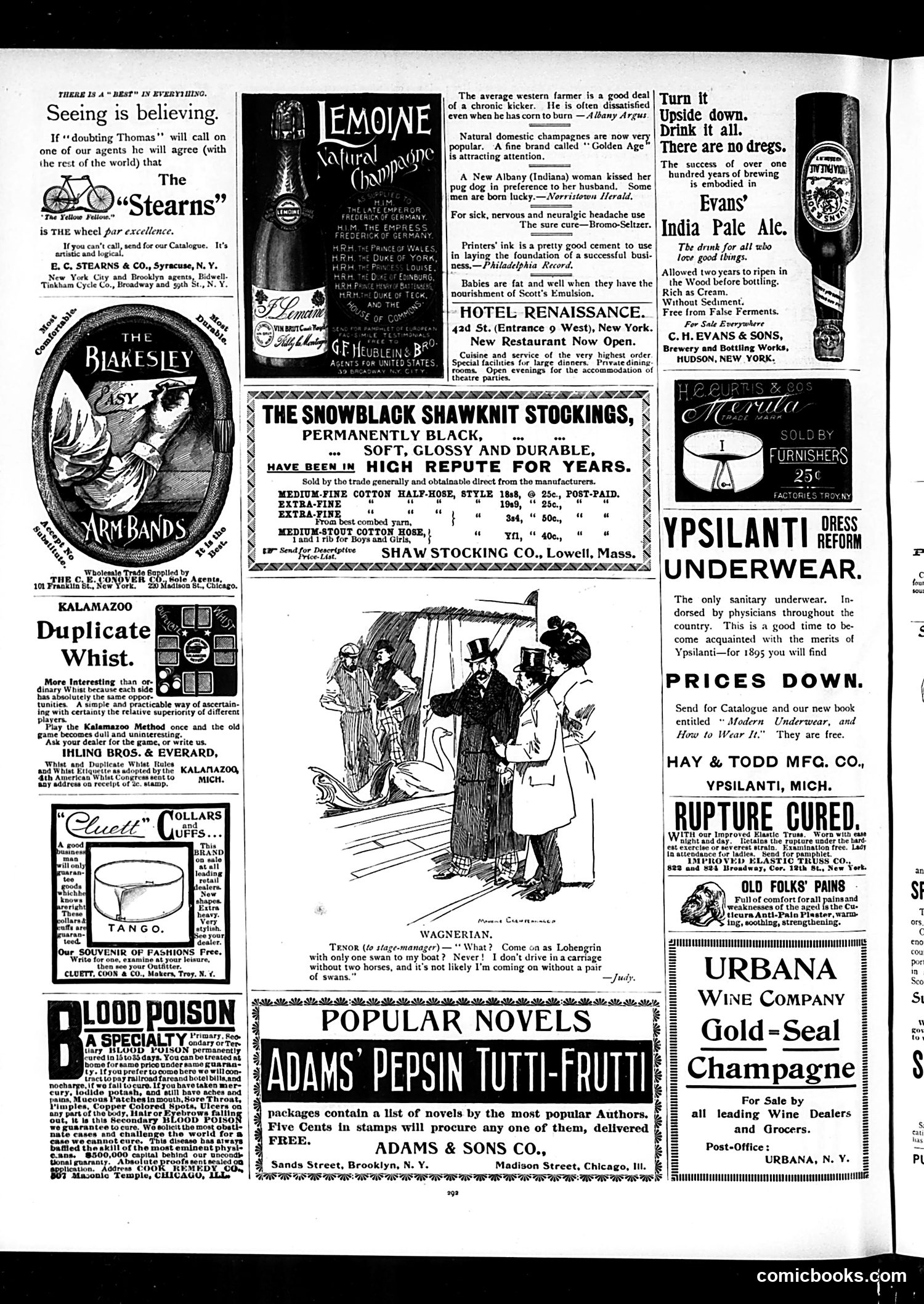
This page from *Judge* is primarily **commercial advertising** rather than editorial cartoon content. The notable satirical element appears in the small vignette titled "WAGNERIAN" at the bottom, which depicts an opera scene with a tenor character complaining about his carriage accommodations—a light social commentary on the pretensions of opera-goers and classical music culture. The bulk of the page comprises period product advertisements (bicycles, champagne, underwear, stockings, medical treatments) interspersed with brief humorous observations about rural farmers, domesticity, and marriage. These quips mock farmers as chronic complainers and husbands unfavorably compared to pets—typical turn-of-the-century domestic humor reflecting middle-class attitudes toward rural life and gender relations. The page reflects *Judge*'s satirical focus on American society through both targeted commentary and consumer culture mockery.
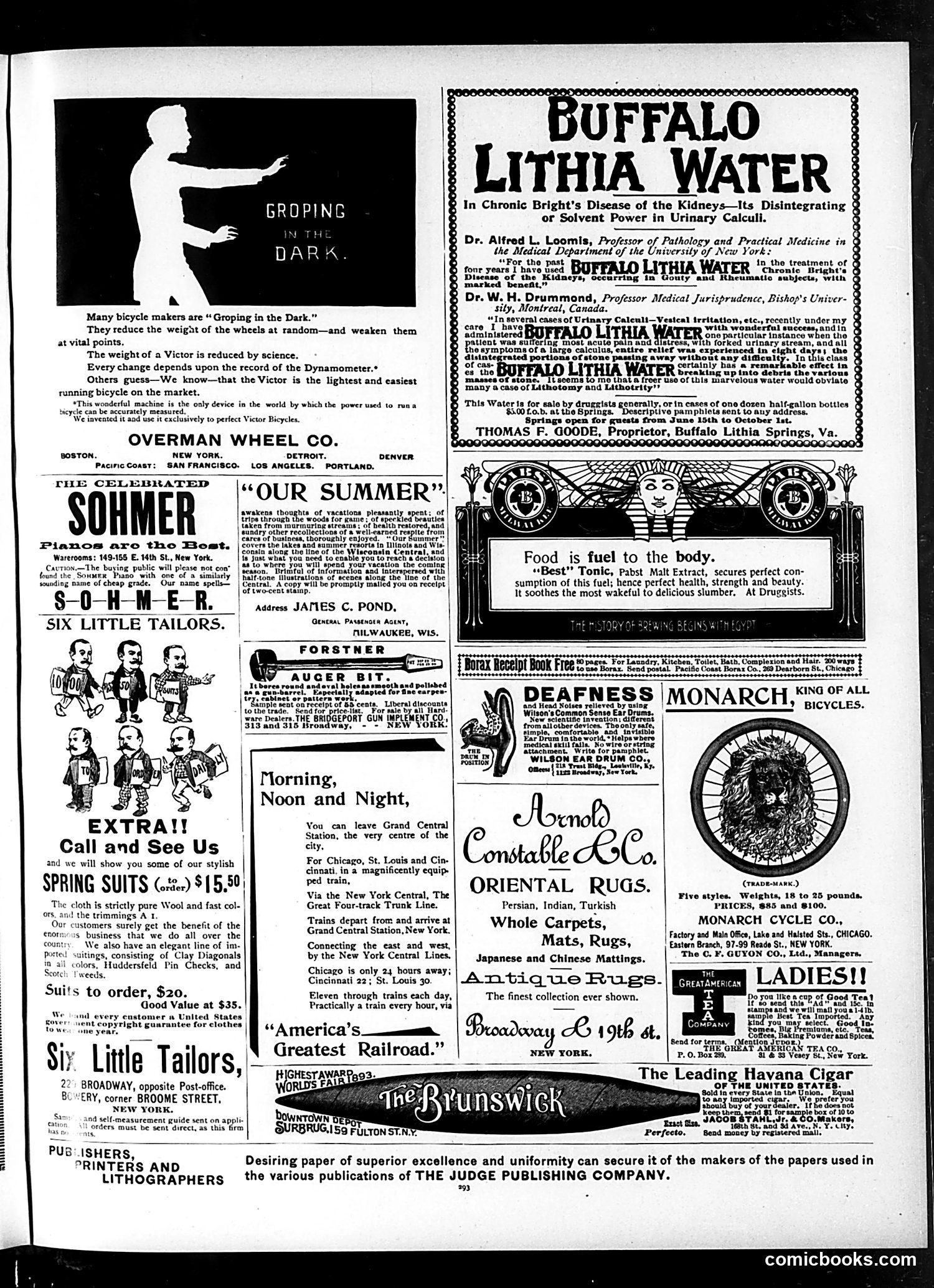
This page is primarily **advertisements** with one satirical element. The main content includes: **"Groping in the Dark" (Victor Bicycles)**: A satirical comparison contrasting manufacturers who randomly reduce bicycle weight versus Victor's scientific approach using a "Dynamometer" (a measuring device). The joke mocks competitors' guesswork versus Victor's precision engineering—a commentary on the emerging importance of scientific method in manufacturing during the early 1900s. **Buffalo Lithia Water Advertisement**: Features medical endorsements for treating kidney disease and urinary calculi (stones). This reflects the era's patent medicine culture, where mineral water springs claimed therapeutic powers—a practice now recognized as largely ineffective. **Remaining content**: Generic period advertisements for pianos (Sohmer), tailoring services, railroads, oriental rugs, bicycles (Monarch), cigars, and other products typical of early-1900s American commerce. The page primarily demonstrates **advertising conventions and consumer culture** of that era rather than political satire.
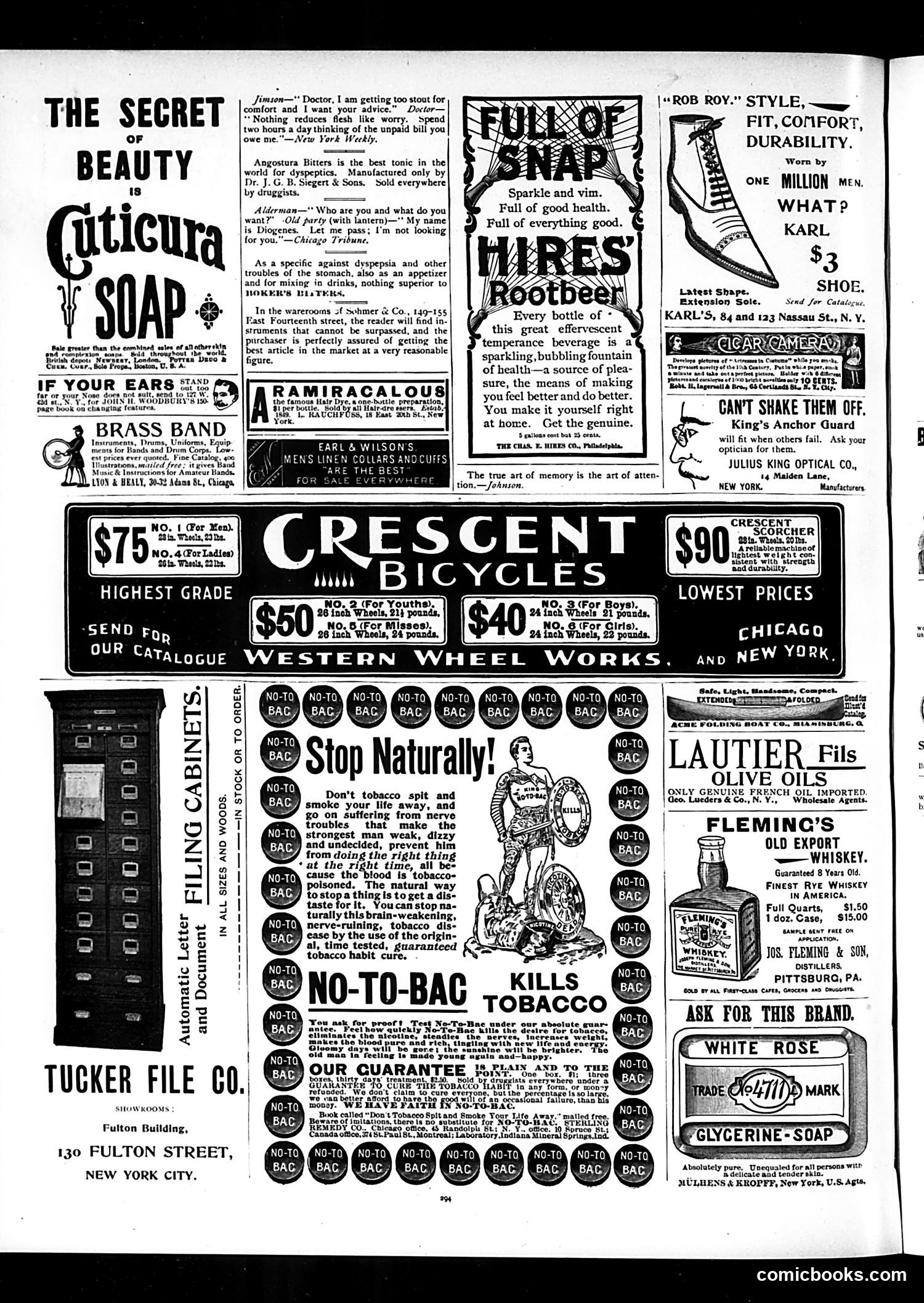
This is primarily an **advertising page** from Judge magazine with limited satirical content. The few jokes present include: 1. **The Jimson/Doctor Exchange**: A brief medical joke where a doctor advises his worried patient that worry reduces flesh—while noting the patient's unpaid medical bill as a source of worry. This is gentle satire on medical costs and debt. 2. **The Alderman/Diogenes Reference**: A play on the classical tale of Diogenes searching for an honest man. The "old party" claims to be Diogenes still searching—but *not* looking for the alderman, implying aldermen are dishonest. This is political satire mocking municipal corruption. The rest of the page consists of patent medicines, bicycles, office furniture, shoes, and the prominent **No-To-Bac tobacco cessation product**—typical turn-of-the-century advertisements. The No-To-Bac ad uses dramatic claims about tobacco poisoning the blood and weakening the mind, reflecting period attitudes toward public health.
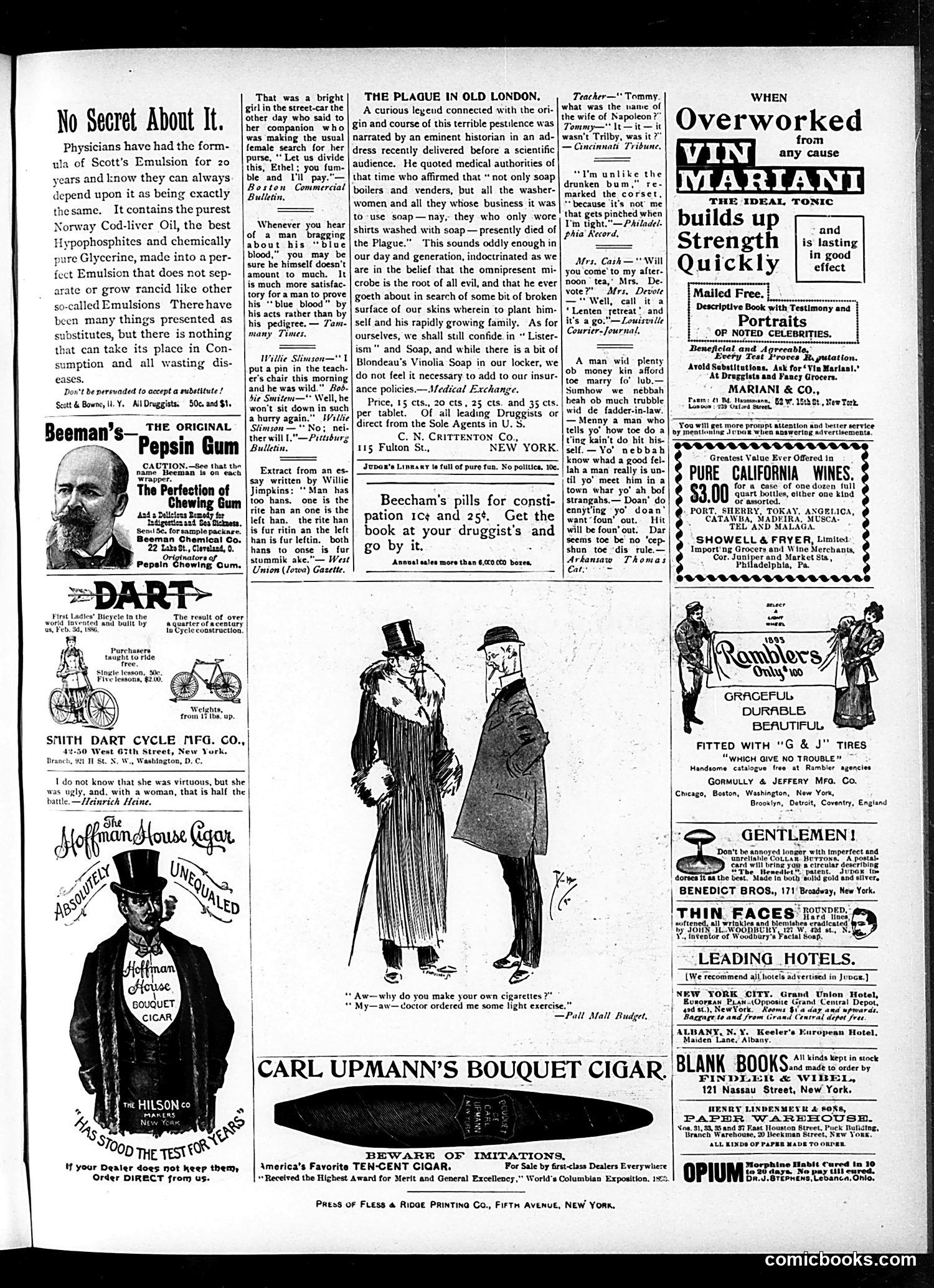
This page is primarily **advertising** with brief humorous filler content typical of early-1900s magazines. The main satirical content is a short anecdote about **the Great Plague of London**, which mocks historical medical beliefs. The piece quotes period authorities claiming soap users died during the plague—absurd by modern germ theory standards. Judge uses this to humorously contrast medieval ignorance with contemporary understanding of microbiology and hygiene ("Listerism"), while ironically promoting Blondeau's Vinolia Soap as protection. The remainder consists of **joke fillers** (brief quips about human nature, marriage, class, etc.) and numerous product advertisements (cigars, bicycles, tonics, hotels). The cartoon illustration appears to depict two figures discussing exercise—one asks "why do you make your own cigarettes?" The other replies about doctor-ordered "light exercise"—a visual pun on the dual meaning of "light" cigarettes. The page reflects Judge's formula: satire mixed with advertising revenue.
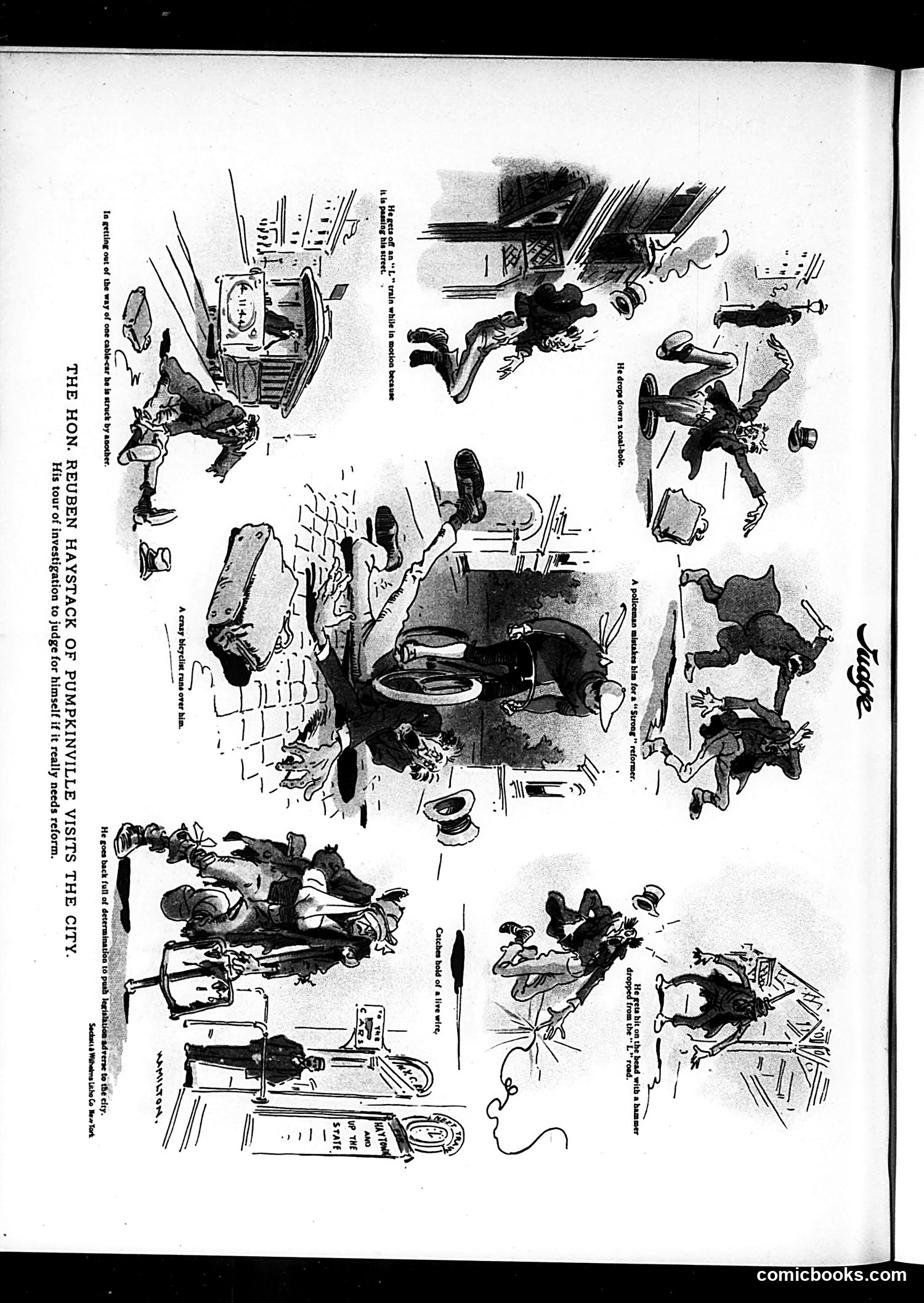
This political cartoon satirizes a naive rural politician, "Hon. Reuben Haystack of Pumpkinville," visiting the city to assess whether reform is needed. The sequential panels show him encountering urban hazards—particularly cable cars—that repeatedly strike and injure him. Despite these chaotic experiences, he returns "full of determination to push legislation adverse to the city," meaning he wants to pass laws *against* urban interests. The satire cuts both ways: it mocks both the bumbling country politician too foolish to navigate city life, and implicitly critiques rural legislators who make anti-urban policy based on prejudice rather than genuine understanding. The cartoon suggests that even direct experience with city problems doesn't generate sympathy—only antagonism toward cities themselves.