
A complete issue · 16 pages · 1895
Judge — April 6, 1895
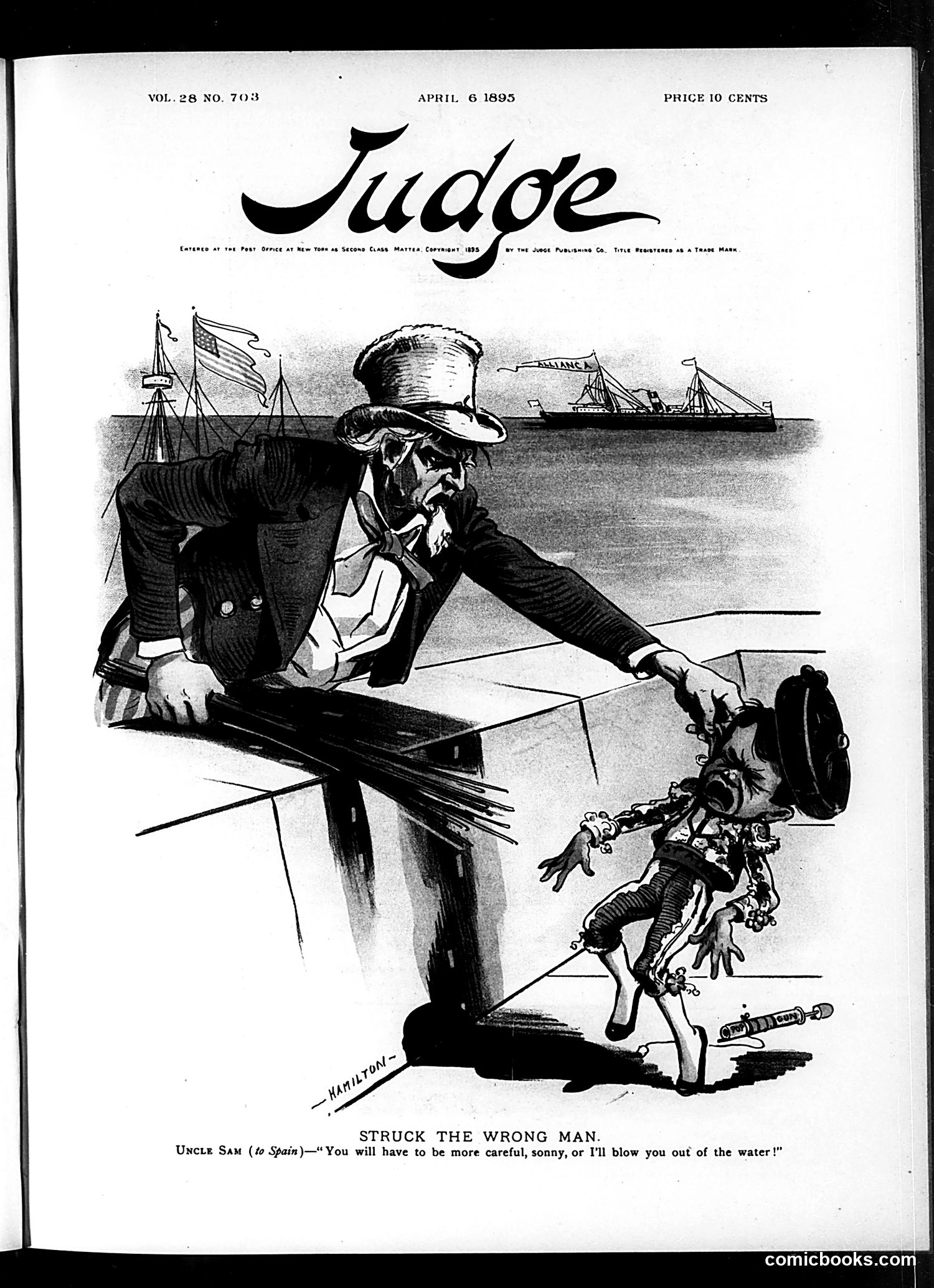
This political cartoon depicts **Uncle Sam** (representing the United States) as a tall figure wielding a large stick, confronting a small, caricatured figure labeled as Spain. The caption reads: "You'll have to be more careful, sonny, or I'll blow you out of the water!" The cartoon likely references tensions between the U.S. and Spain, possibly relating to Spanish colonial possessions or maritime disputes. The naval vessels in the background emphasize American military power. The "wrong man" title suggests Spain has provoked or miscalculated in confronting American interests. This precedes the Spanish-American War (1898), when such tensions were escalating. The cartoon presents American dominance as inevitable, using a parent-child dynamic to suggest Spain's inferiority.
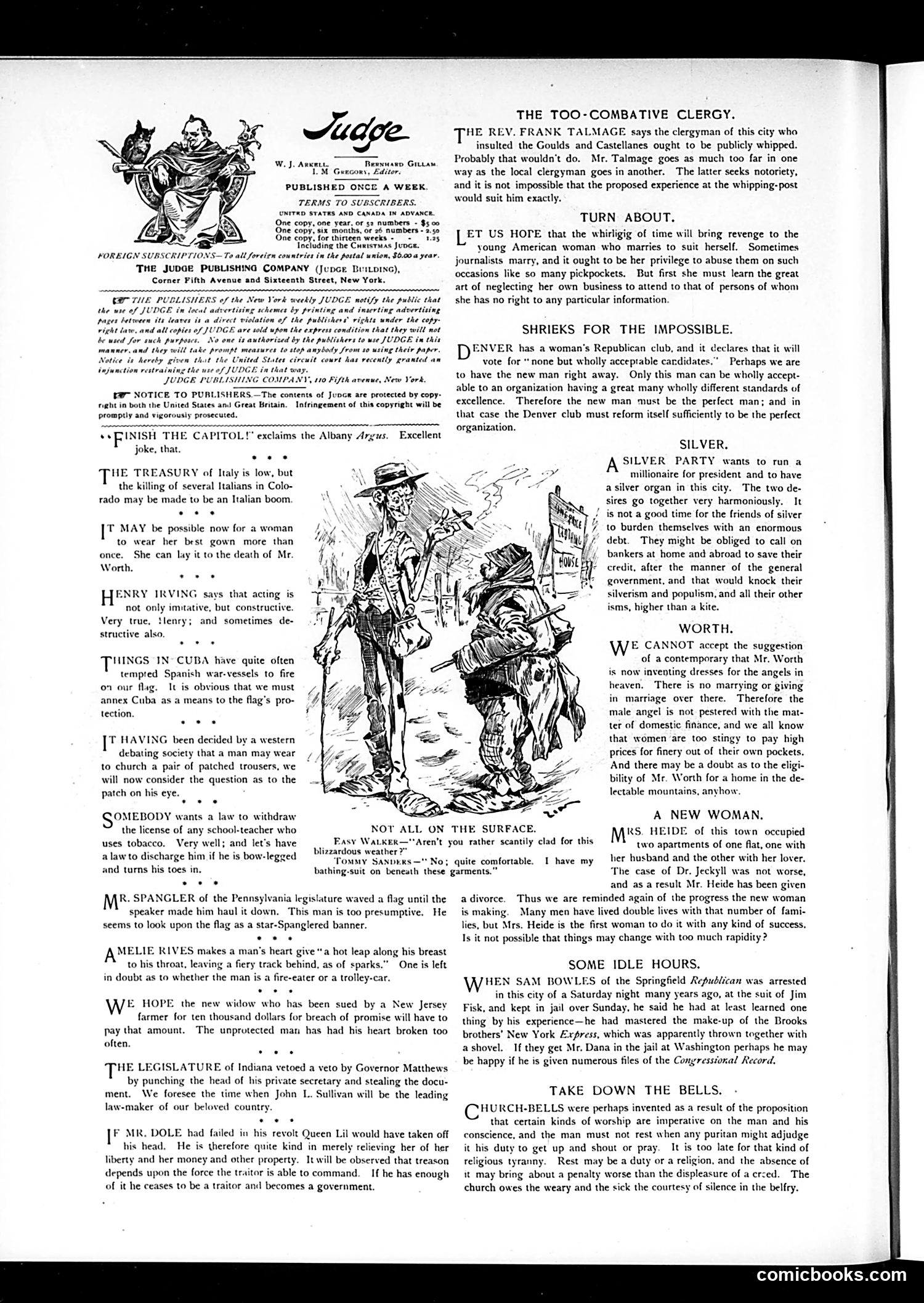
This page from *Judge* magazine contains several brief satirical commentary pieces rather than a single cartoon. The main illustration depicts a well-dressed man confronting what appears to be a beggar or vagrant. Key satire targets include: - **"The Too-Combative Clergy"**: Criticizes clergymen for public whipping campaigns against vice, arguing this approach is ineffective. - **"Shrieks for the Impossible"**: Mocks a Denver women's Republican club demanding impossibly perfect standards for their organization's leadership. - **"Worth"**: Sardonically rejects the idea that angels in heaven wear fashionable dresses, suggesting Mr. Worth's high prices are unjustified. - **"A New Woman"**: Comments on Mrs. Heide's successful divorce and independent life managing apartments. The content reflects Progressive-era debates about clergy activism, women's organizations, consumerism, and evolving gender roles.
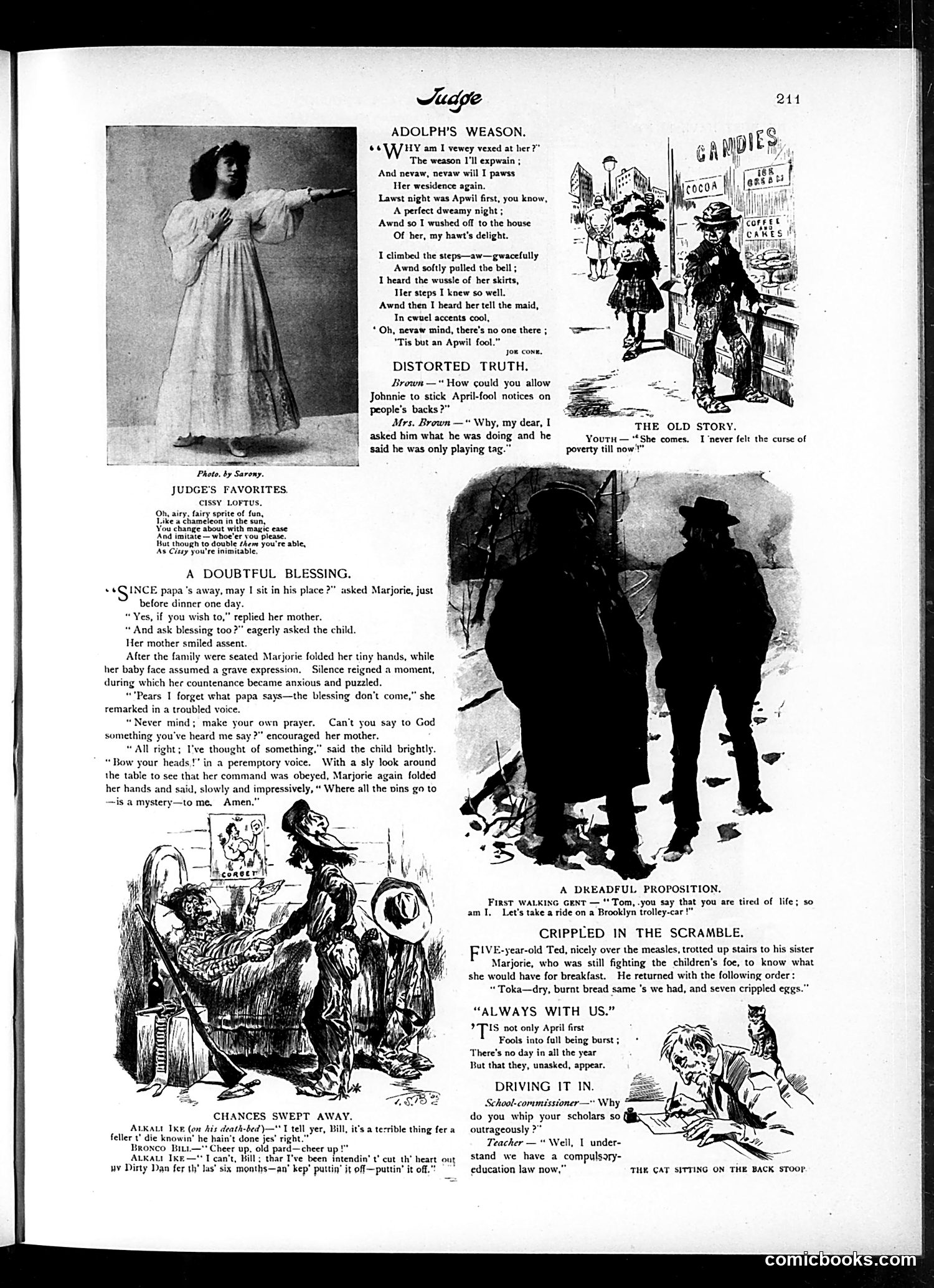
This page contains several unrelated satirical pieces and humorous sketches typical of Judge magazine's format. The main sections include: **"Adolph's Weapon"** — A poem mocking romantic excuses, with an illustration of a woman in classical dress. **"Distorted Truth"** and **"A Doubtful Blessing"** — Short comedic dialogues about April Fools' pranks and children's prayers, illustrated with period sketches. **"A Dreadful Proposition," "Crippled in the Scramble,"** and **"Always With Us"** — Brief humorous anecdotes with accompanying illustrations depicting working-class and street life. The cartoons employ sentimental and comedic treatments of everyday situations—poverty, childhood, urban hardship—typical of early 20th-century American humor magazines. No specific political figures or events appear to be referenced on this particular page.
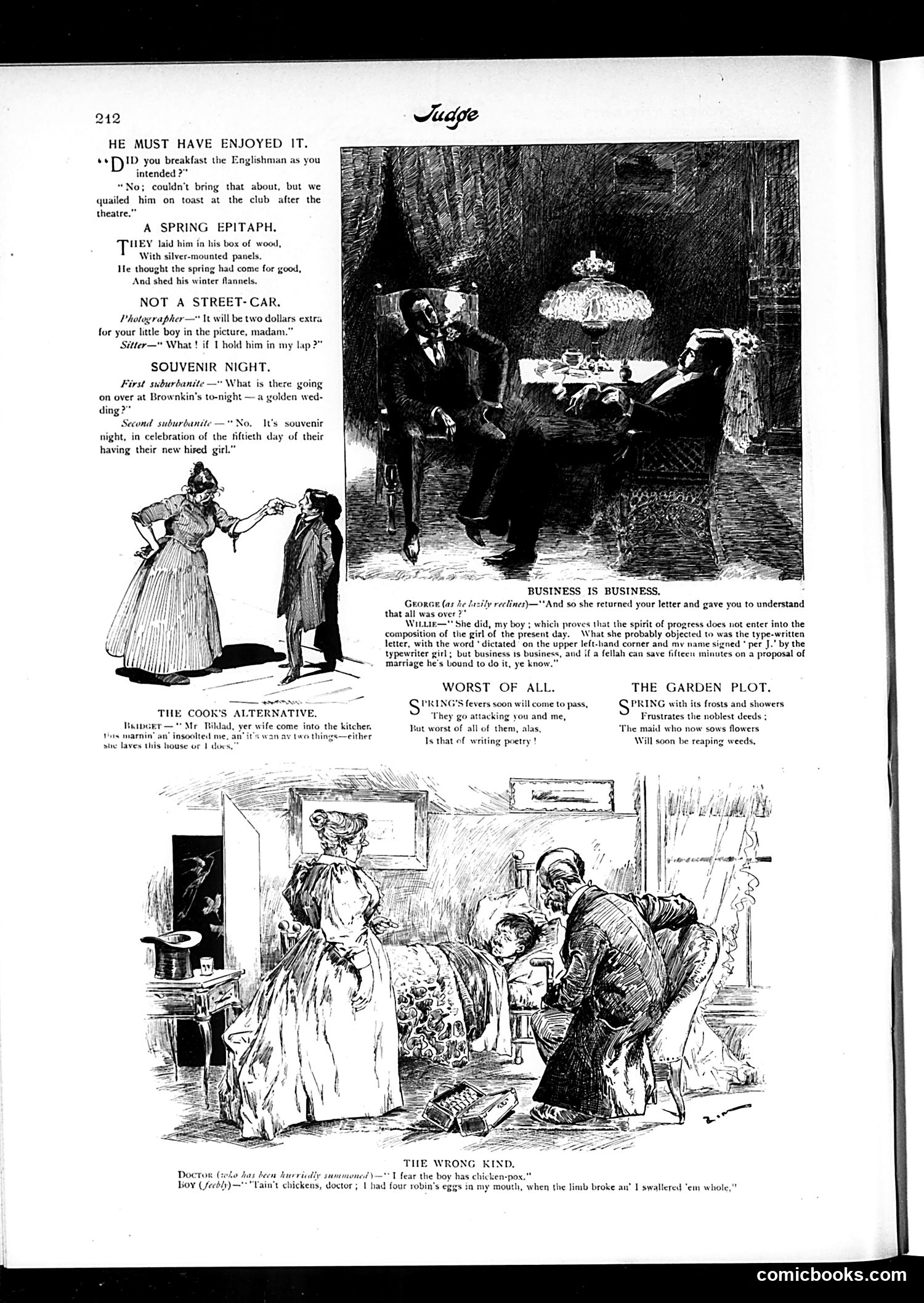
This page contains several brief satirical sketches typical of late 19th-century humor: **"He Must Have Enjoyed It"** jokes about entertaining a visiting Englishman with minimal effort—serving him toast instead of a proper breakfast. **"A Spring Epitaph"** mocks someone who shed winter clothing prematurely, assuming spring had arrived, and died from exposure—a dark joke about poor judgment. **"Not a Street-Car"** plays on a photographer's extra charge for including a child in a portrait, with the sitter's naive suggestion of holding the boy in her lap instead. **"Souvenir Night"** celebrates the 50th day of employing a new servant girl—satirizing how quickly hired help quit, making each milestone noteworthy. **"Business is Business"** ridicules a young man for sending a typewritten marriage proposal with a dictated notation, prioritizing efficiency over romance. **"The Wrong Kind"** depicts a doctor misdiagnosing a boy's illness; the boy swallowed robin's eggs that fell when a tree branch broke, not actual chicken-pox. The humor reflects period class attitudes and domestic servant culture.
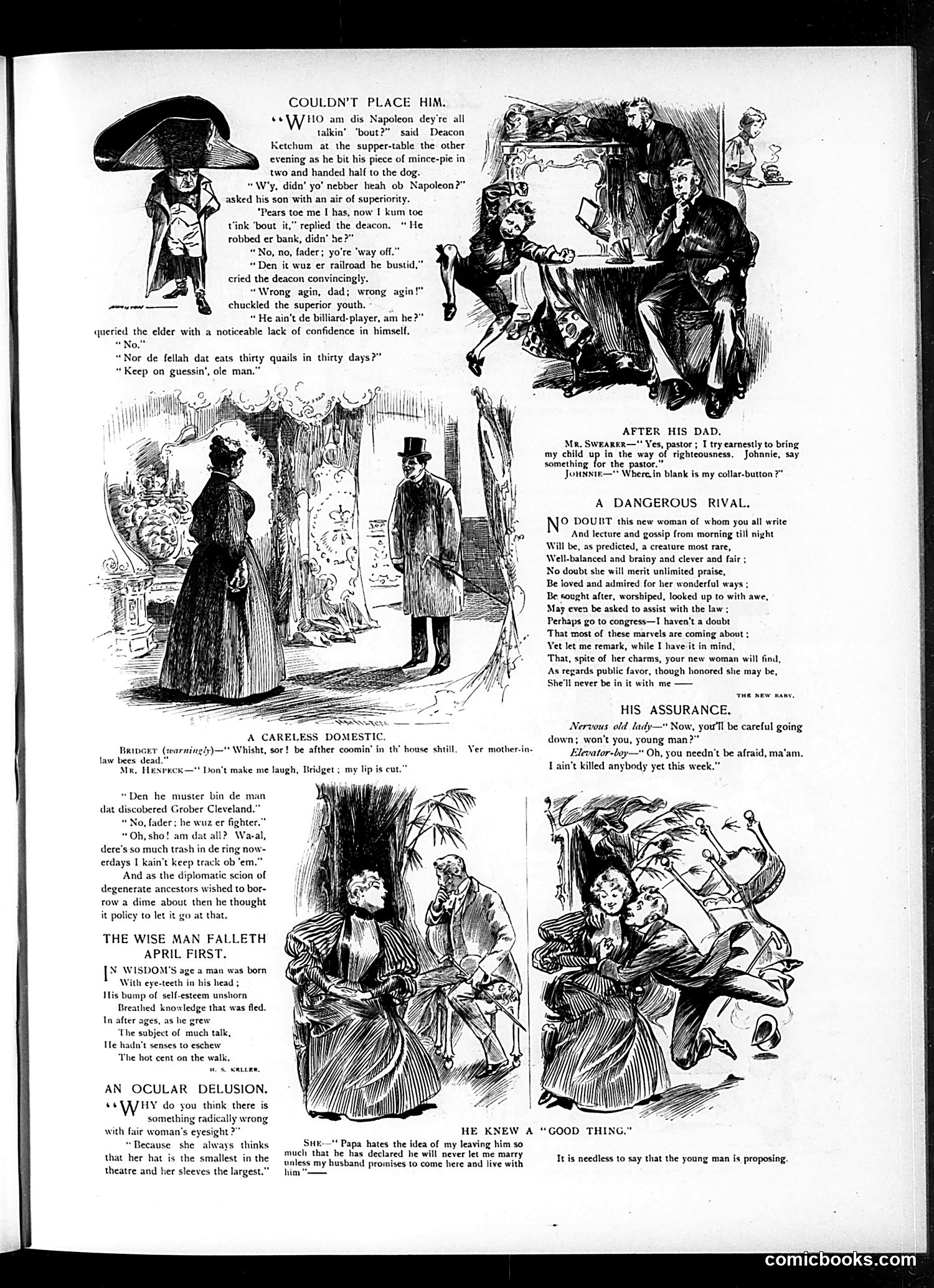
This page contains multiple brief satirical sketches typical of late 19th-century American humor: **"Couldn't Place Him"** mocks an uneducated Black man (written in dialect) who confuses Napoleon with American criminals—a bank robber or railroad swindler. The joke relies on contemporary racial stereotypes. **"After His Dad"** satirizes hypocrisy: a man claims to raise his son righteously, but the boy unconsciously echoes his father's vulgar cursing ("Wherein blank is my collar-button?"). **"A Dangerous Rival"** addresses the "New Woman" debate of the era—concerns about women gaining education, professional work, and political power. The satirist argues women will achieve all these things but still won't surpass the traditional housewife in public favor. Other sketches mock: careless domestic servants, naive elevator boys, April Fools' gullibility, and women's supposedly poor judgment about fashion. The page reflects period anxieties about social change, gender roles, and class through gentle ridicule.
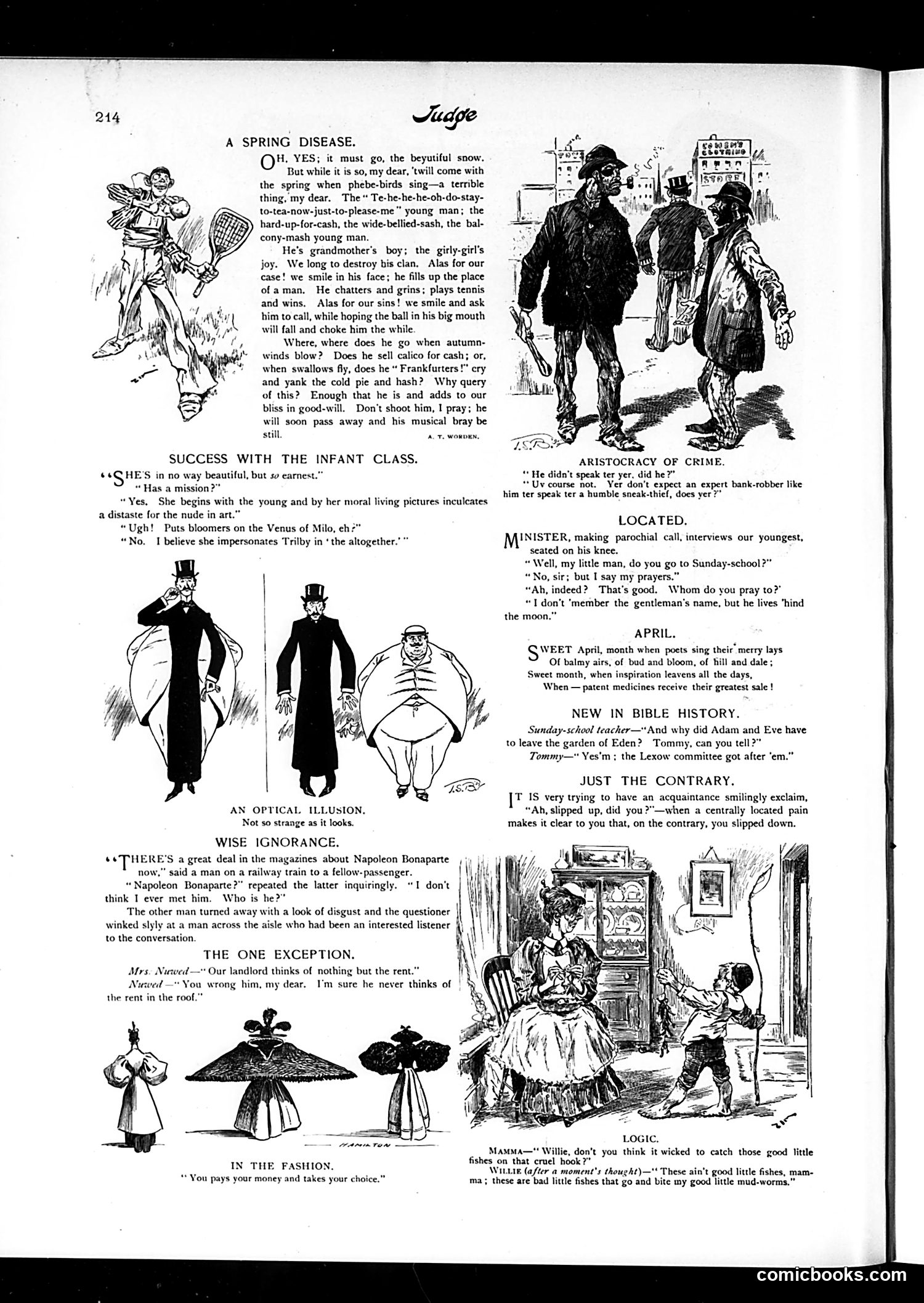
This page contains multiple short humorous pieces typical of Judge's satirical format: **"A Spring Disease"** mocks a social type—the unemployed but charming young man who freeloads by flirting and visiting, chattering constantly. The satire questions where he disappears in autumn, suggesting he's a seasonal nuisance. **"Success with the Infant Class"** jokes about a preachy young woman who teaches morality to children while being prudish (covering the Venus de Milo). **"Aristocracy of Crime"** presents criminal hierarchy humor—a bank robber considers himself superior to a common thief. **"Located"** shows a minister misunderstanding a child's naive religious answer. **"New in Bible History"** references the Lexow Committee (a real 1890s New York corruption investigation), sardonically suggesting it exposed Adam and Eve's transgressions. **"Just the Contrary"** is a mild pun about physical mishaps. Other pieces mock patent medicines' marketing during April, fashion absurdities, and children's moral reasoning. The cartoons are mostly social commentary on contemporary manners and hypocrisy.
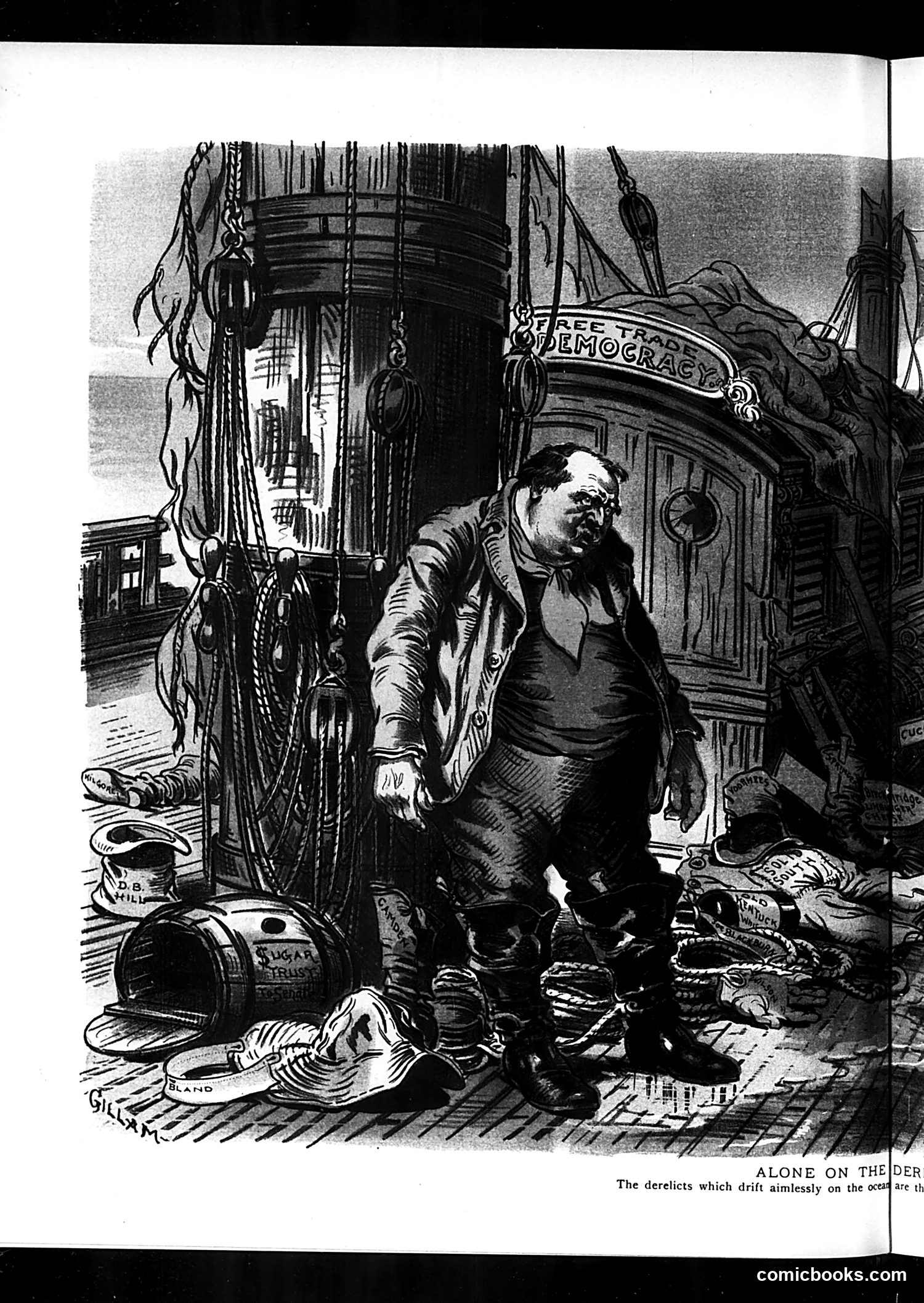
This cartoon, titled "Alone on the Deck," depicts a disheveled man standing amid nautical debris and scattered cargo labeled with goods like "sugar." A sign reading "Free Democracy" appears on a building behind him. The figure appears to represent a politician or leader abandoned during a crisis—the shipwreck imagery suggests governmental collapse or failure. The scattered cargo and debris symbolize mismanagement or loss of resources. The caption references "delicts which drift aimlessly on the ocean," implying criticism of poorly managed policies or abandoned responsibilities. Without the publication date visible, the specific political event referenced is unclear, but the satire suggests Judge magazine is mocking a leader or administration for failing to govern effectively, leaving them isolated amid the wreckage of their failed policies.
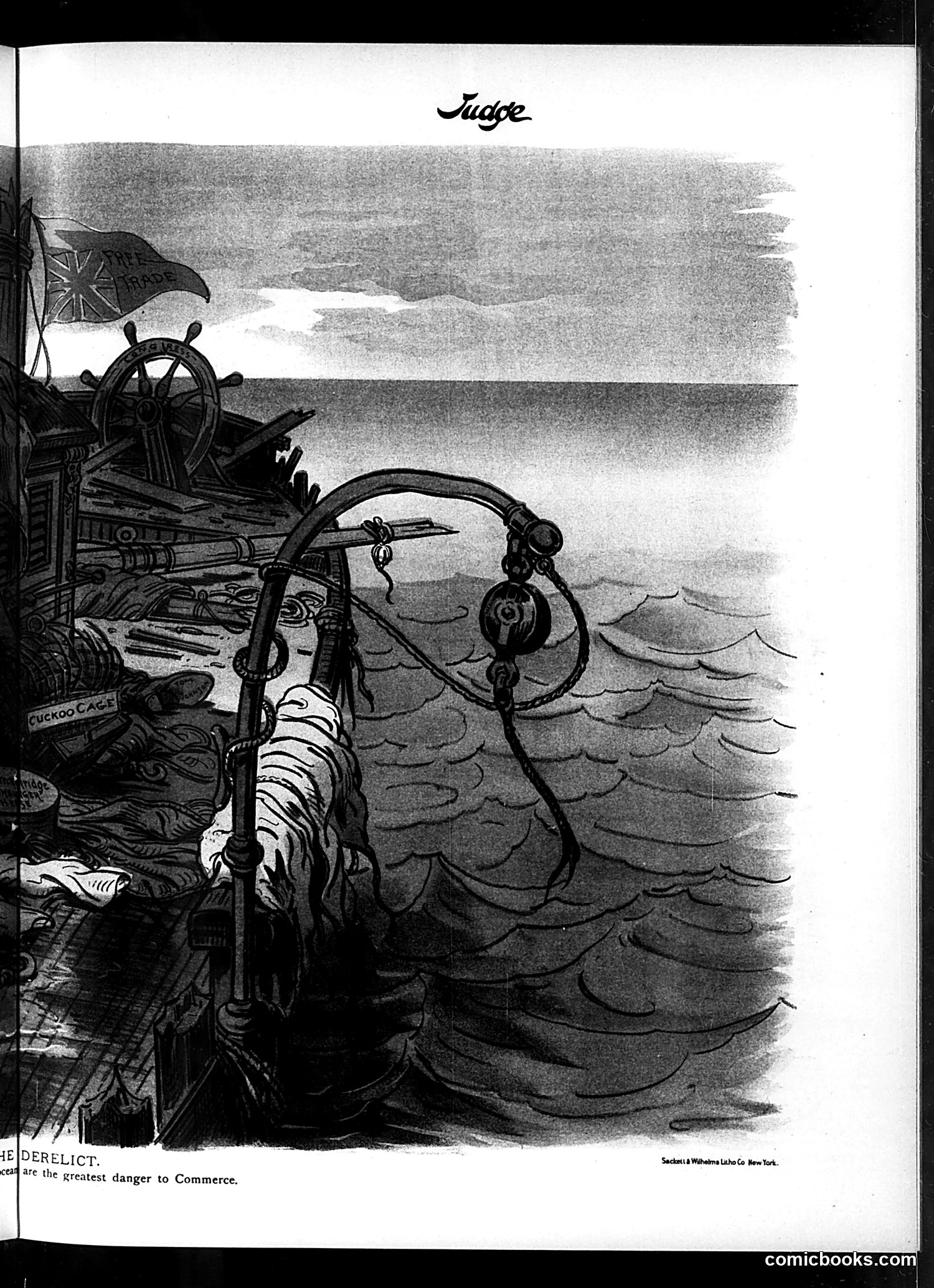
This political cartoon depicts an abandoned ship—a "derelict"—as a maritime hazard. The illustration shows a vessel with tattered sails and deteriorating equipment floating on rough seas, viewed from another ship's deck (visible steering wheel and rigging in foreground). The caption identifies derelict ships as "the greatest danger to Commerce," satirizing a practical concern of the era: abandoned, unmaintained vessels posed real navigation hazards and economic threats to shipping industry. The cartoon likely advocates for maritime regulation or cleanup efforts. The ship's British flag suggests international commerce concerns. This reflects late 19th/early 20th-century debates over shipping safety and navigational standards—an issue affecting commercial interests that Judge magazine's audience would have recognized as economically significant.
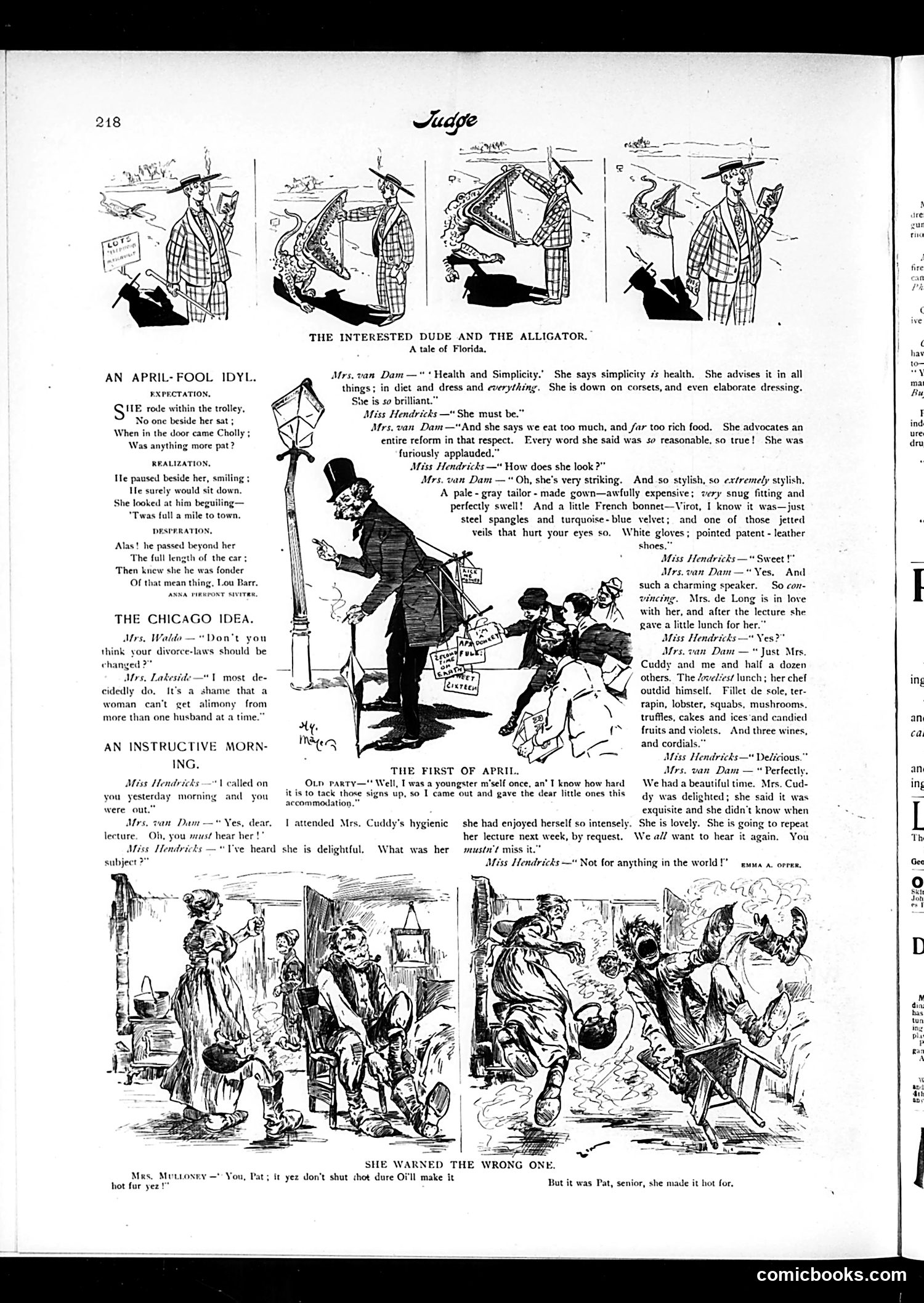
This page contains several satirical pieces mocking upper-class hypocrisy and social pretension circa the early 1900s. **"The Chicago Idea"** ridicules divorce laws by having Mrs. Lakeside suggest women should receive alimony from *multiple* husbands simultaneously—absurd even by loose standards. **The main feature** satirizes a wealthy woman (Mrs. van Dam) who publicly lectures on "Health and Simplicity," advocating against corsets, elaborate dress, and rich food. Yet the cartoon exposes her actual lifestyle: she wears expensive tailored gowns, elaborate French bonnets, and attends lavish lunches featuring lobster, terrapin, truffles, and multiple wines. The satire is the contradiction between her preached values and lived reality. **"The Interested Dude and the Alligator"** appears to be a humorous Florida tale (unclear from this excerpt alone). The bottom panels show working-class characters (Pat and others), providing social contrast to the wealthy women's pretension above. The overall theme: wealthy society women's hypocrisy and the gap between their public moral posturing and private indulgence.
This page is primarily **advertisements** interspersed with brief satirical commentary typical of Judge magazine's format. The opening poem satirizes the "coming woman"—the emerging New Woman of the 1890s who was gaining independence and social freedoms. The joke questions whether this modern woman will maintain traditional courtesies (offering her seat to men) or selfishly ignore social conventions while reading newspapers and fidgeting with her wrap. The satire gently mocks both female independence and societal anxieties about changing gender roles. Other brief quips mock married life, legal arguments over the income tax, women's fashion obsessions, and male-female relationship dynamics. The humor relies on period stereotypes: women as illogical, obsessed with hats and appearance; men as long-suffering; lawyers as motivated purely by payment rather than principle. The page demonstrates Judge's formula: mixing consumer advertisements with snappy one-liners reflecting contemporary social concerns, particularly anxiety about women's evolving roles in American society.
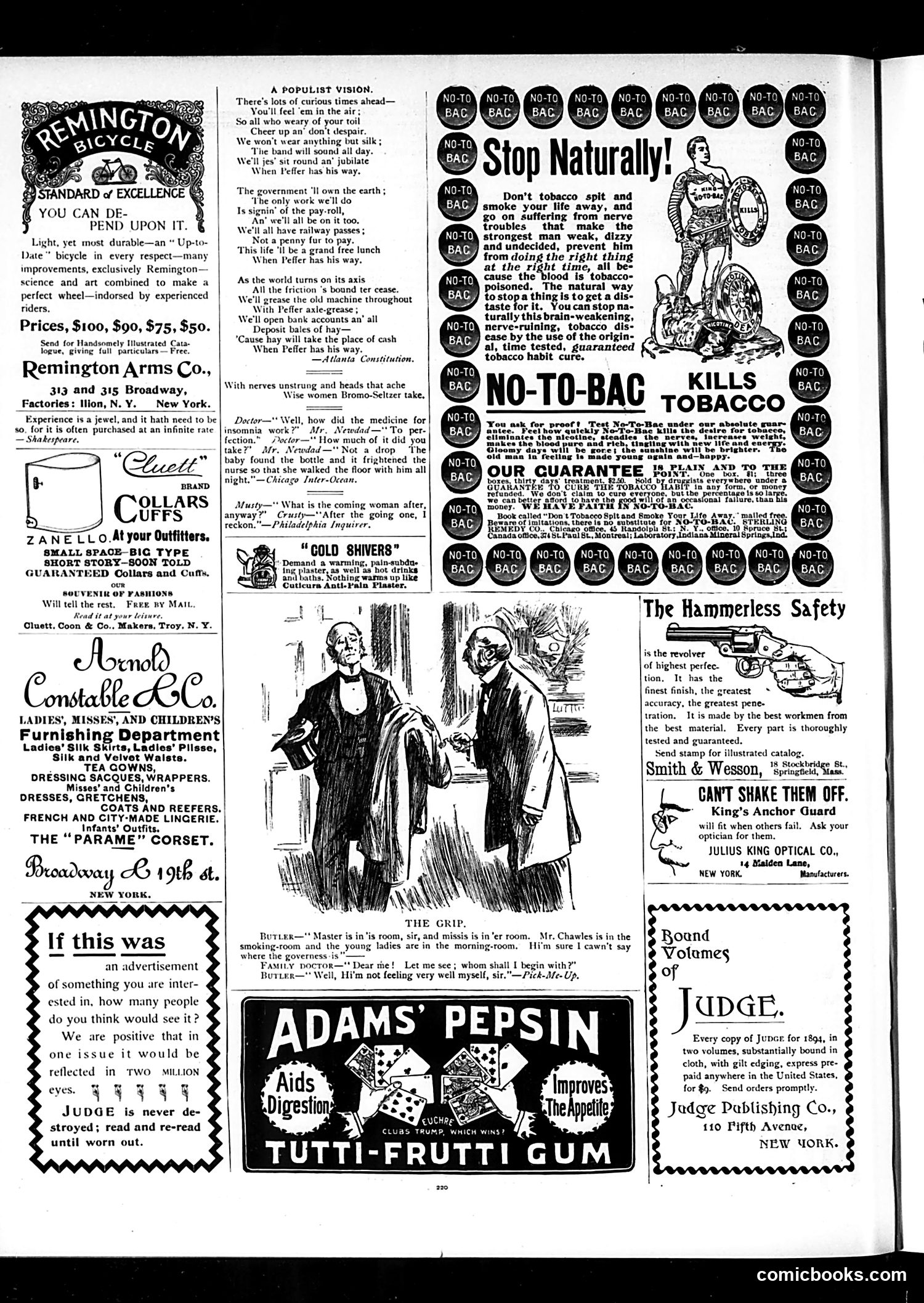
This page is primarily **advertisements with one political satire poem**. The main cartoon content is "A Populist Vision," a satirical poem mocking the People's Party platform, likely referencing **James H. Peffer**, a Kansas Populist senator. The poem ridicules Populist promises as absurdly utopian: free government employment, railway passes, money replaced by hay, and frictionless society. The satire suggests these reforms are naive fantasies, using exaggeration ("jubilate," permanent free lunch) to delegitimize the movement. The remaining content is period advertising: Remington bicycles, corsets, cigars, collars, and notably anti-tobacco products (No-To-Bac). One small cartoon labeled "The Girl" depicts a domestic servant scene. **Context for modern readers**: The Populist Party (1892-1908) advocated radical reforms like government ownership and monetary reform. Judge magazine, a conservative humor publication, attacked Populism as economically impossible and socially dangerous. This reflects late-19th-century political divisions over agrarian reform.
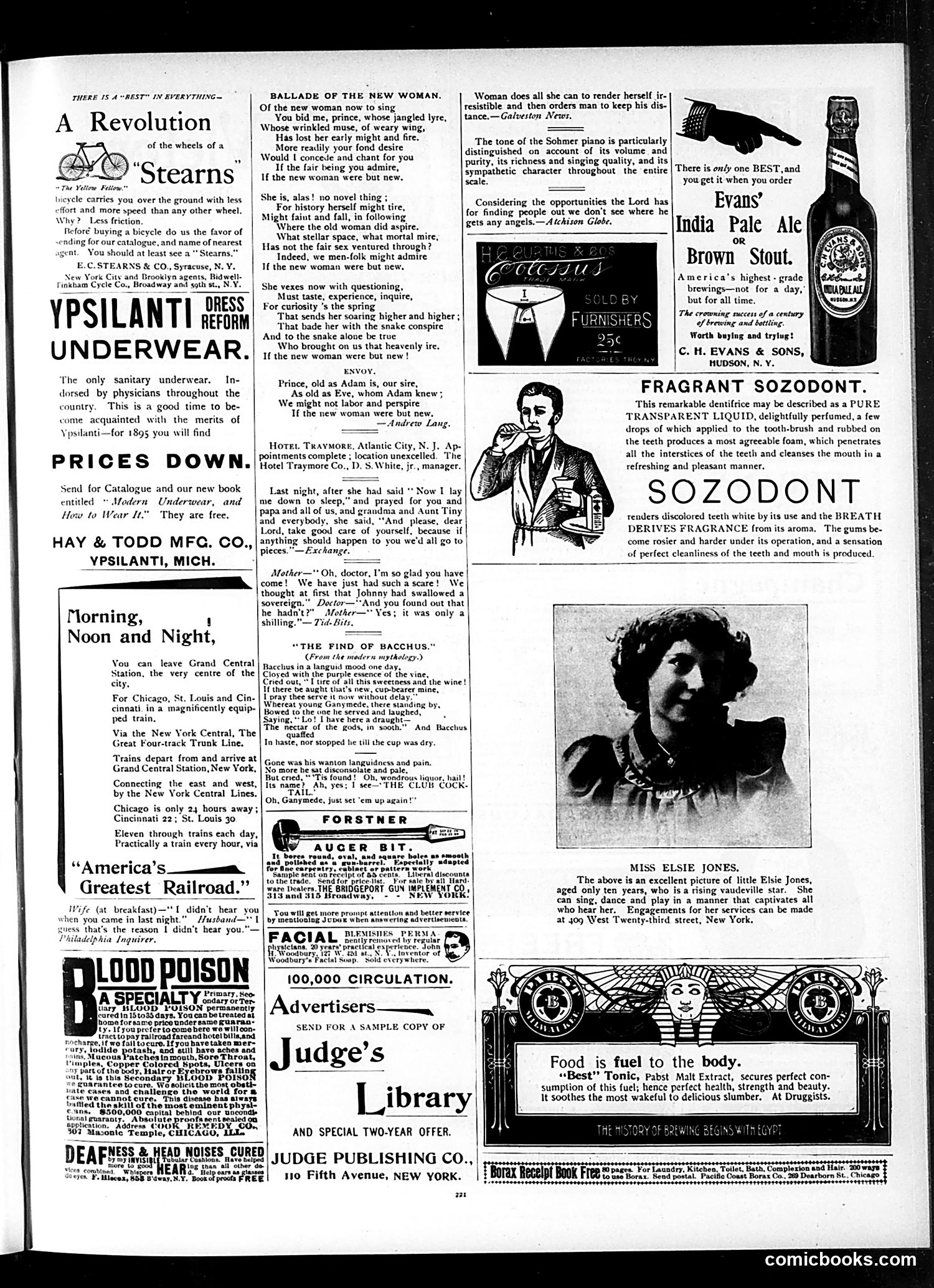
This page is primarily **advertising and light humor** rather than political satire. The main content includes: **"Ballade of the New Woman"** - A poem by Andrew Lang mocking the "new woman" of the 1890s (women seeking education, independence, and questioning traditional roles). The satirical point: women's desire for autonomy and intellectual engagement isn't actually "new"—women have always pushed boundaries, from Eve onward. The poem suggests such aspirations are cyclical and inevitable, presented with bemused resignation rather than genuine critique. **Advertisements** dominate: bicycles (Stearns), underwear (Ypsilanti), trains (New York Central), medical treatments (blood poison cure, deafness remedies), and Judge's Library books. **Brief humor snippets** include a marital joke about a husband not being heard coming home late. The page reflects 1890s concerns about women's changing social roles, presented through literary mockery rather than visual cartooning. No specific political figures or events are referenced—it's general social commentary on gender dynamics.
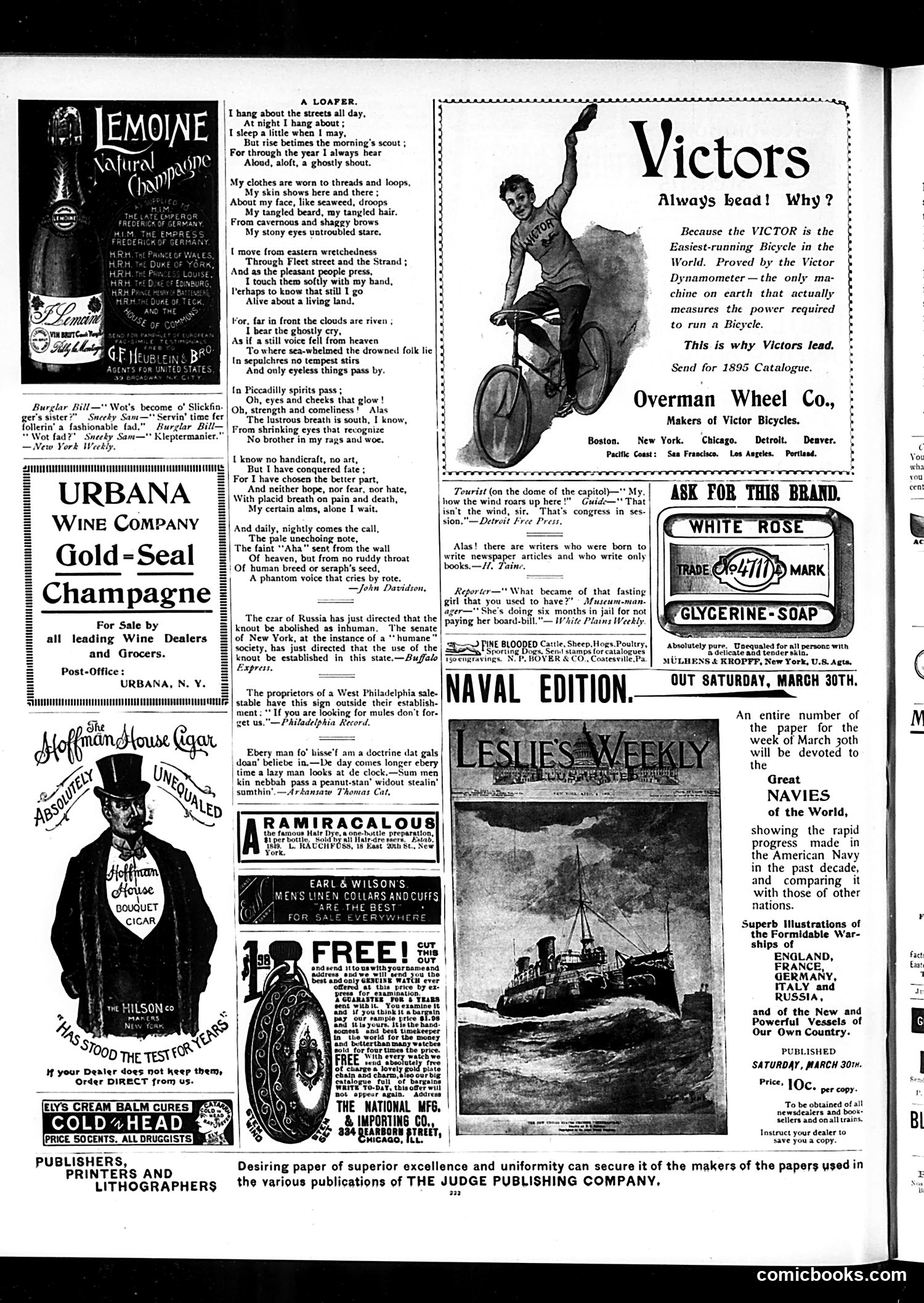
This page is primarily **advertisements and filler content** rather than political satire. The main textual piece is a poem titled "A Loafer" by John Davidson—a melancholic work about a vagrant wandering London streets, hearing mysterious ghostly cries. It's literary rather than satirical. The page includes a brief, mild political reference: a joke mocking New York's senate for abolishing the knout (Russian whip) as "inhumane" while simultaneously establishing its use within the state—a hypocritical contradiction on criminal punishment policy. The advertisements are era-typical: bicycle promotion (Victor bicycles), champagne, cigars, and patent medicines. A bicycle company ad claims the Victor is the "easiest-running" bike, proven by a "dynamometer." There's minimal sustained satire here—mostly light editorial jokes and product marketing characteristic of 1890s magazine filler content.
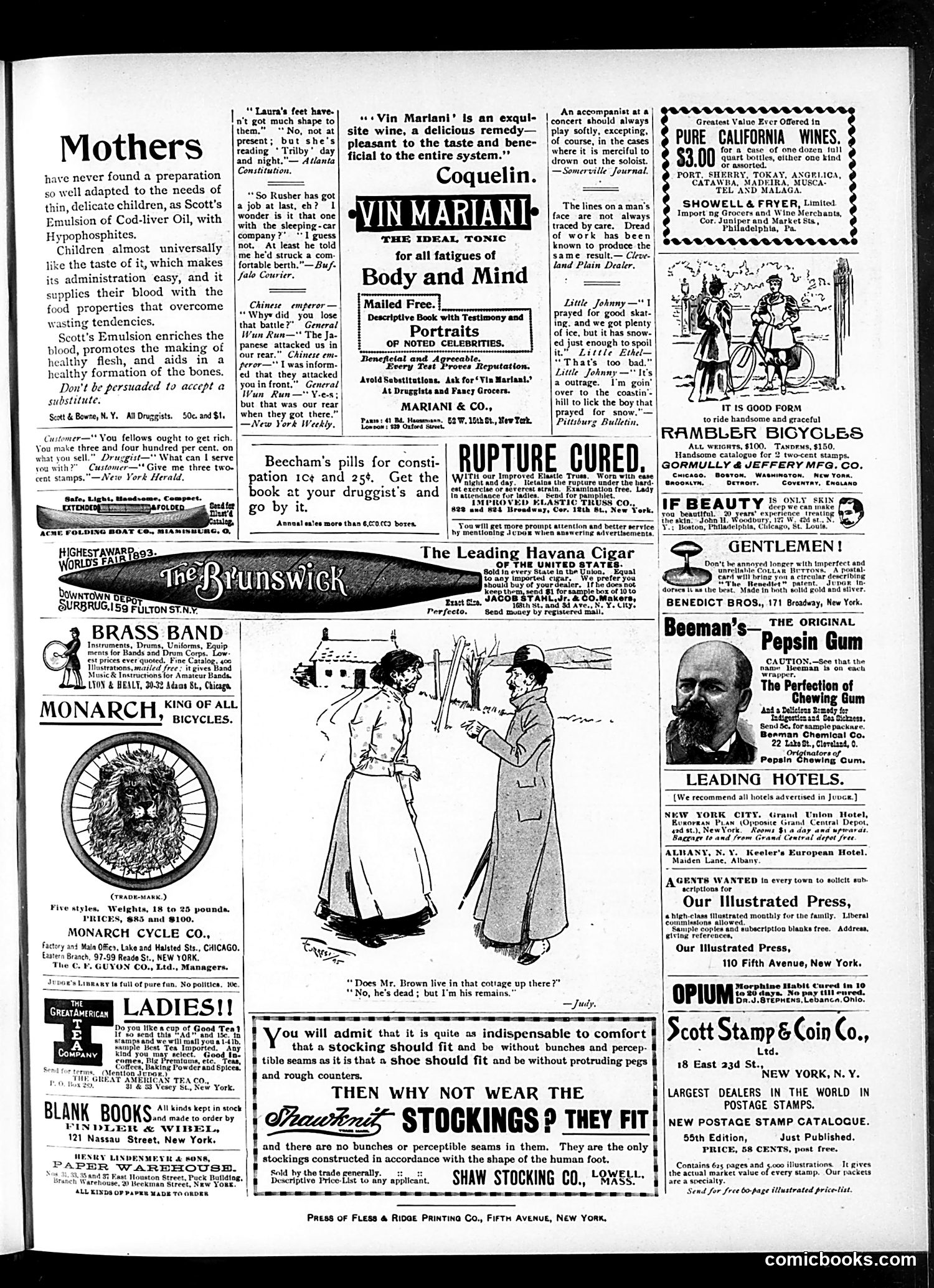
This page is primarily **advertising**, with only minor comic content. The main elements are: ## The Cartoons A small dialogue cartoon shows two figures in winter clothing, with text: "Does Mr. Brown live in that cottage up there?" / "No, he's dead. He left his remains." The joke appears to play on the ambiguity of "remains"—a pun on bodily remains versus leftover possessions. Another brief comic dialogue discusses a lost battle, with a Chinese general explaining the Japanese attacked from the rear, which was "their rear" once they got there—a play on perspective. ## The Advertising The page is dominated by product advertisements: Scott's Emulsion (cod-liver oil for children), Beecham's pills, Vin Mariani (wine-based tonic), bicycles, stockings, cigars, hotels, and postage stamps. These ads represent typical turn-of-the-century consumer products marketed to middle and upper-class readers. The humor is minimal and gentle—typical of Judge's lighter content filler between satirical pieces on other pages.
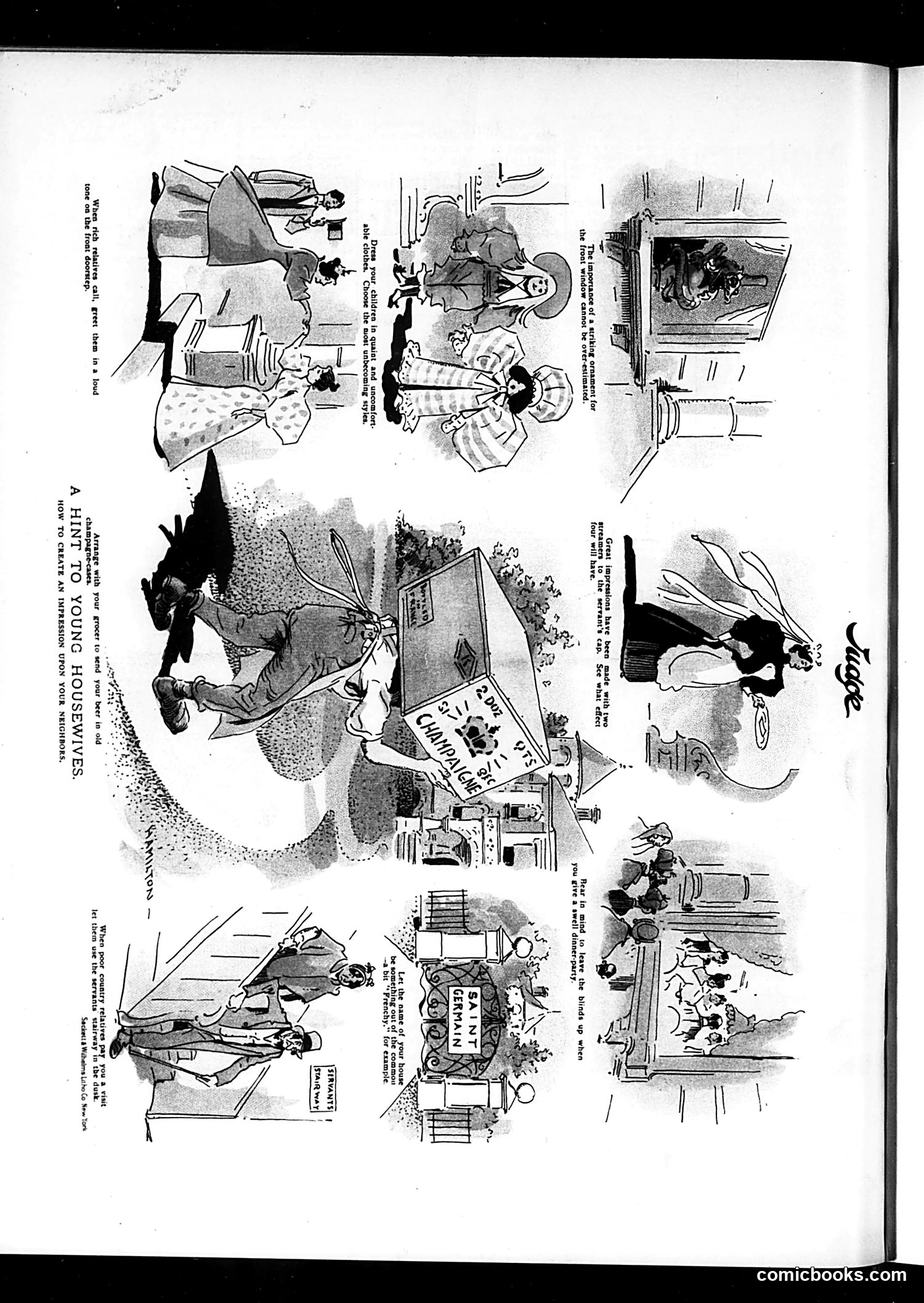
This page satirizes social pretension and conspicuous consumption among the newly affluent middle class. The central cartoon shows various schemes young housewives employ to impress neighbors: displaying fancy dinner settings in front windows with blinds raised, wearing elaborate servants' caps, loudly greeting guests, and requesting grocers deliver beer in expensive bottles rather than plain ones. The satire targets the performative nature of social climbing—the gap between actual wealth and the appearance of wealth. These women aren't genuinely wealthy; they're engaged in theatrical displays of status for neighbors' benefit. The cartoon ridicules how shallow these impressions are: expensive-looking *presentation* matters more than substance. The humor lies in exposing this transparent pretense and the anxiety about social standing that drives such performative behavior among aspirational housewives of the era.