
A complete issue · 16 pages · 1895
Judge — March 30, 1895
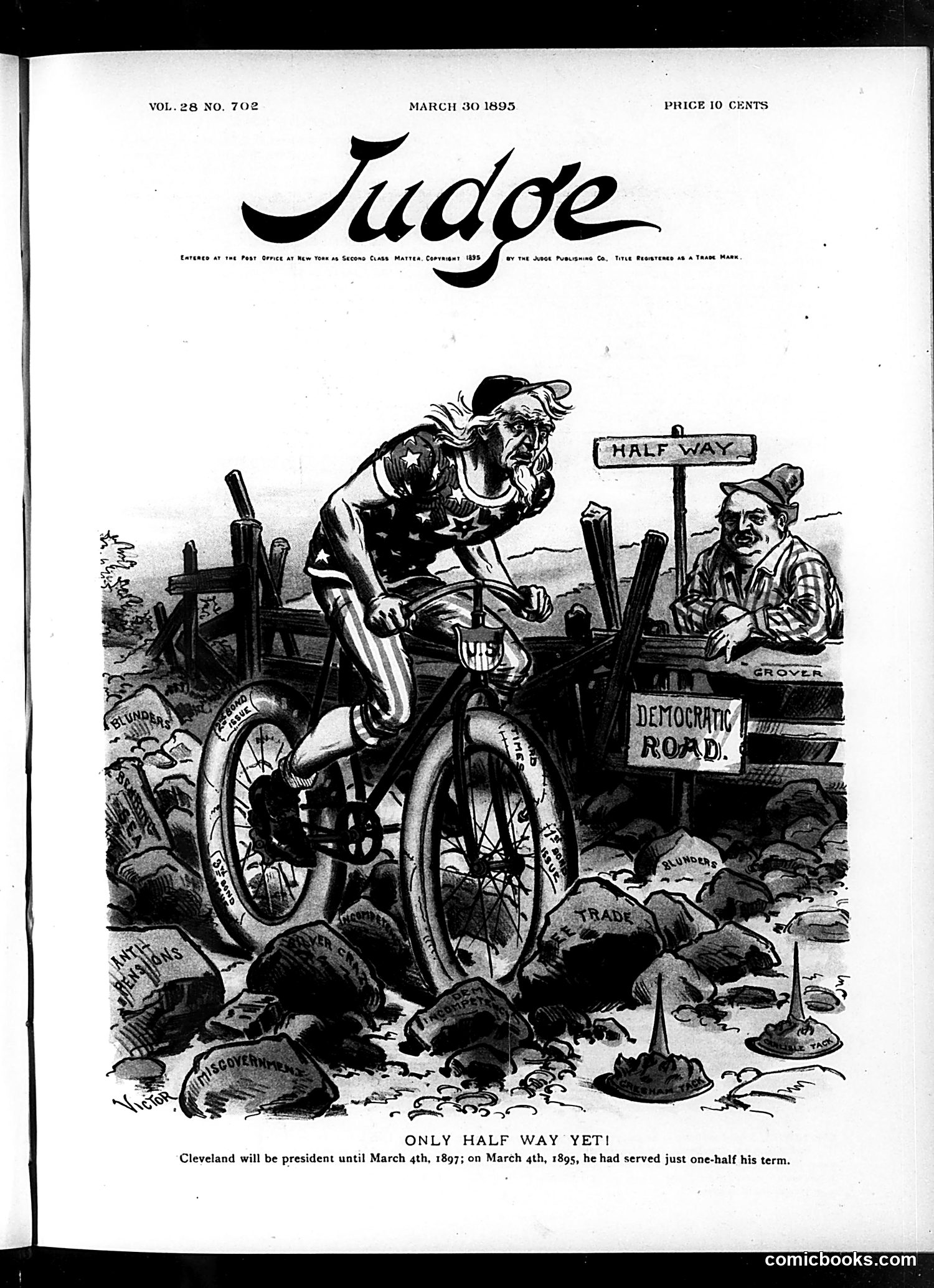
This Judge magazine cover from March 30, 1895 satirizes President Grover Cleveland's first term nearing completion. The central figure is Uncle Sam (identified by stars and stripes), riding a bicycle labeled "Democratic Road" through treacherous terrain—rocks labeled with issues like "Tariff," "Trade," "Blunders," and "Misgovernment." The "Half Way" sign and caption reference Cleveland's presidency ending March 4th, 1897, noting he had completed exactly half his term by March 4, 1895. A figure identified as "Grover" (Cleveland) sits on the roadside, observing Uncle Sam's difficult journey ahead. The cartoon criticizes Cleveland's Democratic administration, suggesting the Democratic political path has been rocky and dangerous, with greater difficulties still to come in the remaining half-term.
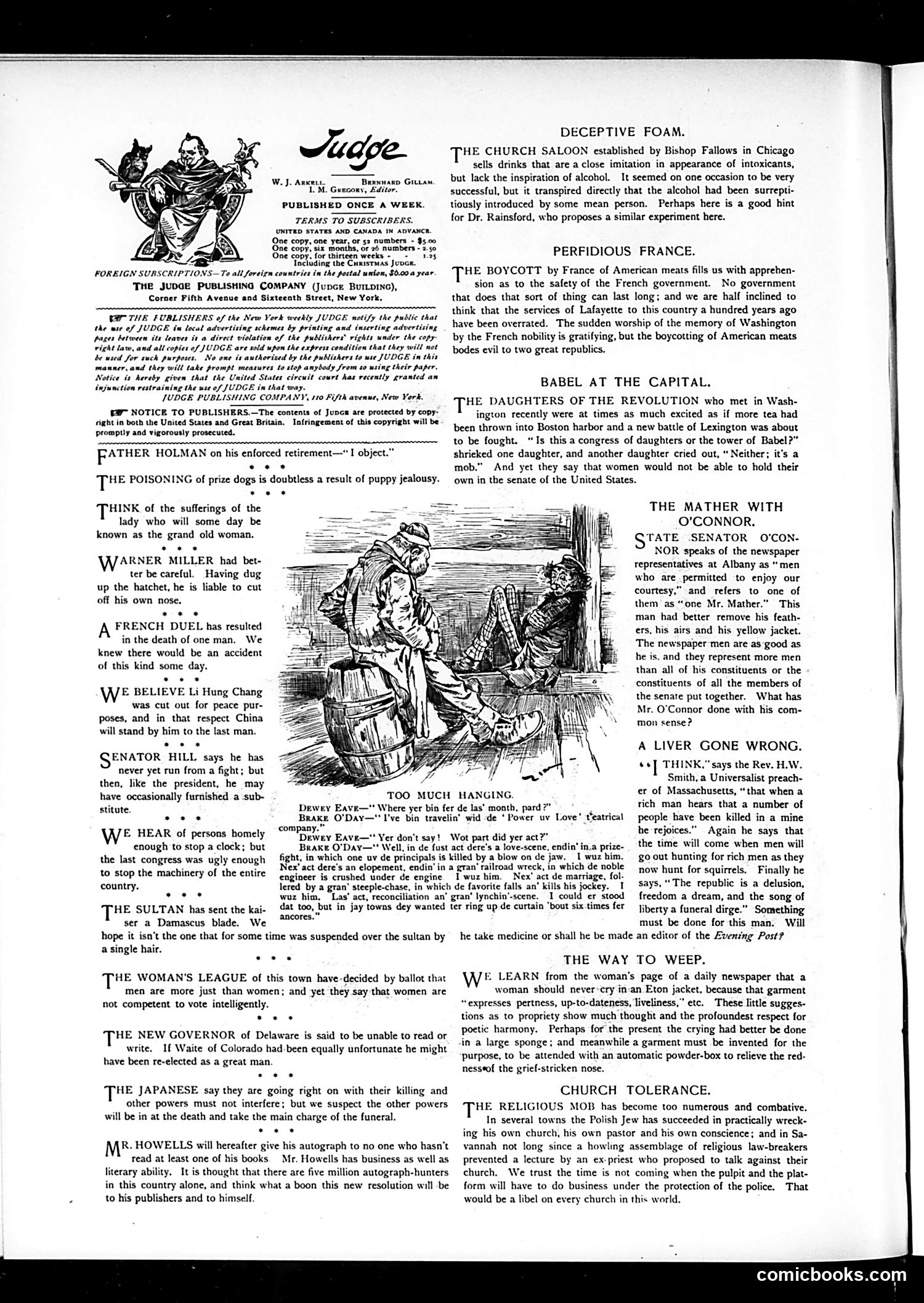
This cartoon satirizes excessive capital punishment. The illustration shows a gallows scene with multiple figures, captioned "Too Much Hanging" with dialogue referencing executions and "love-scenes." The accompanying text uses theatrical references (from what appears to be a burlesque or comic play) to mock judicial excess. Characters named "Dewy Face" and "Brake O'Day" discuss executions sarcastically, suggesting the frequency of hangings has become absurd entertainment rather than justice. The satire critiques both the judicial system's reliance on capital punishment and public fascination with executions as spectacle. This appears to reference late 19th-century concerns about overcriminalization and hanging as a routine punishment, presented here as darkly comedic commentary on a justice system gone wrong.
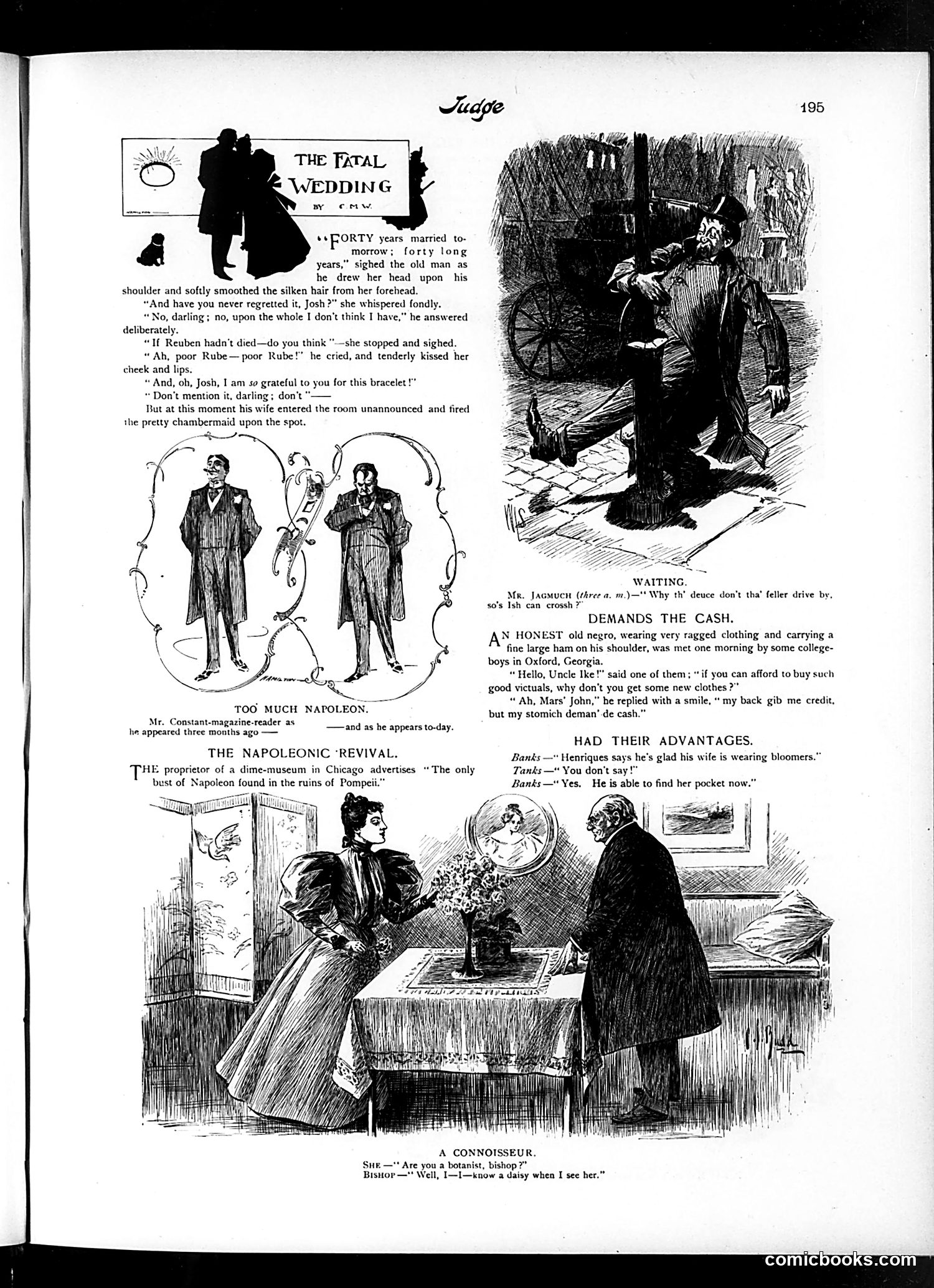
This page contains four satirical pieces typical of Judge's humor: 1. **"The Fatal Wedding"** (top left): A sentimental domestic story about an elderly couple married 40 years, interrupted by unexpected visitors—likely satirizing melodramatic serialized fiction popular at the time. 2. **"Too Much Napoleon"** (center left): Shows a man appearing identical to Napoleon before and after—apparently mocking someone's obsession with Napoleon or recent "Napoleonic revival" in fashion/culture. 3. **"The Napoleonic Revival"** (bottom): References a Pompeii museum piece, satirizing contemporary interest in Napoleon memorabilia. 4. **"Demands the Cash"** and **"Had Their Advantages"** (right side): Brief humorous anecdotes about an African American man and domestic situations—representative of the period's problematic racial humor standards. The page exemplifies Judge's mix of domestic satire and topical commentary.
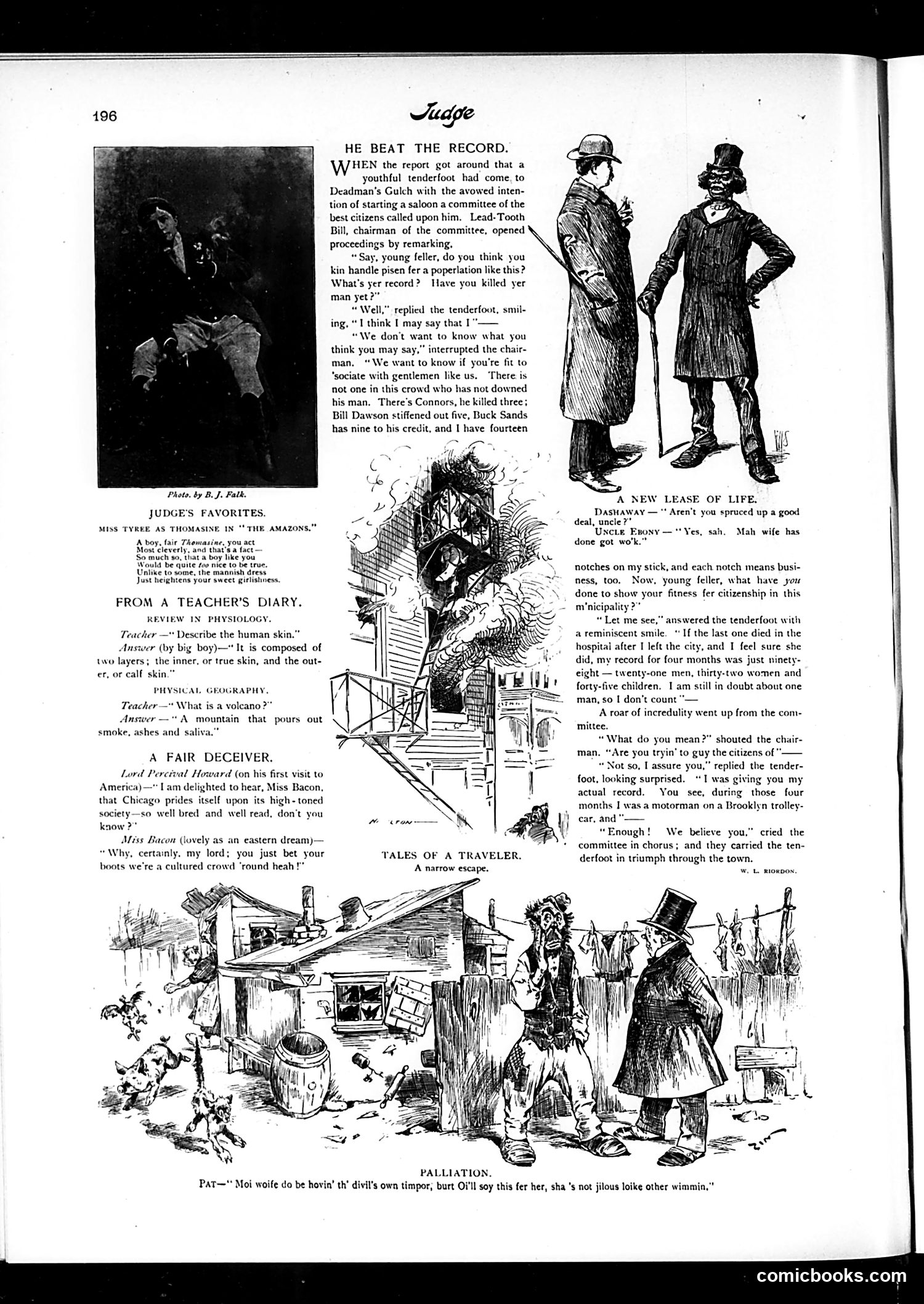
This satirical story mocks both Wild West mythology and urban dangers. A naive tenderfoot arrives in a frontier town claiming qualification to run a saloon. The local committee—tough gunmen who brag about their kills (the chairman claims fourteen)—grill him about his violent credentials. The tenderfoot's punchline: his "record" comes from being a *streetcar motorman in Brooklyn*, where he killed ninety-eight people (twenty-one men, thirty-two women, forty-five children) in just four months. The committee, shocked into belief, celebrates him as a hero. The joke critiques both frontier romanticism and contemporary urban industrial accidents. By 1900s standards, trolley accidents were common and often fatal. Judge contrasts the "civilized" East's casual carnage with the West's celebrated violence—suggesting modern technology kills far more efficiently than six-shooters, yet society accepts it without moral reckoning.
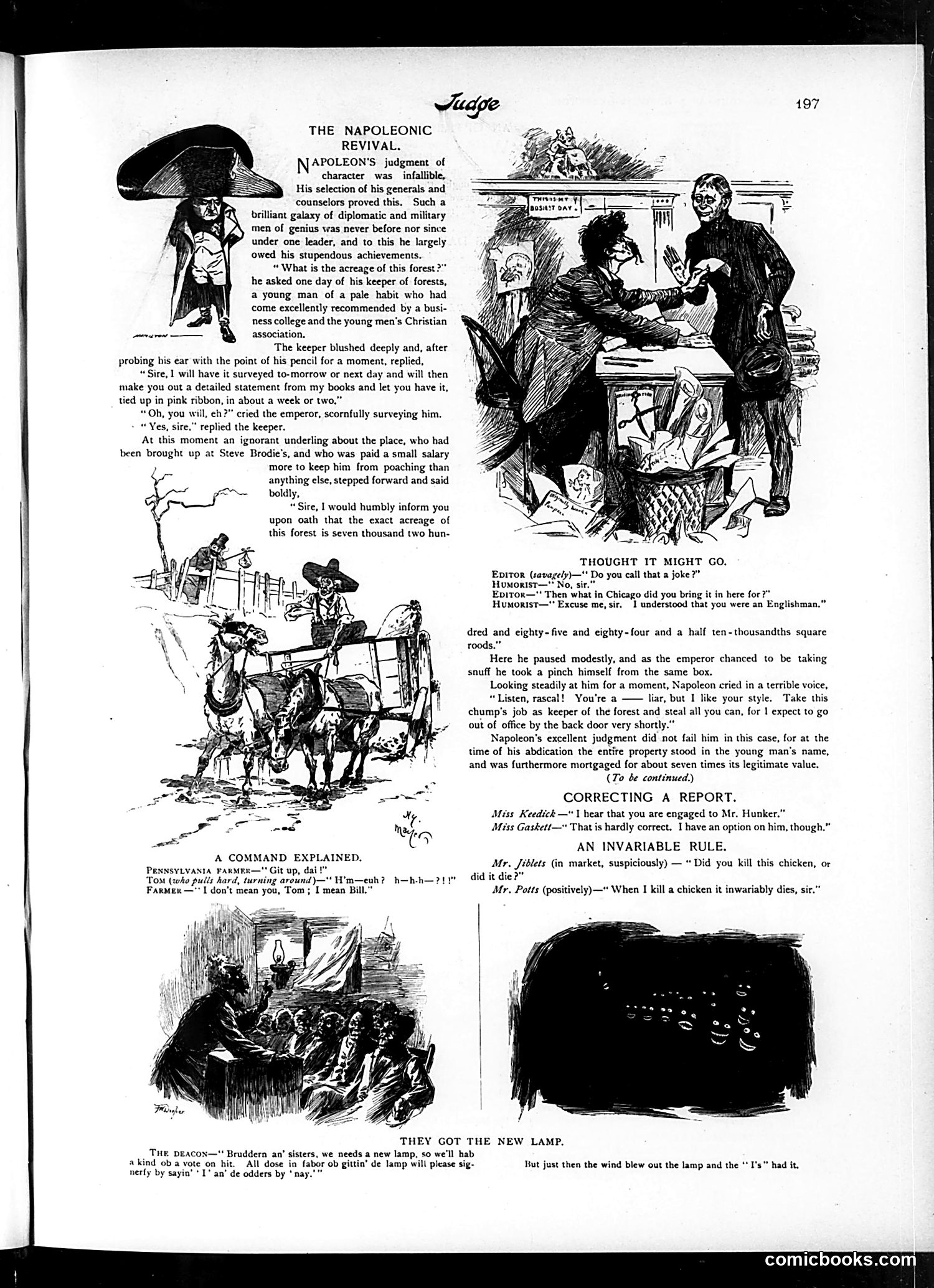
This page satirizes American business culture by contrasting Napoleon's legendary ability to judge character with modern incompetence. The main story mocks a forest-keeper recommended by "a business college and the Young Men's Christian association"—establishments representing the new, credential-based meritocracy. When asked for forest acreage, the keeper cannot answer without consulting his books and ribbons. An uneducated laborer "brought up at Steve Brodie's" (likely a reference to a notorious saloon) answers instantly and accurately. Napoleon rewards dishonesty combined with confidence, making him the corrupt official. The joke targets American faith in formal education and credentials over practical knowledge and natural ability. The satire suggests modern institutions produce incompetent bureaucrats while genuine talent goes unrecognized. The page's other brief jokes are unrelated humor pieces typical of Judge magazine's miscellaneous content.
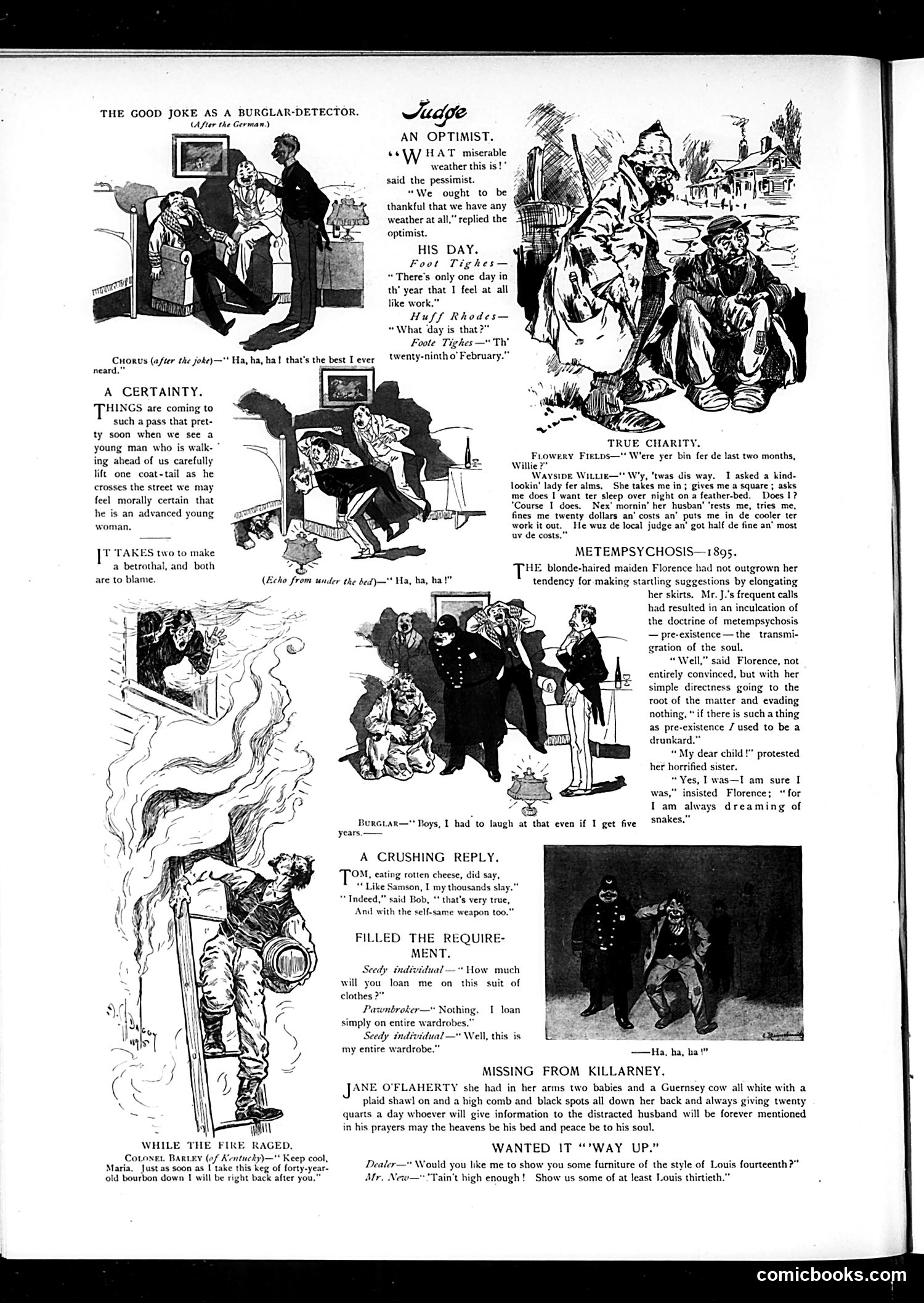
This page contains multiple short humorous pieces typical of 1890s American satire: **"The Good Joke as a Burglar-Detector"** mocks German culture by suggesting that if a burglar laughs at a joke, you've identified him—a jab at what Judge considered German humorlessness. **"An Optimist"** presents a mild debate between pessimist and optimist perspectives on weather—standard comic fare. **"True Charity"** satirizes both poverty and corrupt small-town justice. A homeless man receives shelter from a kind woman, only to be arrested, tried, and jailed by her magistrate husband who profits from the fine—exposing how "charity" and legal corruption coexist. **"Metempsychosis—1895"** jokes about reincarnation beliefs. A woman claims her constant snake dreams prove she was a drunkard in a past life, shocking her sister. The page also includes brief character jokes and advertisements. The humor relies on contemporary social anxieties about class, morality, and urban life rather than specific political events. The satire targets hypocrisy and social pretension broadly.
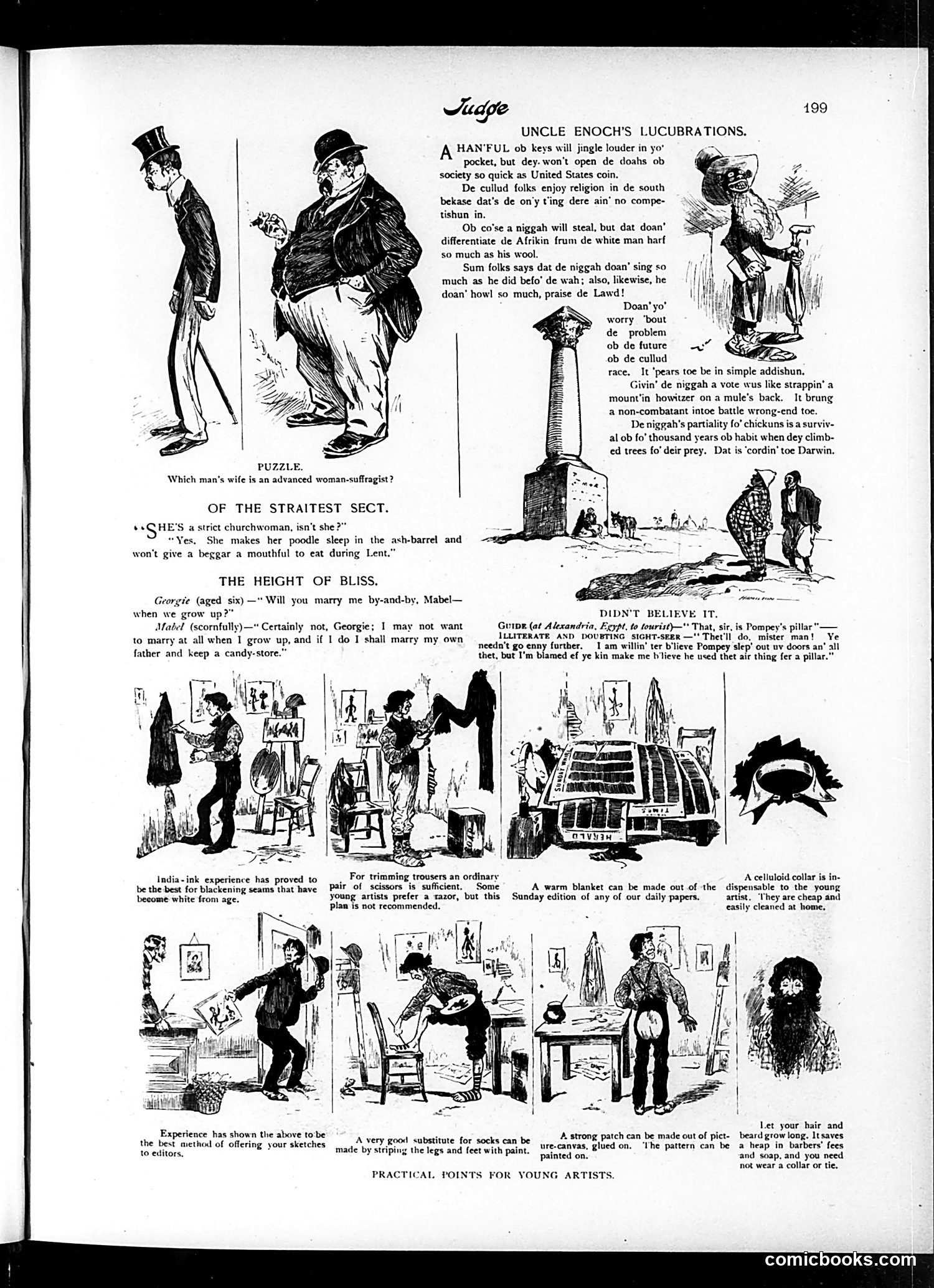
This page contains racist dialect humor and stereotypes typical of late-19th/early-20th century American satire. "Uncle Enoch" appears to be a caricatured Black character offering folksy "observations" in exaggerated dialect about African American life and behavior. The "lucubrations" (pretentious musings) mock Black people through pseudo-philosophical statements about stealing, singing, chicken-eating, and voting—all relying on degrading racial stereotypes. The humor depends on the audience finding the character's malapropisms and false "scientific" explanations (attributing chicken-preference to evolutionary adaptation) amusing. The page also includes unrelated content: a "Puzzle" about woman-suffrage, dialogue pieces about children and tourists, and practical tips for young artists. This material illustrates how mainstream American publications openly published racist caricature and humor that would be considered deeply offensive today—revealing the casual, normalized racism of the era.
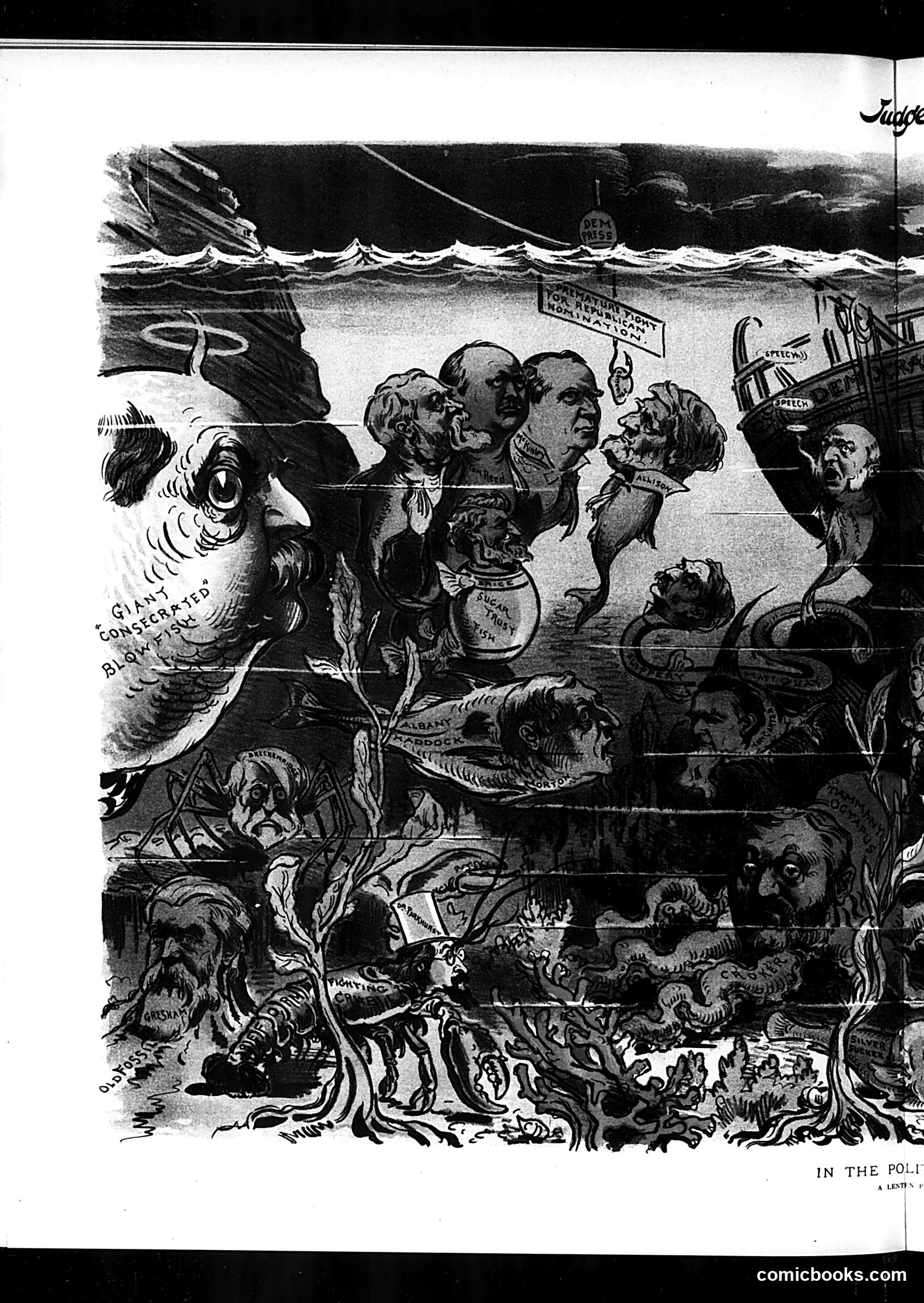
This political cartoon depicts a maritime scene with multiple caricatured figures aboard or near a ship. The visible text references "Giant Confected Blowfish" (left side) and what appears to be political figures in a nautical setting, suggesting allegory about government or political navigation. The lower section shows demonic or serpentine creatures emerging from water, likely representing societal threats or political opposition. The mixed human and monster figures suggest commentary on political corruption or danger. Without complete legible text labels identifying specific politicians or dated context, I cannot definitively name the figures or pinpoint the exact political event being satirized. The naval setting and caricature style are typical of Judge's political satire from the late 19th/early 20th century, but the specific reference remains unclear from this image alone.
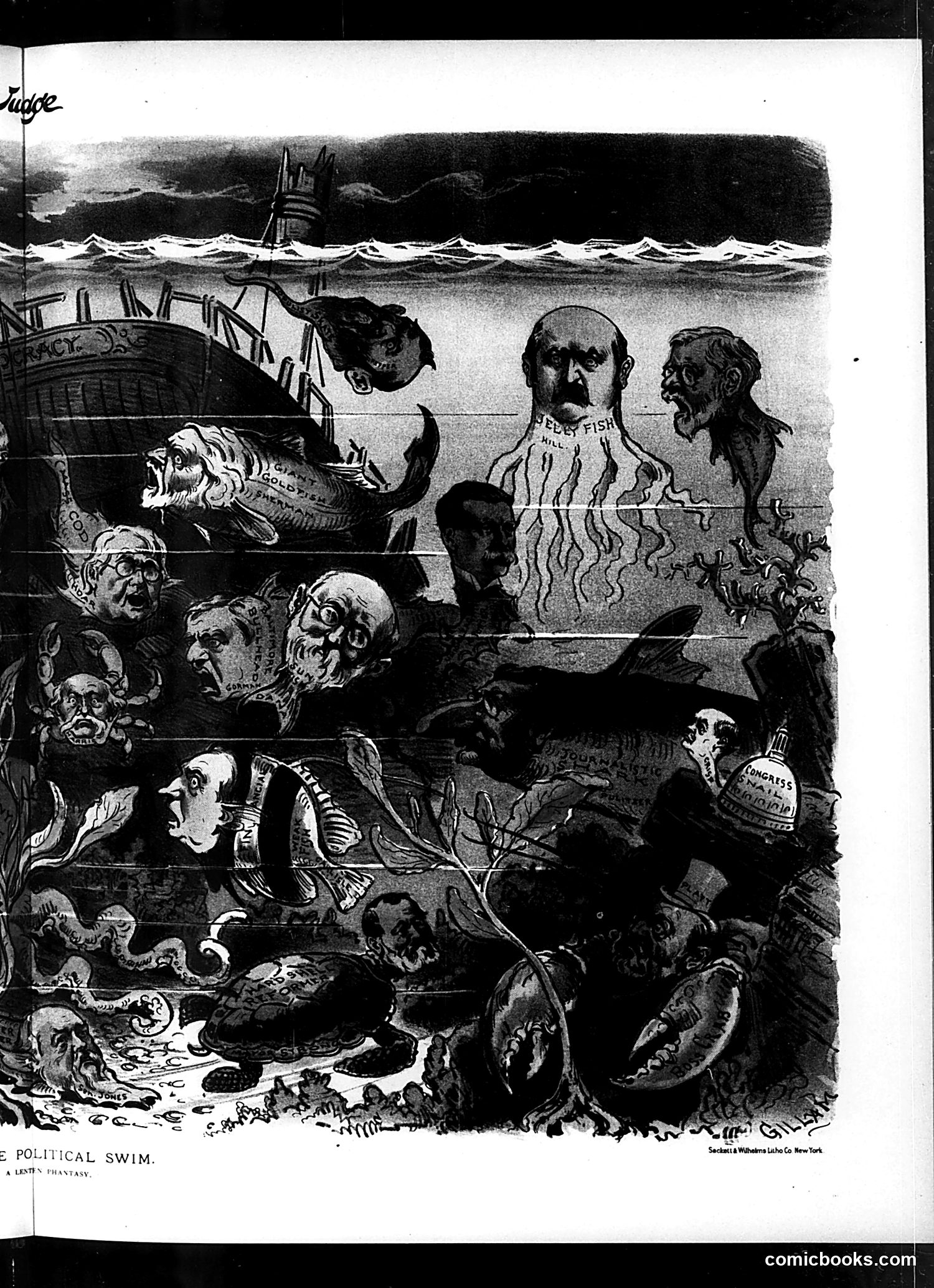
This satirical cartoon depicts politicians as various sea creatures in an underwater scene, with a ship above. The title "The Political Swim" suggests commentary on politicians navigating treacherous waters—a common metaphor for political maneuvering. The figures appear to be caricatured political leaders of the era, depicted with exaggerated features typical of Judge magazine's style. One figure is labeled "Jelly Fish," emphasizing weakness or spinelessness. Others bear labels suggesting different political characteristics or affiliations. The underwater setting with predatory creatures implies danger, competition, and the ruthless nature of political struggle. The ship above may represent the nation or government itself, threatened by the turbulent political "waters" below. Without clearer text identification of specific figures, the exact historical reference remains unclear, though this appears to critique political infighting and the questionable character of politicians circa Judge's late 19th or early 20th-century period.
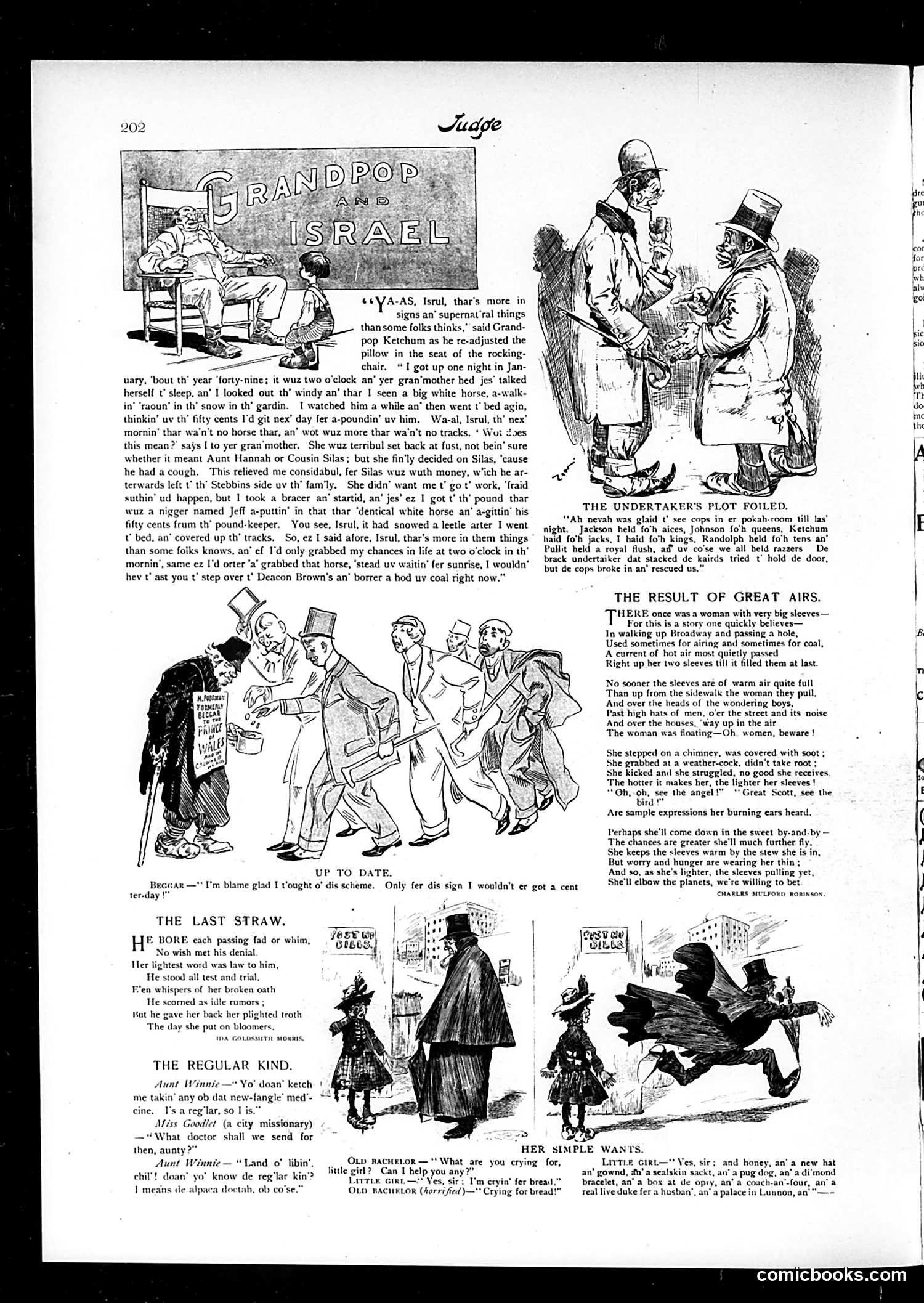
This page contains several humorous sketches mocking contemporary social pretensions and foolishness: **"Grandpop and Israel"** depicts an elderly man telling a tall tale about a supernatural white horse—a satirical jab at rural superstition and gullible storytelling. **"The Result of Great Airs"** ridicules women's fashionable puffy sleeves by imagining a woman literally inflated by hot air from a street vent, floating uncontrollably skyward. The satire targets both the absurd fashion trend and women's vanity. **"Up to Date"** mocks a man taking credit for a scheme, suggesting modern dishonesty. **"The Last Straw"** and **"The Regular Kind"** appear to be brief satirical verses about domestic relationships and masculine weakness toward female demands. The cartoons exemplify Judge's characteristic style: crude woodcut illustrations paired with exaggerated dialect and sarcastic commentary on American social follies, fashion absurdities, and human weakness.
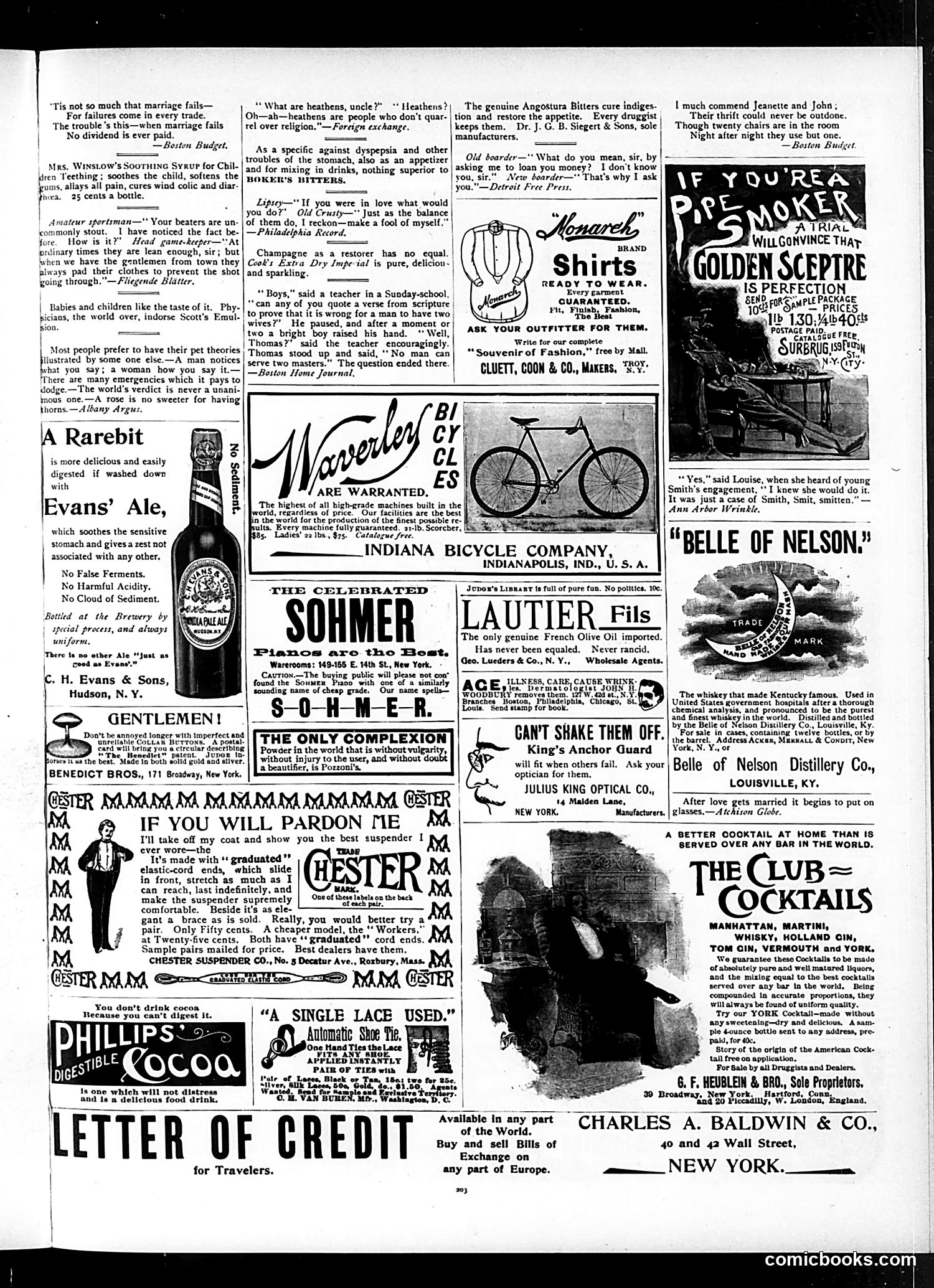
This is primarily an **advertising page** from an early 1900s Judge magazine, with minimal political content. The few editorial pieces are brief humor snippets typical of the era: - **Marriage joke** (Boston Budget): Satirizes how failed marriages differ from business failures—no financial recovery possible. - **Hunting satire** (Fliegende Blatter): Mocks wealthy townsmen's pretensions; their beaters pad clothes to hide their poor marksmanship from shot. - **Sunday school joke**: A boy quotes "No man can serve two masters" to prove bigamy is wrong—gentle religious humor. - **Heathen definition**: Wordplay suggesting heathens are those who *don't* argue about religion (inverting expectations). The page is dominated by period product advertisements (ale, bicycles, pianos, suspenders, cocoa, patent medicines) typical of Judge's revenue model. No identifiable political figures or campaigns are visible. This appears to be a standard commercial issue rather than satirical commentary on current events.
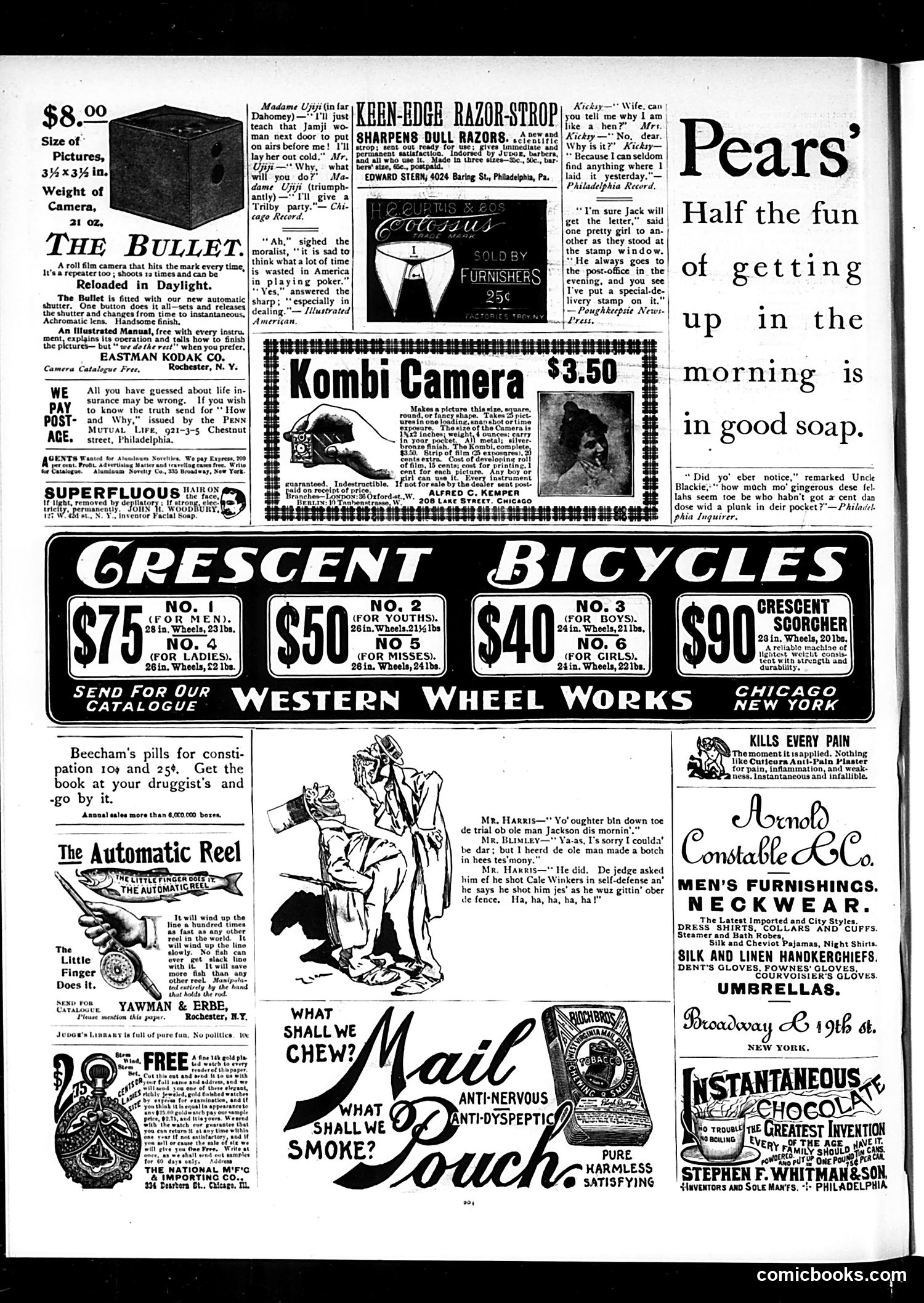
This is primarily an **advertising page** from Judge magazine with minimal editorial content. The page showcases period products: cameras (The Bullet, Kombi Camera), bicycles (Crescent brand), razors, pills, and men's furnishings. The few **joke items** scattered among ads are typical Judge humor: - A "Trilby party" joke playing on the fashionable Gibson Girl hairstyle - Puns about postal delivery and hen-laying (dated wordplay) - A dialect joke about a court testimony (reflecting period stereotypes) The **Pears' Soap advertisement** with its prominent placement features a woman and the slogan "Half the fun of getting up in the morning is in good soap"—reflecting Edwardian consumer culture's emphasis on personal grooming and "modern" conveniences. The page reflects **early 1900s advertising aesthetics**: ornate typography, product-heavy layout, and the assumption that humor and commerce could coexist naturally. There's no sophisticated political satire here—mainly commercial promotion with light, formulaic comedic filler.
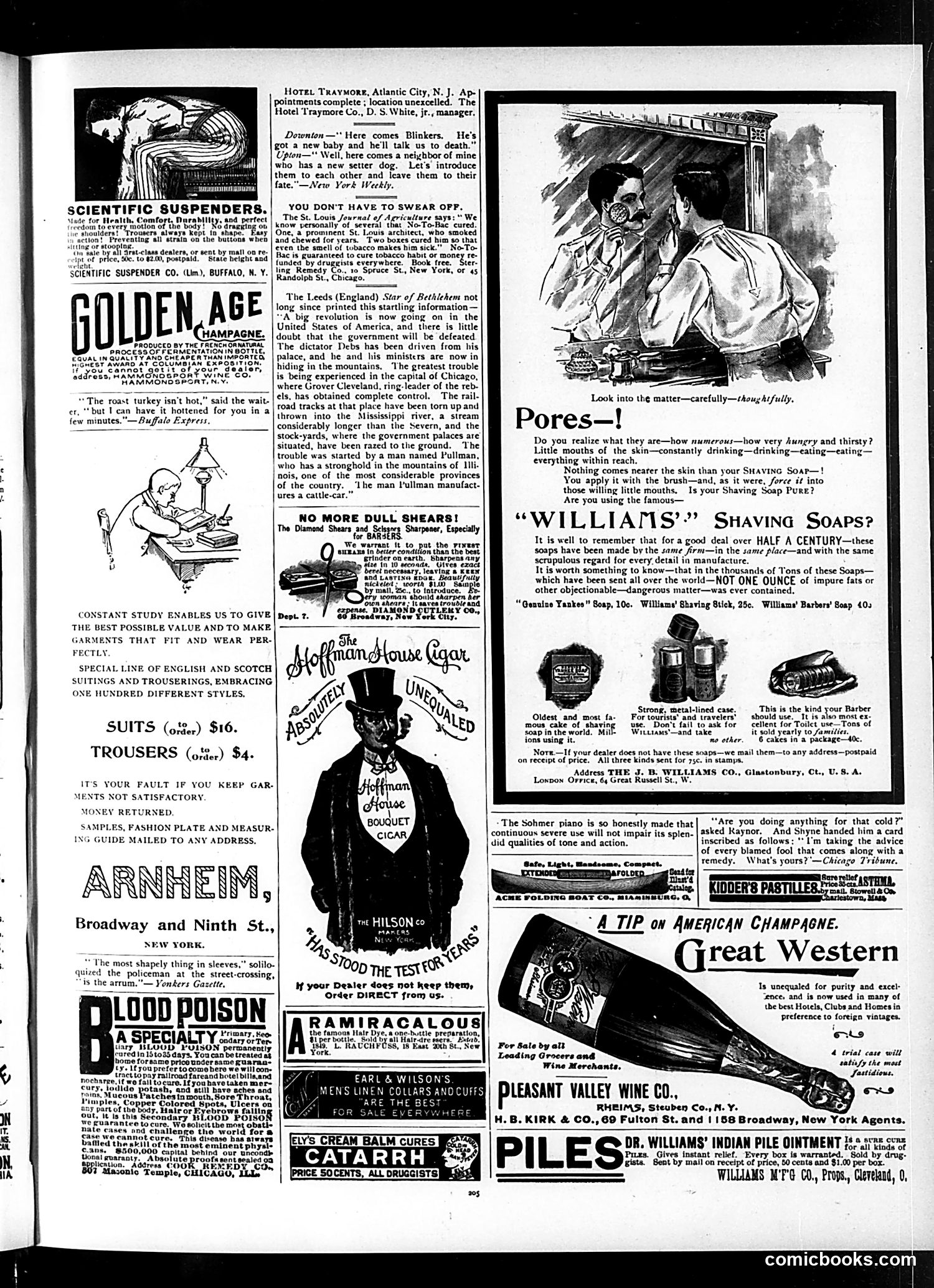
This page is primarily **advertising**, with one small satirical piece. The main content includes ads for suspenders, wine, tailoring, blood poison treatment, cigars, champagne, and hemorrhoid cream. The only cartoon/satire appears in the brief "Downton/Upton" joke: two men introduce their neighbor's new dog to Blinkers' new baby, then leave them together—implying both will be equally annoying and talkative nuisances. It's a mild domestic humor joke with no political content. The "Leeds Star" excerpt is actual satirical *writing* (not a cartoon), appearing to mock a British newspaper's absurdly inaccurate fantasy about American politics—depicting Eugene Debs as a deposed dictator hiding in mountains while Grover Cleveland leads rebellious Chicago. It's satirizing either sensationalist foreign journalism or British ignorance of American affairs. Most of the page is genuine period advertising for now-obsolete products and services.
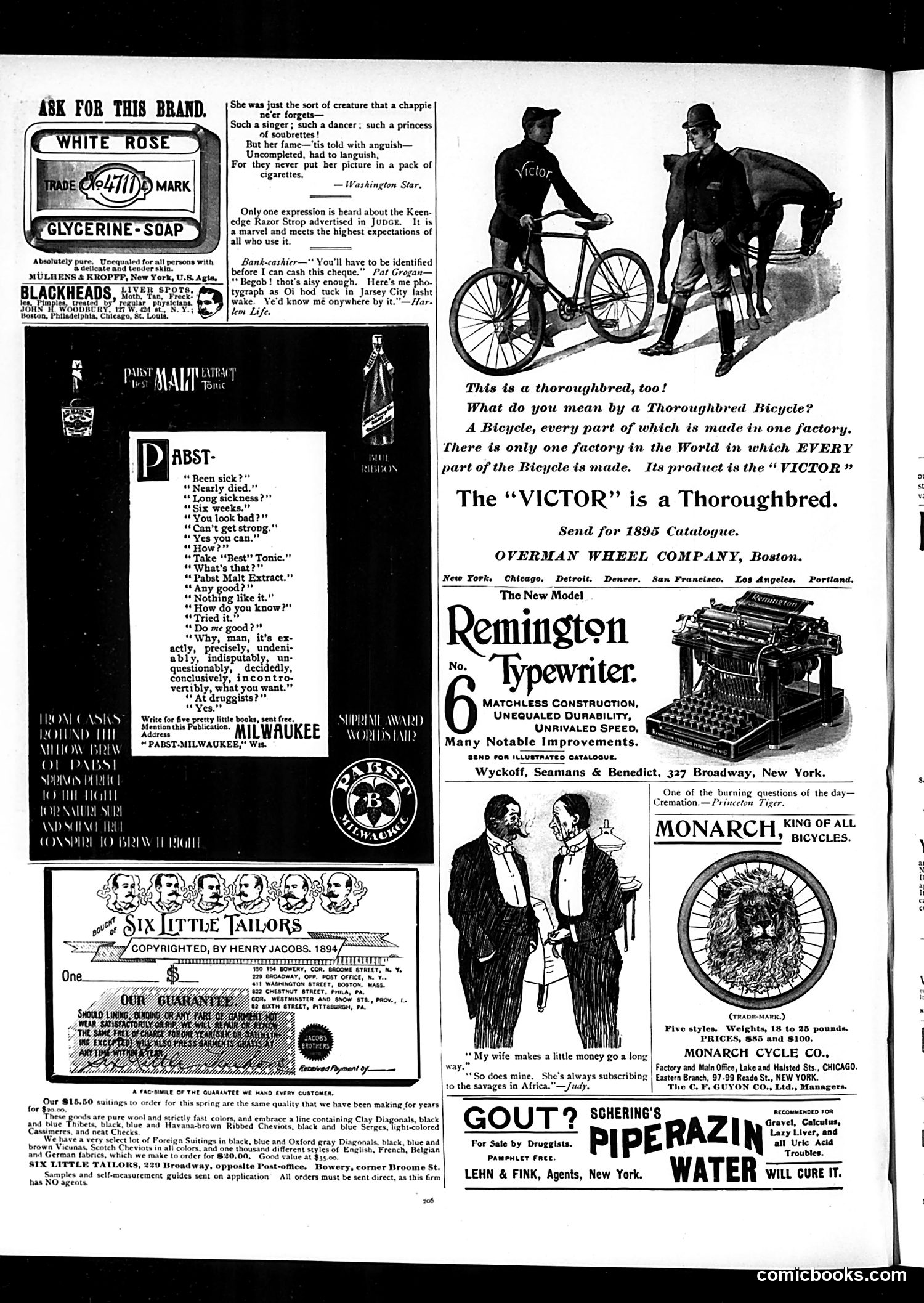
This page is primarily **advertising**, typical of 1890s Judge magazine. Key content includes: **Main Advertisements:** - Victor and Remington bicycles, Monarch bicycles (competing brands) - Remington typewriter (No. 6 model) - Pabst Malt Extract (nutritional tonic) - Six Little Tailors (custom tailoring service) - Various patent medicines and grooming products **Satirical Elements:** A brief poem (Washington Star credit) mocks an unnamed actress/entertainer whose career languished because she wasn't featured in cigarette packs—a form of promotional publicity common in the era. The joke: celebrity depended on commercial endorsement, not talent. A short comic dialogue depicts an Irish bank clerk (Pat Grogan, identified by dialect) offering a photograph from Jersey City as identification—absurd humor based on ethnic stereotyping. **Historical Context:** This reflects the 1890s advertising boom, bicycle craze, and tobacco marketing that used celebrity endorsements. The page demonstrates how Judge blended satirical content with revenue-generating advertisements.
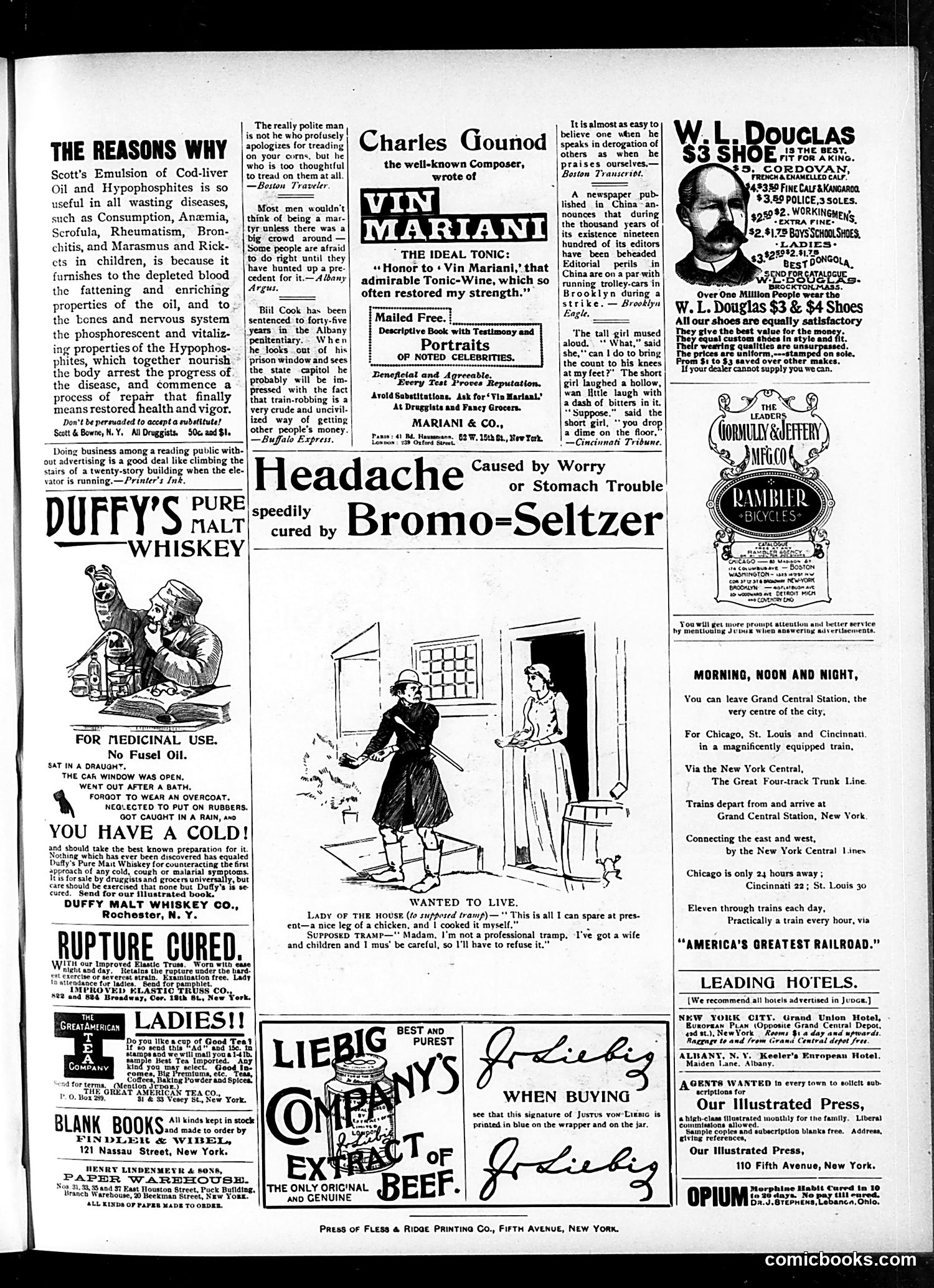
This is primarily an **advertising page** from Judge magazine, with minimal editorial content. The page consists almost entirely of patent medicine and product advertisements typical of early 20th-century American publications. **Notable elements:** The small editorial snippets scattered among ads contain mild social commentary—observations about politeness, martyrdom, and political corruption—but lack specific satirical targets. **Key advertisements** include Scott's Emulsion (cod-liver oil for wasting diseases), Duffy's Malt Whiskey (marketed as medicinal), and Liebig's Extract of Beef. These reflect the era's unrestricted advertising of products now recognized as dubious or harmful. A **small cartoon** titled "Wanted to Live" depicts a woman considering marrying a professional tramp, presenting domestic hardship as comedic fodder. There is **no identifiable political satire or caricature** on this page. It represents Judge's revenue model: satirical magazine content subsidized by extensive patent medicine advertising—a practice that contributed to Progressive Era food and drug regulation reforms.
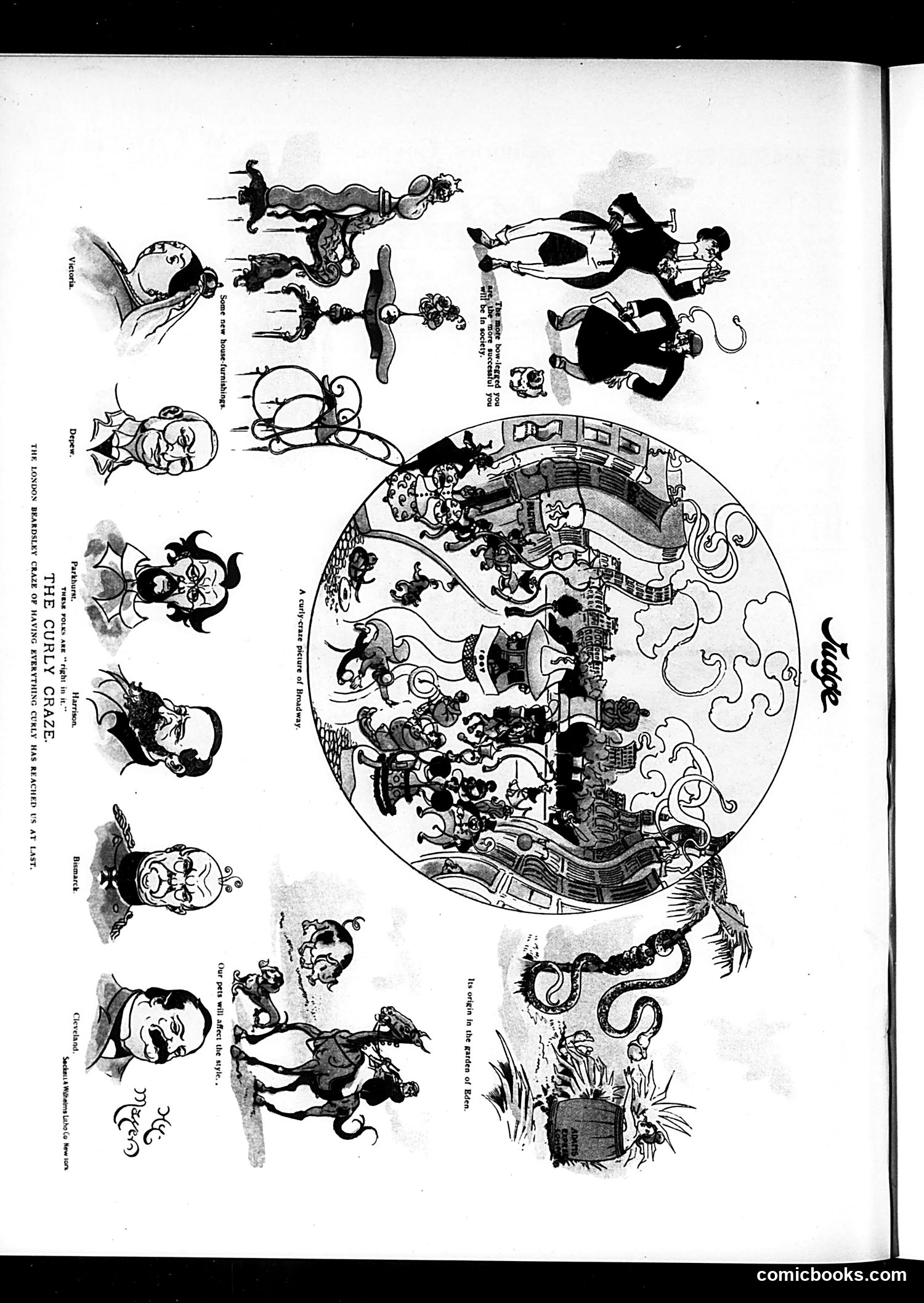
I cannot reliably read the OCR'd text on this page—it appears heavily corrupted or reversed. From the IMAGE alone, I can see this is a "Judge" magazine page featuring a large central circular illustration (possibly depicting a fantastical or allegorical scene with multiple figures, architecture, and decorative elements) surrounded by smaller character sketches and vignettes arranged around it. However, without legible text identifying the specific figures, historical context, political references, or the satire's target, I cannot accurately explain what this cartoon means to a modern reader. The artistic style suggests late 19th or early 20th century American satire, but I cannot determine the specific political or social commentary intended without being able to read the captions and article text. To provide accurate analysis, I would need either clearer OCR or the original text.