
A complete issue · 16 pages · 1895
Judge — March 23, 1895
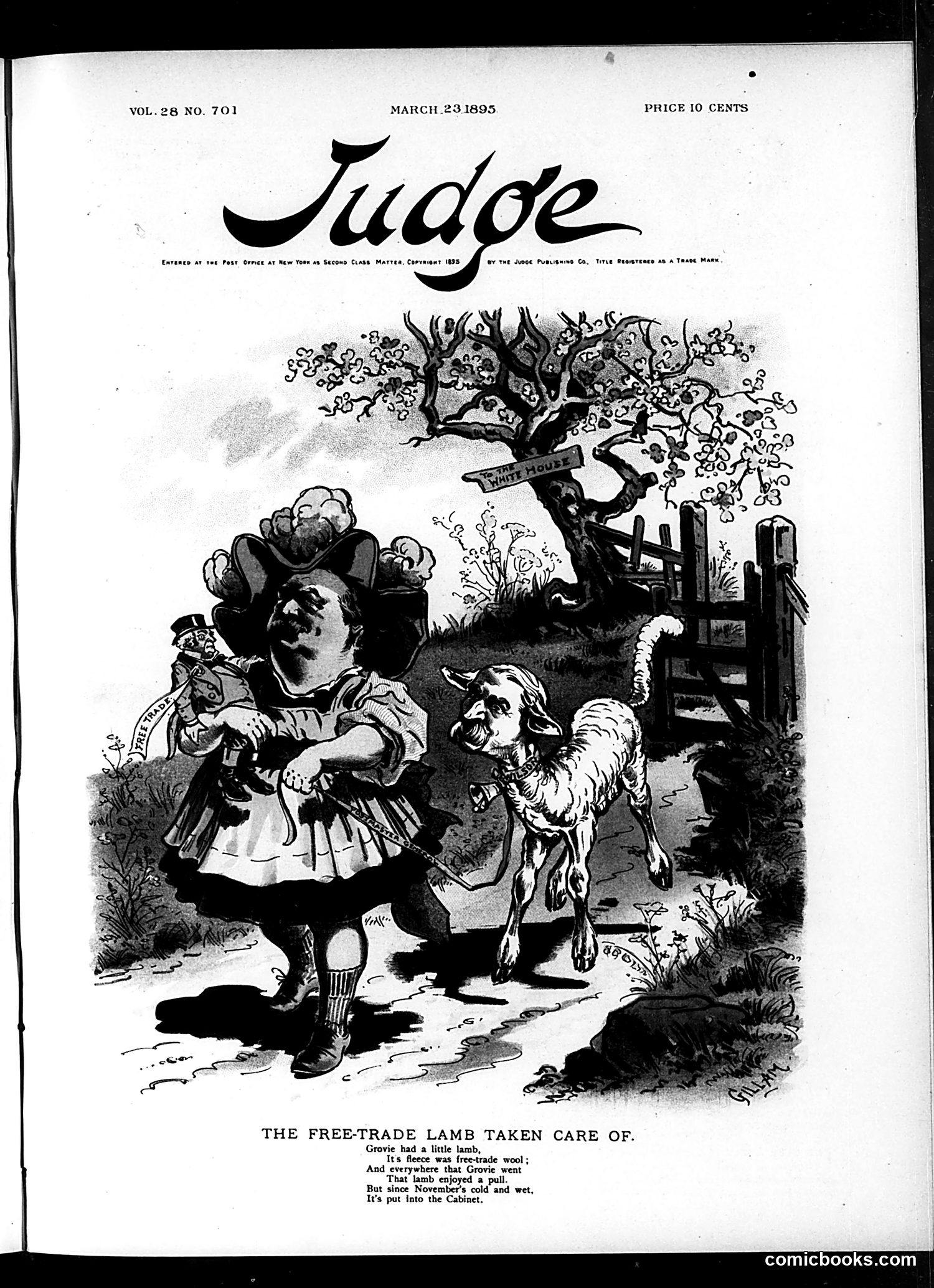
This 1893 *Judge* cartoon satirizes the effects of free-trade policy on American wool producers. The illustration depicts a woman (representing American interests) holding a lamb labeled "free trade wool," with a goat at her side. The accompanying verse describes Grover (likely President Cleveland, who championed free trade) taking the lamb, which "enjoyed a pill" and subsequently suffered from illness—suggesting free-trade policies made the wool industry sick. The cartoon argues that free-trade wool imports harmed domestic American wool producers and workers. The satirical premise equates trade policy to poisoning: what seemed beneficial ("a pill") actually damaged the vulnerable domestic industry, portrayed as a defenseless lamb requiring protection rather than exposed to foreign competition.
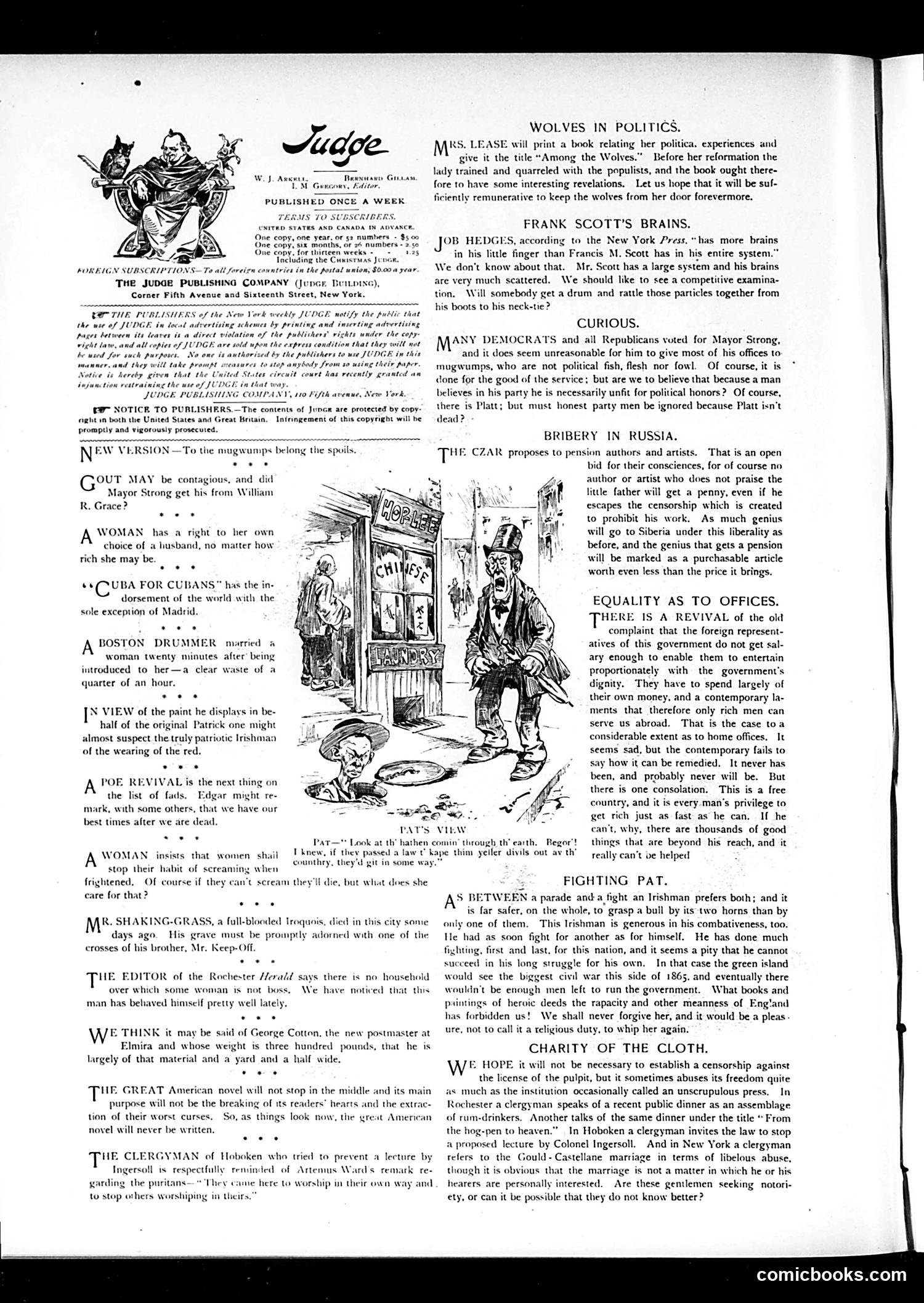
This page contains editorial commentary rather than a single political cartoon. The main illustration, titled "Fat's View," depicts a street scene with working-class figures observing chimney sweeps and what appears to be a tenement building—likely satirizing urban poverty and poor working conditions in industrial America. The accompanying short opinion pieces address various political topics: a mayor's election, foreign diplomats' salaries, censorship of authors in Russia, and charity organizations. The commentary reflects Progressive-era concerns about government corruption, workers' rights, and social inequality. The specific political figures and electoral races referenced are unclear without additional historical context, but the overall tone criticizes both governmental inefficiency and hypocrisy among the wealthy regarding charitable work.
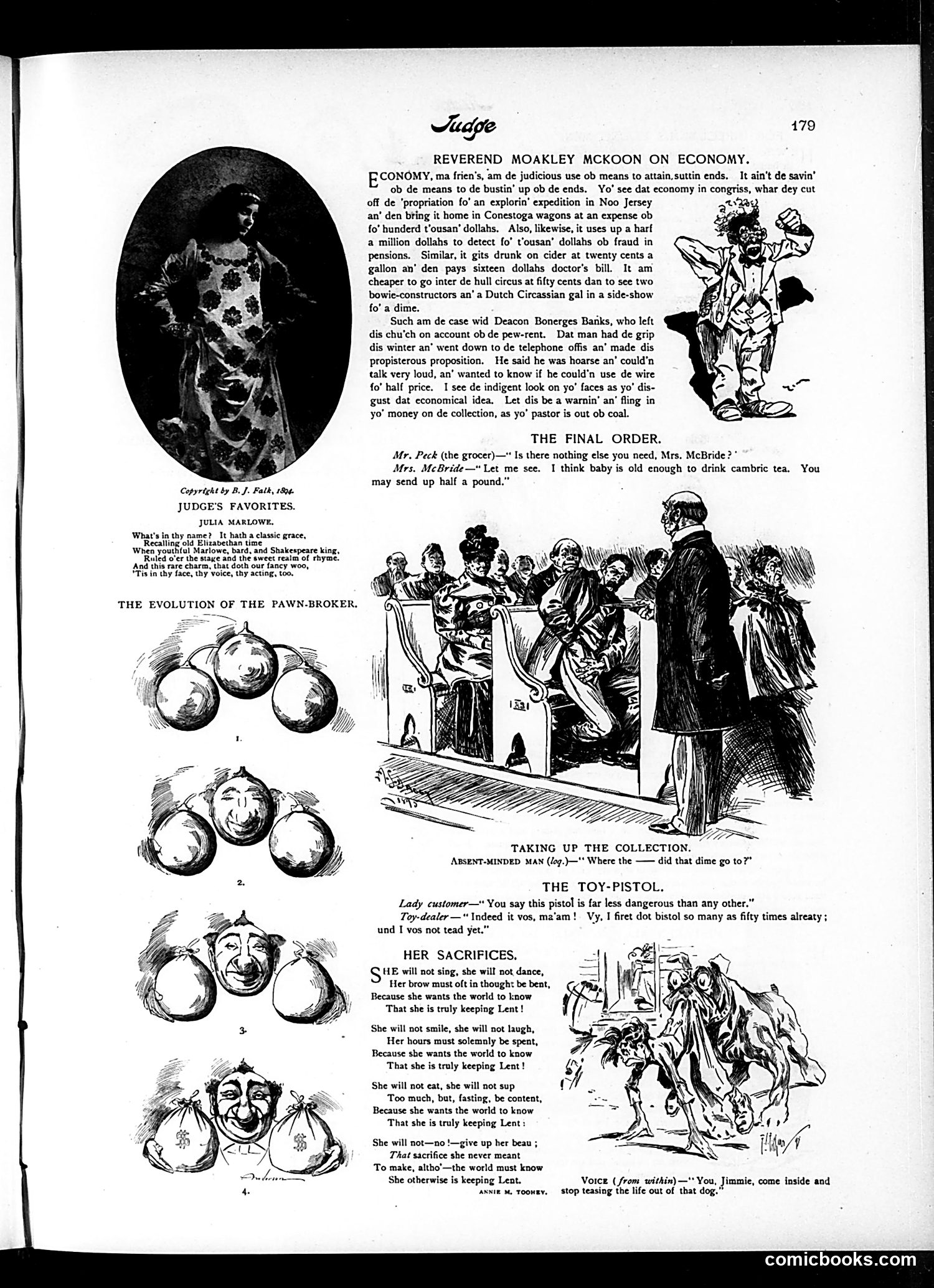
This page contains several humor pieces mocking social and religious practices of the era: **"Reverend Moakley McKoon on Economy"** satirizes wasteful charitable spending by clergy—the reverend describes dubious financial decisions (funding expensive expeditions, detecting fraud through expensive methods) while claiming to practice economy. The joke targets hypocrisy: religious leaders preaching frugality while spending lavishly. **"The Evolution of the Pawn-Broker"** shows four progressive stages of a pawn-broker's face, suggesting moral/physical degradation through the profession—a commentary on what was considered disreputable work. **"Her Sacrifices"** is a poem about a woman's Lenten observances, mocking performative religious devotion focused on public perception ("wants the world to know") rather than genuine faith. The remaining pieces ("The Final Order," "Taking Up the Collection," "The Toy-Pistol") are brief satirical dialogues mocking consumer behavior and church fundraising.
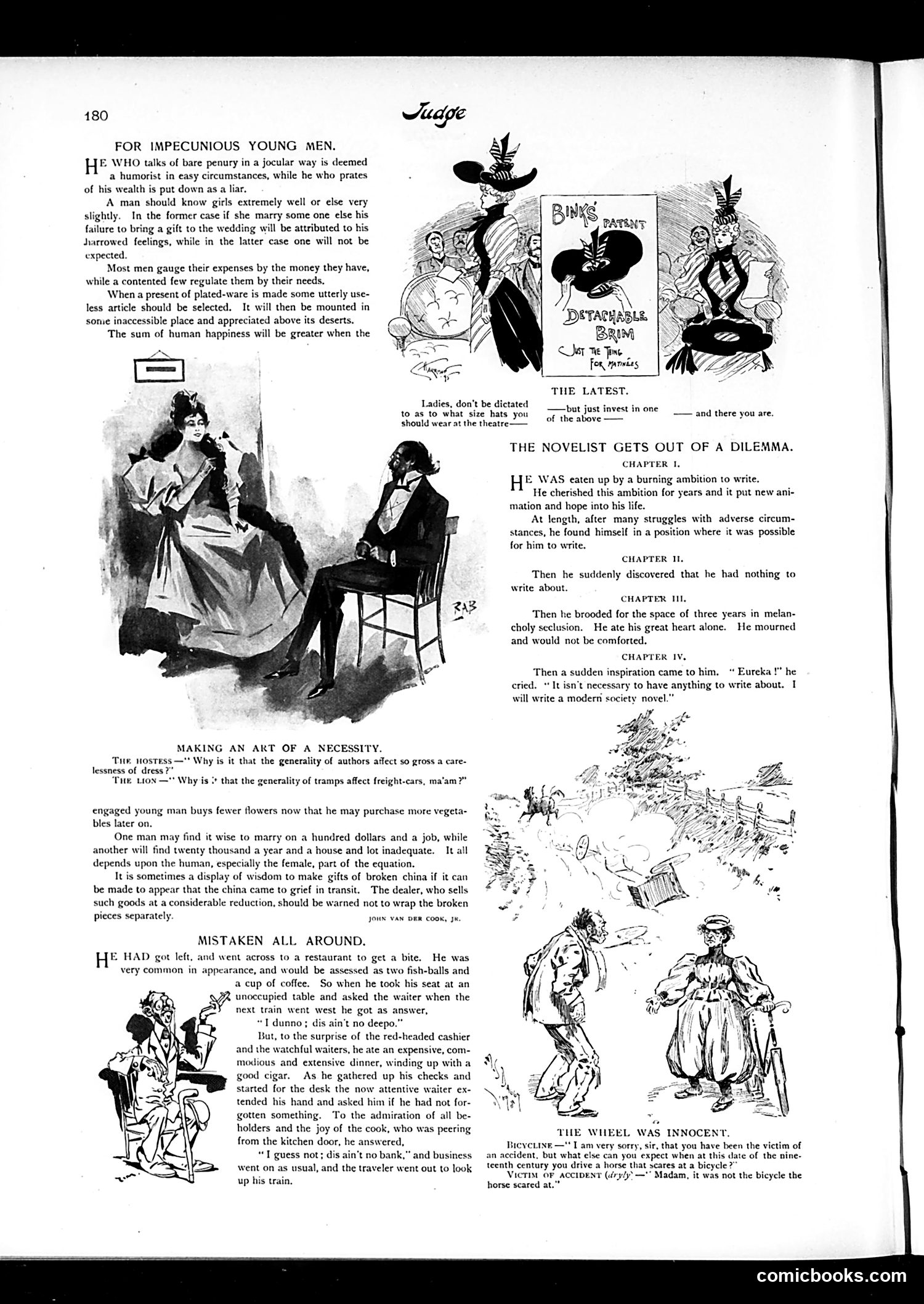
This page collects several satirical pieces aimed at different audiences: **"For Impecunious Young Men"** offers tongue-in-cheek advice about gift-giving and courtship on a budget—a humorist's guide to appearing wealthy while poor. **"Making an Act of a Necessity"** features a joke where a hostess asks why authors dress poorly, and a guest quips it's like asking why tramps prefer freight cars—implying both groups are vagrants and deadbeats. **"Mistaken All Around"** depicts a shabby-dressed traveler who surprises restaurant staff by ordering an expensive dinner, then tells the waiter he hasn't forgotten anything since "dis ain't no bank"—humor about defying low expectations. **"The Novelist Gets Out of a Dilemma"** satirizes contemporary fiction writers: a man burns to write, finally can, but discovers he has nothing to say—so he'll simply write a "modern society novel" anyway. This mocks frivolous contemporary literature requiring no real substance or inspiration. The cartoons mock poverty, pretension, and literary mediocrity of the era.
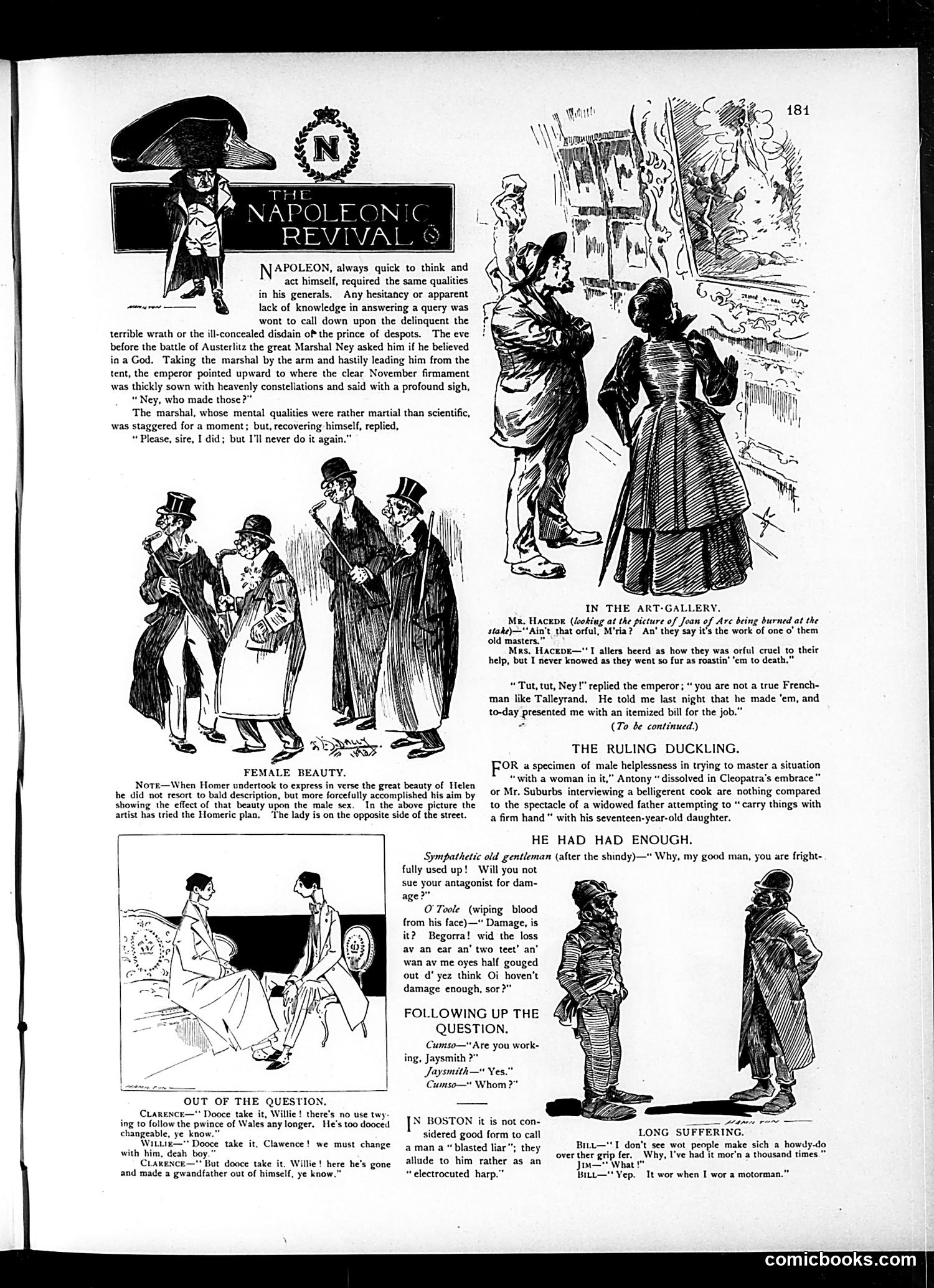
This page contains multiple satirical sketches typical of early 20th-century American humor: **"The Napoleonic Revival"** opens with a historical anecdote about Napoleon questioning Marshal Ney about God before the Battle of Austerlitz—likely satirizing contemporary figures who claim grandiose accomplishments. The punchline mocks both blind obedience and absurd responsibility-claiming. **"In the Art-Gallery"** features working-class visitors misunderstanding a painting of Joan of Arc's execution, confusing artistic brutality with actual cruelty—satirizing both artistic pretension and lower-class naïveté. **Remaining sketches** use exaggerated dialect (Irish, British upper-class) to mock various social types: indecisive aristocrats following trends, a father struggling with his teenage daughter, a brawler with injuries, and a motorman boasting about surviving illness. The humor relies on class stereotypes, dialect comedy, and physical comedy—common Judge conventions. No specific political figures or events appear referenced; instead, the satire targets universal human follies and social pretensions.
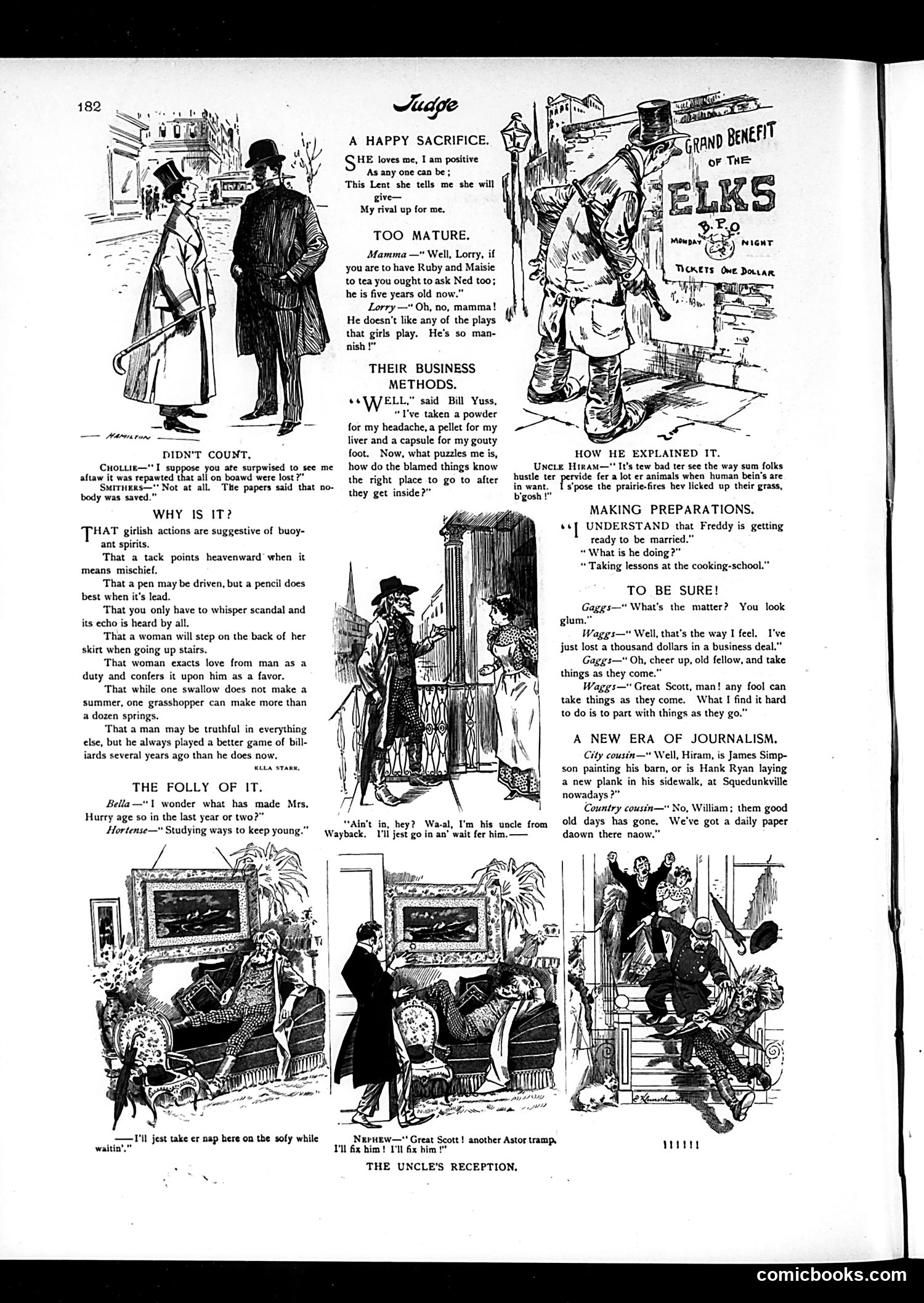
This page contains multiple short satirical pieces typical of Judge magazine's humor: **"Didn't Count"** mocks a survivor's surprise at being reported lost—the joke being that newspapers reported "nobody saved" rather than listing individuals. **"Why Is It?"** is a humor column offering absurd observations about human behavior (women stepping on their skirts going upstairs, men exaggerating past billiards skills). **"The Folly of It"** jokes that Mrs. Hurry aged from studying "ways to keep young"—ironic self-defeat. **"Their Business Methods"** satirizes patent medicine's mystery: a man takes powders, pellets, and capsules but can't understand how they know where to go inside his body—mocking the pseudoscience of contemporary patent remedies. **"The Uncle's Reception"** appears to reference wealthy Astors, with a poor rural relative visiting and being mistaken for "another Astor tramp." **Other pieces** humorously address romance, cooking-school marriage prep, and rural journalism's modernization. The cartoons are largely domestic humor rather than political satire.
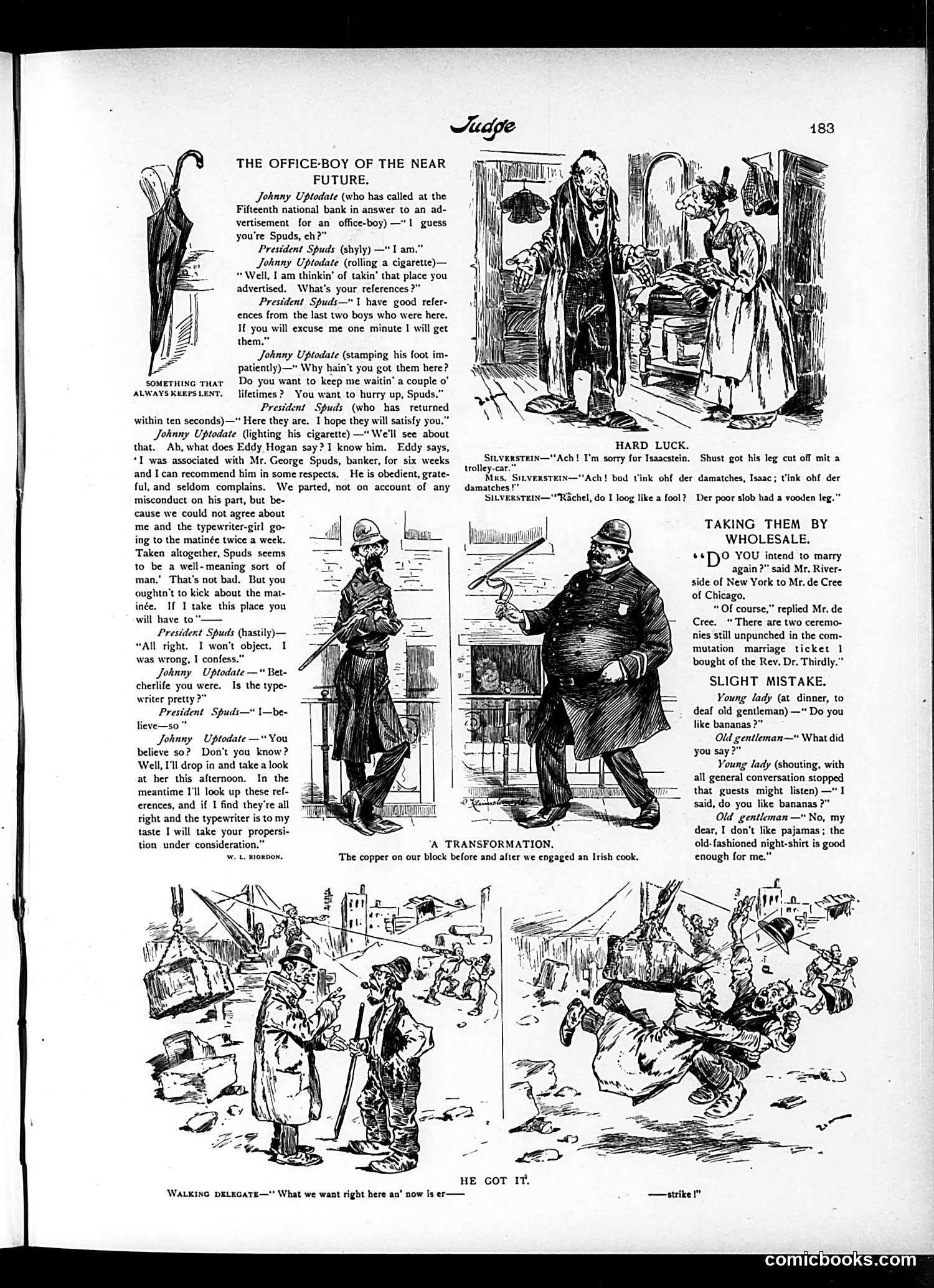
This page contains several satirical sketches mocking early 1900s social attitudes and manners. **"The Office-Boy of the Near Future"** depicts role reversal: an arrogant, cigarette-smoking job applicant interrogates a bank president as references, treating the employer as subordinate. The satire targets the younger generation's perceived disrespect and entitlement—Johnny Uptodate demands immediate gratification and presumes to audit the boss's personal life (the typewriter girl). **"Hard Luck"** uses Yiddish-accented characters (Silverstein and Isaacstein) for humor. When Isaacstein loses his leg to a trolley, Silverstein sympathizes—not about the injury, but the wooden prosthetic leg that won't yield insurance money. The joke mocks both immigrant stereotypes and the era's casualness about industrial accidents. **"Slight Mistake"** plays on deaf-elderly-gentleman tropes: a young woman shouts about "bananas" at dinner; the old man mishearsas "pajamas," responding about nightshirts instead. **"Taking Them by Wholesale"** jokes about remarriage using multiple "comutation marriage tickets"—treating marriage like commercial bulk purchasing. The page reflects period class anxieties, immigrant caricatures, and generational conflict.
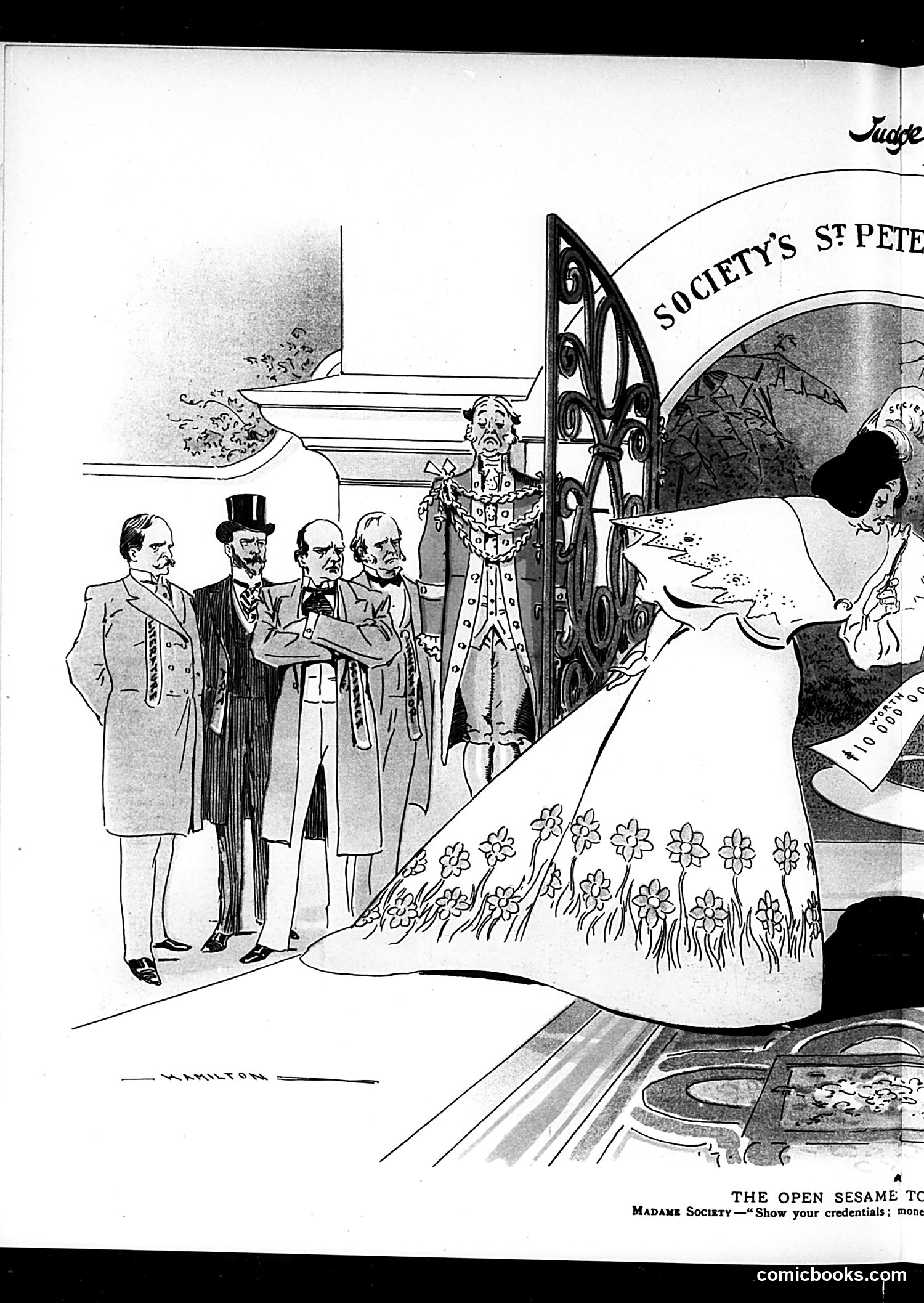
This cartoon satirizes the "Madame Society" — likely referring to exclusive, elite social clubs that demanded credentials for entry. The scene shows four well-dressed gentlemen attempting to enter what appears to be "Society's St Peter" (a grand entrance with ornate gate), while a large woman in an elaborate, flower-patterned gown guards the entrance like a gatekeeper. The satire critiques social gatekeeping and class exclusivity. The woman demands "Show your credentials; money" — suggesting that wealthy individuals must prove their worth through financial status to gain admittance to high society. The "open sesame" reference implies these exclusive spaces use hidden passwords (wealth/credentials) to exclude ordinary people. The cartoon mocks how turn-of-the-century American high society functioned as a closed system based on money and status rather than merit.
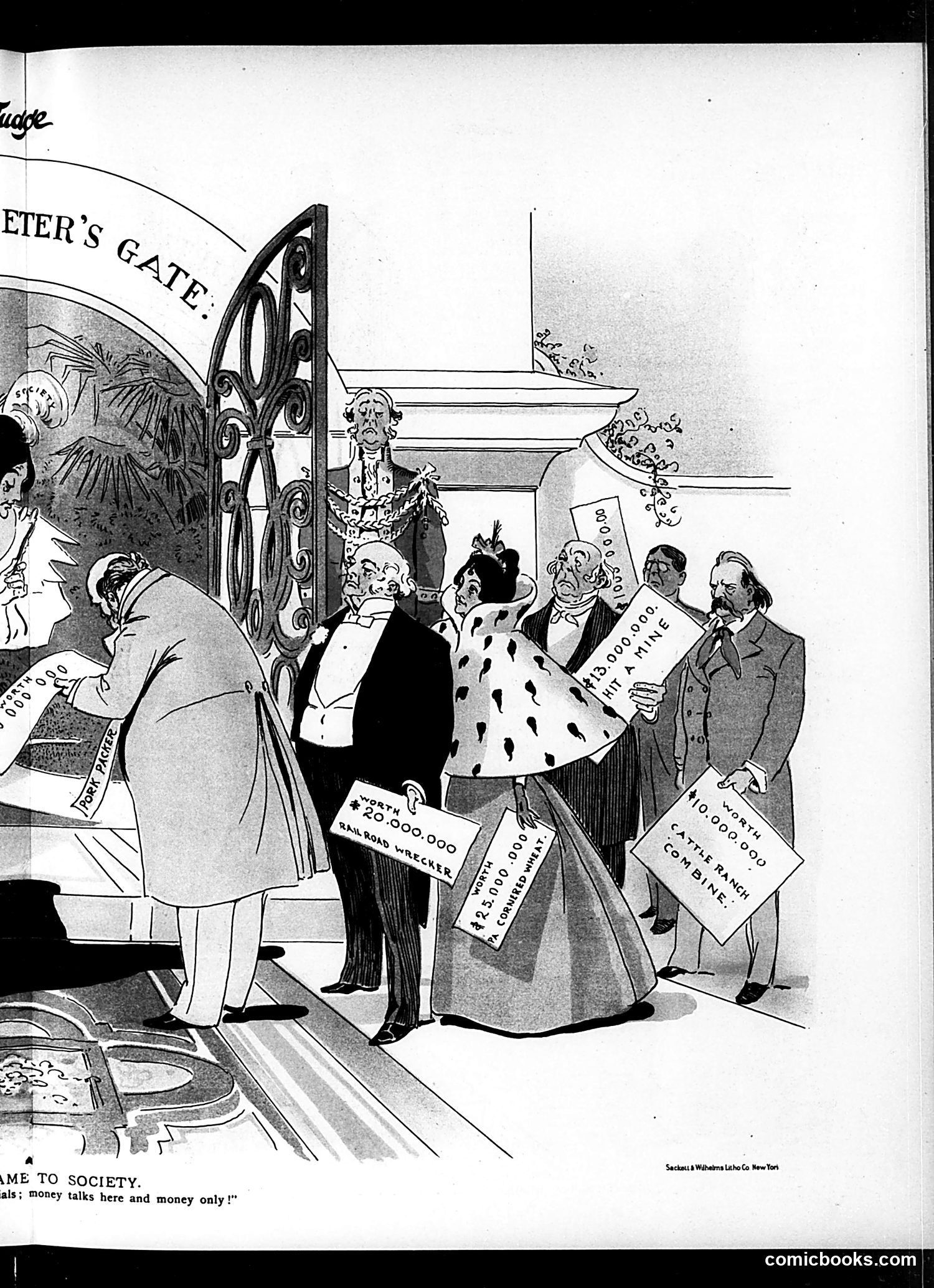
This appears to be a satirical cartoon about wealth and social access, likely from the early 20th century. The ornate gate labeled "PETER'S GATE" seems to reference St. Peter's entrance to heaven, but here it's being guarded as an exclusive club for the wealthy. Figures holding signs displaying large sums ("$20,000," "$2,000,000," "$1,000,000") seek entry, suggesting that monetary wealth—not virtue or merit—determines admission to high society. The gatekeepers appear to be aristocratic or established wealthy individuals controlling access. The caption's statement that "money talks here and money only" makes the satire explicit: Judge is mocking how American high society judges people solely by financial status rather than character or accomplishment. This critiques the era's materialism and class stratification among the elite.
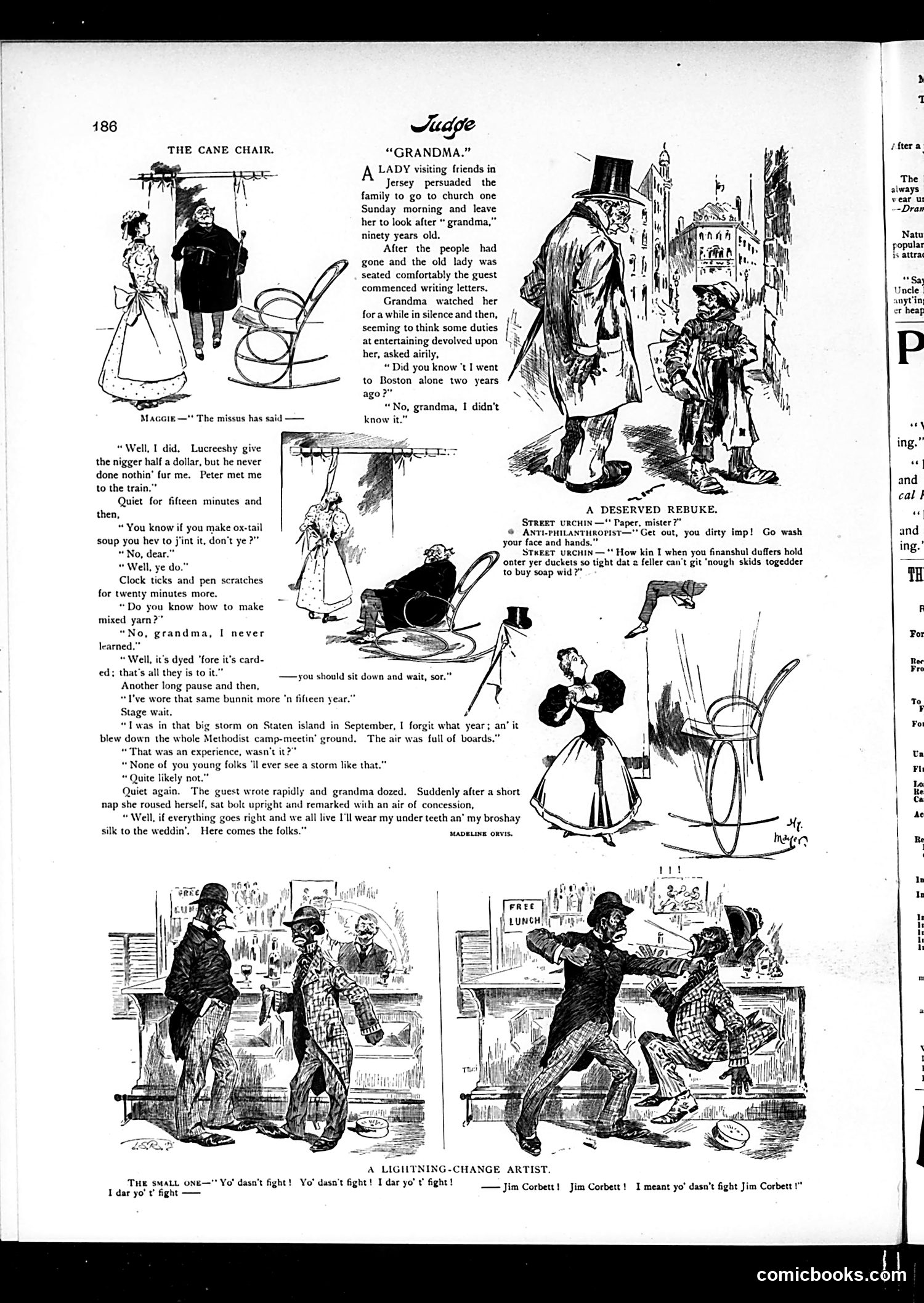
This page contains three separate satirical pieces: **"The Cane Chair"** depicts a tedious social obligation: a visitor left to entertain an elderly grandmother delivers rambling, pointless anecdotes (ox-tail soup recipes, storm stories, worn bonnets) with long awkward silences. The satire mocks both the obligation of polite small talk and elderly people's tendency toward repetitive reminiscence. **"A Deserved Rebuke"** shows a street newsboy confronting a wealthy philanthropist. When told to wash his dirty face, the boy retorts that rich people hoard money so tightly that poor children can't afford soap—turning the moralistic rebuke back on its hypocrite. This critiques wealthy charity that demands poor people "improve themselves" while maintaining economic systems that prevent it. **"A Lightning-Change Artist"** references boxer Jim Corbett, showing a child challenging another to fight, then nervously backing down once the name "Jim Corbett" is invoked—humor based on Corbett's famous fighting reputation making even invoking his name a deterrent. The page reflects late 19th-century class tensions and social commentary through humor.
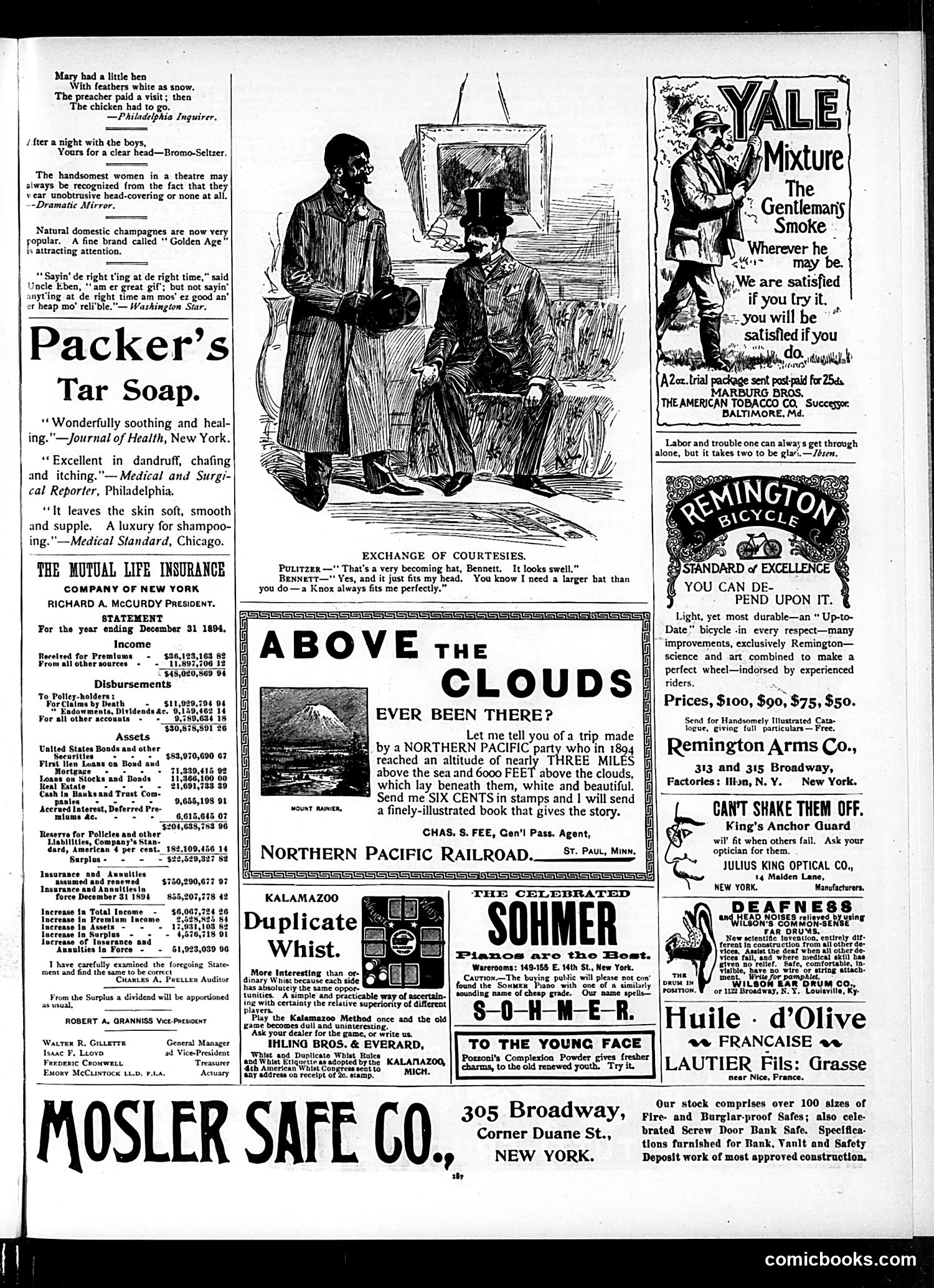
This Judge magazine page is primarily **advertising**. The main cartoon (centered) titled "Exchange of Courtesies" depicts an exchange between newspaper publishers Joseph Pulitzer (New York World) and James Gordon Bennett (New York Herald)—rivals competing for dominance in American journalism. The joke pivots on hat sizes: Pulitzer compliments Bennett's hat; Bennett responds that he needs larger hats because Knox brand "always fits perfectly," implying Pulitzer has a smaller head (a witty insult about intelligence). The page is otherwise dominated by **product advertisements**: insurance, soap, pianos, railroads, bicycles, optical goods, and furniture safes. A secondary illustration advertises Northern Pacific Railway's mountain scenery. The quoted text snippets at the page's top are typical Judge filler—witty observations attributed to various publications.
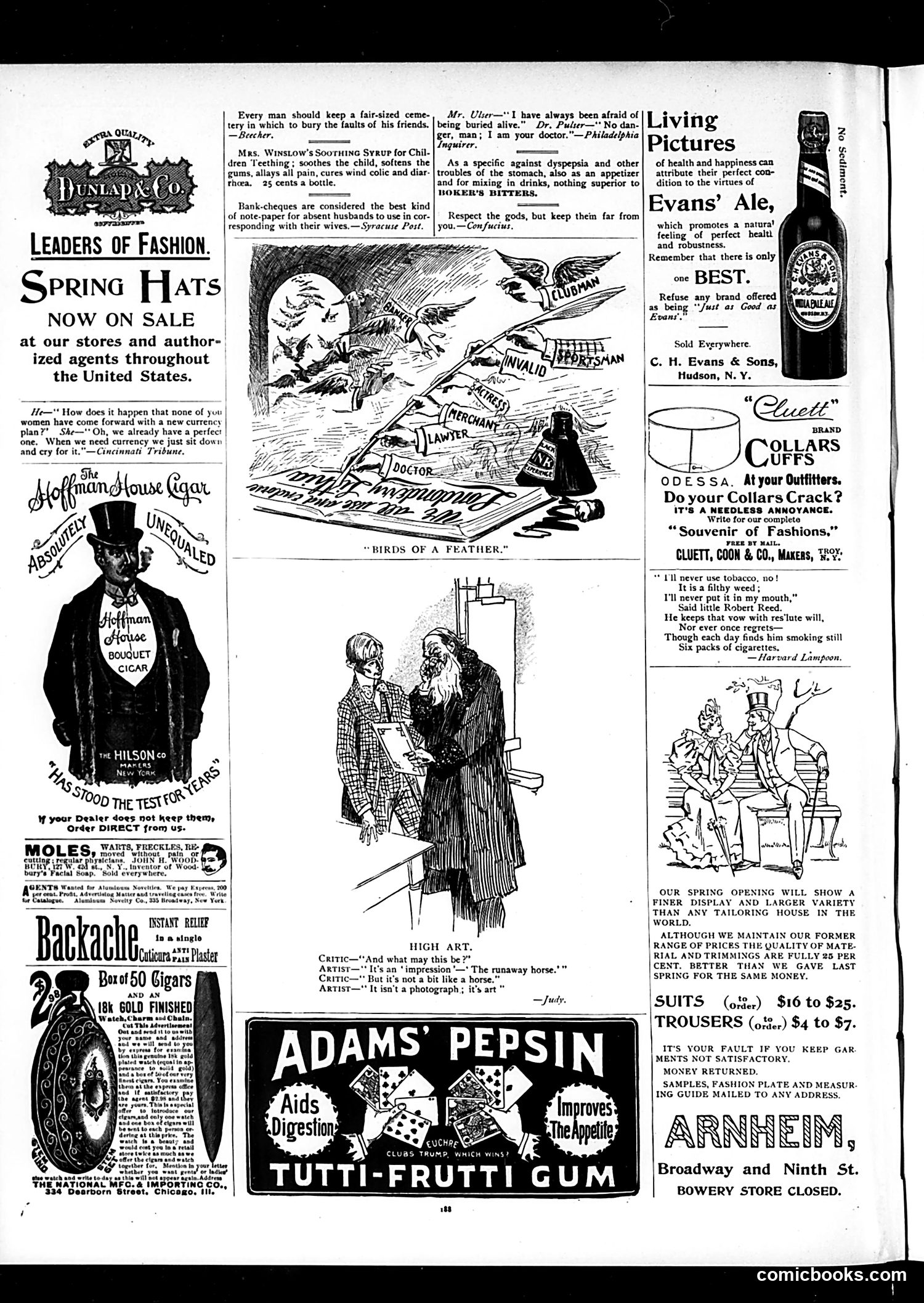
This page from *Judge* (a satirical weekly) mixes advertisements with satirical commentary typical of early 20th-century humor journalism. The main cartoon, "Birds of a Feather," depicts various professional figures (labeled Policeman, Lawyer, Doctor, Merchant, Invalid) being herded like birds—a visual metaphor suggesting these professions are all "flocking together," likely satirizing corruption or moral compromise across society's institutions. The "High Art" cartoon mocks Impressionist art movements gaining popularity. A critic questions whether an abstract painting titled "The Runaway Horse" actually resembles a horse; the artist dismisses this as irrelevant to "art." This reflects contemporary tension between realistic representation and modernist abstraction—a frequent target of conservative satirists. A joke about women and currency plays on period stereotypes about women's financial dependency, suggesting wives simply "cry for" money from husbands rather than earning it. The remaining content is primarily advertisements for products (cigars, medicine, collars, clothing) typical of *Judge's* revenue model, with occasional embedded humor ("Little Robert Reed" humorously contradicts his pledge against tobacco).
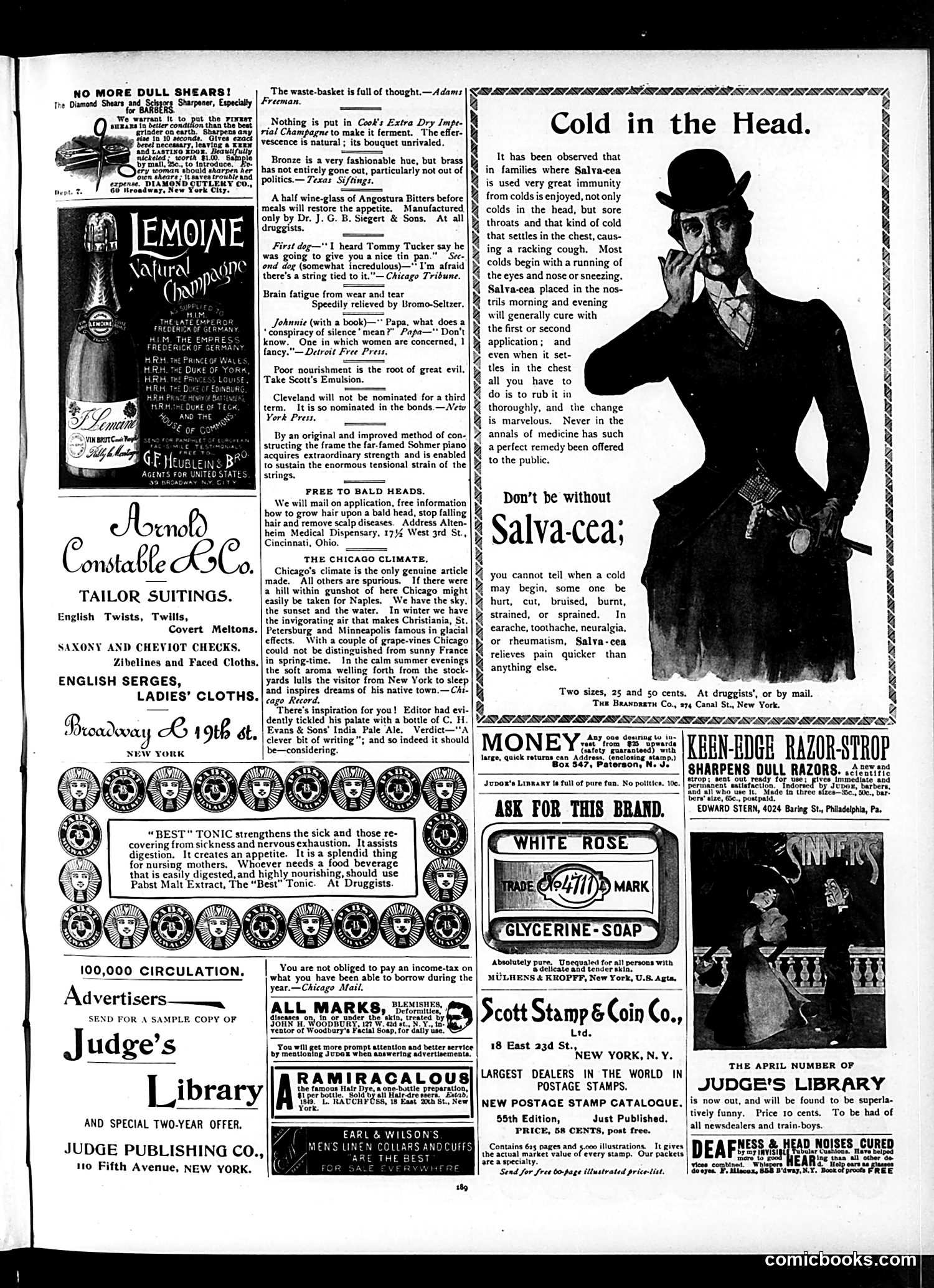
This is primarily a **full-page advertisement layout** from Judge magazine (an American satirical publication) rather than a single coherent cartoon. The page contains dozens of product ads—for razors, soap, champagne, hair-restoration treatments, and tailoring services—interspersed with brief satirical quips. The small jokes mock contemporary figures and attitudes: a reference to Cleveland's presidential prospects; jibes at Chicago's harsh climate and slaughterhouses; commentary on brass remaining in politics despite its unfashionable status. One quip suggests women conspiring to keep secrets. **For a modern reader:** This layout reflects how satire magazines funded themselves entirely through advertising while inserting sharp one-liners throughout. The "jokes" are topical references—Cleveland (President Grover Cleveland), Chicago's industrial reputation—that required historical knowledge to land. The page shows satire's 19th-century format: punchy, wide-ranging commentary embedded among commerce.
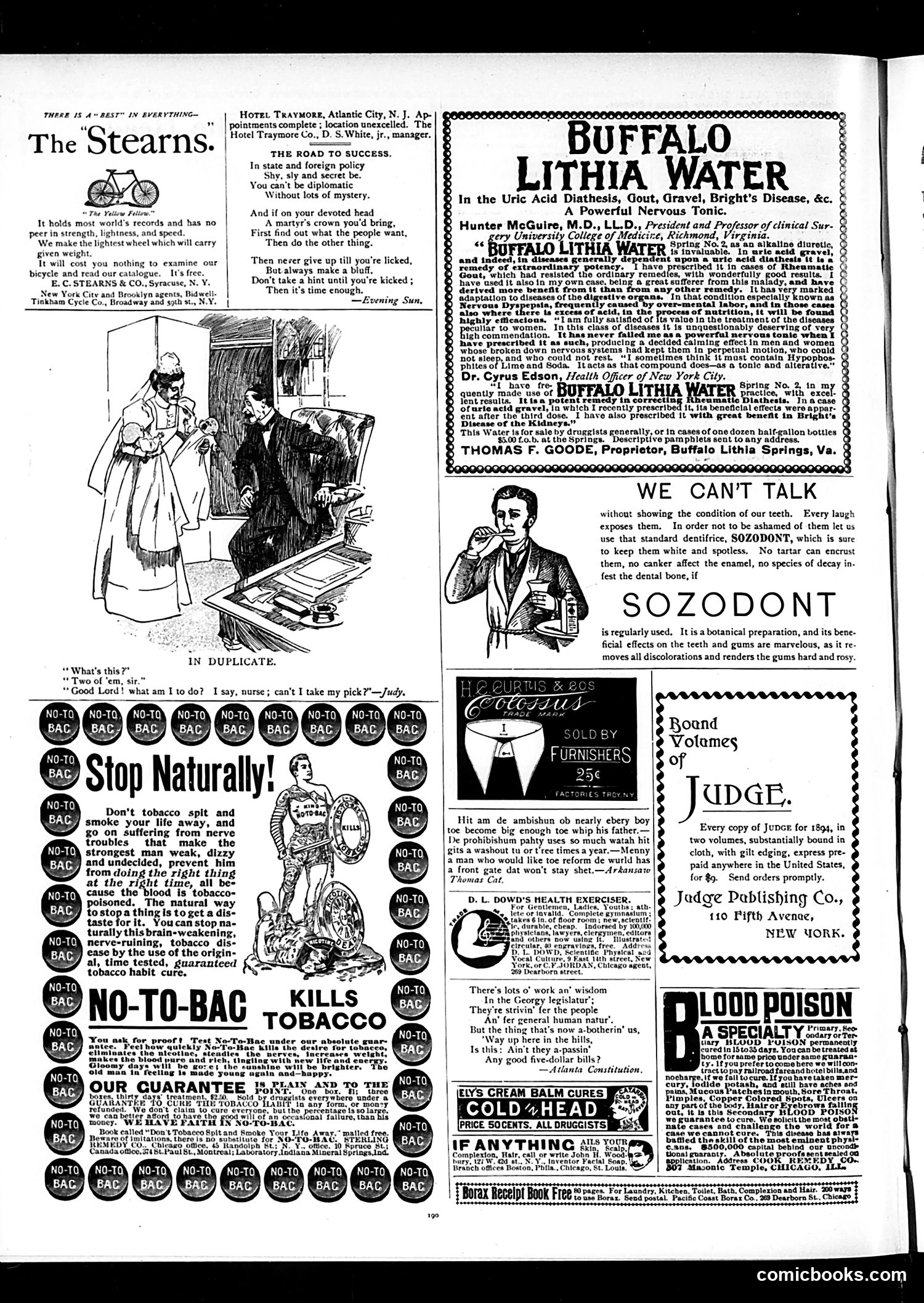
This is primarily an **advertising page** from Judge magazine, typical of late 19th-century publications that relied heavily on patent medicine and consumer product ads. ## Main Content: **The Stearns Bicycle Ad** (top left): Promotes the Stearns brand bicycle as superior in speed, strength, and lightness—standard competitive marketing of the bicycle boom era. **Political Satire Poem** ("The Road to Success"): A brief satirical commentary on government policy, mocking political hypocrisy: do what people want secretly while publicly claiming the opposite; use bluffing and deception; ignore warnings until forced to act. This reflects period cynicism about politics. **Medical Ads**: The page features dubious "health" products—Buffalo Lithia Water (supposedly treating gout and kidney disease), Sozodont toothpaste, and No-To-Bac (a tobacco cessation product). These represent the era's unregulated patent medicine industry, making exaggerated health claims without scientific backing. Modern readers should note: these products were largely ineffective or harmful, yet advertised with doctor endorsements and pseudoscientific language—practices that would later prompt FDA regulation.
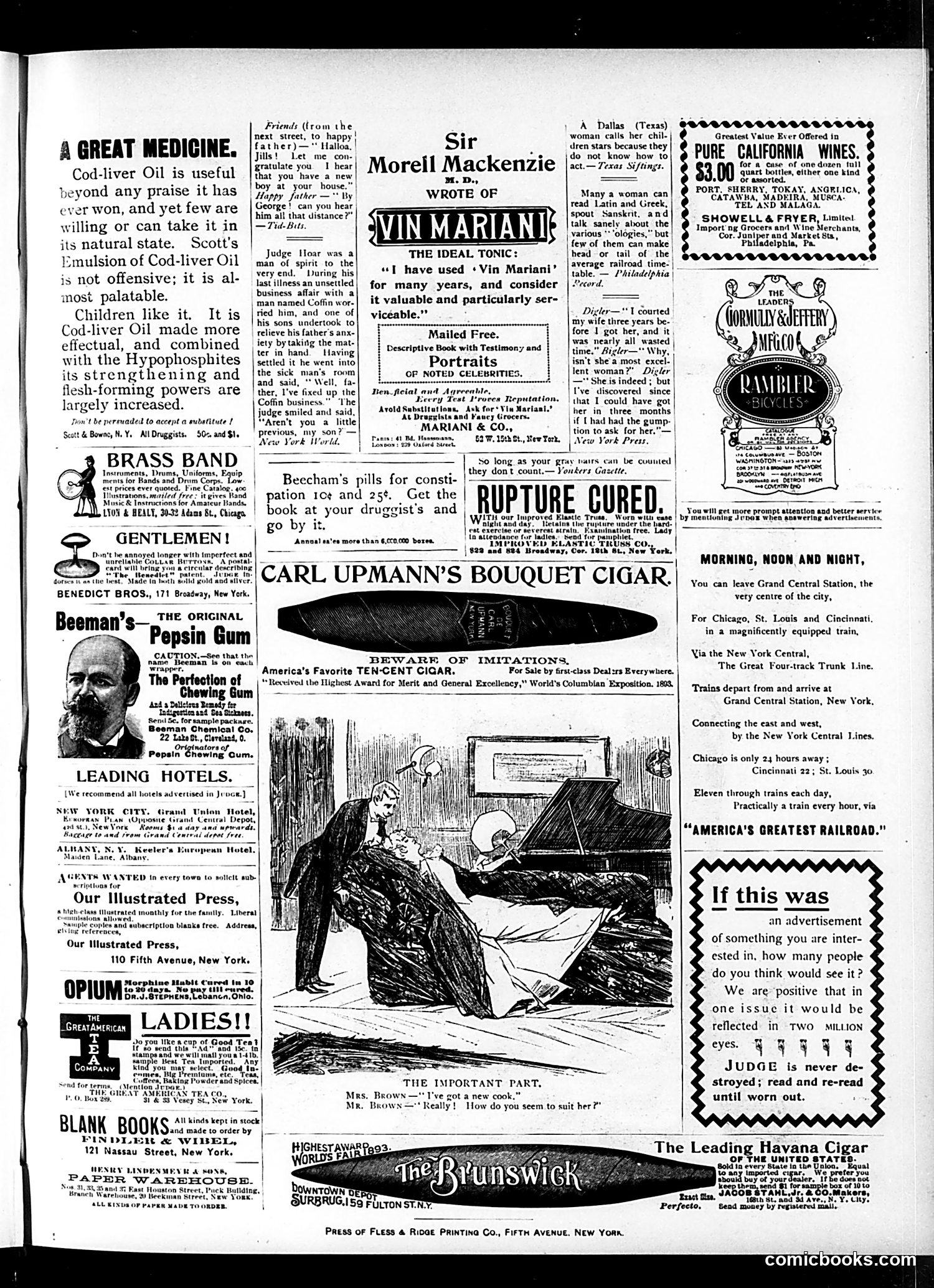
This is primarily an **advertising page** from Judge magazine featuring patent medicines, tobacco products, and services typical of the late 19th century. The main content is commercial rather than satirical. **The One Notable Comic:** The only cartoon illustrates a joke titled "THE IMPORTANT PART." It depicts Mrs. Brown showing her husband a new rooster, with dialogue: "I've got a new cock." / "Really! How do you seem to suit her?" The humor relies on crude double entendre—misinterpreting "cock" (rooster) as referring to male sexuality or infidelity, playing on the era's prudish sensibilities around such wordplay. **Context:** This reflects late-1800s American advertising standards: numerous dubious "cure-all" products like cod-liver oil emulsion, Beecham's pills, opium remedies, and "Vin Mariani" (wine-based tonic) are promoted alongside tobacco. Sir Morell Mackenzie's endorsement of Vin Mariani lends false medical credibility. The ads target common anxieties about health and masculinity typical of the Gilded Age.
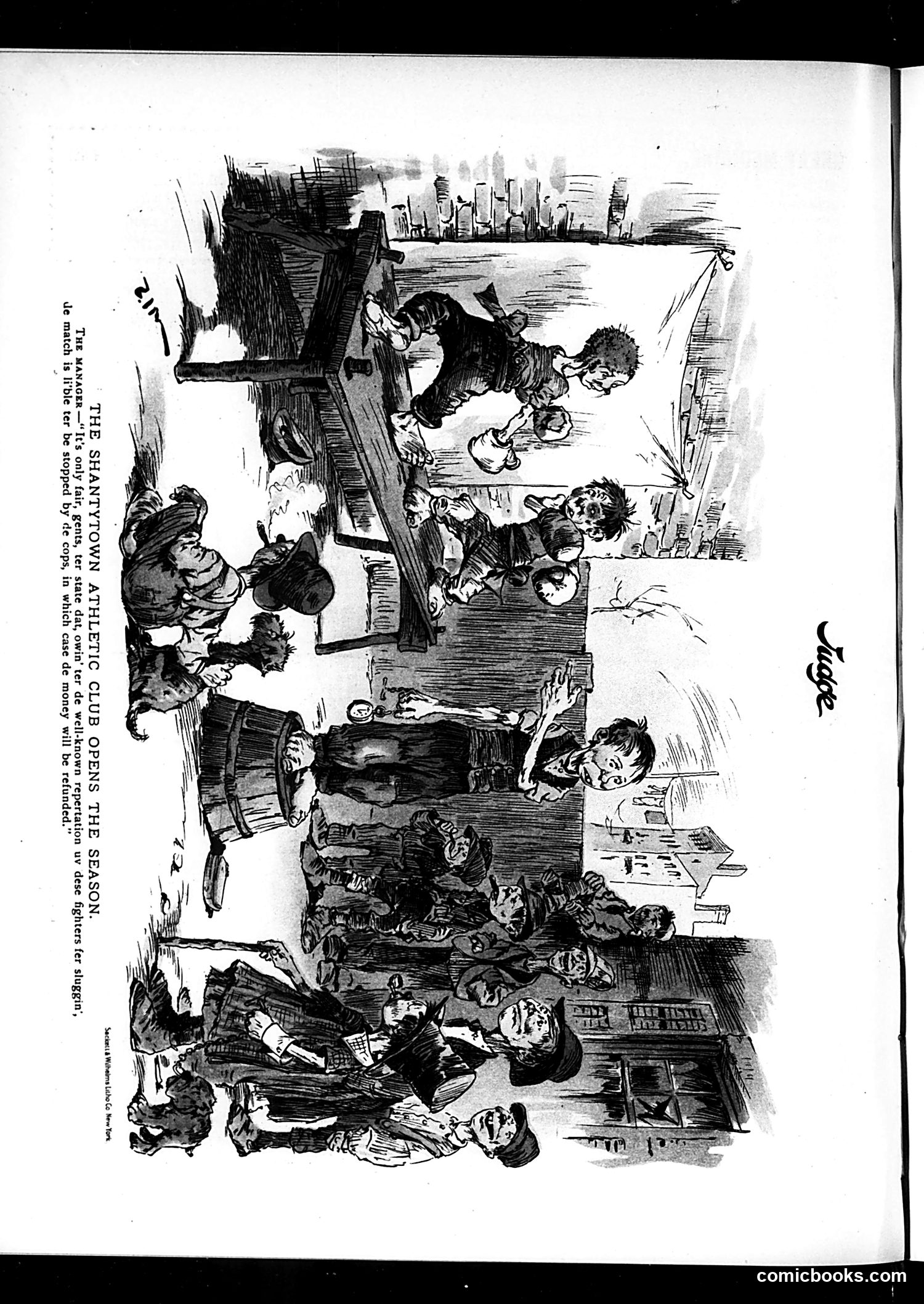
This is a satirical cartoon mocking working-class boxing clubs and their participants. "Shantytown" refers to poor neighborhoods, and the crude dialect of the manager ("gents," "ter," "uv") stereotypes lower-class speech. The satire targets several things: the rough, violent nature of informal boxing matches in poor communities; the expectation that police will shut down such events; and the implicit assumption that refunds would be necessary because violence is so inevitable it's virtually guaranteed. The caricatured figures and crude drawing style reinforce the condescending depiction of working-class entertainment and urban poverty that was common in Gilded Age satirical magazines like *Judge*. The cartoon presents these boxing clubs as disreputable operations where violence and police intervention are foregone conclusions.