
Judge, 1895-03-23 · page 5 of 16
Judge — March 23, 1895 — page 5: what you’re looking at
What you’re looking at
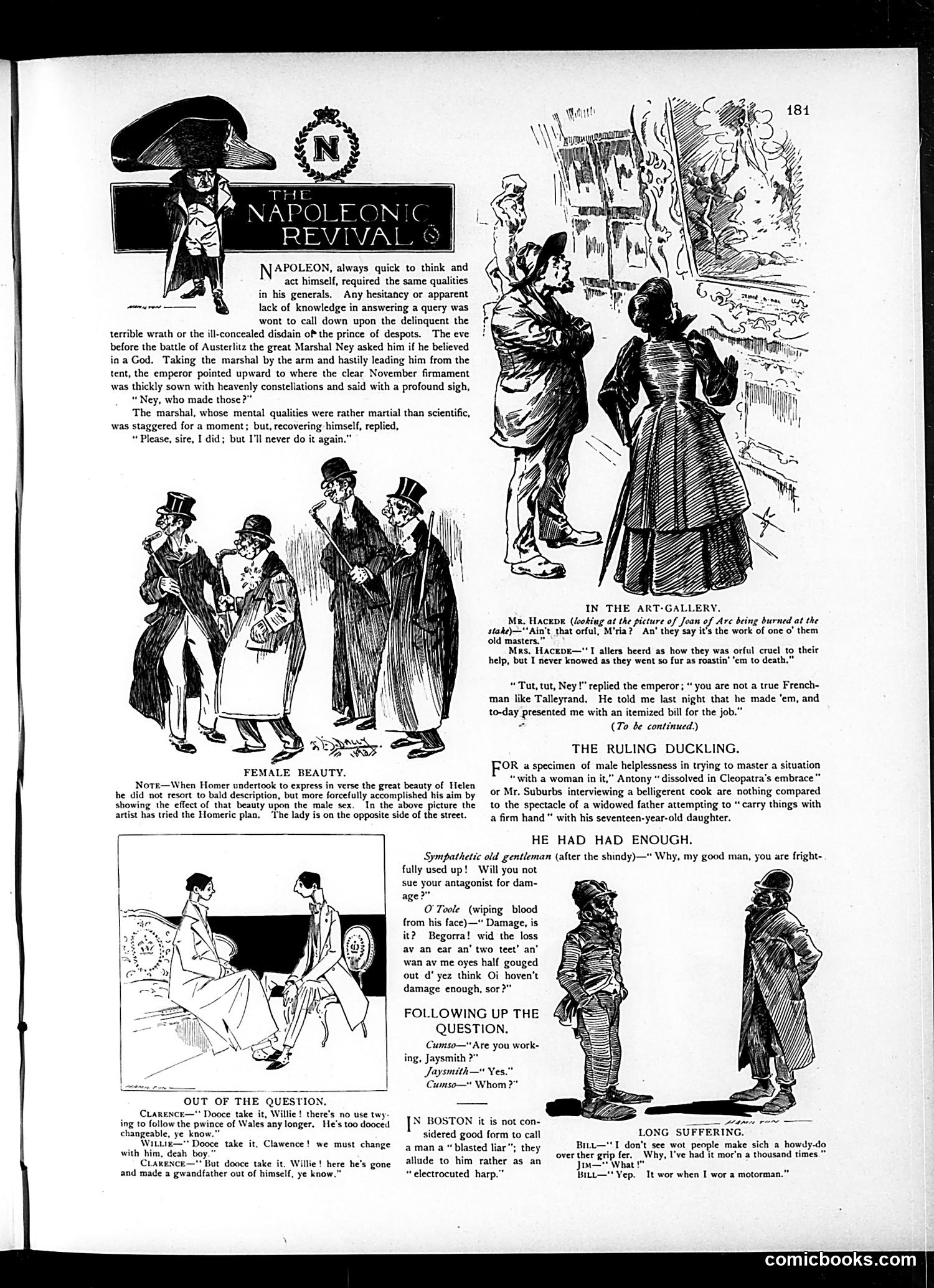
This page contains multiple satirical sketches typical of early 20th-century American humor: **"The Napoleonic Revival"** opens with a historical anecdote about Napoleon questioning Marshal Ney about God before the Battle of Austerlitz—likely satirizing contemporary figures who claim grandiose accomplishments. The punchline mocks both blind obedience and absurd responsibility-claiming. **"In the Art-Gallery"** features working-class visitors misunderstanding a painting of Joan of Arc's execution, confusing artistic brutality with actual cruelty—satirizing both artistic pretension and lower-class naïveté. **Remaining sketches** use exaggerated dialect (Irish, British upper-class) to mock various social types: indecisive aristocrats following trends, a father struggling with his teenage daughter, a brawler with injuries, and a motorman boasting about surviving illness. The humor relies on class stereotypes, dialect comedy, and physical comedy—common Judge conventions. No specific political figures or events appear referenced; instead, the satire targets universal human follies and social pretensions.
📄 Transcribed text from this page (OCR, searchable)
Machine-transcribed from the original scan — historical spelling and the odd misread are preserved.
N APOLEON, always quick to think and act himself, required the same qualities in his generals. Any hesitancy or apparent lack of knowledge in answering a query was wont to call down upon the delinquent the terrible wrath or the ill-concealed disdain of the prince of despots. The eve before the battle of Austerlitz the great Marshal Ney asked him if he believed in a God. Taking the marshal by the arm and hastily leading him from the tent, the emperor pointed upward to where the clear November firmament was thickly sown with heavenly constellations and said with a profound sigh, “Ney, who made those?” The marshal, whose mental qualities were rather martial than scientific, was staggered for a moment; but, recovering himself, replied, “ Please, sire, I did; but I'll never do it again.” IN THE ART-GALLERY. Hacepe (looting at the picture of Joan of Arc being burned at the ‘Ain't that orful, M'ria? An' they say it's the work of one o' them old masters.” Mrs. Hacepe—"'I allers heerd as how they was orful cruel to their help, but I never knowed as they went so fur as roastin’ ‘em to death.” “ Tut, tut, Ney !" replied the emperor; “ you are not a true French- man like Talleyrand. He told me last night that he made ‘em, and to-day presented me with an itemized bill for the job.” ° (To be continued.) THE RULING DUCKLING. FEMALE BEAUTY. Note—When Homer undertook to express in verse the great beauty of Helen he did not resort to bald description, but more forcefully accomplished his aim by ‘OR a specimen of male helplessness in trying to master a situation “with a woman in it,” Antony “ dissolved in Cleopatra's embrace” or Mr. Suburbs interviewing a belligerent cook are nothing compared showing the effect of that beauty upon the male sex. artist has tried the Homeric plan, OUT OF THE QUESTION. CLARENCE—"* Dooce take it, Willie ! there’s no use twy: ing to follow the pwince of Wales any longer. He's too dooced changeable, ye know.” Witttz—" Dooce take it, Clawence! we must change with him, deah boy.” CLARENCE—"* But dooce take it. Willie! here he's gone and made a gwandfather out of himself, ye know.” In the above picture the “The lady is on the opposite side of the street. to the spectacle of a widowed father attempting to “carry things with a firm hand " with his seventeen-year-old daughter. HE HAD HAD ENOUGH. Sympathetic old gentleman (alter the shindy)—"* Why, my good man, you are fright- fully used up! Will you not sue your antagonist for dam- age?" O'Toole (wiping blood from his face)—" Damage, is it? Begorra! wid the loss av an ear an’ two teet’ an’ wan av me oyes half gouged out d’ yez think Oi hoven’t damage enough, sor?” FOLLOWING UP THE QUESTION. Cumso—" Are you work- ing, Jaysmith 2° Jaysmith—" Yes." ‘Cumso—* Whom ?” [8 BOSTON it is not con- sidered good form to call aman a“ blasted liar”; they allude to him rather as an “electrocuted harp.” LS LONG SUFFERING. Bna—"'I don't see wot people make sich a howdy-do over ther grip fer. Why, I've had it mor'n a thousand times," Jim—"* What !" BILL—"* Yep. Tt wor when I wor a motorman.” comicbooks.com |