
A complete issue · 16 pages · 1895
Judge — March 2, 1895
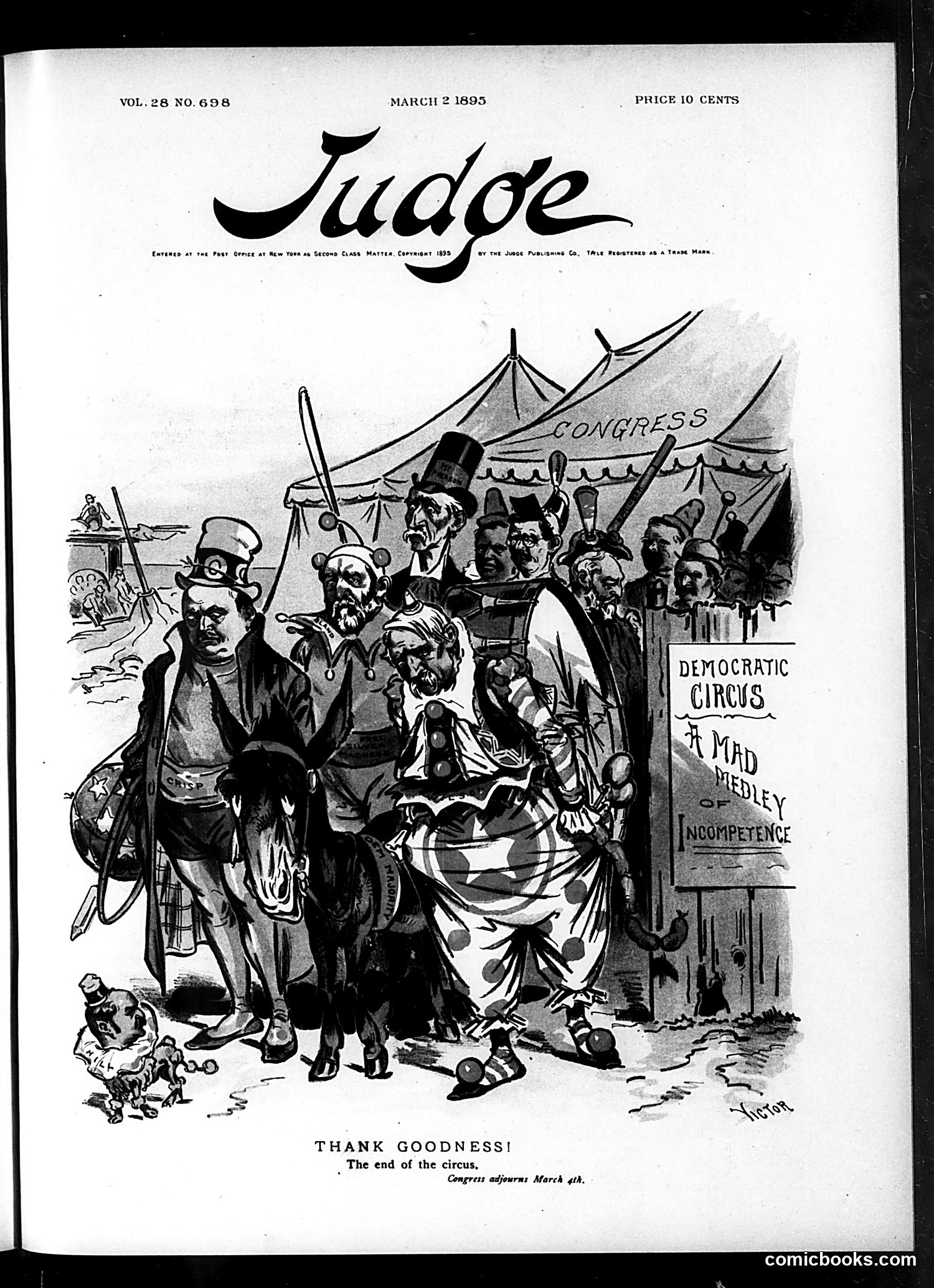
This political cartoon satirizes the Democratic Party as a chaotic circus. The image shows caricatured Democratic politicians and figures performing under a tent labeled "Congress," with a prominent sign reading "Democratic Circus: A Mad Medley of Incompetence." The circus setting is deliberate satire—suggesting Democratic governance is entertainment rather than serious leadership. Multiple caricatured figures in top hats appear disheveled or foolish, performing like circus acts. The caption "Thank Goodness! The end of the circus. Congress adjourns March 4th" indicates this was published after a Congressional session, suggesting relief that Democratic incompetence was temporarily ceasing. This reflects Republican-leaning Judge magazine's criticism of Democratic leadership during the mid-1890s, likely referencing President Cleveland's administration or Congressional Democrats of that era.
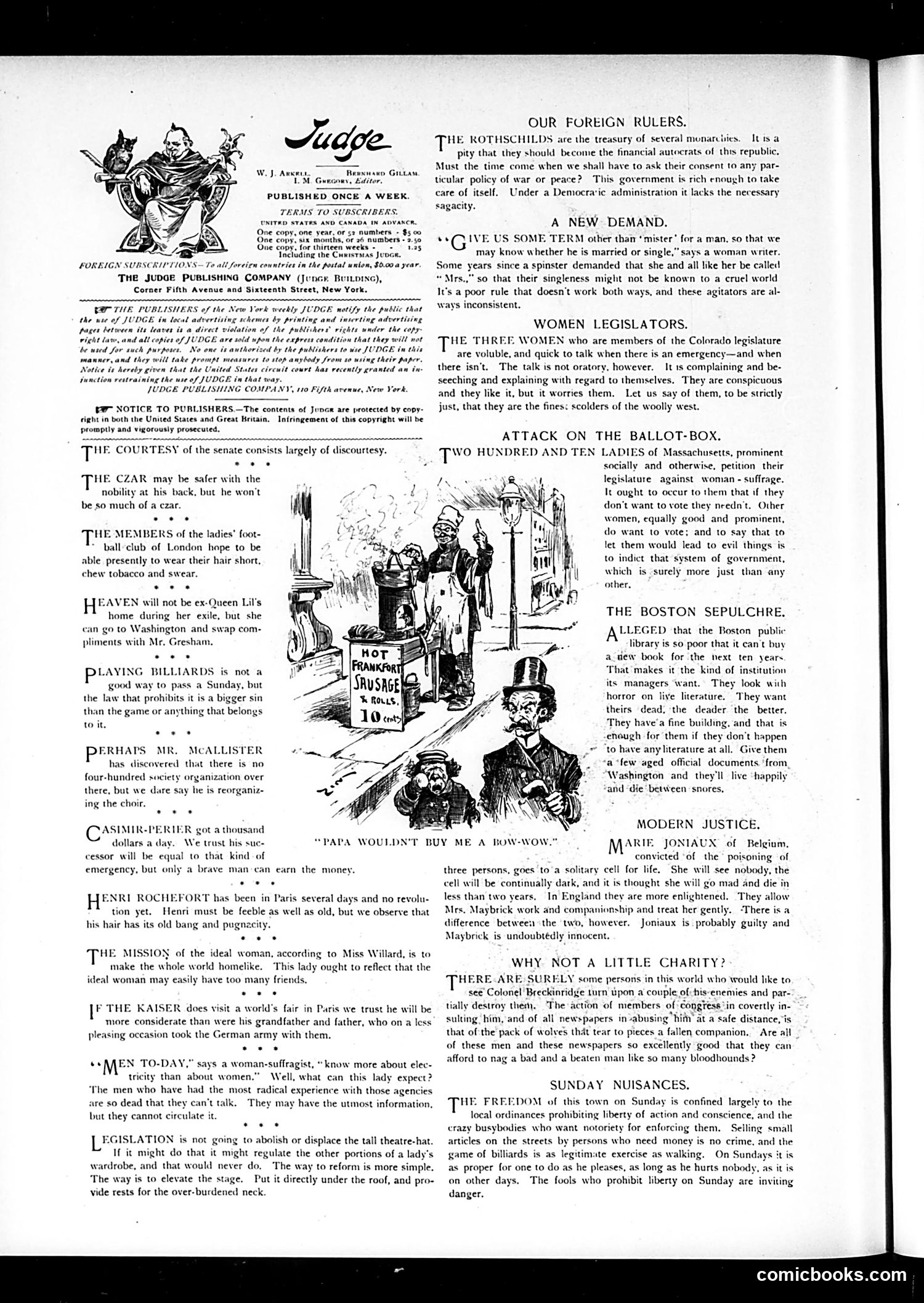
This cartoon satirizes women's suffrage opposition through a domestic scene. A well-dressed man refuses to buy his child a dog, while the child protests tearfully. The caption quotes the popular song "Papa Wouldn't Buy Me a Bow-Wow." The satire compares suffragists to spoiled children demanding treats—implying women seeking voting rights are petulant and unreasonable. The "papa" (government/male authority) refuses their "demands" just as the father refuses his child's pleas. This reflects early 20th-century anti-suffrage arguments that portrayed women voters as childish and unfit for political participation. The cartoon mocks suffragists by equating their political aspirations with childish whining, a common rhetorical tactic of the era.
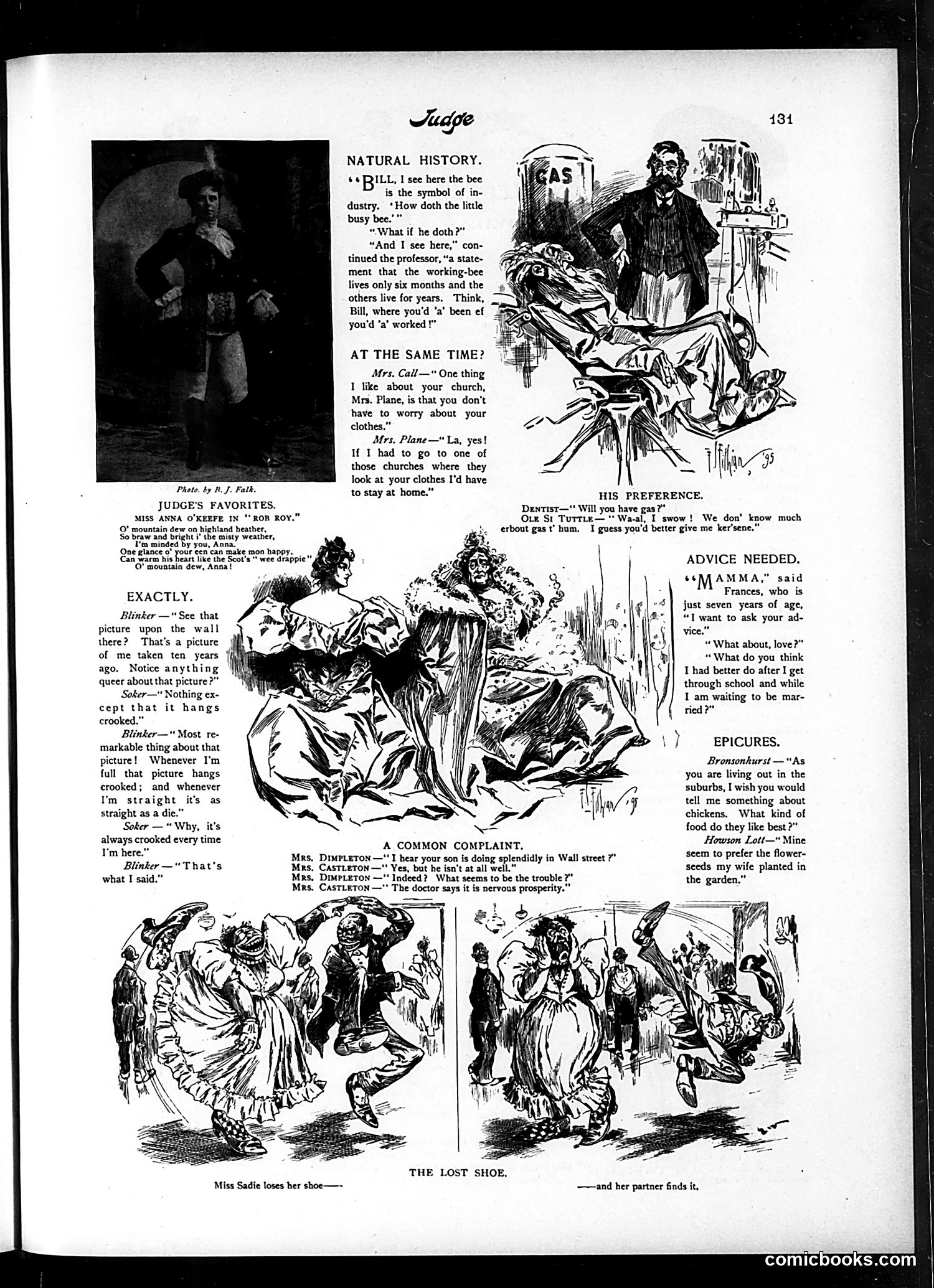
This page contains several satirical sketches and humorous anecdotes typical of Judge magazine's format. The content includes: **"Natural History"** - A joke about bees as symbols of industry, playing on the contrast between hardworking bees (living six months) and humans who work their entire lives. **"At the Same Time"** - Social commentary on church attendance and clothing anxieties among working-class women. **"The Lost Shoe"** - A visual comedy about Miss Sadie losing her shoe at what appears to be a social dance or party, with her partner retrieving it. **Other sketches** address contemporary concerns: dental work, suburban living, marriage advice, and gardening preferences. The humor relies on class observation, domestic situations, and wordplay rather than political commentary. The caricatured drawings emphasize exaggerated features typical of Gilded Age satirical illustration.
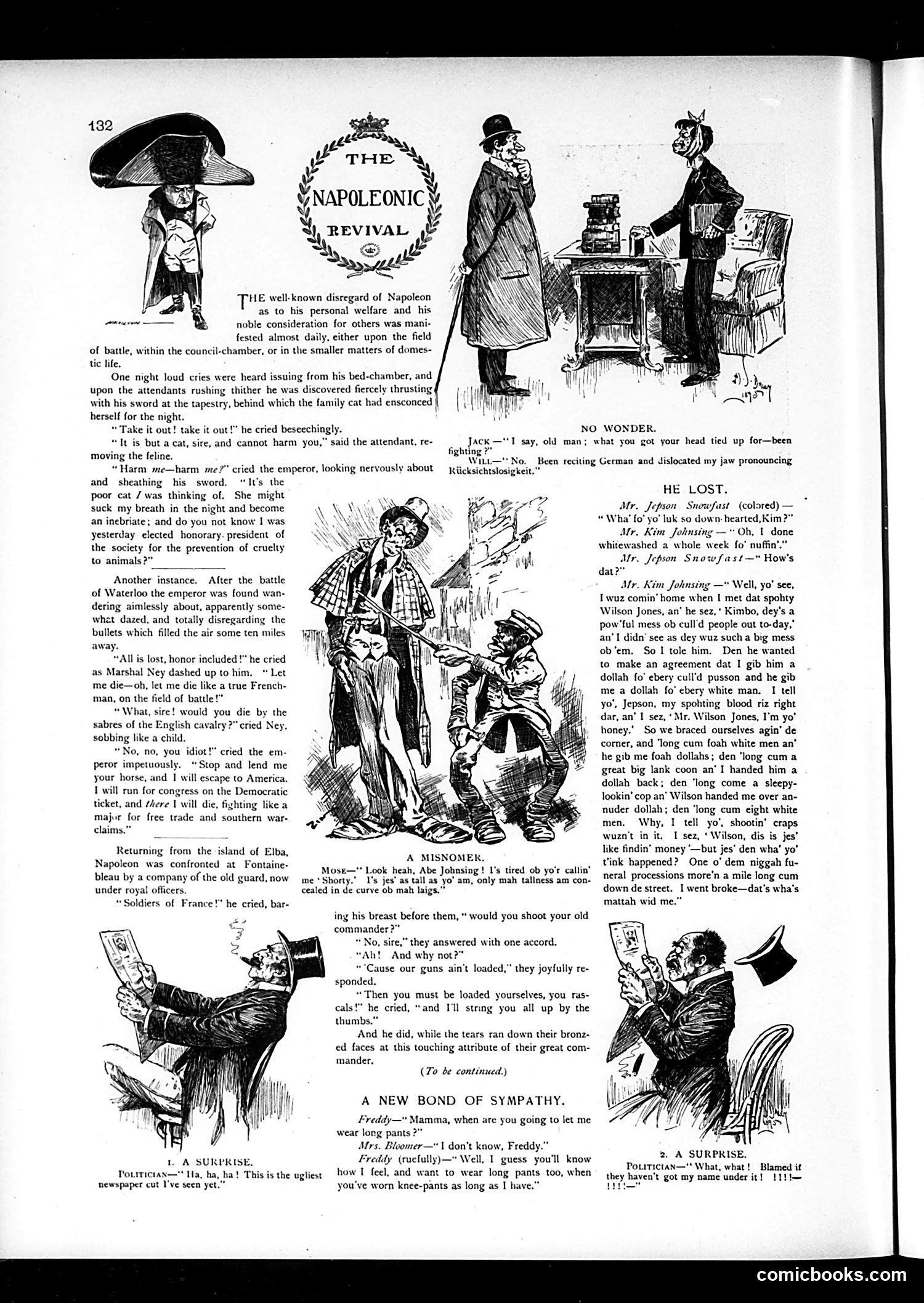
This page satirizes Napoleon Bonaparte through exaggerated anecdotes mocking his character. The cartoons depict Napoleon as absurdly contradictory: he's shown fighting a cat while claiming to be "honorary president of the society for the prevention of cruelty to animals," and after his Waterloo defeat, prioritizing escape to America over honorable death. The satire targets 19th-century romanticization of Napoleon as a noble figure. Judge presents him as cowardly, hypocritical, and absurdly sentimental—weeping soldiers while stringing them up by thumbs. The final scene shows his Imperial Guard with unloaded guns, undermining his legendary authority. The page also contains period racial humor (dialect humor featuring Black characters), typical of 1880s-90s American satirical magazines. This reflects the publication's casual bigotry rather than political satire.
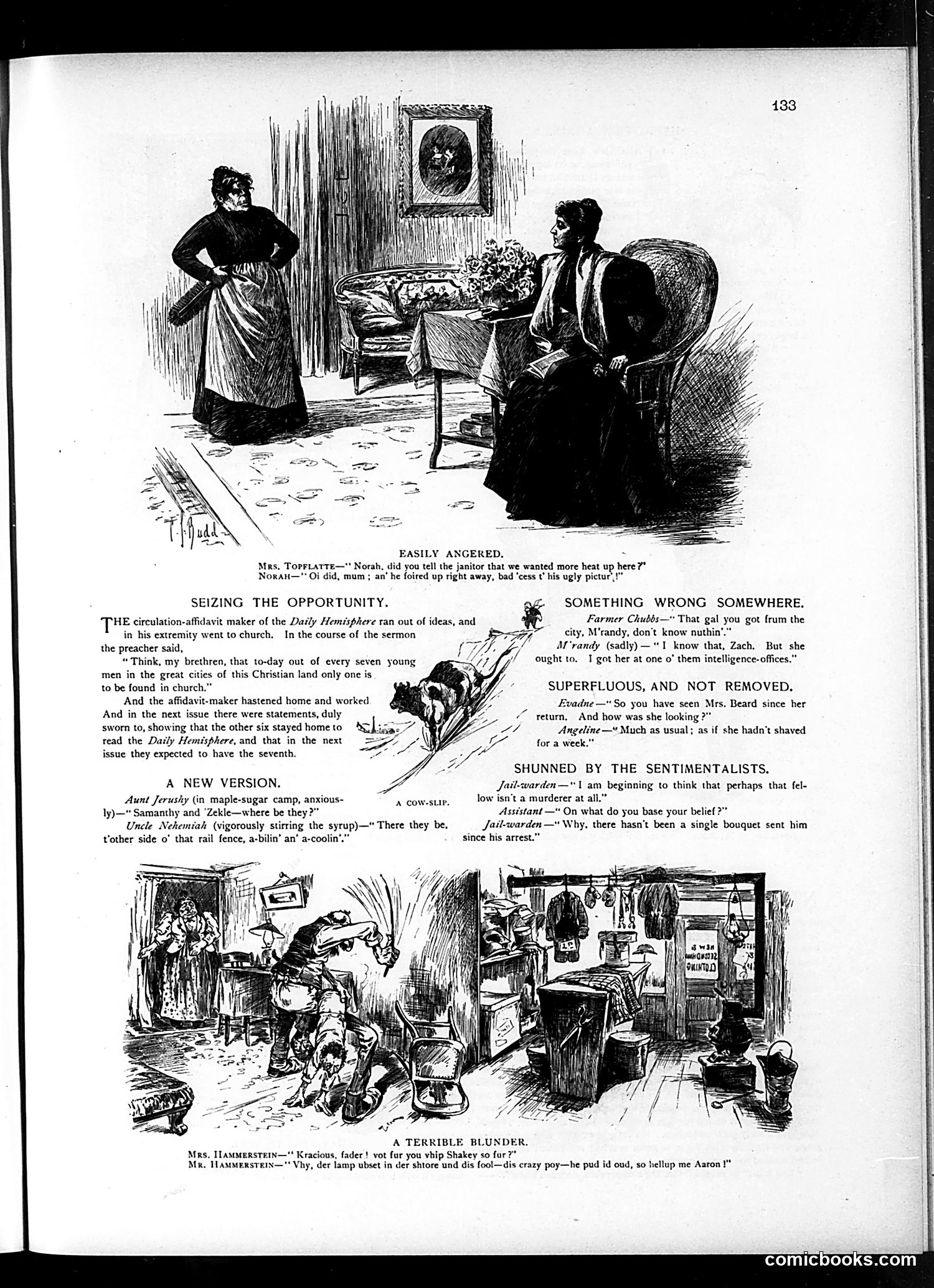
This page contains six separate satirical vignettes typical of late-19th/early-20th-century American humor: **"Easily Angered"** mocks Irish domestic servants through dialect humor—a common stereotype of the era. **"Seizing the Opportunity"** satirizes sensationalist journalism. A newspaper editor, desperate for content, exploits a sermon statistic about young men avoiding church to fabricate exaggerated claims in print—critiquing the "circulation-affidavit" (circulation fraud) practices of yellow journalism. **"Something Wrong Somewhere"** jokes about employment agencies placing unsuitable workers, specifically women from cities into farm labor. **"Shunned by the Sentimentalists"** mocks the public's morbid fascination with criminals, suggesting sympathy has vanished because no sentimental admirers are sending bouquets to a jailed man. **"A New Version"** uses rural dialect for rustic humor about maple-sugar production. **"A Terrible Blunder"** employs heavy Yiddish-accented dialect (typical of period immigrant humor) for a domestic accident story. The page reflects Judge's reliance on ethnic caricature and class-based humor.
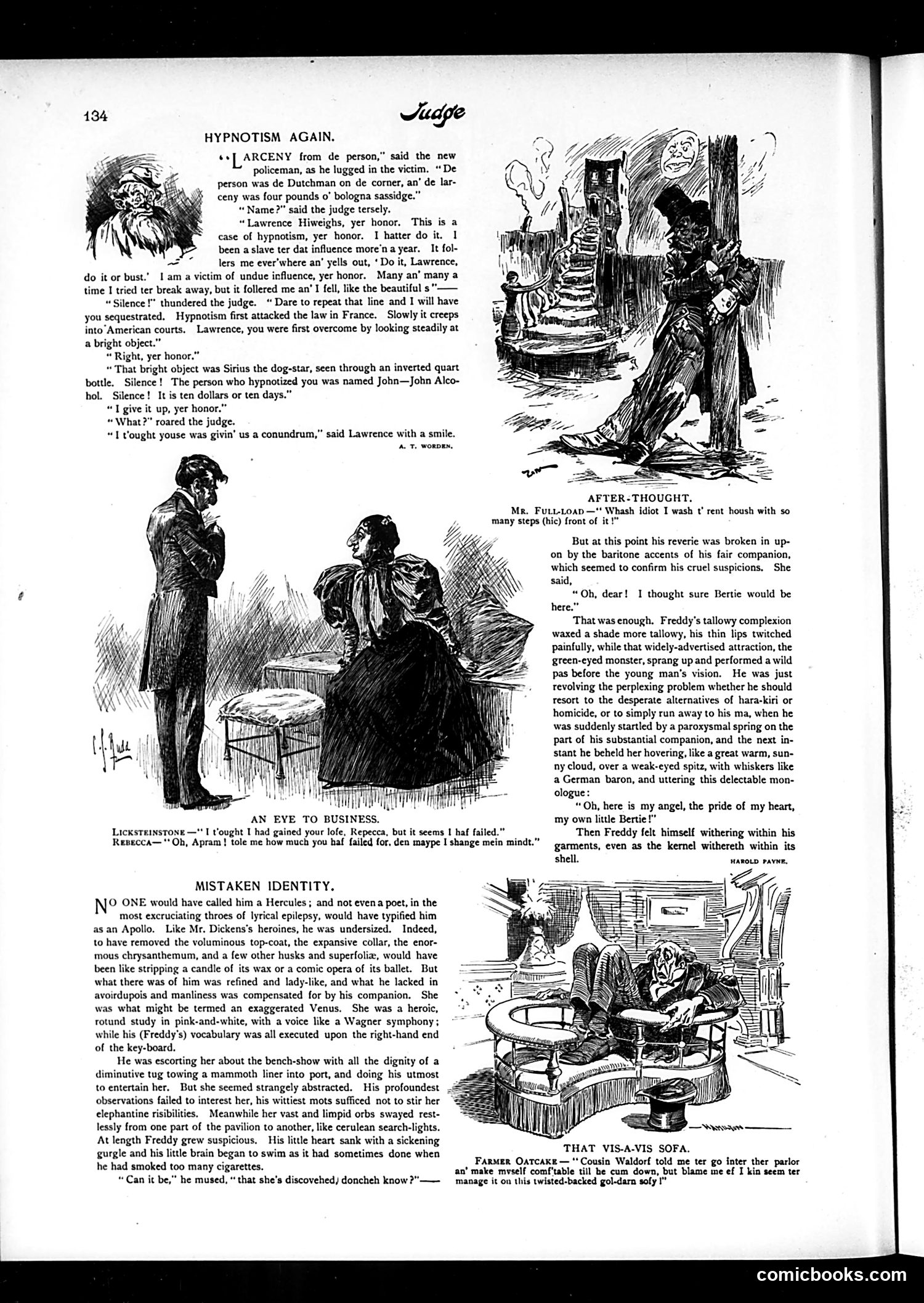
This page contains three separate satirical pieces: **"Hypnotism Again"** mocks a court case where a man claims hypnotism by "John Alcohol" caused his theft. The judge dismissively sentences him to ten dollars or ten days, treating the hypnotism defense as absurd legal theater. **"An Eye to Business"** depicts a couple at a dog show where the small, refined man (Freddy) awkwardly escorts his large, imposing female companion. She appears distracted, searching the pavilion—likely for someone else—which makes Freddy anxiously suspicious she's discovered infidelity. **"Mistaken Identity"** shows a brief romantic exchange where a man (Apram) confesses failed love to Rebecca, but she dismissively asks how much money he lost rather than expressing emotional concern. The page satirizes courtroom absurdity, class dynamics in dating, and mercenary attitudes toward romance—common Judge topics of social pretension and human folly.
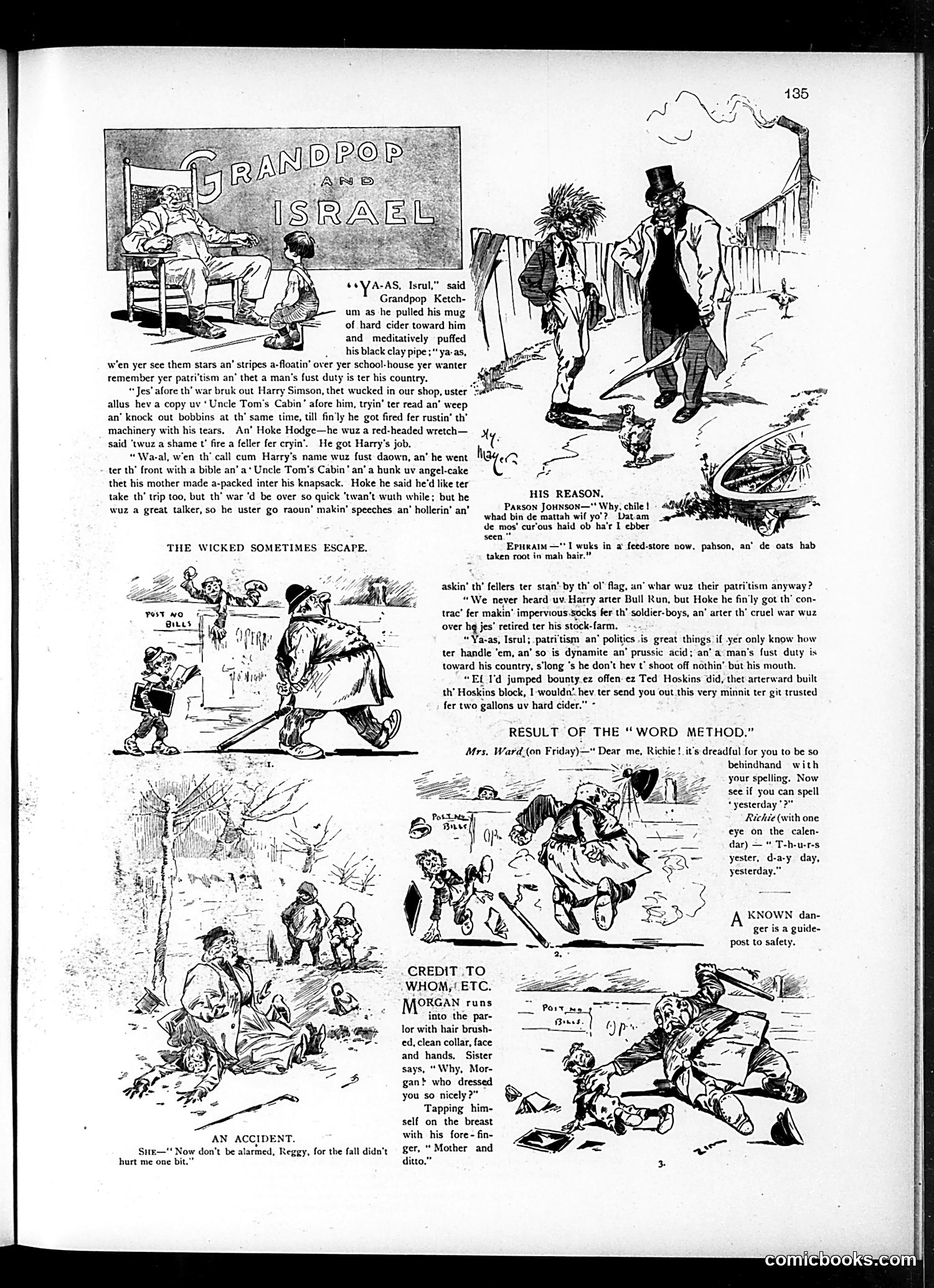
This page contains three satirical pieces reflecting late 19th-century American concerns: **"Grandpop and Israel"**: A dialect story mocking patriotic hypocrisy. An old man lectures about duty to country while recalling how patriotic Harry enlisted after Bull Run, while opportunistic Hoke—who made speeches about patriotism—stayed home and profited making military supplies. The satire targets hollow nationalism and those who exploit patriotic sentiment for personal gain. **"His Reason"** and other brief comics: Light humor about dialect speech and Southern stereotypes (African American characters with exaggerated vernacular). **"Result of the Word Method"** and remaining items**: Gentle domestic humor about spelling instruction and children's behavior—standard magazine filler. The page's main satirical thrust critiques Civil War-era profiteering and the gap between proclaimed patriotism and actual conduct, a common Judge theme during Reconstruction.
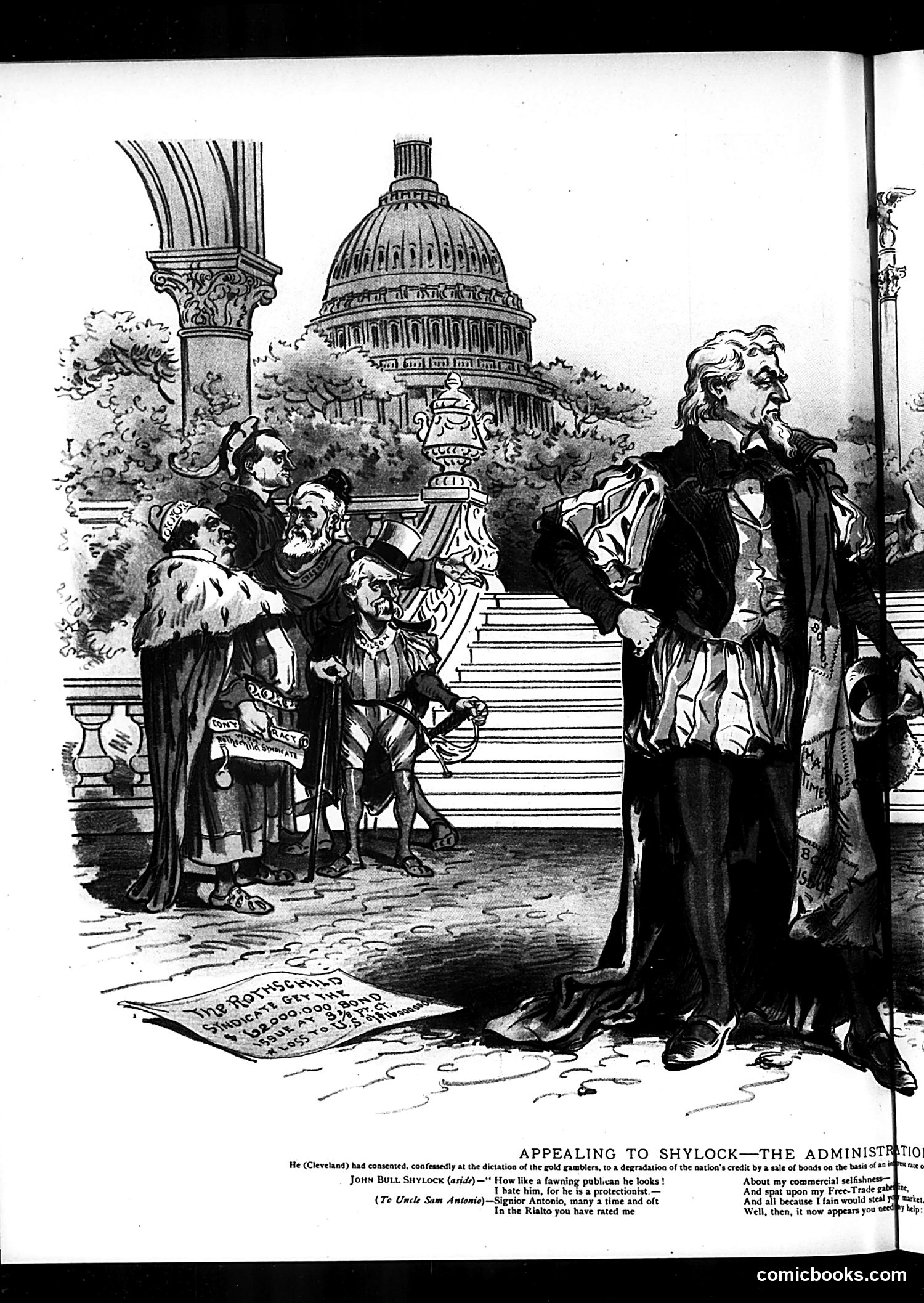
This **Judge magazine** cartoon satirizes President Cleveland's bond sale during an economic crisis, likely the 1890s depression. Cleveland is depicted as "Antonio" (from Shakespeare's *Merchant of Venice*), forced to appeal to financial interests personified as "Shylock"—a moneylender character representing Wall Street "gold gamblers." The satire works on multiple levels: Cleveland, a Free-Trade Democrat, must humiliatingly borrow from the protectionist financial establishment he opposed. The cartoon mocks his perceived weakness—he's been forced by economic necessity to compromise his principles and beg from those he criticized. The Capitol dome frames the scene, emphasizing the national stakes. The crude caricatures and theatrical tone typical of Judge convey sharp disapproval of both Cleveland's capitulation and the financial powers dictating government policy.
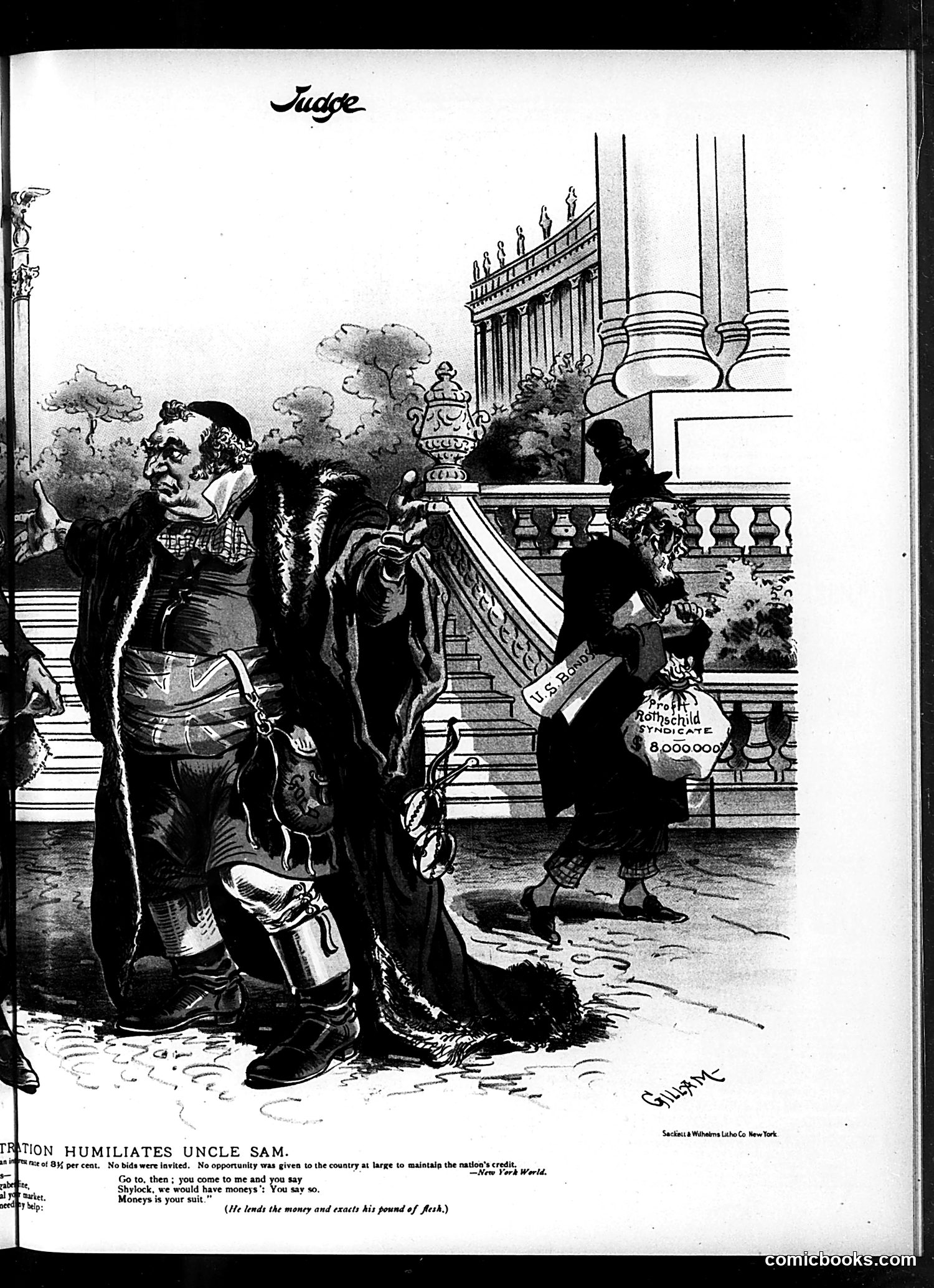
This Judge magazine cartoon satirizes a controversial government bond transaction. The figure on the left represents **Uncle Sam** (personified America), depicted as humiliated and subordinate. The figure on the right, labeled "Profit Rothschild Syndicate," represents wealthy financiers—likely referencing the Rothschild banking family, who were frequent targets of antisemitic conspiracy theories about controlling governments. The Shakespearean quote ("Shylock, we would have moneys") explicitly evokes *The Merchant of Venice*, casting the financiers as greedy usurers demanding their "pound of flesh." The cartoon's complaint, per the New York World quote, is that the government secretly negotiated a bond deal with this syndicate without competitive bidding, thereby compromising the nation's credit and financial independence. The satire attacks both the financiers' exploitation and the government's backroom dealing.
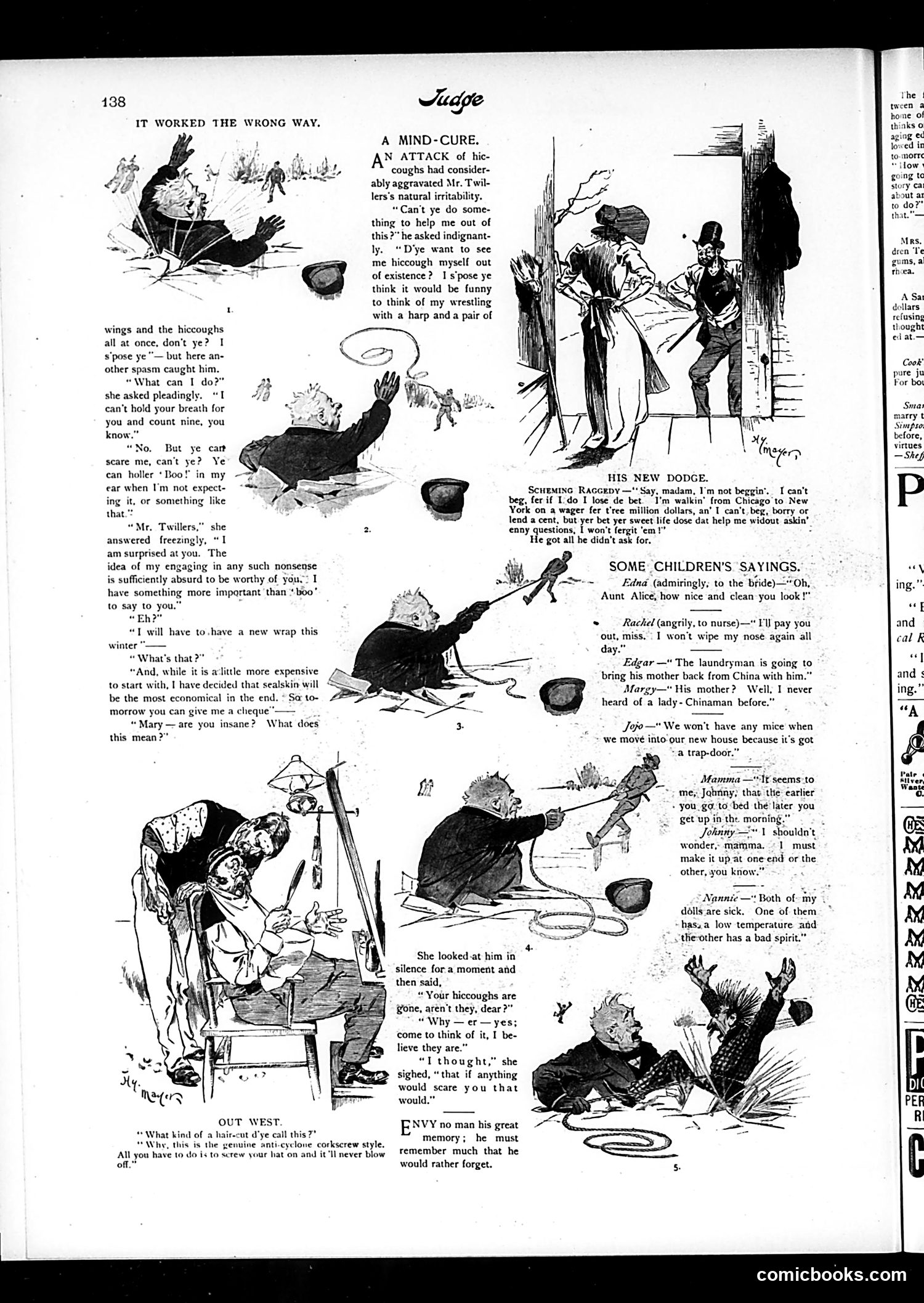
This page contains several unrelated humorous sketches typical of Judge magazine's satirical format. **"It Worked the Wrong Way"** depicts a domestic dispute where Mr. Twillers suffers from hiccoughs. His wife suggests a "mind-cure"—frightening him by mentioning an expensive sealkin wrap she wants. The joke is that instead of scaring away his hiccoughs, her announcement about the costly purchase actually *cures* them, suggesting marital anxiety works better than medical remedies. **"Out West"** is a brief visual gag about an unusual haircut style described as an "anti-cyclone corkscrew." **"His New Dodge"** mocks a beggar's clever scheme: he walks across America on a bet, claiming he cannot beg or borrow, thus manipulating people into giving freely without being asked. **"Some Children's Sayings"** collects humorous misunderstandings and literal interpretations by children—a popular format satirizing childhood logic and parental assumptions. The page represents typical early-20th-century American humor: domestic comedy, class commentary, and innocent child observations.
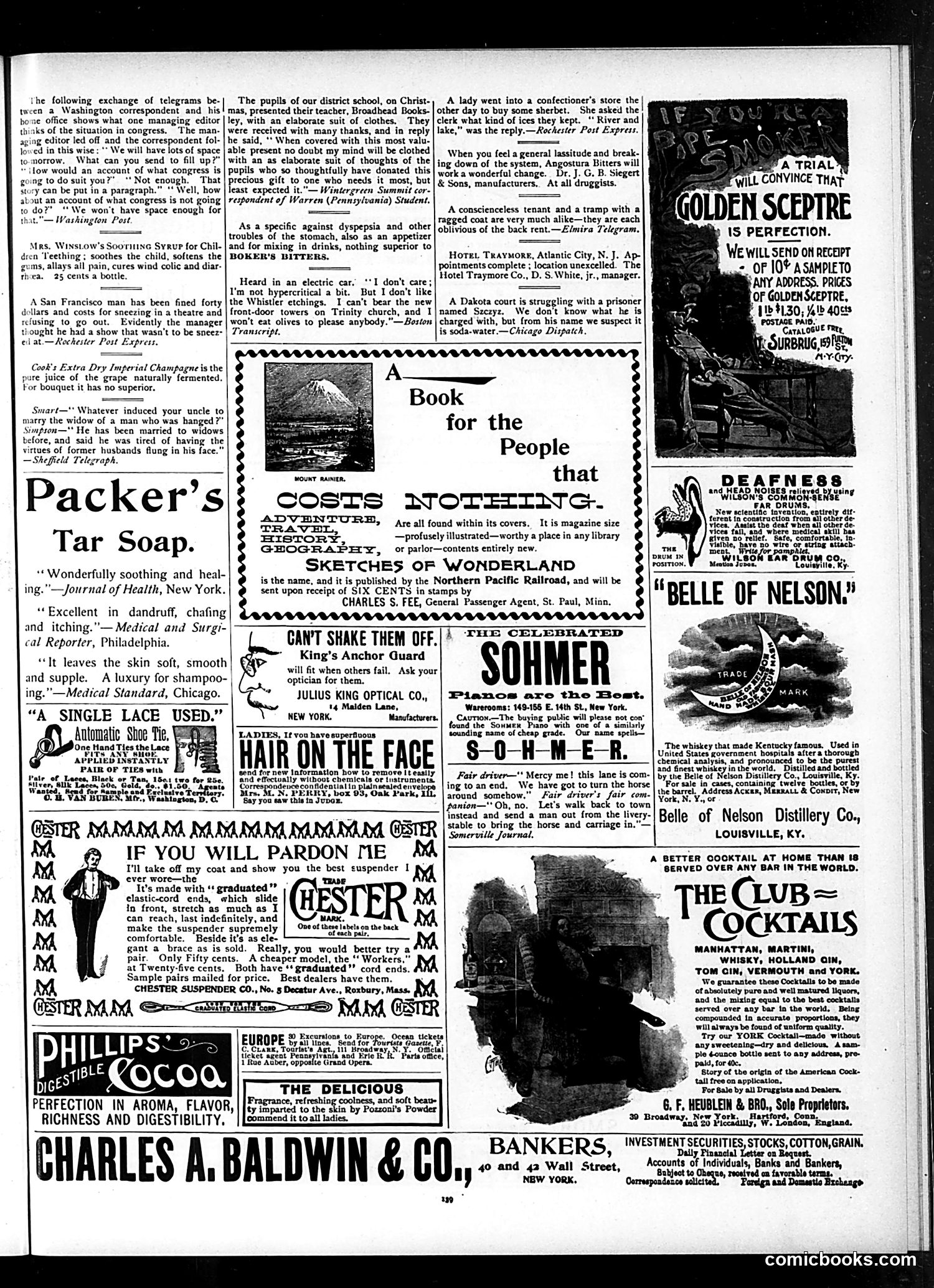
This page is primarily **advertising** with minimal satirical content. The one clear political-humor piece is the opening exchange of telegrams between a Washington correspondent and his managing editor. **The Satire:** The joke mocks Congress's ineffectiveness. When asked what news he can send, the correspondent sarcastically suggests that "an account of what congress is **not** going to do" would be the only story that fits available space—implying Congress accomplishes nothing worthwhile and that describing its inaction would be more accurate and space-efficient than reporting actual legislation. The remainder of the page consists of patent medicine advertisements (Boker's Bitters, Mrs. Winslow's Soothing Syrup), product ads (Packer's Tar Soap, Chester Suspenders, Phillips' Cocoa), and miscellaneous short humorous anecdotes about everyday absurdities—a man fined for sneezing in theater, confusion over "river and lake" ice cream. No specific political figures or dated events are identifiable in the visible content.
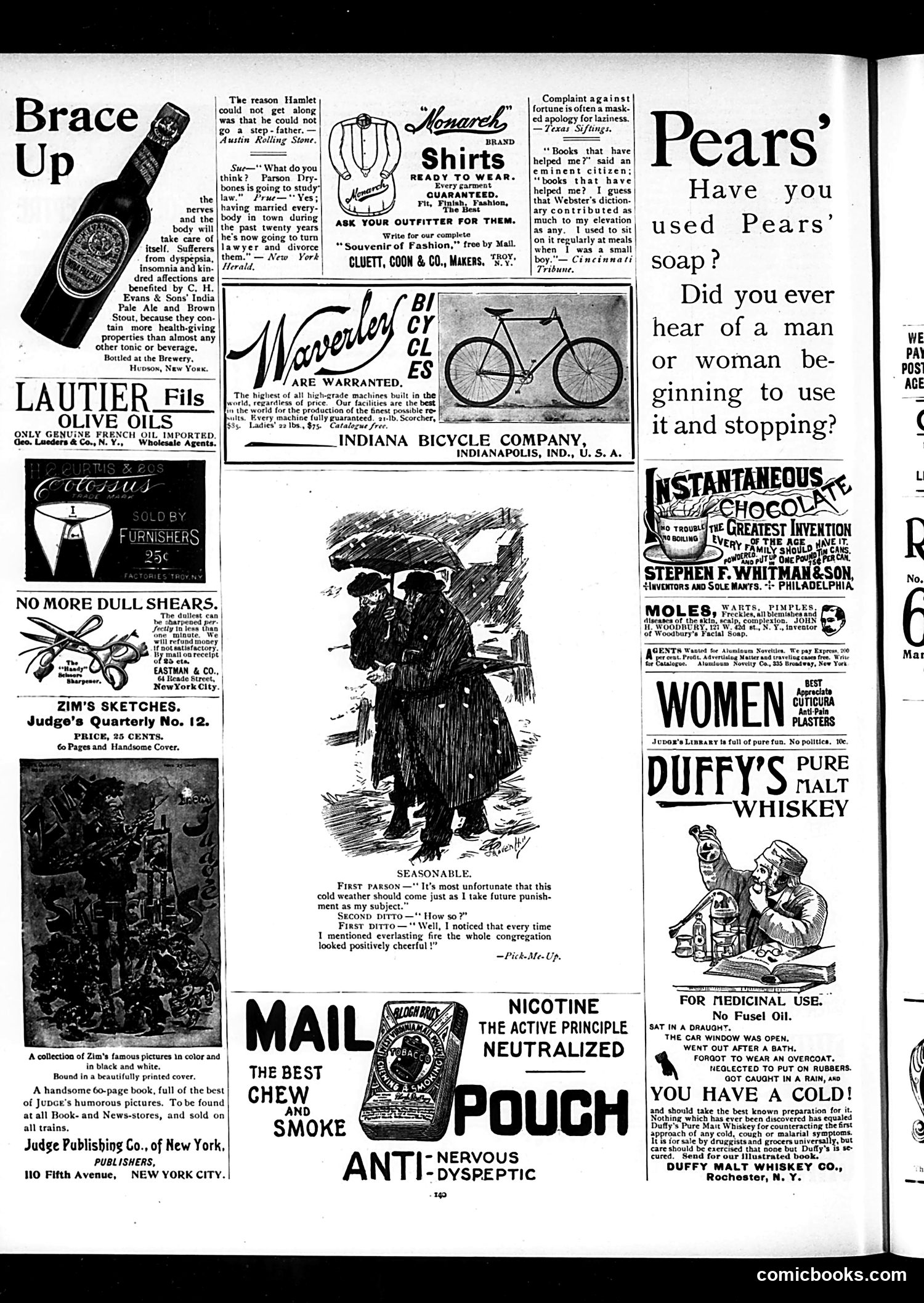
This page is primarily **advertising with minimal editorial cartooning**. The main cartoon—a sketch by "Zim" showing a figure in winter clothing—illustrates a joke about a clergyman whose sermon on hellfire backfires when parishioners look cheerful (apparently grateful for the topic's warmth during cold weather). The humor is straightforward: ironic juxtaposition of fire-and-brimstone preaching with the congregation's practical comfort. The page otherwise consists of period advertisements for products including bicycles, olive oil, razors, shirts, chocolate, soap, and whiskey—some claiming medicinal properties. Notable is "Duffy's Pure Malt Whiskey," marketed "for medicinal use" with instructions for treating colds, reflecting early-20th-century attitudes toward alcohol as medicine. The few jokes printed (about Hamlet, books, laziness) are generic humor without political content. This appears to be a typical Judge issue focused on commercial sponsorship rather than sustained satirical commentary.
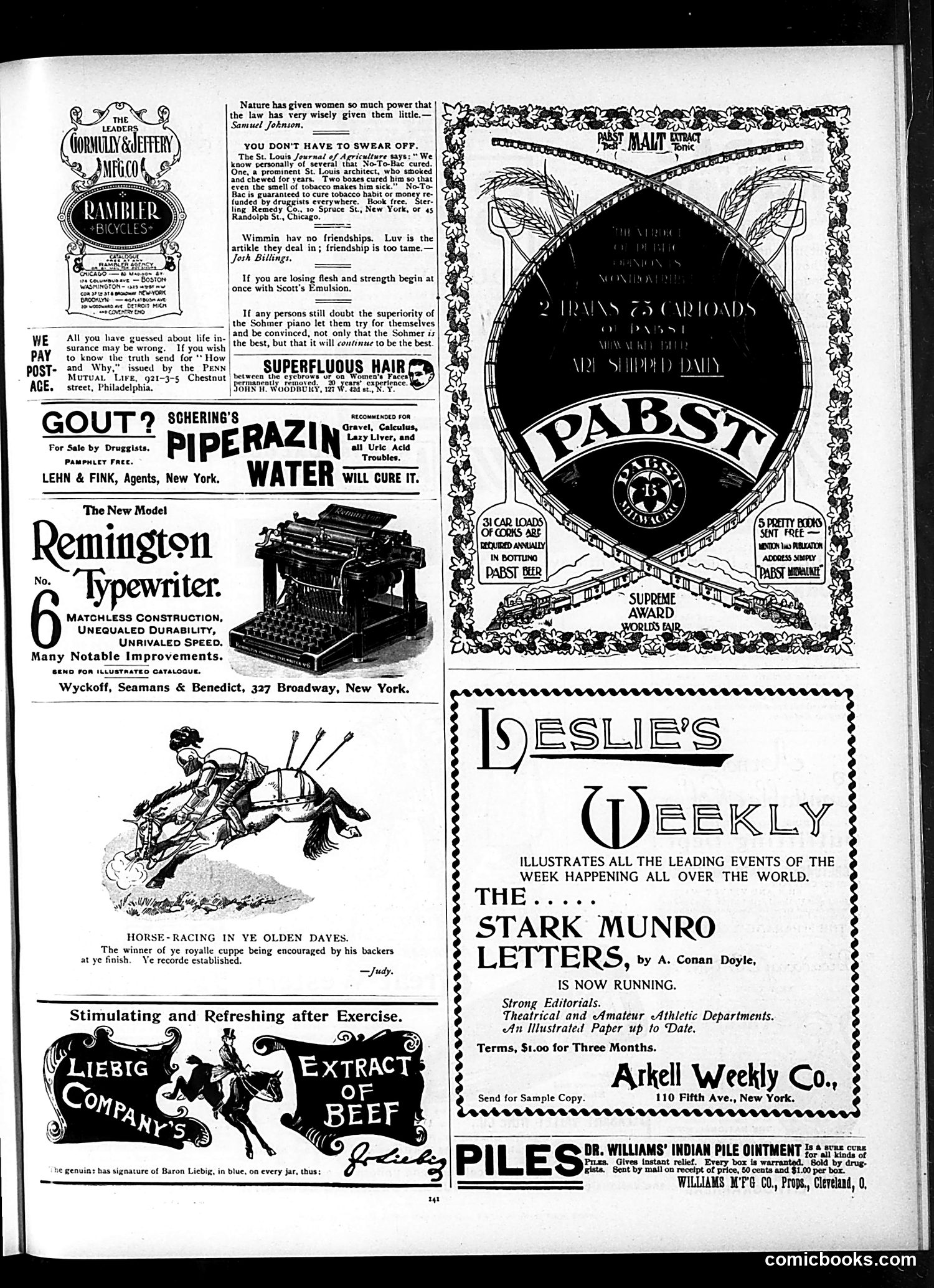
This is primarily an **advertising page** from Judge magazine, with one notable cartoon and various product advertisements typical of early 20th-century periodicals. ## The Cartoon The single cartoon depicts **"Horse-Racing in Ye Olden Dayes"** — a humorous historical scene showing a mounted rider being encouraged by backers at the finish line. The joke appears to be nostalgic satire about antiquated sports practices, contrasting primitive racing customs with modern conventions. ## The Advertisements The page features typical era advertisements: tobacco cessation products (No-To-Bac), medical remedies (gout cure, pile ointment), the Remington typewriter, and Liebig's beef extract. These reflect common health concerns and consumer goods of the period. ## Notable Content The page includes a Samuel Johnson epigraph about women's legal limitations—reflecting contemporary debates about women's rights—and promotes Leslie's Weekly and the Stark Munro Letters by Arthur Conan Doyle. The page lacks overt political satire or social commentary beyond the mild historical humor of the horse-racing cartoon.
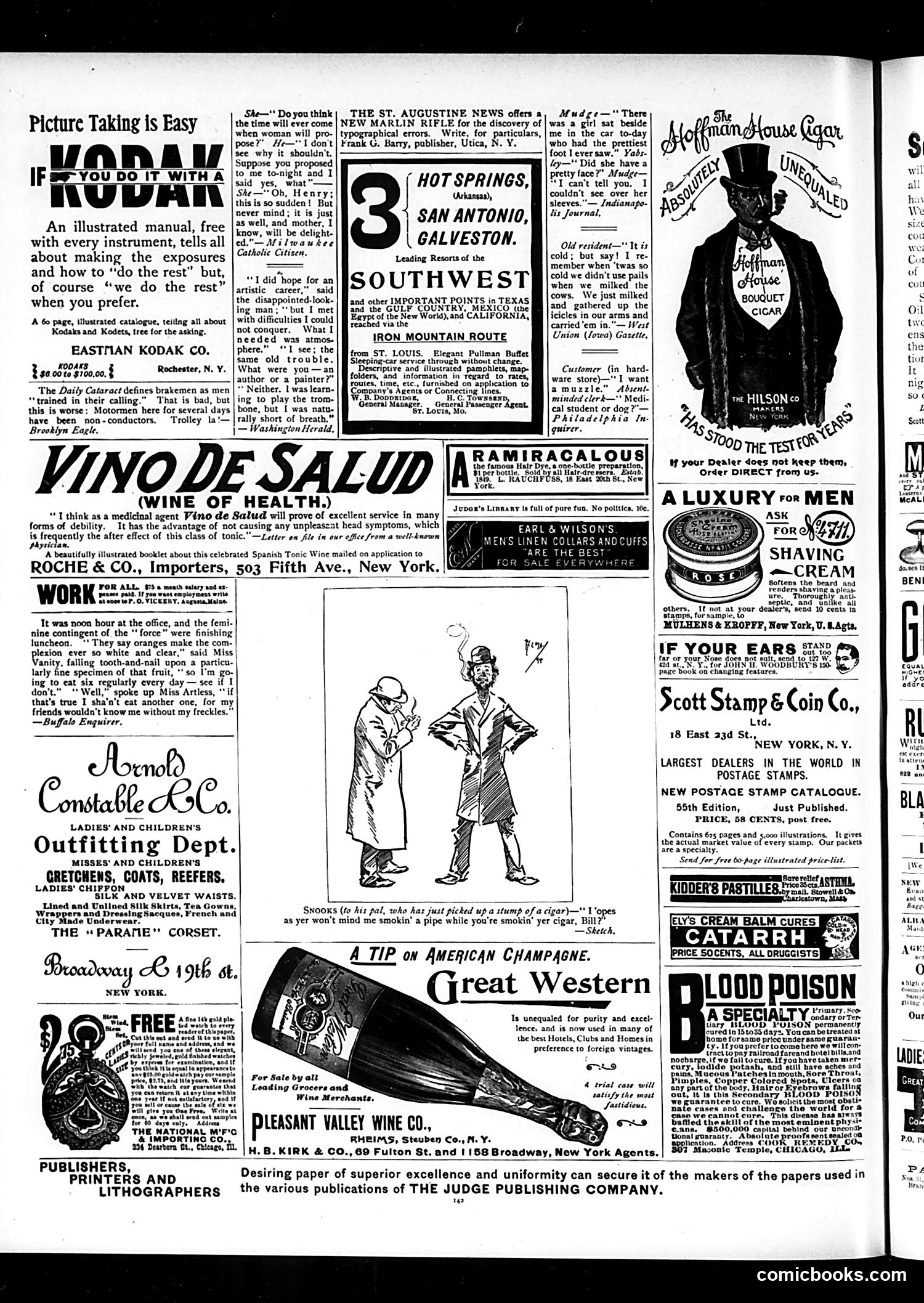
This page is primarily **advertisements and humor shorts** rather than political cartooning. The main cartoon shows two men in conversation about smoking cigars—one says "I hope as you won't mind me smoking a pipe while you're smoking a cigar," to which the other replies "Smoke!"—a gentle joke about social courtesy. The page contains numerous brief humor items typical of Judge's style: jokes about women proposing marriage, a motorman described as a "non-conductor" (wordplay), and anecdotes about office workers and dating. Most notably, there's advertising for luxury goods (Kodak cameras, wines, corsets, champagne) targeting wealthy readers. The railroad advertisement promotes travel to Hot Springs and San Antonio via the "Iron Mountain Route." The humor is entirely **social/domestic** rather than political—poking fun at courtship rituals, vanity, and office workplace dynamics. No political figures or events are referenced or caricatured on this page.
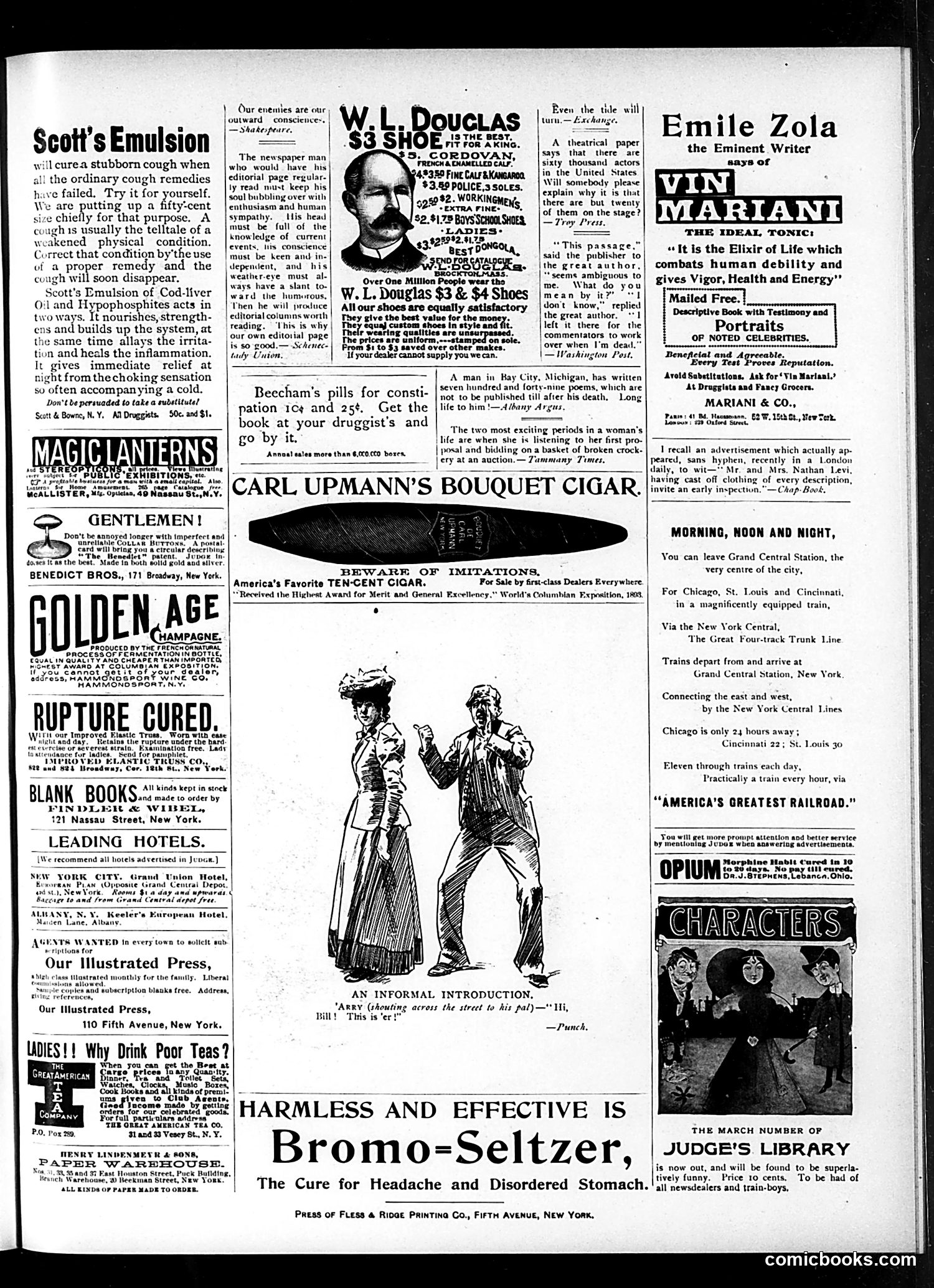
This is mostly a page of period advertisements and brief editorial snippets from Judge magazine. The main visual element is a cartoon labeled "An Informal Introduction" showing two figures on a street (likely from a Punch magazine reprint, as credited). The editorial content consists of brief humorous observations: a joke about sixty thousand actors existing in America but only twenty performing on stage; commentary on what makes good newspaper editorials; and anecdotes about a poet and an author. These are typical of the satirical filler content Judge ran. The advertisements reflect late-19th/early-20th-century concerns: Scott's Emulsion for coughs, W.L. Douglas shoes, Beecham's pills for constipation, and Bromo-Seltzer for headaches. The page reflects the magazine's reliance on patent medicine and consumer goods advertising for revenue—common practice in this era before modern advertising regulations.
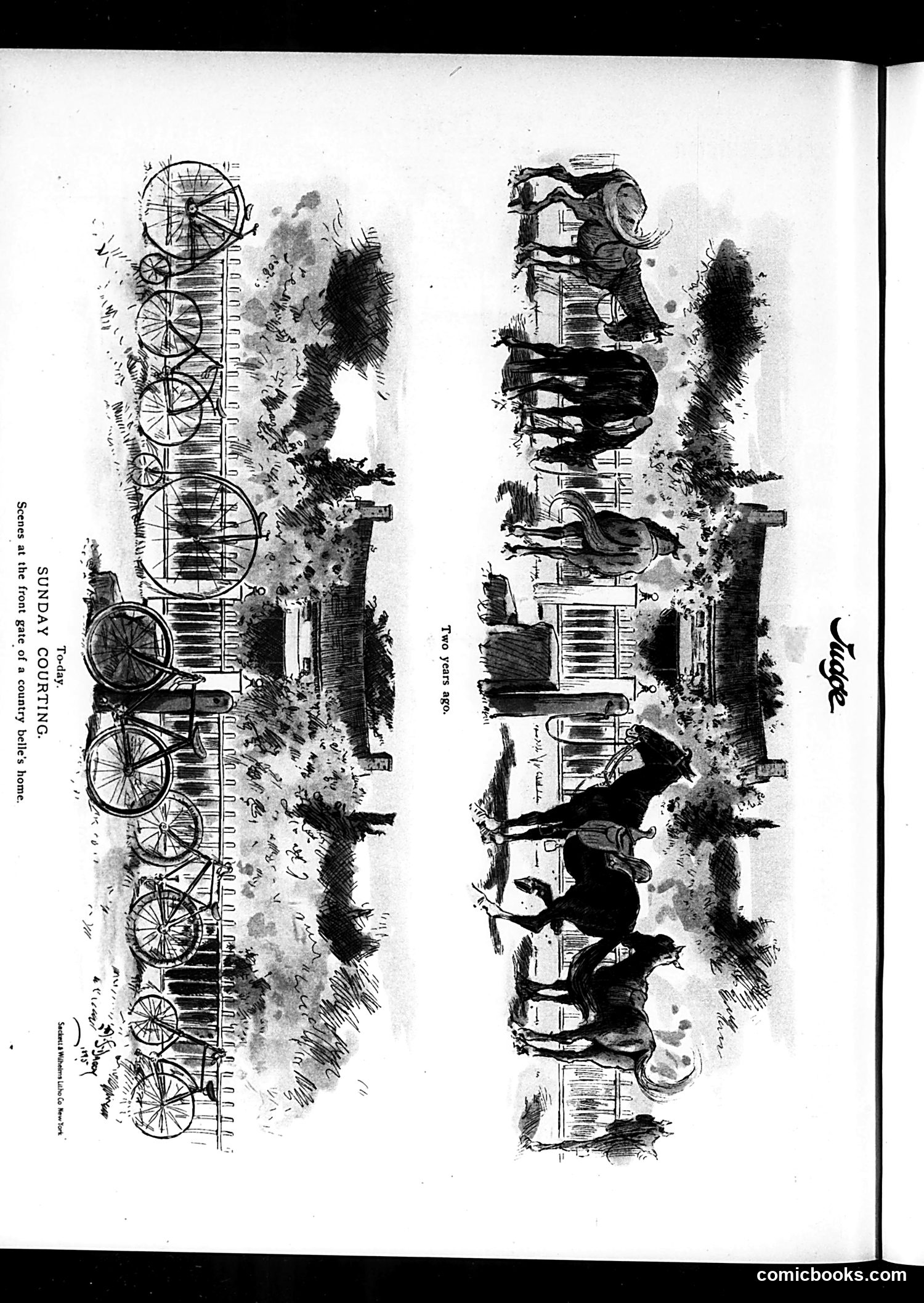
This is a two-panel satirical cartoon about courtship rituals in rural/country settings. The left panel shows a long line of young men with bicycles waiting outside a belle's home—suggesting intense romantic competition and the popularity of cycling as a courting activity. The right panel depicts the chaos of multiple suitors simultaneously vying for her attention at the gate. The satire targets the social phenomenon of "Sunday courting," when young men would visit eligible women. The bicycle imagery suggests this is from the 1890s cycling craze era, when bikes became tools for social interaction and courtship. The joke mocks both the absurd competition among suitors and the apparent ease with which country girls attract multiple admirers. It's humorous commentary on Victorian-era dating customs and the new mobility that bicycles provided to young men seeking romantic opportunities.