
Judge, 1895-03-02 · page 3 of 16
Judge — March 2, 1895 — page 3: what you’re looking at
What you’re looking at
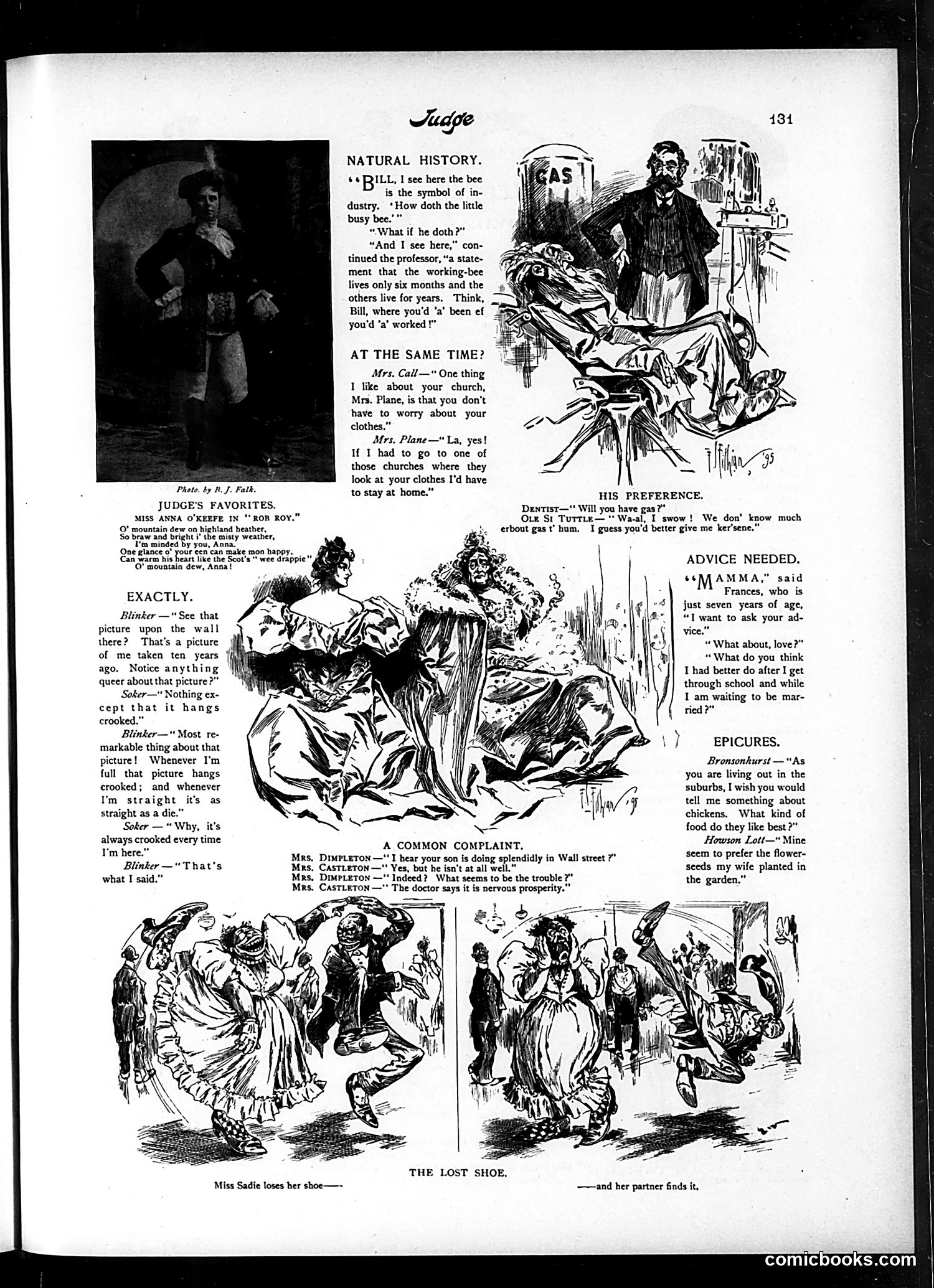
This page contains several satirical sketches and humorous anecdotes typical of Judge magazine's format. The content includes: **"Natural History"** - A joke about bees as symbols of industry, playing on the contrast between hardworking bees (living six months) and humans who work their entire lives. **"At the Same Time"** - Social commentary on church attendance and clothing anxieties among working-class women. **"The Lost Shoe"** - A visual comedy about Miss Sadie losing her shoe at what appears to be a social dance or party, with her partner retrieving it. **Other sketches** address contemporary concerns: dental work, suburban living, marriage advice, and gardening preferences. The humor relies on class observation, domestic situations, and wordplay rather than political commentary. The caricatured drawings emphasize exaggerated features typical of Gilded Age satirical illustration.
📄 Transcribed text from this page (OCR, searchable)
Machine-transcribed from the original scan — historical spelling and the odd misread are preserved.
Photo. by B. J. Falk. JUDGE'S FAVORITES. MISS ANNA O'KEEFE IN ‘ROR ROY.” Q' mountain dew on highland heather, So braw and bright i' the misty weather, I'm minded by you, Anna. One glance o' your een'can make Can warm his heart like the Scot's happy, “wee drappie' ‘O” mountain dew, Anna! EXACTLY. Blinker —“ See that picture upon the wall there? That's a picture of me taken ten years ago. Notice anything queer about that picture?” Soker—" Nothing ex- cept that it hangs crooked.” Blinker—" Most re- markable thing about that picture! Whenever I'm full that picture hangs crooked; and whenever I'm straight it's as straight as a die.” Soker —“ Why, it's always crooked every time Guage NATURAL HISTORY. «BILL, I see here the bee is the symbol of in- dustry. ‘How doth the little busy bee.’ “What if he doth?” “And I see here,” con- tinued the professor, “a state- ment that the working-bee lives only six months and the others live for years. Think, Bill, where you'd ‘a’ been ef you'd ‘a’ worked !" AT THE SAME TIME? Mrs. Call—“ One thing I like about your church, Mrs. Plane, is that you don’t have to worry about your clothes.” Mrs, Plane—'La, yes! If I had to go to one of those churches where they look at your clothes I'd have to stay at home.” HIS PREFERENCE. Denrist—"* Will you have gas?" Ote St TurTLe— " Wa-al, I swow! We don’ know much erbout gas t' hum. I guess you'd better give me ker'sene.” ADVICE NEEDED. se AMMA,” said M Frances, who is just seven years of age, “T want to ask your ad- vice.” What about, love?” “ What do you think Thad better do after I get through school and while 1 am waiting to be mar- ried ?” EPICURES. Bronsonhurst —““As you are living out in the suburbs, I wish you would tell me something about chickens, What kind of food do they like best ?”” “Mine A COMMON COMPLAINT, Mrs. DimpLeton —‘'I hear your son is doing splendidly in Wall street 7° Mrs. CASTLETON —"* Yes, but he isn’t at all well.” seem to prefer the flower- seeds my wife planted in et b the garden.” Mrs. CastLeTon —"* The doctor says it is nervous prosperity, THE LOST SHOE, Miss Sadie loses her shoe—~ —and her partner finds it, comicbooks.com |