
A complete issue · 16 pages · 1895
Judge — February 2, 1895
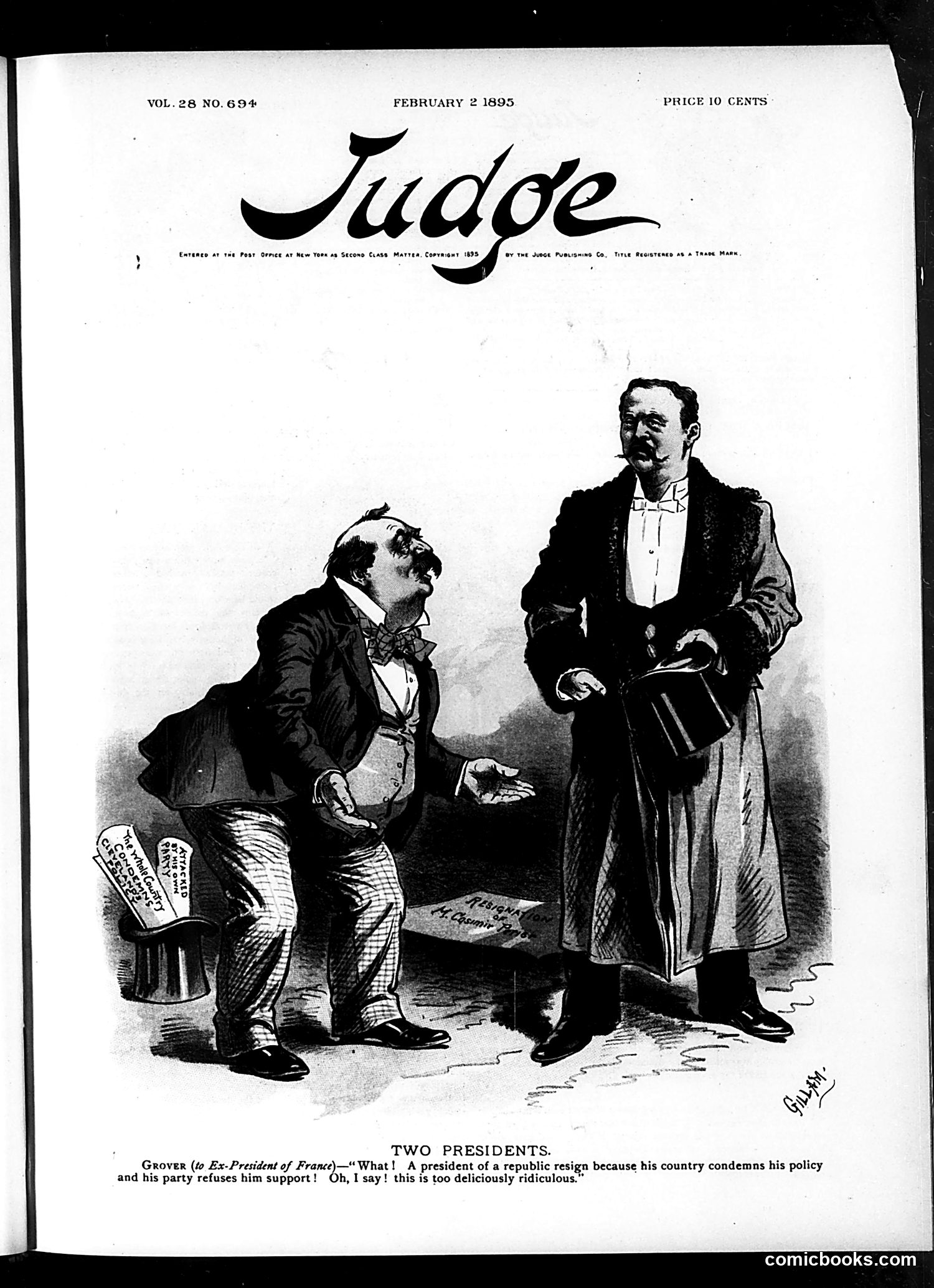
This cartoon depicts **Grover Cleveland** (identified as "Ex-President of France" in the caption—likely a satirical error or joke), sitting dejected while a tall man stands beside him. The caption quotes Cleveland expressing dismay that a president of a republic would resign because his country condemns his policy and his party refuses support, calling it "deliciously ridiculous." The cartoon likely references **Félix Faure** of France or a contemporary French political crisis involving presidential resignation. Judge uses this to mock Cleveland's own political troubles—suggesting American politicians face similar party abandonment and policy rejection, making the European situation uncomfortably relevant to U.S. readers. The satire mocks political instability and lack of party loyalty in both nations.
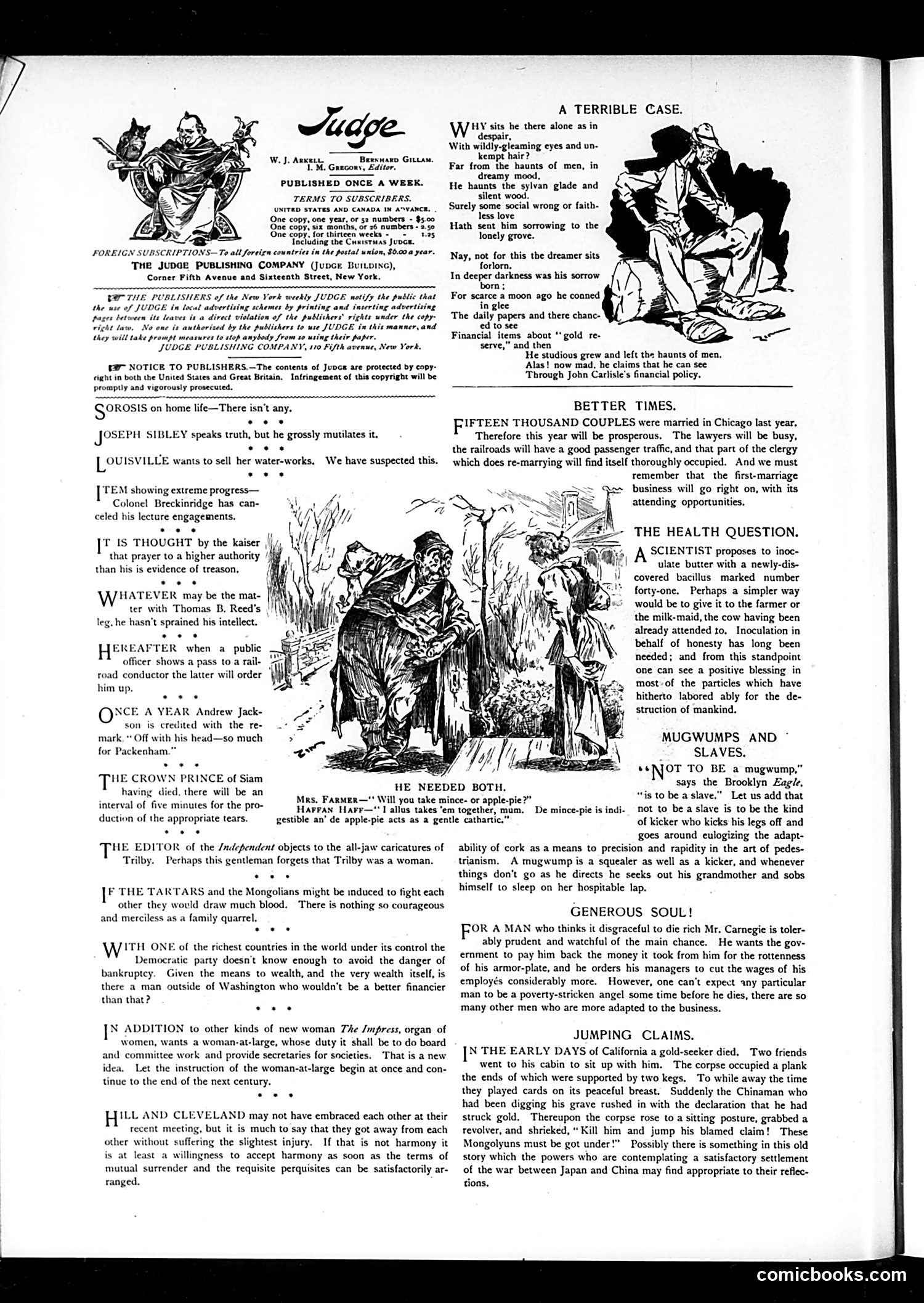
The cartoon depicts a man in distress, appearing to suffer from melancholy or depression. The accompanying poem suggests he's a wealthy dreamer haunted by financial worries and social failure—possibly a speculative investor or businessman who lost his fortune. The satirical point targets the psychological toll of financial instability on the privileged classes. The poem references his obsession with "Financial ruin" and inability to see beyond his troubles, suggesting Judge magazine is mocking both his self-pitying nature and the contrast between his wealth and emotional fragility. The cartoon's title "A Terrible Case" treats his anxiety as a medical condition worthy of mockery, typical of Judge's satirical approach to elite anxieties during the Gilded Age economic uncertainty.
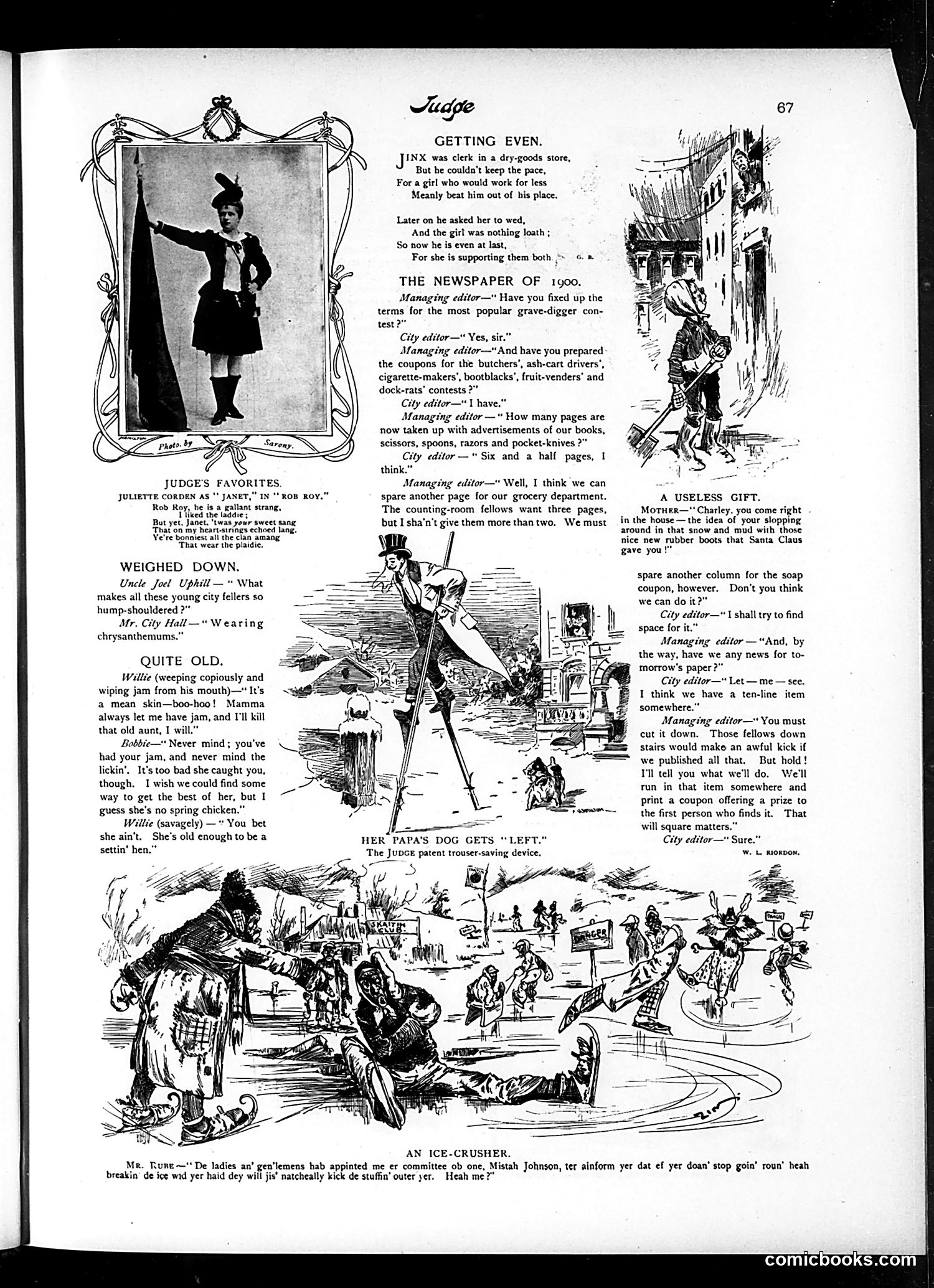
This page contains several satirical pieces typical of Judge's humor circa 1900: **"Getting Even"** mocks class dynamics—a clerk outearns a working girl, so she marries him to achieve financial equality. **"The Newspaper of 1900"** satirizes newspaper management, showing editors debating page allocations for advertisements (grave-digger contests, butchers, grocers) versus actual news. The joke critiques how commercial interests increasingly dominated newspaper content. **"Weighed Down," "Quite Old,"** and other brief pieces use character sketches to mock social types—aging bachelors, worn-out wives, and pretentious behavior. **"Her Papa's Dog Gets Left"** and **"An Ice-Crusher"** are illustrated comic scenarios depicting absurd situations with working-class or domestic themes, rendered in Judge's characteristic sketch style. The overall tone reflects turn-of-century satirical concerns: commercialism, gender relations, and class consciousness.
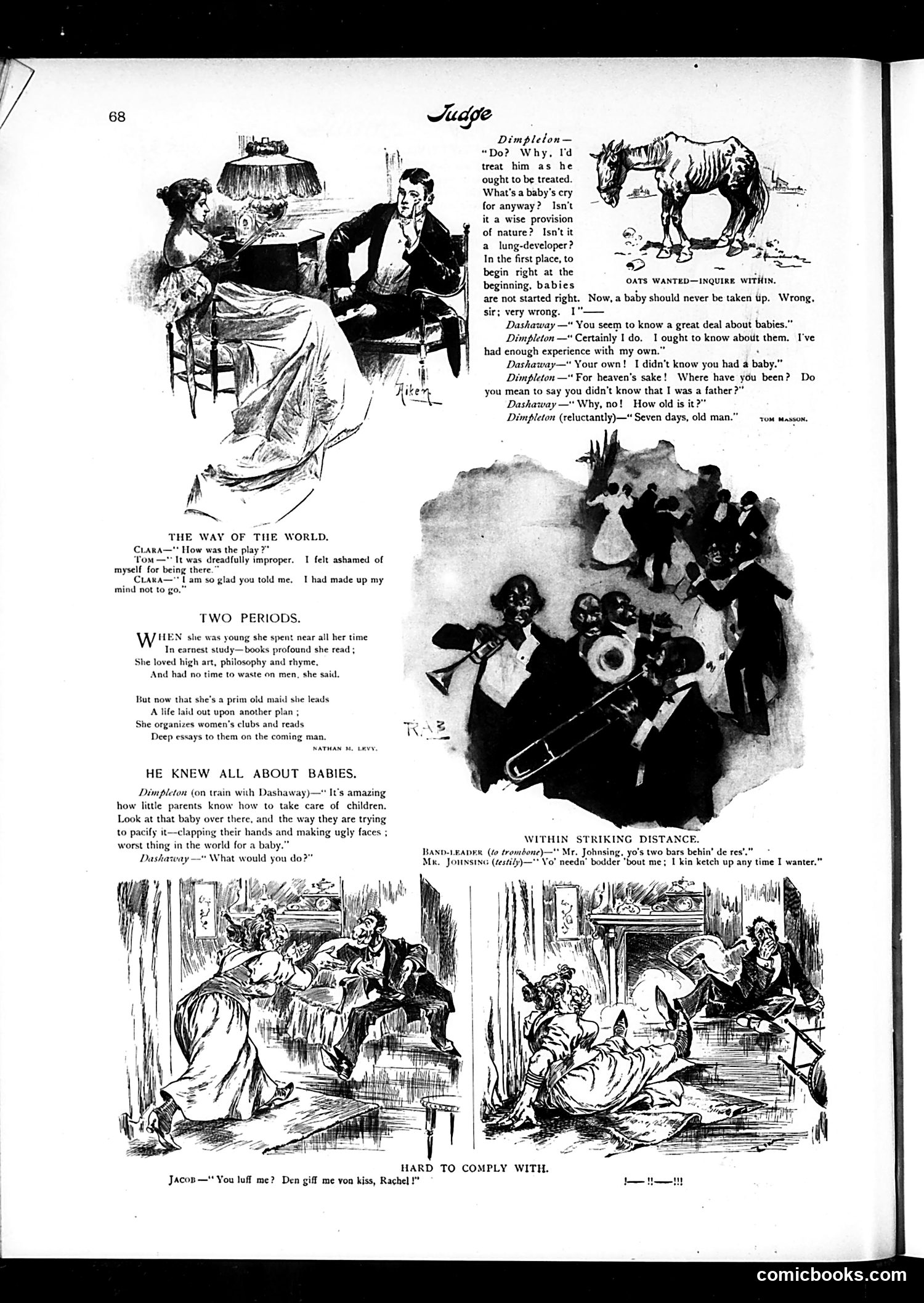
This page contains multiple humor pieces satirizing social pretense and absurdity: **"The Way of the World"** mocks hypocrisy: a woman attends an "improper" play, feels ashamed, yet tells her friend to avoid it—ensuring she'll go anyway. **"Two Periods"** contrasts a young woman devoted to serious study with her current self as "a prim old maid" who now organizes women's clubs—suggesting spinsterhood redirects intellectual energy into busybody activism. **"He Knew All About Babies"** satirizes the smug, childless pontificator. Dimpleton confidently lectures about infant care despite never having children, only admitting after seven days of fatherhood that he's clueless—a common target: pretentious expertise without experience. The remaining brief sketches ("Within Striking Distance," "Hard to Comply With") appear to be quick gag cartoons without clear historical references. The satire targets Victorian-era social hypocrisy, spinster stereotypes, and male pomposity.
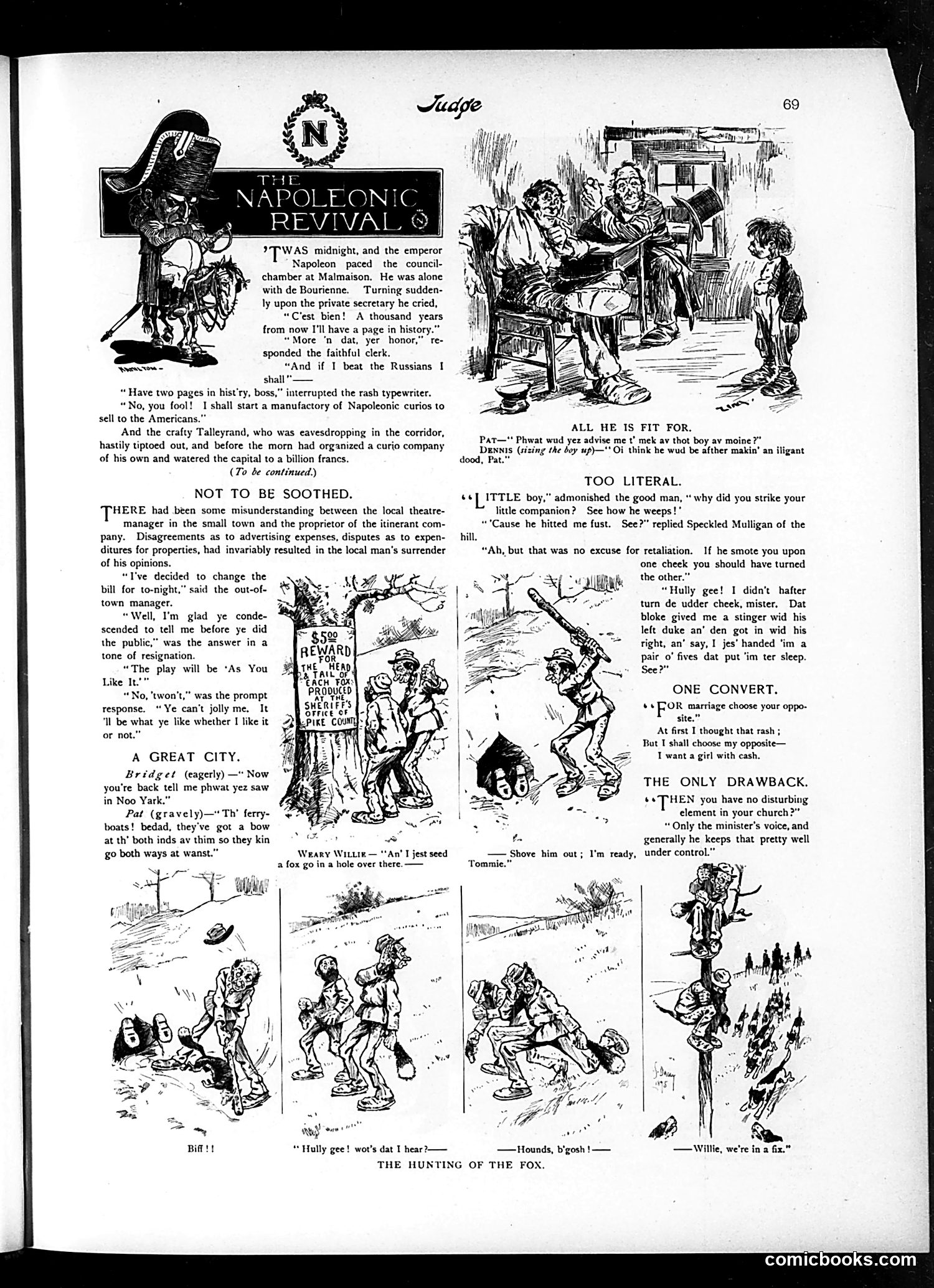
This page contains multiple satirical sketches typical of early Judge humor: **"The Napoleonic Revival"** parodies American commercialism by imagining Napoleon discussing his historical legacy with his secretary, who interrupts with quips about selling "Napoleonic curios to the Americans." The satire mocks both American consumer culture and European entrepreneurialism—the crafty Talleyrand overhears and starts his own curio company, inflating capital to a billion francs. It's a jab at how history gets commodified. **The remaining sketches are brief comic vignettes:** An Irish immigrant (Pat) describes New York's ferries in comically literal terms; a boy defends striking his companion by literalizing the Biblical "turn the other cheek" teaching; a man choosing a wife "opposite" to himself means finding one with money; and a minister's voice is the church's only "drawback." The humor relies on ethnic dialect humor (Irish and working-class speech), wordplay, and social commentary on materialism and religious hypocrisy—typical of Judge's satirical approach to American society.
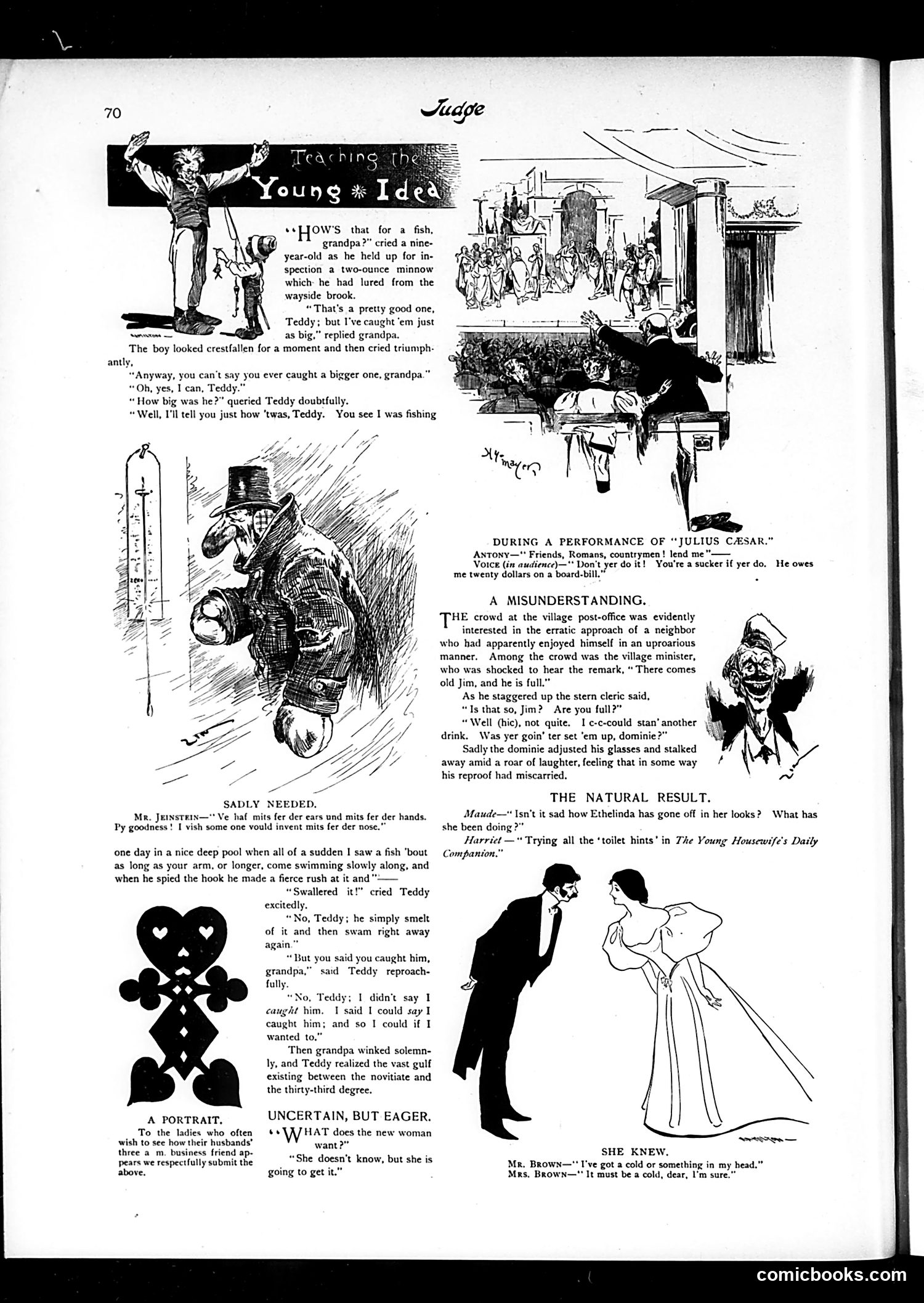
This page from *Judge* magazine contains multiple brief humorous sketches typical of early-20th-century American satire: **"Teaching the Young Idea"** mocks grandfatherly tall tales—a boy catches a tiny fish; grandpa claims to have caught bigger ones, then uses Masonic-style wordplay ("the thirty-third degree") to escape contradiction. **"Sadly Needed"** features a Yiddish-accented character (Mr. Jeenstein) joking about needing mittens for his nose—simple ethnic humor common to the era. **"A Misunderstanding"** plays on a minister's prudishness when he misinterprets a drunk man saying he is "full" (of alcohol) as admitting spiritual emptiness, offering moral reproof instead of a drink. The remaining sketches are brief quips about new women's ambitions, marital dynamics, and theater-going. The overall tone reflects genteel Victorian-era humor emphasizing wordplay, misunderstandings, and gentle mockery of social pretension and moral earnestness.
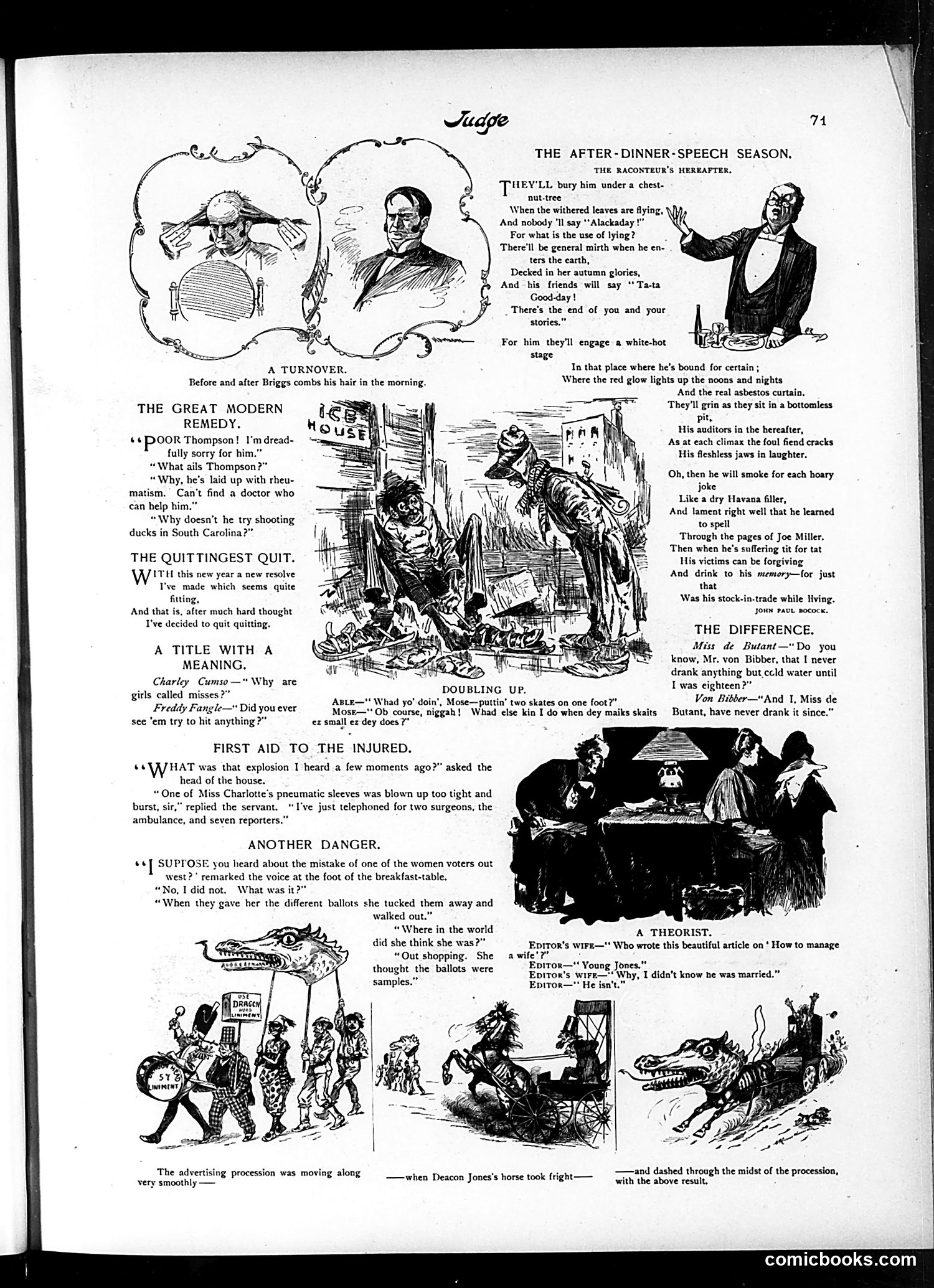
This page from *Judge* (undated, but stylistically early 20th century) collects brief satirical pieces on contemporary life and social foibles: **Main targets:** The satire mocks affectation, incompetence, and social pretension. "The After-Dinner-Speech Season" ruthlessly attacks long-winded raconteurs—boring speakers condemned to eternal torment. "The Difference" contrasts a society debutante's claimed purity with a man's admission he stopped drinking water at eighteen, implying vice. "A Theorist" jokes that the author of an article on managing wives is unmarried, suggesting theoretical expertise without practical knowledge. Other pieces ridicule new inventions ("pneumatic sleeves" that burst), women voters confused by ballots, and dialect humor (common then, now offensive). "Doubling Up" features racist caricature depicting African Americans. The cartoons illustrate these jokes with exaggerated illustrations typical of the era's visual humor style.
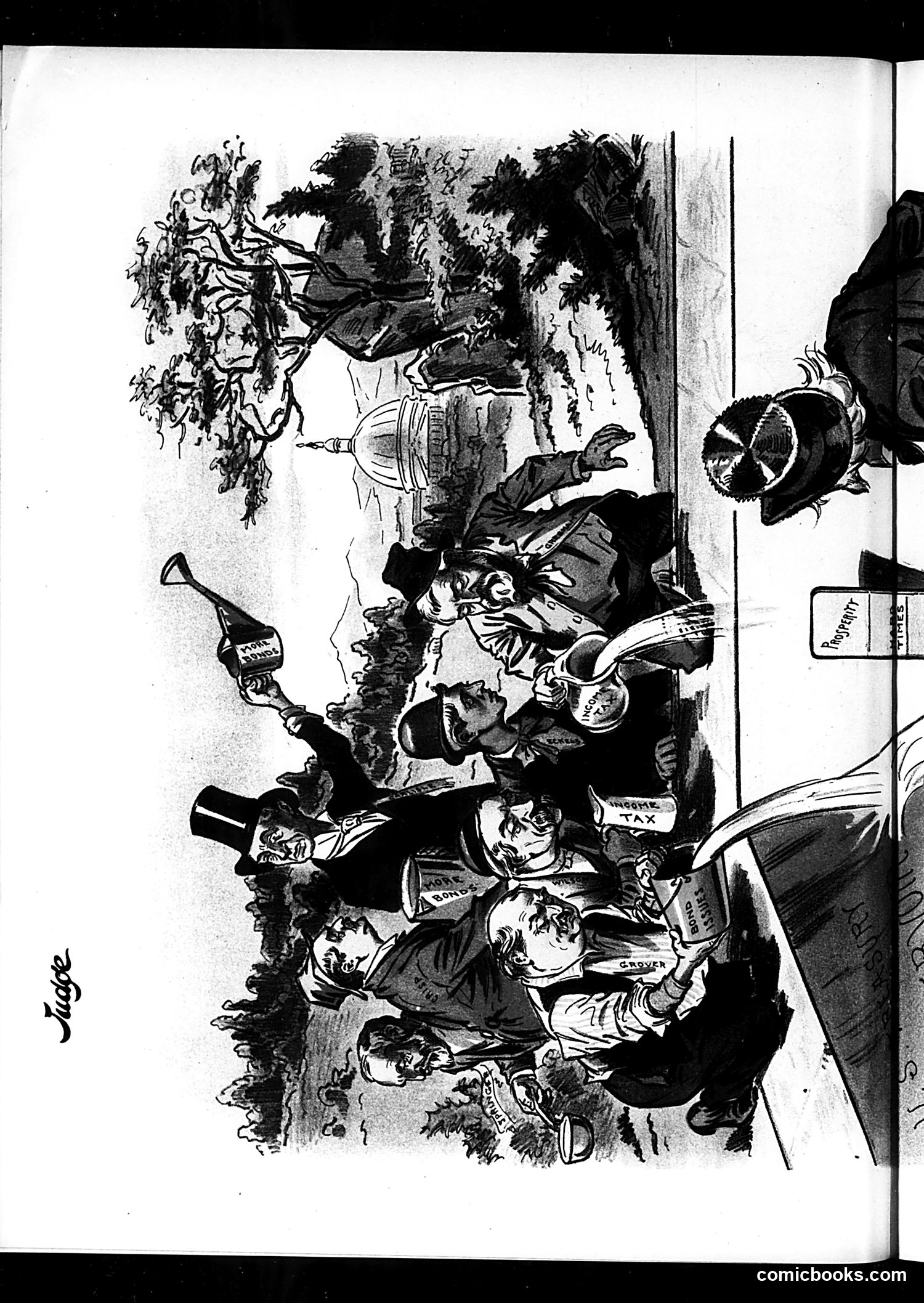
I can see this is a political cartoon from *Judge* magazine, but the OCR text provided is essentially unreadable—it appears to be corrupted character data rather than actual text content. From the IMAGE alone, I can observe what appears to be a satirical scene with multiple figures in formal dress (top hats and coats) arranged around hanging vegetation or ivy, suggesting a social gathering or political event. The figures' caricatured faces and exaggerated features are typical of *Judge* magazine's style. However, without legible text or a visible date/caption, I cannot reliably identify the specific figures, the political context, or the intended satire. To properly explain this cartoon's meaning to a modern reader, I would need either clearer OCR text or additional identifying information from the magazine's masthead or surrounding content.
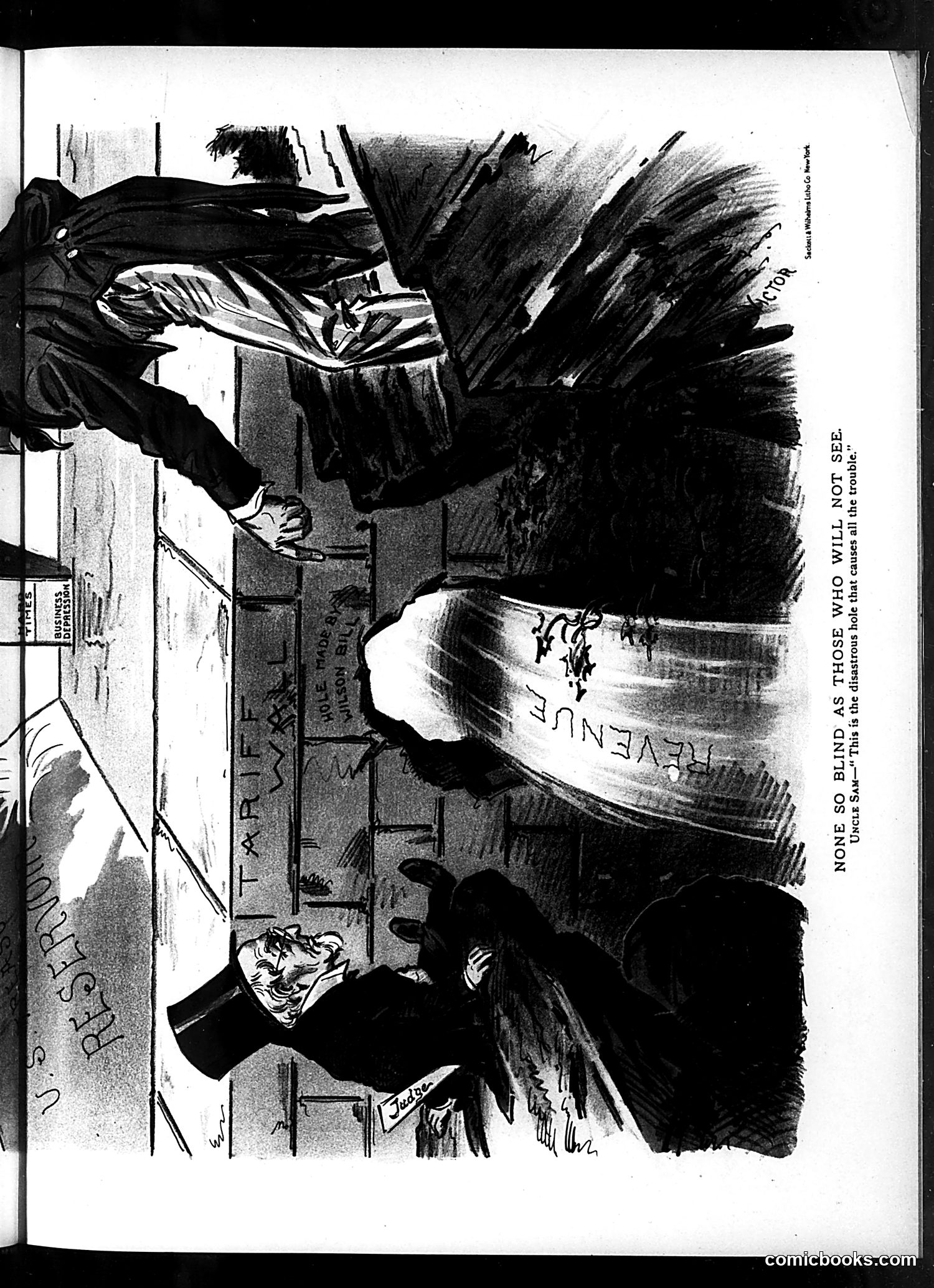
I cannot reliably interpret this cartoon due to the severely degraded OCR text, which appears corrupted or inverted. While the image shows a black and white political cartoon with figures in what appears to be an interior setting with some signage visible, I cannot confidently identify the specific individuals, historical event, or satirical point without legible text to anchor my analysis. To properly explain this cartoon's meaning to a modern reader, I would need either a clearer OCR transcription or the original publication date and title from Judge magazine, which would provide necessary historical context for identification.
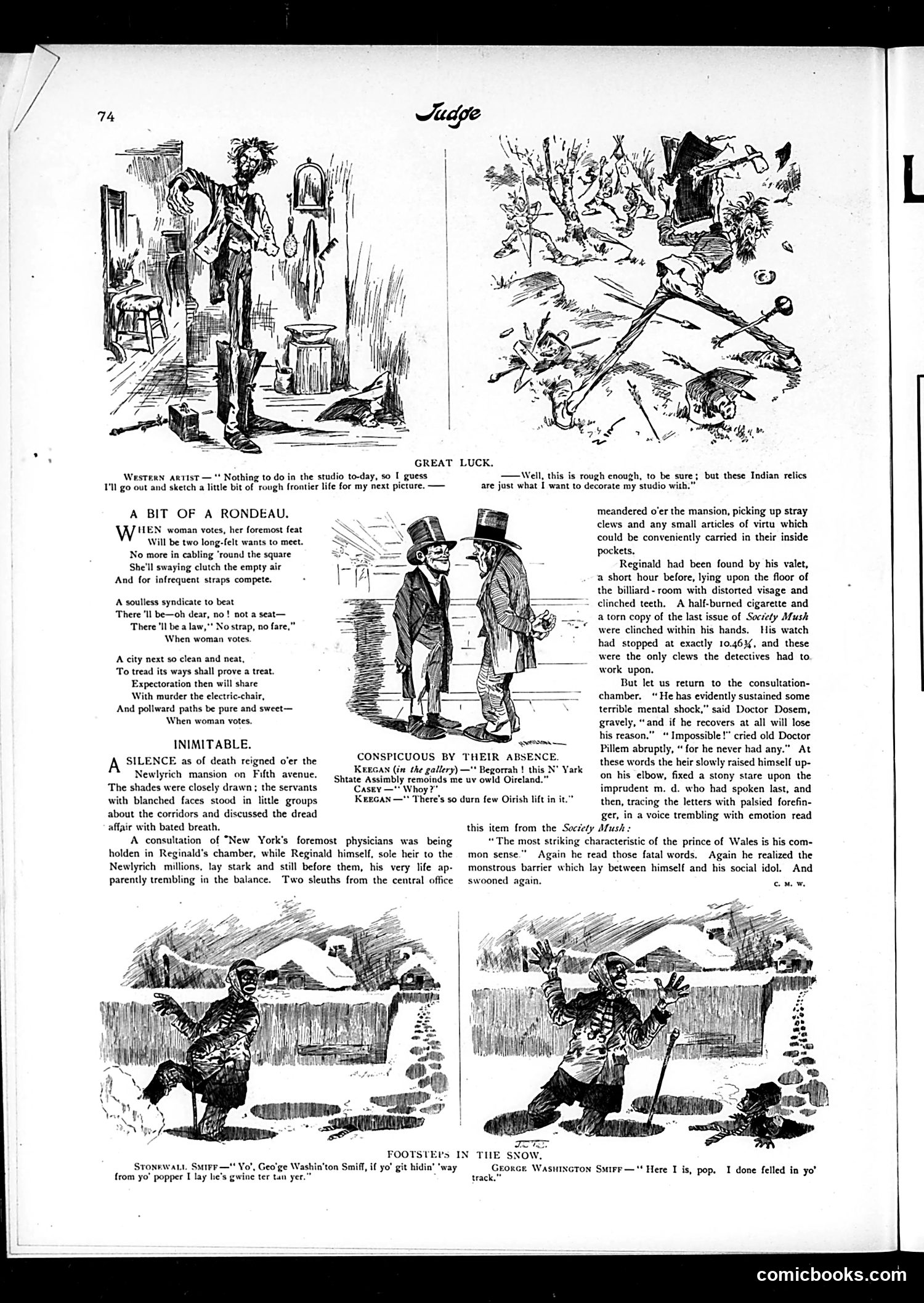
This page contains multiple satirical pieces typical of the era: **"A Bit of a Rondeau"** mocks women's suffrage through verse, predicting that when women vote, they'll secure streetcar straps and enforce spitting laws—trivializing women's political participation as focused on minor domestic conveniences rather than substantive issues. **"Inimitable"** is a humorous mystery story parody about wealthy Manhattan society, featuring detectives investigating a man's collapse. The joke culminates when he reads in *Society Mush* magazine that the Prince of Wales lacks "common sense"—devastating him because he idolizes the royal and now cannot emulate his social superior. **Minor cartoons**: "Great Luck" shows a Western artist claiming he'll loot Native American artifacts for studio decoration. "Footsteps in the Snow" and "Conspicuous by Their Absence" feature dialect humor—Irish and African American characters rendered in exaggerated speech patterns typical of period comedy. The page reflects Progressive-era anxieties about women's rights, immigrant stereotypes, and mocking of wealthy pretension.
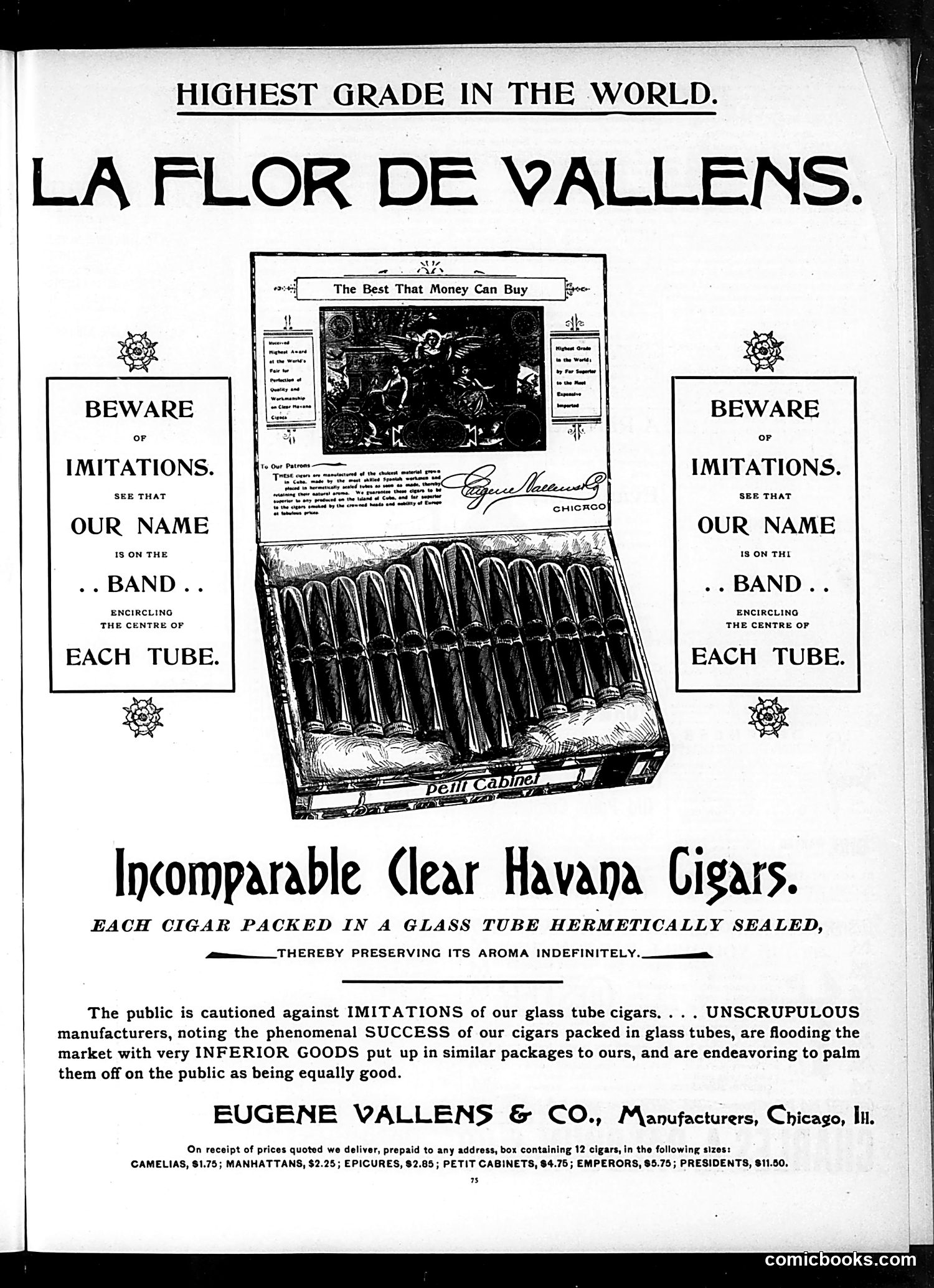
This page is **not a cartoon or satire** — it's a period advertisement for Eugene Vallens & Co., a Chicago cigar manufacturer. The ad promotes "La Flor de Vallens" cigars, emphasizing they're "the highest grade in the world" and packed in glass tubes to preserve aroma. The central image shows a box of cigars with a cherub or angel figure and a signature (likely the manufacturer's). The satirical/cautionary element is the repeated "BEWARE OF IMITATIONS" warnings flanking the product. The manufacturer warns consumers that competitors are producing inferior knock-offs in similar glass-tube packaging, attempting to deceive buyers into thinking they're purchasing the genuine Vallens product. This reflects early 20th-century commercial competition and consumer fraud concerns — unscrupulous manufacturers exploiting a successful product's popularity by creating cheap imitations in nearly identical packaging. The ad appeals to buyers to verify the brand name on the band encircling each tube.
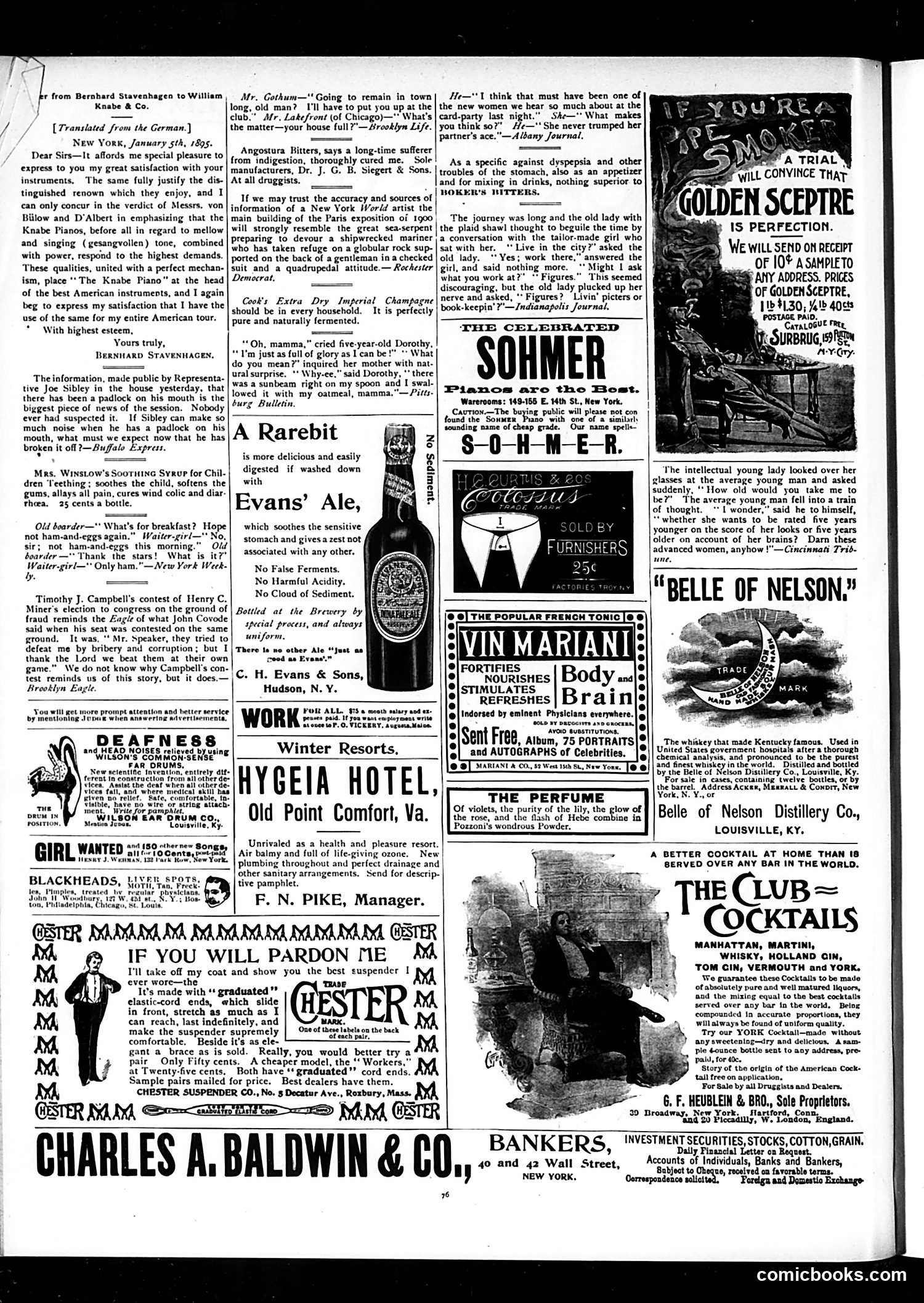
This page is primarily **advertising and testimonial content** rather than political cartoons or satire requiring historical context. The main notable editorial content includes brief satirical commentary: 1. **Joe Sibley reference**: A joke about Representative Joe Sibley, suggesting he had a "padlock on his mouth" but made noise anyway—trivial political humor about a congressman's verbosity. 2. **Timothy Campbell contest**: References a congressional election dispute, comparing it to a historical precedent from John Covode's contested seat, implying political corruption through bribery. 3. **Minor jokes**: Light domestic humor about breakfast, a girl swallowing sunbeams, and a visiting Chicagoan. The bulk of the page consists of **product advertisements**—piano endorsements (Knabe pianos), digestive bitters, champagne, ale, ear drums, and other patent medicines typical of 1890s magazines. **No major political cartoons or satire requiring specialized historical knowledge appear on this page.** It's a standard Judge issue mixing minor political commentary with commercial advertising.
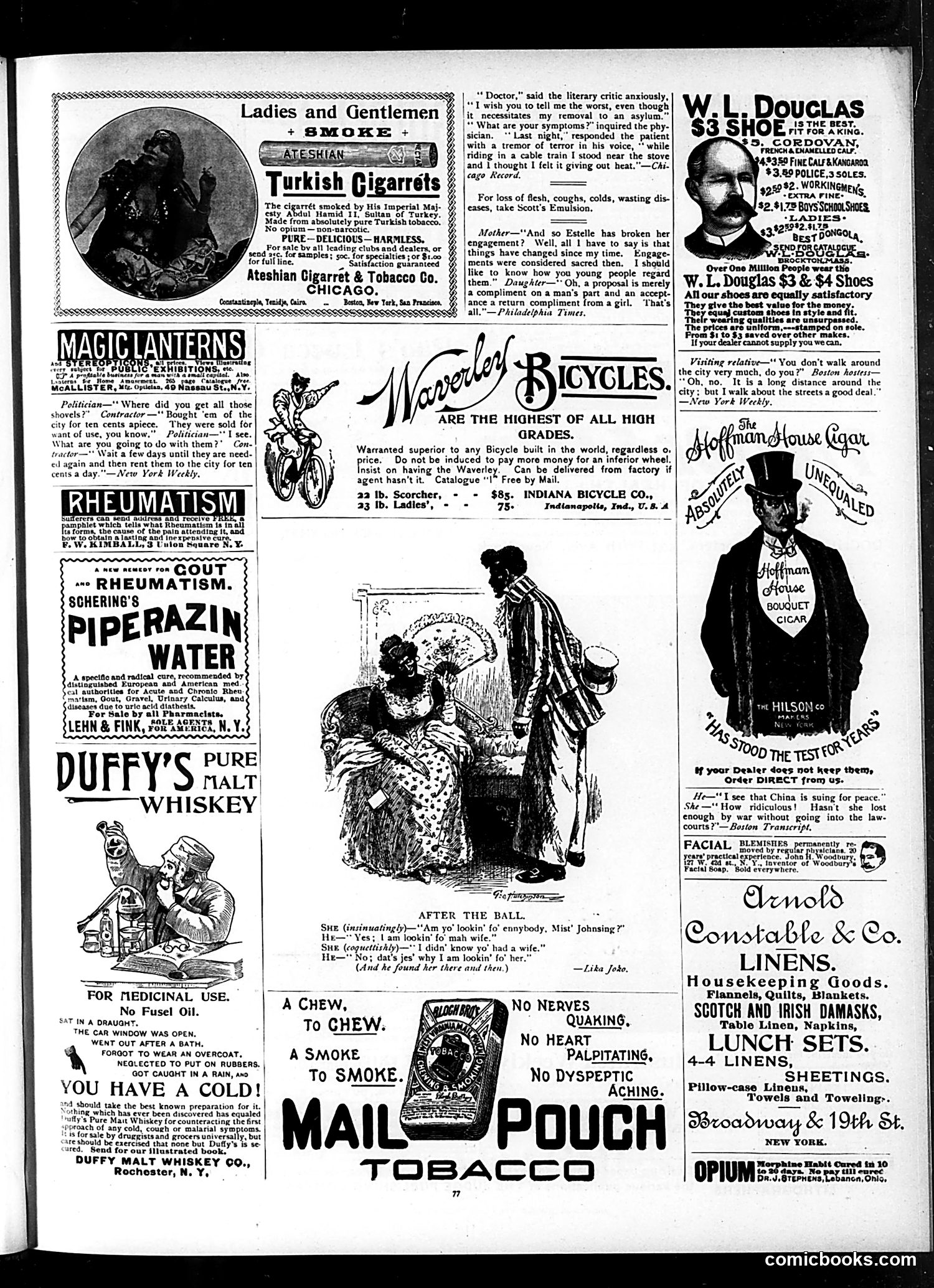
This is primarily an **advertising page** from Judge magazine, with one significant cartoon and several small joke snippets interspersed among product advertisements. The main cartoon, **"After the Ball,"** depicts a social interaction between a man (Sue/Mister Johnsing) and a woman at what appears to be a formal dance. The joke plays on the man claiming to search for his wife while flirting with another woman at the event—the humor deriving from his transparent excuse and the woman's coquettish response. This reflects period anxieties about marital fidelity and social propriety at public gatherings. The page's advertisements reveal **turn-of-the-century consumer culture**: Turkish cigarettes, bicycles, malt whiskey (marketed as medicinal), patent remedies for rheumatism and colds, and shoes. Several joke snippets mock modern life (cable cars, broken engagements, political corruption involving city shovels). The overall tone is light social satire targeting contemporary mores, consumer gullibility, and urban life's absurdities—typical of Judge's satirical approach.
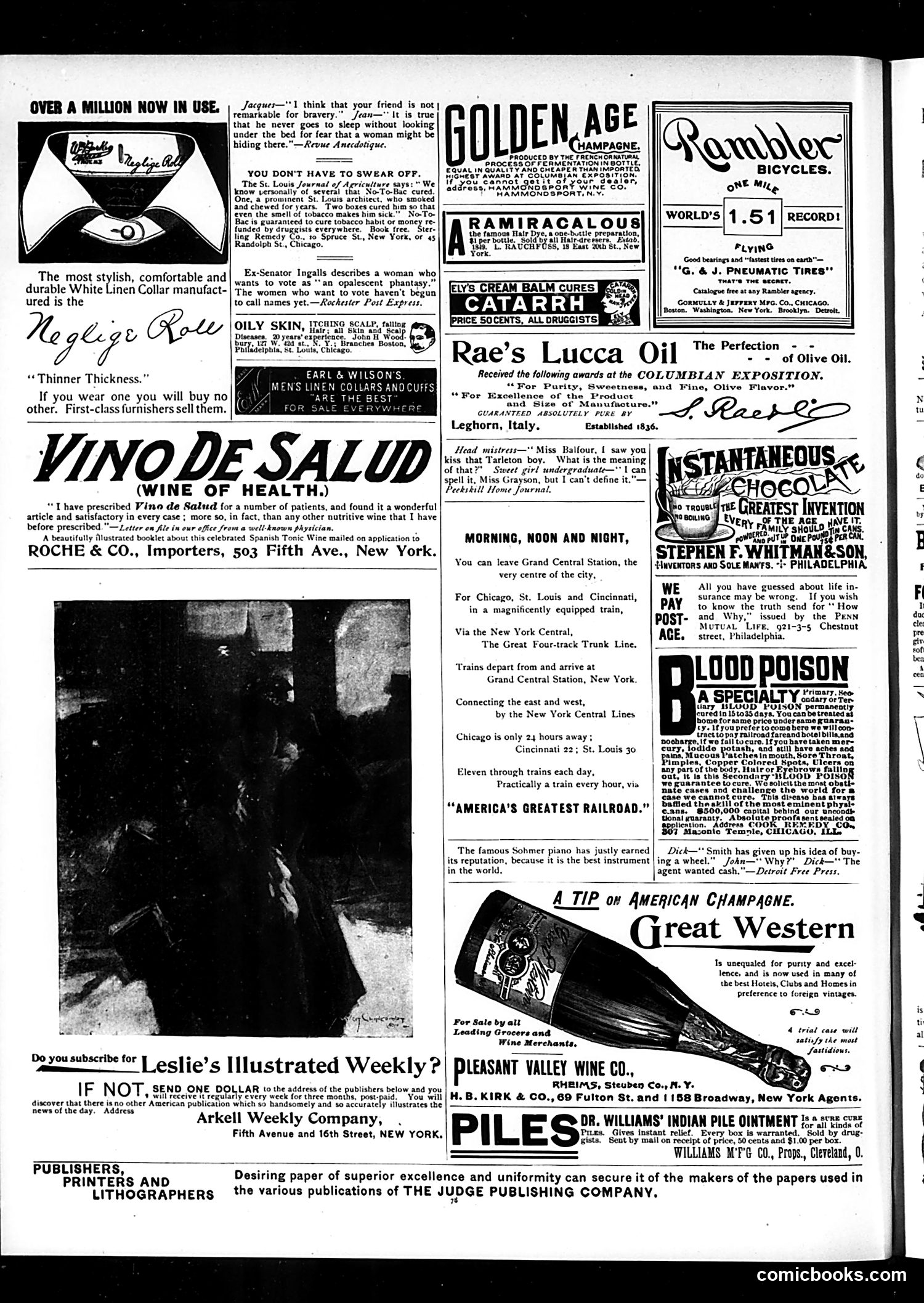
This page is primarily **advertising**, not political satire. It features numerous product advertisements typical of the late 19th/early 20th century, including: - **White Linen Collars** and men's furnishings - **Tobacco cessation products** ("No-To-Bac") - **Wine tonics** (Vino de Salud, Golden Age Champagne) - **Medical remedies** (Rae's Lucca Oil, Dr. Williams' Indian Pile Ointment, blood poison cure) - **Bicycles** (Rambler brand) - **Champagne** (Great Western) - **Chocolate** (Stephen F. Whitman's) The page includes small **humorous snippets** (short jokes about women voting, kissing), typical of Judge's satirical format, but these are minor filler rather than the main content. The **historical context**: This reflects an era when Judge relied heavily on patent medicine and dubious health product advertising—common in American magazines before FDA regulation. The prominence of tobacco-cessation ads and sexual innuendo jokes reflects period attitudes.
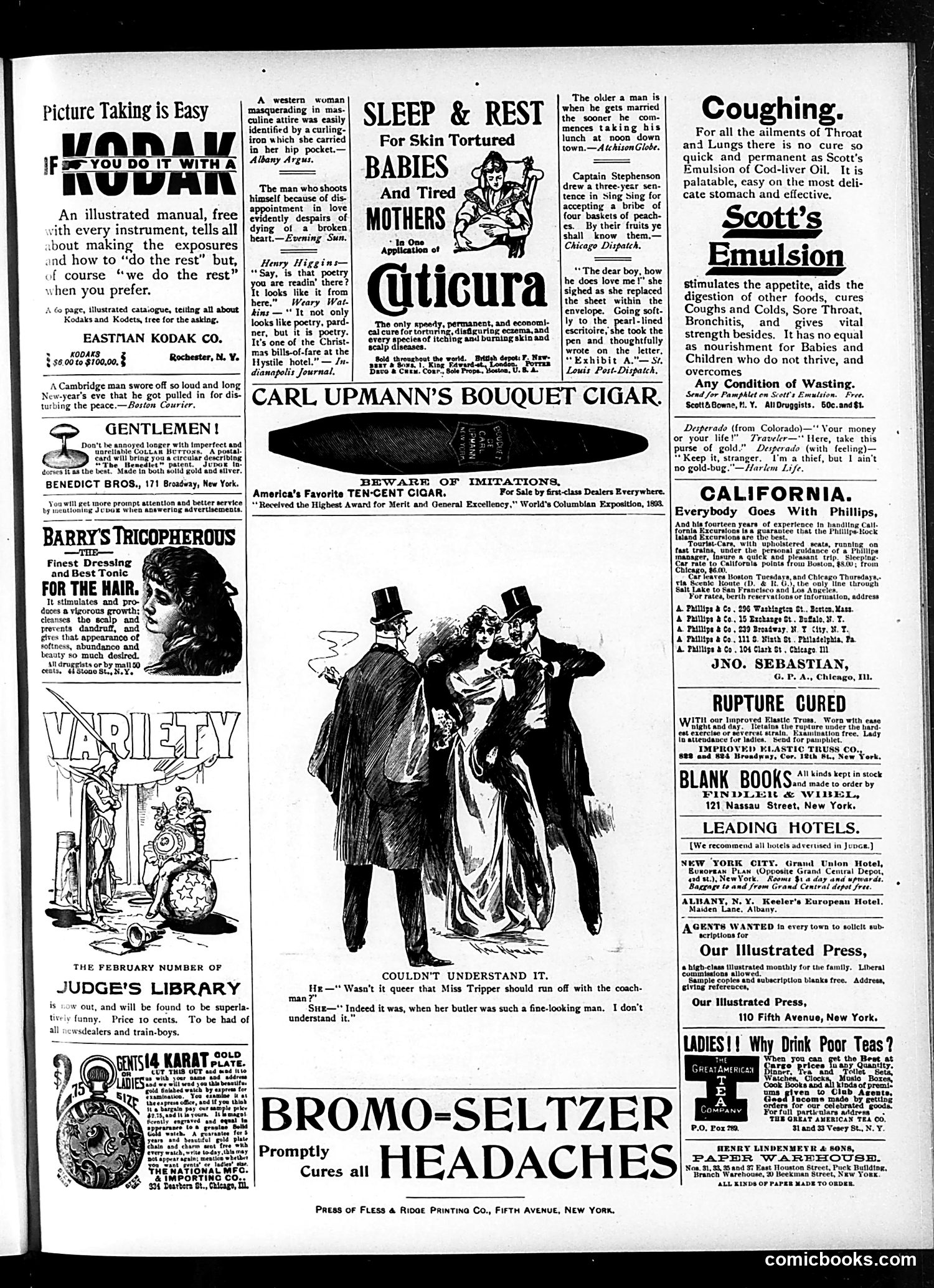
This page from the satirical magazine *Judge* contains mostly **advertisements and brief humorous anecdotes** rather than sustained political cartoons. The main illustrated cartoon depicts a scene titled "Couldn't Understand It," showing three well-dressed men in formal attire (top hats) apparently discussing a woman's elopement. The joke's caption reveals the humor: a woman (Miss Tripper) ran away with the coachman, surprising the speaker because "her butler was such a fine-looking man." The satire targets upper-class social pretension—the joke assumes servants rank by appearance rather than character, and mocks the speaker's confused priorities about which servant the woman "should" have chosen. The page is otherwise dominated by period advertisements for products like Cuticura (skin treatment), Scott's Emulsion (cod-liver oil), Bromo-Seltzer, and various other remedies. Short humorous items appear throughout, typical of *Judge*'s format mixing satire with advertising. No major political figures or events are referenced on this particular page.
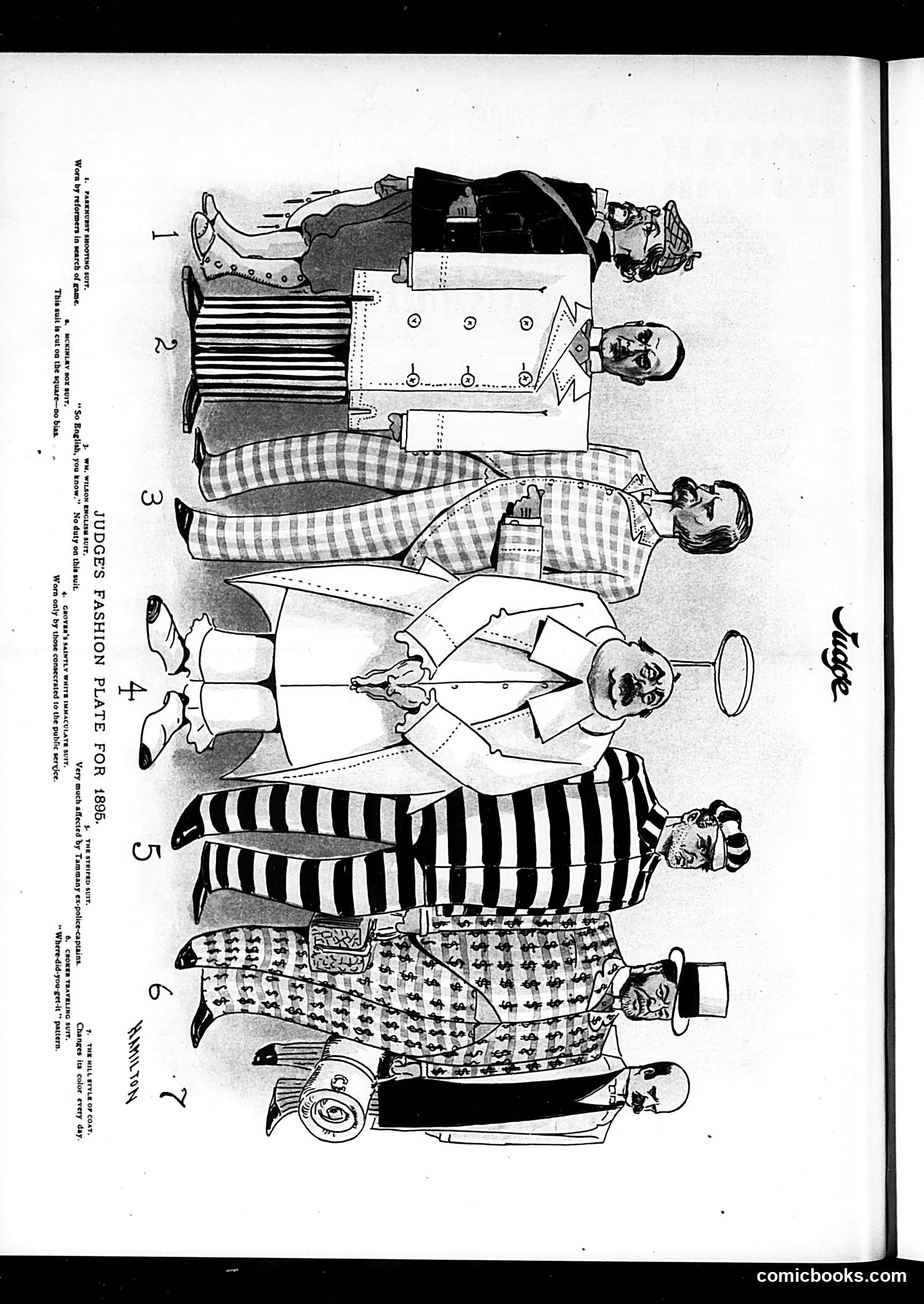
This is a satirical "fashion plate" mocking prominent political figures of 1896 through exaggerated clothing descriptions. **The figures appear to be:** - **Parkhurst**: A reformer (likely Rev. Charles Parkhurst, known for anti-corruption crusades), depicted hunting for "game" (corruption) - **McKinley**: Presidential candidate William McKinley, wearing a "square" suit (honest dealing) - **Grover** (Cleveland): Former president in an "immaculate" white suit, mocking his moral pretensions - **Croker**: Richard Croker, Tammany Hall boss, in a suit with a suspicious "where-did-you-get-it pattern" (implying ill-gotten gains) - **Wilson**: An Englophile in an affected English suit - **Tammany ex-police captains**: In striped suits that "change color daily" (corrupt, unreliable) The satire equates clothing with character, suggesting these politicians' actual moral fiber matches the absurdity of their fashion choices.