
A complete issue · 16 pages · 1895
Judge — January 26, 1895
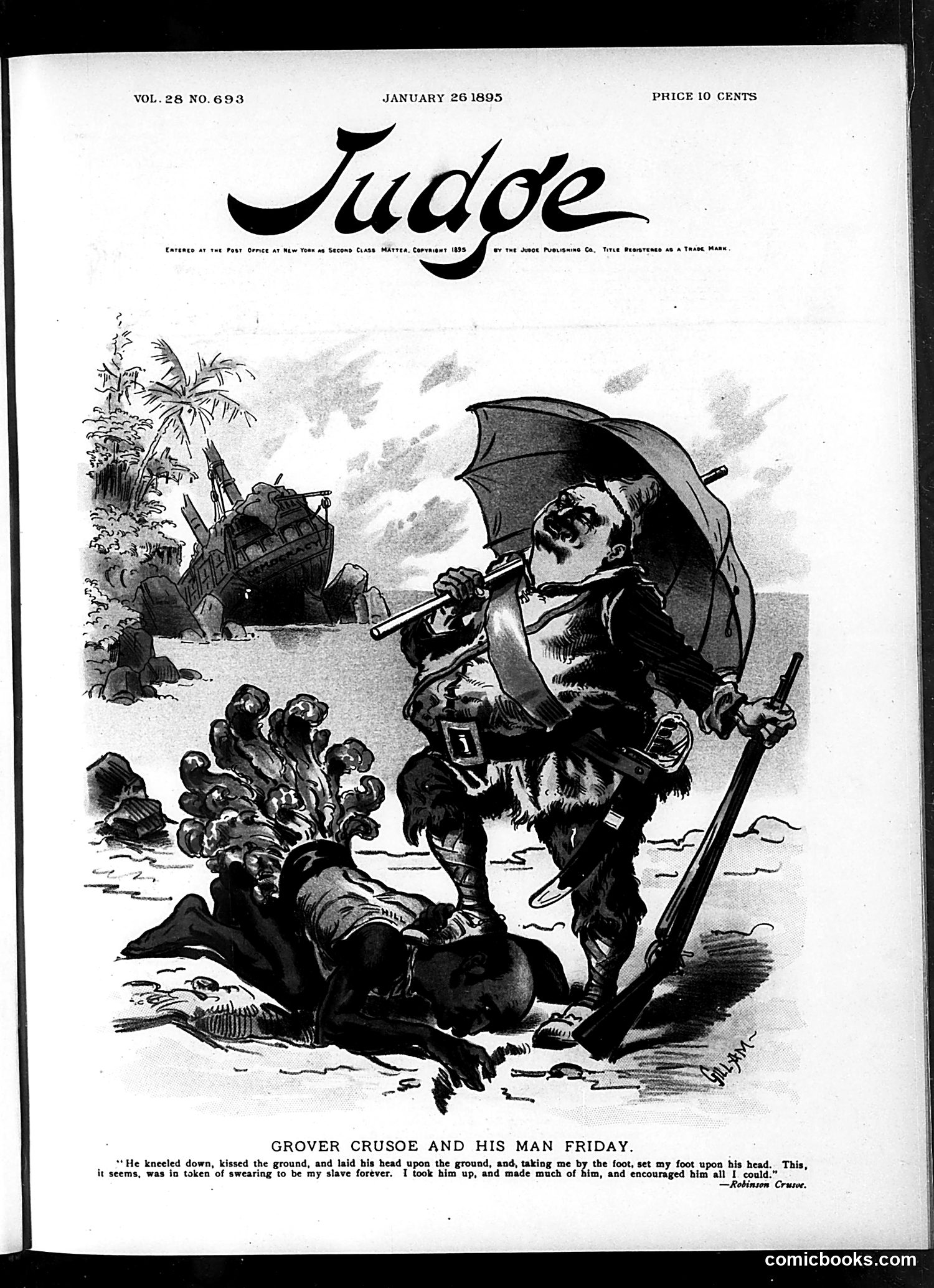
This 1895 Judge cartoon satirizes President Grover Cleveland (identifiable by the caricatured features) as "Grover Crusoe"—the marooned castaway from Defoe's novel. The figure kneeling before him represents his servant "Friday," labeled as his enslaved man. The satire appears to mock Cleveland's isolated political position or unpopular policies, suggesting he's stranded without popular support, with only a desperate subordinate remaining loyal. The quote attributes to Cleveland a paternalistic attitude toward his dependent—typical of the era's racial and class hierarchies that Judge's cartoonists both reflected and sometimes critiqued. The specific policy or political moment being referenced is unclear from the image alone, though Cleveland's second term (1893-1897) was marked by economic crisis and declining popularity.
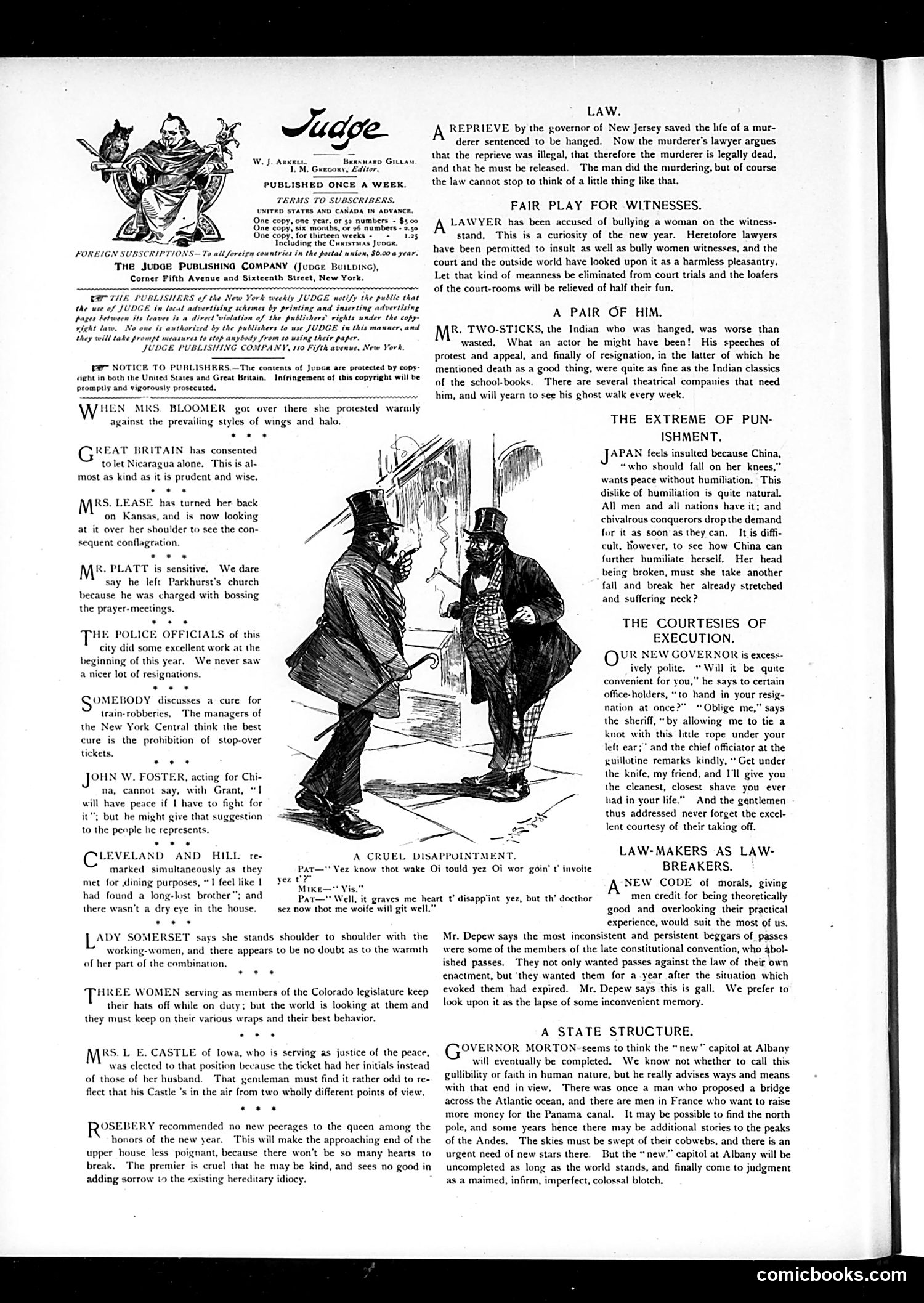
This page contains multiple short satirical pieces rather than a single cartoon. The central illustration shows two men in conversation—one appears to be a police or government official (top hat, formal dress) speaking with another man. The accompanying text pieces mock various political and social figures of the era, including references to Mrs. Bloomer (women's dress reform), Great Britain, Mrs. Lease (Kansas politics), and Governor Morton. The humor targets contemporary issues: women's rights activism, international relations, police conduct, and state politics. Without specific dates or clearer identification of the illustrated figures, the precise political context remains unclear. However, the overall tone satirizes late-19th century political figures and social reform movements through sharp, critical commentary typical of Judge magazine's editorial approach.
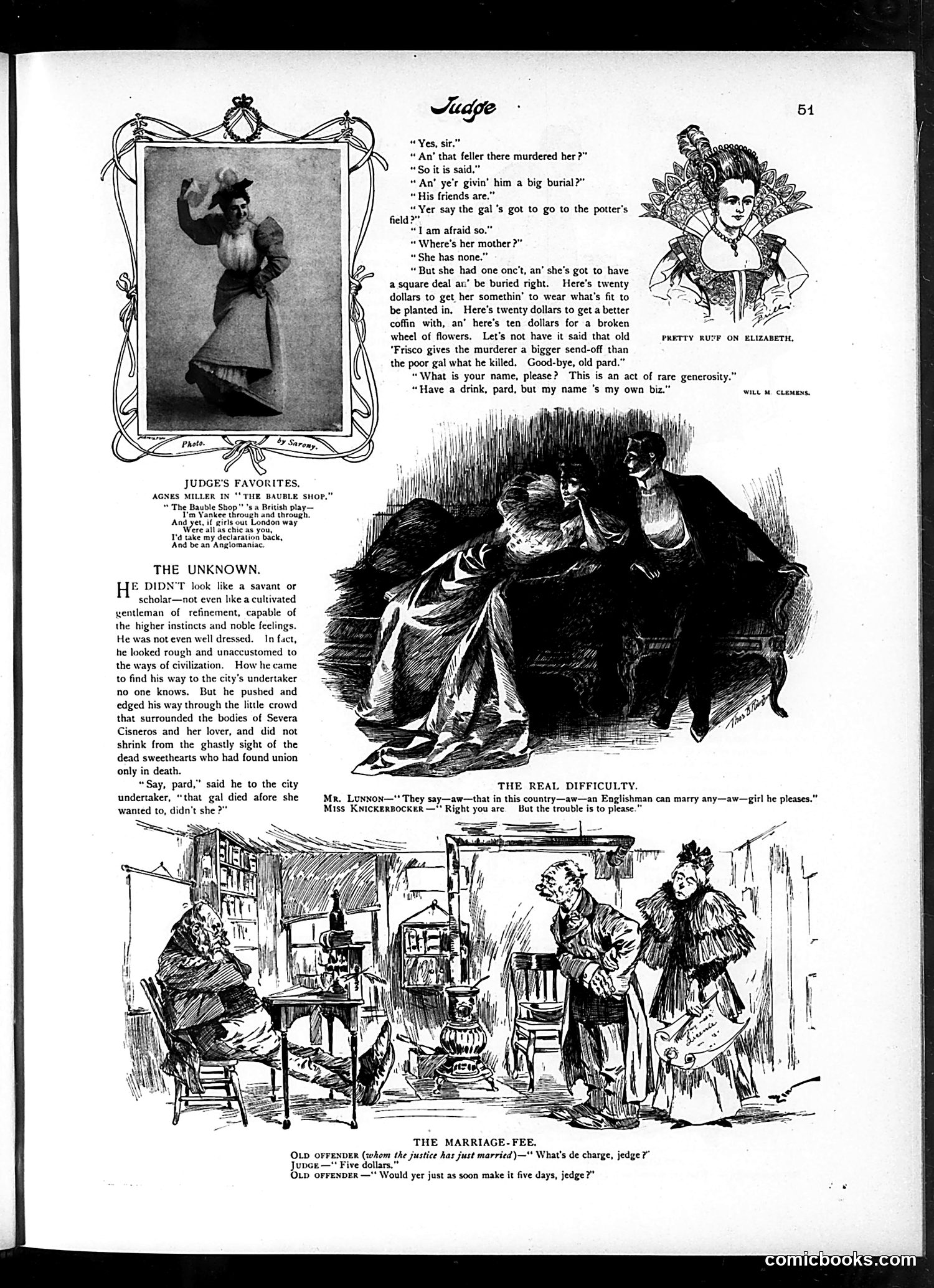
This page contains Victorian-era satirical sketches mocking social conventions and crime. "Judge's Favorites" references "The Bauble Shop," a British play popular in London theaters. The main cartoon "The Unknown" depicts a rough, uncultured man who murdered his lover Ciscneros and was executed as the city's undertaker—a commentary on social class and respectability. The piece satirizes how society judges criminality through a lens of gentility. "The Real Difficulty" and "The Marriage-Fee" mock matrimonial customs: the former jokes about marriage eligibility requirements, while the latter depicts a judge charging fees for performing marriages—satirizing how commercialized and corrupt the legal system made even sacred institutions. The "Pretty Ruff on Elizabeth" portrait provides period illustration context. Overall, the page critiques crime, class prejudice, and legal commercialism in Gilded Age America.
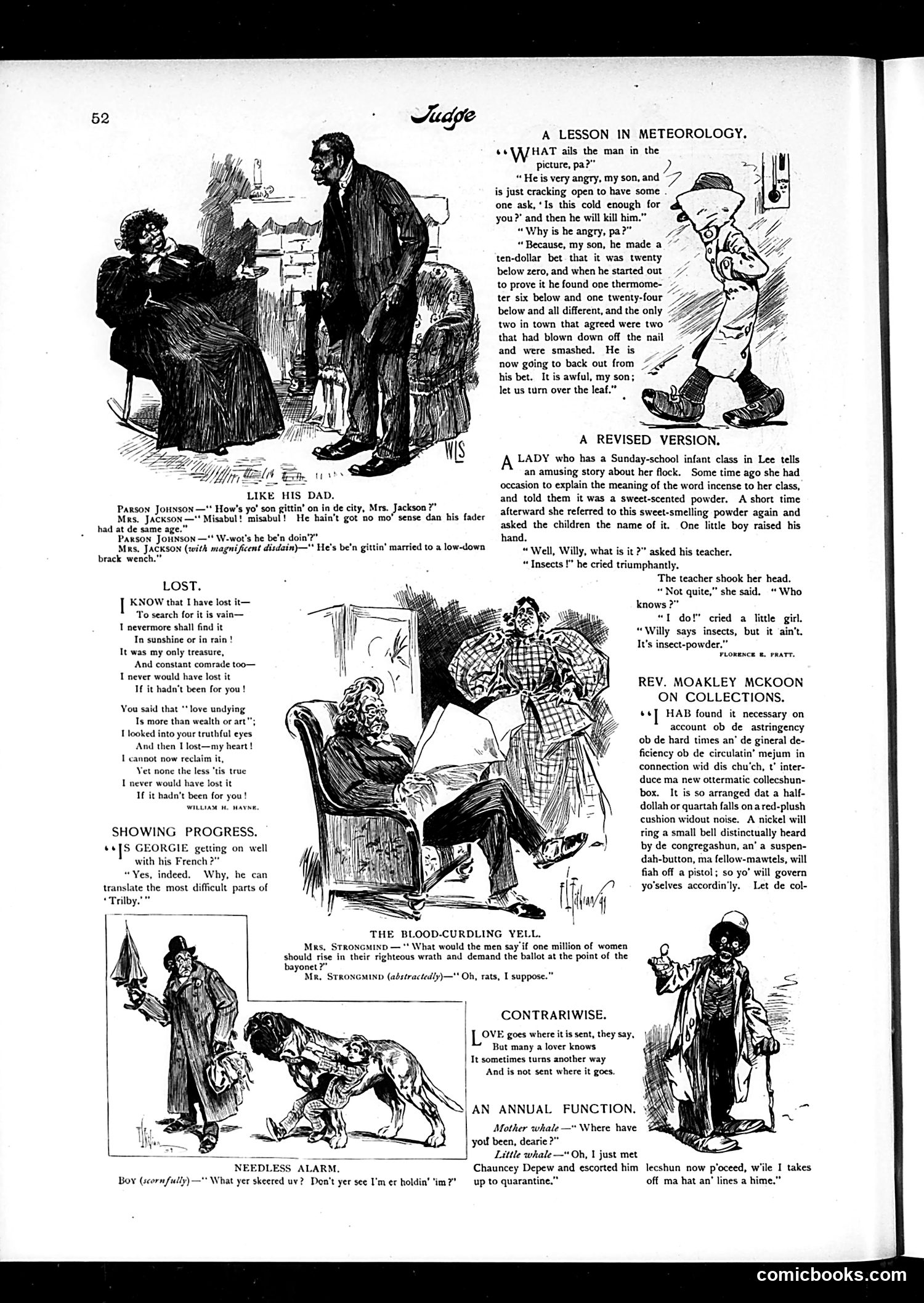
This page contains multiple satirical pieces typical of late-19th century Judge magazine: **"Like His Dad"** mocks racial stereotypes, with a parson asking Mrs. Jackson about her son's progress, only to learn he's "married to a low-down brack wench"—the joke implying inevitable moral degeneracy. **"Lost"** and **"Showing Progress"** are sentimental/humorous verses about romance and language learning. **"A Lesson in Meteorology"** satirizes a man who made a ten-dollar bet about sub-zero temperatures but found conflicting thermometer readings—poking fun at both gambling and scientific unreliability. **"A Revised Version"** is a genteel anecdote about a child mishearing "incense" as "insect-powder." **"Rev. Moakley McKoon on Collections"** uses heavy dialect humor to mock African American religious practices, describing an elaborate church collection box with escalating noise-makers. **"The Blood-Curdling Yell"** and other pieces satirize women's suffrage advocates and contemporary social issues. The page reflects Judge's typical late-Victorian satirical style: mixing sentiment with crude ethnic/racial mockery now considered offensive.
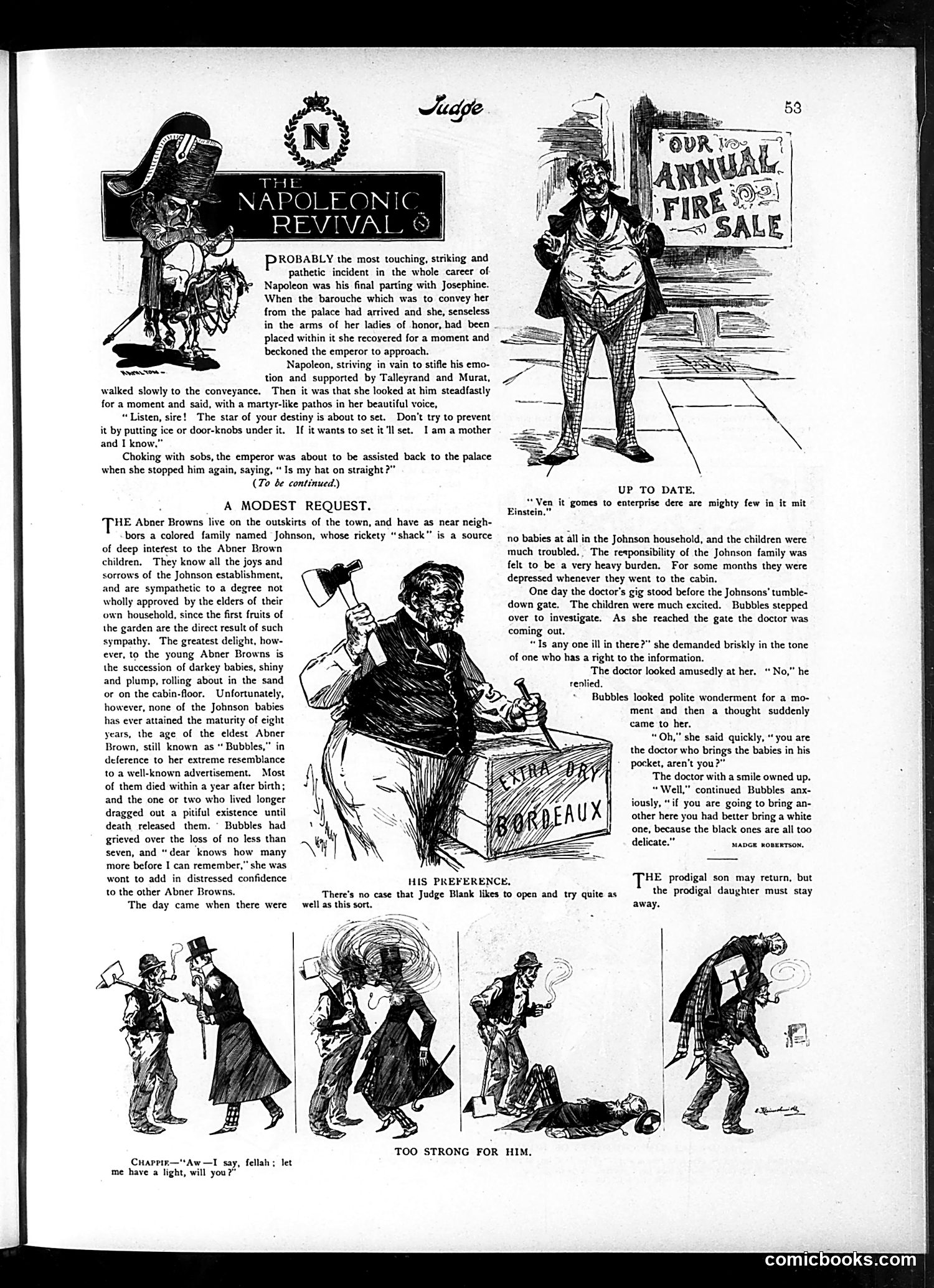
This 1910s *Judge* page contains three distinct satirical pieces: **"The Napoleonic Revival"** mocks sentimental historical drama by parodying Napoleon's farewell to Josephine. The joke undercuts the emotional moment—after his tearful goodbye, Josephine's only concern is whether her hat is straight, deflating the supposed grandeur. **"A Modest Request"** presents a darker satire on racial attitudes. Young white children sympathize with a neighboring Black family's repeated infant deaths. The cruel punchline comes when one child asks the doctor to bring "white" babies next time because "black ones are all too delicate"—a vicious inversion that blames Black infants' mortality on inherent weakness rather than systemic poverty and inadequate healthcare. **"His Preference"** (bottom strip) and **"Up to Date"** are brief gags about judicial preferences and Einstein respectively. The page reflects early 20th-century *Judge* conventions: mixing literary parody with casual racial stereotyping considered acceptable satirical fare then, though deeply offensive today.
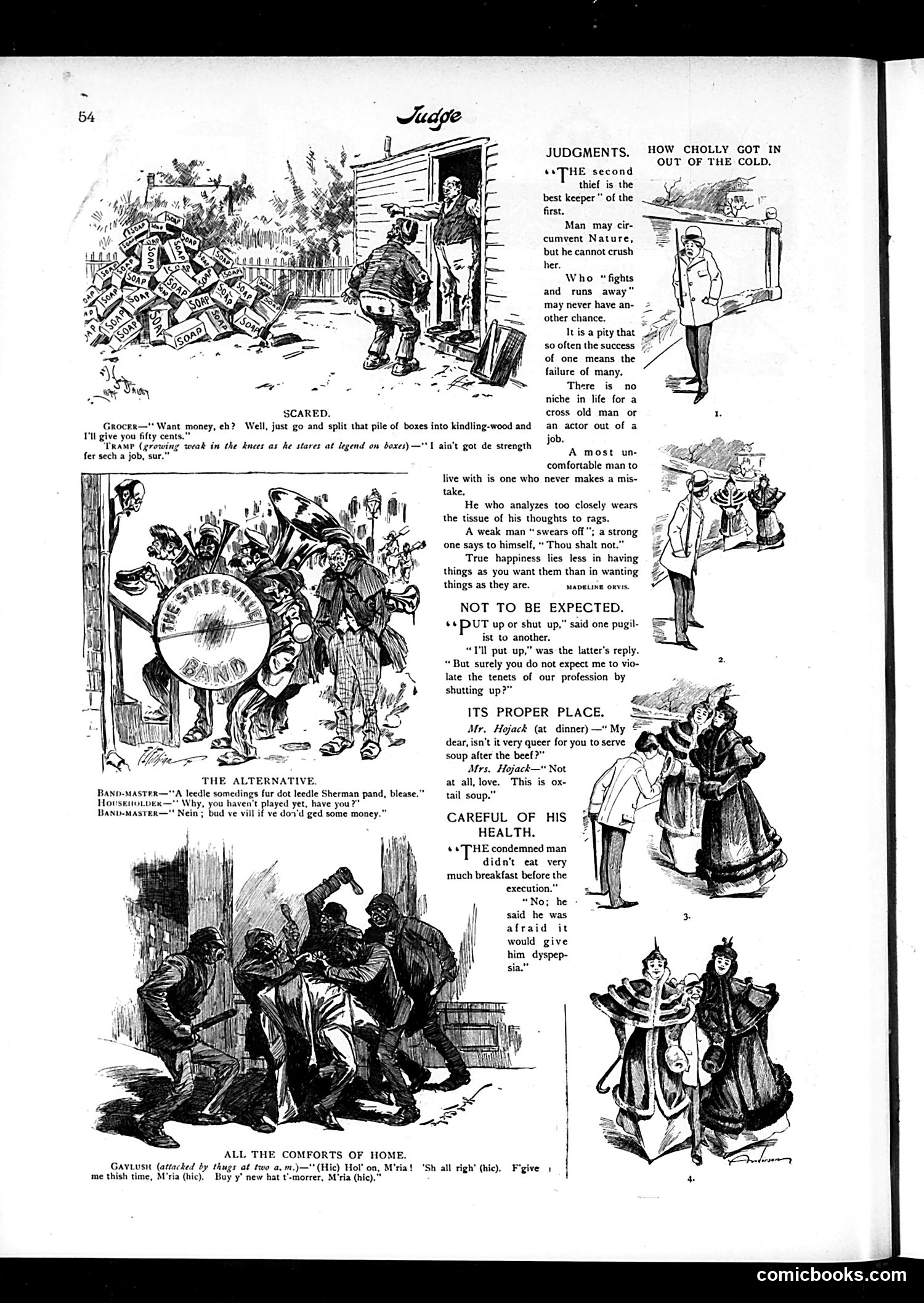
This page contains several brief satirical jokes typical of Judge magazine's social humor: **"Scared"**: A grocer offers work splitting boxes into kindling wood, but an actor (identified by legend on boxes) refuses, claiming weakness. The joke mocks struggling actors' pretensions and desperation. **"The Alternative"**: A German band-master (indicated by accent) requests money for Sherman's band before they've performed, implying musicians exploit audiences by demanding payment upfront without delivering service. **"All the Comforts of Home"**: A drunk man pleads with his wife after being attacked, promising her a new hat tomorrow—satirizing domestic discord and male drunkenness as normalized problems. **Other items**: "Judgments" offers moral aphorisms; "Not to Be Expected" jokes about pugilists' professional codes; remaining pieces mock pretension around soup service and condemned prisoners' dietary concerns. The satire targets working-class struggles, immigrant stereotypes, marital dysfunction, and absurd social conventions of the era.
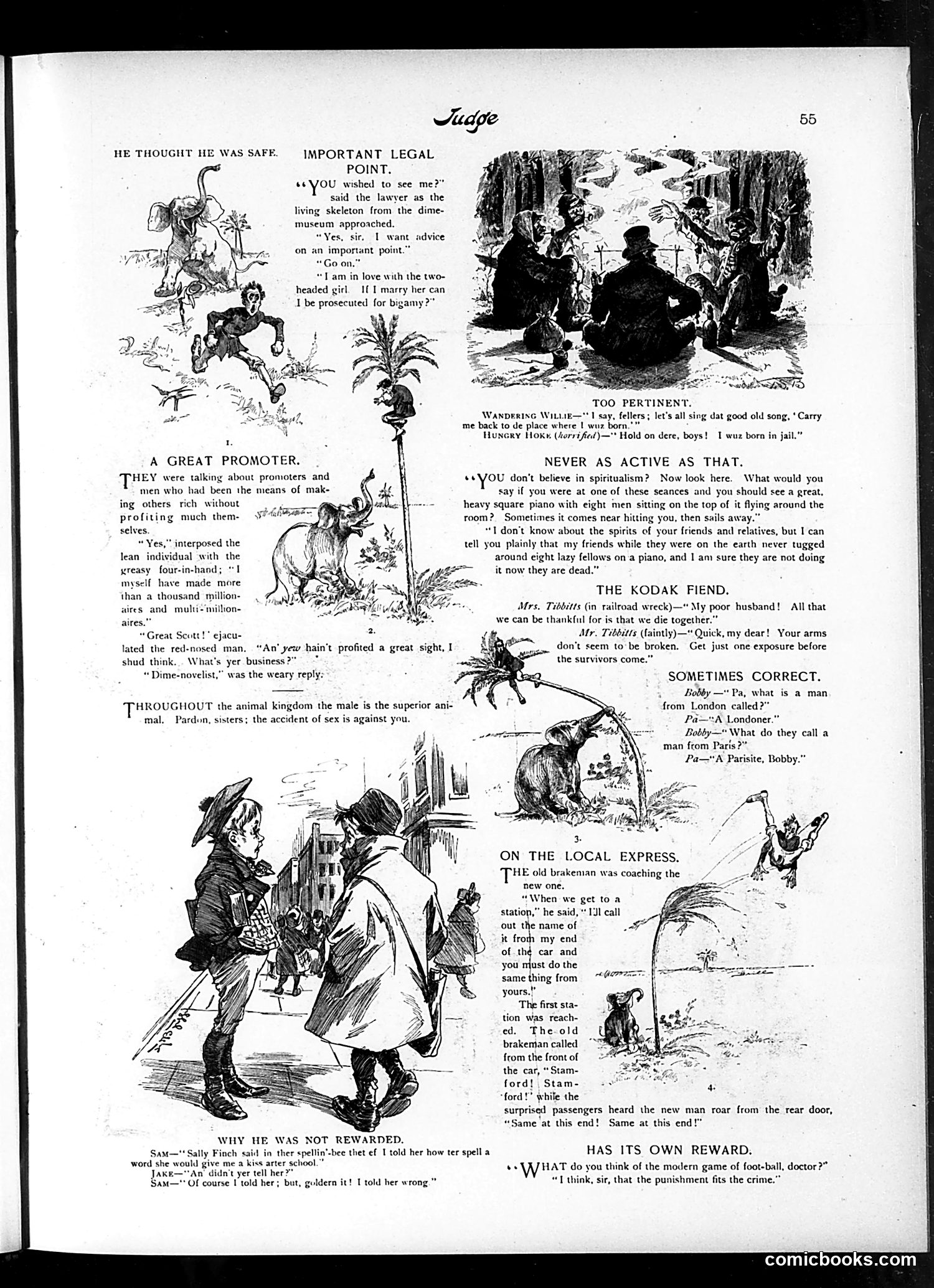
This page collects brief satirical sketches typical of Judge's humor circa early 1900s. **Key sketches:** - **"A Great Promoter"**: Mocks a self-aggrandizing businessman who claims to have made "a thousand million" dollars—obvious exaggeration satirizing turn-of-century robber barons and promoters. - **"Two-Headed Girl"**: A lawyer joke playing on dime-museum curiosities (actual circus attractions of the era), with absurdist legal humor about marrying a conjoined twin. - **"Wandering Willie"**: Social commentary where a vagrant nervously objects to singing about "the place where I was born" because he "was born in jail"—gentle satire on poverty and criminality. - **"Never As Active As That"**: Mocks spiritualism fads by joking that deceased friends wouldn't have labored moving pianos during séances—contemporary debunking of spiritualist entertainment. - **"Local Express"**: Slapstick about a new railroad brakeman mishearing station names. Most humor relies on wordplay, class observation, and ridiculing contemporary fads and professions rather than specific political events.
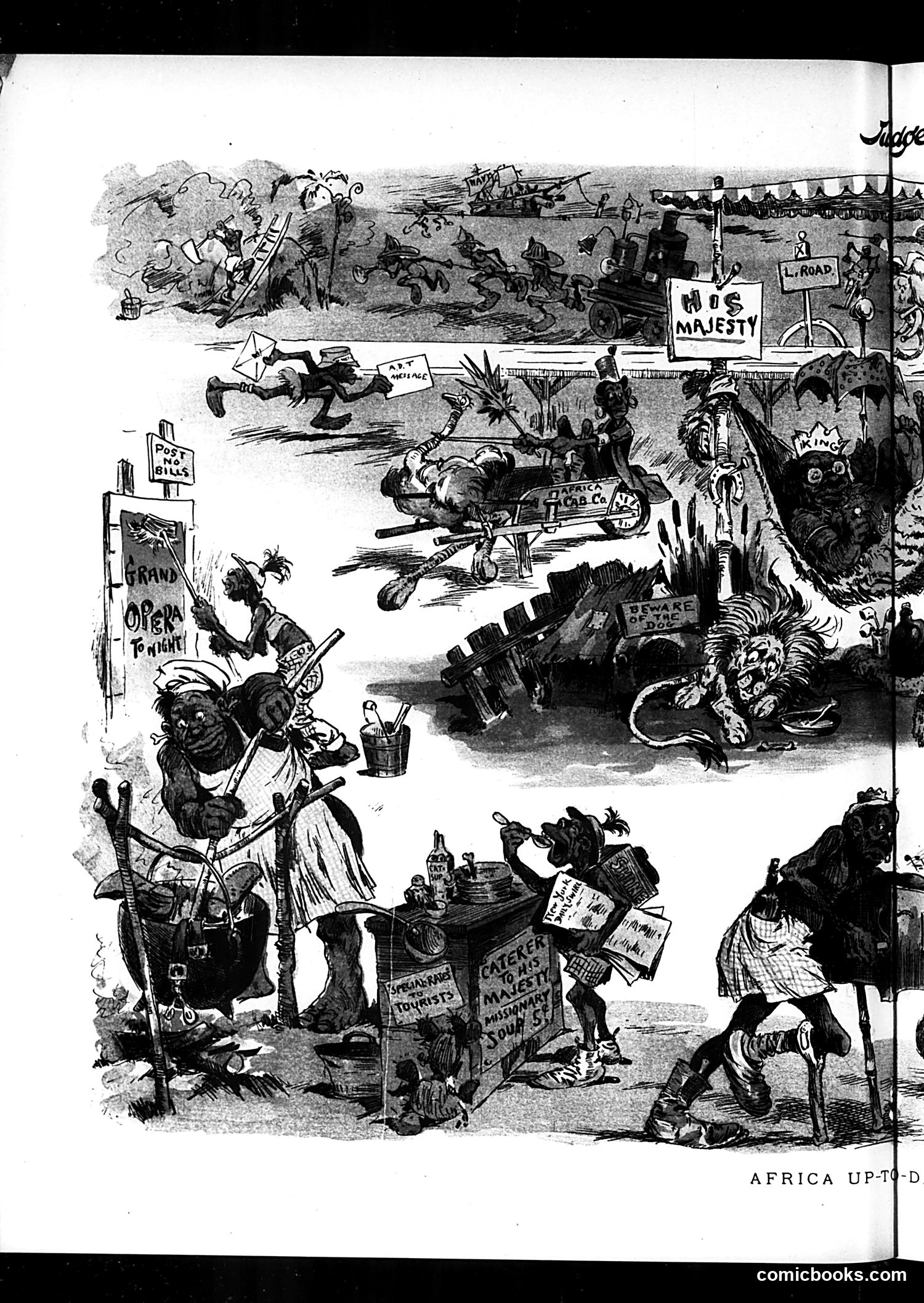
This satirical cartoon depicts a chaotic African colonial scene, likely from the early 20th century. The title "Africa Up-to-D" appears to mock contemporary "progress" claims about colonialism. The imagery shows: - Colonial infrastructure (railroads, aircraft, military equipment) introduced by Europeans - Indigenous African figures depicted in exaggerated, dehumanizing caricature style typical of the era - Signs referencing "His Majesty" and colonial administration - Scenes of conflict and disorder amid the supposed "modernization" The satire likely critiques the destructive impact of European colonization—suggesting that despite claims of bringing civilization and order, colonial powers actually brought chaos, exploitation, and harm. The grotesque depictions of Africans reflect the racist attitudes common in early Judge magazine cartoons, though the cartoon's actual target appears to be colonialism's failures rather than endorsing it.
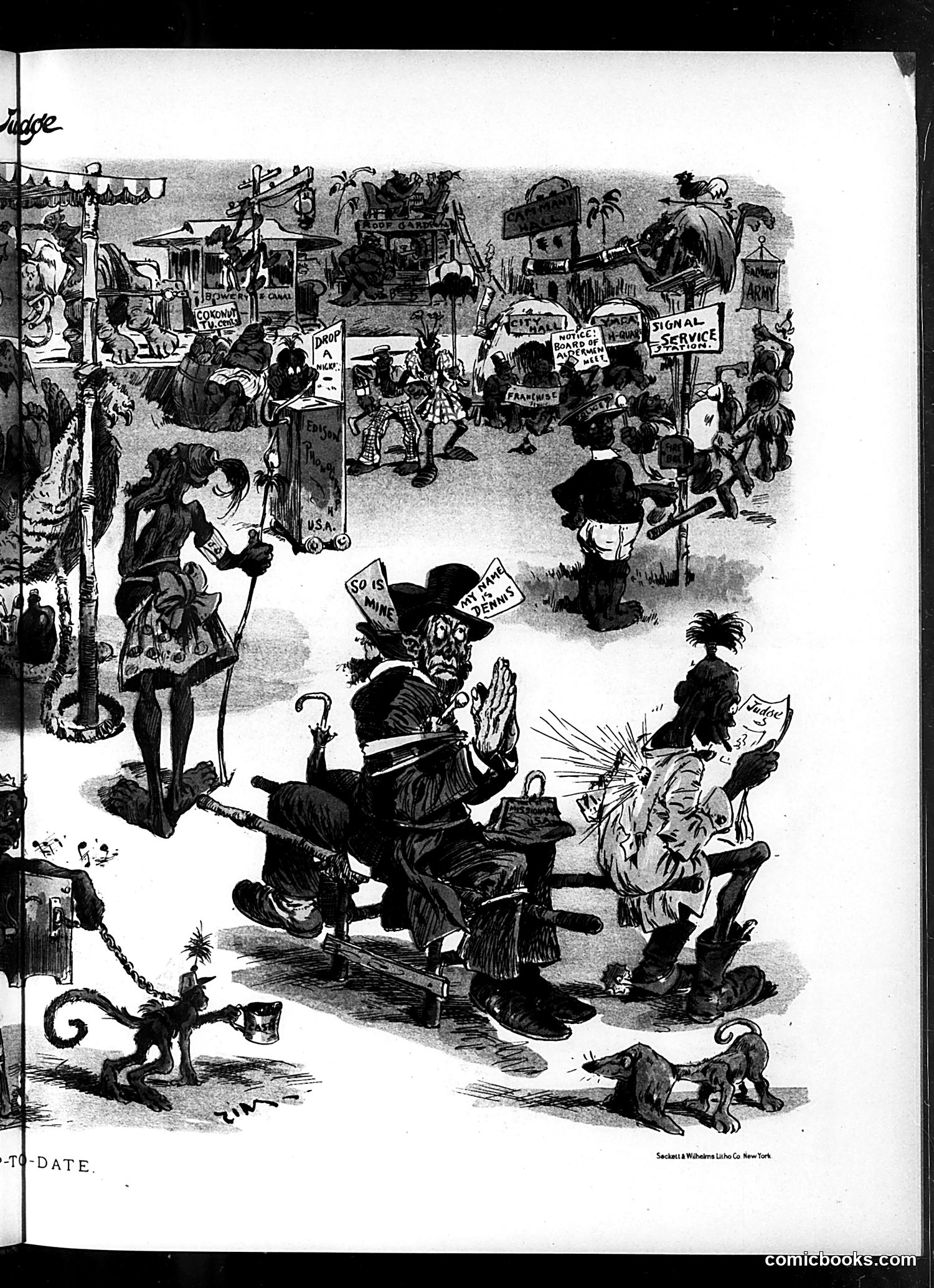
This Judge magazine cartoon satirizes **colonialism and imperialism**, likely from the early 1900s. The central caricatured figure appears to represent a European colonial power (possibly Uncle Sam or a European nation) engaged in exploitative commerce in a tropical setting. The scene depicts various colonial activities: the figure wears a top hat labeled with imperial ambitions, while surrounding vignettes show extraction of resources, commercial dealings, and the displacement or exploitation of indigenous peoples. Small animals (possibly monkeys) in the foreground suggest dehumanizing depictions common to period satire. The carnival-like atmosphere and multiple scenes critiqued the chaotic, predatory nature of imperial expansion and resource extraction in colonized territories. The artist mocks both the pretensions and destructive consequences of colonialism.
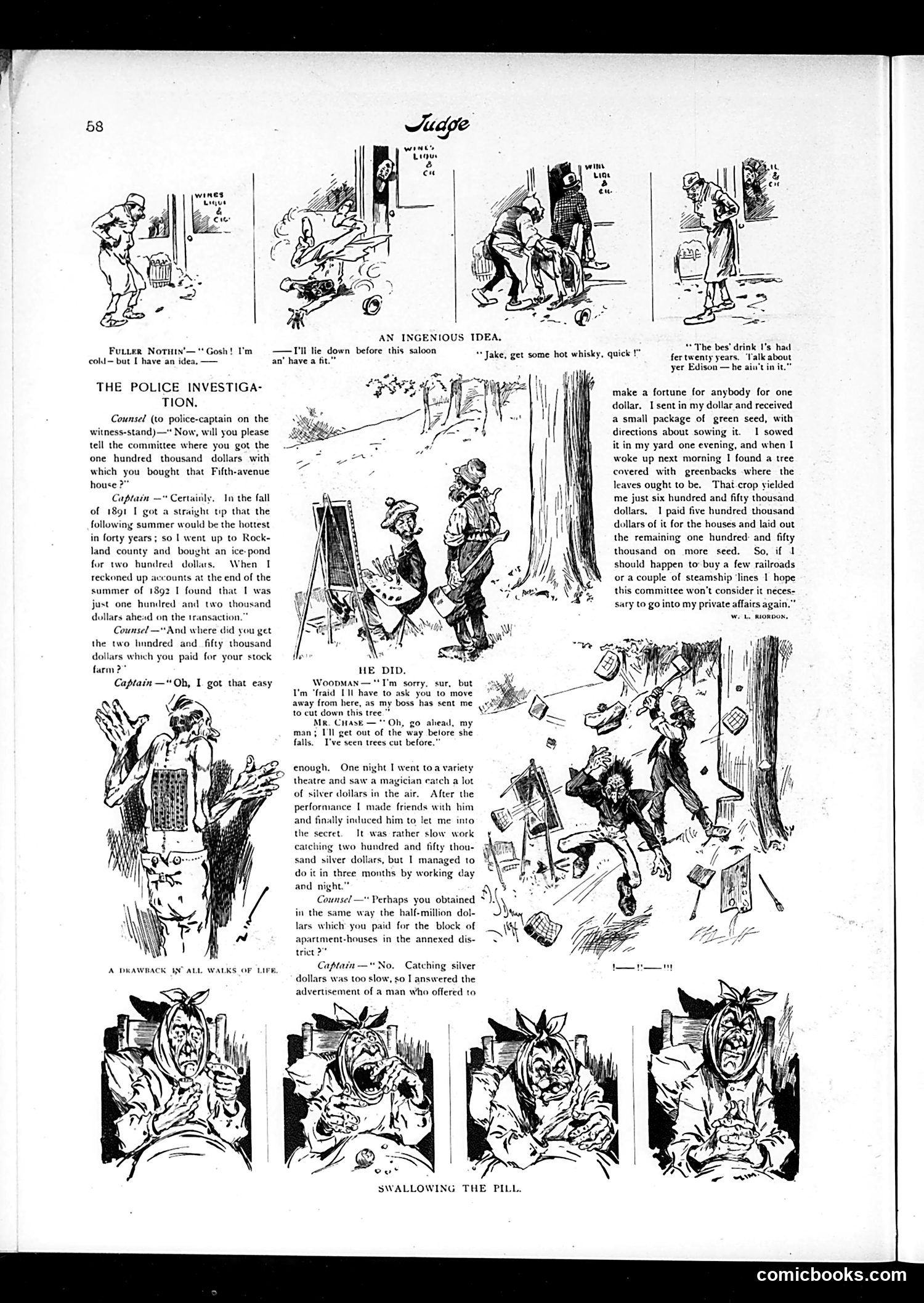
This page contains two distinct satirical pieces: **"The Police Investigation"** mocks corrupt police officials during the Gilded Age. A police captain, questioned about his sudden wealth, offers absurdly implausible explanations: an ice-pond investment, a magic tree that grew money, catching silver dollars from a magician's act. The satire exposes how police brass accumulated fortunes through graft while providing laughably transparent cover stories to investigating committees. **"An Ingenious Idea"** depicts a homeless man faking a seizure outside a saloon to attract sympathy and free whiskey from the bartender—a commentary on urban poverty and exploitation. The phrase "best drink" suggests the man finds this survival strategy effective. **"Swallowing the Pill"** (bottom) shows a man grimacing while swallowing something, likely satirizing acceptance of unpleasant political or social realities, though context is unclear from this page alone. The cartoons reflect Progressive Era concerns about urban corruption, poverty, and moral compromise.
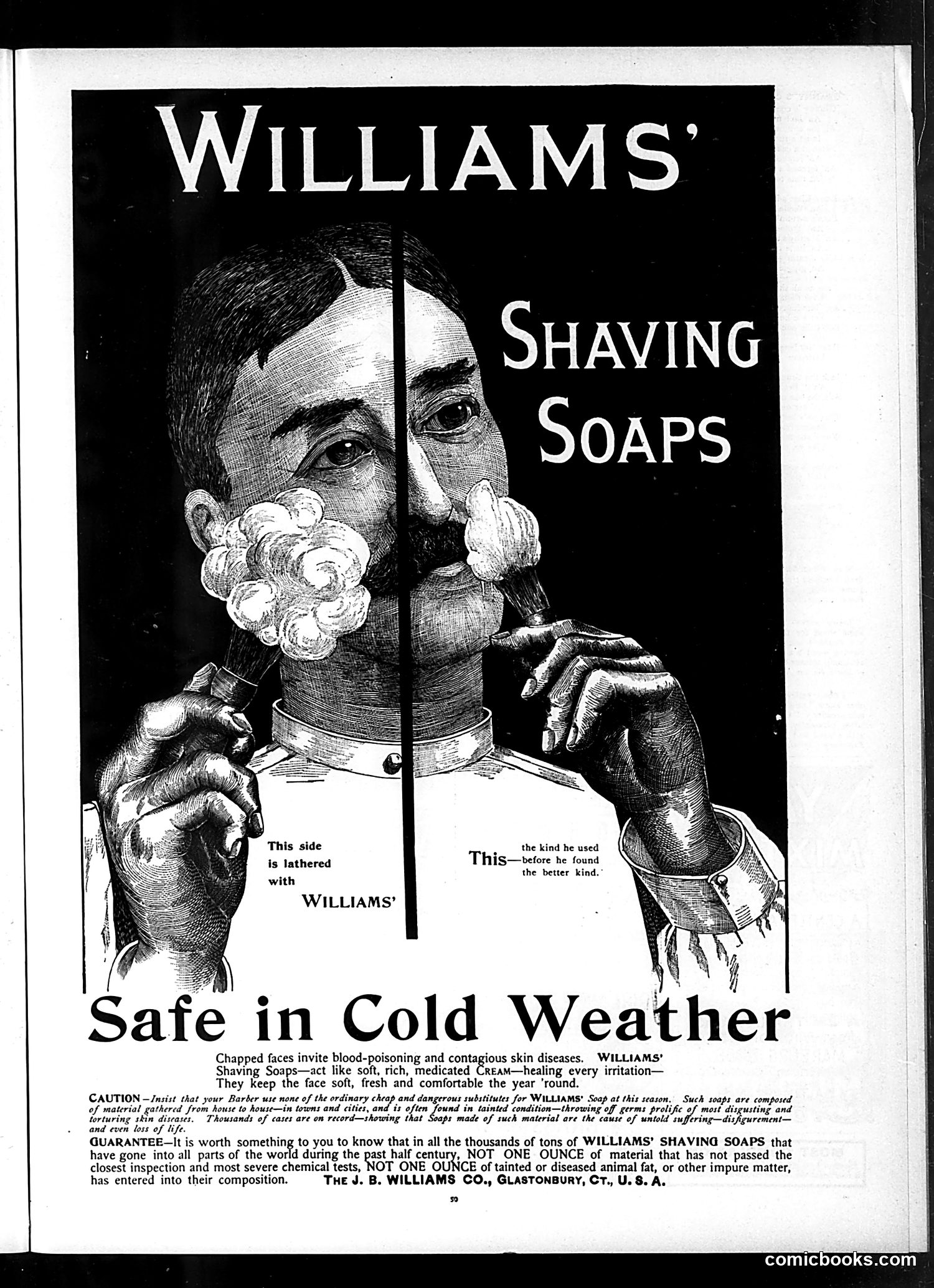
This is a **Williams' Shaving Soap advertisement**, not political satire. The illustration shows a man's face split vertically—one side lathered with inferior soap (left), the other with Williams' product (right)—to demonstrate the superiority of the brand. The ad's appeal is fear-based: it warns that cheap, contaminated soaps made from "material gathered from house to house" cause chapped faces, skin diseases, and blood-poisoning. Williams' positions itself as safe, medicated, and chemically tested. The "CAUTION" warns barbers against substituting cheaper soaps, while the "GUARANTEE" emphasizes the company's rigorous quality control over decades. This reflects early-20th-century advertising tactics exploiting health anxieties about contamination and industrially-produced goods, before modern FDA regulations. The dramatic visual comparison was designed to persuade consumers that brand-name products were safer than generic alternatives.
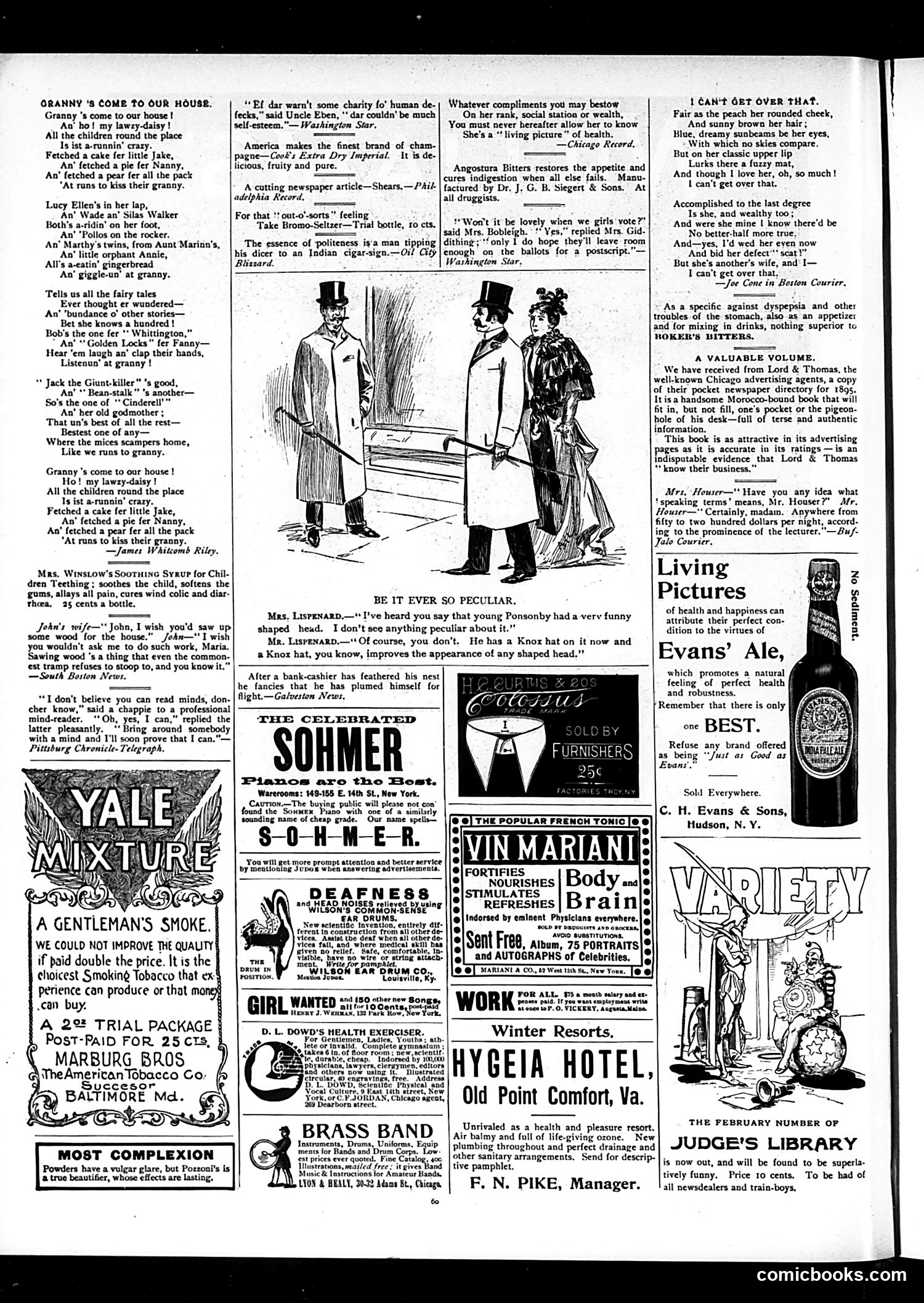
This page is primarily **advertising and light verse**, not political satire. The main content is James Whitcomb Riley's sentimental poem "Granny's Come to Our House"—celebrating a grandmother's visit and the joy she brings children through storytelling and treats. It's nostalgic Americana, popular in the era. The cartoons and jokes are social humor rather than political: a domestic dispute about chopping wood, a mind-reader's quip, and observations about women's fashion and etiquette. One joke references women voting, reflecting early-1900s suffrage debates without taking a stance. The page is dominated by **period advertisements** for patent medicines (Bromo-Seltzer, Angostura Bitters), tobacco, cosmetics, and hotels—typical Judge content. These ads, like the health claims for Evans' Ale and Vin Mariani tonic, reflect unregulated marketing practices of the era. No specific political figures or events are referenced.
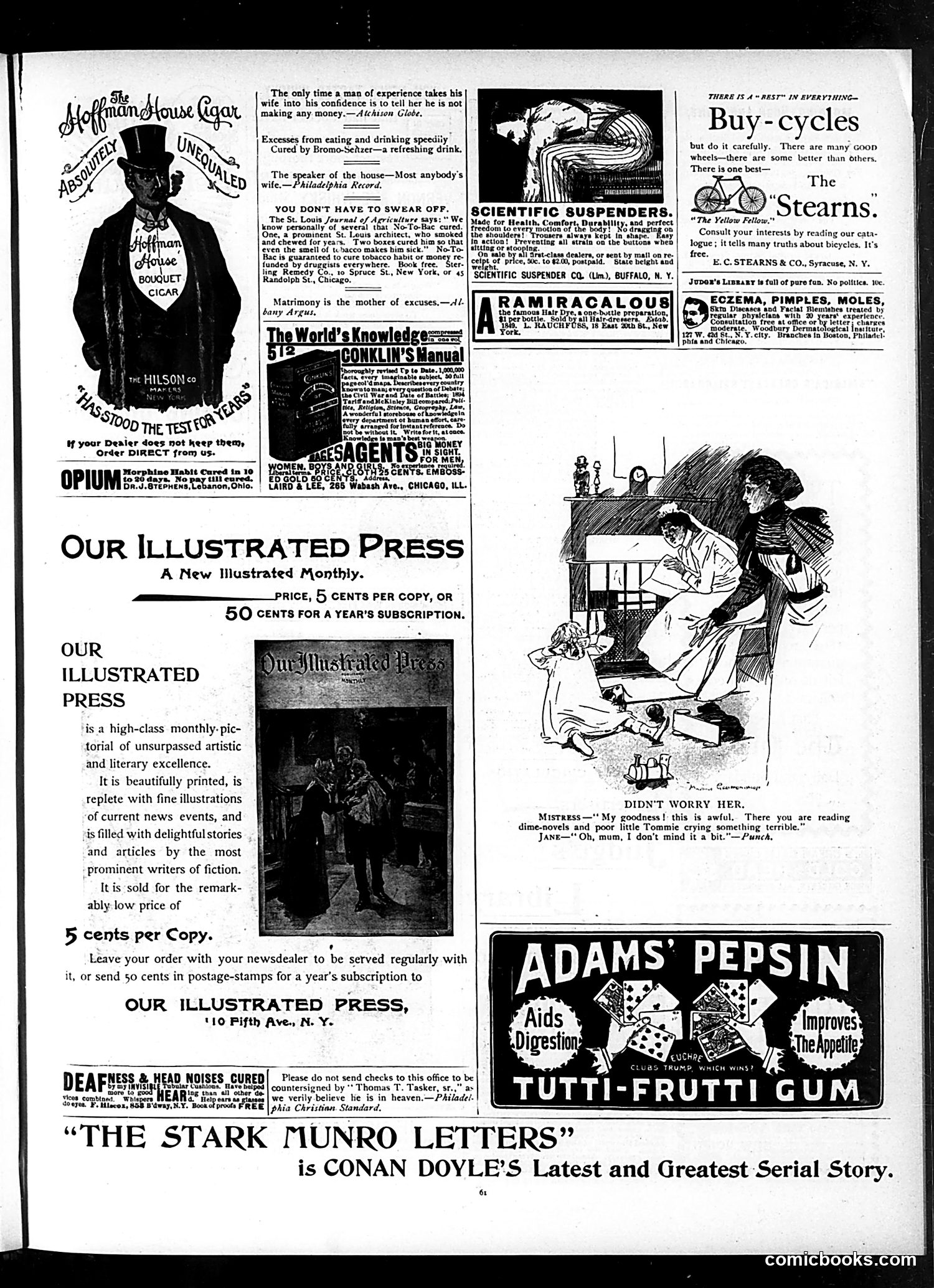
This page is primarily **advertising**, typical of early 1900s magazines. The notable cartoon appears in the upper right: "DIDN'T WORRY HER." **The Cartoon's Point:** A mistress scolds her maid Jane for reading dime novels while the mistress's child Tommie cries. Jane dismissively responds she doesn't mind. The joke satirizes servant indifference and the era's class divide—the working-class Jane is portrayed as callous and unfit for childcare, prioritizing cheap popular fiction over her employer's distressed child. **Historical Context:** "Dime novels" were sensational, cheaply-printed stories considered morally corrupting, especially by the middle and upper classes. This cartoon reinforces period class anxieties about servants' literacy and judgment. **Other Content:** The page advertises patent medicines (No-To-Bac tobacco cure, Bromo-Seltzer), bicycles, and subscriptions to *Our Illustrated Press*. The scattered jokes at top are typical Judge humor—cynical observations about money, marriage, and human nature.
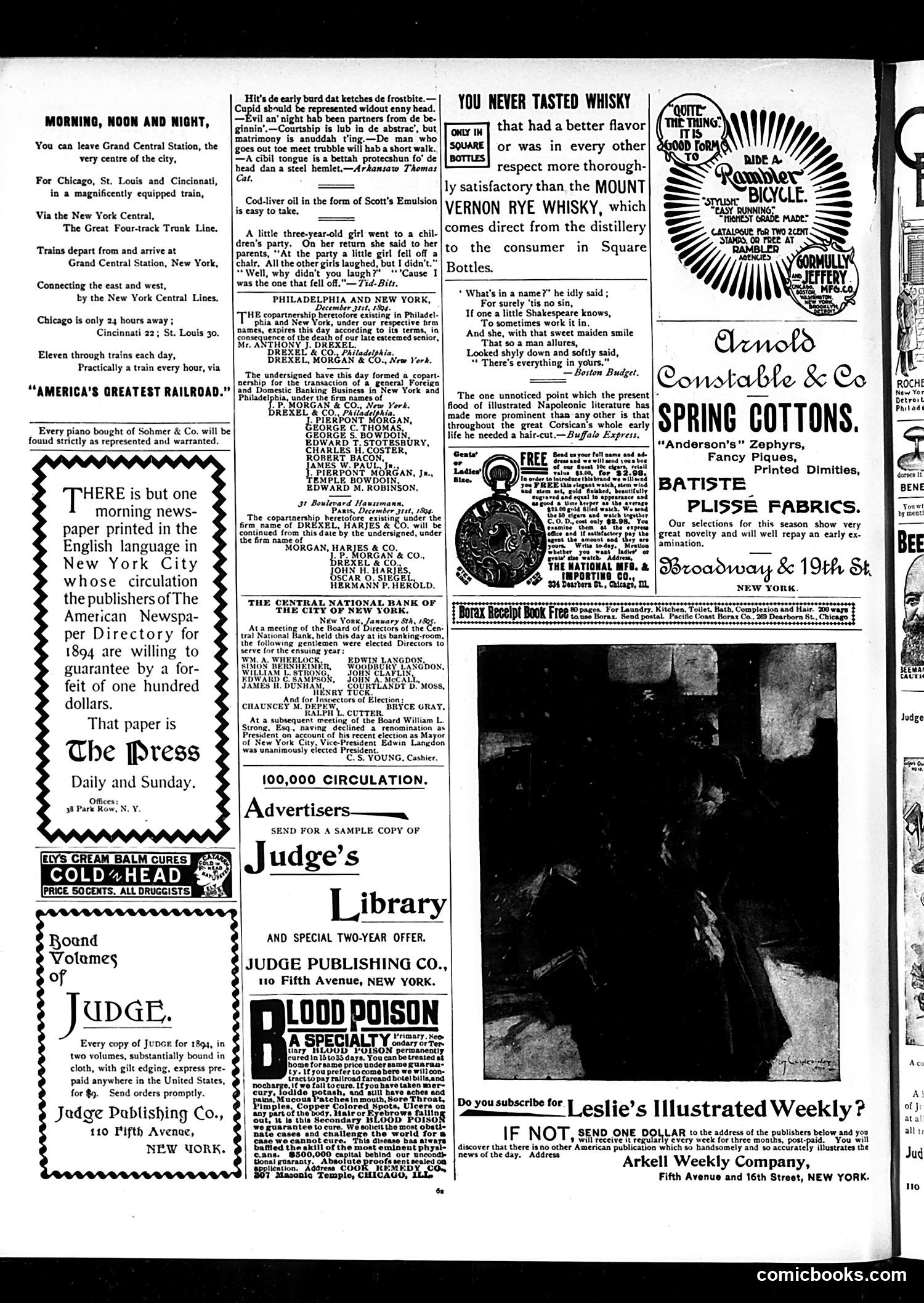
This page is primarily **advertisements and business announcements** rather than satirical cartoons. The visible content includes: - **Railroad ads** for the New York Central's "Great Four-track Trunk Line" - **Product advertisements** (Scott's Emulsion cod-liver oil, Mount Vernon Rye Whisky, spring cottons, and other goods) - **Banking announcements** regarding the restructuring of Drexel banking partnerships in Philadelphia, New York, and Paris following a senior partner's death - **Judge Publishing promotions** and circulation claims - **Miscellaneous humor** ("What's in a name?" jokes with faux-dialectal quips attributed to "Arkansas Thomas") The small illustrated cartoons visible are generic greeting-card style humor unrelated to current events or political satire. The page functions primarily as a business journal supplement rather than showcasing Judge's typical satirical political content.
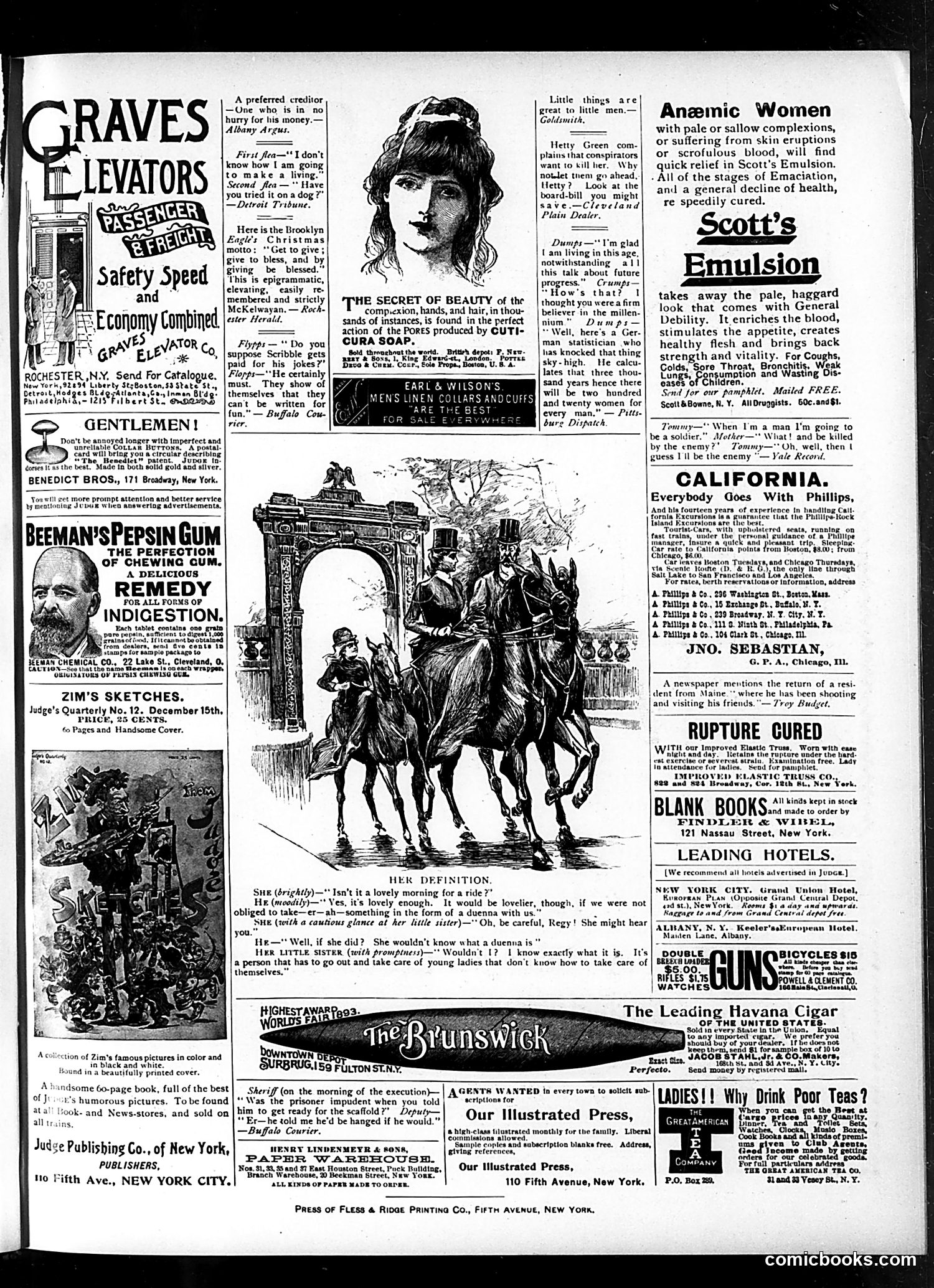
This page from *Judge* (a satirical weekly) contains mostly **advertisements and brief humorous snippets** rather than a coherent political cartoon. The central illustration shows a romantic scene of a couple on horseback—likely generic period imagery for advertising purposes. The text consists of short, unrelated jokes and witticisms typical of the era: - Definitions of terms ("preferred creditor," "duenna") - Brief dialogue jokes about fleas, collars, and chewing gum - A humorous exchange about a young lady and her chaperone **Context for modern readers**: The repeated jokes about women needing chaperones reflect strict Victorian/Edwardian social conventions where unmarried women required supervision in public. References to "duenna" (a Spanish chaperone) were common in period fiction. The bulk of the page is filled with **patent medicine advertisements** (Scott's Emulsion for anemia, Beeman's Pepsin Gum for indigestion, etc.)—reflecting the era's largely unregulated medical industry and advertising's prominent role in magazines. This appears to be filler content typical of early-1900s magazine pages.
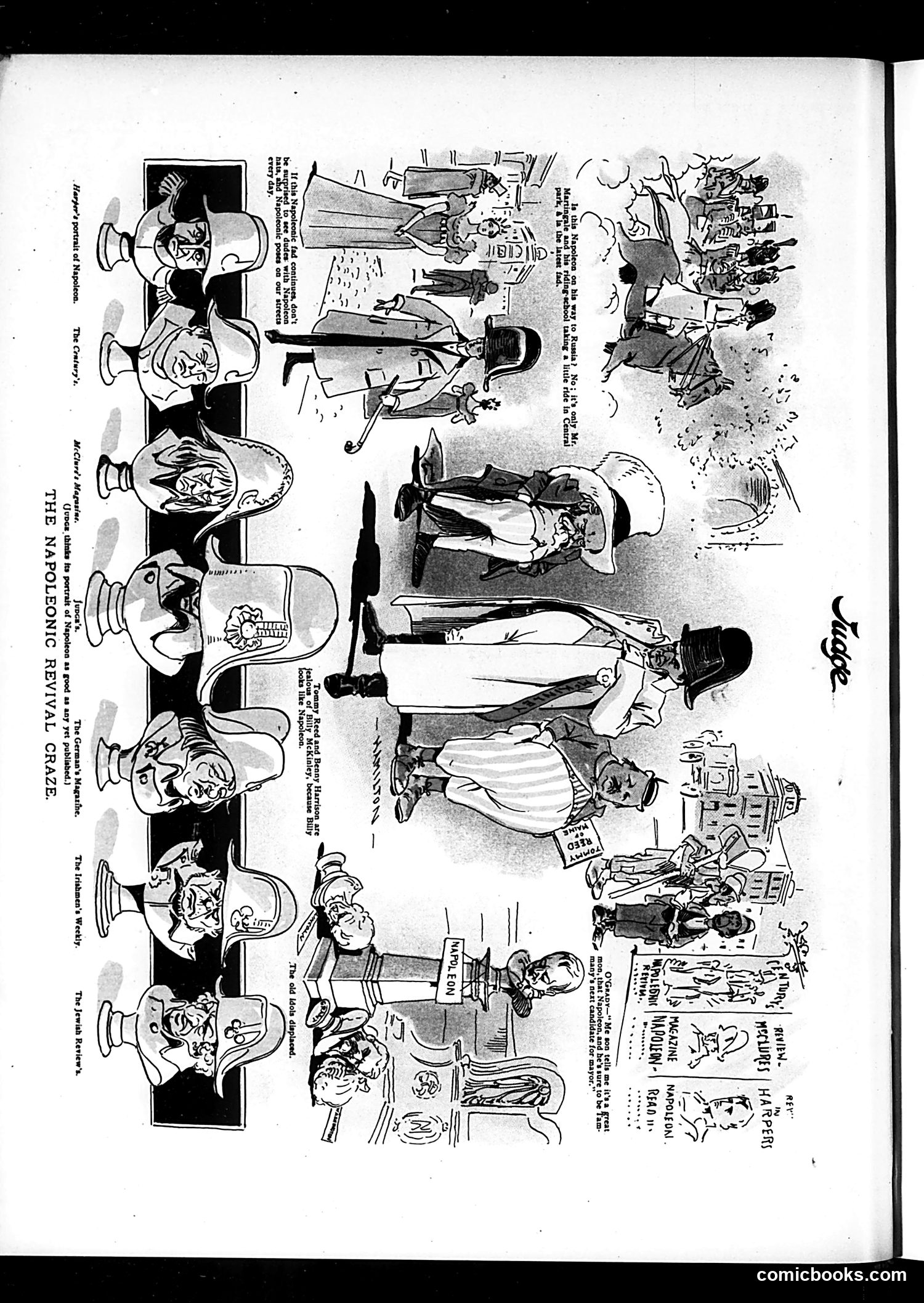
I cannot reliably read the OCR text on this page—it appears heavily corrupted or garbled, making it impossible to identify the specific cartoon(s), their titles, or context with confidence. From the IMAGE alone, I can see this is a Judge magazine page containing multiple illustrated panels arranged vertically on the left side, and what appears to be additional cartoon illustrations on the right. The style suggests early-to-mid 20th century American editorial cartooning. However, without legible text identifying the subjects, figures, political references, or satirical points, I cannot responsibly explain what these cartoons mean to a modern reader. To provide accurate analysis, I would need either a clearer image with readable text, or the original publication date and titles of these pieces.