
A complete issue · 16 pages · 1894
Judge — December 15, 1894
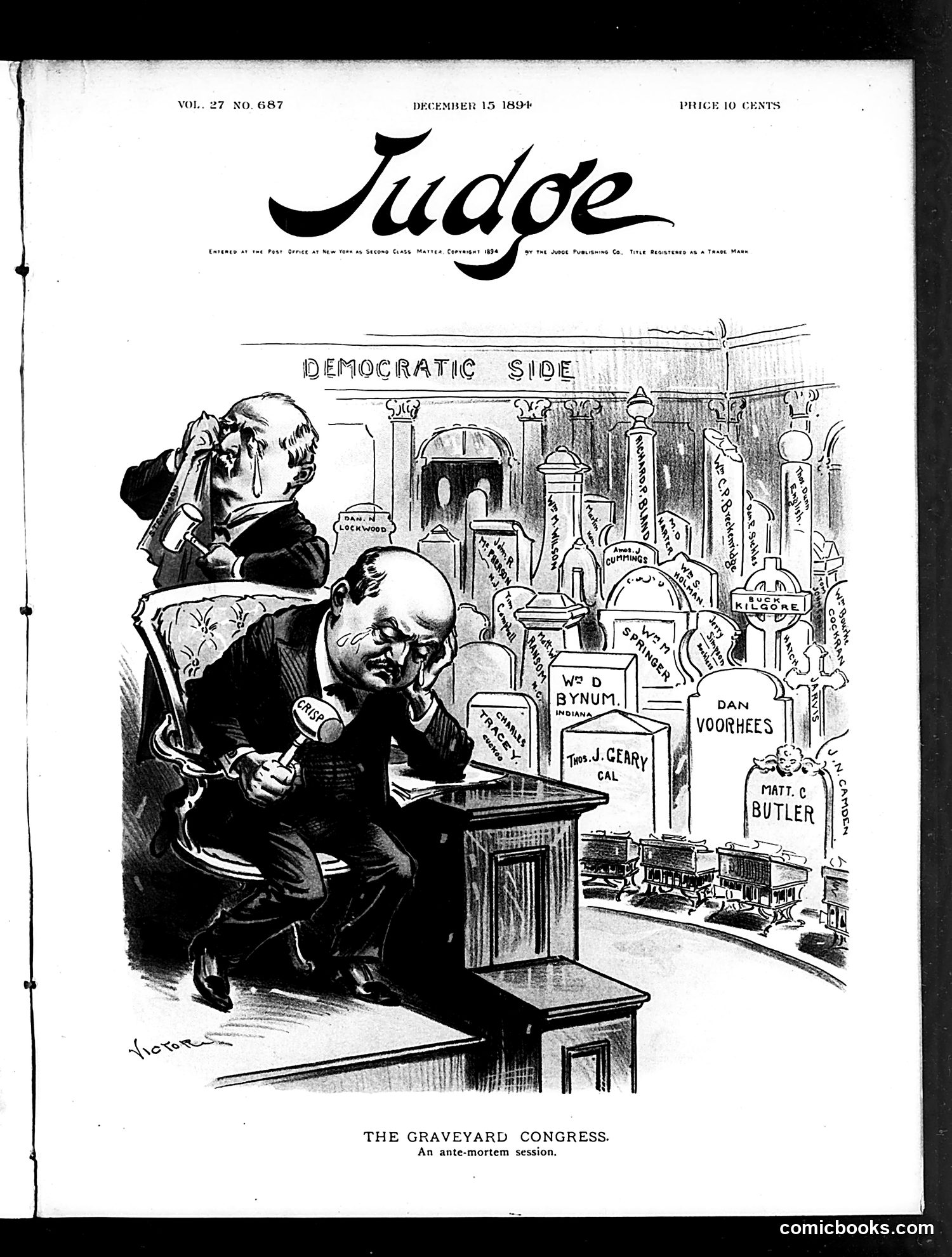
This December 1894 *Judge* cartoon satirizes the Democratic Party's congressional leadership as spiritually "dead." The title "The Graveyard Congress" and subtitle "An ante-mortem session" establish the metaphor: the scene depicts a séance or spiritualist gathering among tombstones labeled with Democratic names including W.D. Bynum, J. Ceary, Dan Voorhees, and Matt C. Butler. The figure on left appears to be conducting a séance (holding what looks like a telephone or mystical device), while the bald figure in center sits contemplatively. The graveyard setting with model buildings suggests the Democratic Party's political position has become lifeless or defunct. This reflects the party's weakened state following electoral defeats in the early 1890s.
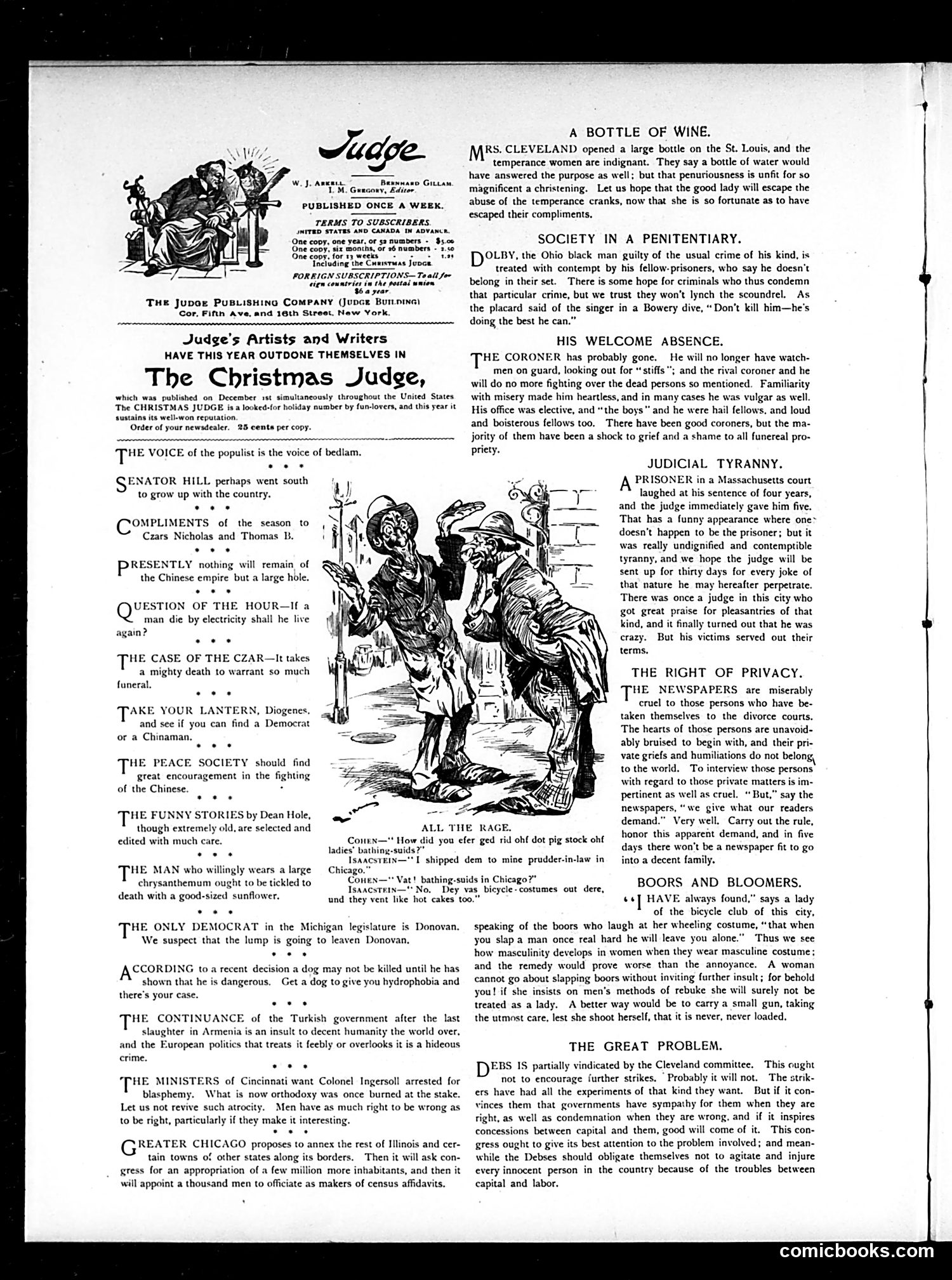
The main cartoon labeled "ALL THE RAGE" depicts two figures in 19th-century dress arguing over bathing attire. The dialogue references a dispute about "old pig stock old ladies bathing-suits" and "bicycle costumes," with one character objecting that men's cycling outfits are too revealing. This satirizes contemporary debates over athletic wear—specifically women's new "rational dress" (bloomers/cycling costumes) that shocked Victorian sensibilities by revealing women's legs. The cartoon mocks both the controversy itself and the absurdity of gender-based clothing restrictions during an era when women were beginning to participate in cycling and sports. The surrounding text articles address unrelated social issues: judicial tyranny, newspaper invasions of privacy, and labor disputes—typical Judge satirical commentary on Gilded Age politics and society.
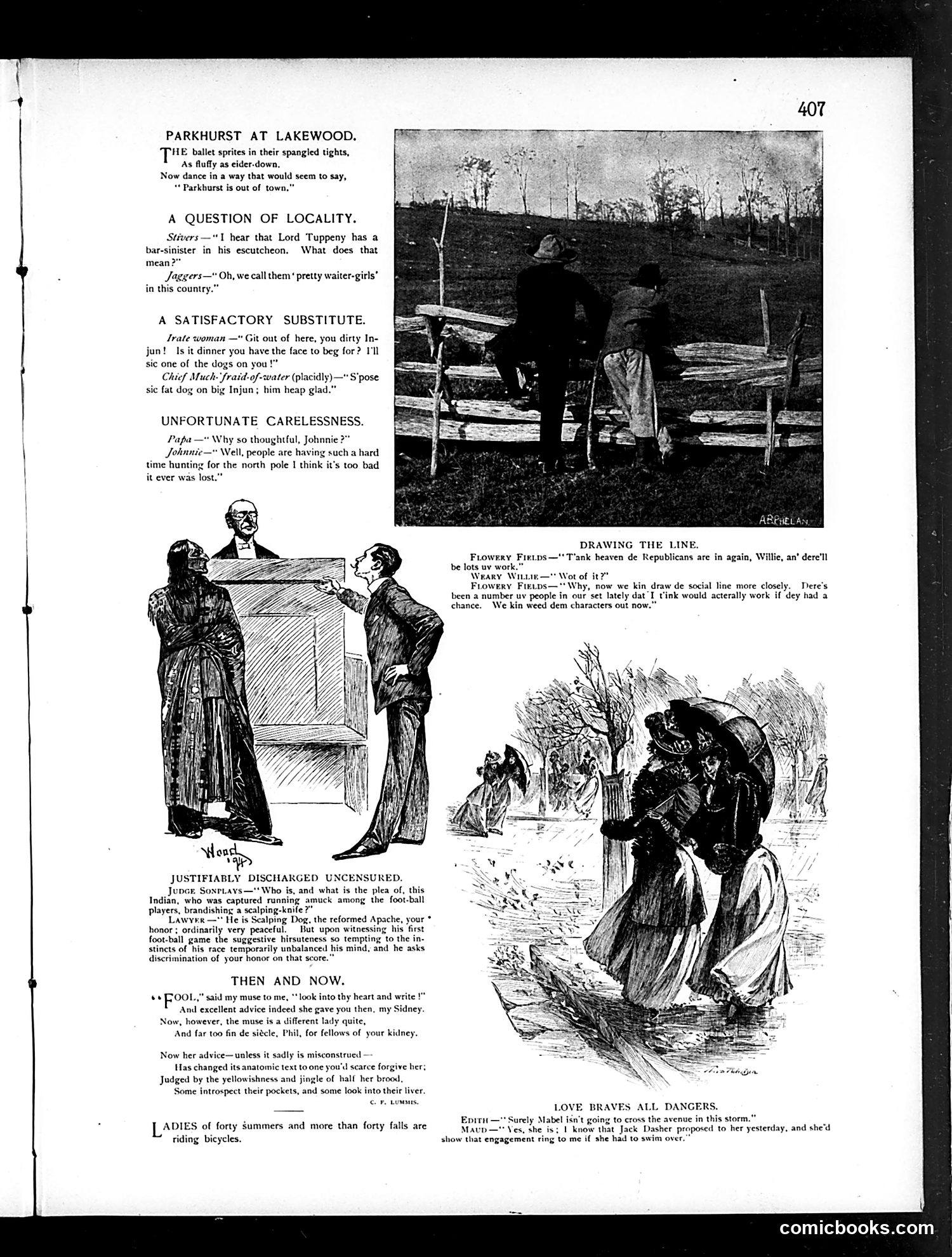
This page contains multiple satirical vignettes typical of Judge's humor. The sketches mock various social situations: **"A Question of Locality"** jokes about regional dialect—a character's unfamiliar term ("bar-maiden") confuses locals who call them "pretty waiter-girls." **"Drawing the Line"** appears to reference political divisions, mentioning Republicans and Democrats in a context about work opportunities. **"Love Braves All Dangers"** mocks romantic melodrama, with a character (Jack Dasher) proposing despite social obstacles. The page also includes **"Parkhurst at Lakewood,"** a poem about ballet dancers, and several other brief satirical bits about everyday social absurdities—carelessness, class pretension, and changing social mores. The humor relies on recognizing period-specific social codes and regional differences that would have been familiar to Judge's educated, urban readership in the early 1900s.
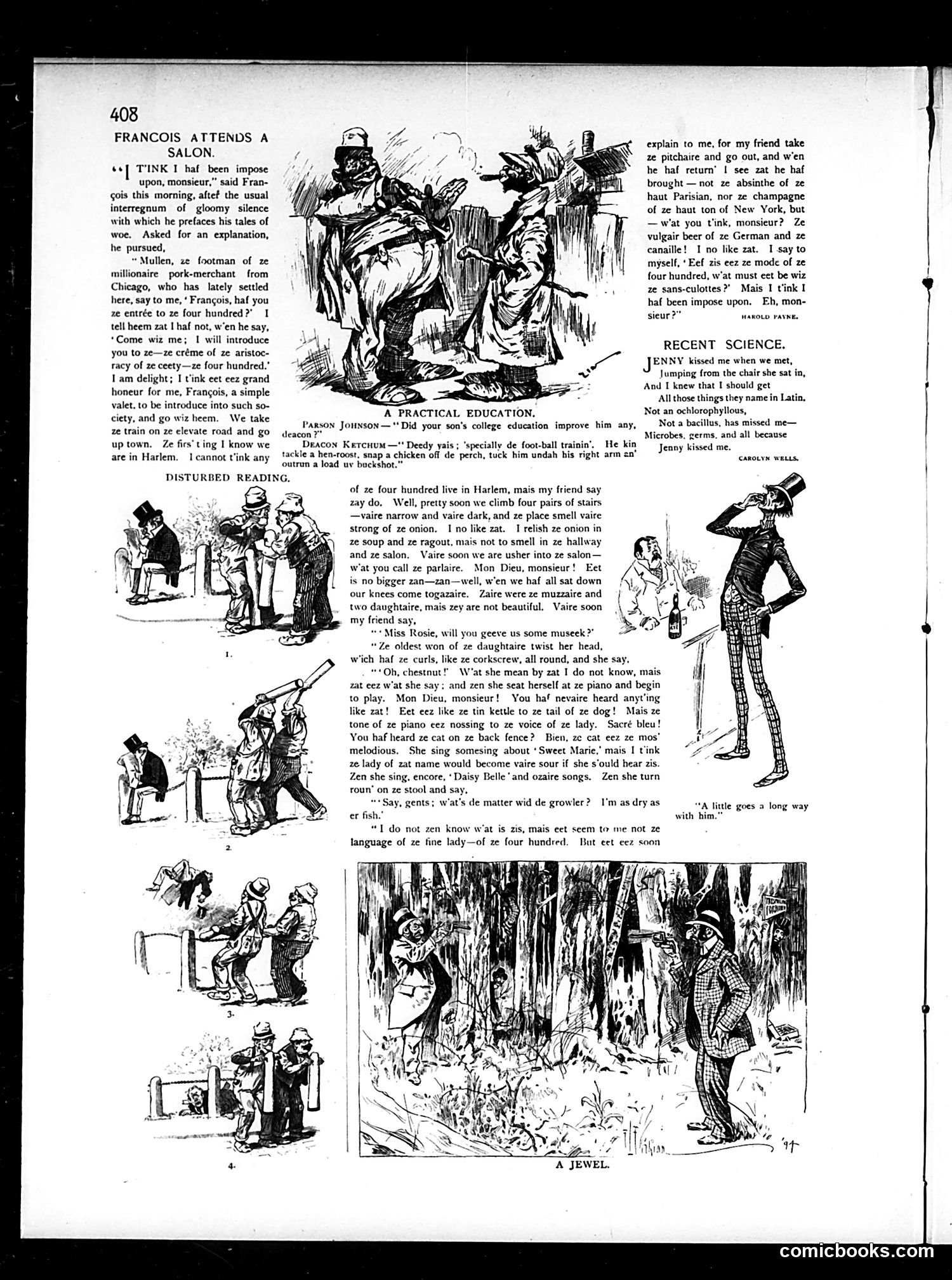
This page satirizes the pretensions of newly wealthy Americans and the fake exclusivity of high society. **"François Attends a Salon"**: A French valet describes being invited to a "Four Hundred" salon (New York's supposed elite social circle) by a Chicago pork merchant's servant. François expects refined Parisian culture but finds instead: a cramped Harlem apartment, onion smells, a musically talentless girl who plays off-key piano and sings in crude slang ("w'at's de matter wid de growler?") while calling herself cultured. **The joke**: The "Four Hundred"—supposedly America's most exclusive social class—is revealed as vulgar, poorly educated newcomers lacking genuine refinement. Their pretense to aristocratic taste is exposed as hollow. François's exaggerated French accent and bewilderment underscore the satire: even a simple servant recognizes their fraudulence. The other items on the page ("Recent Science," "Disturbed Reading," "A Practical Education," "A Jewel") appear to be separate brief jokes or poems, typical of Judge magazine's format.
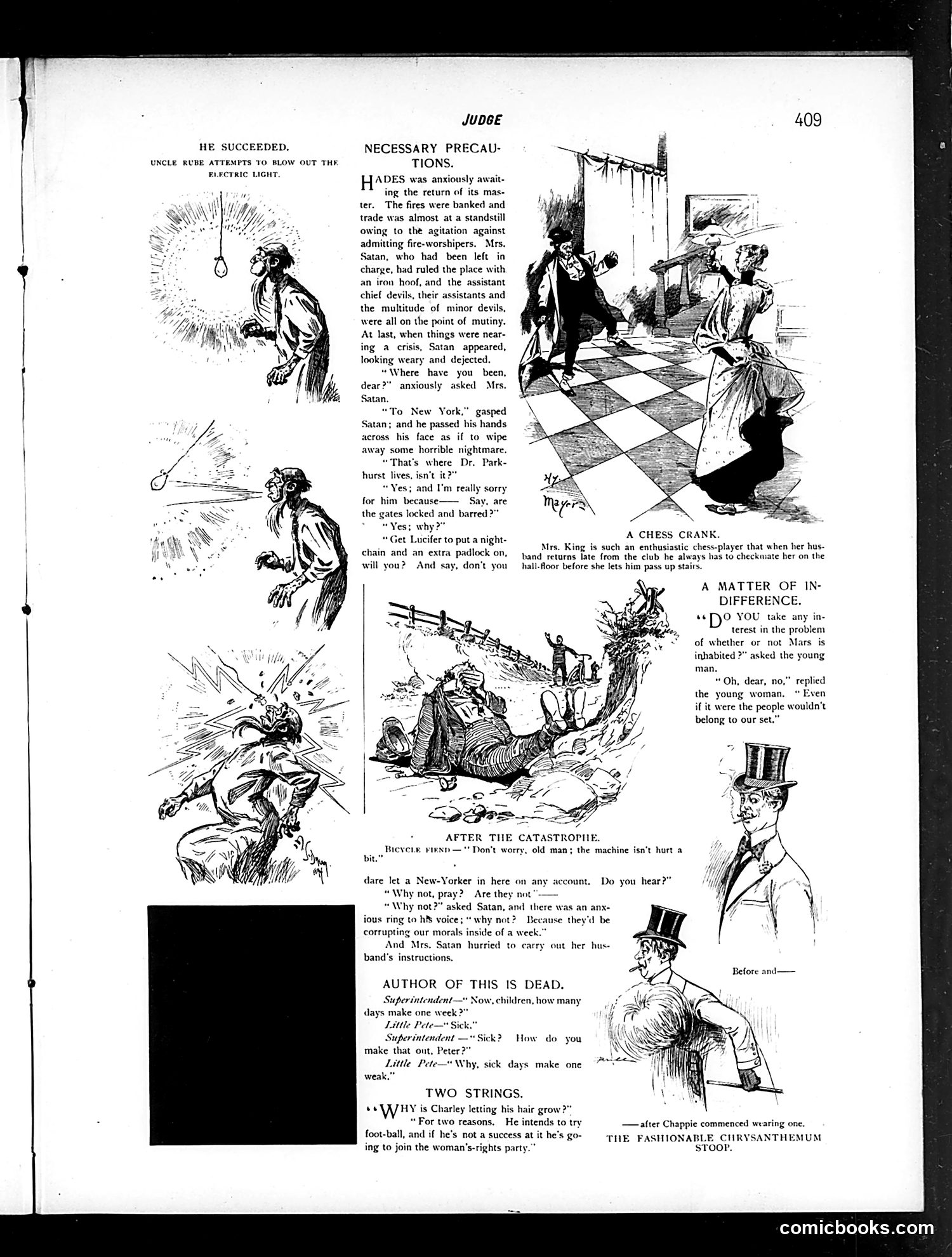
This page from *Judge* magazine contains several satirical cartoons mocking late-19th-century social issues: **Top cartoon**: "Uncle Rube" (likely Uncle Sam) attempts to extinguish an electric light—satirizing failed attempts at regulation or control of new technology. **"Satan in New York"**: The main story mocks Dr. Parkhurst, a real reformer who crusaded against vice in 1890s New York. Satan complains that New York is so morally corrupt he must lock Hell's gates to prevent New Yorkers from entering—inverting the usual moral hierarchy as satire against the city's perceived depravity. **Minor cartoons**: Brief jokes about childhood (sick days), physical fitness trends (hair-growing for football), chess obsession among women, and class-conscious indifference ("if it were the people wouldn't belong to our set"). The page reflects Gilded Age anxieties: rapid urbanization, new technologies, reform movements, and changing gender roles—all treated with *Judge's* characteristic irreverent humor.
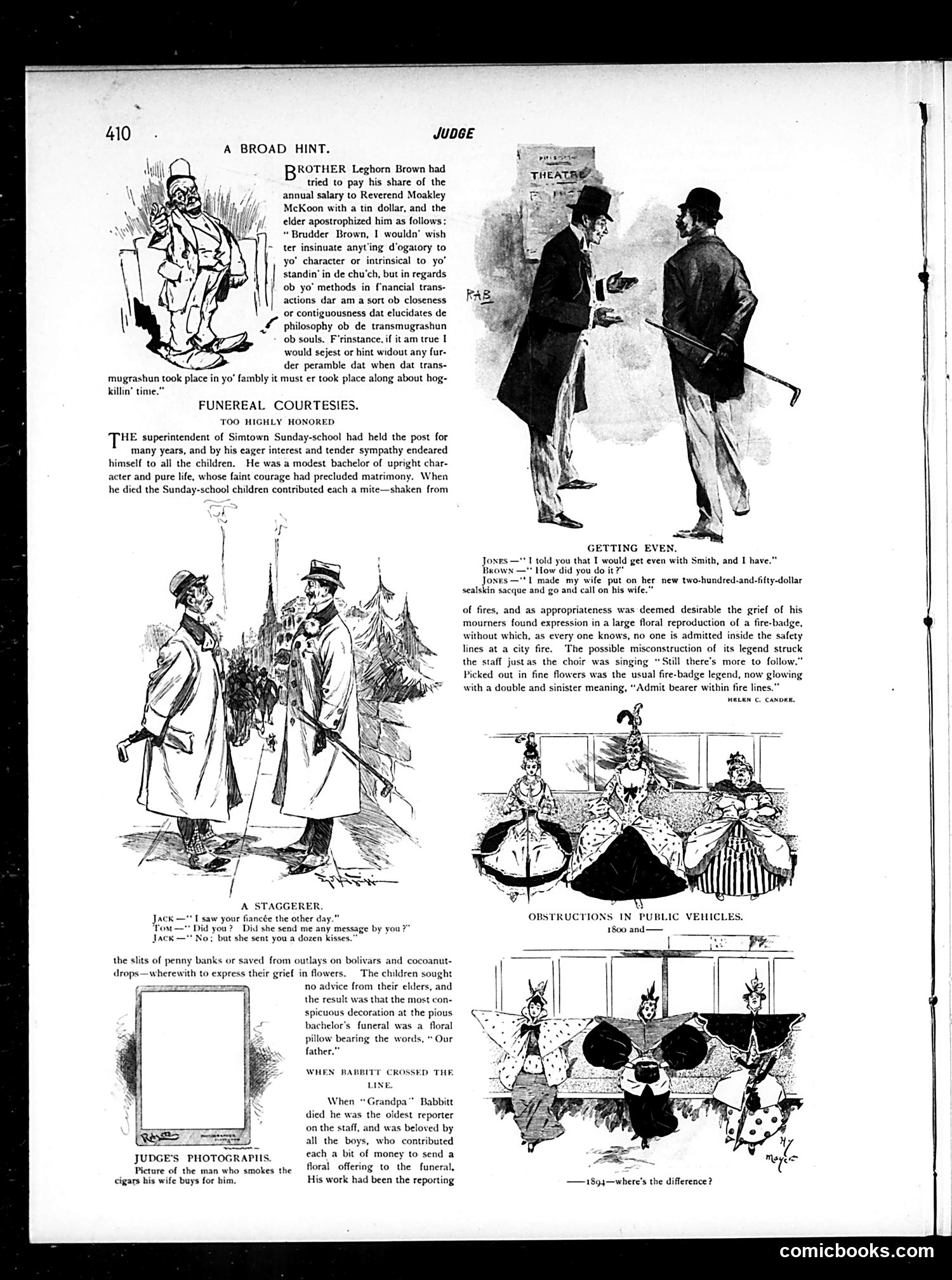
This page contains multiple satirical pieces typical of 1890s American humor: **"A Broad Hint"** mocks African American dialect and financial dishonesty through a church elder's accusation that Brother Leghorn Brown paid with counterfeit money, suggesting his family's "transmigration of souls" occurred during hog-killing season—implying he's soulless or animalistic. **"Funereal Courtesies"** satirizes sentimentality and misguided gesture. A Sunday-school superintendent's students create a floral fire-badge for his funeral, which accidentally becomes darkly ironic when placed beside hymn lyrics about "more to follow." **"Getting Even"** jokes about consumer excess: a man punishes a rival by having his wife display an expensive fur coat to the rival's wife—the implication being feminine vanity and social competition constitute suitable revenge. **"Obstructions in Public Vehicles"** (bottom) appears to satirize women's elaborate fashions (large bonnets/hats) creating literal physical obstruction in streetcars—a recurring complaint in 1890s urban life. The cartoons target class pretension, racial stereotypes, feminine materialism, and urban inconveniences typical of Judge's satirical focus.
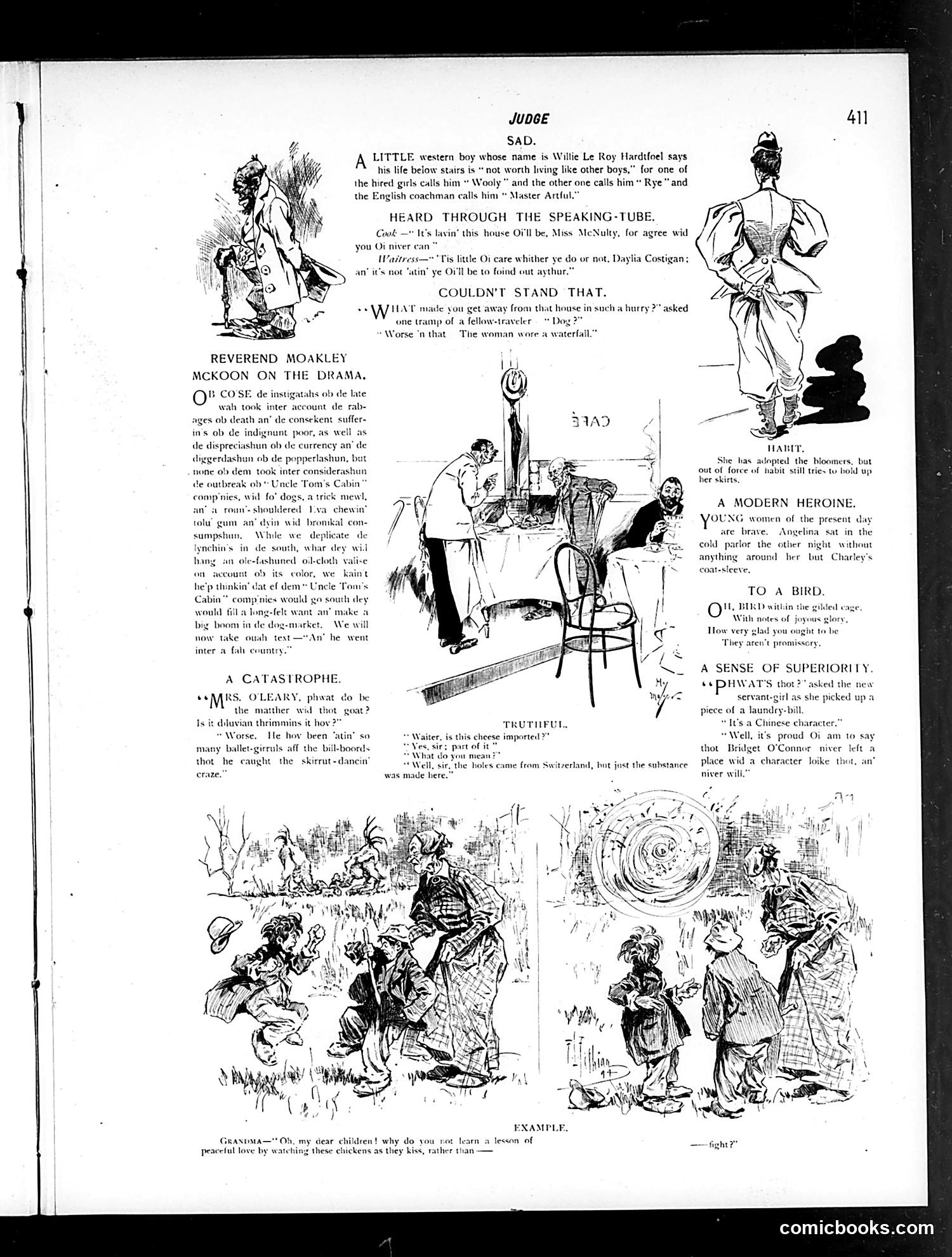
This page contains multiple short humorous pieces typical of Judge's satirical style, primarily mocking working-class immigrants and domestic servants through ethnic caricature. **Key content:** - **"SAD"** mocks a wealthy boy nicknamed unflattering names by household staff - **"HEARD THROUGH THE SPEAKING-TUBE"** depicts Irish servants (Cook, Waitress) in exaggerated dialect, complaining about their employer - **"COULDN'T STAND THAT"** jokes about a tramp fleeing because a woman wore a "waterfall" (a fashionable hairstyle of the era) - **"REVEREND MOAKLEY McKOON ON THE DRAMA"** appears to be a theatrical review in heavily stereotyped African-American dialect - **"A MODERN HEROINE"** celebrates a woman's bravery wearing bloomers (controversial at the time) - Remaining pieces mock Irish servants, Chinese characters, and domestic absurdities The satire primarily targets working-class immigrants and their speech patterns, reflecting period class prejudices, while occasionally satirizing fashion trends or social pretensions among the wealthy.
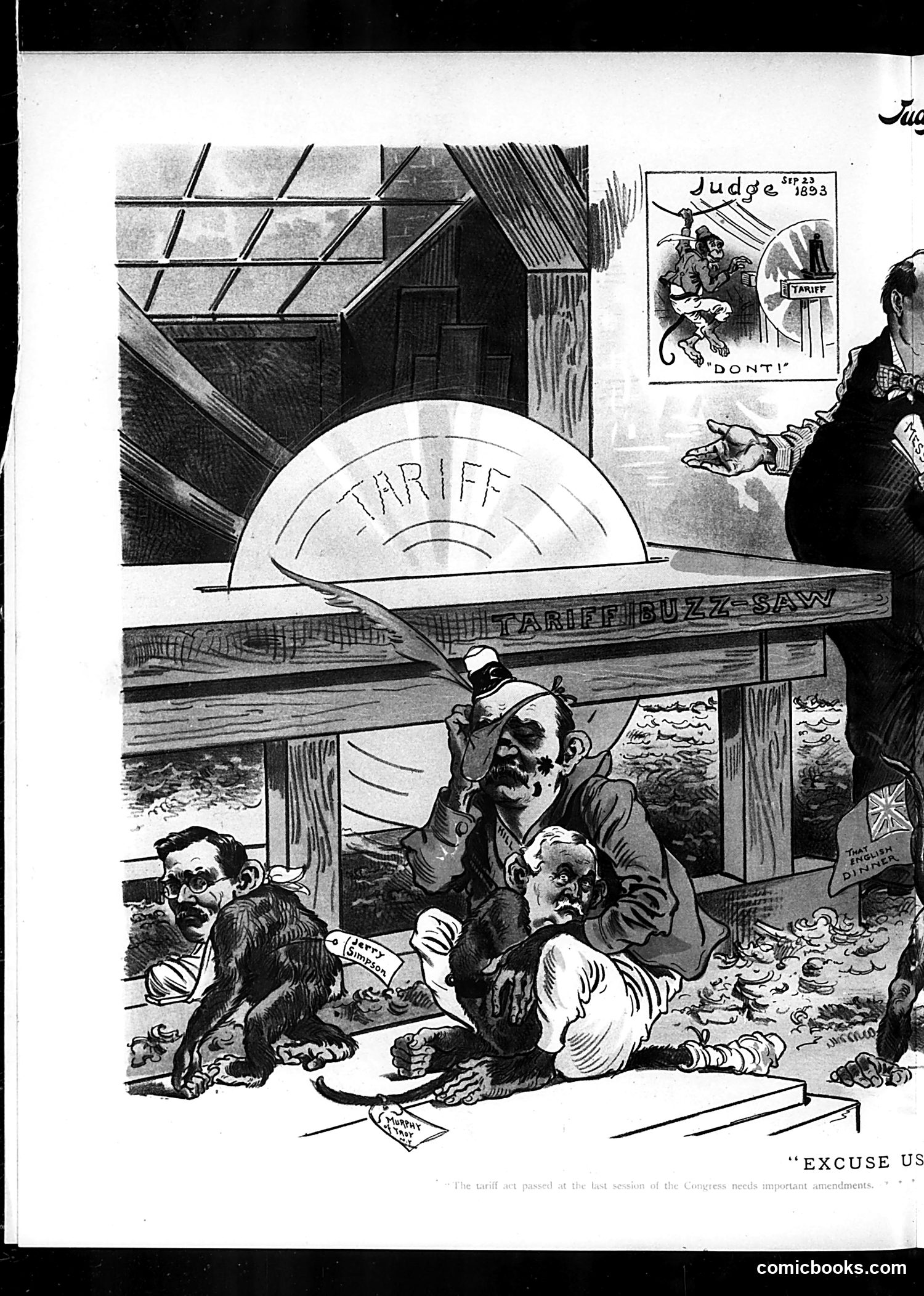
This 1893 *Judge* cartoon satirizes tariff policy debates. The main image depicts caricatured figures (appearing to represent political or business figures) operating a "Tariff Buzz-Saw"—a dangerous tool cutting through materials labeled with economic references. The saw itself is labeled "TARIFF," suggesting the cartoon criticizes how tariff legislation functions as a destructive instrument. The inset cartoon titled "Judge" from 1893 shows a figure saying "DON'T," warning against something, likely the tariff's harmful effects. The caption notes Congress needs "important amendments" to the tariff act. This reflects 1890s debates over protectionist tariffs, where opponents argued such policies harmed workers and consumers rather than helping American industry. The "buzz-saw" metaphor suggests the tariff cuts through ordinary people's welfare.
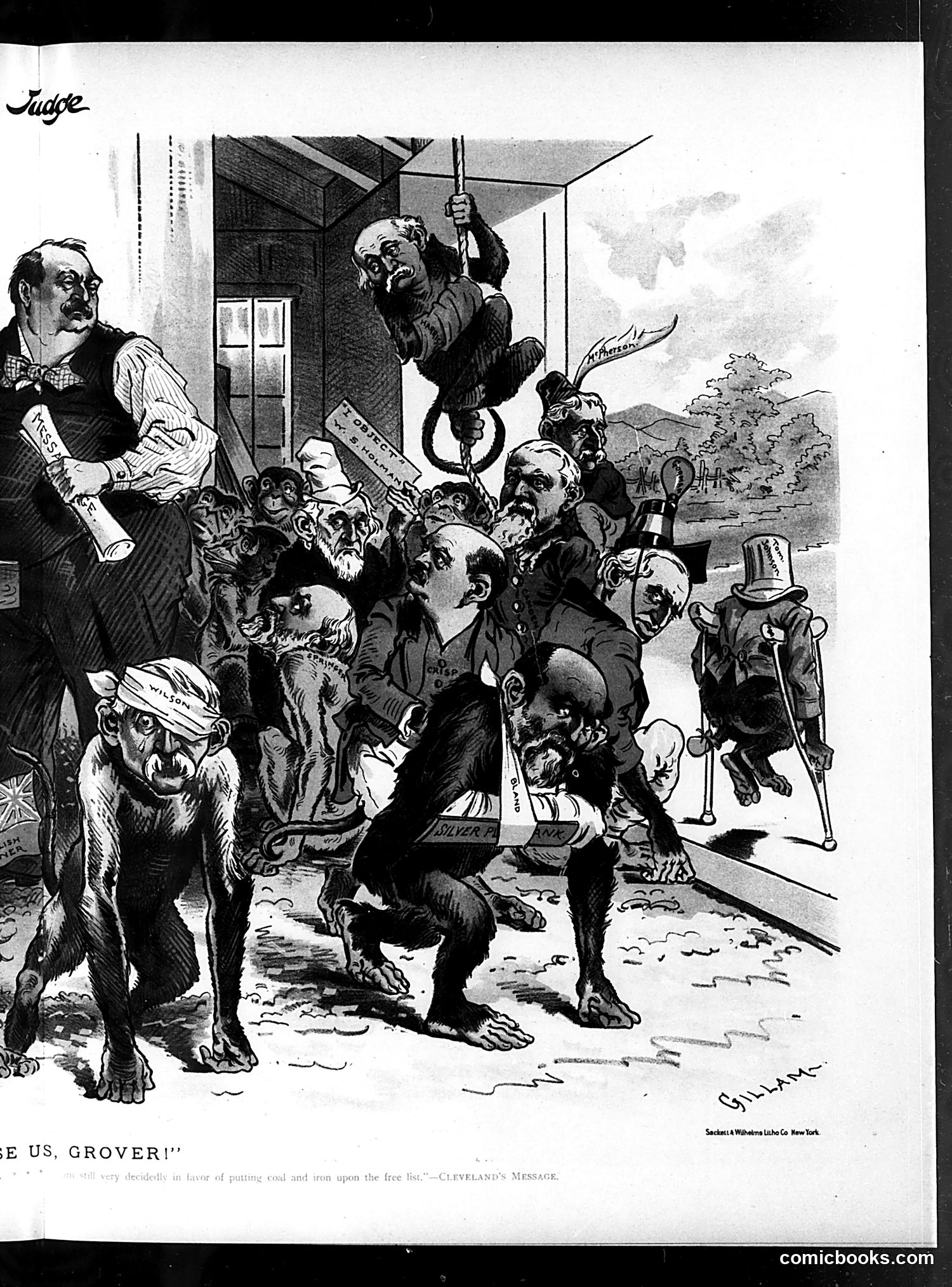
This Judge magazine cartoon depicts what appears to be a political allegory using apes and monkeys to represent political figures or groups. A well-dressed man on the left holds a document labeled "TARIFF" while observing a chaotic scene of ape-like creatures. One prominent ape is being hanged from a gallows inside a building. The partial caption reads "...GROVER!" likely referencing President Grover Cleveland. The text mentions "putting coal and iron upon the free list"—referring to Cleveland's tariff policies. The cartoon satirizes Cleveland's controversial tariff reduction efforts, using animal caricatures (a common racist practice of the era) to mock political opponents or specific groups opposing his policies. The hanging suggests the cartoonist viewed certain political positions as doomed or deserving execution. The satire targets the heated tariff debate of Cleveland's presidency (1885-1889, 1893-1897).
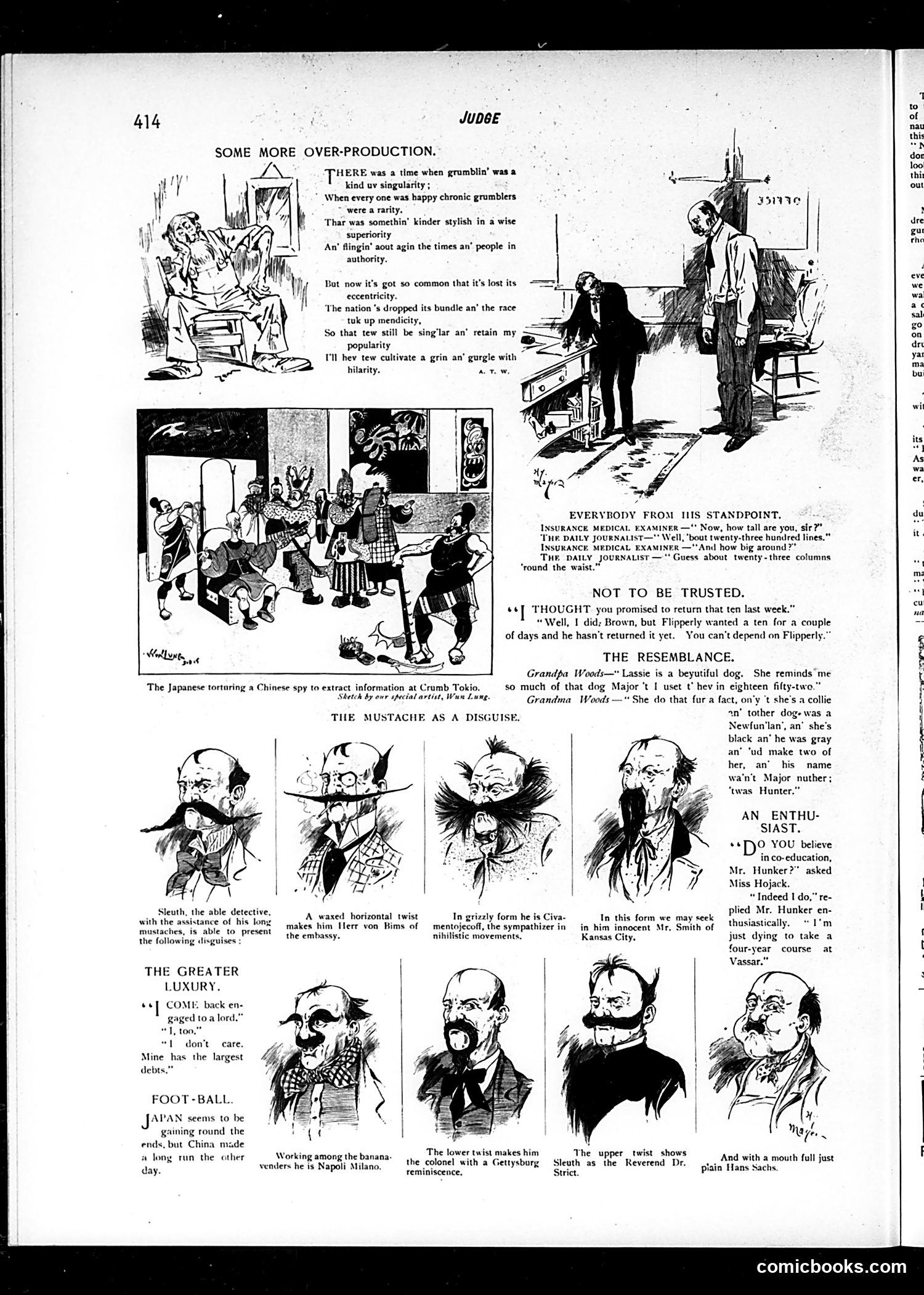
This satirical page contains several unrelated editorial cartoons and jokes typical of Judge's format: **"Some More Over-Production"** (top left): A rural character complains that complaining itself has become so common it's lost its distinctiveness—he must now "cultivate a grin" to remain unique. This satirizes how widespread grumbling and social criticism had become. **Insurance/Journalist Exchange**: A joke about a newspaper journalist's enormous output (23 "hundred lines," 23 columns around the waist), mocking sensationalist newspaper production. **Japanese Torture Scene** (center): Depicts a Japanese officer torturing a Chinese spy, referencing contemporary tensions during the Sino-Japanese conflict period. **"The Mustache as a Disguise"**: Four sketches showing how the same man appears as different characters—a detective, diplomat, revolutionary, and clergyman—merely by varying his mustache style. This satirizes how easily facial hair creates false identities. The page also includes domestic humor ("Not to Be Trusted," "The Resemblance") and brief items about football and co-education. The overall tone reflects early 20th-century American satirical magazine conventions combining political commentary, social criticism, and light domestic comedy.
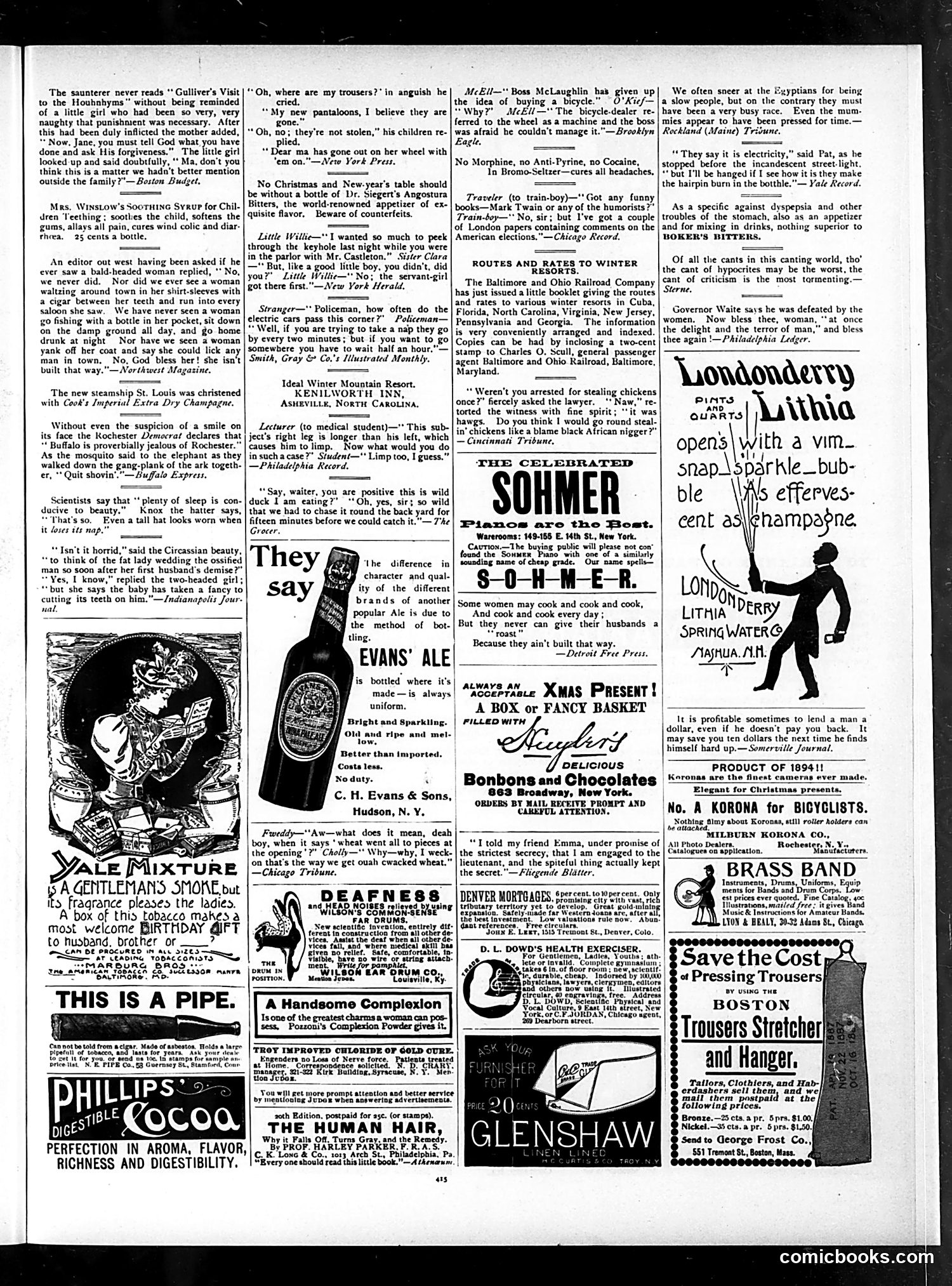
This is primarily an **advertising and humor miscellany page** from Judge magazine, featuring short jokes and advertisements rather than political cartoons. The visible humor pieces are genteel domestic and social jokes typical of the era: - A child's innocent misunderstanding about confession - A man's wife taking his new trousers on her bicycle ("wheel") - A boy trying to peek through a keyhole while a servant girl beats him to it - A policeman's quip about electric streetcars running frequently when you want sleep but rarely when you need them - A medical student's naive response to a teaching question - A waiter's exaggerated claim about catching wild duck These represent **turn-of-the-century American middle-class humor**—mildly risqué (servant girls, marital situations), featuring technological references (bicycles, electric cars), and relying on wordplay and double meanings. The advertisements (cocoa, ale, hair products, linens) indicate this page targeted affluent readers. There is **no significant political satire** visible here—just period domestic comedy reflecting contemporary anxieties about new technology and changing social mores.
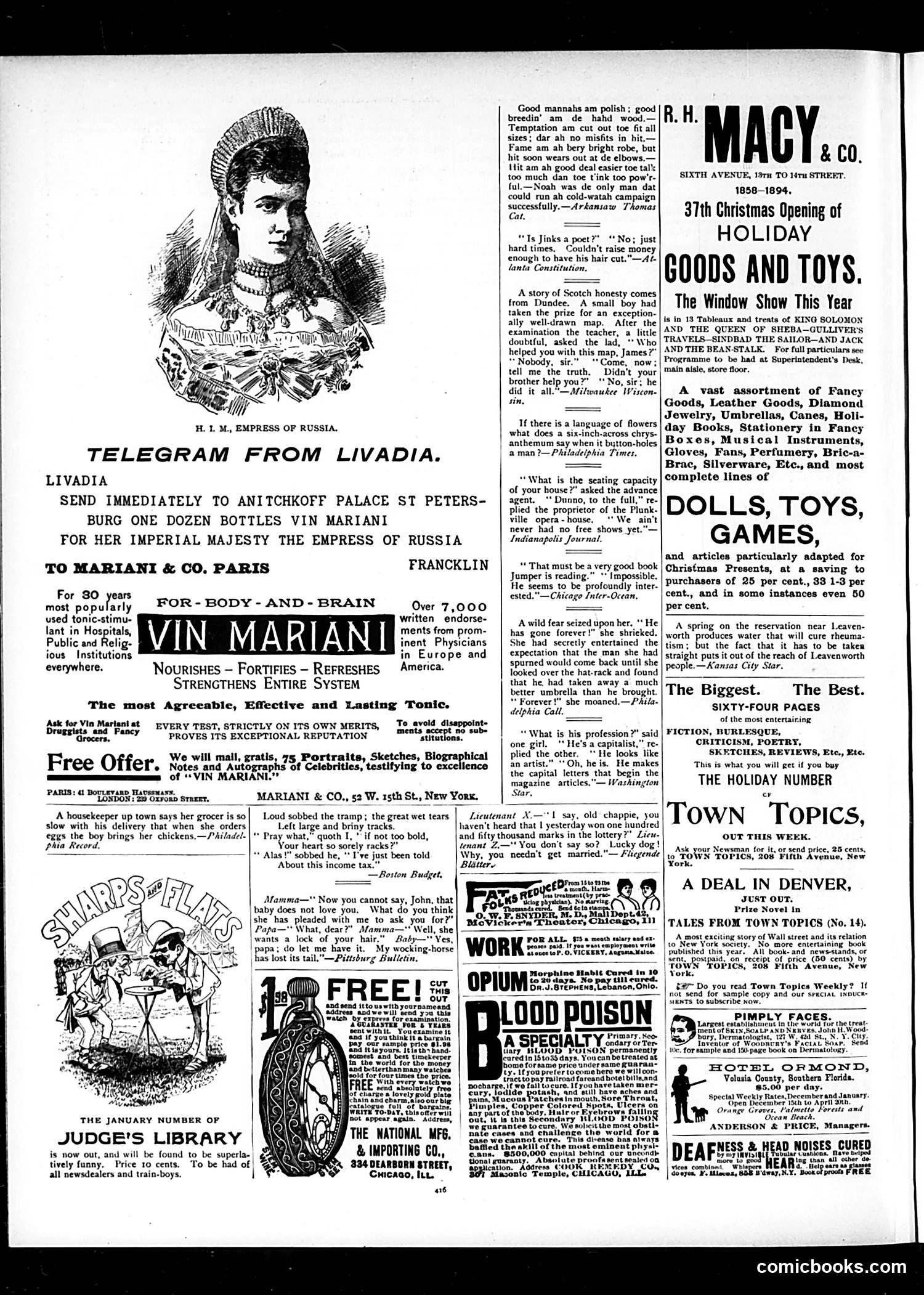
This page is primarily **advertising**, not political satire. The dominant content is a fake telegram claiming the Russian Empress ordered Vin Mariani tonic wine, used to promote this popular patent medicine. The single cartoon ("Sharps & Flats," lower left) shows two figures on a bicycle—likely a visual pun about "tandem" or shared burden, though the specific satirical point is unclear from the image alone. The remaining content consists of: humorous short jokes and quips (typical Judge filler), advertisements for products like opium-based medicines and Judge's Library magazine, and various commercial notices. The jokes reference contemporary American life (income tax, grocery delivery, hair cuts) but contain no identifiable political figures or clear satirical targets. This appears to be a general-interest humor magazine page circa the 1880s-1890s, mixing light entertainment with commercial promotion.
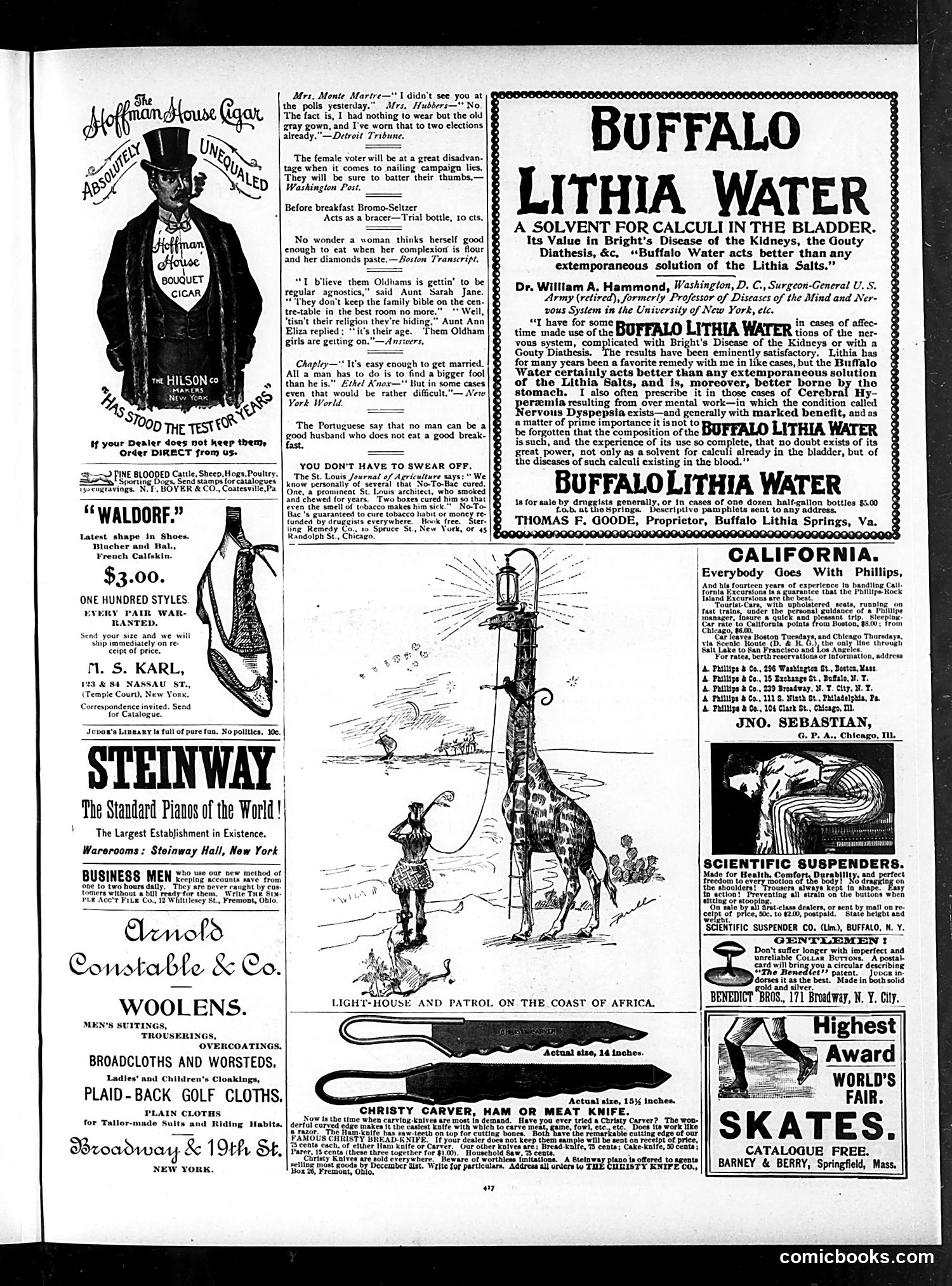
This page combines satirical commentary on women's suffrage with period advertisements. The central cartoon depicts a tall giraffe as a "Light-House and Patrol on the Coast of Africa," a whimsical illustration unrelated to the page's primary content. The satirical text mocks newly enfranchised women voters through several jokes. One quip suggests women will struggle "nailing campaign lies" because they'll "batter their thumbs" (implying incompetence). Another joke has a woman claim she couldn't vote because she'd already worn her only decent dress to two previous elections—satirizing women's limited wardrobes and economic dependence. The remaining content consists of advertisements for shoes, pianos, woolens, knives, lithia water (a patent medicine), and other goods typical of the era. The satire reflects early-20th-century anxieties about women's political participation, portraying female voters as frivolous, economically dependent, and intellectually inferior—common tropes used to oppose women's suffrage.
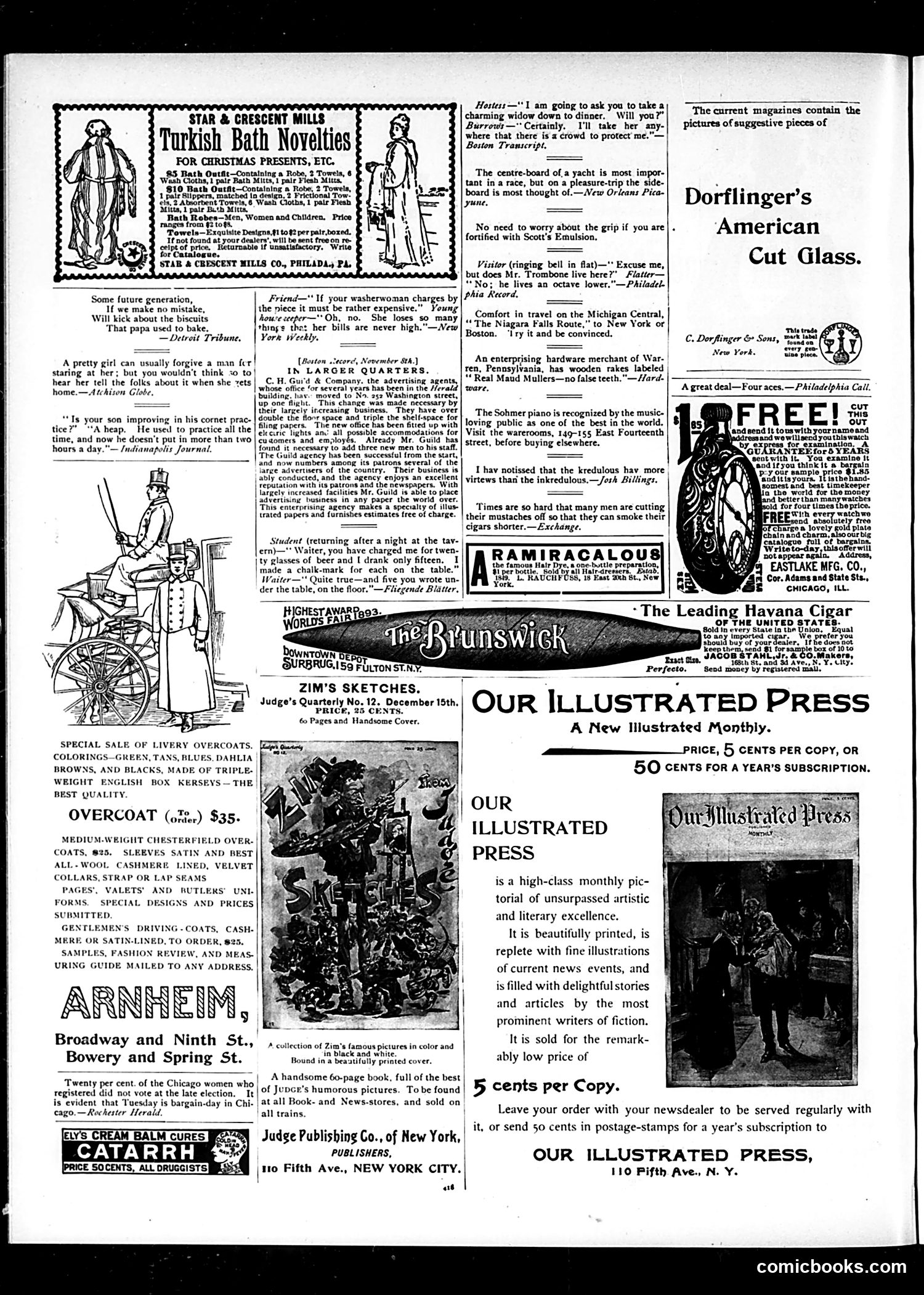
This page is primarily **advertising and filler content** rather than satirical cartoons. The main elements include: **Advertisements:** - Turkish Bath novelties and accessories (top) - Dorflinger's American Cut Glass - Overcoat sale at Arnhem (Broadway/Ninth St.) - Brunswick cigars - "Our Illustrated Press" magazine subscription **Humor/Filler:** The text contains brief jokes and anecdotes typical of Judge's format: - A quip about future generations criticizing old biscuits - A joke about a girl forgiving staring - Humor about a son's cornet practice improving (by practicing less) - A Chicago voting joke implying women shoplifted rather than voted - Various one-liners about servants, waiters, and social situations **Notable Content:** A Boston newspaper excerpt discusses C.H. Guild & Company's advertising agency relocating to larger quarters due to business growth. The page lacks prominent political satire or identifiable caricatures. It represents Judge's typical mixed format of advertisements, light humor, and social commentary designed for middle-class readers of the era.
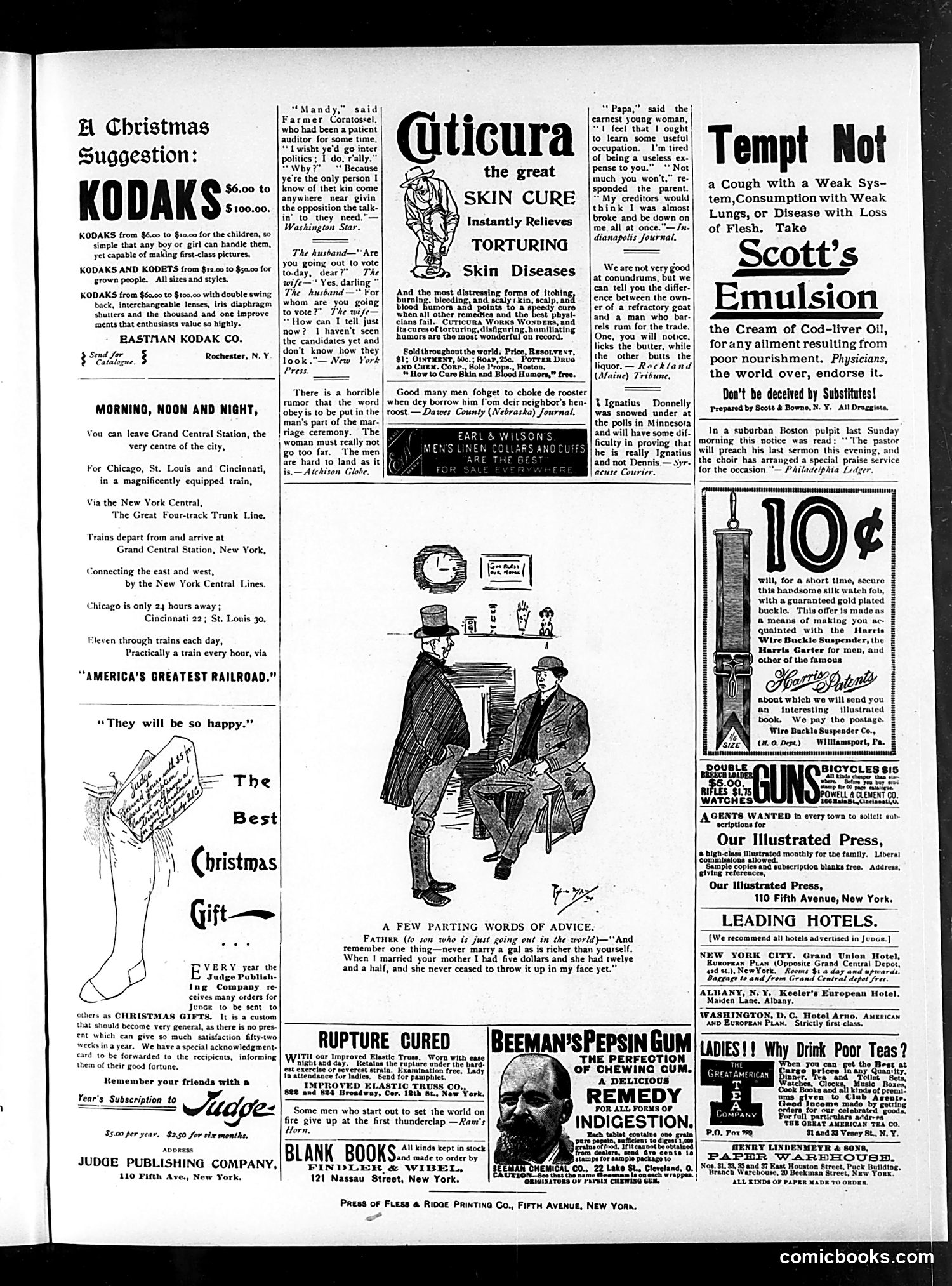
This page is primarily **advertisements and light humor columns** rather than political satire. The main content includes: **"A Few Parting Words of Advice"**: A domestic humor cartoon showing a father warning his son never to marry a woman richer than himself—a commentary on 19th-century anxieties about masculine financial superiority in marriage. The father boasts he married a woman with only slightly more money, and she "never ceased to throw it up in my face." **Scattered one-liners** mock contemporary social anxieties: rumors about removing "obey" from marriage vows (mocking women's emerging independence), racial dialect humor about borrowing roosters (offensive period stereotype), and worries about finding husbands. **The bulk of the page** consists of patent medicine ads (Cuticura, Scott's Emulsion), railroad advertisements, and product promotions—typical Judge magazine filler. The humor is domestic and gender-focused rather than political.
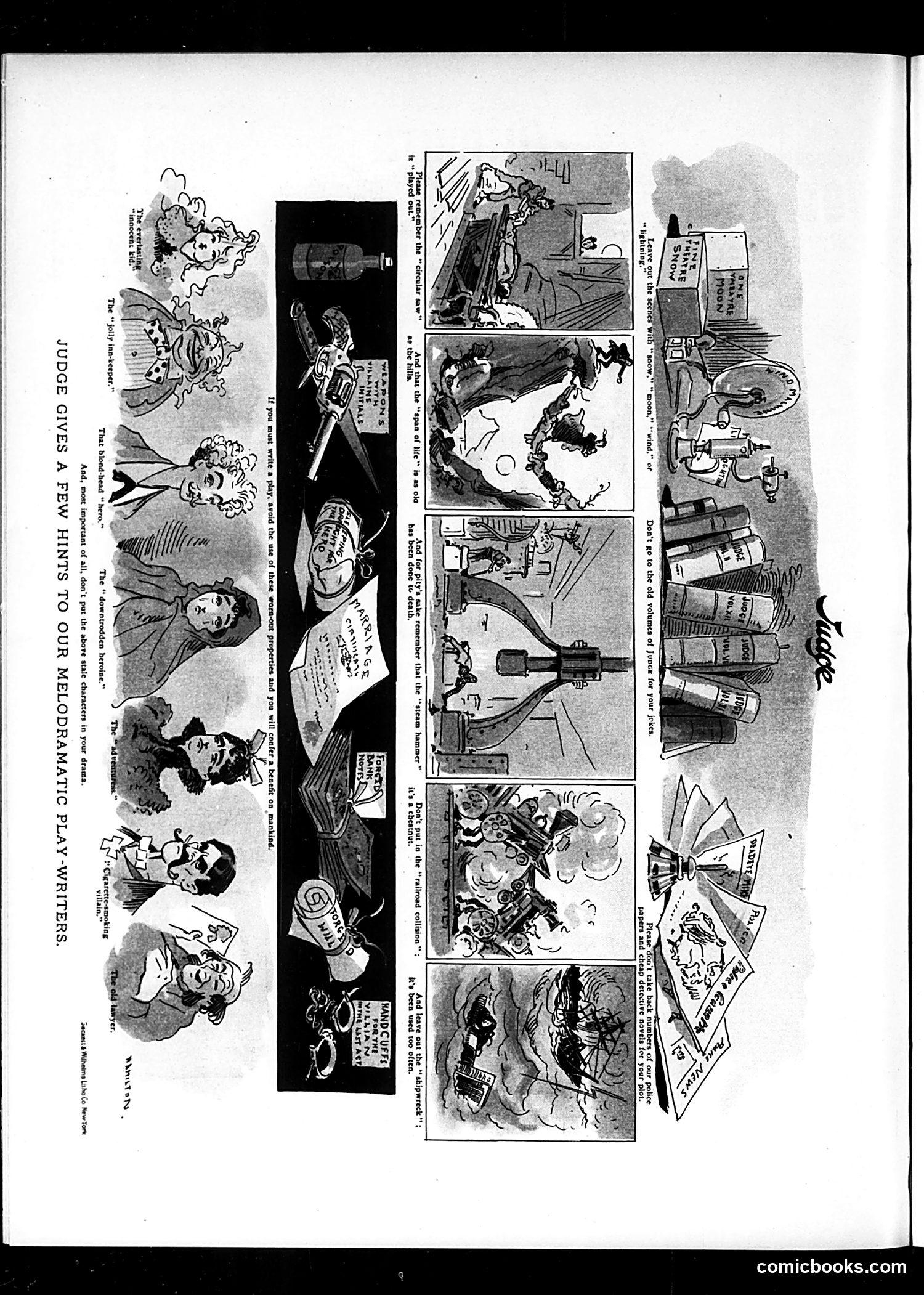
This satirical page mocks the tired, predictable tropes of late 19th/early 20th-century melodramatic theater. Judge magazine identifies overused character types and plot devices that had become clichéd: - The "circular saw" plot (a suspenseful device where victims face mechanical danger) - The innocent child character - The jolly innkeeper - The blond "hero" - The downtrodden heroine The cartoons illustrate these stock characters and scenarios. Judge's critique emphasizes that these elements were "played out," "chestnuts," and "stale"—suggesting playwrights relied on lazy formulas rather than original storytelling. This reflects Progressive Era skepticism toward popular entertainment conventions. The magazine urged writers to abandon hackneyed melodrama in favor of fresher, more sophisticated theatrical material. It's essentially early media criticism lamenting formulaic entertainment.