
A complete issue · 16 pages · 1894
Judge — September 22, 1894
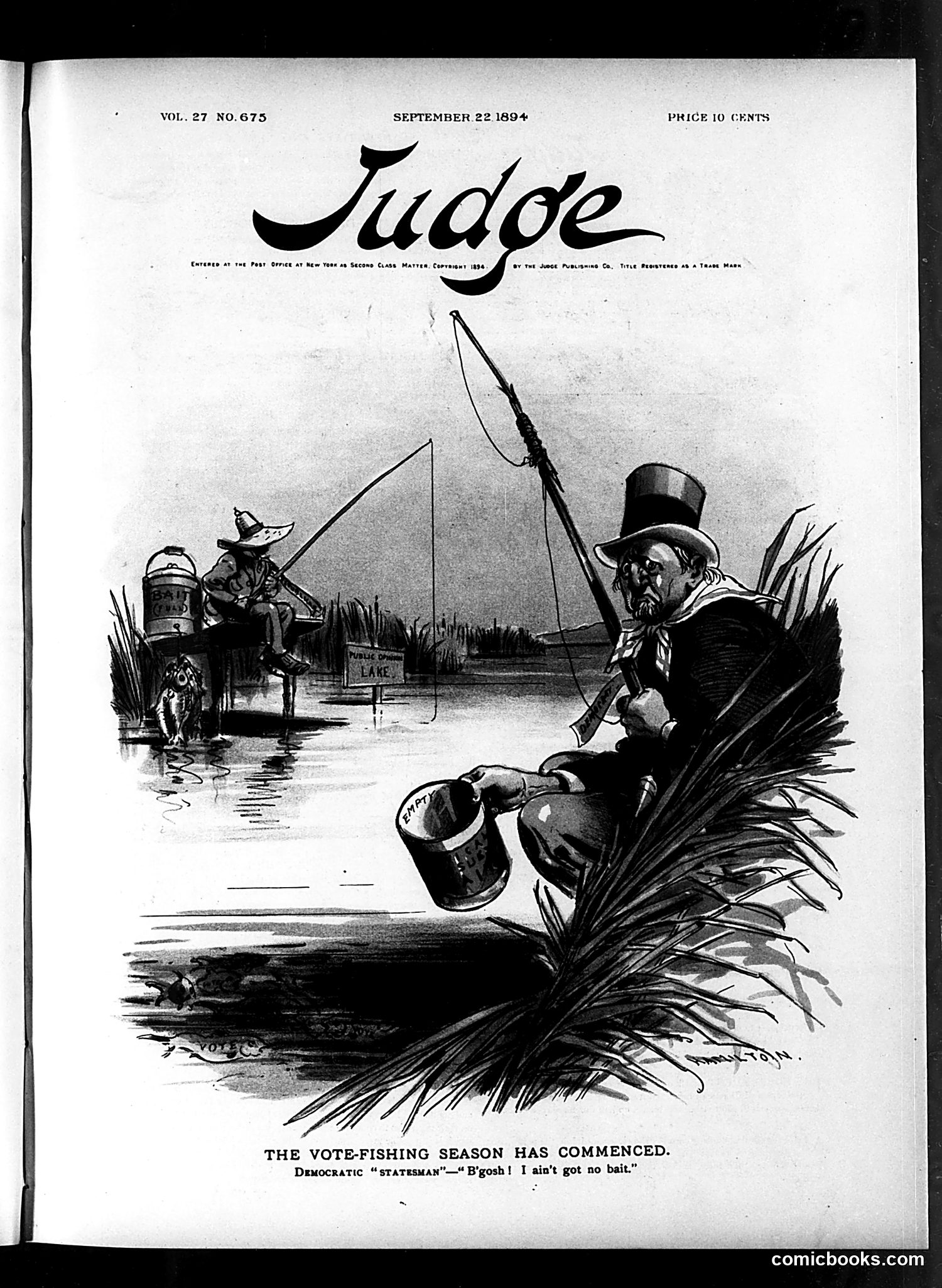
This Judge magazine cover from September 22, 1894 uses fishing as a metaphor for political campaigning. The cartoon depicts two well-dressed men fishing in what appears to be "Public Opinion Lake" (visible on a sign). The satire suggests that Democratic politicians ("Democratic 'Statesman'") are attempting to catch voters like fish—and notably, one figure complains "B'gosh! I ain't got no bait," implying Democrats lack appealing campaign promises or policies to attract voters. The caricatures appear exaggerated in typical 1890s satirical style. The "vote-fishing season" metaphor mocks electoral politics as a predatory sport where candidates cynically manipulate public opinion rather than genuinely serve constituents. This criticizes Democratic campaign tactics as insubstantial or manipulative.
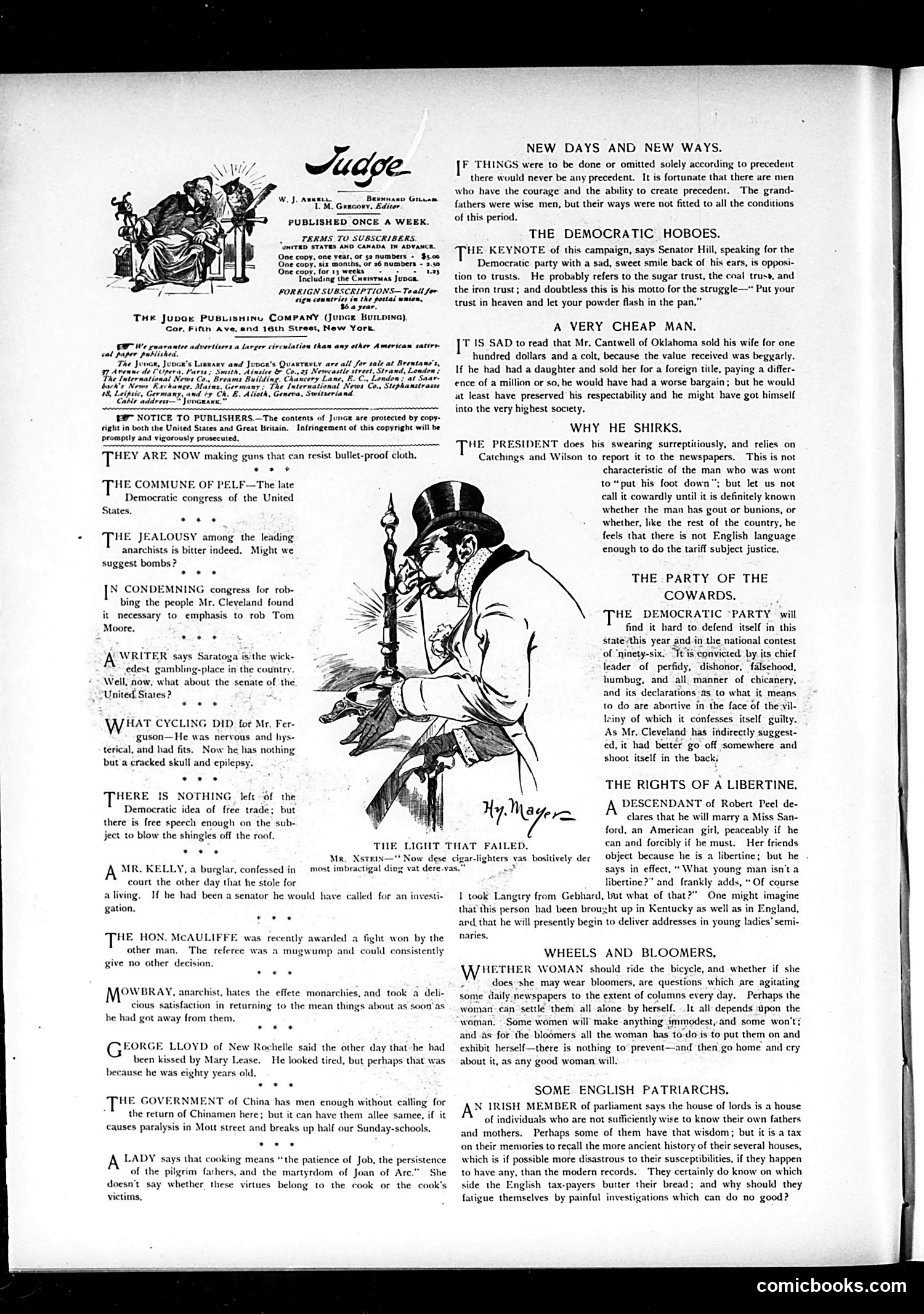
The main illustration, credited to "Hy. Mayer," depicts Uncle Sam as a figure in top hat and formal dress, appearing anxious or frustrated while holding what looks like a bayonet or sword. The caption reads "THE LIGHT THAT FAILED." This appears to satirize American foreign policy or military intervention. Given the references in surrounding text to trusts, the Democratic party, and questions about American strength, the cartoon likely critiques either failed military ventures or the ineffectiveness of American power projection during the Progressive Era (early 1900s). The surrounding editorial content mocks political figures and parties, including references to Cleveland and discussions of American imperialism and economic inequality. Without clearer context or dates visible, the specific political moment remains unclear, though the overall tone criticizes American political leadership and international conduct.
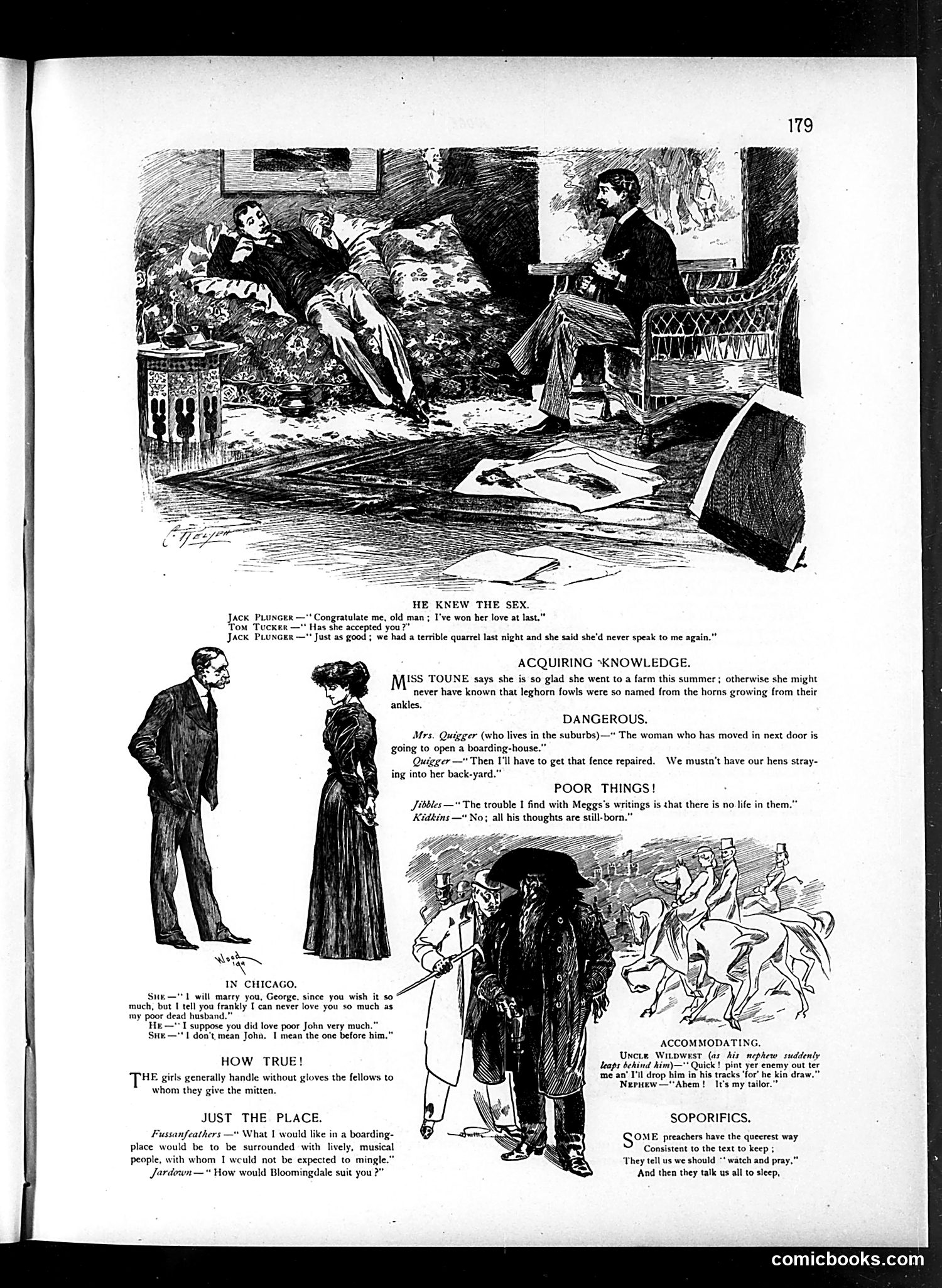
This page contains multiple short satirical pieces and illustrations mocking social conventions and domestic relations of the era. The top cartoon, "He Knew the Sex," depicts a man lounging while a woman stands, illustrating jokes about courtship and gender dynamics—specifically a man claiming victory in romance after a quarrel. Below are several brief comedic vignettes with titles like "Acquiring Knowledge," "Dangerous," and "Poor Things!" that mock suburban life, women's education, and marital concerns typical of late 19th/early 20th-century Judge humor. "How True!" jokes about women's manipulation of suitors, while "Just the Place" satirizes boarding-house life. The illustrations show stock character types—well-dressed men and women in period clothing—representing familiar social situations the magazine's audience would recognize. The humor relies on period gender stereotypes and domestic anxieties rather than specific political events.
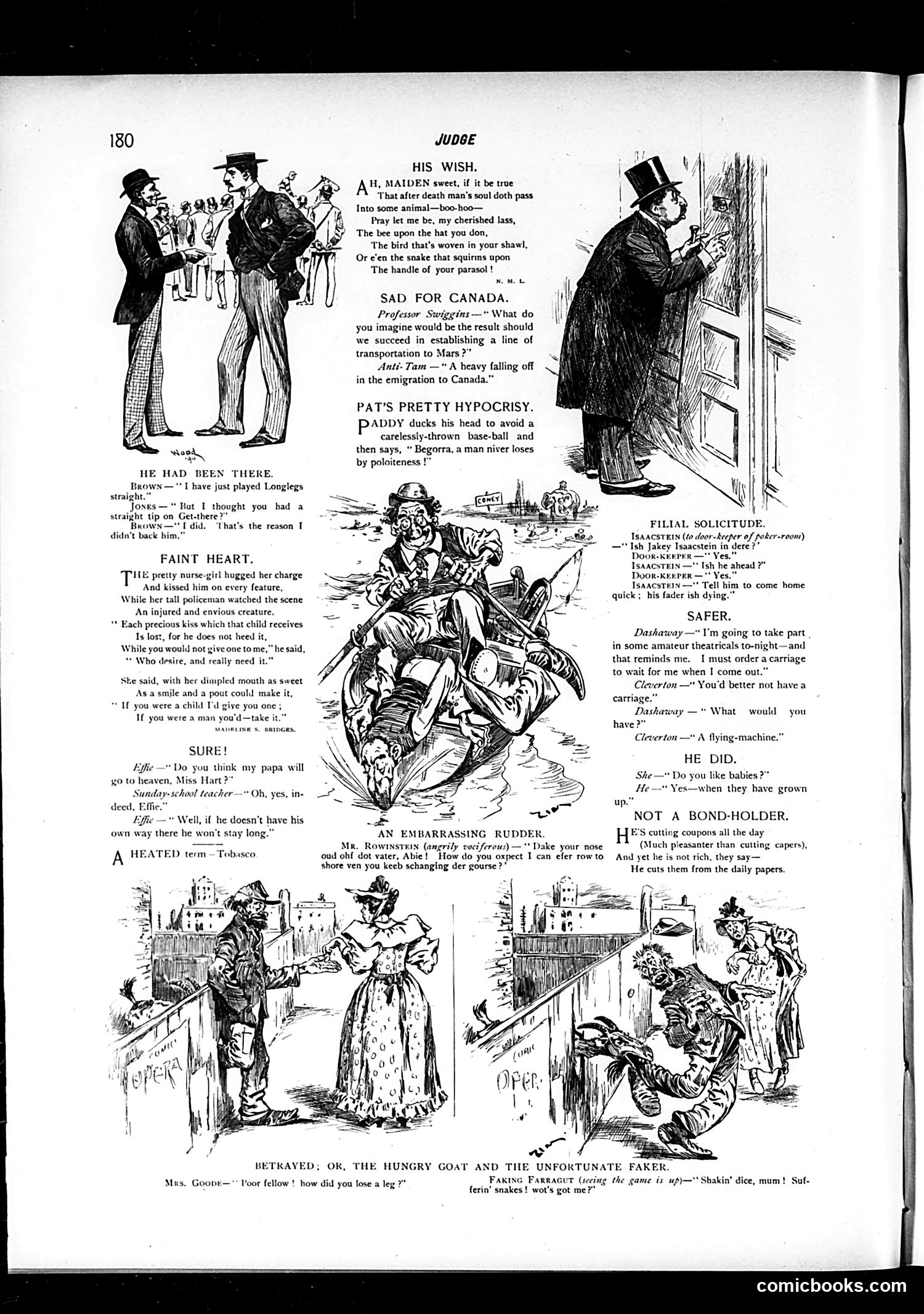
This page collects brief humorous sketches typical of Judge magazine's satirical content. Key pieces include: **"His Wish"**: Romantic verse about a man wishing to become objects near an attractive woman—conventional sentimental humor. **"Sad for Canada"**: Jokes that Canada's emigration problems would worsen if Mars became accessible (implying Canada is an undesirable destination). **"Pat's Pretty Hypocrisy"**: Stereotypical Irish character ("Paddy") claims politeness prevented injury, when he actually ducked—mockingly suggesting Irish hypocrisy. **"An Embarrassing Rudder"**: Yiddish-accented immigrant character frustrated with another's boat-steering, using exaggerated dialect humor common to period satire. **"Betrayed; or, The Hungry Goat"**: Visual comedy about consequences of carelessness. **Bottom sketches** cover romance, theatrical pretension, and financial fraud through stereotyped characters. The page relies on ethnic caricatures (Irish, Jewish) and class-based humor typical of late-19th/early-20th-century American periodicals.
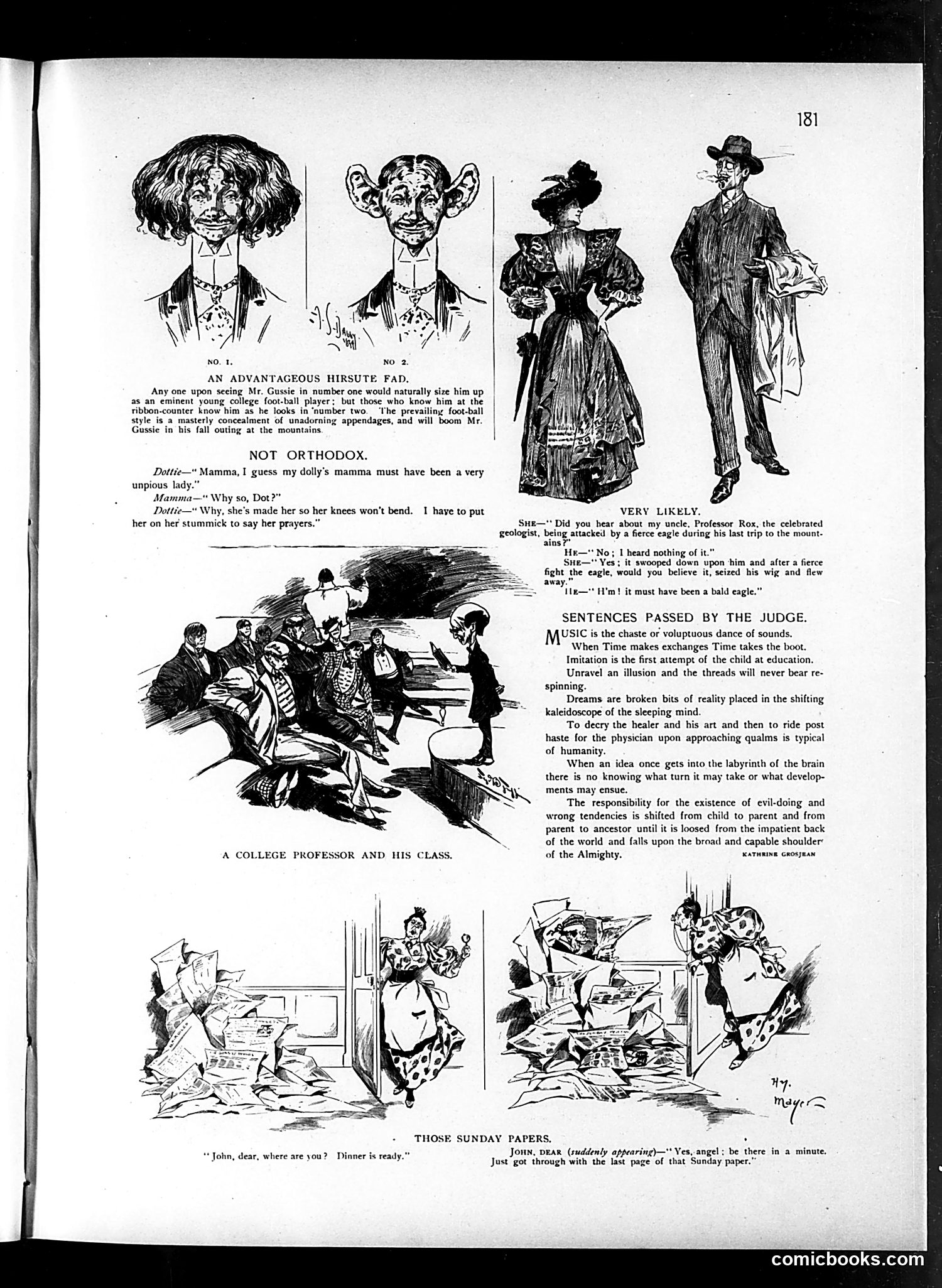
This page contains several brief satirical jokes typical of Judge's humor: **"An Advantageous Hirsute Fad"** mocks a college football player named "Mr. Gussie" whose prominent ears and unflattering features are hidden by the fashionable fluffy hair style of the era—suggesting the trend serves as convenient camouflage for unattractive men. **"Not Orthodox"** is a child's joke: a doll's mother must have been "unpious" because the doll's knees won't bend for prayer. **"Very Likely"** jokes about a bald professor attacked by an eagle that steals his wig, with the punchline that it "must have been a bald eagle"—a pun on the bird species. **"Those Sunday Papers"** depicts domestic chaos caused by lengthy Sunday newspaper supplements, with the wife buried in papers while calling to her husband about dinner. These represent Judge's typical light domestic and observational humor rather than political satire, poking fun at fashion fads, literal-minded children, and modern newspaper culture.
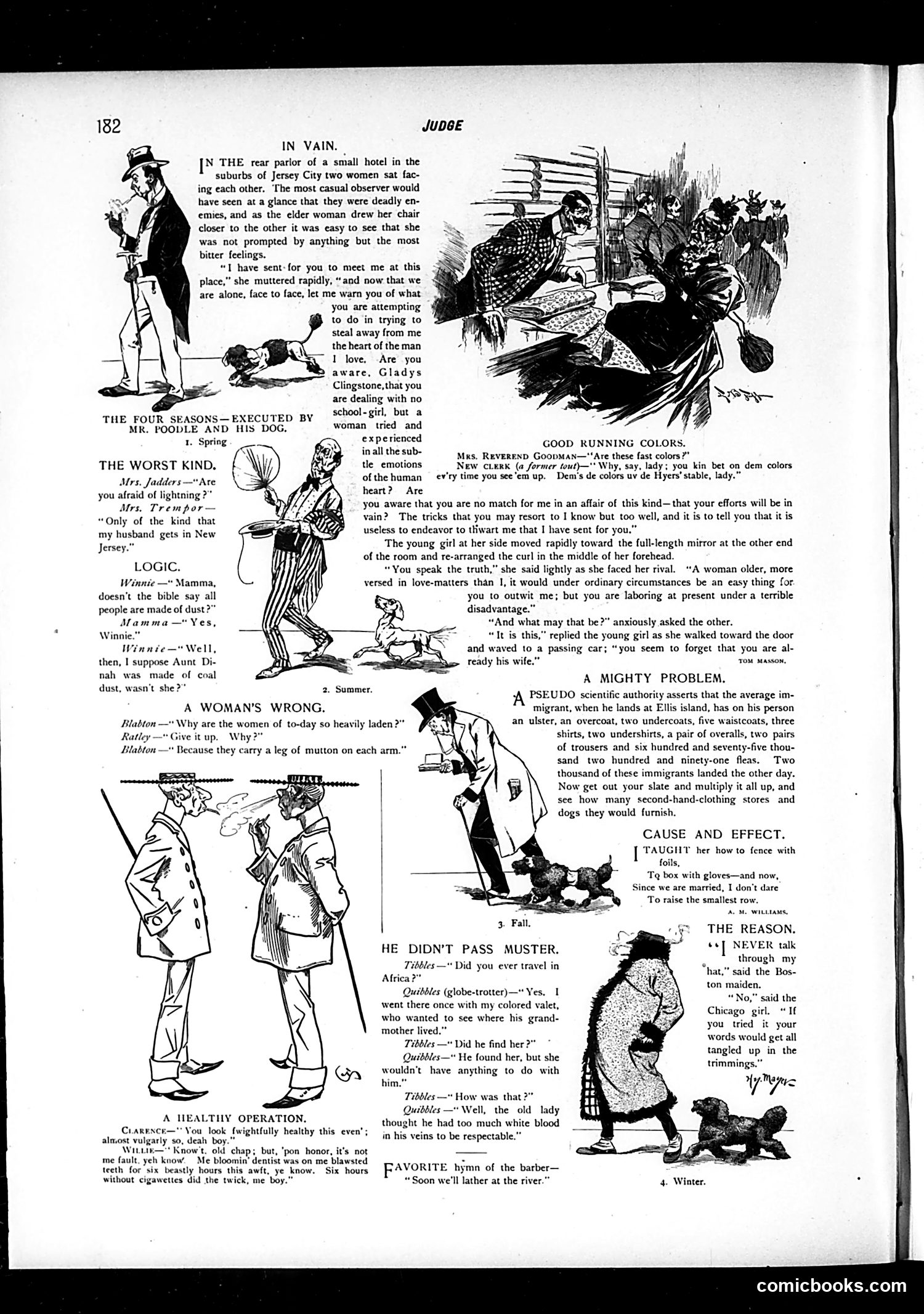
This page contains multiple short satirical pieces typical of early-20th-century Judge magazine: **"In Vain"** presents a domestic drama where a jealous woman confronts her rival, only to be told the younger woman is already married to the man in question—the ultimate comeuppance. **"The Four Seasons"** depicts a fashionable gentleman with his dog across seasons, captioned with observations about running colors and stable horses—likely mocking both fashion pretension and society's obsession with horse racing. **Minor pieces** include crude ethnic humor ("Logic" mocking Black speech), commentary on immigrants' poverty at Ellis Island, and observations on women's clothing and mannerisms. **"Good Running Colors"** jokes that a clerk recognizes fast dyes from his gambling background at horse stables—conflating retail commerce with vice. The humor relies on period stereotypes: marital discord, class anxiety about immigrants, ethnic caricature, and observations about gendered behavior. Most satire targets human vanity and social climbing rather than specific political events.
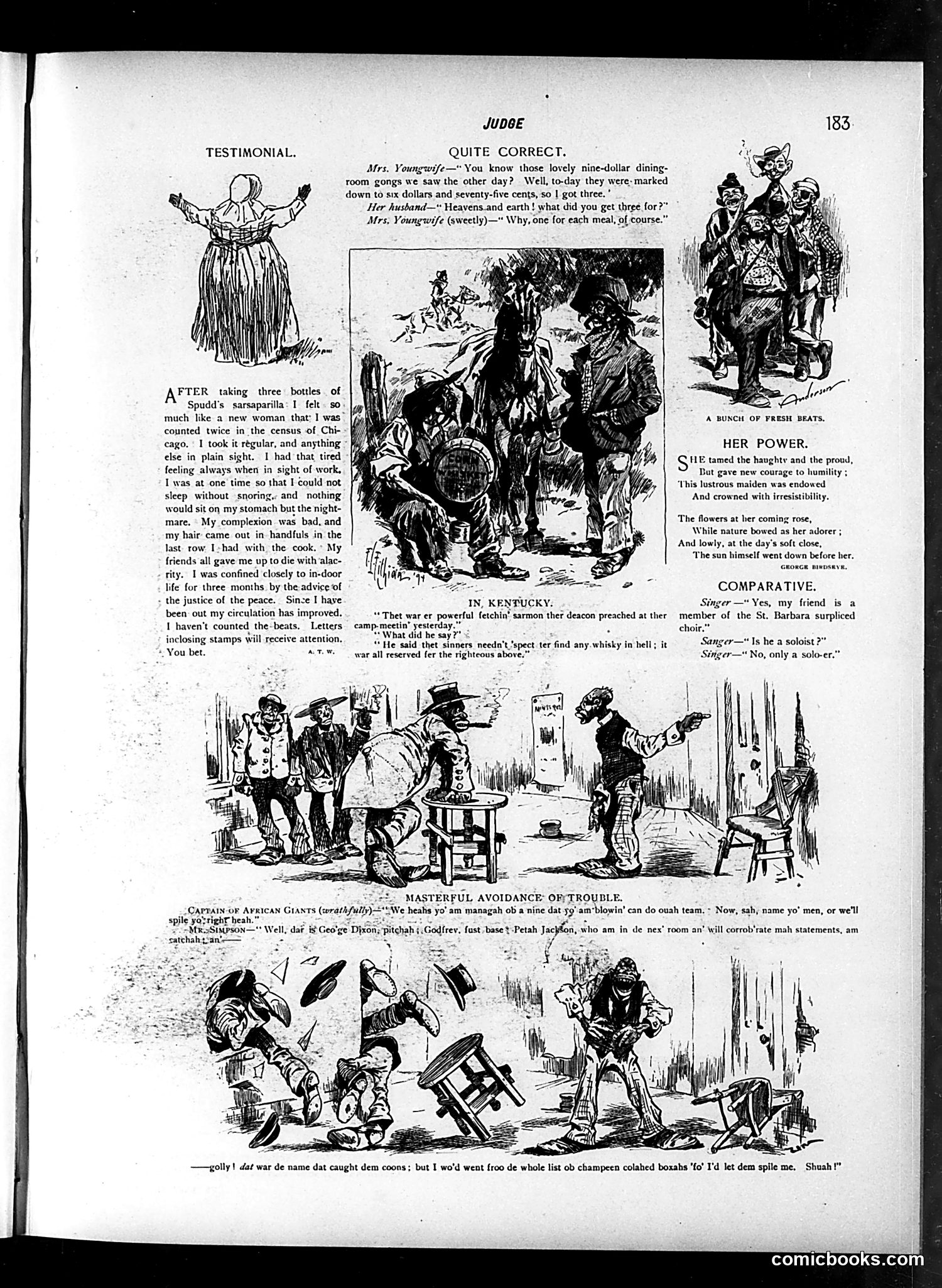
This page contains several humor pieces typical of Judge's satirical style: **"Quite Correct"**: A joke mocking nouveau-riche consumerism—a wife buys three identical nine-dollar gongs on sale, justifying the wasteful purchase by claiming she needs "one for each meal." **"Testimonial"**: A fake advertisement parody for "Spudd's Sarsaparilla" (a patent medicine). The testimonial hilariously contradicts itself—the product supposedly made the woman feel "new" yet caused hair loss, insomnia, digestive problems, and nervous collapse. This satirizes the absurd health claims made by real patent medicines of the era. **"In Kentucky"**: Rural dialect humor where a preacher's sermon claims all whisky is reserved for the righteous in heaven—a joke about frontier religiosity and drinking culture. **"Masterful Avoidance of Trouble"** and **"A Bunch of Fresh Beats"**: Baseball-themed cartoons with dialect humor, likely satirizing baseball management and African American players (using period racial caricatures and stereotypes). The page reflects early 20th-century upper-class satirical targets: consumer excess, medical quackery, and rural/racial stereotyping.
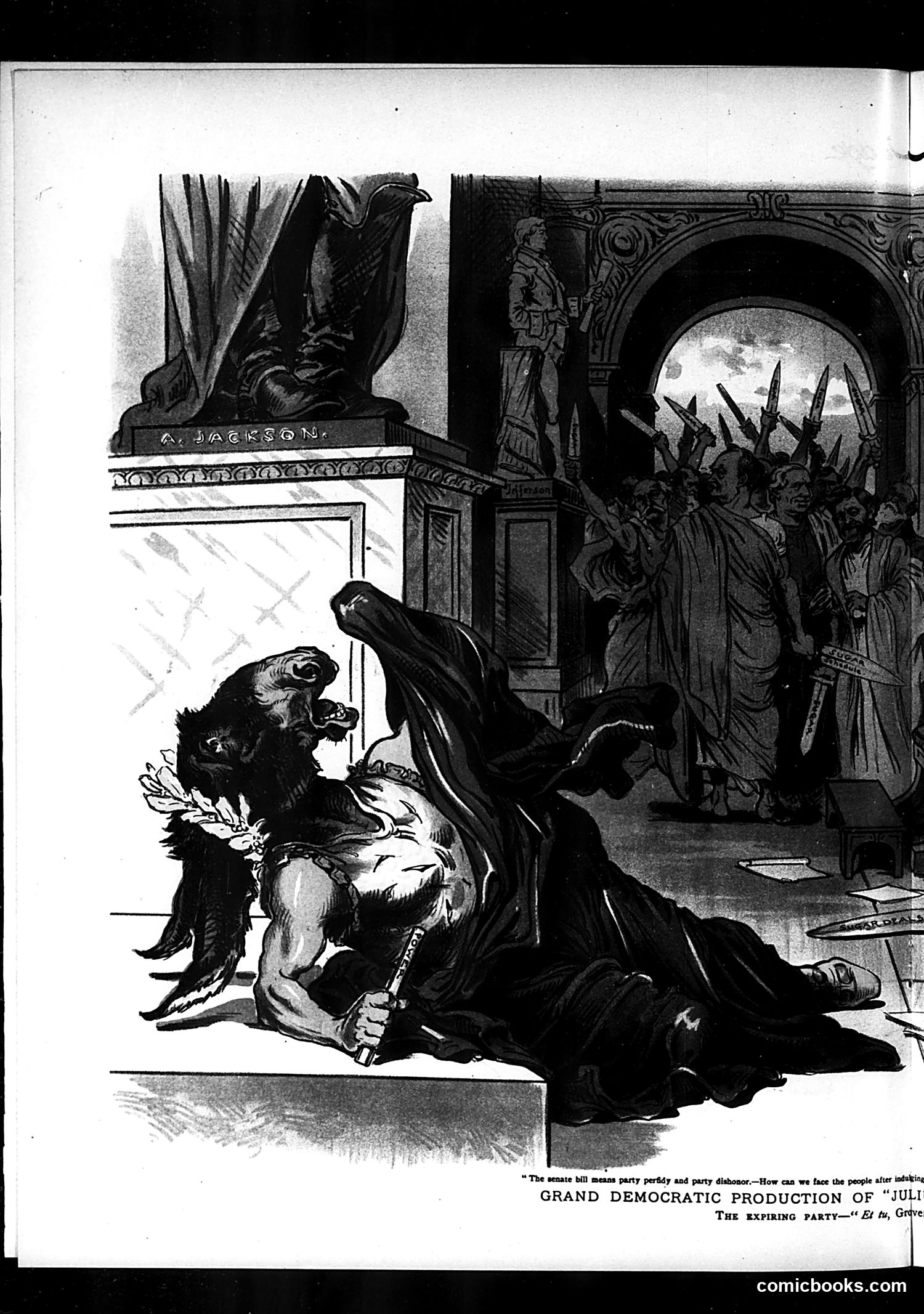
This Judge magazine cartoon satirizes Democratic Party internal conflict, likely from the late 19th century. The image shows a dying or fallen figure (representing the Democratic Party) clutching a dagger, while a crowd of armed figures emerges from a classical building (suggesting Congress or government). Above sits a raven perched on a "Jackson" monument, evoking Edgar Allan Poe's "The Raven" — a literary reference to doom and decay. The OCR'd caption references "senate bill" causing "party perfidy and party dishonor," suggesting the cartoon mocks Democrats for internal betrayal over legislation. The theatrical reference ("Grand Democratic Production") emphasizes the spectacle of Democratic self-destruction. The overall message: the Democratic Party is imploding through its own internal conflicts and legislative compromises, portrayed as self-inflicted tragedy.
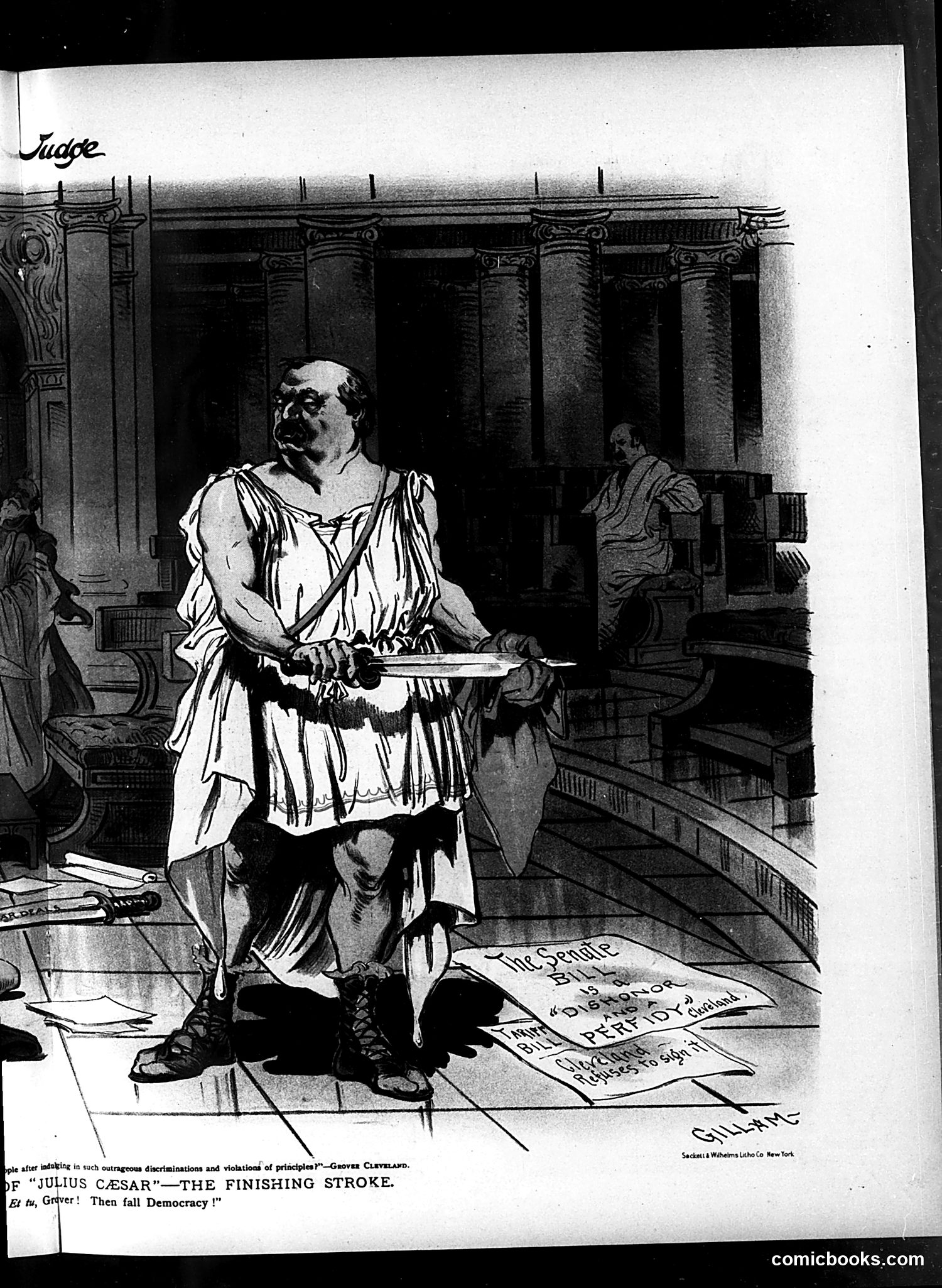
This political cartoon depicts a figure in Roman dress wielding a sword, labeled "THE FINISHING STROKE" to reference Julius Caesar's assassination. The scattered documents at his feet appear to be bills or legislation. The caption quotes Grover Cleveland condemning "outrageous discriminations and violations of principles," then adds a twist on Shakespeare's "Et tu, Brute?"—changing it to "Et tu, Grover!" The satire appears to criticize Cleveland (or someone Cleveland is addressing) for actions perceived as destroying democratic principles, comparing them to Caesar's assassination of the Republic. The cartoon suggests that certain political decisions represent a fatal blow to democracy itself. Without the specific date, the exact legislative controversy referenced remains unclear, though it likely concerns a controversial Cleveland-era policy.
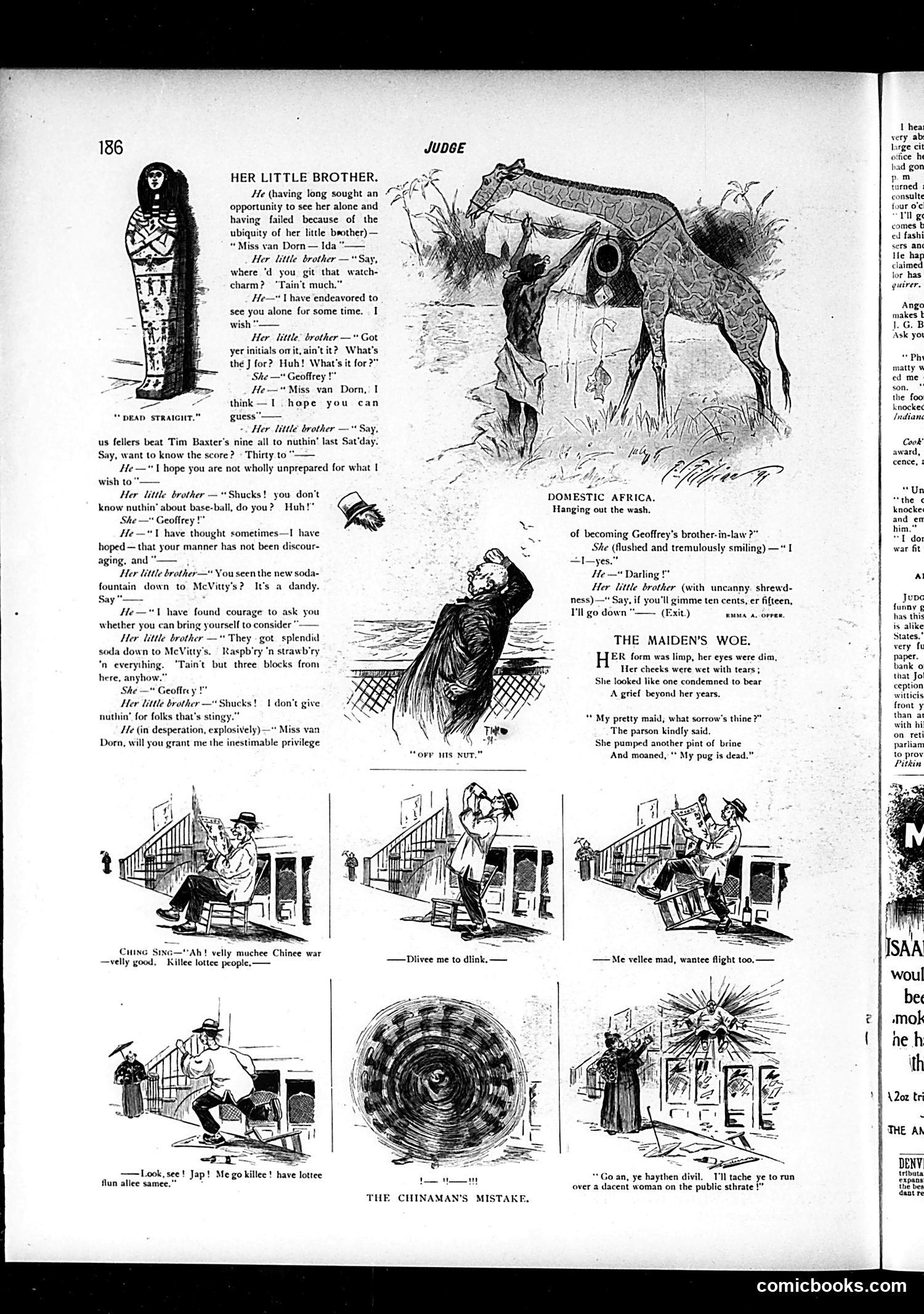
This page contains three satirical pieces typical of late 19th-century American humor: **"Her Little Brother"** (top): A romantic comedy where a young man repeatedly attempts to propose to Miss van Dorn, but her annoying little brother constantly interrupts with inane questions about watch charms, baseball scores, and local soda fountains. The satire mocks both the persistent suitor and the oblivious child who ruins the moment. The phrase "DEAD STRAIGHT" suggests the man's exasperation. **"The Maiden's Woe"** (right): A brief sentimental parody where a grief-stricken woman mourns—not a person, but her dead pet pug dog. The exaggerated emotion satirizes Victorian sentimentality and the era's obsession with lap dogs as status symbols. **"The Chinaman's Mistake"** (bottom): Comic strips using offensive racial stereotypes, depicting a Chinese immigrant's mangled English. The humor relies entirely on ethnic caricature, typical of period publications. The page reflects common Judge themes: romantic mishaps, class anxiety, and casual racism normalized in American popular culture of the era.
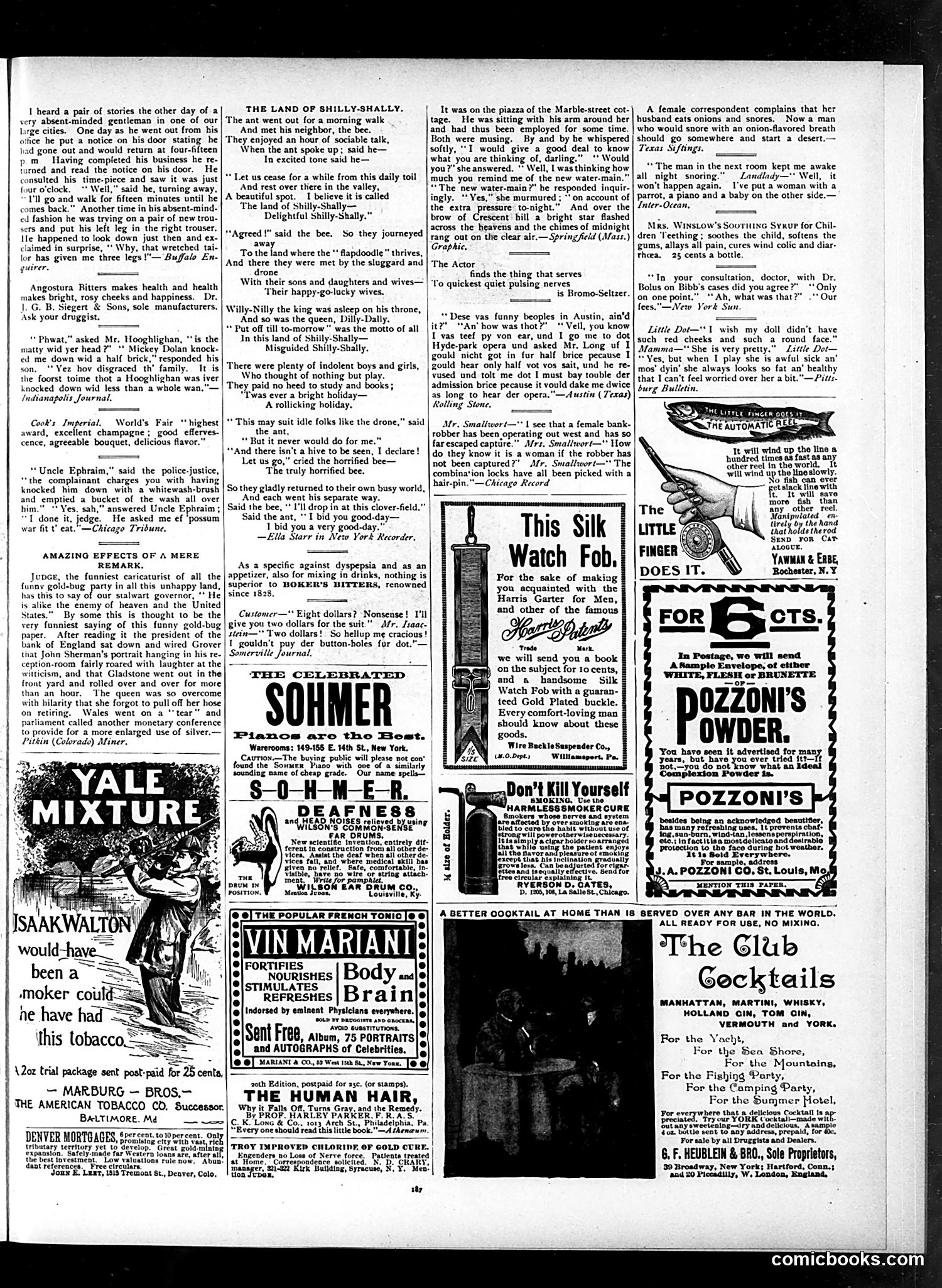
This page is primarily **advertising and light humor** rather than political satire. The visible content includes: **Main Feature: "The Land of Shilly-Shally"** A whimsical poem about an ant and bee visiting a fictional lazy kingdom ruled by King "Willy-Nilly" and Queen "Dilly-Dally." The satirical target is procrastination and indecision—the kingdom's motto is "Put off till to-morrow." This appears to be social satire about human laziness rather than political commentary. **Supporting Content:** Humorous anecdotes about absent-minded gentlemen and ethnic humor (Irish and African American dialect jokes typical of the era). **Advertisements:** Numerous patent medicines and consumer products dominate the page, including Angostura Bitters, Sohmer Pianos, and Pozzoni's Powder—standard Judge magazine filler. **Significance for Modern Readers:** The casual ethnic stereotyping in jokes reflects period attitudes. The main satire—mocking procrastination through fantasy—remains universally understandable, though historically specific references (like monetary policy debates) appear elsewhere on the page.
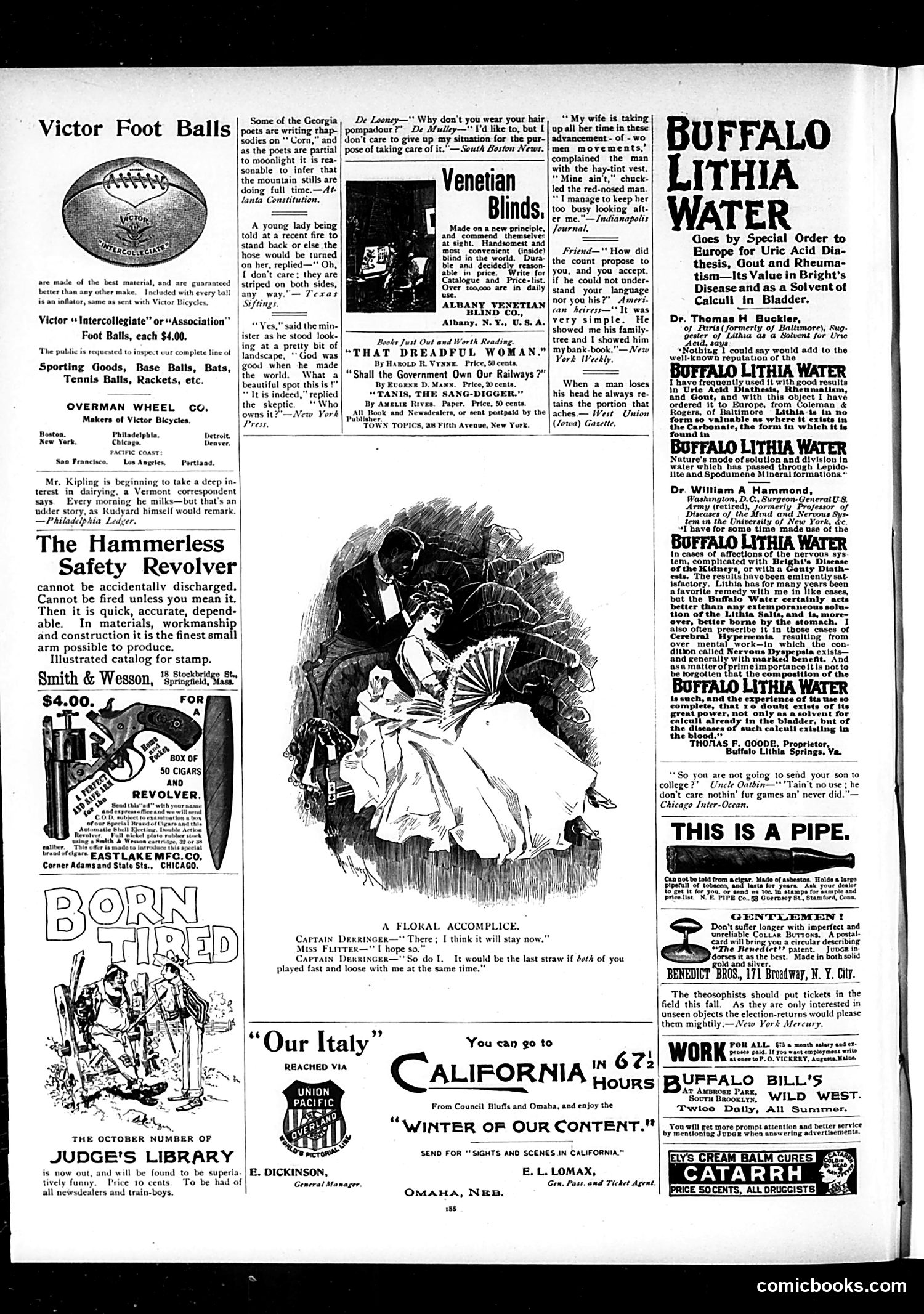
This page is primarily **advertising and light humor**, typical of Judge magazine's format. Key elements: **The Cartoons/Jokes:** The small illustrated jokes scattered throughout are genteel Victorian-era humor with no specific political content—quips about courtship, domesticity, and wordplay ("udder story" about Rudyard Kipling). **The Main Cartoon:** The large center illustration titled "A Floral Accomplice" depicts a flirtation between Captain Derringer and Miss Flitter, with the joke being that he threatens to "stay" with her in romantic commitment, and she worriedly agrees—suggesting entrapment through courtship. **The Advertisements:** The bulk of the page promotes: - Victor sporting goods (bicycles, footballs) - Smith & Wesson revolvers - Venetian blinds - Buffalo Lithia Water (claiming health benefits) - Union Pacific railroad travel to California **Historical Context:** There is no significant political satire here. The page reflects turn-of-century consumer culture and gentle domestic humor, with health-cure advertising (Buffalo Lithia Water) typical of the era's patent medicine marketing.
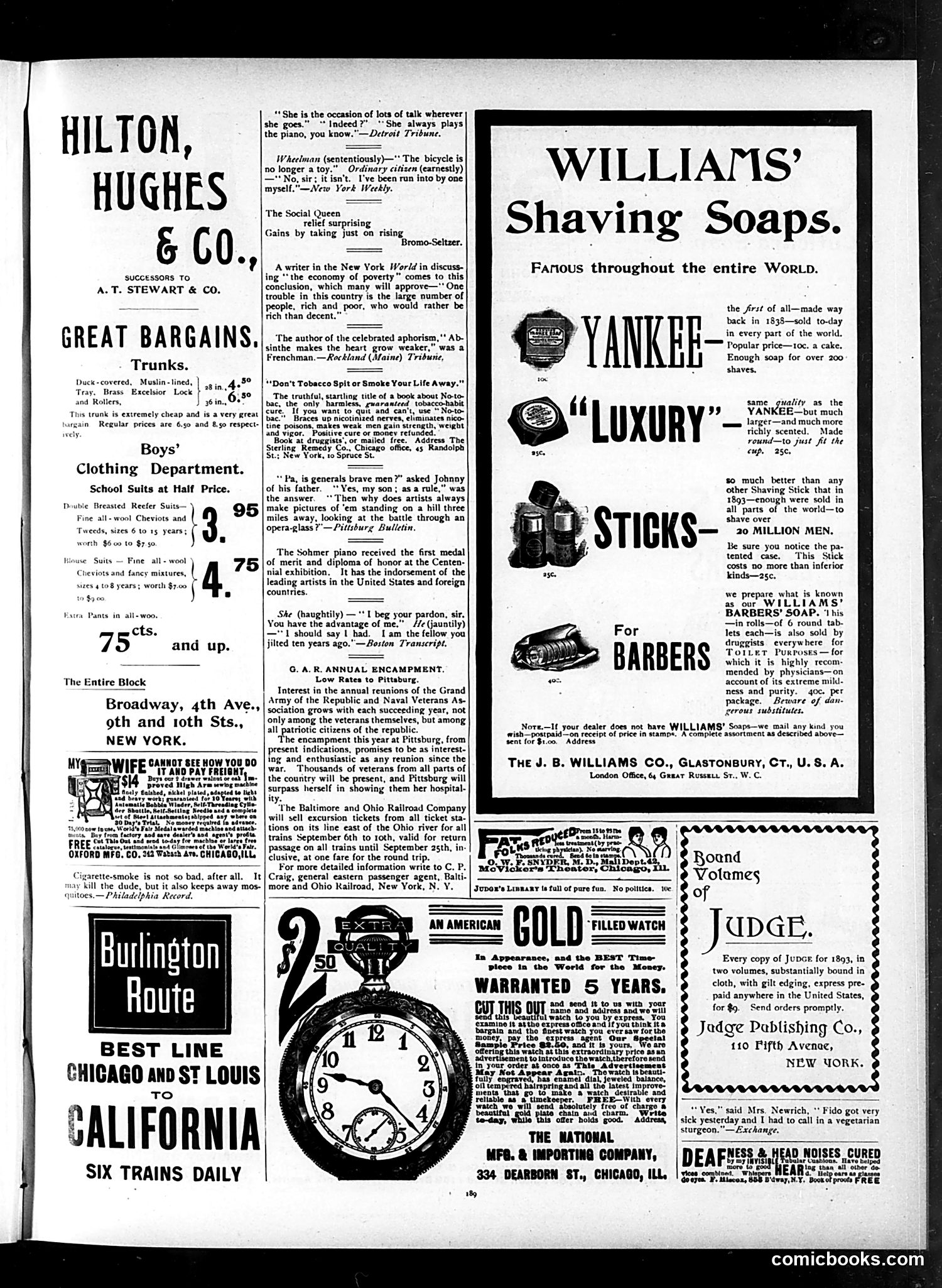
This page is primarily **advertising with light satirical content**, typical of Judge magazine's format. The visible satirical items are brief, quotation-based jokes: - A quip about a woman who "always plays the piano" being the subject of gossip - A "Wheelman" (cyclist) and ordinary citizen discussing how bicycles are dangerous, not toys - A joke about generals being depicted from miles away with opera glasses rather than in actual battle - A humorous exchange between a man and woman where he reveals he's someone she jilted ten years ago These are mild social observations rather than political satire—poking fun at pretension, bicycle culture, artistic convention, and romantic awkwardness. The jokes assume readers recognize these as common social situations worth light mockery. The page is dominated by department store advertisements (Hilton, Hughes & Co.), product ads (Bromo-Seltzer, No-to-bac tobacco cure, Williams' Shaving Soaps), and railroad promotions, reflecting the magazine's revenue model of mixing editorial content with commercial material.
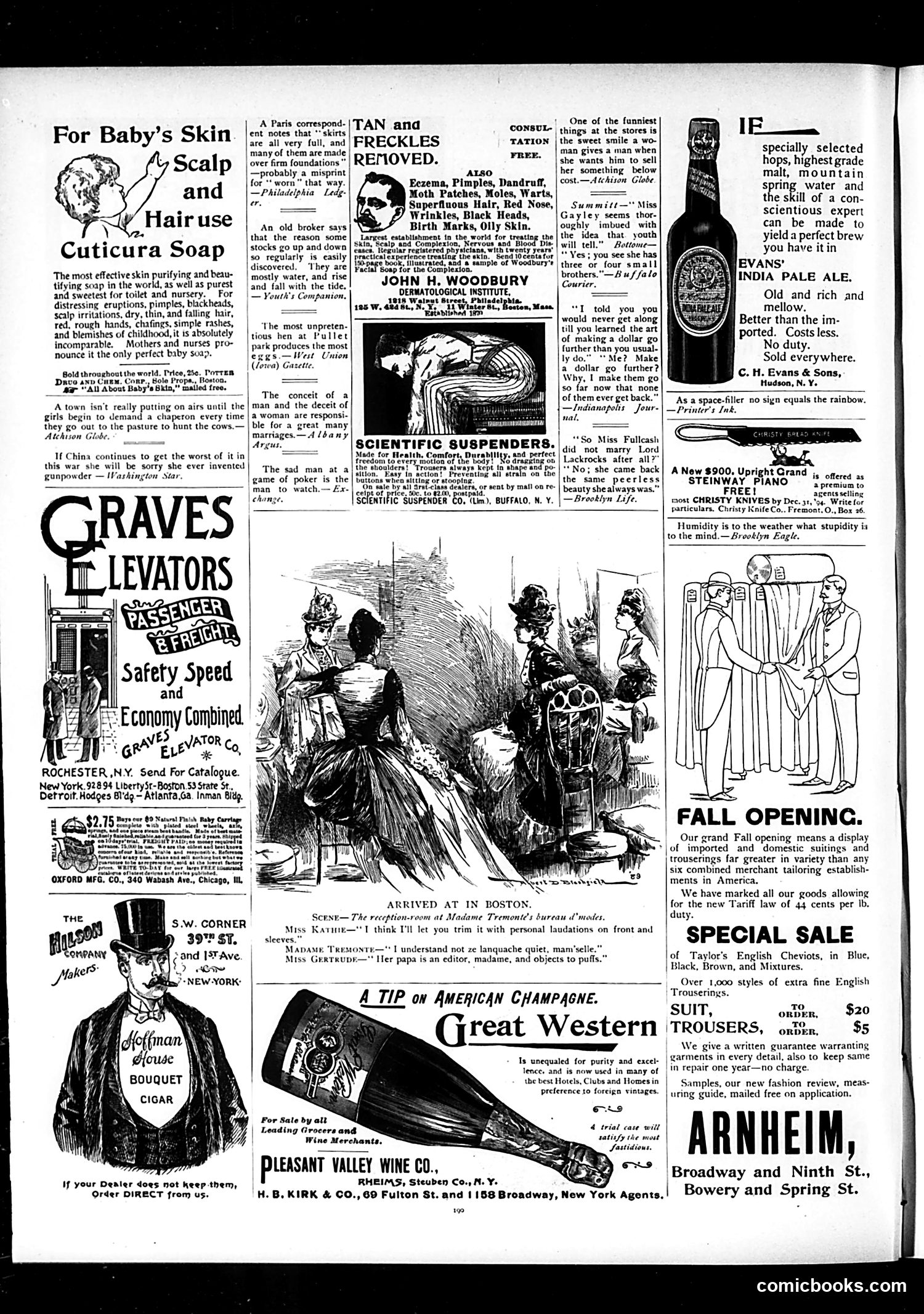
This page is primarily **advertising** from Judge magazine, typical of early-1900s periodicals. Rather than containing political cartoons, it features commercial ads for consumer products (Cuticura baby soap, Graves elevators, dermatology services, wine, pianos, clothing stores) interspersed with brief humor snippets—short satirical observations about daily life. The notable text items (about rural women hunting cows, China's gunpowder, stock market water content, poker faces) represent the magazine's editorial style: light social commentary poking fun at contemporary life—small-town pretension, gender relations, financial markets, and human nature. There are no identifiable political figures or major satirical targets. The page serves mainly as advertising space with filler humor.
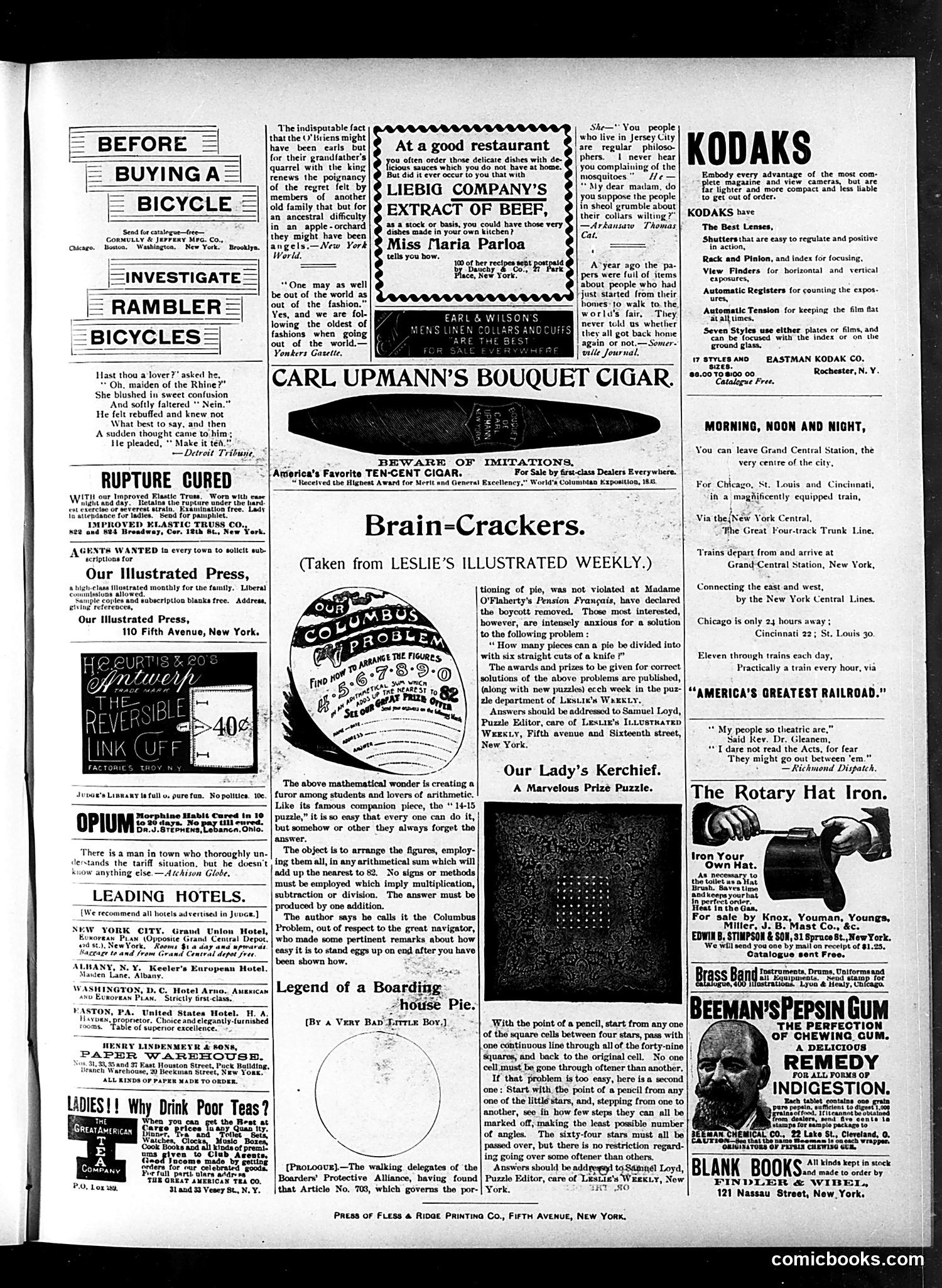
This page is primarily **advertising** with occasional satirical content typical of Judge magazine. The cartoons and jokes are scattered among commercial notices. The main satirical pieces include: - **"Before Buying a Bicycle"** — a brief advertisement for Rambler bicycles - **Short humorous quips** about regret, Jersey City mosquitoes, and courtship (the "Nein/tea" exchange) — these are lighthearted social commentary on urban life and romance - **"Brain-Crackers"** section with mathematical puzzles from Leslie's Illustrated Weekly, including a famous "pie-cutting" problem The page reflects **late 19th-century American consumer culture**, featuring Kodak cameras, Liebig beef extract, cigars, and patent medicines (rupture trusses, opium cures). The **satire is gentle**: poking fun at everyday anxieties (missing mosquitoes in Jersey, romantic rejection, World's Fair walkers who disappeared). There's no obvious political commentary—this appears to be a **leisure/lifestyle page** mixing advertising with mild domestic and social humor aimed at middle-class readers.
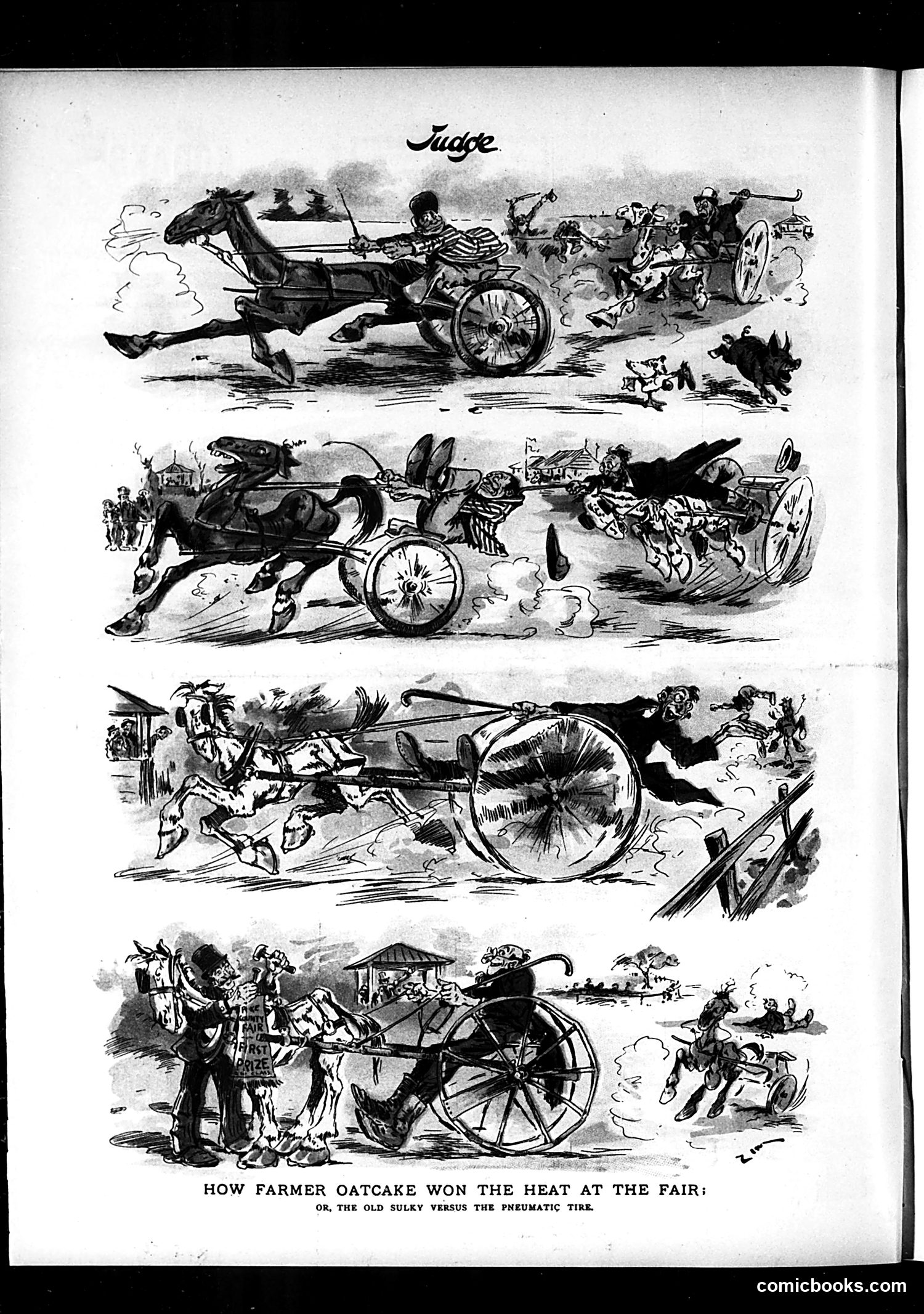
This page presents a four-panel satirical comic strip titled "How Farmer Oatcake Won the Heat at the Fair: or, The Old Sulky Versus the Pneumatic Tire." The narrative contrasts an old-fashioned horse-drawn sulky (a light racing cart) against a modern pneumatic-tired vehicle. Through sequential panels showing increasingly chaotic scenes, the comic depicts a racing competition where the farmer's traditional horse-and-sulky repeatedly outperforms the newer technology, which experiences various failures and mishaps. The satire mocks the era's enthusiasm for newfangled pneumatic tire technology by suggesting that proven, traditional methods remain superior. "Farmer Oatcake" appears to represent rural, common-sense practicality defeating urban technological pretension—a recurrent Judge magazine theme during the early automotive era when pneumatic tires were still novel and unreliable.