
A complete issue · 20 pages · 1894
Judge — May 5, 1894
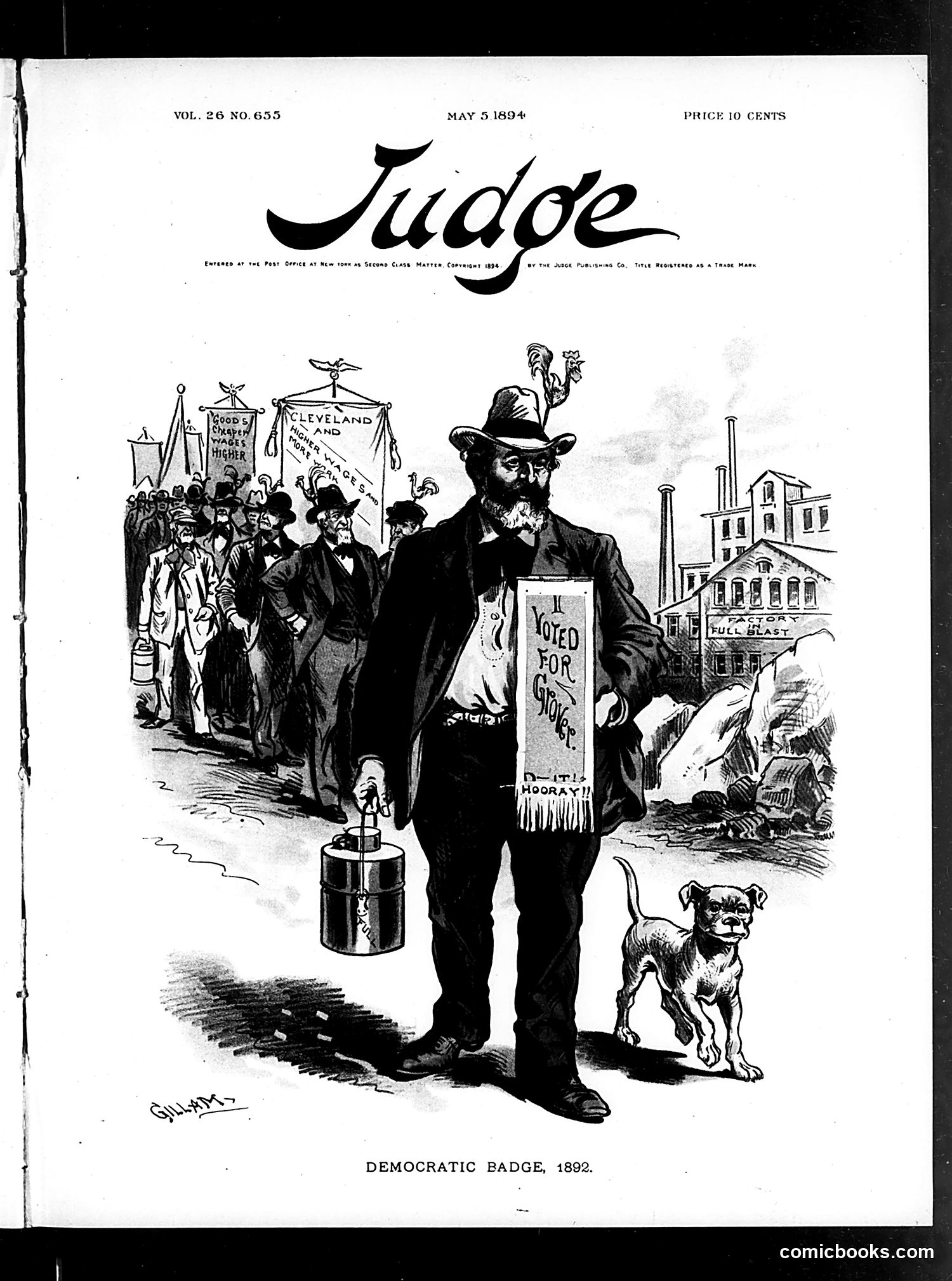
This Judge magazine cover satirizes the Democratic Party during the 1892 election cycle. The central figure—a bearded man wearing a hat with a rooster (symbol of the Democratic Party)—carries a bucket labeled "VOTED FOR STOVE" and wears a sash reading "VOTED FOR STOVE" with "HOORAY!" below. Behind him marches a crowd carrying banners referencing Cleveland, suggesting support for Grover Cleveland's presidential campaign. The satire appears to mock Democratic voters as foolishly devoted to their party despite poor outcomes. The "stove" reference likely alludes to economic hardship or failed Democratic policies. The small dog at his feet and industrial buildings in the background emphasize working-class struggle. The cartoon criticizes blind party loyalty during economically difficult times.
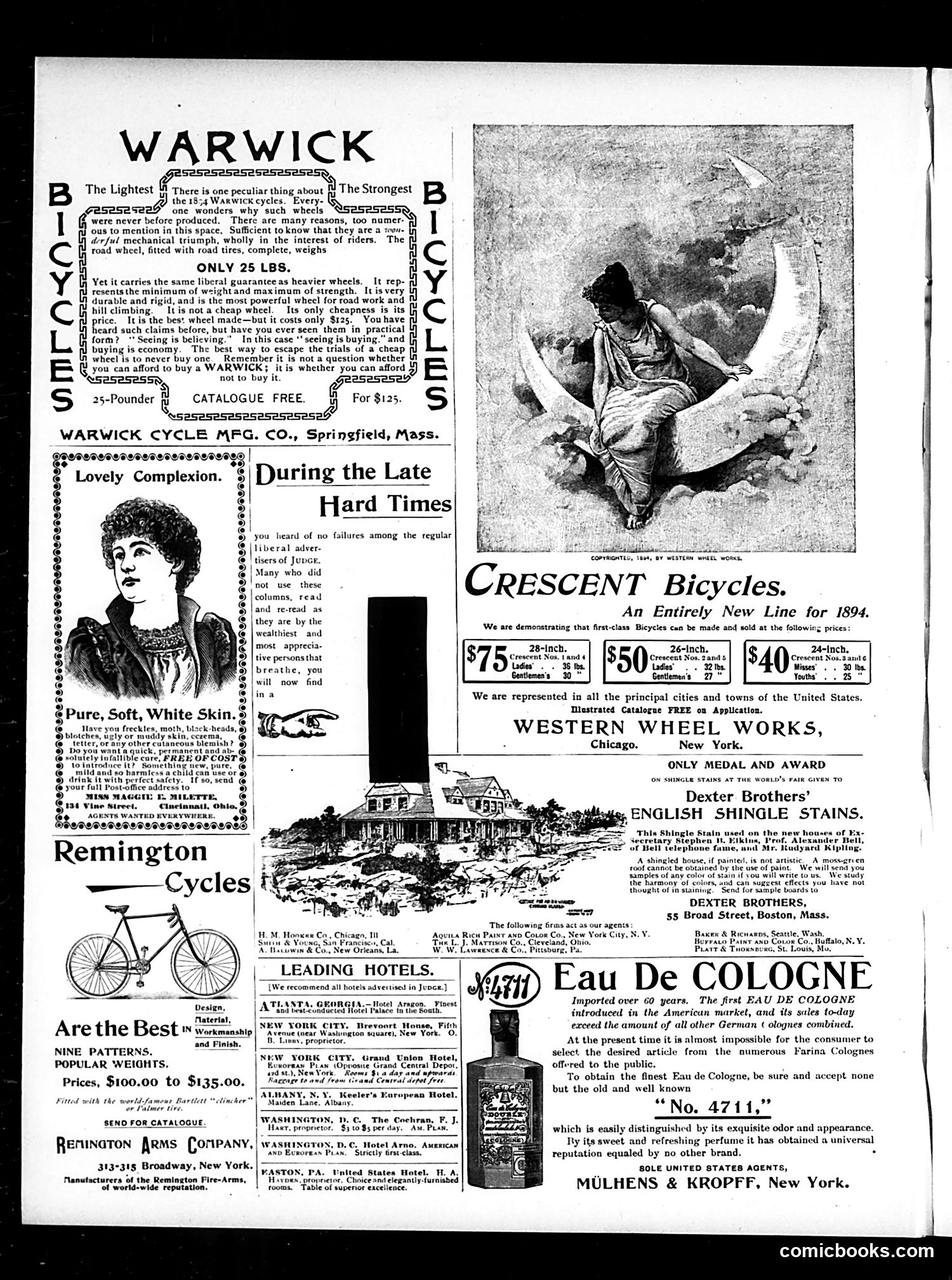
This page is primarily **advertising** with minimal satirical content. The dominant image shows a man in formal attire falling or tumbling dramatically—this appears to be **visual comedy** rather than political satire, likely promoting Crescent Bicycles with a humorous "hard times" scenario. The page features advertisements for: - Warwick Bicycles (25 lbs, $125) - Remington Cycles - Crescent Bicycles ($40-$75) - Dexter Brothers' English Shingle Stains - Eau de Cologne (No. 4711) - Lead Hotels listings - Beauty products The falling figure may suggest bicycles as practical transportation during economic hardship ("During the Late Hard Times"), but without clearer context, the specific satirical point is unclear. The page primarily represents Judge magazine's commercial function rather than political commentary.
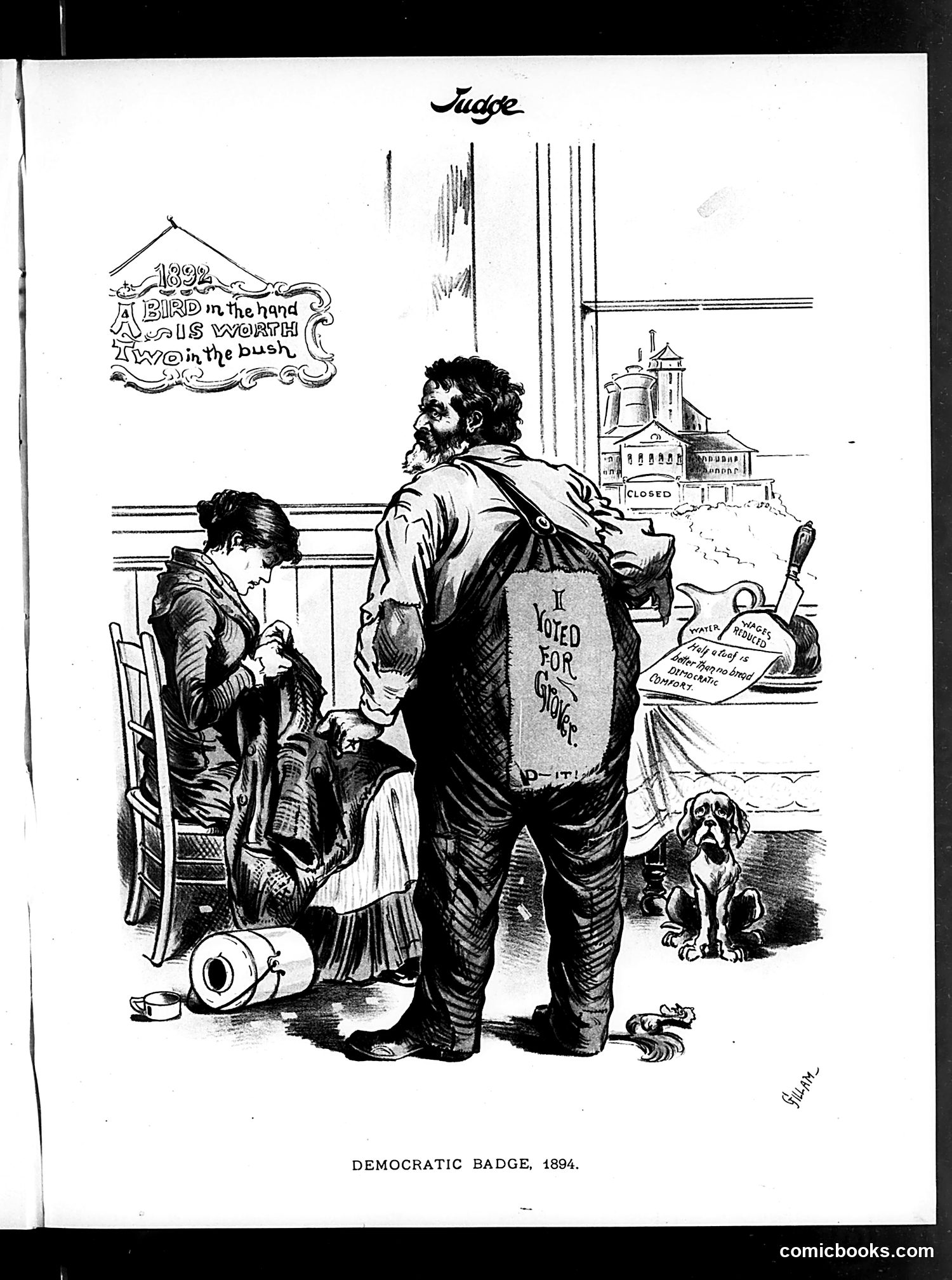
This Judge magazine cartoon satirizes the Democratic Party's political failures and broken promises. The central figure, a large man wearing a vest labeled "I VOTED FOR GROVER" (referring to President Grover Cleveland), appears impoverished and dejected. He's surrounded by family members in distress, with a closed government building visible in the background—likely referencing the economic depression of 1893. The proverb at top—"A BIRD IN THE HAND IS WORTH TWO IN THE BUSH"—suggests Democrats promised prosperity but failed to deliver. The man's worn clothing and despairing expression mock Democratic voters who supported Cleveland, only to face economic hardship during his presidency. The cartoon criticizes the party's inability to address the severe economic crisis affecting American families.
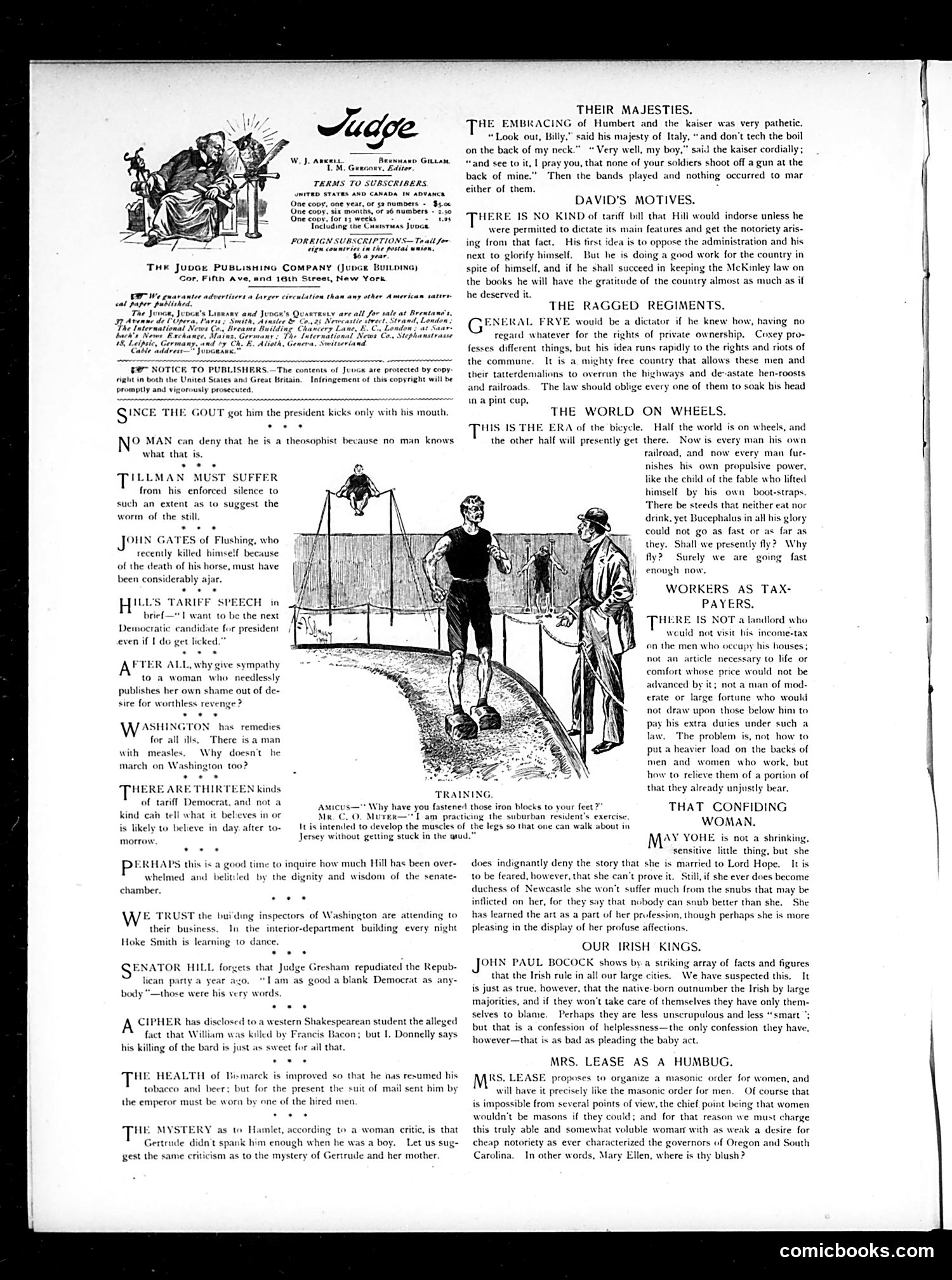
This page from *Judge* contains brief satirical quips targeting American political figures of the 1890s. Key targets include: **"THEIR MAJESTIES"**: Mocks King Humbert of Italy and the German Kaiser's embrace, suggesting their careful politeness masks underlying tensions—a jab at diplomatic posturing. **"DAVID'S MOTIVES"**: Attacks David B. Hill, a Democratic senator, claiming he'll only support tariff legislation if he controls it and receives credit. The satire suggests his opposition to McKinley's tariff is purely self-serving, though admittedly beneficial to the country "in spite of himself." **Other snippets** mock Tillman (enforced silence), Senator Hill's ambitions, and various political figures. References to "the McKinley law" indicate this is from the 1890s, during debates over protective tariffs. The cartoons satirize politicians' vanity, inconsistency, and self-interest—typical *Judge* fare ridiculing both parties through personal attacks rather than substantive policy critique.
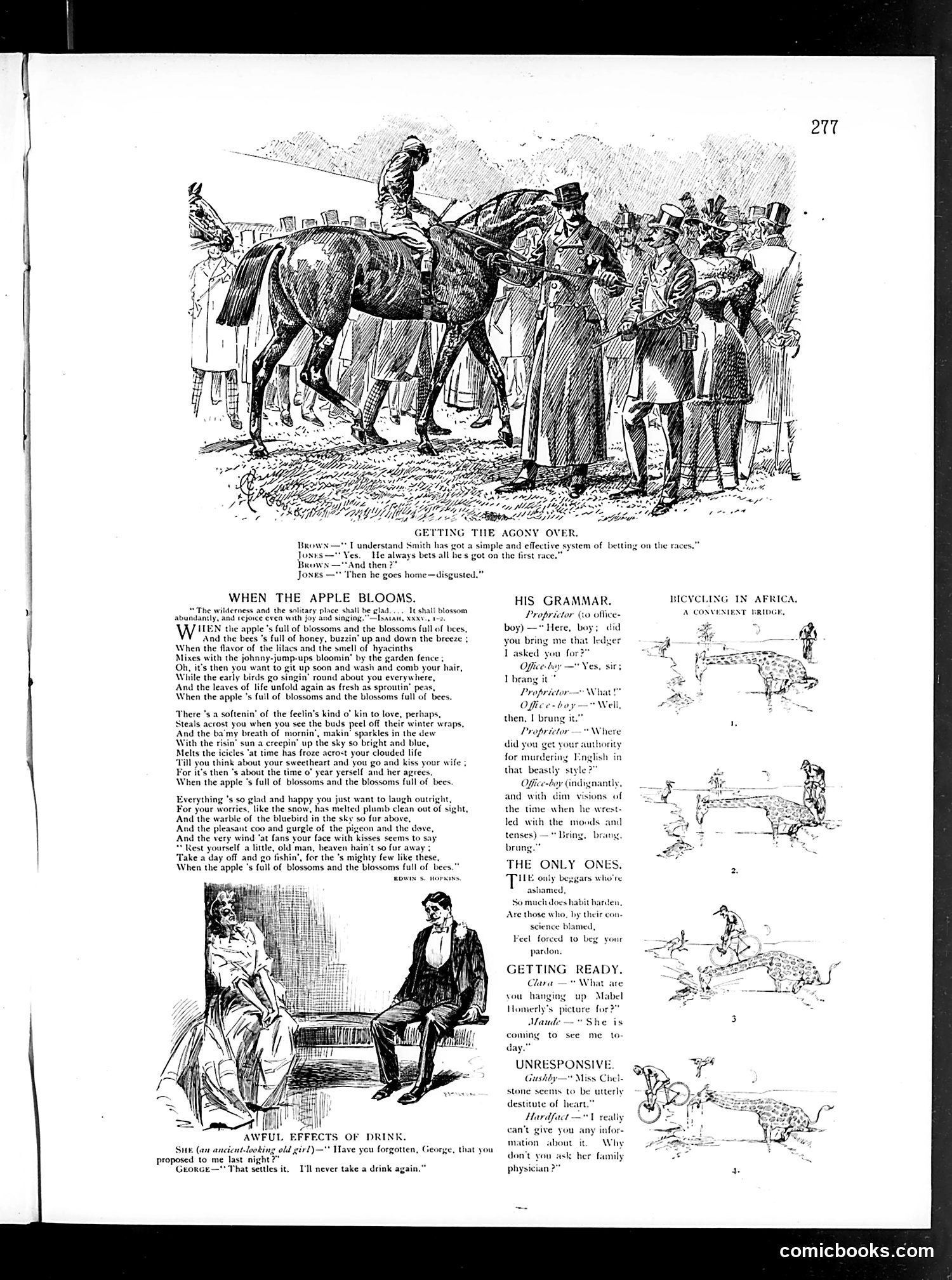
**Top Cartoon: "Getting the Agony Over"** A dialogue joke about horse racing. Brown and Jones discuss a man with a "simple and effective system" for betting—he wagered everything on the first race, lost, and went home "disgusted." The satire mocks both compulsive gambling and the false confidence of amateur bettors who mistake recklessness for strategy. **"When the Apple Blooms"** A sentimental poem celebrating spring's renewal and its effect on reconciling married couples. The lengthy verse contrasts with other page content, appearing to be filler material common in 19th-century magazines. **Bottom Sections** Several brief sketches: "Awful Effects of Drink" (a man swears off alcohol after a woman reminds him of a drunken proposal), "His Grammar" (satirizing poor English usage), "Bicycling in Africa" (small illustrations of cyclists), and "Getting Ready" (presumably about preparations for courtship). The page represents typical Judge content: topical humor, class-conscious satire, and sentimental verse mixed with domestic comedy and moral messaging about drinking and propriety.
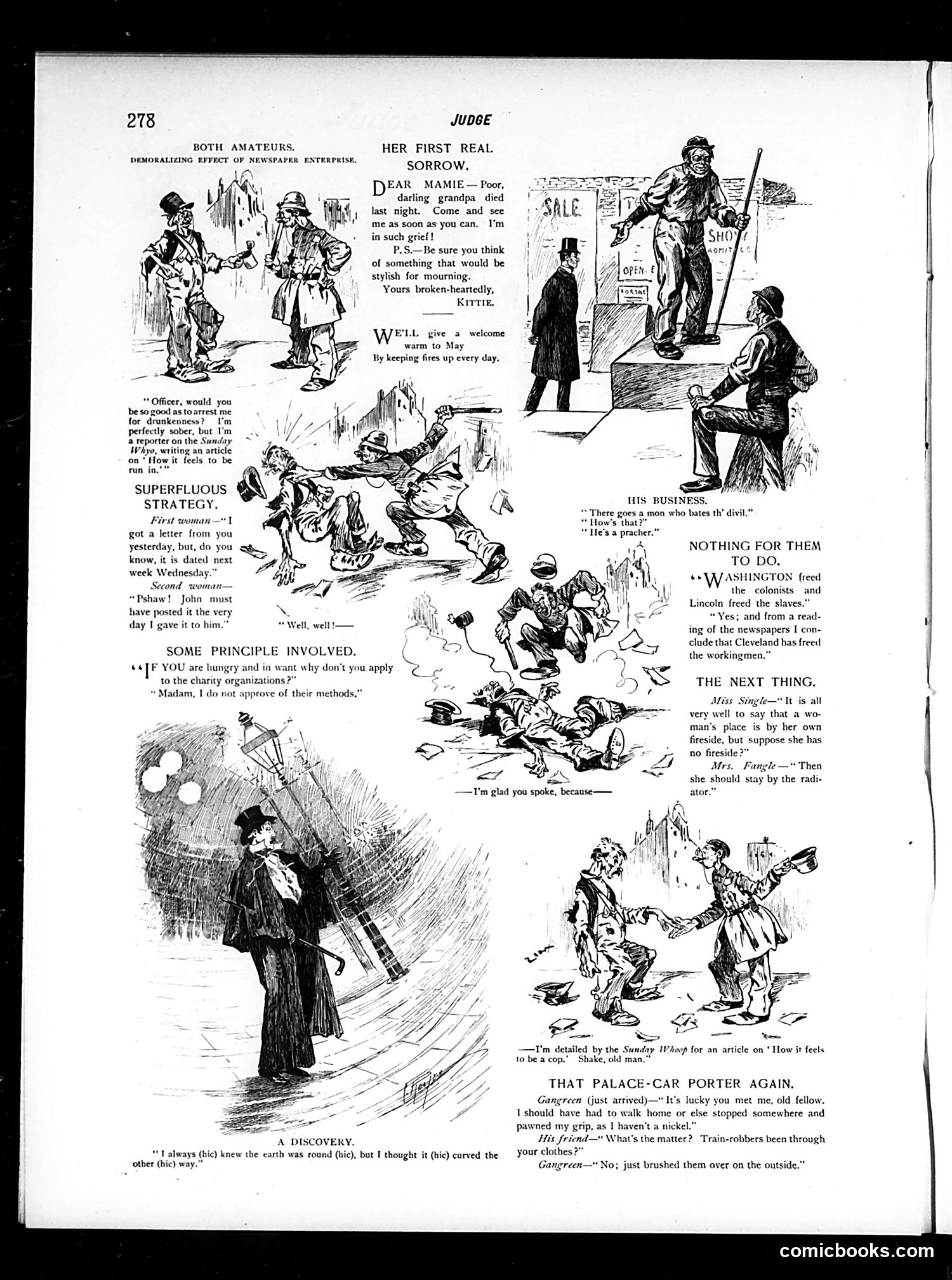
This page from Judge magazine contains multiple satirical cartoons mocking amateur pretense and newspaper sensationalism (likely 1880s-90s era). **"Her First Real Sorrow"** satirizes shallow grief: a girl's letter about her grandfather's death includes a postscript asking what's "stylish for mourning"—mocking superficial mourning etiquette over genuine emotion. **"Both Amateurs"** depicts a drunk reporter arrested while researching an article "How it feels to be run in"—satirizing yellow journalism's fake authenticity and reporters creating false experiences for stories. **"Superfluous Strategy"** shows a hungry man refusing charity because he disapproves of "their methods"—mocking principled poverty and counterproductive pride. **Other sketches** target pretension: someone wanting arrest for an article, a man obsessed with writing about being a cop, references to Cleveland and workingmen (likely political commentary on labor issues). The page's theme: amateurs and pretenders creating artificial experiences rather than living authentically—a critique of both journalism ethics and social pretense.
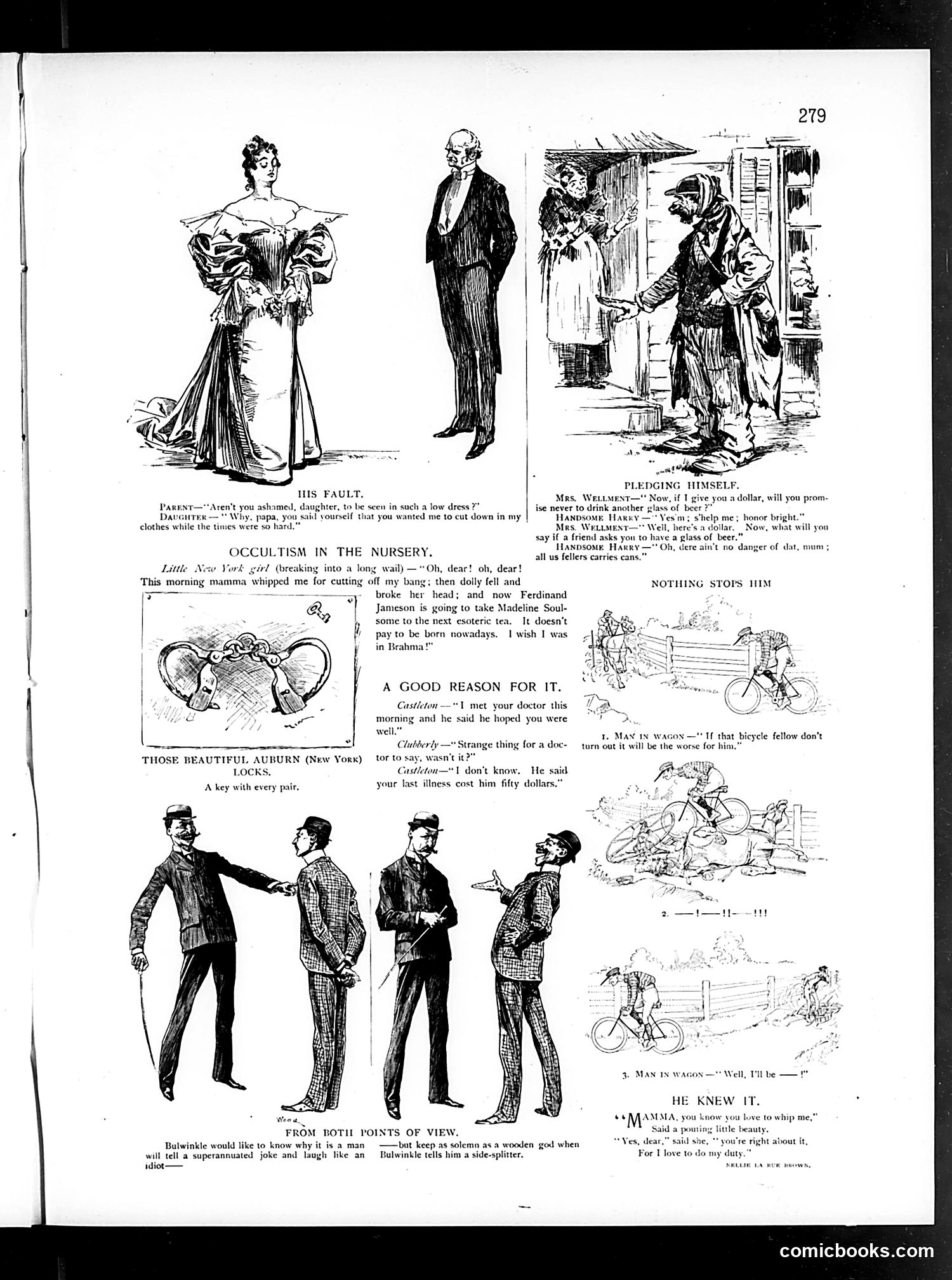
This page contains multiple satirical sketches typical of late 19th-century humor magazines: **"His Fault"** mocks parental hypocrisy—a father demands his daughter dress modestly while he himself wears fashionable low-cut clothing. **"Occultism in the Nursery"** ridicules trendy spiritualism/mysticism fads among wealthy New Yorkers through a child's exasperated complaints about her chaotic day. **"A Good Reason for It"** jokes about a doctor's financial self-interest—he hopes a patient stays sick since the illness cost him fifty dollars in unpaid fees. **"From Both Points of View"** satirizes how the same person can be solemn with superannuated (outdated) jokes yet laugh uproariously at someone else's identical joke—poking fun at social hypocrisy. **"Nothing Stops Him"** appears to depict a cyclist's dangerous indifference to warnings from a wagon driver, suggesting commentary on reckless new bicycle culture. The sketches collectively target contemporary social pretension, medical greed, and emerging fads.
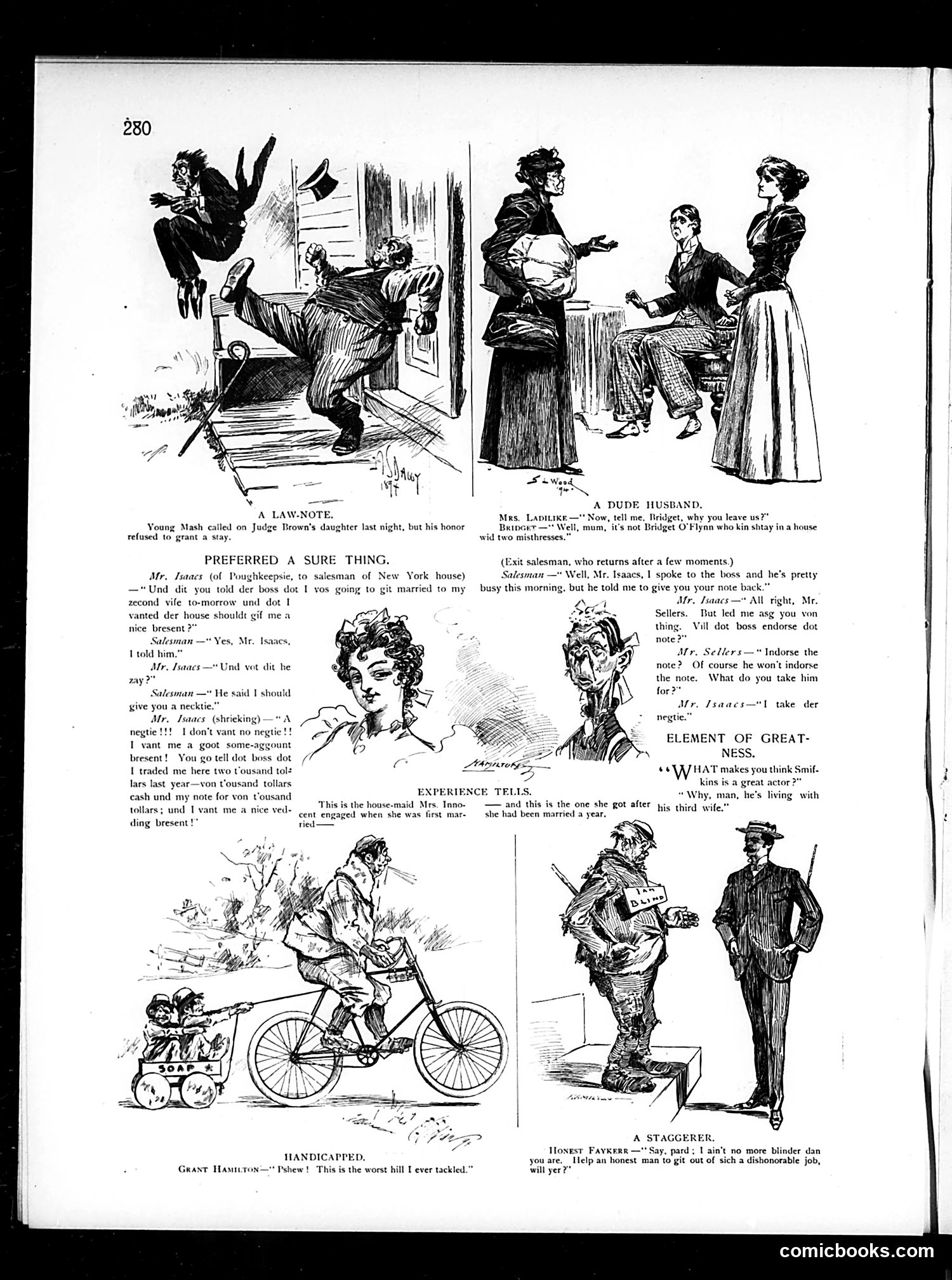
This page contains multiple satirical vignettes mocking social types and gender dynamics of the era: **"A Law-Note"** jokes about a young man's failed courtship attempt. **"Preferred a Sure Thing"** features Mr. Isaacs, a Yiddish-accented immigrant businessman, complaining that his boss offered only a necktie as a wedding gift despite his loyalty. The humor exploits ethnic stereotyping of Jewish merchants' mercenary attitudes. **"A Dude Husband"** depicts a servant leaving because the husband has a mistress, mocking infidelity among the wealthy. **"Experience Tells"** contrasts an innocent housemaid with a worldly-wise one, suggesting married experience teaches cynicism. **"Handicapped"** shows a cyclist struggling uphill—Grant Hamilton's caption suggests "worst bill I ever tackled," likely a pun on financial debt. **"Element of Greatness"** satirizes shallow celebrity worship, suggesting a man is "great" merely for having multiple wives. **"A Staggerer"** presents an honest man requesting help escaping dishonorable work, criticizing workplace corruption. The page exemplifies Judge's emphasis on ethnic humor, marital infidelity, and social class commentary.
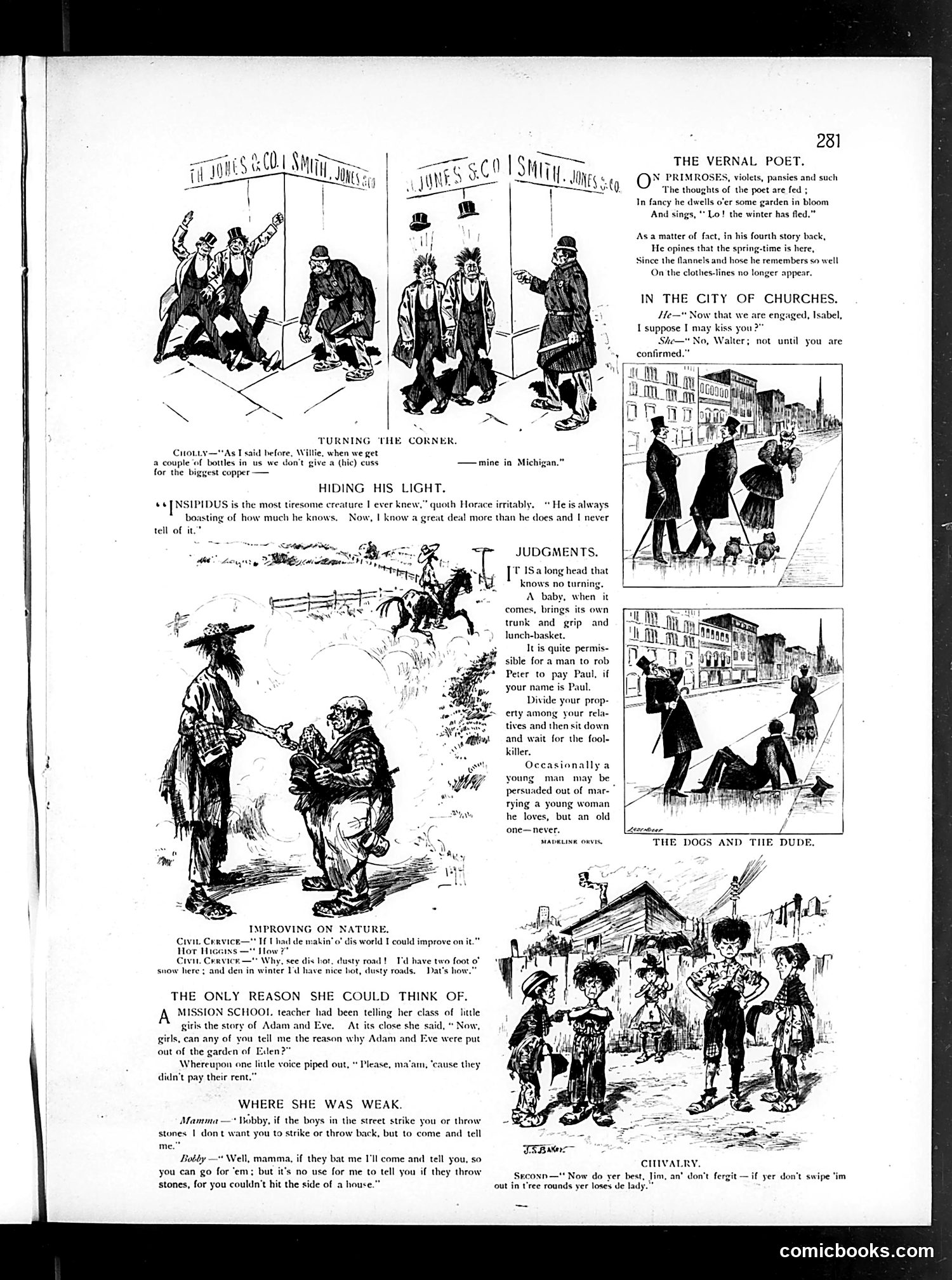
This page features satirical commentary on turn-of-the-century American life through short jokes and cartoon vignettes. **"The Vernal Poet"** mocks romantic poetry by contrasting the poet's flowery spring verses with his mundane reality: he notices spring only because his winter underwear has disappeared from clotheslines. **"In the City of Churches"** satirizes religious formality—a couple cannot kiss until the man is confirmed, suggesting excessive adherence to ecclesiastical protocol over genuine emotion. **"Hiding His Light"** skewers false modesty: Horace claims he knows far more than his boastful acquaintance but never mentions it, implying his silence is actually prideful self-restraint. Scattered throughout are humorous "Judgments"—pithy observations about human nature covering babies, morality, and romance. **"The Only Reason She Could Think Of"** presents a child's logic: when asked why Adam and Eve were expelled, she concludes they didn't pay rent—reducing theological doctrine to landlord-tenant relations. The remaining sketches similarly use working-class characters and children's naive interpretations to satirize contemporary social pretensions and adult hypocrisy.
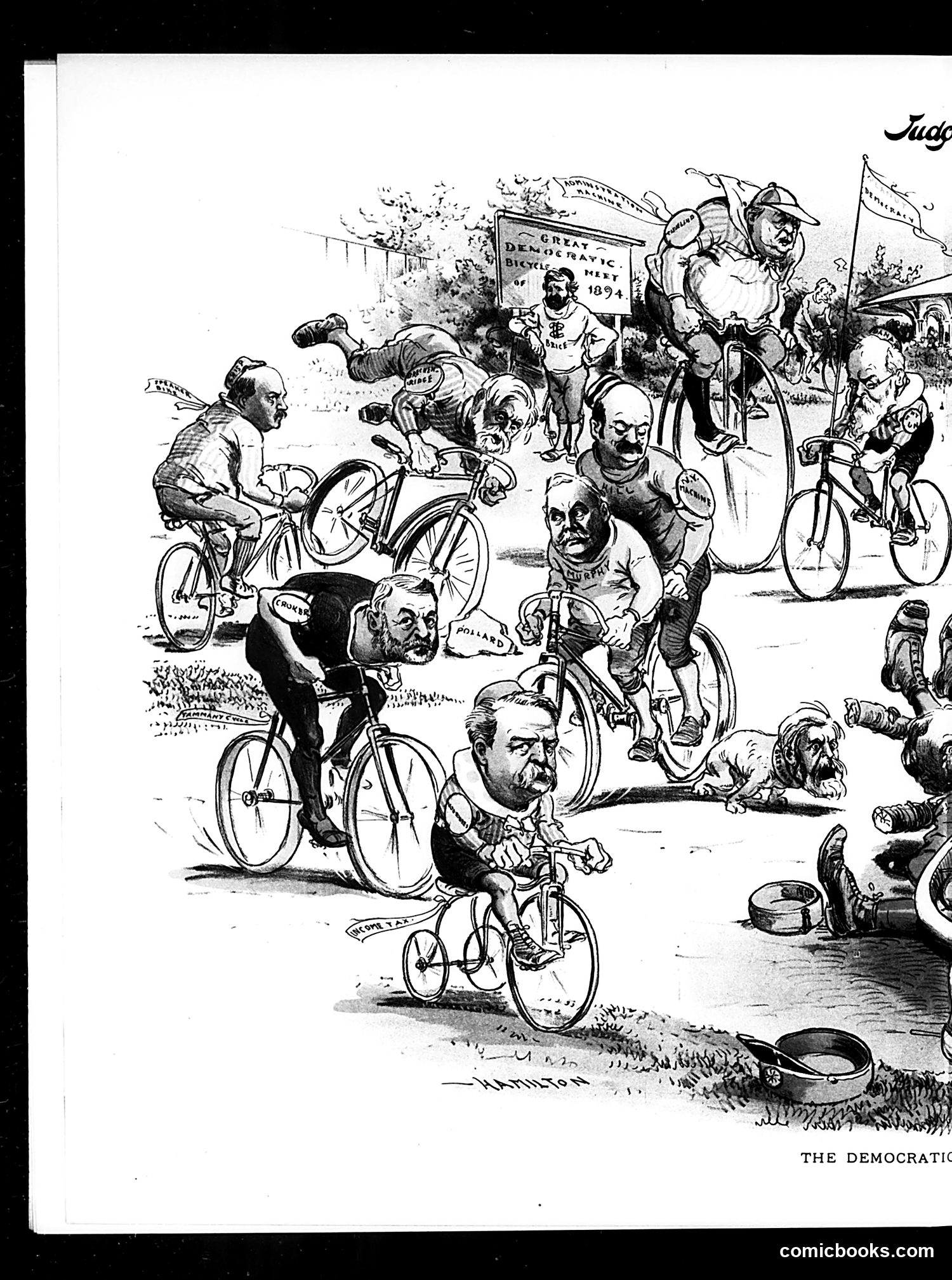
This 1894 *Judge* cartoon satirizes the Democratic Party as a chaotic bicycle race. The caricatured figures—appearing to represent Democratic politicians and factions—ride bicycles of various sizes and conditions, suggesting organizational disorder and internal conflict. The "Great Democratic Meet of 1894" banner references the 1894 midterm elections. The jumbled riders, some struggling or falling, mock Democratic disunity during President Grover Cleveland's second term, a period marked by economic depression (the Panic of 1893) and party fracturing between Cleveland's conservative wing and populist/silver advocates. The satirical point: Democrats were depicted as unable to coordinate effectively, with competing interests pulling the party in different directions—a visual metaphor for political dysfunction.
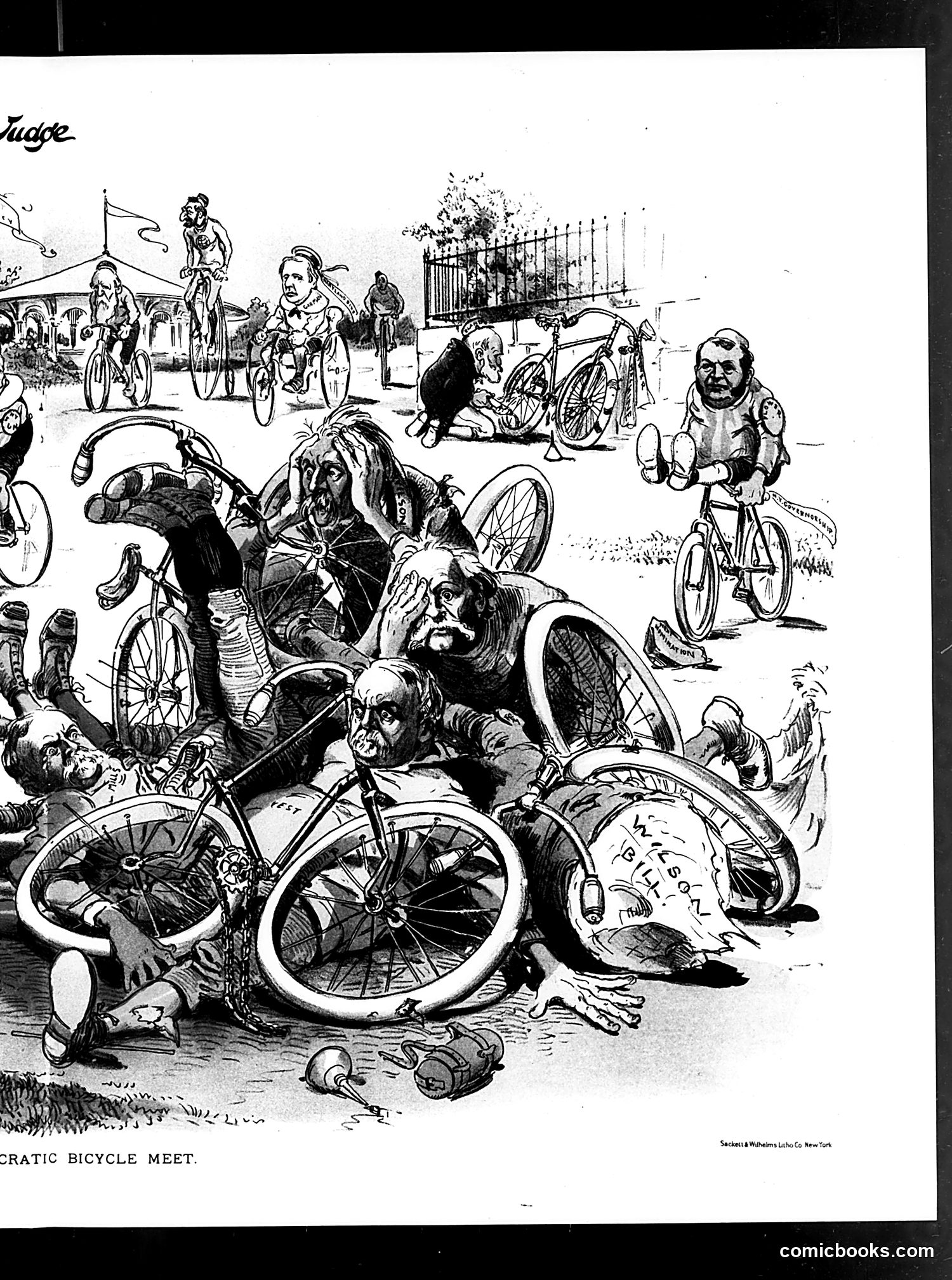
This political cartoon satirizes the Democratic Party, depicting its members as chaotic, incompetent cyclists who have crashed and tangled together in a disastrous heap. The title "Democratic Bicycle Meet" suggests what should be an organized event has devolved into complete disorder. The caricatured figures—rendered with exaggerated, unflattering features typical of late 19th-century Judge magazine—sprawl amid overturned bicycles, fallen riders, and debris. Meanwhile, better-organized Republican cyclists (shown upright and in control in the background) observe the mess with apparent smugness. The cartoon mocks Democratic Party disunity, incompetence, or internal conflict, using the bicycle-meet metaphor to suggest the party cannot even coordinate basic activities. It's partisan propaganda favoring Republicans.
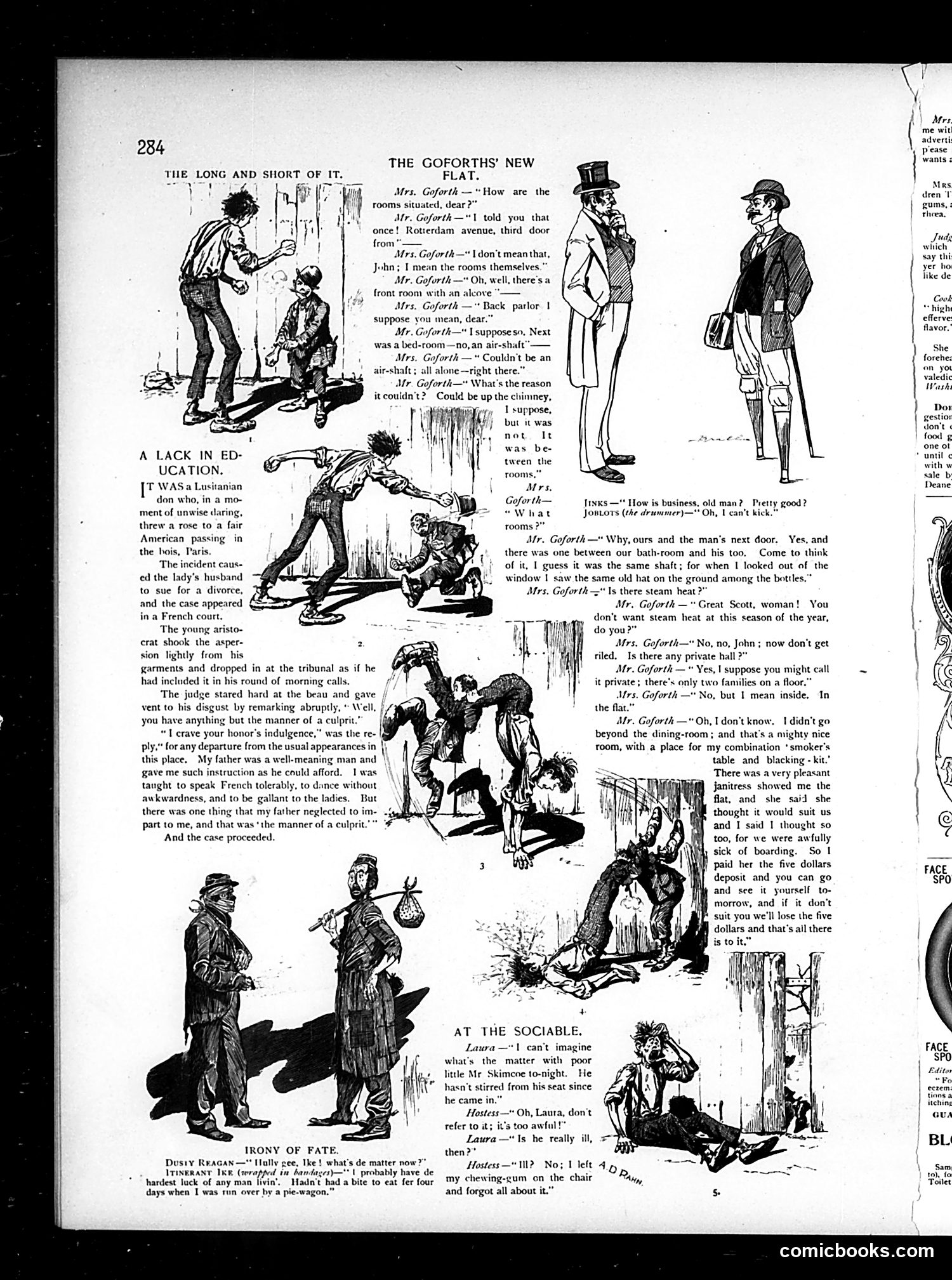
This page contains several short humor pieces typical of *Judge* magazine's satirical style: **"The Long and Short of It"** depicts a married couple apartment hunting. Mrs. Goforth repeatedly misunderstands her husband's architectural descriptions—he says "air-shaft," she hears "back parlor"; he mentions an alcove, she corrects him. The satire targets miscommunication between spouses and the absurdity of cramped urban tenement living, where features like air-shafts (ventilation spaces between buildings) and shared plumbing were standard complaints. **"A Lack in Education"** mocks a Portuguese aristocrat sued for throwing a rose at an American woman. In court, he protests he was taught French, dancing, and gallantry but never "the manner of a culprit"—satire on European aristocratic pretension meeting American legal seriousness. **"Irony of Fate"** shows a battered man claiming he had no food for days before being hit by a "pie-wagon"—dark humor about urban poverty and misfortune. **"At the Sociable"** jokes that a guest won't leave his seat because the hostess lost her chewing gum on his chair—absurdist humor about social embarrassment. The cartoons use exaggerated character types and working-class scenarios common to turn-of-the-century American humor.
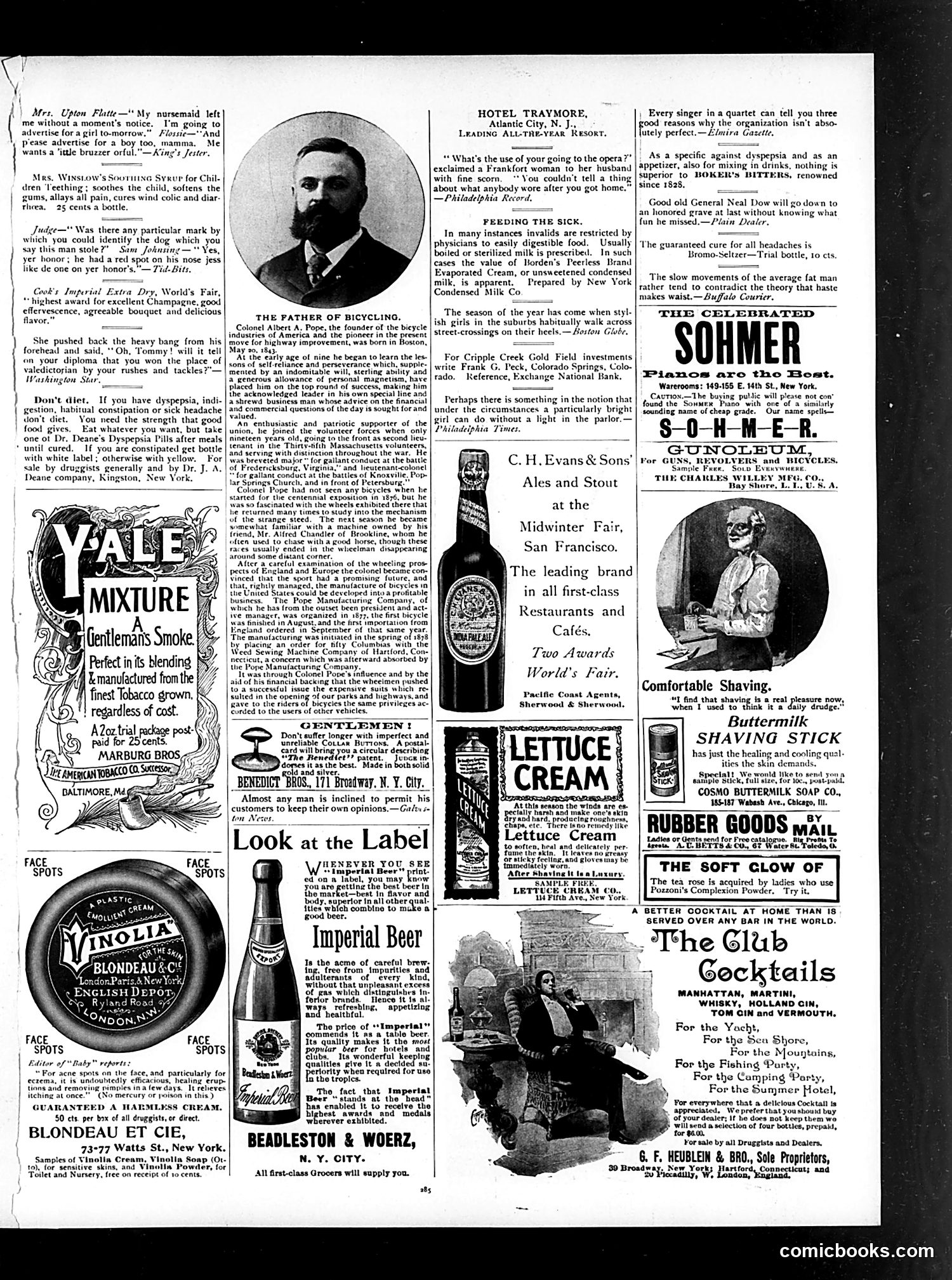
This page is primarily **advertising**, with a small joke at the top and a biographical profile of Colonel Albert A. Pope ("The Father of Bicycling"). **The joke content:** A brief domestic humor piece about a nursemaid quitting, followed by a courthouse joke where a witness identifies a stolen dog by a red spot on its nose—mimicking the judge's own facial mark. This is gentle wordplay rather than satire. **The main feature** is a laudatory biography of Colonel Pope, founder of the American bicycle industry. The text celebrates his self-reliance, business acumen, and Civil War service (breveted major for gallantry). The article presents his discovery of bicycles at the 1876 Centennial Exposition as transformative, showing how he became the cycling industry pioneer. The remaining space contains period patent medicines, beer advertisements, and grooming products—typical Judge magazine filler advertising the era's dubious health remedies and consumer goods. **No political satire is present** on this page; it's essentially a promotional/advertising issue with light humor.
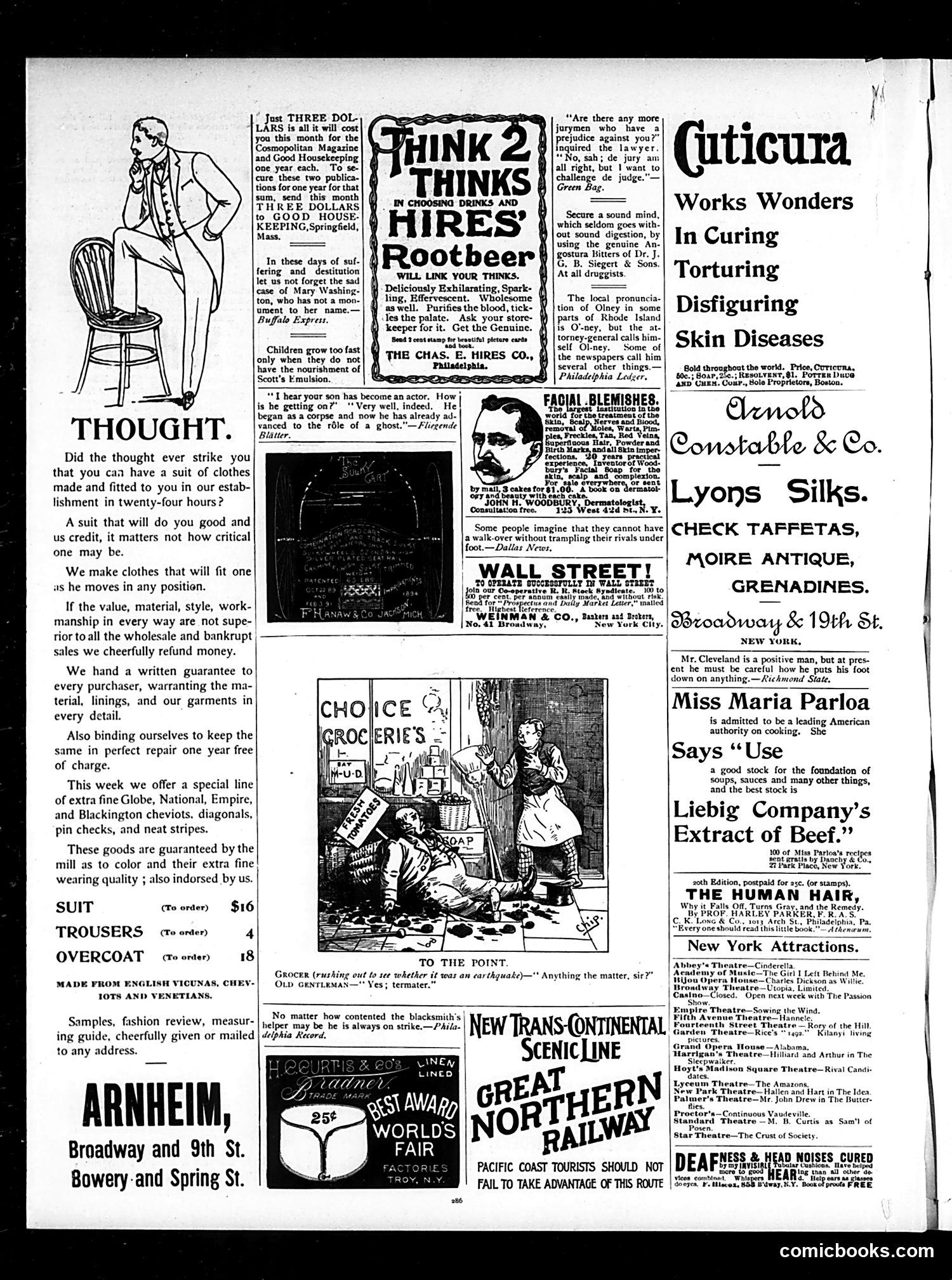
This page is primarily **advertising and commercial content** rather than political satire. The main cartoon, titled "TO THE POINT," depicts a grocer dealing with a messy customer interaction—likely satirizing everyday commercial disputes rather than political issues. The page features numerous product advertisements (clothing by Arnheim, Cuticura skin treatments, Liebig Company's Extract of Beef, railroad services) typical of Judge's revenue model. There's a small "THOUGHT" illustration about men's clothing quality, emphasizing proper fit. The overall tone is lighthearted social commentary on consumer culture and personal appearance rather than political satire. Without visible dates or specific historical references, the exact era remains unclear, though the typography and advertising style suggest early 20th century.
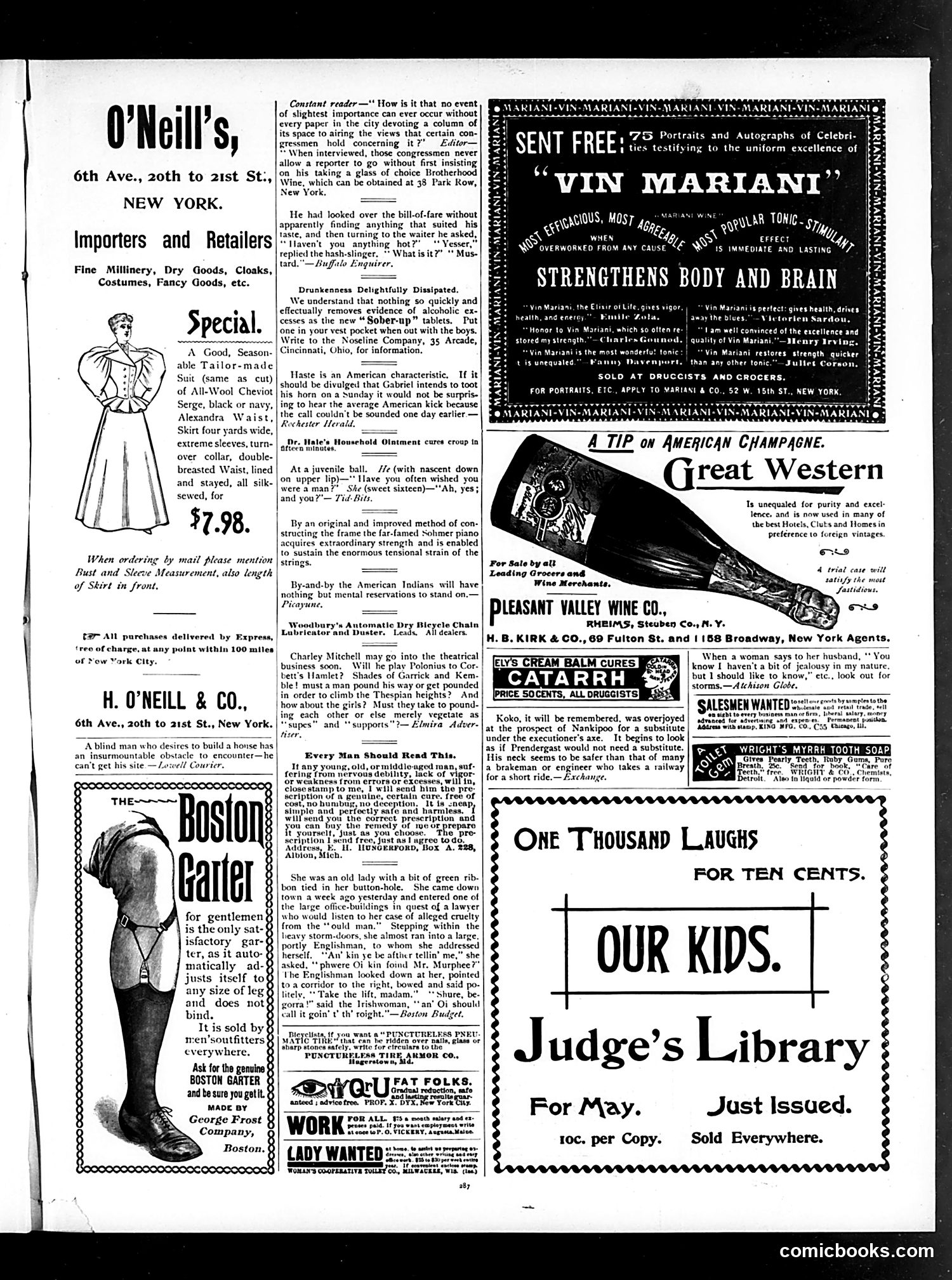
This page is primarily **advertising**, not political satire. It contains: **Main Content:** - Department store ads (O'Neill's clothing, Boston Garter hosiery) - Wine and tonic advertisements - Various patent medicines and remedies (for drunkenness, male vigor, croup) **Brief Comic Items:** The small jokes scattered between ads are mild observational humor typical of the era: - A congressman anecdote mocking politicians' tendency to promote themselves - A waiter joke about "hot" mustard - A jab at American impatience regarding religious matters - Light romantic banter at a children's dance **Social Context:** These ads reflect Gilded Age consumer culture and prevalent medical quackery. The "patent medicine" ads—particularly those promising cures for male weakness and nervous debility—were common in publications of this period, before FDA regulation. The fashion ads show women's clothing styles of the era. The page lacks sustained political cartoons or sharp satirical commentary on specific events or figures.
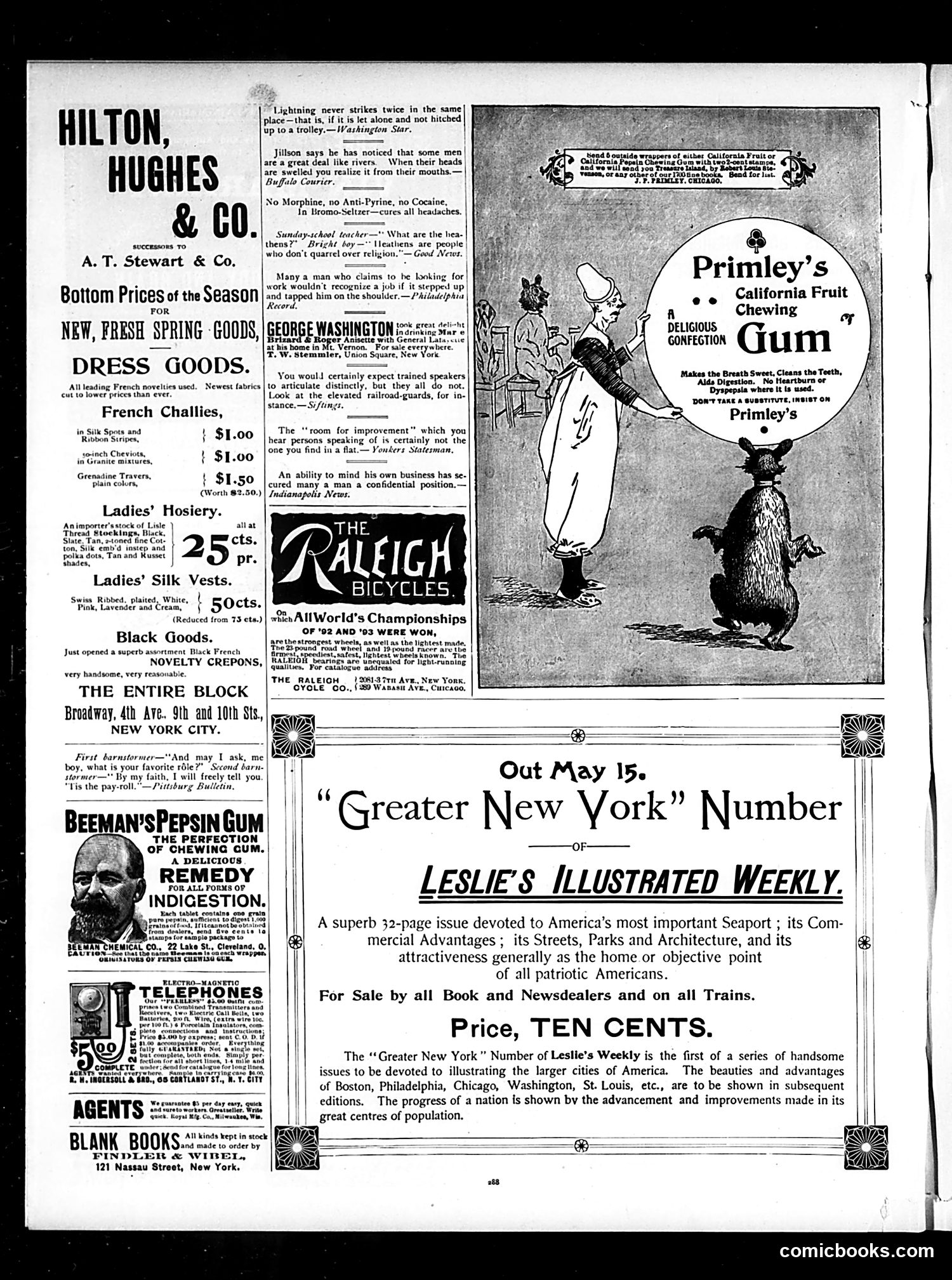
This page is primarily **advertising and promotional material** rather than political satire. The dominant feature is a full-page announcement for Leslie's Illustrated Weekly's upcoming "Greater New York" issue (May 15), priced at ten cents. The page contains scattered **short satirical quips** typical of Judge's humor column format—brief observations about human nature ("men are like rivers," "trained speakers don't articulate well," etc.). These lack specific political targets. The **Primley's Gum advertisement** features an illustrated cow as mascot, promoting the product's digestive benefits—typical period advertising using animal characters. Other ads promote mundane goods: dress fabrics, bicycles (Raleigh brand), hosiery, blank books, and patent medicines (Beeman's Pepsin Gum, Bromo-Seltzer). **No identifiable political figures or events** appear on this page. The content reflects turn-of-the-century consumer culture and light social humor rather than political commentary. This appears to be a standard Judge issue page mixing advertising with mild, generic observational humor.
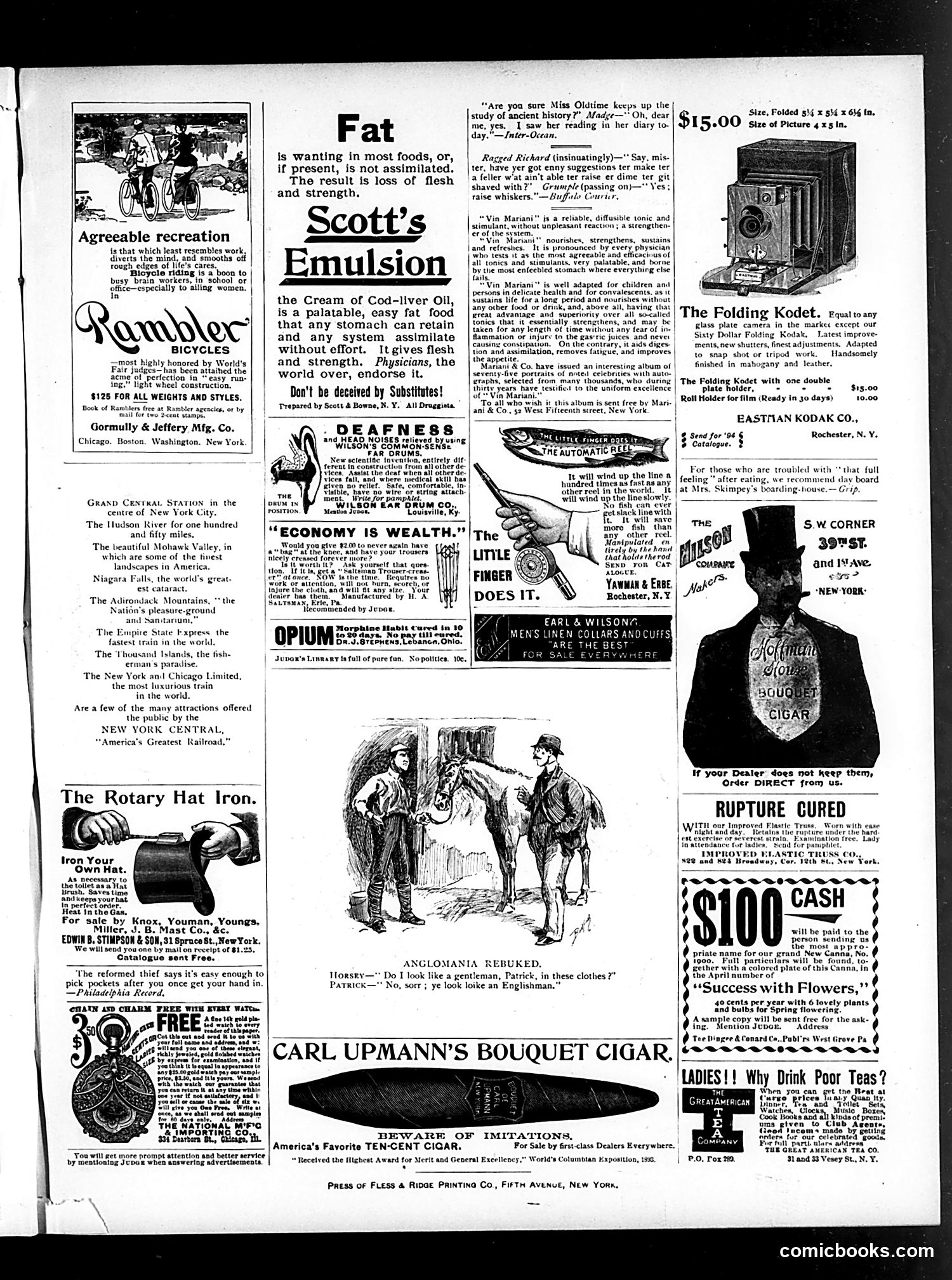
This page is primarily **advertisements** with one notable cartoon. The cartoon titled "ANGLOMANIA REBUKED" depicts two men examining clothing at what appears to be a tailor shop or clothing establishment. **The satirical joke**: A gentleman (Patrick) comments that clothes look English, while another man (Horace) defensively responds, "No, sir; I look like an Englishman." The humor lies in a mid-period American anxiety about British fashion and mannerisms—the implication being that looking "English" was potentially insulting or affected. The satire mocks both excessive Anglophilia (adopting British styles) and defensive nationalism about American appearance. **Context for modern readers**: In the 1890s-1900s, there was ongoing cultural tension between America and Britain regarding fashion, speech, and social refinement. Some Americans eagerly imitated English fashion as a mark of sophistication, while others viewed this as unpatriotic pretension. The rest of the page contains period advertisements for bicycles, tonics, cigars, and other products—typical Judge magazine content mixing satire with commercial promotions.
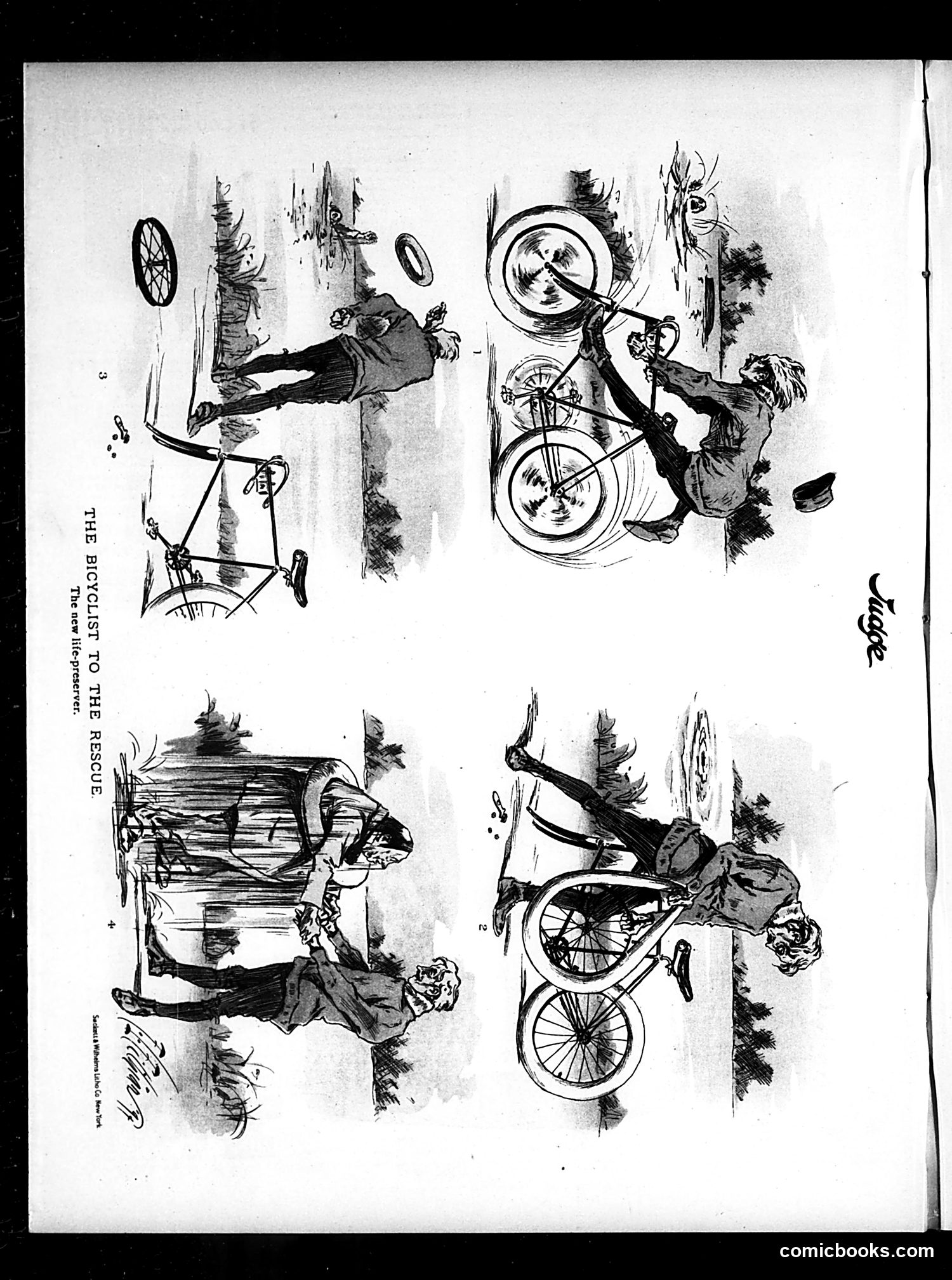
This cartoon satirizes the bicycle craze of the 1890s by depicting bicycles as absurdly impractical rescue devices. The four panels show cyclists attempting to use their bicycles in emergency situations—appearing to help drowning figures or people in distress near water. The joke mocks the era's bicycle mania, where bicycles were promoted as solutions to nearly every modern problem. The caption "The new life-preserver" sarcastically suggests bicycles could serve as safety equipment, when obviously they would be useless or counterproductive in water rescues. This reflects contemporary anxiety about the bicycle fad's dominance in popular culture and advertising, where manufacturers made increasingly absurd claims about their product's utility. The satire targets both overenthusiastic cyclists and the exaggerated marketing of the bicycle industry.
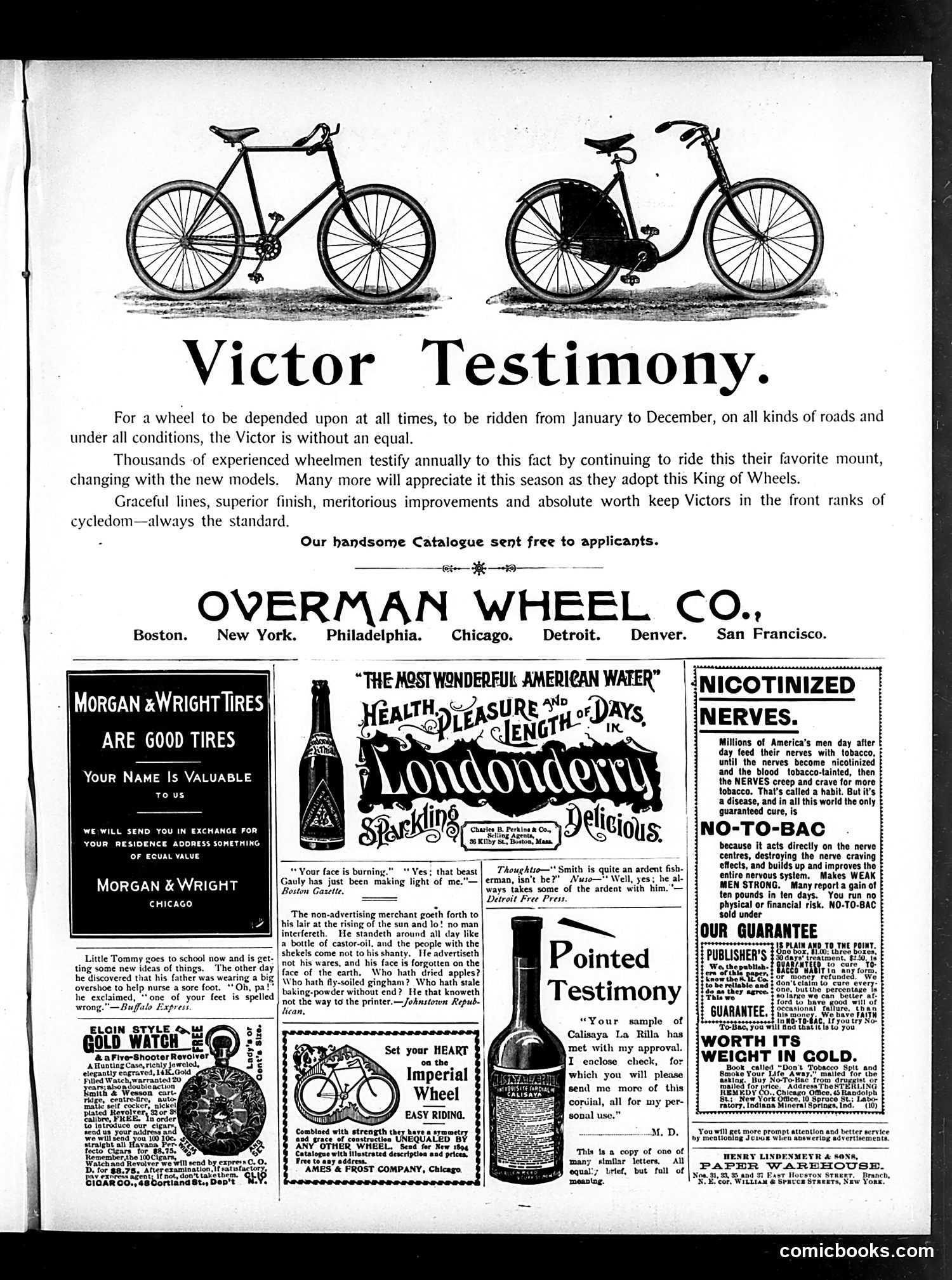
This is primarily an **advertisement page**, not a political cartoon. The main content is a testimonial advertisement for Victor bicycles by Overman Wheel Co., emphasizing the bike's reliability year-round and superior quality—typical cycling-boom marketing from the 1890s. The surrounding advertisements reflect period concerns: Morgan & Wright tires, Londonderry sparkling water, Imperial bicycles, and notably **No-To-Bac**, a nicotine-cessation product. The No-To-Bac ads are particularly revealing—they target "millions of America's men" addicted to tobacco and frame nicotine dependency as a treatable "disease" rather than mere habit. This reflects late-Victorian anxieties about substance addiction and the era's patent medicine industry. Minor jokes appear (a merchant's poor business practices; fishing anecdotes), but they're filler content. The page reflects an era when bicycles were luxury consumer goods and emerging health-consciousness coexisted with unregulated pharmaceutical claims.
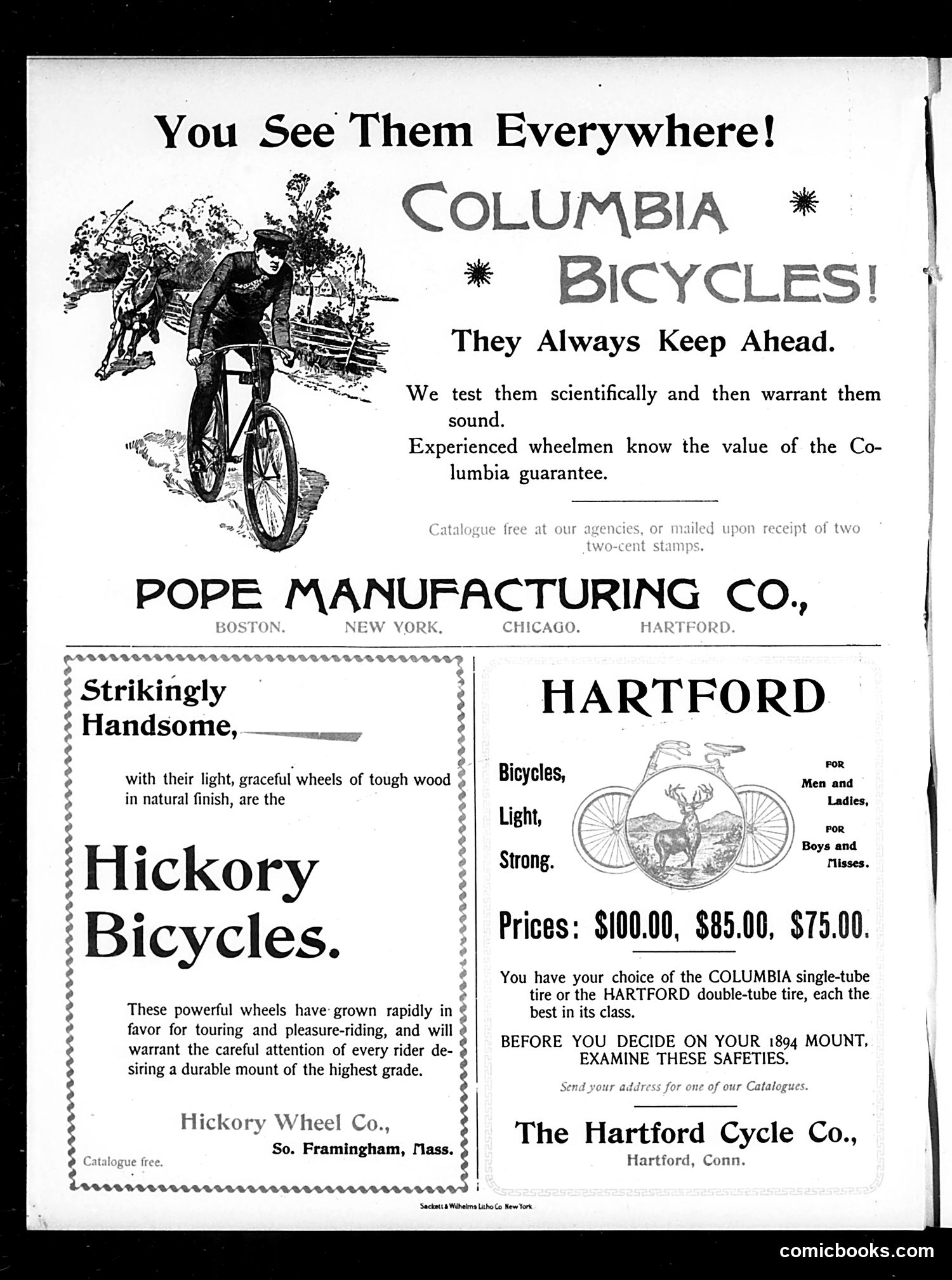
This is **not a political cartoon or satire**, but rather a **bicycle advertisement page** from Judge magazine (circa 1894, based on the "1894 MOUNT" reference). The page features three competing bicycle manufacturers promoting their products: 1. **Columbia Bicycles** (Pope Manufacturing Co.) - the dominant advertiser, claiming superiority through scientific testing and warranties 2. **Hickory Bicycles** (Hickory Wheel Co.) - emphasizing handsome wooden wheels and durability for touring 3. **Hartford Bicycles** (Hartford Cycle Co.) - offering multiple price points ($75-$100) and tire options The opening phrase "You See Them Everywhere!" reflects the genuine 1890s bicycle craze, when bicycles were ubiquitous consumer goods and status symbols. The competitive messaging—"They Always Keep Ahead," emphasis on durability and testing—reflects the booming, competitive bicycle market of this era. This is straightforward commercial advertising rather than satirical commentary.