
A complete issue · 16 pages · 1894
Judge — April 7, 1894
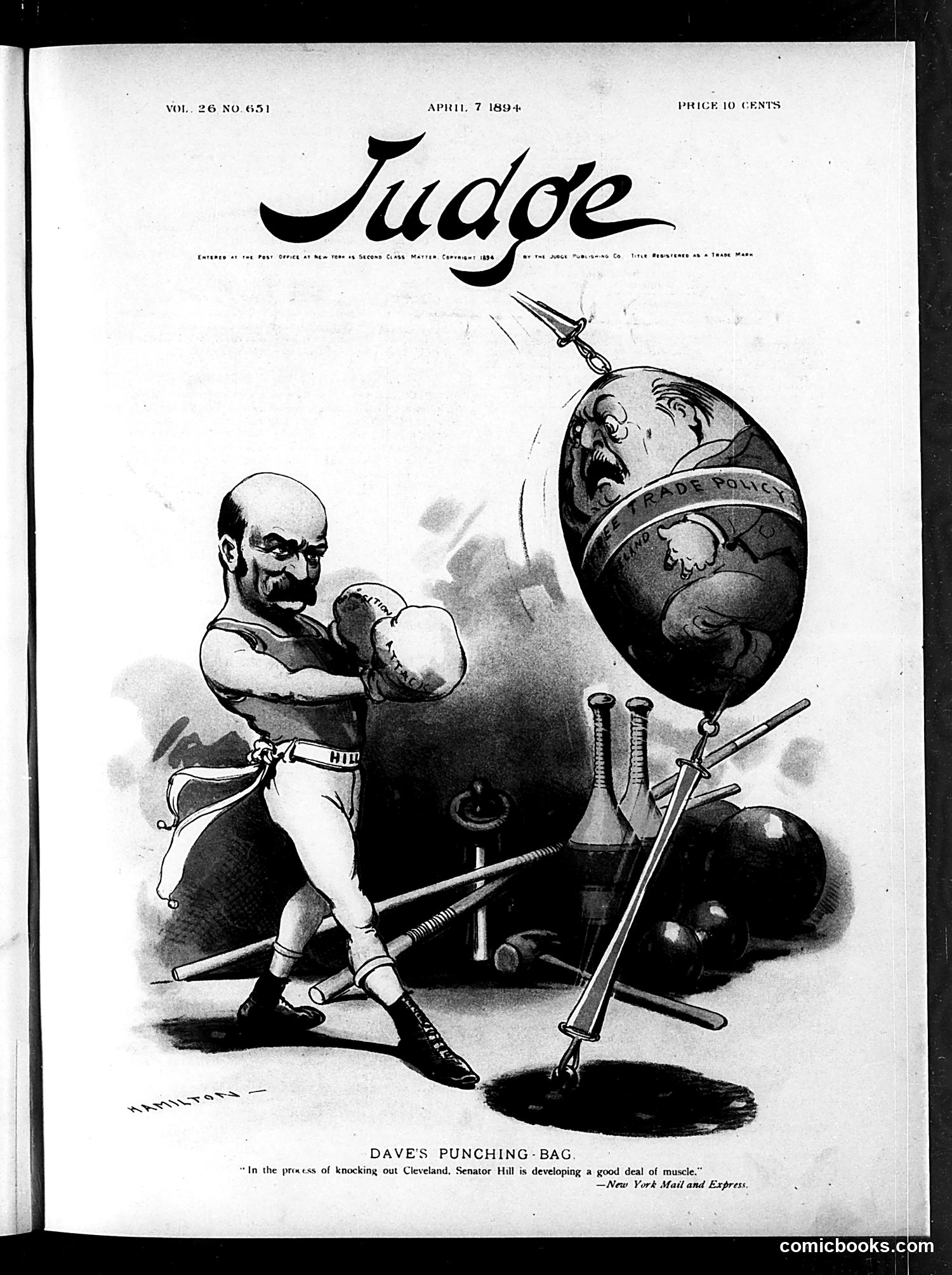
This cartoon from Judge (April 7, 1894) satirizes Senator James H. "Gumshoe" Hall through a boxing metaphor. The figure on the left, depicted as a boxer, appears to be punching a large bag labeled "Trade Policy"—the bag's face caricatures Hall himself. The caption quotes the *New York Mail and Express*: "In the process of knocking out Cleveland, Senator Hall is developing a good deal of muscle." This references political conflict during President Grover Cleveland's administration over trade and tariff policy. The joke mocks Hall as simultaneously being both the puncher and the punching bag—suggesting he's absorbed political blows while attempting to strike back at Cleveland's policies, all while developing political "muscle" through the debate.
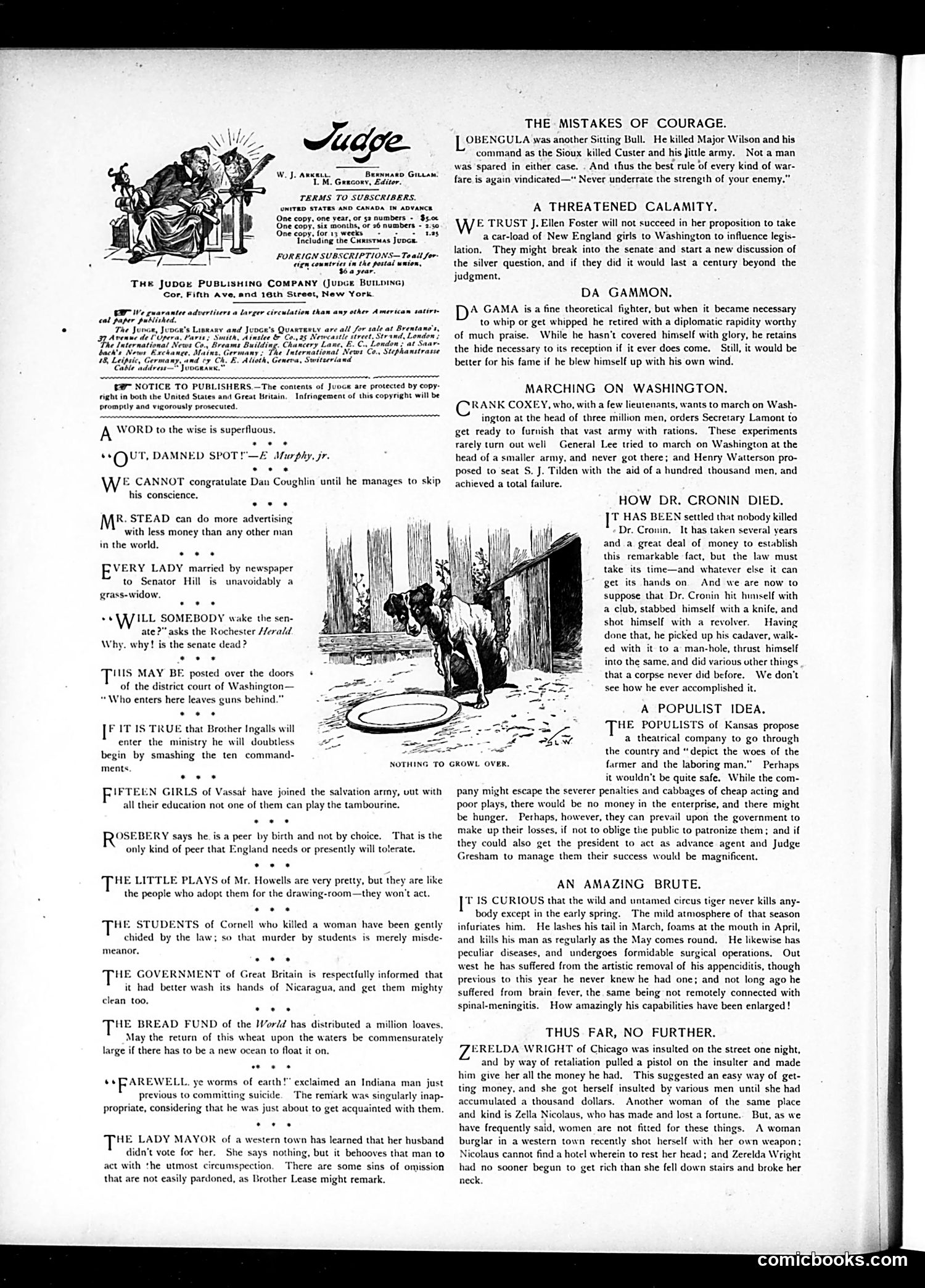
The main cartoon, titled "Nothing to Grow Over," depicts a man standing in an empty circular plot of ground. Based on the surrounding text articles, this appears to satirize **failed military campaigns or infrastructure projects** during the late 19th/early 20th century. The page contains multiple brief satirical commentary items mocking various figures and situations: failed military leaders (references to General Lee and Henry Watson), political incompetence, and social absurdities. One item ridicules someone's advertising ineffectiveness; another mocks newspaper marriages. The cartoon's stark image—bare ground with nothing growing—likely symbolizes **wasted effort, failed initiatives, or hollow promises**. Without identifying the specific historical moment, the page exemplifies Judge's style: biting political and social commentary through brief text items and symbolic imagery.
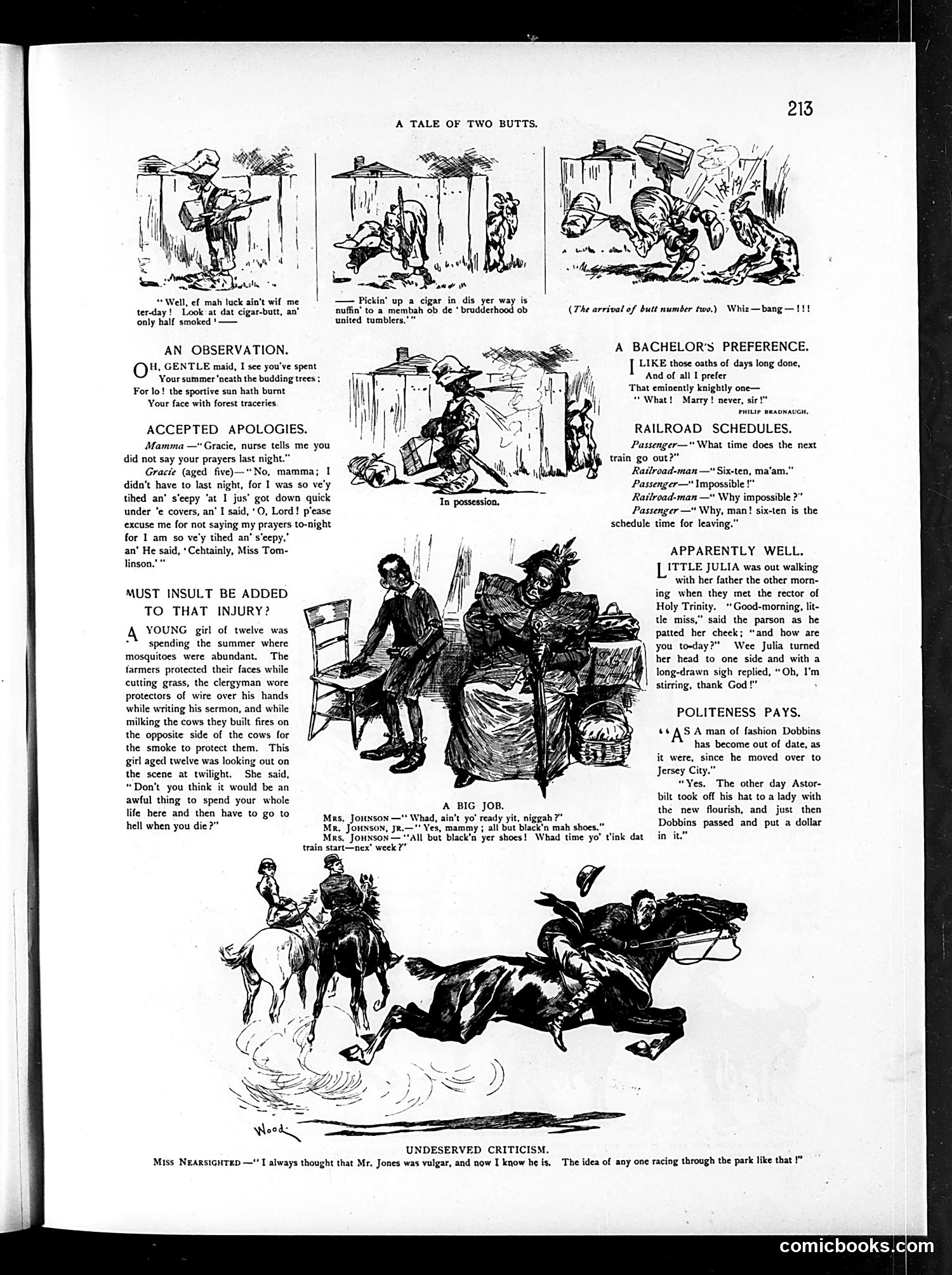
This page contains multiple unrelated satirical sketches and humorous anecdotes typical of Judge's format. The cartoons include: **"A Tale of Two Butts"** - Three panels depicting cigar-smoking mishaps, likely mocking both smokers' pretensions and working-class behavior. **"A Big Job"** - A horse-riding scene captioned with dialect humor about shoe-shining, suggesting working-class or immigrant characters. **"Undeserved Criticism"** - A horse-racing accident scene mocking someone's vulgarity. The page also includes brief humorous text pieces like "An Observation," "Accepted Apologies," and "Railroad Schedules" — all brief satirical jabs at social behavior, romance, and modern life. The overall tone reflects Judge's approach: gentle mockery of everyday manners, class behaviors, and courtship customs rather than explicit political commentary.
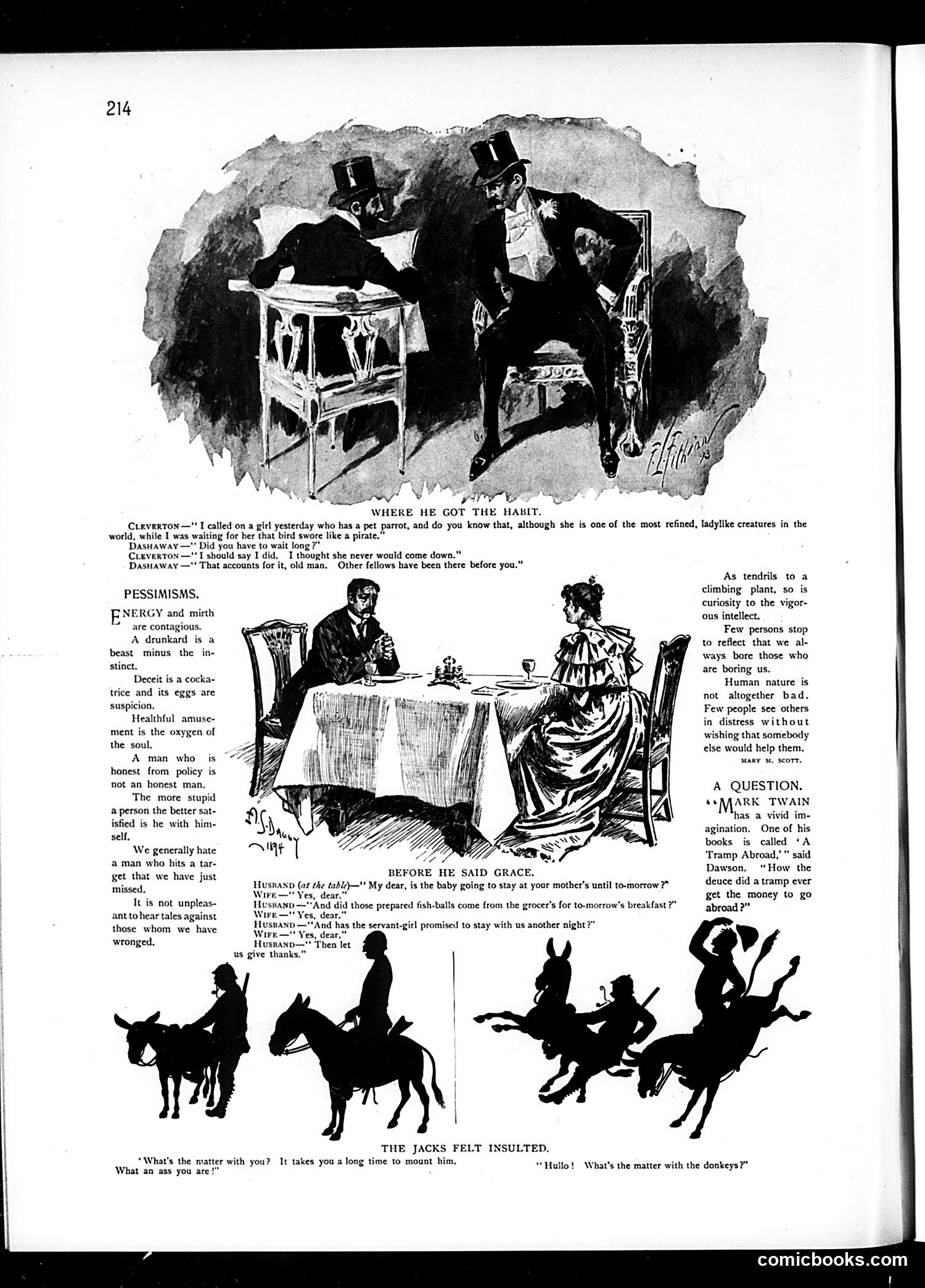
This page contains three separate satirical pieces: **"Where He Got the Habit"** mocks social waiting customs. A gentleman complains that a refined lady's parrot swears like a pirate while he waits for her. The punchline suggests other suitors have also waited so long that the parrot learned profanities from their impatient cursing—satirizing the tedium of courtship calling rituals. **"Before He Said Grace"** depicts a husband interrogating his wife about whether servants and supplies will remain through dinner. His repeated questions and her monotonous "yes, dear" responses mock domestic nagging and anxiety, with the final "let us give thanks" suggesting ironic relief at predictability rather than genuine piety. **"The Jacks Felt Insulted"** shows riders being thrown from mules/donkeys, with the caption questioning why the animals are upset. This appears a simple physical comedy joke about temperamental livestock. The page also includes philosophical aphorisms about human nature, typical of Judge's moral commentary. These pieces target genteel social pretense and marital dynamics common to early 20th-century American satire.
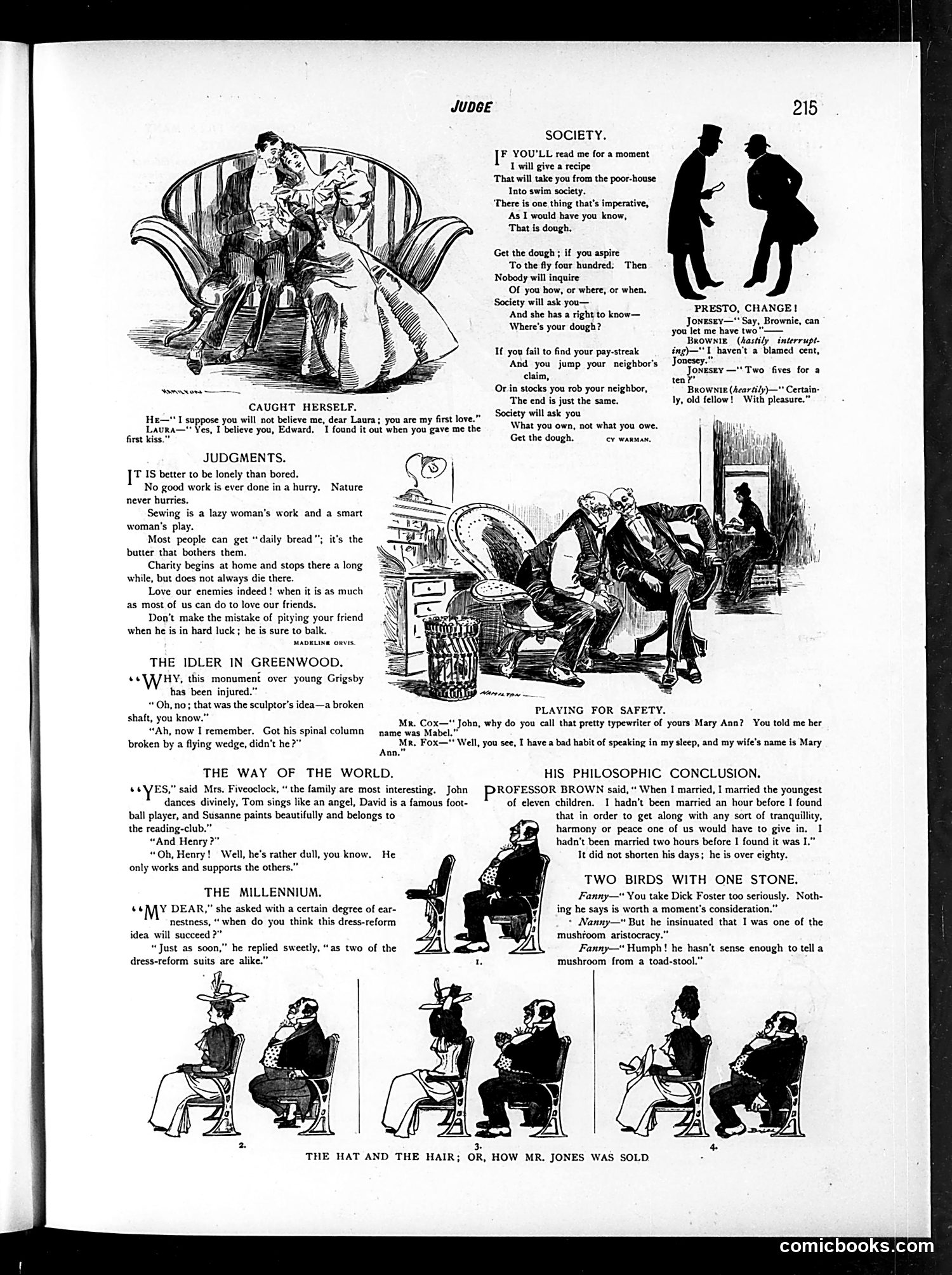
This page contains multiple short satirical pieces mocking Victorian-era social conventions and human behavior: **"Society"** (top) satirizes wealth-obsessed high society, arguing that money ("dough") alone grants social acceptance regardless of how it's obtained—through legitimate work, theft, or fraud. Society cares only that you *have* money, not its source. **"Caught Herself"** jokes about a man claiming a woman is his "first love," which she disproves by referencing his previous kiss. **"The Way of the World"** mocks how families boast of talented members while dismissing the working provider as "dull"—inverting conventional values. **"The Hat and the Hair"** (bottom comic strip) appears to show a transaction where someone is tricked, though specifics are unclear from the image alone. Other sections offer aphorisms on laziness, charity, and marriage. The overall tone criticizes social hypocrisy, materialism, and the arbitrary judgments of polite society.
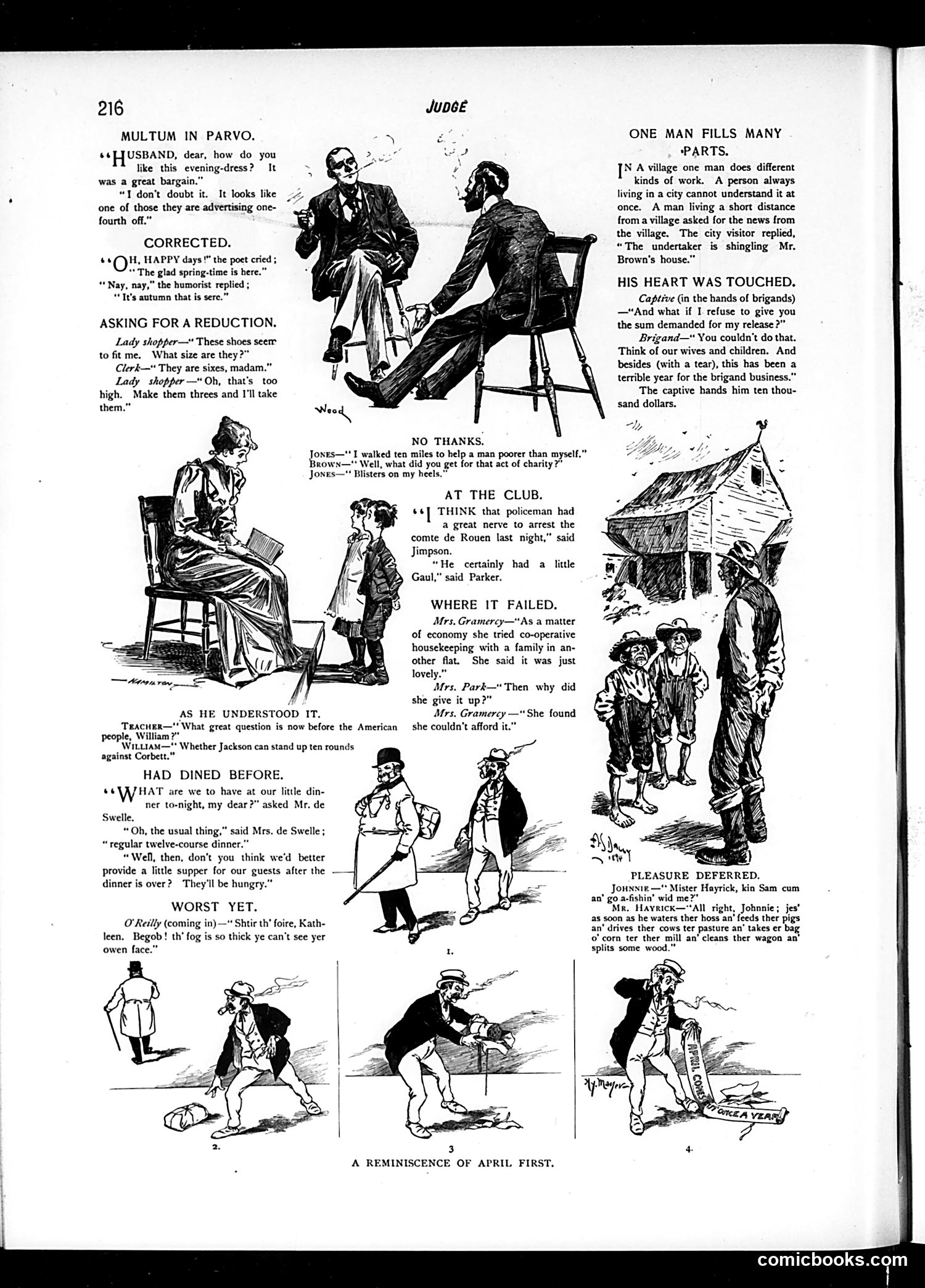
This page collects brief satirical vignettes typical of Judge's humor circa the 1880s-90s. Key items include: **"Multum in Parvo"**: A wife's bargain dress is mistaken for marked-down advertised merchandise—mocking consumer culture and women's fashion obsession. **"One Man Fills Many Parts"**: An undertaker doubling as a roofer illustrates rural life's jack-of-all-trades necessity versus city specialization. **"His Heart Was Touched"**: Brigands emotionally manipulate a captive by invoking their hardship—satirizing both criminal melodrama and class sympathy. **"At the Club"**: A pun on "Gaul" (nerve) regarding a French comte's arrest—playing on ethnic stereotypes and aristocratic privilege. **"Had Dined Before"**: De Swelle's concern that twelve courses won't satisfy guests mocks upper-class excess and gluttony. **"Worst Yet"**: The final strip shows a rural boy's list of chores before visiting—exaggerating farm work's endless demands for comedic effect. The page emphasizes class contrasts, ethnic humor, and absurdist social observation typical of period satire.
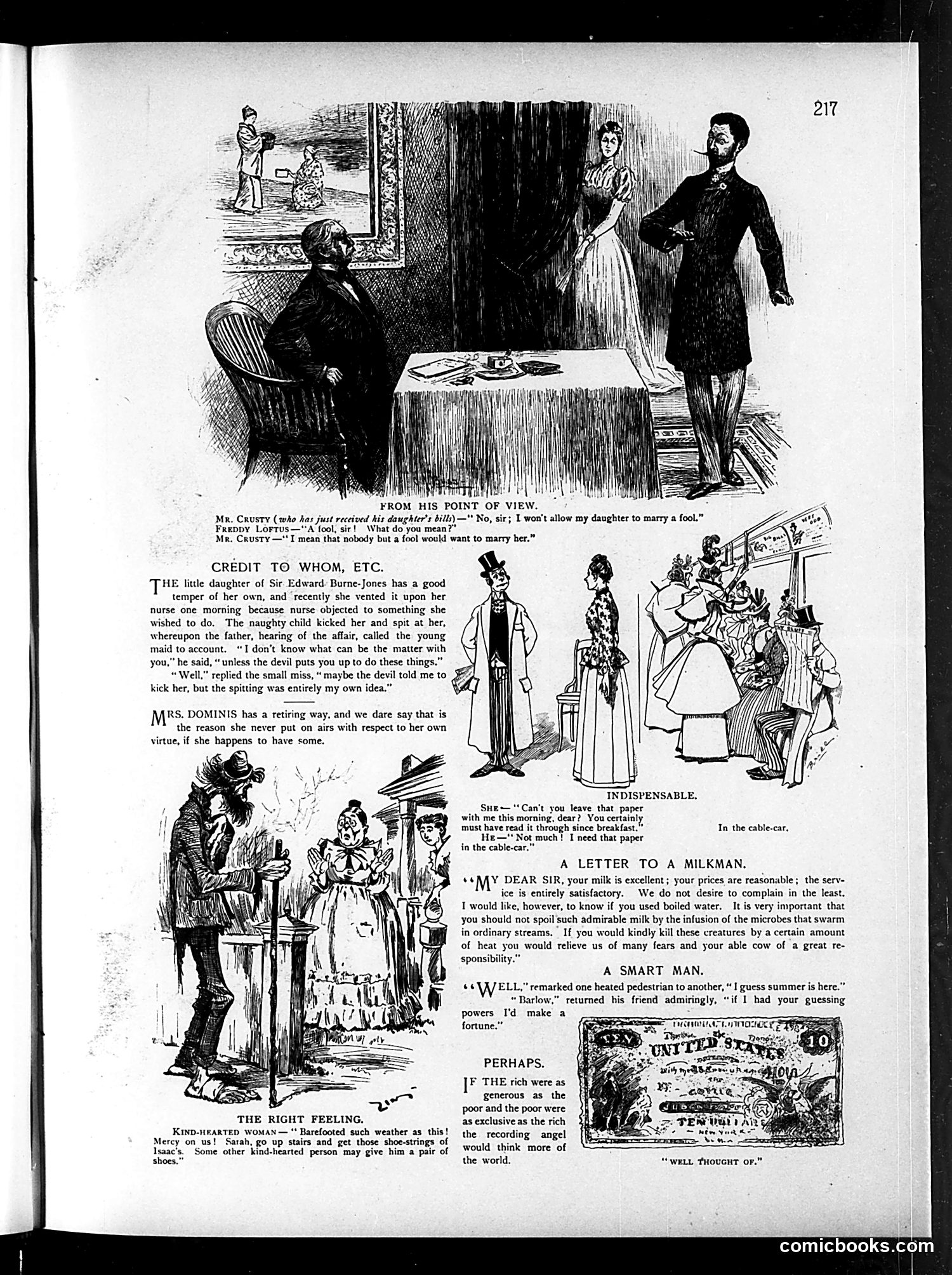
This page contains several brief satirical sketches typical of late-19th-century humor magazines: **"From His Point of View"** mocks a snobbish father (Mr. Crusty) rejecting a suitor as a fool, only to be trapped by his own logic—implying only a fool would marry his disagreeable daughter. **"Credit to Whom, Etc."** references a real incident involving Sir Edward Burne-Jones's daughter, satirizing parental excuses. When the father blames the devil for the child's kickings but the girl claims the spitting was "entirely my own idea," the joke exposes how parents shirk responsibility. **"Indispensable"** gently mocks a commuter's obsessive newspaper-reading in cable cars. **"A Letter to a Milkman"** addresses contemporary health concerns about contaminated milk and microbes—a real public health issue of the era. **"The Right Feeling"** is sentimental social commentary, with a kind woman giving a poor barefoot boy shoes, suggesting charity among the working class. The page satirizes class pretensions, parental hypocrisy, and social anxieties about hygiene and poverty.
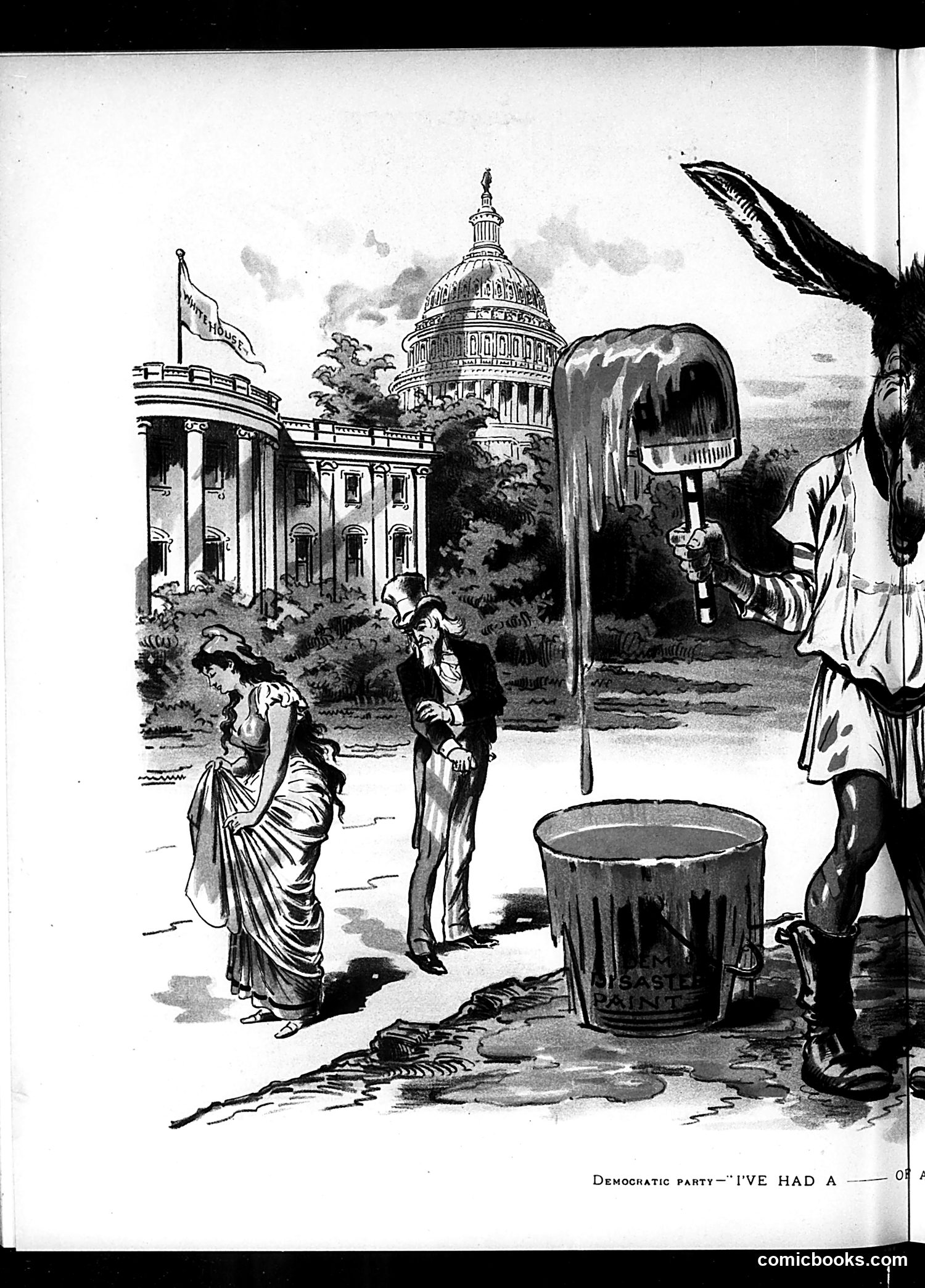
This appears to be a satirical cartoon from *Judge* magazine critiquing the Democratic Party. The caption reads "Democratic Party—'I've Had A'" (text appears cut off). The scene depicts figures at the U.S. Capitol building, with a woman and gentleman in period dress observing a Native American figure holding what appears to be a large ladle or cooking implement over a barrel labeled "CASTLE." The cartoon likely satirizes Democratic Party policies or scandals, possibly referencing corruption ("Castle" may reference a specific political scandal or building), with the Native American figure possibly representing exploitation or broken promises. The wealthy figures' reactions suggest commentary on political hypocrisy or mismanagement. Without the complete caption, the exact target of satire remains unclear, though the imagery suggests criticism of Democratic governance or treatment of marginalized groups.
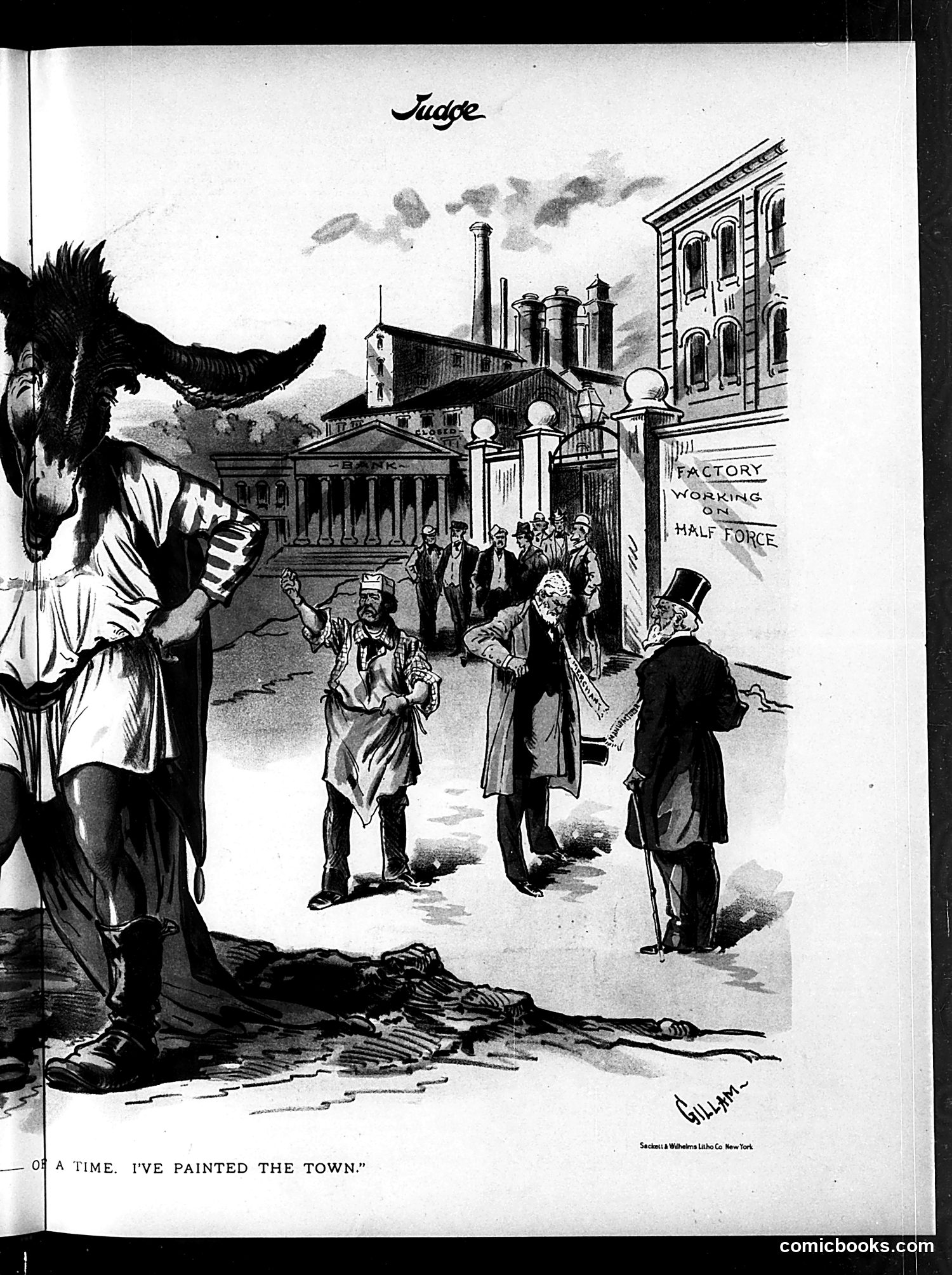
This Judge cartoon satirizes labor disputes and factory conditions. A demonic or monstrous figure on the left—likely representing industrial excess or labor exploitation—boasts of "painting the town," while a sign reads "Factory Working on Half Force," indicating reduced operations, possibly due to strikes or labor shortages. Well-dressed gentlemen (likely factory owners or management) observe the scene with apparent indifference or resignation. The destroyed/scattered materials at the bottom suggest industrial conflict or chaos. The satire appears to mock either factory owners' callousness toward labor problems or, conversely, workers' disruptive tactics—the cartoon's exact target remains unclear without additional context about the specific labor dispute referenced.
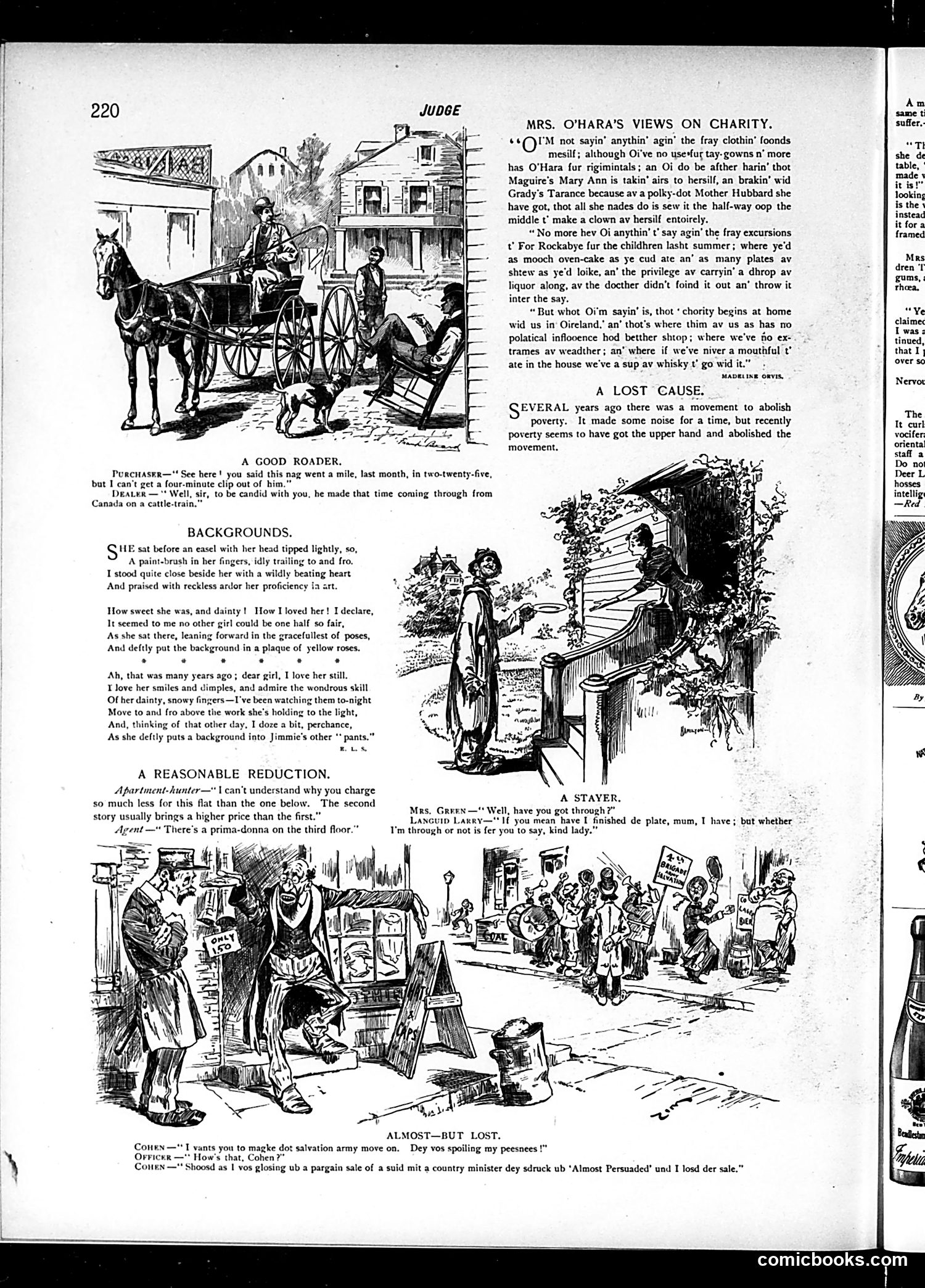
This page contains several brief comedic sketches typical of Judge's satirical humor: **"A Good Roader"**: A horse dealer admits the horse's impressive racing time was achieved while traveling by cattle-train from Canada—implying the horse didn't actually run that fast under normal conditions. The satire targets deceptive salesmanship. **"Backgrounds"**: A sentimental poem contrasts a man's romantic memory of a woman painting with artistic delicacy to his present reality: she now paints backgrounds onto her son's pants. The joke mocks the gap between youthful idealization and domestic married life. **"Mrs. O'Hara's Views on Charity"**: An Irish immigrant woman (indicated by dialect) criticizes charitable organizations and fancy clothing drives, arguing true charity should begin at home—a critique of performative charity among the wealthy while poor communities struggle. **Other sketches** mock apartment rental pricing, a failed poverty-abolition movement, and immigrant experiences. The page reflects Judge's typical blend of class commentary, domestic humor, and ethnic caricature common to early 20th-century American satire.
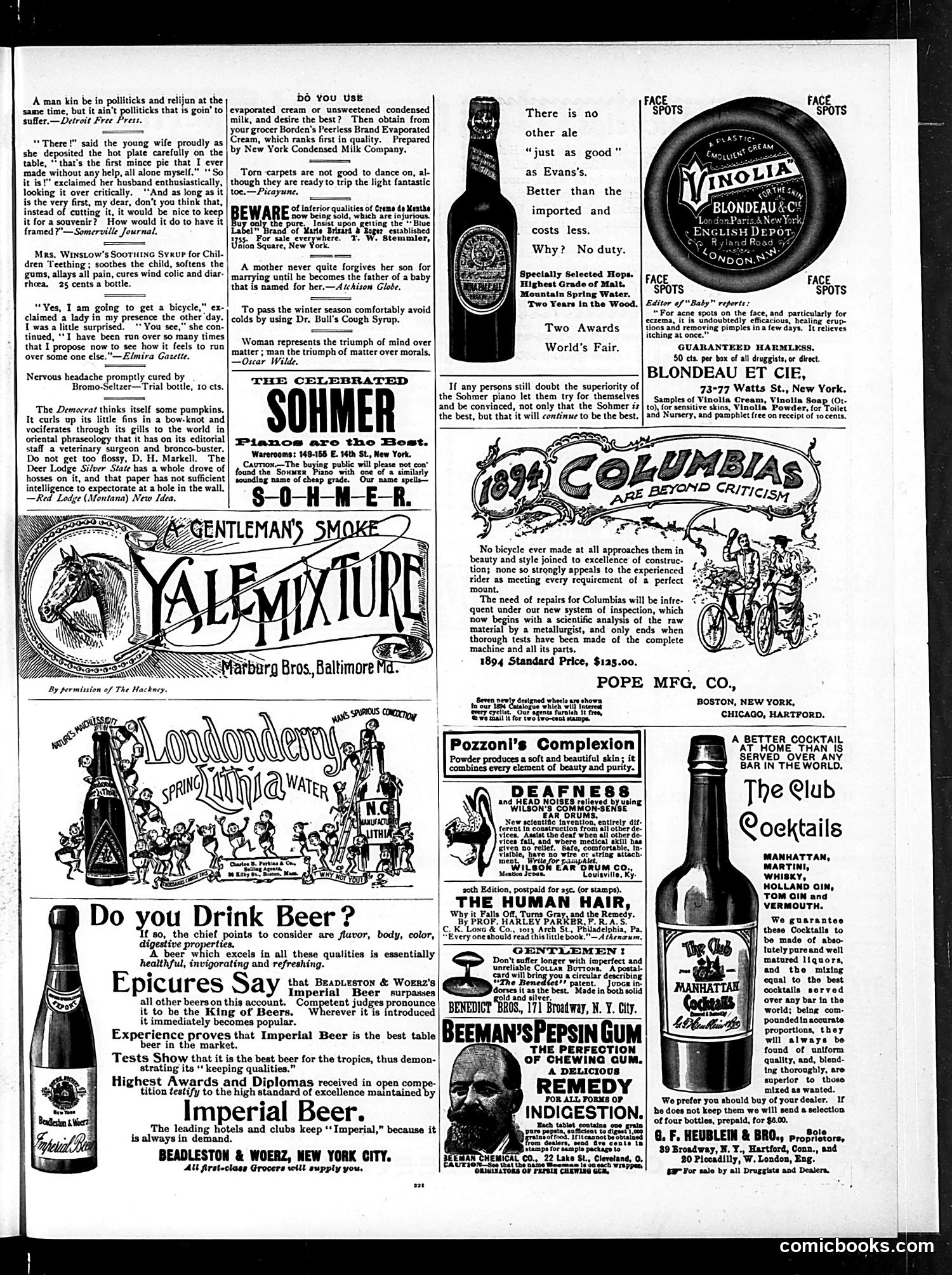
This is primarily an **advertising page** with scattered humorous asides rather than political cartoons. The content reflects late-19th-century consumer culture and domestic humor. **Key advertisements include:** - Borden's evaporated cream - Sohmer pianos (claiming superiority) - Mrs. Winslow's Soothing Syrup (children's medicine) - Columbia bicycles - Various patent medicines and cosmetics (Pozzoni's powder, Deafness cure, hair treatments) - Beer and cocktail guides **The humor** consists of brief quoted jokes about marriage, politics, and bicycles—typical domestic satire of the era. For instance, one joke mocks a wife's "first" homemade pie as so inedible it should be preserved as a souvenir. **The political content is minimal**: one opening quote suggests politics and religion can coexist without compromising politics (implying religion's lesser importance). The page's primary purpose is **selling products to middle-class readers** through advertising disguised as editorial content, a common Judge practice. The scattered jokes serve mainly as filler between advertisements.
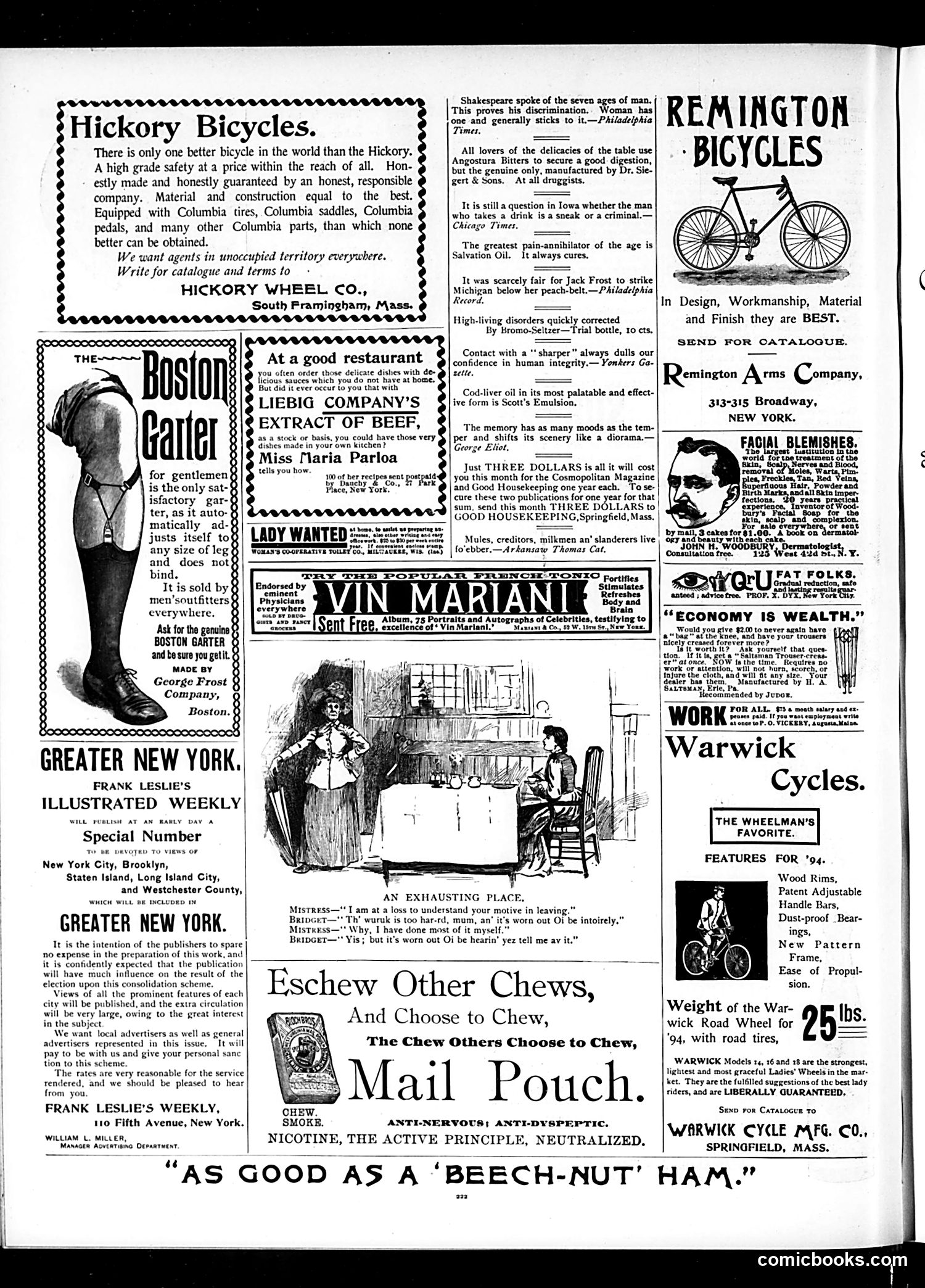
This page is primarily **advertisements and filler content**, not political satire. The main substantive element is a small cartoon titled "An Exhausting Place," depicting a domestic dispute between a mistress and her maid. The maid claims the work is "too hard" and she's "worn out," while the mistress protests she's done most of the work herself. The maid's final retort—that she's heard about the work so much it's worn *her* out—is a simple joke about domestic complaints. The rest of the page consists of product advertisements (bicycles, shoes, beef extract, tobacco) and promotional notices for Frank Leslie's Illustrated Weekly's special Greater New York edition, celebrating the recent consolidation of New York City. The page contains no significant political commentary or historical references requiring contextual explanation for modern readers.
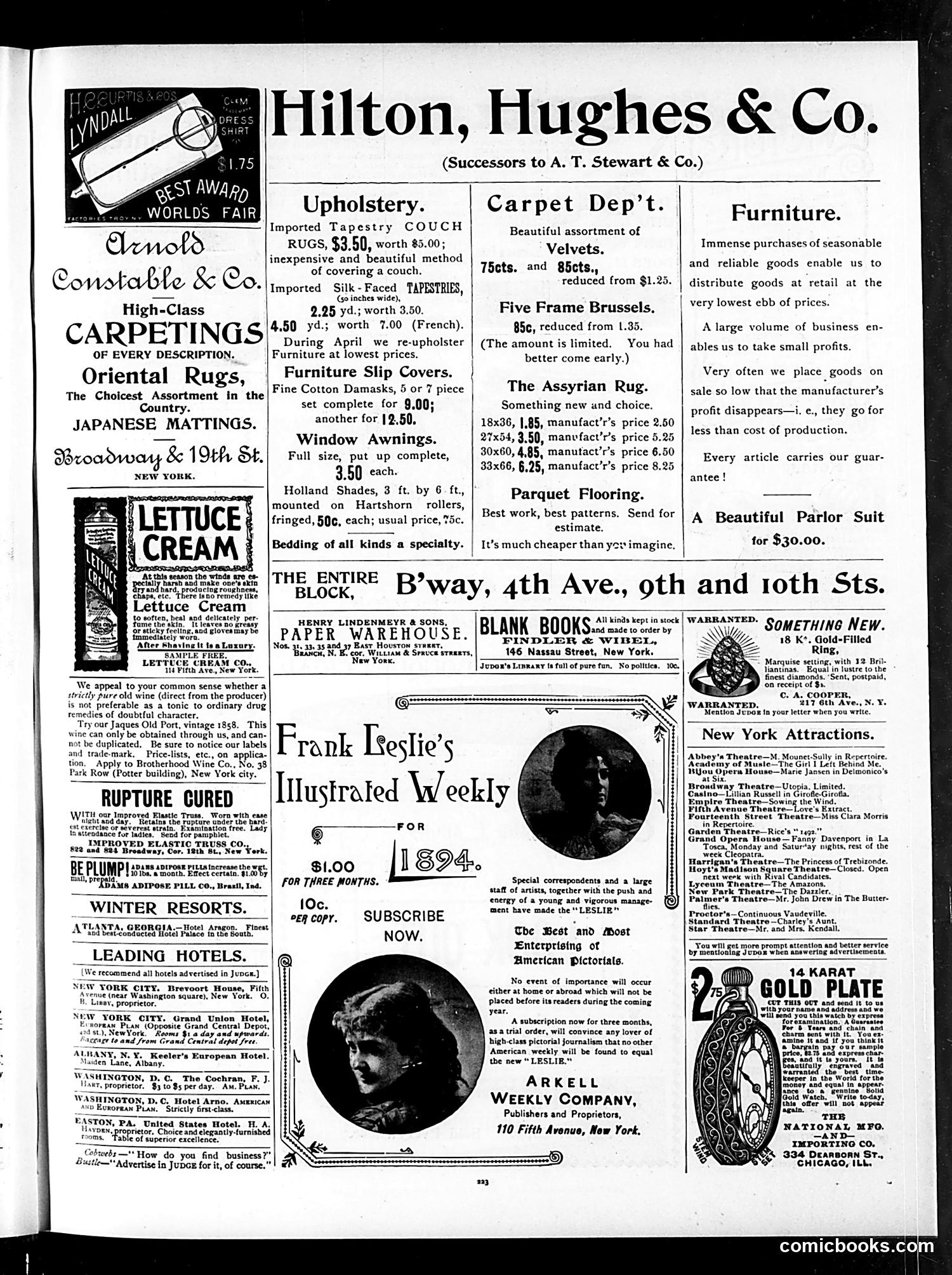
This page is **primarily advertising**, not satire or political commentary. It's a commercial directory from what appears to be the 1890s (based on the 1894 date visible for Frank Leslie's publication). The advertisements feature: - **Hilton, Hughes & Co.** (successors to A.T. Stewart), a major department store offering carpets, furniture, and upholstery - **Specialty products**: Lettuce Cream (skincare), elastic trusses for rupture treatment, obesity pills - **Hotels across America** (New York, Washington D.C., Pennsylvania, Georgia) - **Frank Leslie's Illustrated Weekly** subscription promotion ($1.00/month) - **Various other commercial services** (paper warehouse, rings, plate goods) The **single illustrated element** appears to be a portrait accompanying Frank Leslie's Weekly promotion, but no political figure or satirical cartoon is clearly identifiable from the image. This is a typical Judge magazine page format: mixing modest editorial content with paid advertisements, reflecting late-19th-century publishing business models.
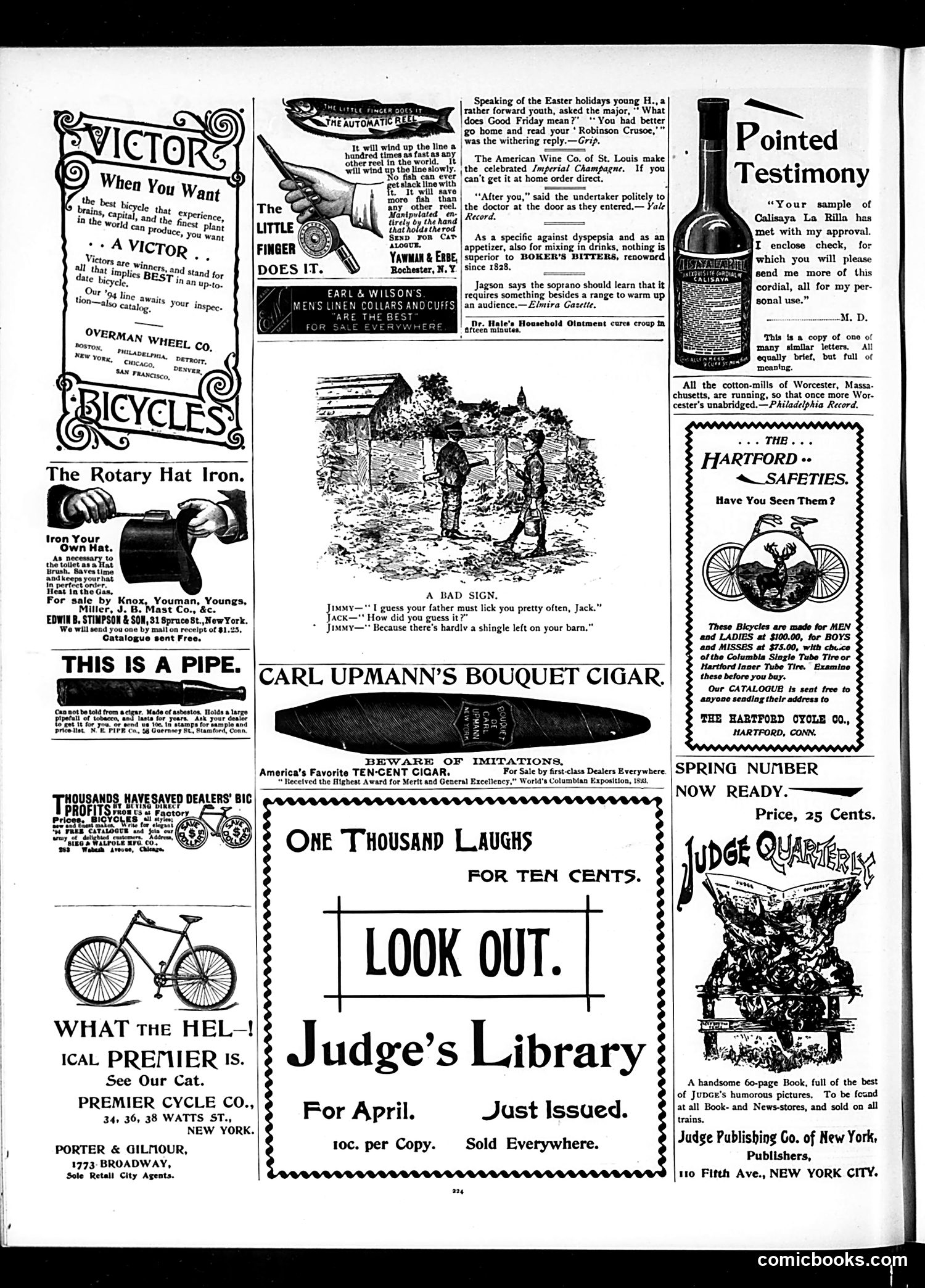
This page is primarily **advertisements and filler content** with minimal political satire. The few brief jokes present include: **"A Bad Sign"**: A children's joke where a boy's father's abuse is humorously inferred from barn damage—crude humor typical of the era. **Easter Joke**: A young man asks what "Good Friday" means; an elder sarcastically tells him to read *Robinson Crusoe* (implying he's ignorant), referencing Defoe's novel where Friday is Crusoe's servant. The humor relies on wordplay. **The remaining content is commercial**: bicycle advertisements (Victor, Premier, Hartford Safeties), cigars (Carl Upmann's Bouquet), hat irons, patent medicines (Dr. Hale's Ointment, Boker's Bitters), and promotional ads for *Judge's Library* and *Judge Quarterly* magazine itself. The page reflects late 19th-century advertising culture more than political commentary. The "Pointed Testimony" testimonial for Calisaya La Rilla tonic appears designed to mock exaggerated patent medicine endorsements—a common satirical target of the era.
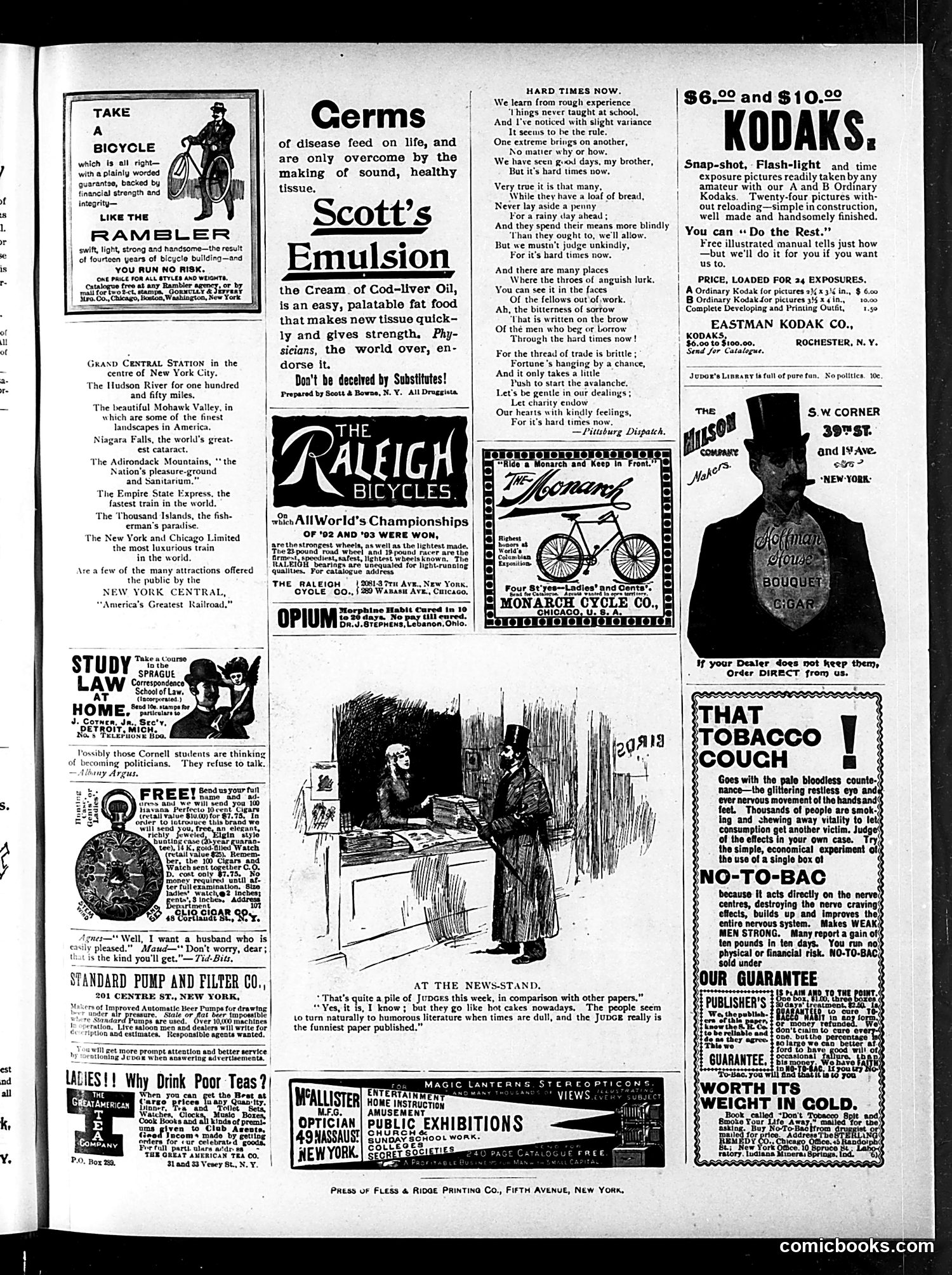
This page is primarily **advertising** with one small cartoon. The main illustrated content is a single panel titled "At the News-Stand" showing a newsstand clerk and customer. The dialogue references **hard economic times** (likely the 1890s depression), explaining that people buy *Judge* magazine because "humorous literature" provides relief when "times are dull." This is meta-commentary: the magazine itself acknowledges economic hardship while marketing humor as an escape. The surrounding advertisements reinforce this context—promoting bicycles, patent medicines (Scott's Emulsion for health), and photography equipment as consumer goods during economic strain. A poem titled "Hard Times Now" explicitly addresses contemporary economic suffering and calls for charitable compassion. The cartoon's point is straightforward: during financial crisis, satirical humor becomes especially valuable as psychological relief.
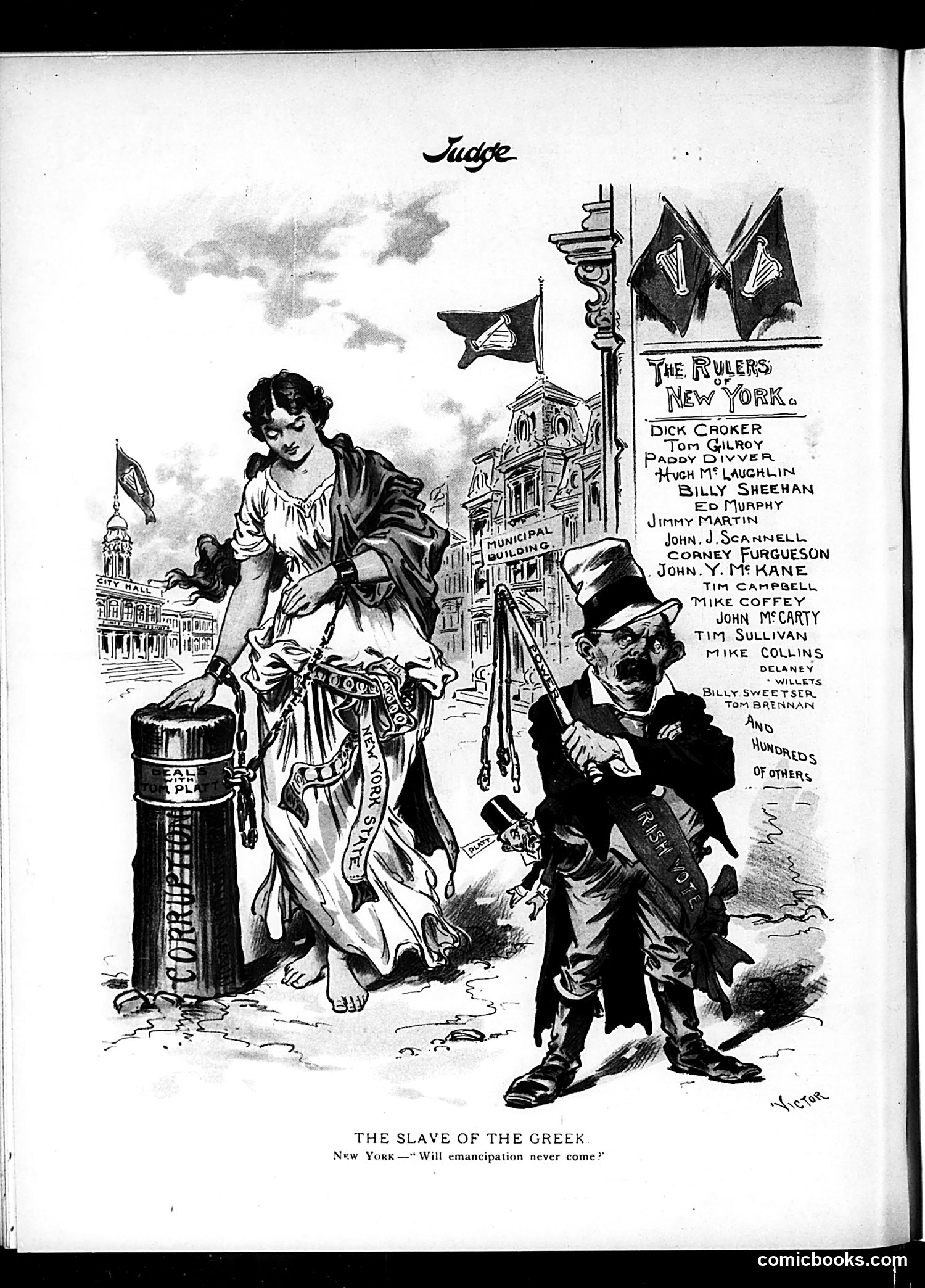
This political cartoon satirizes New York City's corrupt political machine, specifically Tammany Hall's control over the city. The female figure representing New York is depicted as enslaved, literally chained to a post labeled "MUNICIPAL BUILDING," while a caricatured man in a top hat (likely Dick Croker, Tammany Hall's boss, listed first) holds her in servitude. The accompanying list names the "Rulers of New York"—political operatives and machine politicians controlling the city. The caption's bitter question—"Will emancipation never come?"—compares the city's subjugation to slavery, suggesting ordinary New Yorkers are oppressed by this oligarchy of corrupt politicians. The Greek reference (title) is unclear from the image alone, though it may reference classical despotism or a specific contemporary figure. The cartoon attacks systematic political corruption and public powerlessness against entrenched urban political machines.