
Judge, 1894-04-07 · page 4 of 16
Judge — April 7, 1894 — page 4: what you’re looking at
What you’re looking at
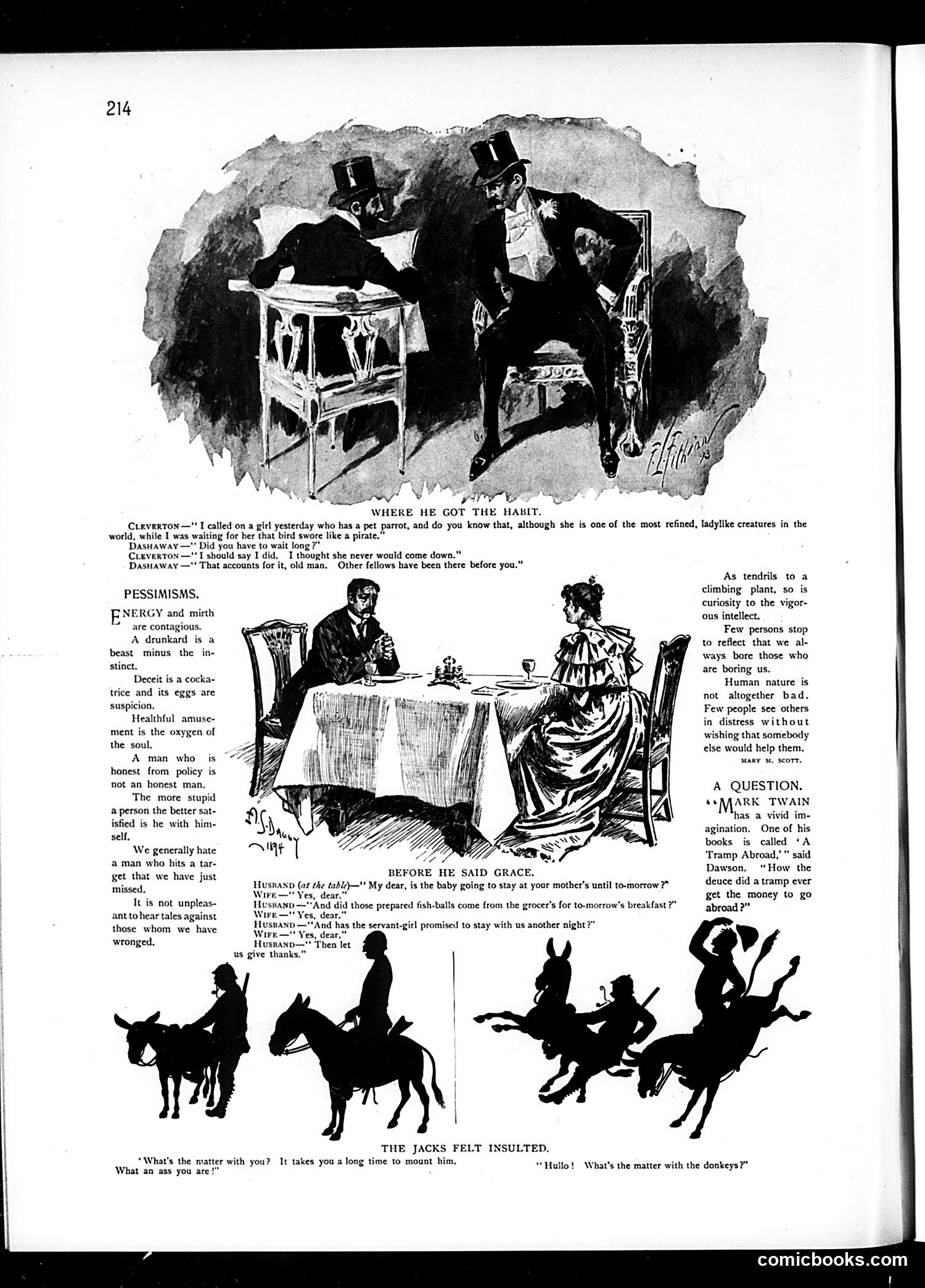
This page contains three separate satirical pieces: **"Where He Got the Habit"** mocks social waiting customs. A gentleman complains that a refined lady's parrot swears like a pirate while he waits for her. The punchline suggests other suitors have also waited so long that the parrot learned profanities from their impatient cursing—satirizing the tedium of courtship calling rituals. **"Before He Said Grace"** depicts a husband interrogating his wife about whether servants and supplies will remain through dinner. His repeated questions and her monotonous "yes, dear" responses mock domestic nagging and anxiety, with the final "let us give thanks" suggesting ironic relief at predictability rather than genuine piety. **"The Jacks Felt Insulted"** shows riders being thrown from mules/donkeys, with the caption questioning why the animals are upset. This appears a simple physical comedy joke about temperamental livestock. The page also includes philosophical aphorisms about human nature, typical of Judge's moral commentary. These pieces target genteel social pretense and marital dynamics common to early 20th-century American satire.
📄 Transcribed text from this page (OCR, searchable)
Machine-transcribed from the original scan — historical spelling and the odd misread are preserved.
rw" WHERE HE GOT THE HABIT. Cueverton —"' I called on a gitl yesterday who has a pet parrot, and do you know that, although she is one of the most refined, ladylike creatures in the world, while I was waiting for her that bird swore like a pirate.” DAsuaway —"* Did you have to wait long?” T thought she never would come down.” Dastiaway —"' That accounts for it, old man. Other fellows have been there before you.”” As tendrils to a climbing plant, so is curiosity to the vigor- ous intellect, Few persons stop to reflect that we al- ways bore those who are boring us. Human nature is not altogether bad. Few people see others in distress without wishing that somebody else would help them. MARY M4. SCOTT. PESSIMISMS. NERGY and mirth are contagious. A drunkard is a beast. minus the in- stinct. Deceit is a cocka- trice and its eggs are suspicion. Healthful amuse- ment is the oxygen of the soul. A man who is honest from policy is not an honest man. The more stupid a person the better sat- isfied is he with him- self. E A QUESTION. «sMARK TWAIN Mis a vivid im- agination. One of his . books is called ‘A We generally hate ‘Tramp Abroad," said a man who hits a tar- : 7 vet that we have j BEFORE HE SAID GRACE. Dawson, “How the g lat we have just ee a % , "5 unti deuce did a tramp ever tlaged Husnanp (a¢ the fabl)—" My dear, is the baby going to stay at your mother’s until to-morrow 7” a Wire—"' Yes, dear.” get the money to go It is not unpleas- SHAND—"“And did those prepared fish-balls come from the grocer's for to-morrow’s breakfast?” abroad?” ant to hear tales against } —"" Yes, dear.” ies. whoth we! bave SBAND —"‘And has the servant-girl promised to stay with us another night ?” 3 Yes, dear,’ wronged. Husnano—"* Then let us give thanks.’ THE JACKS FELT INSULTED. “What's the m y i him, CHET AVERY ; a Wists meyer ee ane Tong time:to smonat: bie Hullo! What's the matter with the donkeys ?” comicbooks.com t