
A complete issue · 18 pages · 1894
Judge — March 31, 1894
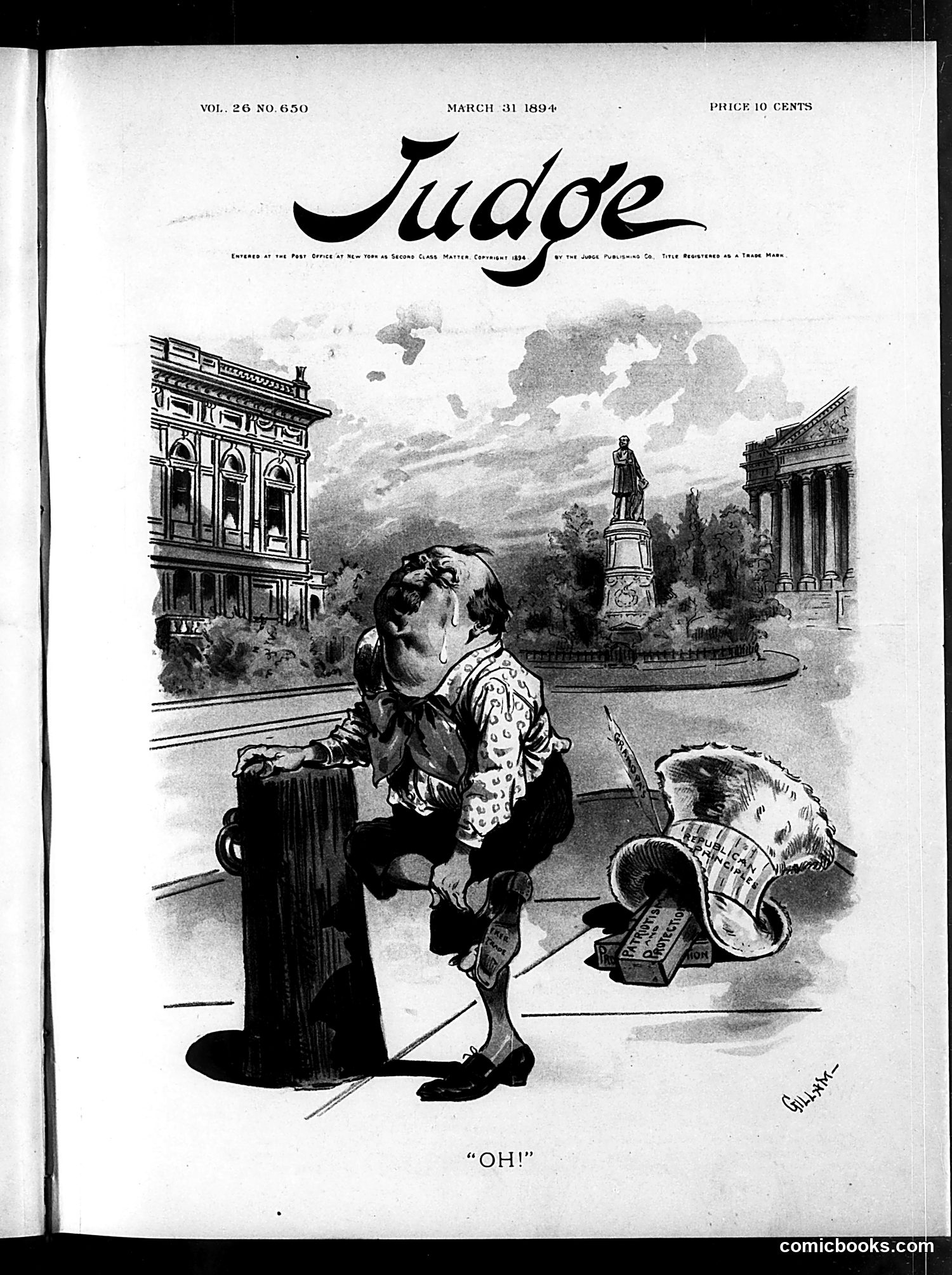
This cartoon depicts a portly man in an elegant suit expressing surprise ("OH!") while standing in what appears to be a grand public plaza with classical buildings and a statue. He's surrounded by scattered items including what appear to be financial documents or bonds. The cartoon likely satirizes a wealthy businessman or politician confronting financial loss or market collapse. The discarded papers and his shocked expression suggest unexpected economic distress. The 1894 date places this during the Panic of 1893, a severe economic depression that devastated American finances. The contrast between his fine clothing and the disorder around him emphasizes the suddenness of financial reversal—even the wealthy and well-dressed faced ruin during this crisis. Without identifying the specific figure, the cartoon appears to mock elite complacency about economic vulnerability.
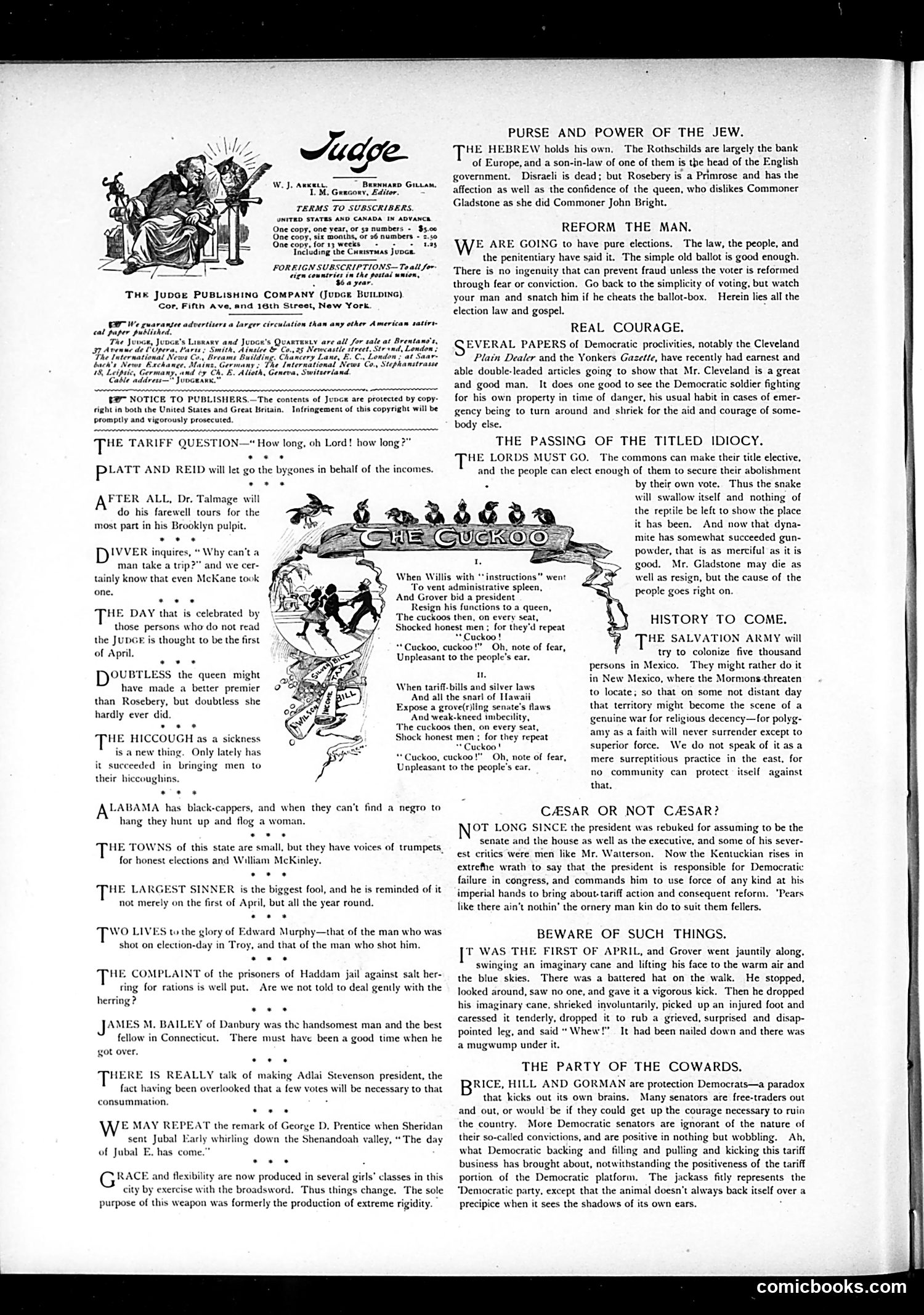
This page contains multiple satirical editorial pieces mocking Democratic politics and politicians of the period. The prominent "Cuckoo" cartoon appears to ridicule political leadership, using the bird as a metaphor for foolishness—with references to Willis, Grover (likely Cleveland), and tariff legislation. Key targets include: - **Democratic incompetence**: Articles mock Democratic senators and congressmen for ignorance and cowardice - **Tariff policy**: Multiple references suggest debate over protective tariffs divides Democrats - **Anti-Semitic content**: The header "Purse and Power of the Jew" promotes harmful stereotypes about Jewish financial control The satire assumes readers share Republican perspectives on Democratic failures. Without visible publication date details, the specific election cycle remains unclear, but the content reflects 19th-century American political partisanship and period prejudices.
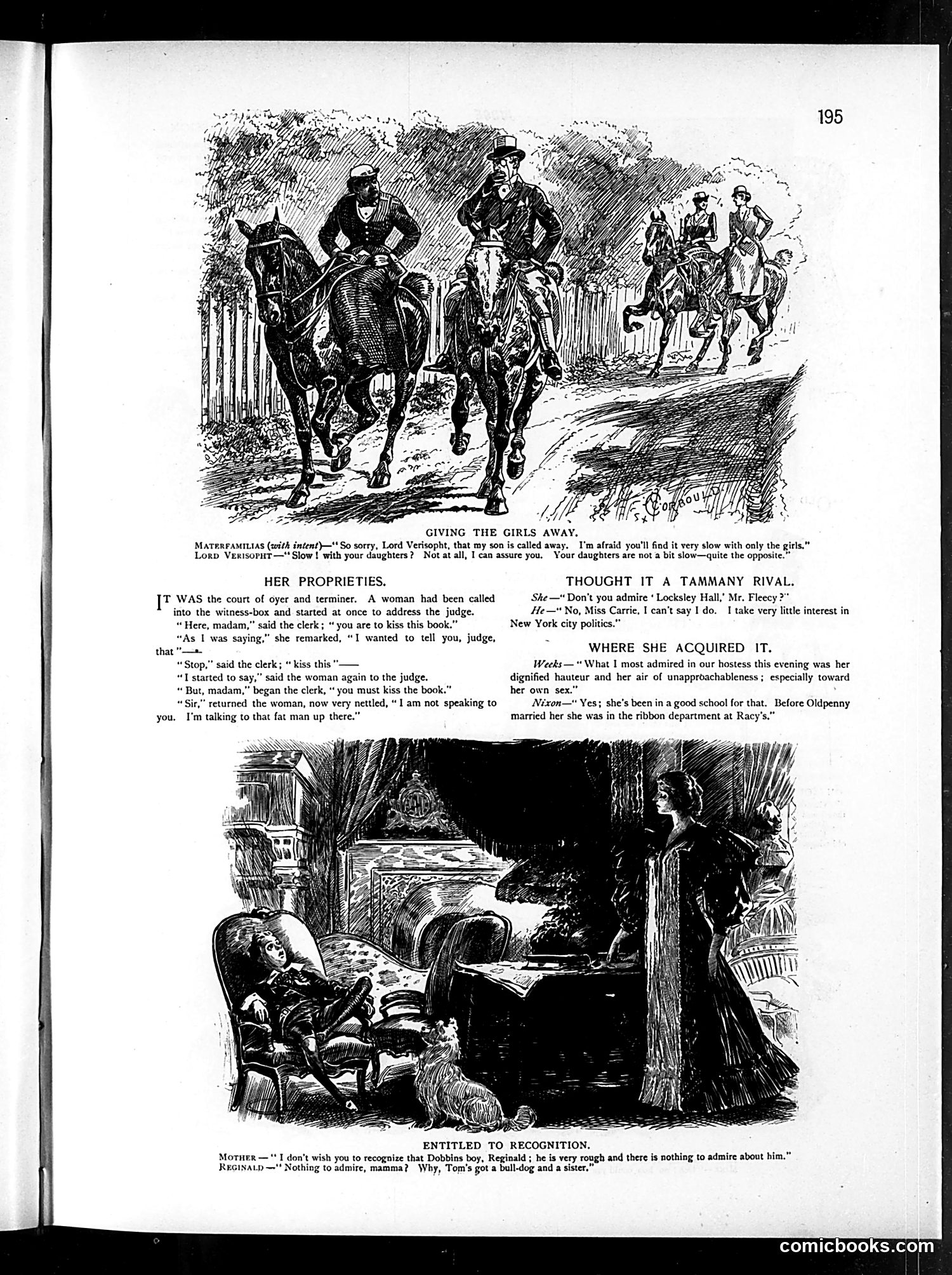
This page contains three brief satirical sketches about social behavior and class distinctions. **Top cartoon ("Giving the Girls Away")**: Lord Vernonght tells his son that the boy has been called away on business. The satire mocks aristocratic concerns—the father worries his son's departure means the girls won't be "given away" (married off) as planned, suggesting upper-class families orchestrated marriages like business transactions. **Middle and bottom sections**: Brief dialogues mock pretension and snobbery. One woman claims not to recognize a "Dobbins boy" as rough and admirable-less; another discusses acquiring dignity and "unapproachableness" through education and marriage. The overall theme critiques how wealthy classes value social status, proper breeding, and strategic marriages over genuine character or merit.
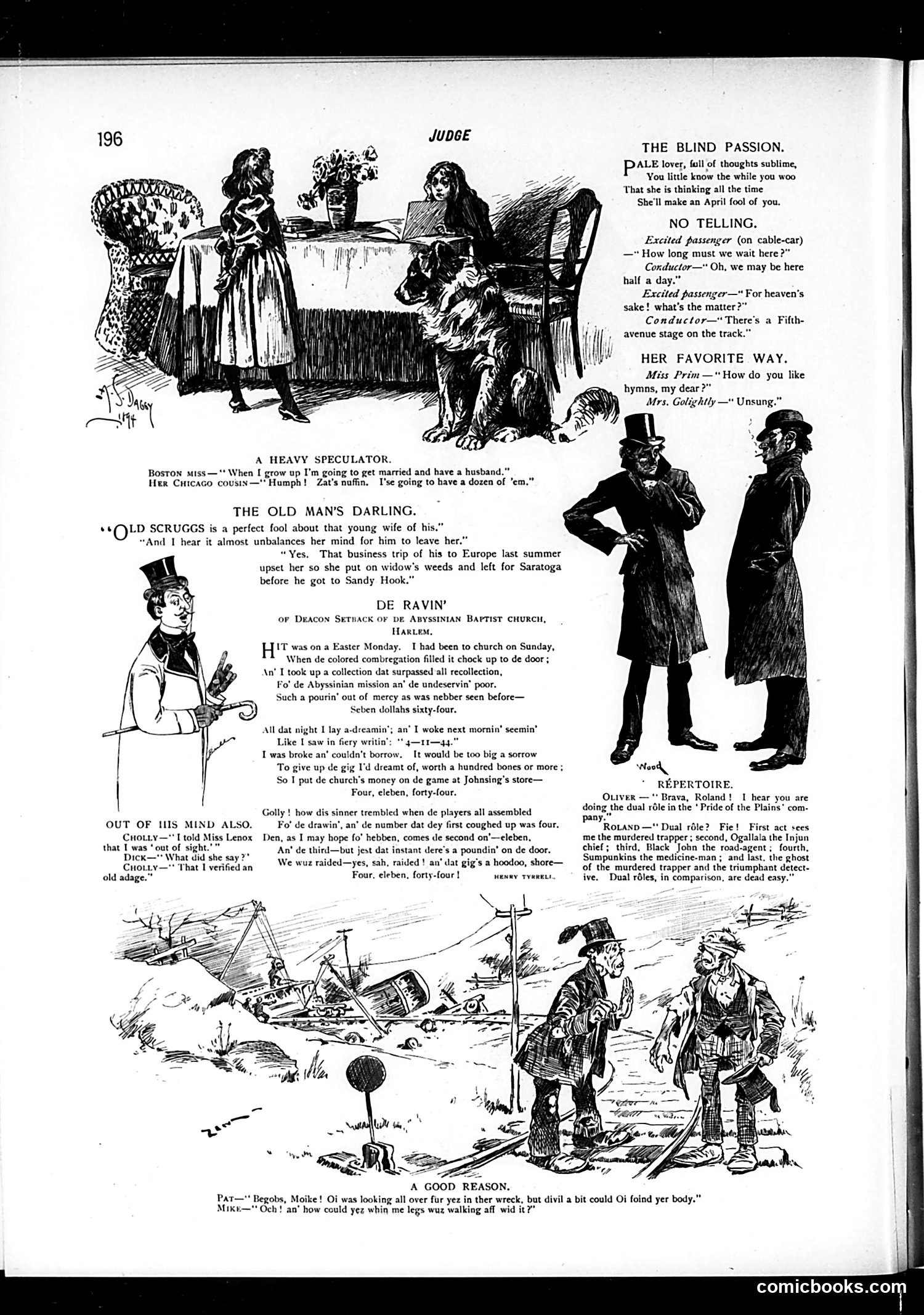
This page contains multiple brief satirical sketches typical of late-19th/early-20th-century American humor: **"The Blind Passion"**: A commentary on romantic deception—a woman pretends affection while planning to humiliate her suitor. **"No Telling"**: Urban satire mocking San Francisco's cable-car system delays, blamed on a Fifth Avenue stage blocking the tracks (likely referencing the chaotic mixing of transportation modes in crowded cities). **"Heavy Speculator"**: Gender satire contrasting a modest Boston woman's marriage plans with a crude Chicago woman's desire for multiple husbands, mocking both regional stereotypes and women's materialism. **"De Ravin'"**: Dialect humor featuring a Black church deacon who steals collection money for gambling, losing it on the numbers. This reflects period stereotypes and racial caricature common in Judge. **"Out of His Mind Also"**: Brief joke about a man lying about his mental state. **"A Good Reason"**: Irish immigrant dialect humor about a shipwreck survivor whose severed legs walked away independently—absurdist comedy typical of the era. The page emphasizes contemporary urban life, transportation, gambling, and ethnic/racial stereotypes.
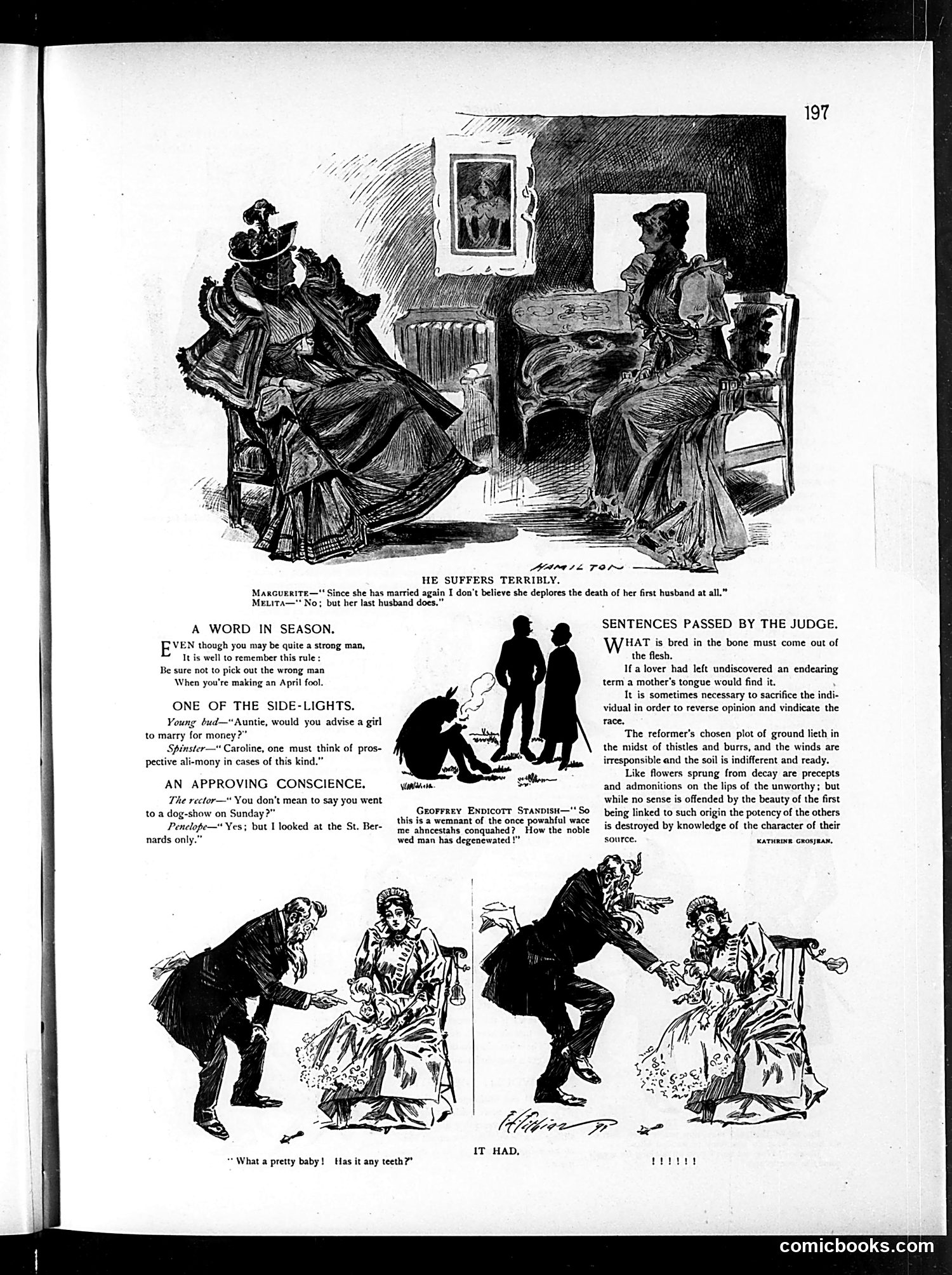
This page collects brief satirical vignettes mocking Victorian social conventions. The top illustration depicts "He Suffers Terribly"—a woman remarried after her first husband's death, indifferent to his passing but her new husband grieves his predecessor. It satirizes both remarriage and marital discord. The side-lights mock courtship and marriage mercenary attitudes: a spinster advises a young woman to consider "alimony" when choosing a husband for money. Another joke ridicules selective morality—a woman attends a dog-show on Sunday (violating Sabbath rules) but claims she only looked at the dogs. The lower cartoons show a snobbish figure (appearing to mock Irish or ethnic stereotypes based on exaggerated accent in the text) questioning an infant's parentage, emphasizing period racism and class prejudice. The page's aphorisms ("Sentences Passed by the Judge") offer moral platitudes about human nature. Overall, the satire targets marriage materialism, religious hypocrisy, and social pretension typical of Gilded Age American humor.
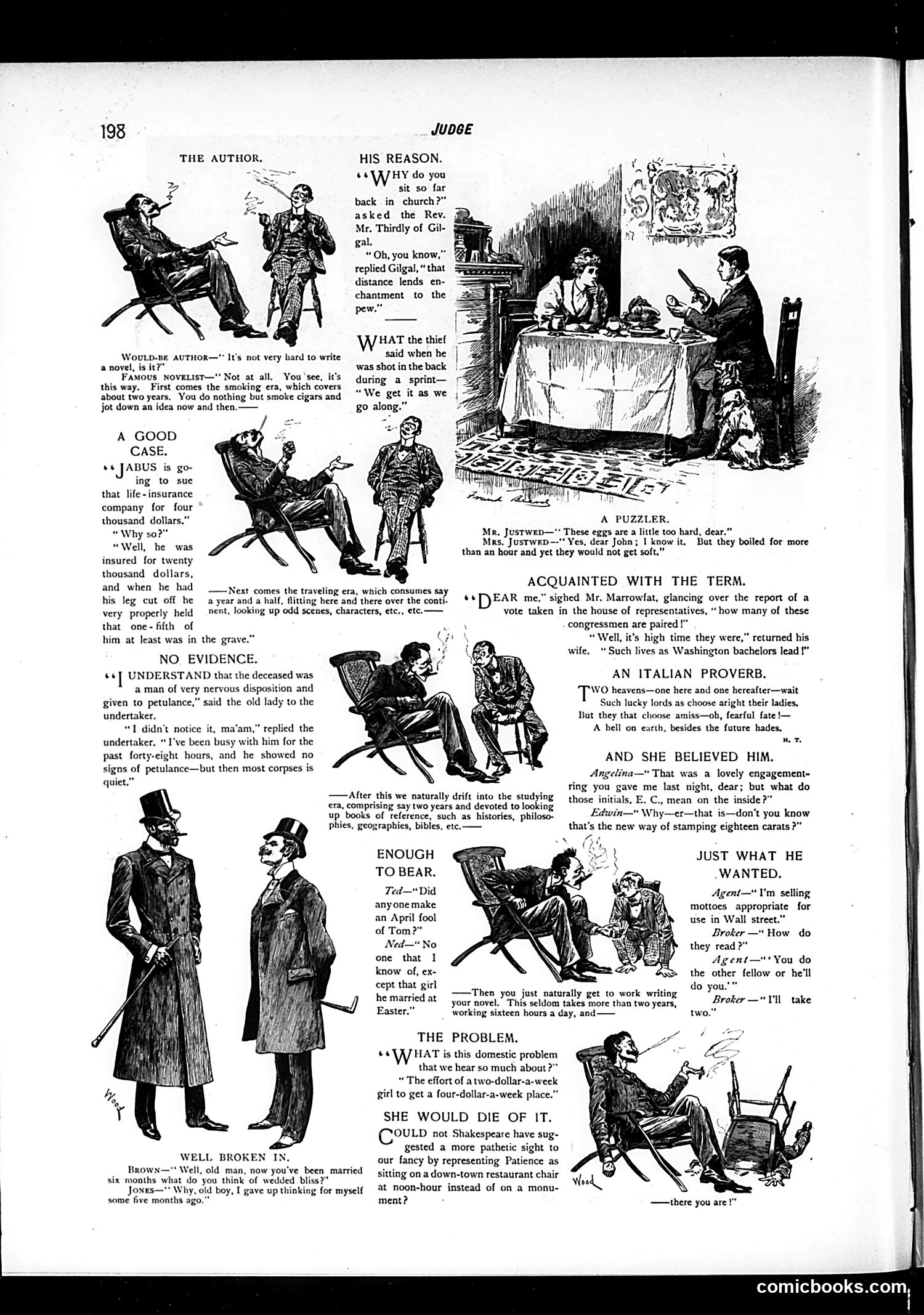
This page contains a collection of satirical anecdotes and jokes typical of Judge's humor. The main targets are: **Social Satire:** - Clergy ("Rev. Mr. Thirdly") mocked for boring sermons - Marriage critiqued as tedious (the "well broken in" husband) - Working-class wage struggles (the "two-dollar-a-week girl" trying to earn four dollars) **Professional Mockery:** - Novelists satirized for their laborious process: years of smoking, traveling, and research to produce work - Wall Street brokers portrayed as cynical and dishonest - Politicians ("congressmen are paired") criticized as absent or non-functional **Period-Specific Humor:** - Insurance and workplace disputes (the amputation claim) - References to "stamping eighteen carats" (jewelry quality marking) - "April fool" humor and engagement ring deceptions The cartoons feature recurring character types in conversation—the everyman, professional classes, and authority figures—all depicted in Victorian dress. The overall tone is genteel mockery of American institutions and social pretense.
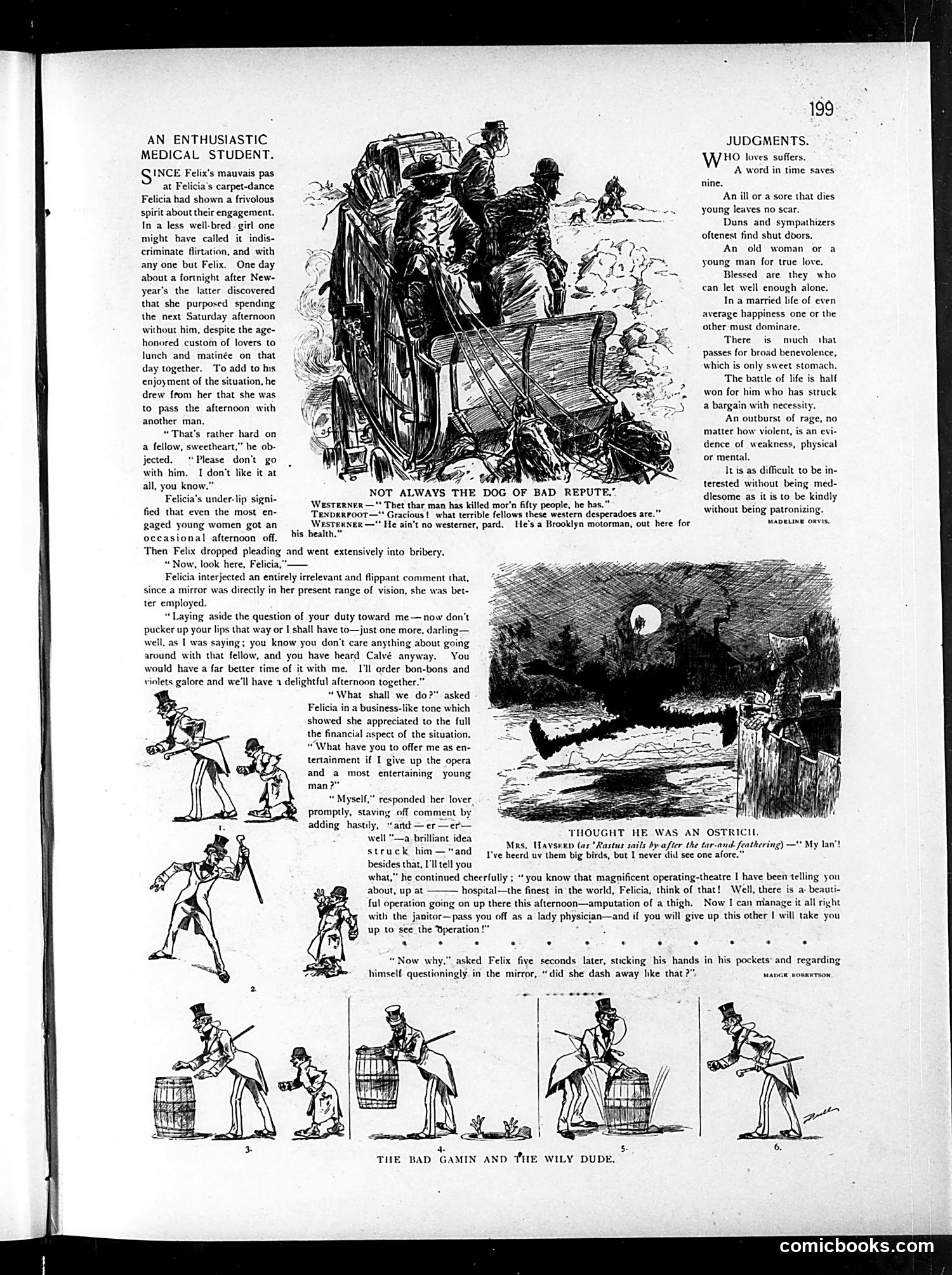
This page contains three satirical items typical of late 19th-century American humor: **"An Enthusiastic Medical Student"** (main story): A young medical student named Felix tries to convince his fiancée Felicia to skip an opera matinee with another man by offering increasingly elaborate bribes—candy, violets, and finally, a chance to observe an amputation surgery at his hospital, disguised as a lady physician. The satire targets medical students' obsession with their work and their transparent manipulation tactics. **"Not Always the Dog of Bad Repute"** (cartoon caption): A Westerner brags that a man has killed fifty people, assuming he's a dangerous frontier outlaw. The punchline reveals he's actually a Brooklyn motorman (streetcar operator)—satirizing urban violence and dangerous working conditions in New York City, contrasting it with stereotypical "Wild West" criminality. **"The Bad Gamin and the Wily Dude"** (comic strip sequence): Depicts a street urchin ("gamin") outwitting a well-dressed man with a barrel—classic urban trickster humor. The page exemplifies Judge's blend of narrative satire, social commentary, and visual humor.
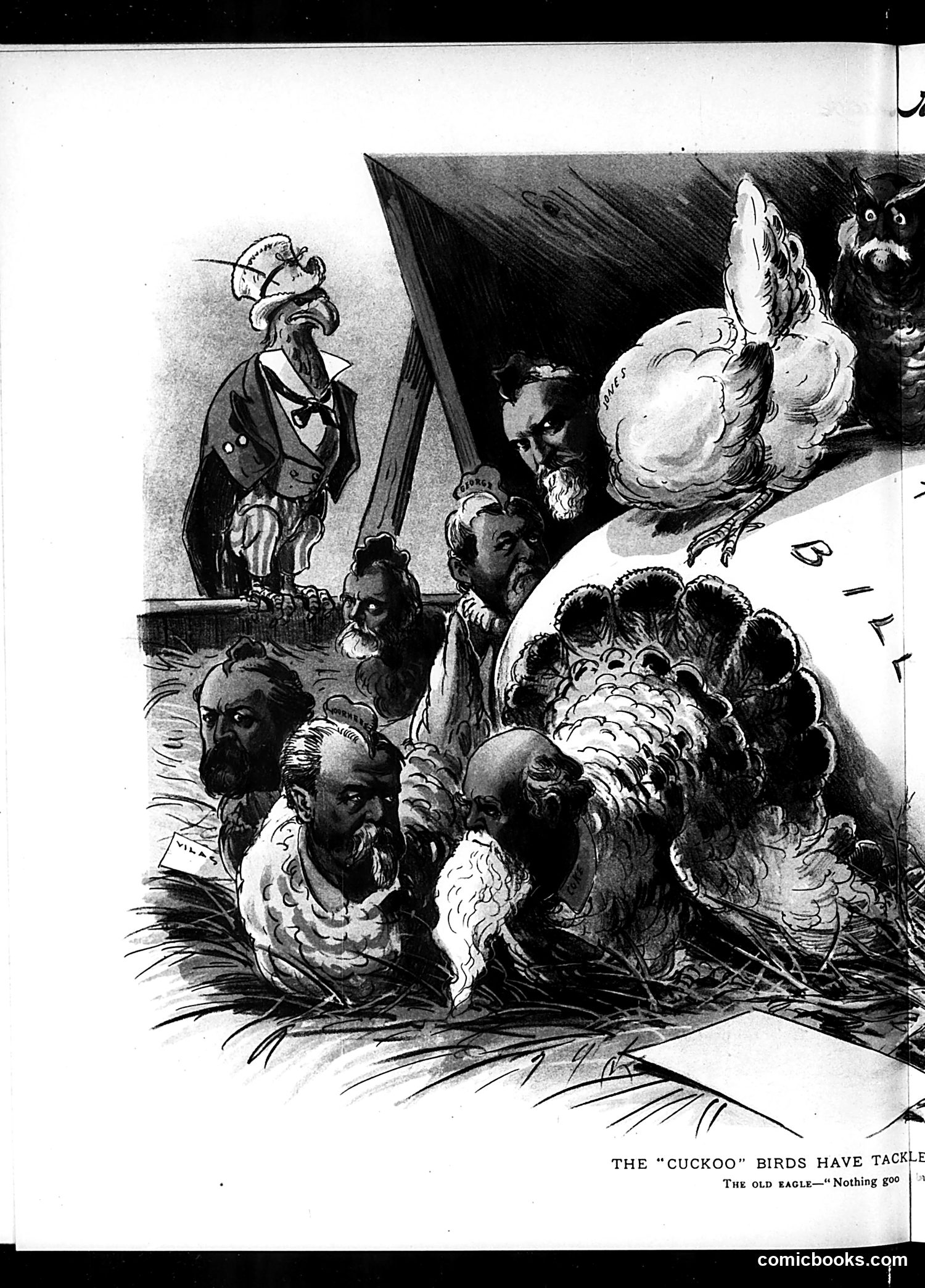
This satirical Judge cartoon depicts an "old eagle" (representing established American authority or leadership) confronted by multiple "cuckoo birds" (likely representing political opponents or insurgent movements). The figures wear period clothing and beards suggesting late 19th-century politics. The composition shows the eagles outnumbered and pressured by the cuckoos—a visual metaphor for upstart political forces challenging traditional power structures. The cuckoo reference is particularly pointed: cuckoos are parasitic birds that invade other birds' nests, suggesting the cartoonist views these challengers as illegitimate intruders rather than legitimate competitors. The incomplete caption ("Nothing go...") prevents full interpretation of the specific political conflict referenced, but the image clearly mocks what the cartoonist sees as an undignified assault on established order.
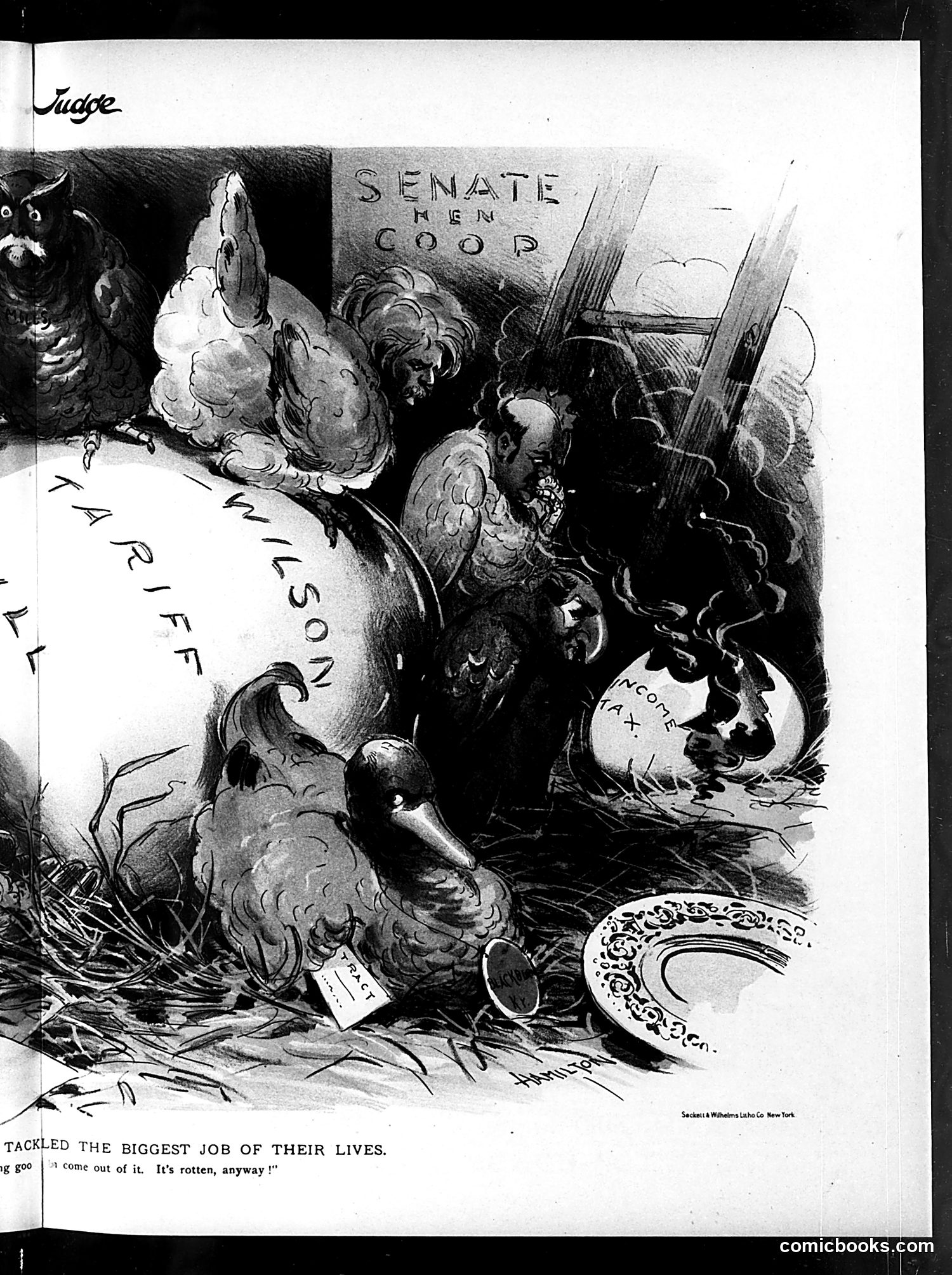
This Judge magazine cartoon satirizes the Senate's effort to pass cooperative legislation (marked "SENATE IN COOP"). The image depicts figures—likely senators or political leaders—struggling with an enormous spherical object labeled with text that appears read "WILSON" or similar. The caption "TACKLED THE BIGGEST JOB OF THEIR LIVES" and the dialogue "come out of it. It's rotten, anyway!" suggest the cartoon mocks senators' difficulty managing major legislation, possibly relating to Woodrow Wilson's policies or a specific Senate bill. The chaotic, crowded composition with scattered papers and implements conveys bureaucratic confusion. The ornate plate at the bottom suggests formal governmental proceedings contrasted with the messy reality depicted above—highlighting the gap between institutional dignity and legislative dysfunction. The satire criticizes Senate incompetence or obstruction.
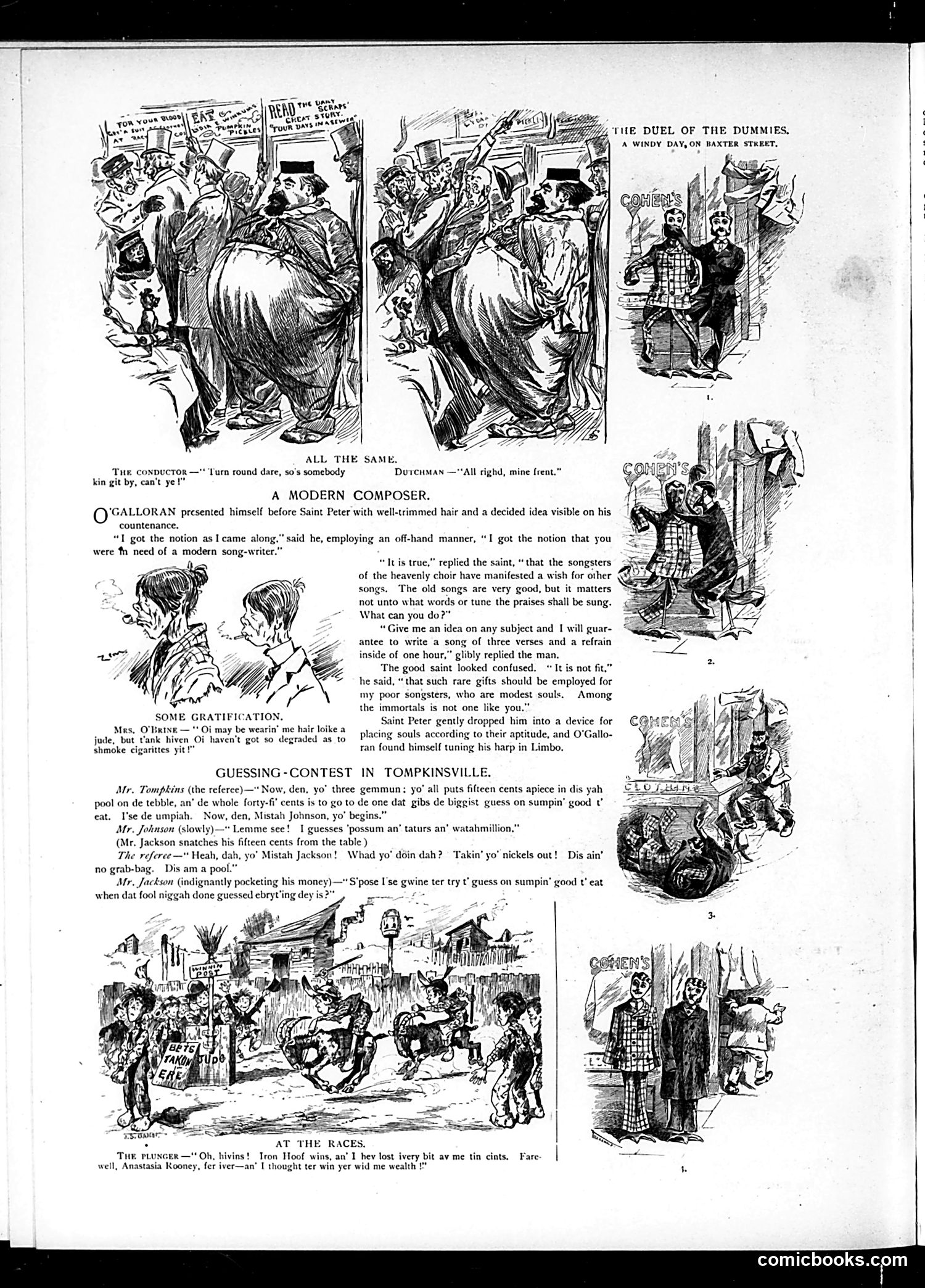
This page contains three distinct satirical pieces: **"All the Same"** mocks urban transit congestion, showing crowded streetcars where conductors and passengers struggle in chaos—social commentary on modern city life's indignities. **"A Modern Composer"** satirizes pretentious contemporary songwriters. O'Galloran boasts he can compose songs rapidly on any subject, presenting himself as a genius. Saint Peter, unimpressed by this arrogant mediocrity, relegates him to Limbo tuning harps—a jab at modern composers' superficiality versus timeless artistic merit. **"Guessing-Contest in Tompkinsville"** uses dialect humor (reflecting period racial stereotypes) to depict a gambling game where participants guess food items. Jackson withdraws his money when he realizes all desirable foods are already guessed, and the final panel shows a loser lamenting lost wealth—mocking working-class gambling habits and unrealistic romantic aspirations. All three target social pretension, urban chaos, and questionable judgment.
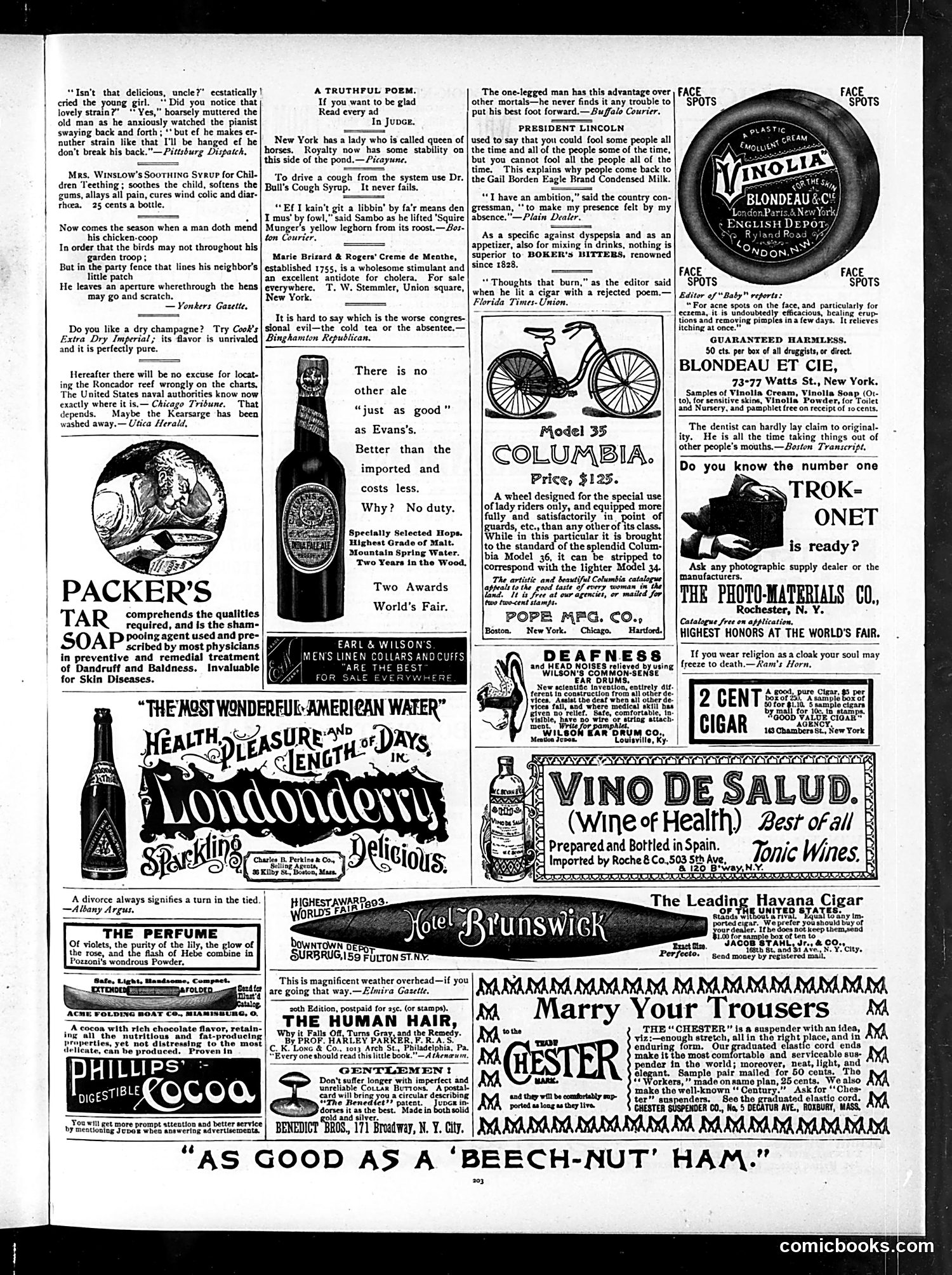
This is primarily an **advertising page** from Judge magazine, with scattered short humorous items interspersed among commercial ads. The few cartoons/jokes present are brief, genteel Victorian-era humor: - A young woman enjoys a pianist's "strain" while her uncle worries the musician will injure himself from swaying—a mild joke about physical exertion. - A farmer deliberately leaves a gap in his fence to let his neighbor's chickens escape into his garden—petty rural mischief. - A play on President Lincoln's famous quote about fooling people, applied to why consumers keep buying Eagle Brand condensed milk (advertising disguised as humor). - A pun: "thoughts that burn" refers to both passionate writing and using a rejected manuscript to light a cigar. The page reflects **late 19th-century advertising culture**, where magazines monetized space through patent medicines, alcohol, bicycles, and consumer goods. The humor is gentle and domesticated—there's no sharp political satire visible here, unlike Judge's typical satirical cartoons on other pages.
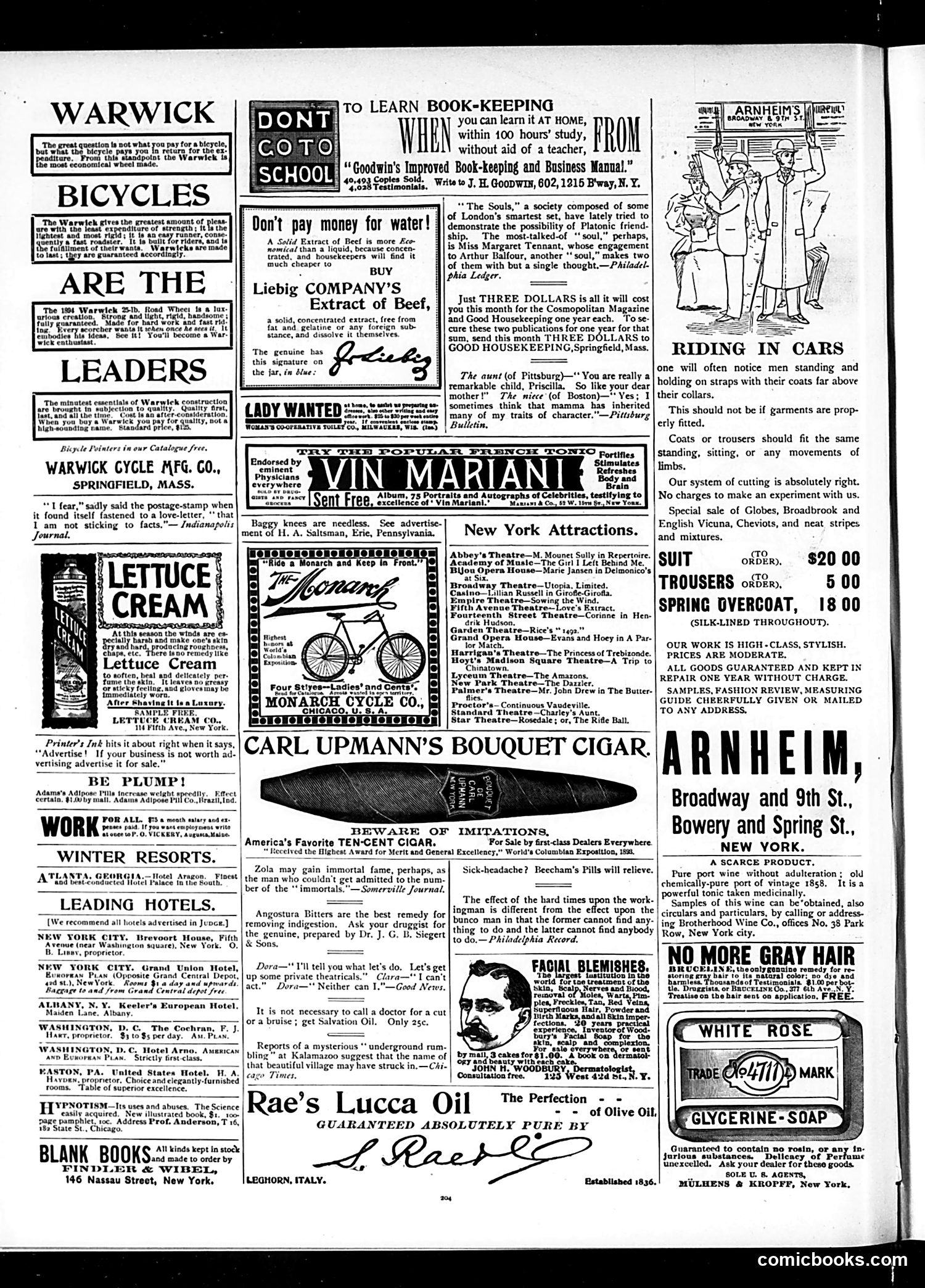
This page is primarily **advertising and miscellaneous content** rather than political satire or editorial cartoons. The dominant visual elements are **advertisements for consumer products and services**: bicycles (Warwick brand), book-keeping courses, Liebig's Extract of Beef, cigars, hotels, and patent medicines. There is one small **cartoon illustration** showing people standing and riding in an early automobile, accompanying an article titled "RIDING IN CARS" that discusses proper etiquette for automobile passengers—a relevant topic for the 1890s when cars were novel luxuries. The page includes brief humorous snippets (like the postage-stamp joke about a love-letter) but these are **filler humor**, not political satire. The references to "The Souls" (a London social set) and mentions of Platonic friendship represent **society gossip** rather than pointed commentary. Overall, this appears to be a **typical Judge magazine page** mixing advertisements with light social humor and consumer guidance for an upper-middle-class readership.
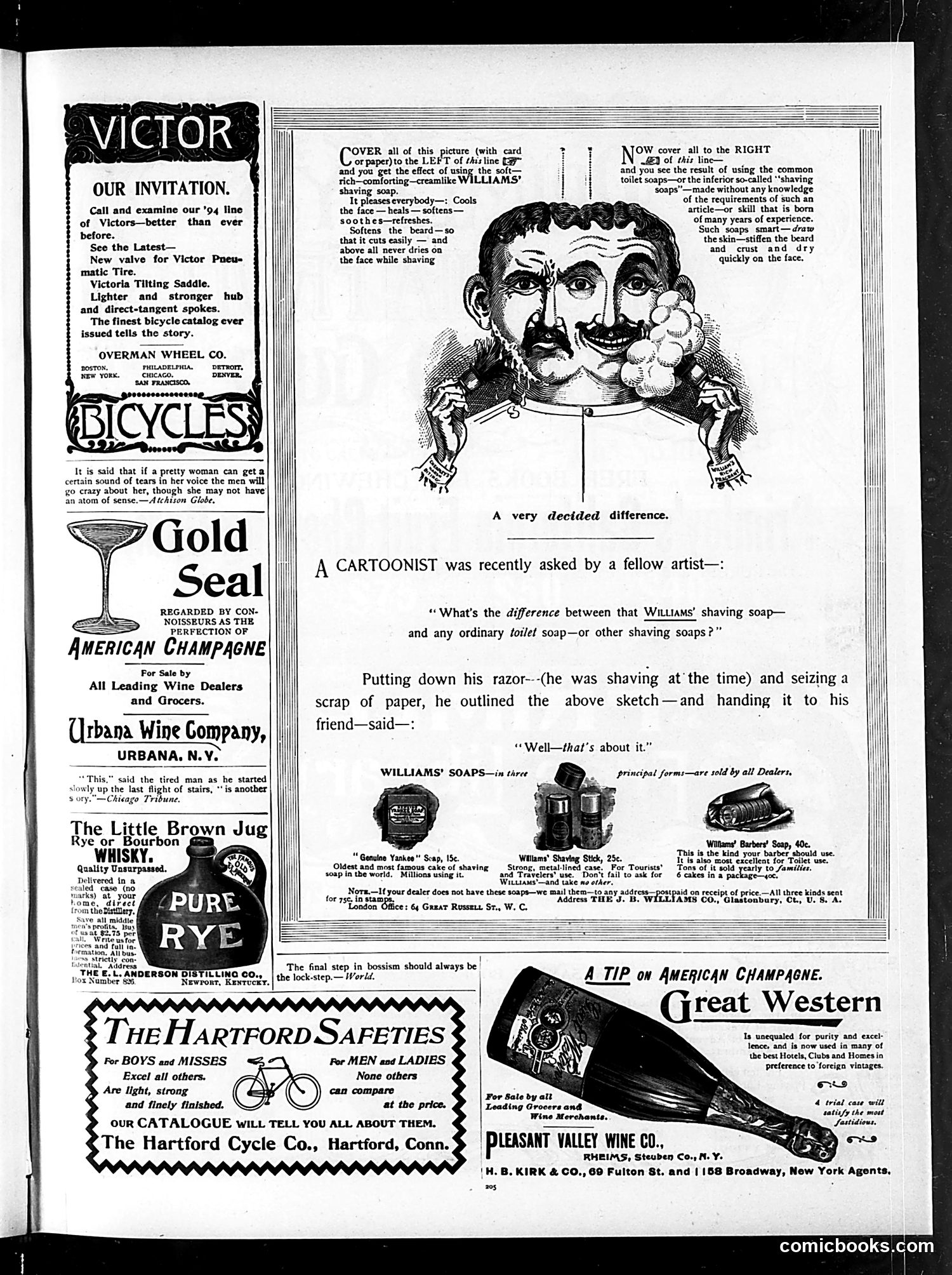
This page features a clever **before-and-after advertisement for Williams' Shaving Soap**. The central cartoon shows a man's face split down the middle: the left side depicts a man after using Williams' soap (satisfied, smooth-faced), while the right side shows the same man using inferior toilet soaps (irritated, uncomfortable). The humor comes from a cartoonist being asked the difference between Williams' and ordinary soaps. Rather than explain verbally, he simply sketches the visual contrast and says, "Well—that's about it." The advertisement emphasizes that Williams' soap is specifically formulated for shaving—cooling, softening the beard, and preventing irritation—whereas generic toilet soaps dry out skin and stiffen whiskers. The page includes product images and purchasing information. The surrounding content is standard period advertising for bicycles, champagne, and whiskey, typical of *Judge* magazine's commercial pages.
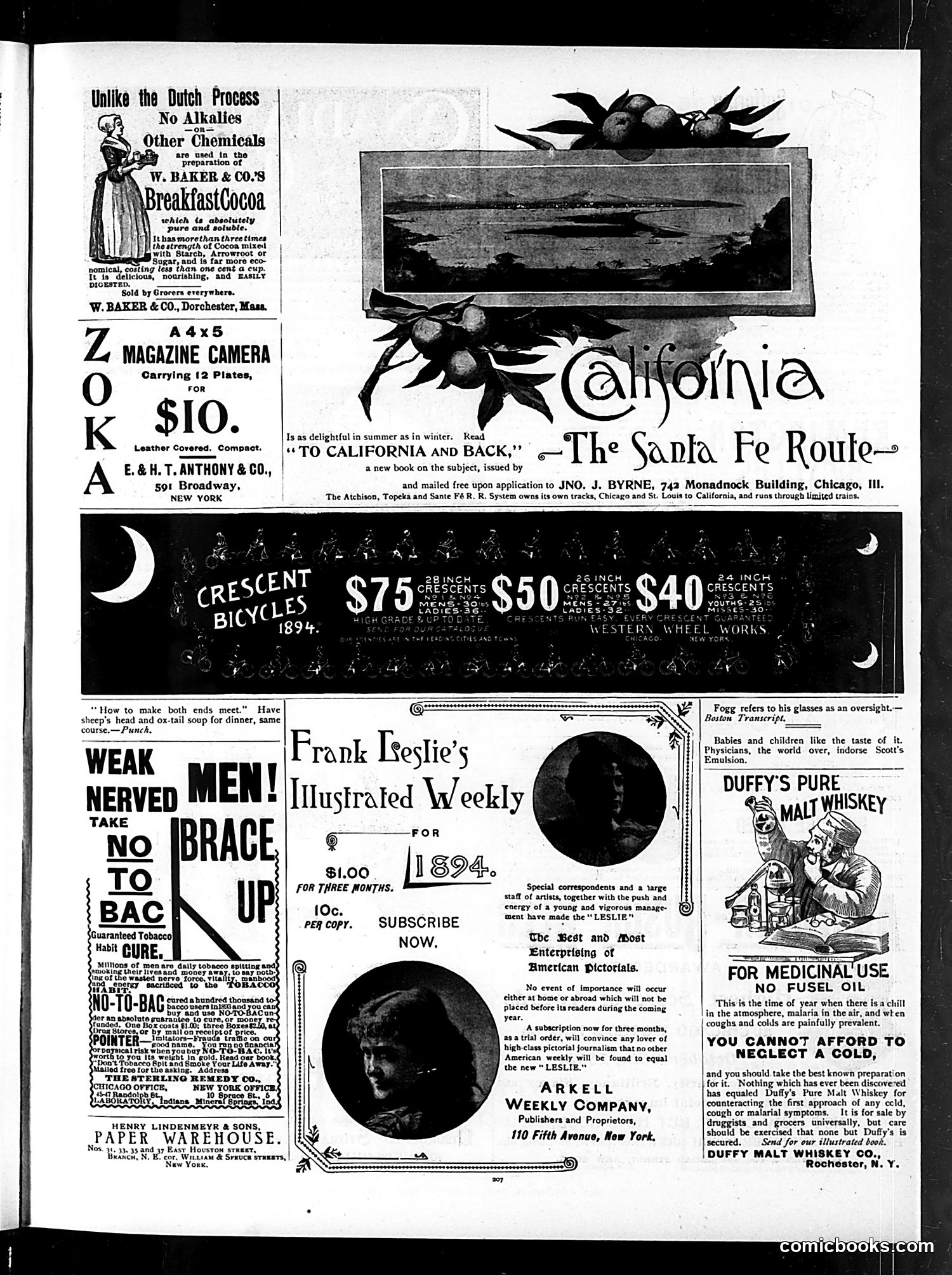
This is **primarily a page of vintage advertisements** from *Judge* magazine (1894), not political satire. The ads promote: - **W. Baker & Co. Breakfast Cocoa** (emphasizing purity and value) - **Santa Fe Railway** (travel promotion to California) - **Crescent Bicycles** (pricing various models) - **Zoak Magazine Camera** ($10, leather-covered) - **Tobacco Habit Cure** (addressing widespread addiction) - **Frank Leslie's Illustrated Weekly** (a competing pictorial magazine) - **Duffy's Pure Malt Whiskey** (marketed for medicinal use—treating colds and malaria) The single **joke at bottom left** references Punch magazine's humor about budget dining ("sheep's head and ox-tail soup"). There is **no political cartoon content**. The page reflects late 19th-century consumer culture and the normalization of whiskey and tobacco products marketed as medicinal remedies—practices now recognized as harmful.
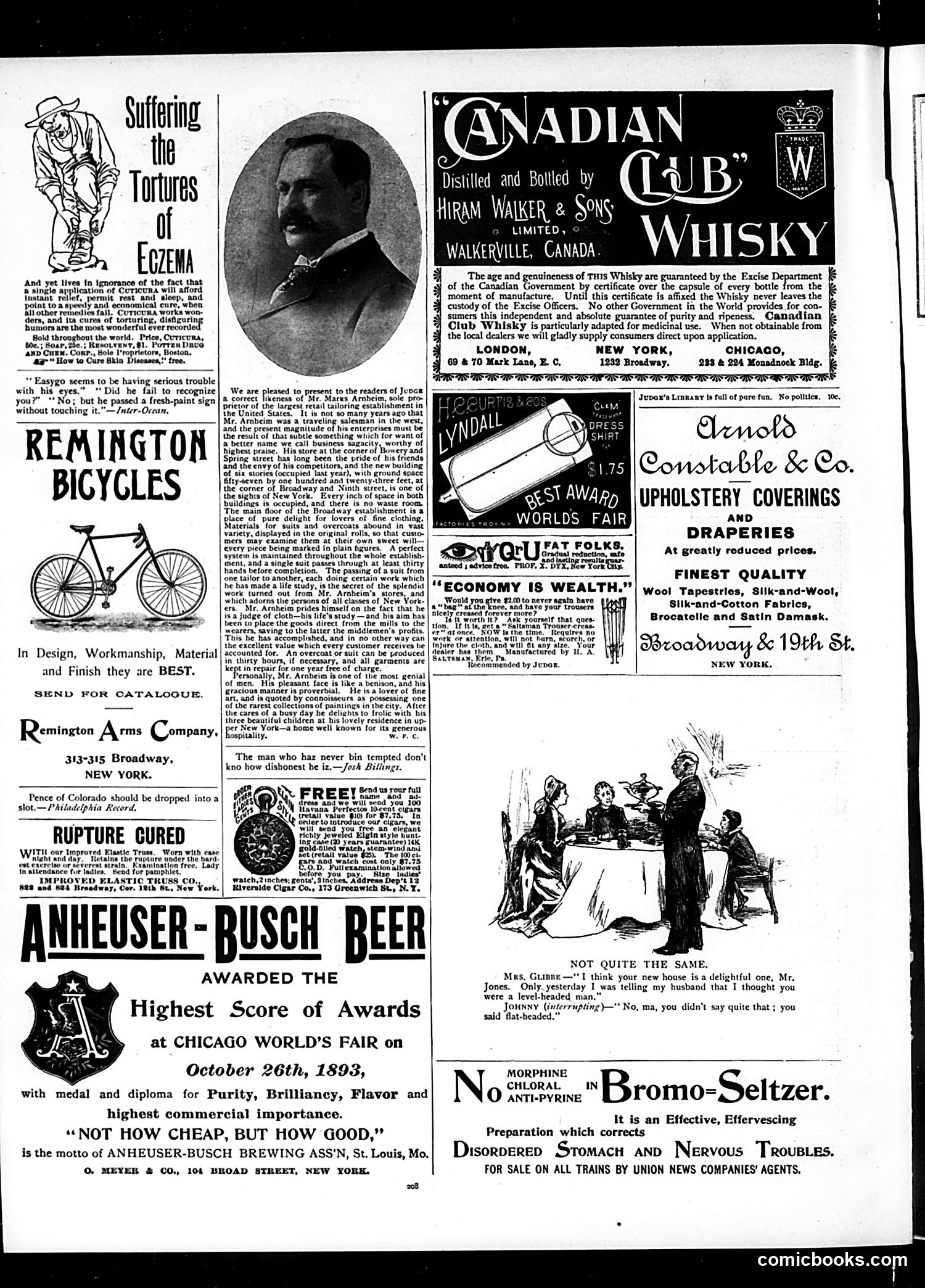
This page is primarily **advertising**, with one small cartoon joke at bottom right. **The Main Cartoon ("Not Quite the Same"):** A domestic scene where Mrs. Gibbs tells Mr. Jones she thought he was "a level-headed one," referencing that yesterday she told her husband Jones was delightful. Johnny (interrupting) contradicts this, saying "No, ma, you didn't say quite that; you said he-headed!" The joke plays on the mishearing or misremembering of an insult as a compliment—Johnny reveals the truth that was actually said was unflattering, not flattering. **Advertisements dominate the page:** Canadian Club Whisky, Remington Bicycles, Anheuser-Busch Beer, Cuticura eczema remedy, and Arnold Constable & Co. upholstery coverings. These ads reflect late-1890s consumer goods and patent medicines. The page contains no significant political satire or social commentary—it's a typical Judge magazine layout mixing light humor with commercial advertisements.
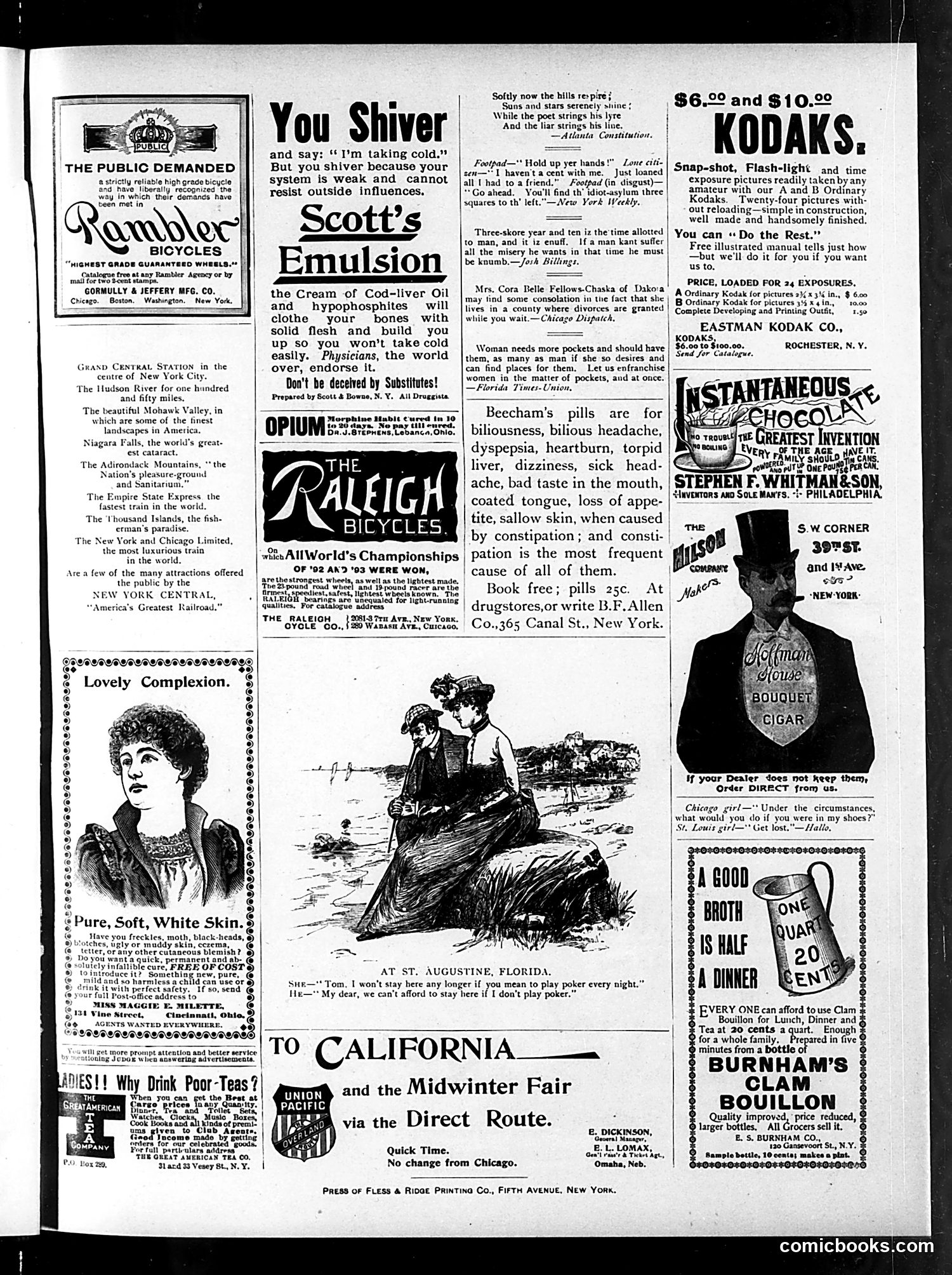
This page is primarily **advertisements and satirical humor snippets**, typical of Judge magazine's format. The main visual content shows a sketch titled "AT ST. AUGUSTINE, FLORIDA" depicting a couple by water, with dialogue about poker playing—a mild joke about marital financial tensions and gambling habits. Scattered throughout are humorous quotations on universal themes (aging, divorce, women's rights, poverty) attributed to various newspapers. One quip plays on the irony of a mugger robbing someone with no money. The bulk of the page consists of **product advertisements** from the 1890s-era: bicycles (Rambler, Raleigh), Scott's Emulsion cod-liver oil, Kodak cameras, Beecham's pills, cigars, bouillon, and railroad services. These ads employ period marketing strategies—testimonials, health claims, and appeals to modern convenience. There is **no significant political satire** on this particular page—it represents Judge's commercial revenue model blended with light social humor rather than its characteristic sharp political commentary.
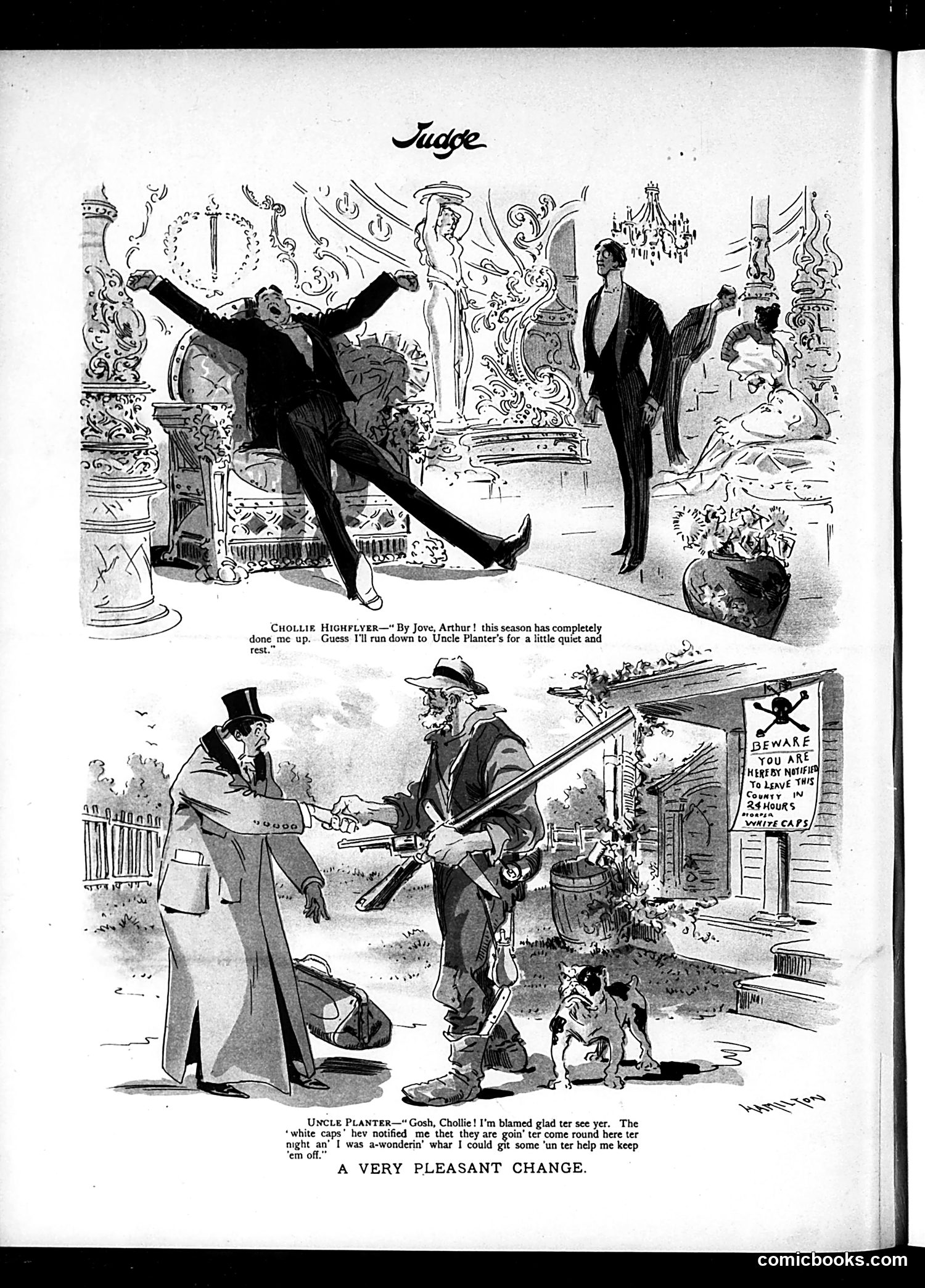
This Judge cartoon satirizes the contrast between urban leisure and rural danger in the American South. **Top panel**: "Chollie Highflyer," an exhausted wealthy urbanite, plans to visit his Southern uncle for rest and relaxation. **Bottom panel**: Uncle Planter reveals the grim reality—"white caps" (vigilante groups, likely the Ku Klux Klan or similar night-rider organizations) have threatened violence, and he desperately needs armed help to defend against them. **The satire**: The title "A Very Pleasant Change" is deeply ironic. What Chollie expects as a restful escape becomes involvement in violent rural conflict. The cartoon critiques both the naiveté of Northern leisure-seekers and the dangerous lawlessness plaguing the South, where organized vigilante groups operated with impunity. The joke exposes the gap between romanticized Southern hospitality and the actual threat of racial or social violence underlying rural life.