
A complete issue · 16 pages · 1894
Judge — March 17, 1894
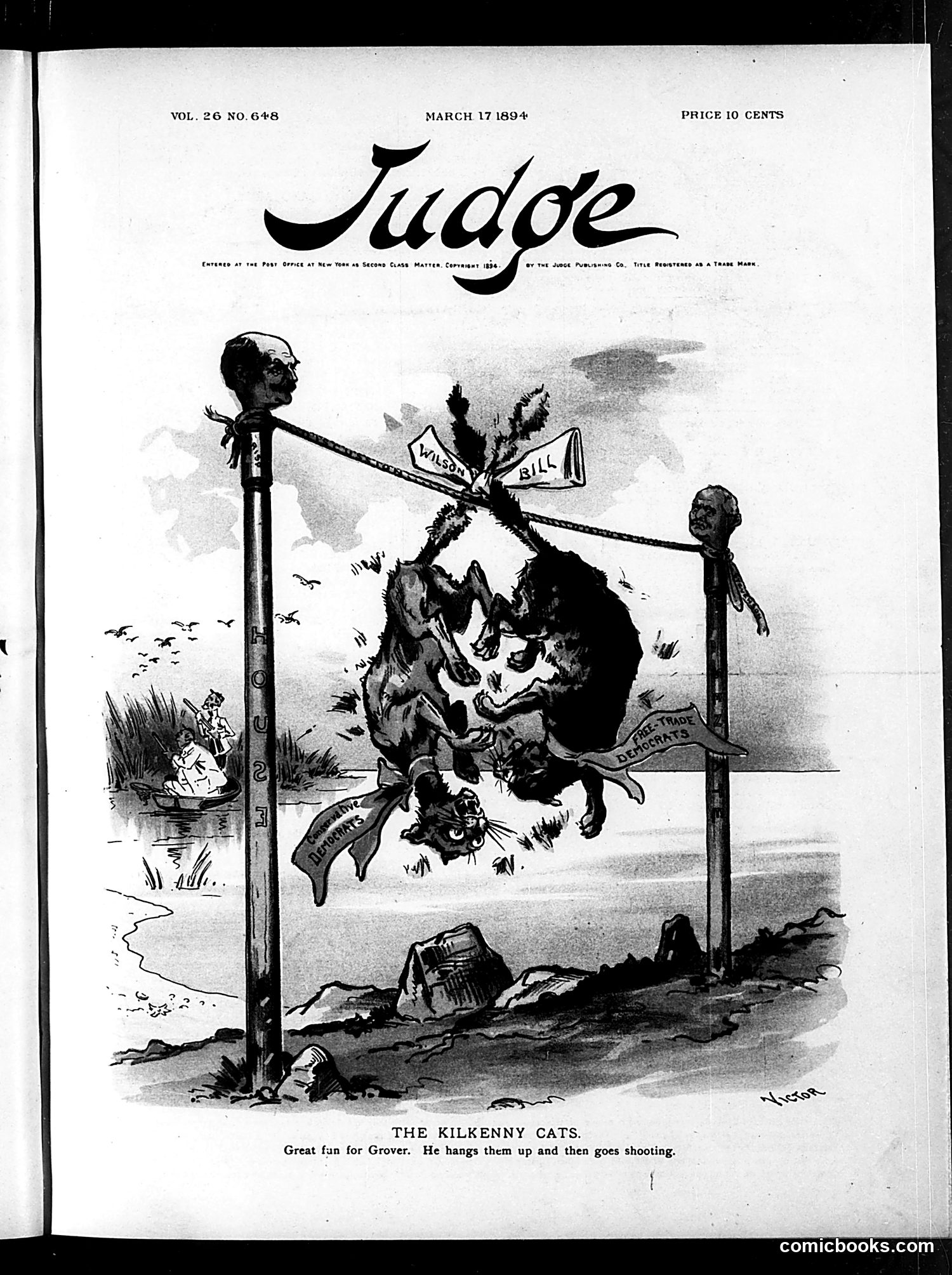
This political cartoon references the famous Irish legend of the Kilkenny Cats—two cats that fought until only their tails remained. The image shows cats labeled with "Wilson" and "Bill" suspended between two poles, while a figure labeled "Democrats" watches from the right and another figure (likely representing "Republicans" or political opponents) observes from the left near water. The satire suggests that Democratic factions fighting over the Wilson Bill (tariff legislation debated in Congress) were destroying themselves through internal conflict, similar to the self-destructive cats. The caption jokes that this political fighting provided "great fun for Grover"—President Grover Cleveland—who could benefit while Democrats weakened each other.
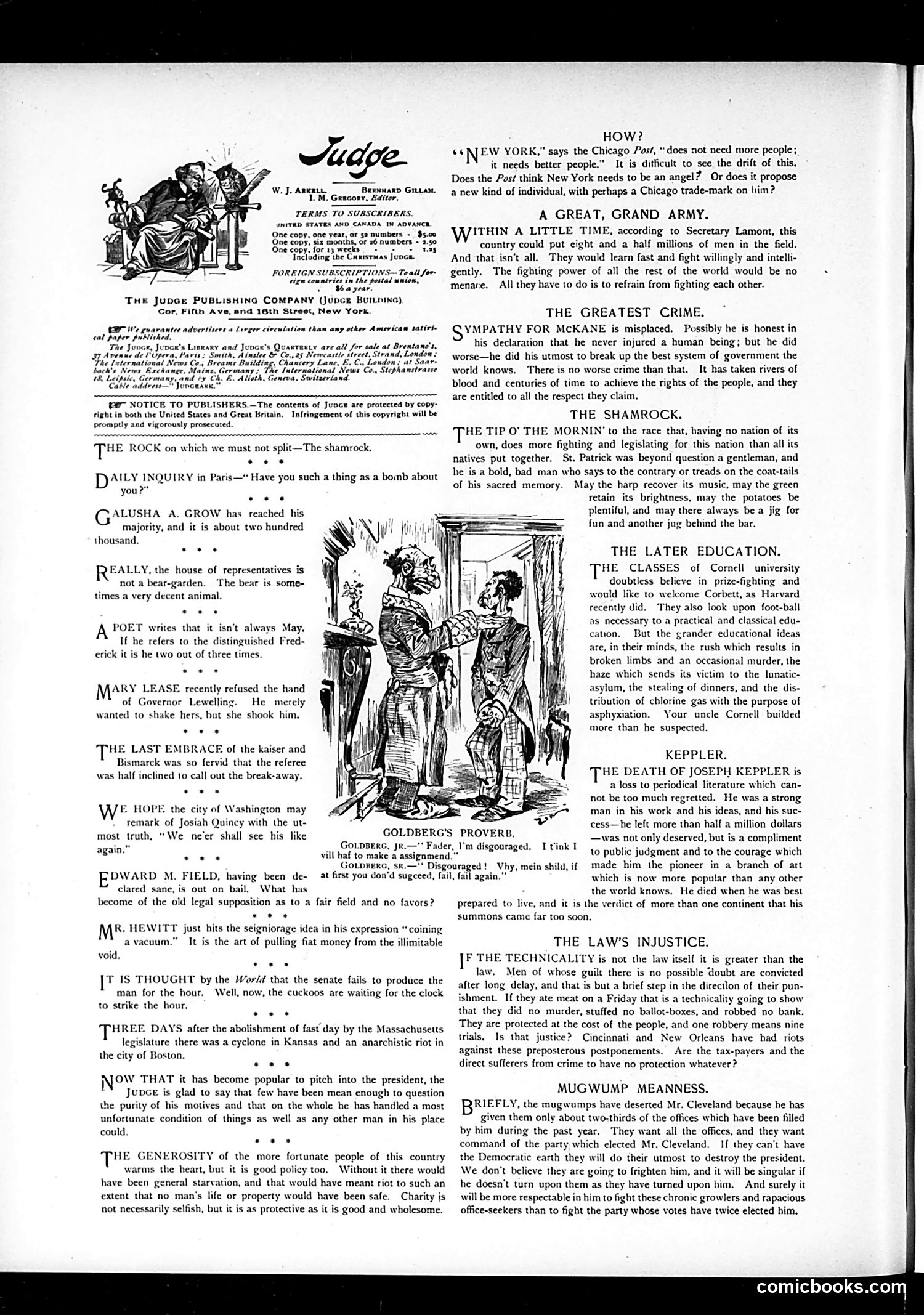
The main cartoon, titled "Goldberg's Proverb," depicts a skeletal figure (Death) confronting what appears to be a wealthy or well-dressed man, with the caption: "Fader, I'm disgusted. I trick I will no make a assignment. I go avay disgausted. Vy, mein shild, if at first you don't succeed, try, try again." This appears to be **anti-German satire**, likely from World War I era, using a Yiddish-accented character to mock German persistence or stubbornness. The skeleton representing Death suggests the futility or horror of continued conflict. The surrounding text columns discuss various political topics including military buildup, education, and legal injustice, typical of Judge's satirical commentary on American politics and society. The cartoon's humor relies on ethnic stereotype caricature—common but now-offensive practice of early 20th-century American satire.
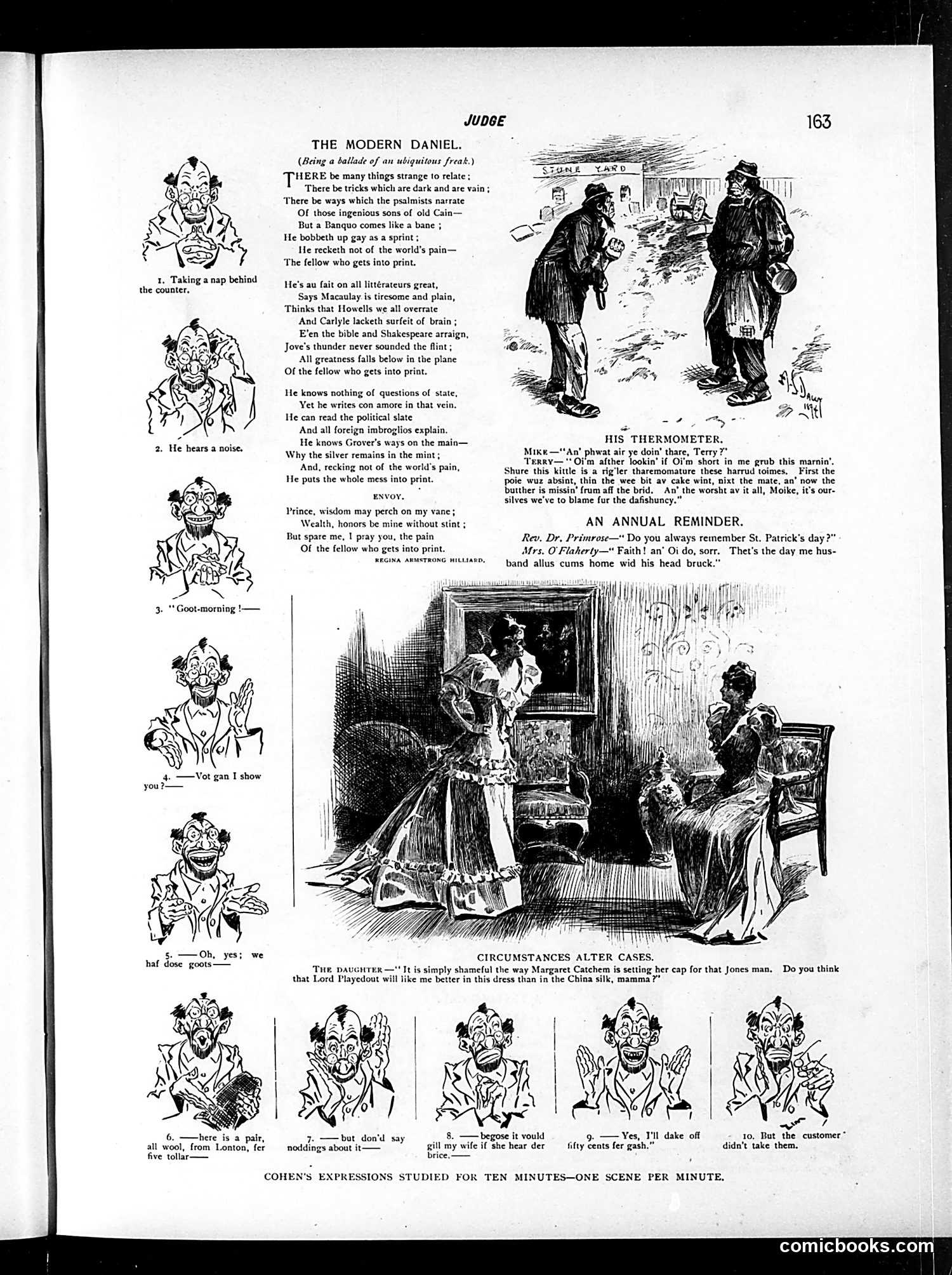
This page satirizes theatrical and social pretension circa the early 1900s. "The Modern Daniel" poem mocks a literary charlatan who falsely claims expertise across multiple fields—literature, science, philosophy—yet understands none deeply. The cartoons show his various affected personas and expressions. "His Thermometer" depicts working-class characters discussing a man of presumed status, with one noting he's "abaitin' thin" and poor, suggesting class anxiety or fraud. "An Annual Reminder" jokes about St. Patrick's Day and domestic relationships. "Circumstances Alter Cases" shows a woman displaying clothing to another, discussing a wealthy suitor (Lord Flycedod), highlighting marriage as transactional. The bottom section depicts an actor (Cohen) demonstrating ten different facial expressions for a single theatrical scene, satirizing method acting's exaggeration.
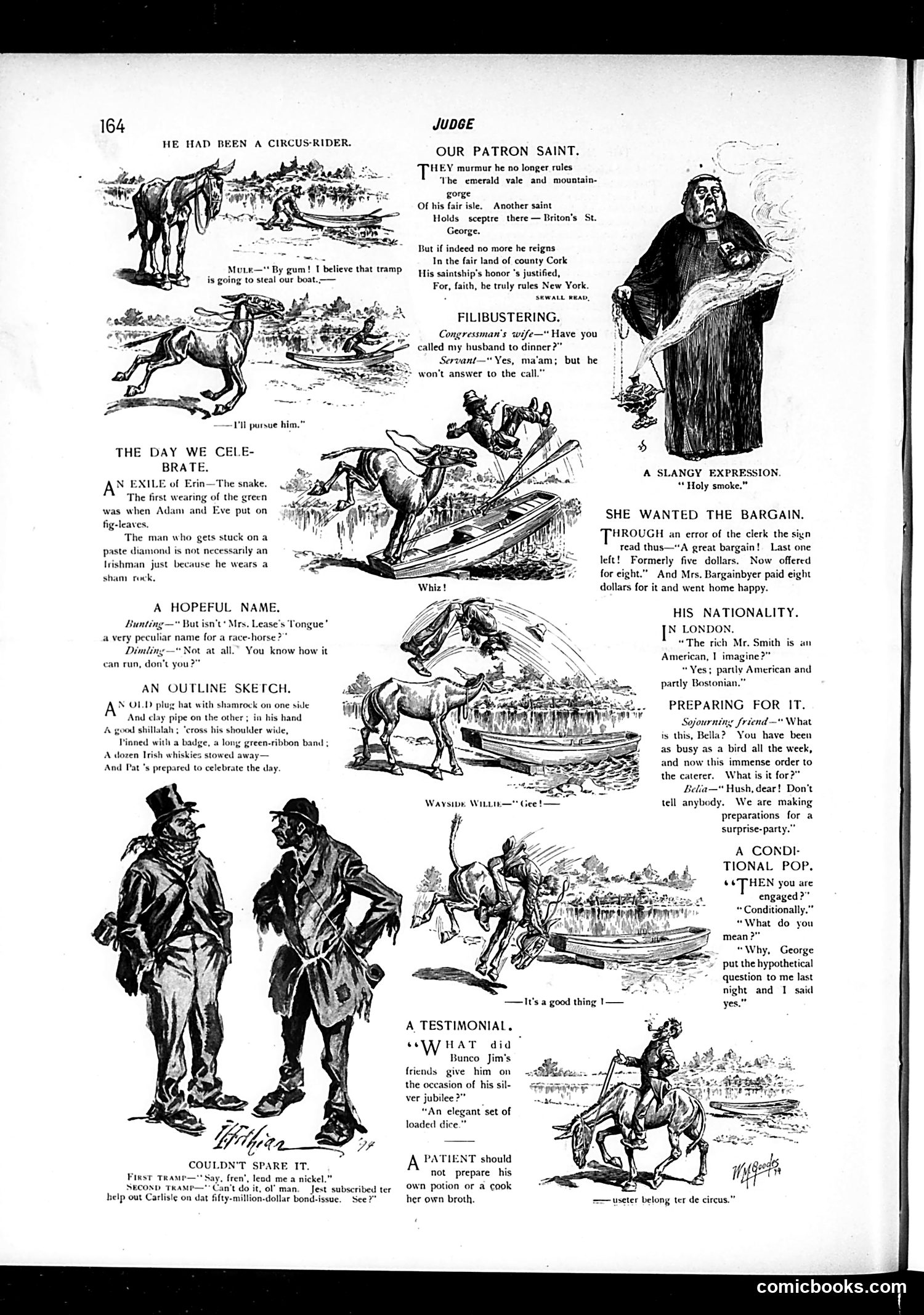
This page from Judge contains multiple short satirical pieces typical of the magazine's format. The dominant theme is **Irish-American stereotyping and St. Patrick's Day humor**. "Our Patron Saint" mocks Irish political influence, suggesting Ireland's St. Patrick now "rules New York" instead of Ireland itself—a jab at Irish-American political power in the city. "An Outline Sketch" reduces Irish identity to caricatured elements: shamrocks, clay pipes, whiskey, and green ribbons. Other pieces employ genteel humor: "Filibustering" plays on a congressman ignoring his wife's dinner call; "She Wanted the Bargain" depicts consumer foolishness; "A Conditional Pop" jokes about tentative engagements. "Couldn't Spare It" references contemporary politics—the Cleveland administration's bond issue to address economic crisis (1890s likely). The numerous small cartoons feature exaggerated character drawings typical of Judge's visual style. Overall, the page blends ethnic stereotyping with political commentary and domestic comedy, reflecting late-19th-century American satire conventions.
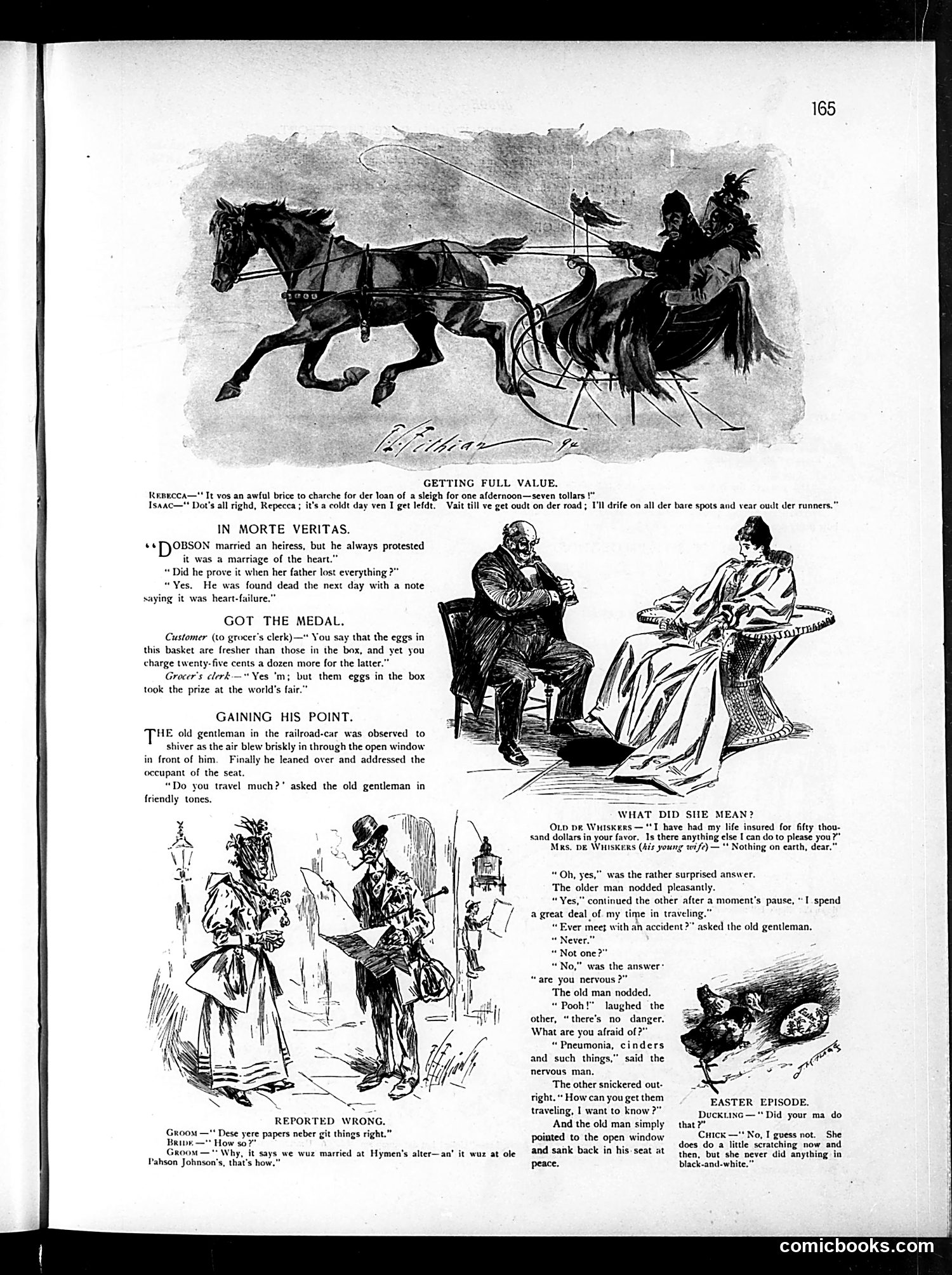
This page contains five brief humorous sketches typical of late 19th-century Judge magazine: **"Getting Full Value"** mocks Jewish immigrants (indicated by dialect) who, charged seven dollars to rent a sleigh, plan to wear out the runners on bare ground to get their money's worth—satire of perceived penny-pinching. **"In Morte Veritas"** jokes darkly that a man who claimed to marry for love (not money) proved it by dying conveniently when his wealthy wife's father lost his fortune. **"Got the Medal"** satirizes a grocer's clerk charging premium prices for eggs that won a prize at the World's Fair, despite being no fresher than cheaper eggs. **"Gaining His Point"** depicts an elderly man manipulating a younger railroad passenger into admitting he travels frequently, establishing they have nothing to fear from accidents. **"What Did She Mean?"** presents a young wife reassuring her elderly, wealthy husband that his life insurance policy pleases her—the implication being darkly cynical about her motivations. The page reflects period attitudes toward wealth, marriage, ethnicity, and commerce.
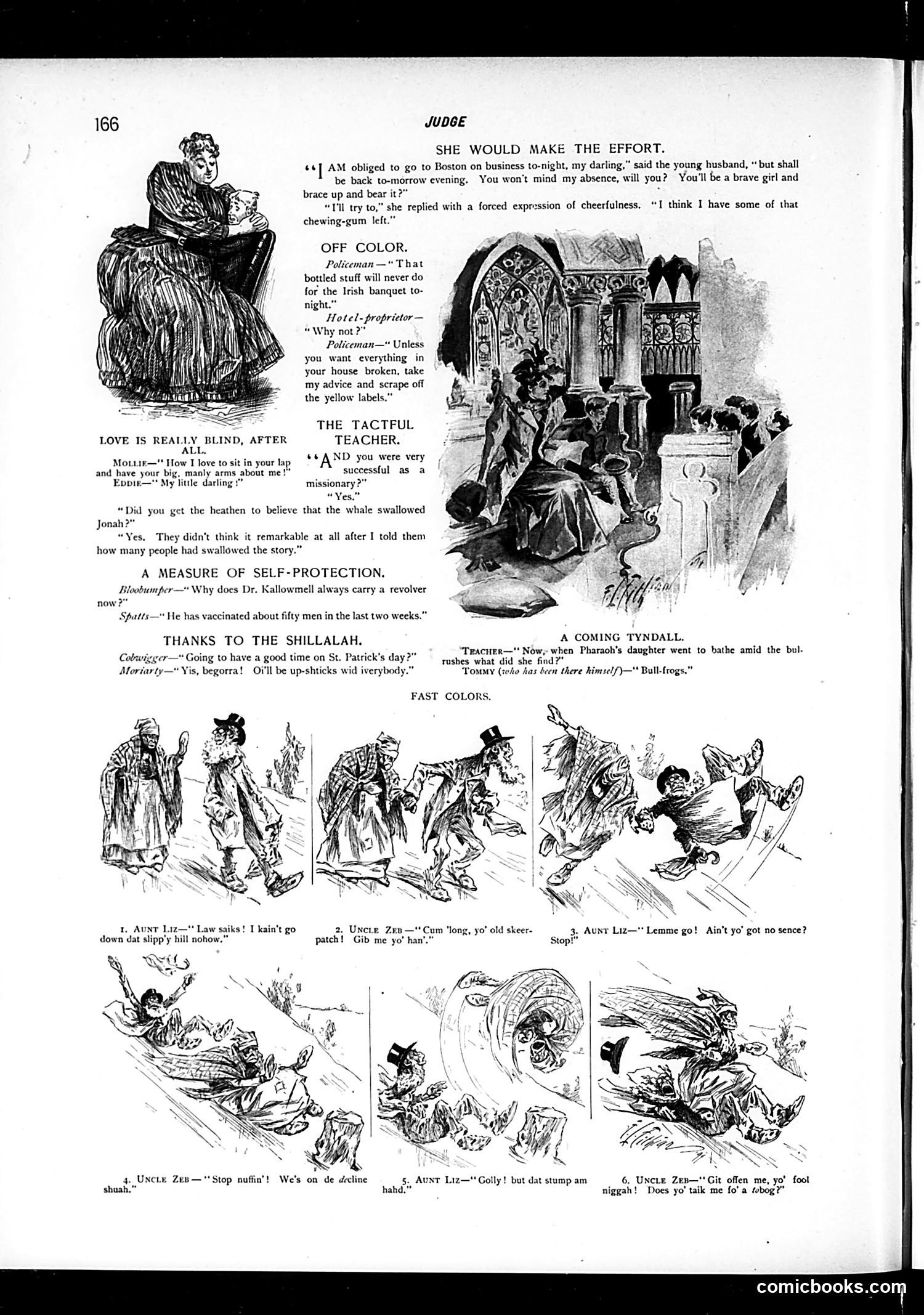
This page contains multiple short satirical pieces typical of Judge's humor circa early 1900s: **"She Would Make the Effort"** mocks marital dynamics—a husband leaving for business expects his wife to suffer nobly; she ironically suggests chewing gum as her only comfort, suggesting both her boredom and trivial concerns. **"Off Color"** relies on ethnic stereotyping: an Irish banquet requires removing "yellow labels" (whiskey bottles) to prevent destruction, playing on period stereotypes of Irish drunkenness and violence. **"The Tactful Teacher"** jokes that a missionary's conversion success came not from Biblical persuasiveness but from the audience's gullibility—they'd believe anything after accepting his tall tales. **"Fast Colors"** (the comic strip sequence) features racist dialect humor with elderly Black characters named Uncle Zeb and Aunt Liz slipping down a hill—"fast colors" being a pun on fabric dyes that don't hold fast. The stereotyped speech and situation perpetuate harmful caricatures common to the era. These pieces reflect Judge's reliance on ethnic stereotypes and social prejudices as humor sources.
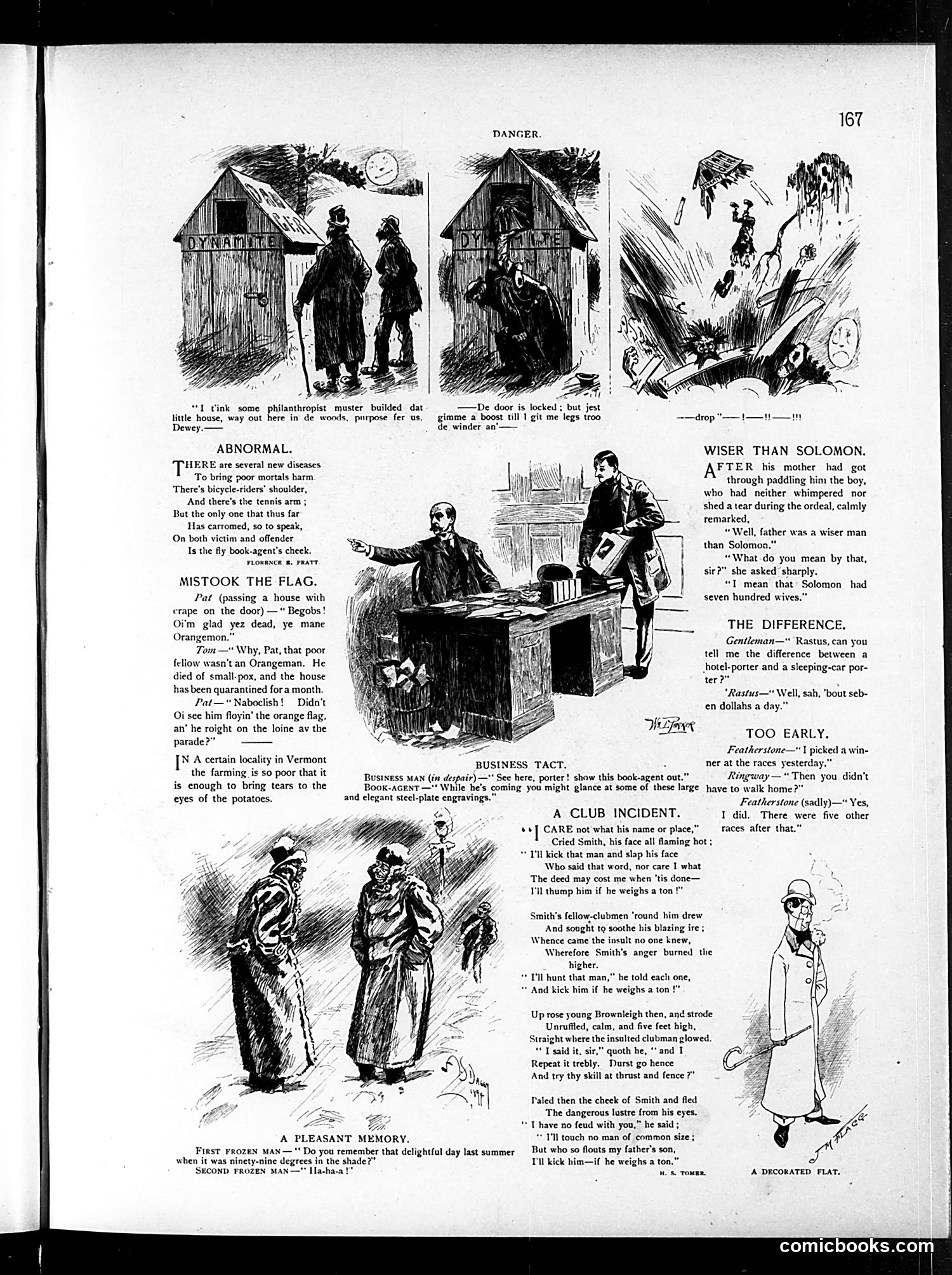
This page contains several unrelated humor pieces typical of late 19th-century satirical magazines: **"Mistook the Flag"** mocks Irish immigrant "Pat," who confuses a quarantine flag (indicating smallpox) with an Orange Lodge banner, mistakenly celebrating a Protestant's death based on visual misidentification. The joke relies on stereotypes about Irish Catholics and their sectarian tensions. **"A Club Incident"** satirizes masculine posturing: Smith threatens violence over an unnamed insult, but when young Brownleigh calmly claims responsibility and offers to duel, Smith backs down—revealing his bluster was hollow. The punchline about only fighting those weighing "a ton" mocks his cowardice. **Other items** include brief jokes about book agents, Vermont farming, hotel porters, and racial stereotypes in the "Rastus" dialogue. The cartoons throughout use exaggerated ink sketches typical of period humor magazines. The overall tone reflects Judge's satirical approach: lampooning social pretension, immigrant stereotypes, and masculine vanity through sharp but crude humor.
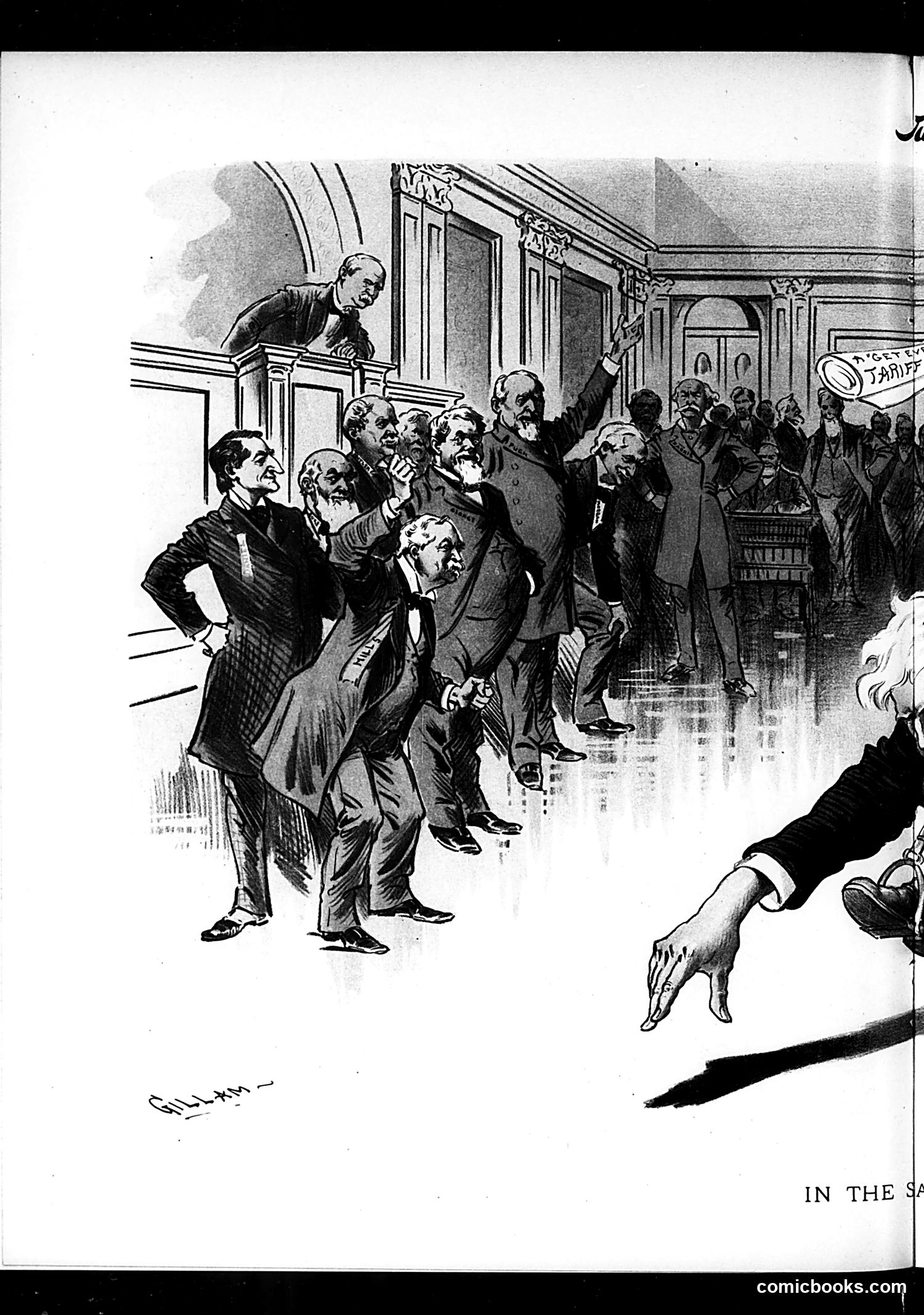
This appears to be a late 19th-century political cartoon depicting a scene "IN THE SA[LOON]" (text partially visible). The illustration shows well-dressed men in formal attire engaged in what seems to be a heated discussion or confrontation. One man stands elevated at a podium or raised platform, gesturing emphatically, while others below react with animated expressions—some pointing, others appearing to argue back. The cartoon likely satirizes parliamentary debate, legislative proceedings, or political discourse of the era, mocking politicians' theatrical behavior and heated rhetoric. The formal dress and architectural setting suggest an official government building. Without clearer text identifying specific figures or events, the precise political targets remain unclear, though the satire targets pompous political behavior generally.
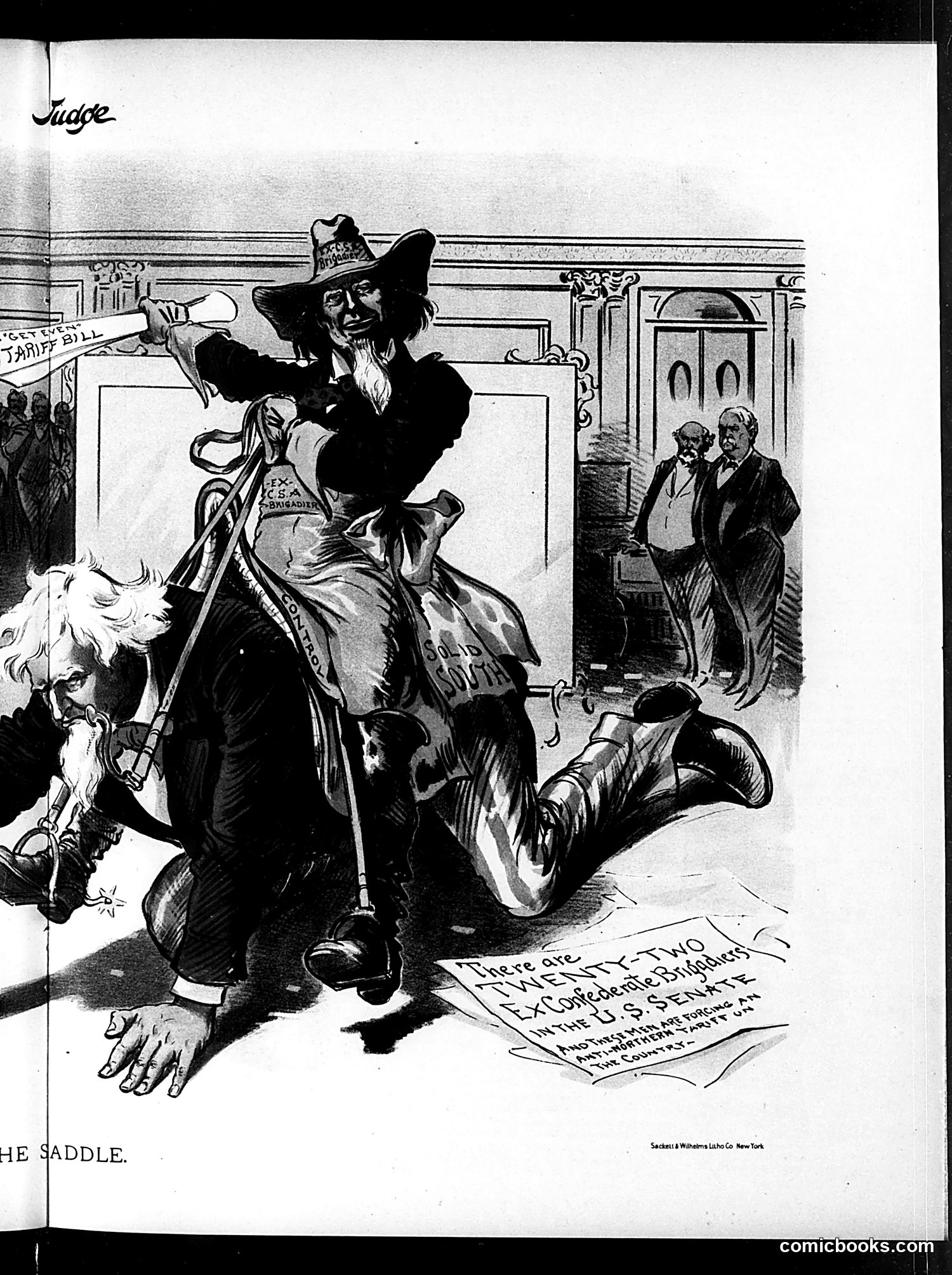
This Judge magazine cartoon satirizes the burden of presidential responsibility. A demonic or devilish figure (representing a political adversary or corrupt influence) rides upon the back of Uncle Sam, who is depicted as a weary beast of burden. Uncle Sam appears exhausted, laden with documents labeled with various governmental obligations and taxes. The cartoon critiques how political forces or specific policies are "saddling" the American public with unsustainable burdens. The caricatured rider represents malevolent political leadership or ideology oppressing the nation. Figures in the background (likely congressmen or politicians) observe the scene indifferently from a doorway, suggesting complicity or apathy toward Uncle Sam's plight. The satire targets government overreach and the exploitation of ordinary Americans.
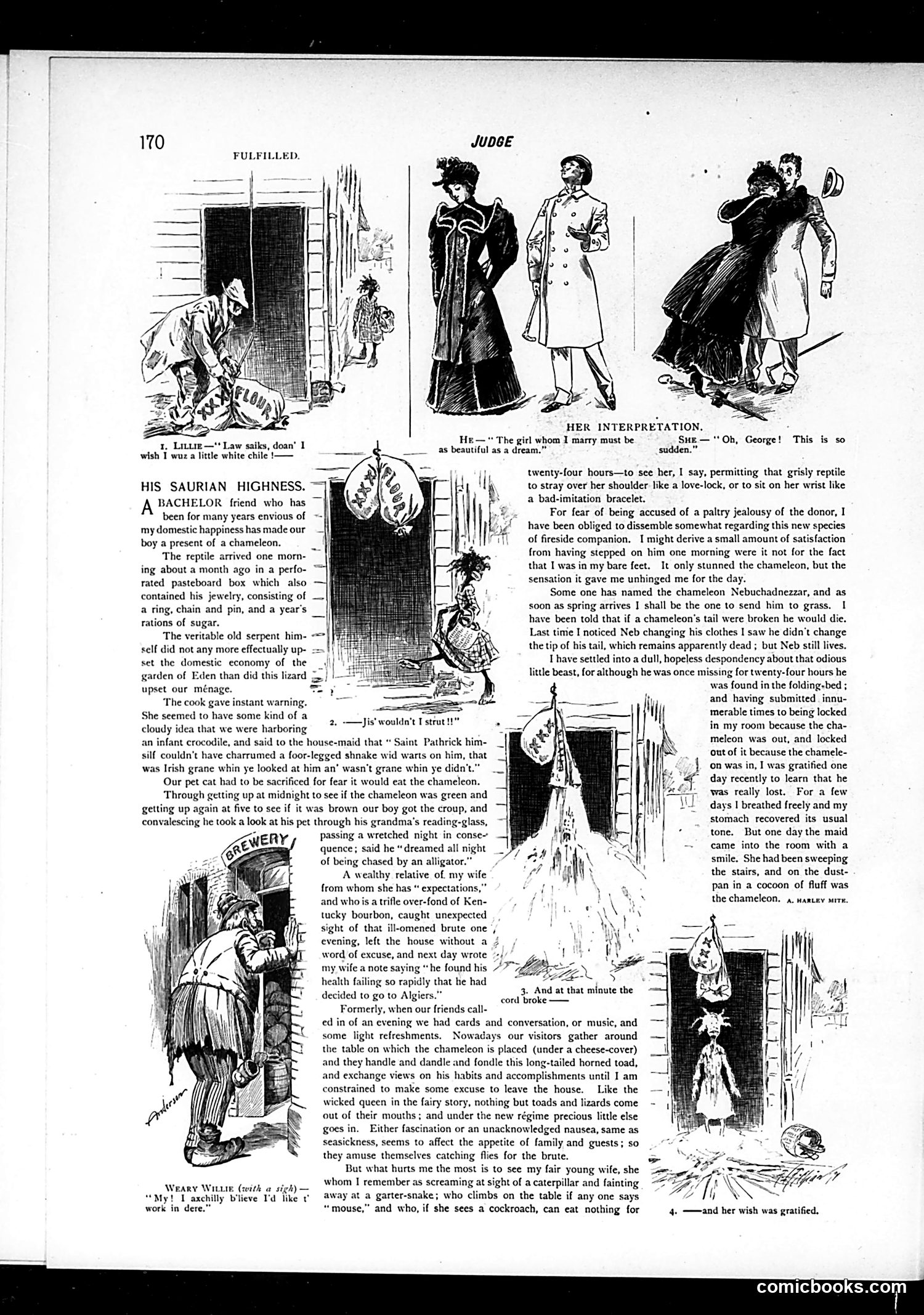
This humorous piece satirizes Victorian domestic life through a bachelor's complaint about a chameleon gift from an envious friend. The narrative mocks the disruption this exotic pet causes to household order: servants flee in terror (the cook fears it's a crocodile), the family cat must be killed to prevent it eating the reptile, and a wealthy relative abandons the house entirely, fearing for his health. The satire targets upper-middle-class anxieties about status and propriety. The chameleon becomes a symbol of unwanted social chaos—what should be an elegant drawing-room novelty instead alienates servants and relatives. The accompanying illustrations show "Her Interpretation" of courtship, contrasting romantic ideals with awkward reality, typical of Judge's commentary on marriage and gender relations. The humor relies on exaggeration and irony: a small lizard produces domestic catastrophe. It reflects period anxieties about fashion, class performance, and the fragility of genteel society.
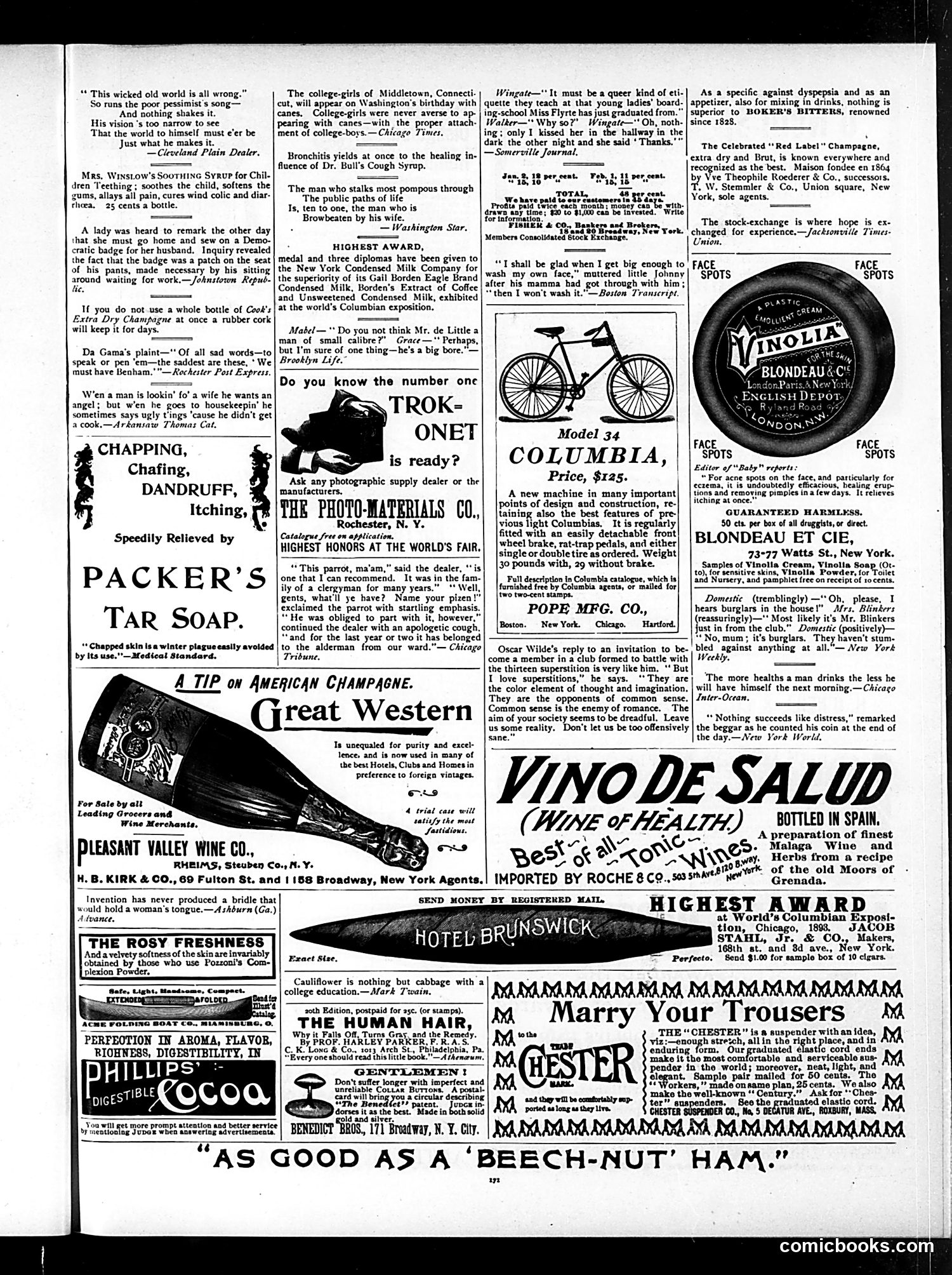
This page, primarily filled with advertisements and brief satirical quips typical of Judge magazine, contains several social and political jokes for modern contextualization: **Key Satirical Content:** 1. **Democratic badge joke**: A woman sews a Democratic badge onto her husband's trousers as a patch—mocking Democrats (likely the party in power) as unemployed or poor ("waiting for work"). 2. **College girls and canes**: References college women parading with canes on Washington's birthday, with innuendo about canes serving as props for courtship with college boys. 3. **Domestic relations humor**: Multiple quips mock wives' authority over husbands, reflecting period gender anxieties. 4. **The parrot anecdote**: A parrot trained by a clergyman becomes crude after belonging to a politician ("alderman"), satirizing political corruption. The page is predominantly **advertisements** for products (soap, champagne, milk, cocoa, wine) rather than formal cartoons. The humor reflects late-19th-century preoccupations: class anxiety, domestic hierarchy, and political cynicism.
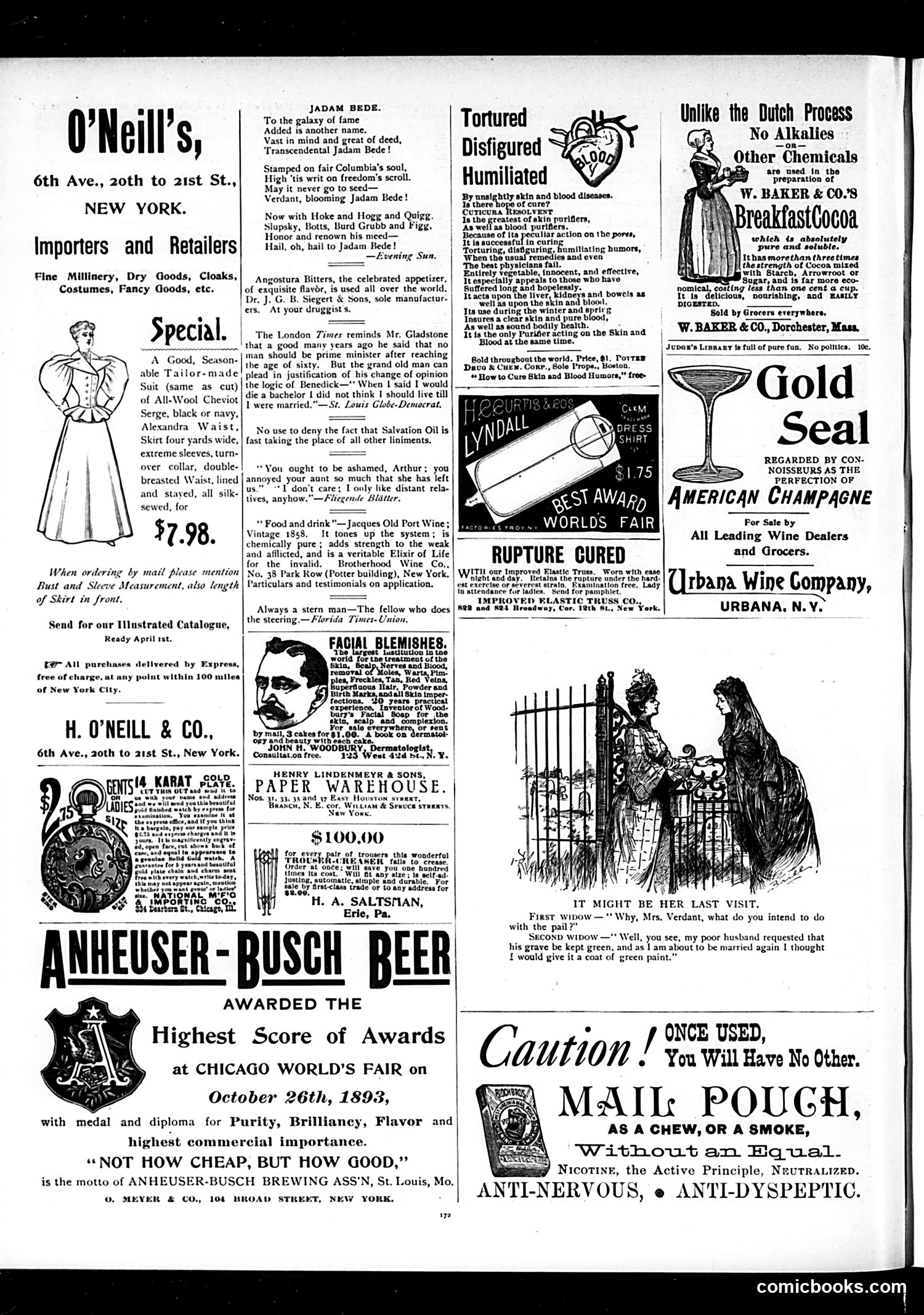
This page is primarily **advertising**, typical of Judge magazine's revenue model. Key content includes: **Main Advertisements:** - O'Neill's department store (women's clothing/millinery) - Anheuser-Busch Beer (prominently featuring their 1893 Chicago World's Fair awards) - Various patent medicines and tonics (Salvation Oil, Angostura Bitters, Concoctions liniment) - Paper warehouse and wine company ads **Satirical Content:** The "Jadam Bede" poem appears to mock a political figure (likely a congressman or public official), elevating his mundane name alongside other absurdly-named politicians ("Hoke," "Hogg," "Quigg," "Slupsky"). This is typical Judge satire—ridiculing politicians through their names. **Cartoon:** The illustration captioned "It Might Be Her Last Visit" depicts a domestic scene with a pauper's visit, likely satirizing class relations or poverty. The page reflects 1890s American consumer culture and Judge's blend of advertising with political/social satire.
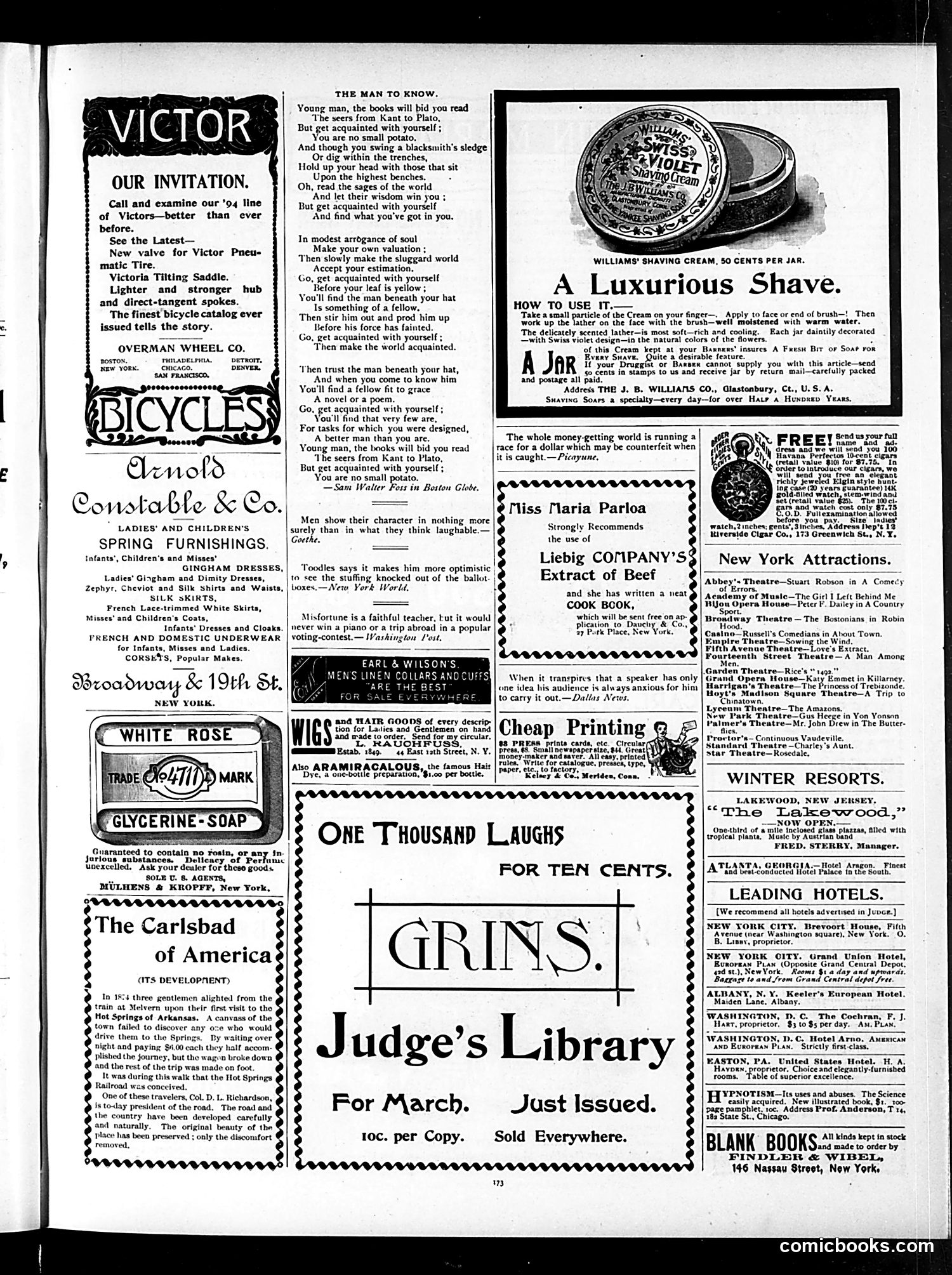
This page is primarily **advertising and filler content**, not political satire. The main elements include: **"The Man to Know"** — a poem by Sam Walter Foss emphasizing self-knowledge and personal character development over mere book learning. It's inspirational verse with no political target. **Product advertisements** dominate: Victor bicycles, women's clothing (Constable & Co.), White Rose glycerin soap, Williams shaving cream, Liebig beef extract, and other consumer goods typical of 1890s marketing. **Short humorous observations** appear scattered throughout (attributed to Goethe, newspapers like the Boston Globe) offering mild social commentary—nothing sharply satirical. **No identifiable political cartoons or caricatures** appear on this page. The content reflects Judge magazine's mixed format: while known for political satire, individual pages often featured conventional advertising, poetry, and light humor to fill space and generate revenue. This appears to be a **revenue-generating page** rather than editorial content.
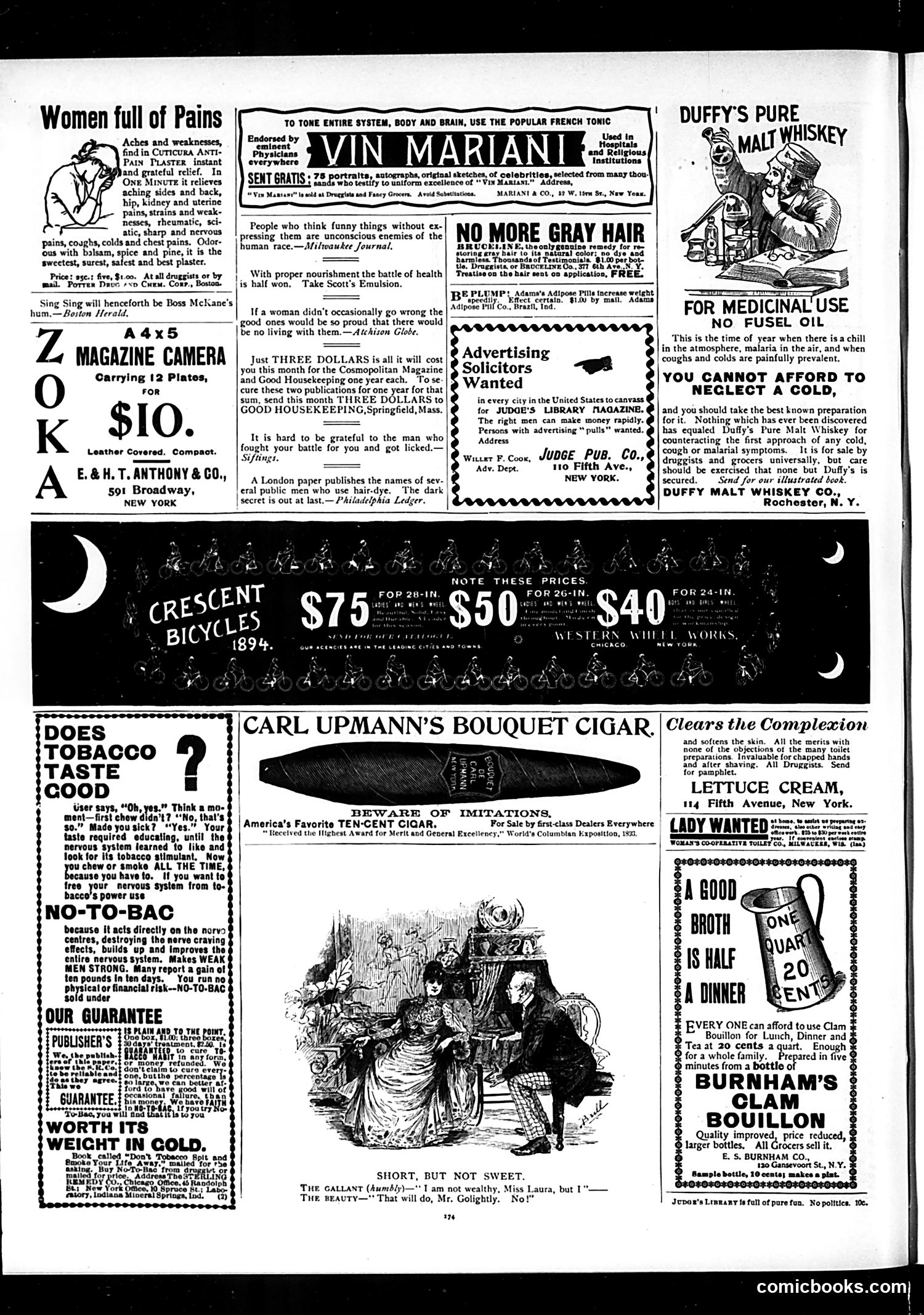
This page from **Judge** (a late 19th-century satirical magazine) is primarily **advertising**, with minimal editorial cartoons. The main visual cartoon depicts a Victorian-era couple in a carriage with the caption "SHORT, BUT NOT SWEET"—a domestic humor joke about marital discord, likely commenting on the gap between romantic courtship and married life. The advertisements reveal period anxieties: **Cuticura plasters** for "women full of pains" (menstrual/gynecological complaints), **Vin Mariani** (cocaine-laced wine marketed as medicinal), and **Broceline** for gray hair removal—products targeting women's appearance and health concerns. **No-To-Bac** promises to cure tobacco addiction via the nervous system, reflecting emerging awareness of addiction. The **Crescent bicycles** ad and camera equipment reflect the 1894 boom in these technologies. Overall, the page demonstrates how Judge monetized satirical readership through patent medicines and novelty products, many of which made dubious health claims by modern standards.
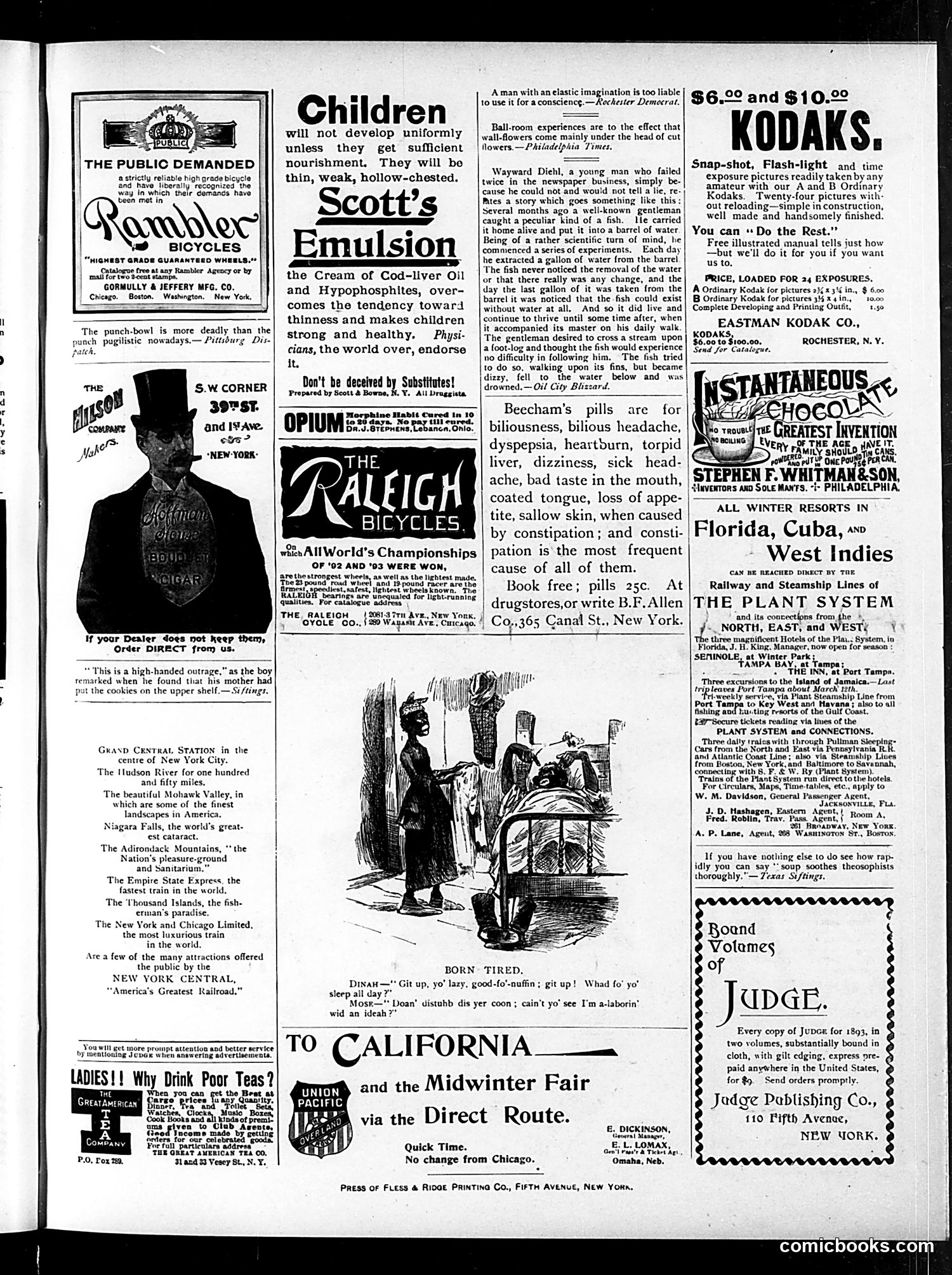
This is primarily an **advertising page** with minimal editorial content. The main cartoon ("Born Tired") depicts a domestic scene: a woman in bed addresses a man, with dialogue suggesting marital exhaustion—she's telling him to "git up" while he protests he's tired. The humor targets lazy husbands and domestic conflict, a common Judge theme. The page is dominated by product advertisements for bicycles (Rambler, Raleigh), Scott's Emulsion (cod-liver oil tonic for children), Beecham's Pills, and patent medicines—typical late-19th century marketing. One ad promotes the New York Central Railroad's scenic attractions. The brief text snippets are humor quotes about daily life: elastic imaginations, ballroom etiquette, and a shaggy-dog story about a fish that dies after being conditioned to live without water. **No significant political satire** appears on this page—it reflects Judge's shift toward lighter domestic humor and extensive advertising rather than topical commentary.
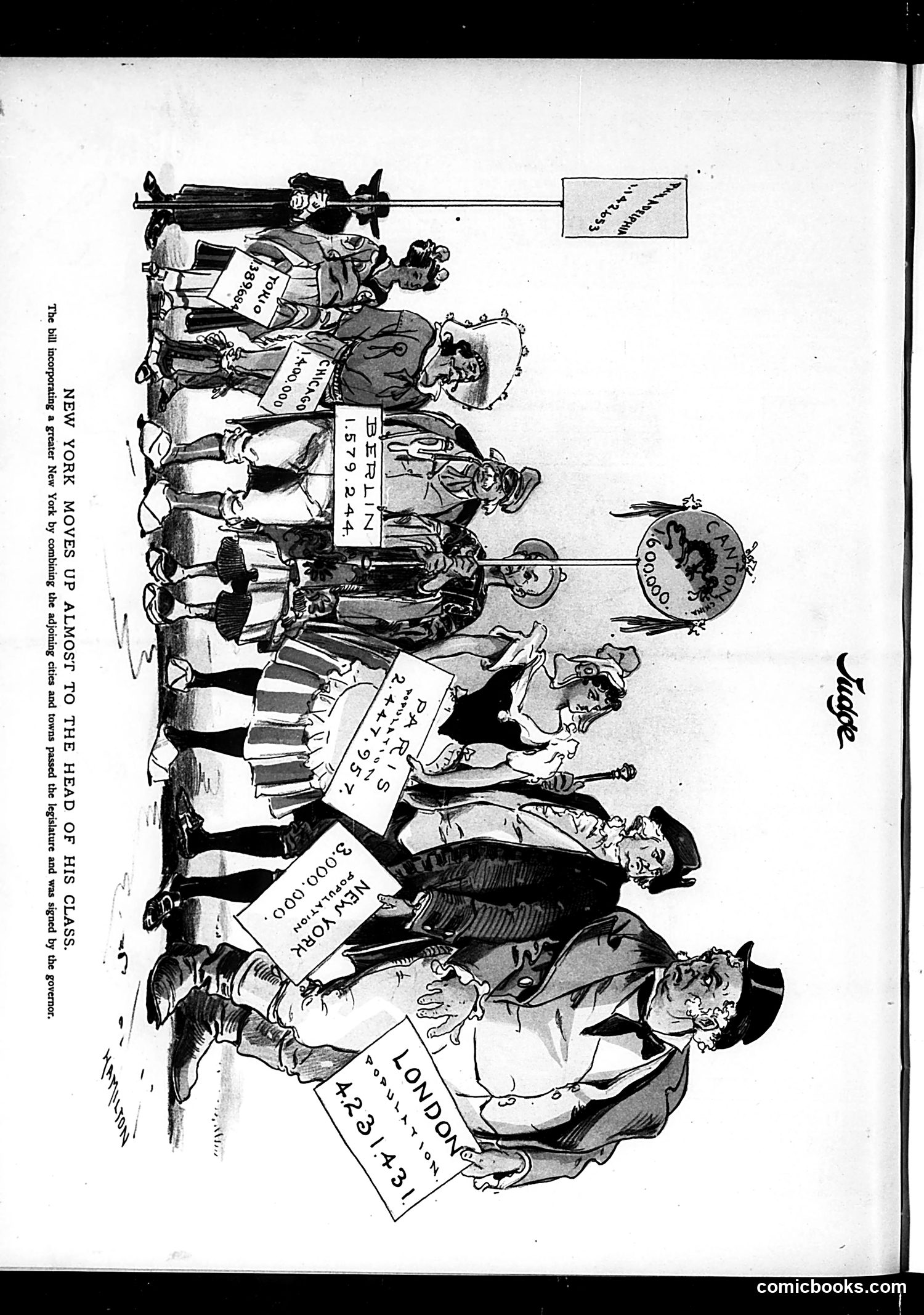
This satirical cartoon depicts the consolidation of New York City with surrounding municipalities—a major 1890s political event. The image shows a schoolboy (representing New York) moving up in academic rank, visualized through a classroom hierarchy with labeled figures representing various cities and towns being incorporated. The cartoon celebrates New York's growth and increased prominence through consolidation, using a school metaphor where advancement means joining a larger entity. The figures wear labels identifying them as different municipalities being absorbed into the greater New York framework. The satire suggests that while New York gains status by becoming larger, the process involves subordinating these formerly independent communities into one system—presented humorously as educational advancement rather than territorial annexation.