
A complete issue · 16 pages · 1894
Judge — March 10, 1894
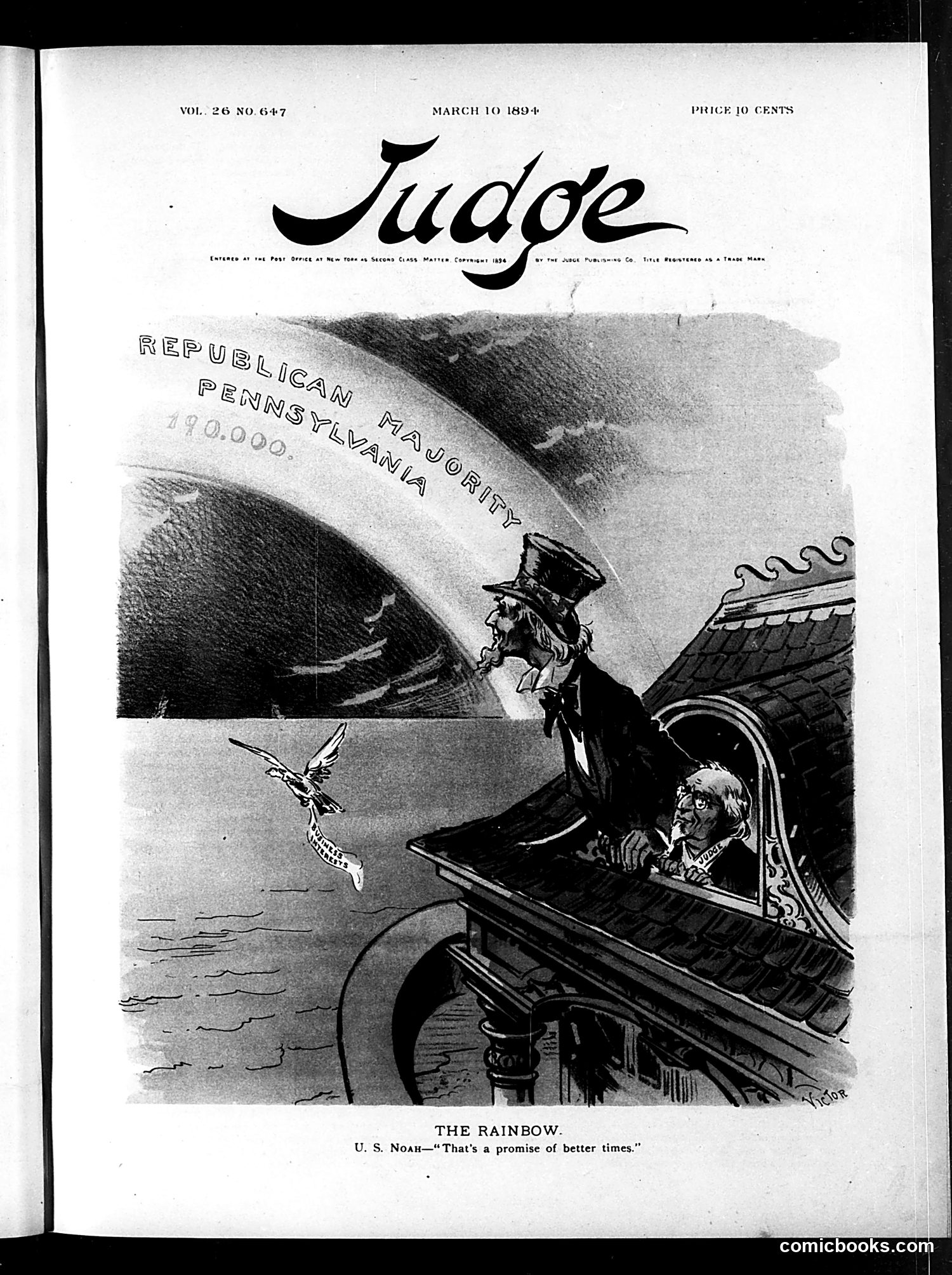
**The Cartoon:** This political cartoon depicts Uncle Sam (the bearded figure in top hat) pointing to a rainbow labeled "REPUBLICAN MAJORITY PENNSYLVANIA 190,000." Below, a figure looks out from a ship's cabin window at this rainbow. **The Meaning:** The cartoon celebrates a major Republican electoral victory in Pennsylvania, presenting the substantial 190,000-vote majority as a hopeful sign. Uncle Sam's caption—"That's a promise of better times"—suggests Republicans believed their political dominance would bring economic prosperity and improved conditions. **Historical Context:** This likely references the 1894 midterm elections, when Republicans gained significant ground during the economic depression following the 1893 panic. The rainbow symbolizes hope and improvement tied to Republican governance.
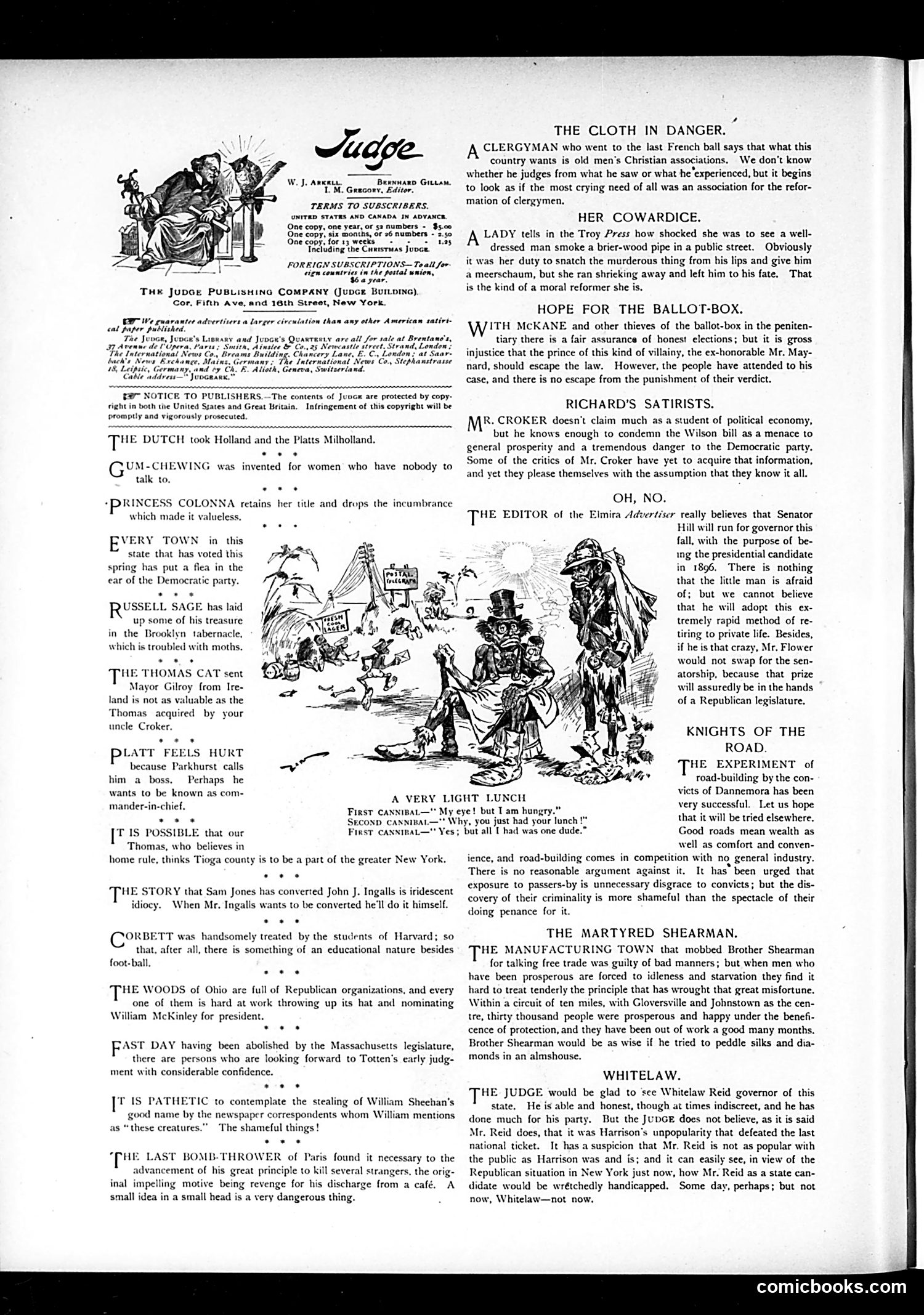
This cartoon satirizes political corruption and bribery during the Gilded Age. The central image depicts well-dressed men dining together—a scene titled "A Very Light Lunch"—with the joke playing on exchange dialogue: "Second Cannibal: 'Why, you just had your lunch?' / First Cannibal: 'Yes, but all I had was one black.'" The "cannibal" reference is a period-appropriate (though offensive) metaphor for corrupt politicians metaphorically "devouring" citizens through graft and fraud. The cartoon mocks how politicians and businessmen constantly seek bribes and kickbacks, treating public resources as their meal. The broader page discusses political reform, election integrity, and Republican malfeasance, suggesting this appeared during a heated electoral period addressing government corruption.
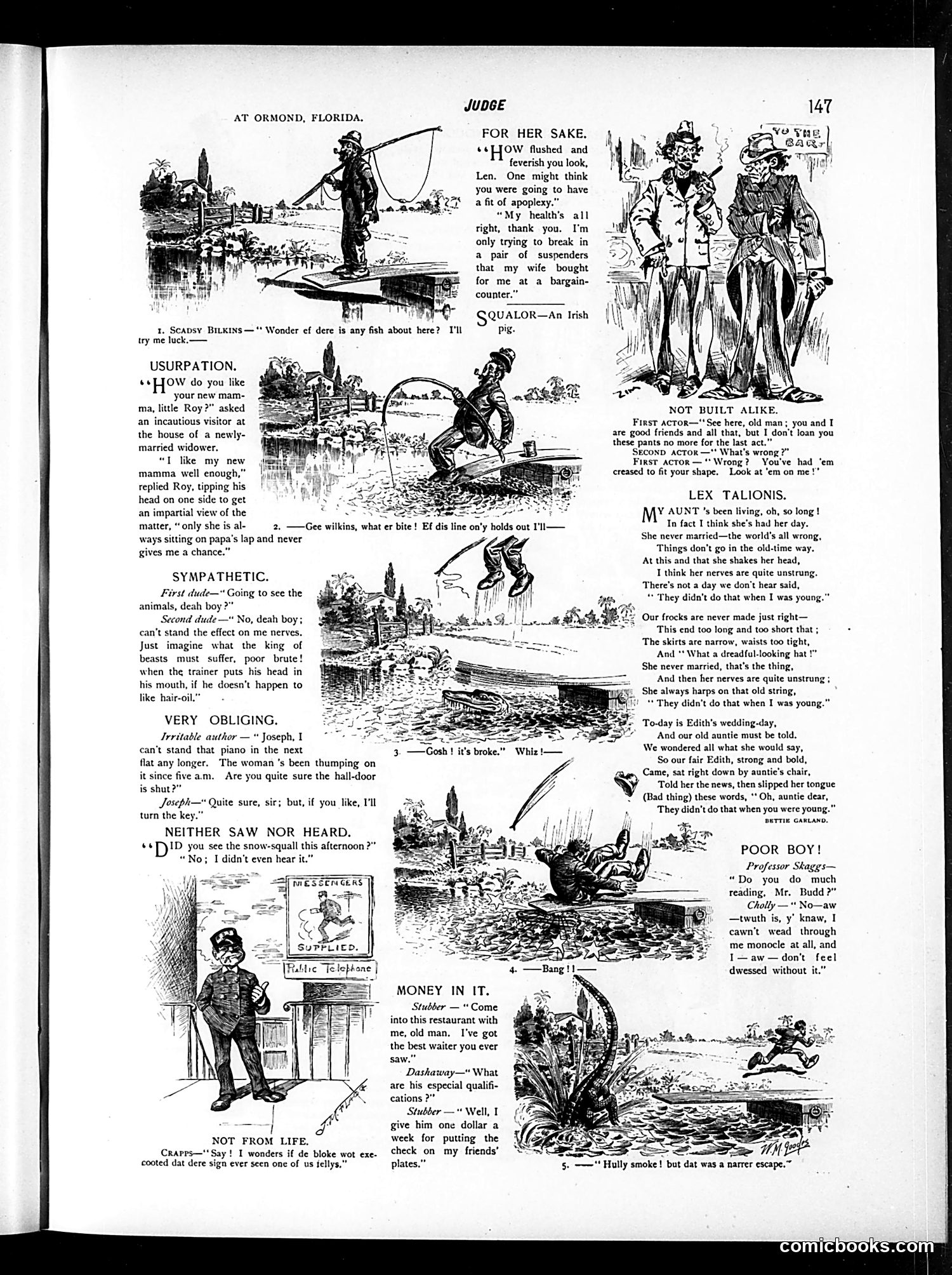
This page contains multiple unrelated humorous sketches and jokes typical of Judge's satirical format. The cartoons depict everyday social situations rather than political commentary: **"Scary Bilkins"** shows a fisherman attempting to catch fish, illustrating a pun about fish and luck. **"Usurpation"** satirizes marital dynamics—a husband avoiding his wife's complaints by pretending not to hear her concerns about new curtains. **"Sympathetic"** jokes about the unpleasantness of beast training. **"Very Obliging"** and other brief comedic exchanges focus on domestic mishaps and wordplay. The remaining content includes poems like "My Aunt's Talionis" and "Poor Boy!" addressing aging, respectability, and poverty—social commentary through verse rather than visual satire. These are genteel humor pieces for middle-class readers rather than sharp political critique.
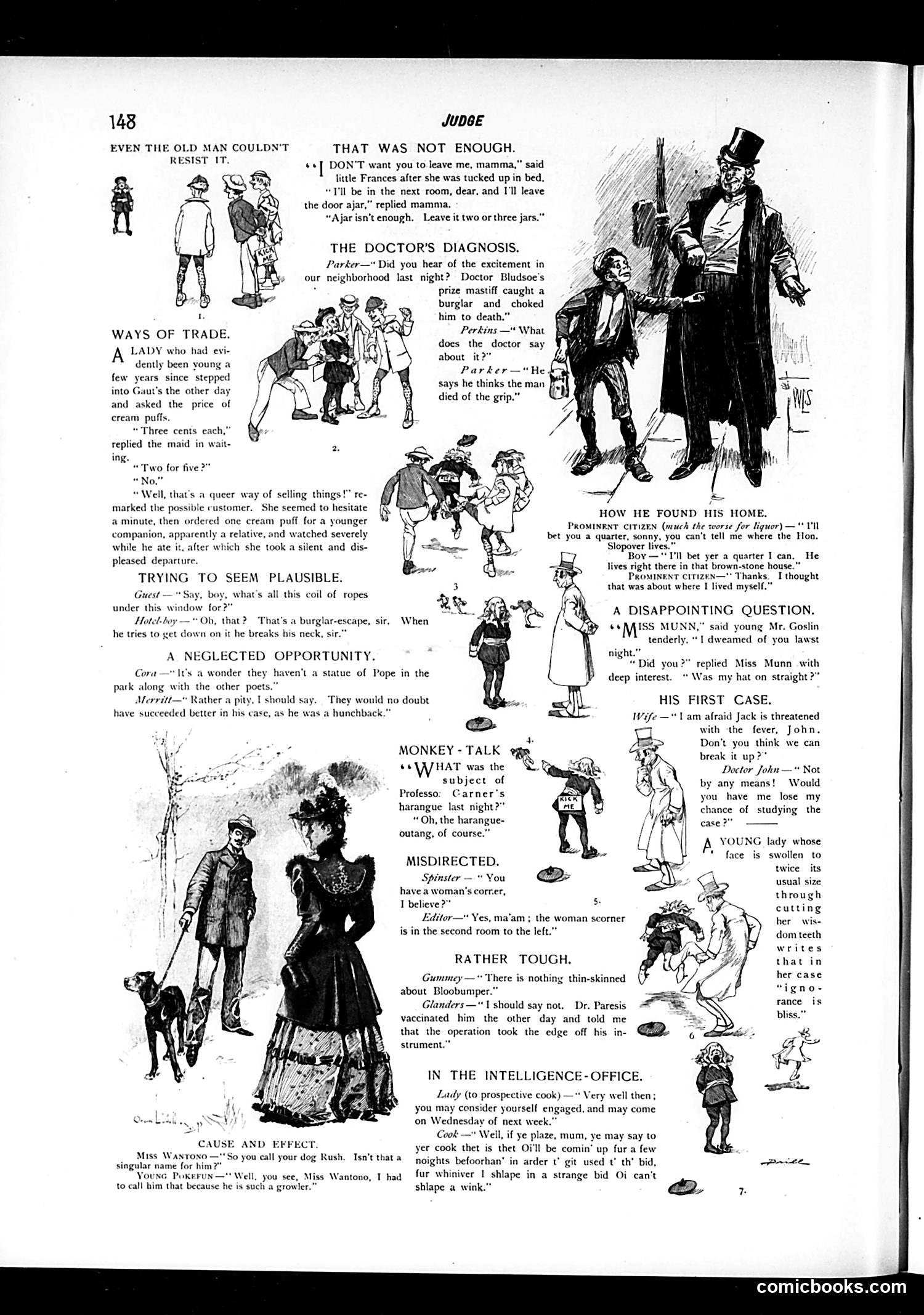
This *Judge* magazine page contains short humor pieces typical of the era's satirical style. The jokes rely on wordplay and social observations rather than political commentary. **Key pieces include:** - **"That Was Not Enough"**: A child's literalism joke—Frances wants the door left "ajar" but asks for "two or three jars" instead. - **"The Doctor's Diagnosis"**: A pun where a dog kills a burglar, and the doctor attributes death to "the grip" (a flu-like illness), ironically misdiagnosing the actual cause. - **"Ways of Trade"**: Mocking a customer's haggling over cream puff prices, then oddly watching someone else eat one she purchased. - **"Monkey-Talk"**: A play on "orang-outang" as a lecture subject. - **"In the Intelligence-Office"**: An Irish cook character struggles with sleeping in unfamiliar beds—period humor stereotyping immigrant workers. The page relies on Victorian-era sensibilities: puns, character stereotypes (the Irish servant, the awkward suitor), and observational humor about class interactions. Nothing directly political appears here.
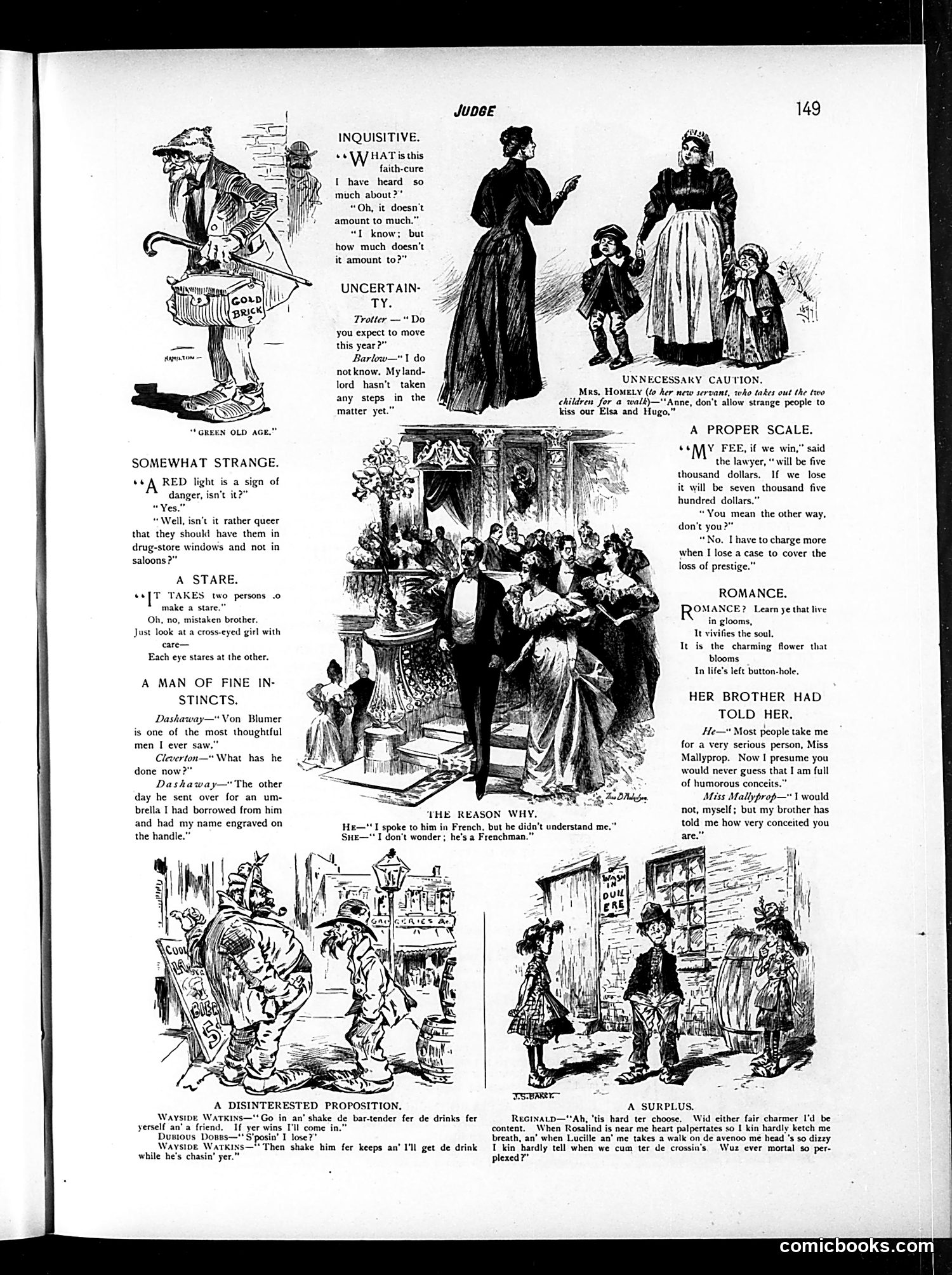
This page contains multiple brief satirical jokes typical of 1890s-era American humor: **Main targets:** - **Faith-cure movement**: The opening joke mocks popular "faith healing" as worthless—someone asks how much it "doesn't amount to," implying it's fraudulent. - **Social pretension**: "A Man of Fine Instincts" satirizes someone returning a borrowed umbrella with the owner's name engraved—presented as thoughtfulness but actually self-serving. - **Legal ethics**: "A Proper Scale" mocks lawyers charging *more* when losing cases "to cover the loss of prestige"—absurd and dishonest. - **Class anxiety**: "Unnecessary Caution" jokes about a servant warned not to let strangers kiss the children, implying the children are so unattractive nobody would want to. **Minor jokes** play on wordplay (cross-eyed girls, French misunderstandings) and working-class stereotypes (the dialect humor in "Disinterested Proposition"). The humor relies on Victorian-era social conventions and targets recognizable hypocrisies: quackery, class pretension, professional dishonesty, and social anxiety.
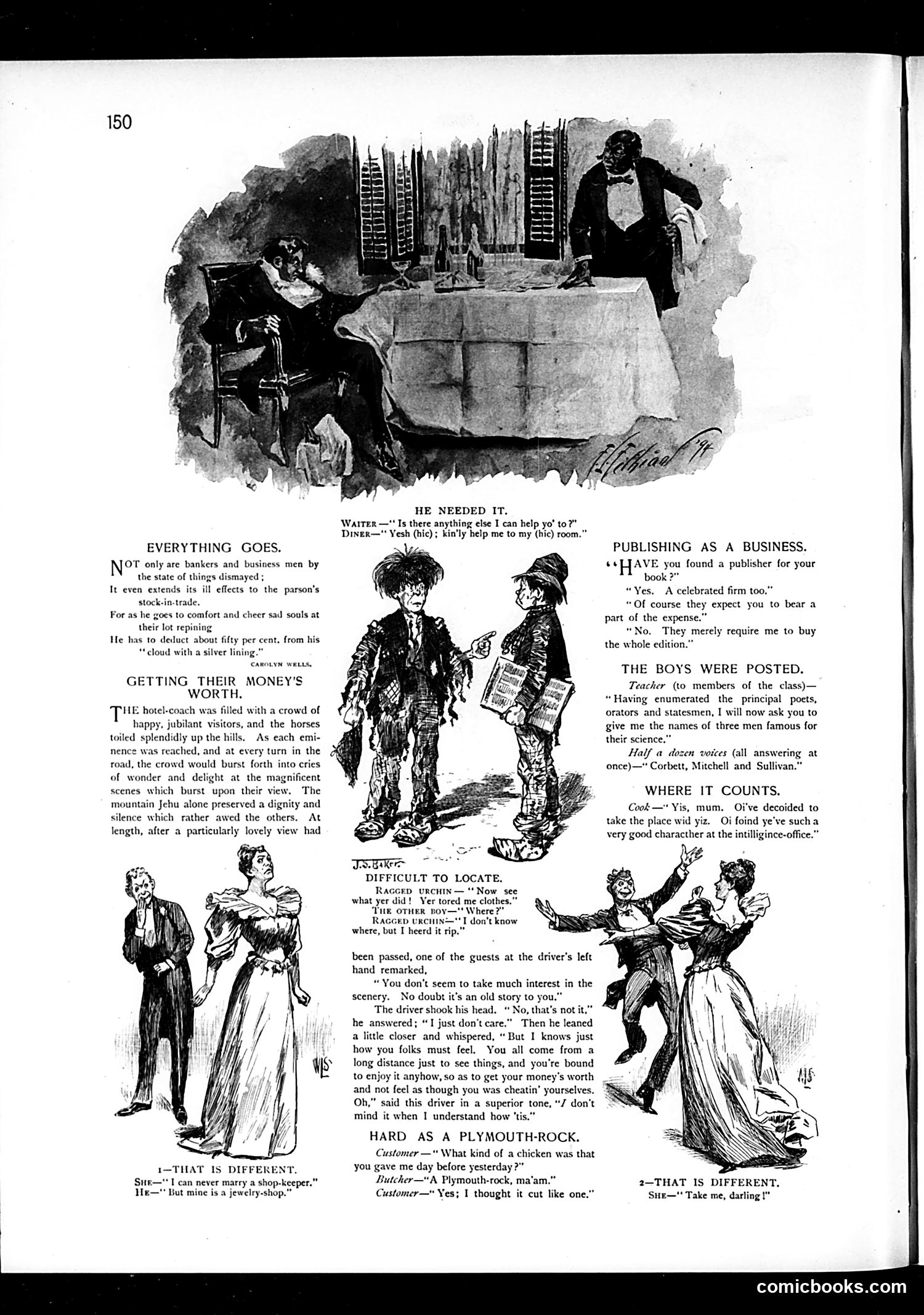
This page contains multiple short humorous sketches satirizing various aspects of late 19th/early 20th-century American life: **"Everything Goes"** and **"Getting Their Money's Worth"** mock how financial hardship affects all classes—even clergy lose faith, and tour drivers cynically exploit tourists' desperation to feel they've gotten value. **"He Needed It"** is a simple drunk joke about a diner needing help to his room. **"Hard as a Plymouth-Rock"** puns on toughness: a butcher sold inedible chicken meat, claiming it was a Plymouth-Rock breed. **"The Boys Were Posted"** satirizes education: when asked to name famous scientists, schoolboys name boxers Corbett and Mitchell and wrestler Sullivan—suggesting popular sports figures overshadow intellectual achievement in public consciousness. **"Publishing as a Business"** mocks vanity publishing, where authors must buy their own printed editions. The remaining sketches use Irish dialect humor and class-based jokes typical of the era's comedy conventions.
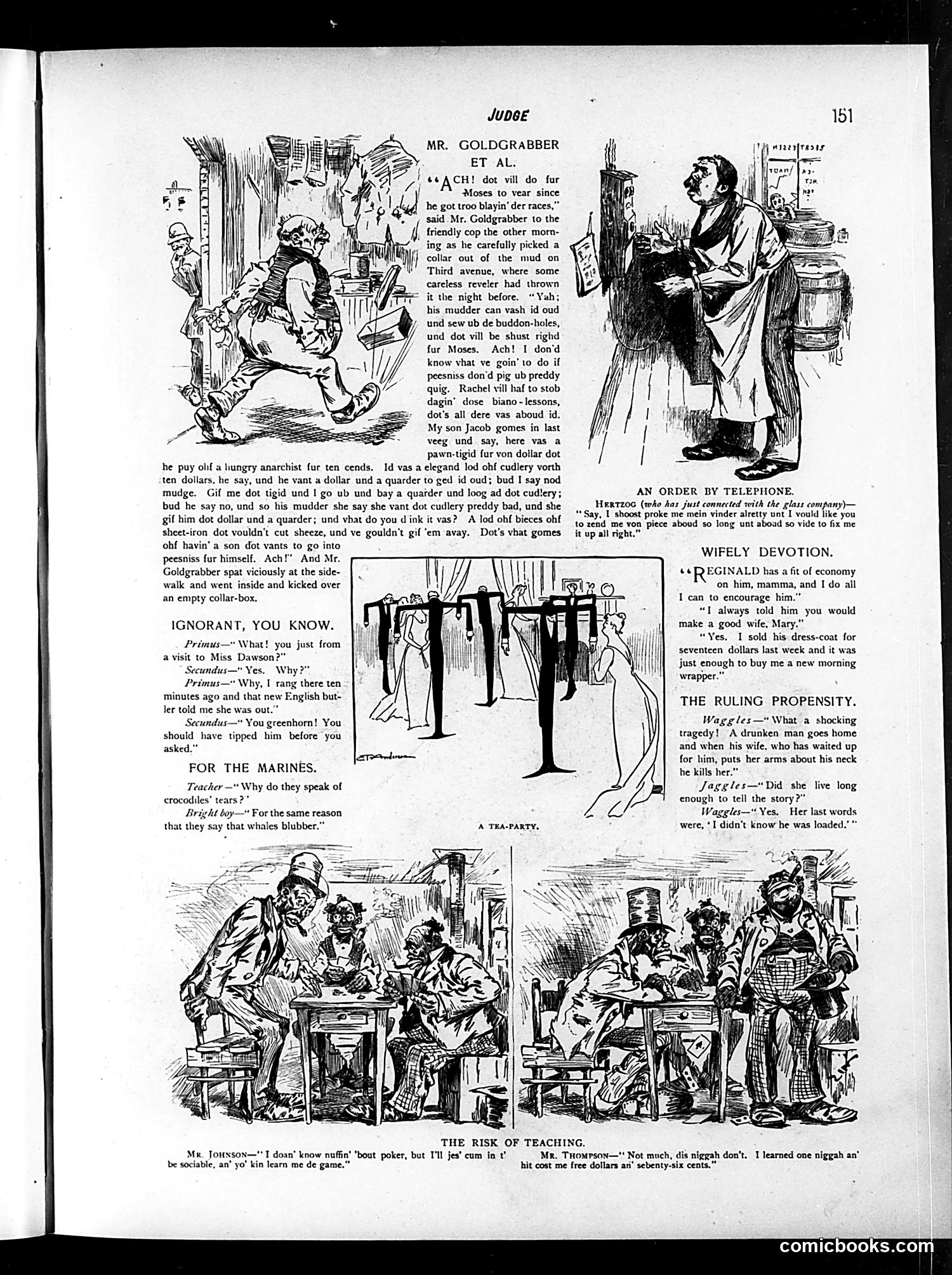
This page contains multiple satirical pieces typical of late-19th/early-20th-century Judge magazine: **"Mr. Goldgrabber et al."** depicts a Jewish immigrant character speaking in exaggerated dialect, complaining about poverty and his family's financial struggles. The humor relies on ethnic stereotyping common to the era—portraying Jewish immigrants as penny-pinching and desperate. **Other brief jokes** include "Wifely Devotion" (a wife sells her husband's coat to buy herself luxuries), "The Ruling Propensity" (a dark joke about a drunk man and his wife), and "For the Marines" (a mild pun). **"An Order by Telephone"** and **"A Tea-Party"** are sight gags with minimal text. **"The Risk of Teaching"** contains deeply offensive racial caricatures and dialect, depicting Black men in dehumanizing ways typical of the period's casual racism. The page reflects Judge's reliance on ethnic and racial stereotyping as humor—content that would be considered highly offensive today but was normalized in American satirical publications of this era.
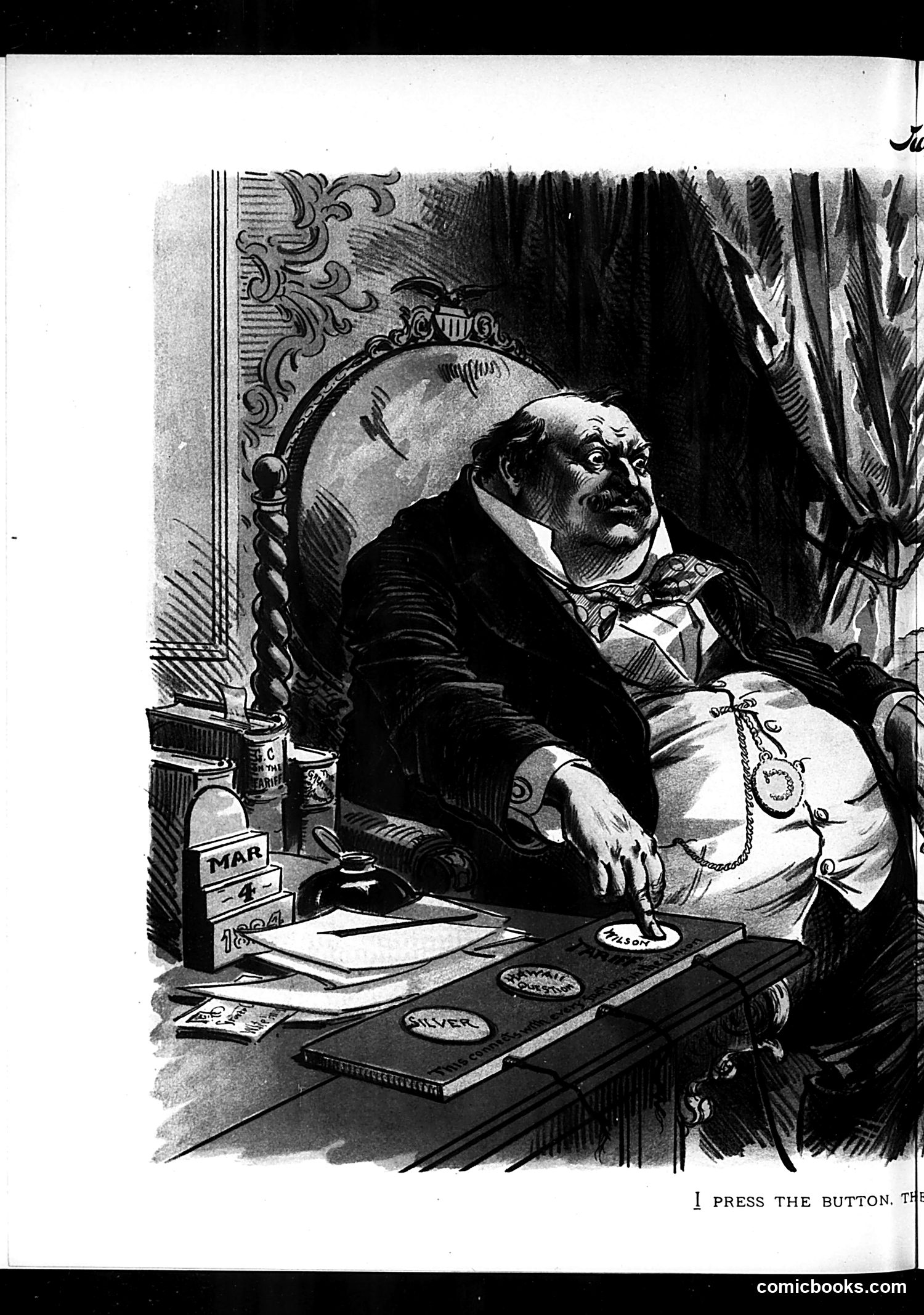
This political cartoon depicts a rotund, well-dressed gentleman seated at a desk, appearing to press a button. The visible text at bottom reads "I PRESS THE BUTTON, TH[E]" (sentence incomplete on this page). On his desk are items labeled "MAR" (likely March), what appears to be official seals or stamps, documents, and a calendar or ledger. The man wears formal attire with medals/decorations, suggesting someone in power—possibly a government or military official. The cartoon likely satirizes executive power and arbitrary decision-making—"pressing a button" to enact consequences. Without the complete caption or publication date visible, I cannot identify the specific figure or event being mocked, but the imagery suggests commentary on authoritarian or bureaucratic abuse of power through simple, decisive (and presumably harmful) actions.
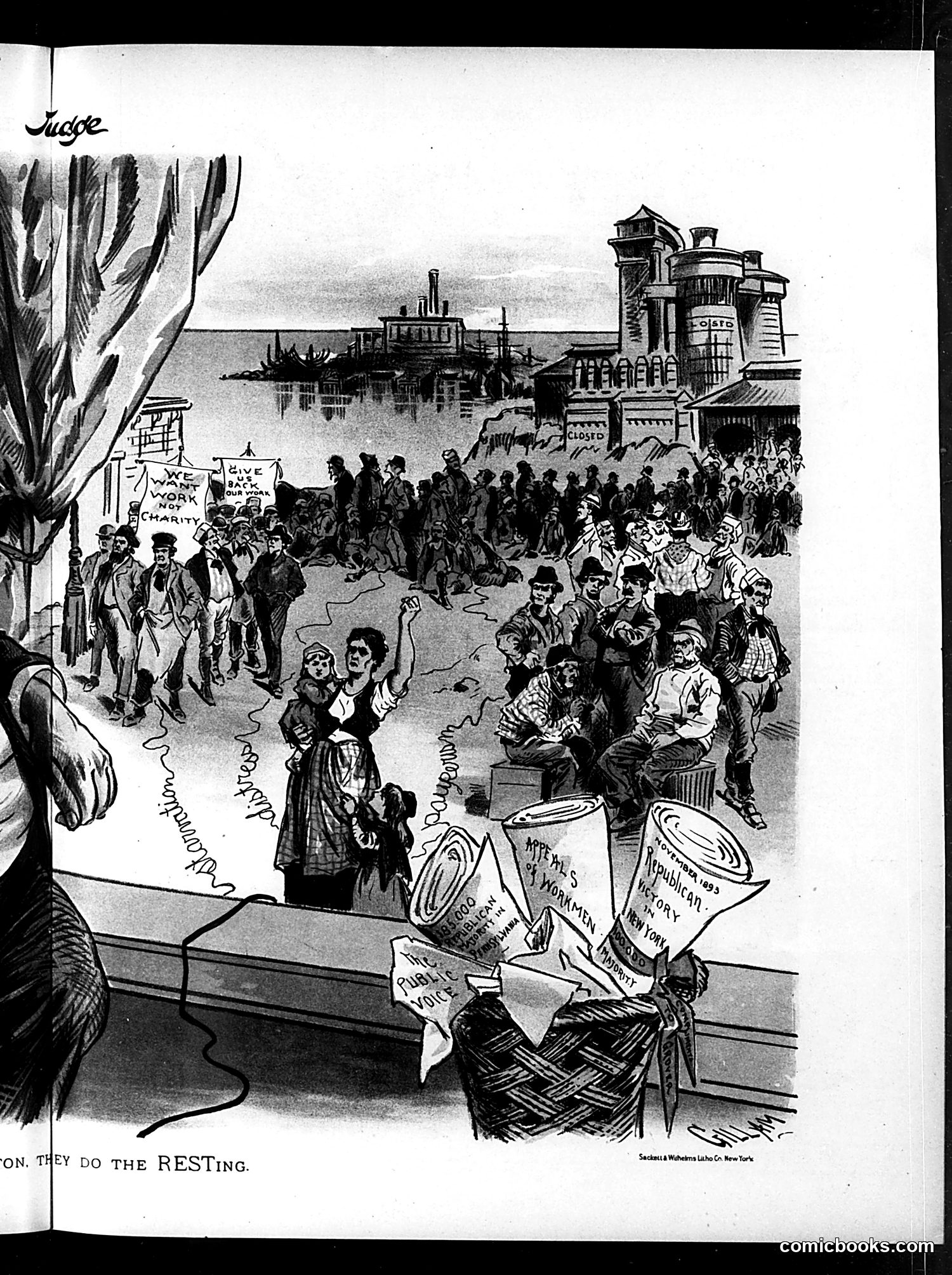
This Judge magazine cartoon depicts a crowded waterfront scene with industrial buildings and a steamship in the background. A large hand emerges from a basket labeled with text including "POLITICIANS," "NEW YORK," and "POWER," suggesting political manipulation or control. The cartoon satirizes how politicians are deployed or used as tools. The masses gathered at the waterfront appear to be immigrants or working-class people, while the invisible hand controlling the politicians suggests elite or corporate interests directing political action from behind the scenes. The title "ON, THEY DO THE RESTING" (likely "ION, THEY DO THE RESTING" with OCR error) implies politicians merely follow orders from hidden power brokers. This reflects late 19th/early 20th-century concerns about political corruption and the influence of wealthy interests over elected officials.
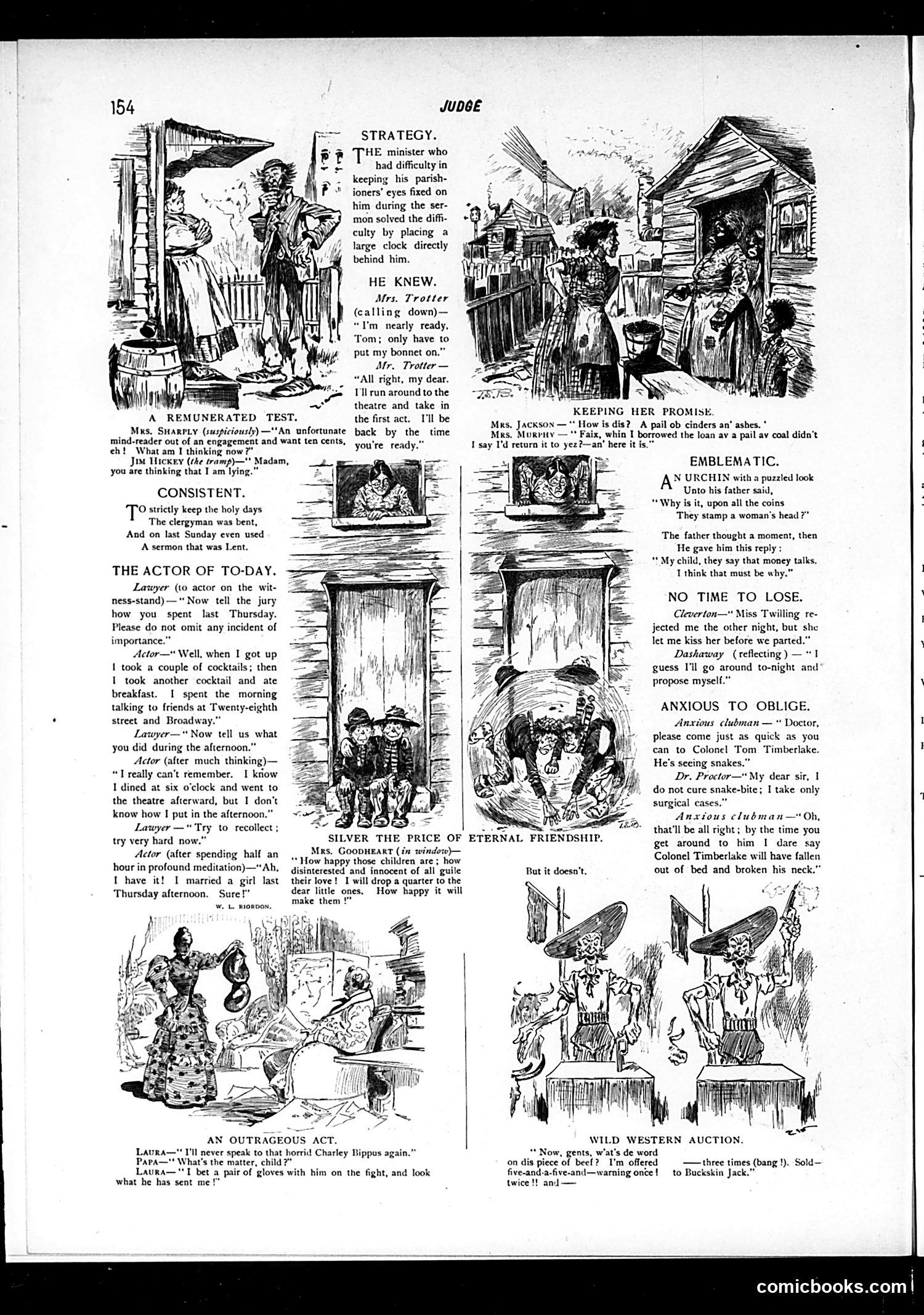
This page collects brief satirical vignettes typical of Judge's humor. Key sketches include: **"The Actor of To-Day"**: Mocks theatrical performers as shallow drunks. An actor testifying in court can detail his cocktails and theater visits but cannot remember his afternoon—implying actors' lives consist only of drinking and performing, with no substance between. **"Emblematic"**: A father explains why coins bear women's heads: "money talks," so naturally it features women (a period sexist trope about women's talkativeness). **"Anxious to Oblige"**: Dark humor about a clubman seeking a doctor for a drunk man "seeing snakes" (hallucinating from alcohol). The doctor refuses surgical cases, but the clubman optimistically suggests the patient will soon fall from bed and break his neck—making it surgical. **"Wild Western Auction"**: Depicts frontier crude speech and commerce, selling beef to "Buckskin Jack." The cartoons collectively mock actors' frivolity, reinforce gender stereotypes, and find humor in drunkenness and violence—reflective of late 19th/early 20th-century attitudes.
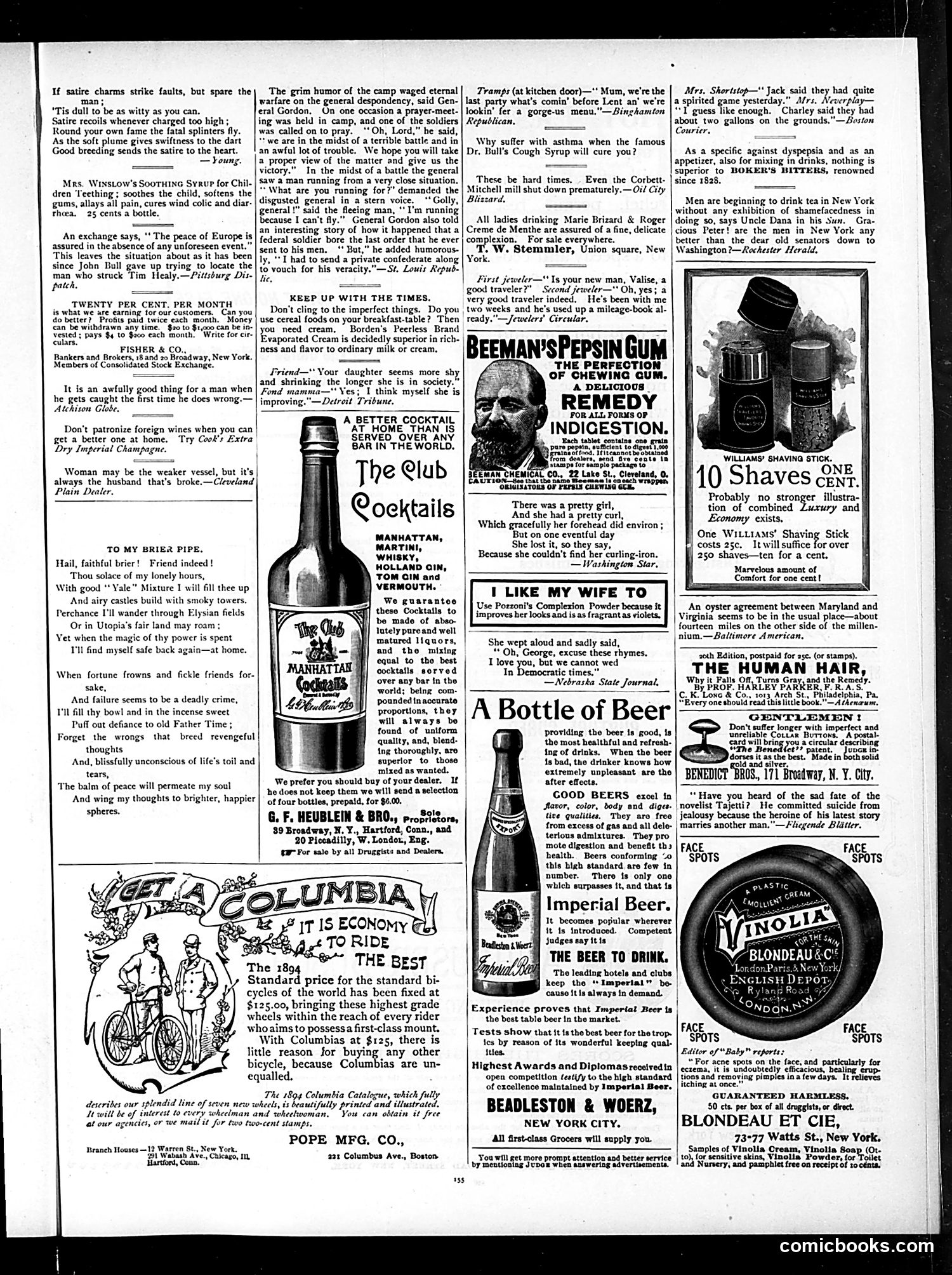
This page is primarily **advertising** with scattered short humorous items and jokes interspersed throughout—typical of Judge magazine's format. The **editorial content** consists of brief comedic anecdotes: - A General Gordon story about a soldier's prayer during battle asking God to "take a proper view" and grant victory - A joke about tramps seeking a "gorge-us menu" before Lent - Sports humor about a game with "two gallons on the grounds" (alcohol) - A newspaper quip about European peace being assured "in the absence of unforeseen events" The **satire is mild and domestic**: poking fun at contemporary social habits (New Yorkers drinking tea without shame), workplace absurdities (a jewelry salesman who's "traveled" through a mileage book in two weeks), and spousal dynamics. The page is dominated by **period advertisements** for products like Beeman's Pepsin Gum, Imperial Beer, Williams Shaving Sticks, and Blondeau face cream—representative of turn-of-century consumer goods marketed to Judge's middle-class readership. No significant political cartoons or caricatures appear on this particular page.
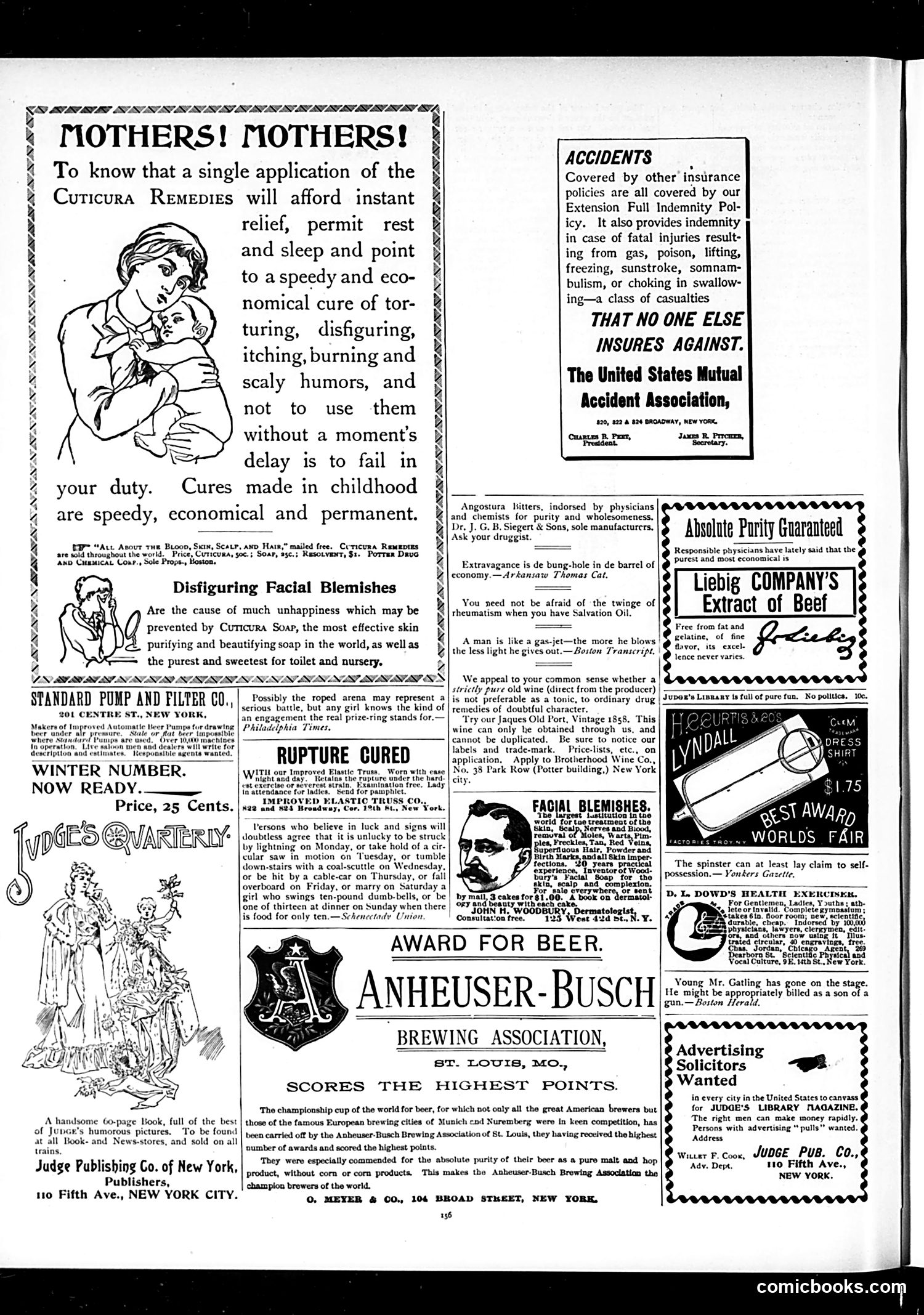
This page is primarily **advertising**, typical of Judge's revenue model. The satirical content is minimal. The main cartoon appears in the middle: a humorous piece about **superstitious beliefs in luck**. It mocks people who simultaneously believe in luck while performing dangerous activities—taking hold of a circular saw, falling downstairs, being hit by a cable car, or marrying a girl who swings "ten-pound dumb-bells." The joke targets contradictory behavior: people claiming to believe luck determines fate, yet courting obvious disaster. This reflects late 19th/early 20th-century skepticism toward superstition. The remainder consists of period advertisements for **Cuticura remedies** (skin treatments), **Anheuser-Busch beer** (which won international brewing awards), **Liebig's Extract of Beef**, accident insurance, and other products. The "Mothers!" pitch for Cuticura emphasizes curing children's skin afflictions—typical era advertising that would seem alarming today regarding product safety standards.
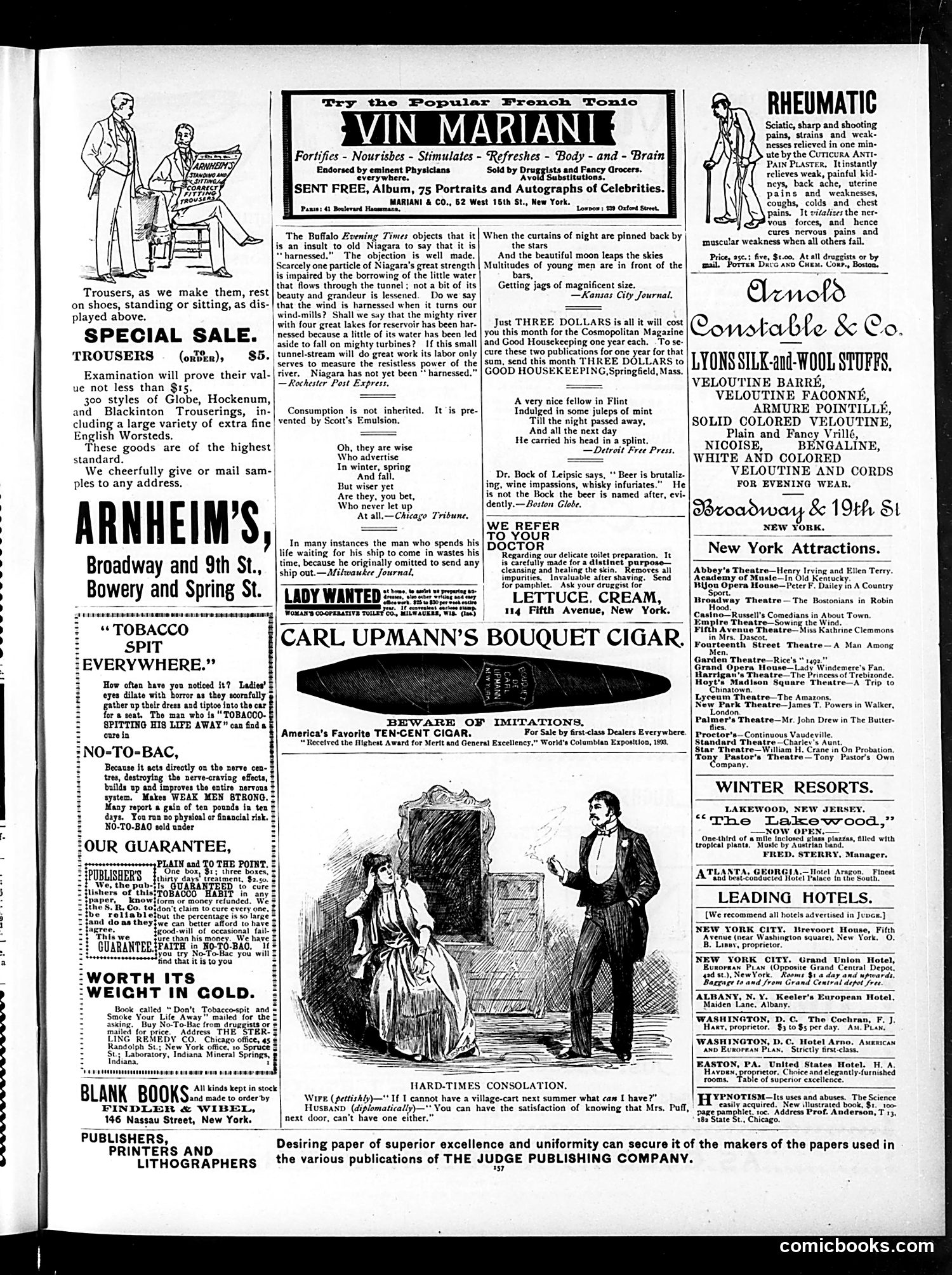
This page is primarily **advertising**, with minimal cartoon content. The main visual elements are: 1. **Arnheim's Trousers ad** (top left): Shows men in various seated/standing positions to demonstrate trouser fit—straightforward product advertising. 2. **No-To-Bac anti-tobacco ad** (left column): Features social commentary about men spitting tobacco, depicting women recoiling in disgust. This reflects genuine Progressive-era concern about public health and civility. 3. **"Hard-Times Consolation" cartoon** (bottom center): A sketch showing a couple—the wife appearing distressed, the husband dismissive. The caption addresses marital discord during economic hardship, a relatable contemporary concern. The page reflects **1900s social anxieties**: tobacco use as a public nuisance, women's sensibilities, economic strain on families. Most content is commercial rather than satirical.
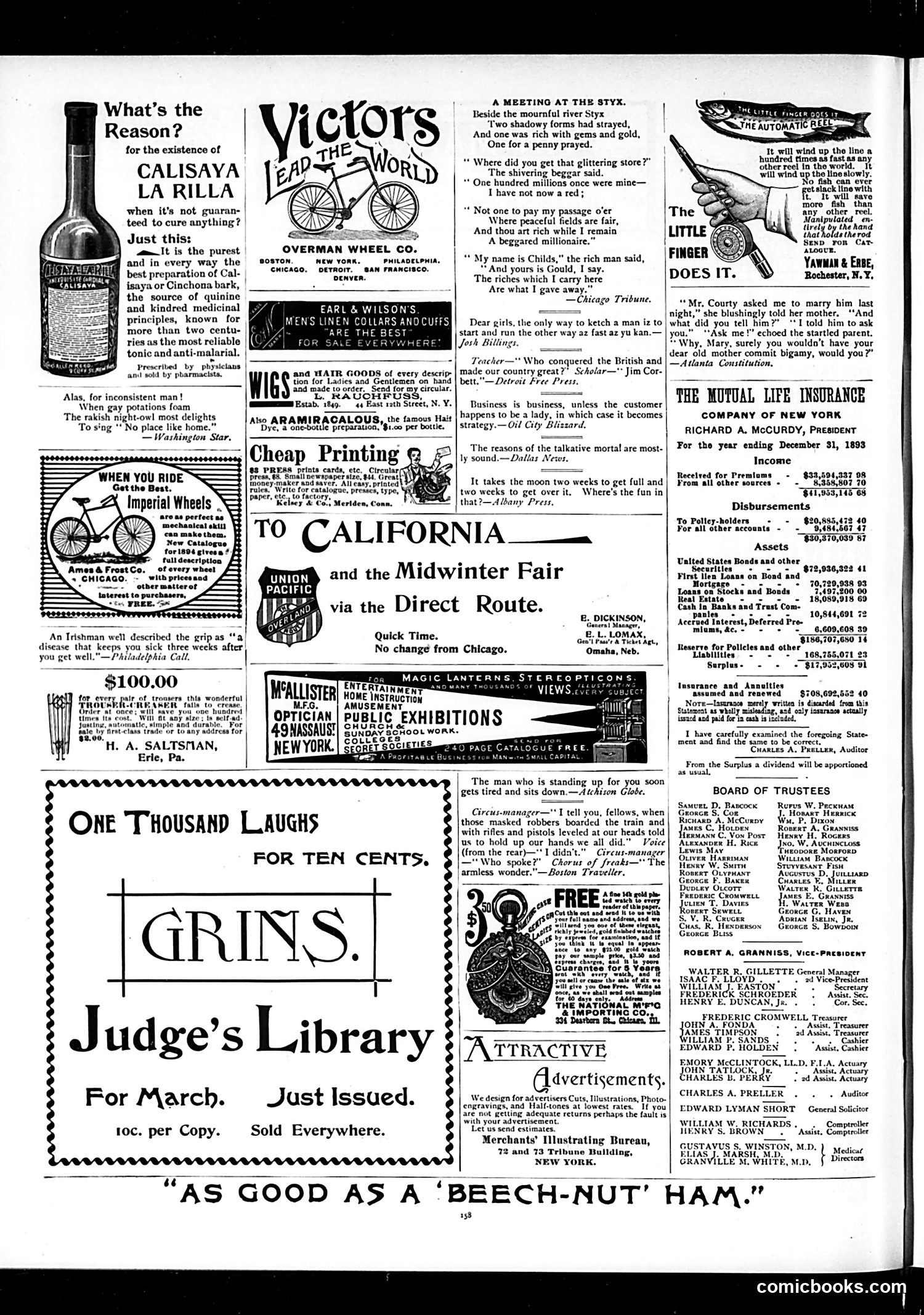
This is primarily an **advertising page** from Judge magazine (circa 1893-1895, based on the "Midwinter Fair" reference to California's 1894 exposition). It contains minimal political satire. The notable content includes: **"A Meeting at the Styx"** — A allegorical poem contrasting two wealthy figures: **Jay Gould** (a famously ruthless Gilded Age railroad magnate) portrayed as spiritually impoverished despite his millions, versus **George Childs** (a philanthropist) who is "rich" in having given away his wealth. This reflects the era's moral debate about robber barons versus charitable industrialists—Gould was despised for his cutthroat business practices, while Childs represented the "Gospel of Wealth" ideal. The rest comprises typical period advertisements for tonics (Calisaya), collars, bicycles, printing services, and novelty items—standard commercial clutter with scattered humorous one-liners about human nature. The page reflects **Gilded Age anxieties** about wealth inequality and virtue, but lacks developed satirical cartooning.
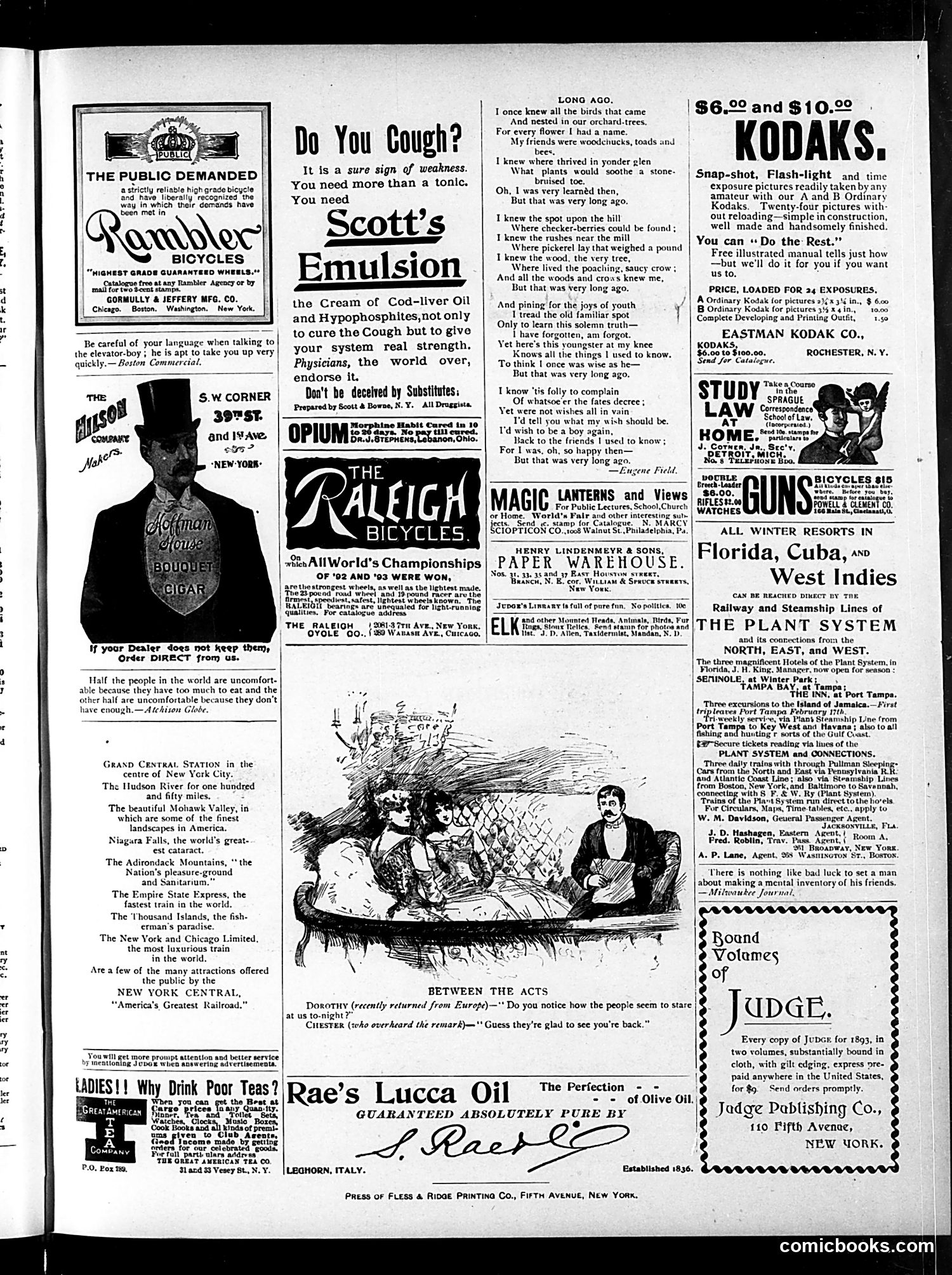
This page is primarily **advertising and literary content** rather than political satire. The main elements include: **Advertisements:** The page features numerous bicycle ads (Rambler, Raleigh, and others), reflecting the 1890s bicycle craze. Other ads promote Scott's Emulsion (cod-liver oil tonic), opium addiction treatment, and travel via the New York Central Railroad. **Literary Content:** The central text is Eugene Field's poem "Long Ago," a nostalgic reflection on lost childhood knowledge of nature—birds, plants, healing herbs—contrasted with present adult ignorance. The poem captures late-Victorian sentimentality about innocence lost to urbanization and modernization. **Illustration:** A sketch accompanying the poem depicts a man and boy in a natural setting, visualizing the generational contrast Field describes. The page reflects Judge's mixed format: satirical commentary interspersed with advertisements targeting affluent readers and sentimental literature appealing to period tastes. The bicycle ads suggest advertising revenue from the booming industry.
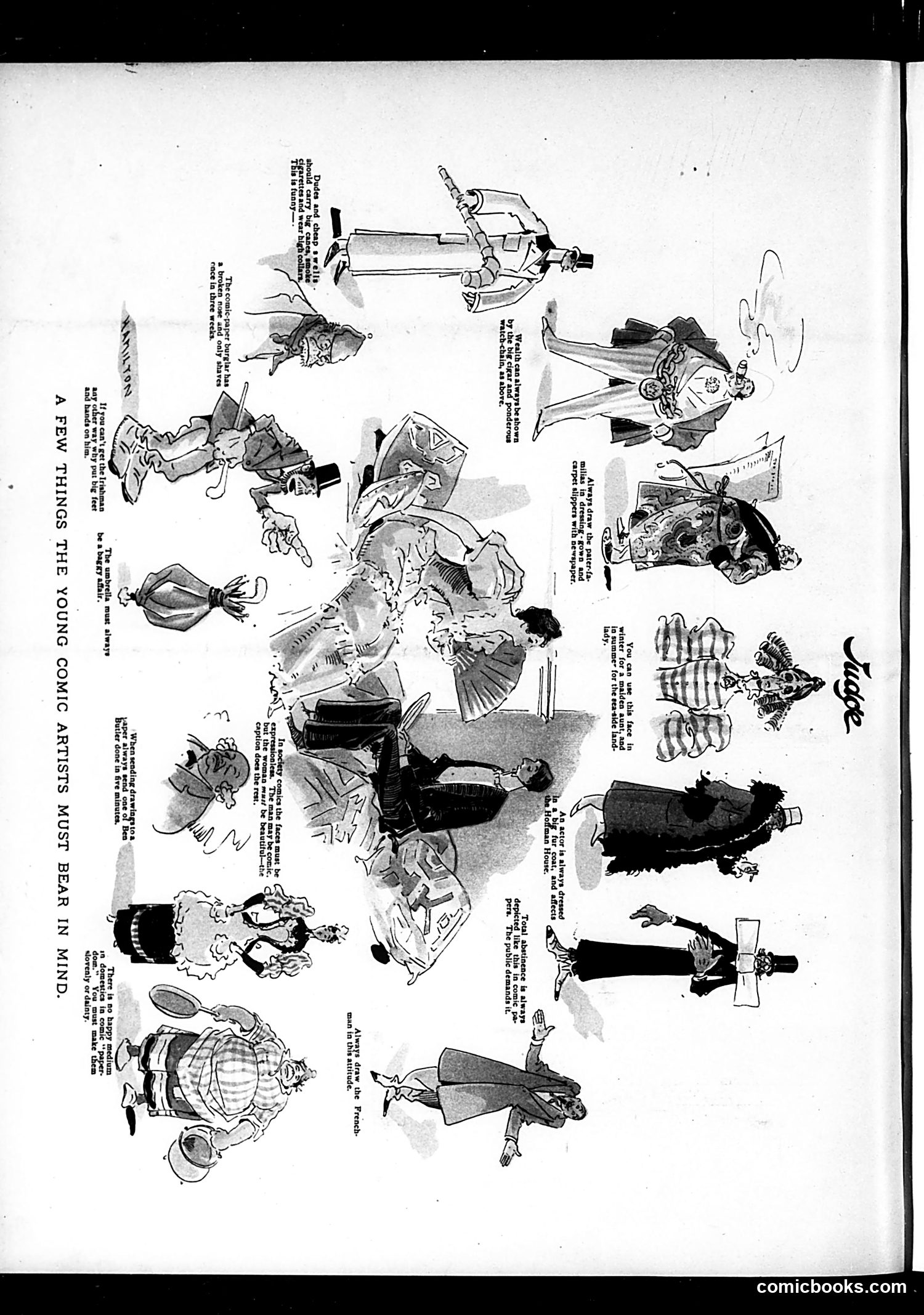
This is a satirical instructional guide mocking the lazy visual clichés used by cartoonists in American comic papers of the era (likely early 1900s). Rather than depicting actual human diversity, the guide ridicules standardized caricatures: fathers shown only in dressing gowns with newspapers; temperance advocates depicted identically; Frenchmen in exaggerated poses; burglars with broken noses; domestic workers as slovenly; Irish characters reduced to oversized feet and hands. The satire targets both cartoonists' creative laziness and their reliance on ethnic and class stereotypes. By presenting these formulas as mandatory conventions "the public demands," Judge exposes how illustration perpetuated crude, dehumanizing tropes while claiming to represent reality. The page ironically "teaches" what actually constitutes visual prejudice masquerading as artistic convention.