
A complete issue · 16 pages · 1894
Judge — March 3, 1894
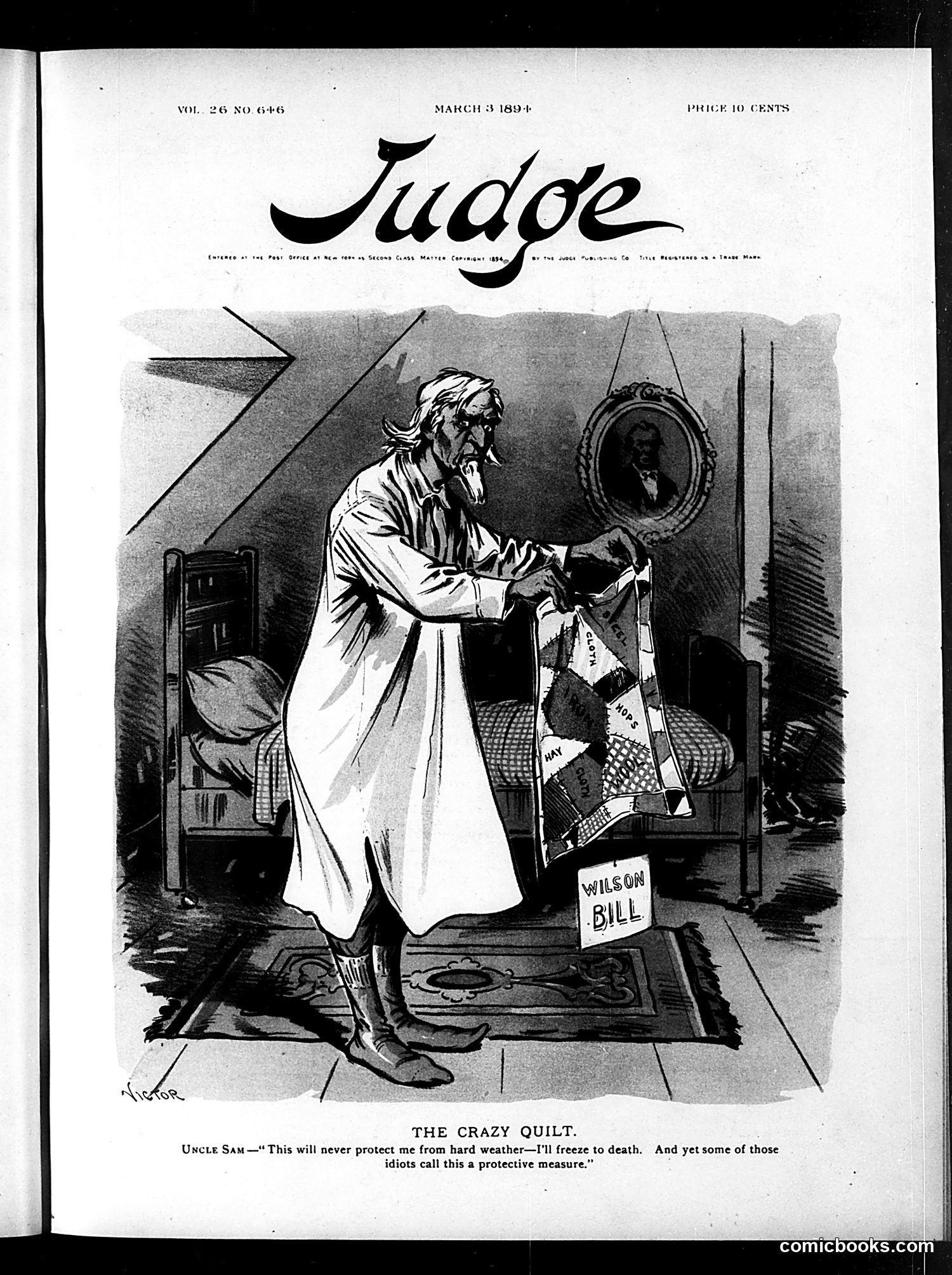
This cartoon satirizes the **Wilson Tariff Bill** (labeled on the cloth), a major piece of legislation debated in 1894. Uncle Sam, depicted as an elderly man, holds up a patchwork quilt made of various fabric scraps labeled with different goods or tariff provisions. His complaint—that this "protective measure" won't actually protect him from hardship—mocks the bill's ineffectiveness or contradictions. The "crazy quilt" metaphor suggests the legislation is haphazardly assembled from incompatible pieces, resembling a chaotic, poorly-designed garment rather than coherent policy. The satire criticizes supporters who claim protectionist tariffs help ordinary Americans while the patchwork design implies the bill actually offers no real protection—just a confusing, ineffectual mess.
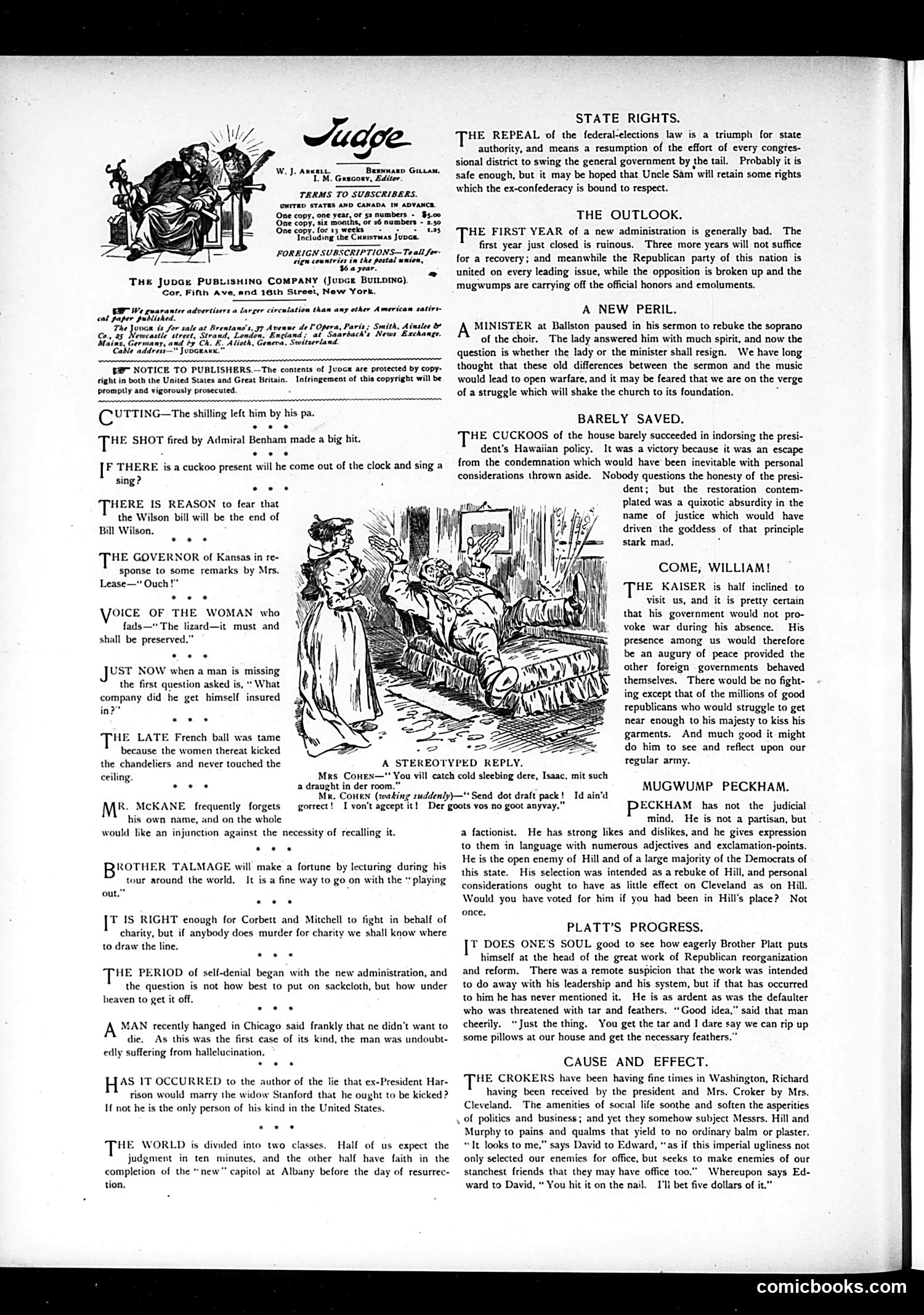
This Judge magazine page contains multiple short satirical pieces targeting the McKinley administration and Republican politics. The main cartoon depicts a woman (likely representing the public or a political widow) tending to an injured man in bed, satirizing Republican leadership and their policies. Key targets include: - **State Rights**: Criticism of federal election authority - **Hawaiian Policy**: Mocking Republican endorsement of annexation - **Mugwump Peckham**: Attacking a political appointee as a factious partisan - **Platt's Progress**: Ridiculing Republican reorganization efforts under Thomas Platt The satirical quips mock McKinley's administration's first year as incompetent and divisive. References to "cuckoos," Bill Wilson, and various political figures suggest internal Republican fracturing. The overall tone criticizes Republican governance as ineffective and self-serving.
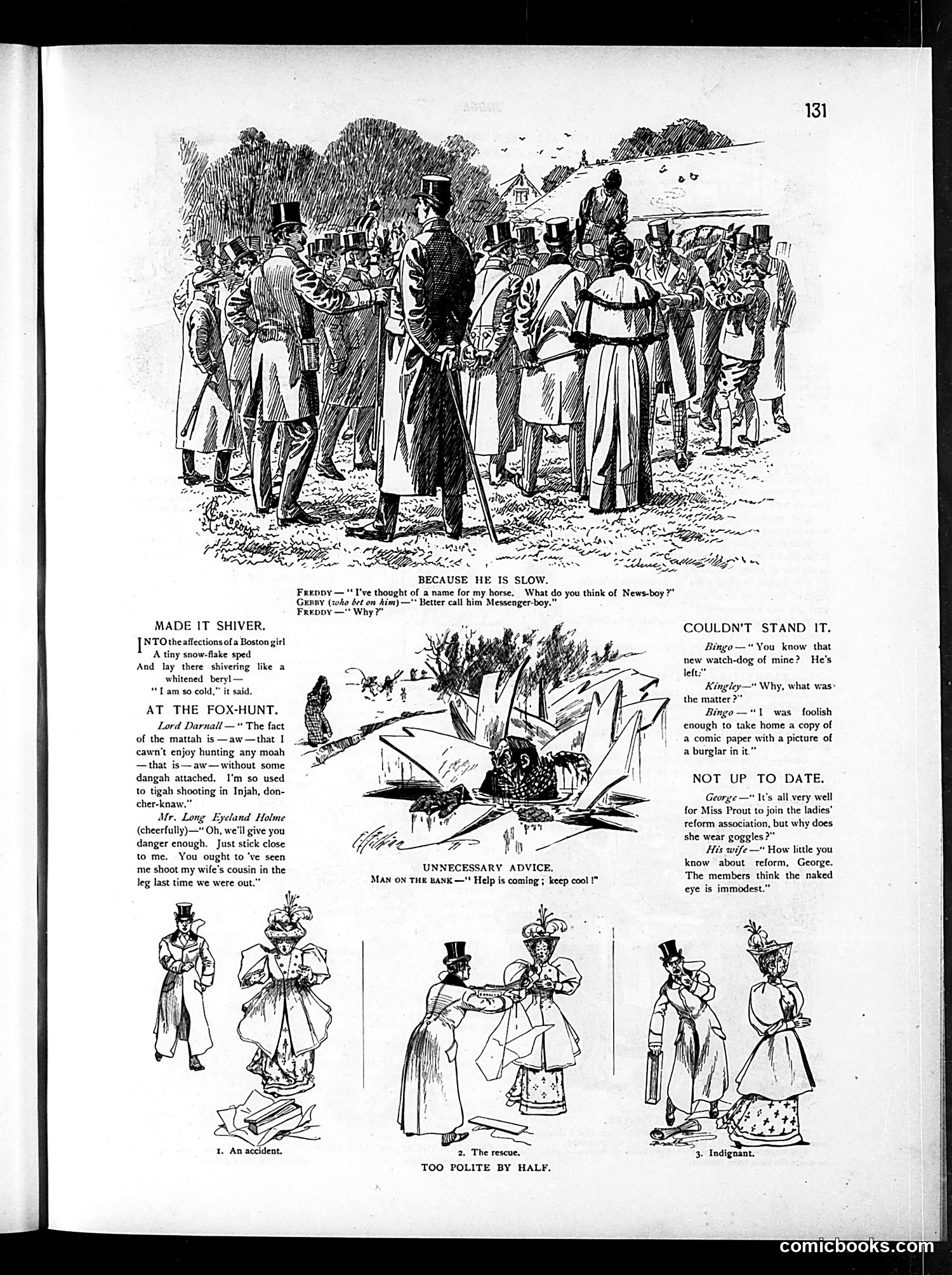
This page from *Judge* contains several satirical vignettes mocking upper-class social conventions and hunting culture. **Top cartoon**: "Because He Is Slow" depicts a group in formal dress discussing naming a slow horse "News-boy," joking about its sluggishness. **Middle sections** include: - "Made It Shiver" and "At the Fox-Hunt": hunting anecdotes with comedic mishaps - "Unnecessary Advice": A man warns of approaching help during a water accident - "Couldn't Stand It," "Not Up to Date": Brief social comedy pieces about fashionable absurdities **Bottom cartoons** titled "Too Polite by Half" show three scenarios (accident, rescue, indignance) satirizing exaggerated Victorian politeness and etiquette among the wealthy. The overall theme ridicules the pretensions and rigid social codes of Gilded Age elite society, particularly regarding hunting, fashion, and formal manners.
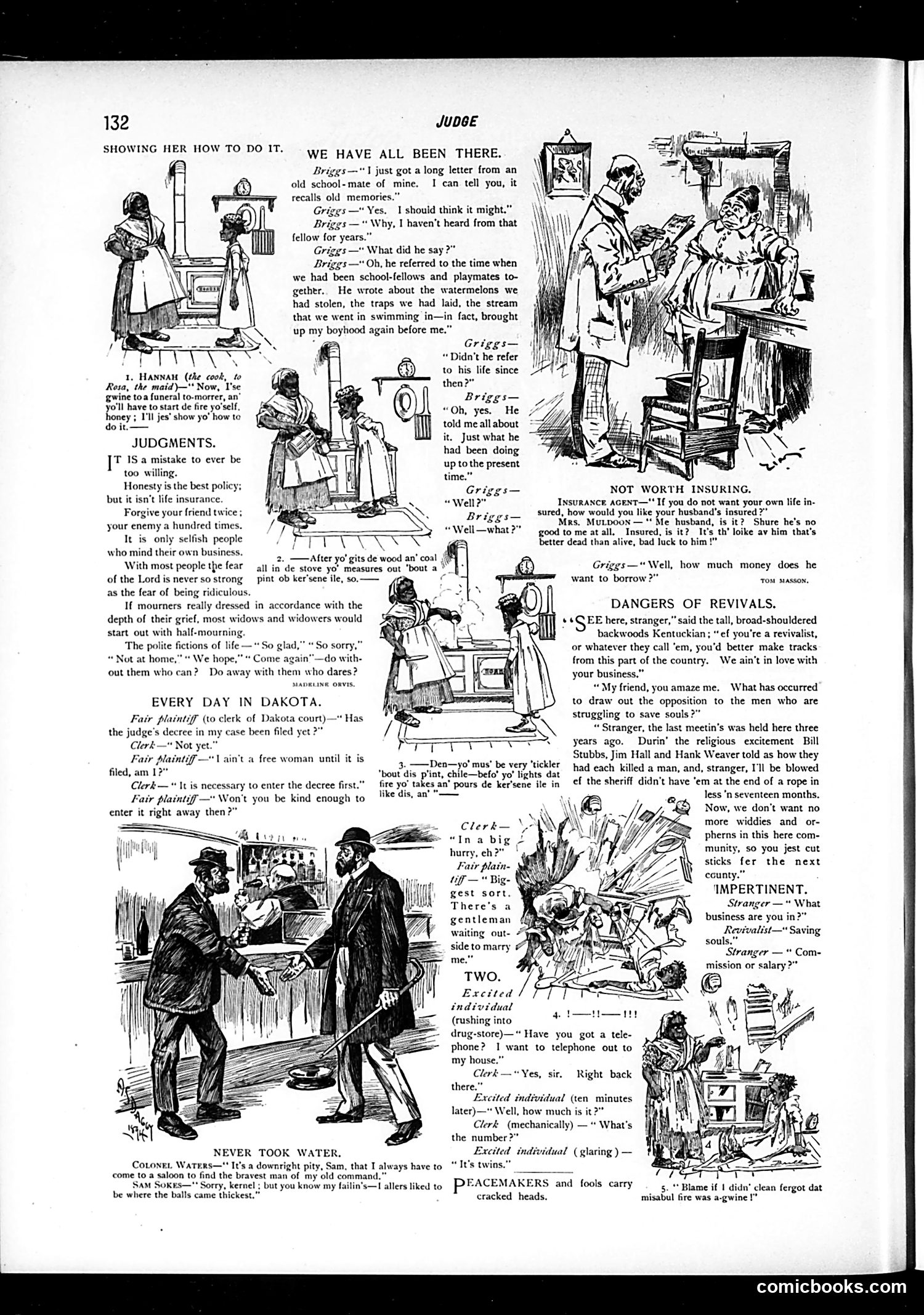
This page contains several unrelated satirical vignettes typical of Judge magazine: **"We Have All Been There"** portrays two men (Briggs and Griggs) reminiscing about school, with the humor being how nostalgia selectively recalls only mischief—stolen watermelons and pranks—while ignoring years of subsequent life. **"Every Day in Dakota"** mocks frontier divorce proceedings, where a woman cannot legally remarry until paperwork is filed, satirizing bureaucratic delays in a rough territory. **"Hannah Showing Her How"** depicts a cook instructing a maid on cooking, with humor in the vernacular dialect and domestic instruction. **"Never Took Water"** references a Civil War soldier's bravery, with "taking water" being a slang term for cowardice. **"Dangers of Revivals"** satirizes religious revival meetings in rural Kentucky, suggesting they cause social upheaval and violence among townspeople. The page also includes lighter items on life philosophy and a joke about insurance. The overall tone is genteel humor aimed at middle-class readers.
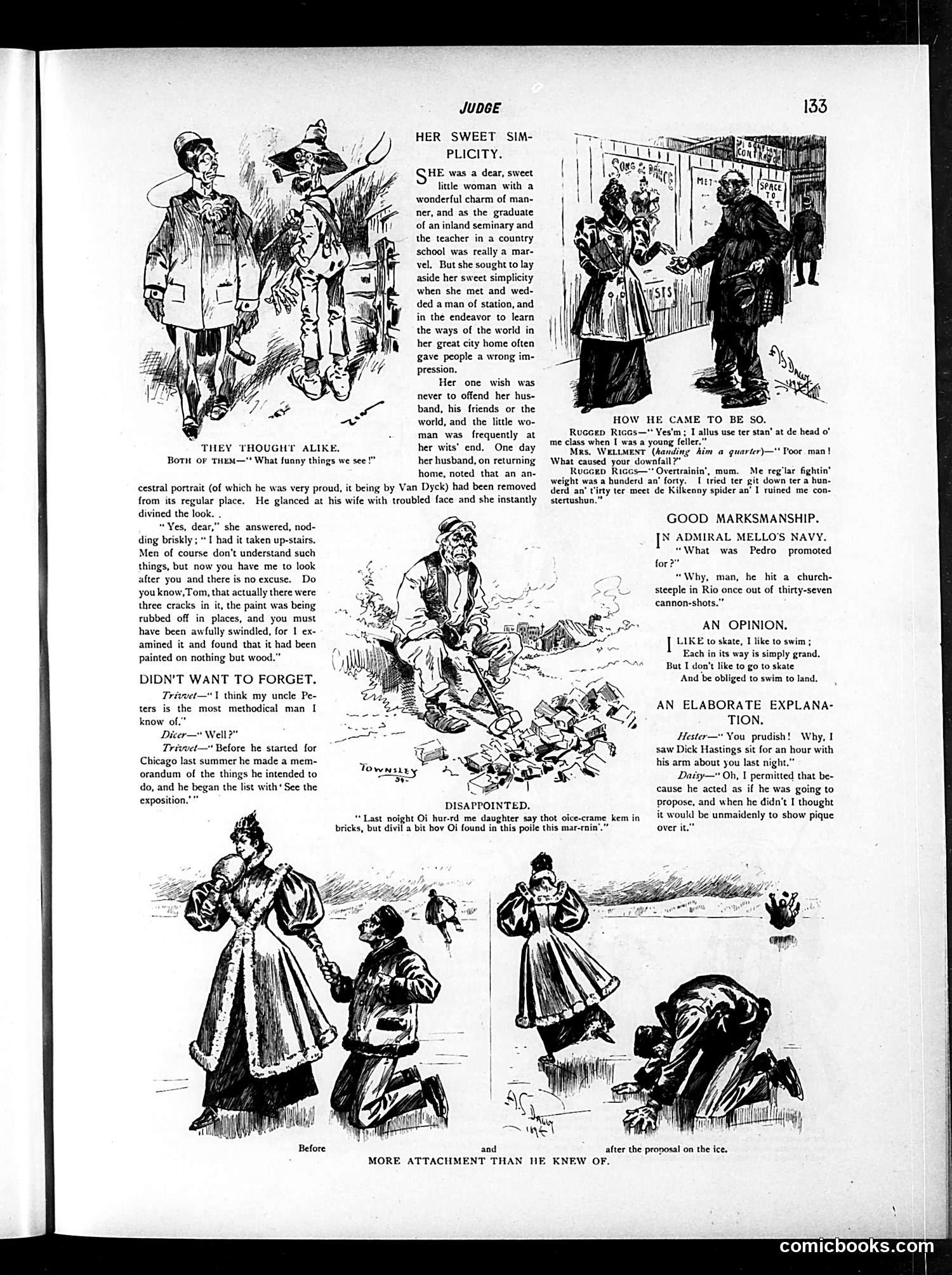
This page contains several comic vignettes satirizing turn-of-the-century social pretension and marital dynamics: **"Her Sweet Simplicity"**: A country schoolteacher marries a man of wealth and status, then anxiously abandons her natural manner trying to impress society. The humor lies in her earnest but misguided efforts—she even has her husband's ancestral portrait (a Van Dyck) moved upstairs because she found cracks in it, not realizing it's valuable precisely *because* it's old. **Other sketches** mock: - A boxer claiming overtraining caused his downfall (implying he's actually failed at boxing) - Naval incompetence (a "promotion" for hitting a church steeple) - Social hypocrisy about physical propriety - A proposal misunderstanding on ice The satire targets Victorian/Edwardian anxieties about class mobility, respectability, and the gap between genuine character and performed sophistication. The simple country woman's earnestness makes her paradoxically *less* refined than she was before.
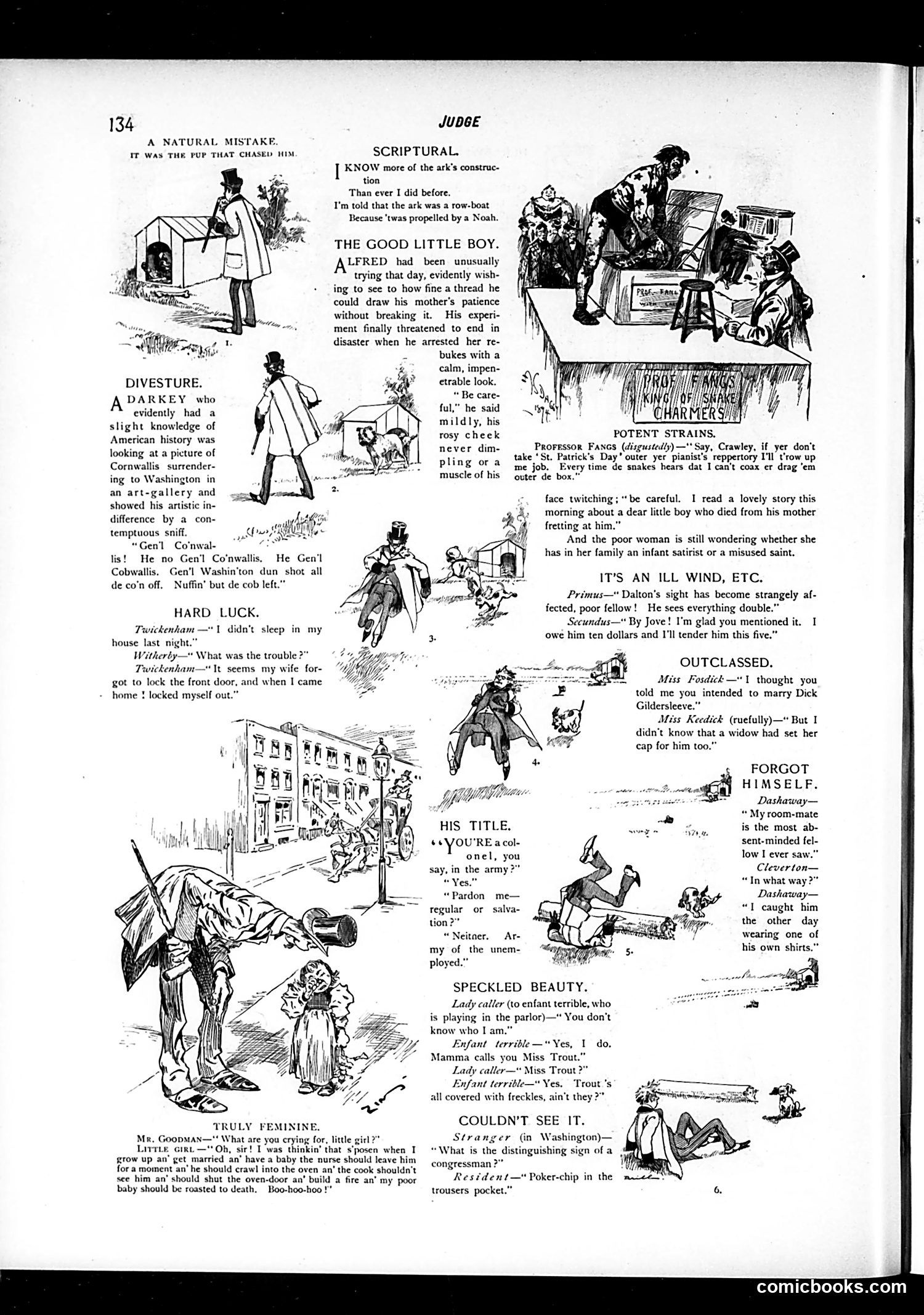
This page contains multiple brief satirical comics and jokes typical of late-19th/early-20th-century American humor: **"A Natural Mistake"** depicts a man chased by a small dog, playing on the phrase "pup that chased him." **"Divesture"** mocks a Black man viewing a Cornwallis surrender painting, making a crude pun: he calls Cornwallis "Cobwallis" because Washington "shot all de co'n off"—racist humor based on dialect and a corny wordplay. **"The Good Little Boy"** satirizes a manipulative child who silences his mother's scolding with an anecdote about a boy who died from maternal worry, exposing his calculated emotional blackmail. **Other shorts** include jokes about insomnia, broken engagements, absent-mindedness, and a congressman identified by a poker chip—likely referencing political corruption or gambling/dishonesty in Congress. The page reflects period attitudes including casual racism and cynicism about politics. The humor relies on wordplay, domestic situations, and social observation rather than visual gags alone.
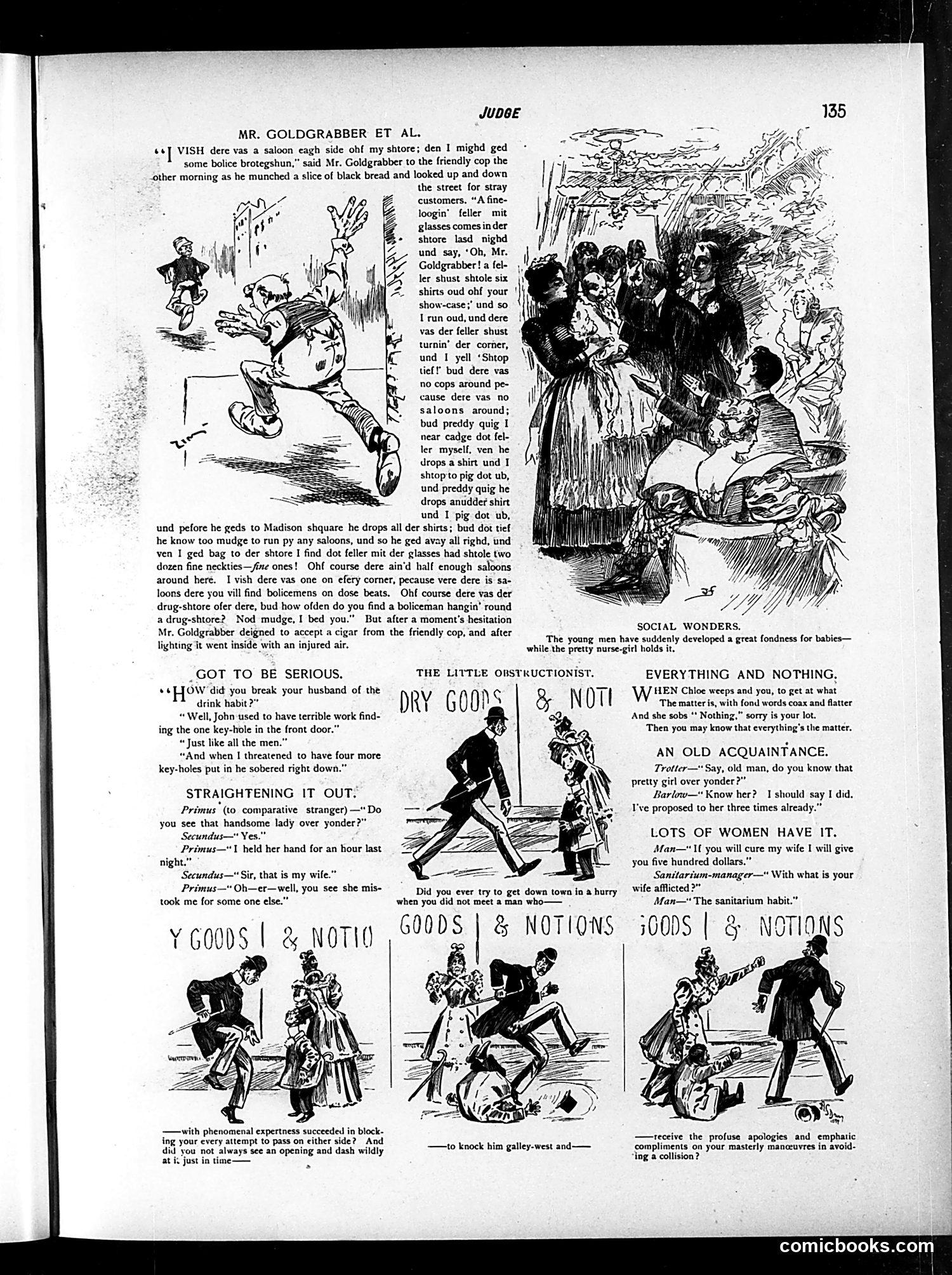
This Judge magazine page (circa early 1900s) contains several satirical cartoons and humorous sketches targeting social behaviors and immigrant stereotypes: **"Mr. Goldgrabber et al."** features a Yiddish-accented immigrant storekeeper complaining to a cop about theft. The satire critiques both inadequate police protection and the store owner's naive assumption that more saloons equal more police presence. The heavy dialect humor reflects period attitudes toward Jewish immigrants. **Other sketches** mock contemporary social absurdities: a man's failed attempts to hide drinking habits, a married man caught flirting, and "social wonders" like men suddenly interested in babies when pretty nurses hold them. **"The Little Obstructionist"** satirizes pedestrians who block sidewalk traffic in hurried situations—a relatable urban complaint. The recurring theme across sketches is exaggerated human folly and social pretense. The humor relies heavily on ethnic caricature, marital discord comedy, and observations of urban social behavior typical of early 20th-century American satire.
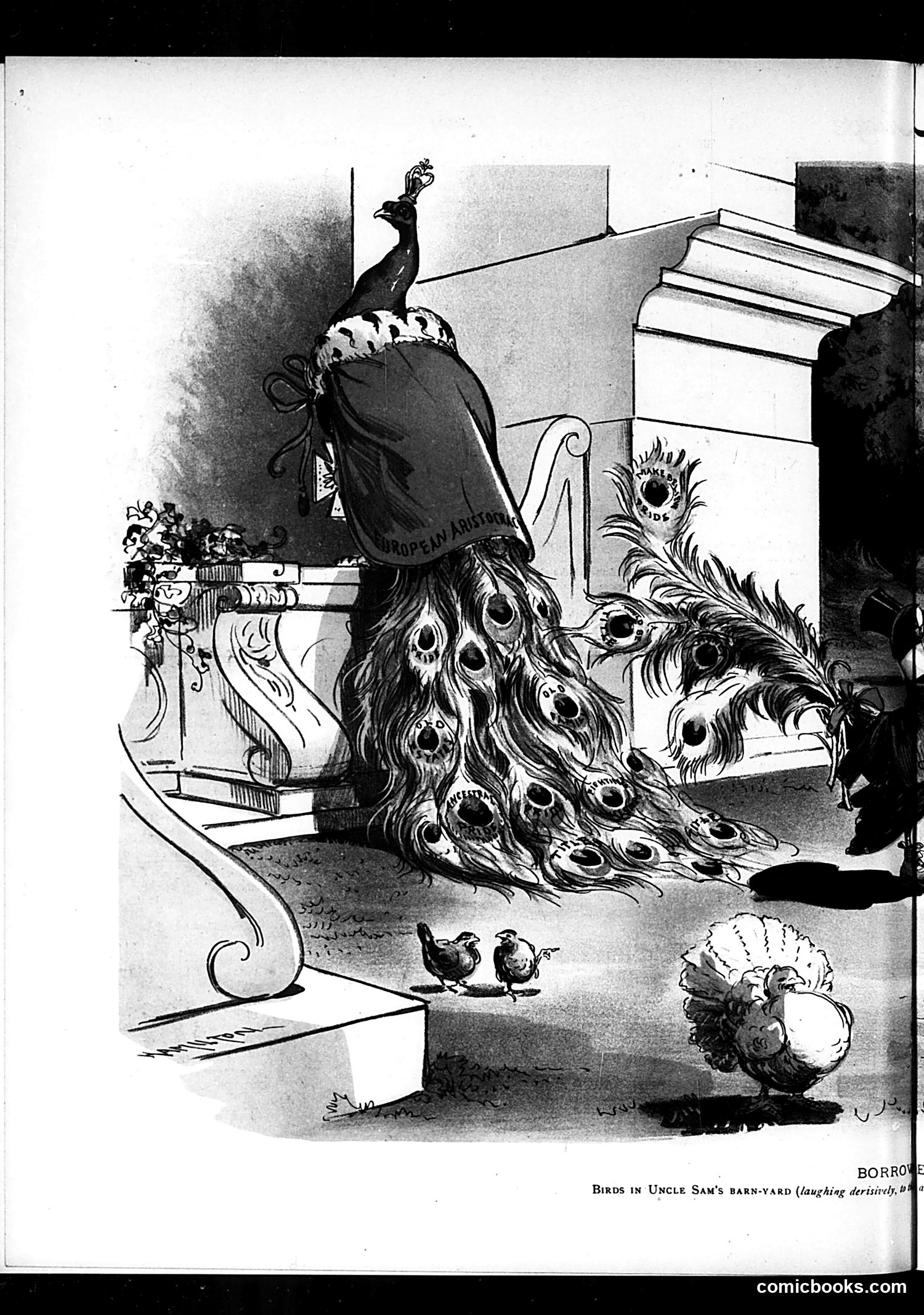
This cartoon, titled "Birds in Uncle Sam's Barn-Yard," uses animal imagery to satirize European nations as unwanted guests in America's domestic sphere. The central peacock—displaying elaborate tail feathers marked with eyes—likely represents a vain European power, while smaller birds at its feet suggest lesser nations or dependencies. The barn-yard setting positions America ("Uncle Sam") as the proprietor whose space is being invaded or exploited. The satire appears to critique European interference in American affairs or American entanglement with European politics and imperialism. The "laughing derisively" caption suggests mockery of these foreign powers' pretensions. Without a specific date visible, the exact historical reference remains unclear, though this echoes isolationist sentiments common in American political cartooning during various periods of tension with Europe.
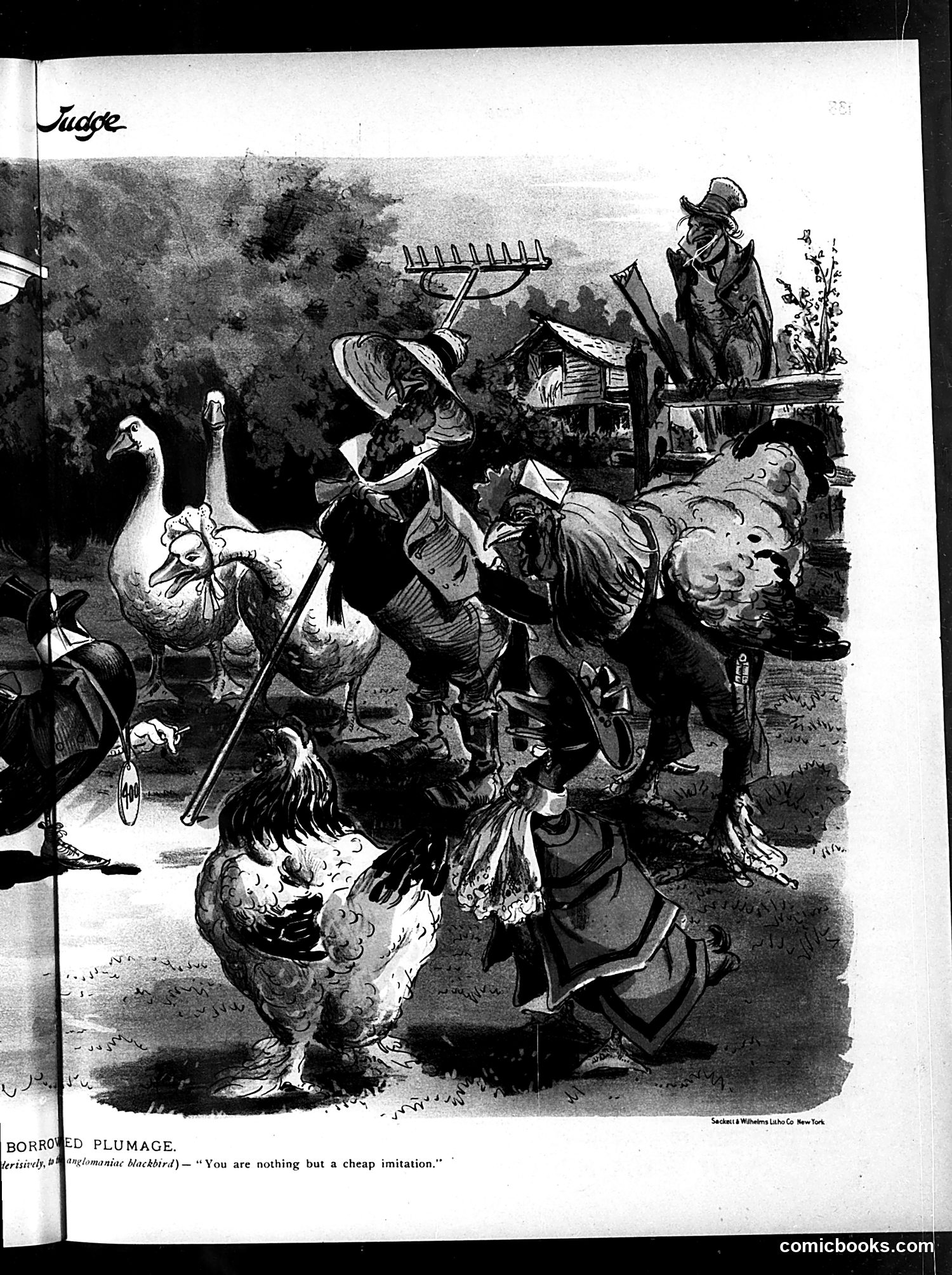
This cartoon satirizes anglomaniac pretension—likely targeting an American who apes British mannerisms or fashion. The central figure, labeled a "blackbird," wears borrowed finery (suggesting fake sophistication) and condescends to others, sneering "You are nothing but a cheap imitation." The irony is pointed: the anglomaniac itself is the cheap imitation, merely copying British style while mocking others for doing the same. The farmyard setting with geese and poultry emphasizes the absurdity—these are common birds dressed up pretentiously. This reflects 19th-century American anxiety about class aspiration and British cultural superiority, mocking wealthy Americans who adopted English affectations to appear refined while remaining essentially provincial.
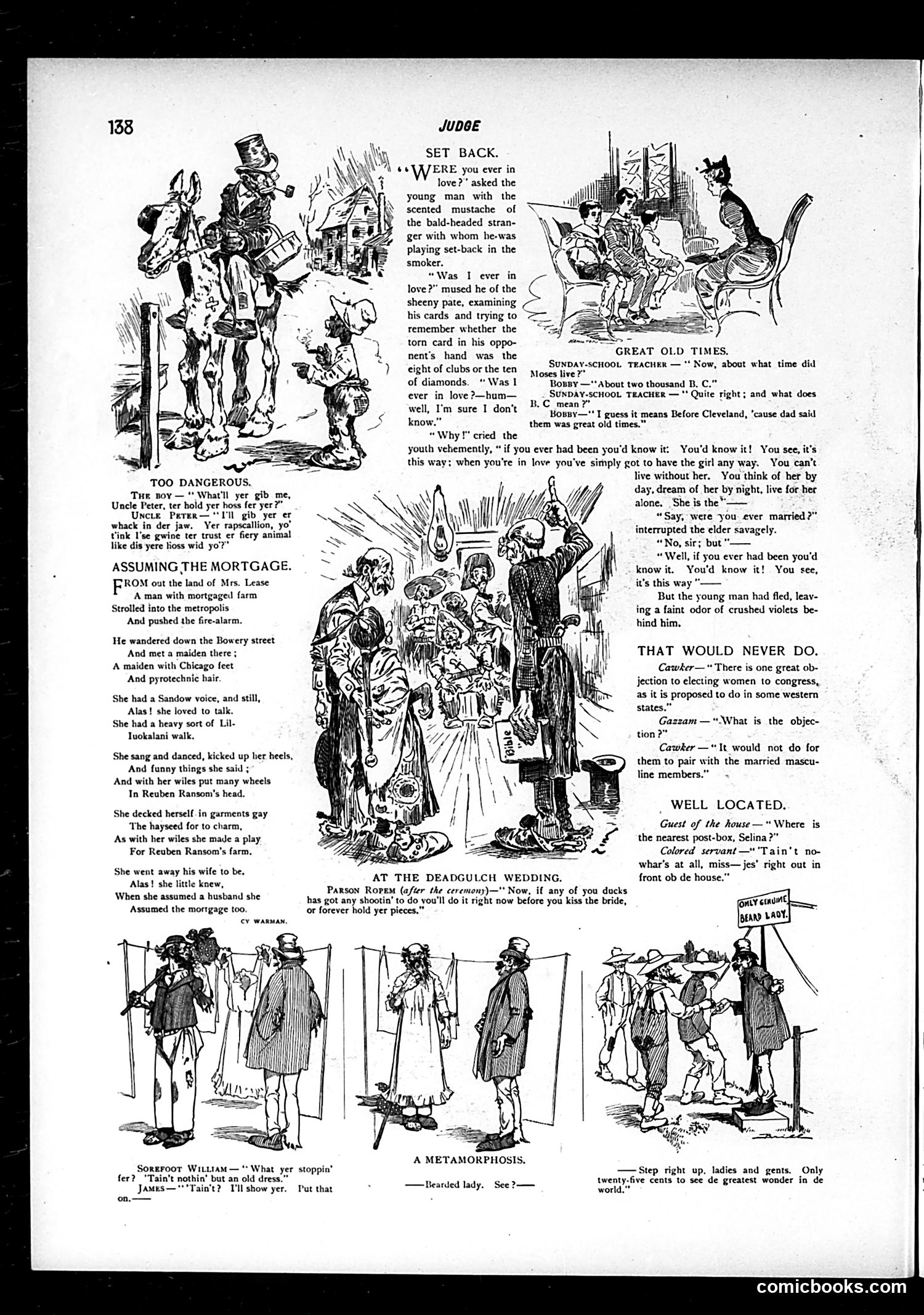
This page contains multiple satirical cartoons and jokes typical of late 19th-century American humor. The content includes: **"Set Back"**: A conversation between card players where one man persistently describes romantic love, annoying his unimpressed companion—satirizing sentimental romanticism. **"Great Old Times"**: A Sunday school joke where a child defines "B.C." as "Before Cleveland," implying the Cleveland administration was so bad that it marked a historical turning point. This references President Grover Cleveland's unpopularity. **Other sketches** mock Irish immigrants ("Uncle Peter"), farmers duped by city women, and frontier wedding customs. A final cartoon shows a woman transformed into a "bearded lady" sideshow attraction—commenting on beauty standards and exploitation. The page reflects period prejudices through dialect and stereotypes (Irish accents, offensive language about Jewish people) typical of Judge's satirical approach. The recurring theme attacks naive rural Americans versus cunning urbanites.
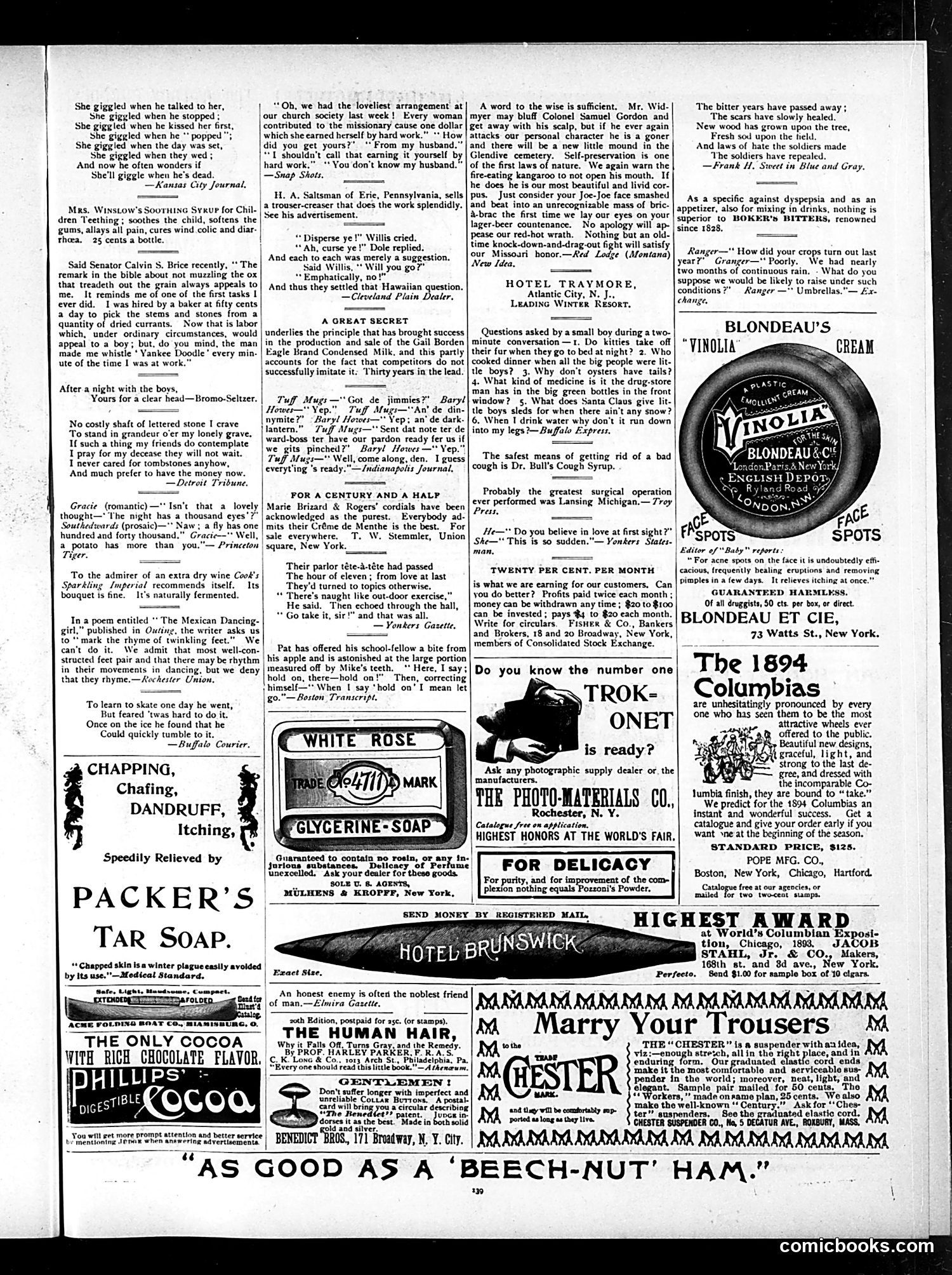
This page from Judge (a major American satirical magazine) is primarily **advertising with scattered humorous content** rather than political cartoons. The notable satirical pieces include: 1. **"She giggled when..."** - A joke about a newlywed woman's changing behavior, implying marital disillusionment 2. **Willis/Dole exchange** - Appears to reference a contemporary political or social dispute (figures unclear without additional context) 3. **A Hawaii-related commentary** - References "Hawaiian question" and mentions a "Missouri honor," likely alluding to late-19th-century American debates over Hawaiian annexation 4. **Senator Calvin Brice anecdote** - A humorous story about child labor in bakeries, presented as commentary on Bible verses about not muzzling oxen The remainder consists of **period advertisements** for patent medicines (Packer's Tar Soap, Mrs. Winslow's Soothing Syrup), cocoa, photography supplies, and suspender products—typical Judge magazine content. Most satirical elements lack sufficient context to decode their specific targets without knowing the publication date.
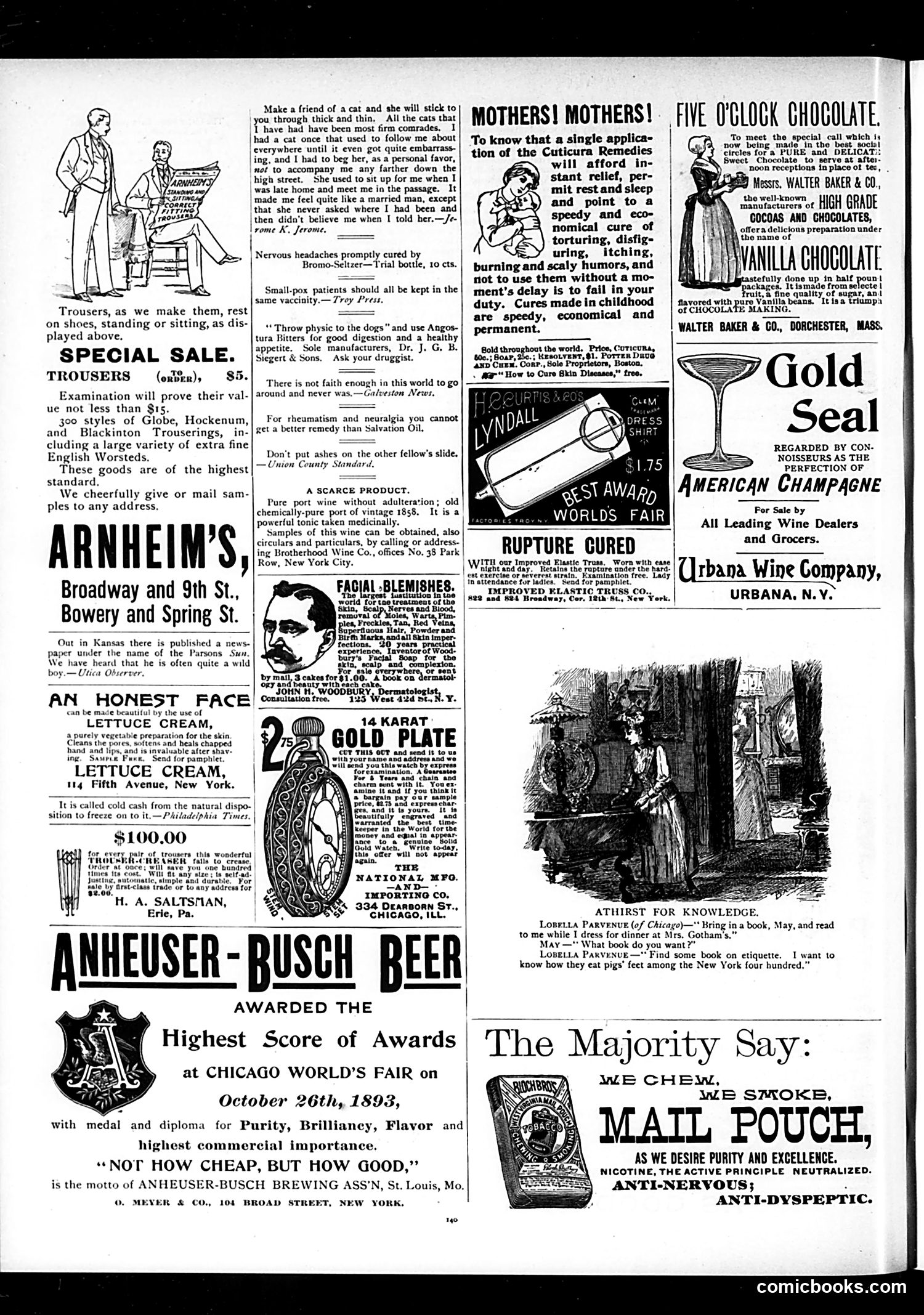
This is primarily an **advertising page** from Judge, a satirical magazine from the 1890s. Rather than political cartoons, it features period advertisements and brief humorous anecdotes interspersed with ads. The only substantive cartoon appears at bottom-right—a sketch of a modest interior scene captioned "ATHIRST FOR KNOWLEDGE," where a character asks about books, suggesting genteel self-improvement. The page content reflects **Gilded Age concerns**: patent medicines (Bromo-Seltzer, Salvation Oil), skin treatments, alcohol products, and clothing sales. Most notably, the **Anheuser-Busch beer advertisement** prominently cites its "Highest Score of Awards" at the 1893 Chicago World's Fair, reflecting how breweries leveraged such recognition in advertising. Scattered quips about cats, newspapers, and daily life provide light satirical humor typical of the magazine's style, though these lack specific political targets—they're general social observations meant to amuse rather than critique particular figures or events.
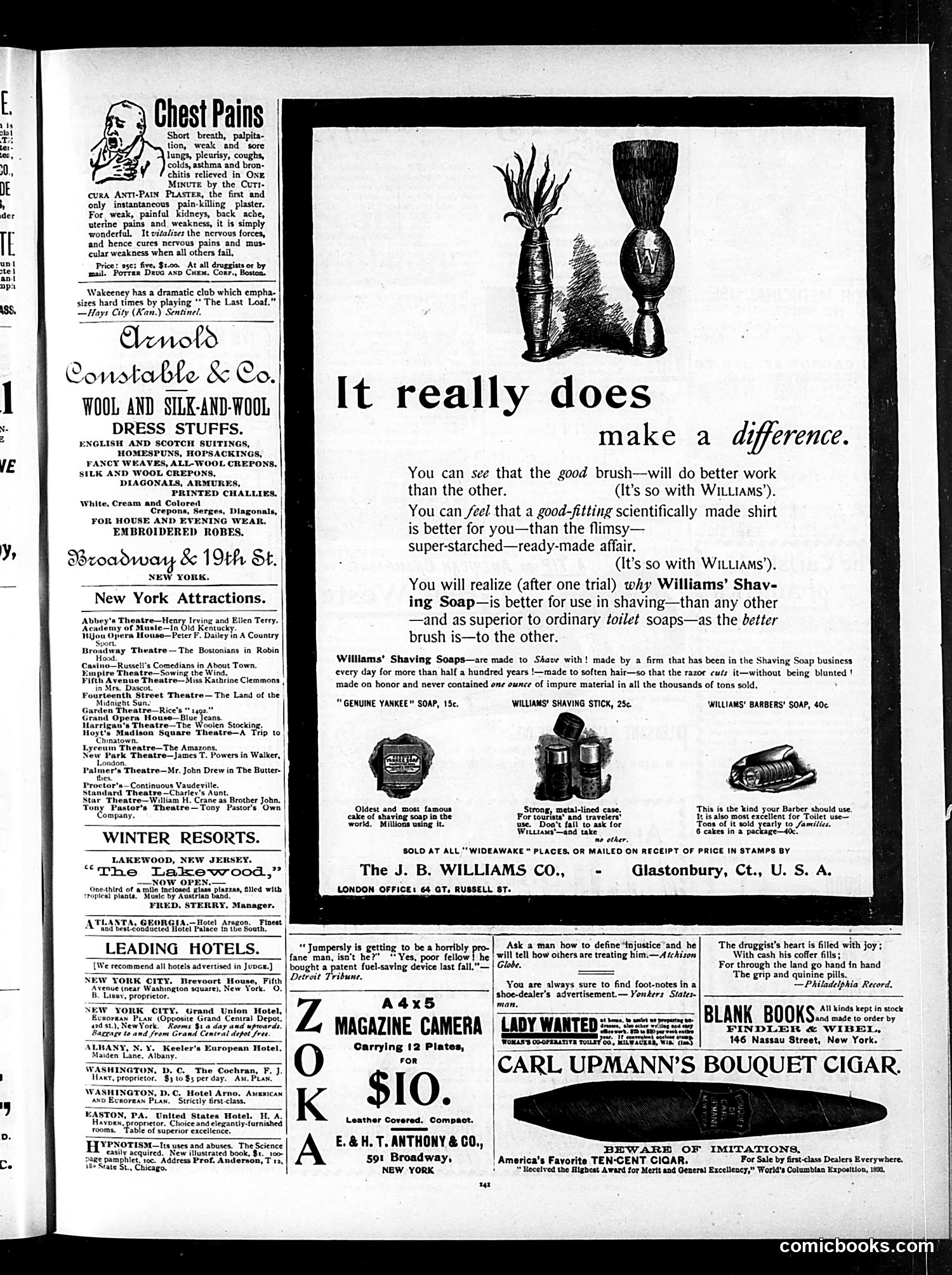
This page is primarily **advertising**, not political satire. The dominant content is a large advertisement for Williams' Shaving Soap products, which occupies the right half of the page. The ad uses comparative marketing language ("It really does make a difference") to position Williams' products as superior to competitors. It emphasizes that the company has specialized in shaving soap for over fifty years, claiming their products soften hair without dulling razors and contain no impure materials—differentiating from generic toilet soaps. The left side contains typical Judge magazine fare: a brief medical advertisement for pain relief plasters, theatrical listings for New York attractions, hotel advertisements, and miscellaneous classifieds (photography equipment, cigars, blank books). There are **no political cartoons or satire visible** on this page. The small illustration above "Chest Pains" merely shows a man holding his chest—a generic medical advertisement graphic, not a caricature or satirical commentary. This appears to be a standard magazine page from the era, mixing editorial content with extensive advertising revenue.
This page is primarily **advertising**, with brief satirical commentary interspersed. Key content: **Main Satirical Elements:** - A brief joke about Chicago: establishing that every bluffing man must keep his word would "produce a panic" — mocking Chicago's reputation for dishonesty or loose business practices. - Commentary on punishment: describing a German socialist's sentencing to hard labor as representing "excessive and cruel punishment" — subtle political critique of European authoritarianism. - Eve's sin transmitted through apples/applejack — a pun playing on the biblical Fall of Man, suggesting modern men fall to temptation (alcoholism) just as Eve did to fruit. **Advertisements:** Duffy's Malt Whiskey (marketed as medicinal), Overman bicycles, Scott's Emulsion (health tonic), Beecham's Pills, and others typical of the era. **Historical Context:** The page reflects late-1890s America: patent medicine promotion, the bicycle craze, and skepticism toward authority — all common Judge magazine themes.
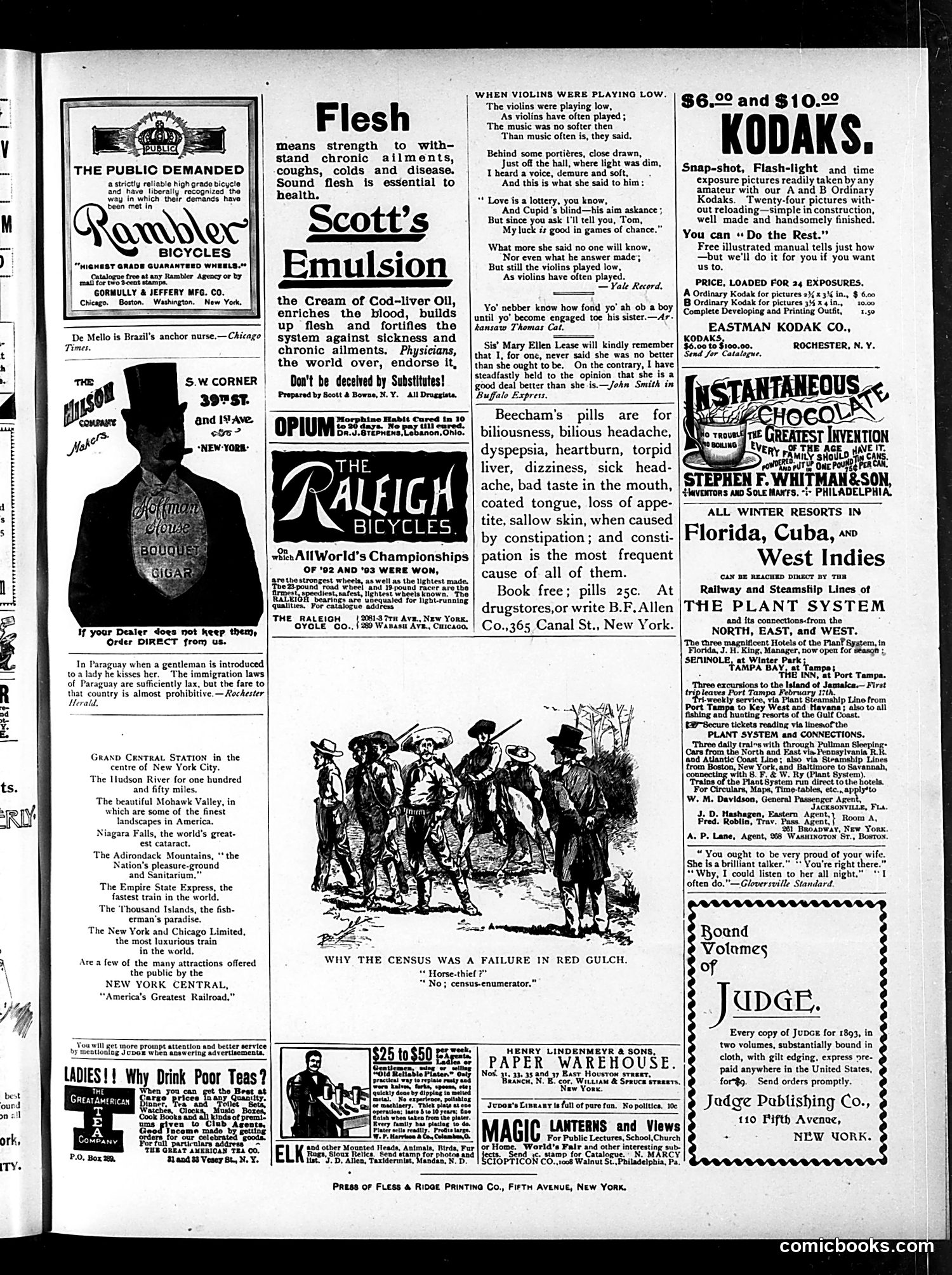
This page is primarily **advertising** with one notable **political cartoon**. The main cartoon, captioned "WHY THE CENSUS WAS A FAILURE IN RED GULCH," depicts a Western scene with cowboys and shows census-taking difficulties in remote areas. The humor targets the practical challenges of conducting the U.S. Census in sparsely populated frontier regions where enumerators struggled to locate and count residents. The caption's punchline—"No; census-enumerator"—suggests the census-taker himself went missing or was absent, satirizing the administrative failures of census operations in the American West during this period (likely 1890s-early 1900s). The remainder of the page features period advertisements for bicycles (Rambler, Raleigh), patent medicines (Scott's Emulsion for health, Beecham's pills), Kodak cameras, and travel promotions for the New York Central Railroad—typical content reflecting the commercial interests and health concerns of that era's readership.
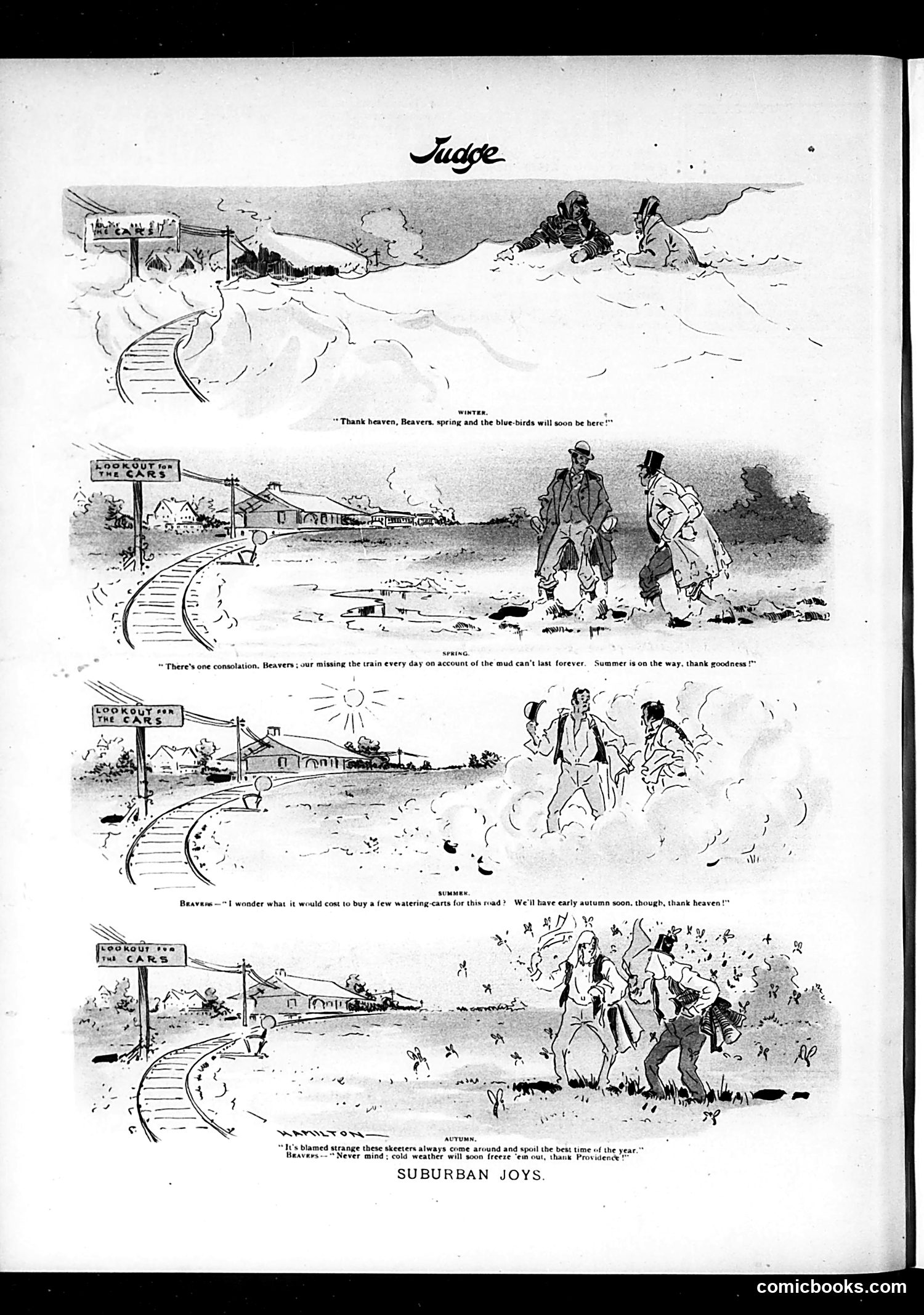
This is a four-panel satirical comic titled "Suburban Joys" depicting the frustrations of suburban commuting through the seasons. In each panel, two men (labeled "Beavers") discuss seasonal problems: **Winter**: Mud makes trains late daily **Spring**: They hope mud won't last forever **Summer**: They wish for watering-carts to control dust **Autumn**: Mosquitoes ruin the pleasant weather The satire mocks suburban life by showing that every season brings its own complaint—there's never a truly "joyful" season for these commuters. The characters constantly defer happiness to the next season, only to find new problems. The cartoon critiques both the discomforts of suburban commuting and the perpetual dissatisfaction of those seeking an idealized suburban existence. The repeated "thank heaven/goodness/Providence" phrases reinforce the ironic tone: there's always something to complain about.