
A complete issue · 16 pages · 1894
Judge — February 3, 1894
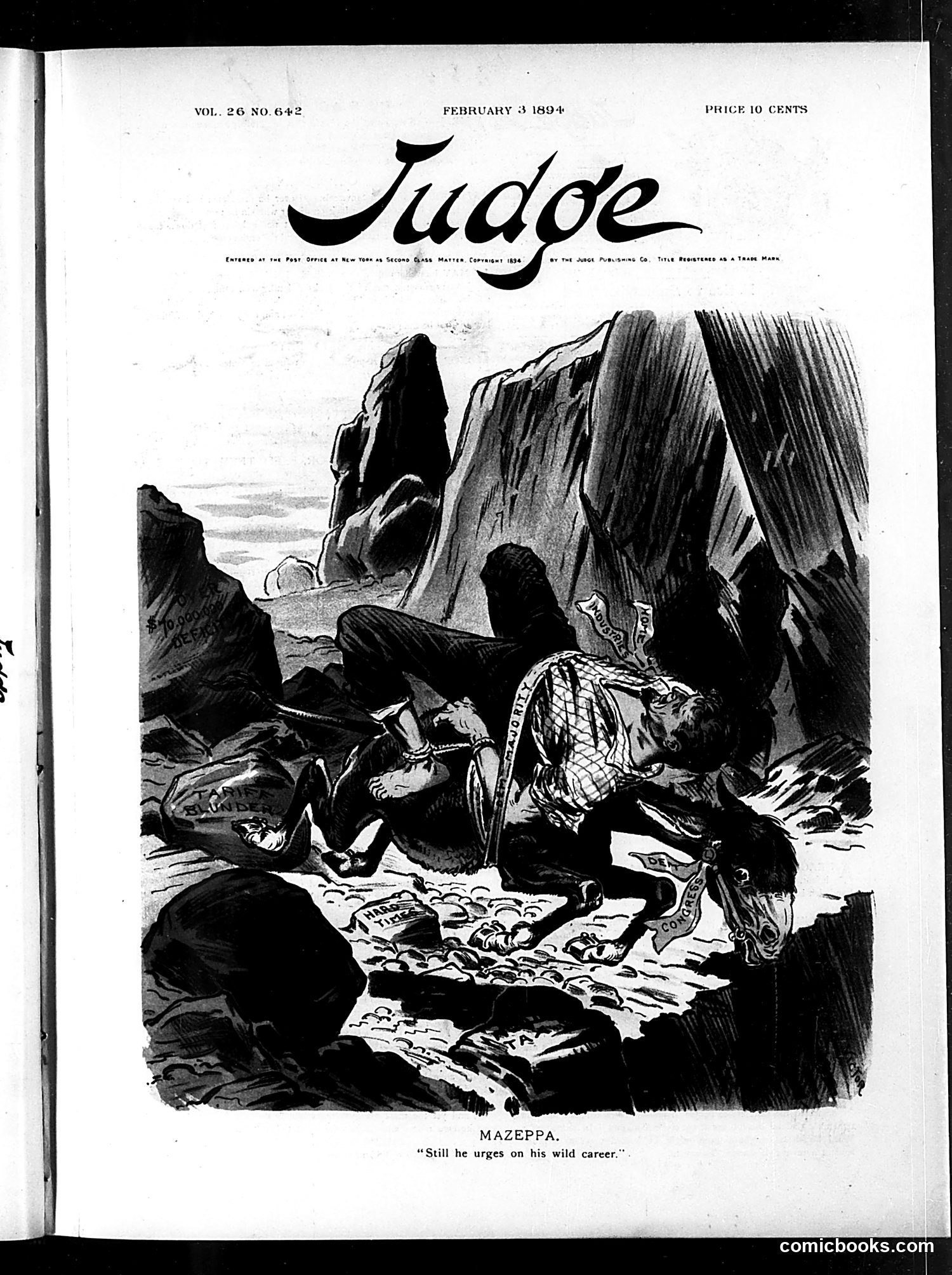
This illustration titled "Mazeppa" depicts a figure in tattered clothing reclining among scattered papers inside a tent, with the caption "Still he urges on his wild career." The cartoon likely references a contemporary political or public figure engaged in reckless or unrestrained behavior. "Mazeppa" alludes to the famous literary character known for wild, uncontrolled actions—a popular cultural reference of the era used satirically to criticize someone's conduct. The scattered papers suggest financial documents or political writings, implying the subject squanders resources or pursues destructive policies. The tent and rugged setting suggest degradation or reduced circumstances resulting from this wild conduct. Without additional context identifying the specific figure satirized, the exact political target remains unclear, but the tone criticizes someone's reckless public behavior.
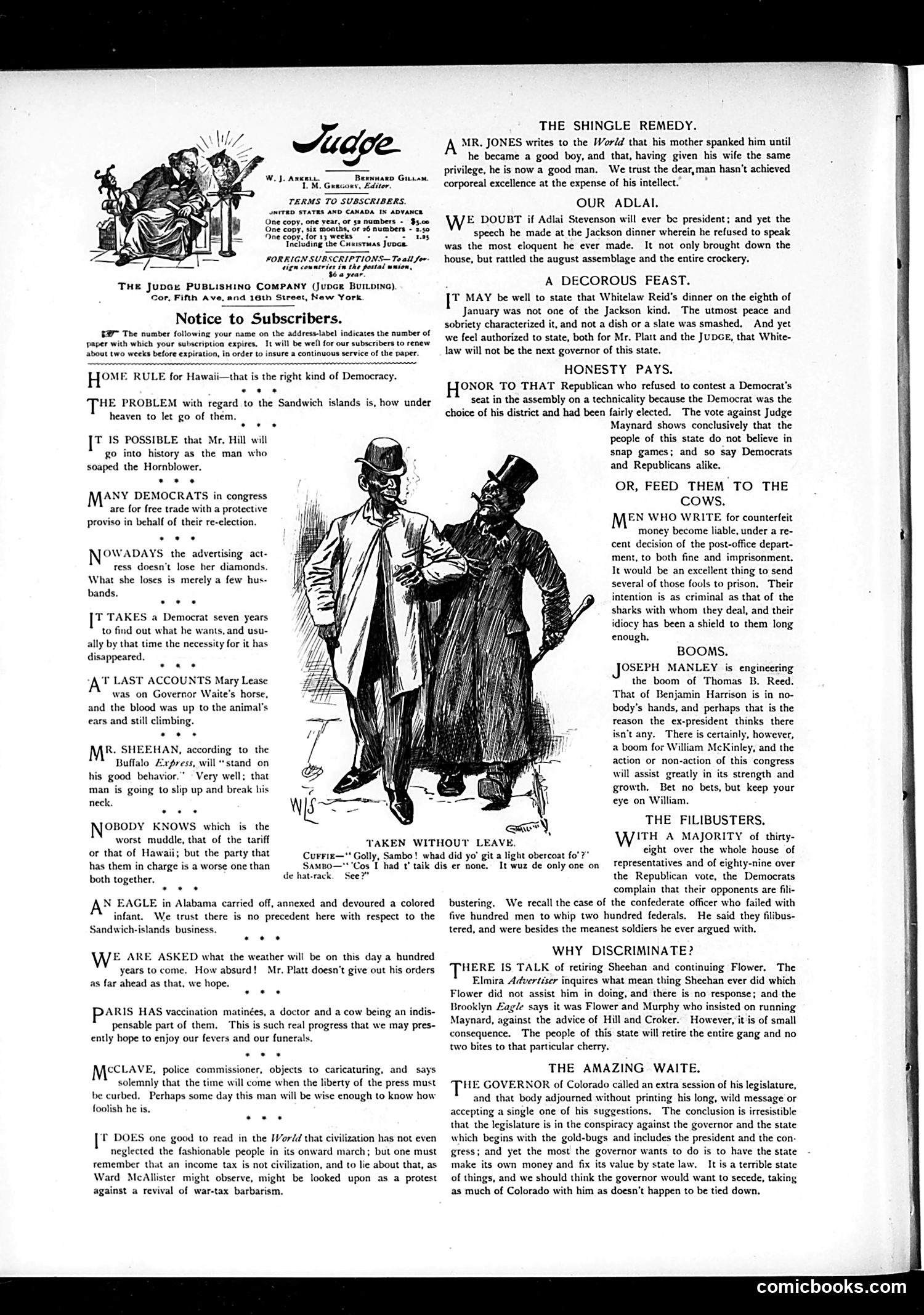
The main cartoon, titled "TAKEN WITHOUT LEAVE," depicts two well-dressed men in conversation. One asks the other for "a light overcoat" to borrow; the reply is "Yes, I had a talk dis er note. It was de only one on his rack." This appears to be satirizing political corruption or hypocrisy—likely referencing someone borrowing or appropriating something not rightfully theirs, perhaps alluding to misappropriation of public funds or positions. The artwork style and dialogue suggest early 20th-century American politics. The surrounding editorial text addresses various political issues including Democratic and Republican rivalry, tariffs, and governance concerns of the era, but the specific cartoon reference remains somewhat unclear without additional historical context about the referenced figures.
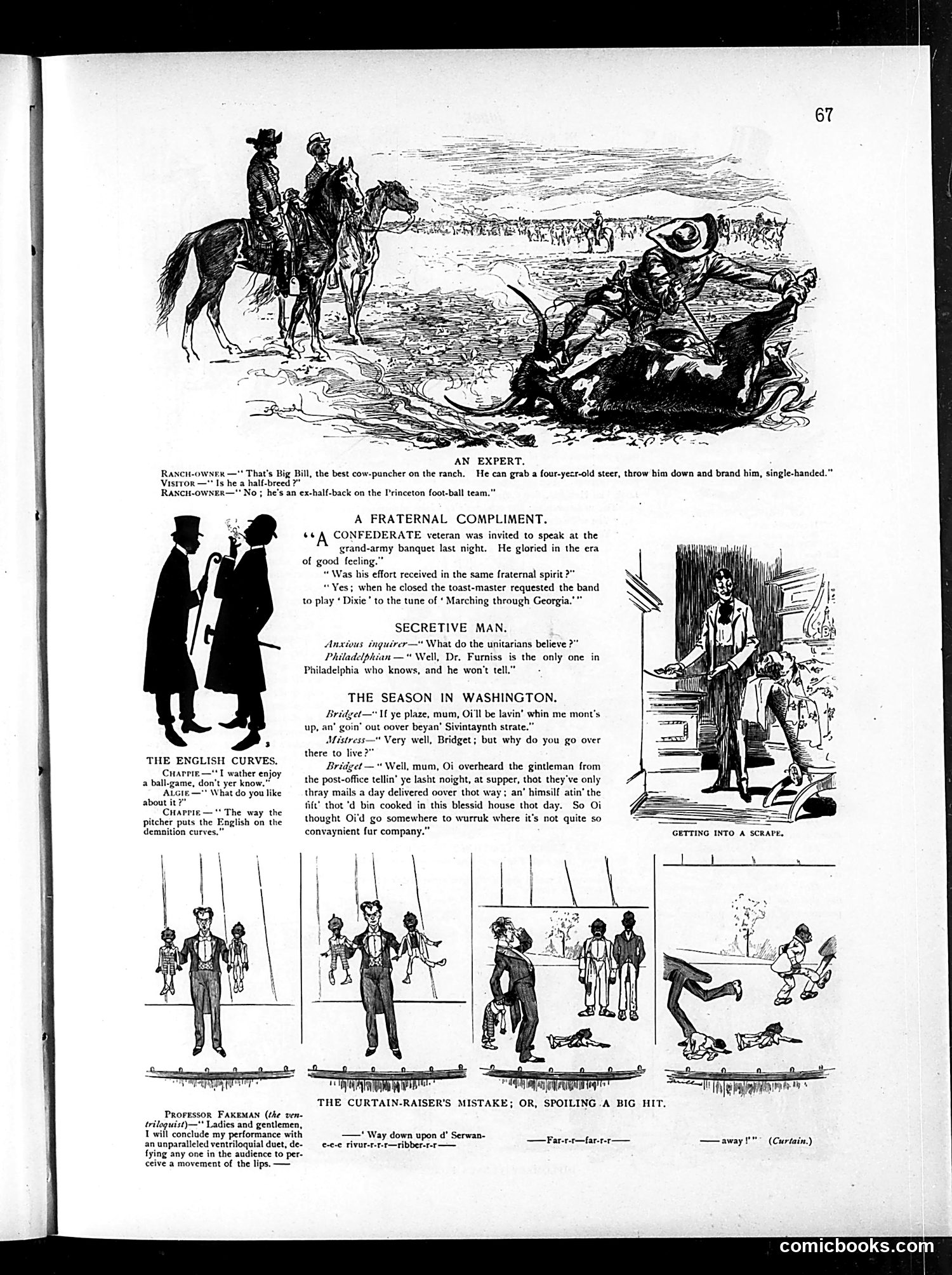
This page from *Judge* contains several unrelated satirical items: **"An Expert"** mocks ranch culture—a visitor questions a rancher's boast about breaking horses, suggesting the feat requires skill beyond what the rancher possesses. **"A Fraternal Compliment"** satirizes a Confederate veteran at a grand-army banquet who receives unexpectedly warm reception, playing on post-Civil War reconciliation between North and South. **"Secretive Man"** jokes about a Philadelphia doctor who supposedly knows something important but won't share it. **"The Season in Washington"** features domestic dialogue about mail delivery and inconvenience. **"The English Curves"** and **"The Curtain-Raiser's Mistake"** appear to be theatrical or vaudeville humor involving performers and stage mechanics. The page primarily offers light social comedy rather than pointed political satire.
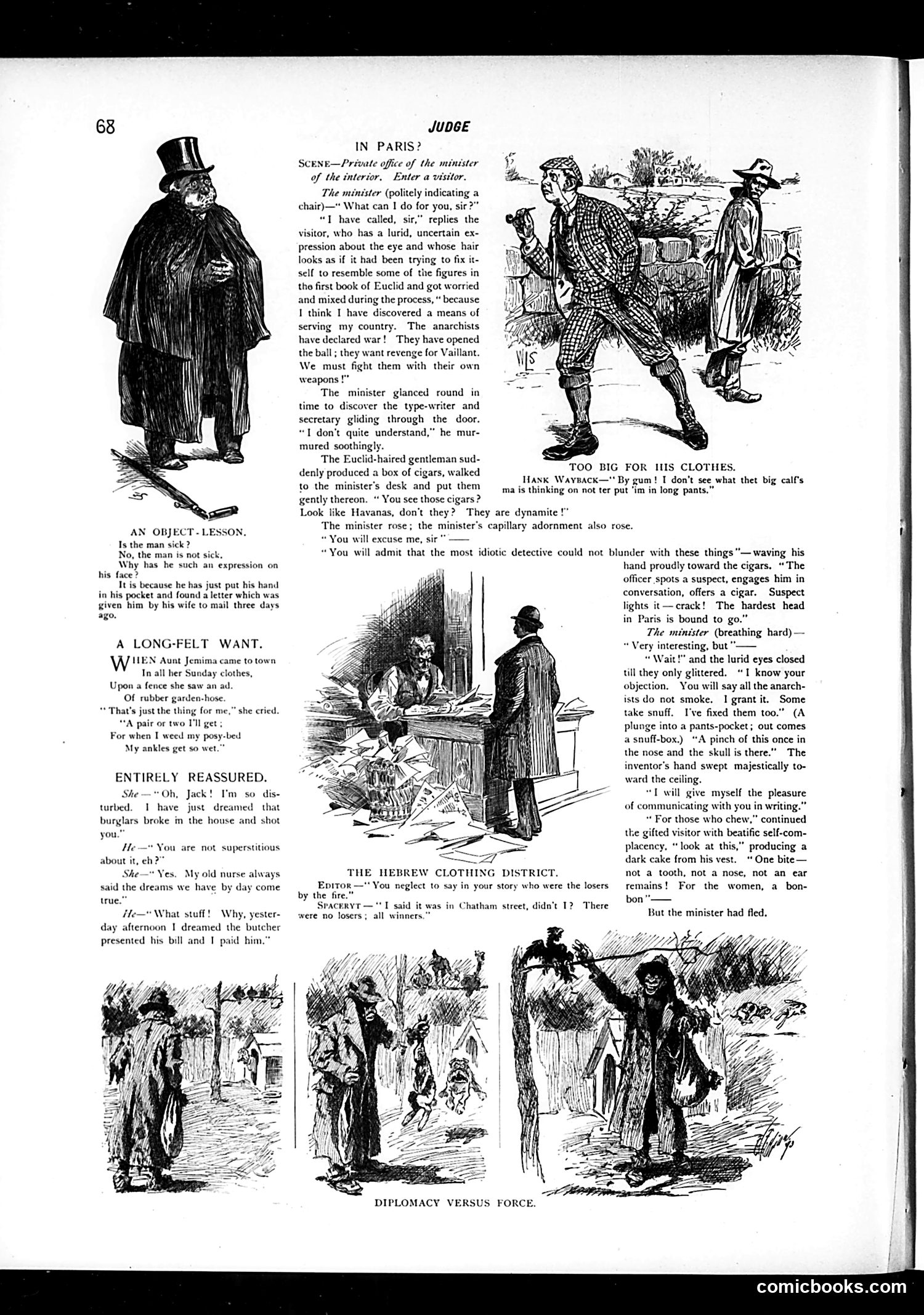
This page contains multiple satirical pieces reflecting late 19th-century concerns: **"Judge in Paris?"** satirizes anarchist violence in France. A disheveled visitor approaches the French Interior Minister with "dynamite cigars"—explosive devices disguised as tobacco products—to combat anarchists who had declared war (likely referencing Auguste Vaillant's 1893 bombing). The minister flees in terror when the visitor produces increasingly absurd weapon variations (snuff, cake). The satire mocks both anarchist tactics and the government's incompetence in combating them. **"The Hebrew Clothing District"** jokes about a fire in New York's Jewish immigrant neighborhood (Chatham Street), with the punchline that all "losers" actually profited—a stereotype about Jewish merchants. The remaining sketches are light domestic humor unrelated to politics. The page satirizes genuine period anxieties: European anarchist bombings and American anxiety about immigrant communities.
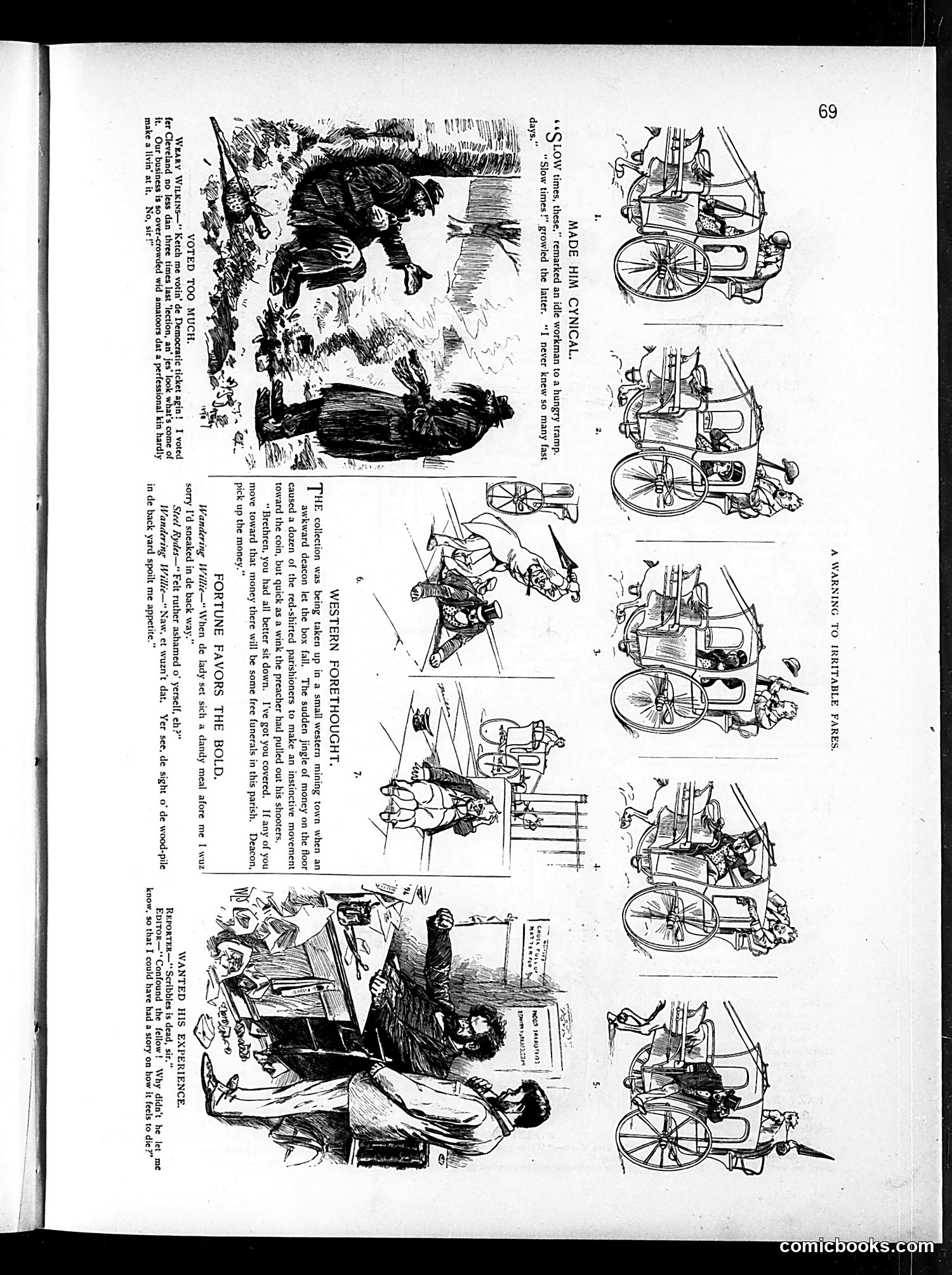
This page contains multiple satirical sketches addressing economic hardship and social pretension during what appears to be a recession or depression era. **"Slow Times"** depicts the irony of economic inequality: an idle workman and hungry tramp commiserate about hard times, while one notes he's never seen so many "fast times"—suggesting the wealthy continue indulging despite general poverty. **"Fortune Favors the Bold"** shows "Wandering Willie," a hobo who sneaks into a fancy dinner, expressing regret at his method of entry rather than the meal itself—satirizing how even desperate poverty retains dignity and pride. **"Wanted His Ex"** mocks a newspaper editor upset that reporter Scribbles died without warning—not from genuine concern, but because the editor missed an opportunity for a sensational "how it feels to die" story. This skewers journalistic sensationalism and callous exploitation of human tragedy for circulation. The page satirizes class divisions, economic desperation, and press ethics during hard times.
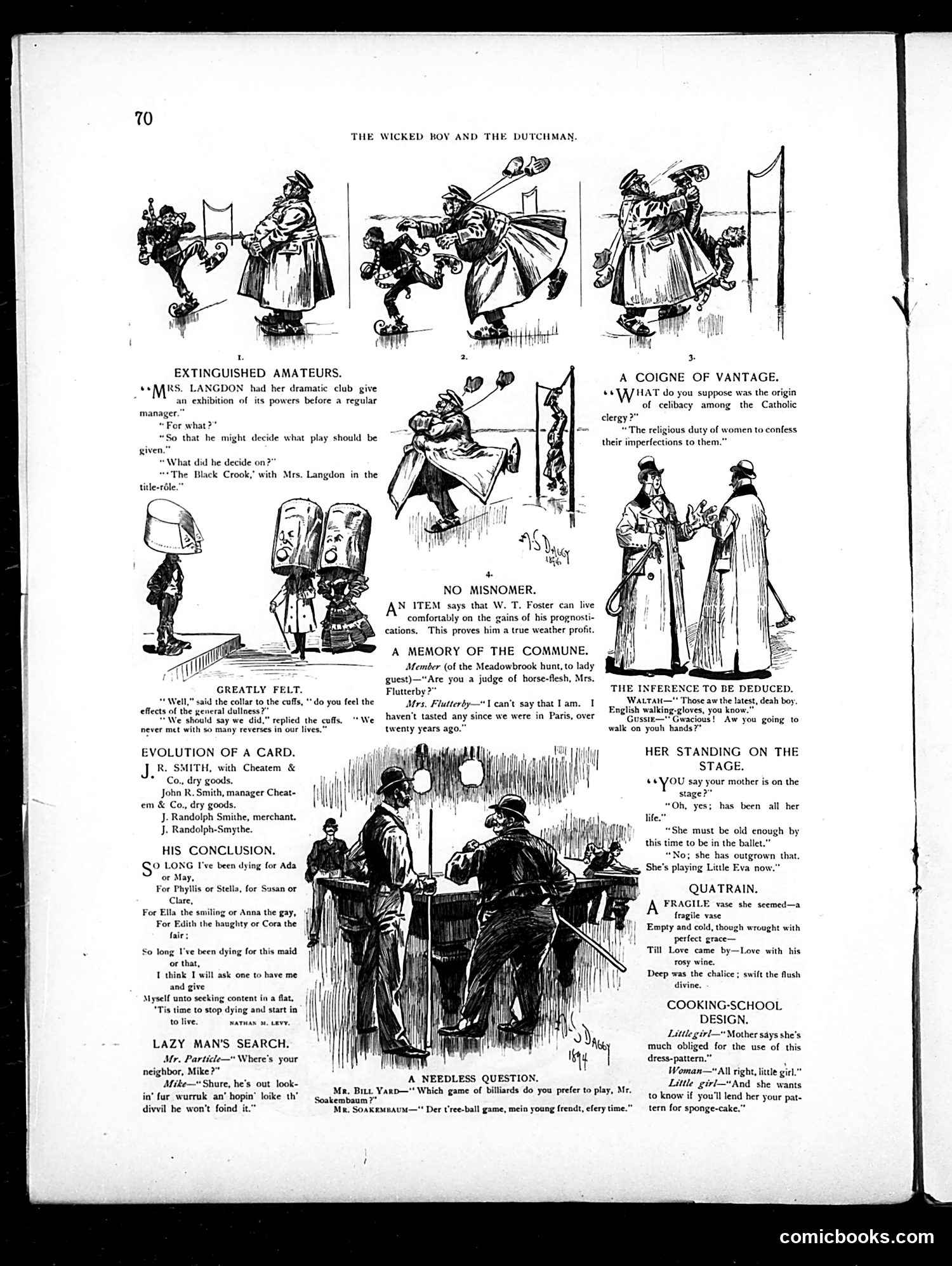
This page collects brief satirical pieces typical of 1880s-90s American humor magazines: **Main items:** - **"Extinguished Amateurs"**: Mocks amateur theatrical clubs—Mrs. Langdon's dramatic society performs for a manager who predictably selects *The Black Crook* (a popular melodrama) featuring Langdon herself, suggesting nepotism and poor judgment. - **"No Misnomer"**: Jokes that W.T. Foster (apparently a weather forecaster) profits from his predictions—a pun on "weather profit" vs. "weather prophet." - **"Memory of the Commune"**: References the 1871 Paris Commune. A hunt-club member asks if Mrs. Flutterby judges horseflesh; she replies she hasn't tasted any since Paris twenty years ago—implying she ate horses during the Commune's siege. - **"Lazy Man's Search"**: An Irish immigrant (stereotyped dialect) seeks work while hoping someone finds him first—satire on idleness. Other pieces mock social pretension, amateur dramatics, and relationship anxieties. The overall tone is light domestic satire with period-specific references.
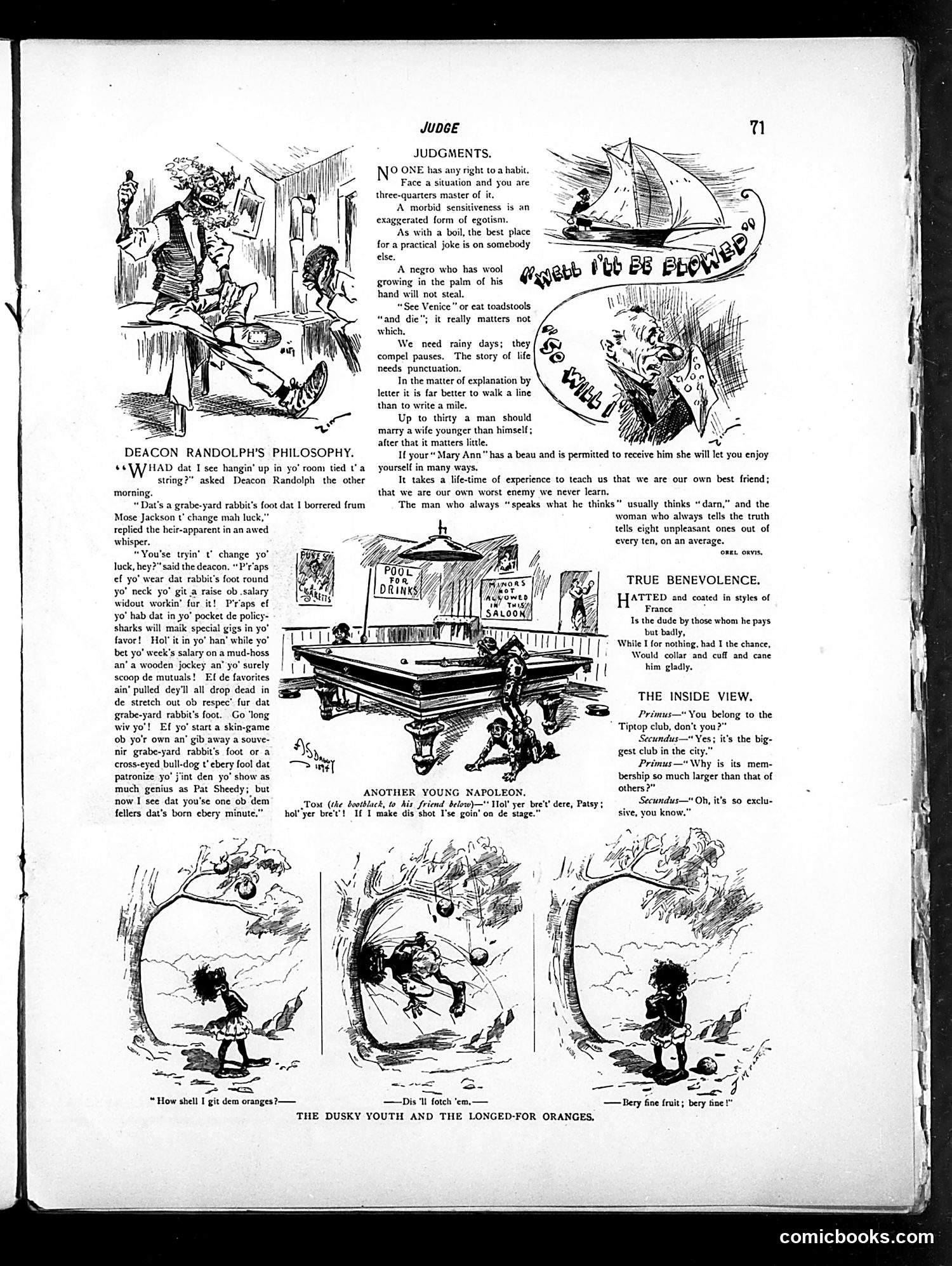
This page contains multiple satirical pieces typical of late 19th-century American humor: **"Deacon Randolph's Philosophy"** presents a dialect-heavy conversation mocking superstition and get-rich-quick schemes. An older Black man (Deacon) sarcastically lectures a younger one about carrying a rabbit's foot for luck, hoping it will improve gambling and criminal outcomes. The satire targets both belief in magical thinking and the desperation of people seeking easy solutions to poverty. **"Judgments"** offers aphoristic commentary on human nature—relationships, morality, and social behavior—typical of the magazine's editorial voice. **"The Dusky Youth and the Longed-For Oranges"** depicts a child attempting to retrieve oranges from a tree by swinging on a rope, illustrated across three sequential panels. The humor appears physical/slapstick-based. The page reflects Judge's characteristic approach: mixing social commentary with crude racial caricatures and dialect humor that was mainstream entertainment at the time, though deeply offensive by modern standards.
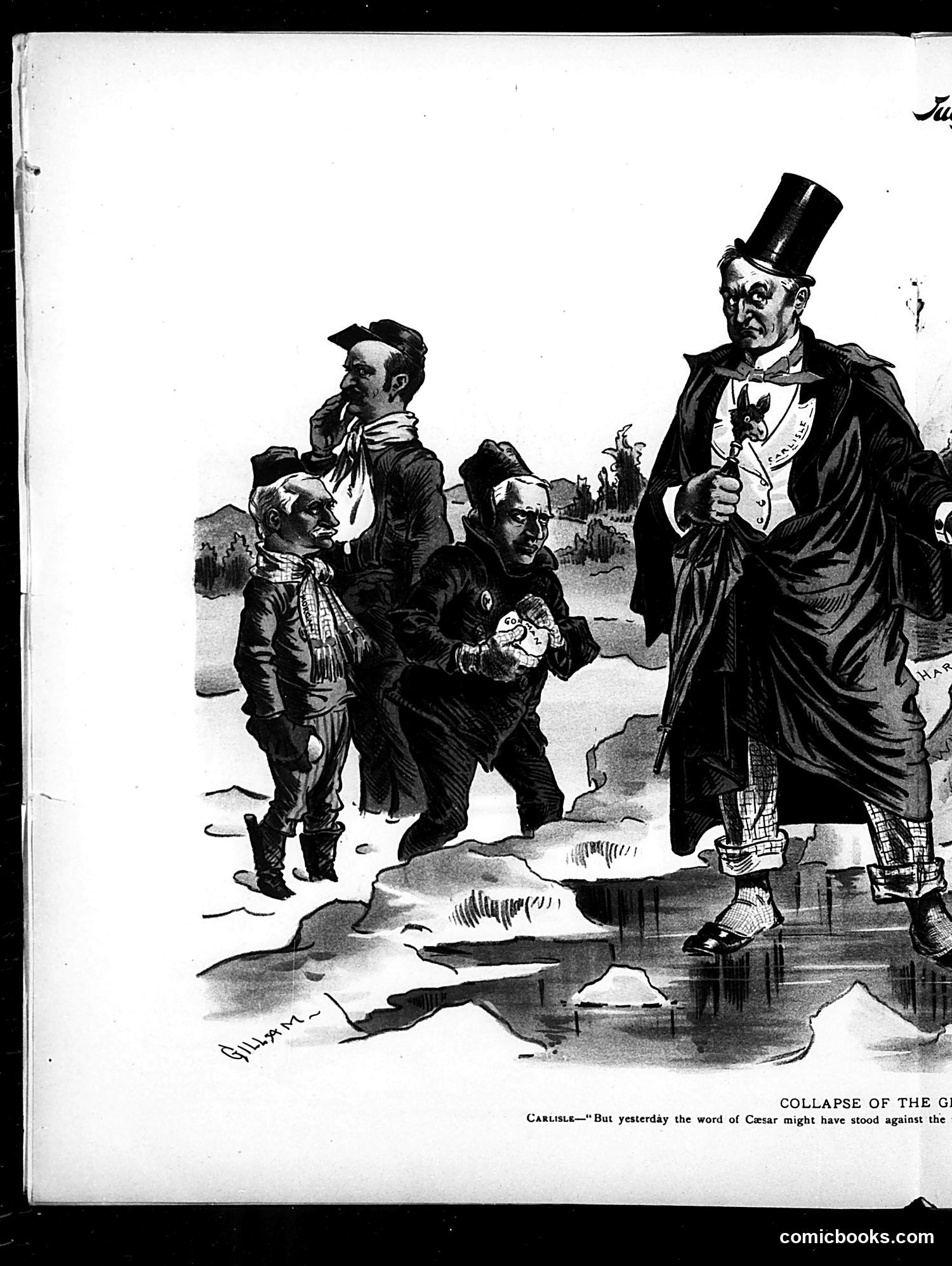
This cartoon depicts what appears to be a commentary on imperial or autocratic collapse. The caption references "Caesar" and suggests that yesterday his word held absolute power ("might have stood against the"), implying that power has now crumbled. The image shows four figures with exaggerated caricatured features in formal dress standing in a desolate, flooded landscape. The figure on the right, wearing a top hat, appears to be a political leader or authority figure. The smaller figures beside him—depicted with animal-like or grotesque features—may represent either supporters or subjects witnessing the collapse of authority. The satire likely critiques the fragility of authoritarian rule or the sudden loss of political power. Without the publication date visible, the specific historical reference remains unclear, though the classical allusion to Caesar suggests commentary on dictatorship or imperial pretension.
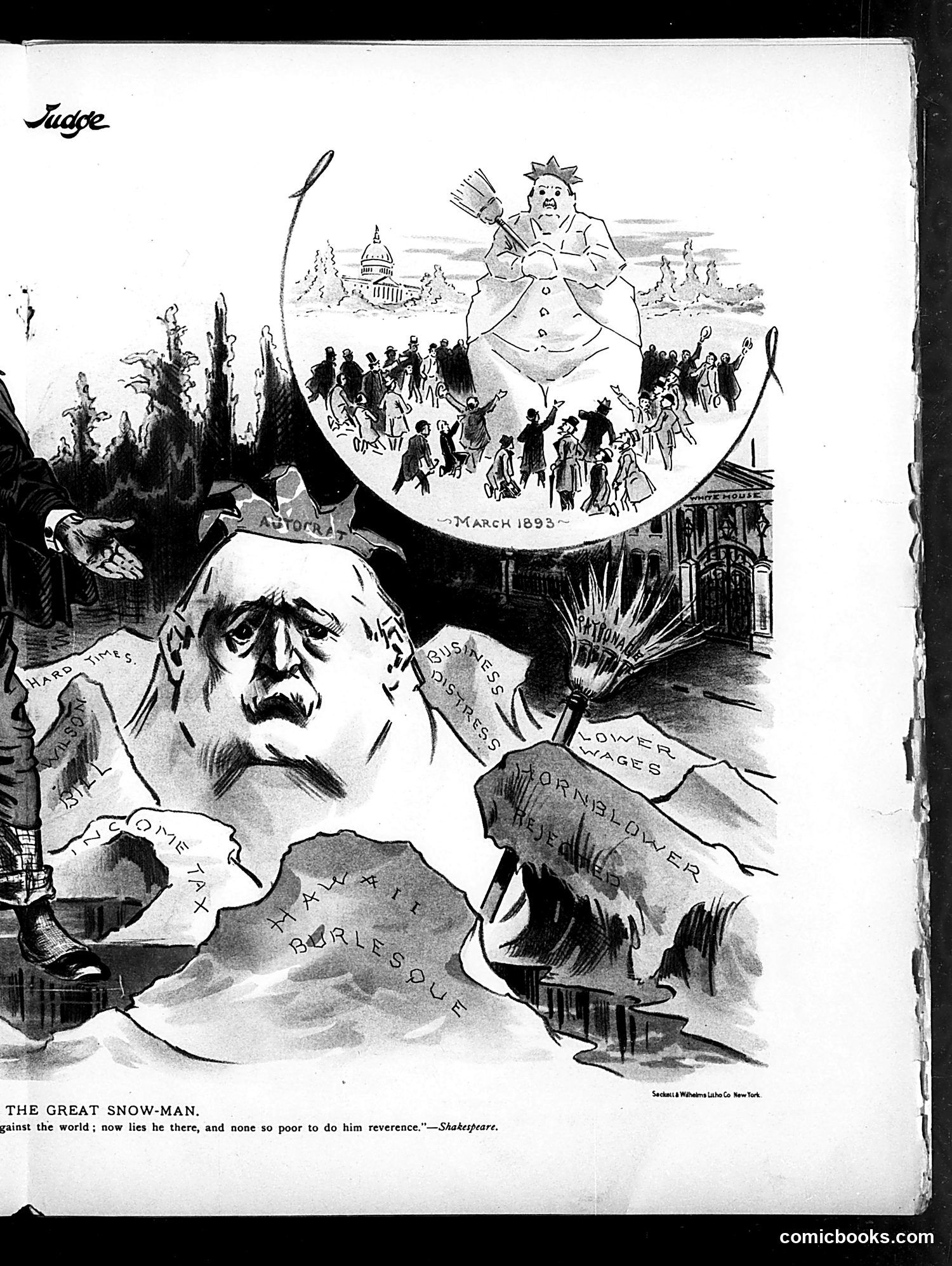
This political cartoon depicts a large snow figure with a stern, mustachioed face—likely representing a political leader or powerful figure of 1893. The figure's body is labeled with various social problems: "Hard Times," "Business Distress," "Lower Wages," "Cornelower [sic] Revenge," and "Burls Dough." A crowd gathered around the melting snow-man appears to mock or celebrate his decline. The Capitol building is visible in the background. The Shakespeare quote emphasizes the figure's fall from power—once mighty, now powerless and contemptible. The satire suggests that a once-dominant political force has crumbled under the weight of economic hardship and social discontent (the 1893 financial panic context), leaving no one willing to defend him. The snow-man metaphor emphasizes his temporary, fragile nature.
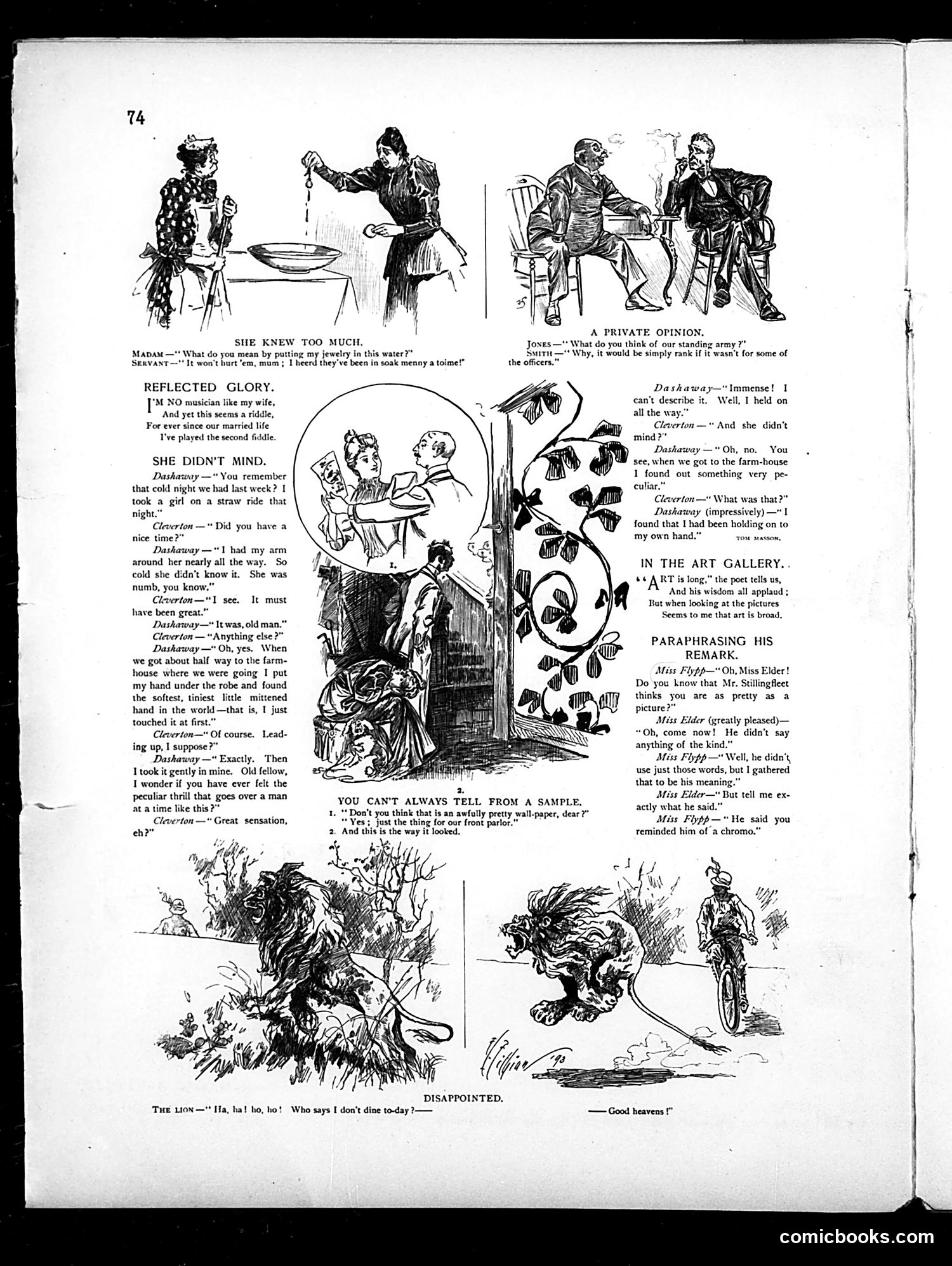
This page contains six separate comic sketches satirizing Victorian social conventions and gender dynamics: **"She Knew Too Much"**: A servant soaks a lady's jewelry in water, claiming this preserves them—revealing either the servant's ignorance or the lady's gullibility. **"Reflected Glory"**: A musician husband complains of playing "second fiddle" to his wife's musical talent—a pun on marital hierarchy. **"She Didn't Mind"**: A man boasts about a romantic sleigh ride where he held a girl's hand without her noticing his arm around her. The "thrill" comes from non-consensual physical contact presented as charming. **"In the Art Gallery"**: A brief observation that art viewing crowds are broad (wide people). **"Paraphrasing His Remark"**: A gossip embellishes a compliment—transforming "pretty as a picture" into comparing someone to cheap chromolithograph prints, insulting rather than flattering. **"Disappointed"**: A lion, presumably having missed dinner, encounters a cyclist—the joke's punchline unclear from the caption alone. The humor relies on period-specific social anxieties and gender expectations.
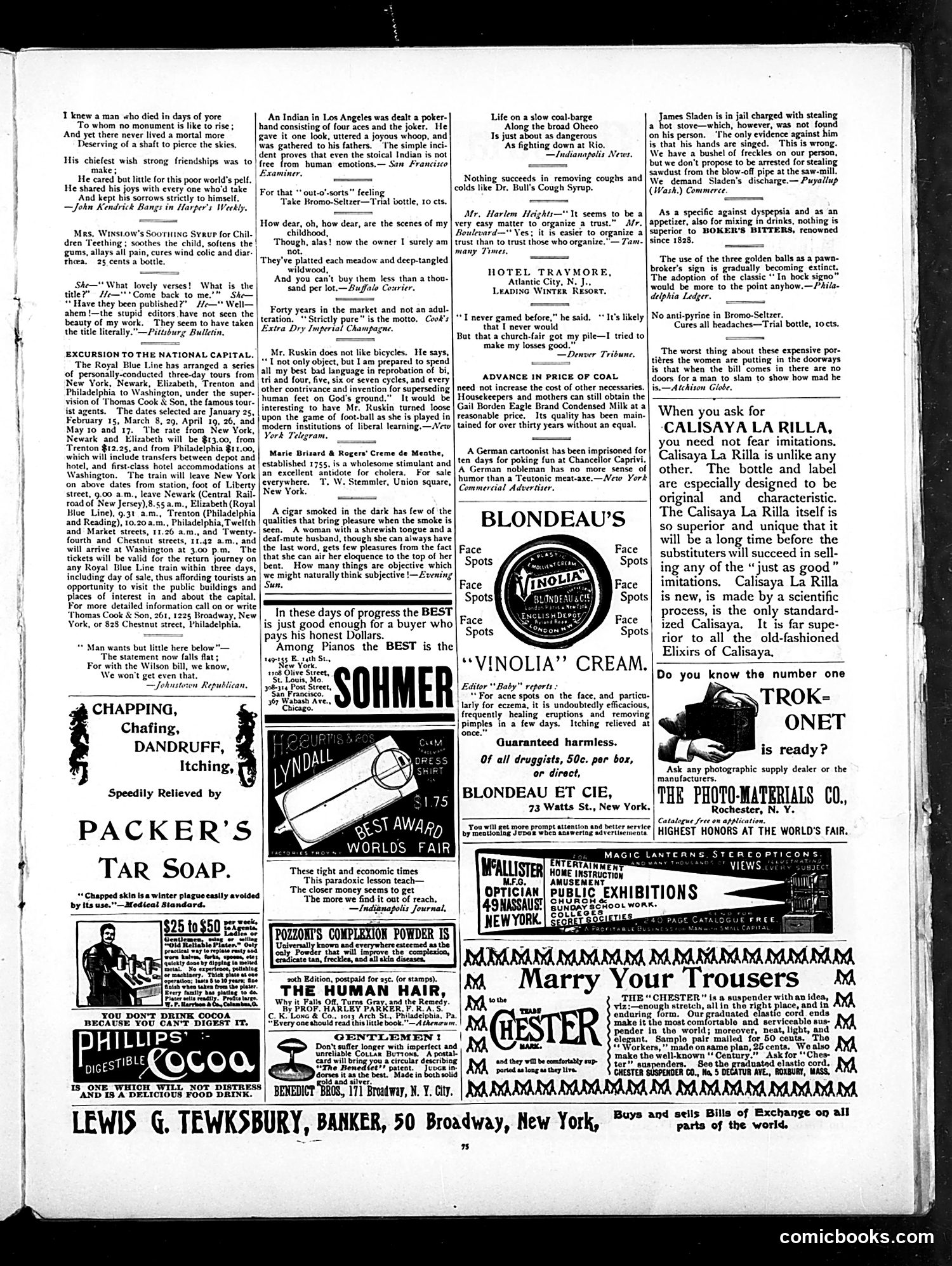
This page is primarily **advertising**, with small satirical fragments scattered throughout. The notable content includes: **Satirical snippets:** - A poem about an unnamed deceased man remembered for generosity and friendship - Brief humorous anecdotes (an Indian dealt four aces and a joker; a slow coal-barge captain; James Sladen arrested for allegedly stealing sawdust) - A "Harlem Heights" vs. "Boulevard" dialogue about organizing trusts—light social commentary on the trust-building craze of the era **Historical context:** The references to trusts, coal barges, and casual racism (the Indian anecdote) suggest this is from the Gilded Age/Progressive Era. The trust joke reflects contemporary anxiety about monopolistic business practices. **Primary content:** The page is dominated by period advertisements for consumer goods (Packer's Tar Soap, Sohmer pianos, Blondeau's face creams, etc.) and travel services, indicating this was a revenue-driven publication mixing light satire with advertising. The "satire" here is gentle and brief—mostly wordplay and social observation rather than sharp political critique.
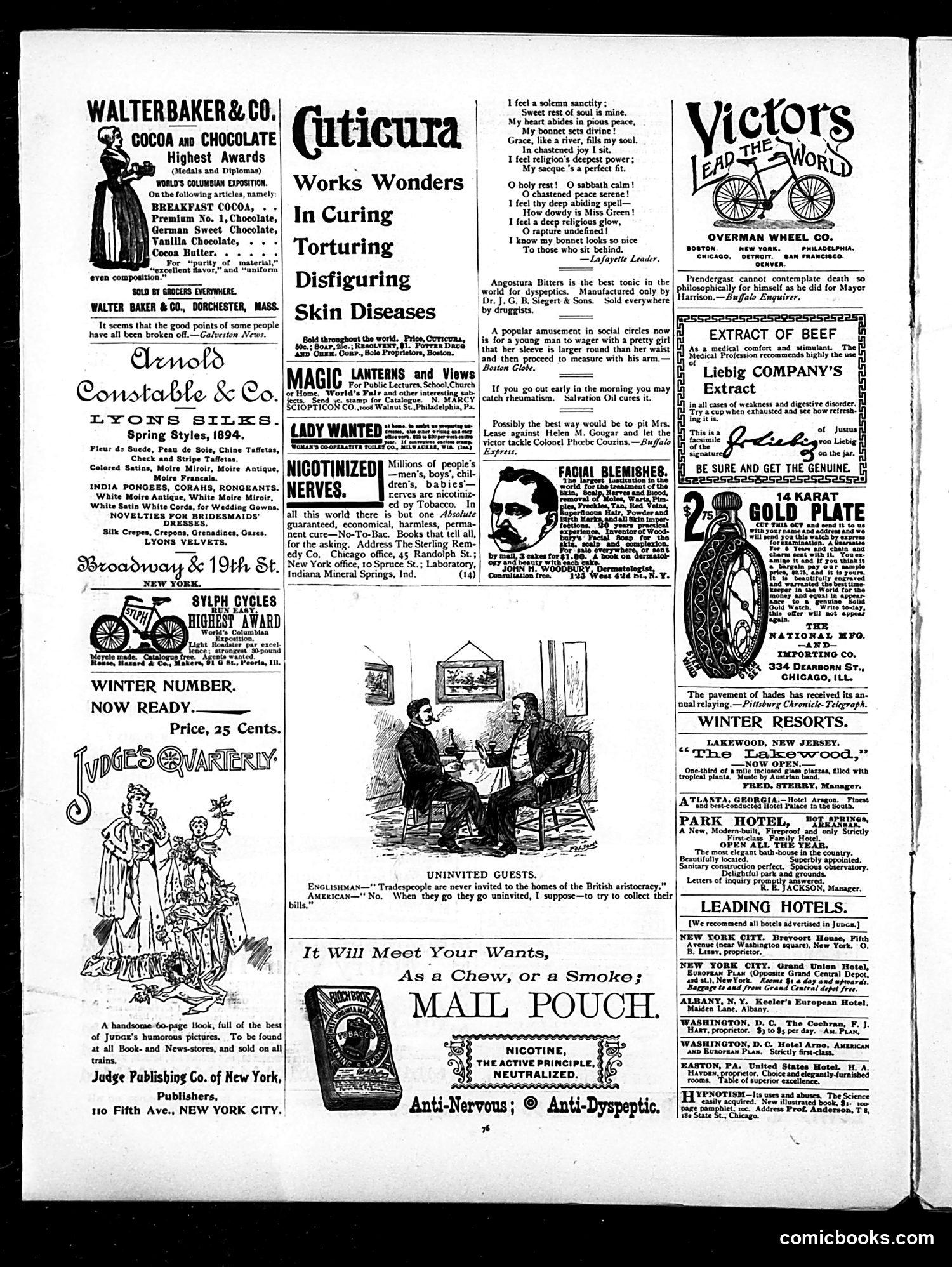
This page is primarily **advertising**, typical of late-19th-century magazines. However, it contains one small satirical cartoon labeled "UNINVITED GUESTS" depicting two men at a dining table with the caption contrasting British and American attitudes toward unpaid bills—a gentle social satire about class differences and debt collection. The page features product advertisements (cocoa, bicycles, patent medicines) and hotel listings. One notable ad promotes "No-To-Bac," a nicotine-cessation product claiming to cure tobacco addiction—reflecting period anxieties about smoking. The small poem titled "In Chastened Joy I Sit" appears to mock women's fashion, celebrating a perfectly-fitting "sacque" (loose jacket), satirizing women's focus on clothing. References to figures like "Phoebe Couzins" (likely suffragist Phoebe Couzins) and "Helen M. Gougar" (women's rights advocate) indicate Judge's contemporary social commentary on women's activism. Overall, this represents a typical Judge issue mixing humor with period consumer culture and social commentary.
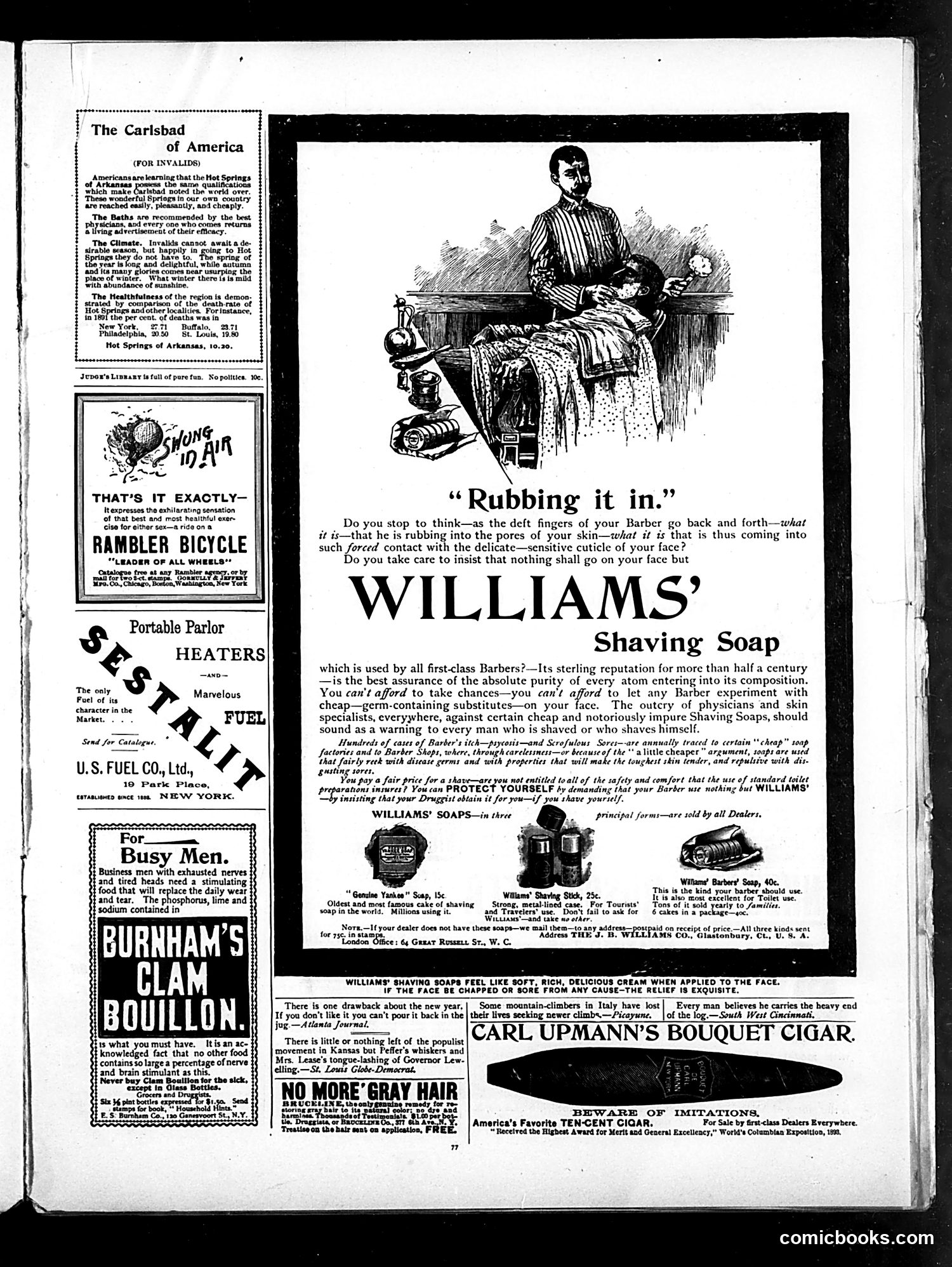
This is primarily a **product advertisement page** from Judge magazine, not a political cartoon. The dominant feature is a large **Williams' Shaving Soap advertisement** occupying the right half of the page, depicting a barber applying soap to a customer's face with the heading "Rubbing it in." The advertisement's satirical angle targets "cheap" and "germ-containing" competing shaving soaps, warning readers against inferior products that may cause "Barber's itch" and skin infections. It appeals to masculine vanity and health consciousness—common advertising tactics of the era. The left side contains smaller ads for bicycles, fuel heaters, clam bouillon, and other products typical of late-19th/early-20th-century publications. Small text snippets at the bottom appear to be humorous newspaper quotes about politics (mentioning Kansas Populists and Governor Lewelling), but these are ancillary to the main advertising content. The page reflects the magazine's business model: satirical commentary funded by product advertising.
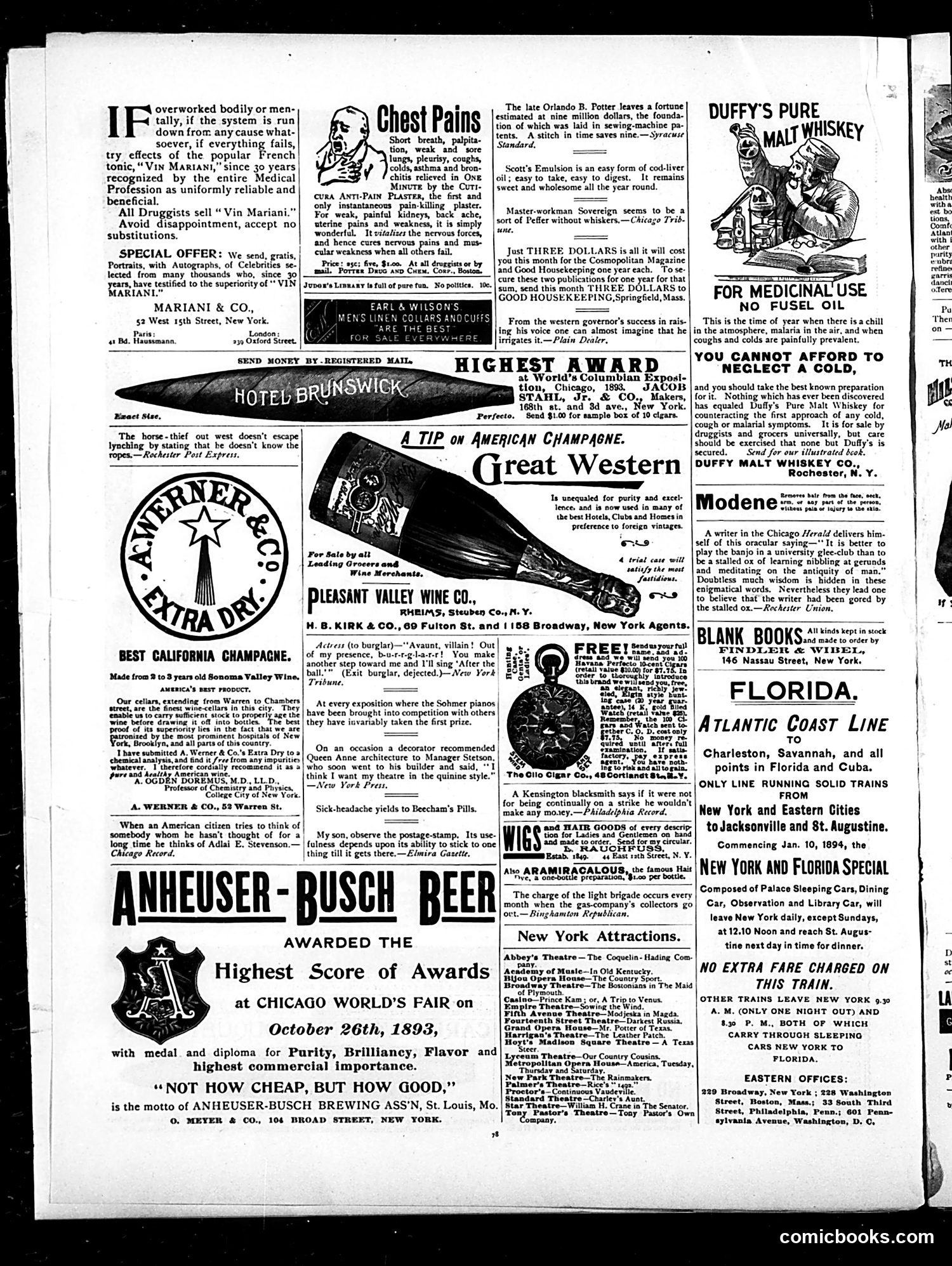
This page is primarily **advertising**, not political satire. Most content consists of 1890s patent medicine and liquor advertisements typical of the period. Notable elements include: **Advertisements featured:** - "Vin Mariani" (French tonic wine, cocaine-based) - Pain plasters and remedies for chest complaints - Scott's Emulsion (cod-liver oil) - Anheuser-Busch beer - California champagne and wine products - Cigars and railroad services **Small satirical items** (the actual Judge content): - Brief one-liners about contemporary figures (Orlando B. Potter's sewing-machine fortune, "Master-workman Sovereign") - A quip about a western governor and irrigation - A joke about a horse-thief's rope knowledge The page reflects **1890s American culture**: patent medicines with questionable ingredients were openly advertised; alcohol was heavily marketed; and brief satirical commentary filled gaps between ads. The content assumes readers understood contemporary political references now obscure to modern audiences.
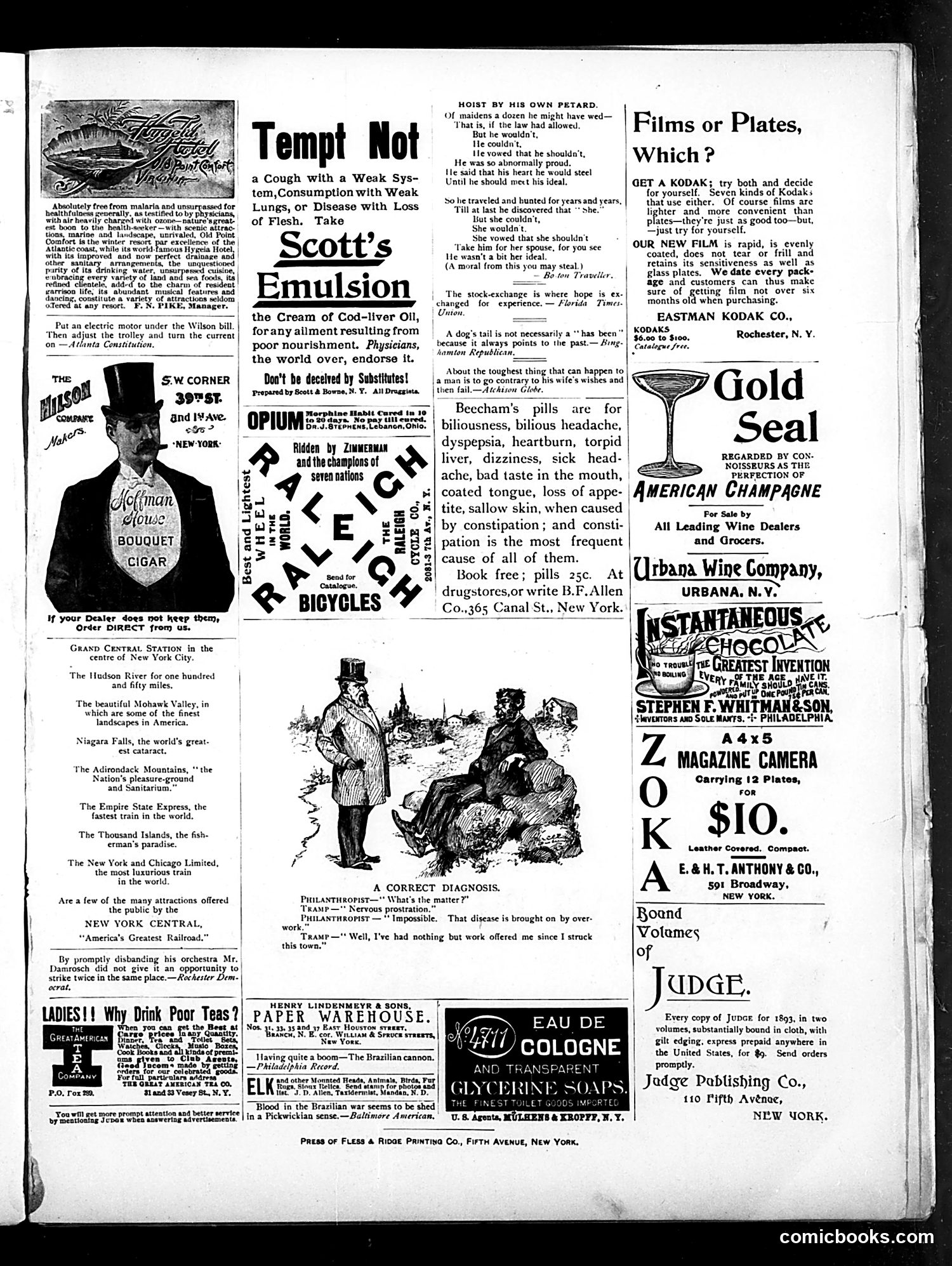
This single-panel cartoon satirizes both charity and unemployment. A well-dressed philanthropist asks a tramp the source of his illness; the tramp replies he's had no work since arriving in town. The joke's irony: the philanthropist diagnoses the man's poor health as arising from *idleness* (implying moral failing), when the tramp has actually sought work unsuccessfully. The cartoon critiques superficial charitable attitudes of the era—wealthy benefactors attributing poverty to character flaws rather than economic circumstances. The "diagnosis" is literally correct (lack of employment = lack of means = poor health) but the philanthropist's framing implicitly blames the victim for his condition rather than acknowledging systemic joblessness. This reflects Progressive-era tensions between moralistic charity and structural economic reform.
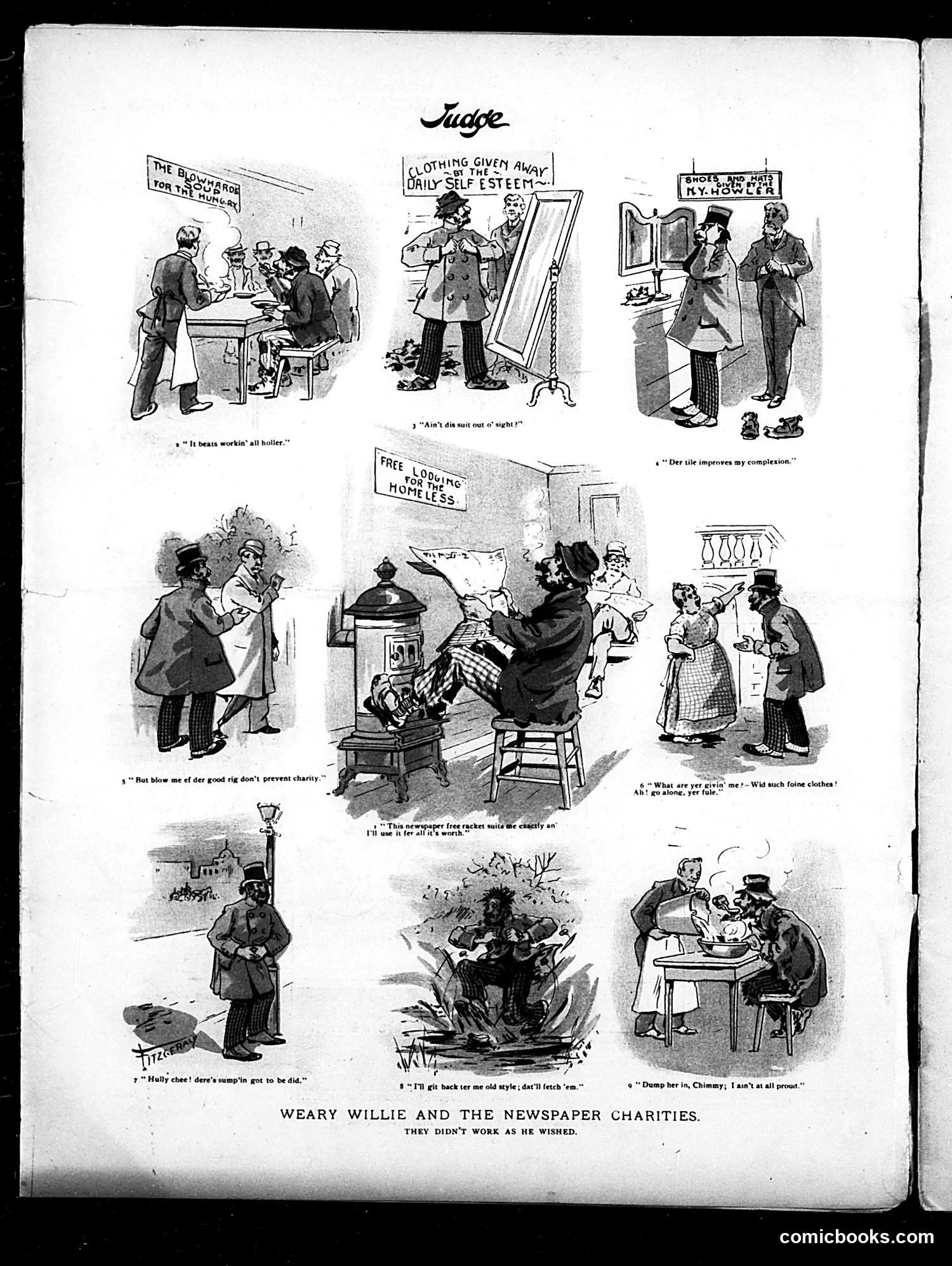
This is a satirical comic strip about a homeless man ("Weary Willie," a stock character of the era) attempting to exploit newspaper-organized charity programs—apparently free clothing drives and other assistance for the poor. The satire targets both Willie's schemes to game the system and, implicitly, the ineffectiveness of newspaper-coordinated charitable efforts. In each panel, Willie tries various angles: claiming self-esteem needs, attempting to receive free goods, requesting shoes, seeking shelter. Yet his manipulations consistently fail or backfire—charities refuse him, or he receives unexpected consequences. The title's punchline—"They Didn't Work As He Wished"—suggests the cartoonist is mocking both the vagrant's cunning and the inadequacy of these charity programs to address actual need. It's period commentary on Depression-era poverty relief and newspaper-sponsored social programs, suggesting they were either easily exploited or fundamentally unable to help the genuinely destitute.