
Judge, 1894-02-03 · page 5 of 16
Judge — February 3, 1894 — page 5: what you’re looking at
What you’re looking at
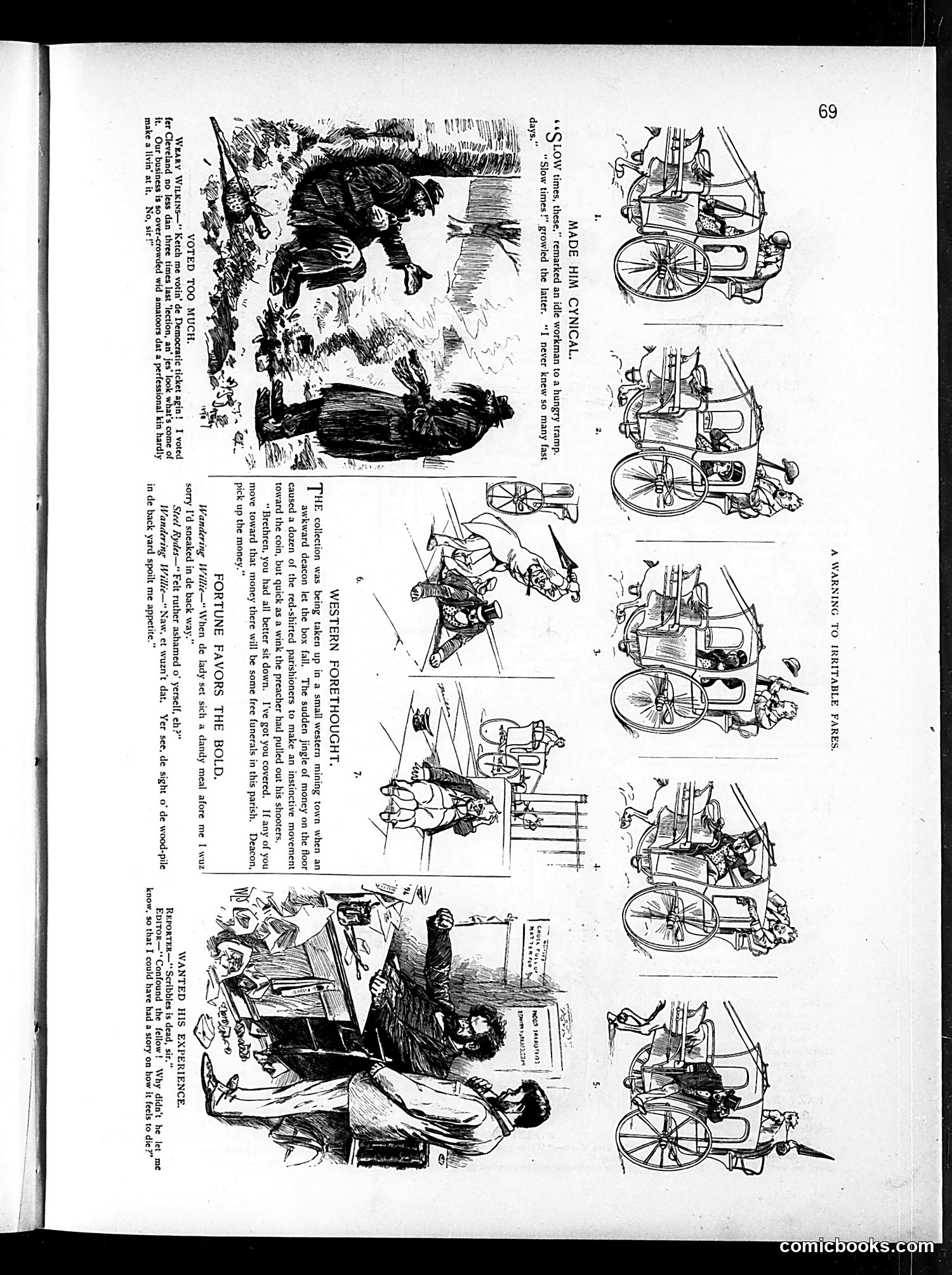
This page contains multiple satirical sketches addressing economic hardship and social pretension during what appears to be a recession or depression era. **"Slow Times"** depicts the irony of economic inequality: an idle workman and hungry tramp commiserate about hard times, while one notes he's never seen so many "fast times"—suggesting the wealthy continue indulging despite general poverty. **"Fortune Favors the Bold"** shows "Wandering Willie," a hobo who sneaks into a fancy dinner, expressing regret at his method of entry rather than the meal itself—satirizing how even desperate poverty retains dignity and pride. **"Wanted His Ex"** mocks a newspaper editor upset that reporter Scribbles died without warning—not from genuine concern, but because the editor missed an opportunity for a sensational "how it feels to die" story. This skewers journalistic sensationalism and callous exploitation of human tragedy for circulation. The page satirizes class divisions, economic desperation, and press ethics during hard times.
📄 Transcribed text from this page (OCR, searchable)
Machine-transcribed from the original scan — historical spelling and the odd misread are preserved.
A WARNIN IRRITABLE FARES. MADE HIM CYNICAL, + +S LOW times, ‘ked an idle workman to a hungry tramp. “Slow times ! the latter. “I never knew so many fast FORTUNE FAVORS THE BOLD. Wandering Willie—" When de iady set sich a dandy meal afore me I wuz sorry I'd sneaked in de back way.” WANTED HIS EX me CS re Rerorter—" Scribbles is dead, it. Our business is so over-crowded wid amatoors dat a perfessional kin hardly . t wuzn't dat, Yer see, de sight o' de wood-pile Epitor—‘‘Confound the fel Why didn’t he let_me make a livin’ at it, No, sir!" in de back yard spoilt me ap| know, so that I could have had a story on how it feels to die?”