
A complete issue · 16 pages · 1894
Judge — January 13, 1894
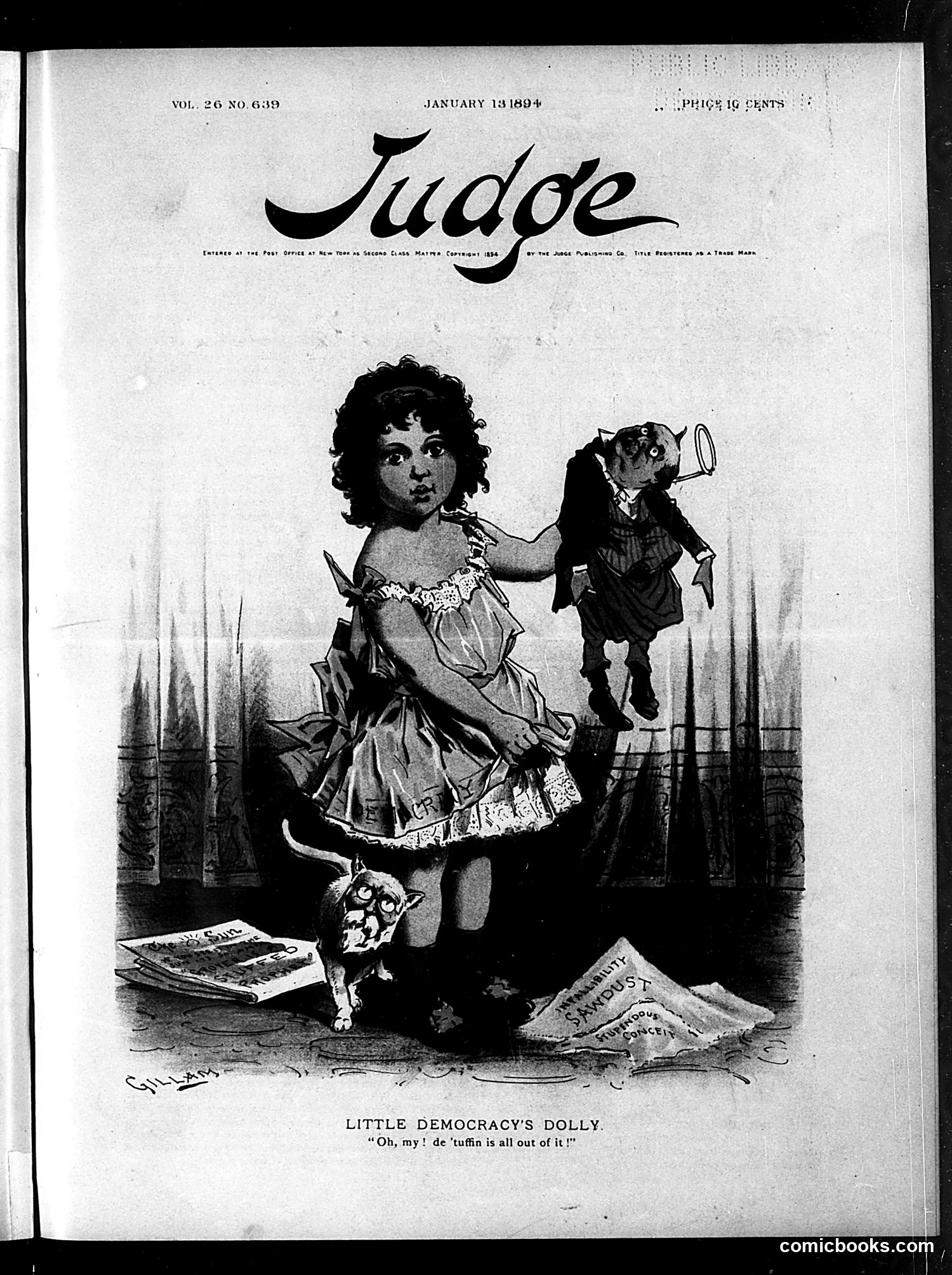
This political cartoon satirizes the state of American democracy in the 1890s. A young girl representing "Little Democracy" is depicted as neglectful or careless with her dolls—one appears damaged or abandoned on the ground, while she manipulates another like a puppet. A small dog sits nearby. The satire suggests that democratic institutions or principles are being treated carelessly or manipulated by those in power, rather than genuinely nurtured. The caption "Oh my! de 'uffin is all out of it!" (likely "de coffin") implies democratic vitality is draining away. This likely critiques political corruption, machine politics, or mismanagement during the Gilded Age—a period of significant political scandal and inequality in late 19th-century America.
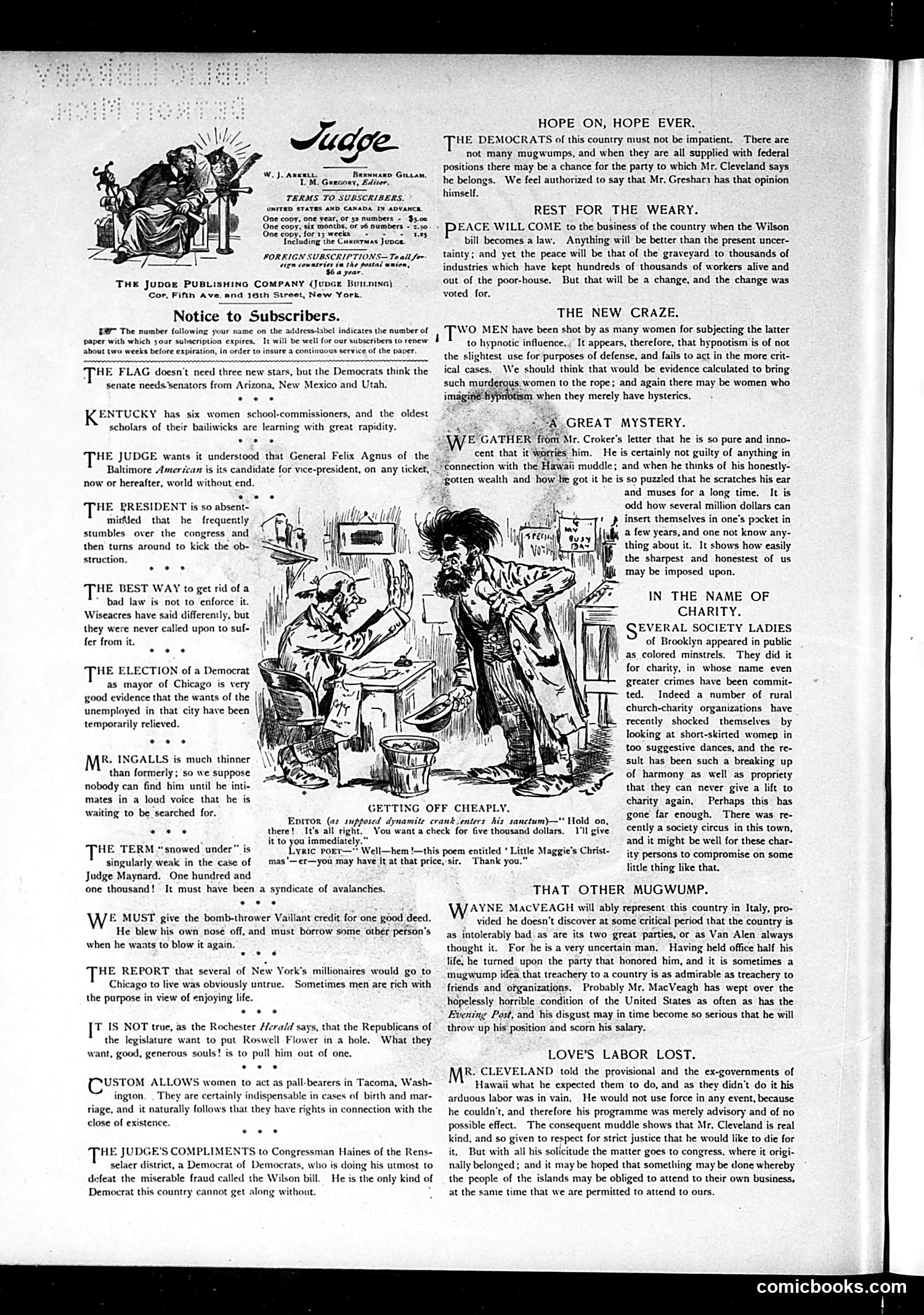
This page contains satirical editorial commentary rather than a single cartoon. The main illustration shows two figures in what appears to be a financial scheme or con—titled "Getting Off Cheaply"—depicting someone attempting to manipulate or defraud another. The text columns reference **Grover Cleveland** and his administration's policies regarding Hawaii and labor issues. One section criticizes Cleveland's "arduous labor" efforts as ineffective, suggesting his programs lacked real impact. The overall theme critiques Democratic Party leadership and Cleveland specifically—mocking their ineffectiveness on economic and foreign policy matters. References to "Democratic" failures and suggestions that party members lack competence dominate the commentary, reflecting Judge's Republican editorial stance during the late 19th century.
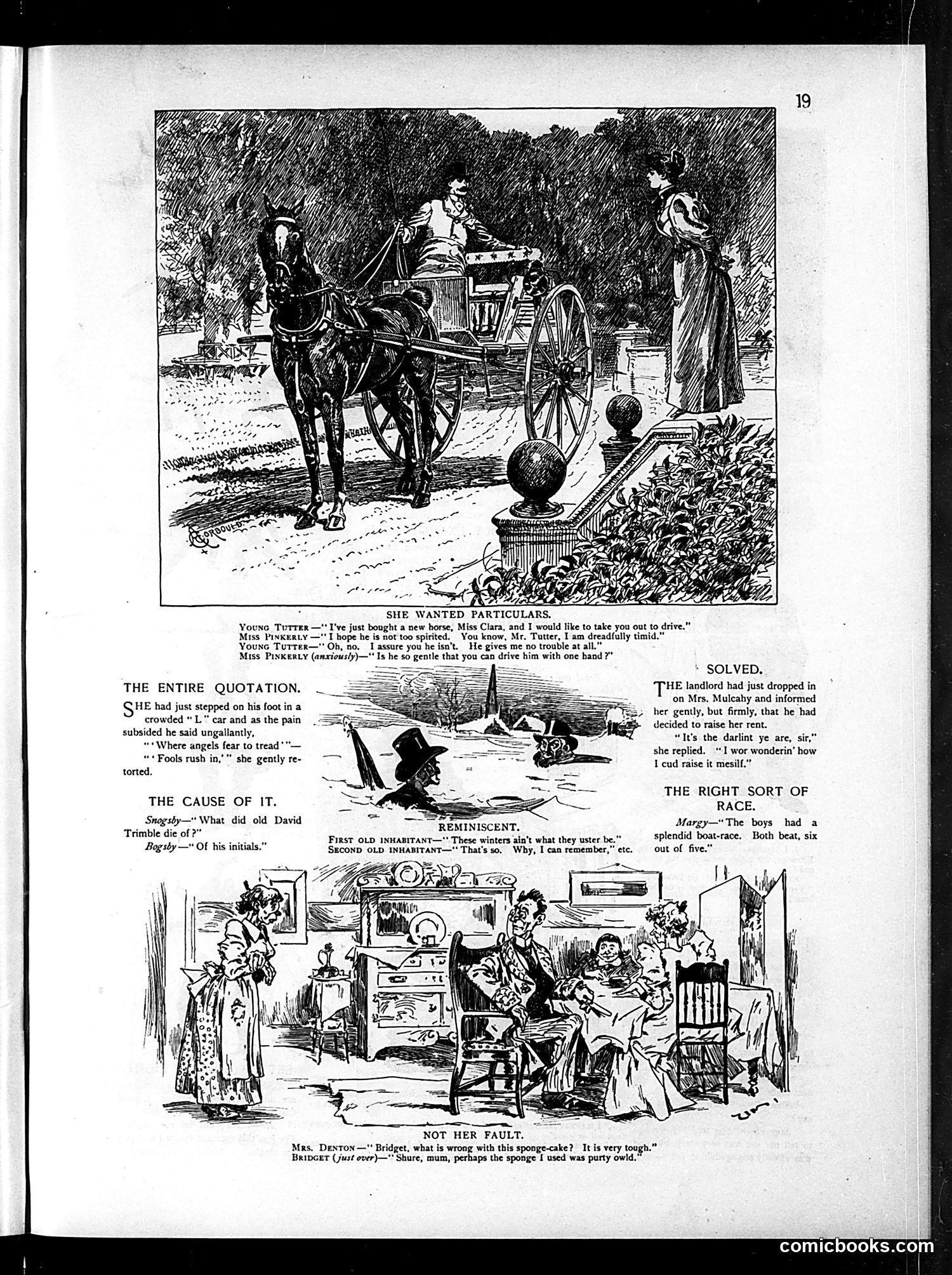
This page contains several short humorous sketches typical of Judge magazine's satirical format. **Top illustration**: Shows a young man (labeled "Young Tutter") offering to take a woman (Miss Clara) for a carriage drive with his new horse. Miss Clara declines, calling herself "dreadfully timid," but Young Tutter assures her the horse is well-behaved. The joke appears to be about courtship rituals and a woman's feigned hesitation. **Lower sketches**: Include brief comedic dialogues about trivial domestic matters—old David Trimble's initials, a tough sponge cake, and a boat race between boys. These are light-hearted vignettes satirizing everyday middle-class life and conversation. The page exemplifies Judge's formula: gentle social satire focused on manners, courtship, and domestic situations rather than serious political commentary.
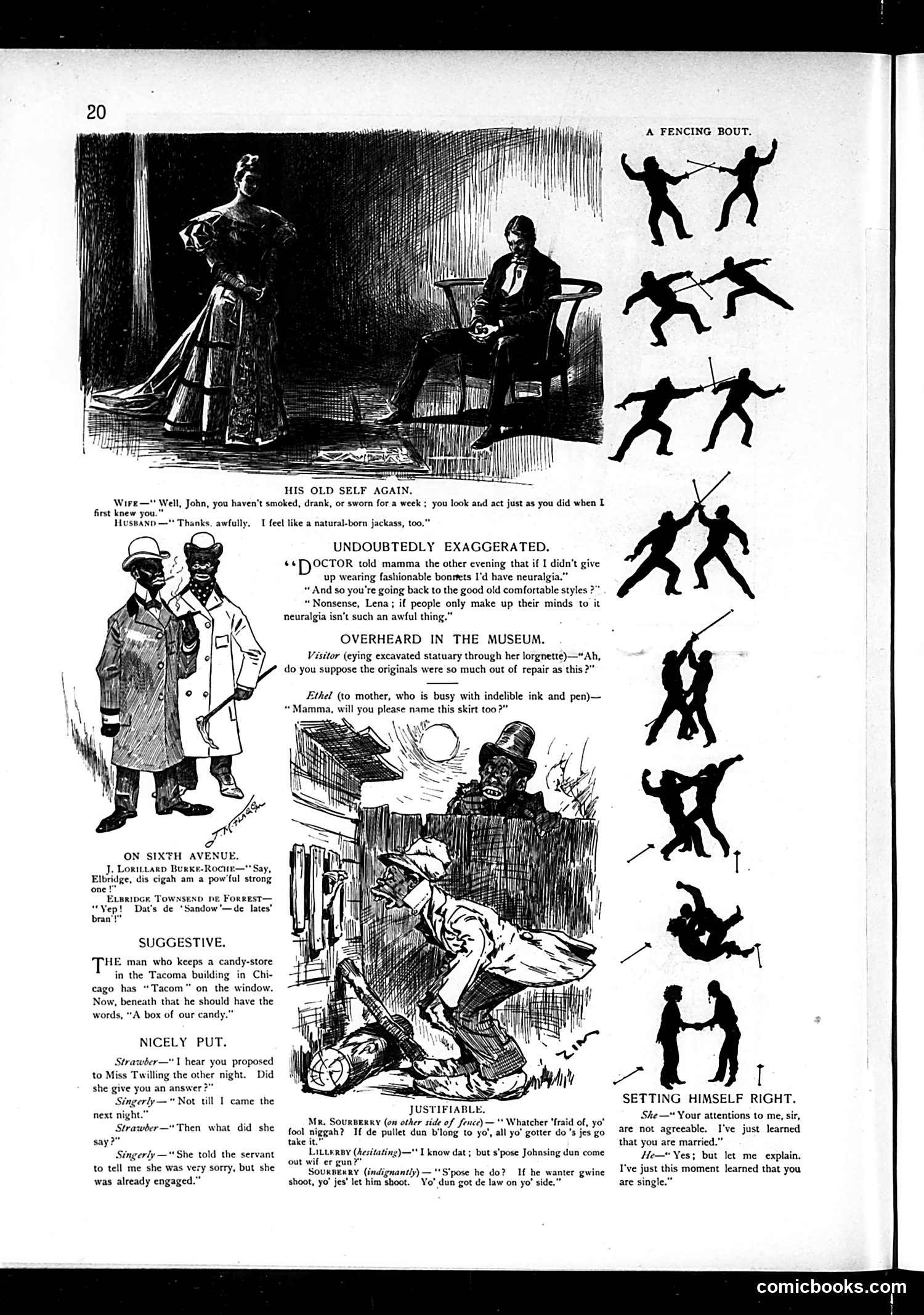
This page collects brief humorous anecdotes and illustrations typical of late-19th/early-20th century American satire. Key content: **"His Old Self Again"**: A husband reformed from vices (smoking, drinking, swearing) claims to feel like "a natural-born jackass"—satirizing how virtue can feel unnatural to some men. **"Undoubtedly Exaggerated"**: A woman refuses fashionable bonnets due to neuralgia concerns, but admits she'd ignore the condition if socially pressured—mocking women's vanity over health. **"Overheard in the Museum"**: A mother labels museum artifacts while her daughter questions whether originals were truly so deteriorated—a dig at both careless restoration and distracted parenting. **"Settting Himself Right"**: A married man learning his romantic interest is single attempts damage control—a quick reversal joke about marital obligation. The page also includes crude dialect humor ("Justifiable" section with racial caricatures) and "A Fencing Bout" silhouettes depicting sport postures. These reflect the era's casual racism and class humor standard in satirical publications.
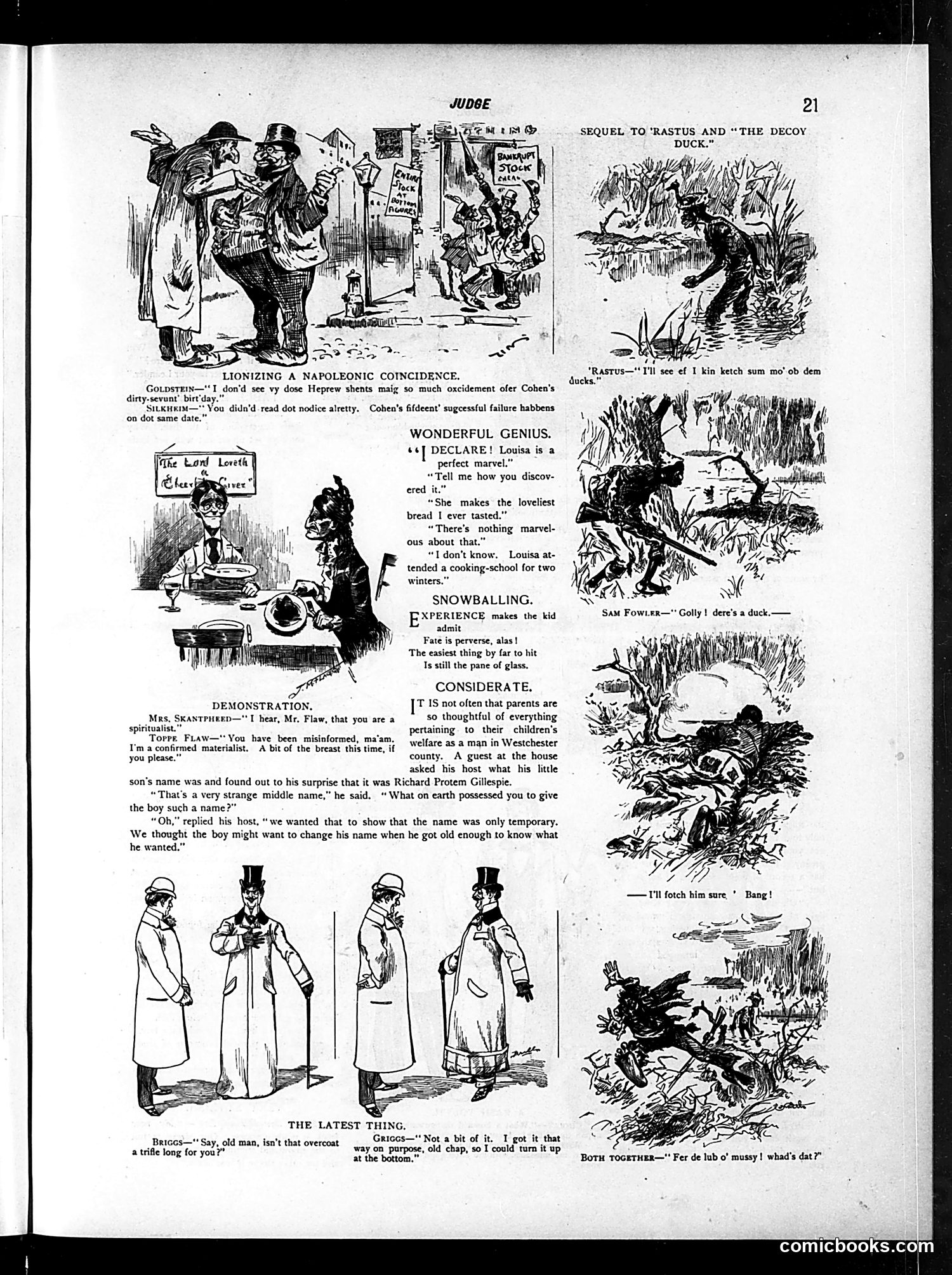
This page contains several unrelated humorous cartoons and brief comedic sketches typical of Judge's satirical style: **"Lionizing a Napoleonic Coincidence"** mocks Jewish immigrants (depicted with stereotypical accents) celebrating a servant's birthday coinciding with Cohen's "fifteenth successful failure"—satirizing both ethnic prejudice and business incompetence. **"Wonderful Genius"** jokes that a woman's ability to bake decent bread after cooking school is treated as remarkable talent. **"Snowballing"** and other sketches offer gentle domestic humor about childhood mischief and parental decisions. **"The Latest Thing"** ridicules fashion vanity—buying an oversized overcoat intentionally to fold up at the bottom, treating impracticality as style. The page also includes a "Rastus and the Decoy Duck" comic strip (right side, unclear narrative). Overall, the content reflects late-19th/early-20th-century American humor: ethnic stereotyping, gender roles, class commentary, and absurdist domestic situations—typical of Judge's middle-class readership appeal.
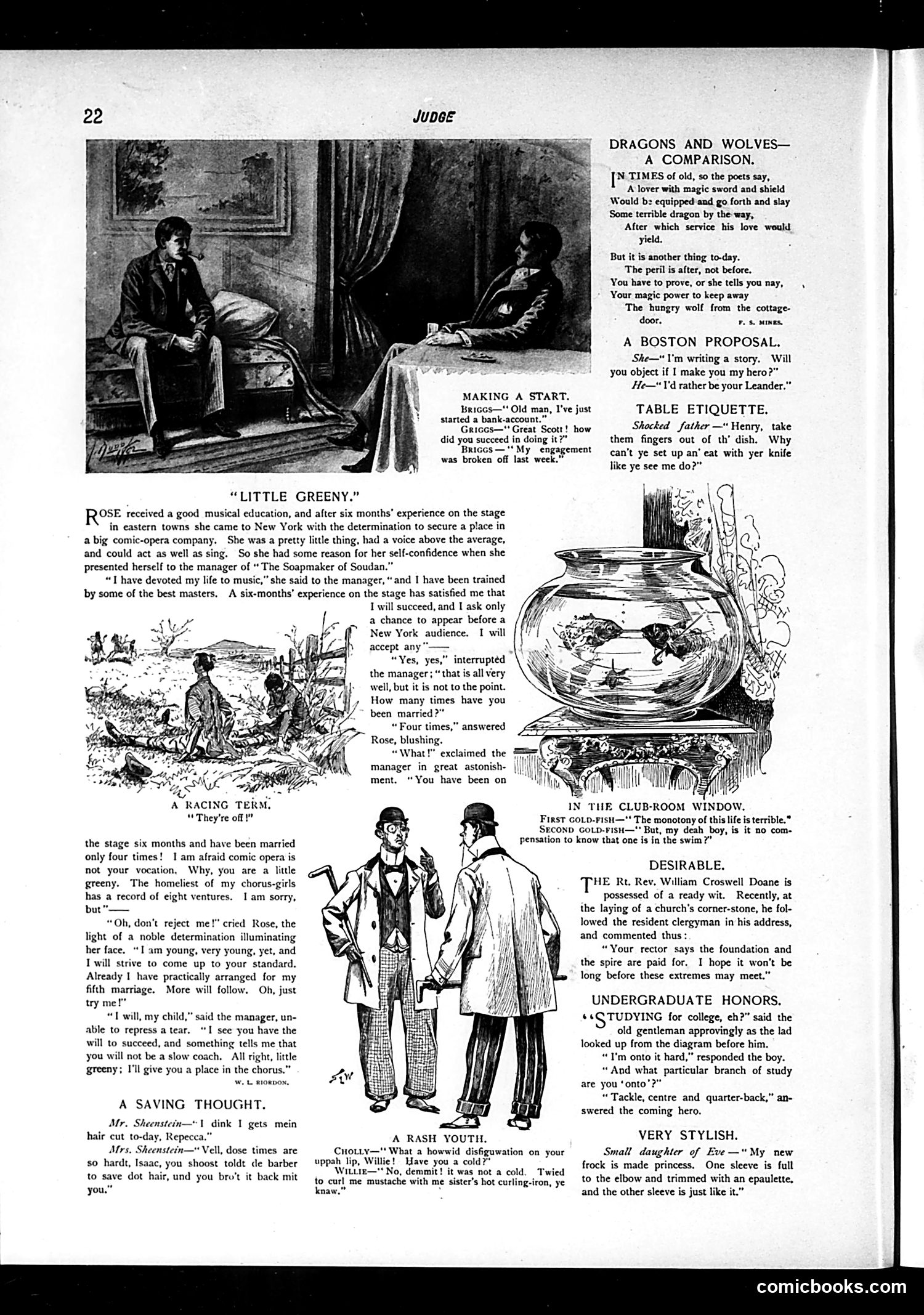
This page from *Judge* contains several short satirical pieces typical of late 19th/early 20th-century American humor: **"Little Greeny"** mocks a naive aspiring opera singer. The joke: she's proud of six months' stage experience, but the manager reveals this is laughably inadequate—even his chorus girls have been married four times, implying widespread casual marriage and remarriage in theatrical circles. Her determination to arrange a fifth marriage to prove her worth is presented as absurdly normal for stage performers. **Other brief jokes** satirize contemporary types: a Jewish immigrant couple discussing penny-pinching ("save dot hair"), a young man's failed mustache-curling attempt, and pretentious Boston courtship language. **"Dragons and Wolves"** contrasts romantic ideals (knights slaying dragons for love) with modern economic reality—women now demand men prove financial stability ("magic power to keep away / The hungry wolf") before yielding affection. The overall tone reflects period anxieties about modern marriage, theatrical morality, and shifting gender economics, delivered through stereotypes and ethnic caricature typical of era humor.
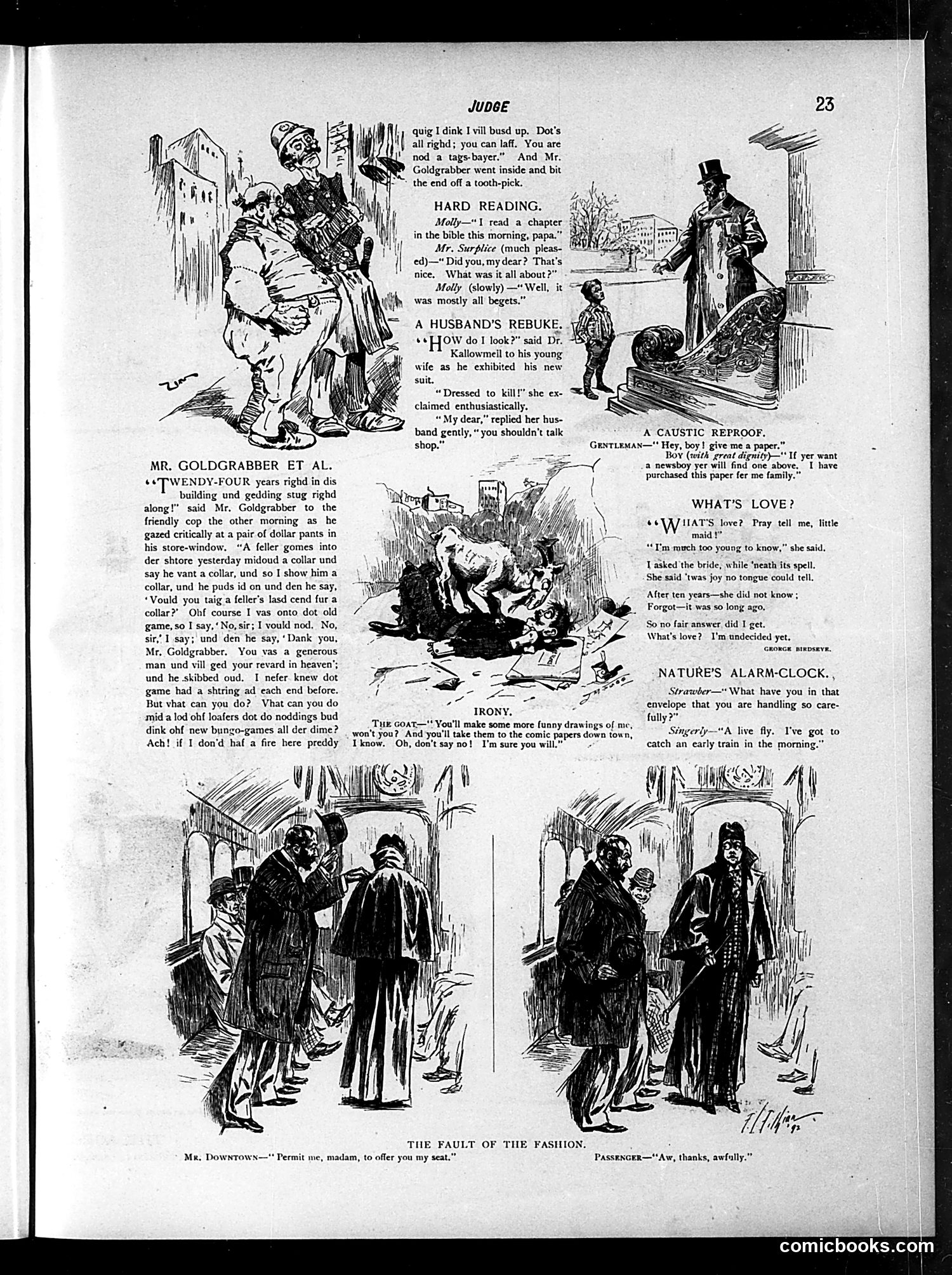
This page from **Judge** magazine (likely early 1900s) contains multiple brief satirical sketches: **"Mr. Goldgrabber Et Al."** features a Yiddish-accented immigrant shopkeeper complaining about con artists—specifically a "collar scam" where someone tries to skip without paying. The satire targets both petty criminals preying on merchants and the shopkeeper's exasperation with urban crime. **"Hard Reading"** jokes about Biblical literacy—a daughter reads the Bible but only remembers "begets" (genealogies), mocking both religious instruction and children's comprehension. **"A Husband's Rebuke"** satirizes women's fashion excess: a wife calls her husband "dressed to kill," and he warns her not to use such violent language—gentle mockery of fashion obsession. **"The Fault of the Fashion"** and other sketches are brief comedic vignettes about social manners, class pretension (a newsboy's dignity), and romantic confusion. The overall tone is gentle satire aimed at urban immigrant communities, fashionable society, and everyday social absurdities typical of Judge's humor.
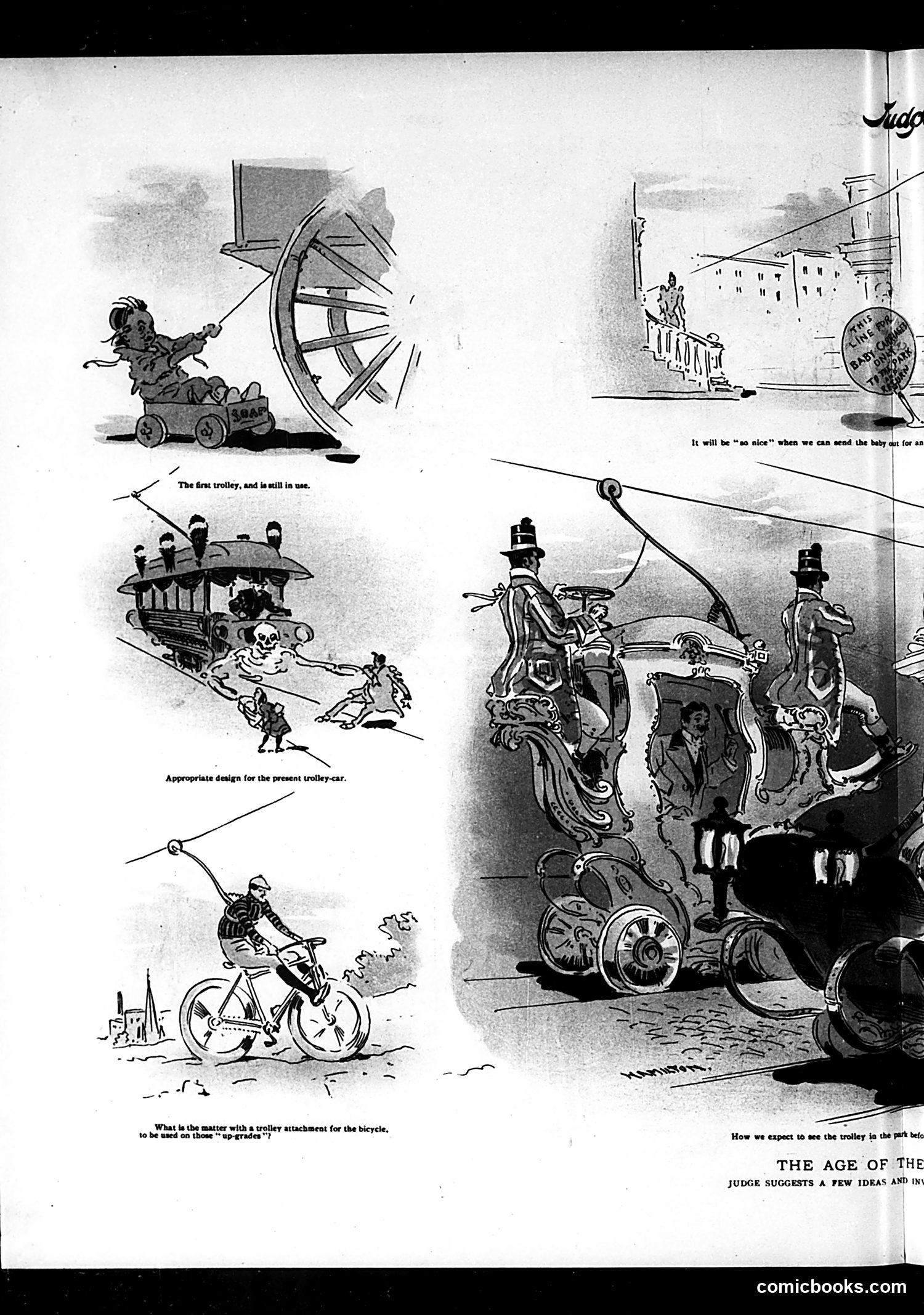
This Judge magazine page satirizes early 20th-century transportation innovation, specifically trolley systems and bicycles. The left panel shows various impractical designs—a figure struggling against a large wheel, an ornate trolley car, and a bicycle with a trolley attachment for climbing hills ("up-grades"). The satire mocks the era's enthusiasm for mechanized solutions by presenting absurdly elaborate contraptions. The right panel depicts an ornately decorated trolley that appears impractical and overly complicated. The joke targets the gap between inventors' grandiose visions and practical reality—the designs are whimsical rather than functional. This reflects broader Progressive Era skepticism about whether new technology actually improved daily life, or simply added needless complexity. The cartoonist suggests that fashion and decoration often triumph over sensible engineering.
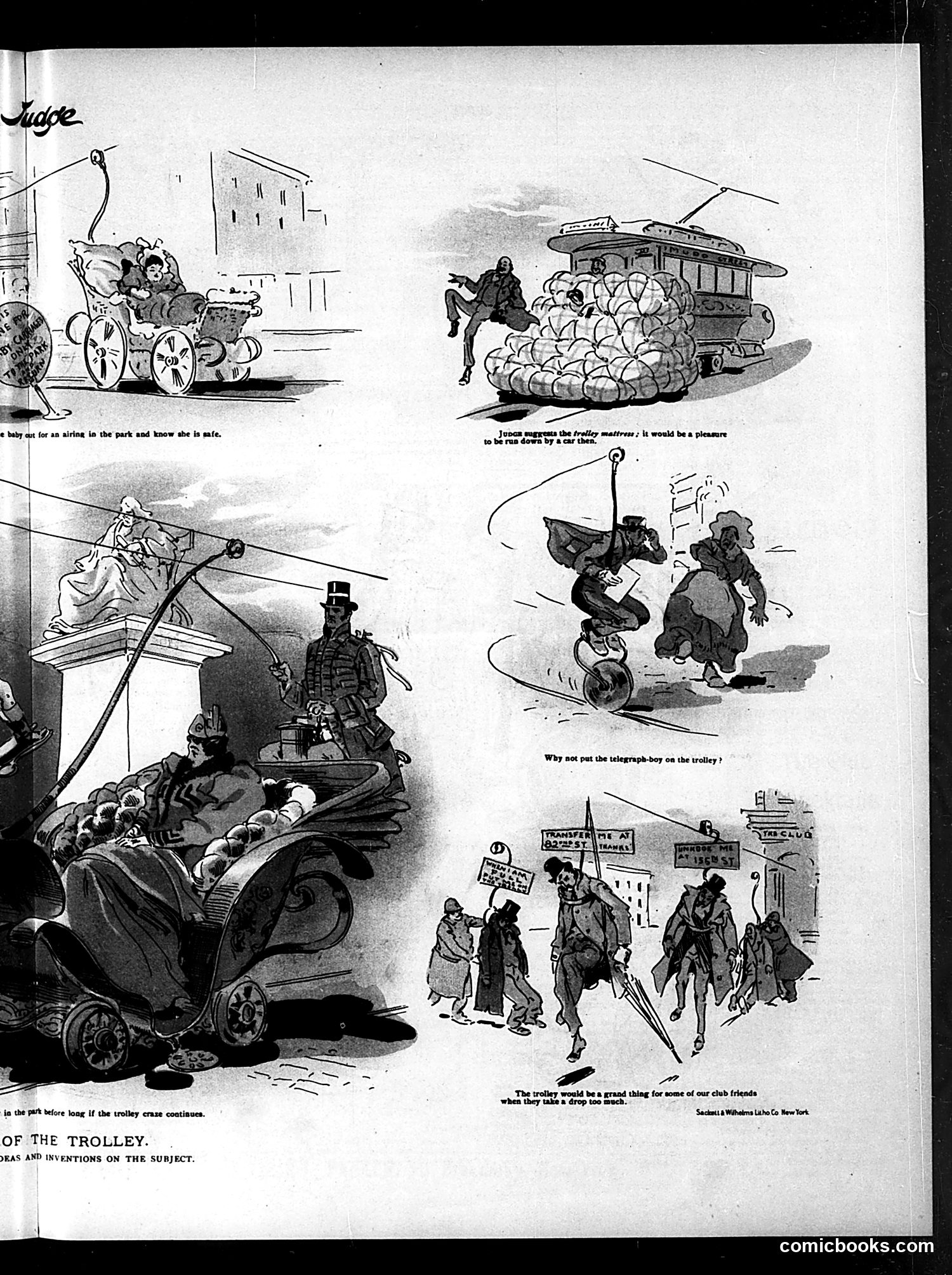
This page satirizes the rapid expansion of electric trolley systems in American cities during the late 1800s. The cartoons mock increasingly absurd "solutions" to trolley transportation challenges: - **Top left**: A woman in a trolley-like carriage suspended by crane - **Top right**: A trolley overloaded with massive cargo - **Middle left**: An elaborate pulley system for transporting passengers - **Middle right**: A single-wheel trolley device (captioned "Why not put the telegraph-boy on the trolley?") - **Bottom**: Citizens carrying signs, suggesting the trolley craze has become chaotic or burdensome The satire targets both the public's enthusiasm for this new technology and inventors' increasingly impractical proposals. The title indicates these are mock "ideas and inventions," mocking the era's obsession with mechanized urban transit solutions, however ridiculous.
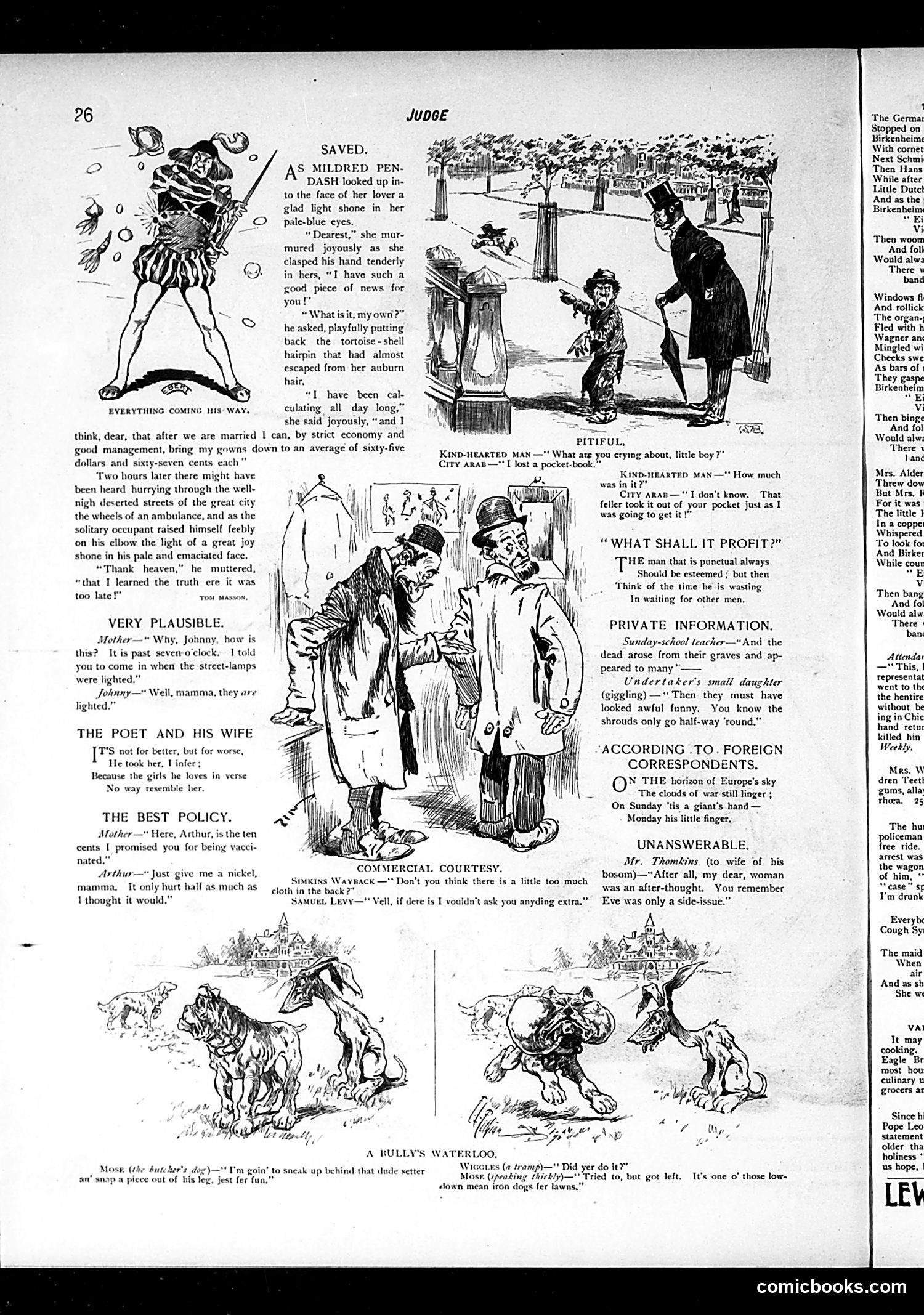
This page contains multiple short humorous pieces satirizing middle-class American life and social conventions, circa early 1900s. **"Everything Coming His Way"** mocks a young couple's marital expectations: the fiancée boasts she'll economize on clothing to $65.67 per dress—so expensive that her relieved fiancé literally faints, thinking he's escaped. **"Very Plausible"** jokes about a child's literal interpretation: when told to come home when street lamps light, he returns at dusk when they're switched on. **"The Poet and His Wife"** cynically suggests poets marry women unlike their romantic ideals. **"Commercial Courtesy"** features a Jewish tailor (Levy, stereotypically rendered) and customer haggling over fabric—gentle ethnic humor typical of the era. **"Private Information"** shows an undertaker's daughter innocently exposing adult hypocrisy about burial practices. **"A Bully's Waterloo"** depicts dogs attacking a bully—visual slapstick justice. The overall tone reflects period class anxieties, domestic comedy, and mild ethnic stereotyping considered acceptable entertainment.
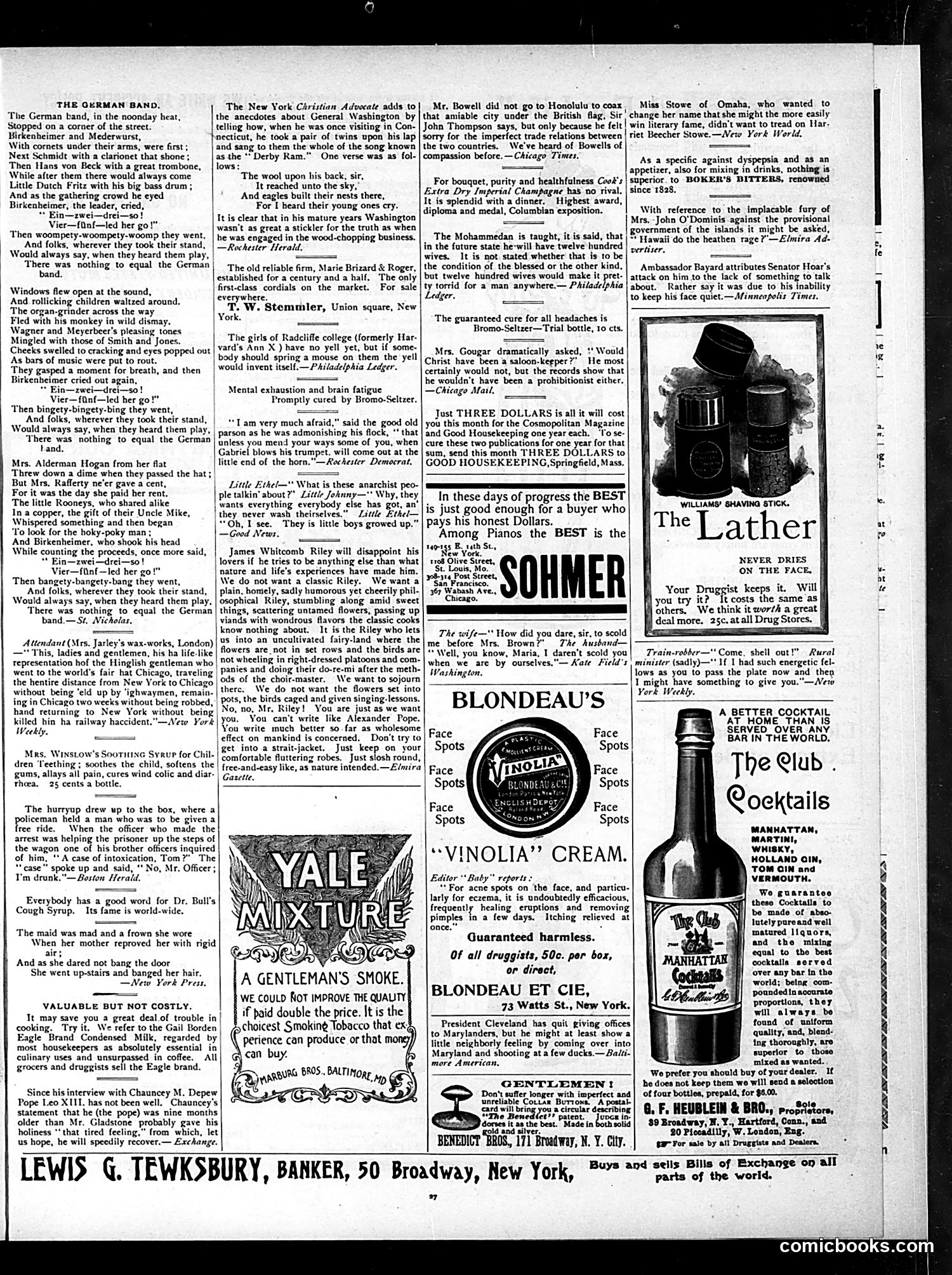
This page from Judge contains primarily **poetry and humorous anecdotes** rather than political cartoons. The main feature is "The German Band," a nostalgic poem celebrating street musicians in what appears to be a working-class urban neighborhood (likely New York, given references to specific areas). The poem depicts Irish and German immigrant communities—Mrs. Hogan, Mrs. Rafferty, the Rooneys—reacting to a German brass band's performance. The satire is gentle: the music is described as enthusiastically received despite being loud and somewhat chaotic ("Wagner and Meyerbeer's pleasing tones / Mingled with those of Smith and Jones"). Other items include brief humorous anecdotes about: - A British tourist in Chicago (remarkably crime-free visit) - A drunk man correcting an officer's assumption - A girl angrily "banging her hair" instead of a door The page is dominated by **advertisements** for products like Vinolia Cream, Yale Mixture tobacco, and The Club Cocktails. There are **no identifiable political figures or major satirical targets**—this is light entertainment reflecting turn-of-century immigrant urban life.
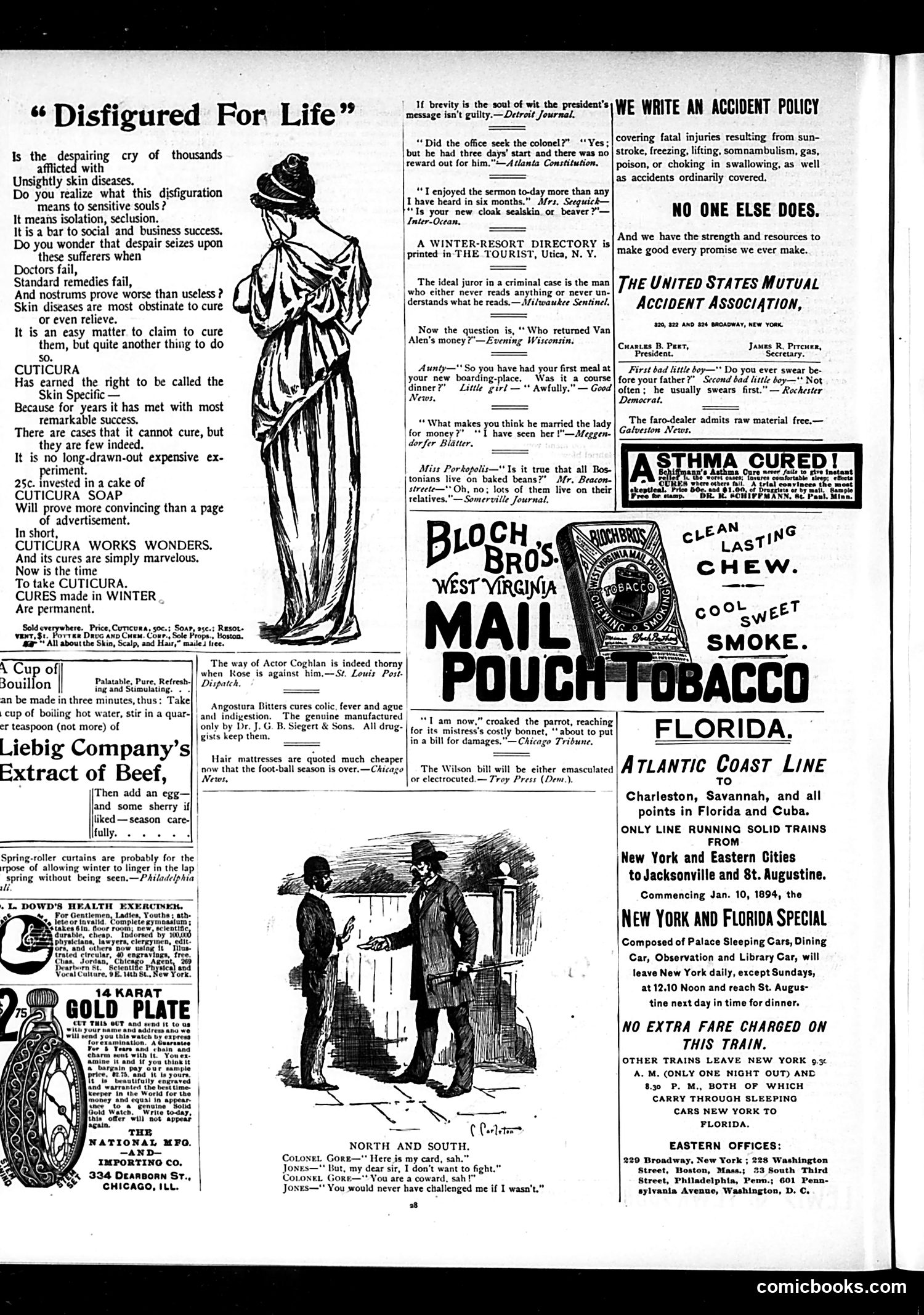
This page is predominantly **advertising**, not political satire. The main content consists of product advertisements for medical remedies popular in the 1890s. The largest advertisement promotes **Cuticura Soap and products** for treating skin diseases, using melodramatic language about social ostracism caused by skin afflictions. This reflects period attitudes toward visible skin conditions as social disqualifiers. Other advertisements include **Liebig's Extract of Beef** (a food product), **Angostura Bitters** (marketed as medicinal), and the **Atlantic Coast Line railway** offering a "New York and Florida Special" train service. The page includes scattered humorous quotes and quips typical of *Judge* magazine's satirical style, but these are brief editorial filler—jokes about brevity, marriage for money, and Boston eating habits—rather than developed political commentary. The single illustration shows two men in period dress, likely depicting a scene from the accompanying caption about Colonel Gore and a card game, but this is minor content on an advertisement-heavy page.
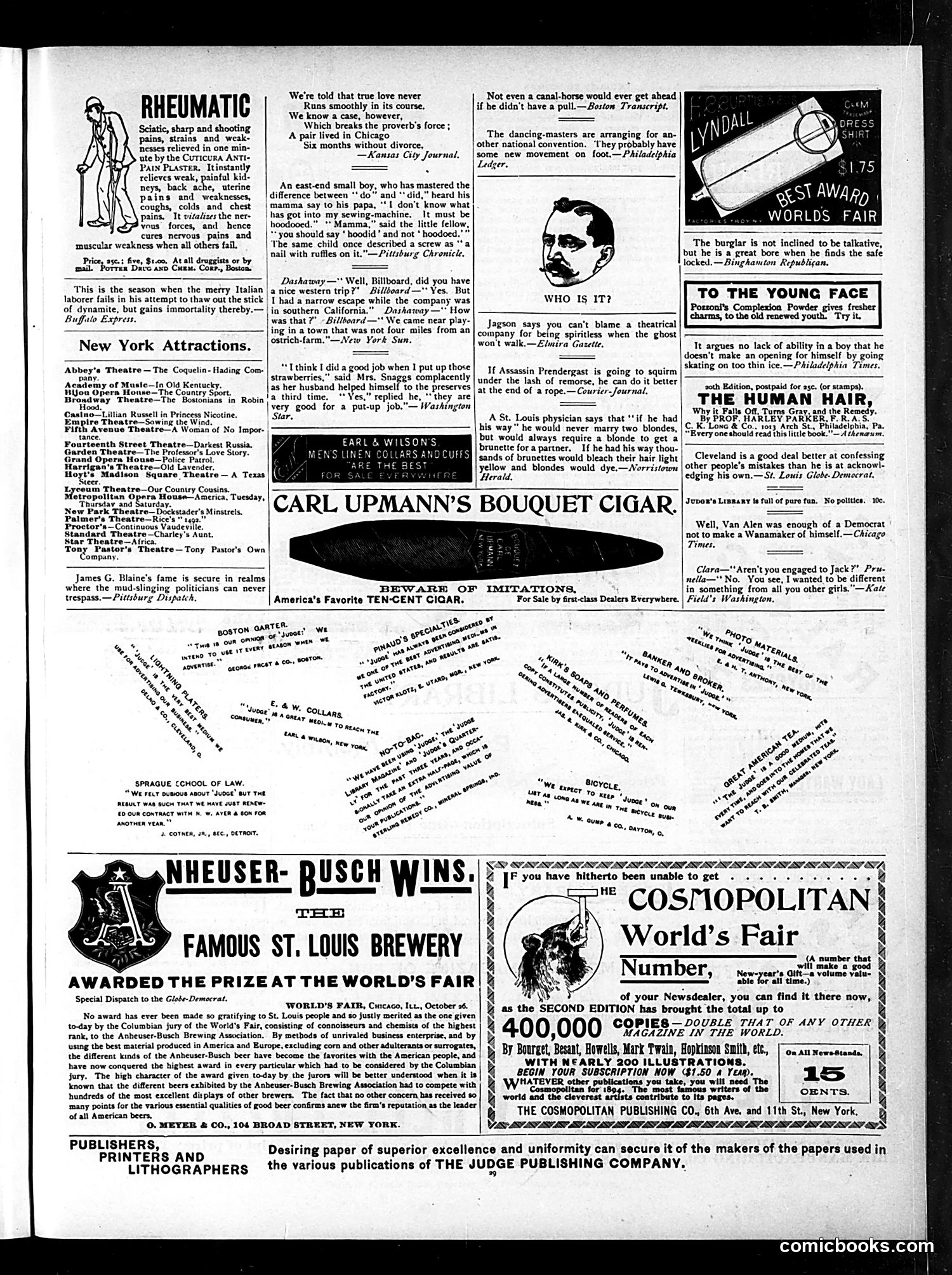
This page is primarily composed of **advertisements and humor columns/jokes** typical of Judge magazine. The only identifiable cartoon appears to be a simple illustration of a rheumatic figure at top left. The substantive content consists of short comedic pieces—mostly puns and observational humor about contemporary life—rather than political satire. Notable jokes reference Chicago marriages ("true love never runs smoothly"), a child correcting grammar ("hoodid"), vaudeville performers discussing an ostrich farm tour, and remarks about theatrical companies needing a "ghost" (pun: actor playing a ghost character). There's a brief editorial jab at "Assassin Prendergast" regarding remorse and execution, apparently referencing a specific crime, though context isn't detailed here. The page is dominated by **product advertisements**: Cuticura pain plaster, Earl & Wilson collars, Pozoni's powder, and Carl Upmann cigars. The Anheuser-Busch brewery and Cosmopolitan magazine also advertise prominently. This is primarily a **commercial publication** rather than political commentary.
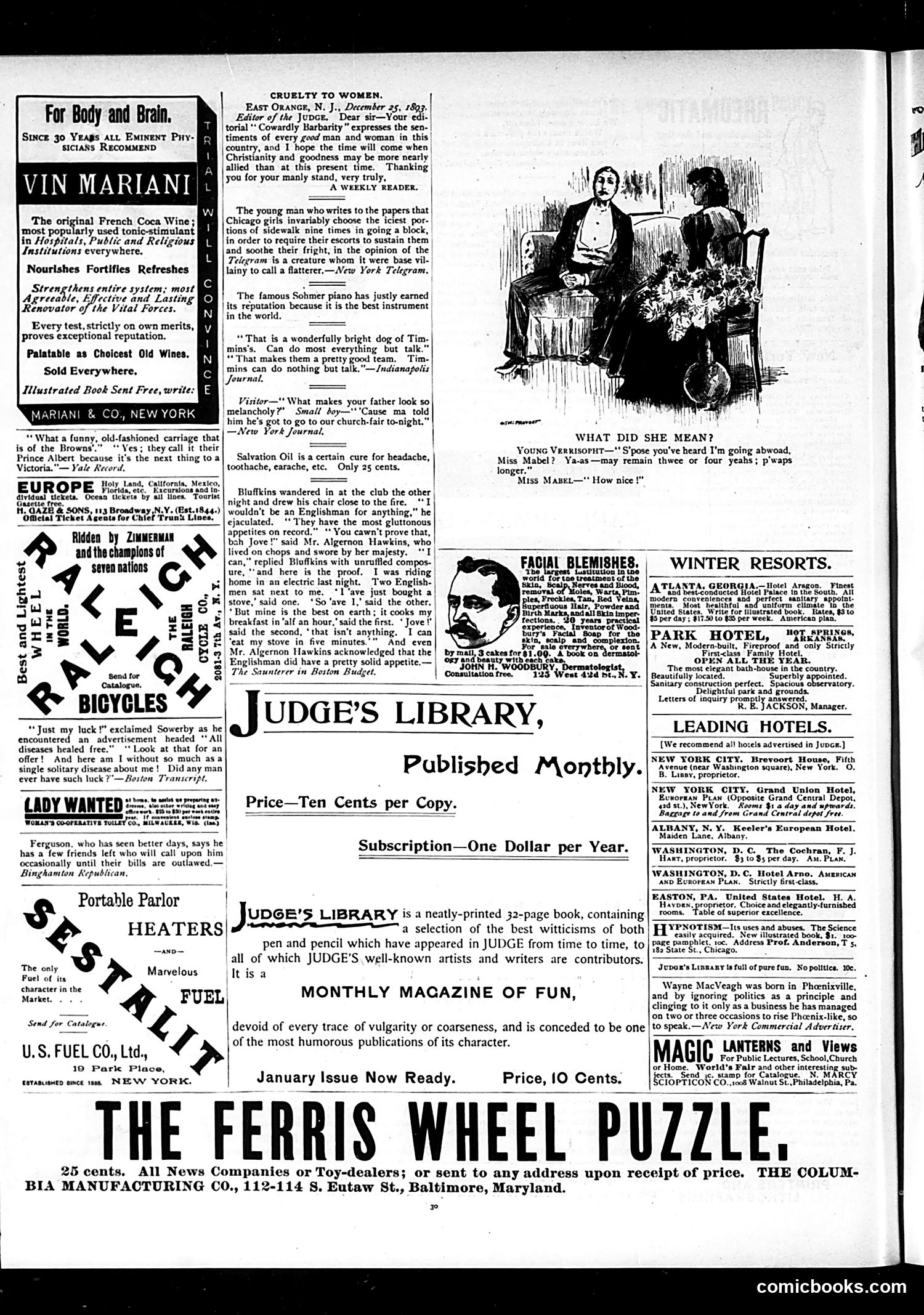
This page from Judge (dated December 25, 1895) is primarily **advertising and miscellaneous content** rather than political satire. The main cartoon titled "WHAT DID SHE MEAN?" depicts a domestic scene where a woman (Miss Verkstoff) tells her companion (Miss Masell) she's going abroad for "three or four years," prompting confusion about her meaning—a simple joke about ambiguous language, not political commentary. The page is dominated by advertisements for products like Vin Mariani (a cocaine-containing wine tonic), bicycles, and heating fuel. A few brief comic anecdotes appear scattered throughout—jokes about carriages, dogs, and an Englishman's appetite—but these are mild social humor without political edge. The only substantive content is a letter to the editor condemning cruelty to women, suggesting domestic violence concerns of the era. This is essentially a **typical magazine advertising page** of the 1890s with light, non-political humor.
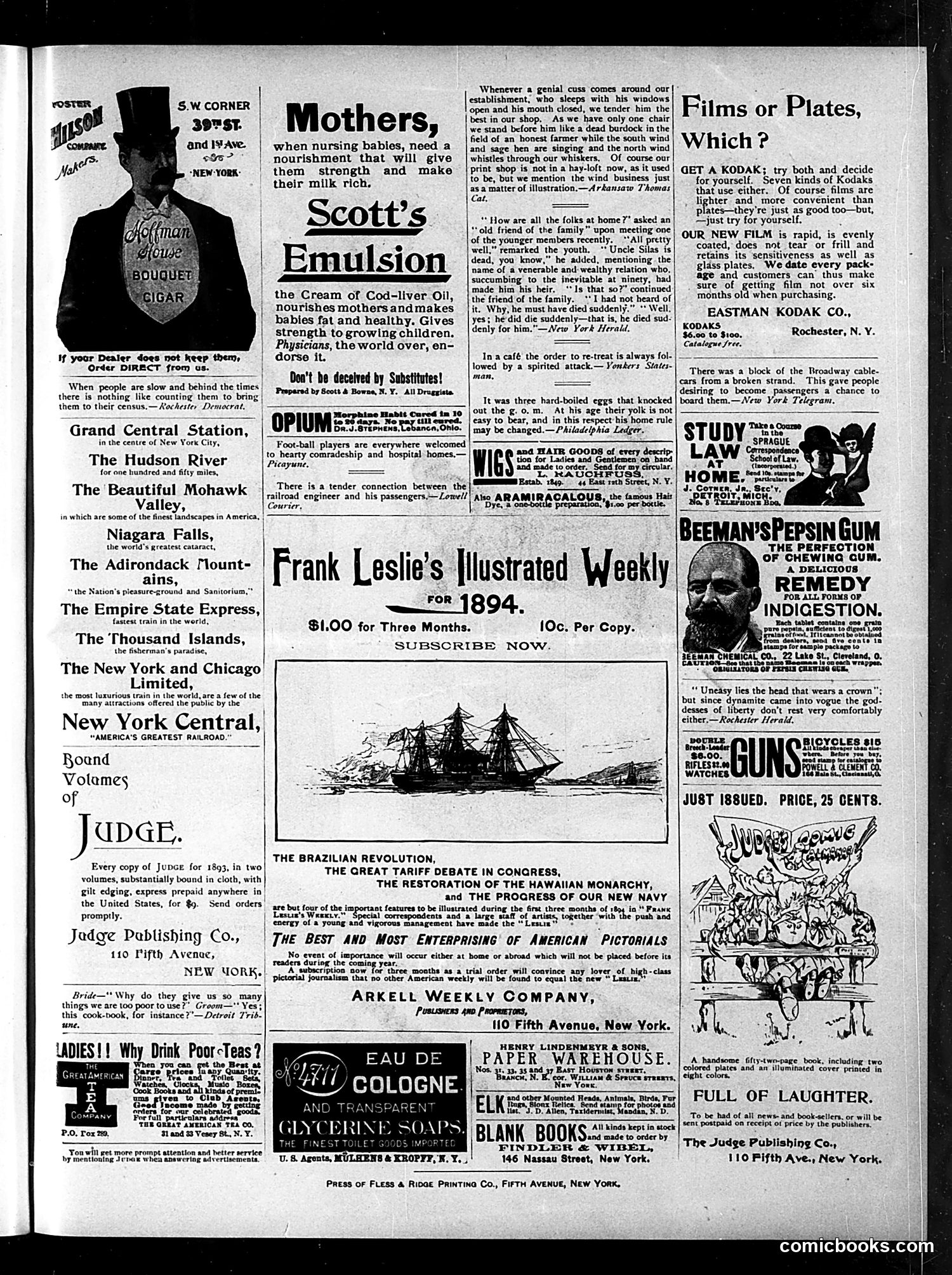
This page is primarily **advertising and promotional content** rather than political cartoons. It showcases Judge Publishing Company's offerings and various commercial advertisements. The notable satirical elements are brief, humorous quips rather than developed cartoons: - A joke about newlyweds receiving impractical gifts (a cookbook for the poor) - A rural anecdote about a print shop operator standing before a customer, using extended metaphors about wind and nature - A quip about an inheritance—the youth's uncle died "suddenly for him" (implying the uncle's great age made his death seem inevitable) - A pun about café "retreats" followed by "spirited attacks" The page emphasizes Judge's business offerings: bound volumes of 1893 issues ($9), Frank Leslie's Illustrated Weekly subscriptions, and various patent medicines and products (Scott's Emulsion, Beeman's Pepsin Gum, blank books). The content reflects **late 19th-century consumer culture** and gentle domestic humor rather than sharp political satire. No specific political figures or events are identifiable on this page.
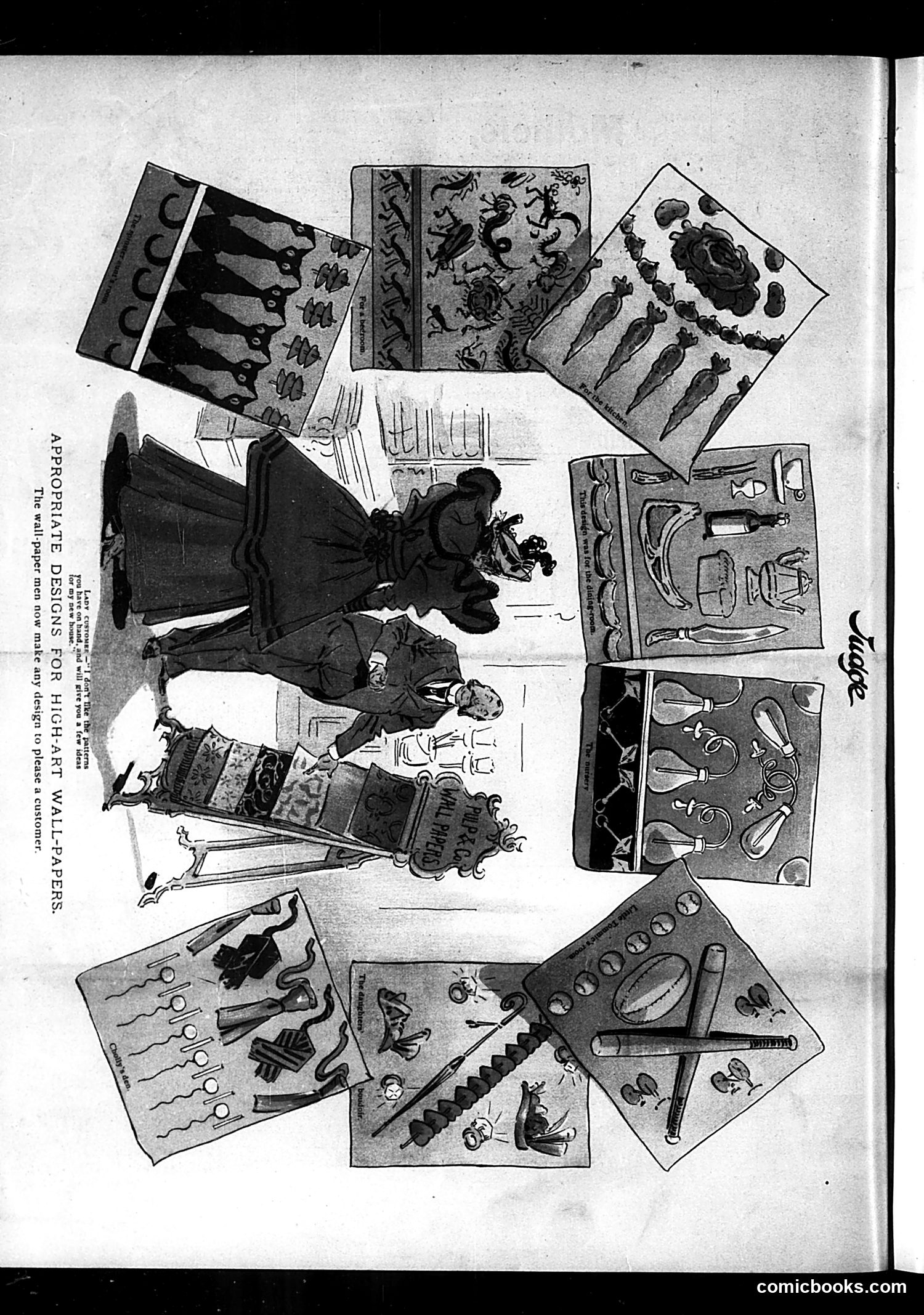
This satirical page mocks the pretentiousness of "high art" wall-paper design. The central figures appear to be fashionable decorators or aesthetes examining elaborate design samples arranged around them. The OCR text indicates the satire: wall-paper manufacturers now claim they'll create "any design to please a customer." The joke targets the absurdity of marketing ornate, pseudo-artistic patterns as serious decoration. The elaborate samples shown—featuring dragons, abstract shapes, classical motifs, and decorative elements—suggest that manufacturers have become so eager to satisfy customer whims that they'll apply grandiose "high art" labels to any commercial pattern. This reflects late 19th-century anxieties about commercialization of aestheticism and the gap between genuine artistic merit and mass-market appeals to artistic pretension. Judge ridicules both the manufacturers' marketing and customers foolish enough to view wallpaper as legitimate "high art."