
A complete issue · 16 pages · 1893
Judge — November 25, 1893
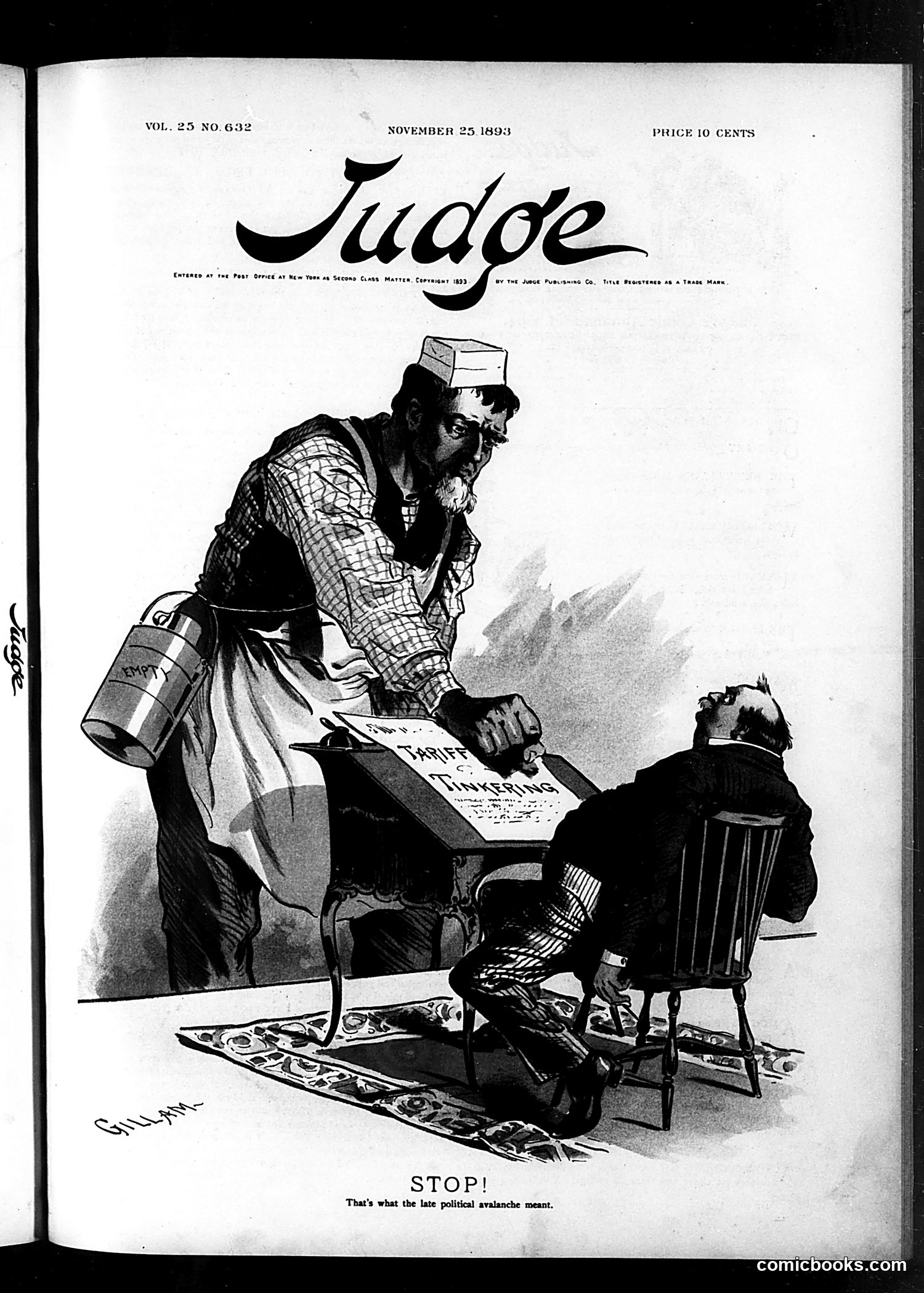
This political cartoon satirizes what the caption labels "the late political avalanche" — likely referring to the economic Panic of 1893, which devastated American finances that year. The caricature depicts an elderly Jewish figure (identifiable by exaggerated period stereotypes: beard, cap, nose) as a street vendor or peddler hawking "Watered Stock" and "Unmarking" schemes — financial fraud products. A well-dressed businessman sits as his customer, examining fraudulent financial documents. The satire blames immigrant or Jewish businessmen for the financial crisis through antisemitic caricature, suggesting they peddled worthless securities that triggered economic collapse. This reflects the era's prevalent scapegoating of Jewish financiers for economic disasters, a harmful stereotype that persisted throughout the late 19th and 20th centuries.
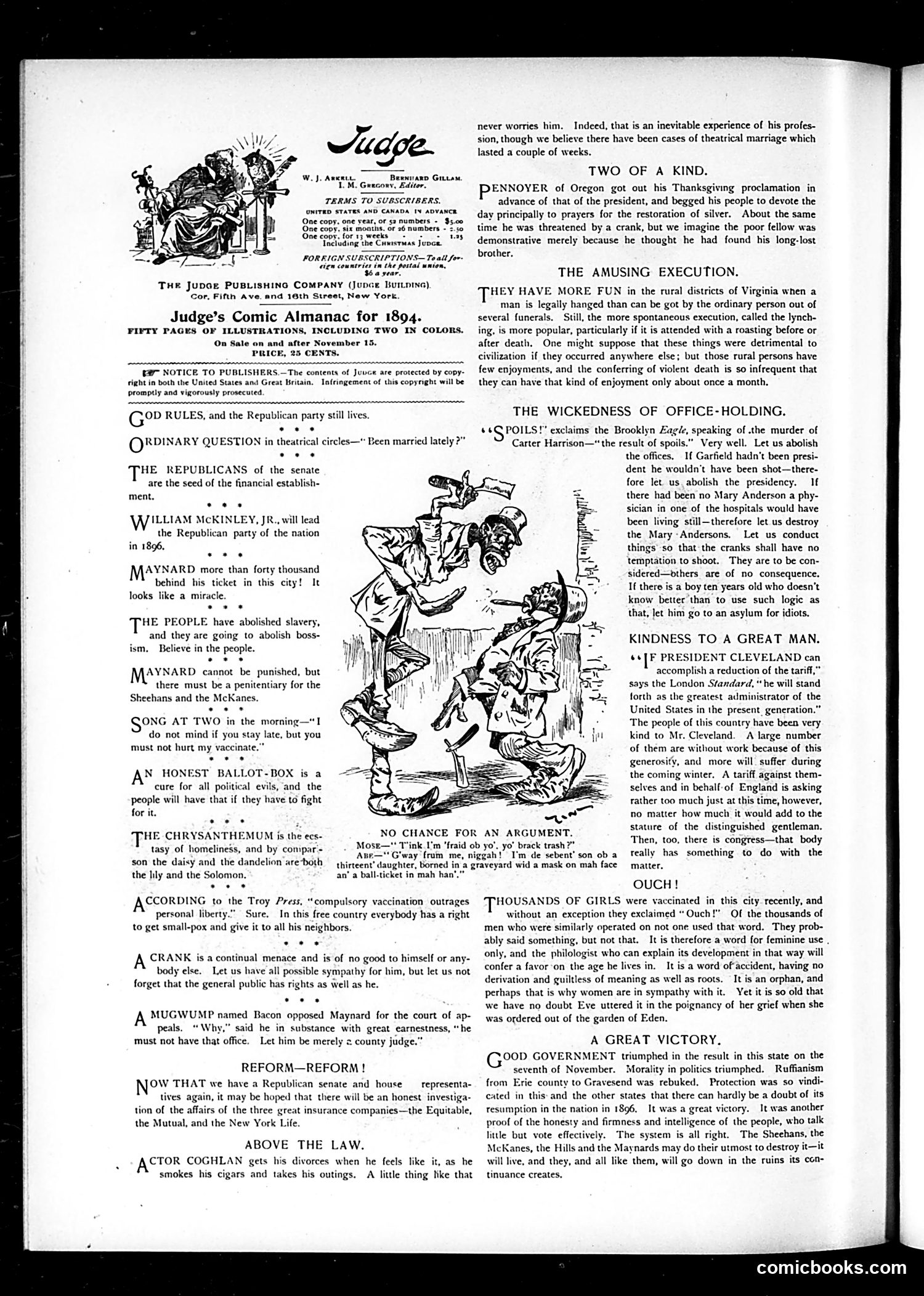
This 1894 page combines political commentary with social criticism. The main cartoon depicts violent chaos, likely referencing contemporary labor unrest or political turmoil of the 1890s—a period marked by the Pullman Strike and economic depression. The text sections mock Republican leadership, questioning their party's direction ("Ordinary question in theatrical circles: 'Been married lately?'"). References to William McKinley, Maynard, and office-holding suggest critique of Republican political establishment and perceived corruption. Other items satirize political violence, vaccination controversies, and Cleveland's presidency. The tone suggests Judge was criticizing Republican incompetence while also mocking progressive reform efforts. The cartoons use exaggerated imagery to make political points about governance failures, contemporary social anxieties, and party politics during this economically turbulent era.
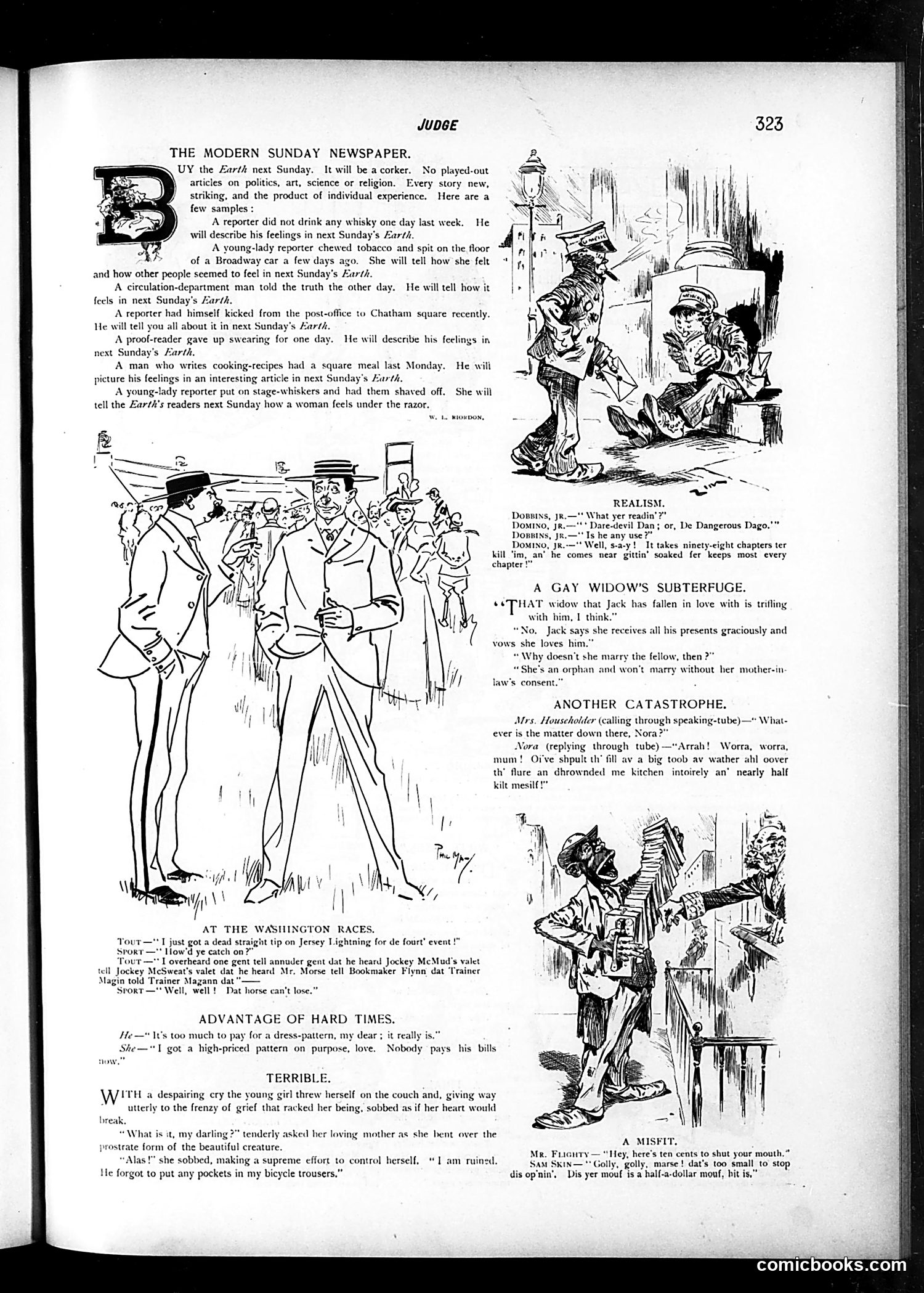
**"The Modern Sunday Newspaper"** (top): This satirizes how Sunday papers cater to varied readers through sensational, emotionally-driven content. A woman feels faint reading tobacco news, a reporter dramatizes a postoffice visit, and others share exaggerated reactions—mocking the paper's appeal to readers seeking entertaining feelings rather than serious information. **"At the Washington Races"** (bottom left): Features men in suits discussing horse-racing gambling. The dialogue suggests someone profited unfairly or through insider information (a jockey's valet involvement), satirizing corruption or unfair advantage in racing circles. **Other segments** include domestic humor ("A Gay Widow's Subterfuge," "Another Catastrophe," "Terrible," "A Misfit")—typical comic sketches of early 1900s American life satirizing financial troubles, family situations, and class dynamics.
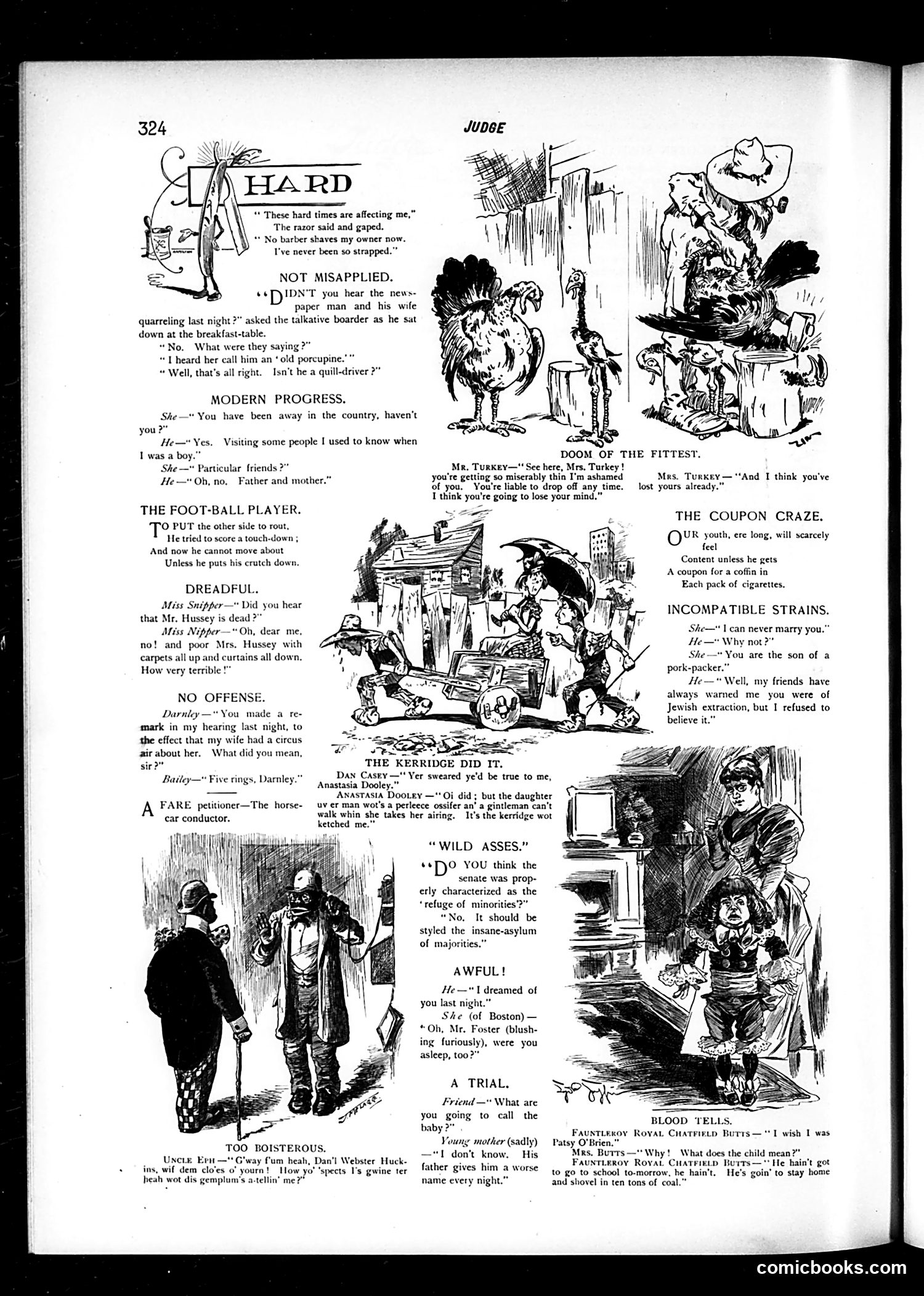
This page contains short satirical jokes typical of late 19th-century American humor, with accompanying illustrations. Key pieces: **"Hard Times"**: A razor personified laments that economic depression means fewer customers shaving—a play on the phrase "strapped for cash." **"Not Misapplied"**: A pun where a wife calls her husband an "old porcupine," and the boarder notes this is apt since he's a "quill-driver" (newspaper writer using quills). **"Doom of the Fittest"**: Turkeys discuss one becoming thin—likely Thanksgiving/holiday season commentary using evolutionary language. **"Incompatible Strains"**: References ethnic/religious prejudice, where a man's friends warned him about his fiancée's "Jewish extraction"—capturing period antisemitic attitudes. **"The Kerridge Did It"**: Irish immigrant dialect humor about a woman abandoning a policeman's son for a gentleman with a carriage. **"Blood Tells"**: A working-class child names his baby after wealthy children's literature characters, but plans to keep him home shoveling coal—satirizing class pretension. The humor reflects Gilded Age social anxieties, ethnic stereotyping, and class dynamics.
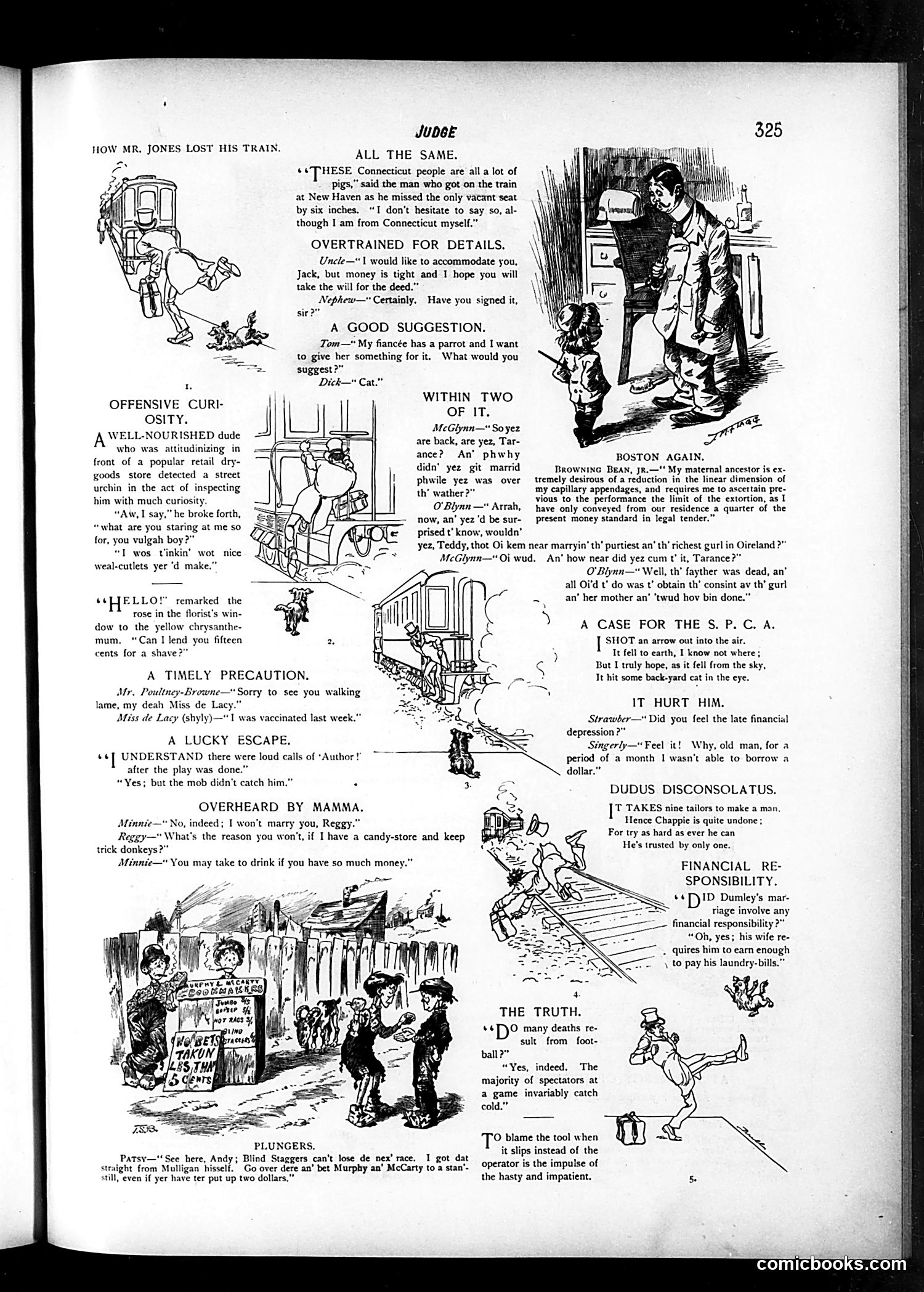
This page contains multiple short humor pieces typical of early Judge magazine's satirical style: **Main themes:** 1. **Irish immigrant stereotypes**: Several dialogues feature heavily accented Irish characters ("O'Blynn," "McGlynn," "Tarance") discussing courtship and financial matters—reflecting Judge's frequent mockery of Irish-American communities. 2. **Social commentary through brief vignettes**: "All the Same" satirizes hypocrisy (a Connecticut man insulting Connecticut people). "Overtrained for Details" mocks nephew's literalism about inheriting uncle's will. "Financial Responsibility" jokes that marriage means paying laundry bills. 3. **Class humor**: A "well-nourished dude" being questioned by a street urchin; references to servants and social pretension (the "Browning Bean, Jr." piece with absurdly flowery language about haircuts). 4. **Dark/cruel humor**: A poem about shooting an arrow that hits a cat, titled "A Case for the S.P.C.A." (Society for Prevention of Cruelty to Animals)—the irony being the shooter finds it funny. The cartoons illustrate these jokes with period-appropriate illustrations, typical of Judge's format blending text and visual satire.
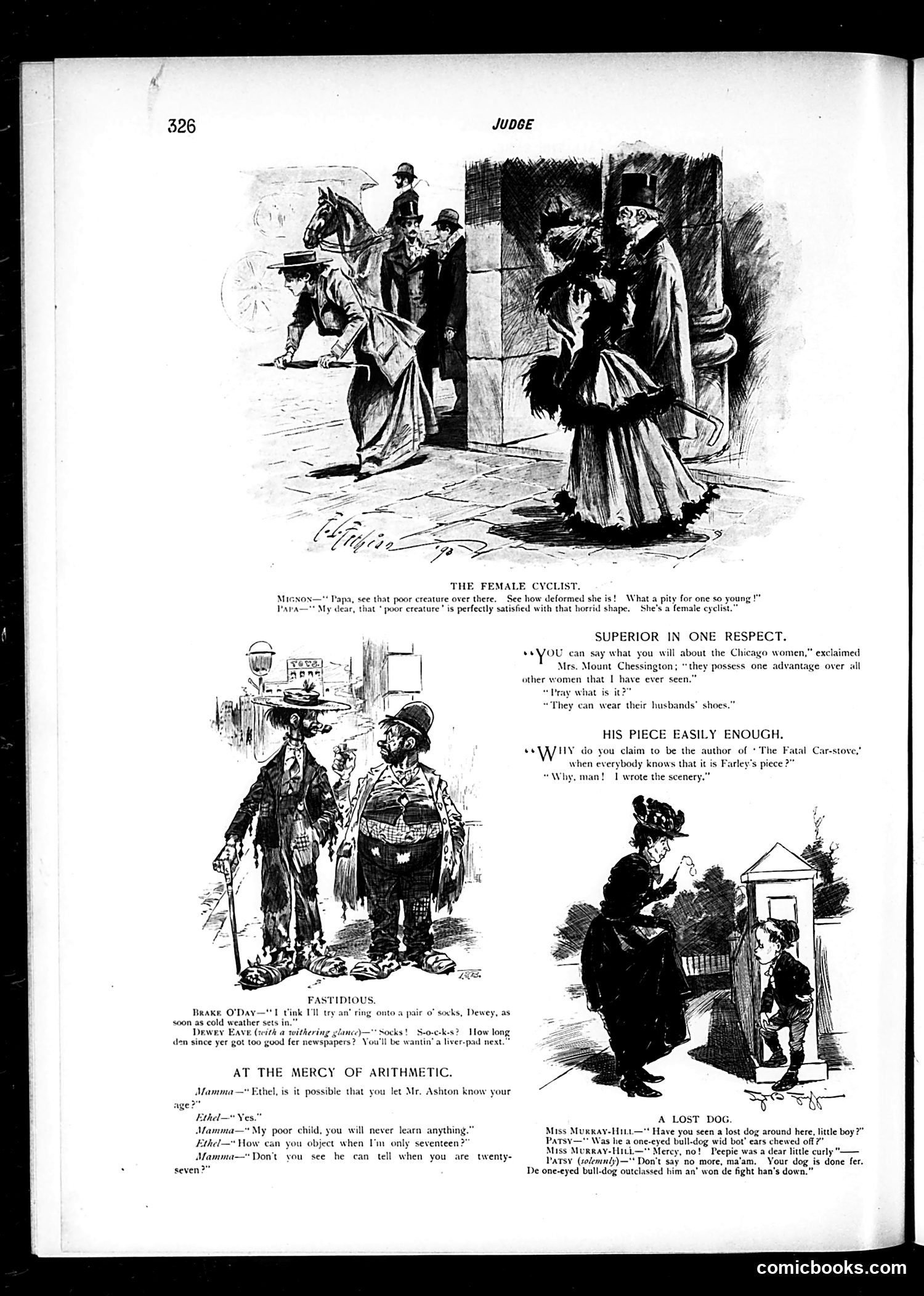
This page contains several satirical sketches mocking Victorian-era social conventions and gender roles: **"The Female Cyclist"** ridicules women cyclists, a controversial new phenomenon. Male observers feign concern about women's "deformed" shapes in cycling attire, while hypocritically disapproving of this emerging female independence. **"Fastidious"** jokes about working-class pretension: a character named Brake O'Day wants socks instead of newspapers (historically used as rough clothing), prompting mockery that he's becoming too good for his station. **"Superior in One Respect"** satirizes Chicago women through backhanded compliments—they're praised only for being able to wear their husbands' shoes, reducing them to domestic utility. **"His Piece Easily Enough"** mocks plagiarism in theater, with someone claiming authorship of scenic design while others created the actual work. **"At the Mercy of Arithmetic"** and **"A Lost Dog"** are brief domestic and street-vendor comedy sketches typical of the era. The page reflects late-19th-century anxieties about changing women's roles and class mobility.
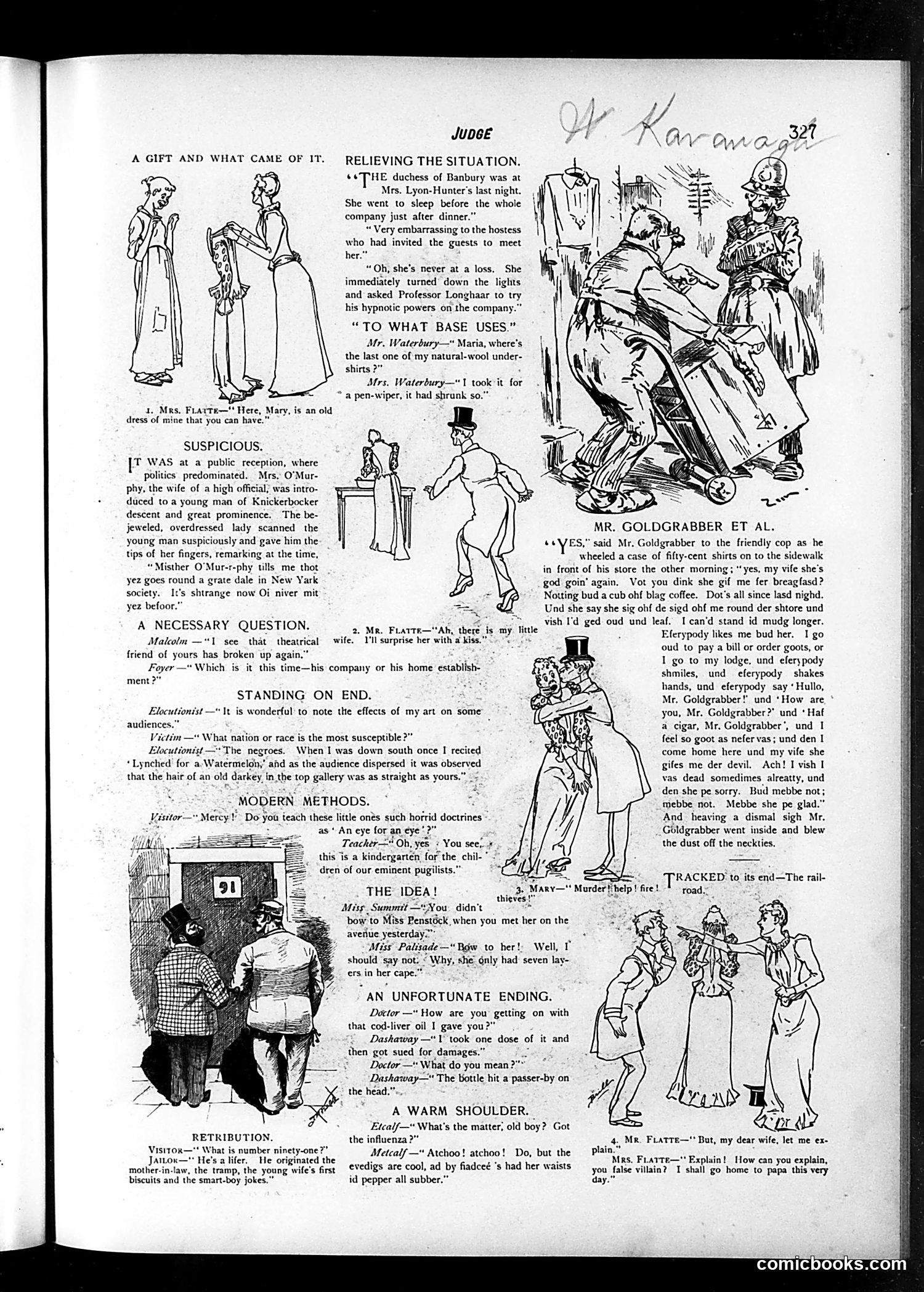
This page from *Judge* contains several satirical vignettes mocking social pretense and ethnic stereotypes typical of Gilded Age humor. **Main cartoon**: "Mr. Goldgrabber et al." features a Jewish immigrant merchant (indicated by phonetic Yiddish-accented English) complaining to a policeman. The satire targets nouveau-riche social anxiety—Goldgrabber enjoys lodge camaraderie but faces domestic misery from his wife, suggesting tensions between immigrant male social aspiration and domestic life. **Other sketches mock**: - Class anxiety (an Irish politician's wife suspiciously interrogating a Knickerbocker gentleman) - Ethnic pretension (the "Lynched for a Watermelon" elocution bit using racist caricature) - Modern parenting (kindergarteners taught "an eye for an eye") - Marital discord and female social climbing The recurring theme: newly wealthy or upwardly mobile figures face ridicule for their social ambitions and perceived cultural inadequacy. *Judge's* humor relied heavily on ethnic caricature and class-based mockery now recognized as offensive.
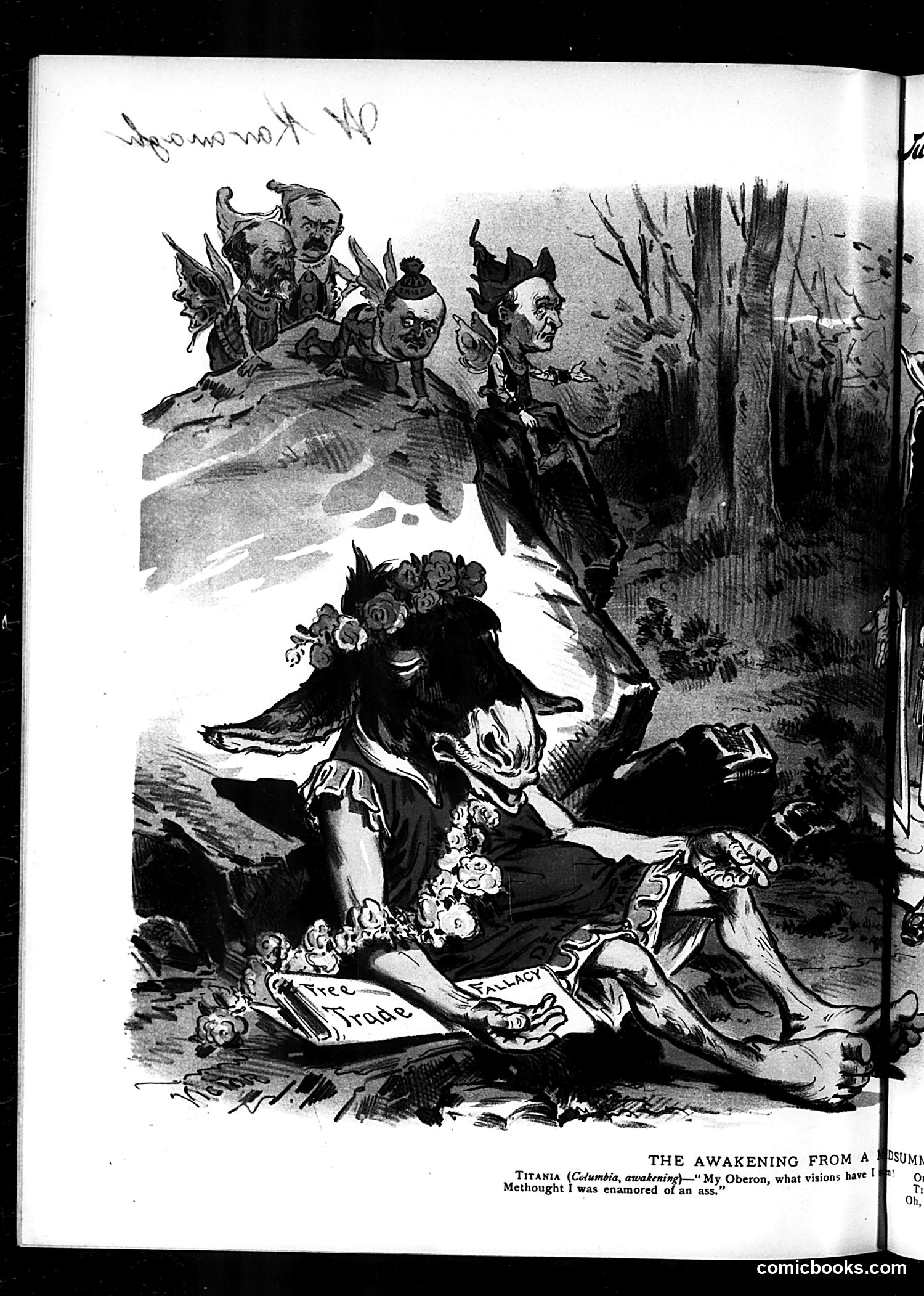
This is a satirical cartoon titled "The Awakening from a Dream," referencing Shakespeare's *A Midsummer Night's Dream*. Titania (personified as Columbia, representing America) awakens from enchantment, declaring she was "enamored of an ass." The central female figure wears a crown of flowers and lies among debris labeled "Free Trade" and "Palmistry." Behind her stand demonic or grotesque figures representing political leaders or policies she was infatuated with during some period of misguided governance. The satire suggests America was foolishly charmed by certain political figures or free-trade policies—depicted as laughably absurd ("an ass")—but is now awakening to reality. The exact historical moment is unclear without additional context, but the cartoon mocks what the artist considered America's previous poor political judgments.
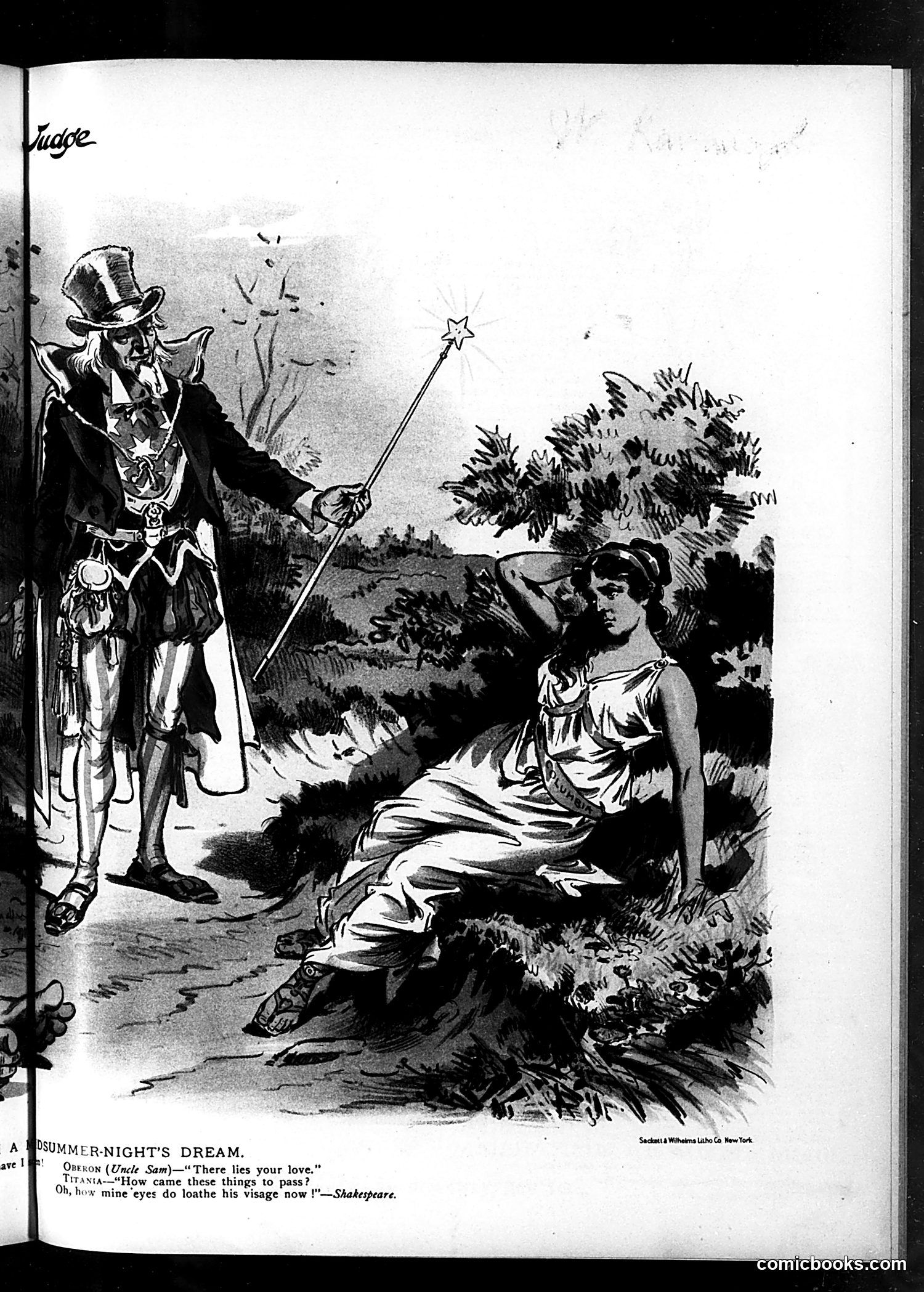
This cartoon satirizes U.S.-British relations through a *Midsummer Night's Dream* parody. Uncle Sam (representing America) gestures toward a reclining female figure labeled Titania (representing Britain), quoting the Shakespeare play. The caption reverses the original: instead of Titania loving Bottom (transformed into a donkey), she now recoils from Uncle Sam's appearance, declaring her love turned to loathing. The satire targets American-British diplomatic relations, suggesting Britain views the U.S. with disgust or betrayal—possibly referencing a specific political conflict or trade dispute. The magical transformation theme implies the relationship has fundamentally changed, with former affection curdling into contempt. The artwork style and *Judge* magazine context suggest this is from the late 19th or early 20th century.
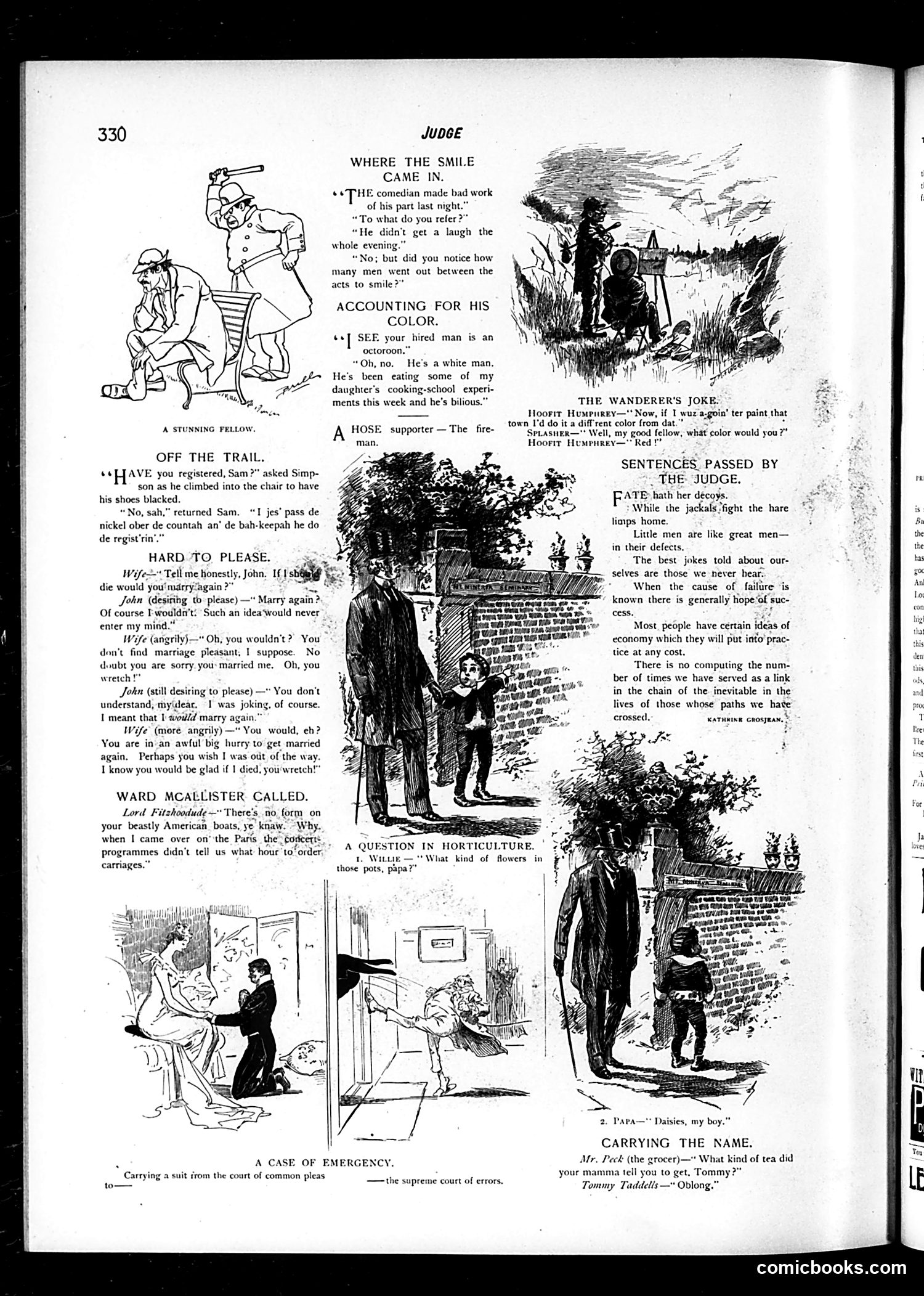
This page contains multiple brief satirical sketches typical of late 19th-century American humor magazines: **"A Stunning Fellow"** and **"Off the Trail"**: Dialect humor featuring an African American character ("Sam") who misunderstands voter registration, confusing it with a payment transaction. This reflects contemporary anxieties about Black voting rights during the Reconstruction/post-Reconstruction era. **"Hard to Please"**: A domestic comedy where a husband cannot satisfy his wife—whatever answer he gives about remarrying offends her. Standard marital humor. **"Ward McAllister Called"**: References the real society figure Ward McAllister, mocking British aristocratic pretension and American social climbing. **Other sketches** include jokes about a comedian whose bad performance drove audiences out to smile elsewhere; a hired man's complexion explained by bad cooking; and wordplay about "Oblong" tea (likely "Oolong"). The page emphasizes class satire, racial stereotypes, marital conflict humor, and social pretension—common Judge magazine fare reflecting late Victorian American attitudes.
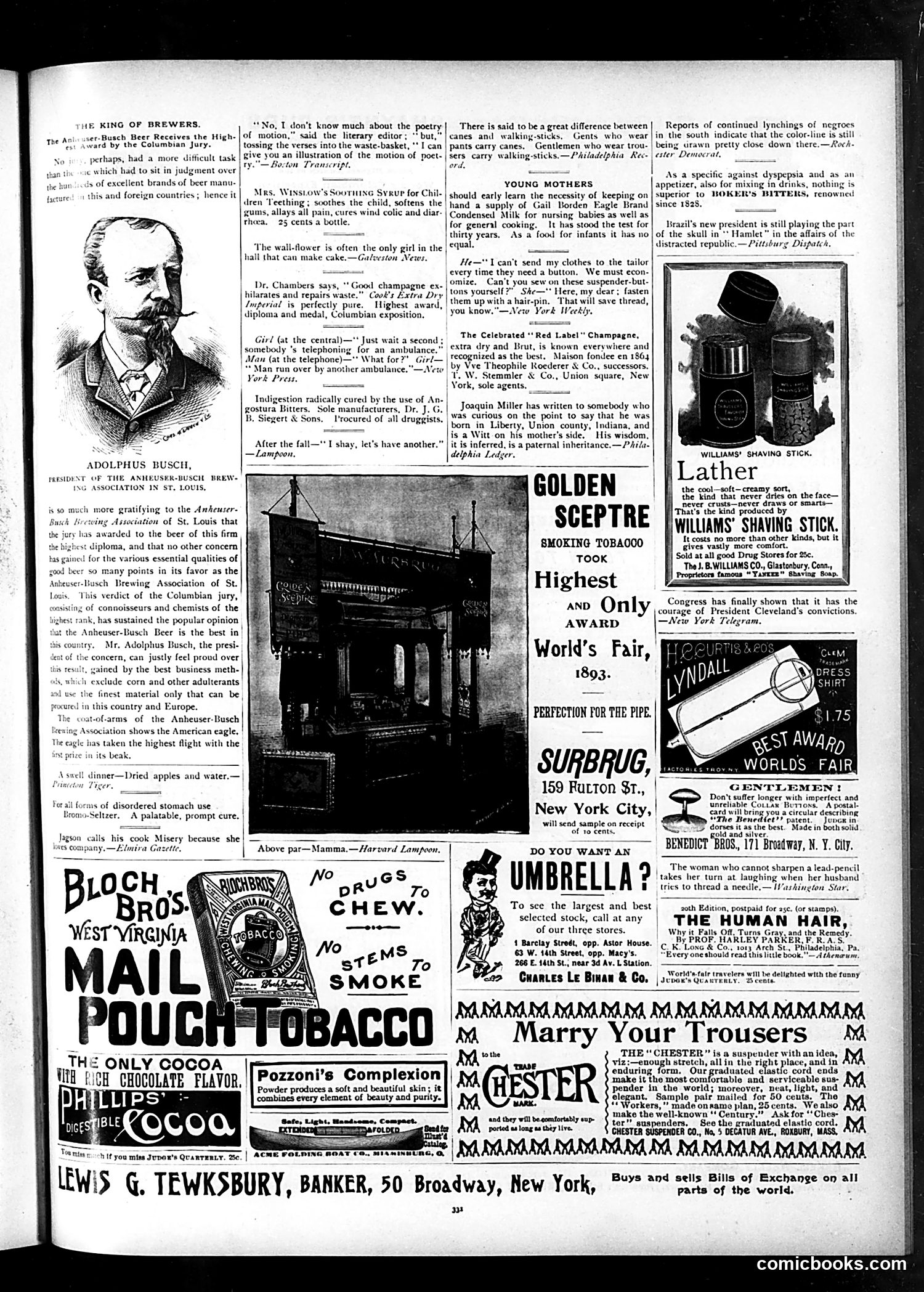
This page celebrates **Adolphus Busch**, president of the Anheuser-Busch brewing company, whose beer won the highest award at the 1893 Columbian Exposition (World's Fair in Chicago). The main article is a puff piece praising Busch's beer as superior to all competitors. The satire is implicit rather than explicit: *Judge* uses Busch's victory to mock both the brewing industry's competitive boasting and the Columbian jury's judgment. The framing suggests the award itself may be questionable or politically influenced—typical of Gilded Age corporate rivalry. The page is otherwise filled with period **advertisements** (cocoa, tobacco, umbrellas, champagne) and **short humorous anecdotes** on topics like poetry, dining, and courtship—standard magazine filler of the era. The only pointed social comment appears at page's bottom: a brief item about continued **lynchings in the South**, sardonically juxtaposed against trivial consumer goods—highlighting *Judge*'s occasional attention to racial violence.
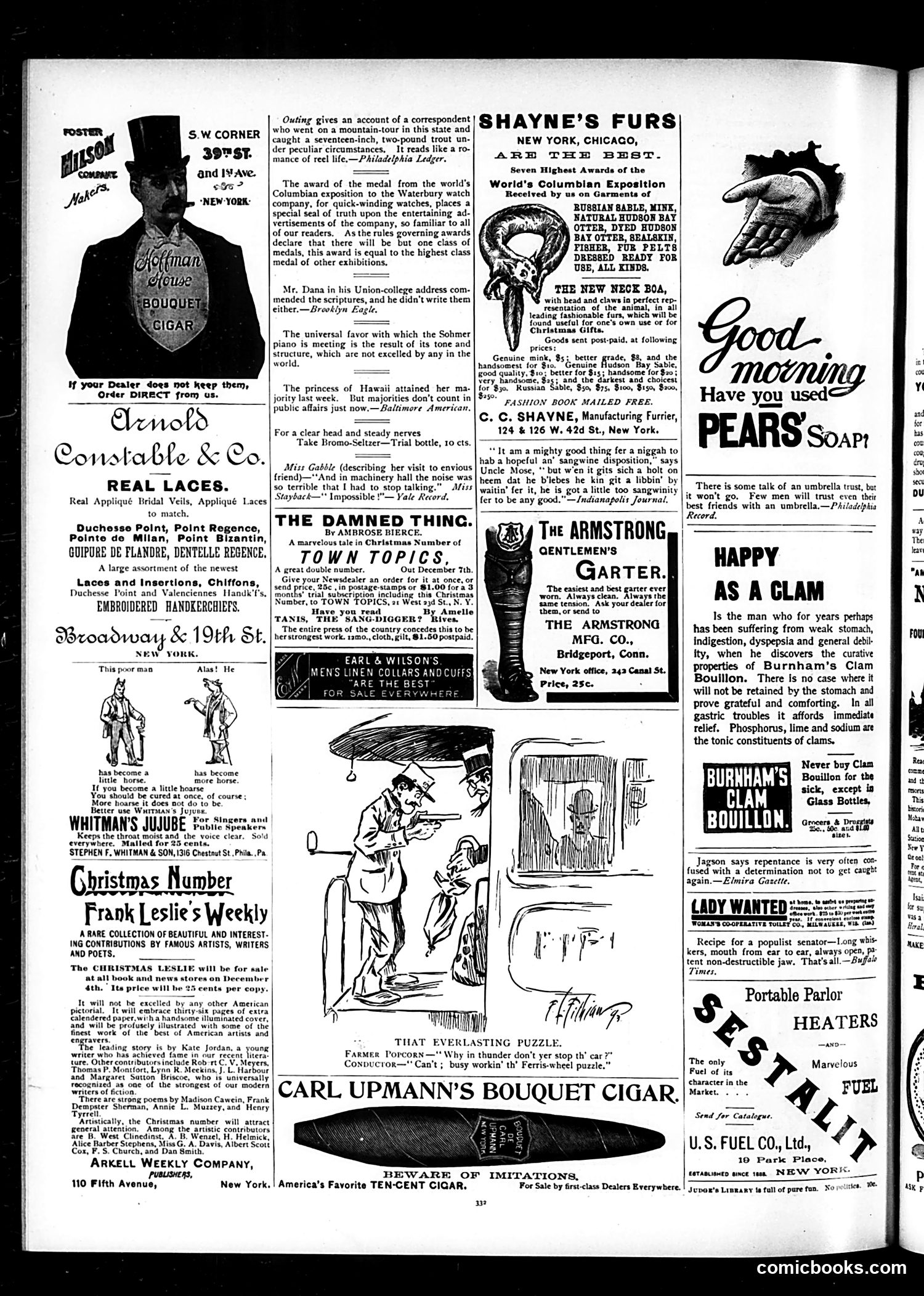
This page is **primarily advertising** with one notable cartoon. The main illustrated piece, captioned "THAT EVERLASTING PUZZLE," depicts a conductor and farmer arguing about a thunderstorm and a "stuck" car—likely satirizing early automobiles' unreliability and the confusion between urban (conductor) and rural (farmer) perspectives on new technology. The page contains numerous late-19th/early-20th-century advertisements for products like real laces, cigars, soaps, and patent medicines (Bromo-Seltzer, Whitman's Jujubes). Several brief satirical notes appear: one mocks Hawaii's princess reaching legal adulthood amid political instability; another pokes fun at a chatty woman being silenced by machinery noise—typical period humor about gender stereotypes. The "Christmas Number" promotion dominates the left side, announcing Frank Leslie's Weekly's holiday edition with contributions from prominent artists and writers.
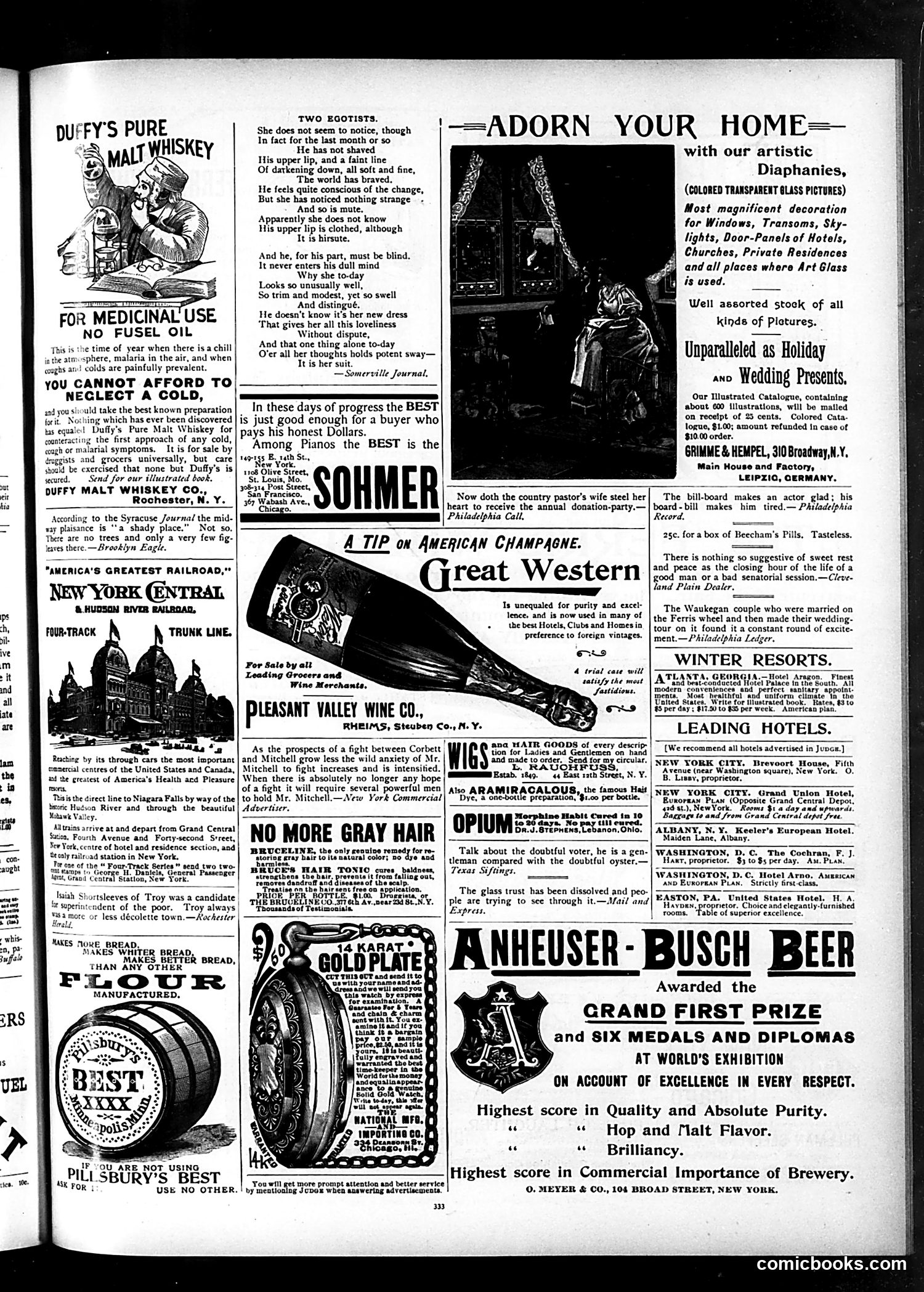
This page is primarily advertising from Judge magazine, with one satirical poem and various product advertisements. The main satire, "Two Egotists," is a brief poem about mutual obliviousness in a relationship. A man is preoccupied with his newly grown facial hair (upper lip), unaware his companion has noticed nothing. Meanwhile, she's equally self-absorbed with her new dress and suit, which he fails to notice. The humor lies in their parallel vanity—each convinced their personal grooming/appearance matters greatly, while their partner remains entirely indifferent. The rest of the page consists of period advertisements for products like whiskey (promoted as medicinal), flour, beer, wine, pianos, and railroad services. These ads reflect late 19th-century marketing tactics, including dubious health claims for alcohol.
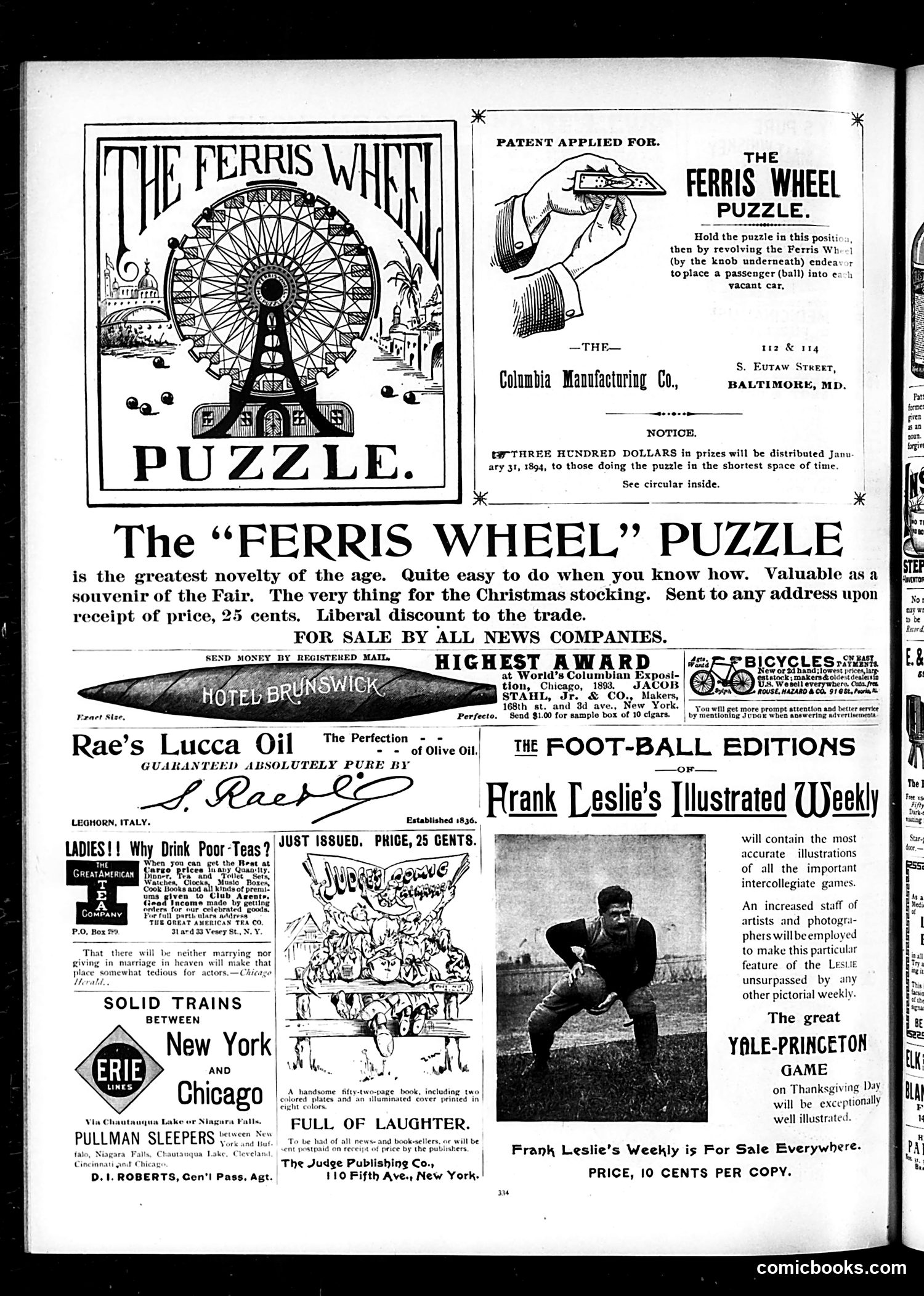
This is primarily an **advertising page** from Judge magazine, not a political cartoon. The central content is a commercial novelty puzzle based on the famous Ferris Wheel from the 1893 World's Columbian Exposition in Chicago. **The Main Feature:** The "Ferris Wheel Puzzle" is a mechanical toy where users tilt and manipulate a small ball into vacant passenger cars around a miniature rotating wheel. It sold for 25 cents, with $300 in prizes distributed to those solving it fastest—marketed as a souvenir of the recent World's Fair and holiday gift item. **Supporting Advertisements:** The page includes typical period ads: Rae's Lucca Oil, Hotel Brunswick, Erie Railroad service, tea companies, and cigars. Notably, there's a plug for *Frank Leslie's Illustrated Weekly*, promoting upcoming football coverage of the Yale-Princeton game. The page reflects the **commercialization of the 1893 World's Fair**, which generated substantial merchandise and popular culture spin-offs celebrating the exposition's iconic Ferris Wheel attraction.
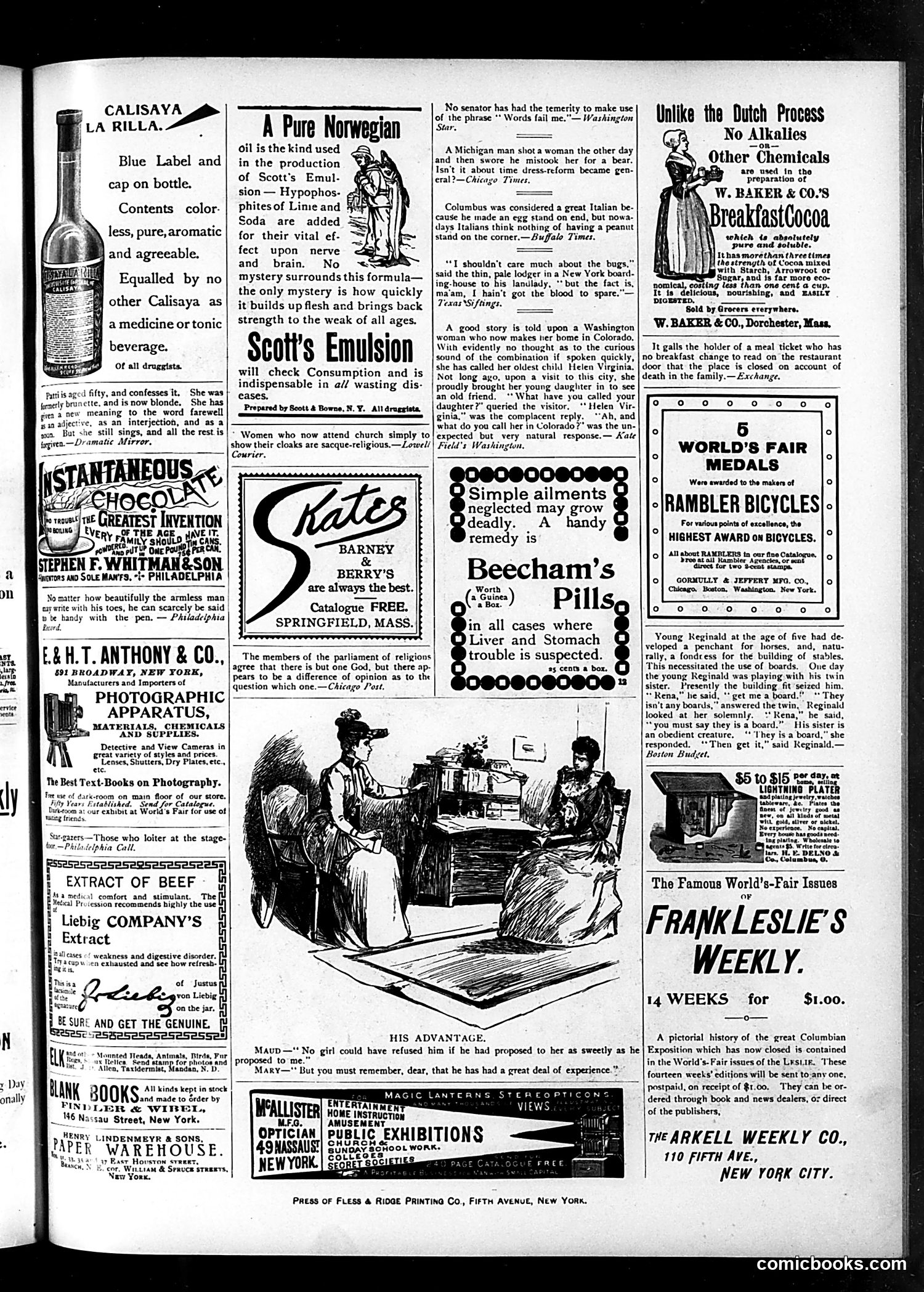
This page is primarily **advertisements and short humorous quips** rather than political cartoons. The main image shows a domestic scene titled "His Advantage," depicting a conversation between a man and woman, apparently about his greater experience—likely a joke about courtship or marriage dynamics. The text snippets are brief, witty observations on contemporary social topics: women's fashion (corsets), religious hypocrisy, Columbus Day myths, and a pun about a girl's name ("Helen Virginia" sounds like "hell and virginity" when spoken quickly). The advertisements promote patent medicines (Scott's Emulsion for consumption, Beecham's Pills), photographic equipment, and food extracts—typical of late 19th-century American magazines. **No specific political figures or events are referenced.** This appears to be a general humor and advertising page rather than satirical commentary on particular political controversies.
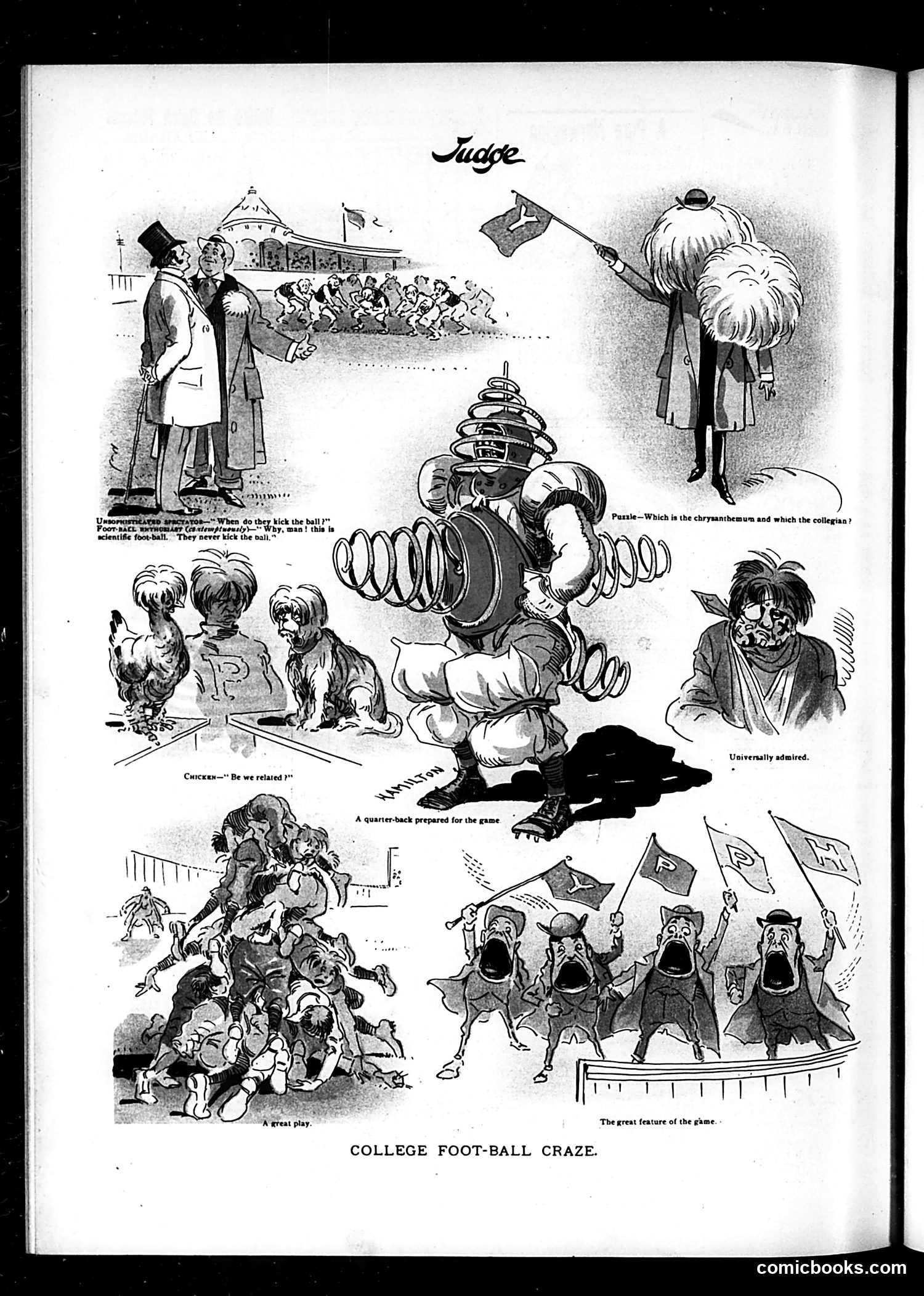
This satirical page mocks the obsessive enthusiasm surrounding college football in late 19th-century America. The title references "foot-ball craze"—suggesting the sport had become an irrational cultural phenomenon. Key panels ridicule: 1. **Academic irrelevance**: Professors debate football rules while ignoring actual education ("scientific foot-ball") 2. **Spectator mania**: Crowds gather at stadium with intense, almost violent enthusiasm 3. **Social climbing**: "University admired" suggests football elevated institutional prestige artificially 4. **Absurd complexity**: A "quarter-back prepared for the game" appears mechanical/overwrought 5. **Mass hysteria**: The final panel shows crowds with flags in what appears to frenzied mob behavior The satire argues that college football had become divorced from education's purpose, transforming universities into spectacle venues where students, alumni, and institutions lost perspective. The exaggerated drawings emphasize the irrationality of this "craze."