
A complete issue · 16 pages · 1893
Judge — October 7, 1893
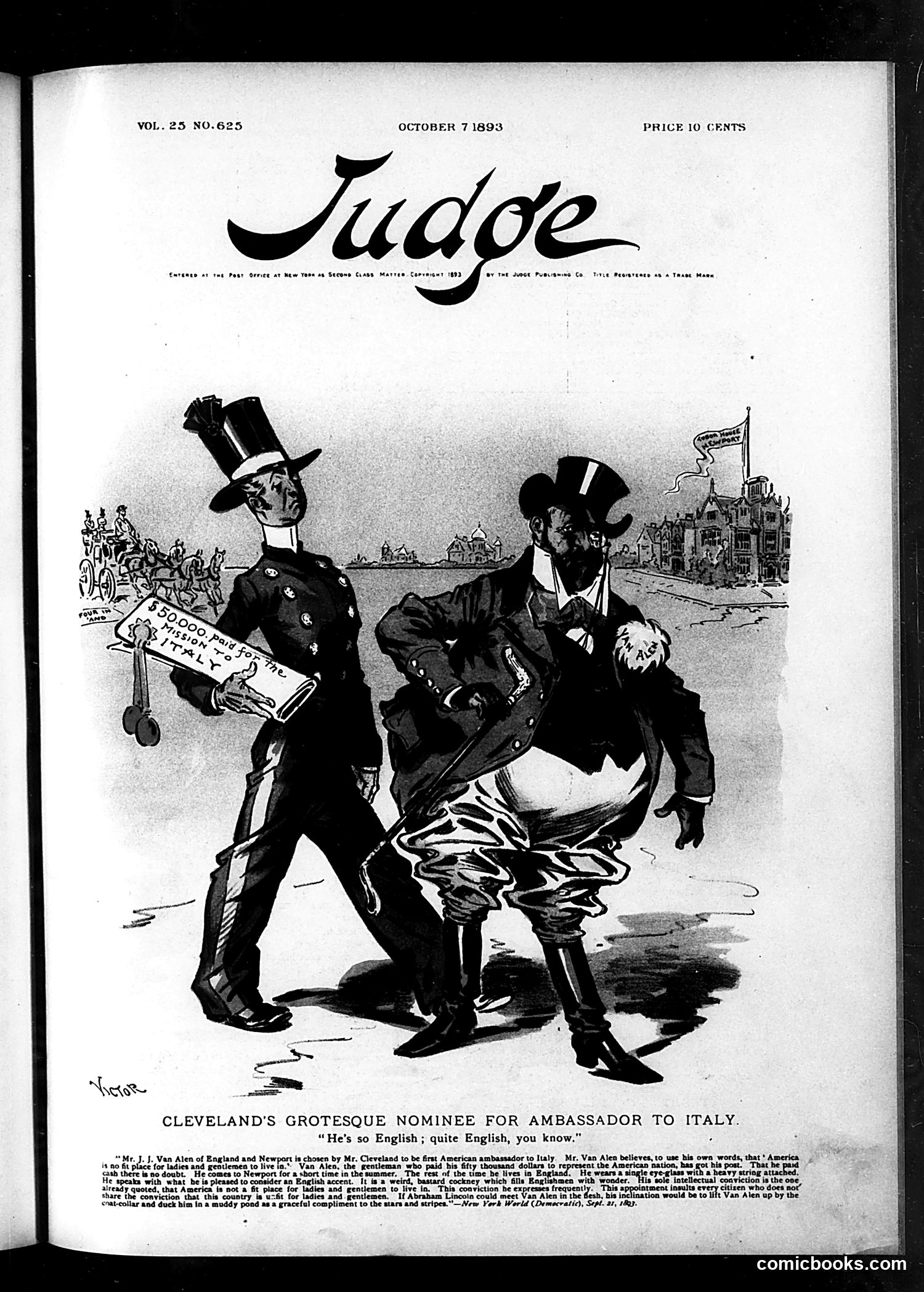
This political cartoon satirizes President Grover Cleveland's choice of Thomas B. Van Alen as U.S. Ambassador to Italy. The caption mockingly notes Van Alen is "quite English, you know"—suggesting he's overly Anglicized and unsuitable for the role. The cartoon depicts Van Alen (center, in striped trousers) being escorted by two formally-dressed figures. The left figure holds a scroll labeled "50,000 FRANCS FOR THE FAIR" (likely referencing a financial contribution), implying the ambassador position was purchased rather than earned through merit. The satire attacks both Van Alen's credentials and the patronage system that allowed wealthy donors to secure diplomatic posts, a common practice criticized during the Gilded Age.
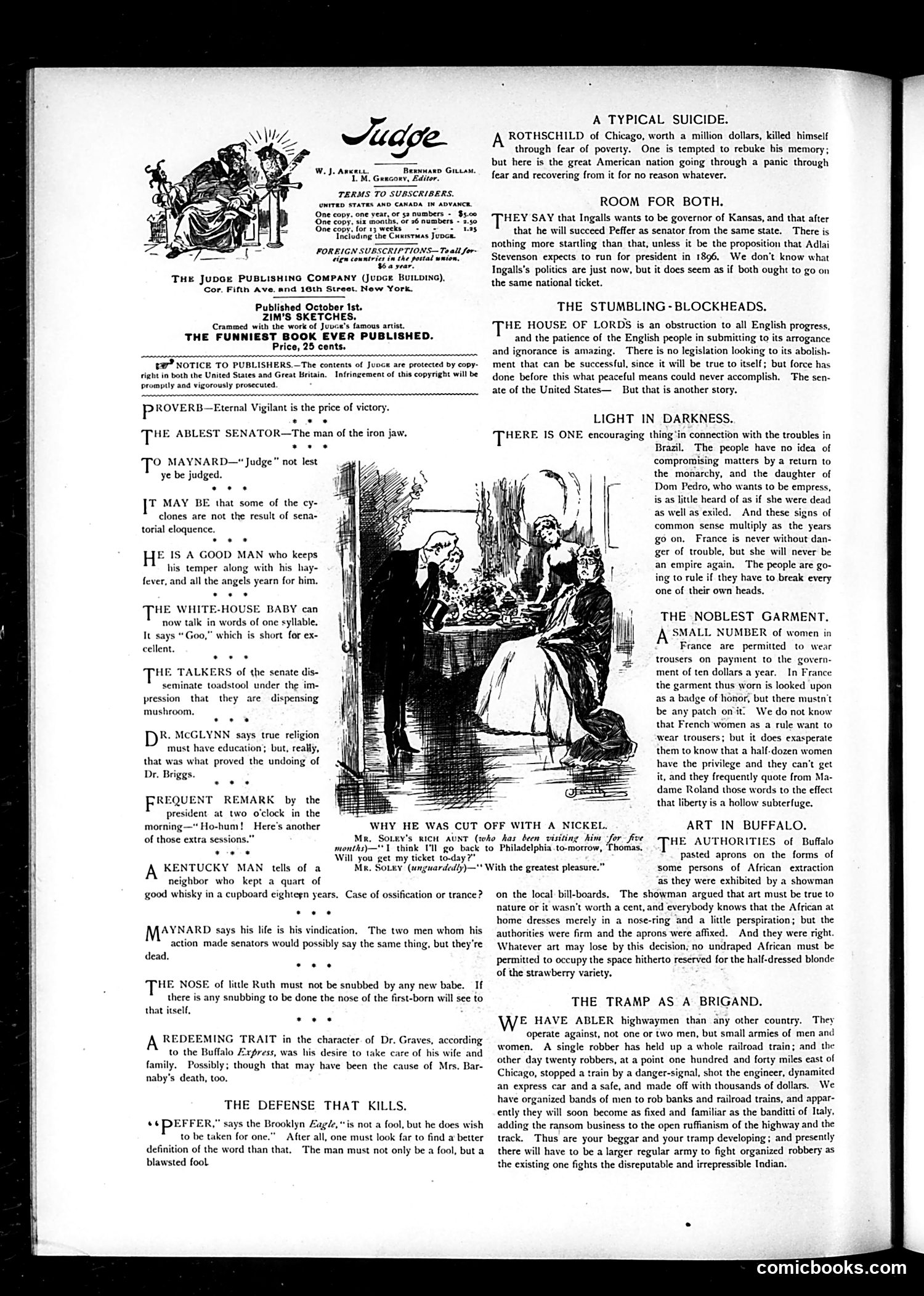
The central cartoon, titled "Why He Was Cut Off With a Nickel," depicts a domestic scene where a man asks his wife for money, offering a ticket to Philadelphia as justification. She dismisses him with only a nickel, suggesting marital discord over finances and travel. The surrounding text consists of brief satirical commentary on contemporary issues: political ambitions (Ingalls as Kansas governor), British obstruction of legislation, Brazilian political instability, women's fashion (French trousers), and Buffalo's controversial display of African peoples. The recurring theme addresses American social problems—poverty, political corruption, gender relations, and racial exploitation—through sharp, sardonic observations typical of Judge's editorial approach to Gilded Age society.
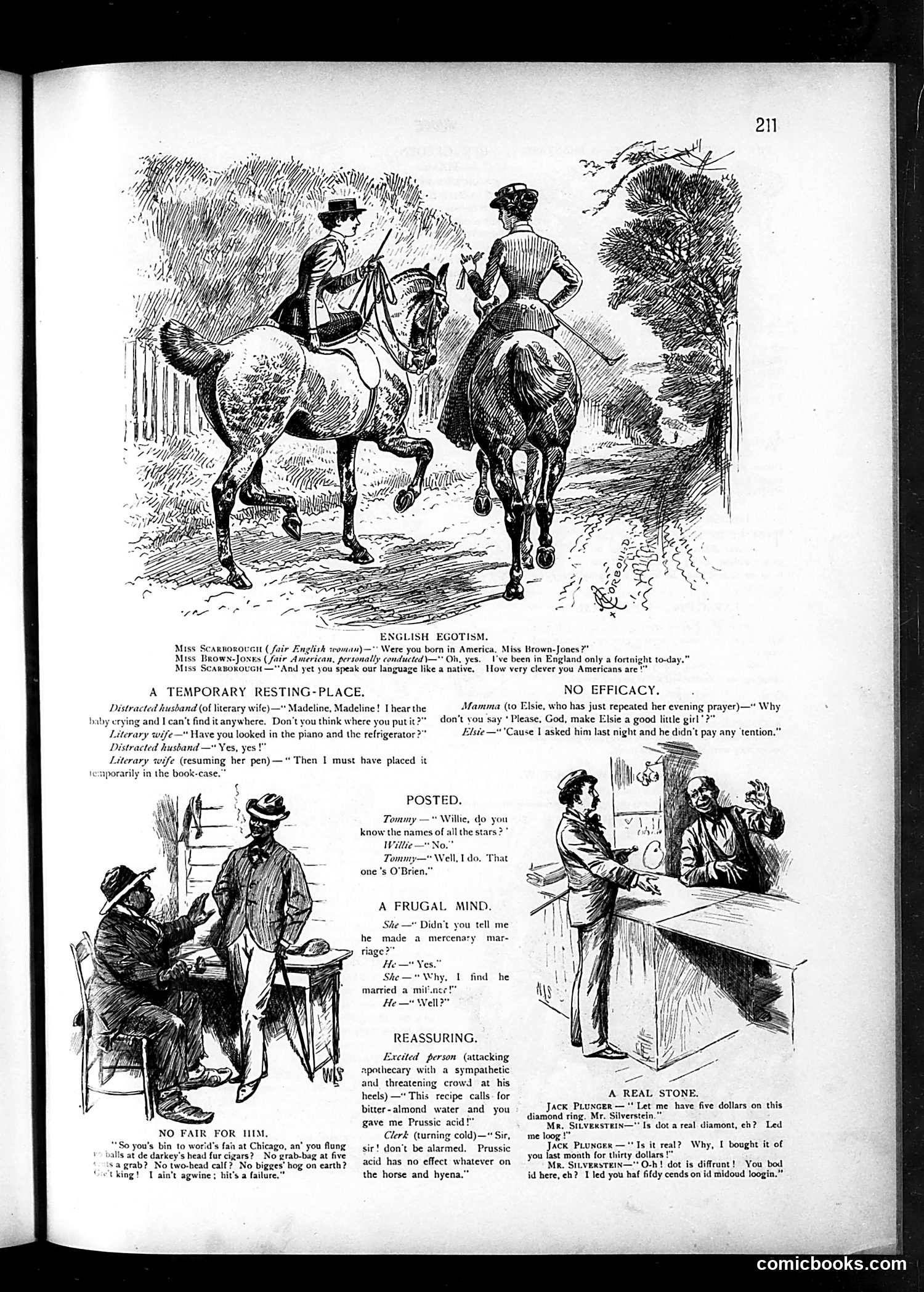
This page contains six brief satirical vignettes typical of *Judge* magazine's humor style. The top cartoon, "English Egotism," depicts American and English women on horseback, mocking English snobbery toward Americans. The remaining five sections are short dialogues satirizing everyday situations: a literary wife's absent-mindedness ("A Temporary Resting-Place"), a man's ignorance about stars ("Posted"), marital misunderstanding about mercenary motives ("A Frugal Mind"), a Prussian officer's failed attempt to intimidate ("No Fair for Him"), and a dispute over diamond authenticity ("A Real Stone"). These appear to be generic social humor targeting common domestic scenarios and national stereotypes rather than specific political events. The satire focuses on human folly, miscommunication, and class pretension rather than partisan politics.
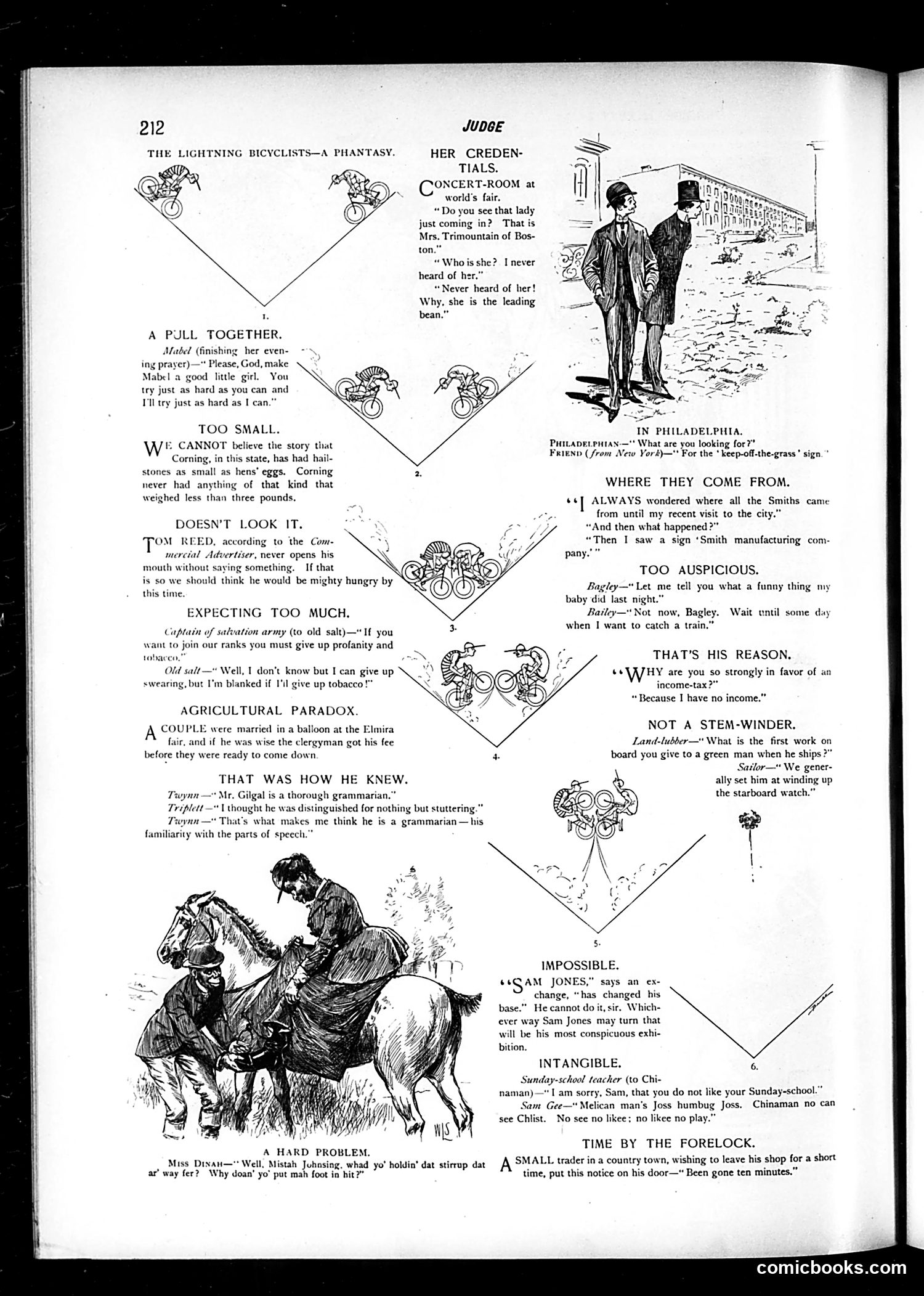
This page contains multiple short humorous pieces typical of Judge's satirical format: **The Lightning Bicyclists** (top): A visual joke about bicycle racing, showing cyclists in rapid succession—the "phantasy" being impossibly fast movement. **Social/Satirical Items:** - "Her Credentials": Mocks Boston society, where being a "leading bean" (eligible bachelor's date) passes for credentials - "A Pull Together": Child's prayer humorously negotiates effort with God - Regional humor about Corning's hailstones and Tom Reed's taciturn nature - Salvation Army recruitment joke about giving up vices - Grammar/stuttering wordplay - Racial stereotypes: a Black servant's dialect humor and a Chinese immigrant's broken English about Christianity **General Observations:** The page reflects 1880s-90s Judge humor: lightweight social satire, regional Americana, and unfortunately, period-typical ethnic stereotyping presented as comedy. The bicyclist "phantasy" likely references the bicycle craze's popularity during this era. Most jokes target pretension, hypocrisy, and human folly rather than specific political figures.
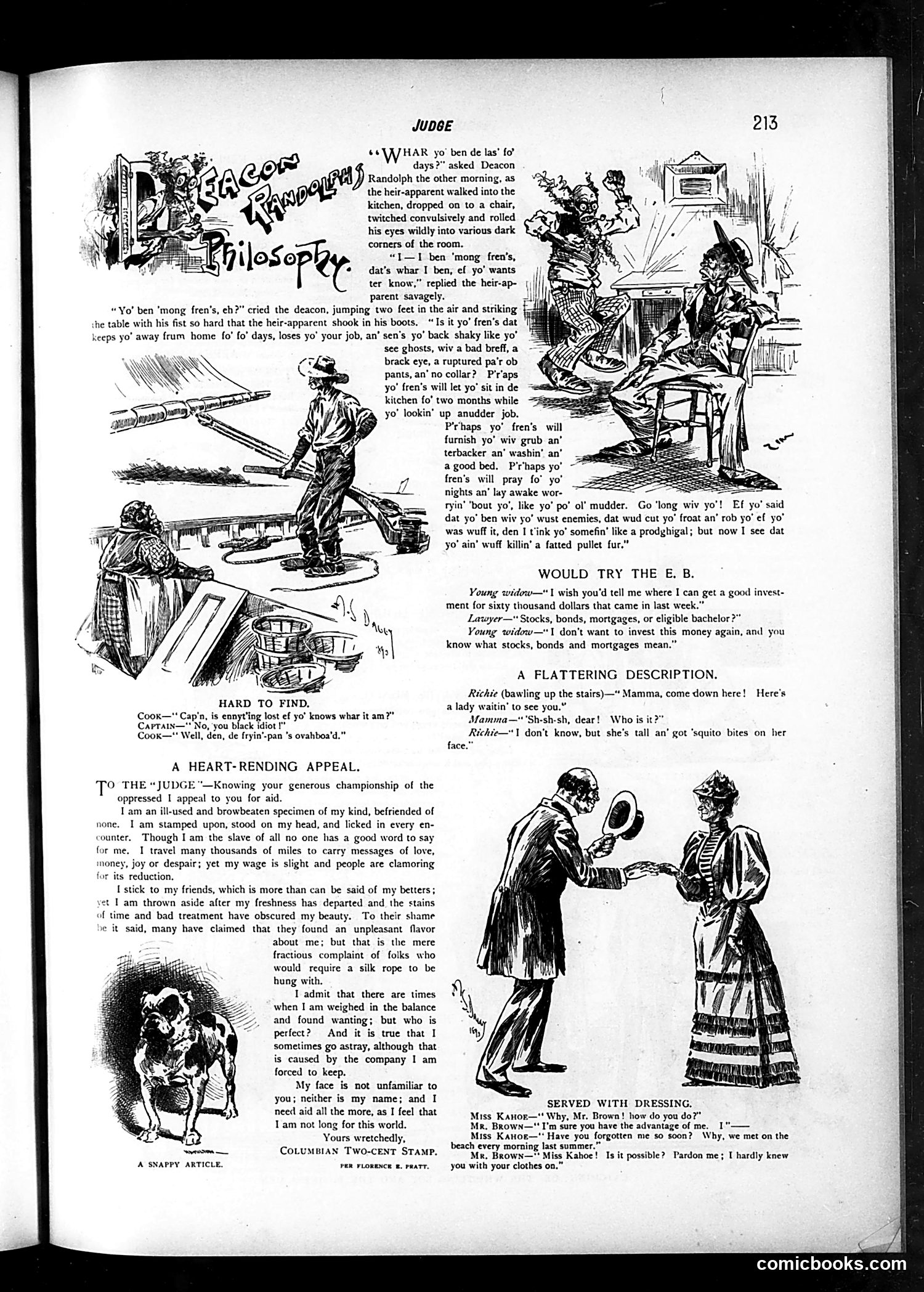
This page contains several satirical pieces typical of late 19th/early 20th-century American humor: **Main cartoon (top)**: A dialectal scene depicting an African American youth returning home disheveled after days away. His guardian, a deacon, interrogates him about his absence, implying the boy spent time gambling or fighting ("wurst enemies") rather than with legitimate friends. The satire mocks both the youth's poor excuses and the deacon's exasperated moralizing. **"Heart-Rending Appeal"**: A humorous personified letter from a two-cent postage stamp complaining about mistreatment—wear, staining, and being discarded after use. It's satirizing Victorian sentimentality by applying melodramatic rhetoric to an inanimate object. **Remaining pieces**: Brief joke sketches about financial advice, mistaken identity at social gatherings, and general absurdist humor. The page reflects period attitudes through heavy dialect representation and reflects common Judge magazine fare: working-class satire, gentle social mockery, and whimsical anthropomorphization.
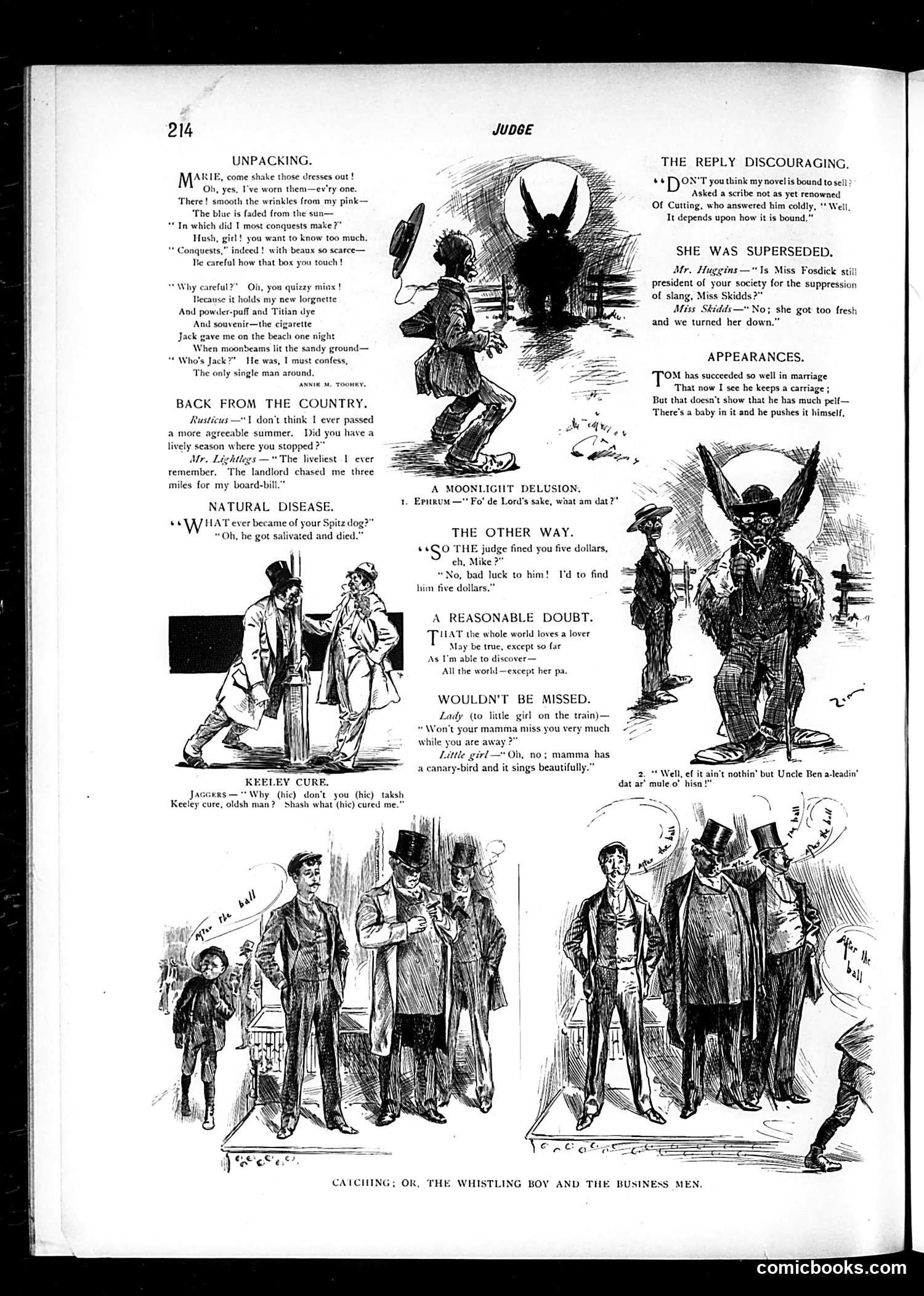
This page contains multiple unrelated short comic sketches typical of Judge magazine's format—each mocking social conventions and human folly of the late 19th/early 20th century. **Key sketches include:** - **"Unpacking"**: A woman lists her worn-out dresses, satirizing vanity and the gap between appearance and reality. - **"The Reply Discouraging"**: A publisher coldly dismisses an aspiring novelist's hopes, joking that success depends on literal book binding—mocking both literary pretension and publishing gatekeeping. - **"Natural Disease"**: A dog died from "salivation," likely referencing the Keeley Cure, a controversial alcoholism treatment involving mercury (which caused salivation as a side effect). - **"Appearances"**: Tom appears wealthy with a carriage but actually pushes his own baby—satirizing middle-class pretense. - **"Wouldn't Be Missed"**: Dark humor: a child won't miss her mother because a pet canary provides sufficient companionship. The overall tone mocks social climbing, failed ambitions, marital discontent, and the gap between pretense and reality.
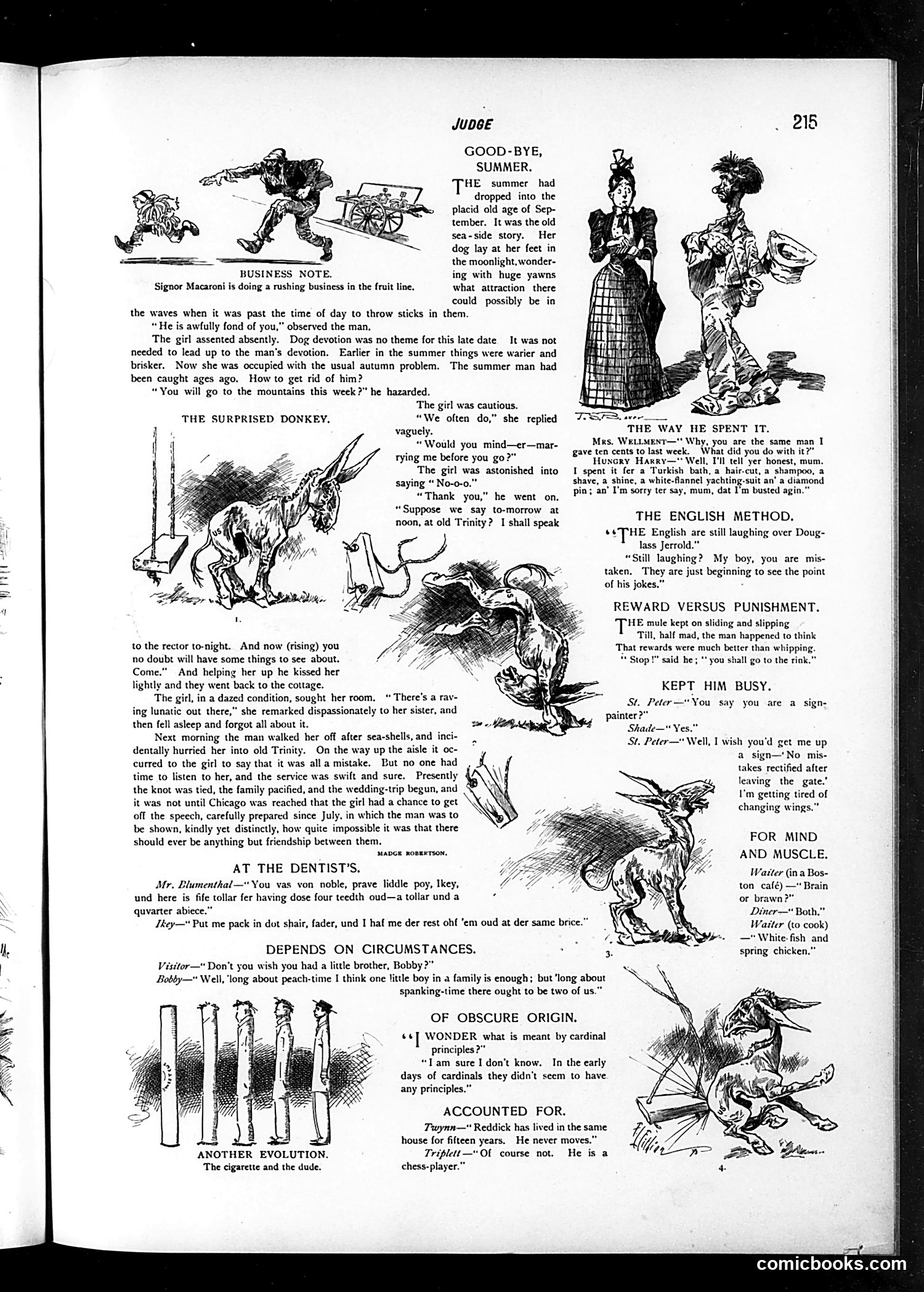
This page from *Judge* magazine contains several unrelated satirical vignettes typical of late 19th-century American humor: **"Good-Bye, Summer"** (main story): A romantic satire about a woman who accepts a marriage proposal from a persistent suitor, only to realize—too late, after the ceremony—that she never actually wanted to marry him. The joke captures period anxieties about courtship rituals and women's limited ability to refuse unwanted advances. **Minor sketches** include: "The Surprised Donkey" (unclear reference), "The Way He Spent It" (mocking working-class poverty), "The English Method" (Douglass Jerrold was a 19th-century humorist; the joke appears to reference delayed comedic timing), and various other one-liners about dentistry, signpainters, and food preferences. The cartoons are characteristic of *Judge*'s lighthearted, domestic humor rather than hard political satire. The page reflects Victorian anxieties about marriage, class, and gender relations.
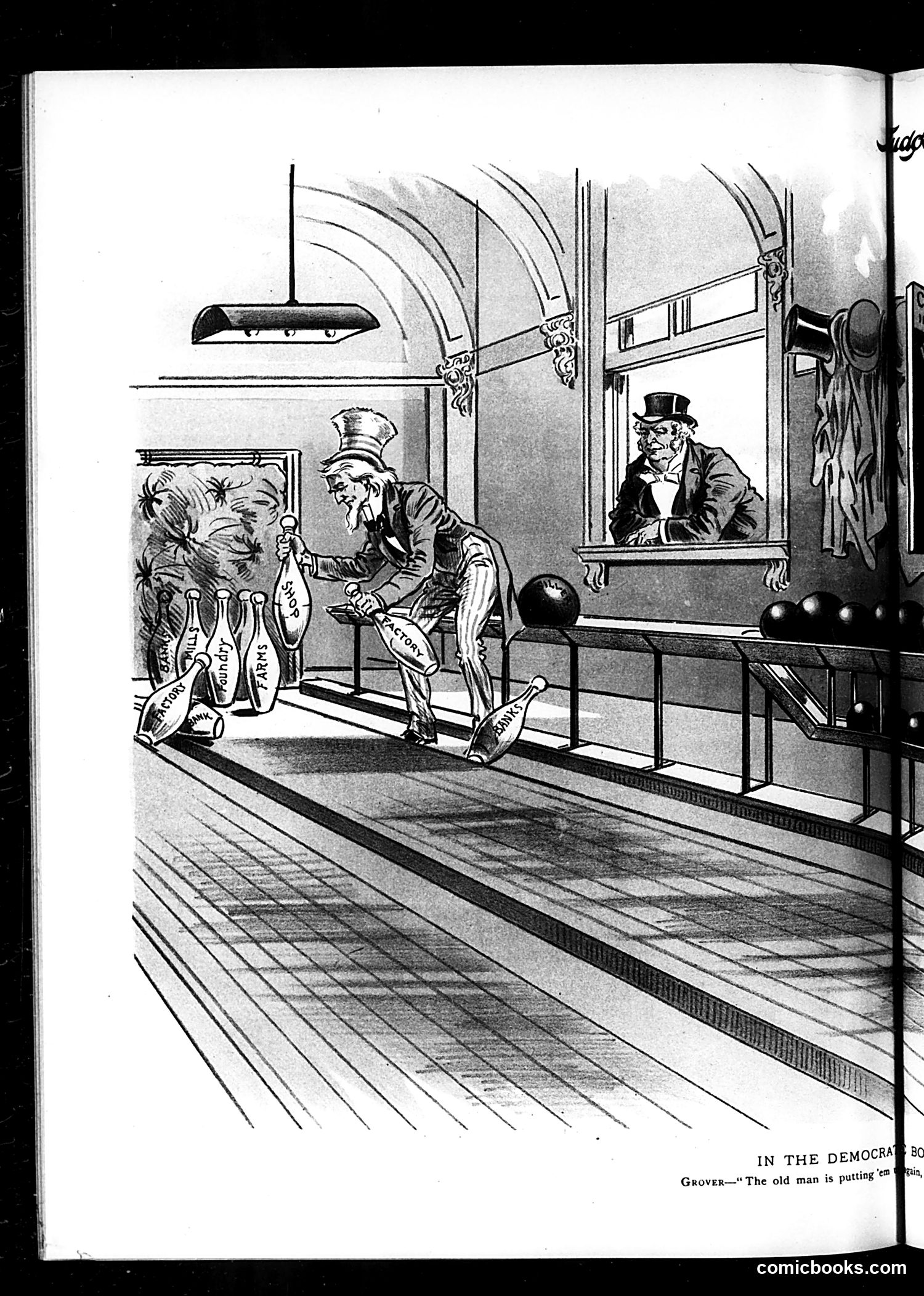
This appears to be a Judge magazine cartoon titled "In the Democratic [Club/Party]" featuring a character named Grover (likely referencing President Grover Cleveland). The scene depicts a bowling alley where Grover, dressed formally with a top hat, is bowling while another well-dressed man watches from a window above. The OCR text is fragmentary ("The old man is putting..."), making the specific satirical point unclear. However, the cartoon likely comments on Cleveland's political activities or leisure pursuits, using bowling as a metaphor for political maneuvering or strategy. The Democratic Party setting and the "old man" reference suggest commentary on Cleveland's leadership or aging relevance during his presidency or post-presidency period. Without the complete caption, the precise joke remains uncertain.
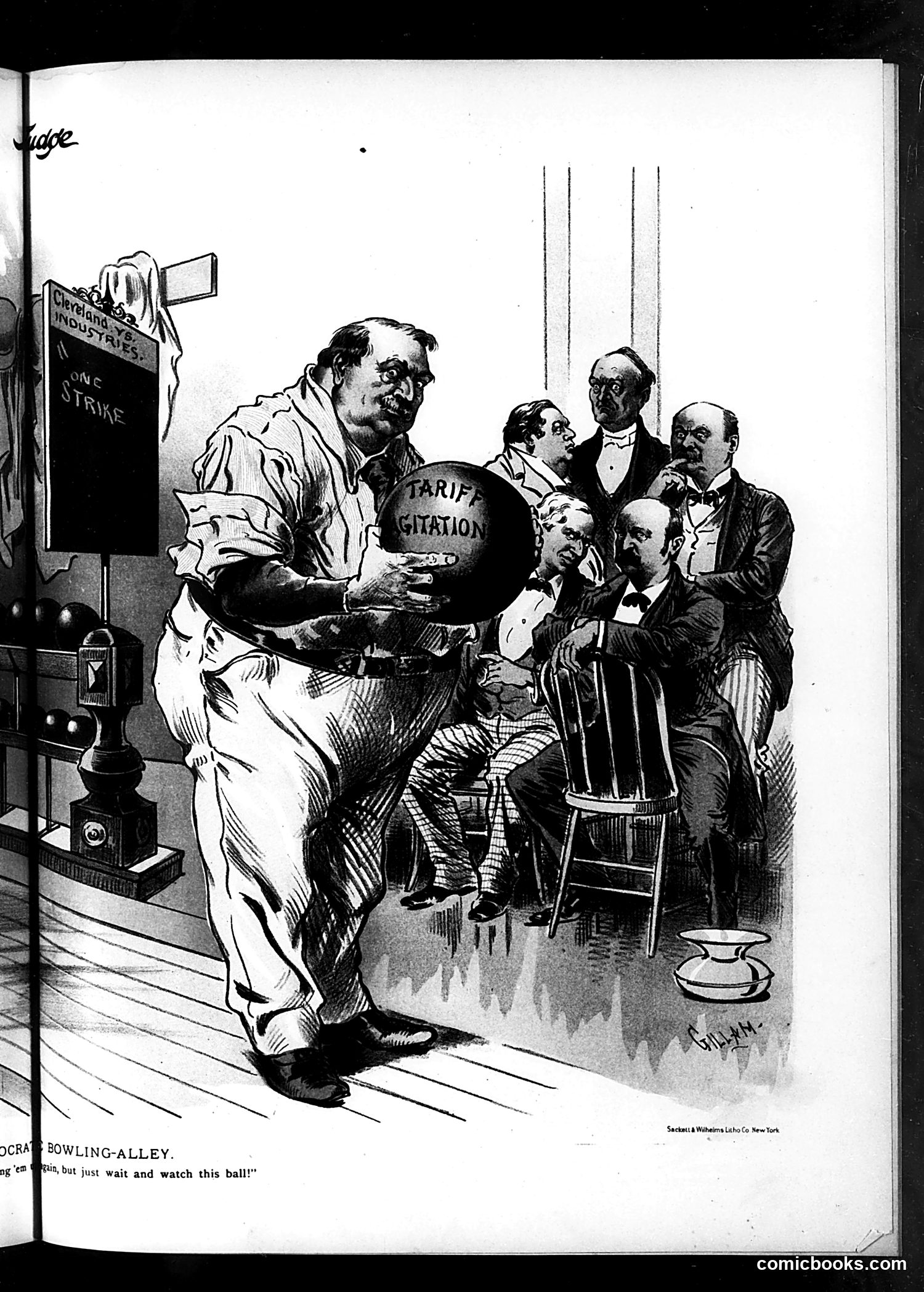
This Judge magazine cartoon satirizes Democratic Party politics using a bowling metaphor. A large bowler (appearing to represent a Democratic leader or the party itself) prepares to roll a ball labeled "TARIFF CITATION" down an alley marked "DEMOCRATIC BOWLING-ALLEY," while five well-dressed men (likely representing Democratic politicians or factions) watch nervously. The caption reads: "Just wait and watch this ball!" The satire mocks internal Democratic discord over tariff policy—a major political issue of the era. The cartoon suggests Democratic leaders are gambling recklessly with the "tariff citation" issue, risking party unity. The anxious onlookers represent different Democratic factions worried about where this policy "ball" will land and what damage it might cause to party cohesion.
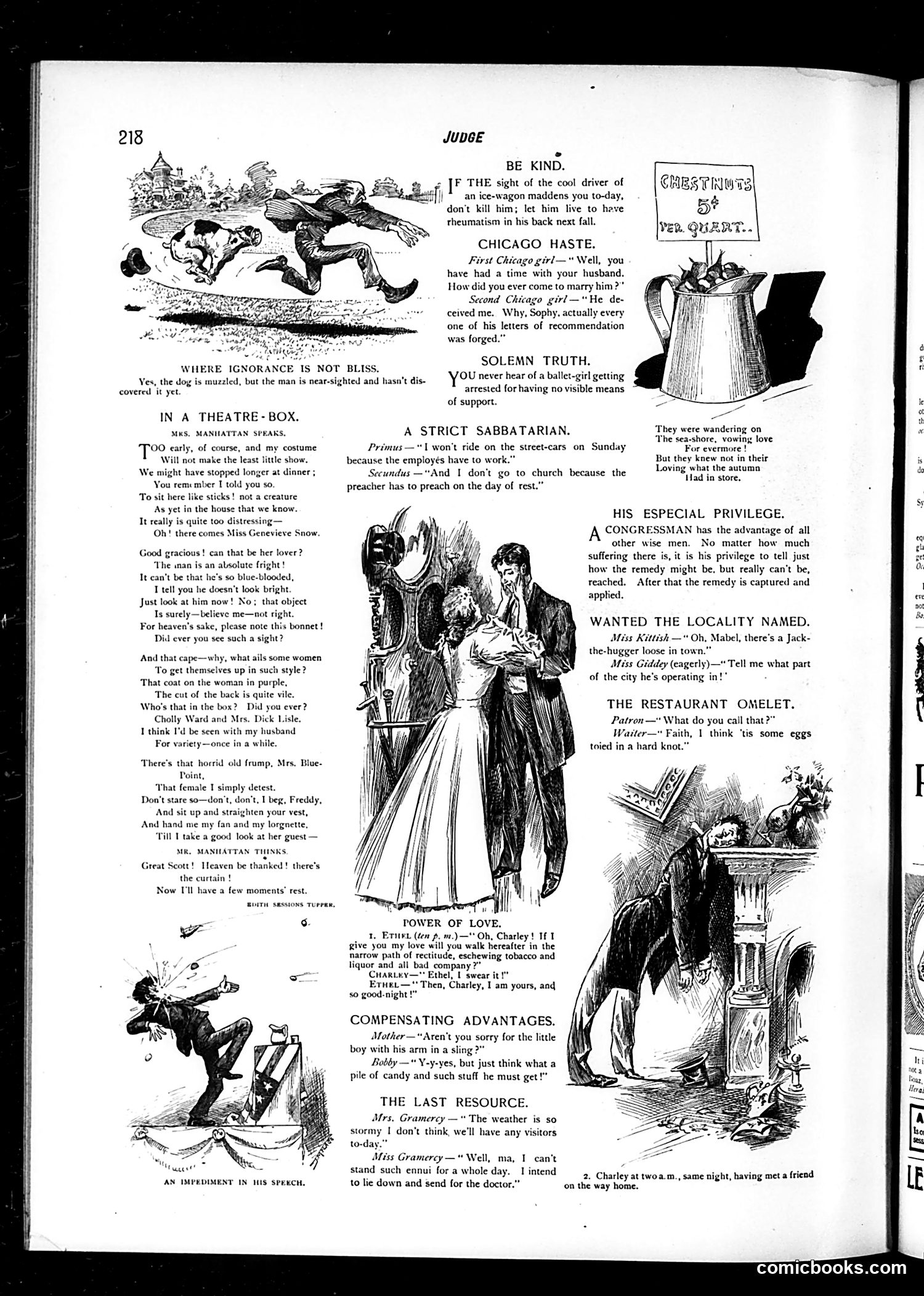
This page from *Judge* contains multiple brief satirical pieces mocking late-19th-century American social conventions and hypocrisy: **"Chicago Haste"** jokes about how quickly Chicago women marry based on forged letters of recommendation—satirizing both hasty marriages and deceptive courtship. **"A Strict Sabbatarian"** ridicules religious hypocrisy: a man won't ride streetcars on Sunday because workers labor, yet won't attend church because the preacher also works—exposing the logical absurdity of selective piety. **"His Especial Privilege"** mocks congressmen who claim inability to implement solutions they publicly advocate, suggesting politicians enjoy privileged irresponsibility. **"The Restaurant Omelet"** presents a waiter's deadpan description of poorly prepared eggs as "some eggs tied in a hard knot"—poking fun at restaurant pretense. **"Power of Love"** shows a woman extracting promises of reformation from a man through romantic manipulation. Throughout, the cartoons satirize vanity, hypocrisy, and social pretension among the urban middle and upper classes.
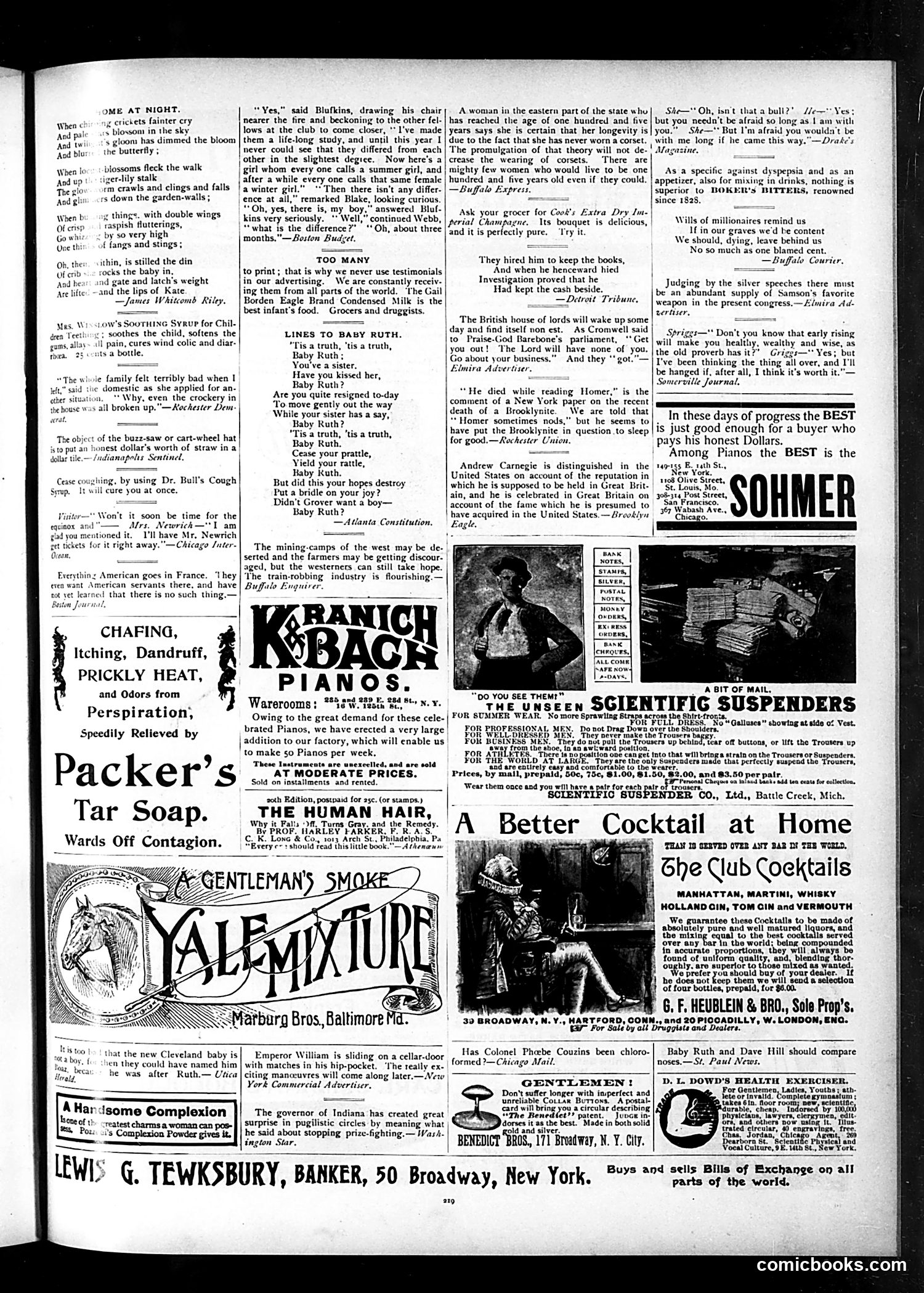
This page is primarily **advertisements and light humor pieces** rather than political cartoons. The content includes: **Main Elements:** - Short humorous anecdotes (a "summer girl" becomes a "winter girl" after three months; a visitor confused about the "equinox") - Product advertisements: Packer's Tar Soap, Branich & Bäck Pianos, Yale Mixture tobacco, Gail Borden condensed milk - Poems to "Baby Ruth" (likely referencing President Cleveland's newborn daughter, mentioned in text) - A brief joke about train-robbing being a "flourishing" industry in the American West **Social Context:** The "Baby Ruth" references reflect contemporary interest in President Grover Cleveland's private life. The Western train-robbery joke satirizes frontier lawlessness as an economic "industry." **Overall:** This is a typical late-19th-century magazine page mixing advertising revenue with light social commentary—nothing substantive in terms of political satire or caricature.
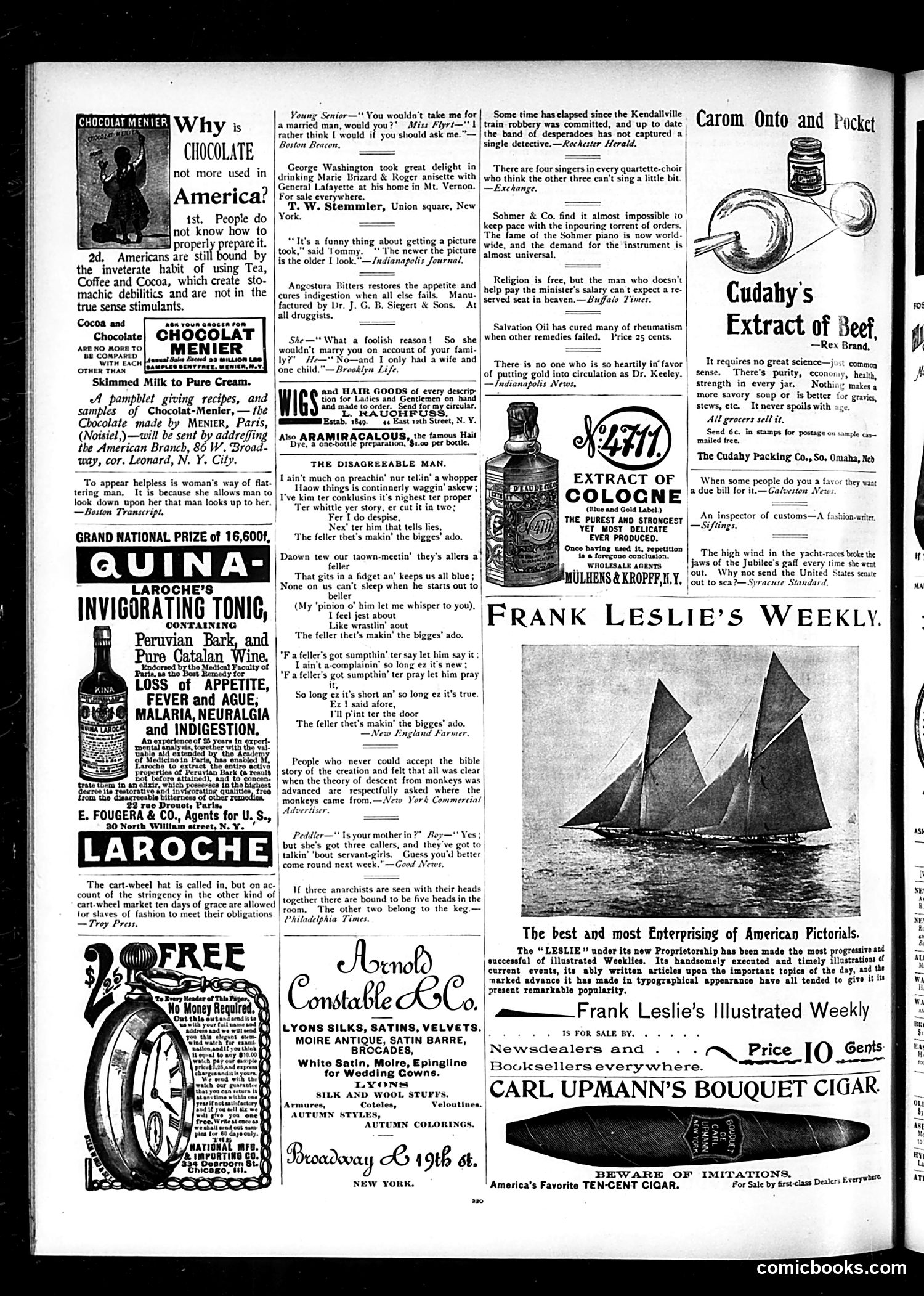
This page is primarily **advertisements and light humor pieces** rather than political satire. The main content includes: **"Why is Chocolate not more used in America?"** — A promotional article for Chocolat-Menier claiming Americans wrongly prefer tea and coffee, presenting chocolate as superior. **"The Disagreeable Man"** — A folk-style poem (attributed to New England Farmer) about an irritating person who complains constantly and makes unnecessary fuss, expressing the speaker's annoyance. **Social humor snippets** include observations on women's flattery tactics, fashion obligations, photography aging, and a joke about a man with an inconvenient wife. **The evolution/monkey reference** appears to mock evolutionary theory advocates by asking where monkeys originated — a common anti-Darwin jab from this era. The page is dominated by period patent medicines (Quina, Laroche's tonic, Angostura bitters) and luxury goods advertising. No significant political figures or events are referenced — it's primarily commercial content with mild, everyday social observations typical of Judge's lighter material.
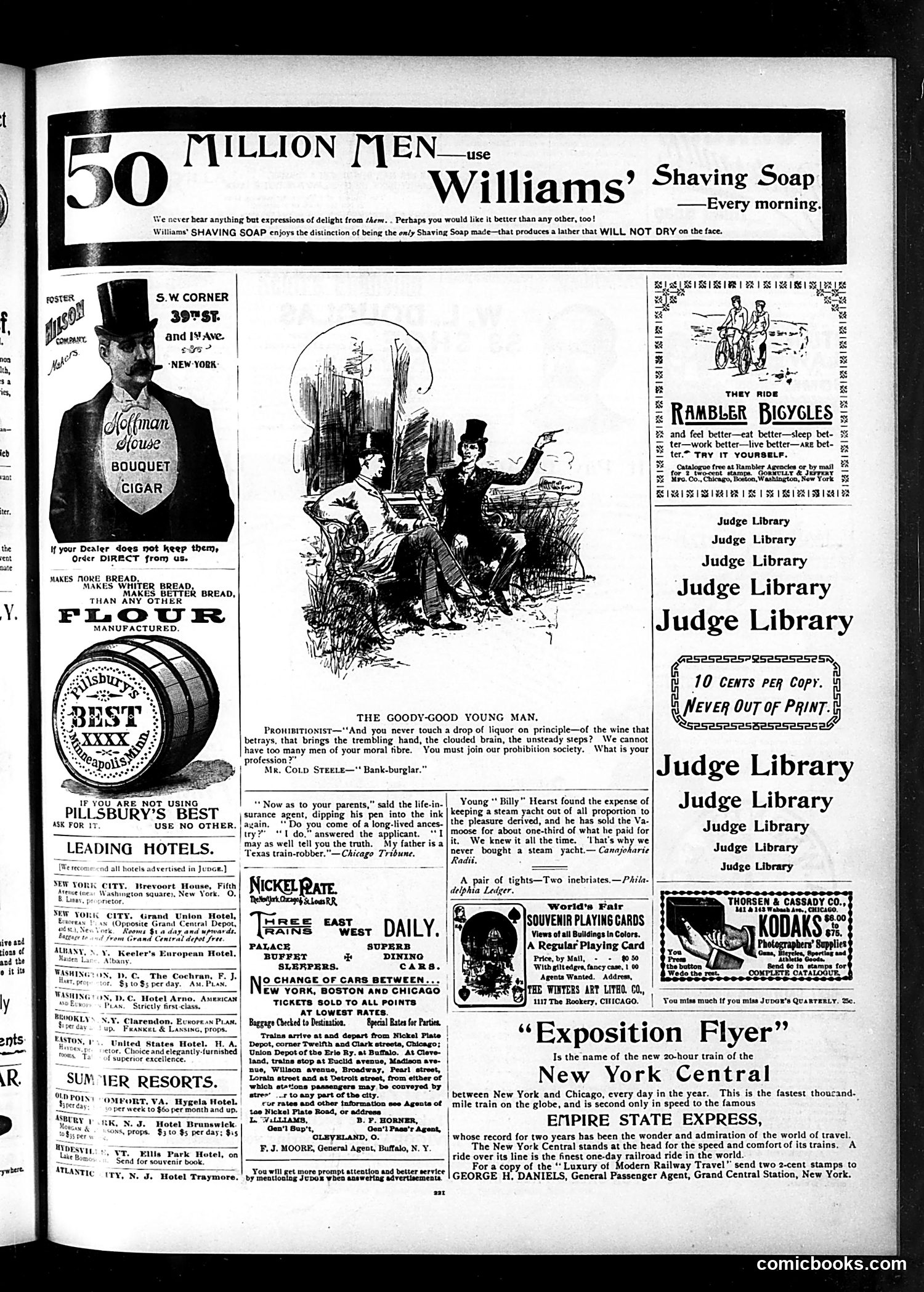
This page is primarily **advertising**, typical of Judge magazine's revenue model. The main cartoon, "The Goody-Good Young Man," satirizes **Prohibition hypocrisy**: a self-righteous temperance advocate who preaches against liquor's moral dangers is revealed to be a "bank-burglar"—suggesting that prohibitionists possess their own serious moral failings, making their sanctimony absurd. The cartoons and jokes scattered throughout are light social commentary: one mocks young William Randolph Hearst for financial excess (owning an expensive steam yacht); another makes a crude pun about "tights" (clothing) and drunks. The bulk of the page comprises advertisements for shaving soap, flour, bicycles, hotels, railroads, and playing cards—the economic foundation of Judge's operations. These ads reflect early-1900s consumer products and leisure activities (bicycles, rail travel, resorts). The page reflects turn-of-the-century American anxieties about morality, wealth, and social status.
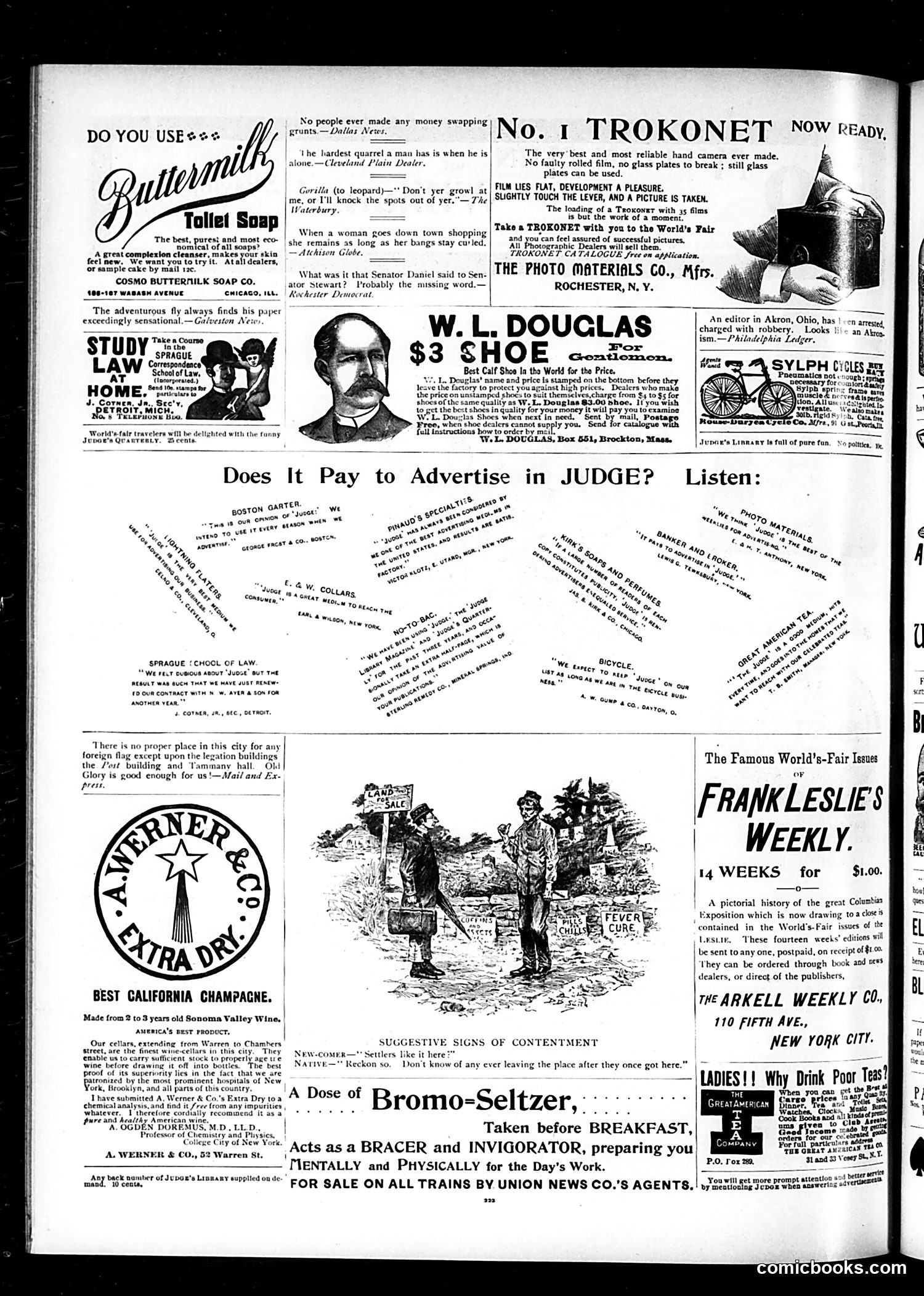
This is primarily an **advertising page** from Judge magazine, featuring product promotions interspersed with brief humorous quotations and jokes typical of the era. The small cartoons and quips are light social commentary rather than political satire: a gorilla threatening a leopard with violence; an editor arrested for robbery in Ohio; observations about shopping women and marital quarrels. These reflect late-Victorian/Edwardian preoccupations rather than substantive social critique. The page showcases period products—Buttermilk Soap, W.L. Douglas shoes ($3, emphasizing value), the Trokonet camera, Bromo-Seltzer, and champagne. The repeated testimonial "Does It Pay to Advertise in JUDGE?" suggests advertisers valued the magazine's reach. Notable: one quotation references "Senator Daniel" and "Senator Stewart" without context, suggesting readers would recognize contemporary political figures. The tone throughout is genteel and commercial rather than satirically biting.
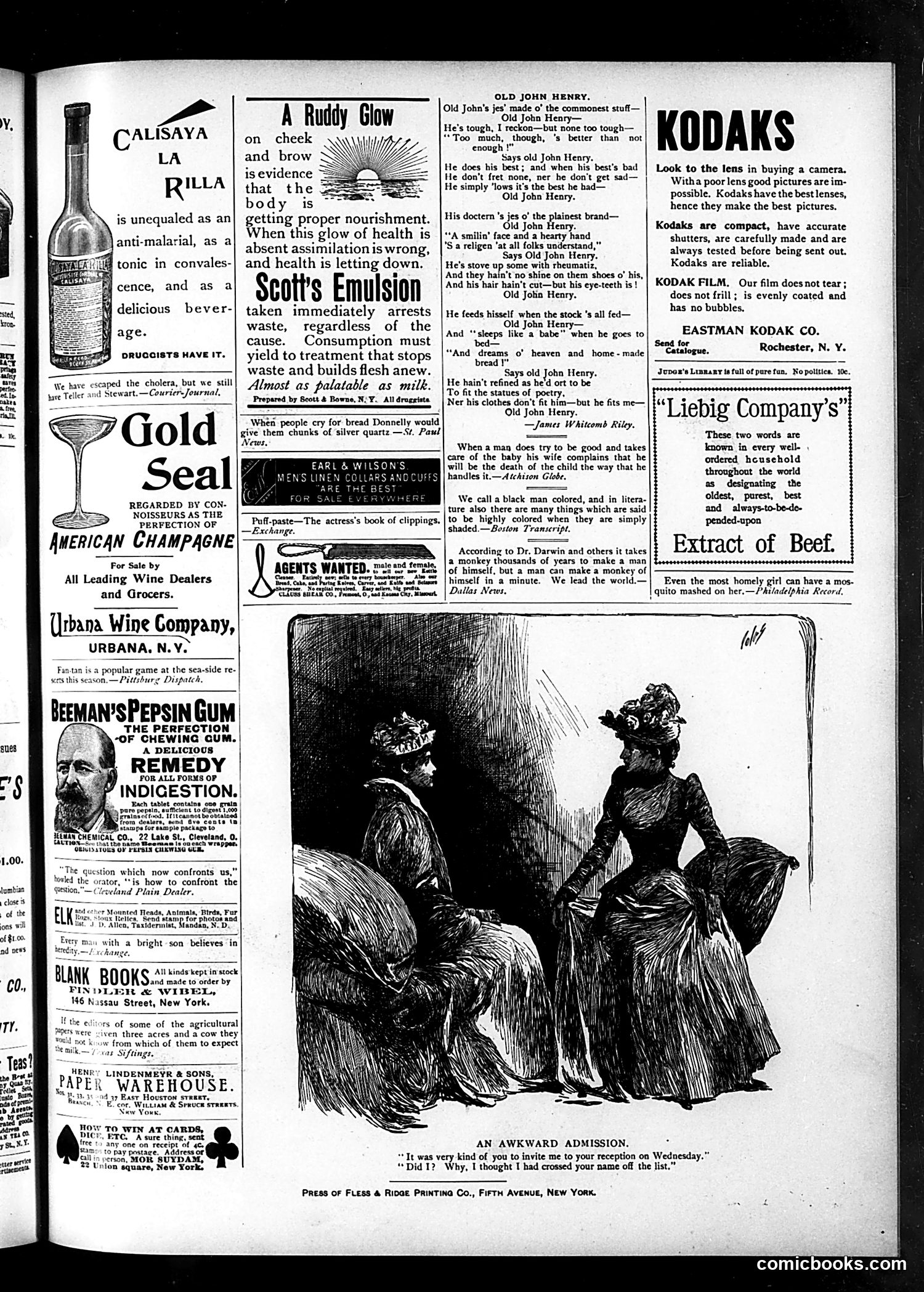
This page is primarily **advertisements and literary content** rather than political satire. The main visual element is a sketch titled "An Awkward Admission" showing two Victorian-era women in an embarrassing social situation—one apologizing for inviting the other to a reception, apparently forgetting she'd already crossed the guest off her list. The page features: - **Product advertisements**: Scott's Emulsion (health tonic), Kodak cameras, Gold Seal champagne, and various other remedies and goods typical of the era - **"Old John Henry"**: A poem by James Whitcomb Riley celebrating an unpretentious, hardworking common man with practical virtues—a nostalgic celebration of American working-class authenticity - **Brief satirical snippets**: Short quips about social hypocrisy (mothers complaining about fathers caring for babies) and linguistic absurdities ("colored" vs. "shaded") The page reflects late 19th-century preoccupations with health remedies, emerging consumer goods, and sentimental Americana, rather than pointed political commentary.
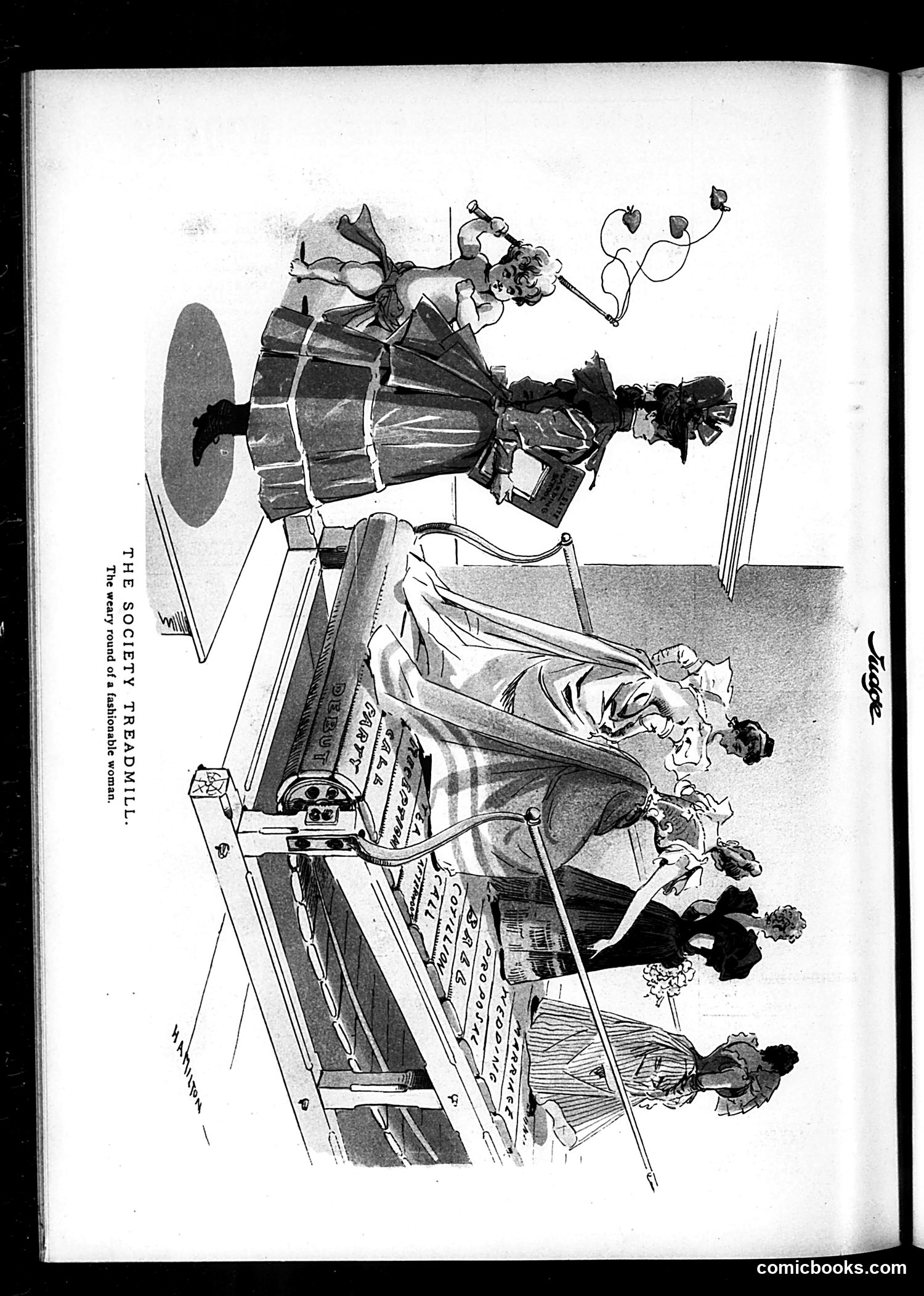
This cartoon satirizes the exhausting social obligations of wealthy, fashionable women. The image shows a woman literally on a treadmill-like device, cycling through various fashionable activities: attending formal dinners, social calls, theater outings, and other high-society events. The mechanical repetition emphasizes how monotonous and involuntary these obligations feel. The caption "The weary round of a fashionable woman" mocks the constraint of upper-class social expectations. Despite their privileged status, society women are depicted as trapped in endless, meaningless rituals—prisoners of fashion and etiquette rather than genuinely free. The Judge magazine is criticizing both the artificiality of high society and the limited autonomy these women possessed, even when wealthy.